Int. J. Electrochem. Sci., 10 (2015) 7073 - 7082
International Journal of
ELECTROCHEMICAL
SCIENCE
www.electrochemsci.org
Determination of the Efficiency of Cathodic Protection Applied
to Alternative Concrete Subjected to Carbonation and Chloride
Attack.
W. Aperador1,3,*, J. Bautista-Ruiz2, K. Chunga3
1
School of Engineering, Universidad Militar Nueva Granada, Bogotá-Colombia
2
Universidad Francisco de Paula Santander, San José de Cúcuta, Colombia
3
Universidad de Guayaquil, Facultad de Ciencias Matemáticas y Físicas, Guayaquil, Ecuador.
*
E-mail: [email protected]
Received: 16 June 2015 / Accepted: 14 July 2015 / Published: 28 July 2015
In this paper we study the electrochemical response by techniques corrosion potential, linear polarization resistance and electrochemical impedance spectroscopy, to the mortars obtained with steel slag activated with sodium silicate, were subjected initially exposed to the accelerated carbonation and then immersed in NaCl solution to study the influence of carbonation on penetration of chloride ion, mixing these two corrosive phenomena of the same material. Afterwards the entry of each of the corrosive phenomena that occur in the steel, cathodic protection systems are used to protect steel. The efficiency of cathodic protection was determined; and it concludes that it is a rehabilitation technique able to stop corrosion in concrete structures carbonated alternatives and contaminated with chlorides, with a high degree of degradation in the structure.
Keywords: cathodic protection, corrosion, carbonation, chloride ion, steel slag.
1. INTRODUCTION
The usual aggressive environments consist of air, water and contaminated soils in contact with concrete structures where the main aggressive agents are chloride ions in offshore regions and carbon dioxide in rural and industrial areas (carbonation) [7-8].
Carbonation of concrete results from the reaction of the hydrated cement components with atmospheric CO2 [9-10]. In consequence of this reaction, the pH of the pore solution of the concrete is
reduced 12 to 8, developed a uniform corrosion in the steel reinforcement. When the corrosion process has begun, the oxide formed occupies a volume much larger than the reinforcing steel in a passive state [11-13].
A report of Standards of the United States, estimated that corrosion costs are in the order of 4% of GNP and that this influence in the anti-corrosive measures assumed [14-15]. The study establishes the total cost of metallic corrosion at US $ 276 billion-equivalent to 3.6% of GDP, but emphasizes that savings of up to 25-30% could be achieved using modern practices for corrosion control [16 -17].
The structures have a lifetime of service, which is expected to do no more than routine maintenance to adequately provide the function for which they were designed, however, there are structures that are not defined they lifetime of service [18], aim to make them resistant to static and dynamic loads but regardless the attack that will be exposed; over time, these can exhibit premature deterioration due to corrosion to be able to passivate the steel embedded in the concrete, resulting in corrosion rates can pose serious damage within a few years [19-20].
When damages affect a significant part of the structure, the conventional repair method involves removal of carbonated or chloride contaminated concrete around the steel, they clean around its perimeter, the replacement of the concrete affected and frequently applying some protection to avoid further repair [21-22].
The high cost of corrosion in reinforced concrete structures have aroused unusual interest in electrochemical methods of rehabilitation: cathodic protection (CP), the electrochemical realkalisation and electrochemical extraction of chlorides [23-24]; to be more economical and more respectful with the environment and health of the workers than traditional repair methods [25]. The CP, the oldest of electrochemical methods of rehabilitation, to various commercial systems have been applied in practice, as well as the amazing diversity of criteria to assess their effectiveness [26-27].
This research presents the evaluation of the effectiveness of cathodic protection applied to the steel embedded in using steel slag as an alternative concrete, previously exposed to reinforcement corrosion phenomena caused by carbonation and chloride penetration.
2. EXPERIMENTAL DETAILS
For making mortar specimens was the selection of materials and working conditions, based on the results of mechanical properties obtained in preliminary studies for the steel blast furnace slag activated with "Sodium Silicate" (Na2SiO3) at a concentration of 5% Na2O expressed as a percentage
by weight, to incorporate slag, with a SiO2 / Na2O ratio of 2.4. The manufacture of concrete mixtures
The type, composition, aggregate size corresponded to an arena with specific surface area of 2.47 g /cm3, compact unit mass of 1.67 kg/cm3, loose unit weight of 1.58 kg /cm3, absorption of 2.9%. Mortar samples were cured under ambient humidity conditions (~ 65%) at room temperature (~ 25 ° C) during the first 24 h. Subsequently, the cylinders were demolded and cured in a moist chamber at a relative humidity (RH)> 90% and a temperature of 27 ± 2 ° C.
For electrochemical measurements one galvanostat potentiostat was used the experimental setup is comprised of a cell containing a counter stainless steel (AISI 304 SS), a reference electrode Cu/CuSO4 and as working electrode was used structural steel AISI 1020, the same setup was used to
apply a cathodic protection where the impressed current applied to the counter electrode (AISI 304 SS) in each case was 55 * 10-6 A cm-2.
The measurement of open circuit potential it was held at a time of 1200 seconds until it reached the stabilization. The measures for mortar activated slag were performed in a period of 7 days, after subjecting the samples to a process of accelerated carbonation 100%, and other exposed to carbonation in laboratory conditions. Measures open circuit potential were made considering the ASTM C876 standard, this standard corrosion indicates the probability function of corrosion potential for the purpose of diagnosing the probability found. The technique of linear polarization resistance is a potential sweep from -25mV to + 25mV with respect to open circuit potential at a rate of 0.1mV/s. The resulting current, the product variation of the potential is linearly plotted against the potential; the value found by this technique is the polarization resistance. The interpretation is basically empirical, and there is a relation to possible corrosion rates generated. The technique of electrochemical impedance spectroscopy was used to apply a sinusoidal signal of 10mV; a scanning at different frequencies between 10 kHz to 0.1MHz. The equivalent circuits modelling was performed using the program Echem analyst.
To study the effect of carbonation in mortars, then the curing process, the specimens free of moisture and water between the pores were introduced in a chamber at controlled conditions. The selected samples to simulate aggressive environments were carbonated in a chamber with 65% relative humidity and 20 ° C, in contact with a stream of CO2 to 3% by volume. Other series of test pieces were exposed to ambient conditions, for the purpose of comparing the effect of carbonation.
Other purpose of the study was to analyze the effect of chloride ions on the corrosion of reinforcing steel, then the carbonation process. About specimens, overexposure to chlorides was made. The specimens were placed in immersion in a saturated with 3.5% of sodium analytical chloride (Panreac PA131655.1211 NaCl-99.0%), was subsequently applied cathodic protection.
3. RESULTS
3.1 Half-Cell Potential
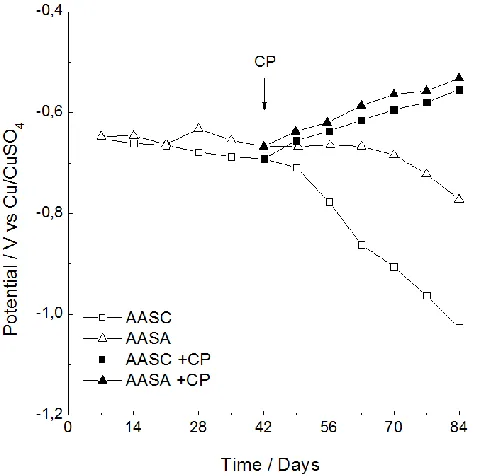
mortars subjected to accelerated carbonation (AASC) without carbonation (AASA), both the solution subjected to the presence of chloride ion, resulting in low corrosion potential values indicating that all systems are analysed in a greater chance of corrosion, AASC trend mortar subjected to a bleach solution; exhibits reduced corrosion potential in each of the levels evaluated, the decline is gradual, a similar behaviour is presented by the AASA chlorine, because its trend is going to decline in each of the levels evaluated, however within 28 days of this behaviour changes, which may be due to clogging of pores prevents the entry of aggressive ions, After 28 days a further decrease in this parameter is observed, returning to the original trend, these values are very close so that a difference is observed between these two systems [29-30]. The cause of this behaviour is due to the AAS only based mortars have an increased susceptibility to carbonation, because alkali activation proceeds via formation of secondary phases such as Na2O·CaO·SiO2·H2O heterogeneous reaction that contribute to lowering the
pH. As for the cathodic protection exhibited potentials were observed up to 42 days evaluation, due the trend was to decrease the potential, protection voltage applied to corresponding protection -850 mV relative to the reference electrode Cu/CuSO4 saturated, and such value is taken as a criterion for
protection. Monitoring the potential of the structure was performed weekly periods. In each of the evaluations, it was determined that the value used as a criterion, generate adequate protection, because the potential in both structures and AASA AASC indicate an increased potential, achieving values with a tendency toward passive region [31].
Figure 1. Potential corrosion, for mortars with and without exposure to chloride and subsequent application of cathodic protection.
3.2. Linear Polarization Resistance
[image:4.596.177.416.394.632.2]
each system, based solely on the criterion of polarization resistance. This can relate, by Ohm's equation, found in an electrical circuit. Thus, if the corrosion potential remains constant, we can infer that low resistances allow passage of larger amounts of current and in a manner contrary. If we relate this with the loss of metal species, we can infer that low polarization resistance (Rp) they correspond to high values of corrosion rate [32].
The concentration of chloride and carbonation depth can be measured; however, it is difficult to predict the onset of corrosion. The corrosion rate measurement is performed using linearly polarized instruments and empirical estimates (B). So in this case, the corrosion current is calculated, for reinforcing steel mortar we have:
p corr
R B E
i B
i
In the case of the mortar-steel interface is taken B = 52mV in active condition, using the method indicated in the corrosion potential measurement. Depending on the value of the corrosion current it determined the condition the steel using the following criteria: when the value of Icorr <0.1 µA/cm2
indicates this is in a passive condition for Icorr 0.1 to 0.5 µA/cm2, is low-moderate corrosion; for Icorr 0.5 to 1 µA/cm2
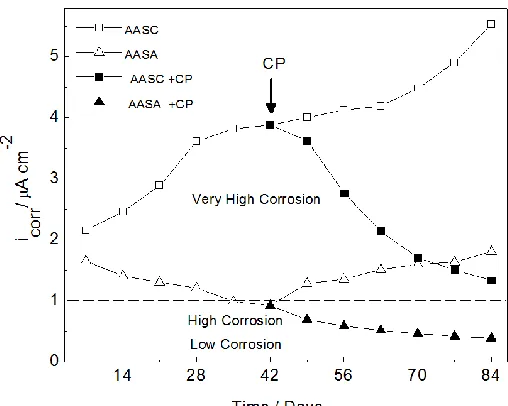
moderately high corrosion and Icorr> 1 µA/cm2 high corrosion rates [33]. In Figure 2 the mortar compared to different test environments it can be seen that the electrochemical conditions vary considerably. This would support the assumption that each system has its own protective characteristics or activity-passivity also be performed a first approximate explanation of the phenomenon in each case.
For systems in which the contact environment consisted environment without carbonation, they are lower than those with pre-treatment of carbonation and in contact with chlorides. Thus, it appears that the polarization resistance of steel, which is in the AASA system, is the highest of all, therefore offers improved passivity. It also indicated that slopes with large values correspond to the polarization resistance (Rp) and higher protective conditions overall better metal protective conditions [34].
Figure 2. Response of corrosion resistance of concrete AASA and AASC, played by the values of the corrosion current.
3.3. Electrochemical Impedance Spectroscopy
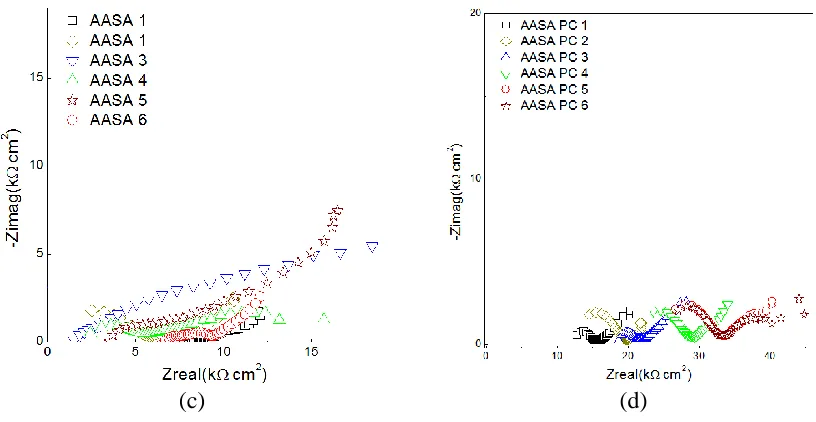
In figures 3 (a, b, c) Nyquist curves, where the study three interfaces are presented, they can be determined with both the behaviour of systems components (resistors and constant phase elements) of each of them, and system values or whole cell (Rp, equivalent circuit). Thus, the assay can be analysed from various points of view, providing complementary information system studied, in this specific case the mortar-steel reinforcement system [36].
Observing in detail Nyquist diagrams, it can be inferred that the electrochemical behaviour of the system changes for each type of environment subject (Fig. 3a and 3c). The frequency curve with phase angle has a much wider in the area AASA capacitive system, a phase change also occurs at low frequencies undetected in, AASC system. The above could is an indication which the corrosive phenomenon is different in each system.
[image:6.596.171.425.70.273.2]
(c) (d)
Figure 3. Nyquist diagrams of AAS systems subjected to processes with and without the presence of carbonation, then exposed to chloride penetration. a) AASC subjected to chloride, b) AASC with cathodic protection, c) AASA exposed to chloride, d) AASA cathodic protection applied.
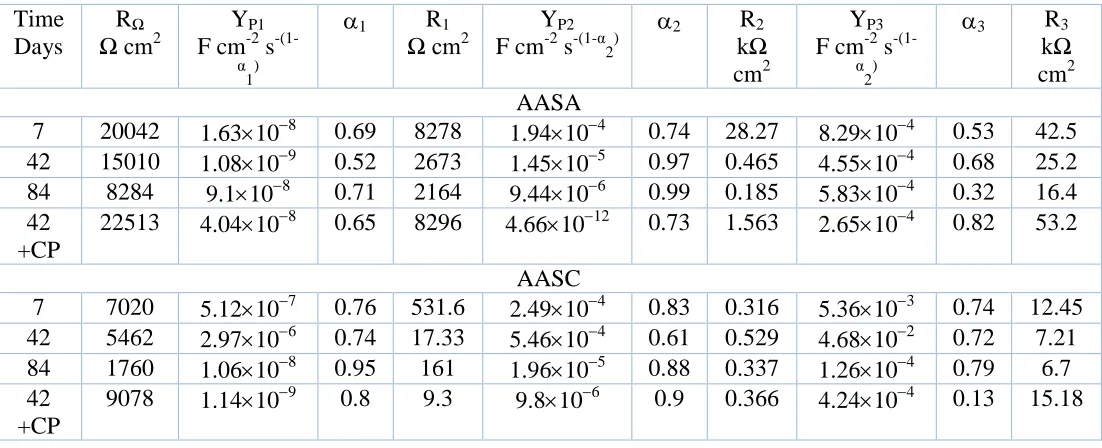
[image:7.596.92.500.70.281.2]To make an adjustment of each of the Nyquist diagrams; during the entire study could be observed that the mechanism of corrosion is similar with and without application of impressed current because it was not modified equivalent circuit used for mathematical adjustments, both of the same elements within the model used (Figure 4) are presented, but they changed their magnitudes, depending on the electrochemical condition (activity-passivity) to which (Table 1) it was, it was possible to observe how the data derived from equivalent circuit modelling had a very similar behaviour to those obtained experimentally for the specimens, as an indication that the model explained with good approximation the corrosive phenomenon in the system. The atmosphere in contact also had influence only in the magnitude of the elements, they formed the equivalent circuit and not a new circuit is generated in each situation. Thus, in the analysis a unique electrochemical model for each specific to different aggressive conditions was applied [37].
Figure 4. Equivalent circuit for fitting the mortar AAS analysed with and without cathodic protection systems.
[image:7.596.164.436.566.652.2]
variability at baseline under conditions no cathodic protection they have no similarity values as shown in Figures 3 and is confirmed in Table 1. After the end of carbonation, the data of polarization resistance obtained are very low, indicating an elevated corrosion rate, further it shows that during the test the magnitude of resistance polarization have magnitudes that are located in nearby ranges, however at no time is the same value of polarization resistance [38].
[image:8.596.24.575.328.552.2]The values of the electrochemical components after applying cathodic protection determines passivity for systems that were not exposed to accelerated carbonation (Fig. 3d), the values of polarization resistance of the steel obtained by using different techniques showed similarity in their magnitude and trend over time. The performance of the mortars previously exposed to accelerated carbonation and chloride ions, and subsequently shown cathodic protection, an active corrosion (Fig. 3d) again giving the indication that these systems are less stable than those not exposed.
Table 1. Values corresponding electrochemical parameters of the AAS mortars exposed to conditions of carbonation and chloride ion, later the application of cathodic protection.
Time Days
RΩ
Ω cm2 YP1
F cm-2 s
-(1-α 1)
1 R1
Ω cm2 YP2
F cm-2 s-(1-α2)
2 R2
kΩ cm2
YP3
F cm-2 s
-(1-α 2)
3 R3
kΩ cm2 AASA
7 20042 1.63108 0.69 8278 1.94104 0.74 28.27 8.29104 0.53 42.5 42 15010 1.08109 0.52 2673 1.45105 0.97 0.465 4.55104 0.68 25.2 84 8284 9.1108 0.71 2164 9.44106 0.99 0.185 5.83104 0.32 16.4 42
+CP
22513 4.04108 0.65 8296 4.661012 0.73 1.563 2.65104 0.82 53.2 AASC
7 7020 5.12107 0.76 531.6 2.49104 0.83 0.316 5.36103 0.74 12.45 42 5462 2.97106 0.74 17.33 5.46104 0.61 0.529 4.68102 0.72 7.21 84 1760 1.06108 0.95 161 1.96105 0.88 0.337 1.26104 0.79 6.7 42
+CP
9078 1.14109 0.8 9.3 9.8106 0.9 0.366 4.24104 0.13 15.18
3.4. Efficiency of Cathodic Protection
Figure 5. Calculation of the efficiency of the cathodic protection of concrete AASC and AASA. 4. CONCLUSIONS
AAS concrete subjected to the most aggressive conditions of the study (accelerated carbonation) did not have the ability to form passive layers to delay the phenomenon of degradation of the metal. This is because the granulated blast furnace slag is chemically reactive and hydration products generated slag mortar porosity accelerating the passage of carbon dioxide and chloride ions aggressive agents from permeate the system and come to destabilize the passive layer of steel. However in specific that were exposed to carbonation and then chloride ions protection is reduced due to the passivation of steel therefore evaluation times to short current protection they are minimal,
The efficiency of cathodic protection it is generated because in the tested structures contain an appreciable amount of chloride ion. However in specific that were exposed to carbonation and then chloride ions protection is reduced due to the passivation of steel therefore evaluation times to short current protection they are minimal, the risk of corrosion is practically high due to action of chloride penetration and carbonation accelerates
ACKNOWLEDGEMENTS
This research was supported by "Vicerrectoría de investigaciones de la Universidad Militar Nueva Granada" under contract ING 1572. Project Prometeo of the Secretaría de Educación Superior, Ciencia, Tecnología e Innovación of the Republic of Ecuador.
References
1. P. Ghods, O.B. Isgor, G. McRae, T. Miller, Cem. Concr. Compos, 31 (2009) 2 2. N. Etteyeb, L. Dhouibi, H. Takenouti, E. Triki, Cem. Concr. Compos, 55, (2015) 241 3. C. Q. Ye, R. G. Hu, S. G. Dong, X. J. Zhang, R. Q. Hou, R. G. Du, C. J. Lin, J. S. Pan, J.
Electroanal. Chem, 688 (2013) 275
4. L. Yohai, M. Vázquez, M.B. Valcarce, Electrochim. Acta, 102 (2013) 88 5. G. Roventi, T. Bellezze, G. Giuliani, C. Conti, Cem. Concr. Res., 65 (2014) 76
[image:9.596.205.391.86.279.2]
7. L. Yohai, M. Vázquez, M.B. Valcarce, Electrochim. Acta, 102 (2013) 88
8. C.Q. Ye, R. G. Hu, S. G. Dong, X. J. Zhang, R. Q. Hou, R. G. Du, C. J. Lin, J. S. Pan, J. Electroanal. Chem., 688 (2013) 275
9. P. Romano, P. S.D. Brito, L. Rodrigues, Constr. Build. Mater., 47 (2013) 827 10. P. Ghods, O.B. Isgor, G. McRae, T. Miller, Cem. Concr. Compos, 31 (2009) 2 11. B. Yu, L. Yang, M. Wu, B. Li, Constr. Build. Mater., 54 (2014) 385
12. A. Michel, A.O.S. Solgaard, B.J. Pease, M.R. Geiker, H. Stang, J.F. Olesen, Corros. Sci., 77 (2013) 308
13. J.L.S. Ribeiro, Z. Panossian, S.M.S. Selmo, Constr. Build. Mater., 40 (2013) 40
14. V.S. Saji, The impact of nanotechnology on reducing corrosion cost, Woodhead Publishing, United Kingdom (2012)
15. K.A. Sosin, P.R. Roberge, Pergamon, corrosion cost and risk analysis: coping with uncertainty, In Proceedings of Metallurgical Society of Canadian Institute of Mining and Metallurgy, Oxford, United Kingdom (1991)
16. A. Firouzi, A. Rahai, Scientia Iranica, 19 (2012) 974
17. Gerhardus H. Koch, Michiel P.H. Brongers, Chapter 1 - Cost of corrosion in the United States, In Handbook of Environmental Degradation of Materials, William Andrew Publishing, New York (2005)
18. G. Mangaiyarkarasi, S. Muralidharan, Procedia Eng, 86 (2014) 615
19. D. P. Bentz, K. A. Snyder, M. A. Peltz, Cem. Concr. Compos, 32 2010, Pages 187-193, 20. J. Marchand, E. Samson, Cem. Concr. Compos, 31 (2009) 515
21. D. P. Bentz, K. A. Snyder, L. C. Cass, M. A. Peltz, Cem. Concr. Compos, 30 (2008) 674 22. H. S. Müller, M. Haist, M. Vogel, Constr. Build. Mater., 67 (2014) 321
23. J. Carmona, P. Garcés, M.A. Climent, Corros. Sci., 96 (2015) 102
24. Rob B. Polder, Greet Leegwater, Daniël Worm, Wim Courage, Cem. Concr. Compos, 47 (2014) 69 25. D.C. Pocock, Societies, Constr. Build. Mater., 10 (1996) 101
26. K. Wilson M. Jawed, V. Ngala, Constr. Build. Mater., 39 (2013) 19 27. K Ishii, H Seki, T Fukute, K Ikawa, Constr. Build. Mater., 12 (1998) 125 28. R. Liu, L. Jiang, J. Xu, C. Xiong, Z. Song, Constr. Build. Mater., 56 (2014) 16 29. A. Husain, S. Al-Bahar, S. Abdul Salam, O. Al-Shamali, Desalin., 165 (2004) 377 30. J. O. Okeniyi, C. A. Loto, A. P. I. Popoola, M. Lucida, Energy Procedia, 50 (2014) 421
31. M.M. Hossain, M.R. Karim, M.K. Hossain, M.N. Islam, M.F.M. Zain, Constr. Build. Mater., 93 (2015) 95
32. M. Ohtsu, T. Yamamoto, Constr. Build. Mater., 11 (1997) 395
33. J. Wei, X.X. Fu, J.H. Dong, W. Ke, J. Mater. Sci. Technol., 28 (2012) 905 34. J. Shi, W. Sun, J. Ming, Procedia Eng., 27 (2012) 412
35. D.P. Cerqueira, K.F. Portella, G.D.O.G. Portella, M. Cabussú, E.C. Machado, G.C. da Silva, K.J.C. Brambilla, D.R. de Oliveira Júnior, R.N. Salles, P.A.M. Pereira, S.L. Henke, P.C. Inone, S. Ribeiro Júnior, Procedia Eng, 42 (2012) 384
36. W. J. McCarter, Ø. Vennesland, Constr. Build. Mater., 18 (2004) 351 37. R. Francois, G. Arliguie, D. Bardy, Cem. Concr. Res., 24 (1994) 401 38. C. Andrade, C. Alonso, Constr. Build. Mater., 10 (1996) 315
39. G. Roa-Rodríguez, W. Aperador, A. Delgado, Int J Electrochem Sc. 8 (2013) 5022 40. W. Aperador, A. Delgado, J. Carrillo, Int J Electrochem Sc. 8 (2013) 7713