This is a repository copy of Indoor Chemistry. White Rose Research Online URL for this paper: http://eprints.whiterose.ac.uk/129820/
Version: Accepted Version
Article:
Carslaw, Nicola orcid.org/0000-0002-5290-4779 and Weschler, Charles J. (2018) Indoor Chemistry. Environmental Science and Technology. pp. 2419-2428. ISSN 0013-936X https://doi.org/10.1021/acs.est.7b06387
[email protected] https://eprints.whiterose.ac.uk/
Reuse
Items deposited in White Rose Research Online are protected by copyright, with all rights reserved unless indicated otherwise. They may be downloaded and/or printed for private study, or other acts as permitted by national copyright laws. The publisher or other rights holders may allow further reproduction and re-use of the full text version. This is indicated by the licence information on the White Rose Research Online record for the item.
Takedown
If you consider content in White Rose Research Online to be in breach of UK law, please notify us by
Accepted as Feature Article in Environmental Science & Technology, Feb. 5, 2018
Indoor Chemistry
Charles J. Weschler
*,†,‡and Nicola Carslaw
§†Environmental and Occupational Health Sciences Institute, Rutgers University, Piscataway,
New Jersey 08854, United States
‡International Centre for Indoor Environment and Energy, Department of Civil Engineering,
Technical University of Denmark, Lyngby, Denmark
§
Environment Department, University of York, York, North Yorkshire, YO10 5NG, UK
Abstract:
This review aims to encapsulate the importance, ubiquity and complexity of indoorchemistry. We discuss the many sources of indoor air pollutants and summarize their chemical
reactions in the air and on surfaces. We also summarize some of the known impacts of human
occupants, who act as sources and sinks of indoor chemicals, and whose activities (e.g., cooking,
cleaning, smoking) can lead to extremely high pollutant concentrations. As we begin to use
increasingly sensitive and selective instrumentation indoors, we are learning more about
2
Introduction
The concentration of an indoor air pollutant is a function of numerous processes
including indoor emissions, exchange with outdoors, deposition to indoor surfaces, removal by
filtration and “indoor chemistry”. As commonly used today, “indoor chemistry” denotes the
chemical and physical transformations that occur in indoor environments. These differ from
those that control outdoor atmospheric chemistry for several reasons, including absence of direct
sunlight and rain, less extreme temperature fluctuations, much larger surface-to-volume ratios
(about three orders of magnitude), and much higher concentrations of organic compounds
(roughly an order of magnitude). For instance, consider the fate of a pollutant common to both
environments – ozone (O3) – in a typical suburban residence, compared to outdoors, downwind
of a major city, using conditions described in Carslaw1. Outdoors there is a 97% chance the O 3
molecule will react with nitric oxide (NO), versus ~ 1% chance it will react with an unsaturated
volatile organic compound (VOC), ~ 1% chance it will deposit to a surface, and ~ 1% chance it
will be photolyzed. In contrast, for typical indoor conditions, the same molecule has a slightly
more than 40% chance of reacting with NO, slightly less than 40% chance of surface deposition,
a 20% chance of being removed through air exchange, and a 1% chance of reacting with
unsaturated VOCs (ozone photolysis is usually negligible indoors).
There have been previous reviews and extended editorials on indoor air chemistry2-10.
The present article will be a popular account with a focus on recent findings, in particular those
that relate to reactive chemicals indoors. We define reactive chemicals as being those that drive
indoor air chemistry or play an important role as reactants. Many different types of reactions
3 both in the gas phase and on surfaces. We will focus on oxidation, photolysis and hydrolysis, as
well as the important role of human occupants.
Sources of reactive chemicals indoors
There are many sources of reactive chemicals in indoor air, including outdoor air.
Pollutants such as O3, nitrogen oxides (NOX), particulate matter (PM) and organics enter with the
ventilation air or air that infiltrates through window frames, doors and other openings in the
building envelope. The chemicals introduced with outdoor air depend on the location and
leakiness of the building. For example, higher indoor concentrations of traffic generated
pollutants will be found in homes nearer to busy roads and/or with higher ventilation/infiltration
rates.
There are also many indoor sources of reactive chemicals:
• cleaning agents and air fresheners (e.g., terpenes, sodium hypochlorite, ammonia, acetic
acid)
• electronic equipment such as photocopiers and laser printers (O3)
• smoking
• combustion appliances, cooking and heating (e.g., nitrogen dioxide (NO2), nitric oxide
(NO), nitrous acid (HONO), acrolein, polycyclic aromatic hydrocarbons (PAHs))
• home improvement measures such as painting
• building materials including wood, PVC pipes and cable insulation
• furnishings including carpets, other floor coverings and wall coverings
• pesticides
4
• pets
• bacteria and fungi, including mold (e.g., microbial organics)
The indoor sources listed above have been discussed in detail11-22. Many are linked to
occupant activities such as cooking or smoking. Such activities can often lead to extremely high
concentrations of reactive chemicals indoors. Singer et al.23 reported a concentration of 200 ppb
of limonene following cleaning indoors, whilst Abdullahi et al.17 noted PM2.5 concentrations of
thousands of g/m3 associated with frying or deep-frying meat.
Reactive chemistry is itself a source of chemicals that might not otherwise be present
indoors. Examples of the reactive chemicals formed through indoor air chemistry are short-lived
radical species such as the hydroxyl (OH), hydroperoxy (HO2), organic peroxy (where the
generic term, RO2, denotes the sum of all peroxy radicals present) and nitrate (NO3) radicals, as
well as Criegee intermediates, which are formed when ozone reacts with commonly occurring
indoor unsaturated VOCs such as terpenes. Other species of note are secondary ozonides, as well
as nitrated and oxygenated VOCs (such as organic nitrates, carbonyls, dicarbonyls and hydroxy
carbonyls) and secondary organic aerosol (SOA). Many of these species are known or expected
to be irritating or even carcinogenic,24, 25 and there are likely to be even more species present
than we are currently able to detect, so-called ‘stealth pollutants’.3 Many reactive chemicals will
further react to propagate the chemistry as discussed in the next section.
Indoor gas phase chemistry
The concentration of any pollutant indoors will depend on the balance between its
sources and sinks. For reactions among gas-phase pollutants to influence indoor environments,
5 coefficients for ozone reacting with limonene and isoprene at 23oC are 5.1 x 10⁻⁶ and 3.0 x 10⁻⁷
ppb-1s-1, respectively.27, 28 At typical indoor concentrations of 20 ppb ozone, 2 ppb limonene and
2 ppb isoprene, ozone removes limonene at a rate equivalent to 0.4 air changes/h while it
removes isoprene at a rate equivalent to only 0.02 air changes/h. The ozone/limonene reaction
can therefore compete with moderate air exchange, but not the ozone/isoprene reaction.
Much indoor air chemistry research to date has focused on the reactions between oxidants
(O3 and OH radicals) and VOCs, which generate thousands of complex and often
multi-functional products in the gas-phase. The main route to OH formation indoors is through reaction
of O3 with alkenes and monoterpenes, whereas O3 photolysis is the most important process
outdoors. For a number of years, and in the absence of any measurements, models predicted that
the OH concentration indoors was likely to be ~105 molecule cm-3 (~0.01 ppt),29, 30, 1 typical for
outdoors at nighttime or in the winter when light levels are low. Recent OH measurements
indoors have confirmed the predicted background concentrations, but also demonstrated that
much higher indoor OH concentrations are possible in the presence of high HONO
concentrations close to sunlit windows31 or during cleaning activities.32
Once formed, OH can react with terpenes and any other organics present, often at similar
rates to those observed outdoors (Figure 1). However, OH oxidation of monoterpenes is more
important indoors reflecting their high indoor concentrations. Clearly, there is the potential for
significant chemical processing indoors.
Finally, the NO3 radical has been postulated to be important indoors given the lower light
levels (NO3 is rapidly photolyzed in sunlight) and frequent co-occurrence of O3 and NO2.33
Predicted concentrations through modelling studies tend to be low: Carslaw1 estimated a
6 can still impact indoor chemistry as seen in Figure 1 where reactions of NO3 with monoterpenes
[image:7.612.87.530.145.445.2]lead to formation of RO2 radicals.
Figure 1. A comparison of rates for key reactions indoors (bold text) and outdoors (normal text) for conditions described in Carslaw1 and in units of 105 molecule cm-3 s-1. The red boxes denote radical initiation processes, blue boxes radical termination and grey arrows,
propagation between radicals. The term ‘+ hv’ denotes a photolysis reaction, while MT denotes
monoterpenes and A denotes alkenes.
Indoor Surface Chemistry
Indoor surface reactions tend to occur at interfaces, including air/particle and air/surface
films.4 The time constraints that the air exchange rate imposes on indoor gas-phase reactions do
not apply to surface reactions, with the exception of those involving airborne particles. This lack
of time constraint, coupled with high surface-to-volume ratios (typically 2 to 4 m2/m3), means
that chemistry on surfaces is more important indoors than outdoors. Although new surfaces have
OH
HO
2RO
2O3+hn 0.3, 31
O3+A/MTs 53, 21 HONO+hn 7, 21
NO2 11, 62
NO 0.6, 22 VOCs 9, 25
CO 17, 25 Alcohols 32, 10 HCHO 20, 10 Aromatics 9, 6 Carbonyls 50, 133
Alkenes 12, 35 Alkanes 8, 18 Aromatics 21, 22 MTs 90, 15 Other VOC 13, 21
O3+A/MTs 52, 21 Carbonyls+hn15, 56
MTs+NO3 11, 0.5
Alcohols+NO31, 11
Alkanes+Cl -, 4 NO 37, 13
HO2 13, 5
NO2134, 47
O2163, 264
HCHO+ hn8, 13
Carbonyls+hn 11, 50
O3+A/MTs 2, 3
HO2 5, 2
RO2 13, 5
-7 distinct properties, they soil fairly quickly. Under typical indoor conditions, five layers of
semi-volatile organic compounds (SVOCs) accumulate on impermeable surfaces in one to three
months.34-37 After this period, the reactivity of many indoor surfaces changes little over time,
reflecting their ongoing acquisition of reactive compounds derived from skin oils, skin flakes,
deposited airborne particles, cooking, and cleaning.38
Reactions between ozone and indoor surfaces have been extensively studied. Early
investigations with carpets revealed reductions in the concentration of unsaturated organic
species and concomitant production of oxidized products, especially aldehydes (Figure 2).39, 40
Modeling studies have indicated that the production of these relatively long chain aldehydes,
through surface reactions on various materials, also leads to the enhanced formation of nitrated
[image:8.612.129.485.376.628.2]organic material such as peroxyacetylnitrates.41
Figure 2. Gas phase concentrations of selected compounds in a 20 m3 chamber
8 The ozone-reactivity of certain terpenoids (e.g., 3-carene) is significantly enhanced on
surfaces compared to the gas phase.42-44 This has a larger impact for lower volatility terpenoids
such as -terpeniol45 and dihydromyrcenol,46 which have a greater affinity for surfaces than their
more volatile terpene cousins. Benzo[a]pyrene (BaP) is one of many PAHs produced during
cooking, smoking and other combustion activities. In the gas phase there is negligible reaction
between BaP and ozone, but when BaP is sorbed to glass it reacts with ozone to produce both
mono- and diol-epoxides.47
As noted in the next section, photolysis of HONO indoors can be a meaningful source of
hydroxyl radicals in certain situations. It has long been known that NO2 reacts with water on
indoor surfaces to produce HONO,48, 49 and has recently been observed that light can enhance
indoor HONO production from interfacial reactions between NO2 and household chemicals.50
HONO, in turn, can react with nicotine sorbed on indoor surfaces to produce carcinogenic
tobacco-specific nitrosamines (TSNAs).51
Wong et al.52 found that mopping of a floor with a bleach solution (97% water) resulted
in elevated concentrations of both HOCl and Cl2 despite a high air exchange rate (~13 h-1). HOCl
decayed significantly faster than the air exchange rate, indicating its participation in indoor
surface chemistry. ClNO2, NCl3 and NHCl2 were also identified in the air; NHCl2 may result
from HOCl reacting with amines on indoor surfaces.
Indoor photochemistry
A common misconception about the indoor environment is that the absence of direct
sunlight means the absence of indoor photolysis reactions. However, there are many ways that
light can propagate through indoor environments: directly through open windows and doors,
9 photolysis still occurs indoors, just more slowly than outdoors. Reactions requiring higher energy
light such as O3 photolysis, are attenuated more indoors relative to outdoors than those reactions
requiring less energy, such as HCHO photolysis to produce HO2 (see Figure 1).
Kowal et al.53 took a variety of lighting types used in residences and measured the
distance-dependent and wavelength-resolved photon fluxes. They also measured the flux of
sunlight directly in front of a window. They found significant variation between light sources,
both in terms of intensity, but also wavelength dependence. Highest peak intensities were found
from fluorescent tubes, whilst the LED light source had zero emission below 400 nm.
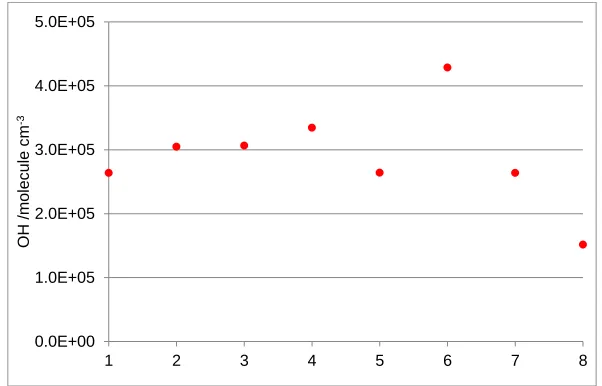
The impact of different indoor lighting sources on predicted OH concentrations indoors
has been explored using models.1, 54 Figure 3 shows OH concentrations predicted by the Carslaw
model1 for the different light sources tested in Kowal et al.,53 as well as in darkness. It indicates a
significant variation in the predicted OH concentration depending on indoor lighting type: using
an uncovered fluorescent tube indoors is likely to lead to significantly more chemical processing
than using an LED. Note also the non-zero concentration of OH predicted in the dark and the
ubiquity of this important oxidant indoors.
Figure 3. Impact of different light sources on predicted OH concentrations indoors under different lighting conditions: 1 (LED), 2 (halogen), 3 (incandescent), 4 (compact fluorescent), 5 (covered fluorescent), 6 (uncovered fluorescent), 7 (attenuated sunlight only) and 8 (dark).
0.0E+00 1.0E+05 2.0E+05 3.0E+05 4.0E+05 5.0E+05
1 2 3 4 5 6 7 8
OH
/m
olec
ule
cm
[image:10.612.155.456.485.678.2]10 The importance of indoor lighting was further illustrated in the bleach/mopping study
mentioned in the previous section.52 Modelling indicated that photolysis of HOCl and Cl2 was a
potential source of chlorine and hydroxyl radicals. Hence, bleach solutions oxidize not only
chemicals on the treated surfaces, but chemicals throughout the room.
Finally, recent research has demonstrated photoinduced chemistry in nonanoic acid
coated aqueous surface films, resulting in the formation of a range of saturated and unsaturated
aldehydes in the gas phase and more highly oxygenated products in the condensed phase.55, 56
Aqueous surface films are ubiquitous indoors, as are carboxylic acids from humans and their
activities.21 Similar processes are likely happening indoors and could be a potentially important
source of oxidized organics.
Indoor secondary organic aerosols
Concentrations of terpenes and terpene alcohols tend to be much higher indoors than out,
reflecting the ubiquitous use of scenting agents in everything from personal care products to
cleaning agents and “air fresheners”. Ozone, transported from outdoors or generated indoors,
reacts with these terpenoids, generating products with a range of volatilities. The less volatile
condense on existing particles or nucleate, producing SOA. When initially produced, SOA are
typically ultrafine particles (UFP, < 100 nm diameter),57 but grow with time into larger, but still
relatively small particles (300 – 700 nm). These processes can generate substantial levels of SOA
in indoor environments.23, 57-67
The production of SOA varies with ozone concentration and can be episodic, such as
during the use of a scented cleaning product,23 or it can be relatively continuous, as occurs with
11 augmented by hydroxyl radicals generated by the reaction of ozone with the double bonds in
terpenoids (and other) precursors.23, 61, 63 Nitrate radicals can also influence SOA production as
illustrated by experiments investigating ozone reacting with -pinene in the presence of different
concentrations of NO; the highest SOA yield was measured under the condition anticipated to
produce the highest nitrate radical concentration.67
Surface chemistry can be a source of SOA, as demonstrated for ozone reacting with
surface sorbed d-limonene70 and squalene.71 In these cases, production rates for SOA from
ozone-initiated surface chemistry were much smaller than those for certain ozone/terpenoid
reactions in the gas phase. However, additional investigation of such processes for alkenes with
volatilities between those of limonene and squalene is warranted.
Waring72 has used modeling, with inputs represented as distributions within a Monte
Carlo framework, to estimate the contribution of SOA formed indoors to the overall indoor
burden of airborne particles. On average, SOA from indoor chemistry contributes only a small
fraction to the total mass of indoor fine-mode particles (6% with a probability of 50%).
However, in 10% of the modeled situations the contribution is > 30%. These high SOA scenarios
have elevated levels of ozone and terpenes, especially limonene, coupled with low air exchange
rates. Under such conditions (e.g. cleaning), modelling studies have suggested that the
composition of SOA may include a significant fraction of peroxide and organic nitrogen
species.73, 74 These model predictions would benefit from evaluation via measurements of the
composition of SOA derived from different mixtures of indoor gas phase pollutants.
Another source of SOA is thermal desorption of SVOCs from surfaces to which they
have sorbed.36, 75, 76 Upon heating of items such as cooking utensils, stovetops, clothes irons, and
12 containing these organics rises and cools, many of the organics supersaturate and nucleate
forming SOA.
Role of partitioning in indoor chemistry
SVOCs partition between the gas phase and other indoor compartments, including
airborne particles, settled dust, exposed surfaces and even the skin, hair and clothing of
occupants.37, 77-84 Inorganic gases also partition between the gas phase and airborne particles,85-87
as well as into dust and aqueous surface films.
Plasticizers, flame retardants, UV-filters and other additives migrate from the products
that originally contained them to other indoor compartments.88-93 As the concentration of
airborne particles increases, the fraction of SVOCs in the particle phase increases, while that in
the gas phase decreases. Temperature further influences the partitioning of SVOCs among the
various indoor compartments.89
When aerosols are transported indoors from outdoors, their volatile constituents
re-equilibrate with the surrounding air. This redistribution can be driven by gas-phase concentration
differences or temperature differences between outdoor and indoor environments. For instance,
loss of PAHs has been demonstrated when indoor particles are compared to co-sampled outdoor
particles.86,94 Outdoor-to-indoor transport can also result in particle sorption of SVOCs whose
indoor concentrations are much higher than their outdoor concentrations,87 as is often the case
for phthalate ester plasticizers or brominated flame retardants.
Losses of ammonium nitrate have also been reported during outdoor-to-indoor transport
13 nitric acid in the surrounding air. The loss of ammonium nitrate from the aerosols influences
their water content and pH, as well as the solubility of transition metals in the aerosols.
Organic films on indoor surfaces are well documented,34, 35, 92, 93, 95, 96 and are a
consequence of partitioning. There is more time, in some cases as long as the interval between
cleaning, for an SVOC to react when sorbed to a surface film than when in the gas phase.
Partitioning to indoor surfaces, especially for SVOCs with log Koa between 10 and 13,37 provides
a large reservoir of SVOCs for both surface and gas-phase chemistry. When the original source
is removed, this reservoir persists for days, months, or even years97, 98 depending on the
properties of the sorbed SVOCs.
Impact of moisture on indoor chemistry
Moisture likely plays a significant role in indoor chemistry. As a reference point, at a
relative humidity of 65%, aqueous surface films are common, and water is a substantial fraction
(~30%) of airborne particles.99 The presence and thickness of aqueous surface films and the
water content of airborne particles changes with changing relative humidity, as does the amount
of water sorbed to porous materials.99, 100 Both inorganic (e.g., nitric, hydrochloric) and organic
(e.g., formic, acetic, lactic) acids partition between the gas phase and water on surfaces/in
airborne particles. The same is true for inorganic (e.g., ammonia) and organic (e.g., nicotine,
amines) bases.
A number of chemicals found in materials and products used indoors are susceptible to
base-catalyzed hydrolysis. These include phthalate, adipate and sebacate esters used as
plasticizers; organophosphate esters used as plasticizers, flame retardants, and pesticides;
14 (BADGE) used in personal care products and coatings; and acrylate-based copolymers used in
adhesives. Hydrolysis reactions tend to be too slow to be important in the gas phase, but can
occur on surfaces (e.g., emission of 2-ethylhexanol when PVC flooring plasticized with
di(2-ethylhexyl) phthalate (DEHP) and its associated adhesives is placed on moist concrete.101, 102).
Wang et al.103 have reported the presence of hydrolysis products of parabens and BADGE in 158
dust samples collected from the U.S., China, Korea, and Japan, indicating the ubiquity of this
process. Nonetheless, hydrolysis reactions in indoor settings remain relatively unexplored.
As the relative humidity increases, the tendency for polar compounds to sorb to indoor
surfaces increases, in turn increasing the probability for their reaction on surfaces (e.g.
-terpeniol on glass, PVC or paint).45 Short-lived, highly reactive intermediates may react via
different pathways under relatively dry conditions compared to relatively moist conditions,
resulting in different product distributions. This is expected to be the case for Criegee
intermediates formed in the reaction between ozone and squalene on surfaces.104
Duncan et al.105 recently measured water soluble organic gases (WSOGs) indoors and
outdoors at thirteen homes; the average concentration was 15 times higher indoors than out. The
authors speculate that aqueous processing of these abundant WSOGs under damp indoor
conditions can increase the indoor concentrations of oxidized and potentially irritating chemicals.
Microbes can be a source of reactive chemicals indoors, and microbial growth requires
moisture. This is a complex topic beyond the scope of the present article. However, a recent
15
Impact of occupants on indoor chemistry
Human occupants emit skin oils and shed their skin flakes, rich in skin oil, at an
astonishing rate. A typical adult emits sebum at ~ 500 mg/h107 and sheds skin flakes at 30-90
mg/h.108, 109 Skin oil constituents with double bonds react rapidly with ozone and nitrate radicals.
The molar fraction of unsaturated species in skin oil is slightly more than 0.9,110 and includes
squalene (~10% by weight) and mono- and di-unsaturated fatty acids (~12% by weight). Skin
oils are transferred to any surface that humans contact, while skin flakes deposit mainly on
horizontal surfaces. Ozone can react with unsaturated skin lipids on these surfaces, as well as on
exposed skin, hair, and clothing of the occupants themselves. As a result, the ozone
concentration in a 30 m3 room with two occupants is roughly half the value it would be if the
room were unoccupied.111
Numerous gas-phase products are generated by ozone/skin oil oxidation chemistry,
including acetone, 6-methyl-5-heptene-2-one (6-MHO), geranyl acetone, and 4-oxopentanal
(4-OPA).111, 112 These reactions also produce less volatile chemicals that remain on skin, clothing or
surfaces, including levulinic, succinic, adipic and suberic acids.113 Oxidation rates are rapid,
implying that these less volatile products are almost always present on skin and surfaces soiled
with skin oil and skin flakes.
Breath is also a significant source of reactive chemicals indoors, including isoprene, nitric
oxide (NO) and ammonia.114-116 In the case of isoprene, typical whole-body emission rates,
which are dominated by breath emissions, are roughly in the range of 160 - 170 µg/h (adults) and
90 -100 µg/h (children).19, 22 Although isoprene reacts slowly with ozone, it reacts more quickly
with hydroxyl and nitrate radicals, forming methacrolein and methyl vinyl ketone amongst other
16 Ammonia is emitted from occupants’ skin as well as breath.116, 117 For an adult, emission
rates tend to be centered around 300 µg/h, but there are large variations with age, diet, oral
hygiene and smoking habits.118, 119 Ammonia from occupants influences the pH of indoor
airborne particles, as well as acid-base chemistry on indoor surfaces.
A fascinating recent observation was reproducible changes in airborne chemicals emitted
by cinema-going audiences depending on the genre of films they watched.120 Suspense and
comedy films elicited the strongest response, and the authors speculate that such behavior may
constitute an alert (suspense)/stand-down (comedy) response that may have proved advantageous
in evolutionary terms assuming such signals can be perceived by others.
Impact of buildings on indoor chemistry
There is no such thing as a typical building. For example, within the United States there
are 118.2 million housing units, 80% in urban areas and 20% in rural areas; 36% are in “very
cold” or “cold” climates, 19% in “hot-humid areas”; 32% were built after 1990 and 18% were
built before 1950; 28% of the units are built from brick, 15% from wood; the most common
number of rooms is 6, but this ranges from 1 to > 9.121 Buildings are diverse, and it is vital to
understand the impacts that variations in building construction, location and operation can have
on indoor air chemistry.
A key issue affecting indoor air chemistry is the building ventilation rate. Mechanically
ventilated buildings often employ heating, ventilation and air conditioning (HVAC) systems and
it is necessary to understand when the system is running, the air exchange rate, the fraction of
recirculated air, whether the fraction of outdoor air used for ventilation is fixed or variable,
17 day.122 Even in naturally ventilated buildings, it is necessary to measure air exchange rates,
temperature and relative humidity to properly understand the chemistry. Although room air is
commonly assumed to be well mixed, for extremely fast reactions (e.g., hydroxyl radical reacting
with organics) with locally produced reactants, the time required for mixing is an important
parameter.8
Another consideration is the chemistry that occurs in “hidden” building spaces (e.g., wall
cavities, basements, crawl spaces, attics) and/or how this can influence the chemistry in occupied
spaces. For instance, Du et al.123 found that for a study of 74 US residences, the basement was a
source of VOCs that were found in the living space. Given linked air flow between different
parts of a building, out of sight does not necessarily mean out of mind.
Modeling indoor chemistry
Indoor chemistry has been modeled for more than three decades.124 We have mentioned
some of the applications of modeling throughout this review. It is an overarching activity,
incorporating results from the different topics discussed above. It can extend findings from a
small number of indoor settings to a larger universe of buildings. Increasingly, indoor air models
are being used to evaluate findings, identify gaps and limitations in knowledge, and design
experimental programs.8 The indoor chemical box model mentioned earlier1, 73 contains around
5000 species and 20,000 reactions. Measurements are available for perhaps only 100-200 indoor
species; model predictions provide insights that would be absent otherwise.
Models are currently limited due to uncertainties regarding the parameterization of
surface interactions, the propagation of light through indoor environments, and the
concentrations of a suite of secondary pollutants formed through indoor chemical reactions.8 The
18 laboratory, experimental and modelling studies. We anticipate that in a future review many of
these limitations will have been addressed.
Vision
We are currently at a crossroads for indoor air chemistry. Over the past several years
there has been increasingly coordinated collaboration among scientists – atmospheric chemists,
building physicists, chemical engineers, mechanical engineers, and other specialists -- working at
the disciplinary boundaries of this field. State-of-the-art instrumentation and novel derivatization
techniques are making accessible what had been nearly impossible measurements. Recent
findings answer some questions and raise many more. Where is all this going?
An emerging area of research is intensive field campaigns in residences, offices and
schools utilizing cutting edge analytical techniques (e.g., proton-transfer-reaction/high resolution
mass spectrometry; chemical ionization/high resolution mass spectrometry; cavity ring down
spectroscopy; low-pressure laser-induced fluorescence spectroscopy; actinic flux
spectroradiometry). Such field campaigns will be complemented by studies in test houses where
researchers with different scientific expertise bring together their instruments to make
coordinated, simultaneous measurements under manipulated indoor scenarios. Comprehensive
measurement campaigns should significantly facilitate model development and aid in the search
for chemicals that “must be there” including amines, organic nitrates, peroxides and peroxy
radicals. We anticipate more detailed studies of indoor acid/base chemistry, hydrolysis reactions,
photochemistry promoted by photosensitizers, and microbe/indoor chemical interactions. Even
the role of water in indoor chemistry is relatively understudied, both in the gas-phase and on
19 indoor environment is far more important than initially imagined,18-21, 125 and further
investigations are likely to uncover additional impacts.
Indoor environments have changed significantly in the last 50 years16 and will continue to
do so. An emerging area of research focuses on low- or zero-energy buildings, which tend to
have low ventilation rates and, hence, more time for gas-phase chemistry to occur. With
increasing use of ‘green materials’ and products containing manmade nanoparticles, we envision
investigations into their emissions/reactions and how their chemical interactions evolve with age.
As various regions of the world warm, more buildings will use air-conditioning, which is often
accompanied by substantial recirculation of indoor air. Recirculation amplifies certain indoor
chemical processes. Climate change is associated not only with increasing heatwaves, but also
increases in outdoor pollutant levels that can impact indoor environments126. As stated in a
National Academy of Sciences’ report: “Climate change may worsen existing indoor
environmental problems and introduce new problems”.127
We conclude with the fundamental question driving indoor chemistry research: What are
the specific chemical reactions that transform relatively benign chemicals into ones that are
responsible for malodors, irritancy, material degradation and adverse health outcomes? Given the
continuing and dramatic changes in indoor environments, it is more important than ever that we
understand indoor chemistry to ensure that building occupants and building contents are
protected from unanticipated exposures to harmful chemicals.
Acknowledgements
In 2016, after funding several preliminary studies, the Sloan Foundation announced a
20 present article, some early findings from this program have been reported. We thank Dr. Paula J.
Olsiewski, Director of the CIE program, for her efforts in bringing together a diverse community
of scientists to improve understanding of the chemistry taking place indoors.
References
1. Carslaw, N., A new detailed chemical model for indoor air pollution. Atmos. Environ. 2007, 41, (6), 1164-1179.
2. Weschler, C. J.; Shields, H. C., Potential reactions among indoor pollutants. Atmos Environ 1997, 31, 3487-3495.
3. Weschler, C. J., Reactions among indoor pollutants: What's new? The Scientific World 2001, 1, 443-457.
4. Morrison, G., Interfacial chemistry in indoor environments. Environ. Sci. Technol. 2008, 42, (10), 3494-3499.
5. Weschler, C. J., Chemistry in indoor environments: 20 years of research. Indoor Air 2011, 21, 205-218.
6. Morrison, G., Recent Advances in Indoor Chemistry. Curr Sustainable Renewable Energy Rep 2015, 2, (2), 33-40.
7. Nazaroff, W. W.; Goldstein, A. H., Indoor chemistry: research opportunities and challenges. Indoor Air 2015, 25, (4), 357-61.
8. Morrison, G. C.; Carslaw, N.; Waring, M. S., A modeling enterprise for chemistry of indoor environments (CIE). Indoor Air 2017a, 27, (6), 1033-1038.
9. Wells, J. R.; Schoemaecker, C.; Carslaw, N.; Waring, M. S.; Ham, J. E.; Nelissen, I.;
Wolkoff, P., Reactive indoor air chemistry and health—A workshop summary. International Journal of Hygiene and Environmental Health 2017, 220, (8), 1222-1229.
10. Alfred P. Sloan Foundation, Chemistry of Indoor Environments,
https://sloan.org/programs/science/chemistry-of-indoor-environments, last accessed 11/17/2017.
11. Nazaroff, W. W.; Weschler, C. J., Cleaning products and air fresheners: exposure to primary and secondary air pollutants. Atmos. Environ. 2004, 38, 2841-2865.
12. Wang H, Morrison GC. Ozone-initiated secondary emission rates of aldehydes from indoor surfaces in four homes. Environ. Sci. Technol. 2006, 40, 5263-5268.
21 14. Destaillats, H.; Maddalena, R. L.; Singer, B. C.; Hodgson, A. T.; McKone, T. E., Indoor
pollutants emitted by office equipment: A review of reported data and information needs. Atmos. Environ. 2008, 42, (7), 1371-1388.
15. Odabasi, M., Halogenated volatile organic compounds from the use of chlorine-bleach-containing household products. Environ. Sci. Technol. 2008, 42, 1445-1451.
16. Weschler, C. J., Changes in indoor pollutants since the 1950s. Atmos. Environ. 2009, 43, 153-169.
17. Abdullahi, K.L.; Delgado-Saborit, J.M.; Harrison, R.M. Emissions and indoor concentrations of particulate matter and its specific chemical components from cooking: a review. Atmos. Environ. 2013, 71, 260-294.
18. Tang, X. C.; Misztal, P. K.; Nazaroff, W. W.; Goldstein, A. H., Siloxanes are the most abundant volatile organic compound emitted from engineering students in a classroom. Environ. Sci. Technol. Letters 2015, 2, (11), 303-307.
19. Tang, X.; Misztal, P. K.; Nazaroff, W. W.; Goldstein, A. H., Volatile Organic Compound Emissions from Humans Indoors. Environ. Sci. Technol. 2016, 50, (23), 12686-12694.
20. Liu, S.; Li, R.; Wild, R. J.; Warneke, C.; de Gouw, J. A.; Brown, S. S.; Miller, S. L.; Luongo, J. C.; Jimenez, J. L.; Ziemann, P. J., Contribution of human-related sources to indoor volatile organic compounds in a university classroom. Indoor Air 2016, 26, (6), 925-938.
21. Liu, S.; Thompson, S. L.; Stark, H.; Ziemann, P. J.; Jimenez, J. L., Gas-Phase carboxylic acids in a university classroom: abundance, variability, and sources. Environ. Sci. Technol. 2017, 51, (10), 5454-5463.
22. Stönner, C.; Edtbauer, A.; Williams, J., Real-world volatile organic compound emission rates from seated adults and children for use in indoor air studies. Indoor Air, 2017 doi:
10.1111/ina.12405
23. Singer, B. C.; Coleman, B. K.; Destaillats, H.; Hodgson, A. T.; Lunden, M. M.; Weschler, C. J.; Nazaroff, W. W., Indoor secondary pollutants from cleaning product and air freshener use in the presence of ozone. Atmos. Environ. 2006, 40, (35), 6696-6710.
24. Weschler, C. J., Ozone's impact on public health: contributions from indoor exposures to ozone and products of ozone-initiated chemistry. Environ. Health Perspect. 2006, 114, 1489-96.
25. Wolkoff, P., External eye symptoms in indoor environments. Indoor Air 2017, 27, 246-260.
26. Weschler, C. J.; Shields, H. C., The influence of ventilation on reactions among indoor pollutants: Modeling and experimental observations. Indoor Air 2000, 10, (2), 92-100.
27. Atkinson, R.; Hasegawa, D.; Aschmann, S. M., Rate constants for the gas-phase reactions of O3 with a series of monoterpenes and related-compounds at 296-K +/-2-K. Int. J. Chem.
Kinet. 1990, 22, 871-887.
28. Greene, C. R.; Atkinson, R., Rate constants for the gas-phase reactions of O3 with a series of
alkenes at 296-K+/-2-K. Int. J. Chem. Kinet. 1992, 24, 803-811.
22 30. Sarwar G, Corsi R, Kimura Y, Allen D, Weschler CJ. Hydroxyl radicals in indoor
environments. Atmos Environ 2002, 36, 3973–88.
31. Gomez Alvarez, E.; Amedro, D.; Afif, C.; Gligorovski, S.; Schoemaecker, C.; Fittschen, C.; Doussin, J. F.; Wortham, H., Unexpectedly high indoor hydroxyl radical concentrations associated with nitrous acid. PNAS 2013, 110, 13294-13299.
32. Carslaw, N.; Fletcher, L.; Heard, D.; Ingham, T.; Walker, H., Significant OH production under surface cleaning and air cleaning conditions: Impact on indoor air quality. Indoor Air, 2017, 27, 1091-1100.
33. Weschler, C. J.; Brauer, M.; Koutrakis, P., Indoor ozone and nitrogen dioxide - a potential pathway to the generation of nitrate radicals, dinitrogen pentaoxide, and nitric-acid Indoors. Environ. Sci. Technol. 1992, 26, (1), 179-184.
34. Liu, Q. T.; Chen, R.; McCarry, B. E.; Diamond, M. L.; Bahavar, B., Characterization of polar organic compounds in the organic film on indoor and outdoor glass windows. Environ. Sci. Technol. 2003, 37, 2340-9.
35. Huo, C.-Y.; Liu, L.-Y.; Zhang, Z.-F.; Ma, W.-L.; Song, W.-W.; Li, H.-L.; Li, W.-L.; Kannan, K.; Wu, Y.-K.; Han, Y.-M.; Peng, Z.-X.; Li, Y.-F., Phthalate Esters in Indoor Window Films in a Northeastern Chinese Urban Center: Film Growth and Implications for Human
Exposure. Environ. Sci. Technol. 2016, 50, 7743-7751.
36. Wallace, L. A.; Ott, W. R.; Weschler, C. J.; Lai, A. C. K., Desorption of SVOCs from heated surfaces in the form of ultrafine particles. Environ. Sci. Technol. 2017, 51, 1140-1146.
37. Weschler, C. J.; Nazaroff, W. W., Growth of organic films on indoor surfaces. Indoor Air 2017, 27, 1101–1112.
38. Wang, H.; Morrison, G., Ozone-surface reactions in five homes: surface reaction probabilities, aldehyde yields, and trends. Indoor Air 2010, 20, 224-234.
39. Weschler, C. J.; Hodgson, A. T.; Wooley, J. D., Indoor chemistry - ozone, volatile organic-compounds, and carpets. Environ. Sci. Technol. 1992, 26, (12), 2371-2377.
40. Morrison, G. C.; Nazaroff, W. W., The rate of ozone uptake on carpets: Experimental studies. Environ. Sci. Technol. 2000, 34, 4963-4968.
41. Kruza, M.; Lewis, A.C.; Morrison, G.C.; Carslaw, N., Impact of surface ozone interactions on indoor air chemistry: a modelling study. Indoor Air 2017, 27, 1001-1011.
42. Fick, J.; Nilsson, C.; Andersson, B., Formation of oxidation products in a ventilation system. Atmos. Environ. 2004, 38, 5895-5899.
43. Fick, J.; Pommer, L.; Astrand, A.; Ostin, R.; Nilsson, C.; Andersson, B., Ozonolysis of monoterpenes in mechanical ventilation systems. Atmos. Environ. 2005, 39, 6315-6325.
44. Springs, M.; Wells, J. R.; Morrison, G. C., Reaction rates of ozone and terpenes adsorbed to model indoor surfaces. Indoor Air 2011, 21, (4), 319-327.
23 46. Shu, S.; Morrison, G. C., Rate and reaction probability of the surface reaction between ozone
and dihydromyrcenol measured in a bench scale reactor and a room-sized chamber. Atmos. Environ. 2011, 47, 421-427.
47. Zhou, S.; Yeung, L. W. Y.; Forbes, M. W.; Mabury, S.; Abbatt, J. P. D., Epoxide formation from heterogeneous oxidation of benzo[a]pyrene with gas-phase ozone and indoor air. Environ. Sci. Process. Impact 2017, 19, 1292-1299.
48. Pitts, J. N.; Sanhueza, E.; Atkinson, R.; Carter, W. P. L.; Winer, A. M.; Harris, G. W.; Plum, C. N., An investigation of the dark formation of nitrous acid in environmental chambers. International Journal of Chemical Kinetics 1984, 16, (7), 919-939.
49. Pitts, J. N.; Biermann, H. W.; Tuazon, E. C.; Green, M.; Long, W. D.; Winer, A. M., Time-resolved identification and measurement of indoor air-pollutants by spectroscopic techniques -nitrous acid, methanol, formaldehyde and formic-acid. Journal of the Air Pollution Control Association 1989, 39, (10), 1344-1347.
50. Gómez Alvarez, E.; Sörgel, M.; Gligorovski, S.; Bassil, S.; Bartolomei, V.; Coulomb, B.; Zetzsch, C.; Wortham, H., Light-induced nitrous acid (HONO) production from NO2
heterogeneous reactions on household chemicals. Atmos. Environ. 2014, 95, 391-399.
51. Sleiman, M.; Gundel, L. A.; Pankow, J. F.; Jacob, P.; Singer, B. C.; Destaillats, H., Formation of carcinogens indoors by surface-mediated reactions of nicotine with nitrous acid, leading to potential thirdhand smoke hazards. PNAS 2010, 107, (15), 6576-6581.
52. Wong, J. P. S.; Carslaw, N.; Zhao, R.; Zhou, S.; Abbatt, J. P. D., Observations and impacts of bleach washing on indoor chlorine chemistry. Indoor Air, 2017, 27, 1082-1090.
53. Kowal, S. F.; Allen, S. R.; Kahan, T. F., Wavelength-resolved photon fluxes of indoor light sources: implications for HOx production. Environ. Sci. Technol. 2017, 51, 10423-10430.
54. Waring, M. S.; Wells, J. R., Volatile organic compound conversion by ozone, hydroxyl radicals, and nitrate radicals in residential indoor air: Magnitudes and impacts of oxidant sources. Atmos. Environ. 2015, 106, 382-391.
55. Rossignol, S.; Tinel, L.; Bianco, A.; Passananti, M.; Brigante, M.; Donaldson, D. J.; George, C., Atmospheric photochemistry at a fatty acid-coated air-water interface. Science 2016, 353, 699-702.
56. Tinel, L.; Rossignol, S.; Bianco, A.; Passananti, M.; Perrier, S.; Wang, X. M.; Brigante, M.; Donaldson, D. J.; George, C., Mechanistic insights on the photosensitized chemistry of a fatty acid at the air/water interface. Environ. Sci. Technol. 2016, 50, 11041-11048.
57. Rohr, A. C.; Weschler, C. J.; Koutrakis, P.; Spengler, J. D., Generation and quantification of ultrafine particles through terpene/ozone reaction in a chamber setting. Aerosol Sci. Technol. 2003, 37, 65-78.
58. Weschler, C. J.; Shields, H. C., Indoor ozone/terpene reactions as a source of indoor particles. Atmos. Environ. 1999, 33, (15), 2301-2312.
24 60. Sarwar, G.; Olson, D. A.; Corsi, R. L.; Weschler, C. J., Indoor fine particles: The role of
terpene emissions from consumer products. J. Air Waste Manag. Assoc. 2004, 54, (3), 367-377.
61. Destaillats, H.; Lunden, M. M.; Singer, B. C.; Coleman, B. K.; Hodgson, A. T.; Weschler, C. J.; Nazaroff, W. W., Indoor secondary pollutants from household product emissions in the presence of ozone: A bench-scale chamber study. Environ. Sci. Technol. 2006, 40, (14), 4421-4428.
62. Sarwar, G.; Corsi, R., The effects of ozone/limonene reactions on indoor secondary organic aerosols. Atmos Environ 2007, 41, (5), 959-973.
63. Fan, Z. H.; Weschler, C. J.; Han, I. K.; Zhang, J. F., Co-formation of hydroperoxides and ultra-fine particles during the reactions of ozone with a complex VOC mixture under simulated indoor conditions. Atmos. Environ. 2005, 39, 5171-5182.
64. Chen, X.; Hopke, P. K., A chamber study of secondary organic aerosol formation by linalool ozonolysis. Atmos. Environ. 2009, 43, 3935-3940.
65. Chen, X.; Hopke, P. K., Secondary organic aerosol from alpha-pinene ozonolysis in dynamic chamber system. Indoor Air 2009, 19, 335-345.
66. Chen, X.; Hopke, P. K., A chamber study of secondary organic aerosol formation by limonene ozonolysis. Indoor Air 2010, 20, 320-328.
67. Liu, Y.; Hopke, P. K., A chamber study of secondary organic aerosol formed by ozonolysis
of -pinene in the presence of nitric oxide. Journal of Atmospheric Chemistry 2014, 71, (1), 21-32.
68. Norgaard, A. W.; Kudal, J. D.; Kofoed-Sorensen, V.; Koponen, I. K.; Wolkoff, P., Ozone-initiated VOC and particle emissions from a cleaning agent and an air freshener: Risk assessment of acute airway effects. Environment International 2014, 68, 209-218.
69. Steinemann, A., Ten questions concerning air fresheners and indoor built environments. Build. Environ. 2017, 111, 279-284.
70. Waring, M. S.; Siegel, J. A., Indoor secondary organic aerosol formation initiated from reactions between ozone and surface-sorbed D-limonene. Environ. Sci. Technol. 2013, 47, 6341-8.
71. Wang, C. Y.; Waring, M. S., Secondary organic aerosol formation initiated from reactions between ozone and surface-sorbed squalene. Atmos. Environ. 2014, 84, 222-229.
72. Waring, M. S., Secondary organic aerosol in residences: predicting its fraction of fine particle mass and determinants of formation strength. Indoor Air 2014, 24, (4), 376-89.
73. Carslaw, N.; Mota, T.; Jenkin, M. E.; Barley, M. H.; McFiggans, G., A significant role for nitrate and peroxide groups on indoor secondary organic aerosol. Environ. Sci. Technol. 2012, 46, (17), 9290-9298.
25 75. Bhangar, S.; Mullen, N. A.; Hering, S. V.; Kreisberg, N. M.; Nazaroff, W. W., Ultrafine
particle concentrations and exposures in seven residences in northern California. Indoor Air 2011, 21, (2), 132-144.
76. Wallace, L. A.; Ott, W. R.; Weschler, Ultrafine particles from electric appliances and cooking pans: experiments suggesting desorption/nucleation of sorbed organics as the primary source. Indoor Air 2015, 25, 536-546.
77. Weschler, C. J.; Nazaroff, W. W., Semivolatile organic compounds in indoor environments. Atmos. Environ. 2008, 42, (40), 9018-9040.
78. Weschler, C. J.; Nazaroff, W. W., SVOC exposure indoors: fresh look at dermal pathways. Indoor Air 2012, 22, 356-377.
79. Morrison, G.; Li, H. W.; Mishra, S.; Buechlein, M., Airborne phthalate partitioning to cotton clothing. Atmos. Environ. 2015b, 115, 149-152.
80. Morrison, G. C.; Andersen, H. V.; Gunnarsen, L.; Varol, D.; Uhde, E.; Kolarik, B.,
Partitioning of PCBs from air to clothing materials in a Danish apartment. Indoor Air 2017b, doi: 10.1111/ina.12411
81. Bennett, D. H.; Moran, R. E.; Wu, X.; Tulve, N. S.; Clifton, M. S.; Colón, M.; Weathers, W.; Sjödin, A.; Jones, R.; Hertz-Picciotto, I., Polybrominated diphenyl ether (PBDE)
concentrations and resulting exposure in homes in California: relationships among passive air, surface wipe and dust concentrations, and temporal variability. Indoor Air 2015, 25, 220-229.
82. Saini, A.; Rauert, C.; Simpson, M. J.; Harrad, S.; Diamond, M. L., Characterizing the sorption of polybrominated diphenyl ethers (PBDEs) to cotton and polyester fabrics under controlled conditions. Sci. Total Environ. 2016, 563, 99-107.
83. Saini, A.; Okeme, J. O.; Mark Parnis, J.; McQueen, R. H.; Diamond, M. L., From air to clothing: characterizing the accumulation of semi-volatile organic compounds to fabrics in indoor environments. Indoor Air 2017, 27, (3), 631-641.
84. Parker, K.; Morrison, G., Methamphetamine absorption by skin lipids: accumulated mass, partition coefficients, and the influence of fatty acids. Indoor Air 2016, 26, (4), 634-641.
85. Lunden, M. M.; Revzan, K. L.; Fischer, M. L.; Thatcher, T. L.; Littlejohn, D.; Hering, S. V.; Brown, N. J., The transformation of outdoor ammonium nitrate aerosols in the indoor
environment. Atmos Environ 2003, 37, (39), 5633-5644.
86. Sangiorgi, G.; Ferrero, L.; Ferrini, B. S.; Lo Porto, C.; Perrone, M. G.; Zangrando, R.; Gambaro, A.; Lazzati, Z.; Bolzacchini, E., Indoor airborne particle sources and semi-volatile partitioning effect of outdoor fine PM in offices. Atmos Environ 2013, 65, 205-214.
87. Johnson, A. M.; Waring, M. S.; DeCarlo, P. F., Real-time transformation of outdoor aerosol components upon transport indoors measured with aerosol mass spectrometry. Indoor Air 2017, 27, (1), 230-240.
26 89. Wei, W.; Mandin, C.; Blanchard, O.; Mercier, F.; Pelletier, M.; Le Bot, B.; Glorennec, P.;
Ramalho, O., Temperature dependence of the particle/gas partition coefficient: An
application to predict indoor gas-phase concentrations of semi-volatile organic compounds. Sci. Total Environ. 2016a, 563, 506-512.
90. Wei, W.; Mandin, C.; Blanchard, O.; Mercier, F.; Pelletier, M.; Le Bot, B.; Glorennec, P.; Ramalho, O., Distributions of the particle/gas and dust/gas partition coefficients for seventy-two semi-volatile organic compounds in indoor environment. Chemosphere 2016b, 153, 212-219.
91. Wei, W.; Mandin, C.; Blanchard, O.; Mercier, F.; Pelletier, M.; Le Bot, B.; Glorennec, P.; Ramalho, O., Predicting the gas-phase concentration of semi-volatile organic compounds from airborne particles: Application to a French nationwide survey. Sci. Total Environ. 2017, 576, 319-325.
92. Venier, M.; Audy, O.; Vojta, S.; Becanova, J.; Romanak, K.; Melymuk, L.; Kratka, M.; Kukucka, P.; Okeme, J.; Saini, A.; Diamond, M. L.; Klanova, J., Brominated flame
retardants in the indoor environment - Comparative study of indoor contamination from three countries. Environment International 2016, 94, 150-160.
93. Melymuk, L.; Bohlin-Nizzetto, P.; Vojta, S.; Kratka, M.; Kukucka, P.; Audy, O.; Pribylova, P.; Klanova, J., Distribution of legacy and emerging semivolatile organic compounds in five indoor matrices in a residential environment. Chemosphere 2016, 153, 179-186.
94. Naumova, Y. Y.; Offenberg, J. H.; Eisenreich, S. J.; Meng, Q.; Polidori, A.; Turpin, B. J.; Weisel, C. P.; Morandi, M. T.; Colome, S. D.; Stock, T. H.; Winer, A. M.; Alimokhtari, S.; Kwon, J.; Maberti, S.; Shendell, D.; Jones, J.; Farrar, C., Gas/particle distribution of
polycyclic aromatic hydrocarbons in coupled outdoor/indoor atmospheres. Atmos. Environ. 2003, 37, (5), 703-719.
95. Bi, C.; Liang, Y.; Xu, Y., Fate and Transport of Phthalates in Indoor Environments and the Influence of Temperature: A Case Study in a Test House. Environ. Sci. Technol. 2015, 49, 9674-9681.
96. Wu, Y.; Eichler, C. M. A.; Leng, W.; Cox, S. S.; Marr, L. C.; Little, J. C., Adsorption of phthalates on impervious indoor surfaces. Environ. Sci. Technol. 2017, 51, 2907–2913.
97. Lyng, N. L.; Gunnarsen, L.; Andersen, H. V., The effect of ventilation on the indoor air concentration of PCB: An intervention study. Build. Environ. 2015, 94, 305-312.
98. Kolarik, B.; Andersen, H. V.; Frederiksen, M.; Gunnarsen, L., Laboratory investigation of PCB bake-out from tertiary contaminated concrete for remediation of buildings.
Chemosphere 2017, 179, 101-111.
99. Ho, W.; Hidy, G. M.; Govan, R. M., Microwave measurements of the liquid water content of atmospheric aerosols. J. Appl. Meteorol. 1974, 13, 871-879.
100. Leygraf, C.; Graedel, T.; Atmospheric Corrosion; Wiley-Interscience: New York, 2000.
101. Sjöberg, A.; Ramnäs, O., An experimental parametric study of VOC from flooring systems exposed to alkaline solutions. Indoor Air 2007, 17, (6), 450-457.
27 103. Wang, L.; Liao, C.; Liu, F.; Wu, Q.; Guo, Y.; Moon, H.-B.; Nakata, H.; Kannan, K.,
Occurrence and human exposure of p-hydroxybenzoic acid esters (parabens), bisphenol a diglycidyl ether (BADGE), and their hydrolysis products in indoor dust from the United States and three east Asian countries. Environ. Sci. Technol. 2012, 46, 11584-11593.
104. Zhou, S.; Forbes, M. W.; Abbatt, J. P. D., Kinetics and products from heterogeneous oxidation of squalene with ozone. Environ. Sci. Technol. 2016b, 50, 11688-11697.
105. Duncan, S. M.; Sexton, K. G.; Turpin, B. J., Oxygenated VOCs, aqueous chemistry, and potential impacts on residential indoor air composition. Indoor Air 2017, DOI:
10.1111/ina.12422.
106. Adams, R. I.; Lymperopoulou, D. S.; Misztal, P. K.; De Cassia Pessotti, R.; Behie, S. W.; Tian, Y.; Goldstein, A. H.; Lindow, S. E.; Nazaroff, W. W.; Taylor, J. W.; Traxler, M. F.; Bruns, T. D., Microbes and associated soluble and volatile chemicals on periodically wet household surfaces. Microbiome, 2017, 5, 128.
107. Downing, D. T.; Stranieri, A. M.; Strauss, J. S., The effect of accumulated lipids on measurements of sebum secretion in human skin. J. Invest. Dermatol. 1982, 79, 226-8.
108. Gowadia, H. A.; Settles, G. S., The natural sampling of airborne trace signals from
explosives concealed upon the human body. Journal of Forensic Sciences 2001, 46, 1324-31.
109. Milstone, L. M., Epidermal desquamation. J Dermatol Sci 2004, 36, (3), 131-40.
110. Pandrangi, L. S.; Morrison, G. C., Ozone interactions with human hair: Ozone uptake rates and product formation. Atmos. Environ. 2008, 42, (20), 5079-5089.
111. Wisthaler, A.; Weschler, C. J., Reactions of ozone with human skin lipids: Sources of carbonyls, dicarbonyls, and hydroxycarbonyls in indoor air. PNAS 2010, 107, 6568-6575.
112. Weschler, C. J.; Wisthaler, A.; Cowlin, S.; Tamas, G.; Strom-Tejsen, P.; Hodgson, A. T.; Destaillats, H.; Herrington, J.; Zhang, J. J.; Nazaroff, W. W., Ozone-initiated chemistry in an occupied simulated aircraft cabin. Environ. Sci. Technol. 2007, 41, (17), 6177-6184.
113. Zhou, S.; Forbes, M. W.; Katrib, Y.; Abbatt, J. P. D., Rapid oxidation of skin oil by ozone. Environ. Sci. Technol. Letters 2016, 3, (4), 170-174.
114. Fenske, J. D.; Paulson, S. E., Human breath emissions of VOCs. J. Air Waste Manag. Assoc. 1999, 49, 594-598.
115. Travers, J.; Marsh, S.; Aldington, S.; Williams, M.; Shirtcliffe, P.; Pritchard, A.; Weatherall, M.; Beasley, R., Reference ranges for exhaled nitric oxide derived from a random community survey of adults. Am J Respir Crit Care Med 2007, 176, (3), 238-42.
116. Schmidt, F. M.; Vaittinen, O.; Metsälä, M.; Lehto, M.; Forsblom, C.; Groop, P. H.; Halonen, L., Ammonia in breath and emitted from skin. J. Breath Res. 2013, 7, (1), 017109.
117. Furukawa, S.; Sekine, Y.; Kimura, K.; Umezawa, K.; Asai, S.; Miyachi, H.,
Simultaneous and multi-point measurement of ammonia emanating from human skin surface for the estimation of whole body dermal emission rate. J. Chromatogr. B 2017, 1053, 60-64.
28 119. Filipiak W., Ruzsanyi V., Mochalski P., Filipiak A., Bajtarevic A., Ager C., Denz H.,
Hilbe W., Jamnig H., Hackl M., Dzien A. and Amann A., Dependence of exhaled breath composition on exogenous factors, smoking habits and exposure to air pollutants. J. Breath Res., 2012, 36008.
120. Williams, J.; Stönner, C.; Wicker, J.; Krauter, N.; Derstroff, B.; Bourtsoukidis, E.;
Klüpfel, T.; Kramer, S., Cinema audiences reproducibly vary the chemical composition of air during films, by broadcasting scene specific emissions on breath. Sci Rep. 2016, 6, 25464; doi: 10.1038/srep25464
121. US EIA (Energy Information Administration), Residential Energy Consumption Survey, 2015 at https://www.eia.gov/consumption/residential/data/2015/#structural, accessed
November 7th, 2017.
122. Rackes, A.; Waring, M. S., Modeling impacts of dynamic ventilation strategies on indoor air quality of offices in six US cities. Build. Environ. 2013, 60, 243-253.
123. Du, L.; Batterman, S.; Godwin, C.; Rowe, Z.; Chin, J. Y., Air exchange rates and migration of VOCs in basements and residences. Indoor Air 2015, 25, 598-609.
124. Nazaroff, W. W.; Cass, G. R., Mathematical-Modeling of Chemically Reactive Pollutants in Indoor Air. Environ. Sci. Technol. 1986, 20, 924-934.
125. Weschler, C. J., Roles of the human occupant in indoor chemistry. Indoor Air 2016, 26, 6-24.
126. Terry, A. C.; Carslaw, N.; Ashmore, M.; Dimitroulopoulou, S.; Carslaw, D. C., Occupant exposure to indoor air pollutants in modern European offices: An integrated modelling approach. Atmos. Environ. 2014, 82, 9-16.