Co-operation between
The European Union
and
The Republic of Malawi
Joint Annual Report
2004
Annual Report on the Implementation of the ACP-
EU
Conventions and other Co-operation Activities
JOINT ANNUAL REPORT 2004
TABLE OF CONTENTS
1. Executive Summary ... 1
2. Update on the political, economic and social situation... 2
2.1 Update of the political situation... 2
2.2 Update of the economic situation ... 2
2.3 Update of the social situation ... 6
According to 2000 estimates, the proportion of people with access to potable water was 62% (percentage of households within 1 km of a water source), increasing at 1% per annum. The target of achieving 78% coverage can probably be achieved assuming that the annual increase in coverage is sustained. ... 7
2.3.1 Food and Nutrition Security... 7
2.3.2 HIV/AIDS ... 8
2.3.3 Gender... 8
2.3.4 Environment... 9
2.3.5 Health... 9
2.3.6 Education ... 10
2.3.7 Migration Profile ... 10
3. Development Agenda of the Partner Country ... 12
4. Overview of Past and Ongoing Co-operation... 13
4.1 Focal Sectors ... 13
4.1.1 Focal Sector: Rural Development, Agriculture, Food Security and Natural Resources... 13
4.1.2. Focal sector –Transport... 16
4.1.3 Macroeconomic Support ... 19
4.2 Projects and programmes outside focal sectors ... 20
4.2.1 Developments in the Health Sector... 20
4.2.2 Governance Programmes ... 21
4.2.3 Micro Projects Programme (MPP)... 21
4.2.4 Other projects... 22
4.3 Resources for Non-State Actors (NSAs) ... 22
4.4 Utilisation of Envelope B... 23
4.5 Other Instruments ... 23
4.5.1 STABEX ... 23
4.5.2 Regional Co-operation ... 23
4.5.3 Community Budget Lines ... 23
4.5.4 Centre for Development of Enterprise (CDE) / Pro€invest... 24
4.5.5 European Investment Bank (EIB) ... 24
5. Programming Perspective for the Following Years... 25
6.1 Dialogue in country with the NAO and non-State actors... 26
6.2 Donor coordination... 27
1. Executive Summary
Presidential and Parliamentary elections were held in May 2004 in a generally peaceful atmosphere. However, the EU Election Observation Mission and other Observer Missions declared that the elections had fallen short of international standards in some areas. By December 2004, major political parties were still contesting the election results in court.
Upon taking office, the Government announced its three policy objectives: (i) the fight against corruption, (i) the strengthening of public finances, and (iii) the acceleration of private sector-led growth to reduce poverty. The new Government quickly replaced the heads of its governance surveillance institutions.
Following the lapse of the Poverty Reduction Growth Facility (PRGF) in early 2004, an IMF Staff Monitored Programme (SMP) was put in place in June 2004. The Government met all but one target by end-2004. This allowed several donors (World Bank, UK, Norway) to release budget support funds.
In the transport infrastructure focal sector, fuel levies on diesel and petrol were increased by MWK 1.95 per litre, though this is not likely to provide the funds to make a significant difference in road maintenance capability. To address the weaknesses in road management, the Government prepared legislation to separate Road Fund administration from road management operations. The Government also announced its intention to establish a Road Traffic Authority.
A €45 million Multi-annual Food Security Programme (MAFSP) was approved in late 2004. Towards the end of 2004, the Government purchased MT 32 000 of maize to replace the maize that had been improperly released from the Strategic Grain Reserve (SGR) in March 2004. The NFRA replenished the SGR with MT 28 000 using EU funds. In November 2004, the EU agreed to the release of MT 10 000 of maize from the SGR to the World Food Programme (WFP) to help avoid a break in the cereals pipeline for humanitarian food aid.
The Mid-Term Review (MTR) took place only in mid-October 2004 so that the new Government could establish a track record with regard to the resumption of donor budget support, and in the road sector. The country strategy contained in the CSP and NIP was maintained. Funds available under the A-envelope of €276.3 million were maintained, but with a change in the balance between focal and non-focal sectors. The B-envelope (emergency aid) was cut from €63.8 million to € 21.3 million.
million of the A-envelope being programmed for agriculture and natural resources programmes.
2. Update on the political, economic and social situation
2.1 Update of the political situation
Presidential and Parliamentary elections were held in May 2004 in a generally peaceful atmosphere. However, the EU Election Observation Mission and other Observer Missions declared that the elections had fallen short of international standards in some areas. By December 2004, major political parties were still contesting the election results in court.
Dr. Bingu wa Mutharika, the UDF Ruling Party candidate was sworn in as President. However, the UDF did not have a majority in Parliament resulting in the formation of a coalition Government.These developments demonstrated Malawian society’s greater civic awareness and increased commitment to democratic principles. A new and much smaller1 Cabinet was appointed in June 2004 and – as stressed by the new President – ministers were appointed on the basis of experience and merit. Upon taking office, the Government announced its three policy objectives: (i) the fight against corruption, (i) the strengthening of public finances, and (iii) the acceleration of private sector-led growth to reduce poverty.
The new Government replaced such key officials as the Anti-Corruption Bureau Director, the Director of Public Prosecutions, the Attorney General and the head of the independent Malawi Revenue Authority. By the end of 2004 several high profile politicians, former ministers and high-ranking civil servants were under investigation. The anti-corruption drive created a good deal of political turbulence.
The elections process highlighted shortcomings of the Election Commission and electoral laws. The new Government accepted the resignation of the Chairman of the Electoral Commission and appointed a new Judge to chair the Commission. She was given the mandate of revising the election rules and looking into the functioning of the Electoral Commission. Against the background of the revision of the electoral legal framework, the Law Commission launched a countrywide consultation for the revision of the Constitution.
2.2 Update of the economic situation
Prior to May 2004, poor Public Finance Management saw the suspension of the IMF PRGF programme and accumulation of arrears to domestic suppliers of services in excess of K10 billion. Since the new administration took office in May 2004, a Staff Monitored programme (SMP) was implemented as agreed with the International Monetary Fund (IMF). Its aim is to establish a policy implementation track record of good Public expenditure management that includes government spending within approved budgets, non-creation of new expenditure arrears and new revenue collection among others. The main objective of the 2004/2005 budget was to provide a transitional framework for a resumption of accelerated and sustainable economic development by establishing a track record of sound fiscal management. A total
1
budget of K89.99 billion was approved in September 2004. The new administration has plans to repay domestic arrears starting with the FY2005/06 budget.
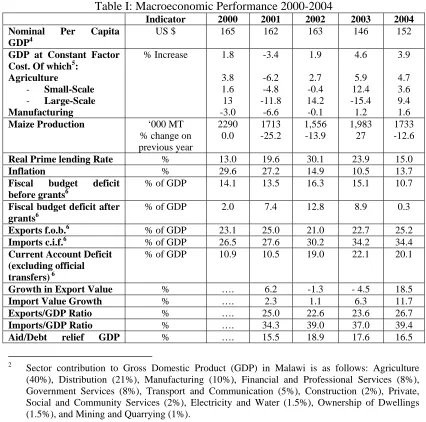
[image:6.595.91.517.279.701.2]Table I shows macroeconomic performance indicators from 2000 to 2004. The GDP growth rate was 4.6% in 2004, up from 3.9% in 2003. This is attributed to good performance of large-scale agriculture, manufacturing, construction and financial and professional services sectors2, and an average inflation rate of 12% between July and December 2004 (against an IMF projection of 18 %). Of more significance to the budget was a positive outturn of fiscal performance during the same period. Fiscal deficit including grants declined from 2.3% of GDP in the first half of the 2003/2004 financial year to 1.6% of GDP over the same period in the 2004/2005 financial year. This followed good expenditure control and management. Interest rates were cut from 35% to 25% in June 2004, with an exchange rate stabilising at K 108 to the US dollar. Expenditure was kept within the budget and almost all SMP targets were met3.
Table I: Macroeconomic Performance 2000-2004
Indicator 2000 2001 2002 2003 2004 Nominal Per Capita
GDP4
US $ 165 162 163 146 152
GDP at Constant Factor Cost. Of which5:
Agriculture
- Small-Scale
- Large-Scale Manufacturing
% Increase 1.8
3.8 1.6 13 -3.0 -3.4 -6.2 -4.8 -11.8 -6.6 1.9 2.7 -0.4 14.2 -0.1 4.6 5.9 12.4 -15.4 1.2 3.9 4.7 3.6 9.4 1.6
Maize Production ‘000 MT % change on previous year 2290 0.0 1713 -25.2 1,556 -13.9 1,983 27 1733 -12.6
Real Prime lending Rate % 13.0 19.6 30.1 23.9 15.0
Inflation % 29.6 27.2 14.9 10.5 13.7
Fiscal budget deficit before grants6
% of GDP 14.1 13.5 16.3 15.1 10.7
Fiscal budget deficit after grants6
% of GDP 2.0 7.4 12.8 8.9 0.3
Exports f.o.b.6 % of GDP 23.1 25.0 21.0 22.7 25.2
Imports c.i.f.6 % of GDP 26.5 27.6 30.2 34.2 34.4
Current Account Deficit (excluding official transfers) 6
% of GDP 10.9 10.5 19.0 22.1 20.1
Growth in Export Value % …. 6.2 -1.3 - 4.5 18.5
Import Value Growth % …. 2.3 1.1 6.3 11.7
Exports/GDP Ratio % …. 25.0 22.6 23.6 26.7
Imports/GDP Ratio % …. 34.3 39.0 37.0 39.4
Aid/Debt relief GDP % …. 15.5 18.9 17.6 16.5
2
Sector contribution to Gross Domestic Product (GDP) in Malawi is as follows: Agriculture (40%), Distribution (21%), Manufacturing (10%), Financial and Professional Services (8%), Government Services (8%), Transport and Communication (5%), Construction (2%), Private, Social and Community Services (2%), Electricity and Water (1.5%), Ownership of Dwellings (1.5%), and Mining and Quarrying (1%).
3
2004/05 Mid-Year Economic and Fiscal Report, Ministry of Finance
4
IMF Staff Estimates April 2005
5
Malawi Government 2004 Economic Report
6
Ratio
Debt Service/Exports % 22.0 19.9 20.2 23.5 21.6
Debt Service/ Govt. Revenue
% 30.0 29.3 29.1 31.4 34.97.
Sources: National Statistics Office, Ministry of Economic Planning & Development and IMF.
General elections-related expenditures and domestic debt service payments created budgetary overruns during the first half of 2004. Government spending in 2004 rose by 18% in real terms. As revenues increased by 23 percent, this helped to reduce the fiscal deficit somewhat. Statistics from the Reserve Bank of Malawi (RBM) indicate that the domestic debt stock increased to MWK 54 billion in 2004, up from MWK45 billion at the close of 2003. The bulk of the increase came from Government overdrafts from the Reserve Bank of Malawi and issue of treasury bills to finance cash shortfalls in budgetary operations during the course of the year. However, this is a significant slowdown when compared to a MWK13 billion increase in 2003. Government’s tight fiscal stance and renewed budgetary support from donors is expected to further slow down the expansion of domestic debt stock. Data from the RBM indicate that in the period July – December 2004 Government began to reduce its debt. Indeed, interest payments on domestic debt in the FY2003/048 revised budget accounted for approximately US$158 million (10% of GDP) while in the FY 2004/05 revised budget it accounts for about US$148 million (8% of GDP). The downward trend mainly reflected the reduction in interest rates following a cut in the bank rate from 35% to 25% in June 2004. Annual inflation increased to 13.7% in December 2004, compared to 9.8% in December 2003, fuelled mainly by increases in food and fuel prices.
Government of Malawi’s external debt stock stood at US$3.2 billion as at end of 20049. External debt service in the FY 2004/05 revised budget accounts for about US$26 million (1.4% of GDP). Malawi qualified for HIPC relief in 2000 and substantial sums (approximately 2 to 3% of GDP) have been factored into the 2002/03, 2003/04 and 2005/05 budgets. Despite substantial progress, HIPC Completion Point is not likely to be reached before 2006 as six specific triggers are still outstanding (out of 23)10.
In June 2004, the new Government agreed to a Staff Monitored Programme (SMP) with the IMF, setting macroeconomic and fiscal targets covering the period July 2004 – June 2005. Government satisfactorily met the SMP quantitative benchmarks for the period ending in December 2004. However, higher costs than foreseen arising from the Government wage policy reform, fertiliser subsidy and maize purchases are likely to pose serious challenges in meeting 2005 targets.
The resumption of budgetary support in 2004 improved the foreign reserves situation in the country. RBM figures indicate that in December 2004, foreign reserves were equivalent to 2.7 months of imports. The increased availability of foreign exchange from exports and donor inflows cushioned the Malawi Kwacha from severe depreciation. Malawi is highly dependent upon donor aid with the aid-debt
7
This figure is for FY 2004/05. Source:Draft Financial Statement for FY 2005/06
8
Malawi Government Budget Documents for FY 2004/05 and FY 2005/06
9
Monthly Economic Review for April 2005
10
relief/GDP ratio reaching 16.5%. The debt service burden is heavy, absorbing over 20 percent of export earnings and 34.9 % percent of Government’s revenue.
In 2004, Government suspended the privatisation programme to take stock of progress and begin to map the way forward. The privatisation of remaining Government-owned businesses, including Air Malawi and ESCOM (Electricity Supply Company of Malawi), was put on hold pending the completion of this review.
One critical area in public sector reform is the process of decentralisation which requires that there is a transfer of fiscal and other resources to the local authorities in order to permit them to effectively and efficiently undertake the decentralised functions and responsibilities. Malawi planned to decentralise major policy responsibilities to local government, but very little was implemented in 2004.
Another important area is transparency and accountability in the procurement of public goods and services. The Director for the ODPP (Office of the Director of Public Procurement) was appointed in March 2004, but the office is too understaffed to be effective.
Central to a sustainable and comprehensive financial management system in government is the full implementation of the Malawi Financial Accountability Action Plan (MFAAP). The Government approved the Malawi Financial Accountability Action Plan (MFAAP) in May 2004, but implementation did not start in 2004. The Ministry of Finance Medium Term Expenditure Framework programme (MTEF II) covering the implementation of budget division priorities within the MFAAP was not finalised in 2004.
Malawi’s economy is relatively open, with exports and imports respectively accounting for 27% and 39% of GDP. The current account deficit excluding official transfers has worsened over the past three years, reaching MK37 billion (around €257 million) in 2004. However, as a percentage of GDP, the current account balance improved from 22.1% in 2003, to -20.1% in 2004. The trade deficit slightly improved over that of the previous year (reaching MK21 billion in 2004) but is still part of an overall worsening trend in trade deficit levels over the past five years.
Export proceeds (determined largely by tobacco) grew by 18.5% in 2004, generating sufficient external resources to finance an 11.7% growth in recovery-induced imports, whilst reducing the current account deficit by 1.5% of GDP. The tobacco marketing season closed on 25th November 2004, with the volume of tobacco sold increasing by 48.8% as compared to 200311. Despite a lower tobacco price, tobacco proceeds in 2004 were US$205.6 million, a 41 % improvement on 2003 proceeds. For the period covering January to November 2004, tea production increased by 13.9% as compared to 2003 and total earnings amounted to approximately US$15.9 million, a 10% increase on 2003 proceeds. Sugar production was 28.7% lower than in 2003, due largely to poor weather conditions. Some MT 84 000 of sugar were exported reflecting a reduction of sugar exports as compared to 2003. Out of the MT 46 825 MT exported to non-African markets (less that 1% in refined form), some 46
11
% was exported under the Special Preferential Sugars/Everything But Arms Initiative in September 200412.
Malawi’s trade policy has seen a significant shift, which centres on the country being transformed from an importing and consuming country to a predominantly producing and exporting one13. Malawi’s external trade policy is thus oriented towards diversification of both products and markets. Although Malawi is currently negotiating the EPAs under the ESA regional grouping, there is an ongoing internal debate with regard the country’s configuration as in terms of trade flows, SADC would be the more logical configuration for Malawi to negotiate under. The main outcome of Malawi’s EPA Impact Assessment Study was that Malawi is better off negotiating an EPA than not. Other than this, many specific studies on the consequences of the EPAs are yet to be developed. On the Doha Development Agenda (WTO issues), Malawi continues to show willingness to commence discussions on Trade Facilitation. Tariff escalation, the removal of tariff peaks and the reduction in non-tariff barriers remain issues of high importance to the GoM.
Malawi belongs to both the Southern African Development Community (SADC) and Common Market for Eastern and Southern African States (COMESA). Malawi’s average tariff rate remained at 14 percent in 2004, with the maximum rate in the four bands at 30 percent. As a member of COMESA, Malawi is committed to implementing a plan for a Customs Union in 2005, establishing a common market by 2014 and becoming an economic community by 2025.
Between 30 - 40% of Malawi’s exports are to the EU. The main exports are tobacco (63%), sugar (21%)14 and tea (10%). After the EU, Malawi’s main export partners are South Africa (22%) and the US (15%). In terms of imports, Malawi’s main trading partner is South Africa (46%) followed by Zimbabwe (13%) and the EU (12%)15,16.
Malawi attended the official launching of the Economic Partnership Agreement (EPA) negotiations in February 2004 as a member of the Eastern and Southern African (ESA) region. In July 2004, Malawi established its National Development and Trade Policy Forum (NDTPF) as agreed in the EU–ESA Roadmap for the EPA negotiation process.
2.3 Update of the social situation
The UNDP Human Development Report (2004) ranks Malawi as number 165 out of 177 countries on the Human Development Index. The Human Development index for Malawi is 0.388 which means that close to two-thirds of the population of 10 million people, 51 per cent of whom are women, live in poverty17. According to the
12
Stanbic Bank – Highlights on the Malawi Economy, December 2004.
13
United Democratic Front (UDF) Manifesto and the Inauguration Speech of His Excellency, Dr. Bingu Wa Mutharika, President of the Republic of Malawi, June 2004.
14
Malawi’s sugar exports to the EU fall under three different schemes; (i) the Sugar Protocol (+/-20,000 MT), (ii) the Special Preferential Sugars scheme (+/- 11,000 MT) and (iii) the EBA initiative (+10,000 MT). In 2004, Malawi exported approximately 42,000 MT to the EU.
15
The main products imported from the EU into Malawi are machinery (33%), chemicals (27%), pulp, paper 13% and vehicles (8%).
16
Consolidated trade statistics for 2004 are not yet available.
17
1998 Integrated Household Survey (IHS) 65.3 percent of the population was poor, with 29 percent living in extreme poverty. Some 40% of the population is expected to survive on a daily income of US $0.30.
Table II shows data for some of the Millennium Development Goals (MDG) indicators (no data are available for 2004). Of high concern is that maternal mortality has doubled in the last 10 years and is about 1,120 for every 100,000 live births (not shown in table II). This is due to haemorrhage, sepsis, pregnancy-induced hypertension, obstructed labour and abortion complications. Modestly encouraging, is that under-five mortality has fallen from 234/1000 live births in 1992 to 189/1000 in 2000 even though the absolute levels are very high. Challenges in this area are water and food-borne diseases, the high incidence of malaria amongst children and pregnant mothers resulting in anaemia and low birth weight of babies.
The number of children immunised against measles was 55% in 2003 against a target of 84% for 2005. The deteriorating vaccination rate for measles is due to government failure in providing basic health services to the population a well as significant under-spending on Pro-Poor Expenditures (PPEs) (particularly in the education and health sectors).
The enrolment gains registered by the introduction of Free Primary Education in 1990/91 were quickly negated by high drop-out rates of 10 to 15 % in the period 1990 to 2000, except in 1994/95 when the rate rose to 27%. High drop-out rates are due to the low value attached to education (especially for girls), long distances to school, early pregnancies, lack of food and clothes and poverty. Overcrowding and lack of recreation facilities are cited as reasons for dropping out in junior classes. Drop-out rates by gender show that girls drop out at a faster rate than boys due to lack of gender-sensitivity by teaching staff and inadequate sanitary facilities for girls.
According to 2000 estimates, the proportion of people with access to potable water was 62% (percentage of households within 1 km of a water source), increasing at 1% per annum. The target of achieving 78% coverage can probably be achieved
assuming that the annual increase in coverage is sustained. 2.3.1 Food and
Nutrition Security
[image:10.595.94.522.644.753.2]Erratic rainfall coupled with the high cost of fertilizer and agricultural credit resulted in a 2004 maize harvest of only 1.7 million tonnes. This is 12.6% below the 2003 maize harvest of nearly 2 million tonnes. However, a strong increase in the production of cassava, sweet potatoes and Irish potatoes might have helped to ease the food security situation somewhat.
Table III: Smallholder Crop Production Estimates (‘000 tonnes)
Crop 2000 2001 2002 2003 2004
Maize 2 501 1 713 1 556 1 983 1 733
Cassava 2 794 3 362 1 540 1 735 2 559
Sweet Potatoes 1 918 2 586 1 061 1 535 1 784
Irish Potatoes 160 323 325 399 421
Groundnuts 122 155 159 190 161
Sorghum 37 37 399 45 41
Millet 20 20 20 25 17
Pulses 267 304 283 323 247
Concerned by a possible food shortage, the Government decided in July 2004 to import MT 70 000 of maize (but purchased only MT 32 000). In November 2004, the EU agreed to the release of MT 10 000 of maize from the SGR to the World Food programme to help avoid a break in the cereals pipeline for humanitarian food aid.
2.3.2 HIV/AIDS
The Millennium Development Goals on HIV/AIDS require that all countries begin to reduce and reverse spread of the infection. The 2003 estimates show that the prevalence of HIV/AIDS among adults in the 15-49 year age group was 14.4%. This translates to approximately 760,000 infected people in this age group, 58% of whom are women. The prevalence was higher in urban areas at 23% and lower in rural areas at 12.4%. Although the prevalence rate has apparently remained at 14-15% since 1998, new infections are still occurring at a rate of about 80,000 per year (Sentinel Surveillance Report, NAC 2003). Despite almost universal awareness of the mode of infection, condom use is viewed as ‘unnatural’. Even in ‘high-risk’ contacts, only 39% of men use condoms (2000 data). Culturally, men are tolerated to have multiple partners, either through polygamy or extra-marital relationships. There is also resignation among the population concerning their HIV status.
Government formally launched the National Policy on HIV/AIDS in February 2004. Principles of the policy include a public health approach to the epidemic, promotion and protection of human rights, greater involvement of people living with HIV/AIDS, political leadership and commitment. The policy addresses complex issues which include beneficial disclosure, an expanded basis for HIV testing and counselling and diagnostic testing. Financial commitments on the order of US $270 million have been obtained from the Global Fund and from several multilateral and bilateral co-financing partners. The Fund disbursed some US $7 million in 2004, mostly for implementation rollout of the Anti-Retroviral therapy programme. The number of people on ARVs rose from 5 000 in early 2004 to 9 000 in December 2004. The NAC has been criticised for the slow implementation of its projects as well as for its limited coordination with other partners in the health sector. In 2004, the World Bank approved a Multi-Sectoral AIDS project of US $35 million to help Government mitigate the impact of the disease throughout Malawian society.
Most current and planned EU-financed programmes include HIV/AIDS initiatives. The Public Works Programme for example has made its response central to its work and appointed a HIV/AIDS Coordinator.
2.3.3 Gender
Women in Malawi continue to form a major force in the country’s socio-economic activities. The Malawi Poverty Reduction Strategy (MPRS) acknowledges that gender disparities in Malawi are one of the major causes of poverty. The 1998 IHS showed that 52 percent of the 65.3% of Malawians living below the poverty line were females and that 25% of the households were female-headed.
A major achievement in 2004 was the launch of the National Gender Programme which implements the National Gender Policy. This focuses mainly on education and training, reproductive health, food and nutrition, security, natural resources and environmental management, governance and human rights, poverty eradication and economic empowerment. Gender issues have been addressed as a self-standing set of activities in several EU funded projects. This includes making credit lines available through the Micro-Projects Programme to women entrepreneurs and farmers. Gender issues have also been a thematic priority of the NICE programme. In addition, the Public Works Programme appointed Gender and Environment Officers to ensure that gender issues are incorporated into planning and operations.
2.3.4 Environment
Policies and programmes to arrest degradation of the environment are an integral part of the MPRSP. High population density and poverty are exerting unsustainable pressure on natural resources. Rapidly rising demand for energy (especially for fuel wood needed for cooking) and agricultural expansion have resulted in large-scale deforestation. The National Strategy for Sustainable Development (NSSD) and the National Environment Action Plan (NEAP) were launched in 2004. NEAP includes projects for developing alternative sources of energy, including the use of solar energy. However, there is a lack of supportive legislation and as a result implementation is weak. Funds to finance projects did not become available in 2004. A number of EU supported programmes focus on specific aspects of the environmental policy and natural resources management, such as forestry, soil and water conservation, However, a holistic approach to environmental issues is lacking. For example, many bridges, which have been washed-away due largely as a consequence of deforestation in river valleys, are being replaced under the EU-funded Lakeshore Road Infrastructure Programme. This project does not address afforestation in the river valleys in order to diminish the risk of further flooding, and links with other EU funded projects could be developed (Both the Public Works Programme and Microprojects 4 programme have forestry components).
2.3.5 Health
Health indicators for Malawi remain poor. Life expectancy has fallen to 37.8 years, with HIV/AIDS a strong contributing factor. The effectiveness of the health system is severely affected by the continuous depletion of human resources due to a high turnover of staff, particularly nurses and midwives who migrate to other countries. In 2003, Malawi filled only 28 percent of vacant nursing positions. One hospital in AIDS-stricken Malawi had 30 nurses, 26 of whom had plans to leave the country. This is a good representation of the reality in most hospitals. The main cause of attrition among health workers in Malawi is not migration but death, mainly from HIV/AIDS18 (attrition rate of at least two nurses per week). The critical shortage of human resources has been exacerbated by the increasing demand for health services due to the HIV/AIDS pandemic. Other problems in the health sector include absent and inadequately compensated health personnel, insufficient essential drugs, and shortage of clinical and technical support services. The expenditure per capita achieved in FY 2003/2004 was only US$0.96 against a MPRS health expenditure target of US$1.25 per capita. In October 2004, a SWAp (Sector Wide Approach) for
18
the health sector was signed by key donors, constituting a significant step towards an integrated approach to the health sector and towards increased donor coordination. The initiative will begin to address the issues like high staff turnover by, for example, offering better pay packages.
2.3.6 Education
Since the introduction of free primary education in 1993/1994, enrolment increased from 1.9 million to over 3 million by 2004. Gross enrolments are very high at over 130, showing that both under and over-aged children, including repeaters, burden the primary education system. The net enrolment rate improved from 7 percent in 1998 to 85 percent in 2002, against a target of 88 percent for 2005. However, the quality of education is poor and the amounts allocated for education over the past few years were below those in the MPRSP. Other contributory factors are the shortage of trained staff and a high teacher attrition rate, largely induced by HIV/AIDS. Migration of persons in the education sector is not a significant concern. In this regard, teachers are more likely to leave the sector and continue in another service area, as opposed to migrate out of Malawi. Among the achievements in Basic Education was the launch in February 2004 of the Early Childhood Development (ECD) policy. A national strategy for community participation in primary school management was also adopted. At the secondary and higher level, the focus was on access and equity, improving quality and relevance of education. At the tertiary level, the focus was on reducing reliance on Government financing.
2.3.7 Migration Profile
During the civil war in Mozambique, Malawi was host to approximately 1.9 million refugees, most of whom were repatriated in the mid 1990s. Malawi at present has about 7,000 refugees 19 coming mostly from the Great Lakes area (Burundi, DRC and Rwanda), and increasingly from Somalia and Ethiopia. The pattern observed in 2004,was that of transitional migration into Malawi with the final destination being South Africa, Mozambique and Zimbabwe. The law does not allow the permanent resettlement of refugees and does not permit them to work or study. In practice, however, the law is not enforced. The government accepts all/most asylum seekers based on the decision of a Board which determines refugee status20. The reasons for immigration into Malawi range from economical gain to pure necessity.
19
Internal Country Office Reporting, UNHCR Malawi, 2004.
20
Table II: Data on Millennium Development Goal indicators for Malawi
Type Indicator 97 98 00 2001 02 03 Target 2005
Impact 1. Population living on less than $1 per day (%)
65 65 54 65.3 -- 59
2. Prevalence of underweight children (under-5) in %
30 -- 25 25 25 20
3. Under-5 mortality rate (death per every 1000 live birth)
241 (1990
data)
189 189 183 182 150
Out-come
4. Net enrolment ratio in primary education (%)
99 76 78 81
85 88
5. Primary Completion Rate (%)21
33 (1990
data)
-- 64 -- -- --
6. Ratio of girls to boys in education - primary - secondary - tertiary 91 55 -- 97 -- -- 96 75 38 -- -- -- -- -- -- 100 -- -- 7. Proportion of births attended
by skilled health personnel 22 (%)
56 -- 56 56 40 41 --
8. (a) Proportion of 1-year-old children immunized against measles (%)
(b) Proportion fully immunized against TB
-- -- 91 84 69
78
55 84
9. (a) HIV prevalence rate in % in young females (15-24) (b) HIV prevalence for ages (15-49) -- 14.4 -- 14.6 -- 14.7 14.9 14.6 15 14.5 1823 14.4 11- 1824
10. (a) Proportion of population with access to potable water25 (%)
(b) Population without access to improved water source (%)
-- -- 57 --
43
84
Sources: National Statistical Office, Malawi Integrated Household Survey (1998 & 2000), Malawi Demographic and Health Survey (2001), MPRSP (2002), National Aids Council (2003), UNDP Malawi Country Report on MDG (2002), UNDP Human Development Reports, UN World Development Reports, UNAIDS Global Report (2002), DFID Statistics on International Development, WDI 2002, HMIS Bulletin (2002-2003).
21
Defined as completion of Standard 8 for adults aged 25 years and above
22
“Skilled Health Personnel” is defined as: doctors/ trained nurse/ midwife/ ward attendant; excluding traditional birth attendants (additional 22.7%).
23
11% representing the “low estimate”; 18% representing the “high estimate”; 16% for women 15-49
24
Prevalence among women antenatal clinics (national figure).
25
3. Development Agenda of the Partner Country
In 2002, the Government and its development partners formulated the Malawi Poverty Reduction Strategy (MPRS) with the aim of reducing poverty through economic growth and empowerment of the poor26. The implementation of the MPRSP made slow progress in 2003 and showed mixed results in 2004. There is thus little progress towards poverty reduction. However, some positive developments were:
(i) In 2003/2004, food availability increased relative to 2002, with Government figures indicating agricultural production rose by 6.8 percent in 2003 and a further 7 percent in 2004. Over this two-year period maize production is estimated to have risen by 11 percent, while small-scale agriculture production – significant for poverty alleviation – rose by 19 percent;
(ii) Economic growth in 2004 rose to 4.9 percent, up from 4.4 percent in 2003. The sustained recovery of 2004 was brought about by strong growth in agricultural production, together with a 10 percent expansion in mining and a 7.5 percent increase in construction.
The new Government put more emphasis on the implementation of the already existing Malawi Economic Growth Strategy (MEGS). Its aim is to achieve an annual minimum economic growth of 6 % which is deemed necessary to generate the resources needed for meaningful poverty reduction. The MPRS will expire in 2005 and it is expected that the MEGS will form the core of the new Government’s approach to poverty reduction. The MEGS reflects the new Government’s vision that Malawi should move from being an importing and consuming society to becoming an exporting and producing economy. Government will continue to pursue the objective of reducing poverty by prioritising economic growth for poverty reduction as well as by pursuing social programmes, HRD (Human Resource Development), safety nets, and cross-cutting issues.
The Transitional Economic Reform Agenda that is being prepared stresses policy reform, institutional reform and programme reform. To achieve economic growth of 6 % per annum, measures are being proposed to reverse the declining trend in private and public investment which reached a low of 7.3 % in 2004. Most of the decline came from the public sector where recurrent expenditures, including domestic debt service, absorbed a rising share of revenue. This decline will be reversed and public investment will no longer be considered a residual in the Government’s Budget. Instead, the PSIP (Public Sector Investment Programme) will be integrated into the MTEF (Medium-Term Expenditure Framework) and the Annual Budget. The closer link between the PSIP, the MTEF and the Budget is also expected to contribute to better aid management and co-ordination. Private investment fell in 2004, to an all-time low of 1.4 % of GDP, thus underscoring the urgency of bold measures to regenerate private investors’ confidence in Malawi’s economic prospects.
As regards sectoral priorities of the new Government, improvement of infrastructure commands the highest priority in economic services. In the social sectors, it is HIV/AIDS, health and education. The Treasury Task Force started to design the new policy framework with contributions from donors.
26
As regards trade policy, priority has been given to the development of a stimulative export policy. Government policy now places greater emphasis on strengthening trade related regulatory systems. A draft trade remedies law is being drafted whose objective is to encourage international traders to invest and open businesses in the country. The Government is also looking into the operationalisation of the Consumer and Competition Acts so as to better protect the country’s infant industrial sector, as well as to ensure increased competitiveness for Malawi’s products.
Leading up to May 2004 elections, Government failed to keep public expenditures in check, leading to the discontinuation of the IMF Poverty Reduction Growth Facility (PRGF) in April 2004. Shortly after the elections, an IMF Staff Monitored Programme (SMP) was agreed between the new Government and the IMF. All but one of the SMP targets for December 2004 were met. This allowed several donors (World Bank, UK, Norway) to release budget support funds. Depending on continued adherence to the SMP macroeconomic and fiscal targets, a new PRGF may be resumed in 2005. Malawi will become eligible for HIPC Initiative completion after a suitable track record under a new PRGF has been demonstrated.
4. Overview of Past and Ongoing Co-operation
4.1 Focal Sectors
4.1.1 Focal Sector: Rural Development, Agriculture, Food Security and Natural Resources
a) Results
Malawi is one of the least developed countries in the world with about 86% of the population living in rural areas characterized by population densities about four times higher than the average for sub-Saharan Africa. The majority of the rural population, comprising an estimated 1.8 million small farming households, depends heavily on agriculture. Farmers with less than one hectare of land represent 56% of all smallholder households. Subsistence agriculture accounts for 64% of the income of the rural poor, most of which is consumed within the household. The average annual income is less than US $100. Increasing population pressure is restricting access to land and leading to environmental degradation, especially of the natural resource base, through soil erosion and depleted fertility levels.
Against this background, the following activities for intervention in the agriculture, natural resources and food security areas have been identified in the Country Strategy Paper and National Indicative Programme:
- Institutional development, including land reform
- Diversification of on- and off-farm income earning opportunities - Sustainable management of natural resources
- Safety net activities
Five new financing proposals, falling within the abovementioned activities, were finalised in 2004:
- Farm Income Diversification Programme (FIDP: € 36.5 million)27
- Institutional Development Across the Agri-Food sector (IDAF: € 8million)
- Improved Forest Management for Sustainable Livelihoods (IFMSL: € 14.9 million)13
27
- Income Generation Public Works Programme (IGPWP: € 25 million)
- Multi-Annual Food Security Programme (MAFSP) 2004-2006 (€45 million, €15 million annually).
The global objective of FIDP is to improve the livelihoods of rural communities through diversifying farmers’ incomes. The programme purpose is to increase food security and income levels in selected communities by encouraging business development and employment as well as through improved marketing of agricultural products (for both local and export markets).
The main thrust of IDAF is to improve institutional capabilities within the Ministry of Agriculture, Irrigation and Food Security, district agricultural services, farmer organisations and to provide support systems to promote agri-food trade and access to export markets. Public sector institutional capacities to foster development in the agri-food sector remain very weak. As a result, individuals and farmers’ organisations are unable to organise production effectively and achieve access to markets. The agri-food sector contributes approximately one-third of GDP and accounts for 90% of export earnings.
The Improved Forestry management for Sustainable Livelihoods is, in particular, complementary to FIDP and the Public Works Programme in that it is aimed at helping forest-dependent communities to engage in forest and non-forest income- generating activities.
The IGPWP programme, categorised mainly as a safety net activity, is aimed at providing much needed cash income for people in rural areas through community involvement in a range of demand-driven projects (re-forestation, small-scale irrigation, road rehabilitation and maintenance).
The €1.9 million “Support to Ministry of Land” project was also approved in 2004. This capacity building project was initiated in July 2004 with the aim of ensuring adequate capacity to carry out the Malawi Land Reform Programme Implementation Strategy (MLRPIS: 2003-2007).
Concerning the Food Security Budget Line, the EU together with other donors, maintained its support for the Joint Food Crisis Technical Secretariat (JFCTS). The JFCTS was renamed the Food Security Joint Task Force in 2004 to reflect the shift in focus from addressing a food crisis to tackling medium and long-term food security issues. Funding was also provided to the Ministry of Agriculture to develop a Food and Nutrition Security Policy. The Policy is intended to provide a coherent framework within which all stakeholders can more accurately direct efforts to mitigate the effects of chronic food insecurity. Progress in the formulation of this policy was slow in 2004 and the challenge remains to finalise the work in 2005.
Towards the end of 2004, Government purchased MT 32 000 of maize to replace the maize that had been improperly released from the Strategic Grain Reserve (bypassing the agreed procedures) in March 2004. The NFRA replenished the SGR with MT 28 000 using EU funds. The financial reserve, currently standing at €3 million, can be used to replenish the SGR in the case of emergency. Two technical assistants are supporting the financial and operational management of the SGR and its silos.
b.1 Activities Financed by the EDF
The Public Works Programme (PWP) was expanded in 2004 to include four more districts
approach was introduced in all programme components. The programme also now incorporates a “cash for assets” component. Up to December 2004, some 2 500 km of rural feeder roads were rehabilitated, 750 meters of timber bridge decks were replaced with concrete decks and some 2 100 km of rural feeder roads maintained. In addition, 24.5 million trees were planted on communal and individual woodlots, and 12.4 million seedlings were made ready for transplanting. Some 700 small-scale irrigation schemes covering 6,660 farm families were established and 7 District Assemblies became implementing agencies through 146 “cash-for-assets” projects. A pilot programme to mainstream HIV/AIDS and gender was implemented.
b.2 Programmes financed by the Food Security Budget Line
The Multi-Annual Food Security Programme (MAFSP) 2002-2004 focused in 2004 more on the accessibility dimension of food security. The MAFSP eased the transition from emergency to development aid and promoted the socio-economic reintegration of population groups that were affected by the hunger crisis of 2002.
Financial support of €150,000 was provided to the Association of Smallholder Seed Multiplication Action Group for capacity building, strengthening linkages and seed business development in 2004.
A comprehensive audit of the Agricultural Productivity Investment Programme (APIP) for the period covering 1997/98 through to June 2004 of 2003/2004 season was commissioned and carried out by Price Waterhouse Kenya. The audit identified key issues that need to be considered if APIP is to be sustainable in the long term.
Through the Food Security Budget Line, the EU continued to support the former ECHO-funded project to strengthen capacity of the Ministry of Health (Nutrition Department) and its structures, facilitate data collection for nutrition surveys, and establish a nutrition monitoring system.
The EU also supported a FAO project to promote diet diversification for malnourished groups and HIV/AIDS-affected and infected communities. Some 18 Nutrition Rehabilitation Units and up to 50 communities are being used to develop demonstration fields and training centres for targeted families who will receive training in agricultural techniques (traditional and diversified crops, labour saving technologies, permaculture, livestock, fisheries), HIV/AIDS prevention and the interaction between diet/nutrition and HIV/AIDS.
With EU and DFID pledges on the 2005 Food Aid Operation, MT 29 000 were released from the SGR (EU: MT 10 000; DFID MT 19 000). Other EC/GoM nutritional programmes helped feed malnourished children and pregnant and lactating women. Diet diversification for malnourished groups was also promoted. As a result, acute malnutrition remained low in 2004.
Organisation Title of Project EC Contribution SHMPA - Shire Highlands Mild
Producers Association
Smallholder dairy development project 994,043
SWET - Story Workshop Educational Trust
Rural development communication campaign 1,142,363
COSPE - Cooperazione per lo Sviluppo dei Paesi Emergenti
Rehabilitation, upgrading, crop diversification and marketing of Ngolowindo self help irrigation scheme
599,750
Movimondo Mangochi food security and land care project 1,981,974
COOPI - Cooperazione internazionale
Improvement of farming systems through the promotion of small holders farmers' co-operatives in Malawi Central Region
1,030,234
Concern Universal Njala Yatha Food Security Project 1,385,532
Concern Universal Dedza food security improvement project 2,757,155
CISP - Comitato Internazionale per lo Sviluppo dei Popoli
Food security improvement through Economic Diversification in Malawi
866,224
Inter Aide Food security project in Lilongwe East and Zomba south
1,166,351
World Vision UK Malawi Food Security Project 2,999,877
In 2004, the Food Security Budget Line was also utilised to bridge gaps between two EDF funding support programmes to the NAO Support Unit, the Public Work Programmes and the Better Land Husbandry Project.
The new €45 million MAFSP 2004-2006 programme, which is still to be signed, will aim to reduce chronic food insecurity at the national and household level through the implementation of a revised Food and Nutrition Security Policy. To achieve this, the programme includes 5 components, with annual amounts allocated as follows:
(i) Implementation of the Food and Nutrition Security Policy €2.30 million (ii) management of the Strategic Grain Reserve (SGR) €2.65 million (iii) improvement of institutional capacity in trade €0.85 million (iv) increase in household farm and non-farm incomes €5.35 million (v) improvement of nutritional status of vulnerable groups. €3.85 million
c) Degree of integration of crosscutting themes
The Public Works Programme programme employs a full-time environmentalist who monitors the environmental impact of all activities. Approximately 40% to 50% of persons employed in road works and forestry respectively are women. A pilot programme to mainstream gender and HIV/AIDS awareness and implement appropriate impact mitigation initiatives is being implemented. A study was conducted to determine the linkages that the programme can establish with NGOs and other organisations in implementing crosscutting themes.
Crosscutting issues relating to gender, environment, technology and HIV/AIDS have been incorporated in project activities of the €1,9 million “Support to Ministry of Land” capacity building programme.
4.1.2. Focal sector –Transport
a) Results
movements by rail, water and air transport has been declining, whilst movements by road remain steady (see transport indicators 5 and 6)28. This new policy reflects the need for Malawi, as a landlocked country, to grow faster, export more competitively and import at lower costs.
The National Road Authority’s capacity to maintain the road network declined sharply in 2002-2003, mainly due to a lack of adjustment of the fuel levy to offset the effects of Kwacha depreciation and inflation. In 2004, however, the fuel levies on diesel and petrol were increased by MWK 1.95 per litre, but by much less than the MWK 4 per litre that had been discussed by Government and donors at the end of 2003. This was influenced by conflicting demands from donors (IMF and others), which Government had to satisfy. This small increase is unlikely to make a significant difference to road maintenance capability as funding levels are still inadequate29. The amount spent on routine maintenance in FY 03/04 was €10.9 million, representing 80% of the Road Fund revenue. Maintenance works were carried out on some 4 600 km of roads, or about a third of the road network30. Spending on routine and periodic maintenance has declined sharply (50% and 85% decrease respectively) from its peak levels in 200131. It is noticeable that the decline in maintenance is coupled with a steady growth in funding for upgrading and new construction of roads.32
The change of Government in May 2004 brought a new start in the donor dialogue with Government on transport sector policy and several much needed reforms in the sector were carried forward.
To address the weaknesses in road management, the functions of the Road Fund administration will be separated from road management operations. This development, previously discussed with donors, will help to ensure more accountable and efficient use of Road Fund Revenues. Legislation was prepared for a new Road Fund Administration and a new Road Authority to replace the present National Roads Authority. This will be presented to Parliament in 2005.
To deal with Malawi’s serious road safety problems, the Minister of Transport & Public Works announced the Government’s intention to establish a Road Traffic Authority that will be responsible for all aspects of traffic management, with the power and resources, from vehicle owner charges, to enable effective enforcement of traffic regulations and improve road safety.
Support to reinforce the capacity of the privates sector consulting and contracting industry has been continued, mainly by training actions through the National Construction Industry Council. The Government also identified the poor capacity of the Central Materials
28
Domestic freight movements (‘000 tonne km) show a decline over the last five years from 79747 to 26531 for rail transport and 745 to 362 for lake transport. Freight movements (‘000 tonnes) by road over the same period show a steady increase in domestic traffic from 201 to 235 and 823 to 1087 for international traffic.
29
The projected revenue for FY04/05 is €13.7 million as compared with €11.2 million for FY03/04, €16.4 million in FY 02/03, and €20.9 million in FY 01/02.
30
In 2003, some 29% of the central and urban network was classified as good, 27% was fair and 44% was classified as poor. Malawi with some 80,000 registered vehicles has one of the highest accident fatality rates in the world. Road accident fatalities are at least 100 deaths per 10,000 vehicles as compared to 2/3 deaths per 10,000 vehicles in most EU countries.
31
Spend on routine and period maintenance has dropped from €37.7M in 2001 to €13.1M in 2004
32
Laboratory (particularly important to the road sector) as a major limitation, and EU assistance has been provided.
Showing confidence in the new Government’s policy, despite relatively poor performance in the sector in recent years, the Mid-Term Review of October 2004 allocated an amount of €75,5 million for the roads’ programme (including a road component under the Income
Generating Public Works Programme). Reflecting the lack of adequate funding for road
maintenance, the allocation will not be used to construct new paved roads. Rather, the focus is on backlog maintenance and institutional support for transport public bodies. It was also agreed in 2004 that steps towards achieving a sector programme, supported by all donors, would be initiated in 2005 with the longer-term aim of sector budget support.
b) Progress in activities
Road Management Support Programme: Several activities progressed in 2004, including (i)
re-launch of the tender for weighing stations, following the failure to award a contract when the first tenders exceeded the budget; (ii) short study to develop a strategy for introducing interventions in projects to address cross-cutting themes; (ii) delivery of training programmes to small contractors (iii) implementation of road safety schemes (iv) completion of a road network level survey to support NRA planning and (v) commencement of legal services for drafting legislation to enable separation of Road Fund administration from Operations. The NAO requested an extension to the validity of the Financing Agreement to allow completion of the programmed activities.
Karonga-Chilumba-Chiweta Road: The certificate of final acceptance was issued in August
2004, but final payments were still to be made at the end of 2004. The audit on revision of prices was completed, with the final report due early in 2005. A contract for the end-of-project evaluation has been signed and services will commence in 2005.
M1 (Masasa)-Golomoti-Monkey Bay Road: Works continued through 2004 but major
difficulties were encountered with base course materials not meeting the specified requirements. Taking account of the nature of the traffic expected to use this road, the NRA decided to relax the specification. The Commission approved a €5 million increase in financing for the project to cover increased costs, due to the base course problem, earlier design work and social interventions. A technical audit was carried out to review the design failings and confirmed the validity of the changes made to the project by the Contracting Authority.
Lakeshore Road Infrastructure Support Programme: The certificate of final acceptance was issued for the Dwambazi Bridge in April 2004 and payments have since been finalised. Contracts were signed for the 4 Bridges programme and works will be completed in 2005. A tender for the design and supervision of the Mangochi-Monkey Bay road was launched in November 2004 with services to commence in 2005. The technical assistance to the NRA has been extended to October 2005 to assist with preparation of 9th EDF pipeline projects. The NAO requested an extension to the validity of the Financing Agreement to 2008.
c) Degree of integration of crosscutting themes
local communities. Measures targeting the labour force are prescribed in the works contracts and are an obligation of the contractor. A significant financial provision was included in the additional financing for the Masasa-Golomoti-Monkey Bay project for crosscutting issues. A programme to increase HIV/AIDS and road safety awareness will be implemented in 2005.
To tackle the chronic road safety problem of Malawi, structural reforms are being investigated to combine various existing agencies into a Road Traffic Directorate and improve policy and enforcement of traffic laws. Each construction project also considers safety aspects and newer designs incorporate particular attention to the safety of pedestrians and cyclists, who account for a large fraction of the fatalities.
Through the Road Management Support Programme, training is being provided for emerging contractors in management, tendering and construction activities.
Gender and environmental issues are being addressed in several projects. Gender mainstreaming is included as a component of the engineering service contracts for design and supervision, requiring social aspects to be addressed and employment opportunities for women’s groups and disadvantaged groups to be promoted. In labour intensive projects e.g. Public Works road rehabilitation and maintenance participation of female clubs is common. Work hours and conditions can be designed such that family duties are not neglected. Environmental issues are addressed during the design phase, carrying out environmental impact studies where necessary and following national environmental regulations. Any work necessary for environmental remediation (e.g. filling of borrow pits, removal of equipment, removal of spoil, regrassing) is included in the works contracts. For example, as part of the Limbe-Thyolo-Muloza Road project, quarry sites and borrow pits were properly reinstated after use. Since most of the road section passes through tea estates, the road reserve was reduced to reduce the negative impact on the land. Similar measures were taken in other projects. Under the Masasa-Golomoti-Monkey Bay Road Project, women participation was encouraged.
The Roads Management Support Programme includes a significant component of NRA staff training. The project also includes a component of private sector training and a human resources study for the construction sector. One of its main objectives is the strengthening of transport sector management, including a streamlining of NRA functions, introducing a systematic approach to transport planning, and the sound organisation and financing of road maintenance.
4.1.3 Macroeconomic Support
a) Results
In anticipation that a new PRGF will be approved in 2005, the 9th EDF mid-term review (MTR) programmed a global commitment of some €41.5 million for budget support (€31.5 million plus €10 million for Fluctuations in Export Earnings (FLEX)).
In collaboration with other CABS members a common Performance Assessment Framework (PAF) and Partnership Framework was prepared. The latter will include indicators covering public financial management, social sector development and cross cutting issues. The EU will use the Framework as a guide in deciding on disbursement of the variable tranches under the new Budget Support programme. In November 2004, the PAF and Partnership Framework were submitted to Government. They are expected to be finalised and approved by both Government and donors in the early part of 2005.
b) Progress in activities in the implementation of the matrix of measures
The EU resumed its SAF IV (Structural Adjustment Facility) budget support by disbursing in March 2004 the remaining tranches 3 and 4 of €10 million and € 5.49 million respectively. This disbursement followed completion by the Government of the matrix-of-measures, specifically the contracting of an independent firm to conduct a verification of government arrears.
A Memorandum of Understanding governing the utilisation of counterpart funds arising from the disbursement of the third tranche was signed between the EU and Government. One of the conditions was that between July 2003 and June 2004 District Health Offices should be fully funded in accordance with the 2003/04 Budget. A Technical Assistant was attached to the Ministry of Finance to assist Government in reporting on the utilisation of the final tranche. In line with the MoU, Government submitted a final justification report showing that District Health Offices had indeed been financed according to the 2003/2004 budget.
c) Degree of integration of crosscutting themes
Gender, environment and institutional capacity building activities form part of the Budget Support programme in Malawi. Crosscutting issues are addressed in the MPRS (i.e. gender, environment, information technology and HIV/AIDS), which the CABS group considers to be the reference document for assessing Government progress in the provision of better social services. The Performance Assessment Framework includes one specific gender-related indicator (percentage of women in decision making positions). Also, the education and health indicators in the PAF are disaggregated by gender and HIV/AIDS prevalence.
4.2 Projects and programmes outside focal sectors
4.2.1 Developments in the Health Sector
In 2004, EU funding supported health sector reforms, the construction of two district hospitals, and the development of a national blood transfusion service. In October a Health SWAP (Sector Wide Approach) document was completed and signed by three key donors. This constitutes a significant step towards an integrated approach and increased donor coordination in Malawi’s health sector. Discussions with the Government on further assistance to the health sector through budget support under the 9th EDF were initiated.
The Physical Assets Management Programme came to an end in 2004. All equipment and materials were handed over to the Ministry of Health, and the Physical Assets Management Policy was officially launched in February 2004.
The objective of the Malawi Blood Transfusion Service (MBTS) Programme is to establish a sustainable national capacity to supply Malawi’s hospitals with safe blood and reduce the incidence of HIV/AIDS and other diseases transmissible by blood. In the Southern region, the project began collecting and testing blood destined for hospitals. Sites were identified for construction of blood banks in the Central and Northern Regions.
4.2.2 Governance Programmes
The National Initiative for Voters and Civic Education Programme (NICE) played a
significant role in the run-up to the 2004 General Elections by providing civic education to voters. NICE was also accredited by the Malawi Electoral Commission to monitor the elections and fielded monitors in 187 polling centres. NICE’s network covers all 28 districts. Activities are organised in a decentralised manner and provide information on democracy and human rights, gender, HIV/AIDS, food security and environment. The 28 district offices can call on some 10, 000 volunteers who take the work from the district to the village level. NICE publishes and distributes a quarterly newspaper called, “Tilime”, in English and the 3 main vernacular languages, which is in high demand in the rural communities.
The Promotion of the Rule of Law and Improvement of Justice Programme (RoLP) aims at
improving the productivity and quality of services rendered by public legal institutions in Malawi. Some of the main beneficiaries in 2004 were the Judiciary, Ministry of Justice, Prisons, Law Commission, Faculty of Law. National Compensation Tribunal, Anti-Corruption Bureau, and National Archives. The activities ranged from the preparation of law reports, to the training of civil servants in Administrative Law; and the start-up of digitalisation of historical archives to be accessible on line. The current Rule of Law programme is due to end in December 2005 and a new programme is being designed, including support to Parliament and the Electoral Commission.
The Capacity Building Programme for Economic Management and Policy Coordination
(CBPEMPC) provides support to the Ministries of Finance and of Economic Planning and Development. In 2004, the Department of Economics at Chancellor College of the University of Malawi became one of the beneficiaries. As regards economic management and policy work, the project supported, for example, the preparation of the Public Sector Investment Programme (PSIP) and development of the Monitoring & Evaluation Master Plan. Work also started towards the establishment of a Policy Analysis Institute. The project helped strengthen aid management by providing technical assistance and financing to the NAO Support Unit.
In 2004, the EU provided Support to the Election Process by contributing € 2 million to a trust fund managed by the UNDP to assist with the implementation of the Presidential and Parliamentary elections. The funds were mostly used to help the Election Commission provide ballot papers.
4.2.3 Micro Projects Programme (MPP)
The project has offices in the country’s three regions. During 2004, the financing agreement was revised to include (i) an increased presence of the programme at regional and district levels (ii) increased range of professional skills at regional level (iii) increased role for decentralised actors including NGOs and Local Authorities (iv) training and capacity building for Local Authorities and (v) increased community participation and expansion of project activities for pro-poor economic development.
Contracts have been awarded for the supply of materials and for skilled labour components of community projects. Works tenders have been launched for drilling 76 boreholes. Memoranda of Understanding were also signed with partner organisations and NGOs for the implementation of 9 projects and funding for 5 new NGO initiatives (i.e. water and sanitation, environmental preservation, appraisal of sustainable livelihoods, support to youth groups and the renovation of a health centre).
Previous MPPs had a component for support to women’s groups. The 4th MPP will seek guidance from the National Gender Policy (under formulation) and produce guidelines on gender to be used in assessing funding requests. The 4th MPP will take into consideration the impact of HIV/AIDS on beneficiaries and seek measures for mitigating it. Contractors on construction projects will be obliged to observe HIV/AIDS best practice with regard to minimising risk on site. The environmental impact of projects will be introduced as an assessmentcriterion for new projects.
4.2.4 Other projects
The purpose of the ASYCUDA (Automated System for Customs Data) is to provide infrastructure and equipment to the Malawi Revenue Authority (MRA) to modernise and automate its customs operations. Most construction and rehabilitation of buildings at border posts and inland examination centres was completed in 2004. The Financing Agreement (which has already been extended once) expired on 31st December 2004.
The Financing Agreement for the €7.5 million Technical Cooperation Facility project was signed in May 2004. Its objective is to assist Government in the design and implementation of its development strategies by facilitating the implementation of the 9th EDF CSP in Malawi The programme provides financial support for technical assistance, training support for projects and programmes and support for conferences and seminars. Several ministries expressed and interest in availing themselves of TCF resources
One outcome of the MTR was that the National Development and Trade Policy Forum (NDTPF) EPA Secretariat is scheduled to receive EU funding of some €1.6 million in 2005.
4.3 Resources for Non-State Actors (NSAs)
4.4 Utilisation of Envelope B
The October 2004 Mid-Term Review reduced the B-envelope (emergency aid) allocation of €63.8 million to €21.3 million. In 2004, a proposal for a €6.5 million Sustainable Nutrition Rehabilitation Project was developed. The objective of the project is to sustain the nutritional rehabilitation interventions supported by ECHO by smoothly linking relief, rehabilitation and development, while at the same time complementing the nutritional component that will be implemented under the future FSP in 2004-2007. The project will strengthen local and national ownership, including communities, by empowering them to recognise, prevent and address malnutrition. The project will be implemented by NSAs, benefiting from their expertise and experience with community based operations.
4.5 Other Instruments
4.5.1 STABEX
STABEX is phasing out and projects funded under this scheme are due to end in 2005/2006. Unused balances from poorly performing projects will be transferred to better performing projects in order to maximise potential gains of the programme. In addition, successful projects, notably support to the Small Holder Coffee Farmers Trust, Paprika Small Holders Growers Association (PAMA) and the tea sector may be eligible for assistance under the forthcoming Farm Income Diversification Programme (FIDP) and possibly Institutional Development Across the Agri-Food Sector (IDAF). STABEX will be replaced by FLEX (Financing for short-term Fluctuations in Export earnings) in the form of budget support for an amount of €10 million from the B-envelope. Subject to the Budget Support financing proposal being approved by the EDF committee in mid-2005, 100% of the expected allocation of €6 million for FY2002/2003 would be released end-2005on the basis of consolidated export statistics and final budget deficit figures to be provided by the government.
4.5.2 Regional Co-operation
The Nacala Development Corridor (NDC) is a transport route extending from the port of Nacala in Mozambique through Eastern Malawi to Zambia. In early 2003, the three Governments put in place an institutional framework to promote the NDC as a trans-boundary initiative. The Government has included the development of the Corridor as a key objective in its MEGS. In 2004, the Government also began discussions with the Governments of Tanzania and Zambia on the Mtwara Corridor.
With World Bank financing, a feasibility study and environmental assessment was launched in 2004 for inter-connecting the Malawian and Mozambican electric power grid. This may lead to less load-shedding which currently constitutes a significant impediment to economic expansion.
4.5.3 Community Budget Lines
In addition to the financing of 10 NGO projects via the Multi-annual Food Security Programme for €14.9 million, a further 7 NGO projects (encompassing health, water and sanitation) are being financed from the Co-Financing Budget Line for a total amount of €5.5 million (see table below). The management of NGO projects was transferred from Brussels to the Delegation in 2004.
Organisation Title of Project EC Contribution Sight Savers International Malawi Opthalmic Outreach Programme €963,247