This is a repository copy of Blended learning for project management. White Rose Research Online URL for this paper:
http://eprints.whiterose.ac.uk/8542/
Proceedings Paper:
Puplampu, A.B. and Tutesigensi, A. (2008) Blended learning for project management. In: Dainty, A., (ed.) Proceedings of 24th Annual ARCOM Conference. 24th Annual ARCOM Conference, 1-3 September, 2008, Cardiff. Association of Researchers in Construction Management , pp. 943-952. ISBN 978-0-9552390-1-4
[email protected] https://eprints.whiterose.ac.uk/ Reuse
See Attached
Takedown
If you consider content in White Rose Research Online to be in breach of UK law, please notify us by
White Rose Research Online
Universities of Leeds, Sheffield and York
http://eprints.whiterose.ac.uk/
White Rose Research Online URL for this paper:
http://eprints.whiterose.ac.uk/8542/
Conference paper
Puplampu, A.B. and Tutesigensi, A. (2008) Blended learning for project
management. In: Dainty, A., (ed.) Proceedings of 24th Annual ARCOM
Conference. 24th Annual ARCOM Conference, 1-3 September, 2008, Cardiff. Association of Researchers in Construction Management , pp. 943-952.
BLENDED LEARNING FOR PROJECT MANAGEMENT
Anna B. Puplampu1 and Apollo Tutesigensi
Department of Civil Engineering, University of Portsmouth, Portsmouth, PO1 3AH, UK
Students studying at postgraduate level should engage in learning on higher cognitive levels such as evaluation and creation. The notion of effective learning at this level is characterised by the student’s ability to use acquired knowledge and principles to solve complex problems. Learning theories advocate maximising student engagement with the learning resources in order to facilitate such effective learning. This can be achieved by addressing the following factors in curriculum design: accessibility, variety, formative assessment and the development of learning communities. This paper presents work done on a postgraduate level Project Management course to maximise the factors mentioned above, for example, with the introduction of automatically marked quizzes and the re-structuring of the course content. The content and delivery of the course was changed from weekly lectures and tutorial sessions (old system) to a web-based blended learning system (new system). Evaluation of the old and new systems was undertaken using questionnaires. The student evaluation suggests that the new system led to more effective learning. It is suggested that effective learning can be facilitated by a blended learning system.
Keywords: blended learning, cognitive processes, effective learning, project management
INTRODUCTION
Since its introduction the internet has played an increasing part in our lives. It has become a major method of communication and a widely used tool for the transfer of information. Various educational institutions have provided long distance learning courses for many years where the teaching is facilitated by post or more recently email (Ryan, Scott, Freeman and Patel 2000). The problem with this approach is that it lacks the interactivity present in the classroom. However, with the continuing advancement of technology, it is now possible to have a virtual learning environment (VLE) where students can actively be taught without having to be in the same physical space as the teacher or the other students.
In simple terms a VLE is an area on the internet where learning material can be collated and made available to students so that they can interact with it, with other students, and with the teacher to receive a complete learning experience. It is a tool that provides for synchronous, as well as asynchronous, communication and enables students to come together in an educational and social sense so that they can benefit from each other’s involvement (Paulsen 1995).
Teaching and learning practices should be aimed at achieving the transfer of
knowledge (Lauder, Sharkey and Booth 2004). This is a more complex process than the transfer of information and to be done effectively requires considered planning and
1
design. As with traditional methods of teaching, a VLE will only be beneficial if its development is influenced by appropriate models of learning and teaching. It is not enough to provide the course material alone, the course itself must be designed to facilitate the transfer of knowledge from the virtual classroom to the physical world (Lauder et al.). It has also been concluded that the role of the teacher is still central to the success or failure of the learning process and the VLE is only a tool which, however well designed, cannot foster interactivity in itself (Ryan et al.).
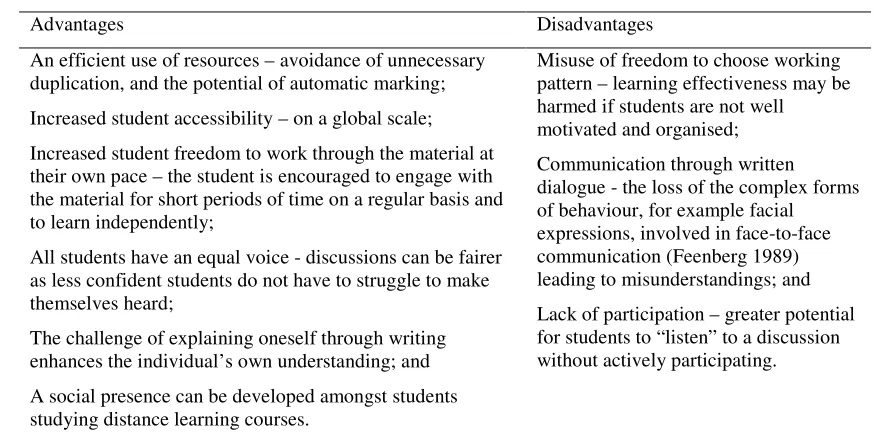
[image:4.595.56.493.220.440.2]There are various advantages and disadvantages which are associated with the use of VLEs for delivering courses. These are summarised in Table 1.
Table 1: Advantages and disadvantages of VLEs
Advantages Disadvantages
An efficient use of resources – avoidance of unnecessary duplication, and the potential of automatic marking;
Increased student accessibility – on a global scale;
Increased student freedom to work through the material at their own pace – the student is encouraged to engage with the material for short periods of time on a regular basis and to learn independently;
All students have an equal voice - discussions can be fairer as less confident students do not have to struggle to make themselves heard;
The challenge of explaining oneself through writing enhances the individual’s own understanding; and
A social presence can be developed amongst students studying distance learning courses.
Misuse of freedom to choose working pattern – learning effectiveness may be harmed if students are not well motivated and organised;
Communication through written dialogue - the loss of the complex forms of behaviour, for example facial expressions, involved in face-to-face communication (Feenberg 1989) leading to misunderstandings; and
Lack of participation – greater potential for students to “listen” to a discussion without actively participating.
VLEs clearly have significant advantages, but their exclusive use can have some negative consequences. However, these negative aspects may be minimised, or even eliminated, by the use of VLEs in addition to other approaches in a blended learning style. The University of Portsmouth defines blended learning as "a mixture of different media and teaching methods to enhance education. It can include a mixture of face-to-face, elearning, problem-based learning, work based/related learning as well as paper and books" (Bunker 2005).
In the work reported in this paper, the blended learning system consisted of weekly face-to-face lectures and tutorials and a "24/7" VLE as described in Tables 2 and 3. A blended learning system, providing a mix of both online and face-to-face experiences which support each other in achieving desired learning outcomes (Ginns and Ellis 2007), has the potential to address the disadvantages of both the classroom-based and the web-based learning environments without compromising the associated
advantages.
Blended learning
Project Management course through a blended learning system were used to evaluate its effectiveness.
RESEARCH PROBLEM
If a learner has learnt effectively, rather than being able to simply remember what was taught, they should be able to understand and apply what they have learnt (Boydell 1976). This is effectively the transfer of knowledge. VLEs have the potential to direct the power of the internet to go beyond simply the transfer of information and to achieve the transfer of knowledge.
The aim of this study was to evaluate the use of a web-based course, either as the sole method of teaching or as part of a blended learning system, to teach postgraduate students Project Management within the context of the Construction Industry.
In order to achieve the aim, the following objectives were pursued:
To determine what constitutes effective learning and the ways in which it can be promoted;
To determine views on the effectiveness of the classroom-based postgraduate Project Management course taught at the University of Portsmouth;
To evaluate the potential of a web-based course developed to teach the postgraduate Project Management course; and
To evaluate a blended learning system that incorporates elements of both the classroom-based and web-based courses.
METHODS AND RESULTS
In order to be able to design a course with characteristics which promote effective learning through a VLE, it was first necessary to determine what factors contribute to effective learning. There are a number of theories that explain the process of learning. These include cognitive, gestalt, experiential, and multimedia learning theories.
Cognitive theory
Learning is achieved through a change in the learner’s perception of their environment (Hill 2002). In order to effectively teach the learner to deal with a complex task, it is recommended that the task is analysed and broken down into various component items (Gagné 1962). These constituent components should been learnt and brought together in a coherent way. One method for the coherent combination of old and new
knowledge is to tell the learner what they will be taught and to explain how the new knowledge will fit in with what they already know.
Gestalt theory
The learner has whole systems of perceptions, known as gestalts, in which the parts are interrelated in such a way that separately they cannot be used to infer the whole (Hill 2002). The process by which a gestalt is changed is known as ‘insight’ and occurs when the learner suddenly feels that they understand something that was previously a mystery. According to gestalt theory it is through confusion that learning occurs and the learner needs to be presented with problems which they can solve.
Experiential learning
Learning is achieved through the learner sorting things out for himself; assessing his experiences and giving them their own meaning (Boydell 1976). A concrete
makes sense of the situation or problem (abstract conceptualisation) and from there makes plans as to how to deal with the experience should it arise again (active experimentation). Bligh (1972) suggests that discussion is an effective method of stimulating thought and advocates its use to encourage experiential learning.
Structured exercises, designed to emphasise particular learning objectives, are another tool which can be used in experiential learning (Boydell 1976).
The teacher must also play a part in the learning process and should strive to develop an active learning community, conducive to experiential learning, where students are encouraged to actively participate, and understand that making mistakes is a necessary part of the process (Boydell 1976). In addition, the teacher must guide the learners by correcting mistakes and misunderstandings, so that they can be learnt from.
Multimedia learning
The human mind processes verbal and visual material through two different information processing channels. The verbal channel processes material which is presented as printed or spoken words, while the visual channel processes static
graphics, for example pictures, and dynamic graphics, for example videos. Each of the channels has a limited capacity so that only a certain amount of information can be processed at one time (Mayer 2001). Learning occurs when the learner organises the selected incoming information into coherent mental representations and integrates these with the knowledge they already have (Mayer 2001). To present material in only verbal form ignores the potential of the visual channel for processing
information, and the incorporation of relevant pictures can aid students' learning (Mayer 2001).
In line with the advice drawn from the learning theories above Biggs (2003) has recommended the following procedures for teaching which aids deep learning:
1. Teaching in such a way as to explicitly bring out the structure of the topic or subject;
2. Teaching to elicit an active response from students, e.g. by questioning and presenting problems;
3. Teaching by building on what students already know; 4. Confronting and eradicating students’ misconceptions; 5. Assessing for structure rather than independent facts;
6. Teaching and assessing in a way that encourages a positive working atmosphere, so students can make mistakes and learn from them; 7. Emphasising depth of learning, rather than breadth of coverage; and 8. Using teaching and assessment methods that support the explicit aims and
objectives of the course.
The depth of learning which a student has reached in a particular subject area can be classified in terms of the cognitive processes which the student is capable of. In order of increasing complexity the cognitive processes are; remember; understand; apply; analyse; evaluate; and create (Krathwohl, Anderson, Mayer, Pintrich, and Wittrock 2001). The more complex cognitive processes cannot be performed unless the student is capable of the less complex ones. Krathwohl et al. define the cognitive processes in the following way:
Blended learning
Understand – constructing the meaning of instructional messages, including oral, written and graphic communication;
Apply – carrying out or using a procedure in a given situation;
Analyse – breaking material into its constituent parts and determining how the parts are related to one another as well as to an overall structure or purpose;
Evaluate – making judgements based on criteria and/or standards; and
Create – putting elements together to form a novel, coherent whole or to make an original product.
Students studying at postgraduate level should be aiming at achieving the top two levels of the cognitive process hierarchy; a goal which requires them to be capable of the lower four processes. These levels are linked to the idea of effective learning as the further up the cognitive process hierarchy a student is the deeper will be their knowledge of the subject area. Therefore, postgraduate level students should be taught in a way which leads them through each of the cognitive processes.
Development of the web-based project management course
The classroom-based course consisted of one 1-hour tutorial and one 2-hour lecture per week. Each lecture finished with a problem question for the students to consider during the week, and to discuss at the following tutorial. Communication outside the classroom was primarily through email.
The web-based Project Management course was developed using WebCT, a standard VLE used in higher education, as the platform since the VLE was already in use at the University of Portsmouth and was therefore readily available. The course was
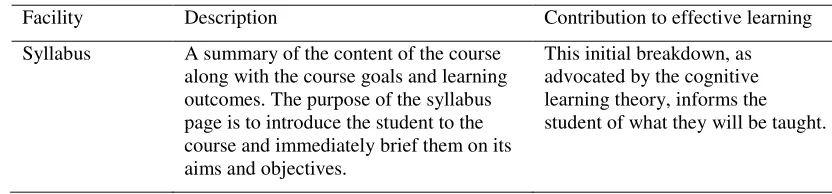
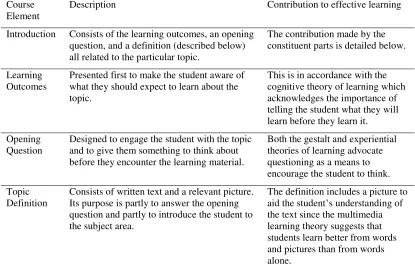
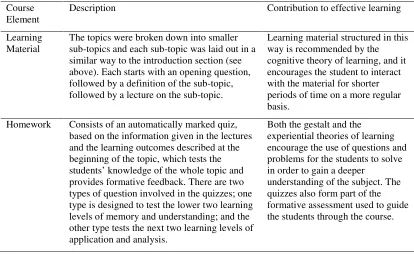
designed to present the learning material in a more effective manner, taking advantage of the facilities available in WebCT and incorporating the recommendations from the learning theories. The course notes from the classroom-based course were used to provide the learning material. The facilities available in WebCT, pertinent to this study, are described in Table 2. The constituent parts of the course content, designed to promote effective learning, are described in Table 3.
Evaluation of learning effectiveness
[image:7.595.102.518.628.725.2]The effectiveness of the existing classroom-based Project Management course was evaluated, using a questionnaire, by the students who had recently completed the course. The same students were also introduced to the new web-based course and given time to familiarise themselves with its facilities and contents. The students then evaluated the potential improvement in learning effectiveness that could be gained through the use of the new course using the same questionnaire.
Table 2: WebCT facilities
Facility Description Contribution to effective learning
Syllabus A summary of the content of the course along with the course goals and learning outcomes. The purpose of the syllabus page is to introduce the student to the course and immediately brief them on its aims and objectives.
Table 2 (continued): WebCT facilities
Facility Description Contribution to effective learning
Course Content The majority of the topics have been split into three main sections; an introduction to the topic; the learning material; and homework.
Each of the sections plays an important part in the learning process (see Table 3).
References Includes links to websites that will be of interest to the students, and a reference list of sources referred to in the lecture notes.
The purpose of the references section is to provide the student with extra sources of information, giving them the opportunity to gain a deeper understanding by
exploring the subject further.
Communications Consists of three tools; the discussion boards (for asynchronous discussions); the chat rooms (for synchronous discussions); and email. The discussion boards and the chat rooms are public forums where the discussions are
recorded and all members of the class can read the messages which are sent. The email is a more private facility for sending personal messages to specific people.
As was noted in the experiential theory of learning, discussion can be an effective method of
stimulating thought, and promotes learning on the evaluation and creation levels. At the same time the chat rooms aid experiential learning by helping to create a learning community by
[image:8.595.70.486.90.374.2]encouraging a social presence to develop among the students.
Table 3: Design of course content
Course Element
Description Contribution to effective learning
Introduction Consists of the learning outcomes, an opening question, and a definition (described below) all related to the particular topic.
The contribution made by the constituent parts is detailed below.
Learning Outcomes
Presented first to make the student aware of what they should expect to learn about the topic.
This is in accordance with the cognitive theory of learning which acknowledges the importance of telling the student what they will learn before they learn it.
Opening Question
Designed to engage the student with the topic and to give them something to think about before they encounter the learning material.
Both the gestalt and experiential theories of learning advocate questioning as a means to encourage the student to think.
Topic Definition
Consists of written text and a relevant picture. Its purpose is partly to answer the opening question and partly to introduce the student to the subject area.
[image:8.595.70.485.407.671.2]Blended learning
Table 3 (continued): Design of course content
Course Element
Description Contribution to effective learning
Learning Material
The topics were broken down into smaller sub-topics and each sub-topic was laid out in a similar way to the introduction section (see above). Each starts with an opening question, followed by a definition of the sub-topic, followed by a lecture on the sub-topic.
Learning material structured in this way is recommended by the cognitive theory of learning, and it encourages the student to interact with the material for shorter periods of time on a more regular basis.
Homework Consists of an automatically marked quiz, based on the information given in the lectures and the learning outcomes described at the beginning of the topic, which tests the students’ knowledge of the whole topic and provides formative feedback. There are two types of question involved in the quizzes; one type is designed to test the lower two learning levels of memory and understanding; and the other type tests the next two learning levels of application and analysis.
Both the gestalt and the experiential theories of learning encourage the use of questions and problems for the students to solve in order to gain a deeper
understanding of the subject. The quizzes also form part of the formative assessment used to guide the students through the course.
The questionnaire contained the following 14 statements:
1. The course aims and learning outcomes were clear from the start. 2. The lectures gave me an in-depth understanding of the topics covered. 3. I felt free to express my opinions and ask questions.
4. The problem questions made me think beyond what was discussed in the lectures.
5. Discussing the problem questions helped to correct any misunderstandings. 6. The course required too much previous knowledge.
7. I liked to actively participate in the tutorial discussions.
8. There were sufficient examples given to help me understand the subject matter. 9. The course helped me to prepare for the exam.
10. There was too much information covered in the lectures.
11. I felt encouraged to attempt the problem questions even if I got the answer wrong.
12. I would have liked to have had my answers to the problem questions marked by the tutor.
13. There were too many problem questions.
14. The structure of the course was logical and coherent.
Each of the above statements draws on the criteria recommended to promote effective learning by the theories discussed previously, so that the responses indicate how well aligned with the theories the course is perceived to be, and therefore the respondent's view on the impact of the course on learning effectiveness.
The classroom-based Project Management course was evaluated by the students anonymously indicating, on a seven-point scale, their agreement with the statements. The web-based Project Management course was evaluated by the students
[image:9.595.107.521.88.343.2]analysed quantitatively, using Likert scaling (Oppenheim 1992), to give scores out of 100 (0 = most negative response; 50 = neutral response; and 100 = most positive response). On this scale, a score of greater than 50 represents either a positive impact on the student perception of learning effectiveness, or an improvement in the student perception of learning effectiveness.
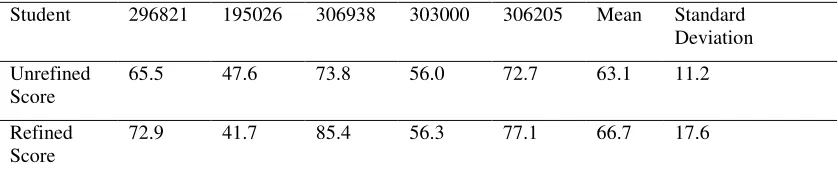
[image:10.595.66.485.280.369.2]From a class size of seven, five students responded to the classroom-based course evaluation, and four responded to the web-based course evaluation. The scores indicate that generally the students thought the classroom-based course had a positive impact on the effectiveness of their learning (see Table 4). The student opinions of the classroom-based course were relatively consistent. The scores indicate that generally the students thought the web-based course was an improvement on the classroom-based course (see Table 5). The student opinions of the web-classroom-based course were less consistent.
Table 4: Classroom-based Project Management Course
Student 296821 195026 306938 303000 306205 Mean Standard Deviation
Unrefined Score
65.5 47.6 73.8 56.0 72.7 63.1 11.2
Refined Score
[image:10.595.62.487.405.496.2]72.9 41.7 85.4 56.3 77.1 66.7 17.6
Table 5: Web-based Project Management Course
Student 195026 306938 306205 298535 Mean Standard Deviation
Unrefined Score
75.0 71.4 50.0 39.3 58.9 17.1
Refined Score
92.9 78.6 57.1 42.9 67.9 22.2
At all points of evaluation the students had the opportunity to make any comments they felt were relevant. The advantages and disadvantages of the web-based course identified are summarised in Table 6.
Table 6: Advantages and disadvantages of the web-based course
Advantages Disadvantages
As discussions are recorded, either on the discussion board or in the chat rooms, the need to write notes is removed and students would be able to digest the material in their own time;
The automatically marked quizzes were seen as an advantage, as there is the opportunity to attempt lots of questions without the pressure and distractions associated with in-class tests, and the additional ability to receive immediate feedback;
The restructuring of the learning material into smaller portions was preferable to the longer style lectures and notes;
When communicating through typing the students would not be able to express
themselves as clearly as they would be able to in a classroom situation, and may be reluctant to raise points that they feel are less important;
The time delay, inherent in the chat room, limits the ability to have a coherent conversation or discussion;
Blended learning
Table 6 (continued): Advantages and disadvantages of the web-based course
Advantages Disadvantages
The time delay, inherent in the discussion boards and chat rooms, allows students time to think through, and construct, better arguments, encouraging them to participate more freely; and
The nature of the virtual environment would provide the students with the confidence to approach the tutor with problems that otherwise they may not have raised.
The examples that a tutor may give when expanding on a point in a dynamic classroom lecture would be missing in the web-based lecture notes;
The web-based system would be too complicated for students to be able to use without some guidance; and
The perception that lack of effort could go unnoticed may lead to students not participating.
After its design and construction, the new course was incorporated with classroom-taught lectures to produce a blended learning system. A group of MSc Construction Project Management students, who had completed the Project Management course through the blended learning system, evaluated the effectiveness of their learning experience using the same questionnaire as described above. The blended learning system was evaluated by the students anonymously indicating, on a seven-point scale, their agreement with the statements. Again, the data collected was analysed
quantitatively, using Likert scaling (Oppenheim 1992), to give scores out of 100, as shown above. A score of greater than 50 represents a positive impact on student perception of learning effectiveness.
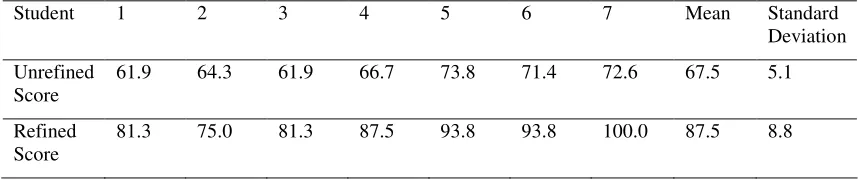
[image:11.595.100.531.89.230.2]From a class size of 12, seven students responded to the blended learning system evaluation. The scores indicate that the students thought that the blended learning system had a very positive impact on the effectiveness of their learning (see Table 7); much greater than the classroom-based course alone. The student opinions of the blended learning system were consistent.
Table 7: Blended learning Project Management Course
Student 1 2 3 4 5 6 7 Mean Standard
Deviation
Unrefined Score
61.9 64.3 61.9 66.7 73.8 71.4 72.6 67.5 5.1
Refined Score
81.3 75.0 81.3 87.5 93.8 93.8 100.0 87.5 8.8
CONCLUSIONS
This study is limited in its generalisability given the small number of student participants, however, from the work undertaken, the following conclusions can be drawn:
Effective learning is characterised by the student's ability to use acquired knowledge and principles to solve complex problems. It is facilitated by a variety of techniques including, formative assessment, problem solving and regular interaction with the learning material for short periods;
[image:11.595.101.530.485.575.2] The web-based Project Management course was deemed to provide extra benefits to students, such as flexibility and communication facilities, but the benefits were not considered sufficient to remove the need for face-to-face interaction;
The efficacy of a Project Management web-based course is dependent upon
the level of human interaction, information exchange and conversation achieved; and
A blended learning system which incorporates both classroom-based lectures and web-based resources was viewed by the students as having a greater positive impact on effective learning than either of the methods alone.
REFERENCES
Biggs, J (2003) "Teaching for Quality Learning at University". Maidenhead: Open University Press.
Bligh, D A (1972) "What’s the use of lectures?". Harmondsworth: Penguin.
Boydell, T (1976) "Experiential Learning". Sheffield: Sheffield City Polytechnic.
Bunker, V (2005) "Learning, Teaching and Assessment Strategy 2005 - 2010". Portsmouth: University of Portsmouth. Retrieved June 27, 2008 from
http://www.port.ac.uk/departments/services/dcqe/LearningTeachingandAssessmentStr ategyincludinge-LearningStrategy/filetodownload,32087,en.pdf
Feenberg, A (1989) The written world: on the theory and practice of computer conferencing. In: R. Mason and A. Kaye (Eds.), "Mindweave: Communication, Computers and Distance Education" (pp. 22-39). Oxford: Pergamon Press.
Gagne, R M (1962) The acquisition of knowledge. "Psychological Review", 69, 355 – 65.
Ginns, P and Ellis, R (2007) Quality in blended learning: Exploring the relationships between on-line and face-to-face teaching and learning. "Internet and Higher Education", 10, 53 - 64.
Hill, W F (2002) "Learning: A Survey of Psychological Interpretations". Boston: Allyn and Bacon.
Krathwohl, D R, Anderson, L W, Mayer, R E, Pintrich, P R and Wittrock, M (2001) The Taxonomy Table. In L. W. Anderson and D. R. Krathwohl (Eds.), "A Taxonomy for Learning, Teaching, and Assessing. A Revision of Bloom’s Taxonomy of Educational Objectives" (pp 27-37). New York: Longman.
Lauder, W, Sharkey, S and Booth, S (2004) A case study of transfer of learning in a family health nursing course for students in remote and rural areas. "Nurse Education in Practice", 4, 39 – 44.
Mayer, R E (2001) "Multimedia Learning". Cambridge: Cambridge University Press.
Oppenheim, A (1992) "Questionnaire Design, Interviewing and Attitude Measurement". New York: Pinter Publications.
Paulsen, M F (1995) Moderating Educational Computer Conferences. In: Z. L. Berge and M. P. Collins (Eds.), "Computer-Mediated Communication and the Online Classroom" Volume 3: Distance Learning (pp. 81-90). Cresskill N.P.: Hampton Press.
Puplampu, A (2005) "Effective Web-Based Learning of Construction Project Management: A Case Study of the Department of Civil Engineering at the University of Portsmouth", Unpublished MSc Dissertation, University of Portsmouth.