Aspect-Oriented Thinking
An approach to bridging the disciplinary divides
A thesis submitted for the degree of Doctor of Philosophy
of the
Australian National University
I declare that the work in this thesis is entirely my own and that to the best of my knowledge it does not contain any materials previously published or written by another person except where otherwise indicated.
Acknowledgements
I would like to start by thanking Clive Boughton, my supervisor, for his contin-uous friendship, guidance, support and interest throughout the long process of producing this thesis. He is the one that made it possible for me to satisfy a long held interest in pursuing an academic career. I am also grateful for the constructive feedback that Brian Molinari and Ramesh Sankaranarayana have provided throughout the process and particularly following their review of the draft thesis. These experiencedeyeshave helped me produce a greatly improved thesis.
During my candidature, many people have provided me with great ideas and problems to think about. I want to express particular thanks to Annette Vincent and Malte Stien for their technical interest in my work, and to Stephen Mellor for the books that changed the way I conceptualised software development, and for the few, but extremely valuable, conversations we have had about software development and my work.
During the early stages of this research Jennie Clothier and Marilyn Cross gave me the opportunity to work as part of an interdisciplinary team of psycholo-gists, sociologists and computer scientists at the Australian Defence Science and Technology Organisation. This was a turning point in my research. Conversations with Jennie, Marilyn, Nicole Zambelli, Toby Keene and Derek Bopping enabled me to fully understand the vital need for engineering to be a truly interdisciplinary activity. Thanks for opening my eyes.
Special thanks also goes to Barry Newell, who has helped me develop a great appreciation for the way engineering should be practised and the responsibility we have in protecting the future of our planet. Without Barry’s influence, I would still be ‘looking in’. I hope that I will get the chance to work with Barry in the future and to learn as much as I can from him and his world.
friendship, I am truly thankful. Thanks to them all, I am now starting to feel at home in academia.
Closer to home, I would like to acknowledge the friendship that has formed between my family and that of Alex Zelinsky. Our wives are great mates, and this has allowed Alex and me to spend many hours discussing academic life, research, business, and all of the world’s problems. He has shown me that an exciting and rewarding career can be had in research and has offerred me many pieces of valuable advice to that end.
Abstract
Engineering is often described as the application of scientific and technical knowledge to solve problems. In this thesis, I support a more general view that engineering should be treated as a continuous process of learning and action that aims to make well understood improvements within dynamically complex environments of co-evolving social, man-made and natural systems. I argue that this can only be achieved by adopting an approach that systematically develops, manages and integrates the knowledge and expertise of many disciplines to conceive, develop, modify, operate and retire systems. A novel implementation of such an approach, calledAspect-Oriented Thinking, is presented.
Aspect-Oriented Thinkingbegins with the development and verification of a set
ofDomain Models. Each Domain Model represents knowledge about a separate,
autonomous and possibly discipline specific concern or view within a given context.
Domain models are developed by engineers, scientists, sociologists, psychologists,
lawyers, philosophers, economists and others, using languages and techniques with which they are familiar. Knowledge captured in a set of Domain Models is then
woven together, in accordance with a set of separately developed patterns and
rules, to construct, modify, operate and retire systems, including models, hardware, software, processes and simulations. This is a continuous process which, in the first instance, involves those systems used to learn about a given context and to make decisions regarding required changes. Later, the process involves those systems used to implement and evaluate the impact of these decisions.
The significance of Aspect-Oriented Thinking lies in its broad applicability to any situation in which the expertise and knowledge of diverse disciplines is required to understand and make improvements within complex multifaceted environments such as those that involve sustainable development and national security.
Contents
Acknowledgements v
Abstract vii
Preface xxi
I Introduction 1
1 Overview 3
1.1 Introduction . . . 4
1.2 Initial motivation and research aim . . . 4
1.3 Thesis scope . . . 5
1.4 Thesis structure . . . 5
1.5 Publications . . . 7
1.6 Summary of contribution . . . 8
2 Background 11 2.1 Introduction . . . 13
2.2 The original research proposal . . . 13
2.3 Preliminary research . . . 15
2.4 Understanding the bigger picture . . . 17
2.5 Capability Dynamics . . . 20
2.6 eXecutable and Translatable UML . . . 24
2.7 Aspect-Oriented Systems Engineering (AOSE) . . . 27
2.8 Emergence of Aspect-Oriented Thinking . . . 28
2.9 Summary of influences . . . 29
2.10 Conclusion and conjecture . . . 31
II Contribution 33 3 Research design 35 3.1 Introduction . . . 36
3.2 A conceptual model of software engineering research . . . 36
3.3 The Aspect-Oriented Thinking research approach . . . 44
4.1 Introduction . . . 51
4.2 Problem situations . . . 51
4.3 Systems . . . 52
4.4 Domains . . . 53
4.5 Domain Models . . . 61
4.6 Aspect-Oriented Specifications . . . 62
4.7 Aspect-Oriented Specification Archetypes . . . 67
4.8 Implementation Models . . . 69
4.9 Conclusion . . . 72
5 Aspect-Oriented Thinking Process 73 5.1 Introduction . . . 74
5.2 Problem situation analysis . . . 75
5.3 Knowledge domain identification and analysis . . . 76
5.4 Aspect-Oriented Specification Archetype development . . . 79
5.5 Aspect-Oriented Specification development . . . 79
5.6 Implementation modelling . . . 80
5.7 Aspect-Oriented Specification implementation . . . 80
5.8 Continuous learning and improvement . . . 80
5.9 Comparison with traditional life-cycle models . . . 81
5.10 Documentation . . . 83
5.11 Conclusion . . . 84
III Proof of Concept and Conclusion 85 6 Proof-of-Concept 87 6.1 Introduction . . . 88
6.2 Problem situation analysis . . . 88
6.3 Domain identification and analysis . . . 92
6.4 Aspect-Oriented Specification Archetype development . . . 95
6.5 Aspect-Oriented Specification development . . . 96
6.6 Implementation modelling . . . 98
6.7 Implementation . . . 99
6.8 Conclusion . . . 99
7 Summary and Conclusion 101 7.1 Introduction . . . 102
7.2 Summary of contribution . . . 102
7.3 Limitations of contribution . . . 104
7.5 Recommendations for future work . . . 106
7.6 Closing remarks . . . 109
IV Appendices 111 A Aspect-Oriented Specification notation 113 A.1 Introduction . . . 114
A.2 Domain model notation . . . 114
A.3 Individual requirement notation . . . 114
A.4 Requirement set notation . . . 114
A.5 Domain model set notation . . . 116
A.6 Conclusion . . . 117
B Proof of concept -Knowledge Domain Models 119 B.1 Introduction . . . 120
B.2 Contact Managementdomain model . . . 120
B.3 Product Managementdomain model . . . 123
B.4 Securitydomain model . . . 125
B.5 User Interfacedomain model . . . 128
B.6 LAMP Frameworkdomain model . . . 134
B.7 X TUMLdomain model . . . 136
B.8 Linux Operating Systemdomain model . . . 136
B.9 PHP Web Programming Languagedomain model . . . 136
B.10Structured Query Languagedomain model . . . 136
B.11APACHE Web Serverdomain model . . . 136
B.12MySQL Relational Databasedomain model . . . 136
B.13 Domain model verification . . . 137
B.14 Conclusion . . . 137
C Proof of concept -LAMP Aspect-Oriented Specification Archetype 139 C.1 Introduction . . . 141
C.2 User interface related requirement archetypes . . . 142
C.3 Security related requirement archetypes . . . 151
C.4 Database related requirement archetypes . . . 152
C.5 Implementation specific requirement archetypes . . . 153
C.6 Security Mechanismsdomain model . . . 155
C.7 Conclusion . . . 155
D.3 PMS Securitydomain model . . . 164
D.4 PMS Securityrequirements . . . 165
D.5 PMS User Interface domain model . . . 166
D.6 PMS User Interface requirements . . . 174
D.7 Conclusion . . . 186
E Proof of concept -LAMP Implementation model 187 E.1 Introduction . . . 189
E.2 General implementation rules . . . 190
E.3 User interface implementation rules . . . 190
E.4 Database implementation rules . . . 226
E.5 Security implementation rules . . . 237
E.6 Conclusion . . . 239
F Proof of concept -Annotated Source Code 241 F.1 Introduction . . . 244
F.2 Application configuration . . . 244
F.3 Database . . . 247
F.4 Application startup . . . 249
F.5 Authentication . . . 249
F.6 Main menu . . . 253
F.7 Product management . . . 255
F.8 Product category management . . . 268
F.9 Contact management . . . 274
F.10 User management . . . 293
F.11 Conclusion . . . 299
G Proof of concept -LAMP Mechanisms 301 G.1 Introduction . . . 302
G.2 Application Mechanismsdomain model . . . 302
G.3 Database Mechanismsdomain model . . . 303
G.4 User Interface Mechanismsdomain model . . . 304
G.5 Security Mechanismsdomain model . . . 312
H Reproduced paper: Capability Dynamics: An approach to Capabil-ity Planning and Development in Large Organisations 315 H.1 Introduction . . . 317
H.2 Definitions . . . 318
H.3 Capability dynamics models . . . 321
H.4 Distributed capability dynamics modelling tool . . . 327
H.6 Proposed Experimentation . . . 330
H.7 Conclusions . . . 333
I Reproduced paper: Simplified Development Of Web Applications With Armidale 335 I.1 Background . . . 338
I.2 Requirements, Constraints and Design Approaches . . . 340
I.3 Implementation . . . 349
I.4 Functional Testing . . . 349
I.5 Effectiveness . . . 350
I.6 Some Design Details . . . 351
I.7 Summary . . . 355
J Reproduced paper: eXecutable and Translatable UML and Systems Engineering 357 J.1 Background . . . 359
J.2 Executable and Translatable UML: Key Concepts . . . 362
J.3 X TU M Land Systems Engineering . . . 368
J.4 The benefits ofX TU M L . . . 371
J.5 Further Work . . . 373
J.6 Conclusions . . . 373
Bibliography 375
Proof-of-Concept Index 385
List of Figures
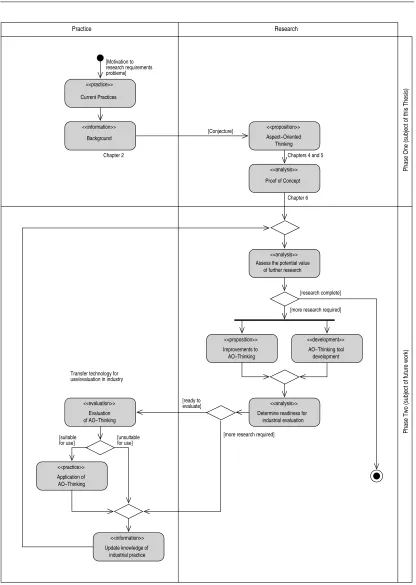
1.1 Activity diagram depicting the structure and the flow of ideas and results throughout this thesis. . . 6 2.1 An activity diagram depicting the organisation of this chapter and
the flow of ideas that led to the notion ofAspect-Oriented Thinking. . 14 2.2 An example of the way in which systems are considered byCapability
Dynamics. . . 22
2.3 TheAspect-Oriented Thinkingconcept. . . 30 3.1 Class diagram depicting the proposed conceptual model of software
engineering research . . . 37 3.2 Activity diagram depicting the idealistic life-cycle common to all of
the research methods described in Section 3.2.1. . . 39 3.3 Activity diagram depicting the ‘Analytical Advocacy Research’
life-cycle [Fenton et al., 1994]. . . 40 3.4 Activity diagram depicting the ‘Research-then-Transfer’ life-cycle
[Potts, 1993]. . . 41
3.5 Activity diagram depicting the ‘Industry-as-Laboratory’ life-cycle
Potts[1993]. . . 43
3.6 Activity Diagram depicting the Aspect-Oriented Thinking research approach. . . 45 4.1 Class diagram depicting the major concepts involved in
Aspect-Oriented Thinking. More detailed concepts are depicted in other class
diagrams throughout this chapter. . . 52
4.2 Aspect-Oriented Thinking domains are organised into the domain
categories depicted in this class diagram. . . 54 4.3 Class diagram depicting the concepts involved in Aspect-Oriented
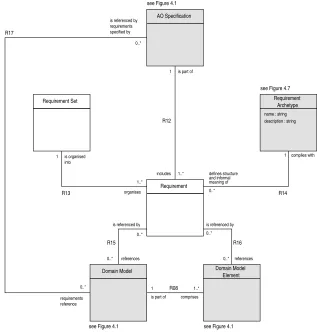
Specifications. . . 63
4.4 Example of aRequirementthat references a data store within aData
Flow Diagram being used as a Domain Model, and the Relational
Database Management Systemdomain model. . . 64
4.5 Examples ofRequirementsrepresented using the notation described in Appendix A. . . 65 4.6 Example of aRequirementthat references a system in a Capability
Dynamicsmodel and anAspect-Oriented Specification. . . 66
4.7 Class diagram depicting the concepts involved in Aspect-Oriented
Archetypewith which it conforms. . . 70 4.9 Class diagram depicting the concepts involved in Implementation
Models. . . 71
5.1 An activity diagram depicting the process ofAspect-Oriented Thinking. 74 5.2 An activity diagram depicting the process ofAspect-Oriented
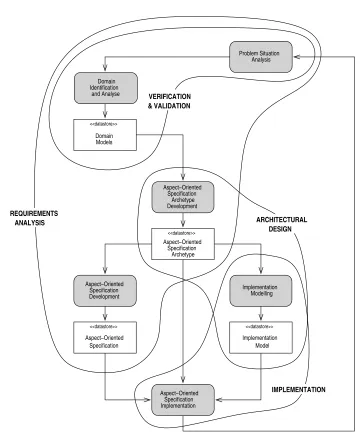
Think-ingand how the activities involved correspond to traditional systems engineering life-cycle activities of Requirements Analysis,
Architec-tural Design, Implementation, Verification&Validation. . . 82
6.1 The Block Diagram Meta-Model. . . 94 6.2 Package diagram depicting theAspect-Oriented Specificationfor the
Product Management System. . . 97
A.1 Examples of the simplified notation that can be used to depict individualAspect-Oriented Specification Requirements. . . 115 A.2 Examples of the notation that can be used to representRequirement
Sets. . . 116 A.3 An Aspect-Oriented Specification depicting Requirement Sets
in-volved in a simple software application. . . 116 A.4 TheAspect-Oriented Specification depicted in Figure A.3, simplified
using the domain set notation. . . 117
B.1 Class diagram depicting concepts involved in the Contact Manage-mentdomain. . . 120 B.2 Class diagram depicting concepts involved in the Product
Manage-mentdomain. . . 123 B.3 Class diagram depicting concepts involved in theSecuritydomain. . 126 B.4 Class diagram depicting concepts involved in the User Interface
domain. . . 129 B.5 Block diagram depicting elements of theLAMP Frameworkdomain. 135
C.1 Application of theraLinkAvailableWithRole requirement archetype.
Rq01 is a requirement for theLink to be only visible if the current user hastheRole. . . 143 C.2 Application of the raClassList requirement archetype. Rq01 is a
C.3 Application of theraGroupClassListrequirement archetype. Rq01is a requirement for instances of theEmployee class (employees) to be listed ontheCrudList.Rq02is a requirement for the listed employees
to be grouped by the name of the company to which they belong. . . . 146
C.4 Application of the raTextInputUpdatesAttribute requirement archetype. Rq01is a requirement for instances of theEmployeeclass (employees) to be listed ontheCrudList. Requirement Rq02 specifies a requirement for the Employee.name attribute to be updated from data entered intotheTextInputonEmployee Edit Page. . . 148
C.5 Application of the raSelectItemCreatesLink requirement archetype. Rq01 is a requirement for instances of the Employee class (em-ployees) to be listed on theCrudList. Requirement Rq02specifies a requirement for the creation of a link between an employee and a company selected usingtheSelectItemon theEmployee Edit Page. . . 150
D.1 Package diagram depicting the Aspect-Oriented Specification of the Product Management System. . . 160
D.2 Page layout notation. See Section B.5 for descriptions of each user interface page element . . . 167
D.3 TheloginPagelayout. . . 168
D.4 TheregisterNewUserPagelayout. . . 168
D.5 TheregistrationSuccessPagelayout. . . 169
D.6 ThemainMenuPagelayout. . . 169
D.7 TheproductListPagelayout. . . 170
D.8 TheeditProductPagelayout. . . 171
D.9 TheeditProductVariantPagelayout. . . 171
D.10 TheproductCategoryListPagelayout. . . 171
D.11 TheeditProductCategoryPagelayout. . . 172
D.12 ThecontactListPagelayout. . . 172
D.13 TheeditContactPagelayout. . . 173
D.14 TheeditContactRelationshipPagelayout. . . 174
D.15 TheeditNotePagelayout. . . 174
D.16 TheregisteredUserListPagelayout. . . 175
D.17 TheeditRegisteredUserPagelayout. . . 175
D.18 TheerrorPagelayout. . . 175
D.19 ThefatalErrorPagelayout. . . 176
E.1 Block diagram depicting the organisation of PHP modules required to implement Forms. . . 202
H.2 Capability Development. . . 323
H.3 Composite Systems . . . 323
H.4 Non-Hierarchical Composite Systems . . . 324
H.5 Decision control process . . . 328
H.6 Experimental software . . . 331
I.1 The Armidale conceptual design . . . 341
I.2 Some Armidale applications running on a KDE desktop . . . 343
I.3 The Armidale Launcher . . . 344
I.4 Generation of Armidale GUI element source code . . . 346
I.5 An Armidale application running in a stand-alone context . . . 352
I.6 An Armidale application running in a client-server context . . . 353
J.1 Primary MDA models and transformation . . . 360
J.2 An Annotated Software Domain Chart . . . 365
J.3 An Annotated Application Domain Chart . . . 369
List of Tables
6.1 Proof-of-Conceptknowledge domains and meta-models . . . 95
D.1 Product Management Systemsecurity specification . . . 164
Preface
The research reported in this thesis started when, after 15 years experience in the software and systems engineering industry, circumstances allowed me to take an extended break from work. With support from Dr Clive Boughton, my current supervisor, I decided to use this break to undertake a post-graduate research project that would aim to improve, in some way, software and systems engineering practice.
After enrolling in a PhD program at the Australian National University I was able to embark on a long and broad exploration of what could be done to improve the ability of software-intensive systems projects to deliver the capabilities expected by stakeholders. My investigations started with the widely held view that problems related to requirements are a major cause of project failure. I studied the requirements engineering literature covering topics such as speci-fication, modelling, measurement and capability maturity, and concluded that requirements engineering process improvement may provide a way to improve software and systems engineering practice. While considering what it meant to
improve a process, I explored systems theory, system dynamics, decision making,
organisational learning and change, socio-technical systems and ethics. I also revisited my early career as a junior engineer and military officer to reflect on success and failure within the complex socio-technical environment of modern defence.
From these explorations it became clear that industrial practice could be improved by developing and using software and systems engineering approaches that help ensure the development of capability that has well understood impacts (both positive and negative) throughout a defined environment and over time.
As these ideas formed, I was offered and accepted a position at the Australian Defence Science and Technology Organisation (DSTO). Whilst at DSTO I worked in a multi-disciplinary group headed by a linguist and comprising social scientists, psychologists, computer scientists and myself - an engineer. From this experience I realised that a multi-disciplinary team was required to fully understand the broader impact of existing, new and modified systems. Any software or systems engineering approach that focused on the development of capability with known impacts in time and space would therefore need to be interdisciplinary in nature.
It was from this milieu of exploration and experience that Aspect-Oriented
Thinkingemerged.
Part
I
Chapter
1
Overview
One wonders sometimes if science will not grind to a stop in an assemblage of walled-in hermits, each mumbling to himself words in a private language that only he can understand. The spread of specialized deafness means that someone who ought to know something that someone else knows isn’t able to find it out for lack of generalized ears.
Boulding[1956]
Contents
1.1 Introduction . . . . 4 1.2 Initial motivation and research aim . . . . 4 1.3 Thesis scope . . . . 5 1.4 Thesis structure . . . . 5
1.4.1 Part I - Introduction . . . 5
1.4.2 Part II - Contribution . . . 7
1.4.3 Part III - Discussion and Conclusion . . . 7
1.1
Introduction
This thesis is submitted for the degree of Doctor of Philosophy of the Australian National University. In it I describe exploratory research that has resulted in the development and demonstration of Aspect-Oriented Thinking, a novel interdisci-plinary approach to software engineering which has applicability to engineering in general.
In this introductory chapter, I provide an overview of the research along with information intended to help the reader navigate this thesis. I conclude the chapter with a summary of work published during the project and contributions made to engineering research and practice.
1.2
Initial motivation and research aim
The initial motivation for conducting the research reported in this thesis can be summed up by Glass’ Law ‘Requirements deficiencies are the prime cause of project
failures’ [Endres and Rombach, 2003, Law L1, pp16-17]. This led to an initial aim
to find ways of improving software requirements development and management practices.
Preliminary research reported in Chapter 2 has shown that requirements practices can be improved by focussing on the development and effectiveness of systems that can be used to learn about and improve Problem Situations
which emerge within a dynamically complex environment of interacting social, man-made and natural systems. Further research reported in Chapter 2 has shown that this would be best achieved using an interdisciplinary approach to system development and operation, and that the development of such an approach, based onaspect-oriented modellingconcepts, is feasible. The preliminary research concludes by presenting the concept of Aspect-Oriented Thinking, an approach that can be used by engineers, scientists, sociologists, psychologists, lawyers, philosophers, economists and others to ‘bridge the disciplinary divides’ [Grafton
et al., 2005] and work together to build, operate and evolve the systems needed to
both understand and improveProblem Situationsof all kinds.
This preliminary work has resulted in a research aimto develop, model, demon-strate and evaluate an aspect-oriented interdisciplinary approach to engineering that can be used to build and operate systems required to understand and improve
1.3 Thesis scope
1.3
Thesis scope
The scope of this thesis is the development, modelling and demonstration of
Aspect-Oriented Thinkingwithin the context of software engineering. While the broader
applicability ofAspect-Oriented Thinkingis discussed, evaluation of the approach within a more general context is beyond the scope of this thesis.
Experimentation aimed at understanding the value ofAspect-Oriented Think-ingin an industrial context is discussed in Sections 3.3.2.2 and 7.5.4. The conduct of such experimentation is beyond the scope of this thesis.
While some ideas regarding appropriateAspect-Oriented Thinkingtool support are introduced in Section 7.5.2, and an implementation of an appropriate architec-tural framework is described inFlint and Boughton[2002, reproduced in Appendix I], the full analysis, design and implementation of a complete Aspect-Oriented
Thinkingtoolset is beyond the scope of this thesis.
1.4
Thesis structure
The structure of this thesis is depicted in the Unified Modelling Language (UML) activity diagram [Object Management Group, 2005, pp 285-406] shown in Figure 1.1. Each activity (grey rounded box) represents a chapter of this thesis, and directed arrows between them represent the flow of ideas and research results. Objects on the diagram (white square boxes) represent key contributions made by the research.
This thesis is organised in three parts comprising two or more chapters as represented by the vertical partitions of the activity diagram shown in Figure 1.1. The contents of each part and chapter of this thesis are outlined below. A more detailed overview of the research can be obtained by reading the preface, Chapter 2, the introduction and conclusion of Chapters 3 to 6, and the overall conclusion provided in Chapter 7. The impatient reader can gain an overview of the
Aspect-Oriented Thinkingapproach itself by reading Chapter 5.
1.4.1 Part I - Introduction
Part I of this thesis comprises 2 chapters. Chapter 1 is the current chapter in which I state the motivation and aim for the research reported in this thesis. Within Chapter 2, I describe the context within which Aspect-Oriented Thinking
emerged. This includes a description of preliminary research which began with an
Overview Chapter 1 Chapter 2 Background engineering practice] requirements [Motivation to improve
Dynamics Capability
Systems Engineering Aspect−Oriented
Aspect−Oriented [The idea of Thinking]
Research design Chapter 3
Chapter 4 Aspect−Oeiented
Thinking Concepts Conceptual Model AOT Process Model AOT Software Research Framework Engineering [AOT research approach] Aspect−Oriented Thinking Process Chapter 5
Proof of Concept Chapter 6 Chapter 7 Summary and Conclusions Example software system
built using AOT
future research Plans for
PART II Contribution
PART III Proof−of−Concept and Conclusion PART I
Introduction
[image:28.595.68.489.92.608.2][Research Aim]
Figure 1.1: Activity diagram depicting the structure and the flow of ideas and results throughout this thesis.
1.5 Publications
andAspect-Oriented Systems Engineering[Flint and Boughton, 2003] as depicted
in Figure 1.1. It was from this work and reflection upon the notions of systems
thinking, problem situations [Checkland, 1981] and wicked problems [Rittel and
Webber, 1973], that the idea ofAspect-Oriented Thinkingemerged.
1.4.2 Part II - Contribution
Part II of this thesis comprises three chapters. Within Chapter 3, I propose a novel conceptual model of software engineering research. I then use this model to describe and discuss existing approaches to software engineering research and, to propose a research approach for the development and evaluation ofAspect-Oriented
Thinking. This proposed approach has been designed to reduce stakeholder risk by
only entering evaluativephases of research after the potential viability of
Aspect-Oriented Thinkinghas been demonstrated within a research context.
Within Chapters 4 and 5, I describe the Aspect-Oriented Thinking approach itself. Chapter 4 contains a model of the concepts involved in Aspect-Oriented
Thinking and the artifacts that are developed and manipulated to construct,
modify, operate and retire systems. Examples from the software engineering domain are included to help explain the concepts involved. Within Chapter 5, I describe the continuous process of Aspect-Oriented Thinking and how it can be used to learn about and improveProblem Situations.
1.4.3 Part III - Discussion and Conclusion
Part III of this thesis comprises two chapters. Within Chapter 6 and associated Appendices B to G, I present a detailedproof-of-concept to demonstrate the appli-cation and viability of Aspect-Oriented Thinking. This proof-of-concept comprises the development of a complete software application from an initial set of user requirements through to working software.
Within Chapter 7, I summarise the work presented in this thesis and discuss its limitations. I then offer a final conclusion and proposals for further research, development and evaluation ofAspect-Oriented Thinking.
1.5
Publications
The contributions made by this thesis are based on the results of preliminary research presented in Chapter 2 and published in the following refereed conference papers.
• Flint, S. (1999),A model which helps control change in dynamically complex
purposeful systems, Proceedings of the 1999 Systems Engineering, Test &
Evaluation Conference (SETE99), Adelaide, Australia, October 1999.
• Flint, S. (2001), Capability Dynamics: An Approach to Capability Planning
and Development in Large Organisations, proceedings of the 2001
Interna-tional Council on Systems Engineering (INCOSE) symposium, Melbourne, Australia, July 2001. Reproduced in Appendix H of this thesis.
• Flint, S. and Boughton, C. (2002),Simplified Development of Web Applications
using Armidale, proceedings of the 2002 AusWeb conference, Sunshine Coast,
Australia, July 2002. Also available from http://ausweb.scu.edu.au.
Reproduced in Appendix I of this thesis.
• Flint, S. and Boughton, C. (2003), Executable/Translatable UML and
Sys-tems Engineering, proceedings of the 2003 Systems Engineering, Test &
Evaluation Conference (SETE2003), Canberra, Australia. Reproduced in Appendix J of this thesis.
1.6
Summary of contribution
The research reported in this thesis has resulted in the following contributions to existing knowledge required to understand and make improvements within dynamically complexProblem Situations.
• Aspect-Oriented Thinking.Aspect-Oriented Thinkingis a novel interdisci-plinary engineering approach that can be used to build and operate systems that have a well understood impact on their environment over time. The approach can be used within the context of software development and systems engineering as well as broader interdisciplinary areas such as sustainable development, the environment and society.
• Capability Dynamics. Capability Dynamics [Flint, 2001, reproduced in Appendix H] is a novel approach to understanding where improvements can be made in dynamically complex environments and the effectiveness over time of any changes that aim to make such improvements. Capability
Dynamics, along with other approaches such asSystem Dynamics[Forrester,
1961] and Soft Systems Methodology [Checkland, 1981] can be used within
1.6 Summary of contribution
Other contributions made by this thesis include:
• Conceptual model of software engineering research. A conceptual model of software engineering research is proposed. The model can be used to describe approaches discussed in the literature as well as those designed to satisfy the needs of specific research programs. The research approach adopted in this thesis has been described using the proposed model.
• Implementation of advancedX
TUML concepts. Key concepts developed
for Aspect-Oriented Thinking go some way to filling a gap in knowledge
surrounding the use of eXecutable and Translatable UML (X
TUML) [Mellor
and Balcer, 2002]. For example, it is not clear from the literature how the
concept of anImplicit Bridgebetween domains can be implemented. It is also unclear how the more recent concepts of model transformation described by
Mellor et al.[2004] can be implemented to build operational software from a
diverse range of domains covering subjects such as user interfaces, security, persistence and communication.
Aspect-Oriented Thinking represents one way of implementing these
ad-vanced concepts ofX
TUML and model-driven development.
• Armidale application development framework. Armidale [Flint and
Boughton, 2002] is a software development framework that radically
simpli-fies the development of web applications by abstracting away (separating) all concerns regarding the internet. This framework was developed to simplify the development of distributed Aspect-Oriented Thinking tools as part of future research.
Chapter
2
Background
When solving problems, dig at the roots instead of just hacking at the leaves.
Anthony J. D’Angelo
Contents
2.1 Introduction . . . 13 2.2 The original research proposal . . . 13 2.3 Preliminary research . . . 15
2.3.1 Requirements engineering . . . 15
2.3.2 Software process improvement . . . 16
2.3.3 Agile software development . . . 17
2.4 Understanding the bigger picture . . . 17
2.4.1 General systems . . . 19
2.4.2 Problem situations . . . 19
2.4.3 Systems Thinking . . . 20
2.5 Capability Dynamics . . . 20
2.5.1 Capability Dynamics Models . . . 22
2.5.2 Limitations of Capability Dynamics . . . 23
2.6 eXecutable and Translatable UML . . . 24
2.6.1 Complexity management . . . 25
2.6.2 Waste reduction . . . 26
2.6.3 Productivity improvement . . . 26
2.1 Introduction
2.1
Introduction
TheAspect-Oriented Thinkingapproach emerged within a context of study, practice
and reflection across a wide range of subjects including software and systems engineering, systems thinking, soft systems, organisational change and learning, system dynamics, simulation and advanced approaches to software development. In this chapter I discuss the path I took through this milieu and how it led to the notion ofAspect-Oriented Thinkingand development of preliminary approaches.
The organisation of this chapter is summarised in the UML activity diagram shown in Figure 2.1. The partition on the left of the diagram represents preliminary research undertaken during early stages of the project. The centre partition represents the reporting of preliminary research results including the two conference papers reproduced in Appendices H and I. The final partition covers the emergence ofAspect-Oriented Thinkingand a conjecture that provides a foundation for the remainder of this thesis.
2.2
The original research proposal
Requirements deficiencies are the prime cause of project failures.
Glass’ Law [Endres and Rombach, 2003, Law L1, pp16-17]
The original motivation for the research reported in this thesis was personal industrial experience with the negative impact that poor requirements practices have on the success of software and systems engineering projects. In addition to this personal experience, much had been published at the time (late 1990’s) to show that poor requirements practices play a key role in software project failure
[The Standish Group, 1994, 1995;Jones, 1996].
In his influential ‘No Silver Bullet’ articleBrooks[1987] sums up the require-ments problem with his statement that:
‘The hardest single part of building a software system is deciding precisely what to build. No other part of the conceptual work is as difficult as establishing the detailed technical requirements, including all the interfaces to people, to machines, and to other software systems. No other part of the work so cripples the resulting system if done wrong. No other part is more difficult to rectify later.’
Capability Dynamics] [The idea of
Aspect−Oriented Modelling
Explore Aspect−Oriented Systems Engineering] [The idea of
[Need to develop systems that have a well understood impact]
engineering practice] requirements [Motivation to improve
and practices is not well understood] [Impact of processes
Explore Requirement Engineering, Process Improvement and Agile Software Development
Explore a Systems Thinking view of software development Capability Dynamics Describe Systems Engineering Aspect−Oriented Describe Aspect−Oriented Thinking Emergence of Influences Summarise Conjecture Conclusion and [The idea of Aspect−Oriented Thinking]
Preliminary Research Preliminary Results Development of Conjecture
[image:36.595.94.457.91.570.2]Aspect−Oriented Systems Engineering Capability Dynamics Section 2.3 Section 2.4 Section 2.5 Section 2.6 Section 2.7 Section 2.8 Section 2.9 Section 2.10
Figure 2.1: An activity diagram depicting the organisation of this chapter and the flow of ideas that led to the notion ofAspect-Oriented Thinking.
More recent work by The British Computer Society and Royal Academy
of Engineering [2004] confirms this view by reporting that poor requirements
practices remain a key cause of software project failure today.
2.3 Preliminary research
The remainder of this chapter describes the path that led from this initial proposal to the development of Aspect-Oriented Thinking, an approach that can be used to improve requirements practices as well as address more general and complex problems such as those facing society and the environment.
2.3
Preliminary research
In order to understand the state of requirements research and practice, the active subject areas of Requirements Engineering and Model-Based Software Process Improvement were investigated. More recently, the subject of Agile Software Development was investigated.
2.3.1 Requirements engineering
Requirements engineering is a relatively new term which has been invented to cover all of the activities involved in discovering,
documenting, and maintaining a set of requirements for a computer based system. The use of the term ‘engineering’ implies that systematic and repeatable techniques should be used to ensure that system
requirements are complete, consistent, relevant etc.
Kotonya and Sommerville[1998, p8]
In response to problems caused by poor requirements practices, industry and researchers have adopted an engineering approach to the elicitation, analysis, specification, validation and management of requirements. The field of
Require-ments Engineering has therefore become an active area of research that aims to
improve software and systems engineering project success by developing improved requirements development and management practices.
The results of this effort are wide ranging and many of the developed practices have been incorporated into various practice guides [Sommerville and Sawyer, 1997; Kotonya and Sommerville, 1998; Young, 2001; Wiegers, 2003]. However, despite the progress being made by this work, many of the practices are presented with little evidence as to their effectiveness or sensitivity to context. This has been expounded on most recently byDavis and Zowghi[2006].
It was the observation regarding a lack of evidence that led me to explore Process Improvement in the hope of finding techniques that might be used to understand and improve the effectiveness of requirements engineering practices.
2.3.2 Software process improvement
The software process is the set of tools, methods, and practices we use to produce a software product. The objectives of software process
management are to produce a software product according to plan while simultaneously improving the organisation’s capability to produce better products.
Humphrey[1989]
Software process improvement is a very active research area and is practiced widely in industry, particularly by those involved in the development of critical and large scale software-intensive systems. The underlying belief behind such approaches is that organisations can improve the quality of their products by assessing and improving the processes they use to develop and support those products.
Most process improvement activities centre around the variousCapability
Ma-turity Modelsdeveloped by the Software Engineering Institute at Carnegie Mellon
University [Humphrey, 1989;Paulk et al., 1993;CMMI Product Development Team, 2000; Ahern et al., 2004] and the Software Process Improvement and Capability
dEtermination(SPICE) framework and associated standards [International
Orga-nization for Standardization, 1997, 2002, 2005a].
While there is extensive evidence that the adoption of process improvement strategies can lead to reductions in defects, improved schedule and cost control, as well as increased productivity [Diaz and Sligo, 1997;Ferguson et al., 1997, 1999;
Young, 2001;Capell, 2004;Subramanyam et al., 2004;Nichols and Connaughton,
2005], there is little reporting of process improvement failures. In addition, there is no real understanding of how particular processes or variations in process performance impact project success, or even whether the schedules and budgets met by a successfulproject are optimal. It might, for example, be the use of good
management and people that has led to the reported project success. There is some evidence to support this hypothesis in that project management has been identified as a key factor in the success of software projects by bothThe Standish
Group[2001] andThe British Computer Society and Royal Academy of Engineering
2.4 Understanding the bigger picture
2.3.3 Agile software development
We are uncovering better ways of developing software by doing it and helping others do it. Through this work we have come to value:
• Individuals and interactionsover processes and tools
• Working softwareover comprehensive documentation
• Customer collaborationover contract negotiation
• Responding to changeover following a plan
That is, while there is value in the items on the right, we value the items on the left more.
The Agile Manifesto [Agile Alliance, 2001]
Agile approaches have been widely adopted throughout the software develop-ment industry and represent an active area of research. They offer an alternative to model-based process improvement by advocating the use of practices that respond to change, deliver functioning software using rapid iterative development lifecycles and promote close customer involvement, rather than advocating the definition, execution and continuous improvement of a set of processes identified by an external authority.
Many agile methods have emerged [Beck, 1999; Highsmith, 1999; Cockburn, 2002;Schwaber and Beedle, 2002] and there is evidence that their use can result in improved productivity, reduced cost and schedule, as well as reduced defect rates
[Reifer, 2002]. However, like model-based software process improvement, there
is no real understanding of how particular agile practices impact project success. Again, it might be the use of good people that has led to project success. Agile projectsuccess might also be due to a form ofStockholm Syndromein which client representatives bond and sympathise with the developers more than with their organisation and its real needs. This could slowly lead an entire project off track while all involved believe valuable software is being produced.
2.4
Understanding the bigger picture
When the performances of the parts of a system, considered separately, are improved, the performance of the whole may not be (and usually is not) improved.
Ackoff[1999, p9]
Evidence available to support the adoption of either model-based process improvement or agile practices (Sections 2.3.2 and 2.3.3) relates to their ability to help organisations deliver software on time, within budget and with low defect densities. In some cases customer satisfaction is also considered using techniques such asThe Balanced Scorecard[Kaplan and Norton, 1996]. However,
as Ferguson et al. [1999] show, customers too are sometimes only interested in
cost, delivery time and delivered defects, rather than any value they derive from using the delivered software. None of this is surprising given the widespread acceptance of such measures of project success [The Standish Group, 1999;Sauer
and Cuthbertson, 2003; The British Computer Society and Royal Academy of
Engineering, 2004].
I contend that this singular focus on cost, schedule and defect density is often inappropriate as it only deals with a narrow set of stakeholder concerns. In order to form a complete picture of project success or failure, it is necessary to consider the evolving concerns of all stakeholders. Of particular importance are the concerns of end users and the benefits they are able to derive from using software and other artifacts produced by a project. The importance of taking such an approach is highlighted by Boehm and Turner [2004, p8] who note that ‘the initially successful Chrysler Comprehensive Compensation (C3) project that gave birth to XP as a remedy for failed traditional methods was eventually cancelled’ and that ‘Cleanroom, one of the most successful and empirically studied of the formal, process-based methods, has never really crossed Moore’s chasm into the mainstream’. That is, neither of these projects produced artifacts that were of any value to end users and organisations despite being successful according to popular measures of cost, schedule and defect density, and despite their adoption of particular practices.
At the other extreme, the WindowsR series of operating systems [Microsoft, 2006c] has been a clear success for Microsoft despite frequent schedule overruns during their development and a less than perfect record in relation to defects and security.
2.4 Understanding the bigger picture
2.4.1 General systems
No part of a system should be changed without understanding its effect on the whole and determining that this effect is beneficial.
Ackoff[1999, p9]
While the above discussion centres around the development of software systems, it equally applies to systems of other kinds. For example, the develop-ment, modification, operation and retirement of hardware, processes, laws and organisational structures should be conducted with a full understanding of the dynamic impact that such activities are likely to have on the systems of which they are a part.
It was at this point that the scope of research reported in this thesis was increased to deal with the development ofallkinds of system.
What is a system?
This thesis adopts Jordan’s view that ‘the only things that need be common to all systems are identifiable entities and identifiable connections between them. In all other ways systems can vary unlimitedly. The quest for a more detailed, specific definition for “system” is chimerical’ [Jordan, 1968, pp 64-65]. Accordingly, the following definition ofsystemis used in this thesis:
A system is a set of identifiable entities and identifiable connections between them.
2.4.2 Problem situations
Problem Situation:A nexus of real-world events and ideas which at least one person perceives as problematic: for him other possibilities concerning the situation are worth investigating.
Checkland[1981, p316]
different times and places. This results in a dynamically complex [Casti, 1979] environment in which the impact of a change is difficult to predict and therefore control.
For the purposes of this thesis, I will refer to such environments as Problem
Situations [Checkland, 1981, 1989] which comprise a set of systems that behave
and interact in ways that are considered unsatisfactory by at least one of the humans involved. Other terms commonly used to refer to such environments includeMesses[Ackoff, 1999, p13] andWicked Problems[Rittel and Webber, 1973]. Because of their complex nature,Problem Situationsare difficult to eliminate. Instead they are best dealt with using a continuous process of learning and change aimed at improving acceptance of the situation by the humans involved.
2.4.3 Systems Thinking
Systems thinking [Churchman, 1968b; Kramer, 1977; Checkland, 1981; Senge, 1992] refers to a set of approaches that can be used to learn about and make decisions regarding changes to dynamically complex systems, such as Problem
Situations. They are distinguished from other approaches by their focus on the
whole and the study of interactions among the parts of a system, rather than the parts themselves. It is by studying these interactions that we can understand emergent properties of an entire system including the impact of a change on the whole.
If we are to make and implement appropriate decisions regarding the improve-ment of Problem Situations, it will be necessary to adopt a Systems Thinking
approach that helps people learn about the systems involved, how they interact, and how changes are likely to impact the situation as a whole and over time.
2.5
Capability Dynamics
The performance of any system has two dimensions: theefficiencywith
which it does whatever it does (doing things right) and theeffectivenessof
what it does (doing the right thing, its value). These things should be
taken together becauseThe righter we do the wrong thing, the wronger we
become.
Ackoff[1999, p10]
2.5 Capability Dynamics
help people learn about a Problem Situation and make decisions regarding the development, operation and retirement of systems to improve it.
An early paper presenting the initial idea ofCapability Dynamics[Flint, 2001] is reproduced at Appendix H. While the idea, as presented in that paper, needs further research, particularly in relation to demonstrating the effectiveness of the approach, the concept is to consider a Problem Situation as a set of interacting systems that each develop a set of capabilities. These capabilities are intended to satisfy the evolving requirements of other systems so that they can, in turn, develop and deliver their own capabilities. The internal operation of each system is not considered within theCapability Dynamicsapproach.
A Problem Situation exists, at a given point in time, when some of these
Requirements are not properly satisfied. As systems are developed, modified,
op-erated and retired, and capabilities develop, Problem Situations will, themselves, evolve.
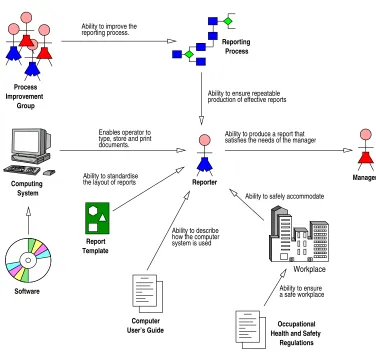
Figure 2.2 shows an example which depicts the way in which a Problem
Situation is considered in Capability Dynamics. The icons with titles such as
Reporting Process represent systems. The arrows between systems represent the
development and delivery of capability by one system for another. Labels on the arrows indicate the nature of the capability provided. Capabilities flowing into a system are used by that system to develop and deliver new capabilities. The
Reporter system, for example, makes use of capabilities from several systems
including the Reporting Process and Computing System to deliver the ability to produce reports in response to requirements of theManager.
The ability of each system to satisfy the requirements of other systems is evaluated against Measures of Effectiveness (MOEs) [Sproles, 2000]. That is, the
Capability Dynamics approach focuses on the ability of systems to do the right
thing [Ackoff, 1999, p10] with respect to their environment rather than their
individual performance.
Note that this arrangement forms a network of dependencies and that deci-sions are being made and implemented throughout theProblem Situationresulting in continuously changing requirements, capability and measures of effectiveness. These changes are often uncoordinated and occur at different tempos resulting in a dynamically complex [Casti, 1979] system in which the impact of a change is difficult to predict and therefore control.
Ability to ensure repeatable production of effective reports
documents. type, store and print
Enables operator to Ability to produce a report that
satisfies the needs of the manager reporting process.
Ability to improve the
the layout of reports Ability to standardise
Regulations Health and Safety
Occupational
Ability to ensure a safe workplace how the computer
Ability to describe
system is used
Process Reporting Template Report Computer User’s Guide Improvement Process Group System Computing Workplace
Ability to safely accommodate
Software
[image:44.595.78.454.86.438.2]Manager Reporter
Figure 2.2: An example of the way in which systems are considered byCapability
Dynamics.
2.5.1 Capability Dynamics Models
A complex system is no more than an interlocking structure of feedback loops. This loop structure surrounds all decisions, public or private, conscious or unconscious. The process of man and nature, of psychology and physics, of medicine and engineering all fall within this structure.
Forrester[1969]
A popular approach to understanding dynamically complex systems involves the use of agent-based simulation technologies such as SWARM [Swarm
Devel-opment Group, 2006]. These tools can be used to build agent-based simulations
in which each agent represents a system element that behaves in response to information from its environment (including other agents) and in accordance with some specified policy.
2.5 Capability Dynamics
Models which are agent-based simulations created as follows:
1. Systems. Identify the systems involved, including systems that are being built, modified or evaluated, along with all those systems with which they interact such as people, organisations, regulatory authorities, hardware, software and processes.
2. Requirements. Specify the requirements that each system involved in a givenCapability Dynamics Modelexpects other systems to satisfy. This will often include conflicting requirements.
3. Measures of Effectiveness. Define Measures-of-Effectiveness (MOEs)that can be used to evaluate the ability of a system to satisfy each requirement.
The Capability Dynamics approach views this effectiveness as the impact
that one system has on another.
4. Agents. Model each system as a separate agent that generates data indicat-ing the effectiveness with which it satisfies the requirements of dependent systems. This data is usually a function of the effectiveness of other systems (i.e., data provided by other agents), along with timing and other information that drives variation in system performance. For example, an agent that represents the Reporting Process depicted in Figure 2.2, would produce a value of capability derived, in part, from values of capability provided by an agent that represents theProcess Improvement Group.
By constructing and executingCapability Dynamics Models based on current, planned, proposed and experimental configurations of systems, requirements, capabilities and measures of effectiveness, the decision maker can learn about the likely impacts of various changes within a Problem Situation. This information can then be used to make decisions that have an increased likelihood of improving a givenProblem Situation.
Once decisions are implemented, they are reflected in applicable Capability
Dynamics Modelsand the above process is repeated. That is,Capability Dynamics
is intended to provide a foundation for continuous learning and improvement withinProblem Situations.
2.5.2 Limitations of Capability Dynamics
H that this work is left to other research and practice, it has become evident that little research has been conducted to create and/or evaluate approaches that can be used to develop and operate systems that havea well understood impact on their
environmentover time.
2.6
eXecutable and Translatable UML
Building a system involves understanding many different subject matters and gluing them together to make a coherent whole.
Mellor and Balcer[2002, p29]
It was at this point in my research effort that I began to fully understand the significance of Sally Shlaer and Stephen Mellor’s work with domain modelling
[Shlaer and Mellor, 1992] and Mellor’s later work with Balcer on the development
of eXecutable and Translatable UML (X
TUML) [Mellor and Balcer, 2002]. The
significance of their concept of autonomous domain modelling and bridging [Mellor
and Balcer, 2002] had escaped me.
In summary, X
TUML is a translative approach to software development [Bell, 1998] in which a set of autonomous domain models are developed to specify functional and data requirements, interfaces, architecture, implementation and other aspects of a software system. These domain models are developed, verified and maintained independently of each other.
When complete and verified, domain models that represent aspects of a software system aretranslated by a model compiler into a conventional program-ming language such as Java. This is achieved using various processes of model refinement, migration, merging and weaving [Mellor et al., 2004, pp51-59]. The resulting source code is then compiled into operational software by conventional compilers.
2.6 eXecutable and Translatable UML
2.6.1 Complexity management
Let me try to explain to you, what to my taste is characteristic for all intelligent thinking. It is, that one is willing to study in depth an aspect of one’s subject matter in isolation for the sake of its own consistency, all the time knowing that one is occupying oneself only with one of the aspects. We know that a program must be correct and we can study it from that viewpoint only; we also know that it should be efficient and we can study its efficiency on another day, so to speak. In another mood we may ask ourselves whether, and if so: why, the program is desirable. But nothing is gained –on the contrary!– by tackling these various aspects simultaneously. It is what I sometimes have called ‘the separation of concerns’, which, even if not perfectly possible, is yet the only available technique for effective ordering of one’s thoughts, that I know of. This is
what I mean byfocussing one’s attention upon some aspect: it does not
mean ignoring the other aspects, it is just doing justice to the fact that from this aspect’s point of view, the other is irrelevant. It is being one-and multiple-track minded simultaneously.
Dijkstra[1982]
X
TUML supports separation of concerns in ways which have a direct impact on complexity management. Firstly, the approach separates concerns related to life-cycle activities. This reduces complexity by allowing the analyst, for example, to focus on the problem at hand without concern for architectural, design and im-plementation issues. The architect can in turn, focus on developing an architecture to satisfy specified performance and other non-functional requirements without any concern for functional requirements or implementation.
Secondly, and more importantly, the approach supports the separation of concerns along multiple dimensions within each life-cycle activity. During ar-chitectural design, for example, concerns related to distribution can be modelled without concern for issues related to persistence or security. During user interface design, concerns related to the layout of user interfaces can be modelled without any concern for the presentation language that will be used.
All of this means that X
TUML can be used to help manage the complexity inherent in software development.
2.6.2 Waste reduction
Errors are most frequent during the requirements and design activities and are the most expensive the later they are removed.
Boehm’s First Law [Endres and Rombach, 2003, Law L2, pp17-19]
Irrespective of adopted life-cycle model, processes, or practices, it can be claimed that the cost of removing requirements defects increases with the time they remain undetected. The reason for this lies in the amount of effort required to rework architecture, design, implementation and integration artifacts that may have been produced to satisfy defective requirements. The longer a requirements defect remains undetected, the more rework will be necessary.
The added cost of removing any defect constitutes waste. The levels of such waste can be very high in software development projects. Boehm and Basili[2001], for example, claim that ‘current software projects spend about 40 to 50 percent of their effort in avoidable rework’.
Much of this unnecessary rework can be avoided when usingX
TUML because domain models that deal with functional requirements, for example, can be deemed correct early in the software development lifecycle before any architectural, design or implementation work has been completed or even started. Similarly, architectural domains can be developed and deemed correct before implementation is started and independently of any other domain models, including those dealing with functional requirements. This is achieved by using interactive verification tools such as those available from Mentor Graphics [2006] and Kennedy Carter
[2006]. These tools can be used to execute and debug domain models to ensure that requirements, architecture and implementation errors are identified and removed as early as possible in the development process.
2.6.3 Productivity improvement
There is general agreement amongst researchers and users familiar with X TUML that its use has potential to improve the productivity of software development teams. While there is some evidence to support this belief [Stien, 2003;Boughton, 2006; Stien, 2006], it is mostly based on intuition stemming from the following features of the approach.
• Full code generation.Models developed usingX
TUMLcan be automatically translated into source code [Bell, 1998; Mentor Graphics, 2006; Kennedy
2.7 Aspect-Oriented Systems Engineering (AOSE)
activities, the approach requires additional architectural design work and development of appropriate model compilers should existing commercial products be unsuitable.
• Faster change cycles. When using the X
TUML approach, changes to functional and data requirements are made to appropriate domain models rather than the source code of an application. Similarly, changes related to non-functional requirements such as performance are made to appropriate architectural and implementation domain models. That is, ‘the models are the code’ [Starr, 2001].
Once changes have been made, the domain models can be verified as correct and then automatically translated to generate new source code. This process results in a rapid change cycle. Some evidence to support this claim is reported by Boughton [2006] who shows that more than ten functional changes to an application per day were possible in the later stages of an
eXecutable and Translatable UMLproject.
• Large-scale reuse. Because of their autonomous nature, X
TUML models represent bodies of knowledge that can be reused across a set of applications. For example, domain models that deal with subjects such as an organisation’s business processes will be a valuable intellectual asset that is independent of changing implementation technology. Because of their autonomous nature, these domain models can be reused in the construction of any system that involves the organisation’s business processes. Similarly, a set of models that represent aspects of a specific architecture, can be reused to construct any application that is required to run on that architecture. That is, domain models, when properly constructed, become corporate assets rather than expenses [Mellor et al., 2004, pp10-11].
2.7
Aspect-Oriented Systems Engineering (AOSE)
In March 2003, the Object Management Group (OMG) released a Request For Proposal (RFP) [Object Management Group, 2003c] for customisation of the Unified Modelling Language (UML) to support the modelling of a wide range of systems including software, hardware, people, procedures and facilities within the frame-work of the OMG’sModel Driven Architecture (MDA)[Object Management Group, 2003b]. Much of the response to this RFP focused on how theUMLnotation might be extended rather than how UML and MDA could be used effectively during the conduct of systems engineering lifecycle process activities.
In response to this and the possibility of generalising the applicability of X
TUML, I, together with my supervisor, wrote a paper [Flint and Boughton, 2003, reproduced in Appendix J] describing the important concepts underlying X
TUML and how they and more traditional modelling concepts can be used to support the objectives of MDA within the Systems Engineering context.
This work, along with a full understanding of the X
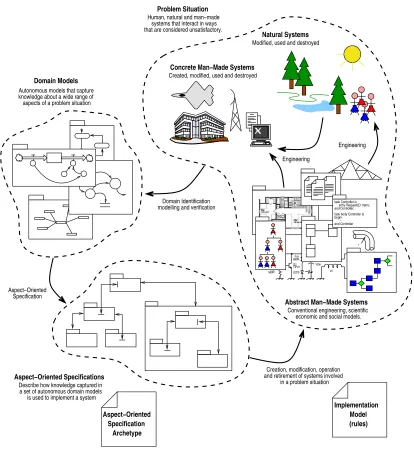
TUML domain modelling concept, suggested the intriguing possibility of being able to form a general systems engineering approach that could be used to help people from multiple disciplines work together to build well understood systems of all kinds. These systems would include the hardware, software, organisational, legal, and social systems required to implement decisions made using techniques such asCapability
Dynamics (Section 2.5), System Dynamics[Forrester, 1961] and the Soft Systems
Methodology[Checkland, 1981;Checkland and Scholes, 1999].
2.8
Emergence of Aspect-Oriented Thinking
The ideal engineer is a composite ... He is not a scientist, he is not a mathematician, he is not a sociologist or a writer; but he may use the knowledge and techniques of any or all of these disciplines in solving engineering problems.
N. W. Dougherty, 1955
One of the greatest disservices of formal education lies in the fact that students are induced to believe that every problem can be placed in an academic discipline such as physical, chemical, biological, psychological, sociological, political and ethical. In business schools, problems are placed in such categories as financial, personnel, public relations, production, marketing, distribution and purchasing. However, the world is not organised like universities, colleges and schools, by disciplines.
Ackoff[1999, p15]




![Figure 3.4:Activity diagram depicting the ‘Research-then-Transfer’ life-cycle[Potts, 1993].](https://thumb-us.123doks.com/thumbv2/123dok_us/8038960.220734/63.595.193.458.368.673/figure-activity-diagram-depicting-research-transfer-cycle-potts.webp)