promoting access to White Rose research papers
White Rose Research Online
Universities of Leeds, Sheffield and York
http://eprints.whiterose.ac.uk/
This is an author produced version of a paper published in
European Journal of
Cancer.
White Rose Research Online URL for this paper:
http://eprints.whiterose.ac.uk/7890/
Published paper
Hall, P.S. and Cameron, D.A. (2009)
Current perspective - Trastuzumab.
European Journal of Cancer, 45 (1). pp. 12-18.
http://dx.doi.org/10.1016/j.ejca.2008.10.013
Page
1
of
18
Current Perspective – Trastuzumab
European Journal of Cancer
December 2008
Authors:
1. Peter S Hall
Clinical Research Fellow, University of Leeds, UK
Email: [email protected]
2. David A Cameron*
Professor of Medical Oncology, University of Leeds, UK
Email: [email protected]
Address for correspondence:
Prof D Cameron
NCRN Coordinating Centre
University of Leeds
24 Hyde Terrace
Leeds
LS2 9LN
Page
2
of
18
Over the last decade, the increased understanding of the molecular basis of cancerhas resulted in the development of a wide range of effective targeted therapies which has
expanded the armamentarium of active drugs available to the oncologist. Trastuzumab is
the first of this new generation to be successfully applied in breast cancer and it now plays
an important part in the management of metastatic and early breast cancer. The
introduction of Trastuzumab has been heralded as a successful example of modern “bench
to bedside” development – from experimental models to translational experiments to clinical
trials in the metastatic then adjuvant setting. This process has been made possible by
worldwide collaboration between laboratory scientists, the pharmaceutical industry and
clinical trialists.
The HER-2/neu (HER2) oncogene, also called c-erbB2, was discovered in the 1980’s and is
a member of the erbB-like oncogene family. It is related to, but distinct from, the epidermal
growth factor receptor (EGFR) and shares a role in the regulation of cell proliferation. HER2
is over-expressed in 15-30% of breast cancers and carries an adverse prognosis.(1, 2)
HER2 cell surface protein over-expression is usually caused by amplification of the HER2
gene. (3, 4) HER2 positive breast cancers represent one end of a spectrum of increasingly
defined breast cancer subtypes, characterised by a high risk of recurrence and metastasis
and reduced overall survival.
Trastuzumab is a recombinant humanised monoclonal antibody (IgG) directed against the
HER2 extracellular domain. It is made with the hyper-variable antigen binding regions of a
potent murine anti-HER2 monoclonal antibody grafted into a human IgG. Its exact
mechanism of action remains unclear and appears to differ in vivo compared to in vitro.
Whether or not Trastuzumab induces HER2 receptor down-regulation remains a matter of
controversy. It may act by blocking HER2 receptor cleavage, inhibiting intracellular
Page
3
of
18
only cytostatic but also cytotoxic and this may be in part due to recruitment of the immunesystem by antibody dependent cell mediated cytotoxicity.(6) In addition to its direct
mechanism of action, a theoretical synergy with chemotherapy may be important.
Standardised selection of the correct population who benefit from Trastuzumab therapy is
vital and has been the subject of ongoing development. Guidelines are now well established
at an international level that define HER2 over-expression (HER2 “positivity”) and thus
predict a high chance of sensitivity to Trastuzumab.(7) Algorithms use a mixture of
immunohistochemistry (IHC) to measure the level of HER2 protein at the cell surface, and
in-situ hybridisation (FISH) to look for gene amplification. FISH is widely held as the gold
standard not just because there is a good correlation between DNA copy number and
protein levels, but also because routine fixation processes mean that protein levels as
measured by IHC may not always be an accurate indicator of the level in vivo in the patient.
Trastuzumab in metastatic breast cancer
As a single agent Trastuzumab can produce response rates up to 35% in selected
metastatic breast cancer patients. (8, 9) In vitro demonstration of additive or synergistic
activity with a number of active chemotherapy drugs led to early clinical development in
combination with chemotherapy. (10) Landmark phase II and phase III trials reported
response rates of 50-84% using Trastuzumab in combination with standard chemotherapy
(paclitaxel, docetaxel or doxorubicin, and cyclophosphamide combinations) and
demonstrated improvement in time to progression, duration of response and survival
compared with the same chemotherapy alone as therapyfor metastatic breast cancer
over-expressing HER2.(11-13) Although combinations with a taxane or anthracycline were
efficacious, anthracycline containing regimens produced unexpected and limiting
Page
4
of
18
Trastuzumab after progression?
Trastuzumab has clearly revolutionised treatment for HER2 positive patients, however, half
of the patients still have non-responding tumours and disease progression occurs within 1
year in the majority of cases. It remains uncertain whether further Trastuzumab either in
combination with further chemotherapy or as a single agent is worthwhile. It is also unknown
whether retreatment on relapse is useful for patients who were treated with adjuvant
Trastuzumab. Current guidelines do not recommend further treatment options after
progression on Trastuzumab. (14) There is, however, emerging evidence suggesting
efficacy with further anti-HER2 therapy and many clinicians will continue Trastuzumab after
progression. Continuing Trastuzumab after cancer progression is undoubtedly an attractive
option for patients and their treating oncologist due to low toxicity and lack of established
alternatives. The implications for those funding healthcare are however significant, with the
costs of trastuzumab and its administration at around Euro 40,000 (£32,000) for 1 year of
treatment.(15)
Initially the practise of continuing Trastuzumab after progression was based on preclinical
studies that suggested Trastuzumab can slow down tumour growth in the presence of
disease progression. Clinical evidence that does exist is largely derived from retrospective
studies and includes an extension trial to the pivotal phase III trial testing Trastuzumab in
combination with first line palliative chemotherapy. They suggest a reasonable safety and
cardiotoxicity profile with continued treatment(16-18) and responses are at least as good
when combined with second line chemotherapy compared to historical controls.(19-21) A
prospective observational database has been set up by Genentech with the hope of adding
Page
5
of
18
More convincing data comes from the randomised trial GBG26/TBP which set out tocompare capecitabine with or without trastuzumab in patients who had progressed or
relapsed after any prior trastuzumab treatment. This was closed early on the
recommendation of the IDMC after recruiting 156 patients. The final analysis recently
reported statistically significant advantages for the combination arm with increased response
rates and mean TTP of 5.6 vs 8.2 months (p=0.034). This is the strongest evidence to date
supporting the role for continuing trastuzumab therapy in this situation. (23)
The small molecule Lapatinib acts by inhibiting the receptor tyrosine kinase activity of HER2
and also the EGFR (ErbB1) receptor. A pivotal trial randomised between Capecitabine
monotherapy and Capecitabine in combination with Lapatinib in patients who had been
previously treated with Trastuzumab. Recently published interim results reported a
statistically significant improvement in the primary endpoint of time to progression (HR 0.57
(95% confidence intervals 0.43 – 0.770, p=0.00013, medians of 4.3 months versus 6.2
months respectively). This demonstrated efficacy has led to approval for use in the US, EU
and Switzerland. (24, 25)
Both of these studies support ongoing anti-HER2 therapy in combination with Capecitabine
in patients with progressive cancer after Trastuzumab. The level of benefit though does not
appear as great as that seen when Trastuzumab was combined with anthracyclines or
taxanes, and therefore there does remain some uncertainty as to the true level of benefit
from continued HER2 blockade. Importantly, they only provide evidence for patients
pre-treated with anthracyclines, taxanes and trastuzumab. There remains no definitive evidence
Page
6
of
18
that continuing Trastuzumab as a single agent is efficacious in this situation. There remainsmuch uncertainty which clearly still needs to be addressed by good quality adequately
powered trials. Prospective randomized trials called THOR (Italian) and PANDORA
(multinational) are attempting to address this need – comparing second line chemotherapy
with or without continued Trastuzumab – but these types of studies have always been
difficult to recruit to, due in part to the expectation that continued anti-HER2 therapy is of
benefit.
Ultimately we need to further develop our understanding of the mechanisms by which
tumours develop resistance to Trastuzumab if they are to be overcome. Proposed
mechanisms are numerous and varied but include increased cell signalling (PTEN loss,
increased AKT activity), alternative cell signalling mediated by EGFR family pathways
(TGF-a over-expression, neuregulin over-expression) (TGF-and (TGF-altern(TGF-ative cell sign(TGF-alling medi(TGF-ated by
different pathways (VEGF over-expression, IGF1R over-expression).(5) In particular, when
considering the potential benefit of an intracellular signalling blockade with small molecules
such as Lapatinib, is the possible relevance of the truncated HER2 receptor, p95, which
results in constitutive activation and no extra-cellular target to which an antibody such as
Trastuzumab can bind. (26) In addition to Lapatinib, other agents at an earlier stage of
development are also showing promise. Pertuzumab is a monoclonal antibody similar to
Trastuzumab which targets a different region of the HER2 receptor. It has demonstrated
activity in early phase trials when added to Trastuzumab for patients with disease
progressing on Trastuzumab therapy, which incidentally provides further evidence of
retained tumour sensitivity to anti-HER2 therapy even though resistance to Trastuzumab has
developed.(27) Gefitinib, a small molecule tyrosine kinase inhibitor (TKI) acting against
Page
7
of
18
used in combination with Trastuzumab.(28) Another agent KOS-953 (17-AAG) inhibits theactivity of heat shock protein 90 resulting in degradation and reduced expression of the
HER2 receptor and has also produced responses in an early report from a phase II
study.(29)
Recent enthusiasm has also focused on the association between vascular endothelial
growth factor receptor (VEGFR) and HER2 expression in breast tumours.(30) Evidence
suggests that VEGFR expression is linked to HER2 signalling and over-expression of HER2
results in induction of VEGFR.(31) Hence Trastuzumab is currently under evaluation in
combination with Bevacizumab, an antibody directed against VEGF. An impressive
response rate of 46% was seen in a phase II trial testing this combination,(32) although
concerns exist surrounding the potential combined cardiotoxicity of these two drugs.
Pazopanib is a small molecule multi-targeted TKI which also inhibits VEGF and has recently
demonstrated tolerability and activity when tested in combination with Lapatinib in a phase II
trial. (33)
It is now well recognised that HER2 positive breast cancer has a high rate of CNS
involvement, and cerebral metastasis as the site of progression after Trastuzumab is
unexpectedly common.(34-37) The particular challenge facing us now is how best to control
this disease, particularly when presenting in the setting of responding extra-cranial
metastasis.(38) Trastuzumab does not appear to efficiently cross the blood brain barrier,
and so it is unclear if the current practise of local CNS therapy and continued Trastuzumab
is optimal. Although early data suggests that Lapatinib may play a role in controlling CNS
Page
8
of
18
Adjuvant Trastuzumab
The clear benefit of using Trastuzumab in patients with advanced HER2 positive breast
cancer quickly led to the initiation of a series of large trials testing the hypothesis that the use
of Trastuzumab in HER2 over-expressing early breast cancer could improve disease-free
survival. Four large and two smaller trials have all now reported, and all but one has shown a
benefit with the use of Trastuzumab in addition to adjuvant chemotherapy in both disease
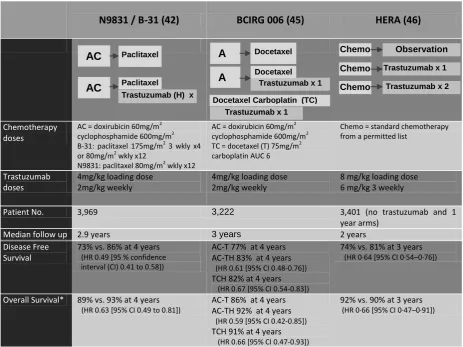
free survival and overall survival (table 1). In fact Trastuzumab is the first monoclonal
antibody to produce a survival advantage when used as adjuvant therapy. Altogether these
trials include more than 13,000 patients and provide a firm evidence base supporting its use
in this setting. The only trial not to show a clear benefit was the smaller PACS04 trial, (40)
where the patients randomised to Trastuzumab, as in the FINHER trial (vide infra) were a
subset of patients in a larger trial whose primary objective was a chemotherapy question.
Thus, although there is little doubt for the role of adjuvant Trastuzumab, the differing designs
of these trials leave many questions as to the optimum timing and duration of its use.
Three North American studies (table 1) – the North Central Cancer Treatment Group
(NCCTG) Intergroup N9831, the National Surgical Adjuvant Breast and Bowel Project
(NSABP) B-31 and the Breast Cancer International Research Group (BCIRG) 006 trials
based their design on data from trials in metastatic breast cancer using a
taxane-Trastuzumab combination. Using a standard sequence of anthracycline followed by taxane,
they added Trastuzumab to the taxane, continuing to a year in total. The similar designs of
N9831 and B-31 led to the joint analysis of their combined data. (41-43) The HERceptin
Adjuvant (HERA) trial recruited from most of the rest of the world. This tested the addition of
one or two years of trastuzumab given as a single agent after completion of standard
Page
9
of
18
Table 1. Large adjuvant trastuzumab trialsN9831 / B-31(42) BCIRG 006(45) HERA(46)
Chemotherapy doses
AC = doxirubicin 60mg/m2
cyclophosphamide 600mg/m2
B-31: paclitaxel 175mg/m2 3 wkly x4 or 80mg/m2 wkly x12
N9831: paclitaxel 80mg/m2 wkly x12
AC = doxirubicin 60mg/m2
cyclophosphamide 600mg/m2
TC = docetaxel (T) 75mg/m2 carboplatin AUC 6
Chemo = standard chemotherapy from a permitted list
Trastuzumab doses
4mg/kg loading dose 2mg/kg weekly
4mg/kg loading dose 2mg/kg weekly
8 mg/kg loading dose 6 mg/kg 3 weekly
Patient No. 3,969 3,222 3,401 (no trastuzumab and 1
year arms)
Median follow up 2.9 years 3 years 2 years
Disease Free Survival
73% vs. 86% at 4 years (HR 0.49 [95 % confidence interval (CI) 0.41 to 0.58])
AC-T 77% at 4 years AC-TH 83% at 4 years
(HR 0.61 [95% CI 0.48-0.76]) TCH 82% at 4 years (HR 0.67 [95% CI 0.54-0.83])
74% vs. 81% at 3 years (HR 0·64 [95% CI 0·54–0·76])
Overall Survival* 89% vs. 93% at 4 years (HR 0.63 [95% CI 0.49 to 0.81])
AC-T 86% at 4 years AC-TH 92% at 4 years
(HR 0.59 [95% CI 0.42-0.85]) TCH 91% at 4 years (HR 0.66 [95% CI 0.47-0.93])
92% vs. 90% at 3 years (HR 0·66 [95% CI 0·47–0·91])
AC
AC Paclitaxel
Paclitaxel
Trastuzumab (H) x
1 year
Trastuzumab x 2
years
Trastuzumab x 1
year Observation Chemo Chemo Chemo A C A C
Docetaxel Carboplatin (TC) Trastuzumab x 1
year Docetaxel
Trastuzumab x 1
Page
10
of
18
Early reporting of trials led to initial concerns over data immaturity – perhaps no survivaladvantage would be seen? (47) In fact the combined analysis of the two US trials N9831
and NSABP B-31 reported a 33% improvement in survival after a median follow-up of two
years. Analysis of the HERA trial also at a median 2 years in 2006 saw a similar 34%
improvement in overall survival. (46)
The duration of treatment with Trastuzumab varies hugely between trials from 9 weeks to 2
years. One year of treatment, starting either with the taxane component of chemotherapy, or
after chemotherapy, has been widely adopted as standard treatment across the world. This
treatment duration remains arbitrary at present but will be addressed in due course with the
maturation of data from the third arm of the HERA trial. This has not yet been released by
the IDMC, but will allow us to compare 2 years to 1 year of Trastuzumab after
chemotherapy.
Researchers in Finland have added a new dimension to the debate with the publication of
the FinHER trial. 231 women with HER2 positive tumours were identified within a larger
adjuvant chemotherapy study. They were randomised to treatment with or without
Trastuzumab immediately after surgery concomitantly with the non-anthracycline part of their
chemotherapy. 3-year recurrence-free survival was better in those who received
Trastuzumab (89 percent vs. 78 percent; P=0.01) with a halving of the risk of recurrence
achieved with only nine weeks Trastuzumab. It resulted in women with HER2 positive
breast cancer having the same prognosis as those with HER2 negative breast cancer in the
Page
11
of
18
The FINHER data suggest a shorter duration could be just as effective as the longerdurations tested in other trials. It is perhaps no surprise that in both the UK and France, it is
government money that supports two similar trials with a planned joint analysis to address
this question. In the UK the Health Technology Assessment have funded a trial called
Persephone which tests a shorter duration of Trastuzumab, comparing 1 year to 6 months of
treatment after chemotherapy. Detailed health economic data collection within Persephone
will add a wealth of information to the ongoing debate surrounding the cost of new expensive
adjuvant drug treatments. The PHARE trial in France, sponsored by Institut National de
Cancer, follows a very similar design, and having opened earlier has already recruited over
1,800 patients at 12 months which represents over half of its targeted accrual. In addition,
another trial from Finland, SOLD, is comparing the 9 week schedule used in FINHER with a
full year’s post-op trastuzumab as used in the HERA trial. This trial is similar in concept to a
small randomised phase II study from ECOG, E2198.(49) Whilst the trial was designed to
address a safety, not an efficacy question, it included a very similar number of HER2 +ve
patients as FinHER, and the 5-year outcome data from this study suggests little additional
benefit from the maintenance Trastuzumab after completion of adjuvant chemotherapy plus
Trastuzumab.
An equally important, and perhaps more challenging, question addresses the optimal timing
of Trastuzumab in relation to chemotherapy. Preclinical experiments suggest that concurrent
administration is necessary to produce cytotoxicity, whereas sequential administration may
be, at best, cytostatic.(50) Administration with the taxane portion of accepted
anthracycline-taxane sequences is possible and efficacious, but trials have produced conflicting results
between this and consecutive treatment. The N9831 trial had a third arm where
Page
12
of
18
N9831 this arm appeared much less effective, in contrast to the HERA trial where it almosthalves the rate of recurrence. It is interesting to note that in the HERA trial, the 26% of
patients who received taxane-based chemotherapy had an apparently lower benefit from the
subsequent year’s Trastuzumab. However, neither of these data have been updated, so
one cannot be sure that it is more effective to commence the Trastuzumab with the taxane,
and this has the added disadvantage of starting the treatment only 3 weeks after a dose of
anthracyclines. Indirect comparisons of the cardiac toxicity data between the two
approaches suggests a lower rate of cardiac toxicity when the Trastuzumab is given further
away from the last anthracycline dose.
The main barrier to concurrent administration of Trastuzumab and chemotherapy is the high
risk of cardiotoxicity with an anthracycline-Trastuzumab combination.(12) The novel
schedule of platinum-taxane-Trastuzumab suggested strong synergy in pre-clinical studies
and with efficacy being confirmed in metastatic breast cancer patients. (51). Therefore the
BCIRG006 included a third non-anthracycline containing arm aiming to reduce cardiac
toxicity and build on preclinical data. This proved to be almost as effective and definitely
less cardiotoxic compared to the anthracycline containing arms. Many argue that this is the
most pragmatic treatment strategy in light of the absence of data confirming long term
cardiac safety with the use of both an anthracycline and a taxane in the adjuvant treatment
schedule. There is, however, convincing evidence suggesting that patients with HER2
positive tumours derive particular benefit from anthracyclines compared to patients with
HER2 negative tumours.(52-54) Although this benefit may only be seen then HER2 is
co-amplified with topoisomerase II,(55) this is hard to ignore. One potential strategy for
Page
13
of
18
liposomal doxorubicin and this topic has been recently reviewed in detail by Rayson et al.(56)
Future Directions
Perhaps a next step required to fully integrate Trastuzumab into the curative treatment
algorithm for breast cancer patients is to fully evaluate its role as neo-adjuvant therapy and
attempts are now being made to extend the benefit seen with adjuvant Trastuzumab as
neo-adjuvant treatment. The MD Anderson centre conducted a randomised trial where patients
either received Trastuzumab or not, concurrently with neo-adjuvant chemotherapy. The
study was stopped prematurely after only 42 patients had been enrolled, because a
significantly increased rate of pathological complete response was seen (43% vs 23%;
p=0.002).(57) An interim analysis of the NOAH trial has recently been presented. This
larger study demonstrated that pathologically complete response was doubled when
Trastuzumab was added to neo-adjuvant chemotherapy for HER2-positive breast cancer
(43% versus 22%, P=0.002, n = 228) thus paralleling the adjuvant benefit. (58) Both of
these studies included concurrent use of Trastuzumab with the anthracycline epirubicin, and
reported acceptable cardiac toxicity.
Regarding the role of Trastuzumab in the 45-50% patients(44) with HER2 positive tumours
co-expressing HER2 and the oestrogen receptor (ER), pre-clinical evidence supports an
interaction between their dependant signalling pathways.(59) This is important because of
the relative resistance of HER2 positive tumours to endocrine therapy. The TANDEM trial
looking at this patient population demonstrated improved PFS with Anastrozole plus
Page
14
of
18
rapid disease progression in these patients, the question is raised as to whether thesepatients proceed directly to chemotherapy in combination with Trastuzumab. (61)
Conclusion
A robust strategy for determining optimal treatment strategies for HER2 positive breast
cancer as a unique disease is essential. Laboratory and clinical data point towards HER2
blockade being a critical drug treatment for most patients with HER2 positive disease. The
limited clinical trial data to date do suggest, in a manner not dissimilar to what is seen with
sequential endocrine agents and ER-positive breast cancer, that the development of
resistance to one anti-HER2 agent, Trastuzumab, does not preclude benefit from further
anti-HER2 blockade, but the optimum strategy and true level of benefit remain unclear. In
the adjuvant setting, Lapatinib is the next in line for testing in HER2 positive early breast
cancer. The ALLTO study - a very large multinational trial designed to assess Lapatinib and
Trastuzumab, each alone, concurrently and sequentially - will confirm or refute the value of
this approach. Ensuring maximum patient benefit by optimising the treatment of this disease
with effective anti-HER2 blockade as the backbone of patient’s therapy should remain high
on the list of current research priorities.
References
1. Slamon DJ, Clark GM, Wong SG, Levin WJ, Ullrich A, McGuire WL. Human breast cancer: correlation of relapse and survival with amplification of the HER-2/neu oncogene. Science 1987;235(4785):177-82.
2. Slamon DJ, Godolphin W, Jones LA, Holt JA, Wong SG, Keith DE, et al. Studies of the HER-2/neu proto-oncogene in human breast and ovarian cancer. Science 1989;244(4905):707-12.
3. Pauletti G, Godolphin W, Press MF, Slamon DJ. Detection and quantifation of HER-2/neu gene amplification in human breast cancer archival material using fluorescence in situ hybridization. Oncogene 1996;13(1):63-72.
Page
15
of
18
5. Valabrega G, Montemurro F, Aglietta M. Trastuzumab: mechanism of action, resistance and future perspectives in HER2-overexpressing breast cancer. Ann Oncol 2007;18(6):977-84.6. Gennari R, Menard S, Fagnoni F, Ponchio L, Scelsi M, Tagliabue E, et al. Pilot study of the mechanism of action of preoperative trastuzumab in patients with primary operable breast tumors overexpressing HER2. Clin Cancer Res 2004;10(17):5650-5.
7. Antonio C. Wolff MEHH, Jared N. Schwartz, Karen Hagerty, D. Craig Allred, et al. American Society of Clinical Oncology-College of American Pathologists Guideline Recommendations for Human Epidermal Growth Factor Receptor 2 Testing in Breast Cancer. ASCO Clinical Practice Guidelines 2007.
8. Vogel CL, Cobleigh MA, Tripathy D, Gutheil JC, Harris LN, Fehrenbacher L, et al. Efficacy and Safety of Trastuzumab as a Single Agent in First-Line Treatment of HER2-Overexpressing Metastatic Breast Cancer. J Clin Oncol 2002;20(3):719-726.
9. Cobleigh MA, Vogel CL, Tripathy D, Robert NJ, Scholl S, Fehrenbacher L, et al. Multinational study of the efficacy and safety of humanized anti-HER2 monoclonal antibody in women who have HER2-overexpressing metastatic breast cancer that has progressed after chemotherapy for metastatic disease. J Clin Oncol 1999;17(9):2639-48.
10. Pegram MD, Konecny GE, O'Callaghan C, Beryt M, Pietras R, Slamon DJ. Rational combinations of trastuzumab with chemotherapeutic drugs used in the treatment of breast cancer. J Natl Cancer Inst 2004;96(10):739-49.
11. Marty M, Cognetti F, Maraninchi D, Snyder R, Mauriac L, Tubiana-Hulin M, et al. Randomized phase II trial of the efficacy and safety of trastuzumab combined with docetaxel in patients with human epidermal growth factor receptor 2-positive metastatic breast cancer administered as first-line treatment: the M77001 study group. J Clin Oncol 2005;23(19):4265-74.
12. Slamon DJ, Leyland-Jones B, Shak S, Fuchs H, Paton V, Bajamonde A, et al. Use of chemotherapy plus a monoclonal antibody against HER2 for metastatic breast cancer that overexpresses HER2. N Engl J Med 2001;344(11):783-92.
13. Burstein HJ, Kuter I, Campos SM, Gelman RS, Tribou L, Parker LM, et al. Clinical activity of trastuzumab and vinorelbine in women with HER2-overexpressing metastatic breast cancer. J Clin Oncol 2001;19(10):2722-30.
14. Coordinating author for the ESMO Guidelines Working Group: V. V. Kalaja. Recurrent or metastatic breast cancer: ESMO Clinical Recommendations for diagnosis, treatment and follow-up. Ann Oncol 2007;18(suppl_2):ii9-11.
15. Neyt M, Huybrechts M, Hulstaert F, Vrijens F, Ramaekers D. Trastuzumab in early stage breast cancer: a cost-effectiveness analysis for Belgium. Health Policy 2008;87(2):146-59.
16. Gelmon KA, Mackey J, Verma S, Gertler SZ, Bangemann N, Klimo P, et al. Use of trastuzumab beyond disease progression: observations from a retrospective review of case histories. Clin Breast Cancer 2004;5(1):52-8; discussion 59-62.
17. Fountzilas G, Razis E, Tsavdaridis D, Karina M, Labropoulos S, Christodoulou C, et al. Continuation of trastuzumab beyond disease progression is feasible and safe in patients with metastatic breast cancer: a retrospective analysis of 80 cases by the hellenic cooperative oncology group. Clin Breast Cancer 2003;4(2):120-5.
18. Tripathy D, Slamon DJ, Cobleigh M, Arnold A, Saleh M, Mortimer JE, et al. Safety of treatment of metastatic breast cancer with trastuzumab beyond disease progression. J Clin Oncol 2004;22(6):1063-70.
Page
16
of
18
20. Montemurro F, Donadio M, Clavarezza M, Redana S, Jacomuzzi ME, Valabrega G, et al. Outcome of Patients with HER2-Positive Advanced Breast Cancer Progressing During Trastuzumab-Based Therapy. The Oncologist 2006;11(4):318-324.21. Bachelot T, Mauriac L, Delcambre C, Maillart P, Veyret C, Mouret-Reynier M, et al. Efficacy and safety of trastuzumab plus vinorelbine as second-line treatment for women with HER2-positive metastatic breast cancer beyond disease progression. J Clin Oncol 2007;25(suppl 18):1094.
22. Yardley DA, Kaufman PA, Mayer M, Ulcickas Yood M, Tan-Chiu E, Brufsky AM, et al. registHER: Patient characteristics, treatment patterns, and preliminary outcomes in patients with HER2-positive (HER2+), hormone receptor-positive (HR+) metastatic breast cancer (MBC). J Clin Oncol 2007;25(suppl 18):21007-.
23. Von Minckwitz G, Zielinski C, Maarteense E, Vogel P, Schmidt M, Eidtmann H, et al. Capecitabine vs. capecitabine + trastuzumab in patients with HER2-positive metastatic breast cancer progressing during trastuzumab treatment: The TBP phase III study (GBG 26/BIG 3-05). J Clin Oncol 2008;26(suppl 15):1025.
24. Geyer CE, Forster J, Lindquist D, Chan S, Romieu CG, Pienkowski T, et al. Lapatinib plus capecitabine for HER2-positive advanced breast cancer. N Engl J Med 2006;355(26):2733-43.
25. Cameron D, Casey M, Press M, Lindquist D, Pienkowski T, Romieu CG, et al. A phase III randomized comparison of lapatinib plus capecitabine versus capecitabine alone in women with advanced breast cancer that has progressed on trastuzumab: updated efficacy and biomarker analyses. Breast Cancer Res Treat 2008:Epub ahead of print.
26. Segatto O, King CR, Pierce JH, Di Fiore PP, Aaronson SA. Different structural alterations upregulate in vitro tyrosine kinase activity and transforming potency of the erbB-2 gene. Mol. Cell. Biol. 1988;8(12):5570-5574.
27. Baselga J, Cameron D, Miles D, Verma S, Climent M, Ross G, et al. Objective response rate in a phase II multicenter trial of pertuzumab (P), a HER2 dimerization inhibiting monoclonal antibody, in combination with trastuzumab (T) in patients (pts) with HER2-positive metastatic breast cancer (MBC) which has progressed during treatment with T. J Clin Oncol 2007;25(suppl 18):1004.
28. Moulder SL, O'Neill A, Arteaga C, Pins M, Sparano J, Sledge G, et al. Final Results of ECOG1100: A phase I/II study of combined blockade of the ErbB receptor network in patients with HER2- overexpressing metastatic breast cancer (MBC). J Clin Oncol 2007;25(suppl 18):1033.
29. Modi S SA, Linden HM, Sugarman S, Ma W, Solit D, Rosen N, Kersey K, Johnson RG, Hannah AL, Hudis C. Phase 2 trial of trastuzumab (T) and KOS-953 (17-AAG) in patients (pts) with HER2-positive breast cancer: preliminary Results. Breast Cancer Treat Res 2006;100(Supp1):abstr 1102.
30. Konecny GE, Meng YG, Untch M, Wang HJ, Bauerfeind I, Epstein M, et al. Association between HER-2/neu and vascular endothelial growth factor expression predicts clinical outcome in primary breast cancer patients. Clin Cancer Res 2004;10(5):1706-16. 31. Yen L, You XL, Al Moustafa AE, Batist G, Hynes NE, Mader S, et al. Heregulin selectively upregulates vascular endothelial growth factor secretion in cancer cells and stimulates angiogenesis. Oncogene 2000;19(31):3460-9.
32. Pegram M CD, Dichmann RA, Tan-Chiu E, Yeon C, Durna L, Lin LS, Slamon D. Phase II combined biological therapy targeting the HER2 proto-oncogene and the vascular endothelial growth factor using trastuzumab (T) and bevacizumab (B) as first line treatment of HER2-amplified breast cancer. Breast Cancer Research and Treatment 2006;100((Supp1):abstr 301.
Page
17
of
18
34. Gori S, Rimondini S, De Angelis V, Colozza M, Bisagni G, Moretti G, et al. Central Nervous System Metastases in HER-2 Positive Metastatic Breast Cancer Patients Treated with Trastuzumab: Incidence, Survival, and Risk Factors. The Oncologist 2007;12(7):766-773.35. Bendell JC, Domchek SM, Burstein HJ, Harris L, Younger J, Kuter I, et al. Central nervous system metastases in women who receive trastuzumab-based therapy for metastatic breast carcinoma. Cancer 2003;97(12):2972-7.
36. Shmueli E, Wigler N, Inbar M. Central nervous system progression among patients with metastatic breast cancer responding to trastuzumab treatment. Eur J Cancer 2004;40(3):379-82.
37. Clayton AJ, Danson S, Jolly S, Ryder WD, Burt PA, Stewart AL, et al. Incidence of cerebral metastases in patients treated with trastuzumab for metastatic breast cancer. Br J Cancer 2004;91(4):639-43.
38. Heinrich B BO, Siekiera W, Raab G, Heinemann V. Development of brain metastasis in metastatic breast cancer (MBC) responding to treatment with trastuzumab. Proc Am Soc Clin Oncol 2003;22:abstr 147.
39. Lin NU, Dieras V, Paul D, Lossignol D, Christodoulou C, Laessig D, et al. EGF105084, a phase II study of lapatinib for brain metastases in patients (pts) with HER2+ breast cancer following trastuzumab (H) based systemic therapy and cranial radiotherapy (RT). J Clin Oncol 2007;25(suppl 18):1012.
40. Spielmann M RH, Humblet Y, et al. 3-year follow-up ofTrastuzumab following adjuvant chemotherapy in nodepositive HER2-positive breast-cancer patients: results of the PACS-04 trial. Breast Cancer Research and Treatment 2007;106(Supp1):Abstr 72.
41. Romond EH, Perez EA, Bryant J, Suman VJ, Geyer CE, Jr., Davidson NE, et al. Trastuzumab plus adjuvant chemotherapy for operable HER2-positive breast cancer. N Engl J Med 2005;353(16):1673-84.
42. Perez EA, Romond EH, Suman VJ, Jeong J, Davidson NE, Geyer CE, et al. Updated results of the combined analysis of NCCTG N9831 and NSABP B-31 adjuvant chemotherapy with/without trastuzumab in patients with HER2-positive breast cancer. J Clin Oncol 2007;25(suppl 18):abstr 512.
43. D. Slamon WE, N. Robert. Phase III randomized trial comparing doxorubicin and cyclophosphamide followed by docetaxel (AC→T) with doxorubicin and cyclophosphamide followed by docetaxel and trastuzumab (AC→TH) with docetaxel, carboplatin and trastuzumab (TCH) in HER2 positive early breast cancer patients: BCIRG 006 study. Breast Cancer Research and Treatment 2005;94(Supp. 1):S5.
44. Piccart-Gebhart MJ, Procter M, Leyland-Jones B, Goldhirsch A, Untch M, Smith I, et al. Trastuzumab after adjuvant chemotherapy in HER2-positive breast cancer. N Engl J Med 2005;353(16):1659-72.
45. Slamon D EW, Robert N et al. BCIRG 006: 2nd interim analysis phase III randomized trial comparing doxorubicin and cyclophosphamide followed by docetaxel (AT/T) with doxorubicin and cyclophosphamide followed by docetaxel and trastuzumab (AC/TH) with docetaxel, carboplatin and trastuzumab (TCH) in HER2neu positive early breast cancer patients. Breast Cancer Research and Treatment 2006;100(Supp1):abstr 52.
46. Smith I, Procter M, Gelber RD, Guillaume S, Feyereislova A, Dowsett M, et al. 2-year follow-up of trastuzumab after adjuvant chemotherapy in HER2-positive breast cancer: a randomised controlled trial. The Lancet 2006;369(9555):29-36.
47. Editorial TL. Herceptin and early breast cancer: a moment for caution. Lancet 2005;366(9498):1673.
Page
18
of
18
49. Sledge GW ONA, Thor A, Kahanic SP, Zander PJ, Davidson N., Group ftECO. Adjuvant trastuzumab: long-term results of E2198. Breast Cancer Research and Treatment 2006;100(Supp. 1):abstr 2075.50. Pietras RJ, Pegram MD, Finn RS, Maneval DA, Slamon DJ. Remission of human breast cancer xenografts on therapy with humanized monoclonal antibody to HER-2 receptor and DNA-reactive drugs. Oncogene 1998;17(17):2235-49.
51. Robert N L-JB, Asmar L, Belt R, Ilegbodu D,, Loesch D RR, Valentine E, Sayre R, Albain K, Cobleigh M,, McCullough C FL, Slamon D. Phase III comparative study of trastuzumab and paclitaxel with and without carboplatin in patients with HER-2/neu positive advanced breast cancer. Breast Cancer Research and Treatment 2002;76((Supp1):S35. 52. Paik S, Bryant J, Park C, Fisher B, Tan-Chiu E, Hyams D, et al. erbB-2 and response to doxorubicin in patients with axillary lymph node-positive, hormone receptor-negative breast cancer. J Natl Cancer Inst 1998;90(18):1361-70.
53. Pritchard KI, Shepherd LE, O'Malley FP, Andrulis IL, Tu D, Bramwell VH, et al. HER2 and responsiveness of breast cancer to adjuvant chemotherapy. N Engl J Med 2006;354(20):2103-11.
54. Gennari A, Sormani MP, Pronzato P, Puntoni M, Colozza M, Pfeffer U, et al. HER2 status and efficacy of adjuvant anthracyclines in early breast cancer: a pooled analysis of randomized trials. J Natl Cancer Inst 2008;100(1):14-20.
55. Slamon DJ MJ, Robert N et al. Role of anthracycline-based therapy in the adjuvant treatment of breast cancer: efficacy analysis determined by molecular subtypes of the disease. Breast Cancer Research and Treatment 2007;106((Suppl 1)):S5 (Abstr 13).
56. Rayson D, Richel D, Chia S, Jackisch C, van der Vegt S, Suter T. Anthracycline-trastuzumab regimens for HER2/neu-overexpressing breast cancer: current experience and future strategies. Annals of Oncology 2008;19(9):1530-1539.
57. Buzdar AU, Ibrahim NK, Francis D, Booser DJ, Thomas ES, Theriault RL, et al. Significantly Higher Pathologic Complete Remission Rate After Neoadjuvant Therapy With Trastuzumab, Paclitaxel, and Epirubicin Chemotherapy: Results of a Randomized Trial in Human Epidermal Growth Factor Receptor 2-Positive Operable Breast Cancer. J Clin Oncol 2005;23(16):3676-3685.
58. Gianni L, Semiglazov V, Manikhas GM, Eiermann W, Lluch A, Tjulandin S, et al. Neoadjuvant trastuzumab in locally advanced breast cancer (NOAH): Antitumour and safety analysis. J Clin Oncol 2007;25(Suppl 18):532.
59. Johnston SR, Martin LA, Leary A, Head J, Dowsett M. Clinical strategies for rationale combinations of aromatase inhibitors with novel therapies for breast cancer. J Steroid Biochem Mol Biol 2007;106(1-5):180-6.
60. Kaufman BM, J. Clemens, M. et al. Trastuzumab plus anastrozole prolongs progression-free survival in postmenopausalwomen with HER2-positive, hormone-dependent metastatic breast cancer. Annals of Oncology 2006;17(supp 9):LBA2.