promoting access to White Rose research papers
Universities of Leeds, Sheffield and York
http://eprints.whiterose.ac.uk/
This is an author produced version of a paper published in
Disability and
Rehabilitation: Assistive Technology
.
White Rose Research Online URL for this paper:
Published paper
Judge, S., Robertson, Z., Hawley, M., Enderby, P. (2009)
Speech-driven
environmental control systems - a qualitative analysis of users' perceptions
,
Disability and Rehabilitation: Assistive Technology, 4 (3), pp. 151-157
Speech Driven Environmental Control Systems - A
qualitative analysis of the perceptions of users
Simon Judge
Barnsley Assistive Technology Team, Barnsley Hospital, Gawber Road,
Barnsley, South Yorkshire, S75 2EP.
(+44)1226 432159
Zoë Robertson
Barnsley Assistive Technology Team, Barnsley Hospital, Gawber Road,
Barnsley, South Yorkshire, S75 2EP.
(+44)1226 432159
Professor Mark Hawley
Barnsley Hospital & University of Sheffield School of Health and Related
Research (ScHARR), Regent Court, Regent Street, Sheffield, S1 4DA.
Professor Pam Enderby
Professor of Community Rehabilitation, School of Health and Related
Research (ScHARR), University of Sheffield, Regent Court, Regent Street,
Speech Driven Environmental Control Systems – A
Qualitative Analysis of users’ perceptions
Abstract
Purpose: To explore users’ experiences and perceptions of speech driven
environmental control systems as part of a larger project aiming to develop a
new speech driven environmental control system. The motivation for this part
of the project was to add to the evidence base for the use of speech driven
environmental control systems and to determine the key design specifications
for a new speech driven system from a user’s perspective.
Method: Semi-structured interviews were conducted with twelve users of
speech driven environmental control systems from around the UK. These
interviews were transcribed and analysed using a qualitative method based
on framework analysis.
Results: Reliability is the main influence on the use of speech driven
environmental control systems. All the participants gave examples of
occasions when their speech driven system was unreliable; in some instances
this unreliability was reported as not being a problem (e.g. for changing
television channels) however it was perceived as a problem for more safety
critical functions (e.g. opening a door). Reliability was cited by participants as
the reason for using a switch operated system as back up. Benefits of speech
methods were not possible; quicker operation and better aesthetic
considerations. Overall there was a perception of increased independence
from the use of speech driven environmental control.
Conclusions: In general speech was considered a useful method of
operating environmental controls by the participants interviewed however their
perceptions regarding reliability often influenced their decision to have backup
or alternative systems for certain functions.
Introduction
Environmental control systems were initially developed in the 1960’s [1] for
patients who had suffered spinal cord injury. The aim of these systems and
environmental control systems today is to enable people with disabilities to
operate equipment within their immediate environment, enabling them to do
things such as answer an intercom, open the door, call for help or operate the
television etc.
The first systems were large wall mounted devices connected by cables to the
devices they were operating (hard-wired). Significant developments in
environmental control have occurred since the 60s [1][2][3] predominantly
driven by advances in technology such as radio and infrared transceivers,
transistors and micro-controllers. These advances have enabled devices to
become smaller and portable, perform more functions and no longer be
Despite these advances, the main methods of operation of environmental
control systems have changed very little; the majority of systems are operated
either via a single switch, a number of switches or via a keypad on the device.
Whilst keypad input can be an efficient method of control for those whose
physical ability is relatively good, this is not the case for many people who
have need of environmental control systems. The majority of environmental
control systems are controlled by switch access which can be slow, effortful
and frustrating. Speech is a possible control method for many current and
potential users of environmental controls or other Assistive Technology [4]
and can make environmental control faster, less effortful and less frustrating
[5]. Existing speech driven environmental controls appear to have a very low
prescription rate however [6]. Speech control of personal computers is more
widely known and used within the field [7][8], suggesting that speech control is
acceptable to users. The question of why speech is not widely used as a
control method for environmental control systems remains open.
The reasons for carrying out this study were to explore the question of why
speech is not used more widely as a control method for environmental
controls and further the knowledge in this poorly evidenced area of Assistive
Technology. Anecdotal evidence exists for the lack of prescription and
adoption of speech-driven systems however no studies have looked at user’s
perceptions and opinions on speech as an access method for environmental
controls. In addition it was planned that results from this study would provide
collaborative project with the aim of developing a new speech driven
environmental control.
This paper presents the results of a qualitative analysis of semi-structured
interviews with participants currently using speech driven environmental
controllers.
Method
Recruitment
United Kingdom ethical approval was granted by North Sheffield Ethics Office.
Participants for the study were identified by contacting health professionals
involved in the prescription of environmental control systems via an assistive
technology professionals’ mailing list (www.jiscmail.ac.uk/lists/assistech.html).
Professionals were sought who could provide details of clients in their areas
currently using speech driven environmental control systems, or clients who
had tried out speech driven environmental control systems but had rejected
them. Eleven professionals expressed an interest and contact was pursued
with five for participant recruitment. As well as providing participants for the
study, data were also collected from these professionals by way of interviews
and focus groups. Data from professionals were collected to help understand
the prescription rationale for speech driven environmental control systems;
this data is to be presented in a separate paper.
The inclusion criteria for this opportunity sample of participants were that they
speech-driven environmental controls or people who had tried speech-driven
environmental controls and rejected them. In addition participants needed to
have sufficient cognitive ability to take part in the interview, i.e. to understand
the questions and prompts set out in the topic guide.
Interview procedure
Interviews were carried out at the participants’ homes by researchers
experienced in Assistive Technology and trained in qualitative interview
techniques. The interviews lasted approximately an hour in length and were
designed to be open and free ranging whilst also drawing on a pre-defined
topic guide. The topic guide was developed following a literature review and
discussion between members of a small expert group. It was designed to
capture participants’ experiences and issues with existing speech driven
environmental control, including the features they like, dislike or would like.
Each participant was interviewed once. Interviews were recorded using a
digital voice recorder and transcribed by an independent transcription service.
Initially two speech driven environmental control users were interviewed. Data
from these initial interviews were analysed using a framework analysis
approach, as detailed in the data analysis section. This initial analysis
identified areas to be explored in further interviews and ensured that the topic
guide was appropriate to elicit the type of data required. No changes were
deemed to be necessary to the topic guide following this initial review and so
Data Analysis
Framework analysis [10], a qualitative research approach, was chosen as the
basis for interpretation of this user data since it allows a focused analysis. A
framework comprises main themes and sub-themes of common perceptions.
Main themes were determined by the needs of the overarching project to
develop a new speech driven environmental control system; sub-themes were
drawn out from the data over the stages described below. As an example, a
main theme is ‘Factors influencing failure’ and a sub-theme is ‘Changes in
voice’.
The main themes, developed from the project and research specification,
were defined as:
• Factors influencing failure – negative perceptions of speech driven
environmental control
• Factors influencing success – positive perceptions of speech driven
environmental control
• Interface – perspectives on interaction with the device
• Usage – perspectives on participants’ day-to-day use of the device
• Background – how participants view their general situation
The analysis process was performed with a number of stages as follows:
Initial Framework Development:
• Individual researchers separately identified sub-themes using the data
• Researchers then jointly compared and consolidated the sub-themes
into an agreed initial framework. Consensus was agreed by joint
discussion between both researchers of each of the sub-themes’
definitions with the aim of identifying any commonalities. In many cases
sub-themes identified were similar however each researcher had
named them slightly differently.
Initial Data Coding:
• The initial two interviews were then coded (extracts were identified in
the data which related to each sub-theme) by both researchers
independently.
• This coding was then jointly compared and consolidated. The
researchers reviewed all of the coded extracts and identified both
extracts which had been coded differently by individual researchers
and those that had only been coded by one researcher. These extracts
were discussed in detail, referring to the definitions of the sub-themes,
until consensus was achieved on the correct sub-theme for the extract.
• The framework and topic guide were checked during this process to
ensure good coverage of data (extracts) across sub-themes.
Full Data Coding:
• Further interviews were coded following the same procedure i.e.
independent coding by each researcher and then joint comparison and
• The data in the sub-themes was further reviewed by both researchers
and weak themes without coverage across participants were
consolidated.
• Summary data (reported in this paper) were then produced by agreeing
on representative extracts from the data.
Results
The initial plan was to interview both successful users of speech driven
environmental control and those who had tried speech driven environmental
control and found it unsuccessful. After contact with professionals it became
evident that it would not be possible to recruit users who had rejected speech
driven environmental control systems. Reasons for this included: the very
small cohort of speech driven environmental control users in different areas;
self selection in the prescription of these devices; rejection due to cognitive
changes which would also impede them being interviewed about the system;
users having died since prescription.
Twelve existing users were recruited, the number being determined by
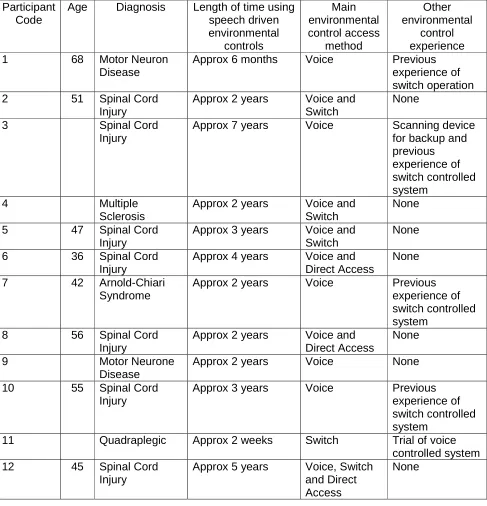
saturation of the data. Table 1 gives an overview of the twelve participants.
A large amount of data (extracts from the interviews) were generated from the
data analysis – with each main theme having from 7 to 15 sub-themes and a
Factors influencing failure
The main overarching feeling among participants was of a lack of reliability
particularly associated with errors in recognition. This can be observed with a
finer grain in a number of the sub-themes although the main reason appeared
to be due to sound interference.
8 - “normally it doesn’t let me down but it did on that occasion when I really needed it, that’s
the trouble, when I really needed it.”
3 - “the trouble also with voice is that if you turn on a CD player and it’s playing too loud then
you have problems, answering the phone’s always a nightmare because you try to
say answer phone but the phone’s ringing at the same time”
Speech specific reliability issues included: changes in the user’s voice
affecting the system; the phonetic similarity of words; sound interference;
specific characteristics required for user’s voices and variability in user’s
voices and the acoustics due to the environment. A complex web of possible
reliability issues was identified, for example: changes in a person’s voice over
a day or over a longer period of time would cause the device to become less
reliable, but in addition so might a change in room or environment:
12 - “So if I haven’t had a drink then my voice is that dry that the voice activator doesn’t
Words that are phonetically similar often required modification of words to
improve reliability but also participants felt that they had to talk to the device in
a certain manner:
7 - “You’ve got to say ‘reda’ instead of ‘red’ or ‘greena’ and ‘bluey’ and it just – people in the
room are laughing and they’re thinking ‘what the hell’s he saying bluey for?”
6 - “you’ve got to speak really, really clearly and think before you speak.”
Several technical issues arose: difficulty interfacing with some peripherals;
difficulty of training new functions; limited menus; problems with batteries &
infrared. These issues could be considered as general environmental control
issues, although there were some peculiarities specific to speech enabled
environmental control.
Human issues were also addressed: lackof patience with system; lack of
training, and learning the operation of the device. The general perception was
that the systems and support could be frustrating, and this could be
detrimental to their potential usefulness.
5 - “You can get frustrated – I don’t know what other people are like – I know I get very
frustrated with it”.
Factors influencing success
Participants for this study were biased, since by their nature they were
them). It is thus interesting that the ‘Factors influencing failure’ theme was
much more heavily referenced – i.e. participants had more negative things to
say than positive. Despite this, participants were generally very strong
advocates for speech as a method of interaction and this shows two of the
qualities highlighted for successful use namely determination and resilience.
10 - “It’s a good piece of equipment, it’s one of the best bits of equipment I’ve ever seen.”
A number of areas were identified as reasons that participants perceived the
device to be positive: simplicity of use; speed of operation; use of voice as an
access method when they could not access another system. These
sub-themes confirm that speed and simplicity are perceived to be a key feature of
speech control. However the data also suggests that currently speech is
prescribed as a last resort and often in conjunction with switch accessible
systems. Participants perceived the benefits from speech control when they
could not (for physical or other reasons) access their alternative
environmental control system and also when used as a complement to their
other system.
5 - “if anybody is like me I would recommend a combination of the two. It is like stopping and
rewinding video and stuff like that, it is quicker to do it by voice”
8 - “it all seemed very daunting at the time, but it was OK - once I picked it up it was not too
12 - “I suppose now my arm movements have got better but my arms still stiffen up, at night
time especially, so that’s when the voice comes into operation and I rely on my voice
more.”
Other areas identified related to ways in which participants had successfully
learnt to use the device. These centred around personalising the device and
learning compensation tactics: ability to use any word for commands; system
training; tailoring the device to the user's needs; using particular voice
intonation and patterning (consistency).
6 - “I’ve got a lot of electrical commands to put in. You put your TV in to get it going on and
off, you’re talking ten minutes if you train it properly. I’ve got it down to a fine art now
so I can do it really quick.”
3 - “it’s more sort of TV on, off, channel up, down, words as opposed to yeah. TV would you
mind turning on”
Interface
The interface of existing speech devices is restricted to a small text display
and limited auditory feedback. Thus, this limited experience may influence
their perceptions and this should be noted when considering the participants’
perceptions recorded below. Interesting observations were made
predominately around the aesthetics of the device, the microphone and also
Participants generally relied on the auditory feedback of the device and rarely
used the display however they could see a reason for a display when this was
discussed. Participants perceived that speech was a good interaction method
when ‘mastered’ and that scanning, the main alternative, was slow and
tedious.
9 - “I never use the display, I always listen to it speaking back. I don’t even bother sometimes
with that, I look and see what it’s done to the screen. But yes, sometimes it’s useful to
listen to the speaking back because you know where the errors have gone, you hear
the errors.”
10 - “A typical woman. If you speak calm, get what you want in the end, shout at them, go off
in a huff.”
10 - “you have to think where things were and it goes beep, beep, beep stop that then, and
then beep, beep, beep and if you want to make a phone call, oh God they were
terrible. Beep, beep, beep and you’d have to find the number and you look for the
number and you stop it then you go somewhere and it goes sideways and I think
‘argh!’”
Participants identified that aesthetics can be an important aspect and noted
the disabling image of many Assistive Technology products and potentially
very positive and enabling image of speech controlled devices.
3 - “by definition probably in the 16 to 24 age bracket you’ve probably got another 40, 50
years to tick along and you don’t suddenly want to be thrust into some you know, and
particularly, and so I think the aesthetics also has to play something as to whether
people feel comfortable using it”
Speech Driven Environmental Control (SPECS) Usage
The biggest overarching sub-themes related to risk, security and
independence – participants overwhelmingly associated the device with
providing independence. In addition there was also a process of risk
assessment: choosing the appliances that the device controlled and ensuring
that human and other backup methods existed. The risk assessment aspect
also highlighted that participants appeared to accept a certain level of
recognition error, given that it was not going to cause any damage (just
maybe turn a TV channel over for example) – there was a trade off between
the reliability, risk and functionality of the systems.
12 - “So I’ve got back-up for both because I do need it, because obviously my voice alters so
much, especially in the mornings.”
3 - “whereas with the TV the worst thing that could happen is you end up watching the wrong
channel or it gets too loud and when somebody then does come to assist you, you
haven’t threatened your existence.”
10 - “The nurses came in the morning, I couldn’t let them in and I don’t know what had gone
wrong with it, but it just went off and there’s keys across the road, so they just got the
A second commonality in the sub-themes is around the outcomes of using
these environmental control systems – reducing the load on carers and
providing independence to participants. These factors strongly support the
reasoning behind environmental control prescription in general.
8 - “I can open and shut a curtain, if I want to look at the moon I can do, if I want some fresh
air in the room I can open the window, I can put my heater on if I get a bit cold, so it
has made a big difference to my role in the house on my own.”
1 - “I mean it’s not just frustrating for me not being able to do it, it gets frustrating for my
husband, when he’s in the middle of cooking a meal and I’m saying “P can you come
and put me this on, can you come and do my back” anything like that that saves him,
you know, is brilliant.”
Background
This theme highlighted the context in which existing speech enabled devices
are used and highlighted some of the selection bias in prescription towards
more able, well supported, clients. The prescribers’ perspective on this was
captured in data from professionals and this is presented in a further paper.
In general participants viewed themselves as very cognitively able and viewed
themselves as being computer literate with eight having previous or current
use of voice recognition software on computers.
me on the go, keeps my mind on the go, I mean I like to do crossword puzzles and
things like that.”
7 - “My background is in computing so consequently I’m used to things like this”
Ten of the participants had a relatively long history of environmental control
use and some used a second switch-operated controller in conjunction with
their voice system. All participants had support from carers and generally had
a good relationship with their environmental control service. Support ranged
from carers who were close relatives and lived with the participant to paid
carers who changed frequently. The inability to rely on carers to carry out
technical tasks was a common theme.
10 - “This is partly my desire not to force my wife to have to do it because she’s very busy
doing all sorts of things. I mean not only is she my 24 hour carer but she has various
other things to do so it’s a matter of – I don’t think I’ve got the right to demand her
time.”
4 - “Well, I have two environmental control systems. One, which is on this chair here which is
not by voice and then one which is by voice.”
Discussion
This study has provided an in-depth analysis of the experiences of existing
users of speech driven environmental control systems. The study followed a
particularly rigorous since at each stage two researchers independently coded
and then compared and consolidated the data.
A weakness of the study was that all of the users were ‘successful’ users i.e.
they had not abandoned use of the speech driven environmental control
system despite any issues with it. Participants still provided both positive and
negative views on the device – however they should be considered a biased
sample because of their continued use. The data reported on would have
been strengthened by collection of data from users who had tried speech
operation but rejected it, however as detailed in the methodology it was not
possible to do this.
In this study we tried to interview a broad spectrum of users of speech driven
environmental controls by identifying users in different geographical areas. All
of the participants however were recruited via the same channel (i.e. via NHS
services) and this may have also been a source of selection bias. This
potential selection bias may have caused data saturation to be reached with
lower participant numbers than if more varied channels had been used to
source participants.
We have shown that reliability is the key issue when it comes to using speech
as an access method – much evidence was found as to the perceived
unreliability of the devices currently used by participants. The range of
reasons identified illustrates the complexity of the problem and the technical
voice control. It is interesting to note that reliability featured so strongly, since
the selection bias of the participants would suggest that they would all be
expert-users and have a low recognition error. In fact, the large amount of
data under the ‘reasons for failure’ theme, despite this selection bias, may be
illustrative of why these devices are not more widespread – even ‘successful’
users struggle with them!
The reasons that participants use existing voice systems at all is seen in a
number of areas: firstly the participants place a high value on their use of
environmental control and the independence it provides and so persevere
with the devices; secondly they are willing to accept a certain level of
unreliability as long as it does not put them at risk; thirdly, in many cases, the
potential gains from using voice outweigh the annoyance of errors – either
because of speed gains or because they were otherwise unable to access
conventional systems.
Although these participants all continue to use speech access devices, the
experience of a lack of reliability for these non-critical functions influenced
their trust in using the devices to control functions associated with more risk,
for example making a phone call in an emergency situation, and often led
them to have some form of backup for this function.
As mentioned in the introduction there is limited research in the field of
speech driven environmental controls to compare this study against. Geggie
driven environmental controls within their service and cite reliability problems
and use with safety-critical functions as important. These experiences concur
with some of the issues highlighted by the participants in our study.
A number of themes arose that could be considered to be relevant to general
environmental control use, for example, the participants’ perceptions of the
outcomes of provision. The Matching Person and Technology Model [11]
identifies the importance of considering not only what technology can do but
the environment in which it will be used and the personality of the user when
assessing for assistive technology. Failure to consider factors such as service
provision have been documented as significant in the adoption or failure to
adopt AT [12], [13]. Studies have also highlighted the lack of user involvement
in the design of assistive devices [14]. The background of this study is to
develop a design specification for a new speech driven environmental control
and hence the analysis of the data collected has focussed on users’
perceptions of the technology (speech driven environmental control systems).
Data from interviews with professionals will be analysed and published
separately.
The data collected in this study demonstrates that speech is a valuable
access method for environmental control but suggests reasons why speech
driven systems have a low prescription level. Whether the current level of
prescription is appropriate or whether professionals are disproportionately put
off from trialling these systems remains an open question and the subject of
In addition to providing evidence around the current use of speech controlled
environmental control devices, this data will be used to influence the design of
a new device. Noting the number of different reasons for possible recognition
errors described in the results it will be important to ensure the new device
has increased reliability in ‘real’ situations. Many of the other themes
identified relate to specific usability issues which will be considered in the
device design with the aim of allowing speech to become an intuitive
interaction method.
Clinical Messages
• Successful users of current speech driven environmental control
appear to be relatively cognitively able, computer literate and tolerant.
• Successful use of existing systems depends on accepting a certain
level of error, use in conjunction with other backup methods and a
strong motivation to increase speed or access to the equipment being
controlled.
• Improving reliability is key to design of a new speech driven device.
Acknowledgements
This work was undertaken as part of research funded by the National Institute
of Health Research (NIHR) Health Technology Devices programme. The
views expressed in the publication are those of the authors and not
References
[1] Shaw H. `'Possum': an electronic aid to fuller living for the severely disabled.'.
Physiotherapy 1962; 48:308-309.
[2] Vincent C, Drouin G, Routhier F. Examination of new environmental control applications.
Assist Technol. 2002;14(2):98-111.
[3] Wellings DJ, Unsworth J. Fortnightly review: Environmental control systems for people
with a disability: an update. BMJ 1997; August 315(7105):409-412.
[4]Hawley MS. Speech Recognition as an Input to Electronic Assistive Technology. British
Journal of Occupational Therapy 2002: 65(1):15-20.
[5] Hawley, M.S., Enderby, P., Green, P., Cunningham, S.P., Brownsell, S. Carmichael, J.,
Parker, M., Hatzis, A., O’Neill, P., and Palmer, R. A speech-controlled environmental control
system for people with severe dysarthria. Medical Engineering and Physics 2007; 29(5):586–
593.
[6] Geggie C. Voice Control of Environmental Control Systems. ACNR 2003; September 3(4).
[7] Sears A, Karat CM, Oseitutu K, Karimullah A, Feng J. Productivity, satisfaction, and
interaction strategies of individuals with spinal cord injuries and traditional users interacting
with speech recognition software. Universal Access in the Information Society 2001; June
1(1):4-15.
[8] Kotze P, Eloff M, Adesina-Ojo A, Eloff J. Accessible Computer Interaction for People with
Disabilities. The case of quadaplegics. ICEIS 2004 – Human-Computer Interaction.
[9] Hawley M, Cunningham S, Judge S, Kolluru B, Robertson Z. Using qualitative research
methods to inform user centred design of an innovative Assistive Technology device.
Proceedings of CWUAAT 2008. In press.
[10] Ritchie J, Lewis J. Qualitative Research Practice: A guide for Social Science Students
and Researchers. SAGE Publications Ltd. 2006.
[11] Scherer MJ, Craddock G. Matching Person & Technology (MPT) assessment process.
Technology and Disability. 2002 January;14(3):125-131.
[12] Scherer M, Sax C, Vanbiervliet A, Cushman L, Scherer J. Predictors of assistive
[13] Phillips B, Zhao H. Predictors of assistive technology abandonment. Assist Technol.
1993;5(1):36-45.
[14] Salminen AL, Petrie H, Ryan S. Impact of computer augmented communication on the
Table 1 – Participant details
Participant Code
Age Diagnosis Length of time using speech driven environmental controls Main environmental control access method Other environmental control experience 1 68 Motor Neuron
Disease
Approx 6 months Voice Previous experience of switch operation 2 51 Spinal Cord
Injury
Approx 2 years Voice and Switch
None
3 Spinal Cord Injury
Approx 7 years Voice Scanning device for backup and previous experience of switch controlled system
4 Multiple Sclerosis
Approx 2 years Voice and Switch
None
5 47 Spinal Cord Injury
Approx 3 years Voice and Switch
None
6 36 Spinal Cord Injury
Approx 4 years Voice and Direct Access
None
7 42 Arnold-Chiari Syndrome
Approx 2 years Voice Previous experience of switch controlled system
8 56 Spinal Cord Injury
Approx 2 years Voice and Direct Access
None
9 Motor Neurone Disease
Approx 2 years Voice None
10 55 Spinal Cord Injury
Approx 3 years Voice Previous experience of switch controlled system
11 Quadraplegic Approx 2 weeks Switch Trial of voice controlled system 12 45 Spinal Cord
Injury
Approx 5 years Voice, Switch and Direct Access