The
Ceteris Paribus
Structure of Logics of Game Forms
Davide Grossi [email protected]
Department of Computer Science University of Liverpool
Emiliano Lorini [email protected]
IRIT-CNRS
Universit´e Paul Sabatier
Fran¸cois Schwarzentruber [email protected]
ENS Rennes - IRISA
Abstract
The article introduces a ceteris paribus modal logic, called CP, interpreted on the equivalence classes induced by finite sets of propositional atoms. This logic is studied and then used to embed three logics of strategic interaction, namely atemporalSTIT, the coalition logic of propositional control (CL−PC) and the starless fragment of the dynamic logic of propositional assignments (DL−PA). The embeddings highlight a common ceteris paribus structure underpinning the key operators of all these apparently very different logics and show, we argue, remarkable similarities behind some of the most influential formalisms for reasoning about strategic interaction.
1. Introduction
The logical analysis of agency and games—for an expository introduction to the field see van der Hoek and Pauly’s overview paper (2007)—has boomed in the last two decades giving rise to a plethora of different logics in particular within the multi-agent systems field.1 At the heart of these logics are always representations of the possible choices (or actions) of groups of players (or agents) and theirpowersto force specific outcomes of the game. Some logics take the former as primitives, likeSTIT(the logic ofseeing to it that, Belnap, Perloff, & Xu, 2001; Horty, 2001), some take the latter likeCL(coalition logic, Pauly, 2002; Goranko, Jamroga, & Turrini, 2013) and ATL (alternating-time temporal logic, Alur, Henzinger, & Kupferman, 2002).
In these formalisms the power of players is modeled in terms of the notion of effectivity. In a strategic game, theα-effectivity of a group of players consists of those sets of outcomes of the game for which the players have some collective action which forces the outcome of the game to end up in that set, no matter what the other players do (Moulin & Peleg, 1982). So, if a set of outcomes X belongs to the α-effectivity of a set of players J, there existsan individual action for each agent inJ such that,for allactions of the other players, the outcome of the game will be contained inX. If we keep the actions of the other agents
fixed, then the selection of an individual action for each agent inJ corresponds to a choice of J under the assumption that the other agents stick to their choices.
It was already observed by van Benthem, Girard, and Roy (2009) that this formalization of choice and power in games is of an ‘all other things being equal’, orceteris paribus, nature. Considering which outcomes of a game are possible for a set of players J once the other players have fixed their actions, amounts to considering what may be the case under the ceteris paribus condition ‘all actions of the agents not in J being equal (to their current ones)’. In the aforementioned work van Benthem et al. also show how this intuition can be used, for instance, to give a modal formulation of Nash equilibria of one-shot games.2 In the current paper we leverage this intuition further and show how it can provide a novel systematization of many of the most influential formalisms in the field of logic and games.
1.1 Scientific Context
Formal relationships linking the logics (or fragments thereof) we mentioned above have been object of several publications. Notable examples are: the embedding of CL into the next-time fragment of ATL (Goranko, 2001) and the embedding of CL into NCL (normal coalition logic, Broersen, Herzig, & Troquard, 2007; Balbiani, Gasquet, Herzig, Schwarzen-truber, & Troquard, 2008a), the embedding of CL and ATL into STIT (Broersen, Herzig, & Troquard, 2005, 2006). Earlier contributions have also attempted more comprehensive systematizations of the field of logic and games. Two in particular are worth mentioning: Goranko and Jamroga’s work (2004), which compares game logics based on the computa-tion tree abstraccomputa-tion like ATL and its variants; and Herzig’s work (2014), which provides a conceptual and syntax-based—while we favor here semantic methods—comparison of all the main formalisms in the literature.
1.2 Aim of the Paper
The aim of the paper is to provide a technical contribution towards a unification of the field of logic and games. We set out to develop a series of embeddings which highlight a common structure in the representation of choice and power, which underpins the semantics of all the logics mentioned above.
We focus on the components of the semantics of those logics that have directly to do with the representation of choice and power, and we abstract away from the representation of time and repeated interaction. So the logics we will be working with are: the atemporal fragment of STIT, logic CL−PC (coalition logic of propositional control, van der Hoek & Wooldridge, 2005) and the starless fragment of DL−PA (dynamic logic of propositional assignments, van Eijck, 2000; Balbiani, Herzig, & Troquard, 2013). These logics cover, arguably, a large spectrum of the most influential existing formalisms.3 LogicSTITis often considered a standard in the literature, as it embeds bothCLandATL(Broersen et al., 2005,
2. We refer the reader to Osborne and Rubinstein’s textbook (1994) for an introduction to the basic notions of game theory.
DL−PA CP
CL−PC
S5
STIT NCL
exp onen
tial
boun ded
mo dels
[image:3.612.197.414.99.235.2]restricted languages
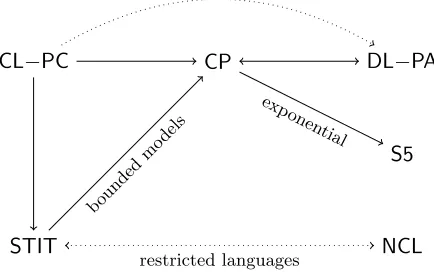
Figure 1: Summary of the embeddings established in the paper and known from the literature An arrow indicates that each formula of the source logic is satisfiable if and only if a suitable translation of that formula is satisfiable in the target logic. DL−PA
denotes the starless version of dynamic logic of propositional assignments, NCL
and STIT denote the atemporal version of, respectively, normal coalition logic and the seeing-to-it logic. S5denotes the normal modal logic of equivalence rela-tions. Dotted lines indicate embeddings known in the literature: fromCL−PCto
DL−PA (Balbiani et al., 2013) and from STIT to NCL (and vice versa) with re-spect to fragments of the rere-spective languages (Lorini & Schwarzentruber, 2011). The embedding from STIT to CP assumes a bound on the STIT-models. All embeddings are polynomial except for the one fromCPtoS5.
2006), so we use it as a natural starting point. Logic CL−PCis an influential extension of
CLand has strong formal ties (Dunne, van der Hoek, Kraus, & Wooldridge, 2008) with the, equally influential, Boolean games model (Harrenstein, van der Hoek, Meyer, & Witteveen, 2001) in multi-agent systems. Finally, logic DL−PA is an extension of PDL (propositional dynamic logic, Harel, Kozen, & Tiuryn, 2000), which has recently been proposed as a new standard for the representation of choice and power (Herzig, Lorini, Moisan, & Troquard, 2011; Balbiani et al., 2013).
To articulate our analysis, whose main technical tool consists of satisfiability-preserving embeddings, the paper introduces and studies—in its axiomatization and complexity—a simple ceteris paribus logic based on propositional equivalence, which we call CP. Such logic is the yardstick allowing us to compare and unifySTIT,CL−PC andDL−PA.
1.3 Outline and Summary of Results
Section 2 introduces logicCP. The logic will be compared to S5and axiomatized.
Section 3 provides a study of the relationship between the atemporal version of STIT and
CP. We show that CP embeds atemporal group STIT—the fragment of atemporal STIT
STIT in which only the actions of individuals are represented. The former embedding is used to transfer complexity results toCP. We also present an embedding inCPof a variant of atemporal groupSTITin which groups are nested (i.e., given two sets of agentsJ andJ0
eitherJ ⊆J0 or viceversa).
Section 4 provides an embedding of the coalition logic of propositional control into atemporal ‘bounded’ group STIT—and therefore, indirectly, into CP—as well as a direct embedding of CL−PCintoCP.
Section 5 provides an embedding of the starless fragment ofDL−PA intoCP as well as an embedding of CPinto DL−PA and therefore, indirectly, of STIT (on bounded models) and
CL−PCinto DL−PA.
Finally, in Section 6 we discuss the obtained results, put them in perspective with related work and draw some general implications for the field. We conclude in Section 7. Longer proofs are collected in a technical appendix at the end of the paper.
Figure 1 gives a graphical presentation of the embeddings established in the paper— as well as relevant ones already known in the literature. Two embeddings are known for the above logics: the embedding of CL−PC into DL−PA (Balbiani et al., 2013), and the embedding ofSTIT intoNCL, and vice versa, when the language ofSTIT (and ofNCL) are restricted to a fragment which does not allow nesting modalities.4
2. A Ceteris Paribus Logic Based on Propositional Equivalence
In this section we introduce and study the logic that will be used as target logic in all the embeddings we will present. The section starts with the definition of equivalence modulo a set of atoms. Then we present our ceteric paribus logic CP whose semantics is based on these equivalence relations. The section finishes with an exponentially embedding of ceteris paribus logicCP intoS5 proving that the CP-satisfiability problem is decidable.
2.1 Equivalence Modulo a Set of Atoms
Consider a structure (W, V) where W is a set of states, and V : P −→ 2W a valuation function from a countable set of atomic propositions Pto subsets ofW.5
Definition 1. (Equivalence modulo X) Given a pair (W, V), X ⊆ P and |X| < ω, the relation ∼VX⊆W2 is defined as:
w∼VX w0 ⇐⇒ ∀p∈X : w∈V(p)⇐⇒w0∈V(p)
When X is a singleton (e.g. p), we will often write ∼Vp instead of ∼V{p}. Also, in order to
avoid clutter, we will often drop the reference to V in ∼VX when clear from the context.
Intuitively, two stateswand w0 are equivalent up to setX, or X-equivalent, if and only if they satisfy the same atoms in X (according to a given valuation V). The finiteness of
4. The reader is referred to Lorini and Schwarzentruber’s paper (2011) for the BNF of this language. 5. In the literature game logics are sometimes defined over a countable set of atoms (e.g., Balbiani et al.,
X is clearly not essential in the definition. It is assumed because, as we will see, each set
X will be taken to model a set of actions of some agent in a game form and sets of actions are always assumed to be finite.
We state the following simple fact without proof. It highlights some interesting features of the notion of propositional equivalence modulo subsets ofP, some of which will be of use later on in the paper.
Fact 1. (Properties of ∼P) The following holds for any set of states W, valuation V :
P−→2W and finite sets X, Y ⊆P:
(i) ∼X is reflexive, transitive and symmetric;
(ii) ifX⊆Y then∼Y ⊆∼X;
(iii) ifX is a singleton, ∼X induces a partition of W with at most 2 cells;
(iv) ∼X ∩∼Y = ∼X∪Y;
(v) ∼∅ = W2.
Intuitively: (i)states that each ∼X is an equivalence relation;(ii)states that the larger
the set of atoms, the more refined is the equivalence relation indexed by it;(iii) states that if the set of atom is a singleton, then its equivalence relation would induce a partition of one (if the proposition in the singleton is globally true or globally false in the model) or two cells (otherwise); (iv) states that the relation indexed by the union of two sets of atoms is the relation one obtains by intersecting the relations of the two sets; finally(v)states that the relation of the empty set of atoms is the global relation.
2.2 A Modal Logic of the ∼X Relation
In this section we consider a simple modal language interpreted on relations ∼X and
ax-iomatize its logic on the class of structures (W, V). The key modal operator of the language will behXi, whose intuitive meaning is ‘ϕis the case in some state which isX-equivalent to the current one’ or, to stress a ceteris paribus reading, ‘ϕis possibleall things expressed in
X being equal’. We call the resulting logicpropositional ceteris paribus logic,CP in short.
2.2.1 Syntax of CP.
Let P be a countable set of atomic propositions. The language LCP(P) is defined by the
following BNF:
LCP(P) :ϕ::=p| ¬ϕ|(ϕ∧ϕ)| hXiϕ
wherepranges overPandXis a finite subset of atomic propositions (X⊆PandX finite). Note that as the set of finite subsets of atomic propositions is countable, the language
LCP(P) is also countable. The Boolean connectives >,∨,→,↔and the dual operators [X]
are defined as usual. Although we have taken diamond operators as primitive, we will for convenience also make use of box operators to state some results in later sections.
The set SF(ϕ) of subformulas of a formula ϕis defined inductively as follows:
• SF(¬ϕ) ={¬ϕ} ∪SF(ϕ);
• SF(ϕ∧ψ) ={ϕ∧ψ} ∪SF(ϕ)∪SF(ψ);
• SF(hXiϕ) ={hXiϕ} ∪SF(ϕ).
We say that a signatureXappears inϕif there exists a formulaψsuch thathXiψ∈SF(ϕ).
2.2.2 Semantics of CP
This is the class of models we will be working with:
Definition 2. (CP-models) Given a countable set P, a CP-model for LCP(P) is a tuple
M= (W, V) where:
• W is a non-empty set of states;
• V :P−→2W is a valuation function.
A CP-model is called universal if W = 2P and V is s.t. V(p) = {w|p∈w}. It is called non-redundant if ∼P is the identity relation in W2.
Intuitively, aCP-model consists just of a state-space and a valuation function for a given set of atoms. The satisfaction relation is defined as follows:
Definition 3. (Satisfaction for CP-models) Let M= (W, V) be an CP-model for LCP(P),
w∈W and ϕ, ψ∈ LCP(P):
M, w|=CP p ⇐⇒ w∈V(p);
M, w|=CP¬ϕ ⇐⇒ M, w6|=CP ϕ;
M, w|=CP ϕ∧ψ ⇐⇒ M, w|=CP ϕand M, w|=ψ;
M, w|=CP hXiϕ ⇐⇒ ∃w0 ∈W :w∼VX w0 and M, w0 |=CPϕ
Formula ϕ is CP-satisfiable, if and only if there exists a model Mand a state w such that
M, w |=CP ϕ. Formula ϕ is valid in M, noted M |=CP ϕ, if and only if for all w ∈ W,
M, w|=CP ϕ. Finally,ϕisCP-valid, noted|=CPϕ, if and only if it is valid in allCP-models.
The logical consequence of formula ϕ from a set of formulae, noted Φ|=CPϕ, is defined as
usual.
So, modal operators are interpreted on the equivalence relations ∼X induced by the
valuation of the model. It is worth observing that the logic of this class of models is not closed under uniform substitution,6 that is, logicCPis not uniform.7 To witness that, notice that formula [{p}]p∨[{p}]¬p is valid, whereas [{p}]ϕ∨[{p}]¬ϕis not.
Let us give a simple illustration of the above semantics.
Example 1. Let us consider the following modelM made up of 5 states w, x, u, y, z:
6. For the definition of uniform substitution the reader is referred to the textbook by Blackburn, de Rijke, and Venema (2001, Def. 1.18).
w:p, q x:p u:p, q, r z:q y
For instance, we haveM, w|=CPh{p, q}ir and M, z|=CP [{p}]¬r.
The following lemmas state simple facts concerning the relation of logic CP with logic
S5 and isolate an interesting class ofCP-models.
Lemma 1. LetL∅CP(P)the set of formulaeϕ∈ LCP(P)containing only h∅ioperators. The set of formulae ofL∅CP(P)which are CP-valid is the modal logic of Kripke frames(W, W2), i.e., logic S5.
Proof. It follows directly from Fact 1 item (v).
In other words, the h∅i operator of LCP is nothing but the global modality (Blackburn et al., 2001, pp. 367–370). The next lemma states thatCPis actually the logic of the class of relevantCP-models.
Lemma 2. Every satisfiable CP-formula is satisfiable on a non-redundant model.
Proof. Assume M, w|=ϕ. We show that MP,|w|P|=ϕof M whereMP is the quotient of M by the equivalence relation ∼P (defined in the natural way) and |w|P is the set of states which are ∼P-equivalent to w. We proceed by induction on the structure of ϕ. The propositional and Boolean cases are obvious. Let ϕ= hXiψ with X ⊆ P. From the assumption and the semantics ofCPoperators we have that there existsvsuch thatw∼X v
andM, v|=ψ. By construction we directly have that|w|P∼X |v|P. By IH MP,|v|P|=ψ, and therefore MP,|w|P |=hXiψ.
2.2.3 Axiomatics of CP
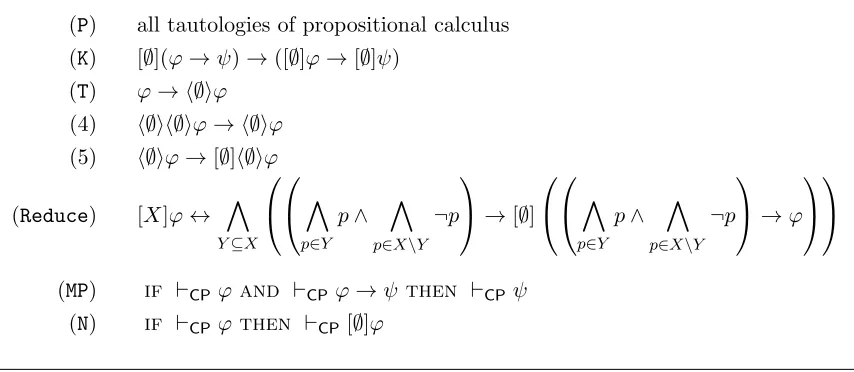
We can obtain an axiom system forCPby a standard reduction technique exploiting Lemma 1. The axiom system is given in Figure 2. The first thing to notice is that the system consists of the usualS5axioms plus the Reduceaxiom. LogicS5 is known to be sound and strongly complete for the class of models where the accessibility relation is the total relation W2
(Blackburn et al., 2001), and modality h∅i can therefore be axiomatized as the (dual of) the global modality.
Having said this, soundness and strong completeness of the above system are easy to establish.
Theorem 1. The axiom system given in Figure 2 is sound and strongly complete for the class of CP-models.
(P) all tautologies of propositional calculus
(K) [∅](ϕ→ψ)→([∅]ϕ→[∅]ψ) (T) ϕ→ h∅iϕ
(4) h∅ih∅iϕ→ h∅iϕ
(5) h∅iϕ→[∅]h∅iϕ
(Reduce) [X]ϕ↔ ^ Y⊆X ^ p∈Y
p∧ ^ p∈X\Y ¬p →[∅] ^ p∈Y
p∧ ^ p∈X\Y
¬p
→ϕ
(MP) if `CPϕ and `CPϕ→ψ then `CP ψ
[image:8.612.92.519.103.289.2](N) if `CPϕ then `CP [∅]ϕ
Figure 2: Axiom schemas and rules of CP. X, Y range over finite elements of 2P, ϕ, ψ
overLCP(P), andp overP. As usual,`CP means that there exists a sequence of
formulae each of which are either an axiom or are obtained from previous formulae through the application of an inference rule.
translation tr0 :LCP(P)−→ L∅CP(P) as follows:
tr0(p) = p tr0(¬ϕ) = ¬tr0(ϕ)
tr0(ϕ∧ψ) = tr0(ϕ)∧tr0(ψ) tr0([X]ϕ) =
^ Y⊆X ^ p∈Y
p∧ ^ p∈X\Y ¬p →[∅] ^ p∈Y
p∧ ^ p∈X\Y
¬p
→tr0(ϕ)
We also write tr0(Φ) for {tr0(ϕ)|ϕ∈Φ}. Notice that the translation removes occurrences
ofhXiand [X] operators from formulae whereX6=∅and it has the same structure of axiom
Reduce. Consider then the following rule of substitution of provable equivalents (REP):
(REP) if `CP ϕ↔ϕ0 then `CP ψ↔ψ[ϕ/ϕ0]
where ψ[ϕ/ϕ0] is the formula that results from ψ by replacing zero or more occurrences of
ϕ, inψ, byϕ0. We have that ruleREPis derivable in the axiom system of Figure 2 (†). The proof of this claim is provided in Appendix A. By using axiom Reduce and rule REP we obtain by (†) that, for anyϕ∈ LCP(P),`CPϕ↔tr0(ϕ) (‡). We can then proceed as follows:
if Φ |=CP ϕ then tr0(Φ) |=CP tr0(ϕ) by (‡); by Lemma 1 and the strong completeness of S5 we thus obtaintr0(Φ)`S5 tr0(ϕ) and thereforetr0(Φ)`CPtr0(ϕ); finally by (‡) again it
The crux of the above reduction argument lies in the use of axiom Reduce. What the axiom does is to enable the reduction of [X]-formulae by taking care of all the possible truth-value combinations of the atoms inX. If a given combination, e.g.,V
p∈Y p∧ V
p∈X\Y ¬p
,
is true at a given state (for some Y), then in all accessible states, if that combination is true, then what occurs in the scope of [X] is also true.
We opted for the above axiomatization in virtue of its simplicity, but alternative systems are of course possible. One in particular is worth mentioning. It first reduceshpi operators by axiom:
hpiϕ↔((p∧ h∅i(p∧ϕ))∨(¬p∧ h∅i(¬p∧ϕ))) (1)
This states that hpiϕ is equivalent to either the case in which the current state satisfies p
and there exists a (possibly different)p-state whereϕis true, or the case where ¬p is true and there exists a (possibly different)¬p-state whereϕis true (recall property(iii)in Fact 1). Given the above reduction, one can then use axioms to enforce the appropriate behavior of∼X relations whereX consists of more than one atom. To this aim, axioms can be used
that are known to be canonical for properties (ii) and(iv) of Fact 1, namely:
hX∪Yiϕ→ hXiϕ (2)
hXii∧ hYii→ hX∪Yii (3)
where i ranges over a set of nominals. A complete system could then be obtained by axiomatizing the behavior of nominals—through axioms and rules used in hybrid logic (Areces & Ten Cate, 2006). From that system, a named canonical model could be built (i.e., a canonical model where all maximal consistent sets contain exactly one nominal) where the axioms in Formulae 1-3 would enforce the desirable properties on the canonical relations.
2.3 Exponentially Embedding CP into S5
The property expressed by axiomReduceenables a truth-preserving translation ofCPinto
S5via the translation tr0 provided in the proof of Theorem 1. This translation is, however,
such that the length of the translated formula grows exponentially by a tower of exponents of height equal to the modal depth of the original formula.
In this section we propose a translation that is single exponential and preserves satisfi-ability. Take the standard modal language L(P) with one modal operator defined on the set of atomsP. S5-models are structures M= (W, V) whereW is a set of states, and
V :P −→2W a valuation function. Given an S5-model M= (W, V) and a state w∈ W,
the truth conditions are defined as follows:
M, w|=S5ϕ ⇐⇒ ∀u∈W :M, u|=S5 ϕ
S5-satisfiability is defined as usual. It is possible to define an exponential truth-preserving reduction tr:LCP(P)−→ L(P) as follows:
tr(ϕ0) = pϕ0 ∧ ^
ϕ∈SF(ϕ0)
wherepϕ are fresh atomic proposition (note that pϕ0 ispϕ whenϕis the formula ϕ0 itself,
which is also a subformula ofϕ0)8,ϕranging over SF(ϕ0) andtr1 is defined as follows: tr1(p) = p forp∈P
tr1(¬ϕ) = ¬tr1(ϕ)
tr1(ϕ∧ψ) = tr1(ϕ)∧tr1(ψ) tr1([∅]ϕ) = pϕ
tr1([X]ϕ) = ^
Y⊆X
^
p∈Y
p∧ ^ p∈X\Y
¬p
→
^
p∈Y
p∧ ^ p∈X\Y
¬p
→pϕ
Intuitively, the translation is designed to operate like axiom Reduce but avoiding expo-nential blow-up to pile up with the modal depth of the formula. The atomic propositions
pϕ in tr1([X]ϕ) avoid the non-elementary size of tr(ϕ0). The definition of tr1([∅]ϕ)
corre-sponds to the degenerated case of tr1([X]ϕ) whereX =∅.The following theorem states the
satisfiability preservation. The proof is given in Appendix B.
Theorem 2. (tr preserves satisfiability) Let ϕ0 be a CP-formula. The two following
state-ments are equivalent: ϕ0 is CP-satisfiable; tr(ϕ0) isS5-satisfiable.
As a consequence, we also obtain the following result.
Corollary 1. (Decidability) The satisfiability problem for CP is decidable and in NEXP-TIME.
Proof. The satisfiability problem forS5is decidable and in NP (Blackburn et al., 2001, Ch. 6). The result follows from Theorem 2 and a decision procedure may work as follows: in order to check thatϕis satisfiable we compute the formulatr(ϕ) and we apply a NP-decision procedure to check whether tr(ϕ) isS5-satisfiable or not.
Notice that if the cardinality of each X that appears in operators [X] ofϕ is bounded by a fixed integer, then the translation tr becomes polynomial in the size of ϕ. Thus, as S5-satisfiability problem is NP-complete, the CP-satisfiability problem with a bounded cardinality restrictions over set of atomic propositions in modal operators is in NP. As it is trivially NP-hard, it is NP-complete.
In Section 3, we will embed the atemporal version ofSTIT(the logic ofseeing to it that) intoCP thereby obtaining lower bounds results.
3. The Ceteris Paribus Structure of STIT Logic
In this section, we investigate the possibility of embedding the logic of agency STIT into
CP. STIT logic (the logic of seeing to it that, Belnap et al., 2001; Horty, 2001) is one of the most prominent logical accounts of agency. It is the logic of constructions of the form “agenti(or groupJ) sees to it thatϕ”. STIThas a non-standard modal semantics based on the concepts ofmoment andhistory. However, as shown by Balbiani, Herzig, and Troquard (2008b) and Herzig and Schwarzentruber (2008), the basicSTITlanguage without temporal operators can be ‘simulated’ in a standard Kripke semantics.
3.1 Atemporal Group STIT
First let us recall the syntax and the semantics of atemporal group STIT. The language of this logic is built from a countable set of atomic propositions P and a finite set of agents
AGT ={1, . . . , n} and is defined by the following BNF:
LG−STIT(P, AGT) :ϕ ::= p| ¬ϕ|(ϕ∧ϕ)|[J :stit]ϕ
wherepranges over PandJ ranges over 2AGT. The construction [J :stit]ϕis read “group
J sees to it thatϕ is true regardless of what the other agents choose”. We define the dual operatorhJ :stitiϕ def= ¬[J :stit]¬ϕ. When J =∅, the construction [∅:stit]ϕis read “ϕ
is true regardless of what every agent chooses” or simply “ϕis necessarily true”.
Definition 4(STIT-Kripke model, Herzig & Schwarzentruber, 2008). ASTIT-Kripke model
M= (W,{RJ}J⊆AGT, V) is a 3-tuple where:
• W is a non-empty set of worlds;
• for allJ ⊆AGT, RJ is an equivalence relation such that:
i) RJ ⊆R∅;
ii) RJ =Tj∈JR{j};
iii) for all w ∈W and (w1, . . . , wn) ∈Wn, ifu1 ∈ R{1}(w), . . . , un ∈ R{n}(w) then T
1≤j≤nR{j}(uj)6=∅;
• V :P→2W is a valuation function for atomic propositions;
with RJ(w) ={u∈W : (w, u)∈RJ} for any J ∈2AGT.
The partition induced by the equivalence relation RJ is the set of possible choices of
the group J.9 Indeed, in STIT a choice of a group J at a given world w is identified with the set of possible worlds RJ(w). We call RJ(w) the set of possible outcomes of group J’s choice at world w, in the sense that group J’s current choice at w forces the possible worlds to be inRJ(w). The setR∅(w) is simply the set of possible outcomes at w, or said
differently, the set of outcomes of the current game at w. According to Condition(i), the set of possible outcomes of a group J’s choice is a subset of the set of possible outcomes. Condition(ii), calledadditivity, means that the choices of the agents in a groupJ is made up of the choices of each individual agent and no more. Condition(iii) corresponds to the property ofindependence of agents: whatever each agent decides to do, the set of outcomes corresponding to the joint action of all agents is non-empty. More intuitively, this means that agents can never be deprived of choices due to the choices made by other agents. In Lorini and Schwarzentruber’s work (2011) determinism for the group AGT was assumed. That is to say that the set of outcomes corresponding to a joint action of all agents is a singleton. Horty’s groupSTITlogic (Horty, 2001) does not suppose this. Here we deal with Horty’s version of STIT. So a STIT model is a game form in which a joint action of all agents might determine more than one outcome.
9. One can also see the partition induced by the equivalence relationRj as the set of actions that agentj
w u v
r s
t z
[image:12.612.191.310.88.177.2]R{1} R{2}
Figure 3: TheSTIT-modelM
Example 2. The tupleM= (W, R∅, R{1}, R{2}, R{1,2}, V) defined by:
• W ={w, u, v, r, s, t, z};
• R∅ =W ×W;
• R{1} ={w, u, v}2∪ {r, s}2∪ {t, z}2; • R{2} ={w, r, t}2∪ {u, v, s, z}2;
• R{1,2} ={(w, w),(r, r),(s, s),(t, t),(z, z),(u, u),(v, v),(u, v),(v, u)};
• for allp∈P,V(p) =∅.
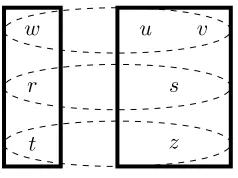
is a STIT-Kripke model. Figure 3 shows the model M. The equivalence classes induced by the equivalence relation R{1} are represented by ellipses and correspond to the choices of
agent 1. The equivalence classes induced by the equivalence relation R{2} are represented
by rectangles and correspond to the choices of agent 2. The choice of group {1,2} at a given world is determined by the intersection of the choice of agent 1 and the choice of agent 2 at this world. For example, the choice of agent 1 at world u is {w, u, v} whereas the choice of agent 2 at world u is {u, v, s, z}. The choice of group {1,2} at u is {u, v}. Note that Condition (iii) of Definition 4 ensures that for any choice of agent1 and for any choice of agent 2 the intersection between these two choices is non-empty. That is, for any equivalence class induced by the relation R{1} and for any equivalence class induced by the
relation R{2}, the intersection between these two equivalence classes is non-empty.
Given a STIT-Kripke model M= (W,{RJ}J⊆AGT, V) and a world w in M, the truth
conditions of STITformulae are the following:
M, w|=STIT p ⇐⇒ w∈V(p);
M, w|=STIT¬ϕ ⇐⇒ M, w6|=STITϕ;
M, w|=STIT ϕ∧ψ ⇐⇒ M, w|=STITϕand M, w|=STITψ;
M, w|=STIT [J :stit]ϕ ⇐⇒ ∀v∈RJ(w) :M, v|=STITϕ
3.2 Embedding Atemporal STIT into CP
We are not able to embed group STIT intoCP because of many reasons. The first one is that the group STIT satisfiability problem is undecidable if there are more than 3 agents (Herzig & Schwarzentruber, 2008).10 The second one is that group STIT does not have the finite model property. Indeed Herzig and Schwarzentruber (2008) provide a translation from the product logicS5n to groupSTITlogic, and as S5n does not have the finite model property (Gabbay, Kurucz, Wolter, & Zakharyaschev, 2003), so atemporal groupSTIT will not have it. On the contrary CP inherits the finite model property from S5. Indeed, if a formulaϕ isCP-satisfiable, Theorem 2 says that tr(ϕ) is S5-satisfiable. But as S5 has the polynomial model property, there exists a polynomial-sized S5-model for tr(ϕ) in the size of tr(ϕ). In other words, there exists an exponential S5-model for tr(ϕ) in the size of ϕ. Theorem 2 ensures that there exists an exponentialCP-model forϕin the size of ϕ.
We will nevertheless embed a variant of group STIT under the assumption that every agent has a finite and bounded number of actions in his repertoire. For every agent j, a
Rj-equivalence class Rj(u) corresponds to an action of agentj. We say that agentj haskj
actions in aSTIT model if and only if there are exactly kj Rj-equivalence classes inM.
The game structure in STIT-models should be enforced in CP-models. That is why we introduce special atomic propositions to encode the game structure. Without loss of generality, we assume that the set Pcontains special atomic propositionsrepj1,repj2, . . . for all agents j which are used to represent the actions of the agents. Let k be the maximal number of actions: k=maxj∈AGTkj. For every agent, we represent its actions by numbers ` in {0, . . . , k−1} and some atomic propositions encode the binary representation of `. Let m be an integer that represents the number of digits we need to represent an action. For instance let m = dlog2ke (the ceiling of the logarithm of k). For a given agent j, Rjm={repj1, . . . ,repjm}is the set atomic propositions that represent the binary digits of an
action of agent j. We suppose that ifj 6=ithenRjm∩ Rim =∅.
Example 3. For example, in the model of Example 2, agent1 hask1 = 3actions and agent
2 has k2 = 2 actions. So k = 3 and m = dlog23e = 2. We have R1m = {rep11,rep12} and R2
m={rep21,rep22}. Then for instance, we may represent the action of agent 1 corresponding
to R{1}(w) ={w, u, v} by the valuation ¬rep11∧ ¬rep12, the action of agent 1 corresponding
to {r, s} by rep1
1 ∧ ¬rep12, the action of agent 1 corresponding to {t, z} by ¬rep11 ∧rep12,
the action of agent 2 corresponding to {w, r, t} by ¬rep21∧ ¬rep22 and the action of agent 2 corresponding to {u, v, s, z} by rep21∧ ¬rep22.
LetRm =S
j∈AGTR j
m be the set of all atomic propositions used to denote actions. Let
us define the following CPformula:
GRIDm
def
= V
x∈Rm[∅]((x→ hRm\ {x}i¬x)∧(¬x→ hRm\ {x}ix)) (4)
This formula enforces aCPmodel to beuniversal(overRm), that is, to contain all possible valuations overRm (recall Definition 2). A model that satisfiesGRIDm is then interpreted
as a game form where each valuation ofRjm represents an action of playerj.
Example 4. For instance, if some world of a CP model M0 satisfies GRID
2, then the
‘skeleton’ of M0 should have the following form (we intentionally draw the ‘skeleton’ of the model M0 so that it looks like the modelM):
| {z } | {z }
worlds where
¬rep2
1 and¬rep22 are true
worlds where rep2
1 and¬rep22 are true
worlds where
¬rep1
1 and¬rep12 are true
worlds where rep1
1 and¬rep12 are true
worlds where
¬rep11 and rep12 are true
R{1} R{2}
We now define a translation from LG−STIT toLCP(P) as follows:
tr2(p) = p forp∈P tr2(¬ϕ) = ¬tr2(ϕ)
tr2(ϕ∧ψ) = tr2(ϕ)∧tr2(ψ) tr2([J :stit]ϕ) = [
[
j∈J
Rjm]tr2(ϕ)
The translation tr2 should be parameterized by m. For notational convenience, in what
follows we write tr2 instead oftrm2 leaving implicit the parameter m.
The set S j∈JR
j
m represents all the atomic propositions used to represented actions of
the coalition J.
Example 5. For instance, with m= 2,
tr2([{1}:stit][{1,2}:stit]p) = [{rep11,rep12}][{rep11,rep21,rep21,rep22}]p.
We then obtained the desired satisfiability-preservation result. The proof is given in Appendix C.
Theorem 3. Let us consider a group STIT formula ϕ. Let m be an integer. Then the following items are equivalent:
1. ϕis STIT-satisfiable in a STIT-model where each agent has at most 2m actions;
2. ϕis STIT-satisfiable in a STIT-model where each agent has exactly 2m actions;
3.3 Atemporal Individual STIT
In this subsection, we consider the following fragment of STITcalled atemporal individual
STIT11:
LI−STIT(P, AGT) :ϕ ::= p| ¬ϕ|(ϕ∧ϕ)|[{j}:stit]ϕ
wherep ranges overPand j ranges overAGT.
This fragment of STIT, axiomatized by Xu (1998), has the exponential finite model property (see Lemma 7 in Balbiani et al., 2008b). Moreover, as the following theorem highlights, it can be embedded in the logicCP.
Theorem 4. Let us consider aSTIT formulaϕ of the individualSTIT fragment. Let m be the length of ϕ. Then the following three items are equivalent:
1. ϕis STIT-satisfiable
2. ϕis STIT-satisfiable in a model where each agent has at most2m actions;
3. GRIDm∧tr2(ϕ) isCP-satisfiable.
Proof. 1 ⇒ 2 Consider a STIT formulaϕ of the individual STITfragment. If ϕ is STIT -satisfiable and m is the length of ϕ, then ϕis STIT-satisfiable in a model where there are at most 2m worlds (see Lemma 7 in Balbiani et al., 2008b). This implies that there are at most 2m actions in that model. The implications 2 ⇒ 3 and 3 ⇒ 1 come from Theorem 3.
Thanks to Theorem 4, we reduce the NEXPTIME-complete satisfiability problem of individual STIT(Balbiani et al., 2008b) to the CP-satisfiability problem. As the reduction is polynomial, we obtain the following lower bound complexity result for theCP-satisfiability problem.
Corollary 2. The CP-satisfiability problem is NEXPTIME-hard.
3.4 Group STIT where Coalitions Are Nested
In this subsection we address the satisfiability problem of the fragment of CPconsisting of formulaeϕofLCPsuch that the sets of atomic propositions that appear in any operator [X]
occurring inϕform a linear set of sets of atomic propositions. More formally, if [X] and [X0] are two operators occurring inϕthen eitherX⊆X0 orX0⊆X. For instance, the formula [{p, q}](ψ∧[{p}][{p, q, r, s}]ϕ) belongs to the fragment because {p} ⊆ {p, q} ⊆ {p, q, r, s}. On the contrary, the formula [{p}]p∧[{q}]p is not an element of this fragment ofCP.
We call the satisfiability problem of this fragment of CP the CP-nested satisfiability problem. Due to the embedding proposed in Theorem 3 of STIT into CP, we provide the following lower bound complexity result for theCP-nested satisfiability problem. The proof is given in Appendix D.
Theorem 5. TheCP-nested satisfiability problem is PSPACE-hard.
The following theorem provides an upper bound complexity result for this fragment of
CP. The proof is given in Appendix E.
Theorem 6. TheCP-nested satisfiability problem is in PSPACE.
This concludes our analysis ofSTITlogics viaCP. In the next section we move to normal coalition logic.
3.5 Normal Coalition Logic
We conclude this section on STITby briefly mentioning a related system, normal coalition logic. Normal coalition logic NCL was introduced by Broersen et al. (2007) to provide an embedding in a normal modal logic of the influential—and non-normal—coalition logic (Pauly, 2002). The embedding was based on a general simulation technique developed by Gasquet and Herzig (1994) and showed for the first time how coalition logic—which had already been recognized as the fragment of ATL containing only the ‘next’ operator (Goranko, 2001)—could actually be interpreted on very traditional structures such as Kripke frames based on equivalence relations. NCLwas further studied by Balbiani et al. (2008a). AlsoNCLhas a known atemporal variant, introduced and studied by Balbiani et al. (2008a) and Lorini and Schwarzentruber (2011).
Two results on atemporalNCLfrom the literature are worth mentioning in this context. First, Balbiani et al. (2008a, Thm. 38) show that the satisfiability problem for atemporal
NCL (when |AGT| ≥ 2) is NEXPTIME-complete, like CP; second, Lorini and Schwarzen-truber (2011, Prop. 1) show that when the|AGT| ≤2, then atemporalSTITis embeddable in atemporalNCLand vice versa, and that an embedding (in both directions) in the general case is possible only by considerably restricting the syntax ofLSTIT.
4. The Ceteris Paribus Structure of Coalition Logic of Propositional Control
In this section we study the relationships between CP, atemporal ‘bounded’ group STIT, and another well-known game logic, the logic CL−PC (coalition logic of propositional con-trol).12 Specifically, we show that CL−PC can be embedded, preserving satisfiability, into atemporal ‘bounded’ group STIT and, by the fact that atemporal ‘bounded’ group STIT
can be embedded intoCP (Section 3.1), we indirectly show thatCL−PC can be embedded intoCP. To complete the picture we also provide a direct embedding from CL−PCto CP. This latter embedding is of particular interest to highlight the striking similarities between the models of CPand of CL−PC.
CL−PC was introduced by van der Hoek and Wooldridge (2005) as a formal language for reasoning about capabilities of agents and coalitions in multiagent environments. In this logic the notion of capability is modeled by means of the concept ofcontrol. In particular, it is assumed that each agentiis associated with a specific finite subsetPi of the finite set of
all propositionsP. Piis the set of propositionscontrolled by the agenti. That is, the agent ihas the ability to assign a (truth) value to each proposition Pi but cannot affect the truth
values of the propositions in P\Pi. In the variant ofCL−PCstudied by van der Hoek and
Wooldridge (2005) it is also assumed that control over propositions is exclusive, that is, two agents cannot control the same proposition (i.e., ifi6=j thenPi∩Pj =∅). Moreover, it is
assumed that control over propositions is complete, that is, every proposition is controlled by at least one agent (i.e., for every p∈Pthere exists an agent isuch that p∈Pi).
The preceding concepts and assumptions are precisely formulated in the following sec-tion, which illustrates the syntax and the formal semantics of CL−PC.
4.1 Syntax and Semantics of CL−PC
The language of CL−PCis built from a finite set of atomic propositions Pand a finite set of agentsAGT ={1, . . . , n}, and is defined by the following BNF:
LCL−PC(P, AGT) :ϕ ::= p| ¬ϕ|(ϕ∧ϕ)|♦Jϕ
wherepranges overPandJ ranges over 2AGT. Operator♦
J is calledcooperation modality,
and the construction ♦Jϕ means that “groupJ has the contigent ability to achieveϕ”.
Definition 5 (CL−PCmodel). A model forCL−PCis a tupleM= (P1, . . . ,Pn, X) where: • P1, . . . ,Pn is a partition of Pamong the agents in AGT;
• X⊆Pis the set of propositions which are true in the initial state.
For every group of agentsJ ⊆AGT, letPJ = S
i∈JPi be the set of atomic propositions
controlled by the group J. Moreover, for every groupJ ⊆AGT and for every set of atomic propositionsX ⊆P, letXJ =X∩PJ be the set of atomic propositions in X controlled by
the group J. Sets XJ are calledJ-valuations.
Given a CL−PCmodel M= (P1, . . . ,Pn, X), the truth conditions of CL−PCformulae
are the following:
M |=CL−PCp ⇐⇒ p∈X;
M |=CL−PC ¬ϕ ⇐⇒ M 6|=CL−PCϕ;
M |=CL−PCϕ∧ψ ⇐⇒ M |=CL−PCϕ andM |=CL−PCψ;
M |=CL−PC ♦Jϕ ⇐⇒ ∃XJ0 ⊆PJ :M M
XJ0 |=CL−PC ϕ
whereML
XJ0 is the CL−PCmodel (P1, . . . ,Pn, X00) such that: XAGT00 \J =XAGT\J
XJ00 =XJ0
That is,♦Jϕis true at a given modelMif and only if, the coalitionJ can change the truth
values of the atoms that it controls in such a way thatϕwill be true afterwards (i.e., given the actual truth-value combination of the atoms which are not controlled byJ, there exists a truth-value combination of the atoms controlled by J which ensuresϕ).
Example 6. Let AGT ={1,2,3}, P={p, q, r}, P1 ={p}, P2={q} and P3 ={r}.
Consider the CL−PC model M= (P1,P2, ,P3,{r}). We have that: M |=CL−PC♦{1,2}((p∧q∧r)∨(p∧ ¬q∧r)).
Indeed, there exists a set of atoms X{1,2}0 ⊆ P{1,2} controlled by {1,2} such that ML
X{1,2}0 |=CL−PC((p∧q∧r)∨(p∧ ¬q∧r)). An example is X{1,2}0 ={p} ⊆P{1,2}, from
which, (P1,P2,P3,{p, r}) |=CL−PC ((p∧q∧r)∨(p∧ ¬q∧r)) where (P1,P2,P3,{p, r}) = ML
{p}.
4.2 Embedding CL−PC into STIT
The aim of this section is to provide an embedding of CL−PCinto the variant of atempo-ral group STIT with bounded choices (atemporal ‘bounded’ group STIT) that have been presented in Section 3.1.
Let us provide the following STIT formulae which catpure four basic assumptions of
CL−PC:
EXC+ def= ^
p∈P
^
i,j∈AGT:i6=j
(h∅:stiti[{i}:stit]p→ ¬h∅:stiti[{j}:stit]p) (5)
EXC− def= ^
p∈P
^
i,j∈AGT:i6=j
(h∅:stiti[{i}:stit]p→ ¬h∅:stiti[{j}:stit]¬p) (6)
COMPL def= ^
p∈P
_
i∈AGT
[∅:stit]([{i}:stit]p∨[{i}:stit]¬p) (7)
GRID∗ def= ^
X⊆P
h∅:stiti
^
p∈X
p∧ ^ p∈P\X
¬p
(8)
FormulaeEXC+andEXC−mean that control over atomic propositions inPis exclusive (i.e., there is no proposition inPwhich can be forced to be true or false by more than one agent), whereas formulaCOMPLmeans that exercise of control over atomic propositions in Pis complete (i.e., for every proposition inPthere exists at least one agent who either forces it to be true or forces it to be false). Finally, formula GRID∗ means that all the possible truth-value combinations of the atomic propositions in P are possible. Note that EXC+, EXC−,COMPLandGRID∗are well-formedSTITformulae because of the assumption that the set Pis finite.13
We define the following translation from LCL−PC(P, AGT) to LSTIT(P, AGT):
tr3(p) = p forp∈P tr3(¬ϕ) = ¬tr3(ϕ)
tr3(ϕ∧ψ) = tr3(ϕ)∧tr3(ψ)
tr3(♦Jϕ) = hAGT \J :stititr3(ϕ)
The following theorem highlights that ‘bounded’ groupSTITembedsCL−PC. The proof is given in Appendix F.
Theorem 7. Let m=|P|. Then, aCL−PC formula ϕis CL−PC-satisfiable if and only if (EXC+∧EXC−∧COMPL∧GRID∗)∧tr3(ϕ) is satisfiable in a STIT model where each
agent has at most 2m actions.
AsCP embeds atemporal ‘bounded’ groupSTIT(Theorem 3 in Section 3.1), from The-orem 7 it follows that CP also embedsCL−PC. Indeed, given a CL−PC-satisfiable formula
ϕ, one can use the translationtr2 given in Section 3.1 in order to find a correspondingSTIT
formula which is STIT-satisfiable. Then, one uses the preceding translationtr3 in order to
find a corresponding CPformula which isCP-satisfiable.
Corollary 3. Let m=|P|. Then, aCL−PC formula ϕis CL−PC-satisfiable if and only if GRIDm∧tr2((EXC+∧EXC−∧COMPL∧GRID∗)∧tr3(ϕ)) isCP-satisfiable.
4.3 Directly Embedding CL−PC into CP
To complete the picture, we study here a direct embedding of CL−PCintoCP.
Definition 6(FromCL−PCtoCPmodels). Let M= (P1, . . . ,Pn, X) be aCL−PC-model.
Define MCP = (W, V) as follows:
• W = 2P;
• V is such that V(p) ={w|p∈w} for allp∈P.
Intuitively, V is such that any truth-assignment on P is witnessed by exactly one
w ∈ W and wX is the witness of the truth assignment represented by X (i.e., makes
all atoms inX true and the rest false). SoMCPis a non-redundant universalCPmodel and
MCP, X is a pointed CP-model (Definition 2). Now define the following translation from
LCL−PC(P, AGT), and a partitionP1, . . . ,Pn ofP, toLCP(P):
tr4(p) = p forp∈P tr4(¬ϕ) = ¬tr4(ϕ)
tr4(ϕ∧ψ) = tr4(ϕ)∧tr4(ψ) tr4(♦Jϕ) = hYJitr4(ϕ)
whereYJ =−Sj∈AGTPj (i.e., the atoms that are not controlled by anybody inJ).
Theorem 8. Let M= (P1, . . . ,Pn, X) be a CL−PC-model and ϕ∈ LCL−PC(P, AGT):
M |=CL−PC ϕ ⇐⇒ MCP, X |=CP tr4(ϕ)
Proof. We proceed by induction on the syntax of ϕ. Base Trivial by the construction of
MCP (Definition 6). Step The cases for the Boolean connectives are straightforward. We
focus on the modal case:
whereYJ =−Sj∈NPj. The case is proven by the following series of equivalences:
M |=CL−PC♦Jϕ ⇐⇒ ∃XJ0 ⊆PJ :MLXJ0 |=CL−PCϕ
Semantics of♦J
⇐⇒ ∃XJ0 ⊆PJ : (P1, . . . ,Pn, XJ0 ∪XAGT\J)|=CL−PCϕ
Definition ofL
⇐⇒ ∃XJ0 ⊆PJ :MCP, XJ0 ∪XAGT\J |=CP tr4(ϕ)
Definition 6 and IH
⇐⇒ ∃Y ∼YJ X andMCP, Y |=CPtr4(ϕ)
Definition 1
⇐⇒ MCP, X |=CP hYJitr4(ϕ)
Definition 3
This completes the proof.
5. The Ceteris Paribus Structure of Dynamic Logic of Propositional Assignments
The dynamic logic of propositional assignments (DL−PA) is theconcrete variant of proposi-tional dynamic logic (PDL) (Harel et al., 2000) in which atomic programs are assignments of propositional variables to true or to false.14 The complexities of the model checking and of the satisfiability problem forDL−PA have been recently studied by Balbiani et al. (2013). The starless version of DL−PA was previously studied by van Eijck (2000) and recently put to use by Herzig et al. (2011), who have shown that it embeds CL−PC. In the next section we study the relationship betweenCPandDL−PA. Specifically, we provide a truth-preserving embedding of starless DL−PA into CPas well as a truth-preserving embedding of CPintoDL−PA.
DL−PA, it has been argued by Herzig et al. (2011), represents a very general and— because of its direct link with PDL—natural formalism for reasoning about agency. The results in this section, we argue, point to a similar status forCL−PC, modulo the use of the Kleene star about which we will comment in Section 7.
5.1 Syntax and Semantics of DL−PA
The language of DL−PA is built from a finite set of atomic propositions P and is defined by the following BNF:
π ::= +p| −p|π;π|π∪π |π∗|ϕ?
LDL−PA(P) :ϕ ::= p| ¬ϕ|(ϕ∧ϕ)| hπiϕ
We will use±p to denote (+p∪ −p).
Definition 7 (DL−PA model). A DL−PA-model is a set X ⊆P.
That is, a DL−PA model is a propositional valuation. The semantics is given by induction as follows:
• J+pK={(X, X
0)|X0 =X∪ {p}};
• J−pK={(X, X0)|X0 =X− {p}};
• Jπ;π0K=JπK◦Jπ 0
K;
• Jπ∪π0K=JπK∪Jπ0K;
• Jπ∗K=S
k∈NJπK k;
• Jϕ?K={(X, X)|X∈JϕK};
• JpK={X |p∈X};
• J¬ϕK= 2P−JϕK;
• Jϕ∨ψK=JϕK∪JψK;
• JhπiϕK={X | there existsX0 s.th. (X, X0)∈JπKand X0 ∈JϕK}.
We writeX |=DL−PAϕforX ∈JϕK. We will refer to the fragment ofDL−PAwithout ∗
operator asstarless DL−PA.
5.2 Some Properties of DL−PA
Like in PDL, program constructors ;,∪and ? are eliminable:
Fact 2. The following are DL−PAvalidities:
hπ;π0iϕ ↔ hπihπ0iϕ hπ∪π0iϕ ↔ hπiϕ∨ hπ0iϕ
hψ?iϕ ↔ ψ∧ϕ
However, unlike in PDL, the∗ operator is also eliminable in DL−PA:
Fact 3 (Balbiani et al., 2013). For everyϕ∈ LCL−PC(P) there existsϕ0 ∈ LCL−PC(P) such
5.3 Embedding Starless DL−PA into CP
By a direct adaptation of Definition 6 above, a DL−PA model X can be translated to the pointedCPmodel MCP, X defined in Definition 6. Now fix the following translation:15
tr5(p) = p forp∈P tr5(¬ϕ) = ¬tr5(ϕ)
tr5(ϕ∧ψ) = tr5(ϕ)∧tr5(ψ) tr5(h+piϕ) = hP\ {p}i(p∧tr5(ϕ)) tr5(h−piϕ) = hP\ {p}i(¬p∧tr5(ϕ))
Notice that the translation fromstarless DL−PA toCP does not need to include the cases for sequential composition (;), nondeterministic choice (∪) and test (ϕ?) since they are eliminable in DL−PA. Therefore, it guarantees that in CP we could do the same kind of reasoning as instarless DL−PA:
Theorem 9. Let X be a DL−PA model andϕ belong to the language of starless DL−PA:
X|=DL−PAϕ ⇐⇒ MCP, X|=CPtr5(ϕ)
Proof. We proceed by induction on the syntax of ϕ. Base Trivial by the construction of
MCP (Definition 6). Step The cases for the Boolean connectives are straightforward. We focus on the modal case:
X|=DL−PAh+piϕ ⇐⇒ MCP, X|=CPhP\ {p}itr5(ϕ)
The case is proven by the following series of equivalences:
X |=DL−PAh+piϕ ⇐⇒ X∪ {p} |=DL−PAϕ Semantics of h+pi
⇐⇒ ∃Y ∼P−{p} X:MCP, Y |=CPtr5(ϕ) Definition 1 and IH ⇐⇒ MCP, X |=CP hP\ {p}itr5(ϕ) Definition 3
The case forh−piis identical.
5.4 Embedding of CP into Starless DL−PA
The above subsection has shown that the semantics of CPand DL−PAare closely related. However, DL−PA has a built-in assumption to the effect that any valuation (i.e., set of atoms) is feasible. From the point of view ofCPthis means thatDL−PAactually works with universal models (cf. Definition 2). Here, we establish an embedding from CPinterpreted on universal models,16 to starlessDL−PA. Consider the following translation fromLCP(P) 15. It must be observed that for this translation to workPshould be finite. If not, then −{p}is co-finite
and♦−{p}would not belong toLCP.
intoLDL−PA(P):
tr7(p) = p forp∈P tr7(¬ϕ) = ¬tr7(ϕ)
tr7(ϕ∧ψ) = tr7(ϕ)∧tr7(ψ) tr7(hXiϕ) = h±p1i. . .h±pnitr7(ϕ)
wherep1, . . . , pn is an enumeration of the atoms in P\X.17 We have the following result:
Theorem 10. Let Mbe an CP-model andϕ∈ LCP(P):
M, w|=CP ϕ ⇐⇒ w|=DL−PAtr7(ϕ)
Proof. We proceed by induction on the syntax of ϕ. Base Trivial by the construction of
MCP (Definition 6). Step The cases for the Boolean connectives are straightforward. We focus on the modal case:
M, w|=CPhXiϕ ⇐⇒ w|=DL−PAh±p1i. . .h±pnitr7(ϕ)
wherep1, . . . , pnis an enumeration of the atoms inP\X. The case is proven by the following
series of equivalences:
M, w|=CPhXiϕ ⇐⇒ ∃w0 ∼X w s.t. M, w0|=CPϕ Definition 1
⇐⇒ ∃w0 ∼X w s.t. w0|=DL−PAtr7(ϕ) IH ⇐⇒ ∃w0 s.t. w0= (. . .(wF{p1})F. . .)F{pn}
and w0 |=DL−PAtr7(ϕ) Definition 1 ⇐⇒ w|=DL−PAh±p1i. . .h±pnitr7(ϕ) Semantics ofDL−PA
whereF∈ {∪,−}, and p1, . . . , pn is an enumeration of the atoms inP−X.
From Theorem 10 we can obtain as corollary a satisfiability-preserving embedding ofCP
inDL−PA. Fix the formula18
GRID∗∗ def= ^
X⊆P
h∅i
^
p∈X
p∧ ^ p∈P\X
¬p
(9)
which, it is easy to see, forces a CP-model to contain all propositional valuations from P. We then have:
Corollary 4. Let ϕ ∈ LCP(P). Then, tr7(ϕ) is DL−PA satisfiable iff GRID∗∗∧ϕ is CP
satisfiable.
This concludes the presentation of the embeddings of STIT, CL−PC and DL−PA into
CP (Figure 1). In the following section we take stock commenting on the technical results presented and drawing links with related work.
6. Discussion and Related Work
In this section we provide a summary of the results presented and discuss their implications. We also position our work with respect to existing contributions in the literature on logic and games.
6.1 Discussion
The paper has introduced a modal logic that arises naturally by interpreting modal opera-tors on the equivalence relations induced by finite sets of propositional atoms. This logic, calledCP, has been axiomatized and embedded (exponentially) into S5. CPhas then been used as a tool to compare three logics of one-shot strategic interaction—atemporal STIT, the coalitional logic of propositional controlCL−PCand the dynamic logic of propositional assignments DL−PA. All these logics have been embedded intoCP.
These embeddings (recall Figure 1) put us in the position to to draw the following general remarks.
• It appears to be justified to talk about a commonceteris paribus structure underpin-ning several of the main logics of game forms as they are all embeddable into CP. This illustrates a striking uniformity in the logical tools needed for expressing choice and effectivity of games in logical languages, and CP appears to offer a well-suited abstraction for systematizing existing formalisms.
• Furthermore, all these logics are embeddable inS5 (either directly or via CP), high-lighting the fact that in order to reason about choice and effectivity in games one essentially reasons over suitably defined partitions of the state space.
• New interesting and so far unexplored embeddings are obtainable as corollaries. In particular, it follows from our results that atemporalSTITon bounded models can be embedded into starlessDL−PA via CP.
• Via logic S5, one can easily show that embeddings in the other directions are also possible (albeit at exponential cost), so that all arrows in Figure 1 may actually be made symmetric. S5 embeds CP, but it is also directly embeddable in all the mentioned logic, as they all contain the universal modality, in the following forms: h∅i
in CP, hAGT \ ∅: stiti in atemporal STIT, ♦AGT in CL−PC and h±p1i. . .h±pni in DL−PA (wherep1, . . . , pn is an enumeration of P).
All in all our results unveil a striking—and to some extent unexpected—uniformity underpinning all the formalisms we considered.
6.2 Related Work
We review two sets of related contributions.
6.2.1 CP and Modal Ceteris Paribus Logics
Release logic is a relatively less known formalism in the landscape of modal logics for artificial intelligence. It has been introduced and studied by Krabbendam and Meyer (2003, 2000) in order to provide a modal logic characterization of a general notion of irrelevancy. Modal operators in release logic are S5 operators indexed by subsets of a finite set Iss of abstract elements denoting the issues that are taken to be irrelevant, or that can bereleased, while evaluating the formula in the scope of the operator. A release model is therefore a tuple (W,{∼r
X}X⊆Iss, V) where all ∼
r
X are equivalence relations with the additional constraint
that if X ⊆Y then ∼rX⊆∼rY, that is, by releasing more issues one obtains a more coarse
equivalence relation. Formally, this is the semantics of release operators:
M, w|=♦Xϕ ⇐⇒ ∃w0 ∈W :w∼rX w0 and M, w0|=ϕ
whereX ⊆Issand M= (W,{∼rX}X⊆Iss, V).
One can easily observe that, by Fact 1 (clause(ii)),CPmodels are release models where
Iss=Pand where the release relation∼rX=∼−X. Vice versa, forIss=P, not all release
models areCPmodels. As a consequence, the logic ofh−Xioperators inCPis a conservative extension of the logic of♦X release operators.
Preference logic has also long been concerned with so-called ceteris paribus preferences, that is, preferences incorporating an “all other things being equal” condition. A first logical analysis of such preferences dates back to Von Wright’s work (1963), where dyadic modal operators are studied representing statements like ‘ϕis preferred toψ, ceteris paribus’. More recently, van Benthem et al. (2009) studied a modal logic of ceteris paribus preferences based on standard unary modal operators. Leaving the preferential component of such logic aside, its ceteris paribus fragment concerns sentences of the form hΓiϕ whose intuitive meaning is “there exists a state which is equivalent to the current (evaluation) state with respect to all the formulae in the (finite) set Γ and which satisfiesϕ”, where the formulae in Γ are not only atoms but formulae from the full language. Logic CP is, therefore, a fragment of the ceteris paribus logic studied by van Benthem et al. where Γ is allowed to consist only of a finite set of atoms.
6.2.2 Other Contributions to a Systematization of Game Logics
Despite the wealth of approaches that can be found in the literature on game logics, only very few papers have attempted some form of comparison spanning across several formalisms, and attempting some kind of systematization. Two in particular are worth mentioning here. The most recent one is Herzig’s work (2014), which provides a very comprehensive analysis of the field by classifying the existing logics depending on what aspects of agency (e.g., whether they capture strategic interaction or not, whether they handle uncertainty and epistemic attitudes) they capture in their languages. The logics we considered in this paper, for instance, would fall into the strategicandno uncertaintycategories according to the terminology used by Herzig. This analysis is conceptual and predominantly driven by syntactic features of the logics, that is, by the theorems about agency that they enable.
An earlier work which is methodologically closer to ours in its focus on semantics is Goranko and Jamroga’s work (2004). That paper comparesATL, its epistemic variantATEL
providing constructive transformations between their models and establishing, in particular, thatATLsubsumesECLand thatATEL can be embedded intoATLpreserving satisfiability.
7. Conclusions and Future Work
The paper has provided a unification of the, to date, most influential logics for the repre-sentation of one-shot strategic interaction—atemporalSTIT,CL−PCand starlessDL−PA— under the ceteris paribusabstraction formalized in logic CP.
One natural future research direction presents itself, which consists in extending logic
CP with a Kleene star operator, in analogy with DL−PA. We conjecture DL−PA to be embeddable into CP with Kleene star and it remains to be investigated whether such new logic could play the same unifying role for logics of extensive form games, that we show it plays in the atemporal case. This will complete the systematization program initiated by the current paper.
Related to the above question, but in a somewhat more technical vein, we have shown in this paper that CP and atemporal individual STIT have the same high complexity of the satisfiability problem when we consider the whole languages. The study of efficient syntactic fragments is then important and we intend to pursue this study in parallel both forCPand for atemporal individual STIT. We expect that several complexity results about fragments of atemporalSTITmay be transferred to fragments of CPand viceversa.
Acknowledgments
The authors wish to thank the anonymous reviewers of JAIR for their thorough and helpful comments. The paper was greatly improved thanks to their feedback.
Appendix A. Proof of Claim (†) in Theorem 1
Proof. One can show thatREPis derivable for every operator [X] as follows: first one shows that each [X] operator satisfies the AxiomKand the rule of necessitation N.
We provide here below the syntactic proofs of these two claims. For notational conve-nience we use the following abbreviation:
b Y def=
^
p∈Y
p∧ ^ p∈X\Y
¬p
Derivation of Kfor [X]:
1. `CP[X](ϕ→ψ)↔ ^ Y⊆X
b
Y → [∅]Yb →(ϕ→ψ)
byReduce
2. `CPYb →(ϕ→ψ)
→(Yb →ϕ)→(Yb →ψ)
byP
3. `CP ^ Y⊆X
b
Y → [∅]Yb →(ϕ→ψ)
→ ^
Y⊆X
b
Y →[∅](Yb →ϕ)→(Yb →ψ)
byP, 2 and ruleRM for [∅] (i.e.,if`ϕ→ψ then`[∅]ϕ→[∅]ψ)
4. `CP
^
Y⊆X
b Y → [∅]
(Yb →ϕ)→(Yb →ψ)
→ ^
Y⊆X
b
Y →[∅](Yb →ϕ)→[∅](Yb →ψ)
byKand P
5. `CP ^ Y⊆X
b
Y →[∅](Yb →ϕ)→[∅](Yb →ψ) → ^ Y⊆X b
Y →[∅]Yb →ϕ
→ ^
Y⊆X
b
Y →[∅]Yb →ψ
byP
6. `CP( ^
Y⊆X
b Y → [∅]
b Y →ϕ
→ ^
Y⊆X
b Y →[∅]
b Y →ψ
)↔([X]ϕ→[X]ψ)
byReduce
7. `CP[X](ϕ→ψ)→([X]ϕ→[X]ψ)
from 1 and 3-6
Derivation of Nfor [X]:
1. `CPϕ
hypothesis 2. `CP[∅]ϕ
from 1 byNfor [∅]
3. `CP ^ Y⊆X
[∅]Yb →ϕ
from 2 by the S5 theorem [∅]ϕ→[∅](ψ→ϕ)
4. `CP ^ Y⊆X
b Y → [∅]
b Y →ϕ
from 3 byP
5. `CP[X]ϕ
Then one proves that REP is derivable by an induction routine analogous to the one used by Chellas (1980, Thm. 4.7).
Appendix B. Proof of Theorem 2
Let ϕ0 be a CP-formula. We have equivalence between ϕ0 is CP-satisfiable and tr(ϕ0) is S5-satisfiable.
Proof. ⇒ Suppose that there exists a CP-model M = (W, V) and a world w ∈ W such that M, w |=CP ϕ0. Let V0 be the valuation V modified such that pϕ is true in exactly all
worlds u such that M, u|=CP ϕ. Let M0 be the S5-model defined as (W, V0). A standard
induction provides that M0, w |=
S5 tr(ϕ0). More precisely, let us prove by induction that
for all ϕ∈SF(ϕ0), we have M, u|=CP ϕiffM0, u|=S5tr1(ϕ) for all u∈W.
• Propositional case: for all atomic propositionsp, we haveM, u|=CPp iffu∈V(p) iff
u∈V0(p) iff M0, u|=S5 tr1(p).
• Negation: M, u|=CP ¬ϕiffM, u6|=CPϕiff M0, u6|=S5tr1(ϕ) iffM0, u|=S5tr1(¬ϕ). • Conjunction: M, u|=CP ϕ∧ψ iff M, u|=CP ϕ and M, u|=CP ψ iff M0, u|=S5 tr1(ϕ)
and M0, u|=S5 tr1(ψ) iffM0, u|=S5 tr1(ϕ∧ψ). • Case of a formula of the form [X]ϕ:
M, u|=CP [X]ϕ
iff for allv∈W,u∼XV v impliesM, v|=CPϕ
iff for allv∈W,u∼VX v impliesM 0, v|=
S5 pϕ
(by construction ofV0)
iffM0, u|=
S5 tr1([X])ϕ
By construction ofV0, we haveM0, w|=S5 Vϕ∈SF(ϕ0)(pϕ↔tr1(ϕ)). AsM, w|=CP ϕ0we
have M0, w|=S5 tr1(ϕ0) thus M0, w|=S5 pϕ0 by construction of V0. As a result,M0, w|=S5
tr(ϕ0).
⇐ Suppose that there exists a S5 model M0 = (W, V) and a world w∈W such that M0, w |=S5 tr(ϕ0). We define the relations ∼X where X ⊆P as in the Definition 1. Let M be the CP-model equal to (W, V). A standard induction provides that M, w |=CP ϕ0.
More precisely, let us prove by induction that for all ϕ∈SF(ϕ0), we have M, u|=CP ϕiff
M0, u|=S5tr1(ϕ) for allu∈W.
• Propositional case: for all atomic propositionsp, we haveM, u|=CPp iffu∈V(p) iff
u∈V0(p) iff M0, u|=S5 tr1(p).
• Negation: M, u|=CP ¬ϕiffM, u6|=CPϕiff M0, u6|=S5ϕiff M0, u|=S5¬ϕ.
• Conjunction: M, u|=CP ϕ∧ψ iff M, u|=CP ϕ and M, u|=CP ψ iff M0, u|=S5 tr1(ϕ)
• Case of a formula of the form [X]ϕ:
M, u|=CP [X]ϕ
iff for allv∈W,u∼XV v impliesM, v|=CPϕ
iff for allv∈W,u∼VX v impliesM0, v|=S5 tr1(ϕ)
(by induction)
iff for allv∈W,u∼VX v impliesM0, v|=S5 pϕ
(because, as M0, w|=S5 tr(ϕ0) we have that
for all v∈W,M0, v |=S5 (pϕ ↔tr1(ϕ)))
iffM0, u|=
S5 tr1([X])ϕ
AsM0, w|=
S5 tr(ϕ0), we have thatM0, w|=S5 (pϕ0 ↔tr1(ϕ0)) andM0, w|=S5 pϕ0. Thus, M0, w|=S5 tr1(ϕ0). HenceM, w|=CPϕ0.
Appendix C. Proof of Theorem 3
Let us consider a group STIT formula ϕ. Let m be an integer. Then the following items are equivalent:
1. ϕis satisfiable in a model where each agent has at most 2m actions;
2. ϕis satisfiable in a model where each agent has exactly 2m actions;
3. GRIDm∧tr2(ϕ) is CP-satisfiable.
Proof. 1 ⇒ 2 LetM0 = (W0,{R0
J}J⊆AGT, V0) be aSTIT-model with at most 2m actions
per agent and w ∈ W0 such that M0, w |=
STIT ϕ. We construct a sequence of models
Mj = (Wj,{Rj
J}J⊆AGT, Vj) such that all agents j
0 ∈ {1, . . . , j} have exactly 2m actions
in Mj and such that Mj is bisimilar toMj−1. We construct Mj from Mj−1 as follows.
LetRj−1{j}(w1), . . . , Rj−1{j}(wk) be an enumeration ofR j−1
{j}- classes (that is, actions for agents j), where k ≤ 2m. Let (Copy`)`∈{k+1,...,2m} be a family of disjoint copies of Rj−1
{j}(w1).
We write uCv to say that u = v or v is a copy of u or u is a copy of v. The model
Mj = (Wj,{Rj
J}J⊆AGT, Vj) is defined as follows:
• Wj =Wj−1∪S
`∈{k+1,...,2m}Copy`;
• Rj{j}=Rj−1{j} ∪S
`∈{k+1,...,2m}{(u, v) |u, v∈Copy`}
• Rj{j0}=C◦R
j−1
{j0}◦Cfor allj0 6=j;
This construction makes thatMjandMj−1are bisimilar and by induction we have that
all agents j0 ∈ {1, . . . , j} have exactly 2m actions in Mj. Finally, we have Mn, w|=STITϕ
and each agent has exactly 2m actions in Mn.
2 ⇒ 3 Let us consider a STIT model
M = (W,{RJ}J⊆AGT, V) in which each agent has exactly 2m actions. Let w ∈ W be
such that M, w |=STIT ϕ. For all j ∈ AGT, let R{j}(wj,1), . . . , R{j}(wj,2m) be an
enumer-ation of all R{j}-classes in M. Let us extend V such that in all worlds of R{j}(wj,i) the
valuations of the atomic propositions in Rj correspond to the binary digits in the binary
representation of i. For all d∈ {1, . . . , m}:
V(repjd) = [
i=1..2m|thedthdigit ofiis 1
R{j}(wj,i) (10)
Independence of agents inMensures thatM, w|=CP GRIDm. We prove thatM, u|=CP
tr2(ψ) iffM, u|=STITψ by induction over all subformulaeψ ofϕ.
3 ⇒ 1 Let M = (W, V) be a CP-model and w ∈W such that M, w |=CP GRIDm∧ tr2(ϕ). We define RJ =∼S
j∈JRj. The resulting Kripke-model M
0 = (W,{R
J}J⊆AGT, V)
is a STIT-model where each agent has exactly 2m actions. In particular, it satisfies the
independence of agents because M, w |=CP GRIDm. We prove that M, u|=CP tr2(ψ) iff M0, u|=
STITψ by induction over all subformulaeψof ϕ.
Appendix D. Proof of Theorem 5
The CP-nested satisfiability problem is PSPACE-hard.
Proof. We reduce the satisfiability problem of STIT-formulae where coalitions are taken from a linear set of coalitions, which is PSPACE-complete (Schwarzentruber, 2012) to the
CP-nested satisfiability problem: we use the translation tr2 of Subsection 3.1. Let ϕ be a STIT-formula. We have ϕisSTIT-satisfiable iff tr2(ϕ) is CP-satisfiable.
⇒ As it stated by Schwarzentruber (2012), theSTIT where coalitions are taken from a linear set of coalitions has the exponential model property. So the result of Theorem 3 is true. Hence ifϕis STIT-satisfiable thenGRIDm∧tr2(ϕ) isCP-satisfiable (wherem is the
length of ϕ). Hence tr2(ϕ) isCP-satisfiable.
⇐ Suppose that there exists aCP-model M= (W, V) and w∈W such that M, w|=
tr2(ϕ). We define RJ =∼S
j∈J. Then the STIT model M
0 = (W,(R
J)J∈ϕ, V) is such that M0, w|=ϕ. Remark that we do not need to specify all the relations RJ for all J. As long
asRJ is specified for all coalitionsJ that appear inϕand thatRJ ⊆RJ0 ifJ0 ⊆J, we can extend the Kripke model M0 to a completely specified STIT-model also satisfying ϕ.20
Appendix E. Proof of Theorem 6
The CP-nested satisfiability problem is in PSPACE.
Proof. We reduce the CP-nested satisfiability problem to the satisfiability problem ofSTIT
where coalitions are taken from a linear set of coalitions. We defineAX ={jp such thatp∈X}