Received13July2016 Revised18April2017 Accepted18April2017 Corresponding author
L. Hay
Published by Cambridge University Press
c
The Author(s) 2017 Distributed as Open Access under a CC-BY 4.0 license
(http://creativecommons.org/ licenses/by/4.0/)
Des. Sci.,vol. 3, e7 journals.cambridge.org/dsj
DOI:10.1017/dsj.2017.6
Towards a shared ontology: A
generic classification of cognitive
processes in conceptual design
Laura Hay1, Alex H. B. Duffy1, Chris McTeague1, Laura M. Pidgeon2, Tijana Vuletic1and Madeleine Grealy2
1Department of Design, Manufacture and Engineering Management, University of
Strathclyde, Glasgow G1 1XJ, UK
2School of Psychological Sciences and Health, University of Strathclyde, Glasgow G1 1QE, UK
Abstract
Towards addressing ontological issues in design cognition research, this paper presents the first generic classification of cognitive processes investigated in protocol studies on conceptual design cognition. The classification is based on a systematic review of 47 studies published over the past 30 years. Three viewpoints on the nature of design cognition are outlined (search, exploration and design activities), highlighting considerable differences in the concepts and terminology applied to describe cognition. To provide a more unified view of the cognitive processes fundamentally under study, we map specific descriptions of cognitive processes provided in protocol studies to more generic, established definitions in the cognitive psychology literature. This reveals a set of 6 categories of cognitive process that appear to be commonly studied and are therefore likely to be prevalent in conceptual design: (1) long-term memory; (2) semantic processing; (3) visual perception; (4) mental imagery processing; (5) creative output production and (6) executive functions. The categories and their constituent processes are formalised in the generic classification. The classification provides the basis for a generic, shared ontology of cognitive processes in design that is conceptually and terminologically consistent with the ontology of cognitive psychology and neuroscience. In addition, the work highlights 6 key avenues for future empirical research: (1) the role of episodic and semantic memory; (2) consistent definitions of semantic processes; (3) the role of sketching from alternative theoretical perspectives on perception and mental imagery; (4) the role of working memory; (5) the meaning and nature of synthesis and (6) unidentified cognitive processes implicated in conceptual design elsewhere in the literature.
Key words:cognitive processes, conceptual design, design cognition, protocol analysis,
psychology
1. Introduction
upon design performance later in the design process, as well as broader social and economic processes and systems. However, in spite of the relative importance of conceptual design and the considerable body of empirical work on the topic, there remains a lack of clarity regarding the nature of the cognitive processes involved in conceptual design tasks (Jin & Benami2010). Kim & Ryu (2014, p. 519) point to the involvement of ‘perception, problem solving, reasoning and thinking about the design’, but acknowledge that there is a need for thorough research ‘to better understand designers’ internal cognitive processes’. More generally, Dorst & Cross (2001, p. 425) note that the internal mechanisms involved in creative idea generation are ‘mysterious (and often mystified)’.
A range of methods may be applied in the study of conceptual design cognition. These include case studies, involving in-depth study of individual design projects (e.g. Tabordaet al.2012; Buys & Mulder2014) and controlled tests of cognitive performance during predefined design tasks (e.g. McKoyet al.2001; Viswanathan & Linsey2012), as well as interviews and questionnaires (Dinar
et al.2015). However, the method of protocol analysis may be viewed as the most prolific. In protocol analysis, the nature of a designer’s cognitive processing at various points during a design task is inferred from verbal self-reports gathered during or following task performance, as well as design outputs produced and observations of physical behaviours such as gestures and other motor actions (Ericsson & Simon1984; van Somerenet al.1994; Gero & Tang 2001). Whilst protocol analysis has been widely criticised with respect to issues of subjectivity and reliability (Ericsson & Simon1984; Lloydet al.1995; Suwa & Tversky1997; Sarkar & Chakrabarti2014), it has nonetheless become regarded as ‘the most likely method (perhaps the only method) to bring out into the open the somewhat mysterious cognitive abilities of designers’ (Cross2001, p. 80). This view is shared by several authors in the literature, including e.g. van Somerenet al.(1994), Lloyd
et al.(1995) and Sarkar & Chakrabarti (2014).
To address the need for greater clarity regarding the nature of the cognitive processes that may be involved in conceptual design, we carried out a systematic review of 47 protocol studies on conceptual design cognition published over the past 30 years (Hay et al. under review). A key finding of this review is that although broad commonalities may be detected, protocol studies vary considerably with respect to the concepts and terminology applied to describe cognition. To some degree, these differences may be explained by variations in the major paradigms underlying design cognition research generally, i.e. the problem solving and reflective paradigms as discussed at length by Dorst & Dijkhuis (1995). Nonetheless, the inconsistencies make it difficult to rationalise the range of cognitive processes investigated in protocol studies on conceptual design. In turn, this obscures the fundamental nature of the processes under study, making it difficult to provide a unified view of the field and to identify general avenues for future work. The use of terms that are virtually meaningless in cognitive psychology further adds to these difficulties, e.g.seeing as(Goldschmidt1991),
cognitive processes actually exist within this domain, and how should they be defined and organised for study?
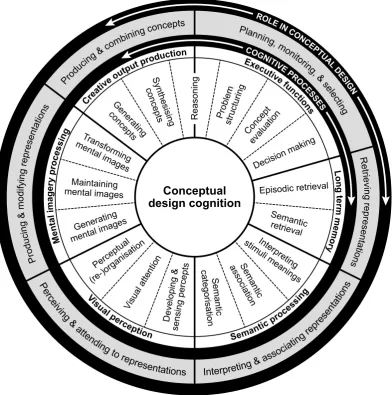
In this paper, we explore the ontological challenges highlighted by our systematic review, and present the first generic classification of cognitive processes investigated in protocol studies on conceptual design cognition. To develop this classification, we mapped specific descriptions of cognitive processes studied by authors in our systematic review sample to more generic, established definitions provided in the cognitive psychology literature. This exercise revealed 6 categories of cognitive process that appear to be commonly investigated and are therefore likely to be prevalent in conceptual design: (1) long-term memory; (2) semantic processing; (3) visual perception; (4) mental imagery processing; (5) creative output production and (6) executive functions. Each category is comprised of several processes, which are elaborated in Section4. In addition, the classification and its development highlight 6 key avenues for future empirical work on cognitive processes in conceptual design:
1. clarifying the nature and role of episodic and semantic memory in conceptual design;
2. developing more consistent definitions of the types of semantic processes involved in conceptual design;
3. considering and critiquing alternative perspectives on the similarities between visual perception and mental imagery processing, and in turn investigating the role of sketching from multiple theoretical perspectives to arrive at a more definitive position;
4. investigating the role of working memory in conceptual design, including the use of both the visuo-spatial sketchpad for mental imagery and the phonological loop for verbal design information;
5. clarifying the meaning of the term ‘synthesis’ in conceptual design and the nature of the process(es) it denotes;
6. expanding the classification as a whole to include any cognitive processes not identified from the reviewed studies, but implicated in conceptual design elsewhere in the literature (e.g. learning).
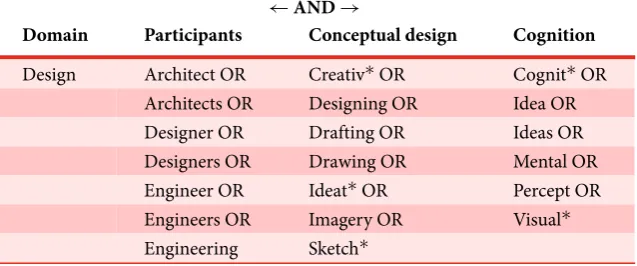
Table 1. Search terms applied in the systematic review (Hayet al.under review), under review)
←AND→
Domain Participants Conceptual design Cognition
Design Architect OR Creativ*OR Cognit*OR
Architects OR Designing OR Idea OR
Designer OR Drafting OR Ideas OR
Designers OR Drawing OR Mental OR
Engineer OR Ideat*OR Percept OR
Engineers OR Imagery OR Visual*
Engineering Sketch*
2. Systematic review approach and sample
As noted in Section1, the work reported herein is based on the findings of a systematic review of 47 protocol studies on conceptual design cognition, guided by the following research question (Hayet al.under review):What is our current understanding of the cognitive processes involved in conceptual design tasks carried out by individual designers? We covered the domains of architectural design, engineering design and product design engineering. The review was conducted by two design researchers (RDes1 and RDes2) with expertise in product design engineering, receiving input from a cognitive neuroscience researcher (RCog) as required. Our approach was informed by the PRISMA statement (outlined in Moheret al. 2009), providing generic guidance with respect to recommended activities for a rigorous and transparent systematic review. An overview of the article selection process, inclusion criteria, sample characteristics and synthesis process is provided below.
Firstly, to identify candidate articles for inclusion, we searched major engineering/design and psychology databases (Compendex, Design and Applied Arts Index, Technology Research Database, Embase, PsycINFO and PubMed) between 27th March 2015 and 3rd April 2015. These searches returned a total of 6796 articles, reduced to 4996 through removal of duplicates. Search terms are presented in Table1, and were applied largely across the title and abstract fields. The broadest time frame permitted by each database was applied. Following de-duplication, we screened the abstracts of the remaining articles for relevance with respect to the research question. At this stage, we decided to focus the review on protocol studies alone, excluding other types of research such as case studies, controlled experiments and surveys. This was largely motivated by the view that protocol analysis is the most capable method for revealing cognitive processes in design (Section1). To maximise coverage, further candidate articles were then identified by searching protocol study reference lists and conducting follow-up database searches with additional terms relating to protocol analysis (9th October 2015). A total of 103 protocol studies were carried forward.
(2) conference papers must be published post-2005; (3) must report original research; (4) must focus on individual designers rather than group-based design tasks; (5) must focus on a conceptual design task in the domains of architectural design, engineering design or product design engineering and (6) must identify cognitive processes involved in conceptual design (Hayet al.under review). Note that articles obtained through initial, reference list and follow-up searches were all consistently assessed. A total of 47 articles were included in the final sample (denoted by*in the reference list at the end of this paper), with the following characteristics (Hayet al.under review):
• Publication year:1979 (Akin1979) to 2015 (e.g. Yuet al.2015), with 52.3%
of studies published in the last decade.
• Study type:full protocol studies (76.6%) and analyses of existing protocol
data (23.4%).
• Sample size:1 to 36 participants (∼350overall), with an average of 7 and a median of 6 per study (SD=6.30).
• Participants: practicing designers and undergraduate, Master’s and PhD
design students with experience levels of 0 to 38 years.
• Design tasks: 45 distinct tasks, with 44.4% architectural design, 42.2%
product design engineering and 13.3% engineering design.
• Types of data gathered: concurrent verbalisations (68.1%); retrospective
verbalisations (23.4%); combined concurrent and retrospective verbali-sations (8.5%); video of behaviour (84.4%) and physical sketches (51.1%).
• Length of verbal protocols:15 to 600 minutes.
Following consolidation of the review sample, the full text of each article was reviewed by RDes1 and RDes2 in order to extract and synthesise descriptions of cognitive processes provided by authors. This was conducted in an iterative fashion, with categories and processes being continually refined through discussion (with RCog) and classification in a common synthesis matrix as they emerged from the review sample. Our interpretation of what constitutes a cognitive process is based on the following definition provided by Poldracket al.
(2011, p. 3) in the cognitive science literature: cognitive processes are ‘entities that transform or operate on mental representations’.Mental representationsare defined as ‘mental entities that stand in relation to some physical entity [. . .] or abstract concept (which could be another mental entity)’. The synthesis process also revealed persistent differences in the way that cognition is described and formalised across different studies, which were interpreted as reflecting the viewpoints of search (V1), exploration (V2) and design activities (V3) introduced in Section1. As a means to structure the review findings, we assigned each article to one of these viewpoints based on relevant keywords and interpretation of the work against the broader literature on search, exploration and activities.
3. Viewpoints on conceptual design cognition
(V3) design activities. V1 and V2 are explored in detail in Hay et al. (under review), whilst V3 is briefly conveyed. We identified a range of cognitive processes investigated in studies associated with each viewpoint. In this respect, the viewpoints overlap to some degree; that is, certain processes may be studied by authors aligning with different viewpoints (an observation that shall become clearer in Section4). To provide a basis for mapping descriptions of cognitive processes provided in design protocol studies to the cognitive psychology literature in Section 4, each of the viewpoints is outlined in the following sub-sections. Whilst the key points are covered, interested readers are referred to Hayet al.(under review) for a considerably more in-depth exploration and discussion of V1 and V2 in particular.
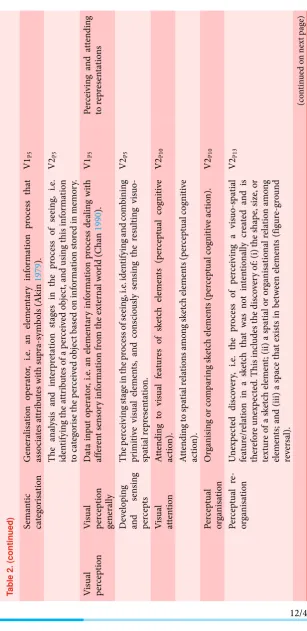
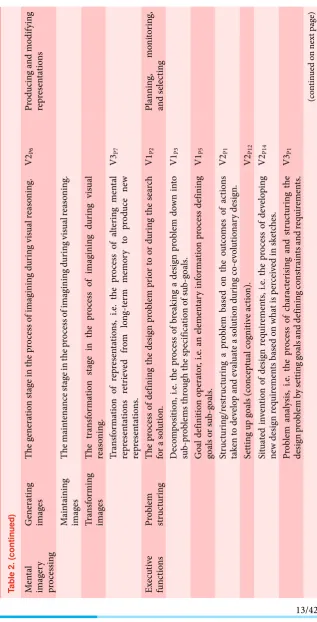
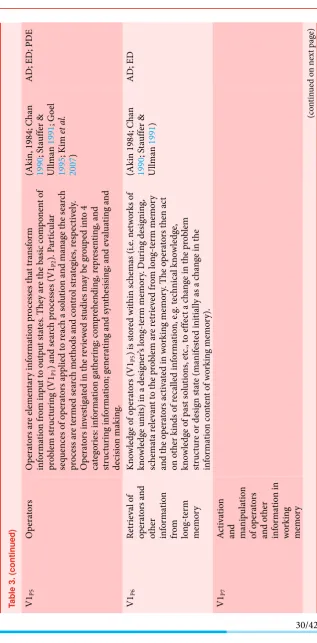
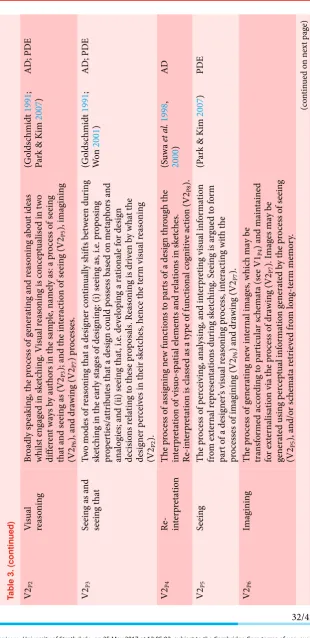
The full set of 35 cognitive processes identified from our review sample is summarised in Table3in AppendixA. It should be noted that several of these processes are described by authors as involving multiple related sub-processes, which may also be viewed as cognitive in nature. Throughout the following sub-sections, the 35 processes listed in Table 3 are italicised and followed by a discussion on any sub-processes that may contribute to their execution. The key elements of this discussion are also summarised in Table3. Note that the comprehensiveness of the identified processes and our resulting classification is discussed in Section5.2.5.
3.1. Design as search
The first viewpoint on design cognition (V1) considers designing to constitute a goal-directed search process transforming knowledge states in a problem space. In the context of design as search, the designer is typically viewed as an information processing system (IPS) operating within some objective reality (Chan 1990; Stauffer & Ullman1991; Dorst & Dijkhuis1995). During designing, information is retrieved fromlong-term memoryand activated inworking memory(Chan1990; Stauffer & Ullman1991), where it is then transformed from input to output states via the execution of elementary information processes termedoperators(Stauffer & Ullman1991). Operators are argued to be stored within schemas in long-term memory, i.e. networks of knowledge units encompassing both declarative and procedural knowledge about design problems (Chan1990; Ballet al.2004). The design state may be transformed laterally, i.e. from one idea to a different idea, or vertically, i.e. from one idea to a more detailed version of the same idea (Goel 1995; Chen & Zhao2006).
Asearch processmay be viewed as a sequence of state transformations effected by the execution of operators. The search begins with a problem state, i.e. knowledge of some problem to be solved, and proceeds through intermediate design states until the goal (i.e. desired) state is reached and the problem is solved (Chan1990; Stauffer & Ullman1991). The search process is delimited by a problem space, constituting a representation of the designer’s task environment. In addition to knowledge of the problem and goal state, the problem space encompasses knowledge of all possible intermediate design states (Newell & Simon1972; Chan1990; Stauffer & Ullman1991; Goel1995).
desired states to be attained (Akin1979; Chan1990; Stauffer & Ullman1991). In this respect, several authors suggest that the search process may be preceded by, and/or interrupted by, another process known asproblem structuring. During problem structuring, information about the problem is gathered, requirements are formulated, goals are set and prioritised, and constraints are established (Akin 1984; Chan1990; Goel 1995). Restructuring the problem results in changes to the nature and/or structure of goals, constraints and requirements (Chan1990). Related processes include:problem decomposition, i.e. the process of breaking down a design problem into sub-problems through the specification of sub-goals (Lloyd & Scott1994; Liikkanen & Perttula2009; Leeet al. 2014); andproblem reframing, i.e. the process of identifying restrictive frames of reference and specifying new frames conducive to solving the design problem (Akin & Akin 1996).
Several authors may also be observed to study reasoning processes in a search context. For instance, Eckersley (1988) and Lloyd & Scott (1994) highlight the role ofdeductive and inductive inferencein design problem solving, i.e. the process by which a logical judgement is made on the basis of pre-existing information (e.g. prior knowledge or previous judgements) rather than direct observations. In addition, Ballet al.(2004) examined the use ofanalogical and case-based reasoning
in design problem solving, where information about known concepts and past design problems is used to understand newly encountered concepts and problems, respectively.
3.2. Design as exploration
In addition to a search process operating within a single knowledge space, designing may also be viewed as an exploratory process operating between a problem and a solution space. During design as exploration (V2), actions taken in the solution space (e.g. idea generation) are considered to influence actions taken in the problem space (e.g. problem structuring) and vice versa. Interactions between the two spaces may add new variables into each (e.g. new design requirements and potential solutions). In this way, design problems are considered to evolve alongside solutions (Maher & Tang2003; Jin & Chusilp2006; Yuet al.
2014). This view is formalised in the co-evolution model of design (Dorst & Cross2001; Maher & Tang 2003; Yu et al.2014), where design is described as aco-evolutionary processthat ‘explores the spaces of problem requirements and design solutions iteratively’. Design concepts in the solution space are evaluated and evolved on the basis of requirements in the problem space, and vice versa.
et al.(1998) study a process that appears similar to SA, termedre-interpretation. That is, assigning new functions to parts of a design through the interpretation of visuo-spatial elements and relations in sketches. More recently, visual reasoning was modelled as the continual interaction of drawing, seeing (i.e. perceptual) and imagining (i.e. mental imagery) processes by Park & Kim (2007).
The concept of situatedness is also reflected in the work of Suwa et al.
(1998,2000), who examine thecognitive actionsof architects. Cognitive actions may be viewed as a set of interdependent cognitive processes argued to be involved in sketching, spanning three different levels of information processing:
physical actionsat the sensory level,perceptual actionsat the perceptual level, and
functionalandconceptual actionsat the semantic level. Suwaet al.(2000) suggest that during sketching, designers may execute a particular type of perceptual action termed unexpected discovery, where a designer perceives a previously unseen feature, relation, or space in their sketches. Instances of unexpected discovery were found to be correlated with a process termedsituated requirements invention, where new design goals are set up, generalised and carried through the design process as new design requirements. Thus, the designer’s understanding of the problem is considered to be affected by changes in perceptual input during sketching.
3.3. Design activities
A final viewpoint that may be adopted on design cognition is that of design activities (V3), with several authors examining activity patterns and relationships in addition to the nature of design activities per se. Note that the former is beyond the scope of this paper and therefore not discussed here. In design research, an activity may be generally defined as a goal-directed action, where an action is the act of transforming some entity from an input state to an output state (Sim & Duffy2003; Boyleet al.2009). Design activities may involve physical actions transforming external entities (e.g. motor actions of the arms and hands transforming sketches), and/or cognitive processes transforming internal entities (e.g. mental imagery processes transforming mental images, ideas, etc.). The design activities discussed in this section are considered from a cognitive perspective, i.e. focusing on the cognitive processes involved rather than physical actions. Five key design activities were identified from our review sample: problem analysis, concept generation, synthesis, concept evaluation and decision making. Firstly,problem analysisinvolves understanding the design problem, setting goals, and defining constraints and requirements (Jin & Chusilp2006; Kruger & Cross2006; Jin & Benami 2010). Jin & Chusilp (2006, p. 30) suggest that when designing, ‘the problem definition may be elaborated or revised’, resulting in changes to constraints and requirements’. Problem analysis may be viewed as analogous to the process of problem structuring discussed in the context of design as search in Section3.1(Liikkanen & Perttula2009), and is examined by several authors in the context of studies on design activity patterns (e.g. McNeill
Secondly, we foundconcept generationto be interpreted in two different ways by authors: the generation of ideas or partial solutions followed by thesynthesis
of these into more mature or complete concepts (Jin & Chusilp2006); or simply the generation of ideas, with synthesis treated as a separate process (Jin & Chusilp 2006; Kruger & Cross2006). Concept generation appears to involve theretrieval of representations from memoryas a basic process (Jin & Chusilp2006; Jin & Benami2010; Lane & Seery2011), which may occur in response to ‘perceptual stimulation’ (Jin & Chusilp2006, p. 30). Theassociation of representationsis also positioned as a basic process by Jin & Benami (2010), and evidence supporting the involvement of associative reasoning processes in concept generation and synthesis (e.g. analogical and case-based reasoning as discussed in Section3.1) has been identified by a number of other authors (e.g. Chiu2003; Kim et al.
2010; Dalyet al.2012; Kim & Ryu2014; Yu & Gero2015). Thetransformation of internal representations(e.g. images and concepts) during concept generation is also considered by Jin & Benami (2010), Lane & Seery (2011) and Leblebici-Basar & Altarriba (2013).
Finally,concept evaluationrefers to the process of assessing concepts against constraints, criteria and design requirements defined during problem analysis (McNeillet al.1998; Jin & Chusilp2006; Kruger & Cross2006; Jin & Benami2010; Leeet al.2014). Evaluation serves to ensure that a concept is ‘relevant, useful and good’, with relevance and usefulness determined against ‘design requirements and constraints’, and goodness against ‘design criteria’ (Jin & Chusilp2006, p. 31). Kim & Ryu (2014) were additionally found to investigate the closely related process of
decision making, i.e. the process of selecting a concept to be taken forward for further development from a range of evaluated alternatives. Two sub-processes involved in evaluation were also considered by several authors: (i)comparing, e.g. comparing two concepts, comparing concepts against criteria, etc. (Kim & Ryu 2014) and (ii)judging, where judgements may be based on subjective aspects such as value (Kruger & Cross2006), aesthetics (Chandrasekeraet al.2013) and affect (Kim & Ryu2014), or objective criteria (Chiu2003; Kruger & Cross2006; Leeet al.
2014).
Figure 1.Generic classification of cognitive processes involved in conceptual design.
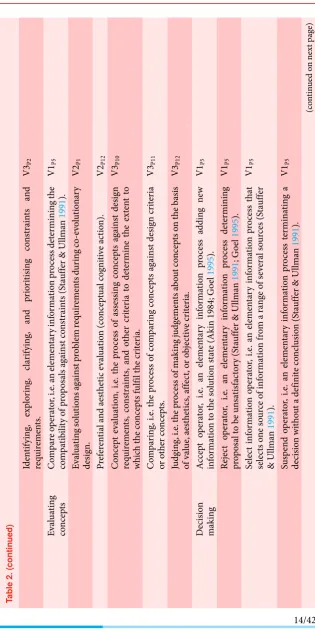
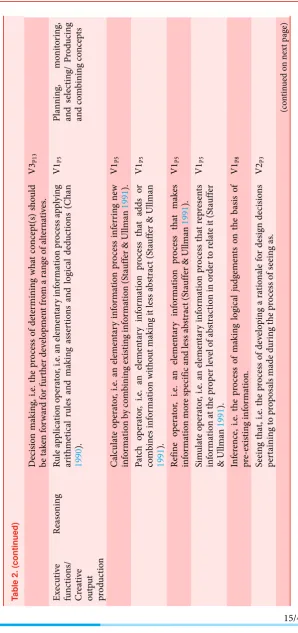
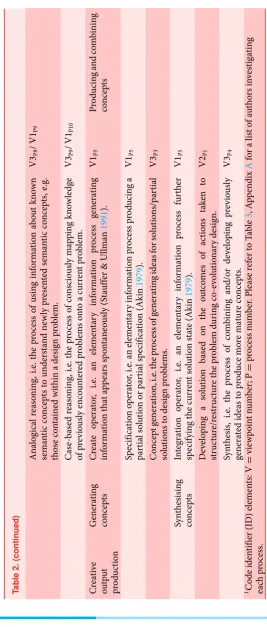
Figure1. As shown in Table2, the 6 categories appear to be commonly investigated across multiple viewpoints and are therefore likely to be prevalent in conceptual design.
4.1. Long-term memory and semantic processing
As shown in Table 2, long-term memory retrieval and semantic processing have received attention across all three viewpoints. These processes may be considered to relate. Firstly, long-term memory can be subdivided into (i) episodic and (ii) semantic memory, dealing with (i) past events/experiences bound with context and (ii) conceptual knowledge that is not tied to specific events/experiences (Tulving 1983; Squire & Zola 1998). Semantic processing refers to the interpretation of meanings conveyed by stimuli (Martin & Chao 2001). Semantic processing may involve what is termed semantic association, i.e. the process of forming mental relationships between meaningful representations (Federmeieret al. 2002). Sets of related representations are termed semantic networks, and exist within semantic memory. Thus, semantic association is intricately related to semantic memory (Martin & Chao2001).
4.1.1. Long-term memory
Based on the review sample, it seems that both episodic and semantic memory are involved in conceptual design. For example, the retrieval of previously encountered design problems in case-based reasoning (Section4.3) may be viewed as an instance of episodic retrieval (Ballet al.2004; Bilda et al.2006), whilst the retrieval of semantic concepts such as types of product and function during concept generation is an instance of semantic retrieval (Jin & Benami2010). Both episodic and semantic memory are argued to play an important role in creative ideation (broadly analogous with concept generation, discussed in Section4.3) in the broader psychology and neuroscience literature (e.g. Runco & Chand1995; Benedeket al.2013; Abraham & Bubic2015). However, whilst the involvement of long-term memory in design concept generation has been investigated by a number of authors in the sample, these studies do not clearly distinguish between episodic and semantic memory (Jin & Benami2010; Lane & Seery2011).
In addition to concept generation, Ballet al.(2004, p. 495) also consider the role of long-term memory retrieval in design reasoning, specifically analogical and case-based reasoning. They suggest that analogical reasoning involves the retrieval and application of ‘abstract experiential knowledge’, whilst case-based reasoning is driven by knowledge about ‘a concrete prior problem whose solution can be mapped systematically onto the current problem’. Whilst the latter clearly pertains to episodic memory, the nature of the former is unclear; the term ‘abstract’ is suggestive of conceptual knowledge recalled from semantic memory, but the term ‘experiential’ pertains to episodic memory.
4.1.2. Semantic processing
Instances of semantic processing identifiable in the sample (Table 2) include both (i) interpreting meanings conveyed by representations and (ii) forming relationships between meaningful representations, i.e. semantic association as noted above. In studies on design as exploration (V2), the process of
seeing as proposed by Goldschmidt (1991), and the closely related process of
Analogical reasoning, and the related process of case-based reasoning, are typically treated as effortful, higher-order processes (discussed in Section4.3). In contrast, semantic association may be viewed as a largely automatic, implicit process (Jin & Benami2010). Theassociation of mental representations(Table2) appears to be a fundamental process involved in concept generation (Jin & Benami 2010), and is also identifiable among the operators involved in design as search, e.g. theinference operatorproposed by Akin (1984) (Table2). Another form of semantic processing identifiable in the sample is what may be termed semantic categorisation. That is, the process of assigning stimuli to conceptual categories stored in memory based on their properties and attributes (Martin & Chao2001). Examples of semantic categorisation include thegeneralisation operatorproposed by Akin (1984), and the analysis and interpretation stages of theseeingprocess proposed by Park & Kim (2007) (Table2).
4.2. Visual perception and mental imagery processing
As shown in Table2, we found visual perception to be investigated primarily in studies on design as search (V1) and exploration (V2), and mental imagery processing in studies on design as exploration and design activities (V3). Visual perception is the process by which a human constructs and consciously senses internal (visual) representations of the external world (Bruceet al.2003; Milner & Goodale2008; Gobetet al.2011). Internal representations produced through perception may be termed percepts (Fish & Scrivener1990; Finke1996). The process is primarily driven by afferent sensory information pertaining to external visuo-spatial representations (Eysenck & Keane2005). Closely related to visual perception is visual mental imagery processing, involving the generation, maintenance and transformation of visual mental images (Kosslyn1995). Mental imagery may be considered to mimic the experience of visual perception by generating and sustaining internal visual representations that may be inspected, but without necessarily using perceptual input and relying heavily on information retrieved from memory (Kosslyn1995). However, the degree to which the two processes may be considered to be similar remains a matter for debate in the psychology and neuroscience literature (Ganis2013). Note also that percepts are typically distinguished from mental images (Fish & Scrivener1990; Finke1996).
4.2.1. Visual perception
Authors studying design as search were found to investigate processes that may be interpreted as perception, e.g. thedata input operatorconsidered by Chan (1990) (Table2). In these studies, perception is largely treated as a process providing the designer with external information when information retrieved from memory is not sufficient to progress the search process. The basic mechanisms of perception are typically not conceptualised or studied in depth, perhaps owing to the perspective that design is a rational search process and the consequent focus on higher-order processes such as reasoning and decision making (Section4.3).
reasoning in conceptual design. That is, based on their description, developing and consciously sensing percepts (Table2). Theperceptual cognitive actionsproposed by Suwa et al.(1998) may be considered to reflect the following processes to some extent: (i) visual attention, where the designer selects and focuses on a particular part of a sketch (Zhang & Lin2013); and (ii) perceptual organisation, referring to the process of organising visual information to form coherent visuo-spatial representations (Bruceet al.2003) (Table2). With respect to the latter, the process ofunexpected discoverystudied by Suwaet al.(2000) may be viewed as an instance of perceptual re-organisation (Table2). That is, the process of re-organising visual information to reveal previously unseen features and relations of visuo-spatial representations (Bruceet al. 2003; Tversky 2014). Indeed, in a later paper published in a psychology journal, Suwa (2003) refers to unexpected discovery as perceptual re-organisation. Three types of re-organisation process were identified by Suwaet al.(2000), namely re-organisation to reveal a previously unseen (i) visual feature, (ii) organisational or spatial relation and (iii) space in between previously drawn elements.
4.2.2. Visual mental imagery processing
The processing of visual mental imagery is argued to be centrally involved in the generation of concepts by numerous authors in the sample (Goldschmidt1991; Athavankar1997; Kavakli & Gero2001; Bilda & Gero2007; Park & Kim2007; Jin & Benami2010). We found that mental imagery has received considerable attention in studies on design as exploration (V2), but virtually none in studies on design as search (V1). This may again be owing to a focus on higher-order processes in studies on design as search as suggested above, and/or the perspective that the designer can be reduced to an information processing system in an objective reality. In contrast, studies on design as exploration tend to view the designer as a person constructing their own reality, in line with the notions of situatedness (Gero & Kannengiesser2004) and reflection-in-action (Dorst & Dijkhuis1995).
Kosslyn (1995) describes four kinds of mental imagery process:
• image generation, i.e. forming mental images by either maintaining
perceptual input or retrieving information from long-term memory;
• image inspection, i.e. interpreting the features and relations of mental
images;
• image maintenance, i.e. retaining the features and relations of mental
images;
• image transformation, i.e. rotating, re-sizing, and manipulating the
structure of mental images.
attention (attending to visuo-spatial features and relations, Table2). However, it is unclear from the findings reported whether evidence supporting this process was identified or not.
4.3. Higher-order processes
A distinction may be made between the cognitive processes discussed in Sections 4.1and4.2and what are termed higher-order processes in this paper. That is, processes that are largely mediated by the frontal lobes of the brain and may involve the interaction of several other processes. As conveyed by Table2, we found higher-order processes to be studied across all viewpoints (in varying degrees). Whilst the processes may be described in different terms by different authors, it may be seen in Table2that these descriptions can be interpreted as describing the same fundamental process. In summary, it seems that the following higher-order processes may be central to conceptual design (presented in order of discussion below):
• Problem structuring(e.g. Goel1995; Suwaet al.2000; Liikkanen & Perttula
2009), i.e. defining and relating the goals, constraints and requirements to be addressed by the designer. Design problems may be restructured during designing, i.e. the definition of and/or relationships between goals, constraints and requirements may be altered.
• Evaluating concepts(e.g. Stauffer & Ullman1991; Maher & Tang2003; Jin &
Chusilp2006), i.e. assessing the goodness of a concept on the basis of value, aesthetics, affect or objective criteria.
• Decision making (e.g. Stauffer & Ullman 1991; Kim & Ryu 2014), i.e.
deliberately selecting (or not selecting) one option (e.g. a concept or a course of action) over another.
• Reasoning(e.g. Chan1990; Goldschmidt1991; Ballet al.2004), i.e. thinking
and drawing conclusions in accordance with some system of logic. Instances of both deductive and inductive reasoning were identified. Two specific forms of inductive reasoning that appear to be important are: (i) analogical reasoning, where a newly encountered concept/situation is compared with previously encountered concepts/situations to infer an understanding of the former (discussed at length by Goel (1997)) and (ii) case-based reasoning, where a newly encountered problem is compared with previously encountered problems to infer a solution and/or solution procedure for the former (conceptualised and discussed in depth by Maheret al.(1995)).
• Generating concepts(e.g. Akin 1984; Jin & Benami2010), i.e. producing new
ideas for solutions or partial solutions to design problems.
• Synthesising concepts(e.g. Akin 1984; McNeill et al.1998; Jin & Chusilp
2006), i.e. combining and developing previously generated ideas to produce more mature ideas.
psychology research typically include processes such as goal setting, selective attention, decision making and problem solving, although there are several different models of executive functioning (Chan et al. 2008). Based on the review sample, it seems that the following processes may be viewed as executive functions in conceptual design (Table2): (i) problem structuring; (ii) concept evaluation and (iii) decision making. It is these processes that appear to facilitate: (i) planning, in the form of identifying and structuring goals (specifying desired design outputs), constraints (specifying limitations on design outputs) and requirements (specifying criteria design outputs should meet); (ii) monitoring, in the form of assessing the goodness of design outputs against goals, constraints and requirements and (iii) selection, in the form of decision making at various points during design tasks (e.g. a decision to reject a concept based on the outcome of evaluation, followed by a decision to restructure the problem by defining new goals or altering existing goals). With the exception of decision making, which we did not identify in studies on design as exploration (V2), all of these processes have received attention across the three viewpoints covered by the review as shown in Table 2. This is not to say that decision making is not involved in design as exploration; rather, it was not identified in the studies included in the review sample. Having said this, several authors focusing on design as exploration mention decision making generally in their discourse (e.g. Goldschmidt1991; Suwaet al.1998).
The remaining higher-order processes identified from the sample – that is, reasoning, generating and synthesising, as listed above – appear to be higher-order processes involved primarily in the production of creative outputs. That is, in a conceptual design context, concepts – i.e. ideas for solutions or partial solutions to design problems. Having said this, it seems that reasoning is also involved in executive functioning to some extent (as indicated in Table2), e.g. Stauffer & Ullman (1991) suggest that thesimulateandcalculateoperators listed in Table2are involved in evaluation. As discussed in Section4.1, there appear to be relationships between concept generation and lower-order memory and semantic processes. However, whilst understanding the nature of these relationships is important for the development of models and theories of design cognition, exploration of these relationships is beyond the scope of this paper.
5. Discussion
As discussed in Section 1, the generic classification elaborated in Section 4 (Figure 1) is based on a set of 35 cognitive processes identified through a systematic review of 47 protocol studies on conceptual design. The classification was motivated by observed differences in the way that cognition is described across different studies, leading us to pose the following ontological question: what cognitive processes actually exist within this domain, and how should they be defined and organised for study? In the following sub-sections, we firstly discuss the implications of the classification with respect to this question (Section5.1). We then outline future empirical work required to clarify and expand the classification
5.1. Towards a shared ontology
Questions regarding the nature of design cognition ontology may be seen to mirror ontological debates in the cognitive psychology and neuroscience literature, where efforts are currently under way to develop a shared ontology of cognitive processes, representations and tasks (Poldracket al. 2011). In this respect, several design researchers have proposed ontologies to describe the phenomenon of design (e.g. Gero1990; Sim & Duffy2003; Gero & Kannengiesser 2004, 2007). However, these are not always intended to describe design at the cognitive level, and those that do describe cognitive processes are not necessarily comprehensive. For example, Gero’s situated FBS ontology describes design in terms of general interpretation, transformation and focusing processes operating on functional, behavioural and structural design variables (Gero & Kannengiesser 2004,2007). However, these processes are positioned as encompassing a range of more specific cognitive processes, examples of which are only briefly mentioned. Whilst the ontology is intentionally general so that it may be applied to describe any instance of designing (Geroet al.2014), it cannot be viewed as comprehensive at the cognitive level.
A generic, shared ontology of cognitive processes in design cognition research would not only provide a common basis for developing theories and models, but would also increase the comparability of findings from different protocol studies and promote a more integrated body of knowledge on design cognition. Two key limitations of protocol analysis are: (i) its reliance upon subjective inferences from verbal self-reports and (ii) its focus on small samples (owing to the resource-intensive nature of qualitative data processing), which may increase the uncertainty associated with results (Hayet al.under review). As suggested in Hayet al.(under review) and Dinaret al.(2015), controlled experiments using cognitive tests and metrics could provide a means to test the findings of protocol studies using a more objective approach and larger samples. In this respect, a shared ontology would provide a consistent basis for selecting and/or developing standard tests of the cognitive abilities contributing to design, an area that has thus far received relatively little attention in the literature (with the notable exception of work by Shahet al. (2012, 2013) and Khorshidi et al. (2014)). In addition, the development of a generic ontology that is conceptually and terminologically consistent with that of cognitive psychology and neuroscience would facilitate comparisons between design cognition studies and cognitive studies of related activities such as artistic and musical composition. This would also increase the capability of design cognition researchers to contribute to the broader body of knowledge on human cognition, and vice versa, for psychologists to contribute to knowledge on design cognition.
perspectives. The classification may additionally provide a basis for identifying what ontological categories, if any, are particular to the different kinds of designing reflected in the three viewpoints outlined in Section3. We suggest that future work to expand and develop the classification towards an ontology should adopt a triangulated approach, combining induction from empirical data with deduction from models and theories of conceptual design to ensure comprehensive coverage of the cognitive processes involved. As highlighted by Poldracket al.(2011, p. 3), continued efforts in this respect must involve the broader design cognition community; an emergent ontology that is ‘based on the consensus obtained within a small group of individuals’ will be largely useless to those who do not ‘share the group’s ontological commitments’.
5.2. Future empirical work
In addition to potentially providing a foundation for ontology development, the generic classification elaborated herein also highlights several avenues for future work relating to specific cognitive processes. These are discussed below.
5.2.1. The role of long-term memory and semantic processing
As noted in Section4.1, both episodic and semantic memory are argued to play an important role in creative ideation in the broader psychology and neuroscience literature (e.g. Runco & Chand 1995; Benedek et al. 2013; Abraham & Bubic 2015). Consistent with this view, a number of authors in our sample were found to suggest that episodic and semantic memory retrieval may be involved in concept generation (broadly analogous with creative ideation). However, although we were able to identify potential instances by interpreting descriptions of memory retrieval provided by authors (Section4.1.1), we found that episodic and semantic memory are rarely explicitly distinguished. Thus, given their potential importance in creativity and ideation, clarifying the nature and role of episodic and semantic memory in conceptual design presents an avenue for future research.
Like long-term memory above, semantic processing – and in particular, semantic association – is argued to play an important role in the generation of creative ideas in the broader psychology and neuroscience literature (e.g. Mednick1962; Mumfordet al.2012; Beatyet al.2014). Furthermore, semantic processing typically involves retrieval of semantic knowledge to some extent and is therefore closely related to semantic memory, which is also argued to be central to creative ideation as discussed above. As such, semantic processing constitutes a salient avenue for research on conceptual design cognition. However, semantic processes are frequently rather poorly and inconsistently conceptualised in the reviewed studies. For example, the processes of bothseeing asandre-interpretation
of semantic processes involved, perhaps using established concepts from the psychology literature.
5.2.2. The role of sketching
Several authors may be seen to suggest that during sketching, visual perception (Section4.2.1), semantic processes (Section4.1.2) and mental imagery processing (Section4.2.2) are intimately related (Goldschmidt1991; Park & Kim2007; Jin & Benami2010). Designers generate mental images by retrieving and associating representations from long-term memory (Goldschmidt1991; Kavakli & Gero 2001; Jin & Benami 2010), processes that are discussed in Section 4.1. They externalise these images through sketching, perceive the elements of the sketches produced and interpret meanings conveyed by what they perceive e.g. design properties/attributes (seeing as, Table2), functions (re-interpretation, Table2), etc. This drives the generation of new images and/or the transformation of maintained images, which may again be externalised and so on. In addition to supporting processes such asre-interpretationandunexpected discovery, sketching is argued to be beneficial in offloading the designer’s visuo-spatial working memory and freeing up cognitive resources during design tasks. That is, sketches serve as an ‘external memory’ where visuo-spatial features and relations may be stored, inspected and manipulated as opposed to maintaining them in working memory (Suwaet al.1998; Bilda & Gero2007).
In spite of the observation that sketching supports key processes involved in conceptual design, there is also evidence in the reviewed studies suggesting that designers can still produce satisfactory design outcomes without sketching (e.g. Athavankar1997; Bilda & Gero 2007; Athavankaret al.2008). That is, relying on mental imagery alone. For example, Bildaet al.(2006) found no significant differences in aspects such as design outcome scores and ideation performance between designers who were blindfolded and unable to sketch, and those who had full access to sketching and visual perception processes. One potential explanation for these observations is that designers may treat mental images in much the same way as they treat percepts of external representations. For instance, Kosslyn (1995) argues that humans inspect and interpret mental images through processes similar to those employed in the inspection and interpretation of external representations. From this perspective, it may be the case that many of the processes conventionally executed on percepts of external sketches in design may equally be executed on mental images. This argument is advanced to some extent in Kavakli & Gero (2001), Kavakli & Gero (2002), Bildaet al.(2006), and Bilda & Gero (2007), with Kavakli & Gero (2001) claiming that visual perception and visual mental imagery constitute ‘functionally equivalent’ processes.
as discussed above. In turn, the coding schemes and approaches adopted in these studies are intimately tied to this premise. For instance, similarities between visual perception and mental imagery processing appear to be used as a justification for applying a perception-based coding scheme to code a mental imagery-based protocol in Bildaet al.(2006). However, as noted above, the degree to which the two processes can be considered to be equivalent remains a matter for debate in the psychology and neuroscience literature. They are generally considered to overlap both cognitively and neurally, but there are differing perspectives on the extent of this overlap (Ganis2013). Thus, there is a need to consider and critique these alternative perspectives in a design context, and potentially to investigate the role of sketching from multiple theoretical perspectives in order to arrive at a more definitive position.
5.2.3. Working memory
Stauffer & Ullman (1991, p. 114) refer to a cognitive system termed the ‘controller’ in the context of design as search, which is included in Newell and Simon’s (1972) information processing model and may be seen to essentially ‘supervise’ the control and execution of cognitive processes. The controller is responsible for sequencing operators (i.e. elementary information processes) in design as search and integrating different kinds of information. This reflects the notion of what may be termed the central executive in psychology research. The central executive is a theoretical cognitive system involved in co-ordinating and regulating cognitive processes, as well as binding different kinds of information to form coherent episodes. The central executive is a key component of working memory models, perhaps most notably Baddeley’s multi-component model (Baddeley1983,2003). In this model, working memory is proposed to constitute a set of cognitive systems supporting the simultaneous storage and manipulation of visuo-spatial and verbal information. In addition to the central executive, working memory is comprised of: (i) the visuo-spatial sketchpad, supporting storage and manipulation of visuo-spatial information; (ii) the phonological loop, supporting storage and manipulation of verbal information and (iii) the episodic buffer, supporting the integration of visuo-spatial and verbal information into coherent chronologically sequenced units (Baddeley1983,2003).
Based on the reviewed studies, working memory appears to be involved in conceptual design. The term is at least briefly mentioned by authors across all three viewpoints, e.g.: V1 – Stauffer & Ullman (1991); V2 – Bildaet al.(2006) and V3 – Liikkanen & Perttula (2009). It appears in the information processing models that typically underpin studies on design as search (e.g. Chan1990; Stauffer & Ullman1991), as well as in general accounts of designers’ cognitive processing (e.g. Liikkanen & Perttula2009; Leblebici-Basar & Altarriba2013; Kim & Ryu 2014). The majority of references to working memory appear to focus on the use of the visuo-spatial sketchpad to support mental imagery processing (e.g. Bildaet al.
received little investigative attention in the reviewed protocol studies. That is, there is little empirical evidence providing insight into the role of working memory in conceptual design. Consequently, working memory processes are not currently included in the classification presented in Figure1.
Given the role of working memory in creative ideation and evaluation, investigating its role in conceptual design provides another salient avenue for future research. Work in this area could also contribute to expanding our proposed classification of cognitive processes. In addition to the visuo-spatial sketchpad, future research on working memory should also consider the role of the phonological loop in conceptual design given that designers frequently deal with verbal information from e.g. design briefs and technical documentation in addition to visual information from sketches and models. For future studies, it should also be noted that working memory and short-term memory are generally not considered to be synonymous terms by psychologists, although they appear to be employed as such in several papers in the sample (e.g. Stauffer & Ullman1991; Bilda & Gero2007).
5.2.4. The nature of concept generation and synthesis
Regarding creative output production, an area requiring clarification is the nature of synthesis and its relationship with concept generation. Both of the following perspectives may be detected in the sample: (i) synthesis involves combining ideas previously generated through concept generation to form more mature concepts (e.g. Jin & Chusilp2006); and (ii) synthesis contributes to the process of concept generation (e.g. Lane & Seery2011). One potential explanation for co-existing interpretations of synthesis may be identified in the work of Finke
et al. (1992) on creative cognition, which appears to have influenced certain authors in the sample (notably Jin & Benami (2010)). As discussed in Section 4.2.2, the generation, maintenance and transformation of mental images is argued to be centrally involved in the generation of concepts. In this respect, Finke
et al.(1992) describe two kinds of synthesis: (i) mental synthesis of an image, i.e. assembling the component parts of a mental image and (ii) conceptual combination, i.e. combining concepts with different attributes to produce new concepts. New concepts produced through conceptual combination may inherit certain attributes from the individual concepts, as well as possess emergent attributes different from those of individual concepts.
function, form and behaviour, as well as the perspective that synthesis is a form of abduction. Nonetheless, Sim & Duffy (2003, p. 205) argue that synthesis is ‘more than just a mapping of dependencies’, suggesting that it may rather be viewed as a process of integrating ‘concepts or parts into a whole’. Overall, then, there is a need for future work to clarify what is meant by the term ‘synthesis’ in conceptual design, and the nature of the process(es) that it denotes.
5.2.5. Unidentified cognitive processes
Finally, as noted in Section 5.1, the cognitive processes included in the classification are necessarily limited to those that were identifiable in the reviewed studies. In this respect, it is possible that there may be cognitive processes considered to play an important role in designing elsewhere in the literature that were not investigated in our sample. A notable example islearning, which may be broadly defined as the process of acquiring new skills and knowledge. Sim & Duffy (2004) highlight that learning in design practice has been studied by a number of authors. However, we did not identify learning as a cognitive process explicitly studied in our sample. Sim & Duffy (2004, p. 40) highlight that the ‘observation that designers learn [. . .] is supported by protocol studies in design that [demonstrate] experienced designers can reach satisfactory design solutions more effectively than novice or naïve designers’, citing Lloyd & Scott (1994), who are included in our review sample, as an example. A similar example may be found in Ballet al. (2004), who conclude that experts are more likely than novices to carry out analogical reasoning in a rapid, automatic fashion based on knowledge schemas. The schematisation of domain knowledge is frequently associated with the development of domain expertise, which may be interpreted as learning. Nonetheless, Ballet al.(2004) do not explicitly study learning.
Considering the continual evolution in our understanding of design cognition, identifying and addressing gaps in the proposed classification must be an ongoing endeavour. Given that different methods may provide different views on the same phenomenon, this may entail empirical work using other approaches such as controlled experiments and case studies. In addition to empirical workper se, systematic reviews focused on other research methods may also reveal additional cognitive processes.
6. Conclusion
several processes. In addition, the classification and its development highlight 6 key avenues for future empirical work on cognitive processes in conceptual design:
1. clarifying the nature and role of episodic and semantic memory in conceptual design;
2. developing more consistent definitions of the types of semantic processes involved in conceptual design;
3. considering and critiquing alternative perspectives on the similarities between visual perception and mental imagery processing, and in turn investigating the role of sketching from multiple theoretical perspectives to arrive at a more definitive position;
4. investigating the role of working memory in conceptual design, including the use of both the visuo-spatial sketchpad for mental imagery and the phonological loop for verbal design information;
5. clarifying the meaning of the term ‘synthesis’ in conceptual design and the nature of the process(es) it denotes and
6. expanding the classification as a whole to include any cognitive processes not identified from the reviewed studies, but implicated in conceptual design elsewhere in the literature (e.g. learning).
In addition to providing a more unified view of the field, the classification provides a starting point for the development of a generic, shared ontology of cognitive processes in design. An ontology of this nature that aligns with that of cognitive psychology and neuroscience would have several benefits, including: provision of a common basis for model and theory development; increased comparability of studies, both within design and across related fields such as artistic and musical composition; provision of a consistent basis for defining/selecting standard tests of cognitive design abilities; and increased capability for cross-disciplinary contributions by design cognition researchers and cognitive psychologists. In closing, it is important to highlight that not only should future work on design cognition address gaps in understanding within the design community; it should also contribute to broadening knowledge on design in the fields of cognitive psychology and neuroscience, where the activity remains under-researched in spite of its fundamental importance across multiple contexts and sectors. As such, we hope that our colleagues in both design research and cognitive science will contribute to the future empirical and theoretical work needed to develop a more consistent design cognition ontology.
Acknowledgments
This research is funded by the United Kingdom’s Engineering and Physical Sciences Research Council, grant number EP/M012123.
Appendix A. Cognitive processes identified from
protocol studies
a viewpoint (V) and process number (P) e.g. V1P1(column 1). Processes are listed and described as conveyed by investigating authors.
It should be highlighted that several processes presented in Table3involve multiple related processes, as conveyed in the process descriptions presented in column 3. We adopted the organisation and structure of Table 3 largely because it aligns with the manner in which processes are discussed by the authors investigating them. In turn, we found it to be the most conducive to clear explanation of the review findings. Nonetheless, we acknowledge that other authors may have different interpretations in this respect.
References
1Abraham, A.&Bubic, A.2015Semantic memory as the root of imagination.Frontiers in
Psychology6, 1–5. doi:10.3389/fpsyg.2015.00325.
*Akin, Ö.1979An exploration of the design process.Design Methods and Theories:
Journal of the DMG13(3/4), 115–119.
*Akin, O.&Akin, C.1996Frames of reference in architectural design: analysing the
hyperacclamation (a-h-a-!).Design Studies17(4), 341–361.
*Athavankar, U.,Bokil, P.&Guruprasad, K.2008Reaching out in the mind’s space. In
Design Computing and Cognition ’08, pp. 321–340. Springer.
*Athavankar, U. A.1997Mental imagery as a design tool.Cybernetics and Systems28(1),
25–42. doi:10.1080/019697297126236.
Baddeley, A.1983Working memory.Phil. Trans. R. Soc. Lond.B302(1110), 311–324.
Baddeley, A.2003Working memory: looking back and looking forward.Nature Reviews
– Neuroscience4, 829–839.
*Ball, L. J.,Ormerod, T. C.&Morley, N. J.2004Spontaneous analogising in engineering
design: a comparative analysis of experts and novices.Design Studies25(5), 495–508. doi:10.1016/j.destud.2004.05.004.
Beaty, R. E.,Silvia, P. J.,Nusbaum, E. C.,Jauk, E.&Benedek, M.2014The roles of
associative and executive processes in creative cognition.Memory&Cognition42(7), 1186–1197. doi:10.3758/s13421-014-0428-8.
Benedek, M.,Jauk, E.,Fink, A.,Koschutnig, K.,Reishofer, G.,Ebner, F.&Neubauer,
A. C.2013To create or to recall? Neural mechanisms underlying the generation of
creative new ideas.NeuroImage88, 125–133. doi:10.1016/j.neuroimage.2013.11.021.
*Bilda, Z.&Demirkan, H.2003An insight on designers’ sketching activities in
traditional versus digital media.Design Studies24(1), 27–50. doi:10.1016/S0142-694X(02)00032-7.
*Bilda, Z.&Gero, J. S.2007The impact of working memory limitations on the design
process during conceptualization.Design Studies28(4), 343–367. doi:10.1016/j.destud.2007.02.005.
*Bilda, Z.,Gero, J. S.&Purcell, T.2006To sketch or not to sketch? That is the question.
Design Studies27(5), 587–613. doi:10.1016/j.destud.2006.02.002.
Boyle, I. M.,Duffy, A. H. B.,Whitfield, R. I.&Liu, S.2009Towards an understanding
of the impact of resources on the design process. In17th International Conference on
Engineering Design (ICED ’09). The Design Society.
Bruce, V.,Green, P. R.&Georgeson, M. A.2003Visual Perception: Physiology,
Psychology and Ecology. Psychology Press.
Buys, A.&Mulder, H.2014A study of creativity in technology and engineering. In
Proceedings of PICMET ’14: Infrastructure and Service Integration, pp. 879–891. IEEE.
*Chan, C.-S.1990Cognitive processes in architectural problem solving.Design Studies
11(2), 60–80. doi:10.1016/0142-694X(90)90021-4.
Chan, R. C. K.,Shum, D.,Toulopoulou, T.&Chen, E. Y. H.2008Assessment of
executive functions: review of instruments and identification of critical issues.
Archives of Clinical Neuropsychology: The Official Journal of the National Academy of
Neuropsychologists23(2), 201–216. doi:10.1016/j.acn.2007.08.010.
*Chandrasekera, T.,Vo, N.&D’Souza, N.2013The effect of subliminal suggestions on
sudden moments of inspiration (SMI) in the design process.Design Studies34(2), 193–215. doi:10.1016/j.destud.2012.09.002.
*Chen, X.&Zhao, J.2006Research on the model and application of knowledge-based
industrial design. InInternational Technology and Innovation Conference 2006, Vol 1, pp. 258–263. Institution of Engineering and Technology.
*Chiu, M. L.2003Design moves in situated design with case-based reasoning.Design
Studies24(1), 1–25. doi:10.1016/S0142-694X(02)00007-8.
Cross, N.2001Design cognition: results from protocol and other empirical studies of
design activity. InDesign Knowing and Learning: Cognition in Design Education(ed.
C. M. Eastman, W. M. McCracken & W. C. Newstetter), pp. 79–103. Elsevier Science
Ltd.
*Daly, S. R.,Yilmaz, S.,Christian, J. L.,Seifert, C. M.&Gonzalez, R.2012Design
heuristics in engineering.Journal of Engineering Education101(4), 601–629.
Dietrich, A.2004The cognitive neuroscience of creativity.Psychonomic Bulletin&
Review11(6), 1011–1026. doi:10.3758/BF03196731.
Dinar, M.,Shah, J. J.,Cagan, J.,Leifer, L.,Linsey, J.,Smith, S. M.&Hernandez, N. V.
2015Empirical studies of designer thinking: past, present, and future.Journal of
Mechanical Design137(2), 1–13. doi:10.1115/1.4029025.
*Dorst, K.&Cross, N.2001Creativity in the design process: co-evolution of
problem-solution.Design Studies22(5), 425–437. doi:10.1016/S0142-694X(01)00009-6.
Dorst, K.&Dijkhuis, J.1995Comparing paradigms for describing design activity.
Design Studies16(2), 261–274. doi:10.1016/0142-694X(94)00012-3.
*Eckersley, M.1988The form of design processes: a protocol analysis study.Design
Studies9(2), 86–94. doi:10.1016/0142-694X(88)90034-8.
Ericsson, A. K.&Simon, H. A.1984Protocol Analysis - Verbal Reports as Data. MIT.
Eysenck, M. W.&Keane, M. T.2005Cognitive Psychology: A Student’s Handbook, 5th ed.
Pyschology Press Ltd.
Federmeier, K. D.,McLennan, D. B.,Ochoa, E.&Kutas, M.2002The impact of
semantic memory organization and sentence context information on spoken language processing by younger and older adults: an ERP study.Psychophysiology39(2), 133–146. doi:10.1111/1469-8986.3920133.
Finke, R. A.1996Imagery, creativity, and emergent structure.Consciousness and
Cognition5(3), 381–393. doi:10.1006/ccog.1996.0024.
Finke, R. A.,Ward, T. B.&Smith, S. M.1992Creative Cognition: Theory, Research, and
Applications. The MIT Press.
Fish, J.&Scrivener, S.1990Amplifying the mind’s eye: sketching and visual cognition.
Leonardo23(1), 117–126.
Ganis, G.2013Visual mental imagery. InMultisensory Imagery(ed. S. Lacey & R.
Gero, J. S.1990Design prototypes: a knowledge representation schema for design.AI
Magazine11(4), 26–36. doi:10.1609/aimag.v11i4.854.
Gero, J. S.&Kannengiesser, U.2004The situated function-behaviour-structure
framework.Design Studies25(4), 373–391. doi:10.1016/j.destud.2003.10.010.
Gero, J. S.&Kannengiesser, U.2007A function-behavior-structure ontology of
processes.AI EDAM21(4), 379–391. doi:10.1017/S0890060407000340.
Gero, J. S.,Kannengiesser, U.&Pourmohamadi, M.2014Commonalities across
designing: empirical results. InDesign Computing and Cognition ’12, pp. 265–281. Springer; doi:10.1007/978-94-017-9112-0_15.
Gero, J. S.&Tang, H.-H.2001The differences between retrospective and concurrent
protocols in revealing the process-oriented aspects of the design process.Design
Studies22(3), 283–295. doi:10.1016/S0142-694X(00)00030-2.
Gobet, F.,Chassy, P.&Bilalic, M.2011Foundations of Cognitive Psychology.
McGraw-Hill Education.
Goel, A. K.1997Design, analogy, and creativity.IEEE Expert12(3), 62–70.
doi:10.1109/64.590078.
*Goel, V.1995Cognitive processes involved in design problem solving. InSketches of
Thought(ed. V. Goel), pp. 95–126. MIT Press.
Goel, V.2014Creative brains: designing in the real world.Frontiers in Human
Neuroscience8, 1–14. doi:10.3389/fnhum.2014.00241.
*Goldschmidt, G.1991The dialectics of sketching.Creativity Research Journal4(2),
123–143. doi:10.1080/10400419109534381.
Hay, L.,McTeague, C.,Duffy, A. H. B.,Pidgeon, L. M.,Vuletic, T.&Grealy, M.A
systematic review of protocol studies on conceptual design cognition: Design as search and exploration.Design Science(under review).
*Jin, Y.&Benami, O.2010Creative patterns and stimulation in conceptual design.AI
EDAM24(2), 191–209. doi:10.1017/S0890060410000053.
*Jin, Y.&Chusilp, P.2006Study of mental iteration in different design situations.Design
Studies27(1), 25–55. doi:10.1016/j.destud.2005.06.003.
*Kavakli, M.&Gero, J. S.2001Sketching as mental imagery processing.Design Studies
22(4), 347–364. doi:10.1016/S0142-694X(01)00002-3.
*Kavakli, M.&Gero, J. S.2002The structure of concurrent cognitive actions: a case
study on novice and expert designers.Design Studies23(1), 25–40. doi:10.1016/S0142-694X(01)00021-7.
Khorshidi, M.,Shah, J. J.&Woodward, J.2014Applied tests of design skills. Part III:
Abstract reasoning.Journal of Mechanical Design136, 101101-1–101101-11. doi:10.11 15/1.4027986.
*Kim, J.&Ryu, H.2014A design thinking rationality framework: framing and solving
design problems in early concept generation.Human–Computer Interaction29(5–6), 516–553. doi:10.1080/07370024.2014.896706.
*Kim, J. E.,Bouchard, C.,Omhover, J. F.&Aoussat, a.2010Towards a model of how
designers mentally categorise design information.CIRP Journal of Manufacturing
Science and Technology3(3), 218–226. doi:10.1016/j.cirpj.2010.11.004.
*Kim, M. H.,Kim, Y. S.,Lee, H. S.&Park, J. a.2007An underlying cognitive aspect of
design creativity: limited commitment mode control strategy.Design Studies28(6), 585–604. doi:10.1016/j.destud.2007.04.006.
*Kim, Y.,Jin, S.&Lee, H.2005Dual protocol analysis based on design information and