City, University of London Institutional Repository
Citation
:
Lee, S. (2016). Distance and diversification. Journal of European Real Estate Research, 9(2), pp. 183-192. doi: 10.1108/JERER-02-2016-0010This is the accepted version of the paper.
This version of the publication may differ from the final published
version.
Permanent repository link:
http://openaccess.city.ac.uk/15683/Link to published version
:
http://dx.doi.org/10.1108/JERER-02-2016-0010Copyright and reuse:
City Research Online aims to make research
outputs of City, University of London available to a wider audience.
Copyright and Moral Rights remain with the author(s) and/or copyright
holders. URLs from City Research Online may be freely distributed and
linked to.
City Research Online: http://openaccess.city.ac.uk/ [email protected]
Distance and Diversification
By
Stephen L. Lee
Faculty of Finance Cass Business School City of London University
106 Bunhill Row London EC1Y 8TZ
England
Phone: +44 (0) 207 040 5257, E-mail: [email protected]
Abstract
Purpose - The purpose of this paper is to examine whether geographical distance or economic distance offers greater diversification benefits in the UK office market.
Design/methodology/approach - The real estate investment data for this study come from the Investment Property Databank (IPD) analysis “UK Quarterly Key Centres Q2 2015”. We measure the geographical distance between the City of London and 27 local authorities by road distance. We used the market size and employment structure of the local authorities relative to the City of London to calculate economic distance.
Findings - The results show that local authorities that are classified on their economic distance show significant negative office rental growth correlations with the City of London. In contrast, geographical distance shows no relationship. Results that are consistent for the overall sample period and for various sub-periods.
Practical implications - Spatial diversity is a fundamental tenet of real estate portfolio management and the results here show that it is better to diversify across office markets in the UK using the economic attributes of local authorities rather than the physical distance between locations.
Originality/value - This is one of only two papers to explicitly examine whether economic distance or geographical distance leads to significantly lower rental growth coefficients between locations in office markets and the first in the UK.
Keywords - geographical distance, economic distance, rental growth correlation coefficients, UK office market
Distance and Diversification
Introduction
The First Law of Geography states that, “Everything is related to everything else, but near things are more related than distant things” (Tobler, 1970). In other words, spatial interaction between a pair of locations decreases as distance increases. In the case of real estate this suggests that has the distance between locations increases the rental growth of those locations will show lower correlation than that in locations that are near to some reference market. Distance can have many facets such as social distance, cultural distance, technological distance etc., but in the real estate literature distance it is usually measured in two ways: geographical distance and economic distance.
Geographical distance refers to the physical distance between two geographic points and can be measured in its actual or functional sense. Actual geographical distance can be operationalised as the straight line distance, i.e. as the crow flies, while functional distance can take the form of road distance to take account of physical barriers between locations. Thus, if geographical distance matters in spatial real estate diversification strategies this suggests that there should be a significant negative rental growth correlation between locations that are actual or functionally distant from a reference market.
Economic distance refers to the differences between locations in terms of employment composition and market size. That is, the local employment composition and market size of the location systematically influences the correlation of movements in real estate markets between locations, independent of physical proximity. The degree of correlation between outcomes in any two real estate markets is therefore a function of the extent to which their economic composition and size is similar. This implies that there should be a significant negative rental growth correlation between locations that are economically distant from a reference market.
As far as the author is aware only one study (Ren and Krasikov, 2015) has explicitly examined whether geographical distance or economic distance leads to lower rental growth correlations between office markets and that was in the US. This study follows a similar approach to that of Ren and Krasikov (2015) and examines whether there is a significant decline between rental growth correlation coefficients with either geographical distance or economic distance in the UK office market.
Previous Studies
In relation to spatial diversification two approaches are identified in the developing body of the literature. The first approach is based on geographical (urban) areas while the second approach is based on the economic function of cities or spatial areas. Of the two approaches the consensus among academics is that real estate diversification strategies based on economic structure have achieved better diversification benefits than strategies based on geographical classification (see inter alia, Lee and Byrne, 1998; Hamelink, et al., 2000; Veizer, 2000 and Katzler, 2005 for extensive reviews).
The reason the economically based real estate strategies seem to be more successful in evaluating spatial real estate investment opportunities and risks is that the economic distance approach allows consistent risk measurement between locations and so enables the portfolio manager to develop a greater spatially diversified portfolio. This implies that portfolio risk in real estate market requires an understanding of the economic risk to which the local markets are exposed to ensure that the resultant portfolio is more balanced. In other words, real estate diversification strategies need to be more sophisticated than simply spreading investment across greater distances. Indeed, compared with the economic distance approach, geographical distance is likely to add little, if anything, to a successful spatial real estate diversification strategy (Goetzmann and Wachter, 1995; and Hartzell et al., 1986).
The contemporary position then is to define locations on their economic distance, rather than geographic distance, since it will be the economic composition of a location that will lead to differences in demand and hence property performance. However, only one study (Ren and Krasikov, 2015) has explicitly tested whether geographical distance or economic distance leads to lower rental growth correlations between locations and so greater diversification benefits. Ren and Krasikov (2015) examined whether metro-city industrial composition affected the correlations of quarterly rental growth for pairs of the top 20 major office markets in the US. The authors found that the industrial composition of the 20 metro-areas were significantly related to rental growth correlation coefficients, i.e. the more similar the industrial composition between cities the higher the correlation and vice versa. Ren and Krasikov (2015) also found that the correlation between rental growths in the 20 metro-areas is not affected by the road distance between cities, as the US is largely flat in terms of economic conditions.
period of the Global Financial Crisis (June 2007 to December 2010) and the post Crisis period (March 2011 to June 2015). In this way we can examine whether the relationship between correlation and distance is consistent in different economic regimes.
Second, while Ren and Krasikov (2015) measured economic distance by industrial composition we appeal to the gravity model approach in developing our measure of economic distance, which is used extensively in examining the interaction between locations (Anderson, 1979). Newton’s gravity model states that: “Any two bodies attract one another with a force that is proportional to the product of their masses and inversely proportional to the square of the distance between them”. That is, we measure the spatial interaction between markets by both market size and employment structure rather an industrial composition alone.
Lastly, we examine the rental growth correlation coefficients between the City of London office market and 27 Local Authorities (LAs) in the UK, rather than for pairs of cities, as it is well known that institutional investors, insurance companies and pension funds, have a bias towards the City of London office market (see inter alia, Cullen, 1993; Hoesli et al, 1997; Hamelink et al, 2000; Henneberry et al, 2004; Andrew et al, 2005; and Byrne and Lee, 2006 and Byrne et al., 2013). At least three reasons exist for this focus by institutional investors on the City of London office market. First, there is more information on the real estate market of London, especially so for City offices, as London is the most researched region in the UK and Europe. Second, offices in the City of London account for the majority of the total office investment in the UK. Third, although the speed and costs of transaction varies enormously from one property type to another and across properties of differing lot-sizes, London typically offers the greatest speed of execution, for properties of a similar lot-size, across all property sectors (McNamara, 1999). Consequently, most institutional investors see the City of London office market as the most researched, potentially most liquid and a market with a sufficient stock of the right quality to make it the most mature market in Europe (Keogh and D’Arcy, 1994). Thus, we are primarily interested in this paper to see whether a spatially diversified portfolio strategy is better achieved by spreading across greater geographical distance or economic distance in the UK, as investors move out of the City of London office market.
Data
The real estate investment data for this study come from the Investment Property Databank (IPD) analysis “UK Quarterly Key Centres Q2 2015”. This provides a detailed view of the performance on a quarterly basis from March 2001 to June 2015, of institutional real estate investment, by sector, in a number of localities across the UK. The Key Centres data series however only covers 27 LAs in the UK outside of London, which are the ones used in this study. Nonetheless, although the 27 LAs are the largest office markets, apart from London, the results only hold for these LAs.
period (March 2001 to March 2007); (P2) the period of the Global Financial Crisis (June 2007 to December 2010) and (P3) the post Crisis period (March 2011 to June 2015).
Table 1: Summary Correlation Coefficients
Statistic Overall P1 P2 P3
Average 0.26 0.16 0.54 0.32
Standard Deviation 0.17 0.30 0.18 0.22
Max 0.67 0.80 0.75 0.64
Min -0.14 -0.54 -0.03 -0.14
# Positive 24 19 26 25
# Negative 3 8 1 2
Sig positive 14 4 17 10
Sig negative 0 1 0 0
Table 1 shows that for the overall sample period the average correlation between the City of London office market and the other 27 LAs is quite small (0.26), indicating good diversification benefits from spatial diversification. Of the 27 LAs three showed a negative correlation, although none significantly different from zero at the 5% level, while of the 24 positive correlations 14 were significantly different from zero at the 5% level.
The results of the overall sample period however varied markedly in different economic regimes. In particular, sub-period one (P1) showed that spatial diversification benefits in the UK were huge with an average correlation of only 0.16. Eight of the LAs (30%) showed a negative correlation with the City, but only one was significantly different from zero at the 5% level, whereas of the 19 LAs with a positive correlation 4 were significant.
The advantageous position in period one was reversed in the period of the Global Financial Crisis (P2). The average correlation coefficient in sub-period two more than tripling to 0.54 compared to sub-period one. Additionally, the spread in correlation coefficients as measured by the standard deviation dropped from 0.30 to 0.18 in comparison with period one. Furthermore, 24 of the LAs showed a positive correlation with the City, 17 at the 5% significance level, whereas the only LA with a negative correlation was insignificantly different from zero. This is indicative of a “correlation breakdown” in the UK real estate market, i.e. the tendency of correlations to become more clustered and move positive, reducing diversification opportunities due to an overall market effect just when it’s needed the most.
Sub-period three (P3) shows some evidence of a movement in the market back to the norm; although the average correlation is still double that of period one (0.32). In addition, only two LAs show a negative correlation, none significantly so, whereas of the 25 LAs with a positive correlation with the City, 10 were significantly different from zero at the 5% significance level.
The market size data of the markets is measured by the average capital value of the office stock in each location over the sample period, the data taken from the IPD UK Quarterly Key Centres Q2 2015 dataset.
To measure the similarity in employment composition between the City of London and the other LAs we use the employment data from the UK Office of National Statistics (ONS) Nomis Labour Market Profile database. The data used are Annual Business Inquiry Employee Analysis, which gives the numbers of employee (available) jobs in each employment category. The data do not therefore relate directly to the employed population living in a location, but are a measure of net employment for each of these kinds of activity in each location. The Annual Business Inquiry Employee Analysis provides data on the number of employees in 13 Broad Industrial Groups (BIG) but to make the data comparable with that of Byrne and Lee (2006, 2009 and 2010) we combine the data into eight categories: % in Manufacturing, % in Construction, % in Tourism, % in Distribution (distribution, hotels and restaurants), % in Transport (transport and communications), % in FIRE (financial, real estate, IT and business activities), % in the Public Sector (public administration, education and health), and % in Other.
To calculate the economic distance of the City of London with the other LAs we used the Euclidian distance approach, like Ren and Krasikov (2015), but to alleviate the large inter-sample differences between the City of London and the other LAs we first standardized the data. That is we first standardized the percentage employment data and the market value data so that they all have the same variance of one. At the same time we centred the variables at their means – this centring is not necessary for calculating distance, but it makes the variables all have a mean of zero and thus make the results easier to compare. Next we calculate the Euclidian distance between the City of London and the 27 LAs as follows:
𝐸𝐷𝑥,𝑦 = √∑𝑗 (𝑥𝑗− 𝑦𝑗)2 𝑗=1
2
(1)
Where; EDx,y is the Euclidian distance between the City of London (x) and a LA (y) calculated as the square root of the sum of the squared standardized difference between values for the City of London and the same categories in each LA.
Figure 1: Rental Growth Correlations and Geographical Distance for UK Office Markets
Figure 2: Rental Growth Correlations and Economic Distance for UK Office Markets Birmingham Bournemouth Brighton Bristol Cambridge Cardiff Chester Exeter Guildford Leeds Leicester Liverpool Manchester Middlesbrough Newcastle Norwich Nottingham Oxford Plymouth Portsmouth Reading Sheffield Southampton York Aberdeen Edinburgh Glasgow -0.20 -0.10 0.00 0.10 0.20 0.30 0.40 0.50 0.60 0.70 0.80
0 100 200 300 400 500 600 700 800 900
Correlation
Road Distance km
Birmingham Bournemouth Brighton Bristol Cambridge Cardiff Chester Exeter Guildford Leeds Leicester Liverpool Manchester Middlesbrough Newcastle Norwich Nottingham Oxford Plymouth Portsmouth Reading Sheffield Southampton York Aberdeen Edinburgh Glasgow -0.20 -0.10 0.00 0.10 0.20 0.30 0.40 0.50 0.60 0.70 0.80
7.5 8.0 8.5 9.0 9.5 10.0 10.5 11.0 11.5
[image:8.612.98.519.421.727.2]The two most notable features of Figures 1 and 2 are the positions of Reading and Edinburgh. First, Reading is the second closets LA in terms of geographical distance and economic distance and has the highest correlation with the City of London (0.67), i.e. rental growth in Reading behaves in a very similar way to that in the City of London. This substantiates the findings of Byrne and Lee (2006) who found that Reading has institutional office investment far in excess of its locational attributes; “due to the ownership of the large amount of office space by Prudential which treats Reading effectively as its second headquarters.” In other words, to all intents and purposes the Reading office market could be considered a suburb of the City of London office market.
Second, Edinburgh’s position with the City of London shows an enormous difference when calculated on geographical distance and economic distance. Edinburgh is the second most distant from the City of London on road distance but is the most similar on economic distance. This indicates that LAs that are geographically distant need not be economically distant and vice versa. In other words, an investor who spreads their office portfolio out of the City of London into Edinburgh would be wrong in thinking they were well diversified, due to the large physical distance between the two markets, as they both have a large stock of offices and both markets are driven by a similar employment composition, especially in the FIRE category.
Lastly, when we compare Figures 1 and 2 we can see that the trend lines confirm the findings of Ren and Krasikov (2015) in the US. That is, while there is a significant negative relationship between rental growth correlation coefficients and economic distance but no relationship between rental growth correlation coefficients and geographical distance in the UK.
Regression Results
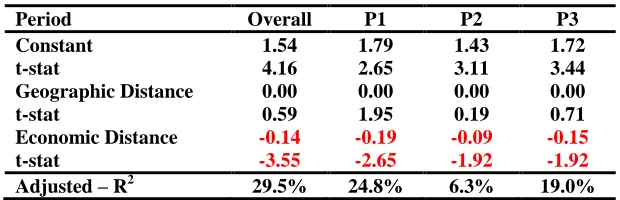
We next regressed the rental growth correlation coefficients against geographical distance and economic distance. The analysis untaken for the overall sample period and for three sub-periods: (P1) The Pre Crisis period (March 2001 to March 2007); (P2) the period of the Global Financial Crisis (June 2007 to December 2010) and (P3) the post Crisis period (March 2011 to June 2015); to see if the results are consistent across various economic regimes. The results presented in Table 2.
Table 2: Regression Results
Period Overall P1 P2 P3
Constant 1.54 1.79 1.43 1.72
t-stat 4.16 2.65 3.11 3.44
Geographic Distance 0.00 0.00 0.00 0.00
t-stat 0.59 1.95 0.19 0.71
Economic Distance -0.14 -0.19 -0.09 -0.15
t-stat -3.55 -2.65 -1.92 -1.92
Adjusted – R2 29.5% 24.8% 6.3% 19.0%
Second, the results in all sub-periods are consistent with those in the overall sample period, i.e. rental growth correlations are significantly negatively related to economic distance but not to geographic distance. In particular, although in the period of the Global Financial Crisis (P2) there was a substantial increase in the office rental growth correlations of the 27 LAs with the City, the results in column 4 of Table 2 indicates that even in this period there was still significant spatial diversification benefits (at the 7% significance level) from spreading investments across the UK; even though all locations were systematically effected by the crisis.
Lastly the relatively low adjusted-R2 values indicate that economic distance is only one element of the correlation between locations, albeit a significant one. This is supportive of the arguments of Liang and McIntosh (1998) and Key et al. (1998) who argue that while employment similarity between locations is important in developing a spatial diversification strategy it does not guarantee that the two markets will always show the same performance. Investors must also consider additional factors that impact on rental growth in a location since job growth converts into demand growth differently in different areas, depending on the local economy and skill base etc., while real estate demand growth translates into rent increases differently depending on availability of developable land and the size and quality of the local office stock etc.
Conclusion
Real estate professionals consistently claim that the most important element in property performance is “location, location, location.” Thus, the desire for some kind of spatial diversity is a fundamental principle in real estate portfolio management with two approaches adopted: the first is based on the simple geographical distance between markets while the second employs the economic attributes between markets. It is not always the case however that the best diversification results come from investing in geographically remote markets. Equally, markets with similar economic functions are not always spatially clustered. Indeed, previous studies have shown that spatial diversification strategies based on economic attributes have achieved better diversification benefits than strategies based on simple geographical distance. A result confirmed in this study.
References
Anderson, J.E. (1979) A Theoretical Foundation for the Gravity Equation, American Economic Review, 69, March, 106-16.
Andrew, M., Devaney, S. and Lee, S. (2003) Another Look at the Relative Importance of Sectors and Regions in Determining Property Returns, working Papers in Real Estate & Planning 14/03, Department of Real Estate & Planning, University of Reading, Reading.
Byrne, P. and Lee, S.L. (2006) Geographical Concentration in the Institutional Market for Office Property in England and Wales, Working Papers in Real Estate and Planning 07/06, Department of Real Estate and Planning, University of Reading, Reading.
Byrne, P. and Lee, S. (2009) Spatial Concentration in Institutional Investment in the UK: Some Comparisons between the Retail and Office Sectors. Journal of Property Investment and Finance, 27, 1, 5-24.
Byrne, P. and Lee, S. (2010) Spatial Concentration in Industrial Real Estate: Institutional Investment in England and Wales. Journal of Property Investment and Finance, 28, 1, 6-23.
Byrne P., Jackson, C. and Lee, S. (2013) Bias or Rationality? The Case of UK Commercial Real Estate Investment, Journal of European Real Estate Research, 6, 1, 6-33
Cullen, I. (1993) Cluster Analysis and Property Risk, in The Cutting Edge: Proceedings of the RICS Property Research Conference, Royal Institution of Chartered Surveyors, London, 21-36.
Goetzmann, W.N. and Wachter, S.M (1995) Clustering Methods for Real Estate Portfolios, Real Estate Economics, 23, 3, 271-310.
Hamelink, F., Hoesli, M., Lizieri, C. and MacGregor, B.D. (2000) Homogeneous Commercial Property Markets Groupings and Portfolio Construction in the United Kingdom, Environment and Planning A, 32, 323-344
Hartzell, D., Hekman, J. and Miles, M. (1986) Diversification Categories in Investment Real Estate, AREUEA Journal, 14, 2, 230-253.
Henneberry, J. and Roberts, C. (2008) Calculated Inequality? Portfolio Benchmarking and Regional Office Property Investment in the UK, Urban Studies, 45, 5&6, 1217-1241.
December.
Henneberry, J. and Rowley, S. (2000) Property Market Processes and Development Outcomes in Cities and Regions, RICS Foundation Research Papers, 3, 9, 1-59.
Hoesli, M., Lizieri, C. and MacGregor, B.D. (1997) The Spatial Dimensions of the Investment Performance of UK Commercial Property, Urban Studies, 34, 9, 1475-1494.
Katzler, S. (2005) Risk Diversification in the Swedish Real Estate Market, Report 5:68, Building and Real Estate Economics, Department of Infrastructure, Royal Institute of Technology (KTH), Stockholm, Sweden.
Keogh, G. and D’Arcy, E. (1994) Market Maturity and Property Market Behaviour: A European Comparison of Mature and Emergent Markets, Journal of Property Research,
11, 215-35.
Key, T., McBurney, D. and Morre, B. (1998) Commercial Investment Property - Towards a Comprehensive Geography, Presented at the Cutting Edge Conference,
Lee, S.L. and Byrne, P.J. (1998) Diversification by Sector, Region or Function? A Mean Absolute Deviation Optimisation, Journal of Property Valuation and Investment, 16, 1, 38-56.
Liang, Y. and McIntosh, W. (1998) Economic Growth and Real Estate Return: Are They Linked? Journal of Real Estate Portfolio Management, 4, 2, 125-133.
McNamara, P. (1999) Finding the Answer to the Property Liquidity Question, Property Week, 14 May, 16
Ren, J and Krasikov, A. (2015) Assessing Diversification Potential in U.S. Commercial Real Estate Markets, Part II, CBRE Americas Investment, October 7, available at
www.cbre.com/researchgateway.
Tobler, W. (1970) A Computer Movie Simulating Urban Growth in the Detroit Region, Economic Geography, 46, 2, 234-240