Differences in utilisation rates between commercial and administrative databases; implications for future health economic and cross national studies
Commentary paper
K. Garuolienė, MA, MD – Faculty of Medicine (Department of Pathology, Forensic Medicine and Pharmacology), Vilnius University, M. K. Čiurlionio g. 21/27, Vilnius, Lithuania, and
Medicines Reimbursement Department, National Health Insurance Fund, 1 Europos, Vilnius, Lithuania. Email: [email protected]. Telephone: + 37052364115, Fax. +37052364111
*B. Godman BSc,PhD - Department of Laboratory Medicine, Division of Clinical Pharmacology, Karolinska Institutet, Karolinska University Hospital Huddinge, SE-141 86, Stockholm, Sweden. Email: [email protected] and Strathclyde Institute for Pharmacy and Biomedical Sciences, Strathclyde University, Glasgow, UK
J. Gulbinovič, MD, PhD – Faculty of Medicine (Department of Pathology, Forensic Medicine and Pharmacology), Vilnius University, Vilnius, Lithuania; State Medicines Control Agency, Vilnius, Lithuania. Email: [email protected].
Krijn Schiffers BSc. - Erasmus University, Rotterdam, The Netherlands. Email: [email protected]
B. Wettermark, MSc Pharm, PhD - Department of Laboratory Medicine, Division of Clinical
Pharmacology, Karolinska Institutet, Karolinska University Hospital Huddinge, SE-141 86, Stockholm, Sweden and Centre for Pharmacoepidemiology, Karolinska Institute, Karolinska University Hospital Solna, Stockholm, Sweden. Email: [email protected]
*Author for correspondence
B Godman BSc,PhD - Department of Laboratory Medicine, Division of Clinical Pharmacology,
Karolinska Institutet, Karolinska University Hospital Huddinge, SE-141 86, Stockholm, Sweden. Email: [email protected]; tel: 0046858581068; fax: 0046858581070
(Accepted for publication in Expert Review of Pharmacoeconomics and Outcomes Research. Please keep CONFIDENTIAL).
Key words
Lithuania, administrative databases, commercial databases, drug utilisation studies, health
economics, health policy, budget impact analysis, statins, PPIs, antidepressants, renin-angiotensin inhibitors
Abstract
Introduction. Comparative cross national (CNC) drug utilization studies are challenging. However, there can be concerns with the accuracy and robustness of the data collected with previous studies showing differences in utilisation rates between different databases. In addition, if utilisation rates vary appreciably between countries with no logical explanation. These studies have been carried out for the same class across countries. This has now been extended to compare utilisation rates between different databases among four high volume classes among administrative and commercial
databases in one country (Lithuania) between 2004 and 2012 alongside health policies. Results: There were appreciable differences in the utilisation of PPIs (5 to 7 fold) and statins (2 to 6 fold) between the different databases with limited differences for the other two classes. This could be explained by restricted reimbursement for the PPIs and statins, with similar utilisation of
renin-angiotensin inhibitors in Lithuania between the databases and with Western European countries in the absence of prescribing restrictions. Low utilisation of anti-depressants in Lithuania versus Western European countries also explained by ongoing policies. Conclusion: Essential to always record the database content in CNC studies alongside health policies otherwise the findings could be
National and cross national comparative (CNC) drug utilization studies provide valuable information to policy makers to plan future measures to further enhance the quality and efficiency of their prescribing (1-5). Data sources for drug utilisation (DU) studies include administrative databases, patient
registries, electronic health records and commercial databases (2, 6). However, CNC studies can be challenging as there can be differences in the data collected, e.g. whether dealing with reimbursed or total medicine utilisation, including also over-the-counter medicines, whether including all sectors or just inpatient or ambulatory care sectors and whether using similar units to measure and contrast utilisation and expenditure data. In addition, whether dealing with aggregated sales data or patient level data (2).
There can also be concerns with the validity, reliability and robustness of the data. Concerns and issues relate firstly to structure of the databases used, i.e. the population included in the database. Is the data collected confined to a particular region or socio- demographic group that can make
comparisons difficult. Secondly, whether there are factors that can appreciably affect utilization patterns which have not been discussed casting doubts on the figures (6, 7). For instance,
atorvastatin was removed from the reimbursement list in Germany once generic simvastatin became available and patented angiotensin receptor blockers (ARBs) were removed from the reimbursement list in Denmark once generic losartan became available (8, 9). Both initiatives had a profound impact, e.g. utilization of patented atorvastatin fell to just 2% of overall statin utilization following this measure in Germany and losartan subsequently accounted for 93% of total ARB utilization in Denmark (8, 9).
Different European countries have also introduced prescribing restrictions affecting subsequent utilization. Patented statins were restricted to second line in Norway and Finland, limiting their utilization in Finland to just 18.3% of total statin utilization, ARBs were restricted to second line after angiotensin converting enzyme inhibitors (ACEIs) in a number of European countries limiting their utilization and more recently patented ARBs were restricted to second line versus generics in Austria and Belgium following generic availability again significantly reducing their use (10-14).
Prescribing restrictions and high co-payments for statins in Lithuania limited their reimbursed utilisation in 2007 to just 0.8 DIDs (Defined daily doses per 1000 inhabitants per day) versus for instance 114.7 in Scotland with no such restrictions (6), despite the prevalence of coronary vascular disease higher in Lithuania than among Western European countries (15). Prescribing restrictions and high co-payments also limited the reimbursed utilisation of proton pump inhibitors (PPIs) in Lithuania in 2007 to just 2.3 DIDs in 2007 compared with for instance 76.9 in Scotland with no such restrictions (6). Other authors have also shown that co-payments can appreciably affect subsequent utilization patterns (16-18).
Thirdly, how often the data is checked for accuracy and reliability, i.e. robustness. Fourthly, how representational is the data for the population under consideration especially if a sample is being used and scaled up. These differences in data sources and regulations can lead to appreciable differences in utilisation rates in practice, e.g. differences up to 55% were seen in a pan-European study
analysing statin utilisation rates between commercial and administrative databases (19).
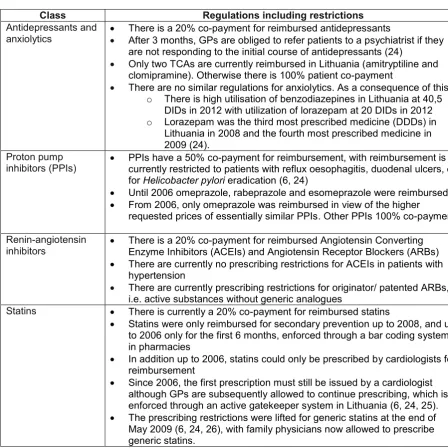
Table 1 – Prescribing regulations and restrictions across a number of classes in Lithuania
Class Regulations including restrictions
Antidepressants and
anxiolytics There is a 20% co-payment for reimbursed antidepressants After 3 months, GPs are obliged to refer patients to a psychiatrist if they are not responding to the initial course of antidepressants (24)
Only two TCAs are currently reimbursed in Lithuania (amitryptiline and clomipramine). Otherwise there is 100% patient co-payment
There are no similar regulations for anxiolytics. As a consequence of this: o There is high utilisation of benzodiazepines in Lithuania at 40,5
DIDs in 2012 with utilization of lorazepam at 20 DIDs in 2012 o Lorazepam was the third most prescribed medicine (DDDs) in
Lithuania in 2008 and the fourth most prescribed medicine in 2009 (24).
Proton pump
inhibitors (PPIs) PPIs have a 50% co-payment for reimbursement, with reimbursement is currently restricted to patients with reflux oesophagitis, duodenal ulcers, or for Helicobacter pylori eradication (6, 24)
Until 2006 omeprazole, rabeprazole and esomeprazole were reimbursed. From 2006, only omeprazole was reimbursed in view of the higher
requested prices of essentially similar PPIs. Other PPIs 100% co-payment
Renin-angiotensin
inhibitors There is a 20% co-payment for reimbursed Angiotensin Converting Enzyme Inhibitors (ACEIs) and Angiotensin Receptor Blockers (ARBs) There are currently no prescribing restrictions for ACEIs in patients with
hypertension
There are currently prescribing restrictions for originator/ patented ARBs, i.e. active substances without generic analogues
Statins There is currently a 20% co-payment for reimbursed statins
Statins were only reimbursed for secondary prevention up to 2008, and up to 2006 only for the first 6 months, enforced through a bar coding system in pharmacies
In addition up to 2006, statins could only be prescribed by cardiologists for reimbursement
Since 2006, the first prescription must still be issued by a cardiologist although GPs are subsequently allowed to continue prescribing, which is enforced through an active gatekeeper system in Lithuania (6, 24, 25). The prescribing restrictions were lifted for generic statins at the end of
May 2009 (6, 24, 26), with family physicians now allowed to prescribe generic statins.
NB: DDDs = Defined daily doses; DIDs = DDDs per one thousand inhabitants per day; TCAs = Tricyclic antidepressants
Methods
Four drug classes were chosen for comparisons between available databases in Lithuania. These were the PPIs, statins, renin-angiotensin inhibitor medicines, i.e. ACEIs and ARBs, as well as
selective serotonin reuptake inhibitors (SSRIs) and newer antidepressants – venlafaxine, mirtazapine, reboxetine and duloxetine. IMS Baltic provided the IMS data, with all figures converted to DIDs for comparison.
Results PPIs
Table 2 – Utilisation of PPIs 2004 to 2012 among administrative (NHIF) and IMS databases in DIDs
Year/ database 2004 2005 2006 2007 2008 2009 2010 2011 2012
IMS (Total) 4.9 7.0 10.4 13.8 18.7 17.6 17.9 20,0 21.2
NHIF reimbursed 0.7 1.4 2.0 2.3 2.9 2.8 2.9 2.9 3.0
% reimbursed vs. IMS 14.5 19.6 19.0 16.5 15.6 15.9 16.3 14.8 14.3
There was a 5 to 7 fold difference (Table 2) between the utilisation of PPIs documented in IMS (commercial) versus NHIF (administrative) database, with utilisation in the NHIF database varying between 14.3 to 19.6% of IMS figures.
Statins
Statin utilisation increased by just over 5 fold from 2.4 DIDs in 2004 to 12.9 DIDs in 2012 in the IMS database, with a greater rate of increase in the NHIF database (Table 3).
Table 3 – Utilisation of statins 2004 to 2012 among administrative (NHIF) and IMS databases in DIDs
Year/ database 2004 2005 2006 2007 2008 2009 2010 2011 2012
IMS total 2.4 2.3 3.1 4.5 7.1 7.7 8.3 10.6 12.9
NHIF reimbursed 0.6 0.6 0.7 0.8 1.1 1.8 3.5 5.3 7.3
% of NHIF database vs.
IMS 23.2 27.4 21.3 17.5 15.1 23.5 42.2 50.2 56.8
Utilisation patterns for the statins were similar between those documented in the Soft Dent database (another commercial database for recording drug utilisation patters in Lithuania) between 2005 and 2007 and the data from IMS (Table 3) at 2.7 to 4.4 DIDs (27).
Utilisation patterns in the NHIF (administrative) database were again lower compared with IMS database findings. Overall, utilisation of statins in the NHIF database ranged between 15.1% to 56.8% of total IMS utilisation during the study period, with differences reducing once prescribing restrictions were lifted for generic statins (May 2009 onwards).
ACEIs and ARBs
Total utilisation of single ACEIs and ARBs in both database grew steadily during the study period (Table 4) with utilisation similar between the databases with reimbursed utilisation rates varying between 75.6% to 89.5% of total IMS utilisation (Table 4) between 2004 and 2012.
Table 4 – Utilisation of single ACEIs and ARBs 2004 to 2012 among administrative (NHIF) and IMS databases in DIDs
Year/ database 2004 2005 2006 2007 2008 2009 2010 2011 2012 IMS total 99.7 100.8 117.3 131.4 147.5 147.3 150,8 152,2 155,3
NHIF reimbursed 75.4 83.6 97.2 111.3 128.2 131.8 134.2 130.8 131.5
% of reimbursed vs. IMS 75.6 83.0 82.9 84.7 86.9 89.5 89.0 86.0 84.6
Selected antidepressants
The utilisation of selected antidepressants grew steadily in both databases (Table 5), with limited differences between them, i.e. reimbursed utilisation (NHIF) rates varying between 70.7% to 88.7% of IMS utilisation (Table 5).
Table 5 – Utilisation of selected antidepressants 2004 to 2012 among administrative (NHIF) and IMS databases in DIDs
Year/ database 2004 2005 2006 2007 2008 2009 2010 2011 2012
IMS total 7.7 8.1 10.0 11.7 13.4 13.7 16.3 18.2 19.2
NHIF reimbursed 5.4 6.5 7.9 8.9 11.0 12.1 14.5 15.3 16.3 % of reimbursed vs.
IMS 70.7 79.9 78.8 75.5 82.7 88.4 88.7 83.8 83.5
Discussion
There can be appreciable differences between utilisation rates in IMS (total) versus reimbursed databases in Lithuania; however, this is not always the case (Tables 2 to 5). Where these occur, e.g. for the PPIs and statins, these can be explained by the specific policies in Lithuania (Table 1).
Interestingly, the differences seen for the statins between the various databases (Table 3) were much greater than seen in previous studies across Europe (1, 19), which shows the value of additional research. Not surprisingly, there was convergence in utilisation rates between the databases once the reimbursement restrictions were lifted for the statins (Tables 1 and 2) in view of the prevalence of CHD in Lithuania (15).
The lack of any major difference in the utilisation of the renin-angiotensin inhibitors between the different databases with no prescribing restrictions in Lithuania (Tables 1 and 4), and similar utilisation patterns to Western European countries in 2007 (10, 26), further demonstrates that prescribing restrictions can appreciably influence subsequent utilisation rates (21, 28). As a result, demonstrating the need to accurately document ongoing reforms in any CNC study. The increase in statin utilisation following the removal of prescribing restrictions (Table 3) further supports this.
Similar utilisation rates for antidepressants in Lithuania between the databases is not unexpected (Table 5). However, the lower utilization at 10.45 DIDs in 2007 in Lithuania versus 40.0 in Austria, 49.4 in Portugal, 61.9 in Scotland, 59.5 in Spain (Catalonia) and 57.3 in Sweden [BBG unpublished data] can potentially be explained by general practitioners being required to transfer patients to a psychiatrist if there is no clinical improvement, which is still associated with a stigma by some (Table 1) (24, 29). This appears to be compensated by high use of benzodiazepines in Lithuania (Table 1), endorsing the findings of currently low utilisation rates for antidepressants in Lithuania especially since there is also limited utilisation of tricyclic antidepressants at approximately 11% of total reimbursed prescriptions for depression in Lithuania during recent years (KG – unpublished data).
These combined findings means it is essential for researchers to always accurately record the content of each database, as well as any concomitant health policies and other activities that may influence utilisation patterns. Otherwise, there could be suspicion with findings that show considerably lower utilisation rates in one database compared with another as well as one country versus another.
These findings also have implications for conducting and analysing budget impact analyses and cost-effectiveness analyses, where for instance the database used could make a substantial difference to any budget impact calculations. This is a key learning point for researchers and others when
undertaking single and CNC drug utilisation studies.
In conclusion, these findings demonstrate it is essential for drug utilisation and other researchers to always fully document health policy initiatives alongside the content of each database to enhance the interpretation of their findings and their implications. Otherwise, there may be a tendency for
considerable differences in budget impact calculations depending which database is used, as well as potentially cost-effectiveness analyses, necessitating again the need for drug utilisation researchers to accurately record the database characteristics used in any analysis.
Consequently, we believe this joint reporting should become standard for all future CNC drug
utilisation studies. As a result, increasing the need for drug utilisation researchers and health authority personnel to work closely together in the future.
Acknowledgments
We thank IMS Baltic for providing their data for the four classes.
This work was in part supported by grants from the Karolinska Institutet, Sweden. There was no writing assistance with the paper.
References
1. Walley T, Folino-Gallo P, Stephens P, Van Ganse E. Trends in prescribing and utilization of statins and
other lipid lowering drugs across Europe 1997-2003. British journal of clinical pharmacology. 2005;60(5):543-51.
2. Wettermark B. The intriguing future of pharmacoepidemiology. European journal of clinical
pharmacology. 2013;69 Suppl 1:43-51.
3. Godman B, Wettermark B, van Woerkom M, Fraeyman J, Alvarez-Madrazo S, Berg C, et al. Multiple
policies to enhance prescribing efficiency for established medicines in Europe with a particular focus on demand-side measures: findings and future implications. Frontiers in pharmacology. 2014;5:106.
4. Bachhav SS, Kshirsagar NA. Systematic review of drug utilization studies & the use of the drug classification system in the WHO-SEARO Region. The Indian journal of medical research. 2015;142(2):120-9.
5. Yoo KB, Lee SG, Park S, Kim TH, Ahn J, Cho MH, et al. Effects of drug price reduction and prescribing
restrictions on expenditures and utilisation of antihypertensive drugs in Korea. BMJ open. 2015;5(7):e006940.
6. Godman B, Shrank W, Andersen M, Berg C, Bishop I, Burkhardt T, et al. Policies to enhance prescribing
efficiency in europe: findings and future implications. Frontiers in pharmacology. 2010;1:141.
7. Latry P, Molimard M, Begaud B, Martin-Latry K. How reimbursement databases can be used to support
drug utilisation studies: example using the main French national health insurance system database. European journal of clinical pharmacology. 2010;66(7):743-8.
8. Godman B, Schwabe U, Selke G, Wettermark B. Update of recent reforms in Germany to enhance the
quality and efficiency of prescribing of proton pump inhibitors and lipid-lowering drugs. PharmacoEconomics. 2009;27(5):435-8.
9. Hesse U, Godman B, Petzold M, Martin A, Malmstrom RE. Impact of delisting ARBs, apart from
losartan, on ARB utilisation patterns in Denmark: implications for other countries. Applied health economics and health policy. 2013;11(6):677-85.
10. Voncina L, Strizrep T, Godman B, Bennie M, Bishop I, Campbell S, et al. Influence of demand-side
measures to enhance renin-angiotensin prescribing efficiency in Europe: implications for the future. Expert review of pharmacoeconomics & outcomes research. 2011;11(4):469-79.
11. Sakshaug S, Furu K, Karlstad O, Ronning M, Skurtveit S. Switching statins in Norway after new
reimbursement policy: a nationwide prescription study. British journal of clinical pharmacology. 2007;64(4):476-81.
12. Martikainen JE, Saastamoinen LK, Korhonen MJ, Enlund H, Helin-Salmivaara A. Impact of restricted
reimbursement on the use of statins in Finland: a register-based study. Medical care. 2010;48(9):761-6.
13. Bucsics A, Godman B, Burkhardt T, Schmitzer M, Malmstrom RE. Influence of lifting prescribing
restrictions for losartan on subsequent sartan utilization patterns in Austria: implications for other countries. Expert review of pharmacoeconomics & outcomes research. 2012;12(6):809-19.
14. Markovic-Pekovic V, Skrbic R, Godman B, Gustafsson LL. Ongoing initiatives in the Republic of Srpska
to enhance prescribing efficiency: influence and future directions. Expert review of pharmacoeconomics & outcomes research. 2012;12(5):661-71.
15. Tamosiunas A, Luksiene D, Baceviciene M, Bernotiene G, Radisauskas R, Malinauskiene V, et al.
Health factors and risk of all-cause, cardiovascular, and coronary heart disease mortality: findings from the MONICA and HAPIEE studies in Lithuania. PloS one. 2014;9(12):e114283.
16. Simoens S, Sinnaeve PR. Patient co-payment and adherence to statins: a review and case studies.
Cardiovascular drugs and therapy / sponsored by the International Society of Cardiovascular Pharmacotherapy. 2014;28(1):99-109.
17. Wladysiuk M, Araszkiewicz A, Godman B, Szabert K, Barbui C, Haycox A. Influence of patient
co-payments on atypical antipsychotic choice in Poland: implications once generic atypicals are available. Applied health economics and health policy. 2011;9(2):101-10.
18. Hynd A, Roughead EE, Preen DB, Glover J, Bulsara M, Semmens J. The impact of co-payment
19. Walley T, Folino-Gallo P, Schwabe U, Van Ganse E, Stephens P. Comparison of national administrative and commercial databases to monitor expenditure and costs of statins across Europe. European journal of clinical pharmacology. 2004;60(7):503-11.
20. Bajcetic M, Kalaba M, Godman B, Sipetic T et al. Ongoing programmes to reduce the high rate of
antibiotic consumption in Serbia; current situation and future direction. Pharmacoepidemiology and drug safety. 2012;21 (Suppl 3):98.
21. Moon J, Godman B, Petzold M, Alvarez-Madrazo S, Bennett K, Bishop I, Bucsics A, Hesse U, Martin A,
Simoens S, Zara C, Malmstrom RE. Different initiatives across Europe to enhance losartan utilisation post generics: impact and implications Frontiers in pharmacology. 2014;5(Article 219):1-10.
22. Godman B, Persson M, Miranda J, Skiold P, Wettermark B, Barbui C, et al. Changes in the utilization of
venlafaxine after the introduction of generics in Sweden. Applied health economics and health policy. 2013;11(4):383-93.
23. Godman B, Bishop I, Finlayson AE, Campbell S, Kwon HY, Bennie M. Reforms and initiatives in
Scotland in recent years to encourage the prescribing of generic drugs, their influence and implications for other countries. Expert review of pharmacoeconomics & outcomes research. 2013;13(4):469-82.
24. Garuoliene K, Godman B, Gulbinovic J, Wettermark B, Haycox A. European countries with small
populations can obtain low prices for drugs: Lithuania as a case history. Expert review of pharmacoeconomics & outcomes research. 2011;11(3):343-9.
25. Garuoliene K, Alonderis T, Marcinkevic˘ius M. Pharmaceutical policy and the effects of the economic
crisis: Lithuania. EuroHealth. 2011;17:1-4.
26. Godman B, Acurcio F, Guerra Júnior AA, Alvarez-Madrazo S , Faridah Aryani MY, Bishop I et al.
Initiatives among Authorities to Improve the Quality and Efficiency of Prescribing and the Implications. Jn Pharma Care Health Sys. 2014;1(3):15.
27. Kadusevicius E, Jankauskiene D, Paulauskaite I, Slapikas R. Policy implications of rationalization of statin use in Lithuania. International journal of technology assessment in health care. 2009;25(3):419-24.
28. Godman B, Malmstrom R, Bennie M, Sakshaug S, Burkhardt T, Campbell S, Garuoliene K, Lonsdale J
et al. Prescribing restrictions - a necessary strategy among some European countries to enhance future prescribing efficiency?'. Reviews in Health Care. 2012;3(1):5-16.