Social labour: exploring work in consumption
Abstract
This paper develops understanding of consumer work at the primary level of sociality in the context of social networking sites. Drawing on ethnographic interviews and netnography, we reveal these sites as distinctive spaces of consumer-to-consumer work.
To explain this work in consumption, we introduce the concept of social labour which we define as the means by which consumers add value to their identities and social
relationships through producing and sharing cultural and affective content. This is driven by observational vigilance and conspicuous presence, and is rewarded by social
value. This draws attention to the variety of work consumers enact within their social lives, indicating that consumer work is broader than previously acknowledged.
Key Words
Social labour: exploring work in consumption
Introduction
Social media and web 2.0 have created the ‘prosumptive internet’ (Ritzer and
Jurgenson, 2010) by facilitating consumer connections, communications and co-creations of brand meanings and messages. In his recent reconceptualisation of prosumption, Ritzer (2013) highlights the interrelatedness of production and
consumption and argues that, although not a new concept, it has become more visible with technological advances. Current literature surrounding social media has broadly
focused on two bodies of marketing theory: the community aspect of social networking sites (e.g. Cova and Pace, 2006), and consumer co-creation (e.g. Fisher and Smith, 2011). The value and content created from consumer-to-consumer interactions has
prompted marketing theory to characterise consumers as producers, prosumers and co-creators (John, 2012; Ritzer and Jurgenson, 2010). In critique of this terminological
diaspora, Cova and Dalli (2009) draw upon post-Marxian theory to conceptualise this new consumer role as the working consumer, describing consumers who engage in immaterial labour that creates value to market offerings. Cova and Dalli (2009)
highlight consumers work at the primary level of sociality (interpersonal level) where symbolic, knowledge and emotional value is exchanged. Value can then be transferred
companies. Gerlitz and Helmond (2013) regard this transition from primary social activity to secondary market activity as the Like economy, whereby through the use of
like and share buttons, users’ interactions are transformed into numerical data that has economic value to outsider companies as indicators of engagement and traffic. Existent research prioritises the impact of consumers’ immaterial labour for companies that
extract value from consumers (Andrejevic, 2010; Fuchs, 2010; Cova and Dalli, 2009). Less research considers the consumer perspective and to redress this imbalance, this
paper aims to develop a richer understanding of consumer work at the primary level of sociality. The context of this study is social networking sites (specifically Facebook)
which we see as spaces of consumer-to-consumer work.
The contribution of this paper is to introduce the concept of social labour to add theoretical depth to the understanding of the working consumer. We define social
labour as the means by which consumers add value to their identities and social
relationships through producing and sharing cultural and affective content. This is
driven by observational vigilance and conspicuous presence, and is rewarded by social
value. This draws attention to the variety of work consumers enact within their social
lives and we demonstrate that consumer work can be waged through the exchange of
social value, visible in acts of social reciprocity.
We will begin with a theoretical examination of the various post-Marxian
digital). We then briefly outline the consumption of social networking sites as the context of our study before presenting the methodology. Our findings are presented
around three key themes: Value Production, Drivers of Social Labour and Social Value as Payment. Finally, we conclude with our conceptualisation of social labour and
directions for future research.
Theorising contemporary labour
Definitions of work and labour and the distinction between them remain somewhat contested. Weeks (2011) uses work and labour interchangeably and in contrast, Arendt
(1958) makes a clear distinction between the two terms; she views labour as essential to survival and work as more focused on satisfying wants. In this paper we follow the distinction offered by Fuchs (2014) in his work on digital labour and transfer Marxian
terms to the cultural spheres of social networking sites. Labour is associated with exchange-value and is “a necessarily alienated form of work, in which humans do not
control and own the means and results of production.” In contrast, work is associated with use-value and “is a process, in which humans make use of technologies for transforming nature and society in such a way that goods and services are created that
satisfy human needs” (Fuchs, 2014: p. 26-27). Marx has often been critiqued for economic reductionism but as Desan (2013) has argued, Marx’s concept of capital is
production. According to Desan (2013), Marx’s concept of capital is doubly social as it entails a social relation of exploitation and also relies upon the totality of social
relations to make it possible. This stands in contrast to Bourdieu’s fetishization of capital as a thing, as an exploitable object and not as a social relation of exploitation (Desan, 2013). For this reason, it is valuable to return to Marx in developing an
understanding of the productive work that goes on in social networking sites.
The changing nature of contemporary production and consumption has increased the
prominence of instable, fluid and intangible work activity (Wood and Ball, 2013). The notion of immaterial labour was developed to account for the increasing intangibility of service sector work where communication, information networks and knowledge are the
main outputs of production (Hardt and Negri, 2000; Lazzarato, 1996). In their seminal piece Empire, Hardt and Negri (2000) claimed immaterial labour can produce two types
of performed work; cultural content which acknowledges the production of consumer tastes, social norms and aesthetic values, and affective content whereby individuals can work at the emotional level, altering their feelings and affective appearance. As such,
immaterial labour uses intangible skills that are considered inseparable from the worker.
The notion of emotional labour developed by Hochschild (1983) accounts for the
commodification of worker’s emotions for the benefit of the organisation. In critique of Hochschild’s conceptualisation, Brook (2009) draws a distinction between emotional
‘emotion work’ or ‘emotion management’ as they have use-value, whereas emotional labour involves exchange-value as employees’ feelings go through transmutation where
the public self is commodified by paying workers to display emotion.
Witz et al. (2003) expand the notion of emotional labour by introducing the concept of
aesthetic labour to account for organisations increasing tendency to commodify
worker’s corporal appearance to fit a particular image. Witz et al. (2003) distinguish aesthetic labour from emotional labour on the basis that the prior is animate and
embodied. Similar to emotional labour, organisations are seen as moulding workers’ aesthetic qualities or ‘styles of the flesh’ (Butler, 1990) for the benefit of the
organisation and to appeal to customers (Warhurst et al., 2000).
In capturing both emotional and aesthetic labour Sheane (2011) introduced the concept of presentational labour which suggests employees must assert emotional and aesthetic
literacy in order to be a service specialist. Presentational labour is viewed as an acquirable skill that employees perform. Grounded in Goffman’s (1959) work on
self-presentation, presentational labour is an acquirable skill that employees perform using emotional and aesthetic communicative skills to present the social attributes that are
approved by organisations.
benefits ICT corporations and has negative impacts on the lives, bodies or minds of workers.” Similarly, Briziarelli (2014) suggests that digital labour accounts for new
technology media workers that are waged in the ICT industry. King (2010) highlights the discourse of creativity that surrounds digital labour as an expressive form of labour. This calls to mind Thrift’s assessment of capitalism as not simply “dead labour haunting
the living” but having “a kind of unholy vitality, a kind of double duty, to possess but also to create, to accumulate but also to overflow, to organize but also to improvise”
(Thrift, 2005, p.17). This “double duty” is evident within the context of social media and is linked to “playbour” where online digital activity is considered a form of labour (Lund, 2014: p. 735). For Lund (2014), there is a fine line between play and work in the
digital environment as it may involve an element of fun as well as the creation of use-value. For example, fan created content is strongly linked to play but is considered to be
more “profitable for producers” than for fans (Milner, 2009: p. 506). However, Banks and Humphreys (2008, p. 413) question whether user production is “an example of a new articulation of a cooperative and non-zero sum game whereby different motivations
and value regimes co-exist?”
Despite these advances in literature, Wood and Ball (2013: p. 54) continue to critique
consumption we consider it useful to focus upon consumer-to-consumer interaction and in doing so, we extend previous work on digital labour beyond the ICT industry. It is
important to better understand such interactions as they are increasingly used to extract market value. As Banks and Humphreys (2008) suggest, there is a dynamic interrelationship between social networks and market-based enterprise. Indeed, “Rather
than non-market, these [social networks] formations can be seen as emerging markets consisting of new collectives that do not fit comfortably with our current understandings
of work and labour relations” (Banks and Humphreys, 2008: p. 406). In the following section we consider consumer activity on social networking sites as the context of our
study.
Social networking sites and consumer labour
To date, there are 1.4 billion global Facebook users with U.S users spending on average 37 minutes each day on the site (Adler, 2014). Importantly, such sites rely upon a
continual feed of consumer created content and they have established a set of social norms that encourage sharing between users. Consumers are motivated to participate within social networking sites for entertainment, escapism, and as a vehicle for
Many authors analysing social networking sites draw upon labour theory in focusing upon distinct features of the labour process such as alienation (Rey, 2012) and
exploitation (Andrejevic, 2010; Fuchs, 2010). Fuchs and Sevignani (2013) also introduce the concept of digital work which they ground in cognitive, communicative and cooperative processes to create use-value. Fundamentally these distinct perspectives
acknowledge productivity has become embedded within everyday sociality (Rey, 2012) as organisations can capitalise upon consumer-generated content as they take ownership
over cultural value (Andrejevic, 2010). For Andrejevic (2010, p. 92), the promotional material for social networking sites is reminiscent of Marxist themes to “overcome
alienation, revitalize community, and empower citizen-consumers.”
For Terranova (2000: p. 36) these trends resemble a social factory where “work processes have shifted from the workshop to society, thereby setting in motion a truly
complex machine”. This has been conceptualised by Illouz (2007) as emotional capitalism, where the rationalisation and masculinisation of work life has caused relationships to be evaluated by economic means. The visibility of the internet
facilitates self-branding whereby the online representation of the self becomes disembodied, displayed and subsequently sold to the audience (Illouz, 2007; Shepherd,
introduce the notion of lateral surveillance or “the work of watching one another” while Trottier and Lyon (2012) speak of social surveillance whereby users invisibly watch,
measure and search other users’ movements online. Owen and Imre (2013) extend this notion to the micro-level, and question if individuals are becoming self-surveilled by using geo-location applications. The normalisation of such sharing within social
networking sites has made it commonplace to relinquish control over personal information (Dubrofsky, 2011).
In an examination of the role neoliberal ideology has in producing digital labour in social media contexts, Brizarelli (2014) suggests digital labour always contains a dialectic between commodification and emancipation, estrangement and reconnection,
coercion and consent. Similarly, Fuchs and Sevignani (2013: p. 257) make a similar point and suggest that social networking sites such as Facebook exercise “a social form
of coercion that threatens the user with isolation and social disadvantages.” The intrusion of digital intermediaries into social relations alienates users from the means of socialisation in the sense that they become reliant on platforms such as Facebook to
store data related to our social lives (Andrejevic, 2010). Brizarelli (2014: p. 20) terms the productive activity enacted in social media as a form of “social working” that is
users’ own needs (Fuchs and Sevignani, 2013: p. 260). Facebook usage is therefore argued to be both work and labour at the same time as it creates use-values for
individual users alongside commercial exchange-value (Fuchs and Sevignani, 2013). In this paper, we acknowledge the “double character” of Facebook but focus on the primary level of sociality and consider the need to go beyond the digital in
conceptualising consumers’ work and labour through evidencing its broader social dimension.
Methodology
We address the following research questions: At the primary sociality level what types
of work do consumers enact? What are the drivers of social labour within social networking sites? What rewards do consumers gain from this work?
Our findings are based on ethnographic interviews and netnographic observations of 15 participant’s social networking sites. This dual approach offers understanding of how
consumers behave on multiple consumption sites (Fisher and Smith, 2011). Sampling was based upon the first author’s extended social network due to the importance of personal community to social networking sites. This approach, coupled with snowball
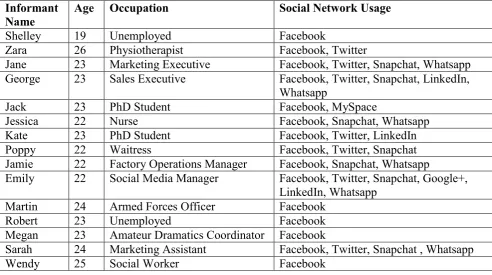
Informants were aged between 19-26 and all had experience of using multiple types of social networks (see Table 1). This demographic was selected as they are amongst the
heaviest users of social network sites (Ellison et al., 2011). The use of friends as informants was particularly relevant to the social networking context of the research as it reduced the power distance between the researcher and informant. This empowered
the informant (Tilman-Healy, 2003) as the researcher is perceived as an equal, allowing for a more open discussion to take place. Participants were added to the first author’s
[image:12.595.80.573.410.685.2]social network in order to gain visual access to participants’ Facebook pages.
Table 1: Participant Details
Informant
Name Age Occupation Social Network Usage
Shelley 19 Unemployed Facebook
Zara 26 Physiotherapist Facebook, Twitter
Jane 23 Marketing Executive Facebook, Twitter, Snapchat, Whatsapp George 23 Sales Executive Facebook, Twitter, Snapchat, LinkedIn,
Jack 23 PhD Student Facebook, MySpace
Jessica 22 Nurse Facebook, Snapchat, Whatsapp
Kate 23 PhD Student Facebook, Twitter, LinkedIn
Poppy 22 Waitress Facebook, Twitter, Snapchat
Jamie 22 Factory Operations Manager Facebook, Snapchat, Whatsapp
Emily 22 Social Media Manager Facebook, Twitter, Snapchat, Google+, LinkedIn, Whatsapp
Martin 24 Armed Forces Officer Facebook
Robert 23 Unemployed Facebook
Megan 23 Amateur Dramatics Coordinator Facebook
Sarah 24 Marketing Assistant Facebook, Twitter, Snapchat , Whatsapp
Ethnographic interviewing seeks to gain richer understanding of consumers’ experiences by locating the interview process within the consumption context (Sharman
Heyl, 2008; Holt, 1997) by the means of a friendly conversation (Spradley, 1979). This technique allows the emic-etic discourse from both researcher and participant to surface which permits the researcher to probe emic terms to gain a better understanding of the
meanings created by the participant and to avoid incorrect etic assumptions. As social networking sites can be consumed anywhere with internet access, the interviews were
conducted in participants’ homes, public places, restaurants and cafes.
All interviews were audio-recorded, generating over 162 pages of transcript data. During the interviews, informants were asked to display and discuss their own social
media pages using a laptop computer, tablet or smartphone device. Following Heisley and Levy’s (1991) account of ‘autodriving’ these pages were used as an elicitation
method and projective technique to stimulate underlying responses and help participants convey richer meaning.
Netnographic observations of informants’ personal pages allowed the researchers to become immersed within the virtual context of study (Kozinets, 2002). It also provided a deeper understanding of broader consumption patterns and social practices as the
researchers shift gaze between micro-practices of consumers and macro cultural patterns that form social trends (Soukup, 2012). Our netnography was conducted both prior to
observations made on each participant. Specifically, data was collected regarding shared comments, status updates, photographs and interactions. This generated over 123 pages
of screenshot data from informants’ pages and, following Kozinets (2002), researcher reflective field notes to aid contextualisation.
All participants received pseudonyms to ensure anonymity. Informed consent was
established to use excerpts of participants’ user profiles. Ethical consideration was also
given to the ‘friends’ of participants whose posts may be visible. To ensure anonymity
and privacy, no data was collected from non-participants, and any references to other
people made within the interviews were pseudo-anonymised.
A combination of interview text and netnographic data allowed the researchers to understand the complexity of these social spaces. As advocated by Fisher and Smith (2011), the data was analysed by conducting an active comparison between the
interview texts and netnographic observations, allowing the researchers to draw comparisons between behaviour and narrative. This is particularly useful for analysing
the similarities and differences between virtual behaviour and reported life experience, whereby disparities between interviews were directly contrasted with the informants’ online behaviour. This added to the texture of the analysis which was aided by iterative
performing member checks and asking key informants to read and validate our interpretation (Wallendorf and Belk, 1989).
Findings
In this section we explore the proposed concept of social labour which we define as the
means by which consumers add value to their identities and social relationships
through producing and sharing cultural and affective content. This is driven by
observational vigilance and conspicuous presence, and is rewarded by social value.
Our findings begin by exploring the types of work participants undertake, followed by an examination of the drivers of social networking participation, and finally an analysis
of the value exchange system is discussed.
Value production: producing, sharing and adding value
Consumers’ engagement with social media technology has evolved from a novel
practice to a facet of everyday life. Our interpretation of the netnography highlighted the scope of content participants share and produce. Firstly, participants produce and share
notifications. Secondly, participants contribute to cultural trends, such as sharing trending media or producing popular imagery through memes or ‘selfies’. This extends
Hardt and Negri’s (2000) two forms of performed work into the consumption domain; affective content acknowledges workers’ use of feelings and emotions, whereas cultural
content acknowledges that workers produce consumer tastes, social norms and aesthetic
values. We interpret these activities as an example of consumer work, undertaken to fulfil participants’ social needs.
Affective content. Affective content was most visible in emotional comments and sentimental pictures. These postings were often directed to another user and therefore can be understood as a form of emotional gift. This is demonstrated by Wendy, a
25-year-old social worker, who viewed affective posts as equal to physical gifts: “it’s like sending a card in the mail like when you get it, it means something”. Some participants
discussed this kind of activity as enjoyable, for example, Jessica states that “Facebook is a bit more fun [in comparison to other social media sites]. I like it because I can
Facebook Jen, “Oh here is a song on Youtube to get you through the studying.” It can
kind of cheer you up.” Similar to Wendy, Poppy posted affective messages on Facebook
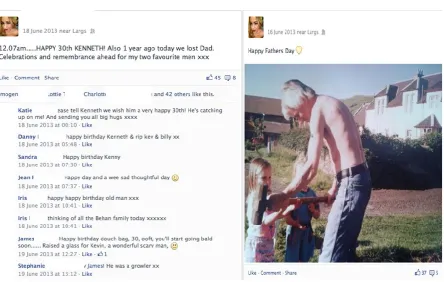
as a symbolic gift to the memory of her recently deceased father. Other examples
include a father’s day message and accompanying photo (see Figure 1)
Poppy: [L]ast week it was my brother’s birthday and it was also the anniversary
just trying to give it the attention that it kind of deserved. […] I was more
posting these things to get support almost for him. That was my main reason for
posting things – to show people that we were actually celebrating the memory of
[image:17.595.97.542.252.534.2]a life.
Figure 1: Exerts from Poppy’s Facebook page
For Poppy, it was important to acknowledge her father’s passing and to share this
considered every time she posted content to Facebook, as in her words “when you put something on there it affects everyone else that has seen it”. This highlights how
affective content adds value to social relationships by acting as emotional and symbolic gifts between users. Affective content can be distinguished from cultural content for the
emotional investment consumers impart in developing affective posts.
Cultural content. Cultural content formed a larger proportion of production and sharing. Whilst participants took careful consideration to find ‘right’ words for emotional gifts, some participants discussed spending hours to find quality content to
share:
Megan: I think like if you are posting something on Facebook it should be to
inform people on things. I think you should consider if people want to hear this.
Is this giving them some kind of information, telling them something interesting?
Like even doing something nice.
Whilst most participants discussed their consideration of ‘good’ postings, we noticed
the quantity of the content was another important factor in the evaluation of approved social media behaviour. Restraint is also requisite in the supply of content production to
their Facebook consumption similar to Brizarelli’s (2014) comments on the dialectic character of digital interaction.
Wendy: It’s like a love/hate relationship. I love that I can talk to my friends that
are like hundreds of miles away… But it is just frazzles my brain sometimes. It is
just so full of rubbish. Like people update such stupid things that are totally
pointless.
Content loses value when it is supplied in excess. Jessica, a 22-year-old nurse, talks
about those who contravene social media norms:
Jessica: One of the things about Facebook that really annoys me are the people
that just post five times every day and it really irritates the life out of me because
I think it is so pointless. Like you are just updating me about having a shower
and what you’ll have for lunch.
Content production must be continuous, yet as Jessica’s account demonstrates, it must add value to the communal newsfeed. Lanham (2006) spoke of the attention economy whereby the commodity in short supply is human attention. This concept is readily
transferable to the social media context where there is evidence of extreme “affirmation seeking” (Belk, 2013). Respondents suggest that there is a need to balance between
Building on Shepherd’s (2005) discussion of personal branding, over-sharing was viewed as narcissistic and a form of “personal marketing” (Megan) or “self-promotion”
(Jack). Our netnographic analysis highlighted that shared posts were mainly visual, including viral videos, trending news images, and ‘selfies’. Some participants would upload photographs every day and change their profile picture every week. Participants
felt the public nature of Facebook had created an aesthetic demand to upload visually pleasing images of the self. Poppy was a self-proclaimed ‘selfie’ addict, sharing
between 2-3 photographs everyday and posting selfies approximately every 3 days (see Figure 2). Poppy’s discussion of how she uses Instagram, an image-editing application,
demonstrates her concerns to conform to a specific aesthetic value:
Poppy: It is so childish but I think that is why so many people put up a nice
picture of themselves because they want other people to think they look nice in
it. People kinda use it [Instagram] to just upload a better version of their own
photos because you can enhance it. […] I literately just upload a picture, edit it
to a way that I would like it to look and then just instantly upload it to Facebook.
That is really only the reason that I would use that. Kind of like “look what I am
doing now”. Snap. Send.
Figure 2: Poppy’s selfies
Aware of this need to post the ‘correct’ amount of images, Poppy claimed to update her
profile picture late at night to prevent others from seeing the upload immediately in fear of being judged as narcissistic. This further highlights the calculated nature of individual’s identity management and self-surveillance (Owen and Imre, 2013) whereby
consumers add value to their identities by projecting the correct public-image through quality production and quantity management.
From our analysis we recognise that cultural and affective content production adds use-value to consumer identity by allowing the expression of aesthetic and cultural idealised
the social networking context. She suggests an individual utilises emotional and aesthetic literacy to be successful. Our data shows this literacy to be visible through
consumers’ calculation and manipulation of the quality, quantity, and level of aestheticisation in the content produced. We view these activities as examples of consumer work whereby activities are perceived as voluntary, yet involve a level of
productivity to create added value.
Drivers of social labour: observational vigilance and conspicuous presence
In an examination of technology consumption, Mick and Fournier (1998) found consumers felt an obligation to consume technology due to its ubiquity in the
marketplace. This created a philosophical paradox between enjoying the freedoms technology provides and loathing the enslaving compulsion to use technology. For some
consumers social media is a source of freedom, for example, as a frequent traveller, Zara, a 25-year-old physiotherapist, uses Facebook to keep in touch with friends abroad.
Similarly, Emily, a 22-year-old graduate, uses social media to be “nosey” and keep track of her school friends’ lives. Twenty-three-year-old Kate is immersed in social media and active on many popular variants. Kate feels a freedom in these digital contexts that
Kate: Maybe people come out of their shell through social media. I think social
media does give you a bit more confidence to say things and post things that you
wouldn’t have in real life.
For Kate, social media has a liberatory and transformative dimension that allows her
real self greater scope to emerge. However, Kate’s experience of social media was rare amongst informants. More commonly, the consumption of these sites has become a demanding task that hinders their daily activities. Megan, a 23-year-old amateur
dramatics co-ordinator, spends two hours each evening attending to her Facebook and Pinterest accounts. She describes both her obligation to check and maintain her online
visibility.
Megan: Now you have this kind of compulsion to go and check Facebook. Like
every day. Or you carry around with you. And it is kind of constantly nagging at
you. […] Yeah it’s like an addiction. I think it is an addiction. You are drawn to
do it at regular intervals. You could run your Facebook like a part-time job
quite easily.
This obligation to continually check social media for updates was one of the most recurrent themes discussed by all participants. Kate admitted checking Facebook at least
as this allowed them to constantly check their pages. We define this obligation as observational vigilance where consumers feel compelled to keep constant check of
social media for updates. We notice informants regard this behaviour as “addictive” (Emily, 22), “habitual” (Poppy, 22), or in some cases pathological - becoming a “Facebook junkie” (Shelley, 19). While Andrejevic (2005) suggests that lateral
surveillance is largely driven by scepticism and mistrust, we suggest that observational vigilance to social networking sites is driven by a Fear-Of-Missing-Out (FOMO) on the
latest posts or being isolated from the social media zeitgeist.
Along with vigilance to check social media, informants discussed the obligation to sustain a level of activity and visibility on their pages. Based on our informants’
discussions, we conceive two forms of conspicuous presence. Firstly, we identify reactive conspicuous presence whereby consumers work to manage their online
interactions. For example, replying to comments and posting on trending threads. Secondly, we identify proactive conspicuous presence whereby consumers actively search and share material online. In this second form, consumer work is more
pronounced as consumers often produce material themselves or contribute to sharing others’ material. From George, a 23-year-old car sales executive, we see the importance
of reactive conspicuous presence to keep on top of social media tasks.
George: You are constantly trying to maintain your virtual lifestyle so that you
many people ‘liked’ your status, texting people, Whatsapping people. There is
so much noise so it is hard to kind of like keep it under control.
George feels he has to be conspicuous within many different communication channels in order to be visible within his friendship group. George’s conspicuous presence is
largely reactive in response to other users’ posts. His experience suggests his social media consumption has transformed into an exercise in time management and task organisation. Caused by demands for content production (John, 2012) and social
surveillance (Trottier and Lyon, 2012), George’s account demonstrates the connection between observational vigilance and conspicuous presence as forms of enforced consumer work. This is akin to the social coercion identified by Fuchs and Sevignani
(2013).
Jack, a 24-year-old student, also discussed the pressure to maintain constant activity
within online social networks. For Jack his presence within social networks was comparable to a machine that continually required maintenance, ranging from profile
picture updates, sharing media and commenting to friends. His productive work was much more proactive than in George’s account.
Jack: I think that a lot of people would like to see their Facebook page busy.
People like activity, it’s like repaving your back garden. It’s not something you
engage. Either way it’s a sustaining thing. If your wall was full of things that
were posted 500 days ago you would just look like this…seemingly you are
dead. Or you don’t exist. Or you are not doing anything. It is as if you are frozen
until someone engages with you again. But on Facebook because it is moving,
you have to be seen to be moving.
Conspicuous presence, as Jack suggests, involves keeping one’s social media page busy or “ticking over” as a form of social survival. George and Jack show different forms of
the work of conspicuous presence: the reactive form that occurs in response to observational vigilance, and the proactive form that emerges in an effort to demonstrate
sociability.
Whilst participation on social networking sites is perceived as voluntary and not coerced via economic exchange (Rey, 2012), the societal norms of sharing (John, 2012)
have created ‘compulsory sociality’ (Gregg, 2008), a pressure to maintain presence and activity. This has become manifest as labour as consumers feel socially coerced and
obligated to continually check and maintain their social media activity. The continual movement of social media forces participants to be “seen to be moving” (Jack), comparable with Trottier and Lyon’s (2012) notion of social surveillance that exerts the
Social value as payment
In order for an activity to be considered as a form of labour it must have exchange-value and therefore receive some form of payment (Rey, 2012). For Marx (1952, p.18), wages
are “a special name for the price of labour power.” Benaria (1999) argues that the recompense for informal and unwaged work is little understood.
Our findings reveal that themes of reciprocity and exchange were common in our
participants’ discussions of their interactions in social networking sites. Reflecting the economic evaluation of emotional capitalism (Illouz, 2007), participants considered the amount of activity on their pages, number of ‘likes’ and ‘followers’ as important
indicators to the value of their public self. This extends Gerlitz and Helmond’s (2013) conceptualisation of the Like economy into the primary level of sociality. Not only does
the like button transform user activity into commercial numerical metrics, it also has social value within consumer-to-consumer interactions. The most telling expression of
this was revealed by participants who claim to only post items which are guaranteed to receive reciprocal tokens.
Poppy: I don’t mean that to sound big headed in any way but I tend to only put
up things that are probably going to get a ‘like’. […] Or I’ll upload something
You upload things because you want other people to see them. You want
approval or you want someone to say something is nice. I know it sounds so sad
when you actually say it out loud. But that is literally why everyone does it.
For Poppy the purpose of social networking sites is to produce materials that will be
well received by the audience. Further, some participants discussed their strategic planning of posts to coincide with days and times when they expected social networking sites to be busiest to increase the number of responses generated. Indeed some had
certain standards in terms of the number of responses they sought: “5 ‘likes’ is fair enough” (George).
When the desired level of acknowledgement from others is not met, many participants discussed feelings of rejection, such as being “abandoned and unwanted” (Emily) and “I would feel like people wouldn’t like me. Like, no one cares about what I have to say”
(George). Shared materials or products of their social labour which remained ‘unliked’ or unacknowledged often were later removed by participants for fear of public
humiliation. In particular, Jessica viewed unacknowledged updates as similar to being stood up on a date.
Jessica: There is almost like humiliation on Facebook because it is so public.
you get stood up and everyone is there and they are just like “Oh my God she is
by herself.” You feel that same embarrassment.
Jessica’s metaphor reveals the vulnerability she feels towards posting online. Whilst participation gives Jessica enjoyment it simultaneously creates feelings of vulnerability
and alienation if posts are left unacknowledged. Her fear of humiliation often left her second-guessing her posts, later returning to take them down if no one had responded to them. This suggests that postings are not simply about producing valued content but are
often highly calculated to increase social status within their friend-group.
Following Desan’s (2013) call for research to extend Marxism beyond the economic
sphere, we draw on such understanding of labour as a social process to evidence the continual cycle of social currency within social networking sites. The “payment” consumers receive from participation can be understood as social value that is derived
from consumer exchanges. Respondents recounted many instances when they felt a responsibility to offer “payment” to others in their networks, as Jack commented, “It is
all back scratching.” These instances of what Belk (2013) would term “reciprocal
smiling” include examples such as “liking” photographs, particularly if posted by family or close friends, and responding to questions. These digital gifts (Schwarz, 2010)
Sarah: It’s nice to think that people are thinking of you. Maybe it reinforces that
connection when people respond. By them responding to me or liking statuses or
sending you a message, it reinforces a friendship in a way… it’s a way of
maintaining strong links.
Figure 3: Exerts from Sarah’s Facebook page
Similar to emotional gifts discussed earlier, using ‘likes’ and postings creates
exchange-value for social relationships. This is visible in the above exert, where Sarah’s profile picture received 37 likes and 5 comments complimenting her photograph (see Figure 3).
The social value received acts as a form of payment for social labourers as consumers are rewarded for their productive work and further confirms the embeddedness of social
Conclusion
Although consumer work occurs at the primary level of sociality (Cova and Dalli, 2009), the majority of research focuses on the secondary level and emphasises how
consumers’ immaterial labour can be transformed into value for the organisation. In this paper, we respond to Wood and Ball’s (2013: p. 54) critique of the neglect of “the work done in consumption.” Drawing on research that focused on consumer-to-consumer
interaction at the primary level of sociality, we introduce the concept of social labour which we have defined as follows:
The means by which consumers add value to their identities and social
relationships through producing and sharing cultural and affective content. This
is driven by observational vigilance and conspicuous presence, and is rewarded
by social value.
We recognise that Marx (1959) characterises all labour as a social process and identifies
co-operation as central to capitalist production. However, his focus is on efficiencies and the exploitation of collective workers to the greatest effect. In contrast, we propose a different form of labour that focuses on the primary level of sociality and consumers’
social needs. We recognise that their work may lead to commercial gain but this is not the motivation behind consumer engagement in social labour. We position social labour
affective gift giving), aesthetic labour (through manipulation of selfies) and presentational labour (management of quality content).
We distinguish social labour from digital labour. Digital labour is broad in scope and relates to all forms of labour associated with the ICT industry, including those that are
more obviously geared towards corporate success (Fuchs, 2014). As above, our definition of social labour has a narrower focus, and adds value to identity and social relations. Whilst previous research has considered labour in social networking sites
(Andrejevic, 2010), and digital contexts (Fuchs, 2014), we question the emphasis on the digital and argue that consumer participation in social media is more social than digital as it is characterised by sharing. This obligation to share is driven by observational
vigilance and conspicuous presence, thus making the practice of social networking a form of social labour.
Social labour differs from other labours in that it is essentially voluntary in nature and not primarily driven by commercial interests. However, we recognise that consumers
experience a social obligation to actively participate. Our conceptualisation of social labour encompasses a process of drivers, activities and reward. There are two drivers that fuel the continuous cycle of social media that we term observational vigilance and
conspicuous presence. Observational vigilance accounts for the obligation to monitor
for new social media posts. This differs from Andrejevic’s (2005) concept of lateral
monitoring of others. In contrast, our notion of observational vigilance is enacted in order to keep up-to-date with social happenings and ensure social inclusion.
Conspicuous presence accounts for the normative pressure to maintain social activity and visibility within social media. Both these drivers operate in conjunction as ongoing processes that require daily attention and maintenance and shape the core activities of
social labour.
Social labourers produce and share affective and cultural content. This develops Hardt
and Negri’s (2000) forms of performed work into the consumption domain. Within our context, affective content can be understood in the form of emotional gifts, and cultural content allows consumers to display a sense of self through producing and sharing
visual and textual artefacts. Both types of content operate within the attention economy (Lanham, 2005) and thus require careful consideration to ensure relevance and interest.
Many forms of labour are rewarded through economic capital (Lazzarato, 1996; Hardt and Negri, 2000; Hochschild, 1983; Witz et al., 2003; Sheane, 2011). Consumer work
differs because it does not receive any economic recompense and indeed, Zwick et al. (2008: p. 180) label this as ‘double exploitation’ since working consumers are not paid for their efforts and typically pay a price premium for their outputs. Brizarelli’s (2014:
p. 20) focus on “social working” prioritises this type of alienation of the worker as market commodity. Whilst previous theory has considered consumer work as unpaid,
social value. Thus, consumer-to-consumer interactions become a market in their own right (Banks and Humphreys, 2008) and carry exchange-value (Illouz, 2007) at the
primary level of sociality. Reciprocity in this publicly visible context enables consumers to gain recognition and approval for their productive contribution. Thus, we extend Gerlitz and Helmond’s (2013) Like economy by demonstrating that consumer
exchanges not only have value to commercial organisation but also become social metrics that consumers find valuable. To summarise, our concept of social labour
follows the Marxian definition of labour as a social process. Similar to Desan (2013), we consider that Marx is useful beyond the economic sphere and has cultural application. We have demonstrated that social labour is a process that produces social
value for consumers and therefore extends our understanding of the working consumer.
Future research should explore how this conceptualisation of social labour may be
extended beyond virtual consumption into other contexts where sociality is a key component, for example, consumer interest or community groups. This would further enrich social labour by extending the range of consumer activity that may produce
affective and cultural content. Future research could also consider whether social labour extends to a broader demographic group who are less immersed in online social
References
Adler, E. (2014) ‘Social Media Engagement: The Surprising Facts About How Much
Time People Spend on the Majority of Social Networks’, Business Insider, Available From: http://www.businessinsider.com/social-media-engagement-statistics-2013-12 [02/02/14].
Andrejevic, M. (2005) ‘The Work of Watching One Another: Lateral Surveillance, Risk and Governance’, Surveillance & Society, 2(4): 479-497.
Andrejevic, M. (2010) ‘Social Network Exploitation’, in Z. Papacharissi (eds) A Networked Self: Identity, Community, and Culture on Social Networking Sites, pp.
82-101. New York: Routledge.
Arendt, H. (1958) ‘The Human Condition’, London: University of Chicago Press, Ltd. Banks, J. and Humphreys, S. (2008) ‘The Labour of User Co-creators’, Convergence:
The International Journal of Research into New Media Technologies, 14(4): 401-418.
Belk, R. W. (2013) ‘The Extended Self in the Digital World’, Journal of Consumer Research, 40(3): 477-500.
Beneria, L. (1999) ‘The enduring debate over unpaid labour’, International Labour Review, 138(3), 287-309.
Bourdieu, P. (1984) ‘Distinction: A social critique of the judgement of taste’. Harvard
Briziarelli, M. (2014) ‘The Ideological Reproduction:(Free) Labouring and (Social)
Working within Digital Landscapes’, TripleC: Communication, Capitalism & Critique,
(12)2, 620-631.
Brook, P. (2009) ‘The Alienated Heart: Hochschild’s ‘Emotional Labour’ Thesis and the Anti-Capitalist Politics of Alienation’, Capital & Class 33: 7-31.
Butler, J. (1990) ‘Gender Trouble’. London: Routledge.
Cova, B. and Dalli, D. (2009) ‘Working Consumers the next step in marketing theory?’,
Marketing Theory 9(3): 315-339.
Cova, B. and Pace, S. (2006) ‘Brand community of convenience products: new forms of customer empowerment - the case “my Nutella The Community”’, European Journal of
Marketing 40(9): 1087-1005.
Desan, M. H. (2013) ‘Bourdieu, Marx, and Capital: A Critique of the Extension Model’,
Sociological Theory 31(4): 318-342.
Dubrofsky, R. E. (2011) ‘Surveillance on reality television and Facebook: From authenticity to flowing data’, Communications Theory 21(2): 111-119.
Ellison, N. B., Lampe, C., Steinfeild, C. and Vitak, (2011) ‘With a little help from my friends: How social network sites affect social capital processes’, in Z. Papacharissi
Fisher, D. and Smith, S. (2011) ‘Co-creation is chaotic: What it means for marketing when no one has control’, Marketing Theory 11(3): 325-350.
Fuchs, C. (2010) ‘Class, Knowledge and new media’, Media, Culture and Society 32(1): 141-150.
Fuchs, C. (2014) ‘Social Media: A Critical Introduction’, London: Sage.
Fuchs, C. and Sevignani, S. (2013) ‘What is Digital Labour? What is Digital Work? What’s their Difference? And why do these Questions Matter for Understanding Social
Media?’, TripleC: Communications, capitalism & critique, 11(2), 237-293.
Gerlitz, C. and Helmond, A. (2013) ‘The Like economy: Social buttons and the Data-intensive Web’, New Media & Society 15(8): 1348-1365.
Goffman, E. (1959) ‘The presentation of self in everyday life’, New York, NY: Bantam Doubleday Dell Publishing Group, Inc.
Gregg, M. (2008) ‘Testing the Friendship: Feminism and the Limits of Online Social Networks’, Feminist Media Studies 8(2): 197-223.
Hardt, M. and Negri, A. (2000) ‘Empire’. Cambridge, MA: Harvard University Press.
Heisley, D. D. and Levy, S. J (1991) ‘Autodriving: A Photoelicitation Technique’, Journal of Consumer Research, 18(3): 257-272.
Holt, D. B. (1997) ‘Poststructuralist Lifestyle Analysis: Conceptualizing the Social Patterning of Consumption in Postmodernity’, Journal of Consumer Research 23(4):
326-350.
Illouz, E. (2007) ‘Cold Intimacies: The Making of Emotional Capitalism’. Cambridge: Polity Press.
John, N. A. (2012) ‘Sharing and Web 2.0: The emergence of a key word’, New Media & Society 15(2): 167-182.
King (2010) ‘On the new dignity of labour’, Ephemera: Theory & Politics in Organisation, 10 (3/4), 285-302.
Kozinets, R. V. (2002) ‘The field behind the screen: using netnography for marketing
research in online communities’, Journal of Marketing Research 49: 61- 72. Labrecque, L. I., Markos, E. and Milne, G. R. (2011) ‘Online Personal Branding:
Processes, Challenges, and Implications’, Journal of Interactive Marketing 25 (1): 37– 50.
Lanham, R. A. (2006) The Economics of Attention: Style and Substance in the Age of
Information, Chicago: University of Chicago Press.
Lazzarato, M. (1996) ‘Immaterial Labour’, in M. Hardt and P. Virno (eds) Radical
Thoughts in Italy: A Potential Politics, Minneapolis: University of Minnesota Press,
Lund, A. (2014) ‘Playing, Gaming, Working and Labouring: Framing the Concepts and Relations’, TripleC: Communications, capitalism & critique, 12(2), 735-801.
Marx, K. (1959) ‘Economic and Philosophic Manuscripts of 1844’, Moscow: Progress Publishers.
Marx, K. (1952) ‘Wage Labour and Captial, New York, NY: Foreign Languages
Publishing House.
Mick, D. G. and Fournier, S. (1998) ‘Paradoxes of Technology: Consumer Cognizance,
Emotions, and Coping Strategies’, Journal of Consumer Research 25(2): 123-143. Milner, R. M. (2009) ‘Working for the text Fan labor and the New Organization’, International Journal of Cultural Studies 12(5): 491-508.
Owen, S. and Imre, R. (2013) ‘Little mermaids and pro-sumers: The dilemma of authenticity and surveillance in hybrid public spaces’, International Communication
Gazette 75(5-6): 470-483.
Pempek, T. A., Yermolayeva, Y. A. and Calvert, S. L. (2009) ‘College students’ social networking experiences on Facebook’, Journal of Applied Development Psychology
30(3): 227-238.
Postrel, V. (2003) ‘The substance of style: How the rise of aesthetic value is remaking
commerce, culture and consciousness’. New York: HarperCollins.
Ritzer, G. (2013) ‘Prosumption: Evolution, revolution or eternal return of the same?’, Journal of Consumer Culture, 14(1), 3-24.
Ritzer, G. and Jurgenson, N. (2010) ‘Production, Consumption, Prosumption: The Nature of Capitalism in the Age of the Digital ‘Prosumer’’, Journal of Consumer Culture 10(1): 13-36.
Schwarz, O. (2010) ‘On Friendship, Boobs and the Logic of the Catalogue: Online Self-Portraits as a Means for the Exchange of Capital’, Convergence 16 (2): 163–83.
Shankar, A., Elliott, R. and Goulding, C. (2001) ‘Understanding Consumption: Contributions from a Narrative Perspective’, Journal of Marketing Management 17: 429–53.
Sherman Heyl, B. (2008) ‘Ethnographic Interviewing’, in P. Atkinson, A. Coffey, S. Delmont, J. Lofland, and L. Lofland (eds) Handbook of Ethnography, London: Sage
Publications Ltd.
Sheane, S. D. (2011) ‘Putting on a good face: An examination of the emotional and aesthetic roots of presentational labour’, Economic and Industrial Democracy 33(1):
145-158.
Shepherd, I. D. H. (2005) ‘From Cattle and Coke to Charlie: Meeting the Challenge of
Soukup, C. (2012) ‘The Postmodern Ethnographic Flaneur and the Study of Hyper- Mediated Everyday Life’, Journal of Contemporary Ethnography 42(2): 226-254.
Terranova, T. (2000) ‘Free Labour: Producing Culture for the Digital Economy’, Social Text 18(2): 33-58.
Thompson, C. J. (2014) ‘The Politics of Consumer Identity Work’, Journal of
Consumer Research, 40(5): iii-vii.
Thrift, N. (2005) Knowing Capitalism, London: Sage.
Tilman-Healy, L. M. (2003) ‘Friendship as Method’, Qualitative Inquiry 9(5): 729- 749. Trottier, D. and Lyon, D. (2012) Key Features of Social Media Surveillance, in C. Fusch, K., Boersma, A. Albrebrechtslund, and M. Sandoval (eds), Internet and
Surveillance: The Challenges of Web 2.0 and Social Media, New York, Routledge,
87-105.
Wallendorf, M and Belk, R. W. (1989) ‘Assessing Trustworthiness in Naturalistic Consumer Research’, in E. C. Hirschman (eds.) Interpretative Consumer Research, Association of Consumer Research, (69-84).
Warhurst, C., Nickson, D. and Witz, A. (2000) ‘Aesthetic Labour in interactive service work: Some case study evidence from the ‘new’ Glasgow’, The Service Industries
Journal 20(3): 1-18.
Witz, A., Warhurst A. and Nickson, D. (2003) ‘The labour of aesthetics and aesthetic of organization’, Organization 10(1): 33-54.
Wood, D. and Ball, K. (2013) ‘Brandscapes of control? Surveillance, marketing and the co-construction of subjectivity and space in neo-liberal capitalism’, Marketing Theory, 13(1), 47-67.
Yau, N. and Schneider, J. (2009) ‘Self-surveillance’, Bulletin of the American Society for information Science and Technology 35(5): 24-30.
Zwick, D., Bonsu, S.K. and Darmody, A. (2008) ‘Putting Consumers to Work: Co-creation and New Marketing Govern-mentality’, Journal of Consumer Culture 8: 163–96.