A review of methodologies applied in Australian practice to
evaluate long-term coastal adaptation options
Timothy David Ramm
a,b,⇑, Christopher John White
a,c,d, Andrew Hin Cheong Chan
a,
Christopher Stephen Watson
ea
School of Engineering and ICT, University of Tasmania, Hobart, Australia bBushfire and Natural Hazards Cooperative Research Centre, Melbourne, Australia cAntarctic Climate and Ecosystems Cooperative Research Centre, Hobart, Australia d
JBA Consulting, Skipton, UK e
School of Land and Food, University of Tasmania, Hobart, Australia
a r t i c l e i n f o
Article history:
Received 22 December 2016 Revised 6 June 2017 Accepted 14 June 2017 Available online 15 June 2017
Keywords: Adaptation Climate change Coastal inundation Evaluation Sea level rise Uncertainty
a b s t r a c t
Rising sea levels have the potential to alter coastal flooding regimes around the world and local governments are beginning to consider how to manage uncertain coastal change. In doing so, there is increasing recognition that such change is deeply uncertain and unable to be reliably described with probabilities or a small number of scenarios. Characteristics of methodologies applied in Australian practice to evaluate long-term coastal adaptation options are reviewed and benchmarked against two state-of-the-art international methods suited for conditions of uncertainty (Robust Decision Making and Dynamic Adaptive Policy Pathways). Seven out of the ten Australian case studies assumed the uncertain parameters, such as sea level rise, could be described deterministically or stochastically when identify-ing risk and evaluatidentify-ing adaptation options across multi-decadal periods. This basis is not considered sophisticated enough for long-term decision-making, implying that Australian practice needs to increase the use of scenarios to explore a much larger uncer-tainty space when assessing the performance of adaptation options. Two Australian case studies mapped flexible adaptation pathways to manage uncertainty, and there remains an opportunity to incorporate quantitative methodologies to support the identification of risk thresholds. The contextual framing of risk, including the approach taken to identify risk (top-down or bottom-up) and treatment of uncertain parameters, were found to be fundamental characteristics that influenced the methodology selected to evaluate adapta-tion opadapta-tions. The small sample of case studies available suggests that long-term coastal adaptation in Australian is in its infancy and there is a timely opportunity to guide local government towards robust methodologies for developing long-term coastal adaptation plans.
Ó2017 The Authors. Published by Elsevier B.V. This is an open access article under the CC BY-NC-ND license (http://creativecommons.org/licenses/by-nc-nd/4.0/).
Contents
1. Introduction . . . 36 2. Review methodology . . . 37
http://dx.doi.org/10.1016/j.crm.2017.06.005
2212-0963/Ó2017 The Authors. Published by Elsevier B.V.
This is an open access article under the CC BY-NC-ND license (http://creativecommons.org/licenses/by-nc-nd/4.0/).
⇑Corresponding author at: School of Engineering and ICT, University of Tasmania, Private Bag 65, Hobart, Tasmania 7001, Australia. E-mail address:[email protected](T.D. Ramm).
Climate Risk Management 17 (2017) 35–51
Contents lists available atScienceDirect
Climate Risk Management
3. Summary of evaluation methodology characteristics in risk management . . . 37
3.1. Risk management as an overarching framework . . . 37
3.2. Components of evaluating adaptation options . . . 38
3.2.1. Understanding the decision needs. . . 38
3.2.2. Selecting a decision process. . . 39
3.2.3. Selecting decision metrics . . . 40
4. Review of long-term coastal adaptation case studies in Australia . . . 40
4.1. Selected case studies . . . 40
4.2. Characteristics of decision support in selected case studies. . . 40
4.2.1. Decision objectives . . . 40
4.2.2. Time horizon. . . 40
4.2.3. Approaches to risk identification. . . 42
4.2.4. Management of uncertainty. . . 42
4.2.5. Decision process . . . 43
4.2.6. Decision metrics . . . 43
5. Discussion . . . 43
5.1. Towards better informed long-term decisions . . . 43
5.2. Benchmarking Australia practice with international methodologies . . . 45
5.3. Opportunities to advance current adaptation practice in Australia . . . 45
6. Conclusions. . . 46
Acknowledgements . . . 46
Appendix A. List of documentation used in the analysis. . . 46
References . . . 49
1. Introduction
Australia is an arid country with approximately 85% of the population settled near the coast (Australian Bureau of
Statistics, 2004; McInnes et al., 2016). During the last few hundred years there has been a steady rise in the global mean
sea level and the rate of sea level rise appears to have accelerated in recent decades (Church et al., 2013, p.1150; White
et al., 2014). This trend is consistent in Australia, with regional sea level rise observations at many locations comparable to the global rate (CSIRO and Bureau of Meteorology, 2014, p.148). Sea level rise increases the frequency and severity of
nat-ural hazards (storm surge, coastal erosion;Hunter, 2010), whilst over multi-decadal (long-term) time scales can contribute
to permanent loss of land in low-lying areas. It was estimated that a 1.1 m sea level rise across Australia would threaten over $200 billion of buildings, roads and rail, including 274,000 residential buildings (Commonwealth of Australia, 2011). Further impacts of sea level rise and changing coastal flooding regimes include more frequent impacts to the built environment, increasing threats to public safety, and disruptions to important resident lifestyle values (Graham et al., 2014).
Engineered shoreline management controls (e.g. sea walls, groynes) that mitigate the impact of coastal hazards are often designed with a serviceable life of 50–100 years (Hallegatte et al., 2012, p.5; Stafford-Smith et al., 2011, p.199), thereby car-rying long-term commitments. Evaluating the effectiveness of different management controls in mitigating projected coastal impacts is difficult because of uncertainty in long-term changes to biophysical, socioeconomic, technological, institutional and built environment stressors (Smith et al., 2015). Such uncertainty is unlikely to be reduced in the short-term due to lim-itations in scientific knowledge, predictability and multi-decadal climate variability. For these reasons, new methods of
deci-sion support have been called for that can accommodate irreducible uncertainty (Hallegatte, 2009).
Local government plays an important role in promoting long-term climate change adaptation in response to the threat of changing coastal hazards. They are responsible for ‘day-to-day’ decision making in coastal planning and management, often
guided by State policy and legislation (Commonwealth of Australia, 2009, p.244). Local government works with communities
to raise awareness of climate change risks, manage public assets, deliver services and support local planning (Council of
Australian Governments, 2012). As local government are at the forefront of community decision-making, they are the target audience of this paper.
This paper systematically reviews characteristics of the methodologies used in current practice by Australian local govern-ment to evaluate long-term adaptation options to manage risks in low-lying coastal settlegovern-ments. These characteristics include the decision objectives, approach taken to identify risk, time horizon over which risks and evaluation activities are assessed, management of uncertainty, choice of decision process and the decision metrics. Case studies are drawn from across Australia, including selected literature from the 2011 to 2012 Australian Government’s coastal adaptation decision pathways program (CAPPs). The characteristics of the methodologies used to evaluate adaptation options in Australia are then compared with two state-of-the-art methods for decision-making under conditions of deep uncertainty – Robust Decision Making (RDM;
Lempert et al., 2003) and Dynamic Adaptive Policy Pathways (DAPP;Haasnoot et al., 2013) – to identify any opportunities for local government to improve adaptation planning and the evaluation of long-term coastal adaptation options.
Whilst previous studies have reviewed (a) the challenges and successes of Australian coastal vulnerability and adaptation
Dittrich et al., 2016); and, (c) decision support methods suited to conditions of deep uncertainty (Kalra et al., 2014; Walker et al., 2013a), there has not been a review of current decision support methodologies being applied by local government at a local scale (i.e. city or urbanised area) in Australian coastal adaptation practice. Notwithstanding the complexities and dif-ferent decision contexts faced at various locations along the Australian coast, this review seeks to reduce some of the diffi-culties associated with long-term decision making by exploring the defining characteristics of the evaluation process and highlighting fundamental considerations for local government agencies. Benchmarking the characteristics of current practice with two state-of-the-art methods for decision-making under conditions of uncertainty allows opportunities to improve long-term decision-making in Australia to be identified. This review may direct local government towards a defensible methodological basis to invest in adaptation policies under conditions of uncertainty, so that they can make better informed
decisions without the threat of maladaptation and legal liability (Baker and McKenzie, 2011; Productivity Commission,
2012).
The remainder of this paper is structured as follows. Section2summarises the review methodology, and a short summary
of risk management and components underpinning evaluation methodologies across long-term planning horizons is
pro-vided in Section3. Section4presents the results of the reviewed case studies. Section5summarises the key characteristics
of the case studies, before benchmarking these with attributes of RDM and DAPP (two approaches that have been demon-strated quantitatively abroad) which are used to support decision-making under conditions of uncertainty. Opportunities to
advance current practice are then identified and conclusions drawn in Section6.
2. Review methodology
The literature reviewed in this study focuses on characteristics of the methodologies applied by local government to eval-uate the performance of long-term coastal adaptation options (‘adaptation option’ is used interchangeably with ‘adaptation policy’). Case studies were derived from published local government and corporate reports, and peer-reviewed publications. Given there are more than 200 local government areas in Australia sharing boundaries with coastal or estuarine water bodies
(based on a count of local government areas;Australian Bureau of Statistics, 2014), this review did not explore publications
from each local government agency in Australia. Therefore, although the literature reviewed in this paper represents diverse geographical coverage, it is a representative selection of studies from around the country.
The review was limited to literature published since 2010, allowing the analysis to focus on recent case studies and include relevant literature produced as part of the 2011–2012 Australian Government funded CAPPs project. Prior to the CAPPs project there were very few examples of local government case studies published that focus on the evaluation of long-term coastal adaptation options. In 2008–2010, 39 projects were completed as part of the Australian local adaptation
pathways program (LAPP;Productivity Commission, 2012), however these were excluded from this review because those
reports focused on risk assessment activities, rather than the evaluation of adaptation options (seePillora, 2010for short
summary of outcomes).
3. Summary of evaluation methodology characteristics in risk management
The formal evaluation of a policy or project requires the use of decision support tools to assess the efficacy of a risk treat-ment (adaptation) option. This section provides a short summary of background fundatreat-mentals that characterise the method-ology used in identifying risk and evaluating adaptation options. The section forms a basis from which the systematic review of case studies is undertaken in Section4.
3.1. Risk management as an overarching framework
Risk management is a recognised framework for developing long-term climate change adaptation strategies under
con-ditions of uncertainty (Jones and Preston, 2011; Jones et al., 2014) and is a common feature of leading climate change
adap-tation frameworks (European Commission and European Environmental Agency, 2013; Mediation Adaptation Platform,
2013; UKCIP, 2015). The evaluation of adaptation options is a risk treatment activity with the benefits often expressed in
terms of how well the option mitigates projected impacts (AS/NZS ISO 31000, 2009; Travis and Bates, 2014). Therefore,
the framing of future risk scenarios is crucial to the evaluation process.
The approach to risk identification is important as it reflects the decision-makers framing of risk (Jones and Preston,
2011). It influences the selection of climate change scenarios (risk identification), from which impacts to low-lying coastal
settlements are analysed (risk analysis), risk treatment options developed (adaptation options) and the net benefit of the adaptation options evaluated. Two common ways that decision-makers frame risk have been described in the literature as being ‘bottom-up’ or ‘top-down’ (García et al., 2014; IPCC, 2012; Jones et al., 2014). Both approaches differ in the order in which the risk assessment steps are undertaken and more crucially in their treatment of uncertainty, thereby making it an important characteristic of the chosen methodology to evaluate adaptation options. In this paper, reference is made to ‘impact-first’ (i.e. ‘top-down’) and ‘threshold-first’ (i.e. ‘bottom-up’) as presented by the Intergovernmental Panel on
Cli-mate Change (IPCC, 2012) to describe the risk identification characteristics found within the Australian case studies. The
‘top-down’ approach follows the sequence of first projecting future emissions of greenhouse gases, then developing climate
scenarios and studying the impacts and adaptation options; in contrast, a ‘bottom-up’ approach starts from a given system and then studies vulnerabilities and risk thresholds (i.e. the degree to which the system is susceptible to, and unable to cope
with, adverse impacts of climate change) (Dessai and Hulme, 2004; Kwadijk et al., 2010; Ray and Webb, 2015; White et al.,
2017).
The time horizon across which the adaptation planning occurs influences the degree of uncertainty about future impacts and adaptation benefits. The extent of knowledge about the models and parameters used to identify risks and evaluate adap-tation options can be described as being certain (i.e. deterministic), quantifiable probabilistically as risk (i.e. stochastic), or
non-quantifiable (Hall and Solomatine, 2008; Knight, 1921; Willows and Connell, 2003). This conceptualisation can be
broadened by using a gradation of uncertainty levels ranging from certainty to total ignorance (Courtney, 2003; Riesch,
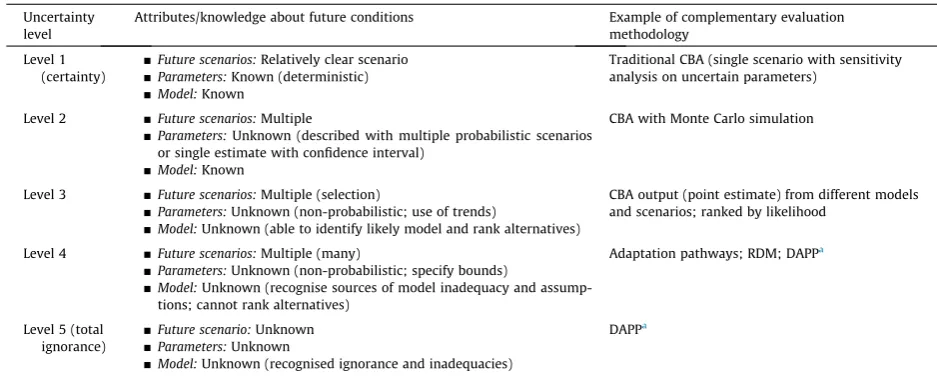
2013; Walker et al., 2013b;Table 1). Uncertain parameters used in traditional cost-benefit analysis (CBA) can include the discount rate, probability of a coastal hazard event occurring and the damage cost estimates.
Deep uncertainty is a condition where decision-makers are unable to agree on models that describe the relationships amongst key input parameters and future impacts, nor the probability distributions used to describe the uncertain
param-eters in these models (Lempert et al., 2003). Additionally such uncertainty requires decisions to be made in a way that
responds to system change with time (Kwakkel et al., 2016). Climate change is an example of deep uncertainty. Attributes
of this uncertainty are often encountered when identifying risks and evaluating adaptation options across multi-decadal
time horizons (Kalra et al., 2014; Lempert and Collins, 2007; Reeder and Ranger, 2011). There is general agreement that
non-probabilistic descriptions of parameters and modelled impacts are better suited to manage this uncertainty (Kunreuther et al., 2013; PROVIA, 2013).
3.2. Components of evaluating adaptation options
Deciding how to evaluate coastal adaptation options requires the analyst to (a) understand the decision needs and con-text, (b) select a ‘decision process’ and (c) identify appropriate ’decision metrics’ (for more details seeHallegatte et al., 2012; Kalra et al., 2014; PROVIA, 2013; Walker et al., 2013a; Watkiss and Hunt, 2013). Once adaptation options have been evalu-ated, an adaptation plan can be developed, which could involve doing nothing and monitoring future changes to risk, select-ing a sselect-ingle adaptation option, implementselect-ing a portfolio of options, or designselect-ing an adaptation pathway. An adaptation pathway is a set of sequenced adaptation options that together form a long-term plan and can be updated iteratively over time (through adaptive management) as new information on uncertain parameters becomes available, or when risk thresh-olds are reached (Haasnoot et al., 2012, 2013; Stafford-smith et al., 2011; Walker et al., 2013a). Thresholds are future con-ditions where the level of risk becomes unacceptable to the decision-maker, signifying that the adaptation option is no
longer effective in managing the risk (Kwadijk et al., 2010; Reeder and Ranger, 2011).
3.2.1. Understanding the decision needs
Identifying the decision needs is addressed during the scoping and context setting activities in risk management practice
[image:4.544.38.507.80.269.2](refer ISO 31000 risk management standard;AS/NZS ISO 31000, 2009; Australian Standard AS5334, 2013; Jones et al., 2014).
Table 1
Levels of uncertainty used to describe parameters and model future impacts (adapted fromRiesch, 2013; Kwakkel et al., 2010; Walker et al., 2013b). The levels of uncertainty are not mutually exclusive.
Uncertainty level
Attributes/knowledge about future conditions Example of complementary evaluation methodology
Level 1 (certainty)
&Future scenarios:Relatively clear scenario &Parameters:Known (deterministic) &Model:Known
Traditional CBA (single scenario with sensitivity analysis on uncertain parameters)
Level 2 &Future scenarios:Multiple
&Parameters:Unknown (described with multiple probabilistic scenarios or single estimate with confidence interval)
&Model:Known
CBA with Monte Carlo simulation
Level 3 &Future scenarios:Multiple (selection)
&Parameters:Unknown (non-probabilistic; use of trends)
&Model:Unknown (able to identify likely model and rank alternatives)
CBA output (point estimate) from different models and scenarios; ranked by likelihood
Level 4 &Future scenarios:Multiple (many)
&Parameters:Unknown (non-probabilistic; specify bounds)
&Model:Unknown (recognise sources of model inadequacy and assump-tions; cannot rank alternatives)
Adaptation pathways; RDM; DAPPa
Level 5 (total ignorance)
&Future scenario:Unknown &Parameters:Unknown
&Model:Unknown (recognised ignorance and inadequacies)
DAPPa
This activity includes defining the decision objectives, data availability and technical capacity for the analysis, uncertainty characteristics and the time horizon across which the risks are identified and the benefits of the adaptation option evaluated. Decision-making objectives often seek either optimal outcomes (i.e. to maximise, or minimise, the performance of an option) or robust outcomes (i.e. identify an option that achieves a satisfactory level of performance across a wide range
of future scenarios;Ben-Haim, 2012; Lempert and Collins, 2007; Walker et al., 2013b; Woodward et al., 2014). Optimal
adap-tation options can be beneficial when assumptions about coastal impacts can be estimated with confidence, or when the adaptation option is flexible and easily reversed. Optimal adaptation options rely on upfront assumptions about the future being correct, which becomes problematic over long-term horizons. This makes robust options superior when future impacts are difficult to model and when adaptation options, such as engineering infrastructure, provide ongoing benefits across mul-tiple decades.
3.2.2. Selecting a decision process
A decision process is a tool used to appraise adaptation options and produce a metric.Kalra et al. (2014)categorises the
decision process into ‘agree-on-assumption’ or ‘agree-on-decision’ processes, based on the analyst’s assumptions and how they manage uncertainty. Traditional decision processes such as CBA and multi-criteria decision analysis (MCDA) are exam-ples of an agree-on-assumption process, as is real options analysis (ROA). These processes generally align with optimal-seeking decision objectives and require analysts to agree on the assumptions used in the analysis before the evaluation takes place. Robust Decision Making (RDM) is an example of an agree-on-decisions process, which does not require stakeholders to agree on input parameter assumptions prior to the analysis. Such processes seek robust outcomes by evaluating policies under hundreds or thousands of non-probabilistic scenarios, to explore the performance of an adaptation option across a large uncertainty space and uncover the vulnerabilities of that option (i.e. when the options fails to adequately manage risks). Data mining algorithms, such as the patient rule induction method, are then used in a process of scenario discovery
(e.g. Bryant and Lempert, 2010) to identify those uncertain parameters that have the greatest impact on achieving the
desired objectives of the decisions-maker. Decision processes such as RDM rely on computational support to explore the per-formance of adaptation options across a much larger uncertainty space than is traditionally done using a limited set of
sce-narios (seeWalker et al., 2013afor a review of computational support tools).
Dynamic Adaptive Policy Pathways (DAPP) is a risk management tool that incorporates transient scenarios to assess the limits of different adaptation options and define risk thresholds (Haasnoot et al., 2013). The DAPP framework builds upon the
adaptation tipping point (ATP) concept (Haasnoot et al., 2013; Kwadijk et al., 2010; Watkiss and Hunt, 2013), and allows
adaptation pathways to be mapped. Pathways are usually designed following the evaluation of individual adaptation options. The adaptation pathway methods align closely with the monitoring and review principals of the globally recognised
[image:5.544.83.451.416.664.2]risk management framework (AS/NZS ISO 31000, 2009) and are examples of adaptive management.
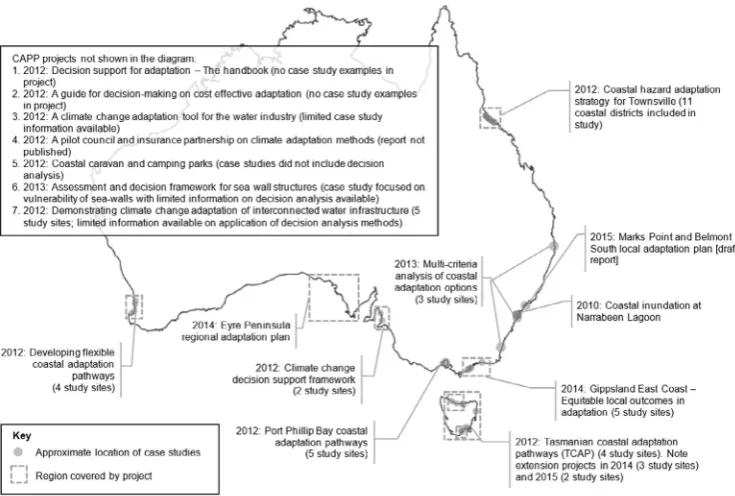
Fig. 1.Geographic location of selected coastal adaptation projects reviewed from around Australia. For the projects analysed (seeTable 2), the number of case study sites are shown in parenthesis.
3.2.3. Selecting decision metrics
Decision metrics are used to compare the performance of different adaptation options. Metrics can be expressed in qual-itative, quantitative or economic (monetary) terms. The decision process uses decision metrics to evaluate the adaptation options, for example the net present value (NPV) metric is used to evaluate options with CBA. An important advantage of the NPV metric over other metrics is that it determines whether an adaptation strategy is economically feasible and calcu-lates the net monetary benefits. The use of an MCDA score as a metric can only rank adaptation options in order of prefer-ence, rather than explicitly indicating whether to make the investment or not. The use of a benefit-cost ratio (BCR) produces
a ratio of benefits to cost, however risks favouring outcomes that may not have the highest monetary net benefit (Boardman
et al., 2011, p.34). Evaluating adaptation options based on an MCDA score can be useful when there are quantitative,
qual-itative and economic criteria that are to be considered (Watkiss and Hunt, 2013), however reducing the evaluation of
mul-tiple criteria down to a single score is often criticised as being subjective and easily influenced by stakeholders (Deb, 2001; Dobes and Bennett, 2009). Techniques such as multi-objective optimisation have been developed to overcome the subjectiv-ities in using a single MCDA score but require a higher level of technical resource to implement. Multi-objective optimisation methods can present decision-makers with a larger set of information about the performance of adaptation options against multiple metrics, from which they can make informed decisions using their own value judgements about the relative impor-tance of the objectives (for further examples seeKwakkel et al., 2015; Mortazavi-Naeini et al., 2013; Woodward et al., 2014).
4. Review of long-term coastal adaptation case studies in Australia
This section systematically reviews characteristics of the methodologies applied to evaluate adaptation options in a rep-resentative sample of long-term coastal adaptation studies in Australia.
4.1. Selected case studies
The geographic location of reviewed case studies is shown inFig. 1. Of the seventeen coastal adaptation studies identified in the review, ten of these projects contained sufficient information about the characteristics of the risk management process
and evaluation methodology for use in this analysis (Table 2). The number of case studies reviewed is a small sample size,
suggesting that the evaluation of long-term coastal adaptation options is a new area of practice in Australia, with limited progress being made by local government in recent years as they transition from risk assessment activities into adaptation planning, evaluation and implementation. A reference list of case study reports and supporting project documentation has
been collated inAppendix A.
4.2. Characteristics of decision support in selected case studies
The reviewed decision support and risk management literature summarised in Section3finds that six characteristics
(Fig. 2) can be used to provide insights about the basis and context of a chosen methodology to evaluate adaptation options: (1) decision objectives; (2) time horizon; (3) approach to risk identification; (4) management of uncertainty; (5) decision process, and (6) decision metrics. Section 4.2.1–4.2.6 summarises the results from Australian case studies based on these characteristics.
4.2.1. Decision objectives
Six case studies focussed on identifying adaptation options that either maximised the monetary benefits of coastal
adap-tation or minimised the projected monetary damage costs through adapadap-tation (ACIL Tasman, 2012; AECOM Australia, 2012;
AECOM and Commonwealth of Australia, 2010; Balston et al., 2012; GHD, 2012; SGS Economics and Planning, 2012). Two
case studies aimed to maximise a weighted MCDA score based on multiple decision criteria (GHD, 2012; Preston et al.,
2013). These were all studies with optimum-seeking decision objectives. Evaluating adaptation options for an optimal
out-come is generally of greater use over short time horizons where uncertainty can be well characterised by probabilities (Watkiss et al., 2014). TheLake Macquarie City Council (2015) case study evaluated adaptation options using a semi-quantitative MCDA approach however the decisions were based on community deliberation, rather than a predefined opti-misation rule. The cases studies that did not have optimal-seeking decision objectives tended to display attributes of robustness-seeking objectives (Barnett et al., 2014; Siebentritt et al., 2014). These studies identified limits of existing coastal risk management measures through stakeholder workshops, producing a list of adaptation responses mapped as an adapta-tion pathway.
4.2.2. Time horizon
The majority of case studies adopted a planning horizon up to the year 2100 to identify risks and evaluate adaptation
options (ACIL Tasman, 2012; AECOM Australia, 2012; AECOM and Commonwealth of Australia, 2010; Balston et al., 2012;
Table 2
Summary of case studies reviewed with selected characteristics of the methodology used to identify risks and evaluate adaptation options.
State Project containing case study Decision
objective Dominant risk framing Time horizon Highest uncertainty level Total number of scenarios Scenario typea Decision processb Decision metricsb Reference
NSW Coastal inundation at Narrabeen Lagoon
Optimal-seeking
Impact-first
2100 Level 2 1,000 Transient CBA, ROA NPV AECOM and
Commonwealth of Australia (2010)
NSW A multi-criteria analysis of coastal adaptation options for local government
Optimal-seeking
Impact-first
2100c
Level 1c
2 Endpoint MCDA, BBN MCDA score Preston et al. (2013)
NSW Marks Point and Belmont South local adaptation Plan
Optimal-seeking
Impact-first
2100 Level 4d
Not specified Endpoint MCDA (semi-quantitative), CBA
BCR, Deliberatived
Lake Macquarie City Council (2015)
QLD Coastal hazard adaptation strategy for Townsville City Council
Optimal-seeking
Impact-first
2100 Level 2 1,000 Transient CBA, MCDA NPV, BCR,
MCDA score
GHD (2012)
SA Climate change decision support framework and software for coastal councils
Optimal-seeking
Impact-first
2100 Level 2 10,000 Transient ROA NPV Balston et al. (2012)
SA Regional climate change adaptation plan for the Eyre Peninsula
Robustness-seeking
Threshold-first
2050+ Level 4 Not specified N/A MCDA
(semi-quantitative)e
Deliberativee
Siebentritt et al. (2014)
TAS Tasmanian coastal adaptation pathways project Optimal-seeking
Impact-first
2100 Level 1 3 Endpoint CBAf
NPVf
SGS Economics and Planning (2012)
VIC Port Phillip Bay coastal adaptation pathways project report
Impact-first
2100 Level 1 1 Endpoint CBA NPV, BCR AECOM Australia
(2012)
VIC Equitable local outcomes in adaptation to sea-level rise Robustness-seeking Threshold-first Not definedg
Level 4 Options not
evaluatedg
N/A Options not
evaluatedg
Options not evaluatedg
Barnett et al. (2014)
WA Developing flexible adaptation pathways for the Peron-Naturaliste coastal region of Western Australia
Optimal-seeking
Impact-first
2100 Level 2 Not specified Transient ROA NPV ACIL Tasman (2012)
a
Transient scenarios (future described as a time-series) or endpoint scenarios (future described at a single point in time).
b
Acronyms: BBN – Bayesian belief network; BCR – benefit-cost ratio; CBA – cost-benefit analysis; MCDA – multi-criteria; NPV – net present value; ROA – real options analysis; decision analysis;
c
Based on the hazard scenarios generated in Stage 2 (place-based evaluation) of the case study.
dEvaluation of adaptation options through stakeholder workshops. Although the CBA reflected level 1 uncertainty, the development of thresholds in the adaptation plan recognises level 4 uncertainty. eSiebentritt 2016, pers. Comm., 22 Jan.
fEvaluation of adaptation options not demonstrated explicitly in these case studies. CBA was inferred on basis that an NPV metric was used to quantify risk and the project being based on a CBA framework (SGS Economics and Planning, 2014).
g
Actions implemented based on when risk thresholds were reached (i.e. water elevation levels).
h
Options not evaluated quantitatively in this case study.
planning time horizon, rather focusing on the development of triggers to implement risk mitigation actions and avoid unac-ceptable risk thresholds being reached (Barnett et al., 2014; Siebentritt et al., 2014).
4.2.3. Approaches to risk identification
A simple classification of the risk identification approach into impact-first or threshold-first was not definitive for many of the case studies, however a dominant approach was identifiable. The use of impact-first approaches to identify climate risks
(scenarios) was dominant inACIL Tasman (2012), AECOM Australia (2012), AECOM and Commonwealth of Australia (2010),
Balston et al. (2012), GHD (2012)andSGS Economics and Planning (2012).Lake Macquarie City Council (2015)adopted an
impact-first perspective for their economic evaluation, whilePreston et al. (2013)used an impact-first approach in their
place-based risk assessment. Fewer case studies displayed traits of a threshold-first approach to risk identification (Barnett et al., 2014; Siebentritt et al., 2014). A clear example was provided byBarnett et al. (2014)who engaged with the community to identify measurable risk thresholds based on observable changes to future coastal flooding regimes. These thresholds reflected the risk tolerance of the community and allowed action plans to be developed should those risk thresh-olds be reached.
4.2.4. Management of uncertainty
It was difficult to describe a single level of uncertainty in case studies that definitively reflected how uncertain
parame-ters were managed in the analysis (Table 1). To illustrate this point, some studies described the sea level rise parameter
deterministically (level 1) and the likelihood of an extreme coastal hazard event stochastically (level 2). In such instances,
the higher uncertainty level was chosen for this analysis (i.e. level 2 in this example). TheLake Macquarie City Council
[image:8.544.116.431.54.193.2](2015)case study made deterministic assumptions about the future for their CBA evaluation, however identified triggers for future action which is indicative of recognising level 4 parameter uncertainty. Seven out of ten case studies described Fig. 2.Selected characteristics used to review methodologies applied in Australia to evaluate long-term coastal adaptation options. The characteristics are grouped into the corresponding steps of theAS/NZS ISO 31000 (2009)risk management process, aligning with Section 4.2.1–4.2.6.
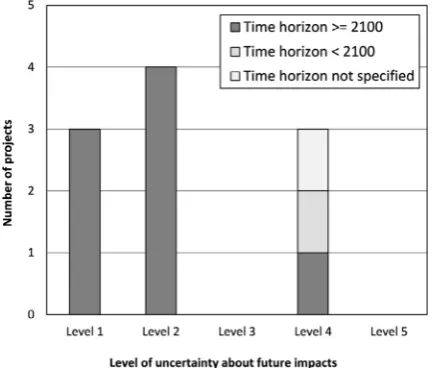
[image:8.544.165.383.238.422.2]future hazards with either level 1 or level 2 uncertainty (Table 2;Fig. 3). Notably the studies that made these assumptions also evaluated the costs and benefits of adaptation options up to the year 2100, a timeframe that is highly uncertain. Assum-ing that parameters can be described with level 1 or 2 uncertainty does allow analysts to use familiar appraisal methods
(such as CBA) to quantify the risks and benefits of adaptation.Barnett et al. (2014)andSiebentritt et al. (2014)recognised
limitations in their ability to define the likelihood of future hazards (an attribute of level 4 uncertainty) and adopted a flex-ible adaptation pathway to support their long-term coastal adaptation plans.
Sensitivity analysis, or use of a small set of scenarios to evaluate adaptation options, was used in some case studies that
managed uncertain parameters deterministically, such as an assuming a sea level rise amount by 2100 (e.g. AECOM
Australia, 2012; SGS Economics and Planning, 2012). Monte Carlo simulation was used in some case studies to stochastically
simulate the probability of future coastal hazards such as extreme inundation events (ACIL Tasman, 2012; AECOM and
Commonwealth of Australia, 2010; Balston et al., 2012; GHD, 2012). Based on the assumed stochastic parameters in the Monte Carlo simulation, the costs and benefits of an adaptation option could be propagated into CBA (or ROA) and an expected value calculated (e.g. NPV metric).
There were different conceptualisations of the term ‘pathways’ that emerged in this review. Some studies (e.g.AECOM
Australia, 2012) grouped individual adaptation options into discrete pathway sets (e.g. an accommodate or protection
path-way); others (e.g.GHD, 2012) analysed adaptation options individually and identified an optimal investment time for the
options (reflecting a future trigger for action contingent on underlying assumptions being correct); and some (e.g.Barnett
et al., 2014) focussed on developing risk triggers for adaptation through deliberation with stakeholders. Barnett et al. (2014)andSiebentritt et al. (2014)where the only two case studies that mapped an adaptation pathway to manage long-term uncertainty. Neither study utilised a quantitative method or any modelling to identify the risk thresholds in the
adapta-tion pathway. TheLake Macquarie City Council (2015)study developed a draft ten year action plan to manage risk in their
com-munity with the plan being reviewed at regular intervals as more information becomes available. They established triggers to implement adaptive actions which included the use of governance mechanisms (e.g. local government applications for asset maintenance), human processes (e.g. re-development applications) and observable increases to flood risk from sea level rise.
4.2.5. Decision process
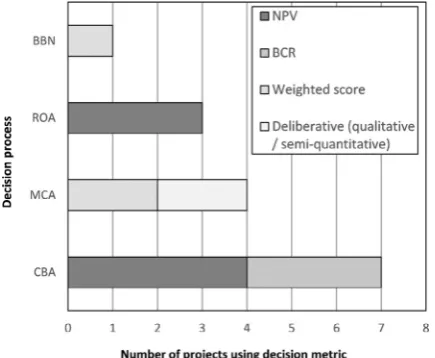
The decision process and decision metrics applied in the reviewed case studies are summarised inFig. 4.
An agree-on-assumption decision process was used in the majority of case studies with CBA being the most common
decision process, used in half of the case studies (Table 2). ROA extends traditional CBA to handle uncertainty and was used
in three case studies (ACIL Tasman, 2012; AECOM and Commonwealth of Australia, 2010; Balston et al., 2012), whilst MCDA
was applied in two of the case studies (GHD, 2012; Preston et al., 2013). MCDA is useful in addressing the challenge of
decision-making with stakeholders whom have multiple, conflicting objectives.GHD (2012)applied MCDA as a screening
tool to reduce the number of adaptation options down to a smaller shortlist, which were then evaluated in further detail
with CBA.Preston et al. (2013)obtained local government stakeholder preferences through a survey and expressed these
as multiple criteria in stage 1 of their analysis, which were then used with MCDA to evaluate adaptation options. They extended their analysis with a Bayesian Belief Network (BBN) to understand the variability in individual preferences within,
and between local government stakeholders.Lake Macquarie City Council (2015)andSiebentritt et al. (2014)used MCDA in
a deliberative manner, the former identifying four critical criteria (one of which was to pass a CBA test) that had to be addressed for the option to be progressed into the adaptation plan.
Barnett et al. (2014)did not formally evaluate adaptation options in their pathway approach. They identified a shortlist of adaptation options with community participants that could be explored once risk thresholds are reached. The first trigger level set by the community was designed to represent a change to the frequency of the inundation hazard and prompted the next level of adaptation planning activities to be implemented.
4.2.6. Decision metrics
The NPV metric was most commonly used in the case studies (referTable 2;Fig. 4), which complements the use of CBA
and ROA as a decision-process.Siebentritt et al. (2014)did not specify a decision metric to evaluate the different adaptation
options in their study, choosing to undertake the evaluation with stakeholder participation and discussion.Lake Macquarie
City Council (2015)used a semi-quantitative analysis (MCDA) to evaluate adaptation options, but did not reduce the assess-ment against four criteria into a single MCDA score leaving it open for deliberation.
5. Discussion
5.1. Towards better informed long-term decisions
The small number of case studies available for review suggests that the planning and evaluation of coastal adaptation options is a relatively new area of practice in Australia. Although there is guidance material available to local government
on risk management and the selection of suitable evaluation methodologies (Dittrich et al., 2016; Mediation Adaptation
Platform, 2013), there is no nationally recognised standard in Australia. The different methodological approaches taken in Australia to identify risk and evaluate adaptation options suggest that further guidance is needed to provide a consistent basis in local governments. Current research being undertaken by the National Climate Change Adaptation Research Facility
(NCCARF) is contributing to this knowledge base, aiming to provide risk management information and a decision support
platform through an online portal called CoastAdapt (https://coastadapt.com.au/).
The diversity of methodological approaches used in the Australian case studies made it difficult in some instances to cat-egorise the approach to risk identification (i.e. impact-first or threshold-first) and identify what level best describes the
treat-ment of uncertain parameters.Armstrong et al. (2015)experienced similar difficulties classifying adaptation projects into
theoretical frameworks, suggesting that the strengths of different approaches sometimes compensate for methodological weaknesses in others, in order to meet decision-maker needs. This conclusion can also be drawn in current Australian practice. An emerging theme in the Australian case studies was a reliance on key upfront assumptions to explore future impact scenarios and to evaluate adaptation options across multi-decadal periods (to the year 2100). This framing was driven by optimal-seeking decision objectives with common assumptions including the extent of sea level rise, probability of extreme events, discount rates and damage costs. Studies that sought to optimise the benefits of adaptation took an impact-first per-spective to identify risk, assuming a risk scenario, from which the value of the adaptation response could be assessed.
Impact-first perspectives are subject to the ‘cascade of uncertainty’ (Wilby and Dessai, 2010), whereby assumptions made
about future (e.g. emissions) feed into downscaled climate projections (e.g. sea level rise), which then are carried through to impact assessments (e.g. monetary impacts) and propagate into the evaluation of adaptation options. Although impact-first approaches are useful to local government faced with budget, time and technical resource constraints, they can make it challenging to formulate a defensible basis for adaptation investment. Furthermore, there is general acknowledgement in the literature that impact-first approaches are useful when uncertainty can be well characterised, however under conditions
of uncertainty – which occurs in long-term evaluations – threshold-first approaches are more suitable (Jones et al., 2014).
Many of the Australian case studies overlooked this important principle for identifying risk and evaluating adaptation ben-efits over the coming decades. Additionally, impact-first approaches can overlook social and community-based objectives in
adaptation planning, which are increasingly becoming recognised (Downing, 2012; Hinkel and Bisaro, 2015; Wise et al.,
2014) and essential to local government decision-making.
The management of uncertainty was another important characteristic of the evaluation methodology, reflecting assump-tions made by analysts in their ability to describe future impacts and knowledge of input parameters. The majority of Aus-tralian case studies characterised uncertain parameters as being deterministic (level 1 uncertainty) or stochastic (level 2
uncertainty). This could be due to the relatively infancy of robust methods being used in policy analysis (Dittrich et al.,
2016) or because such assumptions simplify the quantitative analysis of adaptation options and make it more accessible to
resource constrained local governments. Case studies that characterised uncertainty in this way generally tested their assumptions with a sensitivity analysis; however, there is no guarantee that this explores the full range of uncertainty (Bonzanigo and Kalra, 2014). A few case studies generated many scenarios using Monte Carlo simulation which allowed a much greater set of assumptions about parameter values to be explored. These approaches relied on a probabilistic descrip-tion of uncertain parameters and the result of the analysis infers a likelihood of attaining the calculated metric (Bonzanigo and Kalra, 2014). The assumption that parameters can be described probabilistically is often argued to be inadequate for
long-term decision-making (Kunreuther et al., 2013; PROVIA, 2013), therefore the basis for managing uncertainty in the analysis
of risks and adaptation options in Australian practice requires rethinking to avoid a reliance on overly simplistic assumptions. The reliance on upfront assumptions in Australian practice to evaluate adaptation options (notably underpinning the risk
identification and management of uncertainty) provides empirical evidence to support the conclusions made byJones and
[image:10.544.165.383.54.233.2]The use of CBA to assess the efficacy of capital expenditures is common in practice (Department of Prime Minister and Cabinet, 2016; Dobes and Bennett, 2009; HMTreasury, 2003; IPCC, 2012; Metroeconomica, 2004) and was a theme evident in the case studies. Case studies that recognised the shortcomings of using CBA across longer planning horizons used ROA to undertake an economic analysis, but ROA requires the direction of change in the uncertain parameters to be monotonic and adaptation options to be flexible (Stafford-Smith et al., 2011). ROA can also be challenged by political barriers, for example having uncertain timeframes for capital investment is less desirable to governments than committing to inflexible ‘one-off’ investments (Linquiti and Vonortas, 2012). ROA also assumes that uncertainty is reduced over time (Hallegatte et al., 2012) and like CBA, relies on prob-abilistic projections for climate related parameters which in not always appropriate for long-term evaluations.
The complexities of the adaptation challenge faced by local government was evident across all of the case studies. Whilst it is too early to understand how effective the appraisal of adaptation options were in the Australian case studies (i.e. the analysis was doneex ante), two general observations are made about the resultant conclusions. Firstly, most case studies followed a risk management process (adaptive management) in the face of uncertainty and concluded that adaptation investments were nec-essary at a future time. However, at such points in the future a decision will need to be made whether to invest and the robust-ness of such decisions will depend on characteristics such as the objectives, management of uncertainty and decision process. If investments are to have multi-decadal consequences, then traditional appraisal methods like CBA can risk maladaptive out-comes should the future depart from the assumptions. Secondly, what is identified as being at risk shaped the selection of
adap-tation options (Hinkel and Bisaro, 2015). For example, many of the case studies focused on mitigating physical impacts (i.e.
losses to assets) which could be monetised for use in CBA or ROA. This directed adaptation responses towards engineered defences (levees and seawalls) to manage changing coastal hazards. These plans overlook non-measurable social impacts from changing coastal hazards and resultant policy recommendations could underestimate the need for adaptive action.
5.2. Benchmarking Australia practice with international methodologies
Two state-of-the-art evaluation methodologies used internationally to support decision-making under conditions of uncer-tainty include RDM and DAPP (Kalra et al., 2014; Kwakkel et al., 2016; see Section3.2.2). These methods are most useful when the future is uncertain, complex and unable to be characterised probabilistically, which was a decision context shared by most of the Australian cases studies as planning and evaluation activities occurred across multi-decadal time horizons. In contrast
with many of the case studies reviewed which targeted optimal outcomes using an impact-first approach (e.g.ACIL Tasman
(2012), AECOM Australia (2012), AECOM and Commonwealth of Australia (2010), Balston et al. (2012), GHD (2012)andSGS Economics and Planning (2012)), RDM and DAPP seek robust outcomes and take a threshold-first approach to identify risk. They do not require an evaluation timeframe to be specified, focusing on observable changes to key parameters. The conclu-sions drawn in many of the optimal-seeking case studies rely entirely on initial assumptions being realised decades from today, which can be contentious amongst stakeholders and impede the adaptation planning process. RDM and DAPP can also utilise conventional metrics such as NPV, which is important for decision-makers who rely on economic measures as was seen in
many of the Australian case studies (e.g. ACIL Tasman, 2012; AECOM Australia, 2012; AECOM and Commonwealth of
Australia, 2010; Balston et al., 2012; Lake Macquarie City Council, 2015; GHD, 2012; SGS Economics and Planning, 2012). The use of non-probabilistic scenarios to manage uncertainty across multi-decadal time horizons was a key differentiat-ing factor between those Australian case studies that used many scenarios and RDM/DAPP methods. Methods such as RDM and DAPP specify non-probabilistic bounds for uncertain variables and explore how well an adaptation option performs under many scenarios, which is better suited to managing level 4 or 5 parameter uncertainty. It also allows thresholds for critical variables to be established. In complex coastal applications where there are many uncertain variables and inter-actions amongst stressors, this allows decision-makers to focus on a reduced set of critical variables that matter most to their risk management objectives. Furthermore, the use of many scenarios to evaluate adaptation options allows a greater suite of uncertain parameters to be explored, such as population growth or damage costs, not limited exclusively to climate related variables like sea level rise which was the case in many of the Australian case studies. In contrast, some case studies only used a small number of scenarios to explore a very limited set of future conditions. Those studies that used many probabilis-tic scenarios inferred a likelihood of attaining measured outcomes. The assumption that probability distributions for input parameters can be used to describe scenarios extending decades into the future is challenged by factors such as non-stationarity (e.g.Milly et al., 2008) and the legitimacy of such plans is likely to reduce as the planning timeframe increases.
Some Australian case studies incorporated basic ideas from the DAPP method (Barnett et al., 2014; Lake Macquarie City
Council, 2015; Siebentritt et al., 2014).Barnett et al. (2014)acknowledged the limitations of technical resource in local gov-ernment to apply quantitative evaluation methods, and focussed on a non-intensive methodology for constructing their local adaptation pathway. This approach identified thresholds based on community participation and resident experience with historic floods, instead of through computationally intensive scenario modelling. Notwithstanding the constraints faced by local government, inclusion of a quantitative basis for identifying thresholds would be valuable information to supple-ment adaptation planning in Australian communities.
5.3. Opportunities to advance current adaptation practice in Australia
Local government are faced with many challenges that need to be addressed to advance current adaptation practice. Financial and technical constraints play an important role in the ability of authorities to undertake planning and
uation activities. Additionally, local government are operating in an environment where there is no mandate from
higher-order government for adaptation planning, unclear responsibilities amongst government authorities (Nalau
et al., 2015) and the threat of legal liability for maladaptive decisions. Providing opportunities to increase the uptake of new methods such as RDM and DAPP for planning and evaluating adaptation options requires the creation of interest
and awareness in local government (Lawrence and Haasnoot, 2017), availability of relevant data (Bhave et al., 2016),
leadership from within governments, buy-in from senior management and a coordination mechanism (Lawrence and
Haasnoot, 2017).
Notwithstanding current challenges, the ten representative Australian case studies reviewed suggest that the approach to identifying risk and managing uncertainty in evaluation activities can be improved by recognising the time scales across which the appraisal is occurring and the diminishing ability to predict the future. This is because uncertainty increasingly
propagates as time horizons extend and multiple futures become possible (Maier et al., 2016). Recognising such uncertainty
in evaluation activities requires a shift towards robust rather than optimal-seeking decision objectives. Exploring the perfor-mance of adaptation options across many scenarios (as used in RDM and DAPP) can provide an opportunity for local govern-ments to make better informed decisions in the face of uncertainty, however, the accessibility of these methods to local government needs to be addressed by future research given the challenges mentioned earlier. Scenario-based methods can also provide quantitative information to support the identification of risk thresholds in coastal communities, which can then inform stakeholder discussions and the design of flexible adaptation pathways. Given the severity of coastal impacts is projected to increase in the coming decades along with uncertain change to built and environmental stressors, it is prudent that alternate evaluation methodologies to those currently used in Australian practice are considered when long-term coastal adaptation options are being appraised. This can improve the legitimacy of adaptation planning and avoid maladaptive outcomes that only consider a narrow range of uncertainties.
6. Conclusions
The selection of a methodology to evaluate long-term coastal adaptation options can be influenced by the decision objec-tives, time horizon of analysis, approach to risk identification, management of uncertainty, decision process, and decision metrics. The majority of Australian case studies described uncertainty across multi-decadal timeframes as being determin-istic or stochastic, which is not considered sophdetermin-isticated enough for long-term risk assessment, evaluation activities and decision-making.
Comparing Australian case studies with two state-of-the-art methods from abroad reveals that a key difference lies in the use of scenarios to manage uncertainty and seek adaptation options that are robust to many future scenarios. A greater focus on the use of scenario-based evaluations is needed in Australia to account for interactions amongst multiple variables, espe-cially given the potentially high consequences from poor local government decisions in coastal settlements. The identifica-tion of risk thresholds when formulating adaptaidentifica-tion pathways in Australian practice can also benefit from quantitative scenario-based evaluations to better inform community decision-making.
The reviewed case studies were generally consistent with the overarching ISO 31000 risk management standard but dif-fered in the detailed methods used at each stage of the process. The framing of risk (i.e. establishing the context) – which includes the risk identification perceptive and management of uncertainty characteristics – was found to be a fundamental consideration for local governments involved in adaptation activities as this ultimately influenced the approach taken to evaluate adaptation options. There is an opportunity for decision-makers in Australia faced with changing coastal hazards to consider adopting a threshold-first approach to identify risk and seek robust outcomes in recognition of the uncertainties associated with evaluations across multi-decadal time frames.
The small number of case studies available for this review suggests that evaluation activities associated with long-term coastal adaptation in Australia is in its infancy, and the characteristics discussed in this paper provide a timely opportunity to guide local government towards better informed decision-making, which can reduce the threat of maladaptation and legal liability in the coming decades.
Acknowledgements
The authors are grateful for the financial support of the Commonwealth of Australia through the Bushfire and Natural Hazards Cooperative Research Centre program and the Australian Postgraduate Award. The authors also wish to acknowl-edge Stewart Franks for the useful comments and suggestions in the early stages of this paper.
Appendix A. List of documentation used in the analysis
Table A.1
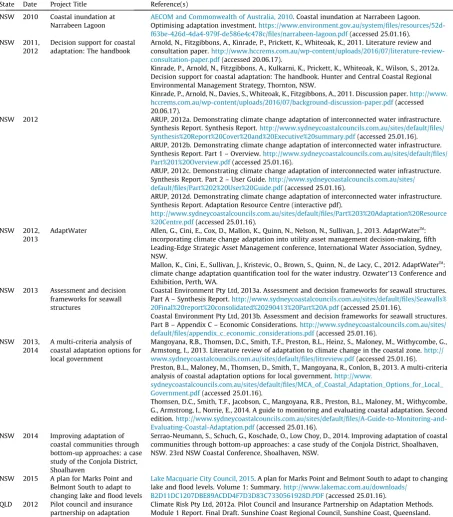
List of selected coastal adaptation projects in Australia grouped by Australian State. There were no reports used in this analysis from the Northern Territory. The Australian Capital Territory was excluded, as this is not a coastal area.
State Date Project Title Reference(s)
NSW 2010 Coastal inundation at Narrabeen Lagoon
AECOM and Commonwealth of Australia, 2010. Coastal inundation at Narrabeen Lagoon. Optimising adaptation investment. https://www.environment.gov.au/system/files/resources/52d-f63be-426d-4da4-979f-de586e4c478c/files/narrabeen-lagoon.pdf(accessed 25.01.16).
NSW 2011, 2012
Decision support for coastal adaptation: The handbook
Arnold, N., Fitzgibbons, A., Kinrade, P., Prickett, K., Whiteoak, K., 2011. Literature review and consultation paper. http://www.hccrems.com.au/wp-content/uploads/2016/07/literature-review-consultation-paper.pdf(accessed 20.06.17).
Kinrade, P., Arnold, N., Fitzgibbons, A., Kulkarni, K., Prickett, K., Whiteoak, K., Wilson, S., 2012a. Decision support for coastal adaptation: The handbook. Hunter and Central Coastal Regional Environmental Management Strategy, Thornton, NSW.
Kinrade, P., Arnold, N., Davies, S., Whiteoak, K., Fitzgibbons, A., 2011. Discussion paper.http://www. hccrems.com.au/wp-content/uploads/2016/07/background-discussion-paper.pdf(accessed 20.06.17).
NSW 2012 ARUP, 2012a. Demonstrating climate change adaptation of interconnected water infrastructure. Synthesis Report. Synthesis Report.http://www.sydneycoastalcouncils.com.au/sites/default/files/ Synthesis%20Report%20Cover%20and%20Executive%20summary.pdf(accessed 25.01.16). ARUP, 2012b. Demonstrating climate change adaptation of interconnected water infrastructure. Synthesis Report. Part 1 – Overview.http://www.sydneycoastalcouncils.com.au/sites/default/files/ Part%201%20Overview.pdf(accessed 25.01.16).
ARUP, 2012c. Demonstrating climate change adaptation of interconnected water infrastructure. Synthesis Report. Part 2 – User Guide.http://www.sydneycoastalcouncils.com.au/sites/ default/files/Part%202%20User%20Guide.pdf(accessed 25.01.16).
ARUP, 2012d. Demonstrating climate change adaptation of interconnected water infrastructure. Synthesis Report. Adaptation Resource Centre (interactive pdf).
http://www.sydneycoastalcouncils.com.au/sites/default/files/Part%203%20Adaptation%20Resource %20Centre.pdf(accessed 25.01.16).
NSW 2012, 2013
AdaptWater Allen, G., Cini, E., Cox, D., Mallon, K., Quinn, N., Nelson, N., Sullivan, J., 2013. AdaptWaterTM : incorporating climate change adaptation into utility asset management decision-making, fifth Leading-Edge Strategic Asset Management conference, International Water Association, Sydney, NSW.
Mallon, K., Cini, E., Sullivan, J., Kristevic, O., Brown, S., Quinn, N., de Lacy, C., 2012. AdaptWaterTM : climate change adaptation quantification tool for the water industry. Ozwater’13 Conference and Exhibition, Perth, WA.
NSW 2013 Assessment and decision frameworks for seawall structures
Coastal Environment Pty Ltd, 2013a. Assessment and decision frameworks for seawall structures. Part A – Synthesis Report.http://www.sydneycoastalcouncils.com.au/sites/default/files/Seawalls% 20Final%20report%20consolidated%20290413%20Part%20A.pdf(accessed 25.01.16).
Coastal Environment Pty Ltd, 2013b. Assessment and decision frameworks for seawall structures. Part B – Appendix C – Economic Considerations.http://www.sydneycoastalcouncils.com.au/sites/ default/files/appendix_c_economic_considerations.pdf(accessed 25.01.16).
NSW 2013, 2014
A multi-criteria analysis of coastal adaptation options for local government
Mangoyana, R.B., Thomsen, D.C., Smith, T.F., Preston, B.L., Heinz, S., Maloney, M., Withycombe, G., Armstong, I., 2013. Literature review of adaptation to climate change in the coastal zone.http:// www.sydneycoastalcouncils.com.au/sites/default/files/litreview.pdf(accessed 25.01.16). Preston, B.L., Maloney, M., Thomsen, D., Smith, T., Mangoyana, R., Conlon, B., 2013. A multi-criteria analysis of coastal adaptation options for local government.http://www.
sydneycoastalcouncils.com.au/sites/default/files/MCA_of_Coastal_Adaptation_Options_for_Local_ Government.pdf(accessed 25.01.16).
Thomsen, D.C., Smith, T.F., Jacobson, C., Mangoyana, R.B., Preston, B.L., Maloney, M., Withycombe, G., Armstrong, I., Norrie, E., 2014. A guide to monitoring and evaluating coastal adaptation. Second edition. http://www.sydneycoastalcouncils.com.au/sites/default/files/A-Guide-to-Monitoring-and-Evaluating-Coastal-Adaptation.pdf(accessed 25.01.16).
NSW 2014 Improving adaptation of coastal communities through bottom-up approaches: a case study of the Conjola District, Shoalhaven
Serrao-Neumann, S., Schuch, G., Koschade, O., Low Choy, D., 2014. Improving adaptation of coastal communities through bottom-up approaches: a case study of the Conjola District, Shoalhaven, NSW. 23rd NSW Coastal Conference, Shoalhaven, NSW.
NSW 2015 A plan for Marks Point and Belmont South to adapt to changing lake and flood levels
Lake Macquarie City Council, 2015. A plan for Marks Point and Belmont South to adapt to changing lake and flood levels. Volume 1: Summary.http://www.lakemac.com.au/downloads/
B2D11DC1207DBE89ACDD4F7D3D83C7330561928D.PDF(accessed 25.01.16). QLD 2012 Pilot council and insurance
partnership on adaptation methods
Climate Risk Pty Ltd, 2012a. Pilot Council and Insurance Partnership on Adaptation Methods. Module 1 Report. Final Draft. Sunshine Coast Regional Council, Sunshine Coast, Queensland. Climate Risk Pty Ltd, 2012b. Pilot Council and Insurance Partnership on Adaptation Methods. Module 2 Report. Sunshine Coast Regional Council, Sunshine Coast, Queensland.
Climate Risk Pty Ltd, 2012c. Pilot Council and Insurance Partnership on Adaptation Methods. Module 3 Report. Sunshine Coast Regional Council, Sunshine Coast, Queensland.
Climate Risk Pty Ltd, 2012d. Pilot Council and Insurance Partnership on Adaptation Methods. Module 4 Report. Sunshine Coast Regional Council, Sunshine Coast, Queensland.
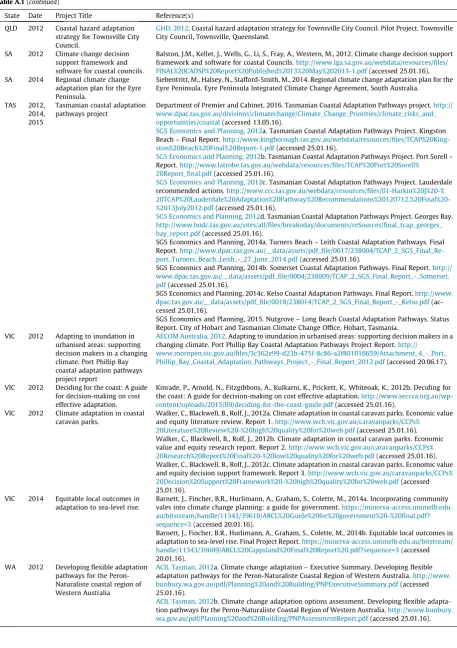
(continued on next page)
Table A.1(continued)
State Date Project Title Reference(s)
QLD 2012 Coastal hazard adaptation strategy for Townsville City Council.
GHD, 2012. Coastal hazard adaptation strategy for Townsville City Council. Pilot Project. Townsville City Council, Townsville, Queensland.
SA 2012 Climate change decision support framework and software for coastal councils.
Balston, J.M., Kellet, J., Wells, G., Li, S., Fray, A., Western, M., 2012. Climate change decision support framework and software for coastal Councils.http://www.lga.sa.gov.au/webdata/resources/files/ FINAL%20CADSP%20Report%20Published%2013%20May%202013-1.pdf(accessed 25.01.16). SA 2014 Regional climate change
adaptation plan for the Eyre Peninsula.
Siebentritt, M., Halsey, N., Stafford-Smith, M., 2014. Regional climate change adaptation plan for the Eyre Peninsula. Eyre Peninsula Integrated Climate Change Agreement, South Australia.
TAS 2012, 2014, 2015
Tasmanian coastal adaptation pathways project
Department of Premier and Cabinet, 2016. Tasmanian Coastal Adaptation Pathways project.http:// www.dpac.tas.gov.au/divisions/climatechange/Climate_Change_Priorities/climate_risks_and_ opportunities/coastal(accessed 13.05.16).
SGS Economics and Planning, 2012a. Tasmanian Coastal Adaptation Pathways Project. Kingston Beach – Final Report. http://www.kingborough.tas.gov.au/webdata/resources/files/TCAP%20King-ston%20Beach%20Final%20Report-1.pdf(accessed 25.01.16).
SGS Economics and Planning, 2012b. Tasmanian Coastal Adaptation Pathways Project. Port Sorell – Report.http://www.latrobe.tas.gov.au/webdata/resources/files/TCAP%20Port%20Sorell%
20Report_final.pdf(accessed 25.01.16).
SGS Economics and Planning, 2012c. Tasmanian Coastal Adaptation Pathways Project. Lauderdale recommended actions.http://www.ccc.tas.gov.au/webdata/resources/files/01-Harkin%20J%20-% 20TCAP%20Lauderdale%20Adaptation%20Pathway%20Recommendations%20120712,%20Final%20-%2013July2012.pdf(accessed 25.01.16).
SGS Economics and Planning, 2012d. Tasmanian Coastal Adaptation Pathways Project. Georges Bay. http://www.bodc.tas.gov.au/sites/all/files/breakoday/documents/reSources/final_tcap_georges_ bay_report.pdf(accessed 25.01.16).
SGS Economics and Planning, 2014a. Turners Beach – Leith Coastal Adaptation Pathways. Final Report. http://www.dpac.tas.gov.au/__data/assets/pdf_file/0017/238004/TCAP_2_SGS_Final_Re-port_Turners_Beach_Leith_-_27_June_2014.pdf(accessed 25.01.16).
SGS Economics and Planning, 2014b. Somerset Coastal Adaptation Pathways. Final Report.http:// www.dpac.tas.gov.au/__data/assets/pdf_file/0004/238009/TCAP_2_SGS_Final_Report_-_Somerset. pdf(accessed 25.01.16).
SGS Economics and Planning, 2014c. Kelso Coastal Adaptation Pathways. Final Report.http://www. dpac.tas.gov.au/__data/assets/pdf_file/0018/238014/TCAP_2_SGS_Final_Report_-_Kelso.pdf (ac-cessed 25.01.16).
SGS Economics and Planning, 2015. Nutgrove – Long Beach Coastal Adaptation Pathways. Status Report. City of Hobart and Tasmanian Climate Change Office, Hobart, Tasmania.
VIC 2012 Adapting to inundation in urbanised areas: supporting decision makers in a changing climate. Port Phillip Bay coastal adaptation pathways project report
AECOM Australia, 2012. Adapting to inundation in urbanised areas: supporting decision makers in a changing climate. Port Phillip Bay Coastal Adaptation Pathways Project Report.http://
www.mornpen.vic.gov.au/files/3c362e99-d23b-475f-8c86-a2f801016659/Attachment_4_-_Port_ Phillip_Bay_Coastal_Adaptation_Pathways_Project_-_Final_Report_2012.pdf(accessed 20.06.17).
VIC 2012 Deciding for the coast: A guide for decision-making on cost effective adaptation.
Kinrade, P., Arnold, N., Fitzgibbons, A., Kulkarni, K., Prickett, K., Whiteoak, K., 2012b. Deciding for the coast: A guide for decision-making on cost effective adaptation. http://www.seccca.org.au/wp-content/uploads/2015/09/deciding-for-the-coast-guide.pdf(accessed 25.01.16).
VIC 2012 Climate adaptation in coastal caravan parks.
Walker, C., Blackwell, B., Rolf, J., 2012a. Climate adaptation in coastal caravan parks. Economic value and equity literature review. Report 1.http://www.wcb.vic.gov.au/caravanparks/CCPs% 20Literature%20Review%20-%20high%20quality%20for%20web.pdf(accessed 25.01.16). Walker, C., Blackwell, B., Rolf, J., 2012b. Climate adaptation in coastal caravan parks. Economic value and equity research report. Report 2.http://www.wcb.vic.gov.au/caravanparks/CCPs% 20Research%20Report%20Final%20-%20low%20quality%20for%20web.pdf(accessed 25.01.16). Walker, C., Blackwell, B., Rolf, J., 2012c. Climate adaptation in coastal caravan parks. Economic value and equity decision support framework. Report 3.http://www.wcb.vic.gov.au/caravanparks/CCPs% 20Decision%20Support%20Framework%20-%20high%20quality%20for%20web.pdf(accessed 25.01.16).
VIC 2014 Equitable local outcomes in adaptation to sea-level rise.
Barnett, J., Fincher, B.R., Hurlimann, A., Graham, S., Colette, M., 2014a. Incorporating community vales into climate change planning: a guide for government.https://minerva-access.unimelb.edu. au/bitstream/handle/11343/39610/ARCL%20Guide%20for%20government%20-%20final.pdf? sequence=3(accessed 20.01.16).
Barnett, J., Fincher, B.R., Hurlimann, A., Graham, S., Colette, M., 2014b. Equitable local outcomes in adaptation to sea-level rise. Final Project Report.https://minerva-access.unimelb.edu.au/bitstream/ handle/11343/39609/ARCL%20Gippsland%20Final%20Report%20.pdf?sequence=3(accessed 20.01.16).
WA 2012 Developing flexible adaptation pathways for the Peron-Naturaliste coastal region of Western Australia
ACIL Tasman, 2012a. Climate change adaptation – Executive Summary. Developing flexible adaptation pathways for the Peron-Naturaliste Coastal Region of Western Australia.http://www. bunbury.wa.gov.au/pdf/Planning%20and%20Building/PNPExecutiveSummary.pdf(accessed 25.01.16).