Short-Term Human-Robot Interaction
through Conditional Planning and Execution
Valerio Sanelli,
1Michael Cashmore,
2Daniele Magazzeni,
2Luca Iocchi
1 1Department of Computer, Control, and Management EngineeringSapienza University of Rome, Italy
2Department of Informatics, King’s College London, UK
Abstract
The deployment of robots in public environments is gaining more and more attention and interest both for the research opportunities and for the possibility of developing commer-cial applications over it. In these scenarios, proper definitions and implementations of human-robot interactions are crucial and the specific characteristics of the environment (in partic-ular, the presence of untrained users) makes the task of defin-ing and implementdefin-ing effective interactions particularly chal-lenging.
In this paper, we describe a method and a fully implemented robotic system using conditional planning for generating and executing short-term interactions by a robot deployed in a public environment. To this end, the proposed method inte-grates and extends two components already successfully used for planning in robotics: ROSPlan and Petri Net Plans. The contributions of this paper are the problem definition of generating short-term interactions as a conditional planning problem and the description of a solution fully implemented on a real robot. The proposed method is based on the integra-tion between a contingent planner in ROSPlan and the Petri Net Plans execution framework, and it has been tested in dif-ferent scenarios where the robot interacted with hundreds of untrained users.
1
Introduction
Short-term human-robot interactions (HRIs) are useful in many application scenarios where a robot is placed in a pub-lic space interacting with non-expert untrained users.
Short-term HRI is characterized by the following aspects: (i) users are not trained and are not aware about the capabil-ities of the robot, (ii) each interaction is assumed to be per-formed with a different non-experienced user (i.e., s/he did not participate in previous interactions of the same kind), (iii) interactions are short in time. Under these conditions, the robot does not need to memorize past interactions or to adapt the current interaction based on those in the past. Moreover, user profiling is also not needed.
Although the interactions are short, it is typically neces-sary or convenient to generate many of them in order to re-alize an effective application. Thus, the problem of generat-ing many interactions is important and the use of automated
Copyright c2017, Association for the Advancement of Artificial
Intelligence (www.aaai.org). All rights reserved.
planning procedures, instead of manual definition, brings several advantages in correctness of the solution, compact-ness of the representation, less effort for the designer of the system, and in the general success of the overall application. Since the interactions with non-expert untrained users cannot be predicted a priori and evaluating the complete cur-rent state is not easy for the robot, classical planning is not adequate for this process. Replanning is not sufficient for this case, as without offline reasoning about different contin-gencies, it is possible for the new plan to result in a dead-end state or repeated interaction (Little and Thiebaux 2007).
In contrast, conditional planning has the advantage that it does not require knowledge about a complete initial state and on-line knowledge acquisition can be performed (Hoff-mann and Brafman 2005a) without requiring the computa-tion of a complete state (Bonet and Geffner 2000).
Consequently, conditional planning is a useful technique for automatic generation of multiple short-term interactions performed by robots deployed in public spaces.
In this paper, we present a complete system where condi-tional planning and human-robot interaction techniques are integrated in a fully working robotic platform that has been deployed in many public environments.
The contributions of this paper can be summarized as fol-lows: 1) a definition of the problem of generating short-term interactions as a conditional planning problem, 2) a solu-tion of the condisolu-tional planning problem though the integra-tion with the condiintegra-tional planner Contingent-FF (Hoffmann and Brafman 2005b) in ROSPlan (Cashmore et al. 2015), 3) the integration between ROSPlan and the Petri Net Plans (PNP) execution framework, 4) implementation and testing on a real robot in several different scenarios and open-source release of the code.
The paper is structured as follows: we start with a discus-sion of related work in Section 2, followed by an overview of the system, in which the contributions are described. We then present the integration with the real robot and experi-ments in Section 4. Section 5 concludes the paper.
2
Related Work
Planning and Robotics is an area of growing interest, in which various planning techniques are being applied to new robotic domains. In particular, planning techniques
have beeen used in the control of Autonomous Underwa-ter Vehicles and Unmanned Aerial Vehicles; and also in the domains of disaster management and manufacturing (Al-terovitz, Koenig, and Likhachev 2016; Karpas et al. 2015; Mudrov´a, Lacerda, and Hawes 2016; Wilson et al. 2016).
The introduction of tools to facilitate the integration of planning and robotics is an important step toward furthering the use of AI systems. In this paper we use ROSPlan to in-tegrate the use of conditional planning with our robotic plat-form. ROSPlan has been used in various robotic domains for this purpose (Cashmore et al. 2014; Palomeras et al. 2016; Brafman, Bar-Sinai, and Ashkenazi 2016; Cashmore et al. 2017). Moreover, the framework has been used to integrate a planner into robotic domains in which humans are present. However, planning techniques were not specifically used for human-robot interaction. (Bajones 2016)
Planning techniques have also been used in robotic appli-cations characterized by some form of human-robot interac-tion.
A first group of works focuses on interactions between humans and robots and on an explicit representation of hu-man activities in the planning formalism. For example, An-swer Set programming (ASP) has been used to model an effi-cient planner for collaborative house keeping robots (Erdem, Aker, and Patoglu 2012). This system automatically extracts common sense information from the ConceptNet dataset and exploits it to better perform the given task. Social norms have also been considered in the planning process. For ex-ample, Human Aware Planning (Tomic, Pecora, and Saffiotti 2014) is a system based on Constraint Based Planning (CBP) that allows modeling and planning with social norms, repre-sented as constraints of the problem. Social norms integrated into a planning system are also discussed in (Nardi and Ioc-chi 2014), where the output of a planner is modified in order to take into account such norms expressed as rules. Although in these works human actions and interactions are explicitly modeled, the planning process focuses on generating inter-actions as interleaved inter-actions between human and robots and no actions to acquire information at execution time affecting the flow of execution of the plans are present.
A second group of works refers to human-robot collabo-ration and focuses on tasks in which human and robots per-form joint actions in the environment. Planning techniques for human-robot collaboration have been implemented in the Hierarchical Agent-based Task Planner (HATP) sys-tem (Lallement, De Silva, and Alami 2014) that enables the definition of collaborative tasks. Recent developments of this system (Fiore, Clodic, and Alami 2016) also allows the user to interact with the robot to define the plan before its ex-ecution and the robot to infer the users’ intentions. Another approach for generating plans for human-robot collaboration is described in (Milliez et al. 2015). In this work, users are characterized by the level of knowledge they have about the task and the robot acts according to it, by providing more or less information during plan execution. All these methods do not consider the possibility of having agreements about the collaborative actions at execution time. Therefore, once the plan is started, it is not possible to change its execution flow (unless with a replanning procedure).
In general, no conditional plans are used in the above mentioned papers. We choose to explore conditional plan-ning in this context, as it is a natural way to model on-line acquisition of information during human-robot interactions explicitly as a planning problem.
Approaches based on probabilistic models (such as Markov Decision Processes (MDP) or Partially Observable Markov Decision Processes (POMDP)) can represent uncer-tainty in the domain and compute a policy that takes into account such uncertainty. However, in some cases, the ex-ecution mechanism still requires a complete evaluation of the current state and the system is not robust to errors in this computation. In order to overcome this difficulty, some recent approaches proposed the use of different levels of planning. For example, integration of classical planning with Partially Observable Markov Decision Processes (POMDP) is described in (Hanheide and others 2015). However, con-tinuous switching planning methods can be impractical in a dynamic world with frequent human-robot interactions. In (Iocchi et al. 2016) a particular translation of the policies generated by an MDP solver have been integrated with a Petri Net Plan executor to reduce the need of evaluating a complete state.
However, the main problem with methods based on proba-bilistic models is that the solutions are sensitive to the many values of probabilities in the model that are often difficult and time-consuming to determine a priori or with learning approaches.
Conditional Planning techniques have been explored in HRI in the domain of a robotic bartender JAMES (Petrick and Foster 2013). In this application the HRI is modeled as a variant of the PDDL language (Mcdermott et al. 1998) in-cluding sensing actions. Plans for the interaction are gen-erated using PKS (Planning with Knowledge and Sensing) (Petrick and Bacchus 2004). More recently, the planning ap-proach for JAMES has been extended to focus on common interaction patterns, such asclarification questions(Petrick and Foster 2016).
We build on these techniques, aiming to provide models that aredomain independent. That is, a more general model that can be used to represent any short-term HRI, indepen-dent from the context. In this way, the model can be pop-ulated with interaction content without any specific knowl-edge of planning.
The main contribution of this paper is the integration of such conditional plans for HRI with tools that make the plans more robust. Specifically, taking the ideas explored in JAMES and adding recovery procedures for circumstances that are not contained in the model.
3
System Overview
Figure 1: An overview of the system.
as a conditional planning problem and generates a condi-tional plan using a condicondi-tional planner. In our implemen-tation we use the Contingent-FF planner. The plan is then translated into a Petri-Net Plan (Seciton 3.2) and finally it is executed by the PNP executor module. The following sub-sections describe the two novel components developed in this work: the conditional planning system and the transla-tor to PNP. The third component is described in (Ziparo et al. 2011) and available inhttp://wiki.ros.org/pnp ros.
3.1
Planning System
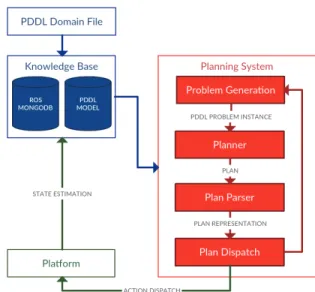
The Planning System is built upon ROSPlan (Cashmore et al. 2015). ROSPlan is a framework for embedding a PDDL planner into a ROS system. ROSPlan automatically gen-erates a PDDL planning problem, passes this to an exter-nal planner, and dispatches the plan. ROSPlan consists of two main components, the Knowledge Base and the Plan-ning System (see figure 2). The Knowledge Base stores the PDDL model. It stores both a domain model and the current state. It is continuously updated throughout execution, and queried by the Planning System. The Planning System in-tegrates with the planner. We have extended the framework to generate conditional planning problems and to make use of a contingent planner. In particular, we extended ROSPlan to use the planner Contingent-FF (Hoffmann and Brafman 2005b), although other planners can be used. The plan dis-patch module of the Planning System is also replaced, to instead pass the contingent plan entirely to the PNP transla-tor.
We use the formalisation of contingent planning from Hoffmann and Brafman (2005b), where observations and uncertainty are added to (sequential) STRIPS with condi-tional effects.
A planning problem comprises of a domainD describ-ing the actions and problem instanceP describing the initial state and goal condition. This is extended with uncertainty about the initial state, non-deterministic action effects, and observations. The initial state is a belief state represented by a propositional CNF formulaI. The possible initial world states are those that satisfy that formula. Observations are encoded as special observation actions. Such actions observe the value of a single proposition in the world state, thereby splitting the current belief state at hand and introducing two branches into the plan. Further details can be found in (Hoff-mann and Brafman 2005b).
In our approach, the domainDis used for modelling the
Figure 2: The Knowledge Base and Planning System com-ponents of the ROSPlan framework.
structure of any short-term interaction, independent from its specific context. The problemPcharacterizes the semantics of a specific interaction in a given context.
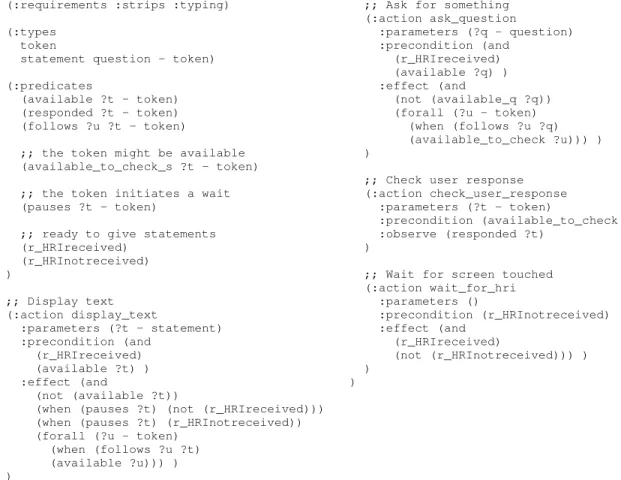
Figure 3.1 shows the conditional PDDL domain model for short-term HRI. As an example, the actiondisplay text is used to display a text token to the user. This action is independent of the content of the text message. Actions ask question andcheck user response are used to model a question and answer between the robot and the user, in which the user response is a proposition that can be observed.
Figure 4 shows a fragment of the PDDL problem for the TV Show scenario described in Section 4. The tokens (e.g., t news1,t news2) are entered by the domain expert, and correspond to messages specific to the context of the interac-tion. These are used by ROSPlan to automatically generate the PDDL problem. It is initially unknown which of the news tokens can be given to the user; this is represented using the standard syntax for uncertainty in the initial state.
(define (domain hri_contingent) (:requirements :strips :typing)
(:types token
statement question - token)
(:predicates
(available ?t - token) (responded ?t - token) (follows ?u ?t - token)
;; the token might be available (available_to_check_s ?t - token)
;; the token initiates a wait (pauses ?t - token)
;; ready to give statements (r_HRIreceived)
(r_HRInotreceived) )
;; Display text (:action display_text
:parameters (?t - statement) :precondition (and
(r_HRIreceived) (available ?t) ) :effect (and
(not (available ?t))
(when (pauses ?t) (not (r_HRIreceived))) (when (pauses ?t) (r_HRInotreceived)) (forall (?u - token)
(when (follows ?u ?t) (available ?u))) ) )
;; Ask for something (:action ask_question
:parameters (?q - question) :precondition (and
(r_HRIreceived) (available ?q) ) :effect (and
(not (available_q ?q)) (forall (?u - token)
(when (follows ?u ?q) (available_to_check ?u))) ) )
;; Check user response (:action check_user_response
:parameters (?t - token)
:precondition (available_to_check ?q) :observe (responded ?t)
)
;; Wait for screen touched (:action wait_for_hri
:parameters ()
:precondition (r_HRInotreceived) :effect (and
(r_HRIreceived)
(not (r_HRInotreceived))) ) )
)
Figure 3: Conditional domain model for human robot interaction.
formalization, whileP can be defined by experts of the ap-plication domain. Although not described in this paper, it is possible to allow domain experts to model the content of the interactions without any knowledge of PDDL, by providing the information in a data format that is then translated in the corresponding PDDL problemP. In other words, our for-malism integrates the work of a planning expert who defines the structure of the interaction and of a domain expert who defines the content of the interactions. Various goals can be given to deliver or discover certain information, amounts of information, or observe other metrics in the interaction. The planner is then able to generate a plan according to the struc-ture and the content specified in the model.
The planner Contingent-FF has been embedded in ROS-Plan and used to generate a contingent plan for the interac-tion. The plan is parsed as a Directed Acyclic Graph (DAG) and published in its entirety as a single ROS message.
3.2
Plan Translator
This module parses the dispatched plan and translates it into a conditional plan. We also ensure that the obtained plan is robust, i.e. less prone to replanning/failures due to uncer-tainty, through a process called robustification. This is re-alised by specifying syntactic rules, called Execution Rules (ER), that describe possible actions and recovery procedures
to perform in the plan. The overall effectiveness and robust-ness of the plan is increased by these routines in situations not modelled in the planning domain and possibly detected by the plan designer after its execution. The approach of im-proving a plan with Execution Rules has been introduced in (Iocchi et al. 2016).
In order to deal with different representations of the out-put plans provided by different planners, we have defined the following format to describe conditional plans:
λ=t1;...;tn
ti=a|< c1?t1:c2?t2;...;ck?tk>
In this representation λis a plan and is composed of a sequence of terms ti. Each term could be either an atomic action a or a multiple branch over k sensed properties
c1, . . . , ck. We assume all the conditions ci to be mutu-ally exclusive with each other and that each ci is associ-ated to a termtithat will be executed whenciis true. These branches are enclosed between angular brackets (< >) and colons (:) separate the different branches. In case conditions are not mutually exclusive and more conditionsci are true at the time they are evaluated by the PNP engine, a non-deterministic transition towards one of the true branches will occur.
(define (problem tvshow) (:domain hri_contingent) (:objects
t_init t_name t_welcome t_intro t_news t_news1 t_news2 t_news3 img_news1 img_news2 img_news3 t_joke t_goodbye img_coaches img_activity
- statement
q_activity q_news - question)
(:init
(r_HRInotreceived) (available_s t_init)
(follows_s_s t_name t_init) (follows_s_s t_intro t_name) (pauses t_intro)
(unknown (available_s t_news)) (unknown (available_s t_joke)) (oneof
(available_s t_news) (available_s t_joke) )
(unknown (available_s t_news1)) (unknown (available_s t_news2)) (unknown (available_s t_news3)) (oneof
(available_s t_news1) (available_s t_news2) (available_s t_news3) )
(pauses img_news1) (pauses img_news2) (pauses img_news3) ...
)
(:goal (and
(given t_goodbye) )))
Figure 4: A fragment of a problem generated for human robot interaction. The problem instance was used in the TV show scenario.
responsible for translating from standard planner output to the described representation. In particular, the planner con-sidered in this work is Contingent-FF, as described in the previous section. This component, however, is easily exten-sible to consider also other planners and different output for-malisms.
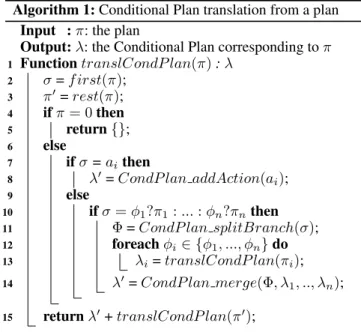
The algorithm that realizes the translation is described in Algorithm 1. f irst() is a function that returns the first part of the current plan, which could be either an atomic action or a branching term. In case of atomic actions,
CondP lan addAction() creates a conditional plan state and links it to one created earlier. In case of branches, we split them and recursively construct the sub-trees. The+ op-erator represents a concatenation opop-erator.
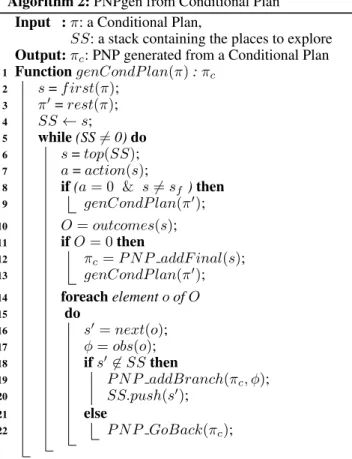
The module responsible for the actual generation of the PNP is calledGenerator. The algorithm that, from the con-ditional plan representation, generates the actual PNP is Al-gorithm 2. This alAl-gorithm realizes a graph visit on the struc-ture described by the conditional plan. It keeps track of the visited states and, at each iteration, it checks the possible outcomes of the states. If the current state has no action
as-Algorithm 1:Conditional Plan translation from a plan Input :π: the plan
Output:λ: the Conditional Plan corresponding toπ
1 FunctiontranslCondP lan(π):λ 2 σ=f irst(π);
3 π=rest(π); 4 ifπ= 0then 5 return{}; 6 else
7 ifσ=aithen
8 λ=CondP lan addAction(ai);
9 else
10 ifσ=φ1?π1:...:φn?πnthen 11 Φ=CondP lan splitBranch(σ); 12 foreachφi ∈ {φ1, ..., φn}do 13 λi=translCondP lan(πi); 14 λ=CondP lan merge(Φ, λ1, .., λn);
15 returnλ+translCondP lan(π);
sociated with it and is not final, it keeps going with recur-sion. Otherwise, there are two possible cases depending on whether the current state has successors. If there are no suc-cessors, we add a final state to the PNP. If there are succes-sors, the algorithms processes each of them. For each suc-cessor state that has not been visited yet, the algorithm adds a branch to the PNP and marks it as visited. Otherwise, if one successor state has been already visited, the algorithm adds an edge going back from that state to the current one.
The complexity of the presented algorithms is linear in the number of plan states. For the translation algorithm, we gen-erate a conditional plan state for each action in the computed plan. For the generation algorithm, we explore these states and generate the correspondent PNP. The functions used for the generation of the conditional plan and the PNP have a constant cost since they perform only local operations with-out looking at the whole plan.
4
Integration and Demonstrations
The presented system has been fully implemented and tested on mobile robots in several different demonstrations in pub-lic environments. The developed software1is based on twoexisting software libraries: ROSPlan2 and PNP3. Also the software described in this paper has been developed under the ROS4middleware and it is thus suitable for integration with other robotic components.
More specifically, the developed ROS node5for the
trans-lation component waits for a plan on the ROS topic pub-lished by the planning system, processes this plan as de-scribed in the previous sections producing a PNP and
dis-1https://sites.google.com/view/robusthri
2
http://kcl-planning.github.io/ROSPlan/
3
pnp.dis.uniroma1.it
4www.ros.org
5
Algorithm 2:PNPgen from Conditional Plan Input :π: a Conditional Plan,
SS: a stack containing the places to explore Output:πc: PNP generated from a Conditional Plan
1 FunctiongenCondP lan(π):πc 2 s=f irst(π);
3 π=rest(π); 4 SS←s;
5 while(SS=0)do 6 s=top(SS); 7 a=action(s);
8 if(a= 0 & s=sf )then 9 genCondP lan(π); 10 O=outcomes(s); 11 ifO= 0then
12 πc=P N P addF inal(s); 13 genCondP lan(π); 14 foreachelementoofO
15 do
16 s=next(o); 17 φ=obs(o);
18 ifs∈SSthen
19 P N P addBranch(πc, φ); 20 SS.push(s);
21 else
22 P N P GoBack(πc);
patches the PNP to the pnp ros module for execution. This process can be executed both off-line or on-line during the execution of a robot task. In the on-line case, the pnp ros module replaces the current plan with any new-coming plan. The planning process for the use cases discussed below is very fast: for these problems, less than a second is required. Moreover, in comparison, the translation from plan to PNP takes negligible time.
4.1
Use cases
The proposed system has been tested in different environ-ments characterized by short-term human robot interactions with non-expert users. The plans defined and generated with the proposed system have thus been exposed to execution in a real environment. Almost all interactions have been cor-rectly handled, regardless the lack of experience of the users interacting with the robot, thus showing the effectiveness of the proposed method.
Videos showing the interactions that oc-curred in these demonstrations are available at https://sites.google.com/view/robusthri/video. In all the examples shown, the robot executes short-term interaction plans generated with the system described in this paper. While the navigation of the robot in the environment was manually driven, mainly for safety reasons, all interactions that required input from the users (through speech or using the GUI on the tablet of the robot) have been modeled
Figure 5: A group of users interacting with the robot at Maker Faire 2016.
Figure 6: A user interacting with the robot during the Eras-mus welcome day.
and implemented as sensing actions. Similarly, the flow of execution of the plan is chosen at execution time according to the outcome of such interaction (i.e., sensing actions).
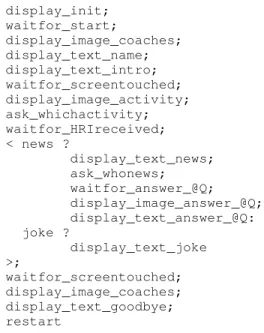
1. TV Show. The first demonstration described in this pa-per was pa-performed during a live TV show in which the robot was interviewed alongside a human. Before going to the TV studio, a sketch of the demo was prepared and it was pre-sented to the TV show director one hour before the show. The director made some comments about the interactions and asked to modify something and to be flexible with re-spect to timing of the show. Before the live show, the plan was modified and during the show the conditional plan pos-sessed the requested flexibility.
display_init; waitfor_start;
display_image_coaches; display_text_name; display_text_intro; waitfor_screentouched; display_image_activity; ask_whichactivity; waitfor_HRIreceived; < news ?
display_text_news; ask_whonews; waitfor_answer_@Q; display_image_answer_@Q; display_text_answer_@Q: joke ?
display_text_joke >;
waitfor_screentouched; display_image_coaches; display_text_goodbye; restart
Figure 7: A conditional plan for the TV Show.
2. Maker Faire. In this demonstration, the robot was de-ployed during a Maker Faire for three days to interact with people; children in particular. The interaction contained dif-ferent choices: information about the robot, quizzes, and jokes. Also in this example, the robustification phase added some recovery procedures to take into account some unex-pected behaviors of the users.
During the three days of the event, we needed to change the content several times. For example, (i) we realized that some interactions were too long and we wanted to simplify them, (ii) we wanted to change some of the content of the interactions for the day in which schools were present, and (iii) we wanted to test different interaction modalities.
To this end, the use of a planning system was fundamental in order to generate new plans on the fly when needed, by just changing the specification of the problem.
During these demonstrations, the robot interacted with about 300 people. Most of the executions were successful, while a very few executions failed and required a manual restart of the system. These situations were due to unex-pected interactions, such as, for example, users closing the window running the interaction program or restarting the op-erating system on the tablet.
An example of conditional plan used in this example is shown in Figure 8, in the format generated by the Plan Translator module.
3. Erasmus welcome day. Finally, the system was tested during a Faculty meeting for Erasmus students. Short-term interactions were designed to welcome the students, to ask the students from which country they come and to show some information about the countries. Since the list of stu-dents and thus of countries was known in advance, it was possible to pre-define all the possible countries and to gen-erate appropriate questions and answers for each country.
display_init; waitfor_answera; askimg_whichinfoABCD; waitfor_HRIreceived; <
answera ?
display_image_info_alfred; display_text_info_alfred: answerb ?
display_image_info_r20; display_text_info_r20: answerc ?
choose_joke; waitfor_joke_@J; display_text_joke_@J: answerd ?
display_image_info_roberto; display_text_info_roberto >;
display_text_goodbye; restart
Figure 8: A conditional plan for the Maker Faire.
display_init; waitfor_personhere; display_text_welcome; ask_whichcontinent; waitfor_continent_@C; ask_whichcountry_@C; waitfor_country_@N; display_text_@N; display_image_@N; ask_wantphoto; waitfor_no;
display_text_greet; display_text_goodbye; display_init
Figure 9: The plan for the Erasmus Welcome day.
This process was done by a semi-automatic tool for the gen-eration of interactions and is not described in this paper.
The robustification phase in this example has been imple-mented with recovery procedures acting when users do not answer a question after a timeout and restarting the interac-tions in these cases.
About 40 students were present in the event and at least half of them interacted with the robot. Since user studies were not an experimental focus, we have not collected spe-cific data about such interactions, but just observed that all the executions of plans were correctly completed (in some cases, thanks to the recovery procedure).
The plan used in this demonstration is shown in figure 9. This format is generated from the DAG by the Translation Module, and then encoded into a PNP, as described in Sec-tion 3.2.
5
Conclusions
gen-display_text t_init
wait_for_hri
display_image i_coaches
display_text t_name;
display_text t_intro
wait_for_hri
display_image i_activity
ask_question q_whichactivity
wait_for_hri
check_user_response t_news
display_text t_news
check_user_response t_joke display_text whonews
wait_for_hri
display_image_answer_@Q
display_text_answer_@Q:
wait_for_hri display_text_joke
display_image i_coaches;
display_text t_goodbye
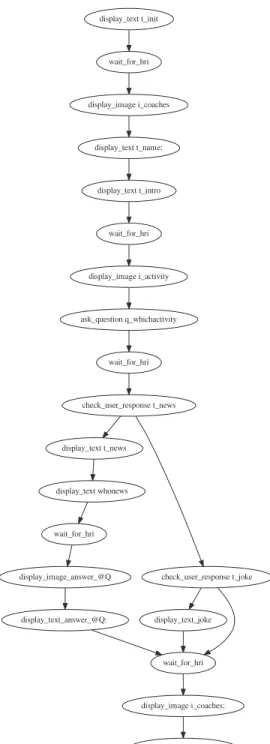
Figure 10: The conditional plan generated by Contingent-FF in DOT form.
erating and executing short-term interactions by a robot de-ployed in a public environment.
While conditional planning has previously been used in short-term HRI, our focus is on 1) the separation of the struc-ture of the planning model and the context of the interaction, 2) the integration into an execution environment through the ROSPlan and Petri Net Planning frameworks. The system has been fully implemented and tested on a real robot in
sev-eral different scenarios and open-source release of the code. Our extension integrates conditional planning into ROS-Plan. This will allow the generation and execution of condi-tional plans on board a robot, through the ROSPlan frame-work. Moreover, it is now possible to use a contingent plan-ner to geplan-nerate the conditional plans used as input to PNP. The result is a powerful and flexible tool for conditional planning on board robotics systems, with potential beyond short-term HRI.
In future work we intend to formalize the conditional planning domain used for our examples, providing links between the common interaction patterns and the general structures in our domain.
Acknowledgements
This work has been partially developed within the COACHES project. COACHES is funded within the CHIST-ERA 4th Call for Research projects, 2013, Adaptive Machines in Complex Environments (AMCE) Section. Sapienza University is funded by MIUR (Italy). This work has been partially funded by European Commision as a part of SQUIRREL project that involves King’s College London, under grant agreement No FP7-610532.
References
Alterovitz, R.; Koenig, S.; and Likhachev, M. 2016. Robot planning in the real world: research challenges and opportu-nities. AI Magazine37(2):76–84.
Bajones, M. 2016. Enabling long-term human-robot in-teraction through adaptive behavior coordination. In The Eleventh ACM/IEEE International Conference on Human Robot Interaction, 597–598. IEEE Press.
Bonet, B., and Geffner, H. 2000. Planning with incom-plete information as heuristic search in belief space. InProc. of the Conference on AI Planning and Scheduling, 52–61. AAAI Press.
Brafman, R. I.; Bar-Sinai, M.; and Ashkenazi, M. 2016. Per-formance level profiles: A formal language for describing the expected performance of functional modules. In2016 IEEE/RSJ International Conference on Intelligent Robots and Systems, IROS 2016, Daejeon, South Korea, October 9-14, 2016, 1751–1756.
Cashmore, M.; Fox, M.; Larkworthy, T.; Long, D.; and Mag-azzeni, D. 2014. AUV mission control via temporal plan-ning. InRobotics and Automation (ICRA), 2014 IEEE Inter-national Conference on, 6535–6541. IEEE.
Cashmore, M.; Fox, M.; Long, D.; Magazzeni, D.; Ridder, B.; Carrera, A.; Palomeras, N.; Hurtos, N.; and Carreras, M. 2015. ROSPlan: Planning in the robot operating system. In Proceedings of the 25th International Conference on Auto-mated Planning and Scheduling (ICAPS’15), 333–341.
Erdem, E.; Aker, E.; and Patoglu, V. 2012. Answer set programming for collaborative housekeeping robotics: rep-resentation, reasoning, and execution. Intel Serv Robotics. Fiore, M.; Clodic, A.; and Alami, R. 2016. On planning and task achievement modalities for human-robot collaboration. InExperimental Robotics, 293–306. Springer International Publishing.
Hanheide, M., et al. 2015. Robot task planning and expla-nation in open and uncertain worlds. Artificial Intelligence. Hoffmann, J., and Brafman, R. 2005a. Contingent planning via heuristic forward search with implicit belief states. In Proceedings of the 15th International Conference on Auto-mated Planning and Scheduling (ICAPS-05), 71–80. Hoffmann, J., and Brafman, R. 2005b. Contingent planning via heuristic forward search with implicit belief states. In Proceedings of the 15th International Conference on Auto-mated Planning and Scheduling (ICAPS-05), 71–80. Iocchi, L.; Jeanpierre, L.; L´azaro, M. T.; and Mouaddib, A.-I. 2016. A practical framework for robust decision-theoretic planning and execution for service robots. In Inter-national Conference on Automated Planning and Schedul-ing (ICAPS), 486–494.
Karpas, E.; Levine, S. J.; Yu, P.; and Williams, B. C. 2015. Robust execution of plans for human-robot teams. InICAPS, 342–346.
Lallement, R.; De Silva, L.; and Alami, R. 2014. HATP: An HTN planner for robotics. In2nd ICAPS Workshop on Planning and Robotics, 20–27.
Little, I., and Thiebaux, S. 2007. Probabilistic planning vs. replanning. In In ICAPS Workshop on IPC: Past, Present and Future.
Mcdermott, D.; Ghallab, M.; Howe, A.; Knoblock, C.; Ram, A.; Veloso, M.; Weld, D.; and Wilkins, D. 1998. Pddl - the planning domain definition language. Technical Report TR-98-003, Yale Center for Computational Vision and Control,. Milliez, G.; Lallement, R.; Fiore, M.; and Alami, R. 2015. Using Human Knowledge Awareness to Adapt Collabora-tive Plan Generation, Explanation and Monitoring. In Inter-national Conference on Human-Robot Interaction.
Mudrov´a, L.; Lacerda, B.; and Hawes, N. 2016. Partial order temporal plan merging for mobile robot tasks. InProc. of the 22nd European Conf. on Artificial Intelligence (ECAI). Nardi, L., and Iocchi, L. 2014. Representation and execution of social plans through human-robot collaboration. InFifth International Conference on Social Robotics (ICSR 2014), 266–275.
Palomeras, N.; Carrera, A.; Hurt´os, N.; Karras, G. C.; Bech-lioulis, C. P.; Cashmore, M.; Magazzeni, D.; Long, D.; Fox, M.; Kyriakopoulos, K. J.; et al. 2016. Toward persistent autonomous intervention in a subsea panel. Autonomous Robots40(7):1279–1306.
Petrick, R. P. A., and Bacchus, F. 2004. PKS: Knowledge-based planning with incomplete information and sensing. In Proceedings of the System Demonstration session at ICAPS. Petrick, R. P. A., and Foster, M. E. 2013. Planning for so-cial interaction in a robot bartender domain. InProceedings
of the Twenty-Third International Conference on Automated Planning and Scheduling, ICAPS.
Petrick, R. P. A., and Foster, M. E. 2016. Using general-purpose planning for action selection in human-robot inter-action. InProceedings of the AAAI Fall Symposium on Arti-ficial Intelligence for Human-Robot Interaction (AI-HRI). Tomic, S.; Pecora, F.; and Saffiotti, A. 2014. Too cool for school - adding social constraints in human aware plan-ning. InProc. of 9th International Workshop on Cognitive Robotics.
Wilson, M. A.; McMahon, J.; Wolek, A.; Aha, D. W.; and Houston, B. H. 2016. Toward goal reasoning for au-tonomous underwater vehicles: Responding to unexpected agents.