City, University of London Institutional Repository
Citation
:
Horkoff, J. & Maiden, N. (2015). Creativity and conceptual modeling for
requirements engineering. CEUR Workshop Proceedings, 1342, pp. 62-68.
This is the accepted version of the paper.
This version of the publication may differ from the final published
version.
Permanent repository link:
http://openaccess.city.ac.uk/15057/
Link to published version
:
Copyright and reuse:
City Research Online aims to make research
outputs of City, University of London available to a wider audience.
Copyright and Moral Rights remain with the author(s) and/or copyright
holders. URLs from City Research Online may be freely distributed and
linked to.
City Research Online:
http://openaccess.city.ac.uk/
[email protected]
Creativity and Conceptual Modeling for Requirements
Engineering
Jennifer Horkoff and Neil Maiden
Centre for Human Computer Interaction Design, City University London
Email: horkoff, [email protected]
Abstract. Creativity techniques have been applied to Requirements Engineer-ing (RE) in order to find novel requirements, facilitatEngineer-ing system and business innovation. Creativity has typically been applied to RE as part of an intensive, often multi-day workshop. Ideas are generated and recorded in a free-form, manual fashion, with much guidance from experienced human facilitators. Alt-hough this format has been successful, economic, time, and geographical pres-sures make this intensive process less feasible. The free-form representation of creative output (text and informal diagrams) provides flexibility in order to sup-port creative thought, but the output of this form is not able to take advantage of much of the (semi-) automated analysis developed for RE, including trade-off analysis. In this work we address two major challenges 1) the limitations of ex-isting creativity RE workshops, particularly their costliness and need for expert guidance, and 2) capturing creative output in a structured form, better amenable to (semi-) automated analysis and downstream development. We address these as part of a 2-3 year project focusing on integrating RE creativity techniques with conceptual modeling techniques such as goal modeling, with a focus on developing online, distributed creative support tools for RE.
1
Introduction
Recent work has made the link between creativity techniques and RE (e.g., [1–6]), arguing that existing approaches treat the RE process as essentially a problem of scop-ing and understandscop-ing activity, while effective requirement elicitation and analysis should focus instead on problem discovery and problem solving. Finding the “right” requirements is not about capturing stakeholder requirements, but is instead about helping stakeholders to discover requirements they were not aware of, solving prob-lems they did not know they had. RE techniques should facilitate the creative pro-cesses needed to develop innovative products - a key factor in keeping competitive.
In this paper we outline ideas, initial progress, and plans for a recently-funded mul-ti-year research project. The project was initially aimed at exploiting the synergies between creativity techniques and goal-oriented modeling for RE, but our focus has broadened to generally making better use of conceptual models in creative RE activi-ties as part of online tool support. In this way, we aim to reduce reliance on creativity experts and expensive workshops, capturing creative ideas in a more structured form, taking better advantage of existing RE analysis techniques. Furthermore, the structure of conceptual models capturing creative ideas can be used to support a more systemat-ic generation of creative ideas. For example, existing goal model analysis techniques (e.g., [7]) can be applied to support creative analysis (transformational, exploratory, combinatorial) by exploring the removal of captured assumptions, automatically sug-gesting new model connections, and evaluating the effectiveness of elicited ideas in terms of system and user goals.
Our aim is, in part, to understand the synergies between conceptual models used for RE and creativity techniques. We begin to explore this area by conducting and describing results of an exploratory experiment evaluating the combination of goal models and creativity triggers.
The overarching challenge of this work is to complement “irrational”, free-form creativity with “logical”, decomposition-based models, without over compromising the advantages provided by each technique. The overall objective is to improve RE practice, ensuring system innovation while meeting user needs.
In the rest of this paper, Sec. 2 provides background on creativity in RE, identifies challenges, and describes an example RE model analysis technique. Sec. 3 gives an overview of our proposed approach, including a high-level description of the intended tool support, examples of how conceptual models can feed into creativity techniques, and a brief description of our exploratory experiment and results. Sec. 4 concludes the paper and discusses future plans.
2
Background
In this section we provide background on creativity in RE and give an example of the type of model analysis which can be used as part of creative RE elicitation.
2.1 Creativity in RE
In [1], Maiden et al. adopt existing definitions of creativity to define creative require-ments as those that are both novel and appropriate (useful). Creativity can be trans-formational, changing boundary rules to consider transformative ideas, possibly in another paradigm [8], exploratory, exploring a space of possibilities, or combinatorial, combining together creative output.
the role of collaboration in RE creativity, proposing a list of factors influencing col-laborative creativity, e.g., values, and subject matter expertise [4]. Although guidance provided by these papers is useful, the output of our proposal aims to be more con-crete – an integrated, tool supported framework for goal-oriented creativity.
Several papers have reported experience applying creativity techniques in an RE workshop setting as part of the RESCUE process (e.g., [5]). This approach has been applied in settings such as Air Traffic Control, work-integrated learning (APOSDLE), and food traceability. Workshops typically involve several stages, each of which can be mapped to a particular type of creativity: Round Robin (exploratory), Scoping (transformational), Creativity Triggers (exploratory), Constraints (transformational), Ideas from presented design features (exploratory), and Storyboarding (combinatori-al). Inputs to workshops included use cases, context, and rich picture models. Work-shop outputs included collages using pictures, storyboards, idea cards placed on pin boards, and mock-ups. Outputs were converted, primarily by analysts, into lists of ideas, requirements, and/or use cases.
The multi-day, in-person workshops, although effective, are costly, both in money and time. Workshop facilitation requires specific soft skills, difficult to capture and transfer. It is critical to develop effective tools which provide semi-automated support for creative tasks. Limited tool support is available, typically focusing on supporting a particular creative activity, e.g., mind maps, composition of document pieces (see [1] for a summary). Tools to guide participants in an overall creative process – candidates to replace the workshop structure – are lacking.
2.2 RE Conceptual Model Analysis
Once requirements knowledge is captured in a structured format, this knowledge can be analyzed (reasoned over, evaluated) in order to support improved RE understand-ing and decision makunderstand-ing. We turn to qualitative, interactive goal model analysis as a concrete example, particularly applicable to creativity activities due to its high level of abstraction and deliberate incorporation of user input.
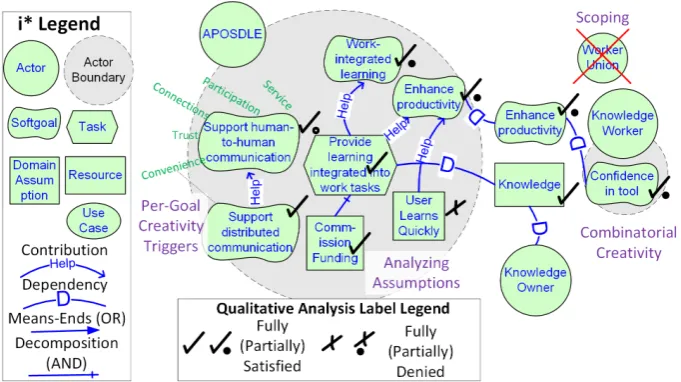
Fig. 1. Example Goal Model (i*) from the APOSDLE Work-Integrated Learning Case showing Example Qualitative Analysis Results
3
Proposed Approach: Creativity and Conceptual Modeling
In this section we give an overview of our planned approach, including tool support and process, an example of how existing model analysis can be used to support crea-tivity, and details about an exploratory study examining the combination of goal mod-eling and creativity.
3.1 Tooling and Process Overview
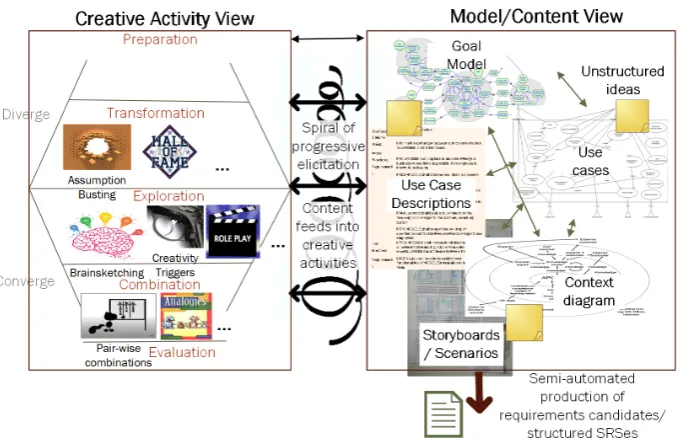
Fig. 2. Conceptual Summary of Distributed, Online, Model-Based, Creative Requirements Elicitation Tool Support
On the right, we see the model/content view. Users can switch between the selec-tion of activities and views of several, interconnected models and other representa-tions. At this point, we include the models/representations used as part of the physi-cal workshops as well as goal modeling. Additional/alternative representations could be used. Following conventions in the physical workshops, creative process may start with an input of pre-existing seed models. Model content is added and changed as a result of the creativity activities. For example, a free writing exercise may elicit an interesting new scenario, captured as a new use case, with a corresponding textual description, bringing to light new goals and goal connections for addition to the goal model, and may be later selected for exploration in a visual storyboard. Although users are encouraged to capture their ideas using model constructs, they can be al-lowed to quickly capture ideas using digital post-it notes added to the models, with encouragement to incorporate these ideas into the model proper when possible.
After an iterative process of creative activities and modeling, resulting model con-tent can be processed automatically to form candidate textual requirements or struc-tured Software Requirement Specifications (SRS), feeding into downstream develop-ment.
3.2 Creativity and Model Analysis
[image:6.595.131.473.160.380.2]In this case, considering the convenience trigger in regards to “Support-human-to-human communication” provokes a new idea which results in a new softgoal, “Sup-port distributed communication”. Constraint analysis can be captured via the addition and removal of domain assumptions (rectangles). Scoping activities can be explored by including or excluding certain actors or responsibilities (tasks). Combinatorial creativity can be facilitated by suggesting new combinations between actors or ele-ments, for example, what if the APSODLE actor depended on the Knowledge Owner instead of the Knowledge Worker? Finally, analysis as described in Sec. 2.2 can be applied to evaluate creative ideas as captured in the model (a bottom-left activity of Fig. 2). Future work will explore more possibilities, including effective tool support.
3.3 Exploratory Study: Creativity and Goal Modeling
We have performed an initial, exploratory study in order to understand potential syn-ergies between creativity techniques and conceptual modelling for RE. As experience has been recorded with models such as use cases and context diagrams, we focused this study on the use of goal models – new to creativity. Although our study was exploratory in nature, we were guided by several questions, including: a) Should goal modeling be performed before or after creativity techniques? b) Can goal models effectively capture creative ideas? c) Does the structure of the models impede creative thought?
In order to begin exploring the space, we have performed nine one-hour sessions with small groups of 1-4 students, primarily graduate students, all of whom have some coursework experience with goal (i*) models. Sessions involved a total of 23 participants, studying a range of Information System-related topics, including ness Analysis and Design, Software Engineering, Information and Technology, Busi-ness Systems, and BusiBusi-ness Computing.
In the sessions, student were given a toy scenario, then were asked to sketch a goal model and come up with creative ideas guided by selected creativity triggers. Five groups performed goal modeling then creative thinking, while the other four groups did the reverse. Participants reflected on the process via a short survey, including the ordering of activities and potential synergies between modeling and creative thought. Results indicate that goal modeling was generally better received before creative thinking – performing a creative activity straight off, without the shared domain ex-ploration provided by modeling, was often difficult. However, results for this question were strongly influenced by the ordering of the activities in the study. Almost all par-ticipants indicated that if they had to do the activity again, they would perform both creativity and goal modeling; there was a general agreement that these activities work well together. Participants were often able to express their creative ideas in terms of the model, e.g., adding new actors or softgoals. However, due to the limited time allotted for the experiment, most groups did not have time to actually make these changes. Goal modeling did not appear to over-constrain creative thought, but gave group members a common understand by which to ground their ideas.
modeling to support shared understanding, then moving into rounds of creativity techniques, with outputs incorporated back into the model(s). We will use the insights gained as part of this study to help shape our tooling.
4
Conclusions and Future Work
We have provided an overview of a project aiming to enhance creativity techniques as applied to RE using tooling with a conceptual modeling foundation. Developed tools should be, as much as possible, online and distributed, helping to avoid costly, in-person workshops. We aim to make creative RE elicitation more accessible while taking advantage of existing work facilitating RE analysis. Obviously, plans are in an early stage and much conceptual and implementation work must be done. Future plans include application of the resulting ideas and toolset to industrial examples.
Acknowledgments
This work is supported by an ERC Marie Skodowska-Curie Intra European Fellow-ship (PIEF-GA-2013-627489) and by a Natural Sciences and Engineering Research Council of Canada Postdoctoral Fellowship (Sept. 2014 - Aug. 2016).
References
1. N. Maiden, S. Jones, K. Karlsen, R. Neill, K. Zachos, and A. Milne, “Requirements engi-neering as creative problem solving: A research agenda for idea finding,” in 18th IEEE Int. Requirements Engineering Conference (RE10), 2010, pp. 57–66.
2. L. Nguyen and G. Shanks, “A framework for understanding creativity in requirements en-gineering,” Information and Software Technology, vol. 51, no. 3, pp. 655–662, Mar. 2008. 3. M. Mahaux, A. Mavin, and P. Heymans, “Choose your creativity: Why and how creativity
in requirements engineering means different things to different people,” in Requirements Engineering: Foundation for Software Quality (REFSQ12), LNCS 7195, pp. 101–116, 2012.
4. M. Mahaux, O. Gotel, A. Mavin, L. Nguyen, L. Mich, and K. Schmid, “Collaborative crea-tivity in requirements engineering: Analysis and practical advice,” in IEEE Seventh Int. Conference on Research Challenges in Information Science (RCIS13), 2013, pp. 1–10. 5. N. Maiden, A. Gizikis, and S. Robertson, “Provoking creativity: imagine what your
re-quirements could be like,” Software, IEEE, vol. 21, no. 5, pp. 68–75, Sep. 2004.
6. T. Bhowmik, N. Niu, A. Mahmoud, and J. Savolainen, “Automated support for combina-tional creativity in requirements engineering,” in IEEE 22nd Int. Requirements Engineering Conference (RE14), 2014, pp. 243–252.
7. J. Horkoff and E. Yu, “Interactive goal model analysis for early requirements engineering,” Requirements Engineering, pp. 1–33, 2014.
8. M. A. Boden, The Creative Mind. London: Abacus, 1990.