University of Strathclyde
Department of Electronic and Electrical
Engineering
Secure Decentralised
Storage Networks
by
Greig Paul
A thesis submitted in fulfilment of the
requirements for the degree of
Doctor of Philosophy
to the University of Strathclyde
Declaration
This thesis is the result of the author’s original research. It has been composed by the author and has not been previously submitted for examination which has led to the award of a degree.
The copyright of this thesis belongs to the author under the terms of the United King-dom Copyright Acts as qualified by University of Strathclyde Regulation 3.50. Due acknowledgement must always be made of the use of any material contained in, or derived from, this thesis.
Signed:
“Security is a process, not a product.”
Abstract
In recent years, cloud-based computing and storage have become increasingly popular, as they remove the need for users and developers to buy or rent expensive dedicated hardware on an ongoing basis. This has led to the increasing centralisation of both ser-vices and storage, where users are reliant upon a small number of cloud-based providers to hold their data, and provide them with services they use. Recent events have shown that security breaches of centralised data stores can lead to significant quantities of per-sonal data being revealed. This centralisation can also result in inconvenience in the event of the failure of the service provider, resulting in potential data loss or a loss of utility of the service.
In contrast, a decentralised service and storage architecture removes the single point of failure from a network, and allows users to remove their dependency on a single company or service provider. In addition, by preventing storage providers from having access to user data, as is inherently needed in a decentralised network to preserve confi-dentiality, it is possible for users to protect their data from theft or unauthorised access, giving rise to data security and privacy benefits.
Acknowledgements
Contents
Abstract
iiiAcknowledgements
iv [image:6.595.111.528.81.745.2]List of Publications
xivTable of Abbreviations
xv1 Introduction
11.1 Thesis Overview . . . 3
1.2 Motivation . . . 4
1.2.1 Limitations of Centralised Services . . . 5
1.2.2 Convenience versus Security . . . 6
1.3 Towards Potential Solutions . . . 8
1.4 Key Research Questions. . . 9
1.5 Thesis Outline and Contributions . . . 10
2 Background Material
14 2.1 Service Architectures . . . 142.1.1 Centralised Services . . . 14
2.1.2 Modern Web Services . . . 16
2.1.3 Decentralised Services . . . 17
2.1.4 Distributed and Federated Services . . . 18
2.2 Impact of Centralisation on Security and Privacy . . . 19
2.3 Distributed Hash Tables. . . 21
2.3.1 Previous Decentralised Networks . . . 24
2.4 Cryptographic Hash Functions . . . 24
2.5 The MaidSafe Network . . . 26
2.5.1 Data Storage and Encryption . . . 26
2.5.2 Data Retrieval and Bootstrapping . . . 27
2.5.4 Network Management . . . 32
2.5.5 Security Model and Encryption . . . 32
2.5.6 Deduplication . . . 33
2.6 Key Challenges in Decentralised Networks . . . 34
2.6.1 Resource Management in Decentralised Networks . . . 34
2.6.2 Application of Storage Limitations . . . 35
2.6.3 Performance Challenges of Proof of Storage Schemes . . . 36
2.6.4 Contact and Resource Discovery . . . 37
2.6.5 Ownership-Transferable Data and Records . . . 38
2.7 Decentralised Smart Contracts . . . 39
2.8 Security and Privacy . . . 40
2.8.1 Security . . . 40
2.8.2 Privacy. . . 41
2.8.3 Privacy in Legislation . . . 43
2.8.4 Privacy in Relation to Services and Storage . . . 45
2.9 Human Factors . . . 47
2.9.1 Passwords as Credentials . . . 47
2.9.2 Key Storage . . . 48
2.9.3 The Value of Successful Attacks . . . 49
2.10 Security of Implementations of Current Services . . . 50
2.10.1 Overview of Transport Layer Security (TLS) . . . 50
2.10.2 Previous CA Compromises . . . 51
2.10.3 Certificate Pinning . . . 52
2.11 Conclusions . . . 52
3 Security of the MaidSafe Decentralised Network
54 3.1 Introduction . . . 543.1.1 Chapter Contributions . . . 54
3.1.2 Terminology Notice . . . 55
3.2 MaidSafe Self-Encryption Algorithm . . . 55
3.2.1 Analysis of the Encryption Implementation . . . 56
3.2.2 Improved Performance of Convergent Encryption Implementation . 61 3.2.3 Network Addressing . . . 62
3.3 Threats Identified . . . 64
3.3.1 Address Proximity Attack . . . 65
3.3.2 Attack Implementation . . . 71
3.4 Application of the Birthday Attack . . . 73
3.5 Manager Verification . . . 75
3.6 Chunk Information Holders . . . 76
3.6.1 Data Distribution Authority. . . 77
3.6.2 False Data Mutation . . . 77
3.6.3 False Data Removal . . . 78
3.6.4 Mitigation and Analysis. . . 79
3.7 Dishonest Vault Attack . . . 80
3.7.1 Overview of Attack . . . 80
3.7.2 Analysis of Impact . . . 80
3.7.3 Mitigation of Attack . . . 81
3.8 Incorrect Proof of Storage Implementation. . . 81
3.8.1 MaidSafe Implementation . . . 82
3.8.2 Implementation of a High Performance Proof of Storage System . . 82
3.9 Storage Hand-Off Attack . . . 84
3.10 Decentralised Transferable-Ownership Mutable Data . . . 85
3.10.1 Challenges of Signature-Based Approaches . . . 86
3.10.2 Formulating an Ownership Structure . . . 87
3.10.3 Threat Modelling . . . 91
3.11 Conclusions . . . 93
4 Decentralised Service Implementation & Performance
95 4.1 Introduction . . . 954.1.1 Chapter Contributions . . . 96
4.2 Storage Contracts . . . 96
4.2.1 Motivation . . . 97
4.2.2 Decentralised Storage Purchase Protocol . . . 97
4.2.3 Threat Modelling of Protocol . . . 99
4.2.4 Adding Bi-Directional Obligations to Contracts . . . 101
4.3 Service Implementation . . . 102
4.4 Service API and Storage Model . . . 103
4.4.1 GETVerb . . . 103
4.4.2 PUTVerb . . . 104
4.4.3 UPDATEVerb . . . 104
4.4.4 DELETEVerb . . . 104
4.4.5 SHAREVerb . . . 105
4.4.6 GETSHARESVerb . . . 106
4.4.7 GETADDRESSVerb . . . 106
4.5.1 Performance of Current Decentralised DHT-Based Services . . . . 108
4.5.2 A Hybrid Approach to Accessing Decentralised Services . . . 111
4.5.3 Performance of Hybrid Relayed Network . . . 116
4.6 Conclusions . . . 116
5 Endpoint Security
118 5.1 Introduction . . . 1185.2 Security of Android Certificate Pinning and Device Provisioning . . . 119
5.2.1 Client Provisioning Process . . . 119
5.2.2 Certificate Pinning . . . 120
5.2.3 Account Registration Security. . . 122
5.2.4 Remote Control of Device . . . 123
5.2.5 Summary of Findings . . . 125
5.3 Encryption Applications on Android . . . 126
5.3.1 Selection of Applications and Testing Methodology . . . 126
5.3.2 Vlocker-Hide Videos . . . 127
5.3.3 Hide Pictures & Videos - FotoX . . . 129
5.3.4 Video Locker & Photo Locker (Handy Apps) . . . 130
5.3.5 Password Locker . . . 134
5.3.6 Video Locker (NewSoftwares.net) . . . 136
5.3.7 Gallery Vault . . . 137
5.3.8 Encrypt File Free . . . 139
5.3.9 Conclusions of Analysis and Discussion . . . 142
5.4 Conclusions . . . 144
6 Preserving Privacy in Centralised and Decentralised Discovery
146 6.1 Introduction . . . 1466.2 Privacy Preserving Service User Discovery . . . 147
6.2.1 Approaching the Problem. . . 148
6.3 Novel Approach to Private Service User Discovery . . . 149
6.4 Background on Memory Hard Hashes . . . 150
6.4.1 Performance on Mobile Phones . . . 151
6.4.2 Parallelisation of scrypt . . . 153
6.5 Implementation Description and Performance . . . 154
6.5.1 Client Application . . . 154
6.5.2 Server Application . . . 156
6.5.3 Parameter Selection . . . 156
6.6.1 Untargeted Attacks . . . 158
6.6.2 Targeted Attacks . . . 160
6.6.3 Social Graph Discovery Attack . . . 161
6.6.4 False Friendship Attacks . . . 162
6.7 Comparison and Evaluation . . . 163
6.7.1 Comparison with TextSecure Server . . . 163
6.7.2 Contribution Overview . . . 164
6.7.3 Performance Comparison. . . 165
6.8 Attack Mitigations . . . 166
6.9 Conclusions . . . 167
7 Identity and Authentication
169 7.1 Introduction to Identity and Authentication . . . 1697.1.1 Relation to Secure Systems . . . 170
7.1.2 Strong Authentication of Identity . . . 170
7.1.3 Trust in Authentication . . . 171
7.1.4 Federation of Authentication . . . 171
7.1.5 Limitations of Delegated Authentication. . . 171
7.2 Enforcing Authentication . . . 172
7.2.1 Mandatory Authentication . . . 173
7.2.2 Identity-based Cryptography . . . 174
7.3 Biometric Authentication . . . 174
7.3.1 History of Fingerprint Reader Usage . . . 174
7.3.2 User Attitudes and a Need for Convenience . . . 175
7.3.3 Biometrics in Authenticaton and Identification . . . 176
7.3.4 Fundamental Limitations of Biometrics . . . 177
7.3.5 Limitations of Fingerprint Sensing . . . 178
7.3.6 Legislatory Concerns . . . 179
7.3.7 Current Implementation . . . 180
7.3.8 Future Considerations . . . 182
7.3.9 Potential Mitigations . . . 183
7.3.10 Conclusions of Fingerprint Authentication. . . 186
7.4 User Credentials and Key Storage . . . 187
7.5 Smartcard Authentication . . . 188
7.5.1 Existing Smartcard Authentication Schemes. . . 188
7.6 Secure Smartcard Identity Storage . . . 191
7.6.1 Overview of Solution . . . 192
7.6.3 Secure Treatment of Keys . . . 195
7.6.4 Key Component Security . . . 196
7.7 Principles of Security . . . 197
7.7.1 Combination of Encryption and Authentication . . . 197
7.7.2 Key Usage Enforcement . . . 198
7.8 Security Threat Model . . . 198
7.8.1 Preventing Key Theft . . . 200
7.8.2 IV Selection . . . 200
7.8.3 Protection of RSA Components . . . 201
7.8.4 Preventing Sign or Decrypt Operations . . . 201
7.8.5 Enforcing Correct Key Usage . . . 201
7.8.6 Preventing Corrupt or Modified Keys from Use . . . 202
7.8.7 Preventing Disclosure of Internal State Data. . . 202
7.8.8 Side Information from Key Blobs . . . 203
7.8.9 Resistance to Attacks Identified against PKCS#11 . . . 203
7.9 Full Implementation and Validation Against Existing Services . . . 205
7.9.1 2-Factor Authentication Using HOTP/TOTP . . . 205
7.9.2 Account Key Authentication Against Let’s Encrypt . . . 206
7.10 Attack Countermeasures . . . 208
7.10.1 Mitigations Against Invasive Attacks . . . 208
7.10.2 Human Factors Including User Duress . . . 209
7.10.3 Verification of Duress Functionality . . . 210
7.11 PIN Entry Security . . . 210
7.12 Performance and Discussion. . . 211
7.12.1 Key Generation . . . 212
7.12.2 Public Key Retrieval . . . 212
7.12.3 Signature Generation . . . 213
7.12.4 Message Decryption . . . 213
7.12.5 AES Performance . . . 214
7.12.6 Identification of Performance Overhead . . . 215
7.13 Conclusions . . . 217
8 Conclusions and Future Work
219 8.1 Conclusions . . . 2198.1.1 Review of Key Contributions . . . 221
8.2 Future Work . . . 223
8.2.1 Decentralised Networks. . . 223
8.2.3 Client Security . . . 224
List of Publications
[A1] G. Paul, F. Hutchison, and J. Irvine, “Security of the MaidSafe Vault Network,” inProceedings of Wireless World Research Forum Meeting 32, May 2014.
[A2] G. Paul and J. Irvine, “Privacy implications of wearable health devices,” in Pro-ceedings of the 7th International Conference on Security of Information and Networks, SIN ’14, (New York, NY, USA), pp. 117:117–117:121, ACM, 2014.
[A3] G. Paul and J. Irvine, “A protocol for storage limitations and upgrades in de-centralised networks,” in Proceedings of the 7th International Conference on Security of Information and Networks, SIN ’14, (New York, NY, USA), pp. 69:69–69:72, ACM, 2014.
[A4] G. Paul and J. Irvine, “Google’s Android setup process security,” inProceedings of Wireless World Research Forum Meeting 33, September 2014.
[A5] X. Bellekens, G. Paul, J. Irvine, C. Tachtatzis, R. Atkinson, T. Kirkham, and C. Renfrew, “Data remanence and digital forensic investigation for CUDA graphics processing units,” inProceedings of 1st IEEE/IFIP Workshop on Security for Emerging Distributed Network Technologies (DISSECT), 2015.
[A6] G. Paul and J. Irvine, “Achieving optional Android permissions without oper-ating system modifications,” in Proceedings of Vehicular Technology Conference (VTC Spring), 2015 IEEE 81st, 2015.
[A7] G. Paul and J. Irvine, “5G-enabled decentralised services,” inProceedings of Ve-hicular Technology Conference (VTC Spring), 2015 IEEE 81st, pp. 1–5, IEEE, May 2015.
[A9] G. Paul, D. Thomas, and J. Irvine, “Privacy implications of smartphone-based connected vehicle communications,” inProceedings of Vehicular Technology Conference (VTC Fall), 2015 IEEE 82nd, pp. 1–3, September 2015.
[A10] G. Paul and J. Irvine, “Take control of your pc with UEFI secure boot,”Linux Journal, no. 257, pp. 58–72, 2015.
[A11] D. Thomas, G. Paul, and J. Irvine, “Going beyond the user — the challenges of universal connectivity in IoT,” in Proceedings of Wireless World Research Forum Meeting 35, 2015.
[A12] P.-L. Dubouilh, G. Paul, and J. Irvine, “Performance of WebRTC in the context of a decentralised storage solution,” inProceedings of Wireless World Research Forum Meeting 35, 2015.
[A13] G. Paul and J. Irvine, “Automating identification of potentially problematic pri-vacy policies,” inProceedings of Wireless World Research Forum Meeting 35, 2015.
[A14] G. Paul and J. Irvine, “Practical attacks on security and privacy through a low-cost Android device,”Journal of Cyber Security and Mobility, 2016.
[A15] G. Paul and J. Irvine, “IEDs on the road to fingerprint authentication: Biomet-rics have vulnerabilities that PINs and passwords don’t,”Consumer Electronics Mag-azine, IEEE, vol. 5, pp. 79–83, April 2016.
[A16] N. Mathur, I. Glesk, A. Davidson, G. Paul, J. Banford, J. Irvine, and A. Buis, “Wearable mobile sensor and communication platform for the in-situ monitor-ing of lower limb health in amputees,” inCircuits and Systems (ISCAS), 2016 IEEE International Symposium on, May 2016.
[A17] G. Paul and J. Irvine, “Automating identification of potentially problematic pri-vacy policies,”Nordic and Baltic Journal of Information and Communications Technologies, 2016.
[A18] X. Bellekens, G. Paul, C. Tachtatzis, J. Irvine, and R. Atkinson, “Strategies for protecting intellectual property when using graphics processing units for CUDA applications,” inProceedings of the 9th International Conference on Security of Information and Networks, SIN ’16, (New York, NY, USA), ACM, 2016.
[A20] N. Mathur, G. Paul, J. Irvine, M. Abuhelala, A. Buis, and I. Glesk, “Towards a low cost platform for remote monitoring of lower limb health of amputees in the developing world,”IEEE Access.
[A21] G. Paul and J. Irvine, “Investigating the security of Android security applica-tions,” inProceedings of the 9th CMI Conference on Smart Living, Cyber Security and Trust, November 2016.
Table of Abbreviations
API Application Programming Interface
APT Advanced Persistent Threat
BGP Border Gateway Protocol
CA Certificate Authority
DHT Distributed Hash Table
DNS Domain Name System
DRM Digital Rights Management
GDPR European General Data Protection Regulation
GMS Google Mobile Services
HTTPS Hypertext Transfer Protocol (Secure)
ICANN Internet Corporation for Assigned Names and Numbers
MDM Mobile Device Management
MITM Man in the Middle attack
RAT Remote Access Trojan
SSL Secure Socket Layer
Chapter 1
Introduction
In recent years, computer security incidents have risen in status from non-events to headline news. Barely a day goes by without high-profile news reports of a significant security breach or incident of data theft from internet-connected systems, including ma-jor household names with international recognition. It is now difficult to name a large company which has not suffered from a major, news-worthy security breach. Adobe [1], Microsoft [2], Sony [3, 4], Target [5], Anthem [6], the US Office for Personnel Man-agement (OPM) [7], Dropbox [8], Experian [9, 10] and Ashley Madison [11], amongst others, have suffered from either cyber-attacks or significant data breaches in recent years, many of which exposed or made available significant quantities of personal data. Much of the data held by companies can be considered sensitive, either by legal definition, such as medical or healthcare related data, or by nature of the context from which it was retrieved. For example, while a security incident involving the release of email addresses may not necessarily appear at first glance to be particularly severe, users may feel this a much more serious breach if it were an email list of those attending a particular clinic for a transmittable or socially stigmatised health condition [12].
Despite data protection legislation such as the UK Data Protection Act [13] being in force and providing protections for the rights of data subjects, security breaches result-ing in the exposure of personal information continue to happen, on an alarmresult-ing scale. Meanwhile, targeted attacks by foreign threats, commonly referred to as Advanced Per-sistent Threats (APTs), present an ongoing a risk of intellectual property theft or unau-thorised access to sensitive data by external attackers [14].
ser-vice [8]. In situations such as these, the encryption only offers protection against offline attack, where the servers of the service provider are examined while powered off (and thus no keys are held in memory), or where physical disks are imaged and exfiltrated without the corresponding keys. When powered on, and connected to the application, they expose data in decrypted form. Transparent server-side encryption systems such as these remove the benefit of the encryption, and instead security falls to that of the lowest common denominator, usually the user account login process, since unencrypted user data will be made available to a logged-in session. This was seen in the case of Drop-box, where login validation logic was found to be non-functional, and user data was potentially exposed to the wider internet [8].
It is certainly possible that the link between companies not employing encryption across data, and data breaches, is indirect — one could reasonably conclude that com-panies employing encryption may be spending more money on a security team, and im-plementing their recommendations, thus resulting in a strong culture of security within the organisation and a more secure product overall, which incorporates security as a design feature. Nonetheless, encryption offers a secondary layer of protection against security breaches — even if an insecure service is breached, if data is encrypted in a manner where the cryptographic keys are not accessible to the service operator, the user data itself remains secure. This defence-in-depth inspired approach is one rarely seen, and where it is employed, it is often used as a unique selling point of a service, such as Spideroak¹, rather than as a routine, best-practice security measure. Indeed, this sce-nario is one addressed by the European Union’s upcoming General Data Protection Regulation [15], which offers an exception to data breach notifications, in the event that data was held encrypted in a manner which prevented the attacker from gaining access to the underlying data, thus rendering it unreadable to them [16, Article 34, §3a]. Another potential avenue an adversary may explore to gain access to data include access gained through presumed-trusted computer systems, such as workstations used by staff, or publicly accessible (and tamperable) terminals. If the endpoint used to access secure data is not itself secure, any data accessible by a user of that system through any kind of credential entered to the endpoint is not secure. For example, a terminal in a retail outlet may be unsupervised, allowing a hardware keylogger to be installed. This would allow the user’s credentials to be captured, thus granting the attacker access to any operation able to be carried out by the user. Alternatively, a piece of software like a Remote Access Trojan (RAT) could be used to gain remote access to the terminal, thus granting an unauthorised user the ability to access corporate systems using the legitimate and trusted terminal. The challenge of endpoint security is therefore relevant
to preventing unauthorised access to sensitive data in an organisation setting. It is also relevant for individuals wishing to ensure that their own systems are not subject to “evil-maid” style attacks [17], where their own trusted system is modified by a third party while the computer is out of sight. This could result in a keylogger or other piece of pervasive malicious software being installed on the system, perhaps as a replacement bootloader for their operating system, thus compromising the security of the operating system running on the computer, even where best-practice techniques such as full-disk encryption are used.
In an otherwise well-designed and secure service, one major avenue for unautho-rised access is through social engineering. Indeed, this approach is widely recognised as being highly effective, and “bug bounty” programs typically make specific exclusions for social engineering attacks on staff [18, 19]. Given social engineering leverages privi-leged access of staff, any service not employing encryption in a manner which prevents access by the service provider is inherently vulnerable, to at least some extent. For ex-ample, scenarios where high-profile targets’ emails have been accessed by third parties have highlighted the risks of social engineering being used against helpful staff, in order to gain access to accounts they should not have access, including, for example, the CIA Director’s AOL email account [20].
1.1 Thesis Overview
The remainder of this chapter explains the motivation of this research, based upon the key problems encountered in secure storage solutions, and describes the main con-tributions of this work.
1.2 Motivation
This work is motivated by the challenge of allowing people to securely store their per-sonal data, without fear of it being compromised, in order to preserve their right to privacy. While this does not inherently require the use of a decentralised network, se-curity can be considered to encompass a variety of factors, including confidentiality and availability. In order to ensure the confidentiality of data, and thus offer users the ability to exercise their right to privacy, it is necessary either to have strict and effective access controls in place on the data, or to securely encrypt it, such that the data itself is not readable to an unauthorised user. Given the principle of defence-in-depth, there is clearly an advantage in doing both, therefore ensuring that even if access control were to be breached, the data retrieved would be rendered unreadable and unusable to the attacker. This is further motivated by the upcoming European General Data Protection Regulation (GDPR) [16]. Availability, on the other hand, encompasses the challenge of ensuring that a user is able to gain access to their own data at any time, without the failure of another party, be that technical or commercial, causing a user to lose access to their data. This is therefore another scenario where a decentralised means of storing and accessing data may be advantageous.
The key motivations of this work can therefore be summarised as follows:
• Affording individuals a strong assurance of the confidentiality, integrity and avail-ability of their own data.
• Using these properties to offer users privacy choices which are enforced through cryptography rather than policy.
• Layering encryption on top of existing policies to offer stronger protection of data, to reduce the impact of breaches.
• Designing future systems such that user data and functionality is not lost in the event of a service provider failure.
1.2.1 Limitations of Centralised Services
When centralised services are built upon other centralised services, a significant chain of potential failure may occur, whereby a provider ofplatform-as-a-servicetechnology goes offline, as a result of their upstream database provider suffering from a prolonged fault ². Here, in addition to the customers of the platform provider finding their services are unavailable, many other services using the upstream provider are also made unavailable. For example, a database platform provided as a service, such as DynamoDB, may be used by many other products, such as Netflix, meaning that a DynamoDB outage could cause service disruption for Netflix users [21]. Decentralised services naturally remove this chain of dependency, and allow services to operate without failure of an external party causing a loss of service.
Additionally, in the event of a centralised service provider deciding to no longer pro-vide a service, users of that service are often left with little or no recourse to allow them to continue using the service; since the service itself resides only with the service provider, and the user’s data is typically held by that provider, users have no option but to stop using the service. With more centralised services, this increases the risk that users will find a service they rely upon one day disappears, or announces it will stop operating. At that point, users may be able to retventurebeatamazonrieve their data from the service, but will lose the functionality offered by the service. Decentralised service architectures allow users to be reassured that nobody can take away a service from them, and that it will continue to be available for them, irrespective of the actions of the developers. High-profile examples of this include Google Reader, the now-discontinued web-based RSS reader, and the Revolv Internet of Things hub, which was acquired by Nest and then closed ³, leaving customers with non-functional hardware.
In addition to the loss of availability of services, a number of high-profile data breaches have occurred in recent years, whereby unauthorised access was able to be made to personal data, on account of a centralised service provider’s failure to authen-ticate users and enforce access control rules properly. This makes it difficult for a user to safely entrust a third party service provider with their confidential data, since a simple mistake or failing on the part of the provider may result in its exposure.
There are also clear benefits for user privacy when it is not possible for third parties to access user data without the user’s consent. Many centralised services have built up business models whereby user data is regarded as an asset, and it is shared with others for the purpose of profiling and targeting users with advertisements. There are therefore benefits to individual privacy and transparency when it is not possible for a third party
²https://aws.amazon.com/message/5467D2/
to access a user’s data without their express consent.
Therefore, to summarise, the following scenarios are envisaged as being desirable to mitigate, as well as practical to seek to solve through the use of encrypted decentralised services:
• Prevent data from being disclosed to unauthorised third parties via errors or weaknesses in service provider systems or procedures.
• Allow users to retain access to services and data, even in the event of popular cloud services experiencing outages.
• Prevent loss of functionality due to a service providing ceasing to offer their ser-vice.
1.2.2 Convenience versus Security
Centralised web services offer some advantages to users, such as the ability to carry out password resets in the event that a user forgets their password. Nonetheless, the risks of such “backdoors” in technology were clearly highlighted in the widely publicised case of Mat Honan. In under an hour, his “entire digital life was destroyed” — his Gmail and Google account was compromised and deleted, his Twitter account was taken over, and his Apple ID account was used to remotely lock and wipe his phone, tablet and laptop, causing the deletion of all of the data held on those devices [22]. The means through which Honan’s accounts were compromised highlights the fundamental weakness of services where user data is accessible to any party other than the authorised user — social engineering attacks against companies’ support staff, eager to be helpful, ultimately led to the compromise of the accounts and devices in question.
Based on Honan’s account of events, it was possible for the attacker to gain access to his Amazon account using only his email address, name, and billing address, the latter of which were able to be looked up in a phone directory, and the former relatively widely available online. This was then used to gain access to existing details on his Amazon ac-count, including the last four digits of the original credit card on the Amazon acac-count, which was the security question for Apple’s password reset system. This allowed the attacker to take control of the Apple iCloud account, thus gaining access to the asso-ciated email as well as the ability to block and wipe any computers, phones or tablets associated with the account [22].
as shown above, not always 8fulfilled. There is also no technical proof or guarantee that these privacy policies are enforced or followed by the service provider, if it is possible for them to gain access to user data or allow others access to a user’s data, and deny having done so.
This example, while extreme, highlights the risks of data held in online services, and the ease with which even a technically-competent individual (a technology writer) could be attacked, causing significant disruption to their life, as well as significant data loss. This scenario highlights the extent to which current services and products are reliant almost entirely upon a security-by-trust model; where a user simply must trust third parties in order to protect them, but where these third parties fail to verify the legitimacy of those attempting to make use of this trust to re-gain access.
Had Honan used end-to-end encrypted services, it is likely that the attacks described above would not have been possible — services designed around a model where the provider was untrusted would have prevented social engineering attacks from yield-ing any useful result, and avoided unintentional disclosure of his information which later led to account compromise. Despite repeated reminders from many sources that users should stop using “facts” about themselves as passwords (such as family members’ names, dates of birth, etc.), when access can be gained through account recovery pro-cesses as a result of such fact-based authentication, there is a clear disparity between the level of security expected and experienced. These recovery procedures themselves also frequently contain vulnerabilities [23].
There is, however, a clear trade-off between usability and security, at least within today’s services. It is possible to design a very secure service which does not facilitate the recovery of an account following the loss of the password. This may be perceived as difficult to use by many users, particularly those who do not use password managers to store their credentials. The ability to reset a web service’s password through an email link, while convenient, also reduces the security of the web service to that of the security of a user’s email account. As users have been shown to generally be unable to select and remember secure, unique, high-security passwords [24], this clearly presents a usability challenge.
1.3 Towards Potential Solutions
There are several potential approaches to eliminating or reducing the risk of attacks such as those discussed above, and mitigating the impact of one succeeding. Not every approach will be appropriate in every scenario, nor will every attack be applicable in every situation.
One potential and signficant approach to reducing the impact and feasibility of secu-rity breaches is through the use and development of decentralised services, rather than centralised services where all user data is held under the control (and access) of one or a small number of companies. When data is not held under the control of one common entity, it becomes much harder to carry out attacks on a third party to gain access to an-other user’s data. Had the CIA Director’s emails been held in a decentralised manner, rather than under the full control of AOL, it would not have been possible for attackers to gain access to his emails by social engineering AOL staff using information obtained from Verizon [20]. While attacks against individuals remain possible in a decentralised system, there is no single point to attack, since all users’ data is not conveniently resid-ing on one entity’s servers. This makes it more difficult to carry out a denial of service attack impacting a significant number of users, and means it is necessary to attack every individual server one-by-one, rather than there being a single large target to attack.
Despite this, in some situations it may not be realistic or practical to use decentralised services, as this thesis shall explore, particularly in the context of mobile access to ser-vices. For this reason, more general techniques to ensure the security of data held on a service are still relevant. Additionally, many of these can also be applied to decentralised systems, as the techniques themselves can be applied to various scenarios, in the design or implementation of services, or the security of client end-points for the purpose of protecting data from unauthorised access.
ac-tual deployments and implementations of this technology to be studied. One challenge of client-side encrypted services is around the management of user keys for non-expert users — there is typically no process in place to facilitate the recovery of lost keys, mean-ing that users must take responsibility for securely stormean-ing their keys in a manner which will not be lost or compromised.
1.4 Key Research Questions
The thesis argument put forward here is that decentralised storage networks present significant opportunity for the protection of privacy and security of individuals’ data, while also introducing the potential for new security considerations, as a result of their decentralised design. Therefore, the thesis will explore how security and privacy of data can be protected in such a network. The decentralised and distributed nature eliminates the concern of a single point of failure from systems. By building a secure storage net-work, other services and applications can then be built upon this secure storage layer. These points shall be explored through the following research questions:
• How vulnerable is a decentralised storage network to large numbers of malicious parties participating in the network, and are such attacks practical?
• How can a decentralised network retain security against large numbers of rogue users joining, without a centralised entity controlling access to the network?
• How can parties which do not trust each other reach secure agreements in a decentralised way, in order to allow decentralised services to be used as replace-ments for centralised platforms?
• Could mobile phones participate in a decentralised network in an efficient man-ner, given the typical requirement for persistent connectivity to participate in a decentralised network?
• To what extent are the devices and software used to access a decentralised net-work a risk to security, and how can these be avoided?
• If services were to be built upon a decentralised platform, how can users discover other users and content within that network, without relying on centralised dis-covery processes?
• Can users feasibly and practically have multiple identities to allow for separation of different activities on a decentralised network, and reduce their exposure if some of their keys were to be compromised?
1.5 Thesis Outline and Contributions
Figure 1.1 illustrates the layout of the main chapters of this thesis, highlighting the re-lationship between chapters.
Chapter 2 presents an overview of security concepts used and referred to by other chapters, and explores some of the key principles of security, privacy, and the tech-nology surrounding them, as well as some of the general rules of security and proper implementation.
Chapter 3 presents the first contribution of this thesis; a high-performance proof-of-storage system design, to prevent flooding attacks from gaining control of the network, by requiring and verifying that users contribute a useful resource to the network.
A thorough critical security evaluation of the MaidSafe decentralised network [25] architecture and implementation is also presented, to provide context for this contribu-tion, highlighting significant performance gains which can be gained through a modi-fied cryptographic implementation, without a loss in security. A number of threats to the network are introduced, with a novel implementation used to show that the uniform XOR metric cannot be assumed to offer security against determined attackers engaging in a Sybil attack, and results used to show a high-performance practical attack against a network relying on address uniformity for self-management. Finally, a decentralised protocol to allow for ownership-transferable data is contributed, facilitating the muta-tion and transfer of data on a decentralised network, in a manner which is verifiable to all other other network members.
Figure 1.1
services, and contributes a hybrid relay approach, allowing users to join a decentralised network via a relatively untrusted relay.
The importance of the client software and devices used to access services is explored in Chapter 5. This chapter contributes a security evaluation of various software used on endpoint systems, to establish a view of the current state-of-the-art. Firstly, the widely-used Google Services in the Android operating system are explored, and it is shown that despite claims otherwise, certificate pinning was not in use, exposing user data to man-in-the-middle attacks if a certificate authority is compromised. It also shows that certificate pinning updates are implemented in an insecure manner, permitting the updates to be blocked from being installed. An architecture entirely trusting the server is shown to result in poor security decisions, such as sending all user keystrokes in the password field to a server over unpinned SSL. It was also shown that Google may remotely change the encryption password on devices using Android Device Manager, violating user assumptions of the security of device encryption. A review of third party encryption software is also presented, highlighting the lack of proper implementations of cryptography on a wide range of popular applications on the Play Store, claiming to use encryption to protect user data.
In order to make decentralised services useful, they should offer user-facing function-ality to assist users with finding other service users, in order to permit them to interact. Chapter 6 contributes a novel solution to the challenge of privacy-preserving contact or user discovery on a third party service, without requiring the disclosure of information to the service provider which would identify a user, or allow them to form social graphs between users. A full analysis is provided of the level of security offered against attack, and the various attack scenarios are modelled based upon their difficulty and com-putational requirements. This offers a solution to contact discovery, a process which currently requires a centralised service to have access to information about all users of a service, and be trusted to act properly with this information.
Chapter 2
Background Material
This chapter shall review a number of background concepts used within the remainder of this thesis. Firstly, an overview of centralised and decentralised networks are given, as well as a history of decentralised network design and related work. Next, a more general overview of security is given, exploring the principles and a number of the technical constructs used in order to offer security. Finally, an overview of privacy and previous related work in the field is given, in light of the close links between security and privacy in the design of services.
2.1 Service Architectures
Within the context of this work, most services shall be considered to be either cen-tralised or decencen-tralised. Cencen-tralised services are typically those which are operated by a single provider, within their own infrastructure. This includes many popular web or cloud-based services. A common characteristic of centralised services is that the core functionality offered by the service would be lost by either a technical or business fail-ure of the company behind the service. In contrast, decentralised services are designed such that functionality is preserved, even in the event of a failure of the technical or business side of the company behind a service.
2.1.1 Centralised Services
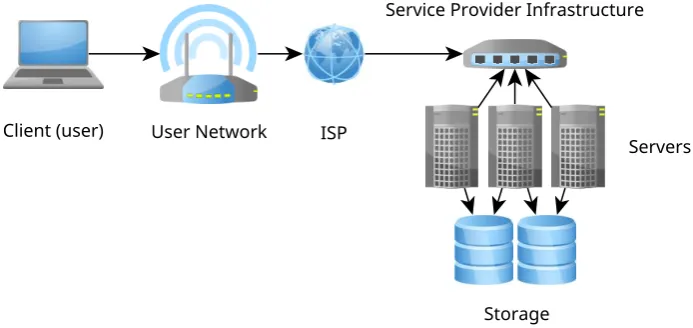
Figure 2.1
A typical centralised service architecture, where client devices communicate with a set of provider-controlled servers, holding their data under the control of this service provider and their servers.
While these servers may be distributed geographically throughout the world, users are still dependent upon one single entity; the provider of the service. If this company were to choose to cease providing the service, or cease trading, a user’s ability to access the service would not be guaranteed. A similar outcome could be experienced in the event of a wide-spread cyber-attack resulting in the service being taken offline, for example.
This service is centralised, in that if the operator of the service ceases to provide the service, all utility of the service is lost by its end users. The failure of this single provider’s architecture will result in the loss of availability of the service for all of its users.
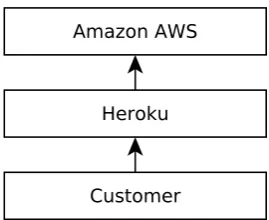
In recent years, the expansion of cloud computing has resulted in a second layer of centralisation across internet-based services; the upstream providers of computing re-sources, storage and other services may well be heavily centralised, resulting in a water-fall effect in the event of an outage. When centralised services are built upon other cen-tralised services, a significant chain of potential failure may occur, whereby a provider of technology goes offline, as a result of their upstream database provider suffering from a prolonged fault [26]. In this case, an Amazon DynamoDB cloud database experi-enced downtime. The knock-on consequence of this was the unavailability of a wide range of other products and services from Amazon’s clients, including many significant and well-known websites [21]. In addition there was a knock-on impact on Heroku, a Platform-as-a-Service provider, which relied on Amazon cloud services for its un-derlying architecture, causing two significant outages for its users, of 8 and 7 hours respectively [27].
Figure 2.2
The chain of dependency of a Heroku-based service, with Heroku being the customer-facing platform provider, and Amazon AWS the underlying hardware operator.
The ability to remove this chain of dependency, and allow services to operate without failure of an external party causing a loss of service, is clearly an advantage for the resiliency and availability of online services. Such failures are not isolated incidents, with previous disruption causing major outages for major internet services [28].
2.1.2 Modern Web Services
Many modern internet-based services and applications are designed such that user data is stored by a single entity, and all users access their data from this entity. Today there are a number of highly popular web-based email services, such as Gmail, which remain a part of the federated email network, implementing the standard protocols, but which hold the email data of many millions of users under the control of a single company. In the event of a failure of their servers or infrastructure, massive numbers of people may be left without email, causing major disruption [29].
Similarly, when a user uploads data to a centralised storage service such as Drop-box, that data is entrusted by the user to DropDrop-box, who store this data on their own servers. When the user then wishes to access the data again, they authenticate them-selves to Dropbox, and request the data be returned to them. In the meantime, this data resides on Dropbox’s infrastructure, where the user must trust that Dropbox keep the data secure, and prevent others from accessing it. This trend towards centralised storage of information and service provision is relatively recent, compared to the his-tory of computing and the internet. Early file and information retrieval protocols on the internet, such as gopher and FTP, provided similar functionality in a decentralised and federated way, as discussed in Section 2.1.4, which anyone could run without the user-friendly web-interface and product-based overlay provided by Dropbox.
ser-vice. For example, email itself is a federated and decentralised service as you may install and operate your own server and client, but Gmail is a centralised mail service, since it is not possible to host your own installation of Gmail and hold your data independently. It is also important to consider that there is a subtle distinction between the levels of decentralisation seen in services. For example, if one user’s email server fails, they are unable to send and receive email through their server at that time. In contrast, Distributed Hash Table (DHT)-based decentralised services, which will be discussed later, remove this reliance upon even a user’s own server, since there is no one-to-one mapping between users and servers; the user may connect to any available member of the network and gain access to their data.
User-facing functionality on the internet is increasingly centralised, as a result of Software-as-a-Service (SAAS) business models and products. The SaaS model for ser-vices has been described as where “the software system and users’ data are stored off-site in a central location run by the vendor” [30]. From a perspective of security and privacy however, there are significant implications for users.
2.1.3 Decentralised Services
Historically and at its heart, the internet is fundamentally a decentralised network. De-cisions on the routing of packets are taken at a local, per-router, level, using the Border Gateway Protocol (BGP) to identify available routes [31]. This means that in the event of disruption to part of the network, working nodes will continue to pass packets to their destination using alternative routes. This makes the internet inherently resilient, as there is no single entity which can prevent other entities from continuing to use the network, and inherent redundancy in connectivity between systems. In the event of the failure of a network link, packets can be routed to their destination using alternative routes.
This also applies to the low-level protocols used to provide connectivity and basic functionality on the internet. For example, HTTP and email are decentralised proto-cols, since users can operate and interact with their own, or others’, HTTP or email servers. Indeed, the traditional services of the internet and subsequently world-wide web were almost always implemented in a decentralised manner, as a result of the in-herently decentralised design of the internet, around multiple servers located in multiple locations, to which users may connect.
2.1.4 Distributed and Federated Services
The Domain Name System (DNS) protocol is not a fully decentralised protocol, al-though it is designed in a distributed and federated manner. DNS allows for hierarchi-cal naming and efficient look-up of computers on a wide-spread network, such as the internet. In order for such a system to work, however, it is necessary for users and server operators to agree upon a series of naming conventions, and a process through which names may be claimed on the system. This was implemented through the centralised process of DNS registries. DNS is distributed in that anyone may run a DNS server, and it will interact with DNS servers elsewhere on the internet to allow any domain name to be resolved. It is not, however, decentralised, since overall control of the root zones is vested in one entity (ICANN), which delegates authority to manage sub-divisions of the namespace to registrars [32].
Despite the centralisation of the DNS root, the DNS protocol itself makes it possible for anyone to host their own root zone, although in reality almost all networks advertise local DNS servers which use the standard Internet Corporation for Assigned Names and Numbers (ICANN) root zones. Open source projects have undertaken to provide alternative roots ¹. Many internet service providers and network operators provide their own DNS servers, in order to reduce query bandwidth and avoid excessive load on the root DNS servers.
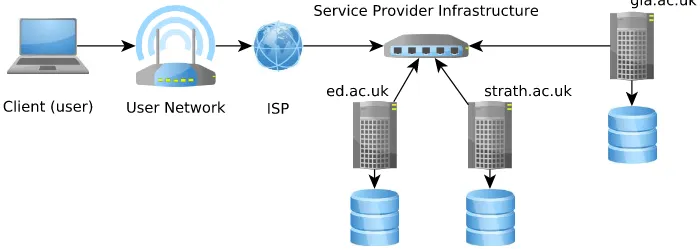
Federated network services are those designed to use standardised communications protocols, facilitating interoperability and communication between users on different servers implementing the same standard. Users of different implementations or installa-tions of a compatible service may interoperate and interact with each other, regardless of the internal structure of their own implementation of the service, provided their imple-mentation adheres to the agreed-upon standards for interoperability between providers. Federation is seen in many early internet protocols, where users are identified based upon their username, as well as the hostname of the server they use. This can be seen today in email addresses — a user’s email address is formed of a username, the @ sym-bol, then the hostname of their email server. This made email a federated service, where each user was able to run their own interoperable server, and send emails to anyone else with access to an email server. In the event of one email server failing, only those users either sending or receiving email from it would be affected. Other servers would oper-ate according to the protocol, and attempt to redeliver mail when the recipient server was back online. Therefore, from a global perspective, email can be considered to be decentralised, since the loss of one provider will not prevent others from exchanging email, although for a given user, they are dependent upon their provider itself, which
Figure 2.3
A typical federated service architecture
may be using a centralised architecture.
Figure 2.3 illustrates the architecture of a federated service, where multiple servers are operated by independent third parties, and a client may interoperate with these as required.
2.2 Impact of Centralisation on Security and Privacy
Centralisation, according to the Merriam Webster dictionary, is the process of bringing “something under the control of one authority”, or “to bring things [...] together at a single point or place” [33]. Within the context of a network-based service, this could be described as a single company or entity having control of a service, and the data of its users. Note that, with the advent of cloud computing and outsourcing of storage, the structure and operation of the service itself may be centralised, even though data may not necessarily be geographically centralised [34]. For example, the popular Dropbox cloud storage service uses Amazon’s S3 cloud storage product to store user data [35].
into knowledge of it.” [37].
More recently, however, the cost of computers and internet connectivity has reduced incredibly — free wireless access to the internet is now available to the public in towns and cities [38], and internet-capable devices are available for as little as £10; £5 for a Raspberry Pi Zero, and £5 for a WiFi adapter. Despite one computer per person now being practical, and indeed in many cases more than one computer being the norm [39], today’s internet services continue to be built with the assumption that users should provide all their data to a service provider, which holds this data on an external computer, and is trusted to hold the user’s data securely. While this offers some elements of convenience, since users may easily access their data from anywhere that this server is available, it has also resulted in the effective centralisation of significant quantities of important, and sensitive, user data.
In contrast to the strict historical expectations of systems administrators keeping all user data private, and only accessing it for technical duties, today’s service providers no longer uphold this principle.
For example, Google’s Gmail service is widely known to read user email, for the purpose of building advertising profiles of users, which may be incorporated into its AdSense product, which shows advertising across the wider internet, based upon the content of a user’s email inbox [40]. Similarly, Yahoo mail defaults to scanning user email for targeted advertising [41]. Despite widespread criticism [42], Microsoft has asserted that it is allowed to choose to carry out “content pulls” of user accounts based upon internal legal review, due to its terms and conditions, and that it may look through these for their own purpose - CNN described how investigators “pored over emails and instant messages”, since “the servers storing the information are on its own prop-erty” [43].
Indeed, The Guardian has highlighted that most webmail services claim rights to read user data for their own reasons to protect themselves [44]. Such terms and condi-tions are instituted as contracts between users and the service provider, and therefore must be accepted for users to make use of the service.
In contrast, privacy-preserving and high security alternatives would consider as many components of a network and service architecture as possible to be untrusted, with trust only placed in the absolute minimum of components necessary to ensure operation of the service. The assumption that the service provider is trustworthy is, as discussed previously, now known to be misguided, given that service providers have now shown on multiple occasions that they do not regard user data as confidential and inviolable. In any case, the risk of a security breach yielding access to vast quantities of user data has only further highlighted the risks to users when they must entrust third parties with their data in order for access to a service.
2.3 Distributed Hash Tables
One of the major challenges within a decentralised network is the efficient location and retrieval of data, with much previous work having focused on addressing this [47, 48, 49]. The challenge is somewhat different on centralised systems, where inter-node latency is typically considerably lower, as servers working together may be located within the same rack of a server cabinet. In contrast, peers in a decentralised network may be located at opposite sides of the world, posing challenges for data discovery and routing of requests.
Figure 2.4
Use of cryptographic hash functions within a DHT for addressing
Figure 2.4 illustrates how cryptographic hash functions may be used to determine the address of a given piece of data. The DHT can thus be effectively considered as a key-value store, with the key being the network address, and the value being the data itself, such that the key is equal toH(value). This is the concept of content-addressable storage, as proposed by CAN [51].
Multiple nodes with an address close to a given piece of data may be responsible for the storage of that data, meaning that the loss of any one of these nodes does not prevent the data from being accessed. The Kademlia DHT network concept has been extended and widely deployed as the mainline Bittorrent DHT, which was estimated to have between 15 and 27 million daily users in 2013 [53].
Within the Kademlia DHT [52], each member forms a routing table ofNentries, for a network with nodes usingN-bit addresses. By calculating the XOR of two network addresses, a closeness metric is obtained between the two nodes. Each routing table entry is considered as a bucket, containing a number of nodes’ information. Working through the routing table, the buckets found should contain routing information (IP and port) for nodes which are of a given distance from the node in question. For example, the first routing bucket will contain details of nodes which share zero bits in common with the seeking node’s address. The second routing bucket would contain details of nodes with the same first bit of their address. The third bucket would contain details of nodes sharing the first two bits of their address with the seeking node. This continues for each bit of the address, meaning that the probability of finding members of the network to fill the full routing table will decrease for later routing table records [52].
Figure 2.5
Illustration of XOR-based DHT routing, showing the routing process from the perspective of node111attempting to locate node001. The annotations on links between nodes indicate the respective bucket which a target would sit in, based upon address prefix. Node111can locate node011in itszero bucket (due to sharing a prefix of zero bits of the address). and this is the closest known node for node111. Node011can locate node001in its first bucket (due to sharing a prefix of one byte), thus allowing message delivery.
scenario, where node111wishes to communicate with node001. In this scenario, each node has a bucket size of 1, meaning that for each bitwise XOR address prefix, infor-mation on only 1 node will be held. In the first step, node111attempts to locate node 001, and is unable to do so from its own routing table, since not all nodes are visibile to it (and those hidden nodes are made lighter in Figure 2.5). Since it is unable to locate the exact node, node111contacts the closest known node to the target node. This is node 011, which is referenced in the bucket for having zero common prefix bits with node 111. The lower half of Figure 2.5 then shows the operations carried out by node 011 — it is able to locate node001in its bucket for nodes sharing the first common address bit. Node 111 can thus communicate with node 001 by communicating messages to the closest known node to the address, which will either know the node, or know other closer neighbours of the node.
the network addressing system scale. To locate another node within the network, the client node should attempt to contact the closest available node it knows of within the network. That node will have a more precise knowledge of nodes addressed closely to it, and can therefore assist with locating the desired node.
When data is stored on the network, it is held by the nodes with addresses closest to the address of the data, meaning that there is inbuilt redundancy and resiliency against loss of individual systems. Since messages can be routed to any other node in the network using the recursive routing process described above, it is possible to join the network at any location and gain access to data from anywhere, eliminating the impact of nodes joining and leaving the network during normal activities.
By placing computers within such a network, based on their logical DHT address, in addition to data, it is possible to create a distributed, decentralised data store, as demonstrated by Kademlia. The MaidSafe network, the subject of security analysis within this thesis, is based upon the Kademlia network concept.
2.3.1 Previous Decentralised Networks
A number of previous works have introduced fully decentralised network services for storage. Freenet was introduced in 2001, designed to offer full decentralisation of all network functionality, as well as anonymity for those sharing and retrieving content, as well as providing deniability for systems holding content within the network, such that they had no knowledge of the data being made available by their system [54]. One major limitation of Freenet, however, is that it is not intended for the permanent storage of data, and that which is not retrieved is purged from the network to make space for new data on the network [54].
The GNUnet project [55] was presentd in 2002 as an approach towards an anony-mous and distributed backup system for files. It was later extended by the authors to include support for a censorship-resistant protocol for distributed file sharing, where content can be addressed by unique friendly names, in addition to key-based identi-fiers [56]. Previous work has identified a number weaknesses within the anonymity of-fered to users, as well as the ability for content filtering or censorship to take place on the platform, as a result of the design of the system [57].
2.4 Cryptographic Hash Functions
• It is non-invertible, so given the output of the function, the input cannot feasibly be determined
• The hash function can be computed for any input, in a computationally efficient manner
• Any alteration to the input will change the output of the function significantly
• It should be infeasible to find two non-equal inputs to the function yielding the same output
The one-way nature of the function, its non-invertibility, is often referred to as pre-image resistance. A pre-pre-image attack involves attempting to find an input to the function to produce a specific output. If it were possible to find an input to produce a given output, this would clearly violate the one-way nature of the hash function, since it would allow the “reversal” of an arbitrary hash output.
The differing output for differing inputs can be considered as second pimage re-sistance, such that for a given input (x), it is infeasible to determine another input value y, such thatH(x) = H(y). Finally, as an extension of this propery, collision resistance covers the property of ensuring that it should be infeasible to find any two input mes-sages, such that H(x) = H(y). Note that for the property of collision resistance, this requires resistance to the birthday paradox scenario, as explored in more detail in Sec-tion 3.4. Since for the scenario of measuring collision resistance, both input messages can be selected, it is necessary for a hash double the length of that required to protect against a second pre-image attack [59, Section 9.7.1][58, Section 5.3.1.2].
2.5 The MaidSafe Network
The MaidSafe network ² is a proposed decentralised secure storage network architec-ture, inspired by the concept of the Kademlia DHT. Within the MaidSafe network, user data is stored across a large, peer-to-peer network, as described by above. To preserve confidentiality, data is stored in an encrypted manner, such that it is not readable by those holding it, and files are split into chunks, with these chunks distributed throughout the network [25]. Crucial to the concept of MaidSafe is that no one entity, not even the developers themselves, is capable of exerting centralised control over the network [60]. Decisions must therefore be made in a decentralised and distributed manner, and the network rules must be designed and carefully balanced to ensure that, in the absence of a centralised gatekeeper to ensure everyone “plays by the rules”, parties will not be able to create disruption through refusing to play by the rules [60]. The MaidSafe network is an interesting target for research, since prior works have tended to focus on the tran-sient transfer of information through decentralised networks, rather than on persistent storage of data for longer periods of time.
The MaidSafe network is built around a security model whereby no network entity other than the owner of data, or their authorised delegate, may decrypt it. Content is therefore transferred and stored by parties who are incapable of decrypting it [25]. In order to create a secure network with these properties, while ensuring data integrity and availability is preserved, a robust data storage strategy is needed. The approach taken by MaidSafe to achieve this is now explored.
2.5.1 Data Storage and Encryption
Within the MaidSafe network, data is always stored in an encrypted form. To allow for global deduplication of data, convergent encryption is used [61]. Convergent encryp-tion [62], proposed by Douceuret al., is an implementation of encryption, whereby the key used to encrypt a file is derived from its plaintext contents. Therefore, since the key is derived in a one-to-one mapping from the file contents, different users holding the same file will each produce the same ciphertext, allowing for inherent deduplication if this can be detected, thus avoiding the need for multiple copies of the same data to be stored [62]. This deduplication is achieved within the MaidSafe network, since data is addressed based upon the cryptographic hash of its encrypted contents.
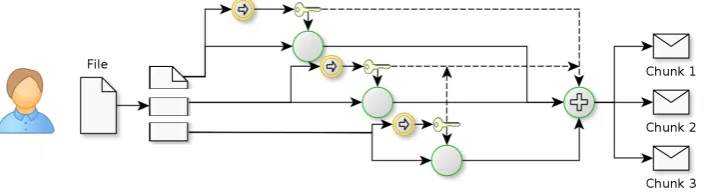
An illustration of this scheme is shown in Figure 2.6 — the client splits their file firstly into chunks, then derives a key from the cryptographic hash of the chunk contents (rep-resented by the yellow one-way arrow function). This key is then used to encrypt the
Figure 2.6
Illustration of MaidSafe self-encryption process, showing the chunking of a file, followed by derivation of a key for each chunk, then the encryption of each chunk, and finally the combina-tion of chunks for XOR-based obfuscacombina-tion.
chunk, and the keys are later combined to obfuscate (using the XOR function) the out-put of the cipher outout-puts, prior to yielding chunks ready for storage within the network. A more detailed analysis of the actual implementation of this process is presented as a contribution in Section 3.2.
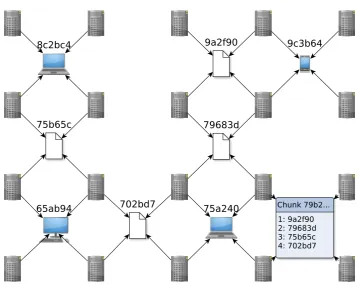
The MaidSafe storage model incorporates three entities — the client, the chunk information holder, and the chunk holders. Both the chunk information holder and the chunk holders are vaults within the network. Each chunk is distributed redundantly throughout the network 4 times, thus requiring a layer of decentralised management to ensure that these copies remain, even as nodes join and leave the network. A chunk information holder therefore is a record which acts as a pointer towards the actual copies of the chunk data. This is illustrated in Figure 2.7. A user wishing to locate a chunk will make a query for data under the hash of the chunk’s contents (its address). At this address, and stored by the 4 closest nodes on the network, will be a chunk information record, containing information about the locations where the actual data is held on the network. The chunk information record acts therefore as a set of pointers, held and maintained by the closest 4 nodes to the chunk’s hash. This record supplies the addresses at which a chunk itself is currently available on the network. The client may then retrieve this data from the nodes holding the chunks.
2.5.2 Data Retrieval and Bootstrapping
Figure 2.7
Figure 2.8
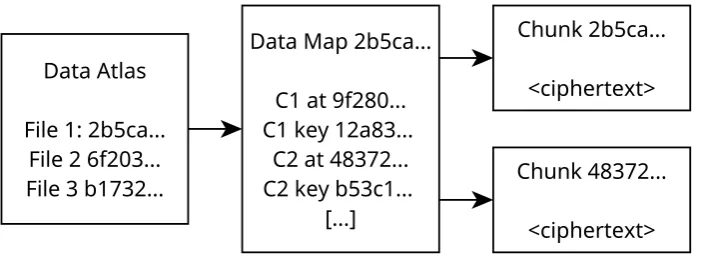
Illustration of the MaidSafe process for retrieval of a chunk, by first locating the account’s data atlas, and using the listing of files to locate the data map. This data map contains the address of the ciphertext chunk on the network, and the key needed to decrypt it.
chunks, and the chunks being held at addresses based on their encrypted contents, as discussed in Section 2.5.1. In order to achieve this, the MaidSafe network introduced a concept of a data map, which acts as a mapping between plaintext data chunks and the respective ciphertext addresses in the DHT [61].
Each file would therefore have a data map, acting as a pointer to the chunks within the file, and record of the keys needed to decrypt the data. The process of locating these data maps is the next significant challenge for storage of data within a DHT — since the data map contents is not predictable, it must be stored in order to re-gain access to data from the network. In the absence of the data map, it is not possible to locate or decrypt the data. This also means that, in order to access data from a new device in future, without any a-priori knowledge of the data map contents, the maps themselves must be stored on the network, leading to the natural question of how to locate those maps without other knowledge.
The solution used by MaidSafe is the creation of a data atlas, a fixed-location index store of mutable data, placed at a location selected by the user, containing the keys and addresses needed to locate and decrypt the data maps and thus re-gain access to a user’s data. The data atlas is stored encrypted at an address, with both the decrytion key and the address derived from a user’s account credentials, thus meaning that the only information necessary to gain access to the network is knowledge of account credentials. Figure 2.8 illustrates the process through which a user may retrieve their data from the network, through the use of a data atlas and data map.
2.5.3 MaidSafe Account Handling