City, University of London Institutional Repository
Citation
: Li, F. (2015). Context-Aware Attribute-Based Techniques for Data Security and
Access Control in Mobile Cloud Environment. (Unpublished Doctoral thesis, City University London)This is the accepted version of the paper.
This version of the publication may differ from the final published
version.
Permanent repository link:
http://openaccess.city.ac.uk/11891/Link to published version
:
Copyright and reuse:
City Research Online aims to make research
outputs of City, University of London available to a wider audience.
Copyright and Moral Rights remain with the author(s) and/or copyright
holders. URLs from City Research Online may be freely distributed and
linked to.
City Research Online: http://openaccess.city.ac.uk/ [email protected]
Context-Aware Attribute-Based Techniques for Data
Security and Access Control in Mobile Cloud
Environment
A Thesis Submitted to
City University London, School of Engineering and Mathematical Sciences In Fulfillment of the Requirements for the Degree
Doctor of Philosophy in Information Engineering
I
Table of Contents
List of Figures………...V List of Tables………VIII Acknowledgements………...IX Declaration………X Abstract………..XI Notation and Abbreviation……….XII Publications………..…XVI
1 Introduction ... 1
1.1 Motivation ... 2
1.1.1 Problems with the Current Technologies ... 4
1.2 Contributions of the Thesis ... 7
1.3 Outline of the Thesis ... 9
2 Identity, Privacy, and Security in Mobile Cloud Environment ... 12
2.1 Mobile Cloud Computing ... 13
2.1.1 Concept of Mobile Cloud Computing ... 13
2.1.2 Advantages of Mobile Cloud Computing ... 19
2.1.3 Issues of Mobile Cloud Computing ... 21
2.2 Case Study ... 24
2.2.1 Existing Data Protection Laws ... 27
2.3 Security Concepts, Technologies and Mechanisms ... 30
2.3.1 Security Technologies and Mechanisms ... 31
2.3.2 Protocols and Standards ... 36
2.4 Summary... 39
II
3.1 Single-Sign-On (SSO) and Federation... 42
3.2 Microsoft .NET Passport: ... 43
3.3 The Liberty Alliance(Kantara) ... 46
3.4 OpenID ... 48
3.5 Higgins ... 51
3.6 OAuth ... 53
3.7 Comparison and Literature Review ... 55
3.8 Conclusion ... 61
4 Access Control Technologies ... 62
4.1 Access Control Models ... 63
4.1.1 Discretionary Access Control ... 64
4.1.2 Mandatory Access Control ... 66
4.1.3 Role-Based Access Control ... 68
4.1.4 Attribute Based Access Control ... 71
4.2 Privacy-Preserving Languages ... 74
4.2.1 The Platform for Privacy Preferences ... 75
4.2.2 Enterprise Privacy Authorization Language ... 76
4.2.3 Extensible Access Control Markup Language ... 76
4.3 Attribute Based Encryption ... 83
4.3.1 Key-Policy Attribute-Based Encryption ... 86
4.3.2 Ciphertext-Policy Attribute-Based Encryption ... 87
4.3.3 Multi-Authority Attribute-Based Encryption ... 89
4.3.4 Challenges ... 95
4.4 Conclusion ... 97
5 User-Centric Attribute-Based Access Control Model Using XACML ... 99
5.1 Architecture of Policy-Based User-Centric Approach ... 100
5.1.1 System Initialization ... 104
5.1.2 Design of the Model ... 105
5.2 Policy Evaluation Component (PEC) ... 110
5.3 Security Evaluation ... 115
III
5.3.2 Security Analysis ... 117
5.3.3 User-Centric Approach ... 122
5.3.4 Use Case Study ... 123
5.4 Proof of Concept ... 125
5.4.1 Protocol Verification ... 125
5.4.2 Implementation and Tests ... 130
5.4.3 Sample Screenshots of the Client Application... 131
5.4.4 Possible Extension ... 136
5.4.5 XACML Message Standard ... 136
5.5 Discussion ... 137
5.6 Conclusion ... 139
6 Context-Aware Attribute-Based Encryption Schemes ... 140
6.1 Introduction ... 140
6.2 Context-Aware Single Authority Attribute-Based Encryption Scheme ... 143
6.2.1 Preliminaries ... 144
6.2.2 Construction ... 146
6.3 Context-Aware Multi-Authority Attribute-Based Encryption Scheme ... 150
6.3.1 Preliminaries ... 151
6.3.2 Construction ... 154
6.3.3 Security Analysis ... 159
6.3.4 Performance Analysis ... 165
6.3.5 Computational Complexity Analysis ... 165
6.3.6 Communication Complexity Analysis ... 171
6.4 Low-Complexity Multi-Authority Attribute-Based Encryption Scheme ... 172
6.4.1 Constructions ... 173
6.4.2 Security Analysis ... 178
6.4.3 Performance Analysis ... 179
6.5 Conclusion ... 183
7 Conclusions and Future Work ... 185
7.1 Summary and Conclusions ... 185
IV
Bibligraphy:... 193
Appendix ... 209
XACML Language ... 209
XACML Policy ... 209
XACML Request ... 212
V
List of Figures
Figure 2.1Authorization Information of Instagram at a Facebook Account. ... 25
Figure 2.2Symmetric En/Decryption Process ... 33
Figure 2.3Asymmetric En/Decryption process ... 34
Figure 3.1.NET Passport Authentication Process ... 44
Figure 3.2 The Abstract View of Liberty Architecture ... 46
Figure 3.3The Liberty Notation of Trust ... 48
Figure 3.4OpenID Authentication Process ... 49
Figure 3.5Architecture of Higgins ... 52
Figure 3.6Workflow of OAuth Protocol ... 54
Figure 4.1Illustration of the Elements in a Standards RBAC Model ... 69
Figure 4.2Illustration of a Role Hierarchy ... 70
Figure 4.3 Data Flow of a Standard XACML Framework ... 78
Figure 4.4Illustration of Attribute-Based Encryption Scheme ... 84
Figure 4.5Key-Policy Attribute-Based Encryption Scheme ... 87
Figure 4.6Ciphertext-Policy Attribute-Based Encryption Scheme ... 88
Figure 4.7Illustration of Multi-Authority Attribute-Based Encryption ... 92
VI
Using XACML ... 102
Figure 5.2Illustration of the Message Flow of Proposed User-Centric Policy-Based Access Control Model ... 107
Figure 5.3 Architecture of the PEC ... 111
Figure 5.4Illustration of Work Flow of Policy Evaluation ... 113
Figure 5.5Authentication between User and SP ... 115
Figure 5.6Authenticaion for SP ... 116
Figure 5.7Authentication for User ... 116
Figure 5.8 Validation of the Proposed Model by Scyther Toll ... 129
Figure 5.9Proof of Concept ... 130
Figure 5.10Login Page of the Client Application... 132
Figure 5.11Requesting Page of the Client Application ... 132
Figure 5.12Information Gathering at PEC ... 133
Figure 5.13Authorization Result of PEC Service ... 133
Figure 5.14Service Test Page ... 134
Figure 5.15PEC Service Test ... 135
Figure 6.1The Framework of Single Authority ABE scheme. ... 144
Figure 6.2Anonymous Key Issuing Protocol ... 154
VII
Figure 6.4 Comparison of Computational Costs for Decryption Between Conventional
MA-ABE Scheme and the Proposed MA-ABE Scheme ... 169
Figure 6.5 Illustration of the proposed Framework of Low-Complexity Context-Aware
Multi-Authority ABE Scheme for Mobile Cloud Environment ... 173
Figure 6.6 Comparisons of Communications between Chase and Chow’s MA-ABE
VIII
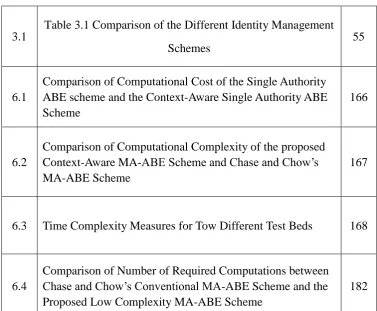
List of Tables
[image:10.595.140.518.163.474.2]3.1
Table 3.1 Comparison of the Different Identity Management Schemes
55
6.1
Comparison of Computational Cost of the Single Authority ABE scheme and the Context-Aware Single Authority ABE Scheme
166
6.2
Comparison of Computational Complexity of the proposed Context-Aware MA-ABE Scheme and Chase and Chow‟s MA-ABE Scheme
167
6.3 Time Complexity Measures for Tow Different Test Beds 168
6.4
Comparison of Number of Required Computations between Chase and Chow‟s Conventional MA-ABE Scheme and the Proposed Low Complexity MA-ABE Scheme
IX
Acknowledgements
This thesis arose after years of research that has been done since I came to City University London. First and foremost, I would like to express my gratitude to my supervisor Professor Muttukrishnan Rajarajan, for his supervision, advice and guidance from the starting of my research. With his extraordinary experience and admirable insights, he has taught me about science, life, and encouragement. It is my pleasure to work with you.
I also would like to acknowledge the research collaboration with Dr. Yogachandran Rahulamathavan. Thanks for the invaluable advice and patience. I am grateful to my colleagues and everyone for their support and help on my research work.
By the completion of this thesis, I am approaching the end of a 20 years long life for officially enrolled as a student. Looking back at these years I will remember with affection the people I have met and the moments with joy and happy along the way.
X
Declaration
XI
Abstract
The explosive growth of mobile applications and Cloud computing has enabled smart mobile devices to host various Cloud-based services such as Google apps, Instagram, and Facebook. Recent developments in smart devices‟ hardware and software provide seamless interaction between the users and devices. As a result, in contrast to the traditional user, the mobile user in mobile Cloud environment generates a large volume of data which can be easily collected by mobile Cloud service providers. However, the users do not know the exact physical location of their personal data. Hence, the users cannot control over their data once it is stored in the Cloud. This thesis investigates security and privacy issues in such mobile Cloud environments and presents new user-centric access control techniques tailored for the mobile Cloud environments.
Most of the work to date has tried to address the data security issues on the Cloud server and only little attention has been given to protect the users‟ data privacy. One way to address the privacy issues is to deploy access control technique such as Extensible Access Control Markup Language (XACML) to control data access on users‟ data. XACML defines a standard of access control policies, rule obligations and conditions in data access control. XACML utilizes Extensible Markup Language (XML) schema to define attributes of data requesters, resources, and environment in order to evaluate access requests. A user-centric attribute-based access control model using XACML which enables users to define privacy access policies over the personal data based on their preferences is presented.
XII
Notations and Abbreviations
2PC Two-Phase Commit Protocol
3G Third Generation
4G Forth Generation
AES Advanced Encryption Standard
APPEL A P3P Preference Exchange Language
CH Context Handler
CIA Confidentiality Integrity Availability
CP-ABE Ciphertext-Policy Attribute-Based Encryption
DAC Discretionary Access Control
DES Data Encryption Scheme
DVLA Driver and Vehicle Licensing Agency
EC2 Elastic Compute Cloud
EPAL Enterprise Privacy Authorization Language
EPIC Electronic Privacy Information Centre
GID Global Identity
GPS Global Positioning System
HIPAA Health Insurance Probability and Accountability Act
HTML Hyper Text Markup Language
HTTP Hypertext Transfer Protocol
ID Identity
IdP Identity Provider
XIII
ID-WSF Liberty Identity Web Services Framework
ID-SIS Liberty Identity Services Interfaces Specification
IMEI International Mobile Station Equipment Identity
J2EE Jave 2 Platform Enterprise Edition
JAX-WS Java API for Web Services
JSON JavaScript Object Notation
JSP JaveServer Pages
KP-ABE Key-Policy Attribute-Based Encryption
LTE Long-Term Evolution
MA-ABE Multi-Authority Attribute-Based Encryption
MAC Media Access Control
ManAC Mandatory Access Control
NHS National Health Service
NI National Insurance
NIST National Institute of Standards and Technology
OASIS Organization for the Advancement of Structured
Information Standard
OECD Organization for Economic Co-operation and Development
OMB U.S. Office of Management and Budget
P3P Platform for Privacy Preferences
PAP Policy Administration Point
PDP Policy Decision Point
PDS Personal Data Service
PEP Policy Enforcement Point
PEC Policy Evaluation Component
XIV
PII Personally identifiable Information
PIP Policy Information Point
QoE Quality of Experience
QoS Quality of Service
RBAC Role-Based Access Control
RG Request Generator
RSA Rivest-Shamir-Adleman
SAML Security Assertion Markup Language
SHA Secure Hash Algorithm
SOA Service-Oriented Architecture
SOAP Simple Object Access Protocol
SP Service Provider
SPId Service Provider Identity
SSL Secure Sockets Layer
SSN Social Security Number
SSO Single-Sign-On
SSS Secret-Sharing Schemes
STA Semi-Trusted Authority
TLS Transport Layer Security
UDDI Universal Description, Discovery and Integration
URL Uniform Resource Locator
VP Validating Point
W3C World Wide Web Consortium
WLAN Wireless Local Area Network
XV
XACML eXtensible Access Control Markup Language
XVI
Publications
The results of the research described in this thesis have been published in the following papers:
[1] Fei Li, DasunWeerasinghe, Dhiren Patel, Muttukrishnan Rajarajan, “An User-Centric Attribute Based Access Control Model for Ubiquitous Environment”
Mobile Computing, Applications, and Services. Springer Berlin Heidelberg, 2012: 361-367.
[2] DasunWeerasinghe, FEI LI, Muttukrishnan Rajarajan, “Novel Framework for Secure Mobile Banking”, In Proceedings of the 5th International Conference on
Security for Information Technology and Communications. 31 May – 1June 2012, Bucharest, Romania
[3] Fei Li, Yogachandran Rahulamathavan, Muttukrishnan Rajarajan, RCW Phan “Low Complexity Multi-authority Attribute Based Encryption Scheme for Mobile Cloud Computing” Service Oriented System Engineering (SOSE). 2013 IEEE 7th
XVII
[4]Fei Li, Yogachandran Rahulamathavan, Mauro Conti, Muttukrishnan Rajarajan, “LSD-ABAC: Lightweight Static and Dynamic Attributes Based Access Control
Scheme for Secure Data Access Control in Mobile Environment”39th Annual IEEE Conference on Local Computer Networks, 8-11 September 2014, Edmonton, Canada
[5]Fei Li, Yogachandran Rahulamathavan, Mauro Conti, Muttukrishnan Rajarajan, "Robust Access Control Framework for Unified Communications Network"
Special Issue on Security and Privacy in Unified Communications: Challenges and
Solutions (under review)
1
1 Introduction
2
high-performance computations. However, this change creates challenges in terms of user data security and privacy. Within this context, this thesis discusses the security and privacy perspective of this trend and proposes novel algorithms to mitigate the risk in identity management and privacy protection. In the following, various components of mobile Cloud computing are briefly discussed followed by contributions and structure of this thesis.
1.1
Motivation
3
embrace new paradigm of mobile Cloud computing such as mobile storage as a new way to extend the capabilities of mobile devices and mobile platforms, which has the potential to impact the business environment and provide more convenience to individual's daily life.
When users are accessing Cloud based services through their mobile devices, the Cloud service providers may collect data from the users for service delivery. Most of today‟s Cloud service providers work in a collaboration environment. Consider the following scenario, an Instagram user can either share his photos with other preferred Instagram users, or publish the content on his Facebook page. In order to do so, he has to authorize Instagram with certain access rights on his Facebook account. There are two security concerns in this scenario:
(1) Identity leakage: Users‟ Facebook identity data will be collected by
Instagram. Service providers collect user‟s attributes or identity related data during the service period. In mobile Cloud computing environment, the user‟s real identity can be disclosed without
4
(2) Data and Privacy Protection: Users use the Cloud for online data
storage. The data managed by Cloud service providers consists of different types of information, such as identity information, location data, and medical records. This information is closely associated with user privacy; hence, the access privileges to access this sensitive information should be strictly controlled. However, existing security approaches are not suitable for protecting the users' privacy in a mobile Cloud computing environment.
The above security and privacy issues are new challenges in mobile Cloud computing environment. Hence new security solutions are required to seamlessly secure the data and online services delivered over the mobile Cloud platform, as well as users‟ privacy.
1.1.1 Problems with the Current Technologies
Existing security mechanisms of current information systems are becoming increasingly inadequate for today‟s complex mobile Cloud environments. The
5
approaches, which are not suitable for mobile Cloud environment [3, 5-7]. The major shortcomings of the existing security solutions are summarised below:
Lack of control for users to protect their data: Service providers often hold and process user data. If such data are disclosed or abused by unauthorized service providers, the mobile Cloud users may lose their competitive advantage or even go out of business. Most of the security solutions implemented by the Cloud providers do not allow the data owners to define the necessary access control policies to restrict access for the personal data. Hence, tailored access control techniques are required in order to restrict data access in Cloud computing in order to protect user‟s privacy.
6
Today most of the social media apps are accessed from smartphones. Hence it is possible to obtain real-time contextual attributes (i.e. location, network connectivity, app usage)which are available in mobile Cloud environments. If two or more service providers corporate together to combine a user‟s information that they hold, the user‟s sensitive privacy information may be illegally shared without the user‟s consent. In order to protect the privacy of the individual, untraceable identities are required in mobile Cloud computing. The identity management solutions should satisfy the requirements that user‟s real identity should be protected and be hidden from the service providers.
The centralized architecture is inadequate: In real life, a number of authorities hold different types of attributes for an individual. Higher education institutions have people‟s educational records. Hospitals store their patients‟ medical records.
7
This thesis focuses on addressing the problems stated above, and proposes robust solutions to overcome the current security vulnerabilities in the mobile Cloud computing environment.
1.2
Contributions of the Thesis
This thesis contributes to the development of a framework for identification, authorization, and data access control in mobile Cloud computing environments. The current security technologies in Cloud environment are examined and a context-aware Multi-Authority Attribute-Based Encryption (MA-ABE) scheme to address the above security issues in mobile Cloud environment is proposed. The MA-ABE scheme enables data owners to define access policies during encryption and is flexible and practical for mobile Cloud computing environment. A number of attribute authorities can work together in a collaboration environment, and issue secret keys to the data owner to secure his personal data that is stored in the Cloud. By capturing real-time context-related attributes via users‟ mobile devices, a security solution can be achieved for authentication and authorization.
In order to restrict access for users‟ online data, anAttribute-Based Access Control
8
access rules to be defined in a policy-oriented fashion, with policies being easily updated as rules change and is suitable for mobile Cloud environment.
The following are the major contributions of this thesis:
- Multi-Authority Attribute-Based Encryption in mobile Cloud computing: To protect the individuals data and privacy in mobile Cloud environments, the MA-ABE scheme is used to enable data owners to define access control policy while storing encrypted data in the Cloud. A data requestor can only decrypt the data based on his/her attributes. In this scheme, a number of attribute authorities maintain different sets of attributes and issue decryption keys for the user respectively. Users obtain decryption keys from each authority based on their attributes. The model has removed the trusted authority which is responsible for monitoring communications and issuing decryption keys in existing MA-ABE systems. Thus, it improves the security and system efficiency.
9
protection in a more flexible, user-centric, and fine-grained manner. Light-weight cryptographic algorithms are also designed for mobile Cloud computing environment. By utilizing the Cloud infrastructure, the light-weight cryptographic algorithm offloads the high-cost computation and communication overheads to the Cloud.
- Anonymisation key issuing protocol: Anonymisation techniques
are involved in the key issuing process. An anonymous algorithm is used to mathematically hide users‟ real identity. Thus, identities are protected from collusion attacks (see in section 1.1.1) in mobile Cloud environments.
- XACML-based access control model: A user-centric access
control model for mobile Cloud environment is proposed to address user‟s data privacy issues in section 1.1.1. The model is based on the
eXtensible Access Control Markup Language (XACML) and enables users to define their own access control policies to secure their data from unauthorized access.
1.3
Outline of the Thesis
10
identity and data security such as cryptographic schemes, security protocols are discussed in this Chapter.Theexisting identity management systems such as .NET Passport, The Liberty Alliance, OpenID, Higgins and OAuth are examined in detail in Chapter 3. In addition to this the comparisons of the widely used identity management systems are also given in Chapter 3.
Chapter 4 discusses the guidelines of privacy protection, and discusses the current approaches in privacy protection, e.g. solutions for privacy, data access control, and then proceeds by explaining the main building blocks required for data access control. Several widely used access control models are discussed followed by a brief discussion of privacy protection languages. The current schemes of attribute-based encryption are also examined. Finally, the requirements and challenges for privacy-preserving and data access control for mobile Cloud environment are discussed.
11
Chapter 6 proposes three different attribute-based encryption schemes for mobile Cloud environments: 1) context-aware single authority attribute-based encryption scheme 2) context-aware multi-authority attribute-based encryption scheme and 3) low-complexity multi-authority attribute-based encryption scheme. In the context-aware single authority ABEscheme, any context-related attributes that can be captured from user‟s mobile devices are used during the encryption. In addition
to this a context-aware multi-authority attribute-based encryption scheme is proposed in order to address issues of the single authority scenario. Finally, a low complexity multi-authority attribute-based encryption scheme is presented to offload heavy computation and communication tasks from the mobile device to the Cloud. The Cloud infrastructure is utilized to improve the efficiency of multi-authority schemes. The algorithm is designed as a lightweight solution which can secure the data confidentiality and preserve the user‟s privacy.
12
2 Identity, Privacy, and Security in Mobile Cloud
Environment
This chapter reviews the concept of mobile Cloud computing,identity, privacy and security as well as outlines important protocols used in this thesis. In particular, new issues rose in identity management, privacy and security technologies in mobile Cloud computing environment are discussed.
13
2.1
Mobile Cloud Computing
2.1.1 Concept of Mobile Cloud Computing
Mobile devices now provide online data and services to users from anywhere at any time. Most of the UK mobile operators have established 3G mobile networks and are now moving forward to 4G LTE networks which can provide much better performance compared to the 3G networks [8]. The term mobile Internet refers to the combination of the mobile communication and Internet [9]. Hence, mobile users can enjoy much better mobile data services via mobile Internet. The number of smartphone subscribers within the UK is more than 50% of standard mobile users in 2013 and it is predicted to reach up to 75% by 2016 [10]. Due to the development of wireless communication technology and Web application technology, mobile Internet provides endless space for mobile network and a platform for developing new Internet-based technologies.
14
June 2014 [16], and over 1.3 million apps available for iOS devices by September 2014 [17]. Meanwhile, Google Play reached 25 billion downloads with over 675,000 apps by 26th September 2012 [18].Google did not release further data on the number of app downloads in the Play market. However, the Play market beats AppStore with over 1 million apps in 2013 [19]. The AppBrain provides real-time number of available apps in Google Play market [20], and there are 1432174 applications available in the Google Play market as of 17th December 2014. These mobile apps give great convenience to people‟s life. Users are increasing the demand of any sophisticated applications to do more work on their mobile devices. The latest advances in mobile communication networks and the increasing penetration of smartphones are transforming the mobile Internet and are empowering end users with rich mobile experience [4]. However, the limited onboard computing, energy and storage capabilities of mobile devices are hampering the ability of smart devices to satisfy such demands. For instance, it is impossible for a hotel reservation app to run at the smartphones as stand-alone software. Because a user has to download a huge size database which stores all related information, and the cost of operations such as search, update and reserve from such apps are heavy. In order to address these limitations, Cloud computing is identified as a possible solution [21].
15
offered “as a service”. In addition, Cloud computing enables users to elastically utilize resources in on-demand fashion. As a result, mobile applications can be rapidly provisioned and released with minimal management efforts or service provider‟s interactions. With the explosion of mobile applications and the support of Cloud computing for a variety of services for mobile users, mobile Cloud computing is introduced as an integration of Cloud computing into the mobile environment. Mobile Cloud computing brings new types of services and facilities for mobile users to take full advantage of Cloud computing.
In Cloud environment, applications are delivered as services over the Internet. The hardware and systems software in the Cloud data centres provide those services. When a Cloud is made available in a pay-as-you-go manner to the public, it is called a public Cloud; the service being sold is utility computing [24]. Currently available public Clouds in the market include Amazon Elastic Compute Cloud (EC2), Google AppEngine, and Microsoft Azure. The term of private Cloud refers to internal data centres of a business entity or other organization that are not made available to the public. Community Cloud is the Cloud infrastructure which is shared by several organizations and supports a specific community that has shared concerns. Hybrid Cloud is a composition of two or more Clouds (Private Cloud, Public Cloud, or Community Cloud) that remain unique entities but are bound together by standardized or proprietary technology that enables data and application portability.
16
The National Institute of Standards and Technology (NIST) defines fou4 types of Cloud deployment models and three service models of Cloud computing [25]:
Cloud deployment models:
Private Cloud: In this model, the Cloud infrastructure is provisioned for exclusive use by a single organization comprising multiple consumers. It may be owned, managed, and operated by the organization.
Community Cloud: The Cloud infrastructure is provisioned for exclusive use by a specific community of consumers from organizations that have shared concerns. It may be owned by one or more organizations in the community.
Public Cloud: The Cloud infrastructure is provisioned for open use by general public.
Hybrid Cloud: In a hybrid Cloud, the Cloud infrastructure is a composition of two or more distinct Cloud infrastructures (private, public, community) that remain unique entities, but are bound together by standardized or proprietary technology that enables data and application portability.
Service models of Cloud computing
17
Cloud infrastructure. The consumers are not required to manage or control the Cloud infrastructure such as network, storage, or servers. Users can access the services from various client devices through a thin client interface such as a Web browser (web-based email). The applications such as Gmail and Facebook are the popular mobile Cloud computing SaaS applications.
Cloud Platform as a Service(PaaS). Cloud consumers are able to develop and deploy their own applications onto the Cloud infrastructure using programming languages and tools supported by the Cloud provider. Consumers do not required to manage the underlying Cloud infrastructure but have the control over the deployed applications and configurations of the application hosting environment. The Amazon AWS is one of the emerging PaaS product which could be used for mobile Cloud computing.
Cloud Infrastructure as a Service (IaaS): The Cloud consumer has the ability of processing, storage, networks, and other fundamental computing resources where the consumer can deploy and run their software including operating systems and applications. The consumer does not manage the Cloud infrastructure but has control over operating systems, storage, deployed applications and possibly limited control of select networking components.
18
Mobile Cloud computing aims at using Cloud computing techniques for storage and processing of data on mobile devices to reduce their limitations. It is the combination of mobile Internet and Cloud computing [26]. An illustrative example of mobile Cloud computing is how a smartphone can best utilize the Cloud resources to reduce its energy consumption. A computing task can be either executed on the mobile devices or outsourced to the Cloud. Where to compute the task is dependent on the overhead trade-offs between computation and communication while considering the requirements of applications‟ Quality of Service (QoS) and users‟ Quality of Experience (QoE) [27], where the QoS refers to the overall performance seen by a customer [28] and the QoE refers to the difference between expectations and perceptions for a service from a customer [29].
19
2.1.2 Advantages of Mobile Cloud Computing
Mobile Cloud computing improves the performance of many applications on mobile devices. By using mobile Cloud computing, the following limitations of mobile devices can be mitigated:
(1) Data storage capacity and processing power: Even though the hardware specification of mobile devices is much improved, storage and processing power are still the major constraints of the mobile devices. For instance, the Instagram [32] service enables mobile users to upload photos to Cloud immediately after capturing the images. Users can browse all the photos from any supported devices. With mobile Cloud computing, users can save energy and storage space of their mobile devices. Such services are today successfully implemented by Flickr [33] and Facebook [34] too.
(2) Battery life: Battery life is one of the most important concerns for smartphones. With the modern hardware, mobile devices are equipped with much more powerful processors, and more memory space to process complex computations. However, these new hardware result in an increase of energy cost and may not be feasible for all mobile devices. Hence offloading complex computations to the Cloud can reduce the operational cost of the mobile transactions. In addition it can also help to conserve the battery life-time.
20
Factors such as the mobile operating system, battery, hardware etc. can influence the reliability. Furthermore, the damage or theft of mobile devices can cause unexpected loss if data are stored locally. By using Cloud, such loss can be minimal since the data are stored and processed on the Cloud.
(4) Flexibility and Scalability: Cloud resources can be consumed in an on-demand, fine-grained, and self-service manner. It is more flexible for service providers and mobile users to run applications without reservation of resources. The deployment of applications can be scaled to satisfy the changes for demands of users, and service providers can easily update their services without considering resource usages.
(5) Ease of integration: Mobile users can consume services from different service providers since it is easy to integrate multiple services in the Cloud. An example of multiple services integration is that of Instagram users who can share their photos on Facebook or Flickr if they authorize Instagram with access to their personal data and page.
21
before it can take off in commercial arena. The drawbacks associated with mobile Cloud computing are discussed in the next section.
2.1.3 Issues of Mobile Cloud Computing
With the advantages discussed above, different types of mobile Cloud computing services greatly increase convenience, however, new issues are introduced which may affect the QoS and QoE of mobile Cloud computing.
(1) Network bandwidth and latency: Bandwidth and communication latency are big issues in mobile Cloud computing since the radio resource for wireless networks is much scarce as compared with traditional wired networks. Bandwidth for 3G cellular systems may be limited by cell tower bandwidth in some areas with low power signal receptions which in turn leads to lower bandwidth and higher latency [26]. The incoming 4G wireless network can address this issue. Wi-Fi is also considered as a solution, but the performance of Wi-Fi depends on the number of mobile users. If there are a large number of users, the bandwidth will also be decreased.
22
weight value will continue to receive content. The new Hyper Text Markup Language (HTML) 5 comes with a function of data caching through mobile devices. It is also possible for mobile Cloud application to address this issue.
(3) Resource poverty of mobile devices: The limited onboard computing power and storage spaces were the major issues of mobile devices. With the development of hardware, such problems can be resolved so that the mobile devices are able to display as much information as required to obtain maximum convenience.
(4) Security concerns: The advancement in technology has also brought new security challenges. Everyone wants to protect their personal data online. Protecting user privacy and data secrecy from an adversary is a key to establish trust in mobile Cloud environments. The following two aspects of security related issues in mobile Cloud environment should be considered:
23
other hand, mobile Cloud applications will request user‟s real-time context information, such as location-based services. Mobile users face privacy issues as service providers may use the important personal information for marketing purposes without prior permission.
b. Security at Cloud: Mobile users benefit from storing data and hosting applications on the Cloud. Data integrity and confidentiality on the Cloud is one of the major concerns. It is important that no unauthorized users can reveal the data. Secondly, it is necessary to have access control over all of the user data on the Cloud. Thus, a user can decide which data requester can obtain access and know the purpose of the data usage. Thirdly, different service providers may holds partial identity information of a user. Avoiding collusion attack in mobile Cloud environment is also an important issue.
24
Cloud Computing in Section 2.2. The current security primitives to protect the user identity and privacy in Section 2.3.
2.2
Case Study
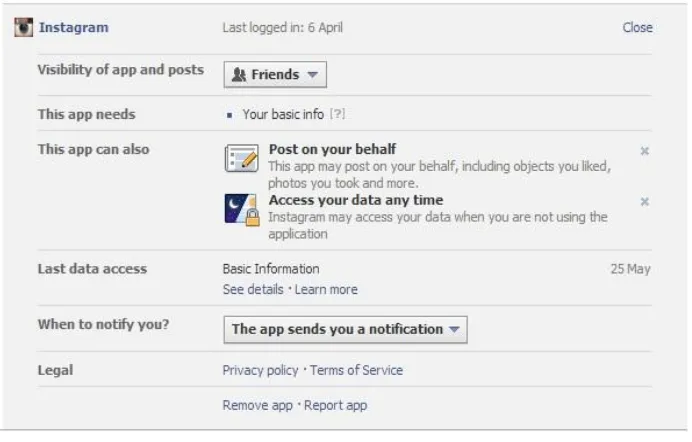
Recall the example used in Chapter 1. If an Instagram user wants to share his photos with his friends on Facebook. He needs to authorize Instagram using his personal Facebook account details. Figure 2.1 shows the default authorization settings of Instagram at a Facebook account. Instagram will ask for the permission to contents on Facebook page and access to data at any time. As a result, the user‟s identity information and attributes recorded at Facebook are revealed to the Instagram service. This is a typical identity information authorization scenario in a mobile Cloud environment.
25
[image:44.595.146.492.263.484.2]It raises an identity security issue that if two such service providers collude together, then they can reveal all the user‟s attributes. Existing identity management systems, such as OpenID [38], Higgins [39] etc. are designed for traditional PC-based Cloud environment, and do not work with all their features in mobile Cloud environments. Such identity management systems will be discussed in detail in Chapter 3.
Figure 2.1Authorization Information of Instagram at a Facebook Account.
26
the Cloud service provider hosting the mobile app. The app analyses the location and returns the requested results. In order to complete the booking, the user needs to give more details about him to the app. During this process, user does not know whether such personal details are collected by the app or some other third party entities. Furthermore, with a long time usage, the app may have a huge number of data based on the user‟s behaviours. The user will not know how his personal information will be used and even does not know his data is collected by the mobile Cloud service provider.
Most of the service providers claim that they will only collect anonymous data. However, when the service provider has a large number of users, it may sell the users‟ sensitive data to a third party who can mine the data to build business models for profits [41-43]. Mobile apps can also be used to inject the malwares to users‟ phones. Some malwares can even monitor user‟s daily activities [44]. Researchers have investigated this issue and proposed solutions in order to prevent collusion attacks. Bugielet al. presented a practical security framework for Android platform which addresses the problem of collusion attacks [45]. Their framework can monitor application communication channels in Android's middleware. A system-centric security policy-based mechanism is deployed to enforce access control in Android platform. They also improved the security framework with a system kernel module [46], which enables the framework to provide security protection at system level.
27
order to protect privacy. However, in many cases users are often asked to give some personal information during system authentication process to gain access to data and services. Researchers have also put efforts to address issues raised above. Various access control techniques such as privacy-preserving languages, access control models, and attribute-based encryption are deployed to protect users' data. Chapter 3 and Chapter 4 details those technologies and gives a literature review for related work.
2.2.1 Existing Data Protection Laws
Privacy protection must control what information about an individual is disclosed over the Internet. It includes two aspects: 1) the users should have the control of giving data access consents about their personal information to any authorized entities (i.e. it determines who can access the data) and 2) the control of how the data can be used (i.e. it determines the purpose of data usage).
The Organisation for Economic Co-operation and Development (OECD) also published guidelines on the protection of privacy and trans border flows of personal data [47]. The guidelines have been used to derive privacy laws governing the use of information systems in a number of countries. It introduces eight basic principles for data privacy protection which are listed below.
Collection Limitation Principle: The collection of personal data and
28
Data Quality Principle: Personal data should be relevant to the purpose
of use, and the extent for those purposes should be accurate, complete and kept up-to-date.
Purpose Specification Principle: The purpose for personal data
collection should be specified earlier than the time of data collection and the subsequent use limited to the fulfilment of those purpose or such others as are not incompatible with those purpose and as are specified on each occasion of change of purpose.
Use Limitation Principle: Personal data should not be disclosed, made
available or otherwise used for the purpose other than those specified at the collection time, except with the consent of the data subject or by the authority of law.
Security Safeguards Principle: Reasonable security safeguards should
be deployed to protect personal data against such risks as loss or unauthorised access, destruction, use, modification or disclosure of data.
Openness Principle: There should be a general policy of openness about
developments, practices and policies with respect to personal data. Means should be readily available for establishing the existence and nature of personal data, and the main purpose of their user, as well as the identity and usual residence of the data controller.
29
a) To obtain from a data controller, or otherwise, confirmation of whether or not the data controller has data relating to him;
b) To have communicated to him, data relating to him
I. within a reasonable time;
II. at a charge, if any, that is not excessive;
III. in a reasonable manner;
IV. in a form that is readily intelligible to them;
c) To be given reasons if a request made under subparagraph (a) and (b) is denied, and to be able to challenge such denial;
d) To challenge data relating to him and, if the challenge is successful to have the data erased, rectified, completed or amended.
Accountability Principle: A data controller should be accountable
for complying with measures which give effect to the principles stated above.
30
owners which are given in the EU law [49, 50]. In 2013, the European Commission proposed a major reform of the EU legal framework on the protection of personal data which is aimed at strengthening individual rights and tackling the challenges of globalisation and new technologies.
2.3
Security Concepts, Technologies and Mechanisms
This section examines the current technology building blocks and standards for developing security frameworks in identity management. In mobile Cloud environment, communications and data exchanges of mobile devices are taking place via wireless medium. Similar to Ethernet, three key aspects of information security referred to as CIA triad: Confidentiality, Integrity and Availability [51] must be followed in wireless communication. Additional aspects to security such as
Non-repudiation, Accountability are also referred to traditional CIA triad [52]. The key aspects are described below.
Confidentiality refers to the data concealment, preventing the disclosure of information to unauthorized entities.
Integrity protects information resources form modification and deletion by unauthorized parties. It ensures the accuracy and consistency of information resources over the life-cycle.
31
Non-repudiation implies the occurrence of an event or an action and the participant. A party cannot deny receiving a request and the other party cannot deny that it is the sender of the request.
Accountability implies the actions or decisions which are made by an entity are accountable.
The concepts listed above are necessary requirements for any security frameworks. These concepts help to protect the information systems from attacks. Security mechanisms are normally designed based on those concepts.
2.3.1 Security Technologies and Mechanisms
Information systems implement security mechanisms to detect, prevent or recover from a malicious attack. It consists of series of security services such as authentication, authorization and access control etc. Various security techniques are used for these services such as cryptography, digital signatures [53], Transport Layer Security(TLS) [54] protocol, and Security Assertion Markup Language (SAML) [13].
32
scrambling or disguising the plaintext by applying cryptographic algorithms. A ciphertext is generated based on the plaintext after encryption process. The decryption process converts the ciphertext to plaintext. It is the reverse of the encryption process. A key is required for both encryption and decryption to perform cryptographic algorithms. It is a secret value which is sensitive and should not be revealed to any other third party. The key normally is a special numerical value which is long and large enough to prevent from attacks.
The current cryptography technologies can be classified by two main categories: the secret key technology and the public key technology. In the secret key cryptography, the sender and receiver use the same key for encryption and decryption. Therefore, the key is shared as a secret by the two ends but is blind to the outer world. Different from the secret key cryptography, the public key cryptography has a pair of keys, a private key and a public key. The public key is open to any one while the private key is only known to the key holder. Either key of the key pair can be applied for encryption, but only the other key of the same key pair can do the decryption. Based on these two main technologies, several known cryptographic mechanisms are described in the following.
2.3.1.1 Symmetric Cryptography
33
depicts the work flow of the symmetric cryptographic mechanism. There are two commonly used types of symmetric encryption algorithms that are listed below:
Block ciphers takes as input a block of data and encrypt them as a single unit with a key. Blocks of 64 or 128 bits have been widely used. Such algorithms are implemented in a variety of ways. For example, the Advanced Encryption Standard (AES) [55] and the triple-DES (Data Encryption Standard) [56].
Stream ciphers encrypt the digits (typically bytes) of a message one at a time. The stream cipher algorithm proposed in [57] is a widely used model.
Figure 2.2Symmetric En/Decryption Process
2.3.1.2 Asymmetric Cryptography
34
public key cryptography. Instead of using pre-shared secret keys, every user must have a key pair. The key pair consists of two keys: a private key and a public key.
Both the private and public keys are generated or acquired by owner of the key pair. The public key is publicly available and can be used for encryption, verification of a digital signature (digital signature will be discussed in the next sub section). The private key is secured at the owner and is kept as a secret. In a public key scenario, a sender encrypts a message with the recipient‟s public key. The receiver who holds the corresponding private key can decrypt the message. Figure 2.3 describes work flow of the asymmetric cryptographic mechanism.
There are several existing asymmetric encryption algorithms, the EIGamal [58] and Rivest-Shamir-Adleman (RSA) [59] are the most widely used public key schemes.
35
2.3.1.3 Digital Signature
Digital signature supports the non-repudiation aspect of the information exchange. In digital signature scheme, a message is signed by the sender using the private key. The recipient can verify the signature using the sender‟s public key. The digital signature scheme gives an evidence for a recipient to believe that the message was sent by a known sender. The sender cannot deny the fact of having sent a message. It is used to preserve non-repudiation and authentication. The Digital Signature Algorithms [60] (DSA) and RSA [53]are commonly used.
2.3.1.4 Hash Function
Hash function is used to provide integrity of messages. A hash function is a public function which maps any length of data input into a fixed length output. Given a message M of arbitrary length, a hash function H will produce a fixed-sized hash value h in a form of h = H(M). h is a hash value of message digest. The properties of a hash function [61] are listed as follows:
One-way property: H(x) is easy to compute h with any given input x, however it is computationally infeasible to compute such that H(x) = h.
Weak collision resistance: For any given x, it is computationally infeasible to find y ≠ x with H(y) = H(x).
Strong collision resistance: It is hard to find any pair (x, y) to compute such that
H(x) = H(y).
36
validation with data privacy. Secure Hash Algorithm (SHA) is a hash algorithm and it was developed in 1993. The cryptography hash algorithm SHA-1 was published in 1995 with a maximum input length 264 bits and outputs a 160 bit message digest[62]. However, a successful attack on SHA-1 was reported in 2005 [63] and in order to avoid these problems, more advanced algorithms such as SHA-2 and SHA-3 in SHA family are used in modern day secure communication.
2.3.2 Protocols and Standards
2.3.2.1 Transport Layer Security (TLS)
The Transport Layer Security and its predecessor, Secure Sockets Layer (SSL), are both cryptographic protocols which provide a channel communication security over the Internet [64]. It secures the communication channels above the IP layer and below the application layer. In a TLS/SSL scenario, asymmetric cryptography is used for authentication of key exchange. Symmetric cryptography is implemented for data exchange.
SSL was first developed by Netscape [65], it enables a client-server application (normally is a Web browser and a Web server) to exchange data over public domains. Data confidentiality and integrity are ensured. The latest version of TLS is published in 2008 [54].
2.3.2.2 eXtensibleMarkup Language (XML):
37
structured data. It enables users to define their own tags in XML document and is widely used for business data share and exchanging in different domains. XML parser is a software program that checks the syntax of the XML document and makes the XML document‟s data readable to applications. XML schema is a method of describing the semantic rules for a XML document to be validated. A XML parser firstly checks whether the document is well formed, the term of well-formed means satisfy all XML syntax rules. Then the parser will check whether the document is Valid, which means satisfied semantic rules that are in XML schemas. W3C published the XML specification in 2008 [48].
2.3.2.3 Simple Object Access Protocol (SOAP)
38
2.3.2.4 Security Assertion Markup Language (SAML)
SAML is an XML-based framework that allows the exchange of authentication and authorization information between two Web service domains. There are four key elements covered by the SAML specification.
SAML Assertions: a pack of XML-based data includes one or more statements made by a SAML authority.
SAML Protocols: Defines data structures of request and response messages on how to obtain assertions.
SAML Bindings: Map SAML protocol messages onto standard communication protocols, e.g. HTTP.
SAML Profiles: Describe particular combination of SAML assertions, protocols and binding for a particular user case.
SAML 1.0 was first adopted as a Web standard by OASIS in 2002 [66]. After several revisions, in 2005, SAML 2.0 was announced [67]. It has been widely adopted by government, higher education and commercial enterprises.
39
2.4
Summary
The mobile Cloud technology is a combination of Cloud computing and mobile Internet technologies. In general, when a user interacts with a service provider, some static user attributes may be gathered by the service provider. However, in mobile Cloud environment, not only static attributes but also dynamic user attributes such as location records and user behavior are collected by the service providers. Hence, this new notion adds various new threats to the user privacy. Identity management systems manage users‟ identities; it is also necessary to modify the security concepts to cope with the emerging mobile application trend. In particular, the current security concepts used in identity management is powerful enough for securing data and service transactions. Even though, smart mobile devices can use these security features, these is a necessary to develop new techniques to protect the privacy of real-time dynamic attributes in mobile Cloud environments.
40
41
3 Identity Management Systems
As the number of mobile Cloud services requiring user authentication continues to grow, so does the number of digital identities. To help protect digital identities, a range of identity management systems have been proposed to address security issues of identity protection and identity management. These proposed systems are designed to simplify the management of a large number of identities, meanwhile, protect identities against cyber-attacks. This chapter briefly surveys various identity management systems in the literature.
42
3.1
Single-Sign-On(SSO) and Federation
Different online services may be hosted by different service providers. Users have to do the authentication to each service provider separately in order to access the different the Cloud services. SSO is a technology that lets users authenticate to a single authentication authority once so that they can access all authentication protected resources and services without re-authentication within the federated environment. Therefore, one login action enables user access to all the permitted resources in a complex system without entering multiple usernames and passwords. SSO provides convenience to both the user and service provide. Users do not have to memorize many usernames and passwords and at the same time, it also reduces the number of authentication requests to the service providers.
43
an identity provider. It takes charge of the authentication and authorization and maps the federated identity to other user identity credentials.
SSO not only provides convenience to traditional PC users in the past, but also can continue to play an important role in today‟s mobile environment. The simplification of identity management delivers excellent user experience in mobile environment. Identity management systems satisfy requirements for security and user experience in different mobile environment. There are several identity management systems in today's market. In the following sections, these identity management systems are briefly described in detail.
3.2
Microsoft .NET Passport:
In 1999 .NET Passport was introduced by Microsoft [68]. In a .NET Passport system, the users can access multiple websites using a single set of credentials. Microsoft presents .NET Passport system as their web-based SSO solution. A Passport user gives permission to the Passport server to the Passport account credentials. The credentials consist of username, password, email address, first name, last name, date of birth, etc. The sites deploying Passport services are called participating sites. Microsoft provides Passport services as a centralized authentication server.
44
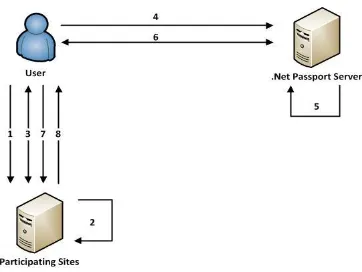
Figure 3.1.NET Passport Authentication Process
(1) User requests resources from a Passport participating site via the browser
(2) The participating site generates a Passport object and forward to the browser to check whether there are any valid passport cookies
(3) If there are any existing cookies, the page loads with a sign-out link and consider the user as an authenticated user. Otherwise, the page loads with a sign-in link.
45
participating site ID, the return URL to the participating site after authentication
(5) .NET Passport Server checks the validity of the participating site ID and returns the URL and the Passport sign-in page
(6) If the user is successfully authenticated by the .NET Passport server. The server generates encrypted cookies based on user‟s Passport User ID and the Passport profile and then forwards these data to the user‟s browser with the redirection URL. Cookies are encrypted by the participating site‟s public key. The communication is secured by TLS/SSL channel encryption
(7) The browser redirects the page to the participating site with the encrypted cookies
(8) The Passport Manager authenticate the cookies and grant access to the user for accessing the site
.NET Passport is a SSO mechanism for systems that are connected over the Internet. User authentication is implemented via web forms. Although today‟s mobile browsers, such as Safari and Chrome are designed with many important functionality to execute operations as a traditional PC browser, the .NET Passport is not a suitable for mobile Cloud environment because of its browser-based feature and lack of participation from users.
46
After this planned implementation in 2009, there is no further update for .NET Passport [70].
3.3
The Liberty Alliance(Kantara)
[image:65.595.146.476.472.699.2]The Liberty Alliance is a large consortium which is established in 2001 by approximately 30 organizations. Now it has over 150 diverse member companies and organizations representing leaders in IT, government, and finance from across globe to build open, standards based specifications for federated identity management. The vision of the Liberty alliance is to establish privacy and security best practices as well as implementation guidelines. It also collaborates with other standards bodies with an eye toward adopting or extending other specifications [71]. From the mid of 2009, the work of the Liberty Alliance project has been to contribute to the Kantara Initiative [72]. Figure 3.2 depict the abstract view of the Liberty architecture.
47
The Liberty Alliance project consists of a number of modules. Each module aims to solve different problems in identity management. The following section will discusses them in detail.
Liberty Identity Federation Framework (ID-FF): The Id-FF enables identity federation and management. A Liberty Federation allows users to authenticate and sign-on to a domain once from any device and then access to the partner Web sites without re-authenticate. It is independent of platform, network devices, computing and mobile devices [73]. It provides approaches for implementing federation and SSO.
Liberty Identity Web Services Framework (ID-WSF)[74]: The ID-WSF is an open framework for deploying and managing a variety of identity-based Web services. It contains a set of specifications for creating, using and updating various aspects of identities. The ID-WSF also presents security functions for privacy protection.
Liberty Identity Services Interfaces Specification (ID-SIS): The ID-SIS is an open framework which contains a collection of specifications. These specifications are designed for the interoperability of different services [75].
48
service providers. The assertion consists of the name identifier of the user for service providers to identify the user. The authentication server uses distinct identifiers for each user with different service providers. Figure 3.3 describes the Liberty notation of Trust.
Figure 3.3The Liberty Notation of Trust
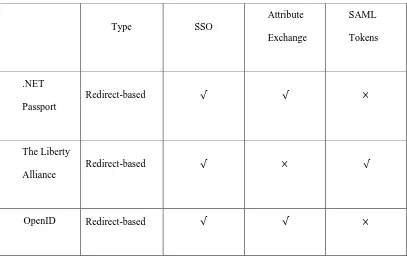
The Liberty Alliance supports SSO and use SAML token for authentication. Using SAML also enable it to bring attributes within the communication messages. However, it does not support attribute exchange which is critical in mobile Cloud environments.
3.4
OpenID
49
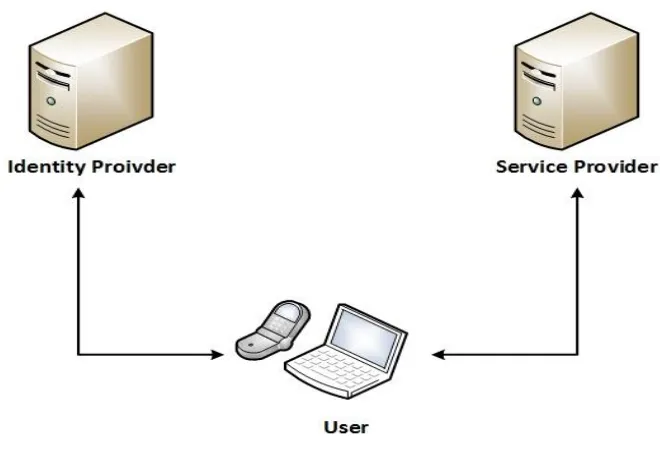
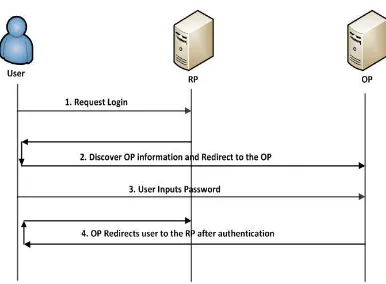
OpenID framework: the user, the Relying Party (RP), and the Identity Provider (IdP). The RP is always known as the service provider from which the user requests services.
[image:68.595.125.511.375.659.2]In the OpenID framework, three parties are involved in the authentication process. They are theOpenID provider (OP), which stands for the identity provider; the Relying Party (RP) which is also called service provider and the user. Assuming that the OP and the RP has an existing trust relationship.OP has a trusted list of RPs. In the OpenIDmodel, the users only need to have the identity and password details. Figure 3.4 describes the workflow of OpenID framework.
50
(1) User requests to login into the RP and submits the credential
(2) RP discovers the OP information from the user‟s credential and redirects the OP to the user
(3) User enters the password into the field on the OP‟s page
(4) If the user‟s credential is verified, OP redirects RP‟s page to the user
OpenID users can choose a trustworthy OpenID server to register their OpenID account. They are identified as a URL: http://yourname.openidserver.com. The RP parses the URL and will get the OP‟s address “openidserver.com” and the user‟s identity “yourname”. Then the RP can redirect the OP to the user for authentication. The authentication process will make use of the identity “yourname” and the user will inputs the password. If the authentication is successful, OP will redirect RP‟s page to the user. In the whole process, user is not required to reveal the password to the RP which protects the privacy [77]. However, limitations are discussed in [78] that OP only uses one password to authenticate the user which is not secure enough. OpenID is a symmetric cryptography based framework, which is simple to use but more vulnerable than asymmetric encryption. Moreover, it is a web browser based mechanism and it utilizes the cookies which is not suitable for the mobile Cloud environment.
51
OpenID authentication services [80]. IT enterprises like Google, Yahoo, and Microsoft are acting as the OpenID Identity Providers.
3.5
Higgins
Higgins [39] launched in 2003, an open-source Internet identity framework designed to integrate identity, profile, and social relationship information across multiple sites, applications and devices. Higgins is InfoCard-based and involves an active client.
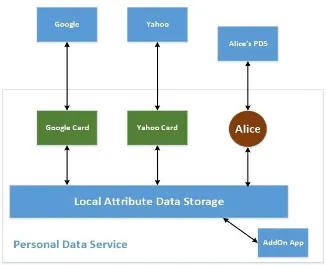
Higgins provides a Personal Data Service (PDS) that let each user control how their personal data is shared with friends and organizations they trust. A PDS is a Cloud-based service that works on behalf of a user, the individual. It gives the user a central point of control for his personal information. The user‟s interests, contact information, address, profiles, affiliations, friends etc. can be considered as user personal data. A PDS is a place where a user establishes bi-directional data flows between external businesses and his PDS, or between a trust recipient‟s PDS and his PDS. Figure 3.5 depicts the architecture of Higgins 2.0.
52
Figure 3.5Architecture of Higgins
The profile shown in brown circle represents a relationship between the user and another person. The relationship includes a bi-directional data connection that shares and synchronizes a set of attributes representing a friend.
The blue box shown as AddOn App is a built-in app or extension app which has access to the local storage and update, add value to what‟s available irrespective of any particular relationship connections.
The local storage for data storage holds user‟s data using the vocabularies of the Higgins‟ Persona Data Model 2.0. It exposes these data to the Portal or a browser extension via an HTTP/Comet messaging interface.