City, University of London Institutional Repository
Citation
:
Tsanakas, A. and Millossovich, P. (2016). Sensitivity analysis using riskmeasures. Risk Analysis: an international journal, 36(1), pp. 30-48. doi: 10.1111/risa.12434
This is the accepted version of the paper.
This version of the publication may differ from the final published
version.
Permanent repository link:
http://openaccess.city.ac.uk/12696/Link to published version
:
http://dx.doi.org/10.1111/risa.12434Copyright and reuse:
City Research Online aims to make research
outputs of City, University of London available to a wider audience.
Copyright and Moral Rights remain with the author(s) and/or copyright
holders. URLs from City Research Online may be freely distributed and
linked to.
City Research Online: http://openaccess.city.ac.uk/ [email protected]
Sensitivity analysis using risk measures
∗Andreas Tsanakas †1 and Pietro Millossovich‡1
1Faculty of Actuarial Science and Insurance, Cass Business School, City University
London
∗Accepted for publication in
Risk Analysis: An International Journal. We thank two referees for constructive
feedback. Earlier versions have been presented at the 17thInternational Congress on Insurance: Mathematics and
Economics, the 6thInternational Conference of the ERCIM WG on Computational and Methodological Statistics,
the 6th International Conference on Mathematical and Statistical Methods for Actuarial Sciences and Finance,
theFISC 2014 Conference, and at research seminars in the Department of Mathematics, ETH Zurich, the Faculty
of Economics, KU Leuven, and the Department of Mathematics and Statistics, University of Montreal. We thank
Jens Perch Nielsen, Mar´ıa Dolores Miranda-Mart´ınez and Mario W¨uthrich for helpful discussions.
Abstract: In a quantitative model with uncertain inputs, the uncertainty of the output can be summarized by a risk measure. We propose a sensitivity analysis method based on derivatives of the output risk measure, in the direction of model inputs. This produces a global sensitivity measure, explicitly linking sensitivity and uncertainty analyses. We focus on the case of distortion risk measures, defined as weighted averages of output percentiles, and prove a representation of the sensitivity measure that can be evaluated on a Monte-Carlo sample, as a weighted average of gradients over the input space. When the analytical model is unknown or hard to work with, non-parametric techniques are used for gradient estimation. This process is demonstrated through the example of a non-linear insurance loss model. Furthermore, the proposed framework is extended in order to measure sensitivity to constant model parameters, uncertain statistical parameters, and random factors driving dependence between model inputs.
1
INTRODUCTION
Sensitivity analysis, alongside uncertainty analysis, is an activity of fundamental importance to
risk analysts, especially in the presence of complex computational models with uncertain inputs.
Reasons for performing sensitivity analyses include the need to rank the relative importance of
input variables, to uncover relations between inputs and outputs in complex models, to perform
quality assurance and reasonableness checks, and to identify areas of investigation and refinement
in the model(1–5). Sensitivity analysis comprises a wide range of methodologies, with global
sensitivity approaches, reflecting the model behaviour over the whole of the input range(3,5,6),
becoming the norm in recent years. Such methods have seen wide application in risk analysis;
indicatively we mention safety assessment for nuclear waste disposal(7), food safety(2), microbial
risk assessment(8), and climate change modelling(9).
Global sensitivity approaches are concerned with “how uncertainty in the output of a model
[...] can be apportioned to different sources of uncertainty in the model input”(5). In
moment-based global sensitivity analyses(3,5), the variance of outputs is typically apportioned to
contri-butions of input variable volatilities. While such analyses are revealing, it is known that using
the variance as a measure of variability can lead to violations of standard dominance
require-ments(10). Furthermore, application of variance-based sensitivity methods becomes involved
when inputs are correlated. Such considerations have motivated the design of moment-free
sen-sitivity analyses(6,11–13), which reflect the difference between the conditional and unconditional
output density via a distance measure.
We consider models where a number of uncertainmodel inputs are mapped to a singleoutput
of interest via a known model function. Both inputs and outputs are observable. Uncertainty
analysis allows determination of the output’s probability distribution, e.g. via Monte-Carlo
a statistical functional that maps a random variable to a real number(14,15). Moments such as
the mean and variance are examples of risk measures. A flexible and widely applicable class
aredistortion risk measures(14,16–18), arising as weighted averages of percentiles. The weighting
function encodes preferences, in the sense that particular areas of the output probability
dis-tribution, corresponding to states of interest, can be focused on. The class of distortion risk
measures includes most coherent risk measures(19) of interest. The sensitivity of optimization
problems that involve such risk measures is studied in Ref.(20).
We propose a sensitivity analysis method that directly links to uncertainty analysis through
the use of risk measures. Specifically, we argue in favor of measuring sensitivity by adirectional
derivative of the risk measure applied on the output, in the direction of model inputs. The
result-ing sensitivity measure satisfies the desirable properties of Saltelli(3). In particular, it is global,
in the sense that it is generated by the weighted average of local sensitivities over the whole of
the input space. The proposed method is general enough to cope with measurement of
sensitiv-ity to various types of variables, such as (i) uncertain model inputs; (ii) statistical parameters
of the distributions of inputs that are subject to uncertainty; (iii) known structural parameters;
(iv) common factors driving dependence between inputs. The calculation of sensitivities can
be carried out on a single Monte-Carlo sample of model inputs and outputs – computational
speed can be further improved for high-dimensional models if information on the hierarchical
(multi-level) construction of the model functions is available. While the method is in principle
applicable to any type of risk measure (including moment-based ones), we focus on the case
where the output distribution is summarized by a distortion risk measure.
In Section 2, the sensitivity to each model input is defined as the derivative of the risk
mea-sure applied on the output, with respect to the scale of a random shock applied to that model
input. The sensitivity thus is a directional derivative, which makes the sensitivity measure a
to non-linear models. For distortion risk measures, an explicit formula for the sensitivity
mea-sure is derived, extending existing results(24,25). The resulting sensitivity is expressed as an
expectation involving the random shock, the corresponding gradient of the model function, and
scenario weights generated by the risk measure. Thus the sensitivity measure reflects
informa-tion about the statistical behaviour of the model inputs, the shape of the model funcinforma-tion, and
preferences. There is flexibility in relation to the shock chosen and we particularly focus on
shocks that produce proportional changes to model inputs.
The formal properties of the sensitivity measure are discussed in Section 2.3, where its
relation to other sensitivity analysis approaches is also discussed. Conceptual parallels are
identified between the properties our sensitivity measure and the concerns of standard methods
such as Regional Sensitivity Analysis(26), elementary effects(27), variance-based sensitivity(3,5)
and moment-free sensitivity(6).
In Section 3, the implementation and communication of the sensitivity analysis is
demon-strated, using the example of a non-linear insurance loss model. The analysis is performed on a
Monte-Carlo sample of the portfolios. We do not calculate the gradient of the model function
analytically, but instead put ourselves in the shoes of an analyst or reviewer who has access to
the simulated samples of the model inputs and output only, but no direct access to the model’s
analytical form. This corresponds to practical situations, where there is limited access to model
documentation and/or the model is too complicated to make analytical calculations
appeal-ing. Then, the gradients of the model are estimated numerically from the simulated sample,
borrowing tools from non-parametric statistics, in particular local linear regression(28,29).
In Section 4, the proposed methods are extended to the measurement of the sensitivity to
parameters and the dependence structure. For this purpose, known model parameters, treated
as degenerate model inputs, are artificially randomized. Sensitivity to statistical parameters
average of distributions (a mixture) over possible parameter values. We express an model input
subject to parameter uncertainty as a function of two independent random variables, representing
stochastic and parameter uncertainty respectively. The sensitivity to each of the two elements
is then calculated.
Correlation and, more broadly, dependence between inputs is understood as a major driver
of output variability(12), see also Ref.(30) for an extensive treatment. Many commonly used
dependence structures can be expressed via conditional independence, given a number of latent
or observable common factors. We proceed by measuring sensitivity to those common factors.
This entails expressing the vector of dependent model inputs as a function of a vector of
in-dependent idiosyncratic and common factors; we present a probability transform that enables
such a decomposition.
Brief conclusions are stated in Section 5; formal statements of results and proofs are given
in the Appendix.
2
SENSITIVITY ANALYSIS
2.1 Preliminaries
For the purposes of this paper, a model consists of three elements: a vector X of inputs, a
functiong, and an output variableY =g(X). We call the elements of X model inputs. Model
inputs are uncertain; they can be subject to both epistemic uncertainty and stochastic variability.
Uncertainty is modelled by consideringX a random vector taking values in an open convex set
X ⊂Rd and with joint probability distribution F. We call g :X →Rthe model function and
Y theoutput. For simplicity, we will typically assume that that high values ofY correspond to
undesirable states of the world, for instance in the case that Y stands for a financial loss.
assume here and in the sequel that distributions are strictly increasing and continuous, though
the results in this paper do not require such assumptions. Then, for u ∈ (0,1), the inverse
FY−1(u) gives the 100uth percentile of Y. We calloutput rank the uniformly distributed random
variableUY =FY(Y), such that Y =FY−1(UY).1
A risk measure is a functional ρ mapping random variables to the real line. For example,
ρ(Y) =E(Y) andρ(Y) =V(Y), the mean and the variance, are risk measures. Here we consider
the class of distortion risk measures, defined as weighted averages of percentiles. Consider a
non-negativeweight function ζ on [0,1] withR1
0 ζ(u)du= 1. The functionζ reflects preferences,
in the sense that it allows assigning a higher weight to output ranks corresponding to (generally
undesirable) states of the world that are of specific interest. The distortion risk measure, as
applied to the random variable Y, is given by the relation
ρ(Y) = Z 1
0
FY−1(u)ζ(u)du=E Y ζ(UY)
. (2.1)
To distinguish the risk measureρas an abstract functional, from the valueρ(Y), we call the latter
therisk summary ofY. The right-hand-side of equation (2.1) shows that the risk summary ofY
may also be represented as its expected value, subject to a re-weighting of probabilities effected
by ζ (note that E(ζ(UY)) = 1). Distortion risk measures were introduced in the actuarial literature by Wang et al.(16). Such risk measures have found wide application in insurance
pricing, financial risk management and risk analysis(14,17,18).
This class of risk measures is fairly flexible and admits commonly used measures as special
cases. The constant weight functionζ(u) = 1 gives the mean. The 100pth percentile, FY−1(p), is derived for a trivial weight functionζ(u), with a mass concentrated atp, such that a weight of 1 is
1For a general distributionF
Y, the definitions are easily extended. The generalized inverseFY−1(u) = inf{y:
P(Y ≤ y) ≥ u} is defined. There still exists a random variable UY such that Y = FY−1(UY), but it is no
longer unique. A simple explicit construction of the output rankUY is given by the generalized distributional
attached toFY−1(p) and a weight of zero to all other percentiles. In finance,FY−1(p) corresponds to the Value-at-Risk measure, denoted by VaRp. Let 1A be the indicator function of an event
(or set) A, taking value 1 when the event is true and zero otherwise. Then, ζ(u) = 1−1p1{u>p}, applying a constant weight to percentiles more extreme than the 100pth, gives rise to Tail-Value-at-Risk (TVaR), TVaRp(Y) = 1−1pRp1FY−1(u)du = E(Y|Y > FY−1(p)), with the second
equality holding whenFY is continuous. The VaR and TVaR risk measures are extensively used
in financial risk management(32), while other weighting functions considering the whole of the
output distribution are available(18,30). When the function ζ is non-decreasing (as in the case
of TVaR), the corresponding risk measure ρ is a convex functional, thus satisfying the axioms
of coherent risk measures(19). For coherent risk measures, inconsistent orderings of probability
distributions, such as those identified by Cox(10), are avoided.
It is not obvious how to best choose a risk measure. Sometimes, particular risk measures are
prescribed by regulation. For example, in an insurance context, capital requirements under the
European Solvency II regime are calculated by VaR0.995(33), while under the Swiss Solvency Test
a TVaR0.99measure is used(34). The choice of these measures is dictated by their regulatory use,
as they both are simple and focus on extreme adverse events. For internal use, which is related
to sensitivity analysis, one need not restrict to those or indeed to any single risk measure. The
choice of risk measure will be discussed further through Examples 1 and 2.
2.2 Sensitivity measures
We measure the sensitivity of the output risk summary to an individual model input, by stressing
that model input with a random shock. Specifically, consider a random variable Z and ǫ > 0.
Denote by ei the vector in Rd with 1 in the ith position and 0 elsewhere. Then, the vector of
model inputs with a shock ǫZ applied to the ith element is written as X+ǫZei. Additionally,
The application of the shock ǫZ corresponds to a change in the distribution of the random
variable Xi (and more generally the random vectorX), effected by adding to it another source
of uncertainty. The selection of Z depends on the purpose of the sensitivity analysis. If one
wants to study for example the impact of increasing the variability ofXi, thenZ can be chosen
to have a mean of zero. It will be seen below that it is possible without loss of generality to
restrict attention to shocksZthat are functions of the random vectorX, such thatZandXi will
generally be dependent random variables. We note that this way of changing the distribution
of the inputs, by perturbing the random inputs directly, is distinct from a perturbation of the
probability distribution itself as practised in Bayesian(35) and robust(36) statistics.
The sensitivity to the shock Z is now defined as the derivative of the risk summary of the
stressed outputρ(g(X+ǫZei)) with respect toǫ, evaluated atǫ= 0.2 Hence, it is a directional
derivative in the direction ofZ. Such derivatives have been considered in finance, where generally
only linear model functions are considered(21–23), while non-linear models are only studied in
the case of VaR(25).
Definition 1. Let the function ǫ 7→ ρ g(X +ǫZei)
be differentiable at ǫ = 0. Then the
sensitivity of ρ g(X)
to the shock Z applied onXi is defined as
Si(Z;X, g) =
∂
∂ǫρ g(X+ǫZei)
ǫ=0
.
For Z =Xi, we denote Si(X, g)≡Si(Xi;X, g) and call this the sensitivity of ρ g(X) toXi.
In general it is not straightforward to obtain Si(Z;X, g) by direct differentiation and
nu-merical evaluation may be challenging for complex models. The following result gives a formula
that is generally be easier to evaluate and also provides additional insight into the definition of
sensitivity introduced.
2The support ofXis a subset ofX and throughout the paper we assume that evaluations ofgat points not
Proposition 2. Assume that
i) g is differentiable with ∇g= (g1, . . . , gd) ;
ii) gis invertible in at least one argument, say thekth, andX
k has a conditional density given
X−k;
iii) the functionǫ7→Fg−1(X+ǫZei)(u) is differentiable at ǫ= 0 for all u∈(0,1).
Then
Si(Z;X, g) =E Zgi(X)ζ(UY)
Si(X, g) =E Xigi(X)ζ(UY).
The proof of Proposition 2, its relation to results already in the literature, and a discussion
of its assumptions are given in Appendix A. Proposition 2 shows that the sensitivitySi(Z;X, g)
can be viewed as the expected value of the shock Z, multiplied by the derivative of the model
function in theith element (evaluated at random points X) and the weights ζ(UY). Taking the
expectation reflects the scale of the shock Z; multiplying by the derivative considers the (local)
sensitivity of the model function to such shock at each state of the world; using the weight
function places emphasis on those scenarios that are of most interest for the calculation of the
the output risk summary. Thus, the sensitivity appropriately reflects the joint distribution of
(Z,X), the properties ofg, and the preferences encoded inζ. By considering the derivativegi at
random pointsX and placing emphasis on regions ofY that are of interest, aglobal sensitivity
measure is obtained. Thus the first three desirable properties of sensitivity analysis methods
specified by Saltelli(3) are satisfied.
There is flexibility in the potential choice of Z. The particular choice Z = Xi, on which
we generally focus, effects a proportional stress on the ith model input. When Z is statisti-cally independent of X one obtains Si(Z;X, g) = E(Z)E gi(X)ζ(UY)
the variability of independent shocks is of no consequence, with only their mean driving the
corresponding sensitivity. This observation motivates the choice of a shockZ that is dependent
on the vector of model inputs X,Z = Xi being one such case. More generally, for any choice
Z, application of the tower property reveals that Si(Z;X, g) =Si(E(Z|X);X, g), showing that
one may meaningfully restrict attention to shocksZ that are functions of X.
One can perform the decomposition
Si(Z;X, g) =SiM(Z;X, g) +SiD(Z;X, g), (2.2)
where
SiM(Z;X, g) =E E(Z)gi(X)ζ(UY)
=Si(E(Z);X, g) (2.3)
SiD(Z;X, g) =E (Z−E(Z))gi(X)ζ(UY)
=Si(Z−E(Z);X, g). (2.4)
Hence the sensitivity to the shock Z can be viewed as the sum of two distinct effects: a mean
elementSM
i (Z;X, g), reflecting sensitivity to a non-random shockE(Z), and adeviationelement
SiD(Z;X, g), reflecting sensitivity to a zero-mean shockZ−E(Z). Considering such a breakdown can be useful for further understanding the nature of the reported sensitivity Si(Z;X, g); for
example whenZ =Xi, for a high mean / low variability model inputXi one would expect the
mean element to dominate, while in a low mean / high variability example the deviation element
would be more important. In particular, if Z is independent of X (with Z constant a special
case), it isSD
i (Z;X, g) = 0.
Finally, we note that the proposed sensitivity measure can also be calculated on
moment-based risk measures. For example, from elementary calculations, we have for the mean and
standard deviation:
ρ(Y) =E(Y) =⇒ Si(Z;X, g) =E(Zgi(X))
where Cis the covariance operator. Moment-based risk measures are not further considered in
this paper.
2.3 Properties and relation to the literature
While the sensitivity measure proposed is different from other measures in the risk analysis
literature(3,5,11), at the conceptual level several parallels emerge. First note that, though defined
by a partial derivative, this is a global rather than a local sensitivity measure, since it is defined
as the directional derivative of a statistical functional (risk measure) and not a derivative of the
model functiongat a given point. This is reflected in Proposition 2, showing that that evaluation
of the gradient of g is necessary for all possible states of of the input vector X. Considering
derivatives of g across the range of X is something already encountered in the Morris method
of Elementary Effects(5,27,37), however here we consider a scenario-weighted average that is
explicitly linked to the risk measure used in the uncertainty analysis.
The sensitivity measure, while global, is still based on differentiation, a characteristic shared
with many local sensitivity analysis methods. Indeed, if one is primarily interested in changes
to ρ(g(X+ǫZei) (as opposed to g(X+ǫZei)), the problem can be recast as a local sensitivity
analysis with the risk summary as the output and ǫ as the input. In that case the arguments
for (and against) local differential methods apply, as outlined in Ref.(38) Sec. 2.5.
The sensitivity Si(Z;X, g) depends on the weighting functionζ, a dependence suppressed in
the notation. A way of expressing sensitivities without reference to ζ follows from considering
the function
si(u;Z;X, g) =E Zgi(X)|UY =u. (2.5)
The quantity si(u;Z;X, g) is the sensitivity of the output percentile FY−1(u) to the shock Z
applied on the ith model input; hence it provides a sensitivity measure specific to a particular
risk measure can be simply recovered by averaging overu,
Si(Z;X, g) =
Z 1
0
si(u;Z;X, g)ζ(u)du. (2.6)
While Si(Z;X, g) summarizes sensitivity in a single number, it will be seen in examples that it
can be informative to plot the whole curvesi(u;Z;X, g).
A particular choice of the weight function ζ induces an interpretation of the sensitivity
measure that is consistent with the ideas of Regionalized Sensitivity Analysis (RSA)(26,39,40). In
such approaches, the distribution of each model input is compared, conditional on the system
being or not in states of a predefined (adverse) behavior. When the conditional distribution
differs across adverse and non-adverse states, then the model input is classified as important. In
our setting, we can consider an eventAthat includes states of particular interest. If those states
correspond to a range of Y, then we can choose confidence levels 0 ≤ α < β ≤ 1 and define
A = {FY−1(α) < Y < FY−1(β)} (β = 1 is often chosen to reflect the full tail of the probability distribution, giving rise to the TVaR risk measure(18)). Then, if we letζ(u) = β−1α1u∈(α,β), we obtain ρ(Y) =E(Y|A),Si(X, g) =E(Xigi(X)|A). Hence the risk measure is the expected value of the outputY conditional on the adverse eventA and the sensitivitySi(X, g) is the expected
value of Xigi(X) over the same states.
In global sensitivity methods, it is typically required that sensitivity measures reflect the
dependence betweenXiandY and in particular the extent to which knowledge ofXi will reduce
the variability ofY (3,5,11). To see how this concern is reflected in the current framework, observe
that SiD(X, g) = C(Xi, gi(X)ζ(UY)), such that the dependence between Xi and (the rank-transformation of)Y is captured. When the function gis linear in theith element,gi(X) =gi is
constant and the expression simplifies togiC(Xi, ζ(UY)). Furthermore, we can reflect a marginal
ǫ >0. By the definition of the sensitivity measure it then is
ρ(g(X))−ρ(g(Xiǫ,X−1))≈ −ǫSiD(X, g). (2.7)
Thus the deviation component of the sensitivity reflects the reduction inρ(g(X)) induced by a
small reduction in the variability ofXi.
In sensitivity analysis, stressing a group of factors at the same time is often desired (the
fourth desirable property of Saltelli(3)). Let such a group be indexed by a set G⊂ {1, . . . , d}.
Consider a vector of random shocks (Z1, . . . , Zd) and let ZG be a random vector such that
ZG
i =Zi if i∈GandZiG= 0 otherwise. Thenρ g(X+ǫZG)
is the output risk summary with
all model inputs in the groupGstressed at the same time. Straightforward calculus leads to
∂
∂ǫρ g(X+ǫZ
G)
ǫ=0
=X
i∈G
Si(Zi;X, g). (2.8)
Therefore, sensitivity to the groupGof model inputs decomposes into a sum of single-factor
sen-sitivities. This form of additivity is shared with the (local)differential importance measure(41,42),
which calculates sensitivity as the ratio of a partial derivative over the total differential. In this
respect, the sensitivity method proposed here can be seen as an extension of the differential
importance measure, applying to functionals.
A further feature that sometimes occurs in sensitivity analyses is an additive decomposition
of the output variability to sensitivities(3,5,43). As we focus on ranking the importance of different
model inputs rather than a variability allocation, we do not pose such an additivity requirement,
consistently with other moment-independent sensitivity analysis methods(6,11). However, in the
special case when g is linear, the first derivatives gi(x) = gi are constant and we can write
g(x) =g(µ) +Pd
i=1gi(xi−µi), for any vectorµ∈Rd. If we letµstand for the vector of means
of X, it follows thatρ(g(X))−g(µ) =Pd
i=1SiD(X, g), i.e. an additive apportioning of the risk
summary is effected. The case of lineargis the one typically considered in financial applications,
of the risk summary ρ(g(X)) may be obtained if one uses a Sobol’/Hoeffding expansion of the
functiong(43,44) (rather than the variance of g(X)). Such a process is outside the scope of the
present paper.
Further formal properties of the sensitivity measure are now briefly discussed. Precise
state-ments and proofs are given in Appendix B. A first consideration relates to the possible sign of
the sensitivity measure. This is of natural interest, since by its definition Si(Z;X, g) enables
approximation of the change in the risk summary due to a marginal change in exposure, by
ρ(g(X+ǫeiZ))−ρ(g(X)) ≈ǫSi(Z;X, g) for small ǫ. When the model function g is convex in
the ith argument and the weight function ζ is increasing, then ǫSi(Z;X, g) actually provides a
lower bound for the incremental change in the risk summary (Lemma 4). Restricting to the case
Z =Xi, it furthermore holds that convexity ofgand positive dependence of the random vector
X leads to positive values of the deviation componentSiD X, g
(Lemma 5).
Quantitative models are often built hierarchically via graphical methods: a number of lower
level model inputs are specified and then combined into model inputs at a higher level, which in
turn determine the output. Such hierarchical structures can be exploited in order to reduce the
dimensionality of the model function whose gradient is required for sensitivity analysis (Lemma
6). Mathematically this is an elementary argument, but the computational benefits it produces
may be substantial. The same approach is extendible to situations where common model inputs
impact on different branches of the hierarchical structure (Lemma 7). Finally, note the potential
arbitrariness in the choice of model inputs, as a non-linear change of scale for a particular
model input will tend to change the measured sensitivity. However, the deviation component
of sensitivity is invariant to linear transformations of model inputs (Corollary 8). This means
that the sensitivity measure introduced here does not satisfy the property of invariance under
monotonic transformations possessed by moment-independent importance measures(9,11), unless
2.4 Treatment of discrete inputs
It is possible that one or more model inputs are modelled as discrete random variables. In such
a case, Proposition 2 is still applicable, but some further comment is necessary. For simplicity,
consider that X1 takes only the values 0 or 1. Then, values of the function g(x) are only
observed for x1 = 0 or x1 = 1; g is therefore not uniquely defined for x1 ∈ (0,1). Hence,
differentiation ofg in the first argument is not meaningful, unlessgis extended in order to take
values for x1 ∈(0,1). Such an interpolation is not unique and should be chosen in a way that
is interpretable. Unavoidably, the choice ofg will then be subjective.
As a particular choice, one may let the function g be linear in its first argument, such that
forx1 ∈(0,1] it is
g(x1,x−1) =g(0,x−1) +x1(g(1,x−1)−g(0,x−1)) (2.9)
Since [X1g1(X)|X1 = 0]≡0 the value ofg1(0,x−1) is not of primary interest for the sensitivity;
as a matter of convention one may set it to zero. Such a choice is presented in Example 1 of
Section 3.
3
APPLICATION TO SIMULATION MODEL
In practical applications, quantitative risk models are typically implemented in a Monte-Carlo
simulation environment, since determining the probability distribution ofY analytically is often
unfeasible. After specifying the joint distribution ofXand the model function g,nindependent
observations of (X, Y = g(X)) are simulated. The risk summaryρ(Y) is then estimated from
the empirical distribution of Y thus obtained.
While specification of the distribution of X and of the model g is necessary to implement
the simulation, a risk analyst or model reviewer does not necessarily have unencumbered access
of documentation. Moreover the function g is often so complex that, even if well documented,
may be cumbersome to use in explicit form. (Model complexity is often the motivation behind
performing sensitivity analyses in the first place.) While some information on the model model
can of course be glanced from documentation (e.g. hierarchical structure), here we simplify the
discussion by considering a black box model. In the current context, that means that a risk
analyst has only access to the simulated sample (x1, y1), . . . ,(xn, yn), wherexj = (xj1, . . . , xjd),
and (for now) nothing else.
From Proposition 2, the sensitivity to the ith model input may be estimated as
ˆ
Si(X, g) =
1
n
n
X
j=1
xjiˆgi(xj)ζ(uj), (3.1)
where uj are obtained via the empirical distribution ˆFY, such that uj = ˆFY(yj), and ˆgi(xj) is
an estimate of gi(xj).
Estimating the gradient of g from the sample provided is not trivial. One possible method
is to use tools from non-parametric statistics, in particular local linear regression(28,29,45,46). In
that framework, smoothing methods are used to provide non-parametric estimates of g and its
gradient, by formulating a statistical model of the formE YjXj
=g(Xj).A detailed review of
local linear regression is beyond the scope of this paper; the description of local linear regression
in the rest of the present section follows Li and Racine(29). For simplicity assume, as in Section
2.4, that the first model input is a Bernoulli variable and all others are continuous. Denote
by xj,−1 = (xj,2, . . . , xj,d) the vector of observations for model inputs X2, . . . , Xd from the jth
simulated scenario. Estimates of the model function and its gradient for continuous model
inputs, (ˆg(z),ˆg2(z), . . . ,gˆd(z)) at some pointz∈ X are obtained by solving
(ˆg(z),gˆ2(z), . . . ,ˆgd(z)) = arg min α,β
n
X
j=1
yj −α−β′(xj,−1−z−1) 2
Kδ(xj,z) (3.2)
whereKδ(xj,z) =Qdi=1ki,δi(xji, zi) is aproduct kernel. Thus the estimates (ˆg(z),gˆ2(z), . . . ,ˆgd(z))
func-tion ki,δi(xji, zi), i= 2, . . . , dis a kernel function with bandwidth δi, that is, a univariate
sym-metric density (e.g. Gaussian) with scale parameterδi. For the indicatorX1, a kernel of the type
k1,δ1(xj1, z1) =1{xj1=z1}+δ11{xj16=z1}is used, a limiting case of which isk1,0(xj1, z1) =1{xj1=z1},
such that no smoothing over X1 takes place. In-sample optimal selection of the vector of
band-widths δ can be carried out by methods like leave-one-out cross-validation, though such
band-width selection procedures can be computationally very intensive.
In the following example, drawn from insurance loss modelling, it is shown how the above
ideas can be applied. Of course the model considered here is not a black box, but the
ex-ample shows that the sensitivities of even standard models can display complexities that the
proposed methodology elucidates. The model function is a simple function containing additive,
multiplicative and non-linear components, thus similar in nature to the test models often used
in to demonstrate sensitivity analysis methods(6). Notwithstanding its simplicity, the example
displays standard features found in more complex models used in risk analysis: namely the
presence of uncertain correlated inputs joined by a highly non-linear function. This is the case
for models used e.g. in safety assessment for nuclear waste disposal(7), financial engineering and
the study of chemical reactions (Sec. 6.2-6.3 in Ref.(5)). In particular, the use of a discrete
Bernoulli variable is also observed in the construction of composite indices combining different
input averaging methods (Sec. 6.1 in Ref.(5)).
Example 1. Consider a simple insurance portfolio of short-term liabilities in two areas (lines)
of business. The first and second lines yield total claims X1 and X2 respectively. The claims
from X1 and X2 are statistically independent, but are both subject to adjustment by the same
multiplicative factorX3 (e.g. due to inflation). Hence the total cost of insurance claims is given
by
The insurer has bought protection via a reinsurance contract. In particular, a reinsurance layer
withdeductible λand limit l has been purchased. This means that the reinsurer agrees to pay
claims in excess of λ, but only up to a maximum payment of l, corresponding to a claim of
C=λ+l. However there is always the chance that the reinsurer does not fulfil his contractual
obligation, e.g. because of a default. Let thenX4 be thedefault indicator, a Bernoulli variable
taking values 0 and 1 in the respective cases of non-default and default respectively. Thus, the
total loss is given by
Y =C−(1−X4) min{(C−λ)+, l}, (3.4)
which with (3.3) defines fully the function g.3
The statistical assumptions and parameters used in the example are:
• X1 ∼LogN ormal, withE(X1) = 153, V(X1) = 442;
• X2 ∼Gamma, with E(X2) = 200, V(X1) = 102;
• X3 ∼LogN ormal with E(X3) = 1.05, V(X3) = 0.012;
• X4 ∼Bernoulli(0.1);
• X1, X2, X3 are mutually independent;
• C, X4 are dependent by a Gaussian copula with correlation parameter 0.6. Conditional on
C,X4 is independent of X1, X2, X3;
• λ= 380, l= 30. The values ofλand λ+l correspond to the 63th and 82th percentiles of
C respectively.
3Following the discussion of Section 2.4, forx
4∈(0,1), values of the functiong(x) are interpretable; in those
scenarios we have partial default, were only a fraction of min{(C−λ)+, l}is paid by the reinsurer. Note that only
The statistical assumptions imply that X4 and C are positively dependent, reflecting the
possi-bility that the reinsurer is under financial distress under those scenarios where performance of
the contract is most likely needed.
A Monte-Carlo sample of size n= 20000 was obtained from (X, Y). To this sample, a local
linear regression model was fitted, using the NP package in R(47). For X1, X2, X3, Gaussian
kernels with bandwidths 4,4,0.01 respectively were used. For the discrete variable X4, we used
k4(x, z) =1{x=z}.4
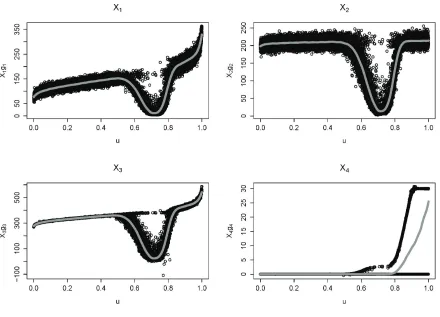
In Figure 1, the quantities xjigˆi(xj) are plotted as black circles, against uj = ˆFY(yj), such
that large values of u in the horizontal axis correspond to high outcomes of the outputY. The
grey line represents an estimate of the functionu7→si(u;X, g) =E Xigi(X)|UY =u
, obtained
again by local regression with a bandwidth of 0.01. As discussed in Section 2.2, averaging over
the curve si(u;X, g) with respect to weights ζ(u) yields Si(X, g).
It is seen that forX1, X2, X3, the plotted curves dip, representing a reduced sensitivity under
those scenarios where a payment from the reinsurer is received (the black circles that do not
follow that pattern correspond to observations xj4 = 1 where reinsurance default has taken
place). Thus, once the reinsurance layer is activated, small changes in those model inputs have
no effect on the value ofY. Once the layer is exhausted (i.e. for scenarios withyj > λ+l) the
sensitivity rises again.
Comparing the curves for X1 and X2, it is seen that (ignoring the dip in the curves) the
sensitivity toX2 is higher for low u, close to its higher mean of 200. However, the sensitivity to
X1 shows an increasing trend, ending up dominating for large confidence levels of the output, i.e.
foru >0.9. This reflects its higher volatility and the heavier tail of the LogNormal distribution
4Due to the small number of simulated scenarios in whichY is very high, it is possible that the local regression
algorithm fails to produce reasonable gradients for some states. In this implementation, we did not use the 30
Figure 1: Sensitivity estimates in example 1. Each black circle represents an
observa-tion xjiˆgi xij; the grey line represents a non-parametric estimate of u 7→ si(u;X, g) =
E Xigi(X)|UY =u .
used to model X1. The sensitivity to X3 also shows an increasing trend in u, even though the
volatility of X3 is low. This reflects the impact of the multiplicative effect of X3.
On the other hand, it is seen that the sensitivity curve s4(u;X, g) for X4 is zero up until
approximately u = 0.6. This corresponds to scenarios where the reinsurance layer is not
acti-vated, and thus reinsurance default is inconsequential. Then the black circles bifurcate. The
part that is stuck at zero corresponds to non-default events{X4 = 0}, while the increasing part
corresponds to default events {X4 = 1}. The curve increases up to l = 30 which is the
Table I: Scaled sensitivities Si(X, g)/ρ(Y) for a range of risk measures.
TVaR(p= 0.99) TVaR (p= 0.95) ED (γ=20) ED (γ=5)
ρ(Y) 516.0 471.4 455.8 409.5
X1 0.593 0.567 0.550 0.425
X2 0.415 0.454 0.460 0.416
X3 1.001 1.019 1.009 0.834
X4 0.050 0.043 0.038 0.019
the highest sensitivity is obtained, reflecting the fact that under those scenarios the maximum
recovery is due and will therefore be lost in the case of default.
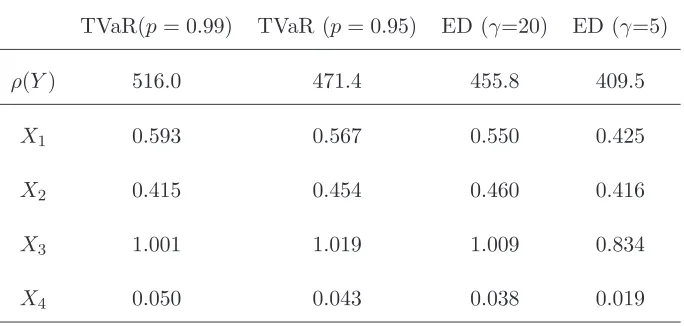
In Table I, we report the sensitivities Si(X, g) to model inputs for two risk measures, TVaR
and Exponential Distortion (ED), at different levels of conservativism. The respective weight
functions are
ζT V aR(u;p) =
1
1−p1{u > p}, ζED(u;γ) =
γexp(γu)
exp(γ)−1. (3.5)
The TVaR risk measure places a constant positive weight to extreme loss scenarios (u > p)
and a weight of zero to all other scenarios. The ED risk measure places a positive weight to
all scenarios, strictly increasing inu, thus reflecting the whole of the output distribution. The
risk measures are ordered from left to right on the table, in terms of a decreasing weight placed
on the right tail of the output loss distribution, noting that ζT V aR(1; 0.99)> ζT V aR(1; 0.95) =
ζED(1; 20)> ζED(1; 5).
To enable comparison, the reported sensitivities are in each case scaled by the risk summary
ρ(Y), giving effectively a measure of elasticity to changes in model inputs. It is seen that the
highest sensitivity is to the multiplicative factorX3, followed by the LogNormal claimsX1. The
Table II: Breakdown of scaled sensitivities Si(X, g)/ρ(Y) to mean and deviation components,
for TVaR with p= 0.95.
SiM(X, g)/ρ(Y) SiD(X, g)/ρ(Y) Si(X, g)/ρ(Y)
X1 0.340 0.227 0.567
X2 0.446 0.008 0.454
X3 1.018 0.001 1.019
X4 0.004 0.039 0.043
used. The sensitivity toX4is not very high and reduces again as less tail-sensitive risk measures
are used. These observations are consistent with the previous discussion of Figure 1.
While the sensitivity values assigned to different inputs by the TVaR and ED measures are
different, the importance ranking produced is the same. In Example 2, it will be seen that
there are circumstances where the exclusive emphasis of TVaR on high outputs can make it
“blind” to sensitivities prevalent in less extreme scenarios. Note also that each point on the
curves u 7→ si(u;X, g) corresponds to sensitivity with respect to the VaRu measure, with the
importance ranking produced strongly dependent on the confidence levelu. Hence we would not
advise the use of a VaR measure at a single confidence level. More broadly, while a risk measure
such as ED can be used to produce a ranking between inputs, consideration of the full set of
curvesu7→si(u;X, g) in Figure 1 is helpful, as it allows the risk analyst to assess comparative
importance of inputs at different output confidence levels.
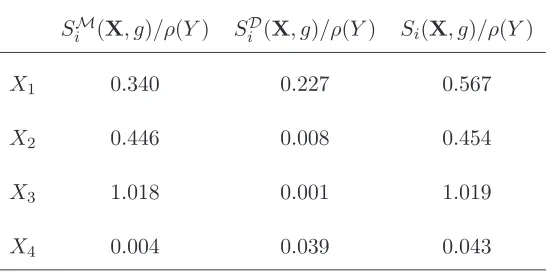
Further insight may be obtained by apportioning each sensitivity Si(X, g) to its mean and
deviation elements SMi (X, g) and SiD(X, g), as in (2.2). Such a decomposition for TVaR with
p = 0.95 is reported in Table II. It can be seen that the sensitivity to X1 is driven to a large
Similarly, the sensitivity to X3 is also driven by its mean due to the multiplicative effect of
inflation. On the other hand, the sensitivity to the indicatorX4 is mainly driven by variability.
In particular, focusing on the second column of the table, it is clear that the risk summaryρ(Y)
is more sensitive to the deviation element of the default indicator X4 than either X2 or X3.
4
EXTENSIONS
4.1 Sensitivity to model parameters
The model function g will generally be characterised by a number r of parameters, λ =
(λ1, . . . , λr), a dependence that has up to now been suppressed in the notation. If there is
uncertainty around these parameters, they can be treated as model inputs. Here we consider
the case where model parameters are known constants (such as λin Example 1). Thus we now
consider the model as a function of d+r arguments, such that Y = g(X,λ), where X is a
random vector andλ is a vector of constants.
A simple way of defining the sensitivity of ρ(Y) to the model parameter λk is to consider it
as a degenerate random variable with all probability mass concentrated at one point. Thus the
sensitivity to λk may be obtained as
Sd+k((X,λ), g) =λkE gd+k(X,λ)ζ(UY). (4.1)
Hence the sensitivity toλkis nothing butλkitself, multiplied by the corresponding model
func-tion gradient, averaged over scenarios of interest as specified byζ. Note thatSdD+k((X,λ), g) = 0. The partial derivativegd+kis not directly obtainable via the local regression scheme of Section
3, since the simulated sample considered there will not supply any variability in the (d+k)th argument of g. A practical way of dealing with this issue is to randomize the parameter vector
λ, such that quantities g(X,Λ) are simulated, where Λ is a random vector of elements that
randomization serves only numerical purposes and does not represent uncertainty in relation
to the value of λk. Once a local linear regression model has been estimated on that sample,
predictions of the model function and its gradients for fixedλcan be simply obtained from (3.2),
by evaluating the non-parametric estimates at the points zj = (xj,λ). Although the choice of
the distribution for Λkis arbitrary, the measured sensitivity is robust to different choices. Indeed,
the volatility of Λk is only used to estimate the gradientgd+kand for sensitivity calculation the
conditioning Λk=λk applies.
4.2 Sensitivity to statistical parameter uncertainty
To study the sensitivity of the output to the uncertainty of statistical parameters, we specify
the distribution of each model input conditionally on the parameters. In particular, we assume
that Xi|Θi =θi∼F(·|θi). The distribution Gi of the random variable or vector Θi reflects the
uncertainty pertaining to the value of the parameters of the distribution ofXi.5
For evaluation of the risk summary and of sensitivities, the unconditional distribution ofXi,
given by ˆFi(x) =
R
Fi(x|θ)dGi(θ) is used. In particular, when a Monte-Carlo sample is produced,
in every state a different observation from Θi is obtained, and subsequently an observation of
Xigiven that outcome of Θiis simulated. Thus Θiis allowed to vary across simulated scenarios.
As opposed to the case of model parameters discussed in Section 4.1, we do not attempt to
“smooth out” the uncertainty in Θi, but retain it as an explicit feature of the model.
Our purpose now is to calculate the sensitivity of ρ(Y) to each of Θ1, . . . ,Θd. To do this,
we express each model input Xi as a function of Θi, representing parameter uncertainty, and
another random variable Zi, representing pure process (stochastic) uncertainty. This can be
achieved, for a conditional distribution Fi, by setting Ui = Fi(Xi|Θi) and Zi = Fi−1(Ui|θˆi),
5Taking a rather pragmatic view, we do not specify the provenance ofG
i – it may be derived by a bootstrap
where ˆθi = E(Θi) is an unbiased estimate of the unknown parameter. Then we have that Zi
follows the distributionFi with parameter ˆθi and is independent of Θi. The precise statement
of this argument is given in Appendix C, Lemma 9.
As a result, we can expressXi asXi =ψ(i)(Zi,Θi),where the first and second arguments of
ψ(i) represent the contribution of process and parameter uncertainty to Xi respectively.
There-fore, following Lemma 6 in Appendix B, the sensitivities to Zi and Θi can be respectively
calculated as
E Zigi(X)ψ(i)
1 (Zi,Θi)ζ(UY)
E (Θi−θˆi)gi(X)ψ(i)
2 (Zi,Θi)ζ(UY)
. (4.2)
For parameter uncertainty we propose the use of the deviation component of sensitivity only.
This is because a marginal change in Θi may be hard to interpret in the context of parameter
uncertainty; on the other hand it is plausible to reduce the volatility of Θi via diligent data
collection, expert judgement and further analysis. While it may be possible to evaluate (and
differentiate) the functionsψ(i)analytically, when working with a Monte-Carlo sample, they can be estimated directly from the data by local linear regression.
The following example builds on Example 1. By considering the sensitivity to known model
parameters, we are able to quantify the importance of the “constants” found in any model, such
as the initial inventories of radionuclides in the Level E model(7). The importance of those
constants is assessed in the context of a global sensitivity analysis, since it still depends on
the variation of the uncertain inputs. Furthermore, we consider the uncertainty in statistical
parameters; this, though simpler, parallels the stochastic volatility model described by Saltelli
et al. (Sec. 6.2, Ref.(5)), where the variance of a diffusion process is endowed with its own
dynamics.
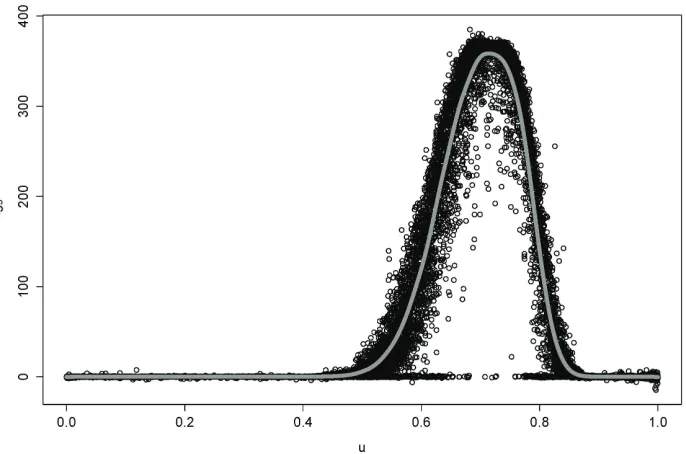
Figure 2: Sensitivity to λ in example 2. Each black circle represents an observationλgˆ5 xij
;
the grey line represents a non-parametric estimate of u7→s5(u;X, g) =λE g5(X)|UY =u .
deductible parameterλ. For this purpose we run the simulation with a randomized deductible,
uniformly distributed around the known value of λ= 380, such that Λ ∼U nif[375,385]. The
corresponding plot of the estimated sensitivity function s5(u; (X, λ), g) is given in Figure 2 and
the scaled sensitivitiesS5(u; (X, λ), g) for different risk measures are collected in the first row of
Table III.
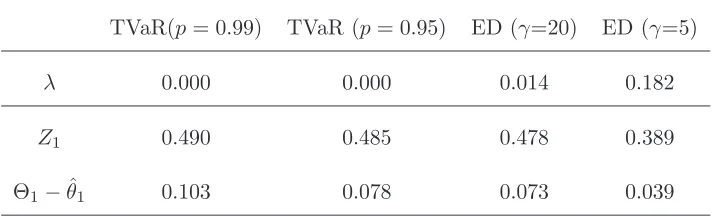
From Figure 2 it is seen that the sensitivity to λ is positive for that range of confidence
levels of output where the reinsurance layer is used but not exhausted. Since the parameter lis
unchanged, the positive sensitivity represents the fact that for a higher deductible, reinsurance
recoveries will be less frequent. The sensitivity is zero for low confidence levels, as in those
scenarios the reinsurance layer is not used. It is also zero for high confidence levels, corresponding
to situations where the layer is exhausted and the exact loss level at which the layer was activated
Table III: Scaled sensitivities to λ, Z1,Θ1 for a range of risk measures.
TVaR(p= 0.99) TVaR (p= 0.95) ED (γ=20) ED (γ=5)
λ 0.000 0.000 0.014 0.182
Z1 0.490 0.485 0.478 0.389
Θ1−θˆ1 0.103 0.078 0.073 0.039
sensitivities to the TVaR measures is zero, since these risk measures only consider scenarios at
the far tail of FY, where the reinsurance layer is completely used up. This shows that a risk
measure such as ED, assigning a positive weight at all confidence levels, may be preferable to
TVaR. The example also demonstrates the usefulness of plotting the sensitivity function at all
confidence levels, in order to detect local effects.
Now we consider the case of parameter uncertainty in the claims from the first line of business.
We assume that there is some uncertainty around the first parameter of the distribution ofX1.
In particular we let X1|Θ1 ∼ LogN ormal Θ1, σ21
and Θ1 ∼ N ormal(ˆθ1, σ2Θ1). After simple
manipulations involving Normal and LogNormal distributions, the decomposition ofXi becomes
X1 =ψ(1)(Θ1, Z1) = exp(Θ1−θˆ1)Z1,
whereZ1∼LogN ormal θˆ1, σ21
. The specific parameters chosen are ˆθ1= 4.99, σ1 = 0.230, σΘ1 =
0.163, such that the unconditional moments of X1 are (consistently with Example 1) E(X1) =
153, V(X1) = 442, while conditional moments areE(X1|Θ1 = ˆθ1) =E(Z1) = 151, V(X1|Θ1 =
ˆ
θ1) =V(Z1) = 352.
The sensitivities toZ1 and Θ1−θˆ1, calculated according to (4.2), are reported in the second
and third row of Table III. It is seen that, particularly for the tail-focused TVaR measures, the
4.3 Sensitivity to the dependence structure
Finally, we turn our attention to studying the sensitivity of the output risk summary to the
dependence structure. We propose an approach that is applicable for dependence structures that
display conditional independence, given some observable or latent common model inputs; the
latter appear implicitly in standard dependence models, such as the popular class of Archimedean
copulas (see Ref.(32), Sections 3.4.1 and 5.4). The idea pursued here is to express each model
input Xi as
Xi=ψ(i)(Zi,V), (4.3)
where the random variables Z1, . . . , Zd are independent and V is the vector of common model
inputs.
Henceforth, we call the elements of V thecommon factors and Z1, . . . , Zdthe idiosyncratic
factors. When the common factors are explicitly modelled and have a direct interpretation
(e.g. as natural catastrophe losses, affecting different parts of an insurance portfolio), the
representation (4.3) is essentially given. In the case that common factors are implicit in the
dependence structure, then the representation (4.3) is again possible by the following
argu-ment. For presentational simplicity, let us assume that Fi(·|v), the conditional distribution of
Xi given V = v, is invertible. Then, to obtain the idiosyncratic factor Zi, we may just set
Zi =Hi−1(Fi(Xi|V)), whereH is an arbitrary distribution (a plausible choice may be to let Hi
be the unconditional distribution of Xi). Then,Zi will be independent of V and we can write
Xi = ψ(i)(Zi,V) = Fi−1(Hi(Zi)|V). A precise statement of these facts is given in Lemma 10,
Appendix C.6
6By its construction,ψ(i) is increasing in its first argument. A particular case of interest emerges ifV ≡V
is 1-dimensional and ψ(i) is also increasing in the second argument for all i. In that case, X
i is stochastically increasing inV and the random vectorXisassociated; see Property 7.2.16 in Ref.(30). Thus, each element of the
The sensitivity to the dependence structure may now be studied by calculating the sensitivity
to the common and idiosyncratic factors. For simplicity consider a univariate common factor
V. Then the sensitivity of output risk summary to Zi and V can be respectively calculated as
E (Zi−E(Zi))gi(X)ψ(i)
1 (Zi, V)ζ(UY) (4.4)
d
X
j=1
E (V −E(V))gj(X)ψ(j)
2 (Zj, V)ζ(UY). (4.5)
We emphasize the deviation component of the sensitivities, since the prime effect of the
depen-dence ofX is on the variability of the output.
The proposed process is demonstrated via the following example, where sensitivity to the
dependence between the output loss of Example 1 and an investment position is studied. The
importance of dependence between inputs is recognised widely in sensitivity analysis, e.g.(5,7),
but, to our knowledge, the sensitivity to factors driving such dependence has not been studied
in the literature.
Example 3. To allow the focus on dependence, here we consider a simple extension to Example
1. Assume that assets are invested that produce income A, with expected value equal to that
of the total lossY. The random variableA is not independent ofY. After taking into account
such investment, the loss becomes ˜Y =Y −A. For consistency with the notation of this section,
we re-label the variables as ˜X1 ≡Y, X˜2 ≡ −A, such that
˜
Y = ˜g( ˜X1,X˜2) = ˜X1+ ˜X2.
Therefore ˜Y is now the model output, arising through simple addition of the inputs ˜X1,X˜2.
The random variable ˜X1 ≡Y has the same distribution as in Example 1, denoted here by
H1. The asset valueA=−X˜2 follows a LogN ormal(5.894,0.12) distribution. The distribution
of ˜X2 is denoted by H2. For those parameters it is E( ˜X1 + ˜X2) = 0, such that assets match
liabilities on average.
The dependence between ˜X1 and ˜X2 is modelled via a Clayton survival copula, with Kendall
rank correlation coefficient ofτ = 0.5. This is the copula of a bivariate Pareto distribution with
parameter α = 0.5(1/τ −1) = 0.5 (Section 5.4 in Ref.(32)). For this model, we can express
˜
X1,X˜2 as non-decreasing functions of the bivariate Pareto random variables X1′, X2′, defined
by X1′ =D1V′, X2′ = D2V′, where D1 and D2 follow exponential distributions with mean 1,
1/V′ is Gamma distributed with shape parameter equal to α = 0.5 and scale parameter 1,
and the random variables D1, D2, V′ are independent (Section 7.2.4 in Ref.(30)). It is evident
that (X1′, X2′), and therefore ( ˜X1,X˜2) are independent conditional onV′. Because of the simple
multiplicative structure, there is no need to invoke the construction of Lemma 10.
Consistently with previous arguments, we let the random variables Z1 ∼H1, Z2 ∼H2 and
V ∼ U nif[0,1] be non-decreasing functions of D1, D2, V′ respectively. Thus the independent
random vector (Z1, Z2) has the same marginal distributions as ( ˜X1,X˜2). A uniform distribution
is chosen for the common factorV, since the latent variableV′ lacks a natural interpretation in
the present application.
For a simulated sample of 20000 observations, the sensitivities toZ1, Z2andV are calculated.
The gradients of the functions ψ(1), ψ(2) are once more calculated numerically by local linear
regression (we treat the gradient of ˜gas given). A pictorial summary of the resulting analysis is
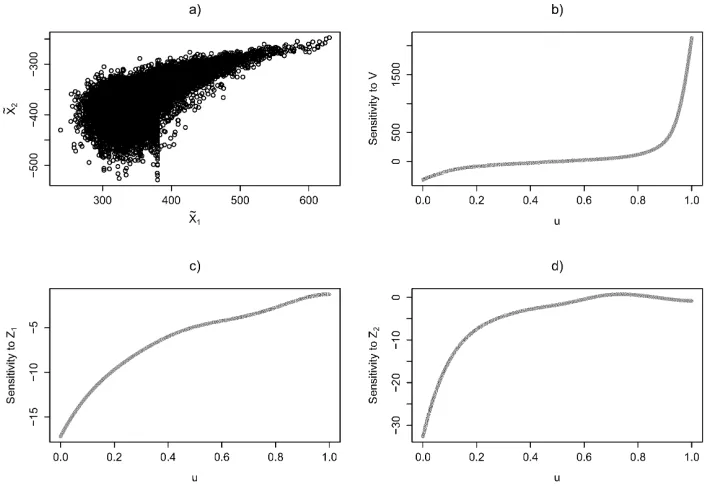
provided in Figure 3. In panel a) a scatter plot between ˜X1 and ˜X2 is given showing the very
strong dependence for high output values, representing joint adverse events. In panels b), c)
and d), estimates of the functions
u7→E V −E(V)
ψ2(1)(Z1, V) +ψ(2)2 (Z2, V)|UY˜ =u
;
u7→E Z1−E(Z1)
ψ(1)1 (Z1, V)|UY˜ =u
;
u7→E Z2−E(Z2)
ψ(2)1 (Z2, V)|UY˜ =u
;
Figure 3: Analysis of the sensitivity to the dependence structure. a) Scatter plot of ˜X1,X˜2;
b) Sensitivity to common model input V; c) Sensitivity to idiosyncratic model input Z1; d)
Sensitivity to idiosyncratic model inputZ2.
dominates those of the idiosyncratic factorsZ1 andZ2for high confidence levelsu. In particular,
at those levels the sensitivities toZ1, Z2 are approaching zero, supporting the intuitive view that
scenarios of extreme output are “driven by dependence”.
5
CONCLUSIONS
A framework for global sensitivity measurement using directional derivatives of risk measures
has been developed. We focused on the class of distortion risk measures, while our arguments
also work for moment-based risk measures, which may be preferred in some applications.
The proposed sensitivity analysis method is applicable to Monte-Carlo samples of non-linear
estimation, if an analytical expression for the gradient is unavailable or hard to work with. It
was shown through examples drawn from insurance loss modelling that informative percentile
sensitivity curves can be produced as outputs of the sensitivity analysis exercise, aiding a risk
analyst in understanding the ways in which inputs and output interact. In this both the modelled
statistical behaviour of model inputs and the non-linearity of the model function are reflected.
Finally, it was demonstrated how the sensitivity measure can be extended to cope with
structural parameters, uncertain statistical parameters and common factors driving dependence.
APPENDIX: FORMAL STATEMENTS AND PROOFS
A
PROOF OF PROPOSITION 2
The technical conditions required for Proposition 2 include differentiability of g (condition i)),
which will not always hold. However, in applications model functiongwill need to be estimated.
In such a context, for reasons of tractability a smooth model is typically used to approximateg
– this process was demonstrated in Section 3. Moreover, when the model function is continuous
and non-differentiable at only a countable number of points, the proof of Proposition 2 still
holds. Condition ii) is relatively weaker; for example any model function that can be written
asg(X) =g(1)(Xk) +g(2)(X−k), where g(1) is an invertible function andXk|X−k is continuous,
will satisfy this. Condition iii) is implied from i) and ii) plus some integrability conditions that
we do not explicitly state, as they are similar to those in(24).
First, in Lemma 3 the derivative of the percentile function with respect to a proportional
shock on Xi is worked out. The proof is a direct generalization of an argument given by
Tasche(24)in the case of linear models. A related result, under somewhat different assumptions,
is obtained by Hong(25).
a conditional density given (X2, . . . , Xd), denoted φ(·|x2, . . . , xd). Let the function g :X → R
be differentiable in the ith argument with ∂g∂x(x)
i =gi(x) and invertible with respect to x1 for all
x2, . . . , xd. Define Y = g(x1, . . . , xd) and Yi,t = g(X1, . . . , tXi, . . . , Xd) and the corresponding
quantile function ηi,u(t) =FY−1i,t(u). If ηi,u(t) is differentiable at t= 1 for given u∈(0,1), then
η′i,u(1) =E(Xigi(X)|g(X) =ηi,u(1)).
Proof. Drop the subscript inηi,u, denote byl the inverse ofg(assumed increasing) with respect
to the first argument and let X−1= (X2, X3, . . . , Xd).
Let us show first that the density of Y is
y→fY(y) =E(φ(l(y,X−1)|X−1)l1(y,X−1)) =
=E
φ(l(y,X−1)|X−1)
g1(l(y,X−1),X−1)
.
For a given nonnegative function k, we have
E(k(Y)|X−1) =E(k(g(X1,X−1))|X−1)
= Z +∞
−∞
k(g(x1,X−1))φ(x1,X−1)dx1
= Z +∞
−∞
k(y)φ(l(y,X−1)|X−1)
1
g1(l(y,X−1),X−1)
dx1,
after making the change of variable g(x1,X−1) = y and observing that dx1 = dl(y,X−1) =
1
g1(l(y,X−1),X−1). It follows that the conditional density of Y given X−1 is
y→φ(l(y,X−1)|X−1)
1
g1(l(y,X−1),X−1
.
From this we immediately deduce the unconditional density of Y.
Consider the case i= 1. Using the definition of quantile we have
so that, usingl and conditioning onX−1, this becomes
u=E
P
X1 ≤
1
tl(η(t),X−1)|X−1
=
=E
Z l(η(t),X−1)/t −∞
φ(x1|X−1)dx1 !
.
Taking derivatives with respect to t, exchanging the derivative with the expectation and
letting thent= 1, gives
0 =E φ(l(η(1),X−1)|X−1)
l1(η(1),X−1)η′(1)−l(η(1),X−1) .
Solving with respect toη′(1) we get
η′(1) = E(l(η(1),X−1)φ(l(η(1),X−1)|X−1)) E(l1(η(1),X−1)φ(l(η(1),X−1)|X−1)).
Now, let us compute the conditional expectation E(X1g1(X)|Y). For any nonnegative function
k, we have
E(X1g1(X)k(Y)) =E(E(X1g1(X1,X−1)k(Y))|X−1)
=E
Z +∞
−∞
x1g1(x1,X−1)k(g(x1,X−1))φ(x1|X−1)dx1
=E
Z +∞
−∞
l(y,X−1)k(y)φ(l(y,X−1)|X−1)dx1
= Z +∞
−∞
k(y)E(l(y,X−1)φ(l(y,X−1)|X−1))
fY(y)
fY(y)dy
=E(k(Y)q(Y)),
with
q(y) = E(l(y,X−1)φ(l(y,X−1)|X−1))
fY(y)
= E(l(y,X−1)φ(l(y,X−1)|X−1)) E(l1(y,X−1)φ(l(y,X−1)|X−1))
so we conclude that
E(X1g1(X1,X−1)|Y) =q(Y),