This is a peer-review, accepted author manuscript of the following publication: Krishnamurthy, Bhaskaran; Bylya, Olga; Muir, Lisa; Conway, Alastair; Blackwell, Paul / On the specifics of modelling of rotary forging processes. In: Computer Methods in Materials Science, (accepted for publication 19/12/2016)
On the Specifics of Modelling of Rotary Forging Processes
Bhaskaran Krishnamurthy*, Olga Bylya, Lisa Muir, Alastair Conway, Paul Blackwell
Advanced Forming Research Centre, University of Strathclyde, 85 Inchinnan Drive, Inchinnan – PA49LJ, United Kingdom
Keywords: Rotary forging, FEA modelling, process design
Abstract: Rotary forging process, in spite of its various advantages, has still not reached industrial production scale owing to its complex nature. With the advent of sophisticated finite-element modelling capabilities, it is now possible to make rotary forging more predictable and optimize it for industrial production standards. However, modelling by nature involves a series of assumptions and simplifications that can help us make reasonable predictions. It is important to know the important factors that affect the results, and what compromises can be made, with a genuine understanding of what the compromises will result in. This paper reports some initial findings from our attempt towards robust modelling for the design of the rotary forging process. Herein, we have taken the simple case of rotary upsetting of cylinders using a custom-designed rotary forging machine and modelled it using commercial metal-forming software QForm.
1. Introduction
From the day man started working metals into tools and ornaments until the advent of sophisticated mills and presses very recently, most metal forming was incremental in nature. However, incremental bulk forming became uncommon around the 20th century, with the production industry moving towards mass production of large series of components. Incremental bulk forming is seeing a revival owing to the shift towards production of small- and medium-sized batches of highly specialized components (Groche et al., 2007). Rotary forging, a niche section of incremental bulk forming, also mirrors this cyclic trend. The first rotary forge machine was developed in 1918 by E. E. Slick, but this remained in the background until the 1960s when the interest in rotary forging was revived. The interest died out in the 1990s owing to various complications faced in controlling the process. Rotary forging is now again gaining interest with the possibility of more sophisticated machine controls and FEA modelling of the process (Standring, 2001; Shivpuri, 1988).
At the outset, as many researchers before have pointed out (Standring, 2001; Shivpuri, 1988), rotary forging has many advantages over conventional die forging:
a. It requires lower forming loads (10–30% of conventional forging loads), and therefore, smaller machines to achieve the required components.
b. It is very flexible in that it can produce a varied range of components with a small set of simple tools. This is very attractive in the automotive industry for small to medium batch production and in the power and aerospace industry in producing large components in very small batches, as this saves a lot on tool cost.
c. It can produce near-net-shape components at room temperature and can produce
high forming ratios, thereby eliminating multiple die sets, production stages and setup times. It is to be noted that rotary forging produces more plastic strain than conventional cold forging owing to the cyclic nature of the loading.
[Type here]
However, these advantages come at a cost. Reduction in contact area reduces the forming loads, but results in highly localized deformation that is difficult to control or predict. Complex shapes can be formed because of the incremental and cyclic loading, but this makes it difficult to predict the material behaviour using standard uniaxial tests. Cold forming of components improves the mechanical properties of the end product, but reduces the flexibility of tailoring the material properties through-process owing to the loss of sensitivity to strain-rate and temperature variation. Using simple tools and complex kinematics improves the flexibility of the machine, but makes it highly difficult to control and optimize the technology because of the sheer number of factors involved. These were some of the reasons why towards the end of the 20th century interest in rotary forging subdued a little.
Nevertheless, very much like the mechanics of rotary forging, the cyclic nature of industrial interest could lead to advances never imagined possible if only we can understand the nature, overcome the roadblocks faced, and put them to advantage. With the advent of sophisticated finite-element modelling capabilities, it is now possible to make rotary forging more predictable and optimize it for industrial production standards. However, it must be borne in mind that modelling by nature involves a series of assumptions and simplifications that can help us make reasonable predictions. It is important to know the important factors that affect the results, and what compromises can be made, with a genuine understanding of what the compromises will result in.
In rotary forging, the issues to be tackled are multiple. Given below are some of the most common ones:
a. Design of process - Owing to the complex non-monotonic loading of the part, the prediction of material flow, optimal process parameters, forming load and springback are non-trivial
b. Fracture of part – The complex triaxial stress state prevalent during the process makes fracture prediction difficult using available uniaxial test data
c. Wear of tool – Severe material pick up happens owing to high-velocity rubbing of surfaces with small contact areas
d. Fracture of tools – Complex machine kinematics coupled with unbalanced offset
load and torque effects can lead to tool fracture (Standring, 2001)
e. Repeatability - Heating up and high springback in tools dictate that special efforts are needed in process design to achieve repeatability in industrial-scale processes.
It is not possible to address all these issues and find optimal solutions for all of them with a single model. Instead, models generated for finite-element analysis must be focused to address one issue at a time. The results required will dictate the parameters considered and simplifications made. In this paper, we have tried to analyse the specific aspects to be considered in designing rotary upsetting of cylinders.
[Type here]
Many researchers before have used analytical models for the design of rotary forging processes (Standring & Appleton, 1979; Hawkyard et al., 1979; Appleton & Slater, 1972; Kubo & Hirai, 1979; Kobayashi et al., 1979). With many simplifying assumptions, they were able to estimate the process parameters and had reasonable success in predicting the load and geometry (Hawkyard et al., 1979; Kubo & Hirai, 1979; Kobayashi et al., 1979). However, most of this published research pertains to an orbital or rocking-die type forging machine with limited capabilities. When using a different type of machine, with different tool kinematics, the factors that affect the process change and the interplay of these factors differ markedly. In such cases, a direct translation of earlier forming approaches and process design will not provide satisfactory results. The process of identifying the key parameters and accounting for them in a model will have to change according to the machine.
The efforts reported in this paper lays out our approach towards understanding a bespoke rotary forging machine and building a robust model of the process. The framework can be used towards understanding and modelling other types of rotary machines as well. The following sections detail the particulars of the rotary forging machine with improved capabilities, the key parameters to be considered in the design of the process, our analysis of the same, modelling approaches to factor them in and some of the important first findings with their significance.
2. Model Setup
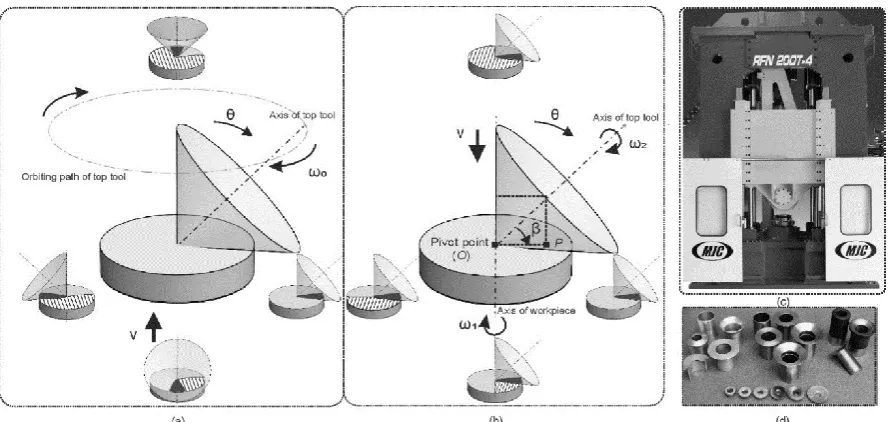
The model described in this work was developed for rotary upsetting of cylinders using a bespoke MJC RFN 200T-4 machine installed at the Advanced Forming Research Centre (AFRC). This is a spin-nutation type rotary forging machine custom-designed for research purposes to handle a range of component shapes and material (figure 1(d)). Figure 1(a) and (b) compares the kinematic scheme of this machine with that of the prevalent orbital-type rotary forging machine. This design affords an ability to provide 0° – 45° nutation angle, change the nutation angle during the process and also apply a maximum load of 200 T at any point in this angle range. In result, we are able to produce a wide range of geometries in the size range 25 – 400 mm.
Figure 1. Kinematic scheme of (a) orbital-type and (b) spin-nutation type rotary forging machine; (c) bespoke MJC RFN 200T-4 machine installed at AFRC and (d) the range of
[Type here]
The model for the rotary forging process was generated with the commercial metal forming software, QForm. The model was setup and improved on the basis of the analysis described below. As a first step towards generating the model, we identified the key process parameters. The key process parameters, which are fed to the machine using a CNC code, are
1. Nutation angle (θ) – the angle of tilt of the top tool with respect to the axis of the bottom tool about the pivot point
2. Speed of rotation of the tools (ω1, ω2) – In order for the top tool to incrementally
compress the workpiece without any shearing or rubbing effects, similar to pure rolling process, the tangential velocity of the top tool and workpiece must match at the contact area. For instance, for point P denoted in figure 1, if we assume r2 to be the radius along
the surface of the cone; r1, radius along workpiece surface; ω2, angular velocity of the
top tool; ω1, angular velocity of the bottom tool; and θ and β are the nutation and half
cone angle, respectively, then the following relationship should hold true:
1 1 2
2 r
r and
) sin(
) sin( 2
1
r
r (1)
Therefore, ) sin( ) sin( 1 2
(2)
For upsetting of cylinders, this is simplified to
) sin(
1
2
, as /2 (3)
3. Feed (v) – controlled translation of top tool towards and away from the bottom tool
As the next step, we analysed the above parameters, their interplay and the sensitivity of the process to them:
2.1. Positioning of the tool
In spin-nutation type machines, the top tool and workpiece rotate about their own axes (ω1, ω2), in addition to relative translational motion (feed, v) about a central vertical axis.
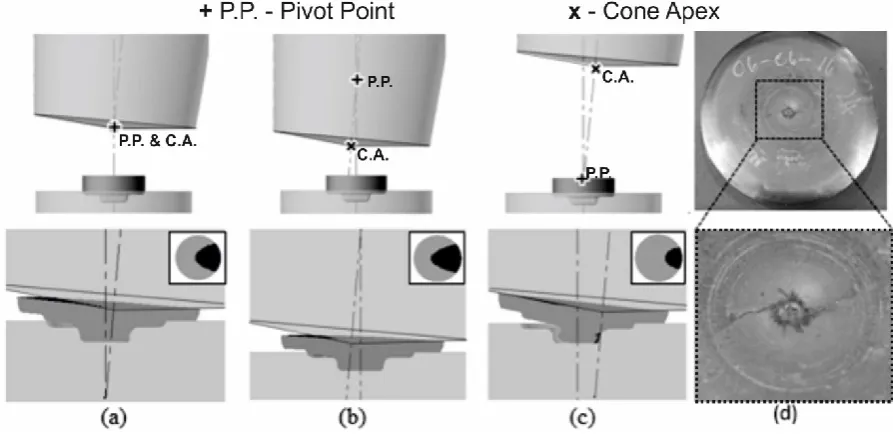
Therefore, the alignment of the axes of the top tool and workpiece about the pivot point plays a very significant role (Standring, 2001). The pivot point is the point of intersection of the axes of the top tool and workpiece (bottom tool), as shown as O in the scheme in figure 1. The value of the nutation angle provided to the machine through the CNC code is calculated about the pivot point, and care is taken to ensure that the apex of the conical top tool aligns with the pivot point. A misalignment with the pivot point potentially leads to instability in the machine kinematics. There are two reasons for this.
[Type here]
leads to a pronounced geometrical distortion, and should be avoided at all costs. Cracks in the centre of the workpiece were observed (as shown in the figure 2(d)) in such cases during our machine setup trials. When the pivot point was shifted down, it did not result in any drastic instability, but the relative contact area increased, which could potentially lead to undesired results.
Figure 2: Positioning of the conical top tool (a) with correct pivot point (PP) alignment, (b) with cone apex (CA) below PP, and (c) CA above PP. Top: alignment before the start of the process; Bottom: Formed geometry at the end of the process; Insert: Contact area between
the top tool and workpiece. (d) Enlarged picture of cracks formed when CA is above PP
The second important factor to be considered in the positioning of the tools is the nutation angle of the top tool (θ). This is dependent on the profile of the workpiece required. In the case of rotary upsetting of cylinders, the nutation angle is provided such that /2, as expressed in equation 3. However, owing to the localized nature of deformation and elastic springback of the material post deformation, sometimes bowing of the top surface is observed. In such cases, it is important to model the whole process involving the forming step (rotation of tools + feed of top tool), dwelling step (only rotation of tools), and the relaxation step (top tool removed) to study the geometry of the workpiece following the elastic springback of the material (refer to figure 3). In cases where bowing of the top surface is observed, it might be required to increase the nutation angle by 1° or 2° to obtain a flat top surface.
Forming Dwelling Relaxation
ω1, ω2, v ω1, ω2 ω1
[Type here]
Figure 3. Modelling of different stages of the forming cycle in rotary forging process: (a) forming step, (b) dwelling step, and (c) relaxation step.
2.2. Process parameters
Although intuitively it is clear that speed and feed play an important role in the rotary forging process, it is not very straightforward to understand their effects. The nature of interaction at the localized contact area is non-trivial and it is a cost-intensive process to estimate the speed and feed that is optimal for individual processes through a trial and error method. Therefore, it is pertinent to arrive at the best speed and feed fit for a process through process modelling. This is easier said than done. Being a cold deformation process, the material is almost insensitive to strain rate in the broad range. However, on the basis of experience, it is understood that the speed and feed affect the forming load and output geometry. The reason for this is that the bite size - penetration of tool into workpiece per revolution (ω1/v) - dictates
the contact area generated between the tool and the workpiece during each revolution of the workpiece. This in turn affect the material flow and load applied.
Research work published in the 1970’s reported on the significance of the bite size (Appleton & Slater, 1972). Unfortunately, this was focused on orbital forging machines with a fixed 2° inclination of the top tool. As emphasised earlier, these results cannot be translated directly to machines such as the one used here. In addition, the findings published were limited in scope in that they only focused on finding appropriate feed values for rotary upsetting process, and failed to analyse the wide-ranging effects of the choice of speed and feed on the process. In particular, the choice of feed and speed will depend on the material to be formed. Although one bite size value may be appropriate for one type of material, they could lead to catastrophic results in other, as shown later in Section 3.3.
Herein, we first setup the model with feed and speed values typically used in spin-nutation type machines on the basis of know-how. The values were varied and the obtained results analysed to understand thoroughly the effect of choice of speed and feed on the forming load and workpiece geometry for a specific hard variant of steel. Section 3.2 provides a detailed description of our initial findings.
3. Results and discussion
3.1. Validation of the model
[Type here]
Table 1. Chemical composition and mechanical properties of 100CrMo7-3 steel
Chemical Composition
C Si P Mn Si S Cr Ni Mo
0.93-1.05
0.20-0.40 0.025 0.6-0.8 0.21 0.015
1.65-1.95 0.25
0.20-0.35 Mechanical Properties
Density
(kg/m3) Elastic Modulus (GPa) Yield stress (MPa) UTS (MPa) % elongation to fracture
7800 210 410 1010 5
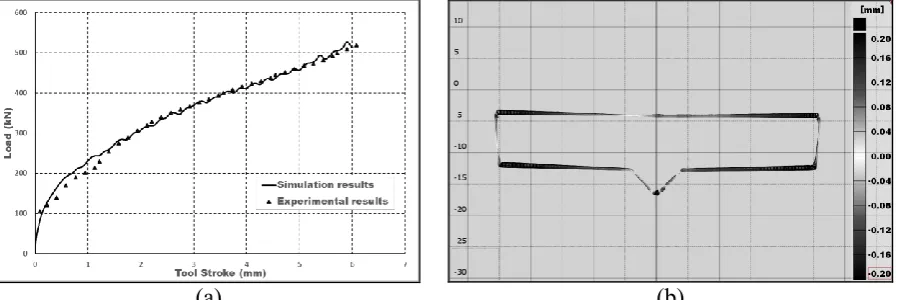
The results obtained, specifically load and output geometry, from the simulations were compared with the experimental results. The machine used is not load controlled, but rather kinematics controlled. Hence, the load and output geometry obtained do not have a direct one-to-one relation with the process parameters used in the model, and are quite practical to judge the effectiveness of the model developed. The load-stroke curve during the forming step was processed from the data available from the machine hydraulic control system and compared with those obtained from the simulations (see figure 4(a)). The geometry obtained after the complete forming cycle was scanned using GOM optical scanner and compared with that from the simulations using the custom GOM Inspect software (see figure 4(b)). The results from the simulation were in good agreement with the experimental results.
(a) (b)
Figure 4. Comparison of results from the simulation with that of experiments: (a) comparison of load vs. stroke curve; (b) comparison of output geometry.
3.2. First findings from the model
[Type here]
A comparison of the load-stroke curve obtained for different bite sizes is provided in figure 5(a). Provided next to the curves is a schematic of the contact area generated during the final step. As can be clearly seen, employing a lower bite size reduces the forming load considerably as the contact area in each step reduces drastically. In figure 5(b), a comparison of the resisting torque generated in the bottom tool, to which the workpiece is attached, is provided. The resisting torque is generated in the bottom tool as the load applied vertically by the top tool hinders the free rotation of the bottom tool. As is clearly seen, the resisting torque in the bottom tool increases as the bite size increases, owing to an increase in the load applied by the vertical tool.
(a) (b)
Figure 5. Comparison of (a) load vs. stroke curve recorded for the top tool and (b) the resisting torque developed in the bottom tool for different bite sizes.
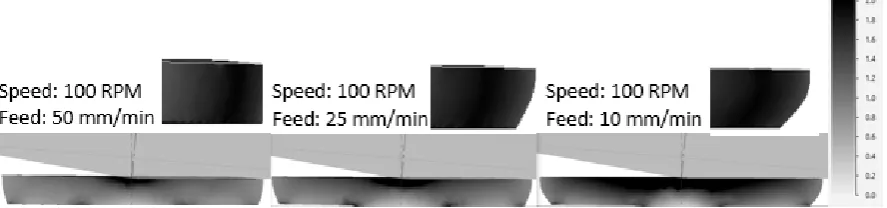
Similarly, the output geometry was also found to be very sensitive to the bite size employed. With the reduction in the bite size, there was an increase in the mushrooming effect along the top surface of the workpiece (refer to figure 6). This effect can be attributed to the change in material flow under the top tool with the change in bite size.
Figure 6. Side view of the output geometry and plastic strain values obtained at the end of the forming cycle for different speed and feed values.
[Type here]
(a) (b)
Figure 7. The radial velocity of points in the material for different bite sizes. Main picture: velocity vectors; Inset: plot of gradients of radial velocity in the part directly under the top
tool; (a) bite size of 1 mm/rev, (b) 0.1 mm/rev
3.3. Significance of the findings
At the outset, as shown in figure 6, a higher bite size is preferable as this provides more uniform deformation of the material. This especially is the case where complicated profiles are generated in rotary forging using a profiled bottom tool. In such cases, employing a very low bite size could lead to improper filling of the die cavity. Moreover, improved mechanical properties of the forged components are possible through cold working of the material. However, with a highly localized deformation concentrated on the top of the workpiece, the material formed into cavities of bottom tool might not be worked enough to generate an appreciable improvement in mechanical properties. This clearly tips the scale towards using higher bite size.
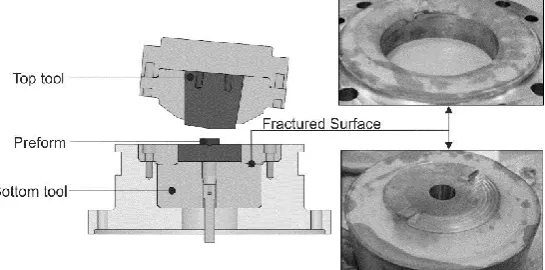
On the other hand, when deforming very hard materials such as 100CrMo7-3, using a higher bite size could create problems. Firstly, when we try to form complicated profiles with large bite sizes, the load required for forming might exceed the capacity of the generally small rotary forging machines. However, more importantly, when using higher bite sizes, there is more likely cause for the fracture of components and tools. Figure 8 shows an example case where the bottom tool sheared off owing to very high resisting torque generated in the bottom tool. This brings us to something of a dilemma regarding the bite size to choose. In such cases, robust modelling specific to the geometry, material and conditions are required to make informed choices.
[Type here]
4. Conclusions
This paper reports some initial findings from our attempt towards robust modelling of the rotary forging process. Herein, we have taken the simple case of rotary upsetting of cylinders using a custom-designed rotary forging machine and modelled it using QForm software. We have analysed the importance of the positioning of the tools and the process parameters in the design of rotary forging process. Although, the results obtained were in good agreement with the experimental findings, it is very qualitative in nature. The model in its present form can be used to arrive at a good indication of the process parameters to be used. For more robust predictive modelling, including the prediction of fracture of components and tools, a more detailed study needs to be carried out.
References
Appleton, E., Slater, R.A.C., 1972, Effects of Upper Platen Configuration in the Rotary Forging Process and Rotary Forging into a Contoured Lower Platen, Proc. of 13th Intl. M.T.D.R. Conf., Birmingham, U.K., 43-62.
Groche. P, Fritsche1. D, Tekkaya. E. A., Allwood J. M., Hirt G., Neugebauer. R., 2007, Incremental Bulk Metal Forming, Annals of the CIRP, 56, 635-656.
Hawkyard, J.B., Yunus, N.M., Gurnani, C.K.S., 1979, Prediction of Force in Rotary Forging of Short Circular Cylinders, Proc. 1st Intl. Conf. on Rotary Metalworking Processes, London, U.K., 111-124.
Kobayashi, M., Nakane, T., Kamada, A., Nakamura, K., 1979, Deformation Behavior in Simultaneous Extrusion-Upsetting by Rotary Forging, Proc. 1st Intl. Conf. on Rotary Metalworking Processes, London, U.K., 251-264.
Kubo K., Hirai Y., 1979, Deformation characteristics of cylindrical billet in upsetting by a rotary forging machine, Proc. 1st Intl. Conf. on Rotary Metalworking Processes, London UK, 99-110.
Shivpuri R., 1988, Past Developments and Future Trends in the Rotary or Orbital Forging Process, Journal of Materials Shaping Technology, 6(1), 55-71.
Standring P.M., 2001, Characteristics of rotary forging as an advanced manufacturing tool,
Proc. Instn. Mech. Engrs., 215(B), 935-944.