Corrigendum to “A coarse space for heterogeneous
Helmholtz problems based on the Dirichlet-to-Neumann
operator” [J. Comput. Appl. Math. 271 (2014) 83–99]
Lea Conena,∗, Victorita Doleanb, Rolf Krausea, Fr´ed´eric Natafc
aUniversit`a della Svizzera italiana, Institute of Computational Science, Via G. Buffi 13,
6900 Lugano, Switzerland
bUniversity of Strathclyde, Dept. of Mathematics and Statistics, 26 Richmond Street,
Glasgow G1 1XH, Scotland, UK
cUniversit´e Pierre et Marie Curie, Laboratoire J.L. Lions, Tour 15-25 Bureau 319, 4 place
Jussieu, 75005 Paris, France
Abstract
This communication gives a corrigendum to the paper “A coarse space for het-erogeneous Helmholtz problems based on the Dirichlet-to-Neumann operator” [J. Comput. Appl. Math. 271 (2014) 83–99].
Keywords: Helmholtz equation, domain decomposition, coarse space, Dirichlet-to-Neumann operator
The preconditioner
PBNN=QM−1P+ZE−1Y† (1) from [1, Equation (7)] might be singular for general non-singular matrices A,
M andE=YTAZ, and full ranked matricesZ andY. Consider
A=
2 5 2
0 6 0
0 1 4
, Z =Y =
0 1 1
, M−1=
1 1 0
1 0 0
0 0 1
.
The matricesA, M, and E are clearly non-singular, but 15 −4 7T
is an eigenvector of PBA with eigenvalue 0. This is in contradiction to a result of Erlangga and Nabben [2], on which our work was based. Their consequently wrong theorem reads
Theorem 0.1 ([2, Theorem 2.9]). Let Z andY be full ranked. LetM be non-singular. Then PBNNA is non-singular. In addition, any zero eigenvalue of
M−1P
DA is shifted to one inPBNNA.
∗Corresponding author. Phone number: +41 (0)58 666 4975
Email addresses: [email protected](Lea Conen),[email protected]
0 50 100 150 0 50 100 150 nloc Num b er of iterations
(a) Number of iterations
Crit. 4.3 2 extra modes negative
0 50 100 150
0 200 400 600 nloc Dimension of coarse space
[image:2.612.149.467.136.260.2](b) Dimension of the coarse space
Figure 5: Comparison of different criteria of how many DtN modes to choose.
Choice # iterations
mi = 12 mi= 24
no coarse space 115 115
Re(λ) minimal 17 11
|λ|minimal 27 17
|λ−k|minimal 49 21
[image:2.612.220.393.292.392.2]|λ| maximal 155 145
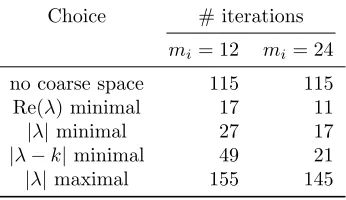
Table 1: Iteration numbers for different choices of DtN eigenfunctions.
The solutions of the preconditioned of the original system might hence dif-fer and the GMRES solver employed in [1] is not adapted to solve systems with singularities. For that reason, in this corrigendum the results of [1] are reproduced using a non-singular preconditioner. Numbering and notation are identitical to the original paper. The new results use the provably non-singular preconditioner [3]
Pnew =I−Z Z†M−1AZ −1
Z†M−1A+Z Z†M−1AZ−1Z† (2) and solve the preconditioned problemM−1AP
new =M−1b. The coarse matrix is nowZ†M−1AZ instead ofZ†AZin Equation (1). Its sparsity structure hence changes; it has blocks not only for neighboring subdomains but also for neighbors of neighbors, which constitutes a drawback for parallel implemetation.
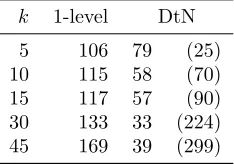
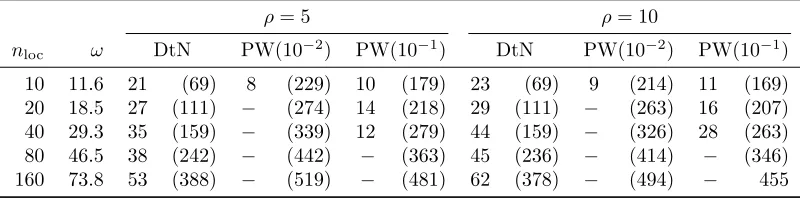
We make a few observations, refraining however from giving a detailed in-terpretation of the new results to save space. The eigenvalue distribution in Figure 7a is more favorable than the one forPBNNA. This is also reflected in the iteration counts for small coarse size, see e.g. Figure 6 or the last line of Table 14 for PW 10−2
L k kL # iterations coarse space dimension
1 30 30 20 224
5 6 30 20 224
[image:3.612.139.466.233.358.2]10 3 30 19 224
Table 2: Dependence on the sizeLof the domain Ω = [0, L]2.
0 5 10 15
0 20 40 60 80
Number of modesmi
[image:3.612.170.439.408.478.2]Num b er of iterations 1-level DtN
Figure 6: Number of iterations in dependence ofmi.
M-1A M−1AP new
−1−0.5 0 0.5 1 −1
0 1
(a)mi= 2
−1−0.5 0 0.5 1 −1
0 1
(b)mi= 16
Figure 7: 100 largest eigenvalues for I−M−1AandI− M−1APnewin the complex plane.
nloc k 1-lev DtN PW(10−2) PW(10−1)
20 18.5 80 16 (144) − (352) 9 (293)
40 29.3 116 19 (224) − (467) 13 (382)
80 46.5 156 30 (299) − (577) 16 (505)
[image:3.612.168.443.517.643.2]160 73.8 217 40 (508) − (609) 25 (597)
Table 3: Number of iterations (dimension of coarse space).
k3h2= 1 k3h2=2π
10 k
3h2= 0.1
20 40 60 80
10 20 30 40 50 k n um b er of iterations
20 40 60 80
200 400 k coarse space dimension
mi from DtN coarse space mi from PW coarse space
nloc k mi DtN PW(10−2) PW(10−1) mi DtN PW(10−2) PW(10−1)
10 11.6 4 15 17 (100) 17 (100) 12 8 7 (288) 7 (244)
20 18.5 6 19 19 (150) 19 (146) 15 9 − (355) 9 (305)
40 29.3 9 23 22 (225) 22 (225) 17 13 − (409) 13 (373)
80 46.5 12 35 30 (296) 29 (292) 24 19 − (556) 16 (496)
160 73.8 21 42 − (521) 31 (513) 25 39 − (609) 25 (597)
Table 4: Comparison of number of iterations with identical coarse space size for DtN and PW.
k 1-level DtN
5 106 79 (25)
10 115 58 (70)
15 117 57 (90)
30 133 33 (224)
[image:4.612.131.536.125.226.2]45 169 39 (299)
Table 5: Dependence on wave number for fixed mesh width.
we additionally give results for PW 10−1
. In total, the results do not change substantially and the conclusions drawn in [1] remain valid.
References
[1] L. Conen, V. Dolean, R. Krause, F. Nataf, A coarse space for heteroge-neous Helmholtz problems based on the Dirichlet-to-Neumann operator, J. Comput. Appl. Math. 271 (2014) 83 – 99.
[2] Y. A. Erlangga, R. Nabben, Deflation and balancing preconditioners for Krylov subspace methods applied to nonsymmetric matrices, SIAM J. Ma-trix Anal. Appl. 30 (2008) 684–699.
[3] P. Hav´e, R. Masson, F. Nataf, M. Szydlarski, H. Xiang, T. Zhao, Algebraic
nloc= 20,L= 2 nloc= 80,L= 2 nloc= 80,L= 8
k 1-level DtN 1-level DtN 1-level DtN
1 73 51 (25) 94 73 (25) 66 46 (25)
5 64 40 (25) 96 70 (25) 55 34 (25)
10 68 24 (74) 106 47 (74) 66 24 (74)
20 84 22 (139) 107 34 (144) 86 21 (139)
[image:4.612.248.365.255.337.2]Number of subdomains
nloc k 5×5 5×10 5×20 5×40
10 11.6 16 (80) 18 (180) 21 (380) 24 (780)
20 18.5 16 (144) 18 (314) 19 (654) 21 (1334)
40 29.3 20 (224) 20 (484) 22 (1004) 24 (2044) 80 46.5 31 (299) 37 (644) 45 (1334)
Table 7: Dependence on number of subdomains, DtN coarse space.
DtN PW(10−2) PW(10−1)
# subdomains # it. size # it. size # it. size
2×2 24 (68) − (96) 18 (88)
4×4 31 (200) − (368) 15 (320)
8×8 40 (416) − (1116) 14 (924)
16×16 60 (960) − (3256) 12 (2686)
[image:5.612.158.454.137.226.2]32×32 48 (2944) ? (9208) ? (?)
Table 8: Second scaling test: Vary the number of subdomains.
ρ= 5 ρ= 10
nloc ω DtN PW(10−2) PW(10−1) DtN PW(10−2) PW(10−1)
10 11.6 21 (69) 8 (229) 10 (179) 23 (69) 9 (214) 11 (169)
20 18.5 27 (111) − (274) 14 (218) 29 (111) − (263) 16 (207)
40 29.3 35 (159) − (339) 12 (279) 44 (159) − (326) 28 (263)
80 46.5 38 (242) − (442) − (363) 45 (236) − (414) − (346)
[image:5.612.158.453.273.374.2]160 73.8 53 (388) − (519) − (481) 62 (378) − (494) − 455
Table 9: Number of iterations (coarse space dimension) for heterogeneous open cavity problem.
ρ 1-level DtN PW(10−2) PW(10−1)
100 156 31 (299) − (577) 16 (505)
101 154 45 (236) − (414) − (346)
102 173 59 (236) − (388) − (320)
103 177 64 (236) − (379) − (315)
[image:5.612.134.534.423.523.2]nloc ω mi DtN PW(10−2) PW(10−1)
10 11.6 3 21 22 (75) 22 (75)
20 18.5 5 23 25 (123) 25 (123)
40 29.3 7 38 40 (171) 41 (163)
80 46.5 10 42 − (237) 45 (223)
160 73.8 16 59 − (358) 63 (346)
Table 11: Fixed coarse space size for heterogeneous open cavity problem.
nglob k 1-level DtN
50 11.6 64 15 (116)
100 18.5 92 17 (168)
200 29.3 130 25 (257)
400 46.5 173 33 (381)
[image:6.612.225.386.280.361.2]800 73.8 256 43 (645)
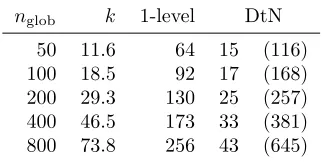
Table 12: Decomposition with Metis.
5×5 subdomains 10×10 subdomains
k nglob DtN PW(10−2) PW(10−1) DtN PW(10−2) PW(10−1)
18.5 100 15 (144) 8 (355) 9 (293) 17 (364) 23 (1152) 8 (872)
29.3 200 18 (224) − (466) 13 (379) 22 (460) − (1288) 11 (1132)
46.5 400 27 (315) − (577) 16 (511) 35 (660) − (1712) 15 (1380)
73.8 800 33 (514) − (609) 25 (597) 57 (956) − (2346) 18 (1928)
Table 13: Number of iterations (coarse space dimension) for Problem 2.
15 subdomains 60 subdomains
ω n DtN PW(10−2) PW(10−1) DtN PW(10−2) PW(10−1)
90 150×250 14 (267) 12 (346) 12 (323) 21 (541) 10 (1038) 12 (877)
180 300×500 15 (514) 24 (375) 24 (373) 22 (1074) 15 (1426) 15 (1333)
[image:6.612.133.578.564.639.2]360 600×1000 18 (968) 50 (375) 50 (375) 26 (2113) 42 (1500) 42 (1500)
![Table 2: Dependence on the size L of the domain Ω = [0, L]2.](https://thumb-us.123doks.com/thumbv2/123dok_us/1582192.110858/3.612.139.466.233.358/table-dependence-size-l-domain-l.webp)