City, University of London Institutional Repository
Citation:
Berger, T., Halikias, G. & Karcanias, N. (2015). Effects of dynamic and non-dynamic element changes in RC and RL networks. International Journal of Circuit Theory and Applications, 43(1), pp. 36-59. doi: 10.1002/cta.1923This is the accepted version of the paper.
This version of the publication may differ from the final published
version.
Permanent repository link:
http://openaccess.city.ac.uk/14026/Link to published version:
http://dx.doi.org/10.1002/cta.1923Copyright and reuse: City Research Online aims to make research
outputs of City, University of London available to a wider audience.
Copyright and Moral Rights remain with the author(s) and/or copyright
holders. URLs from City Research Online may be freely distributed and
linked to.
City Research Online: http://openaccess.city.ac.uk/ [email protected]
Effects of dynamic and non-dynamic element
changes in RC and RL networks
Thomas Berger
∗George Halikias
†Nicos Karcanias
†December 6, 2012
Abstract
The paper deals with the redesign of passive electric networks by changes of single dynamic and non-dynamic elements which may retain, or affect the natural topology of the network. It also deals with the effect of such changes on the natural dynamics of the network, the natural frequencies. The impedance and admittance modeling for passive electrical networks is used which provides a structured, symmetric, integral-differential description, which in the special cases of RC and RL networks is reduced to matrix pen-cil descriptions. The transformations on the network are expressed as those preserving, or modifying the two natural topologies of the network, the impedance graph and the admittance graph topologies. For the special cases of RC and RL networks we consider the problem of the effect of changes of a single dynamic, or non-dynamic element on the natural frequencies. Using the Determinantal Assignment Framework, it is shown that the family of single parameter variation problems is reduced to equivalent Root Locus problems with the possibility of fixed modes. An explicit characterization of the fixed modes is given and a number of interesting properties of the spectrum are derived such as the interlacing property of poles and zeros for the entire family of Root Locus problems.
Keywords: Passive networks, network redesign, matrix pencils, root locus, interlacing property, robustness
1
Introduction
The problem of redesigning autonomous (no inputs or outputs) passive electric networks [9] aims to change the natural dynamics of the network (natural frequencies) by modification of the network. As such, this is a problem that differs from a standard control problem, since it involves changing the values of the elements and possibly the topology of the network to achieve the desirable natural frequencies. In fact, this problem involves the selection of alternative values for dynamic elements (inductances, capacitances) and non-dynamic elements (resistances) within
∗Corresponding Author. Institute of Mathematics, Ilmenau University of Technology, Weimarer Straße 25,
98693 Ilmenau, Germany, thomas.berger@tu-ilmenau.de. Supported by DFG grant IL 25/9 and partially
supported by the DAAD.
†School of Engineering and Mathematical Sciences, City University London, Northampton Square, London
a fixed interconnection topology and/or alteration of the interconnection topology and possible evolution of the network (increase of elements, branches). We use impedance and admittance
modeling [23] for passive electrical networks. Integral part of the study is the investigation of transformations ofstructured models. In our study we identify two natural topologies expressing the structured transformations which are identified as theimpedance graph and theadmittance graphof the network. Within this structured framework we will consider the effect of changes of a single dynamic, or non-dynamic element on the natural frequencies. We consider issues related to the movement of the natural frequencies rather than problems of frequency assignment [9, 14]. It is shown that the single parameter variation problem (dynamic or non-dynamic) is equivalent to a Root Locus problem [2, 18].
The general case of RLC networks may be considered within the impedance and admittance modeling framework we are considering. A simplification of the problem is achieved by restrict-ing our study to the case of RL (resistor-inductor) or RC (resistor-capacitor) networks where the corresponding impedance, or admittance models become matrix pencils. Our study requires the representation of transformations that preserve, or transform the network topology. This is achieved by defining appropriate matrices expressing such transformations. We use the Deter-minantal Assignment approach [7, 13] for the analysis of the spectrum and it is shown that the single parameter variation problem is equivalent to a standard single-input single-output Root Locus problem [18]. The polynomials defining the Root Locus problem are explicitly defined from the network description and the nature of the transformation and it is shown that the problem may have fixed modes [8]. Such Root Locus problems are based on pole and zero poly-nomials formed by fixing the transformation under study. The selection of the transformation fixes the Root Locus problem and in some cases results in the emergence of fixed points in the Root Locus. Such points are readily identified within the exterior algebra framework used and their computation is reduced to a Greatest Common Divisor calculation [10]. The properties of the resulting Root Locus problems stem from the symmetry of the admittance, or impedance operators together with the passivity of the system. A number of interesting properties of the spectrum are derived such as the interlacing property of poles and zeros for the entire family of Root Locus problems. It is also shown that there is a common direction of movement of the poles under single parameter variations.
The paper deals primarily with network formulations coming from the electrical domain. The results however are equally relevant for the redesign of mechanical networks, as well as redesign of structures in structural (civil) engineering problems.
larger than every pole and, as a consequence, the common direction of movement of the poles under single parameter variations. Some conclusions are derived in Section 5.
We close the introduction with the nomenclature used in this paper.
N,R,C the set of natural, real and complex numbers, resp.
Km×n the set ofm×n matrices with entries in K=Ror K=C A∗ = A⊤, the conjugate transpose of A∈Cm×n
kxk = √x∗x, the Euclidean norm of x∈Cn
kAk = max
kA xkx∈Cn, kxk= 1 , induced matrix norm of A∈Cm×n
kerA the kernel of the matrix A∈Cm×n
imA the image of the matrix A∈Cm×n
rkA the rank of the matrix A∈Cm×n
adj A the adjugate of the matrix A∈Cm×n
A >(≥) 0 ⇔ A∈Cm×n is positive (semi-)definite; A <(≤) 0 ⇔ −A >(≥) 0
R[s] the ring of polynomials with coefficients in a ring R degp(s) the degree of the polynomial p(s)∈ R[s]
2
Impedance and admittance modeling of linear passive
networks
2.1
Background
The vertex and path laws (Kirchhoff current and voltage laws for electrical circuits) together with the elemental equations (Ohm’s law and impedance relations for electrical circuits) allow the system equations to be formulated. We consider networks with b branches, n vertices and
s branches which are sources. There are two basic problems in deriving a mathematical model for the network. The first deals with the question of defining the required number of equations and the second is how to solve the obtained set in a systematic way. Such considerations are important especially when we deal with rather large systems. Regarding the first problem the results from network theory state the following [21].
Lemma 2.1. A sufficient set of equations for determining the systems equations for any output of any system (linear or nonlinear) is obtained by using a set of (n−1) linearly independent vertex equations, a set of (b−n+ 1) linearly independent path equations and (b−s) elemental equations.
any selected unknowns and this leads to the development of system equations for the selected outputs. There are basically two methods leading to a systematic derivation of a reduced set equations describing the network. These methods are more easily presented in terms of the variables which are selected as primary unknowns and are referred to as the node and loop methods [21, 23].
The node method: In this method, the across-variables from each vertex to some reference vertex are chosen as the unknowns in terms of which the final set of equations is formulated. Such variables are called node voltages. The vertex equation is then written at each node, and the currents are expressed directly in terms of the node voltages as related by the elemental equations. The process eliminates all variables except the node voltages and ends up with a number of equations which is in general (n−1).
The loop method: In the loop method, the variable are selected such that the vertex law is automatically satisfied. Here we consider only planar graphs. We then consider the variables associated with each of the meshes and define these as theloop currents. The path law is then written for each mesh and substitutions are made for the voltages in terms of the loop currents using the elemental equations. This way the overall system is reduced to a number of equations which is b−n+ 1.
The two above methods lead to mathematical descriptions referred to as node or admittance description and loop or impedance description respectively, and their form is described in the following subsections.
2.2
Loop method formulation
The process of working out the equations involves the selection of internal independent loops, the definition of loop currents and the transformation of current sources to equivalent voltage sources (Th´evenin’s theorem). If we denote by (f1, f2, . . . , fq) the set of the Laplace transforms
of the loop currents and by (vs1, . . . , vsq) the set of Laplace transforms of equivalent voltage
sources, then theloop orimpedance model is defined by
z11 −z12 −z13 · · · −z1q
−z12 z22 −z23 · · · −z2q
−z13 −z22 z33 · · · −z3q ..
. ... ... ...
−z1q −z2q −z3q · · · zqq f1 f2 f3 .. . fq = vs1 vs2 vs3 .. . vsq , (2.1)
where in (2.1):
(i) zii(s) is the sum of impedances in loop i,
(ii) zij(s) is the sum of the impedances common between loops iand j.
(2.1) can be written in short as
This is referred to as the loop or impedance model and the symmetric matrix Z(s) is referred to as the network impedance matrix.
2.3
Node method formulation
The node method is dual to the loop method and the basic steps involve the selection of internal nodes, definition of the corresponding node voltages and transformation of the voltage sources to equivalent current sources (Norton’s theorem). If we denote by (v1, v2, . . . , vn) the Laplace
transforms of the reduced node voltages and by (is1, . . . , isn)) the set of Laplace transforms of
equivalent current sources, then the node or admittance model is defined by
y11 −y12 −y13 · · · −y1n
−y12 y22 −y23 · · · −y2n
−y13 −y22 y33 · · · −y3n ..
. ... ... ...
−y1n −y2n −y3n · · · ynn v1 v2 v3 .. . vn = is1 is2 is3 .. . isn , (2.2)
where in (2.2):
(i) yii(s) is the sum of admittances in node i,
(ii) yij(s) is the sum of the admittances common between nodes i and j.
The mathematical model (2.1) is denoted in short as
Y(s)v(s) =is(s)
and is referred to as node or admittance model. The symmetric matrix Y(s) is referred to as the network admittance matrix.
Remark 2.2. By the construction of the node and loop models the matricesZ(s) andY(s) are symmetric. Furthermore, it should be remembered that the network is passive and this affects the properties of the characteristic roots. ⋄
2.4
Example
For purposes of illustration we consider a mechanical system and its associated linear graph.
▲▲ ✉ K2 ✉ ✉ ▲▲ K1 β2
1 2 3
β1
M1 M2
g (fixed)
✉
4 F✲
We derive the node and loop formulation for the respective electrical analogues. The reason for considering a mechanical system is to stress the significance of the present work beyond the electrical domain - mechanical systems can be modeled with the same methods and be treated within the same framework. This is important since most of the challenges nowadays come from other domains.
[image:7.595.157.443.196.384.2]Consider the mechanical translational system depicted in Figure 1. The associated linear graph is shown in Figure 2.
Figure 2: Graph associated with the mechanical system
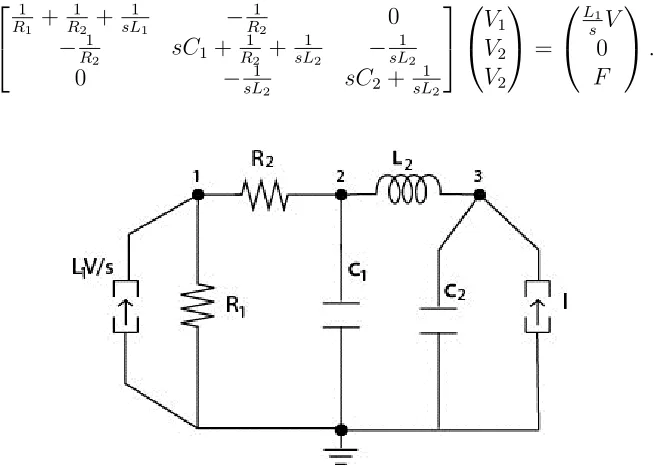
For the node method we transform the velocity source V into an equivalent force source. Node 4 is eliminated and the electrical analogue is presented in Figure 3, where the corresponding system of equations is in matrix form:
1
R1 +
1
R2 +
1
sL1 −
1
R2 0
− 1
R2 sC1+
1
R2 +
1
sL2 −
1
sL2
0 − 1
sL2 sC2+
1
sL2
V1
V2
V2
=
L1
s V
0
F
.
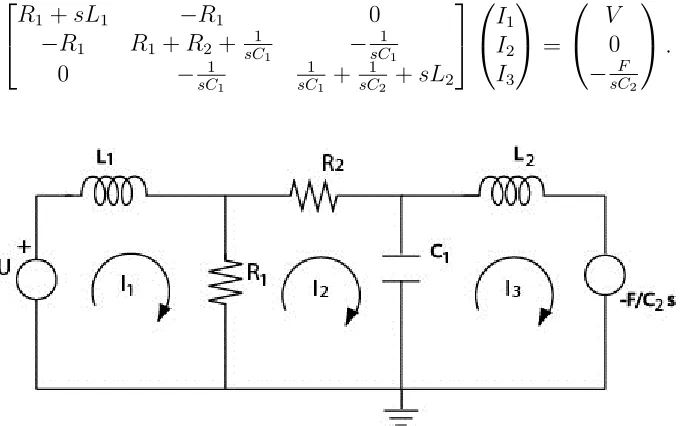
[image:7.595.138.465.474.707.2]For the loop method we transform the force source F into an equivalent velocity source and this leads to an elimination of loopf4. The electrical analogue is presented in Figure 4 and the
system of equations is in matrix form:
R1+sL1 −R1 0
−R1 R1+R2 +sC11 −sC11
0 − 1
sC1
1
sC1 +
1
sC2 +sL2
I1
I2
I3
=
V
0
− F sC2
[image:8.595.132.472.136.349.2].
Figure 4: Electrical analogue of Fig. 1 with transformed force source
2.5
The natural vertex and loop topologies
Network modeling uses the system graph, which is the basic topological structure that gener-ates the system equations. Apart from the system graph we may introduce some additional topologies which are linked to the specifics of the node and loop analysis. These structures are introduced in the following.
The vertex topology: Every network can be presented in terms of a set of vertices, or nodes, and all branches between two vertices may be represented by an admittance function. Spec-ification of the values of the voltages of the vertices defines the values of all currents in the network. The vertex methodology implies the substitution of all voltage sources by equivalent current sources and defines the resulting topology.
For the example of Figure 2 the equivalent vertex graph is, as an electrical circuit analogue, depicted in Figure 3. As it can be seen the number of independent vertices is reduced. The graph corresponding to Figure 3 without the sources completely defines the admittance matrix and it will be referred to as the natural vertex graph of the network.
Remark 2.3. The nature of sources in the network plays a key role in deriving the natural vertex graph from the system graph. The network graph acts as a progenitor of the natural
vertex graph. ⋄
sources to zero, the reduced graph will be referred to as the kernel vertex graph. The kernel vertex graph contains subgraphs defined by the nature of the elements associated with the branches (edges) and these are defined in the following.
Remark 2.4. All ideal lumped parameter elements may be classified on the basis of rela-tionships between the through- and across-variables into the classes: A-type (mass, inertance, capacitance), T-type (spring, inductance), D-type (damper, resistance). ⋄
Definition 2.5. For a given kernel vertex graph we define theA-vertex subgraph by eliminating from the kernel graph all T- and D-type edges. Similarly, we define the T-vertex subgraph by eliminating all A- and D-type edges and the D-vertex subgraph by eliminating all A- and T-type edges. The subgraph of the natural vertex graph obtained by eliminating all T-, D- and A-type elements represents the location of the through-variable sources and will be called the
source-vertex subgraph, or simply S-vertex subgraph. ⋄
Remark 2.6. The A-, T-, D- and S-vertex subgraphs are by construction simple graphs, that is they have no loops or parallel edges. The corresponding adjacency matrices are all symmetric
boolean matrices. ⋄
The loop topology is a notion dual to that of the vertex topology and it is defined along similar lines.
3
Redesign of RC and RL networks for natural
frequen-cies improvements
3.1
Problem statement
The general modeling for passive networks provides a description of networks in terms of sym-metric integral-differential operators, the impedance and admittance models which are described in a general way by
W(s) =sB+s−1C+D, (3.1) where for the case of impedance we have that B is a matrix of T-type elements (spring, induc-tance), C is a matrix of A-type elements (mass, inertance, capacitance) and D is a matrix of D-type elements (damper, resistance). For the case of admittance modeling the reverse holds true, i.e., B is a matrix of A-type elements, C is a matrix of T-type elements and D is again a matrix of D-type elements. The symmetric operator W(s) is thus a common description of the Z(s) (see (2.1)) and Y(s) (see (2.2)) matrices. For the special cases where the network is characterized only by A- and D-type elements, or only by T- and D-type elements the operator
W(s) takes the following special forms: ˜
W(s) = sB+D,
ˆ
W(s) = ˆsC+D, sˆ=s−1,
The operator W(s) describes the dynamics of the network and of special interest are the prop-erties of its zeros. The specific problem we address here is the effect of changing individual elements of the network, i.e., changes of A-, T- or D-type elements, on these natural frequen-cies. We explicitly allow for the addition of such elements to the network within this framework - in particular, we may change the topology by a single addition and we can still treat it within the same framework. This problem is a special case of the more general network redesign prob-lem [5, 9]. Our study will be focussed on the special cases where W(s) is a symmetric matrix pencil.
3.2
Network transformation by change of an element
The study of the effect of changing an element in the network on the natural frequencies presup-poses the representation of these transformations as operations on the operatorW(s) and this is the problem considered here. We will use an example to illustrate the nature of transformations and then generalize the observations.
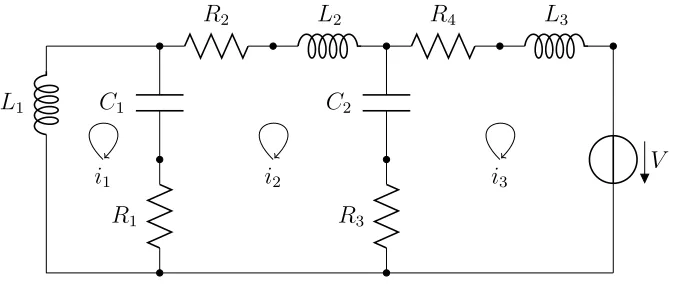
Example 3.1. Consider the electrical network described in Figure 5.
L1
R2 L2 R4 L3
V
R3
C2
R1
C1
[image:10.595.135.472.336.479.2]i1 i2 i3
Figure 5: Electrical RLC network
For this example we are using loop analysis where the network variables are the loop currents
i1, i2, i3. The impedance model expresses the structure of the impedances in the three loops and
has the form
Z(s) =
1
C1 −
1
C1 0
− 1
C1
1
C1 +
1
C2 −
1
C2
0 − 1
C2
1
C2
s−1+
R1 −R1 0
−R1 R1+R2+R3 −R3
0 −R3 R3+R4
+
L1 0 0
0 L2 0
0 0 L3
s
= s−1C+D+sB. (3.2)
⋄
Example 3.1 clearly leads to the statement of the following general observations.
(i) if an element is present in thei-th loop (node), then its value is added to the (i, i) position of the respective matrix.
(ii) if an element is common to the i-th and j-th loop (node), then its value is added to the (i, i) and (j, j) positions, as well as substracted from the (i, j) and (j, i) positions of the
corresponding matrix. ⋄
We demonstrate the above by means of Example 3.1.
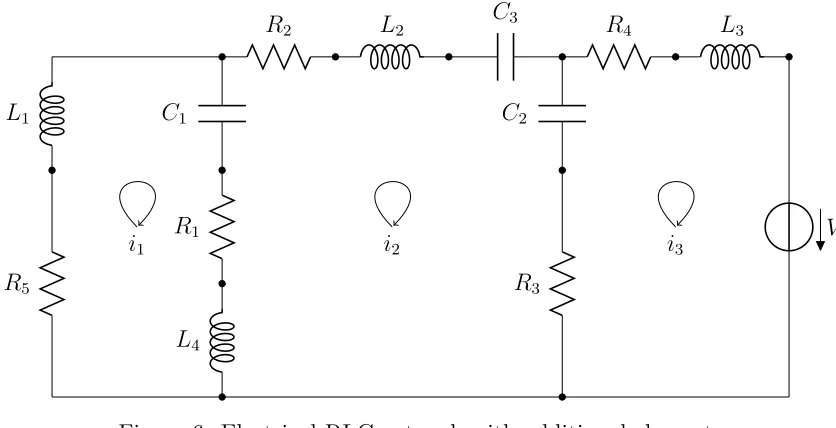
Example 3.3. Consider the following network obtained from that of Figure 5 by the addition of elements L4,R5, C3 as shown in Figure 6. More precise, the transformations are:
• Add a resistor of value R5 to loop #1.
• Add an inductance of value L4 common to loops #1 and #2.
• Add a capacitor of valueC3 to loop #2.
L1
R2 L2 C3 R4 L3
V
R3
C2
L4
R1
C1
R5
[image:11.595.90.508.313.527.2]i1 i2 i3
Figure 6: Electrical RLC network with additional elements
The resulting transformations on the corresponding matrices are then indicated below as
C=
1
C1 −
1
C1 0
−C11
1
C1 +
1
C2 +
1
C3 −
1
C2
0 − 1
C2
1
C2
, D=
R1+R5 −R1 0
−R1 R1+R2+R3 −R3
0 −R3 R3+R4
,
B =
L1+L4 −L4 0
−L4 L2+L4 0
0 0 L3
.
⋄
The problem which we are now to investigate is the effect of single element changes on the corresponding natural frequencies of the network. Our current study will be restricted to the RC and RL cases where the operatorW(s) becomes a matrix pencil. The formulation of these problems is given below.
Single parameter variations: Given the symmetric matrix pencil sF +G ∈ Rk×k[s],
in-vestigate the effect of simple perturbations on the pencil characteristic frequencies, where the variations are
F′ =F + ¯F(x, b), G′ =G+ ¯G(x, b)
and the matrices ¯F and ¯G, depending on the real parameter x ∈ R and the position vector
b∈Rk, have the form
¯
F(x, b) =¯
G(x, b) =x bb⊤ for b =ei or b=ei−ej, i6=j. (3.3)
⋄
The problem of single parameter variation is then equivalent to the investigation of the roots of
˜
f(s;F, G, x, b) = det s(F + ¯F(x, b)) +G
(3.4)
or
¯
f(s;F, G, x, b) = det sF +G+ ¯G(x, b)
(3.5) as functions of the parameter x. In these problems the position vector b is fixed but arbitrary. Clearly, the above two problems are dual and thus we restrict ourselves to the study of (3.4) for the sake of convenience.
Preliminaries from exterior algebra: In the following we will use some results from exte-rior algebra (see e.g. [15]) and the representation of multi-linear maps in terms of compound matrices [16]. Some relevant notation is given below:
LetQk,n denote the set of lexicographically ordered, strictly increasing sequences of k integers
from{1,2, . . . , n}. If{xi1, . . . , xik}is a set of vectors of a vector spaceV,ω = (i1, ..., ik)∈Qk,n,
thenxi1∧. . .∧xik =xω∧denotes the exterior product and by ∧rV we denote ther-th exterior
power of V. If H ∈ Km×n, where K = R or K = C, and r ≤ min{m, n}, then by Cr(H) we
denote the r-th compound matrix of H. Let M(s)∈Rp×r[s], r
≤p, be such that rkM(s) =r, and mi(s), i= 1, . . . , r, are the columns of M(s), then
Cr(M(s)) =m1(s)∧. . .∧mr(s) =m(s)∧ ∈Rσ[s], σ=
p r
,
is an invariant of the column space ofM(s) and it is called a Grassmann representative of the rational vector space [7].
we can rewrite (3.4) as follows:
˜
f(s;F, G, x, b) =Ck([sF +G, Ik])Ck
Ik sF¯(x, b)
=g(s;F, G)⊤p(s;x, b). (3.6)
Note that
g(s;F, G)⊤ = Ck([sF +G, Ik])∈R1×( 2k
k)[s], (3.7) p(s;x, b) = Ck
Ik sF¯(x, b)
∈R(
2k
k)[s] (3.8)
are exterior products of the rows or columns, respectively, of the corresponding matrices.
g(s;F, G) is a polynomial vector of degree at most k and will be referred to as the Grass-mann representative of the network [7]. The nature of ˜f(s;F, G, x, b) is determined by the pair (F, G) and the type of parameter transformation we consider. We distinguish two cases.
Case (1): Transformations take place in an element that is present only in one loop or one node, i.e.,b =ei. This problem will be referred to as afirst order variation problem.
Case (2): Transformations take place in an element that is common to two loops or two nodes, i.e., b=ei−ej. This problem will be referred to as asecond order variation problem.
For each of the two cases we have the following results.
Lemma 3.5. Consider a network with a first order variation that takes place in the µ index variable, i.e., b=eµ. Then the vector p(s;x, b) has the form
p(s;x, eµ)⊤= (1,0, . . . ,0, ε sx,0, . . . ,0),
where the nonzero element εsx is in the position of the minor characterized by the indices
(1,2, . . . , µ−1, µ+ 1, . . . , k, k+µ) ∈ Qk,2k and ε is the sign of the permutation (1,2, . . . , µ−
1, µ+ 1, . . . , k, µ).
Proof: Considering the matrix
Ik sF¯(x, eµ)
=
1 0
. .. . ..
1 sx
. .. . ..
1 0
⊤
it is clear that there are two nonzero minors, the first and the one defined by the rows (1,2, . . . , µ−
1, µ+ 1, . . . , k, k+µ). The claim then follows.
Lemma 3.6. Consider a network with a second order variation that takes place in the i and j
index variables, i.e.,b =ei−ej, i < j. Then the vector p(s;x, b) has the form
where there are four nonzero elements in the positions of the minors characterized by
ω1 = (1,2, . . . , j−1, j+ 1, . . . , k, k+i),
ω2 = (1,2, . . . , j−1, j+ 1, . . . , k, k+j),
ω3 = (1,2, . . . , i−1, i+ 1, . . . , k, k+i),
ω4 = (1,2, . . . , i−1, i+ 1, . . . , k, k+j),
∈Qk,2k (3.9)
andεµ=±1, µ = 1, . . . ,4, which are determined by the sign of the corresponding determinants.
Proof: The proof is established along lines similar to the proof of Lemma 3.5. In fact the submatrix of [Ik, sF¯(x, ei −ej)]⊤ that contributes to maximal order nonzero minors is defined
by the nonzero rows, i.e.,
Rij =
1 · · · 0 · · · 0 · · · 0
..
. . .. ... ... ...
0 · · · 1 · · · 0 · · · 0
..
. ... . .. ... ...
0 · · · 0 · · · 1 · · · 0
..
. ... ... . .. ...
0 · · · 0 · · · 0 · · · 1 0 · · · sx · · · −sx · · · 0 0 · · · −sx · · · sx · · · 0
←1 .. . ←i .. . ←j .. . ←k
←k+i
←k+j
∈R(k+2)×k. (3.10)
We note that due to the structure of the k×k upper part as an identity matrix and the fact that the last two rows are linearly dependent, any maximal k×k minor that includes the last two rows is zero. The only nonzero minors of Rij are:
(i) The first that has value 1.
(ii) The two minors ofRij obtained by eliminating thej-th row and then considering the (k+i
)-and (k+j)-row. These minors will be denoted by detRijj),k+i]=ε1sx,det
Rjij),k+j]=
ε2sx, εµ =±1.
(iii) Similarly we define two nonzero minors of Rij by eliminating the i-th row and then
considering first the (k +i)- and then the (k +j)-row. These minors are denoted by detRiij),k+i]=ε3sx,det
Riij),k+j]=ε4sx, εµ=±1.
The above clearly yields the assertion.
Using the determinantal formulation given by (3.6) and Lemmas 3.5 and 3.6 we are led to the following main result.
Theorem 3.7 (Root locus problem). For RC or RL networks the characteristic frequencies problem under first or second order variations in a single parameter of the network is equivalent to a classical root locus problem and
˜
f(s;F, G, x, b) =pF,G(s) +sxzF,G,b(s), (3.11)
Proof: The result is a direct consequence of (3.6) and Lemmas 3.5 and 3.6.
The study of the root locus problem (3.11) requires determining the nature of the polynomial
zF,G,b(s). This is defined next.
Corollary 3.8. For RC or RL networks under first or second order single parameter variation, the polynomial zF,G,b(s) is defined as follows.
(i) If b=eµ, then
zF,G,b(s) = εµzF,G,µ(s),
wherezF,G,µ(s)is the component of g(s;F, G)⊤defined by the minor characterized by ωµ=
(1,2, . . . , µ−1, µ+ 1, . . . , k, k+µ) ∈ Qk,2k and εµ is the sign of the permutation ω¯µ =
(1,2, . . . , µ−1, µ+ 1, . . . , k, µ).
(ii) If b=ei−ej, i < j, then
zF,G,b(s) =
4
X
l=1
εlzF,G,ωl(s),
where zF,G,ωl(s) is the component of g(s;F, G)
⊤ defined by the minor characterized by
ωl∈Qk,2k, l = 1, . . . ,4 in (3.9) and εl is their corresponding sign.
Proof: The derivation of the polynomials readily follows from the proofs of Lemmas 3.5 and 3.6.
The explicit derivation of the polynomials pF,G(s) and zF,G,b(s) allows for the study of the
respective root locus problem which is considered in the next section.
4
Root locus problem and properties
The derivation of the formulation of the polynomials pF,G(s) and zF,G,b(s) defining the root
locus (3.11) indicates that the problem may be characterized by fixed modes. The emergence of fixed modes is intimately linked to the structured nature of the transformation and it is similar to the emergence of fixed modes in the Decentralized Assignment Problem [8]. We first note:
Remark 4.1. The expression of the polynomial characterizing the natural frequencies as defined by (3.6) indicates that this study as a root locus problem may have fixed modes. In fact, the polynomial multi-vector g(s;F, G) (see (3.7)) is always coprime, but the presence of fixed zeros inp(s;x, b) (see (3.8)) for either types of transformations implies that a sub-vector of g(s;F, G), say g+(s;F, G), is the essential part that defines the resulting polynomial. The reduced vector
g+(s;F, G) may not necessarily be coprime. If this vector is not coprime, then its greatest common divisor (GCD) will define the fixed zeros of the resulting root locus problem. The computation of the fixed zeros requires the computation of the GCD of many polynomials defined by g+(s;F, G). This may be readily achieved by using the well developed numerical
methods such as the ERES methodology [1, 17], the matrix pencil methodology [10], or the
Now we investigate the root locus problem defined by (3.11), i.e., the problem
1 +xs zF,G,b(s) pF,G(s)
= 0 (4.1)
with parameter x ∈ R, and its properties. For some background on the root locus theory see
e.g. [2, 18].
Throughout this section we have to state the additional, but reasonable, assumption that the pencil s(F +xbb⊤) +G is regular for allx∈R. (4.2) In circuital terms, condition (4.2) gives a restriction on the choice of position vectors b and ensures that the changed element is not vital to the circuit, so that the circuit degenerates if the value of the element is changed to a specific value (including removal (value zero) and making it virtually active (negative values)). Degeneration means that the structural changes in the network, which result from the redesign and the desire to improve the behavior of the natural frequencies as discussed in Section 3, lead to a network represented by a singular system formulation. The precise physical meaning of this, i.e., the violation of condition (4.1), is an open problem.
In the next subsection we first provide some results on symmetric matrix pencils.
4.1
Some preliminary results on symmetric matrix pencils
Consider a matrix pencilsF+G∈Rk×k[s] corresponding to an RC or RL network. We first note
that due to the modeling, see in particular Remark 3.2, the pencil has the following properties.
Corollary 4.2. The matrix pencil sF +G corresponding to an RC or RL network has the following properties:
(i) sF +G is regular, i.e., det(sF +G)6≡0,
(ii) F =F⊤≥0, G=G⊤ ≥0.
The natural frequencies of the network now coincide with the finite eigenvalues of the pencil
sF +G, i.e., with those numbers λ∈C where det(λF +G) = 0. Matrix pencils may also have
infinite eigenvalues, see e.g. [3], in the case where detF = 0.
Note that for regular matrix pencils, symmetry does not imply that all finite eigenvalues are real. This is illustrated by the following example [19, p. 304]: Consider
F =
−1 0 0 1
, G=
0 −1
−1 0
.
Then, forx= (i,1)⊤ we have
−Gx=
1
i
=i
−i
1
=iF x,
which shows that the complex numberi is a finite eigenvalue of sF +G.
However, as in the RC or RL network we additionally have that F and G are positive semi-definite, we may deduce that all eigenvalues (natural frequencies of the network) are real and non-positive.
Lemma 4.3 ([20]). Let sF + G ∈ Rk×k[s] be such that F = F⊤ ≥ 0, G = G⊤ ≥ 0 and
kerF ∩kerG = {0}. Then there exist nonsingular T ∈ Rk×k and Λ = diag (λ
1, . . . , λkf) with λi >0 such that
T⊤(sF +G)T =
sIkf + Λ sIk0
Ik∞
.
Note, that regularity of a matrix pencil implies the condition kerF ∩kerG={0}, however the opposite does in general not hold true: consider, for instance, F =
1 0 0 0
, G=
0 1 0 0
.
We will also need another result which guarantees that all eigenvalues of the pencil are real. This requires only symmetry of F, however positive (or negative) semi-definiteness of G. Another fact which follows from these properties is that the index (see e.g. [11, Def. 2.9]) of the pencil
sF +G is at most one.
Lemma 4.4. Let sF +G ∈Rk×k[s] be regular and such that F =F⊤ and either G=G⊤ ≥0 or G=G⊤≤0. Then all finite eigenvalues of sF +G are real, i.e.,
∀λ∈C: det(λF +G) = 0 =⇒ λ ∈R.
Furthermore, the pencil sF +G has index at most one.
Proof: We show that all eigenvalues are real. Let λ ∈ C and x ∈ Ck \ {0} be such that
(λF +G)x= 0. Then
λ(x∗F x) =−x∗Gx.
Suppose x∗F x= 0, thenx∗Gx= 0, and hence Gx= 0. If λ = 0, the assertion is shown, and if
λ6= 0, then F x= 0 and as (sF +G)x= 0 for all s ∈C, this contradicts regularity of sF +G.
Thus
λ=−x
∗Gx
x∗F x ∈R\ {0}.
In order to proof the index property supposesF+Ghas index greater than 1. Then there exist
x, y ∈Ck\ {0} such that
Gx=F y, F x= 0,
and hencex∗Gx=x∗F y =y∗F x= 0, which yields Gx= 0 and contradicts regularity ofsF+G
as above.
It is important to note that Lemma 4.3 implies that sF +Galways has index ≤1. For matrix pencils with this property the degree of the characteristic polynomial coincides with the rank of F.
Lemma 4.5 ([11]). Consider a regular matrix pencil sF+G∈Rk×k[s] of index ≤1. Then
4.2
Interlacing property
In this subsection we show that the poles and zeros of the root locus problem (4.1) have an interlacing property. As usual for root locus problems [2, 18] we will refer to the roots of the polynomialpF,G(s) as the poles of the root locus problem (4.1) and to the roots of the
polyno-mial zF,G,b(s) as the zeros of the root locus problem (4.1).
Interlacing property means that the poles and zeros are located on the real axis in an alternating pattern, so that (after cancelation of fixed points) there are no poles and zeros of multiplicity higher than one and no two poles or two zeros which are next to each other, resp. Interlacing properties for eigenvalue perturbation problems are well known, see e.g. [12], where an interlac-ing property for the dual problem (3.5) has been obtained in [12, Thm. 4.2] under the condition that F is invertible.
The next lemma establishes some important properties of the root locus.
Lemma 4.6. Consider an RC or RL network with corresponding matrix pencilsF+G∈Rk×k[s]
with a first or second order parameter variation given byb ∈Rk. Suppose that (4.2) holds. The
root locus problem (4.1) has the following properties:
(i) For both x > 0 and x < 0 all branches of the root locus are restricted to the real axis. Furthermore, forx >0 all branches are restricted to the negative real axis.
(ii) If there exists a multiple pole, i.e.,p≤0andµ∈N, µ≥2such thatpF,G(s) =η(s)(s−p)µ,
wherepis not a root of η(s), thenpis a zero of multiplicity at leastµ−1, i.e.,szF,G,b(s) = ζ(s)(s−p)µ−1 (pmight still be a root ofζ(s)). In particular this means thatpis a (multiple)
fixed point of the root locus.
(iii) Suppose all fixed points in (4.1) have been canceled out. Then, in the reduced problem, there cannot be two poles, i.e., roots of pF,G(s), next to each other. More precise, it is not
possible that there are two points p1 < p2 ∈R, both roots of pF,G(s), such that there is no
root of s zF,G,b(s) in the interval (p1, p2).
Proof: As ˜f(s;F, G, x, b) = det s(F + ¯F(x, b)) + G
and G = G⊤ ≥ 0, (F + ¯F(x, b)) =
(F + ¯F(x, b))⊤, it follows from Lemma 4.4 that all roots s of ˜f(s;F, G, x, b) are real, for all
x ∈ R. Furthermore, for x > 0 we have (F + ¯F(x, b)) ≥ 0 since F ≥ 0 and ¯F(x, b) ≥ 0, thus
the last statement of (i) follows from Lemma 4.3.
If (ii) were not true, thenpwould be root of dds(pF,G(s) +szF,G,b(s)) (as the equation (4.1) must
hold true), thus being a breakaway point of the root locus in contradiction to (i).
In order to prove (iii) suppose that there is no root of s zF,G,b(s) in the interval (p1, p2). Then,
for eitherx >0 orx <0 there is a breakaway point in the root locus, which contradicts (i).
Theorem 4.7(Interlacing property). Consider an RC or RL network with corresponding matrix pencilsF+G∈Rk×k[s]with a first or second order parameter variation given byb ∈Rk. Suppose
that (4.2) holds. Then the root locus problem (4.1) has the interlacing property, that is, after canceling out all fixed points, the following holds true:
(ii) There are no poles and zeros of multiplicity higher than one, resp.
(iii) There cannot be two poles or two zeros next to each other, resp. That is, it is not possible that there are two points p1 < p2 ∈ R (z1 < z2 ∈ R), both roots of pF,G(s) (s zF,G,b(s)),
such that there is no root of s zF,G,b(s) (pF,G(s)) in the interval (p1, p2) ((z1, z2)).
Proof: The assertion follows immediately from applying Lemma 4.6 to the root locus prob-lem (4.1) and to the inverse probprob-lem 1 +ys zF,G,bpF,G(s()s) = 0 (obtained from (4.1) by considering
y=x−1).
Remark 4.8. The interlacing property implies that for positive (negative) parameter in the root locus problem (4.1) all the branches head in the same direction; we say that all the poles do either not change at all or move in the same direction, that is to the left or to right on the
real axis. ⋄
4.3
Direction of the movement of the poles
In this subsection we show that there is a determinable common direction of movement of the poles under single parameter variations. Using the interlacing property established in the previous subsection, we prove that for positive parameter the poles always move to the right and for negative parameter the poles always move to the left. In order to obtain this result we consider the following reformulation of (3.4):
By Lemma 4.3 there exist nonsingular T ∈ Rk×k and Λ = diag (λ1, . . . , λkf) with λi > 0 such
that
T⊤(sF +G)T =
sIkf + Λ sIk0
Ik∞
.
Let ˜b = (b⊤
1, b⊤2, b⊤3)⊤ :=T⊤b and observe that, withc:= det(T T⊤), we have
det(s(F +xbb⊤) +G) = cdet
sIkf + Λ sIk0
Ik∞
+sx˜b˜b⊤
= csk0det(sI
kf + Λ) det
I+sx
sIkf + Λ sIk0
Ik∞
−1
˜b˜b⊤
= csk0det(sI
kf + Λ)
1 +sx˜b⊤
sIkf + Λ sIk0
Ik∞
−1 ˜b
= csk0det(sIkf + Λ) 1 +sx
b⊤1(sIkf + Λ)
−1b
1+s−1b⊤2b2+b⊤3b3
.
It is therefore immediate that the pole and zero polynomial have the following representations:
pF,G(s) = csk0det(sIkf + Λ), (4.3) zF,G,b(s) = csk0det(sIkf + Λ)
b⊤1(sIkf + Λ)−1b1 +s−1b⊤2b2+b⊤3b3
= csk0
b⊤1adj(sIkf + Λ)b1+kb2k2s−1det(sIkf + Λ) +kb3k2det(sIkf + Λ)
Note thats−1det(sI
kf+Λ) is not a polynomial but a rational function. However,sk0 s−1det(sIkf+
Λ)
(and thereforezF,G,b(s)) is always a polynomial, as k0 = 0 if, and only if,b2 is absent.
Note further, thatb1 and b3 cannot vanish at the same time, because ifb1 = 0 andb3 = 0, then,
for x=−kb2k−2 (b2 6= 0 follows fromb 6= 0), we have
T⊤(s(F +xbb⊤) +G)T
0
b2
0
=
sIkf + Λ 0 0
0 s Ik0 − b2b⊤
2
kb2k2
0
0 0 Ik∞
0
b2
0
= 0
for all s∈C, thus s(F +xbb⊤) +G is not a regular pencil in contradiction to (4.2).
The degrees of the pole polynomialpF,G(s) and the zero polynomialzF,G,b(s) are related by the
type of the parameter variation. It is clear from formulas (4.3) and (4.4) that degpF,G(s) =
degzF,G,b(s) if, and only if, b3 6= 0 and that degpF,G(s) = degzF,G,b(s) + 1 if, and only if,b3 = 0.
In the following we relate this to the property of the parameter variation to increase the rank of F or not.
Lemma 4.9. We have the following equivalences:
b3 6= 0 ⇐⇒ rk(F +bb⊤) = rkF + 1,
b3 = 0 ⇐⇒ rk(F +bb⊤) = rkF.
Proof: First observe that for L=T⊤
Ikf+k0
0
we haveF =LL⊤. Now we show imF = imL.
It is immediate that imF ⊆imL. For the opposite inclusion letx∈imL, i.e.,x=Ly for some
y∈Rkf+k0. Since L⊤ has full row rank there exists z∈Rk such that y=L⊤z. This gives
x=Ly =LL⊤z ∈imF.
Similarly, we obtain
im(F +bb⊤) = im[L, b]
L⊤
b⊤
= im[L, b] = imL+ imb= imF + imbb⊤. (4.5)
With ˆb = (b⊤
1, b⊤2)⊤ we now get that
F +bb⊤ =T⊤
Ikf+k0 + ˆbˆb
⊤ ˆbb⊤
3
b3ˆb⊤ b3b⊤3
T
and hence b3 = 0 if, and only if, im(F +bb⊤) = imF or, equivalently, rk(F +bb⊤) = rkF. On
the other hand side b3 6= 0 if, and only if, imbb⊤6⊆imF or, equivalently,
rk(F +bb⊤) = dim im(F +bb⊤)(4.5)= dim(imF + imbb⊤) = rkF + 1.
The following is immediate from the above.
Corollary 4.10. Consider an RC or RL network with corresponding matrix pencil sF +G ∈
Rk×k[s] with a first or second order parameter variation given by b ∈ Rk. Suppose that (4.2)
(i) If
rk(F +bb⊤) = rkF + 1, (4.6)
then degpF,G(s) = degzF,G,b(s).
(ii) If
rk(F +bb⊤) = rkF, (4.7)
then degpF,G(s) = degzF,G,b(s) + 1.
Remark 4.11. Note that (4.6) and (4.7) fully characterize the relation between the ranks ofF
and F +bb⊤ - either the one or the other is true. That the rank of F cannot increase by more
than one is clear as bb⊤ is a rank-1 matrix, and that it cannot drop is clear from the structure
of the problem.
The above conditions can be interpreted in circuital terms as follows:
• If (4.7), then either a value of an existing element is changed or a new element is added in linear dependence of existing elements.
• If (4.6), then a new element is added which is linearly independent of the existing elements. In the following we will also show that:
(i) If (4.6), then
∀x6= 0 : rk(F + ¯F(x, b)) = rkF + 1,
i.e., the rank of F increases for all values of the parameter.
(ii) If (4.7), then there exists one value ˜x∈R of the parameter such that
∀x6= ˜x: rk(F + ¯F(x, b)) = rkF, rk(F + ¯F(˜x, b)) = rkF −1,
i.e., the rank of F stays unchanged for all but one value of the parameter and decreases at this single point.
In terms of the matrix pencils sF +Gand s(F +xbb⊤) +G this can be interpreted as follows:
If (4.6), then, in the “perturbed” pencil s(F +xbb⊤) +G, one infinite eigenvalue of sF +G
becomes finite for allx6= 0. If (4.7), then the “perturbed” pencil s(F+xbb⊤) +G has the same
number of finite and infinite eigenvalues as sF +G for all x 6= ˜x and in s(F + ˜xbb⊤) +G one
finite eigenvalue ofsF +G becomes infinite. ⋄ In order to obtain the direction of the movement of the poles the next theorem is crucial, as it shows that there always exists a zero which is larger than every pole.
Theorem 4.12(Largest zero). Consider an RC or RL network with corresponding matrix pencil
sF +G ∈ Rk×k[s] with a first or second order parameter variation given by b ∈ Rk. Suppose
that (4.2) holds. Then, in the root locus problem (4.1), after cancelation of all fixed points, we have that there exists a zero z ≤0 (root of szF,G,b(s)) such that for all poles p (root of pF,G(s))
Proof: We consider the representations of pF,G(s) as in (4.3) and zF,G,b(s) as in (4.4) and
distinguish two cases.
Case 1: b2 = 0 or b2 absent (k0 = 0). In this case we have
szF,G,b(s) =csk0+1
b⊤1adj(sIkf + Λ)b1+kb3k2det(sIkf + Λ)
with k0 ≥ 0. As an evaluation of b⊤1adj(sIkf + Λ)b1+kb3k2det(sIkf + Λ) at s = 0 yields the
value
kf X
i=1
b21,i Y
j6=i λj
!
+kb3k2
kf Y
i=1
λi >0,
we find that in the root locus problem (4.1) we have exactly k0 fixed points at s= 0 and after
cancelation of all these fixed points one zero of multiplicity one remains, so we may definez := 0. The remaining polespare the values−λi <0,i= 1, . . . , kf, where possible higher multiplicities
do not matter at the moment. It is clear that the assertion of the theorem follows in this case.
Case 2: b2 6= 0. In this case we havek0 ≥1 and in the root locus problem (4.1) we have exactly
k0 fixed points at s = 0. After cancelation of these fixed points we find that in the reduced
problem
pF,G(s) = cdet(sIkf + Λ), szF,G,b(s) = c
sb⊤1adj(sIkf + Λ)b1+kb2k2det(sIkf + Λ) +kb3k2sdet(sIkf + Λ)
.
We may now observe that forx=−kb2k−2,s= 0 is a solution of the problem (4.1), by evaluating
the above polynomials at s = 0. Therefore, the origin is part of the root locus branches cor-responding to negative parametersx. Using that b⊤
1adj(sIkf + Λ)b1 =
Pkf i=1 b2 1,i Q
j6=i(s+λj)
and det(sIkf + Λ) = Qkf
i=1(s+λi) we may rewrite (4.1) as a problem of finding all solutions of
F(s, x) =x+
szF,G,b(s) pF,G(s)
−1
=x+
kf X i=1 b2
1,is
s+λi
+kb2k2+skb3k2
−1
= 0.
Clearly, F is continuously differentiable in a neighborhood of the solution 0,−kb2k−2
and the implicit function theorem yields existence of a local, continuously differentiable, solution
x=x(s), which in our case is part of the root locus branch through s= 0. Obviously, it is easy to explicitly obtain x(s) from the above equation. We may now obtain the direction in which the branch goes through the origin by calculating the derivative ddsx(0), which is
d
dsx(0) =−
1
kb2k4
kf X i=1 b2 1,i λi
+kb3k2
.
Then ddsx(0) < 0 follows from the fact that b1 and b3 cannot vanish at the same time as the
observations at the beginning of this subsection revealed. Therefore,x(s) must be monotonically decreasing in a neighborhood of s = 0, that is the root locus branch through the origin moves to the left.
number of finite zeros is greater or equal to the number of finite poles. If kf = 0, that is there
are no finite poles, thenb1 is absent and by the observations directly before Lemma 4.9 it follows
b3 6= 0 and then Lemma 4.9 and Corollary 4.10 yield degpF,G(s) = degzF,G,b(s), that is the root
locus problem (4.1) is improper, so we have a finite zero.
By these observations and the fact that the whole positive real axis (0,∞) must be part of the root locus branch through the origin (as no poles can be located in the interval (0,∞)), it follows that there must be a finite zero z to which this root locus branch tends to, located on the negative real axis (−∞,0). This argumentation and the fact that all fixed points have been canceled out now gives that all the finite poles must be smaller than z.
Example 4.13. This example illustrates the fact that it is possible to have a complete pole-zero-cancelation at the origin and nevertheless one zero which is larger than every pole. To this end consider
F =
1 0 0 1
, G=
1 0 0 0
.
Now we do a single parameter variation inF to get
F +xbb⊤ with b =
1
−1
.
Calculating the polynomialspF,G(s) and zF,G,b(s) from this we obtain
pF,G(s) = s2+s, szF,G,b(s) =s(2s+ 1).
Therefore, in the root locus problem (4.1) we have finite zeros at z1 = 0 and z2 = −1/2 and
finite poles at p1 = 0 and p2 = −1, therefore having a fixed point at the origin, but neither a
remaining zero nor a remaining pole at the origin. Nevertheless, the zero z2 is greater than the
polep2. ⋄
In the following we exploit the root locus problem (4.1) to get some statements about the direction of the movement of the natural frequencies of the network under single parameter changes. We use the interlacing property proved in Section 4.2 and show in which direction the poles move for positive or negative parameters, resp. For doing so, the result of Theorem 4.12 is crucial. We have the following theorem for positive single parameter variations.
Theorem 4.14 (Movement of the poles). Consider an RC or RL network with corresponding matrix pencilsF+G∈Rk×k[s] with a first or second order parameter variation given by b∈Rk
and the problem (3.4). Suppose that (4.2) holds. Then, in the root locus problem (4.1) for increasing x > 0, the natural frequencies of the network either shift to the right or do not change at all. More precise, if p is a pole (root of pF,G(s)) of multiplicity µ, then either µ or µ−1 of these poles do not change and at most one pole moves to the right, however staying in the interval (−∞,0]. In particular, if (4.6) holds true, then an infinite pole becomes finite and moves to the right on the negative real axis as the parameter x increases.
p1 < . . . < pq < 0 be the roots of pF,G(s), with multiplicity exactly one, which are no roots of szF,G,b(s). By Corollary 4.10 the degree of zF,G,b(s) equals either degpF,G(s) or degpF,G(s)−1.
We consider these two cases separately.
Case 1: degzF,G,b(s) = degpF,G(s) − 1, i.e., rk(F + bb⊤) = rkF. Since degszF,G,b(s) =
degpF,G(s), the root locus problem (4.1) is proper and we have q finite zeros and q finite
poles. Furthermore, by Theorem 4.12, one of these zeros, say zq, is larger than every pole.
The interlacing property of Theorem 4.7 now gives that the poles and zeros are ordered in the pattern
p1 < z1 < p2 < . . . < zq−1 < pq < zq ≤0.
This yields, since the poles tend to the zeros, that they shift to the right asx increases.
Case 2: degzF,G,b(s) = degpF,G(s), i.e., rk(F+bb⊤) = rkF+1. In this case we have an improper
root locus problem with q+ 1 finite zeros, q finite poles and one infinite pole. Repeating the reasoning of Case 1 we may conclude that the relative positions of the finite poles and q finite zeros z2, . . . , zq+1 are
p1 < z2 < p2 < . . . < zq < pq < zq+1 ≤0.
Now, there is one finite zeroz1 left of which the place is still unknown. However, since we know
that the roots of ˜f(s;F, G, x, b) = det s(F + ¯F(x, b)) +G
always lie on the negative real axis for all x > 0 (by Lemma 4.3) it cannot be the case that the root locus branch corresponding to the infinite pole lies on the positive real axis, tending tozq+1 from the right, thus producing
roots on the positive real axis. Hence it must start at−∞and tend to the right. This however, rises the need for a zero located between −∞ and p1 (repeating the argumentation of Case 1),
thus we have
z1 < p1 < z2 < p2 < . . . < zq < pq < zq+1 ≤0.
This gives, since the poles tend to the zeros, that they shift to the right as x increases and, in particular, the infinite pole becomes finite.
Remark 4.15. From the proof of Theorem 4.12 we see that in the case b2 = 0 or b2 absent
(k0 = 0) we have that the largest finite zero is z= 0 and it does not cancel out as a fixed point.
Hence, there will always be a pole p(0) of the original system (eigenvalue of sF +G) with the property lim
x→∞p(x) = 0. ⋄
We illustrate Theorem 4.14 by an example.
Example 4.16. Consider an RC circuit with two nodes, where at each node we have an earthed resistor and at one node an earthed capacitor. Using the node method we may describe this network by a pencil sF +G, where
F =
C1 0
0 0
, G=
1/R1 0
0 1/R2
.
Now we add an earthed capacitor with capacitancexto the second node, that is we get the new matrix
F +xbb⊤ with b =
0 1
Calculating the polynomialspF,G(s) and zF,G,b(s) from this is simple and we obtain
pF,G(s) = 1/R2(sC1+ 1/R1), zF,G,b(s) = sC1+ 1/R1.
Therefore, in the root locus problem (4.1) we have finite zeros atz1 =−1/(R1C1) and z2 = 0, a
finite pole atp1 =−1/(R1C1) and an infinite pole. This means that−1/(R1C1) is a fixed point
of the root locus and the infinite pole will become finite and move from−∞to 0. We may also calculate this behaviour:
pF,G(s) +x szF,G,b(s) = (sC1+ 1/R1)(sx+ 1/R2),
i.e., we have roots at −1/(R1C1), the fixed point, and at −1/(xR2) which tends to −∞ for
x → 0 and for x > 0 it is always negative and moves from −∞ to the right, reaching 0 for
x→ ∞. ⋄
In the following we investigate the behaviour of the natural frequencies for negative single parameter variations. While this may be not of circuit theoretic interest so much (however it may correspond to active elements), it corresponds to the behaviour if uncertainties in the elements of the network are present and thus provides a robustness result under perturbations of the elements. First we illustrate the difference to the case x >0 by an example.
Example 4.17. Consider the RC circuit with matrices F andGof Example 4.16. Now we add a capacitor with capacitance x in parallel connection to the existing capacitor of the circuit, that is we get the new matrix
F +xbb⊤ with b =
1 0
.
Calculating the polynomialspF,G(s) and zF,G,b(s) we obtain
pF,G(s) = 1/R2(sC1+ 1/R1), zF,G,b(s) = 1/R2.
Therefore, in the root locus problem (4.1) we have a finite zero at z1 = 0 and a finite pole at
p1 =−1/(R1C1). So, forx >0 this pole moves towards 0. In fact we may calculate that
pF,G(s) +x szF,G,b(s) = 1/R2(s(C1+x) + 1/R1)
has exactly one root at p(x) := −1/(R1(C1 +x)) which is negative for all x > 0. However, if
we consider x < 0 now, then (−∞,−1/(R1C1)) and (0,∞) are branches of the root locus, the
pole always moving towards the left. This can be explained by means of the calculated root as follows:
(i) if −C1 < x < 0, then p(x) is always negative and moves towards−∞ for xց −C1;
(ii) if x=−C1 then we have a pole at infinity, this can also be seen from the matrixF +xbb⊤
which has a rank drop forx=−C1;
(iii) ifx <−C1, thenp(x) is always positive and we havep(x)→ ∞forxր −C1 andp(x)ց0
This shows that for x < 0 there may be single values of the gain which cause finite poles to
become infinite. ⋄
In fact, Example 4.17 shows everything which can happen for x < 0 compared to x > 0 investigated in Theorem 4.14. Thus the proof of the following corollary is immediate from the proof of Theorem 4.14 and taking this example into account. Lemma 4.4 guarantees that also for x <0 the pencil s(F +xbb⊤) +Ghas only real finite eigenvalues and index ≤1.
Corollary 4.18. Consider an RC or RL network with corresponding matrix pencil sF +G ∈
Rk×k[s] with a first or second order parameter variation given by b∈Rk and the problem (3.4).
Suppose that (4.2)holds. Then, in the root locus problem (4.1) for decreasingx <0, the natural frequencies of the network either shift to the left or do not change at all. More precise, ifp is a pole (root of pF,G(s)) of multiplicity µ, then eitherµ or µ−1 of these poles do not change and
at most one pole moves to the left. Furthermore, if z ≤ 0 is the largest zero of the root locus problem (4.1) given by Theorem 4.12, then we have the following:
(i) If rk(F +bb⊤) = rkF + 1, then an infinite pole becomes finite and moves to the left on the positive real axis asx decreases, reaching the largest zero z, which does not cancel out with a pole, for x→ −∞; the corresponding root locus branch is (z,∞).
(ii) Ifrk(F +bb⊤) = rkF, then the smallest polep(x)moves to the left towards−∞ and there exists some constant κ > 0 such that p(x) is negative for −κ < x < 0 and p(x) → −∞
for xց −κ, p(−κ) is an infinite pole of the perturbed pencil (i.e., a finite pole becoming infinite under the perturbation), and p(x) is positive for x < −κ and p(x) ց z for x →
−∞; the corresponding root locus branch is (−∞, p(0))∪(z,∞).
Note that the fact, that for rk(F +bb⊤) = rkF there is exactly one value of x < 0 for which
a finite pole becomes infinite, follows from the fact that degpF,G(s) = degzF,G,b(s) + 1 in this
case implies that the leading coefficient ofpF,G(s) +x szF,G,b(s) (wherepF,G(s) andzF,G,b(s) have
positive leading coefficients) can only be zero for one single value of x < 0. That the drop of degree is exactly one in this case follows from the root locus, as only one finite pole can move to∞, the others moving to the finite zeros (except the largest one).
Remark 4.19. As by Corollary 4.18 it is possible that there exists a value ˜x < 0 of the parameter so that rk(F + ˜xbb⊤) = rkF −1, that is a finite eigenvalue of sF +G becomes
infinite in the “perturbed” pencils(F + ˜xbb⊤) +G. In some cases the occurrence of this infinite
pole corresponds to an element of the RC (RL) circuit being removed for the value ˜x of the parameter. However, this is not a general rule as the following example shows: Consider
F +xbb⊤ =
C1+x −C1 −x
−C1 C1+C2 −C2
−x −C2 C2+x
.
We find that rk(F +xbb⊤) = 1 for x=− C1C2
C1+C2 and otherwise the rank is 2. However, the rank
drop for x = − C1C2
C1+C2 does not correspond to removing any of the elements (in this case the
Remark 4.20. The jump of the root locus branch described in Corollary 4.18(ii), that is (−∞, p(0))∪(z,∞), can be easily explained using the standard compactification of the real axis into the complex plane: It is immediate that
Φ :R→ {z ∈C | |z|= 1 } \ {−1}, s7→ 1−is
1 +is
is a one-to-one map of the real axis onto the unit circle in C (without the point −1 ∈ C). In
particular, Φ(0) = 1 and
∀s >0 : Im Φ(s)<0, ∀s <0 : Im Φ(s)>0,
that is a movement on the positive (negative) real axis corresponds to a movement in the lower (upper) unit circle. Furthermore,
lim
s→+∞Φ(s) =−1, s→−∞lim Φ(s) =−1,
so we may identify “+∞” and “−∞” with the same point−1 on the unit circle. Therefore, the jump of the pole p(x) in Corollary 4.18(ii) from −∞ to +∞ is now a continuous movement on
the circle. ⋄
An immediate consequence of Theorem 4.14 and Corollary 4.18 is the following property:
Any given RC or RL network has the property that for small uncertainties in the values of the elements of the circuit, all natural frequencies of the network do change only a little bit from their original position, so RC and RL networks are robust with respect to perturbations of their elements! This property still holds true if a new element is added in linear dependence of the existing elements (of the same type), that is, if its value is sufficiently small, then the natural frequencies do only change little.
An observation following from the previous analysis is that in a passive RC or RL network it always causes the transfer function of the network to become worse in its behaviour as additional capacitors or inductors are placed into the circuit - no matter where. As the capacitances (inductances) of these additional capacitors (inductors) increase, the natural frequencies will move to the right. Hence it can be deduced that in an RC or RL network, as few A- and T-type elements as possible with as low values as possible should be placed in order to obtain the best possible behaviour of the transfer function. In contrast to this performance worsening effect of capacitors and inductors it can be inferred from a consideration of the dual problem (3.5) along similar lines that resistors do always have an improving effect - the natural frequencies will always move to the left for increasing resistances.
Remark 4.21. Note that the whole analysis of Section 4 is based only on the assumptions that F and G are symmetric and positive semi-definite, b is any vector, and s(F +xbb⊤) +G
is a regular pencil for all x ∈R. By the argumentation as in this subsection it is in particular
clear that the root locus problem (4.1) can be derived under only these assumptions. The use of compound matrices as in Section 3 is only important for the calculation of the fixed characteristic frequencies.
5
Conclusions
We have studied the redesign of electrical passive networks by the change of single elements, which preserve or change the natural network topology and their effects on the natural frequen-cies of the network. We have used the impedance and admittance network models, which in the case of RC and RL networks are reduced to symmetric matrix pencil descriptions. For the case of RC and RL networks, it has been shown that such a single parameter modification is equivalent to a classical root locus problem. The explicit form of the pole and zero polynomials is given and the presence of fixed modes is discussed. The properties of the root locus follow from the symmetry and passivity of the pencil description and the main feature is the inter-lacing property of the pole zero structure as well as the common direction of movement of the poles. Aspects of the perturbation properties of the natural frequencies are examined within the framework of the natural network topologies. The work has direct applications in the modi-fication of mechanical networks and in structural engineering. So far we have examined the case of RC and RL networks. Extension of the work to the general case of passive RLC networks, described by integral-differential, symmetric and structured models is under investigation.
References
[1] D. Christou, N. Karcanias, and M. Mitrouli. The ERES method for computing the approx-imate GCD of several polynomials. Appl. Numer. Math., 60(1–2):94–114, 2010.
[2] Richard C. Dorf and Robert H. Bishop. Modern Control Systems. Prentice-Hall, New Jersey, 12th edition, 2010.
[3] Felix R. Gantmacher. The Theory of Matrices (Vol. I & II). Chelsea, New York, 1959. [4] E. A. Guillemin. Synthesis of Passive Networks. John Wiley and Sons Inc., New York,
1957.
[5] N. Karcanias. Structure evolving systems and control in integrated design. Annual Reviews in Control, 32(2):161–182, 2008.
[6] N. Karcanias, S. Fatouros, M. Mitrouli, and G. H. Halikias. Approximate greatest com-mon divisor of many polynomials, generalised resultants, and strength of approximation.
Computers Math. Appl., 51(12):1817–1830, 2006.
[7] N. Karcanias and C. Giannakopoulos. Grassmann invariants, almost zeros and the deter-minantal zero and pole assignment problem. Int. J. Control, 40:673–698, 1984.
[8] N. Karcanias, B. Laios, and C. Giannakopoulos. Decentralised determinantal assignment problem: Fixed and almost fixed modes and zeros. Int. J. Control, 48(1):129–147, 1988. [9] N. Karcanias and J. Leventides. Passive electric network redesign and matrix pencils.
Technical report, City University London, October 2006.