
City, University of London Institutional Repository
Citation
:
Fazzolari, F. A., Boscolo, M. and Banerjee, J. R. (2013). An exact dynamic
stiffness element using a higher order shear deformation theory for free vibration analysis of
composite plate assemblies. Composite Structures, 96, pp. 262-278. doi:
10.1016/j.compstruct.2012.08.033
This is the accepted version of the paper.
This version of the publication may differ from the final published
version.
Permanent repository link:
http://openaccess.city.ac.uk/14986/
Link to published version
:
http://dx.doi.org/10.1016/j.compstruct.2012.08.033
Copyright and reuse:
City Research Online aims to make research
outputs of City, University of London available to a wider audience.
Copyright and Moral Rights remain with the author(s) and/or copyright
holders. URLs from City Research Online may be freely distributed and
linked to.
City Research Online: http://openaccess.city.ac.uk/ [email protected]
An Exact Dynamic Stiffness Element Using a Higher Order
Shear Deformation Theory for Free Vibration Analysis of
Composite Plate Assemblies
F. A. Fazzolari1,∗, M. Boscolo2, J. R. Banerjee3
City University London, Northampton Square, London, EC1V 0HB, United Kingdom
Abstract
An exact dynamic stiffness method based on higher order shear deformation theory is developed for the
first time using symbolic computation in order to carry out free vibration analysis of composite plate
assemblies. Hamilton’s principle is applied to derive the governing differential equations of motion and
natural boundary conditions. Then by imposing the geometric boundary conditions in algebraic form the
dynamic stiffness matrix is developed. The Wittrick-Williams algorithm is used as solution technique to
compute the natural frequencies and mode shapes for a range of laminated composite plates and stepped
panels. The effects of significant parameters such as thickness ratio, orthotropy ratio, step ratio, number
of layers, lay-up and stacking sequence and boundary conditions on the natural frequencies and mode
shapes are critically examined and discussed. The accuracy of the method is demonstrated by comparing
results with those available in the literature.
Keywords: Dynamic Stiffness Method, Composite Plates, Free Vibration, Stepped Panels,
Wittrick-Williams algorithm.
1. Introduction
During the last three decades thin-walled composite structures have played very important roles in
aerospace, automotive, marine and civil engineering design, amongst many others. The use of advanced
composite materials allows structures to be much stiffer and stronger and yet much lighter. When these
materials are combined with cutting-edges manufacturing technologies, they provide design engineers a
competitive edge over conventional design with metallic construction. For this reason, research in the
static and dynamic behavior of composite structures has continued to grow. In particular, free vibration
analysis of assemblies of composite plates has received wide attention over the years. The research is
further stimulated by the fact that many practical structural components can be modelled adequately
as thin or thick metallic or composite plates. One method of analysis, other than the conventional finite
element method (FEM) for this type of structures is that of the dynamic stiffness method (DSM) (see
∗Corresponding author: Tel:+44(0)2070400224, Fax:+44(0)2070408566
Email address: [email protected](F. A. Fazzolari)
1
PhD Candidate, School of Engineering and Mathematical Sciences
2
Researcher Fellow, School of Engineering and Mathematical Sciences
3
[1]). Application of this method involves developing the dynamic stiffness (DS) matrix for each individual
element in the structure and then assembling them into a global DS matrix for subsequent free vibration
analysis. This method is, in many ways, analogous to the conventional finite element method (see [2]).
The main difference between the two methods is that the FEM discretizes a structural element based on
assumed shape functions to derive the mass and stiffness matrices separately, whereas the DSM uses a
single element matrix containing both mass and stiffness proprieties, which are derived from the exact
frequency-dependent shape functions obtained from the solution of the governing differential equations
of the element in free vibration. The assembly procedure for the two methods is essentially the same,
but the solution techniques are different in that the FEM generally leads to a linear eingenvalue problem
in sharp contrast to the non-linear (transcendental) eigen-solution encountered in the DSM, which is
generally solved by applying the well-established algorithm of Wittrick and Williams [3]. For structures
consisting of beam elements there is no restriction on the application of the DSM and there are some well
known software based on the method to analyze plane or space frames [4]. Another important difference
between the FEM and the DSM is that, the number of natural frequencies that can be computed using the
FEM is restricted to the number of chosen degrees of freedom of the structure and the accuracy of results
diminishes with higher order modes. This can be a serious limitation in modal analysis. By contrast,
the DSM has no such limitation and any number of natural frequencies can be computed to any desired
accuracy using the DS matrix without the need to increase the number of elements to achieve higher
accuracy. Moreover, when fast iterative matrix solvers are used, the DSM will be much more efficient
than the FEM. With regard to plate elements the DSM gives exact results because the equations of motion
are solved in L`evy-type closed form to obtain the element properties and no other approximation is made
en route during the analysis. Wittrick and Williams [5] are known to be the first who attempted the
extension of DSM to plate elements. Their pioneering formulation is interesting and relies on extensive
use of complex algebra. In 1972, Williams [6] presented two computer programs, GASVIP and VIPAL
to compute the natural frequencies, based on DSM. Essentially GASVIP was used to set up the overall
stiffness matrix for the structure, and VIPAL demonstrated the use of substructuring. A couple of
years later, Wittrick and Williams reported the computer code VIPASA [5] for free vibration analysis
of prismatic plate assemblies, which was a significant development at the time. VIPASA code allowed
free vibration analysis of isotropic or anisotropic plates and had many additional features. The complex
stiffnesses described in [7] were incorporated, as well as allowances for eccentric connections between
the component plates were accounted for, but more importantly, the code used a powerful algorithm
as solution technique, developed by Wittrick and Williams [3] to compute natural frequencies of plated
structures. The algorithm is robust and it ensures that no natural frequencies of the structure are missed.
(A brief discussion of the Wittrick-Williams algorithm is presented in section (2.5)). In 1983, Williams
and Anderson [8] showed modifications to the eigenvalue algorithm described in [3]. They made use of
Lagrangian multipliers to apply point constraints at any location of plate edges. Each sinusoidal mode of
the freely vibrating plate in the longitudinal direction was included within the dynamic stiffness matrix.
These modifications formed the basis for the enhanced computer code VICON (VIpasa with CONstraints)
of VICON was based on classical plate theory (CPT), and particularly for composite plates, attention
was focused on symmetric laminates. A later version of the code included plates on Winkler foundations
[10]. Next, a major enhancement of the program took place in the early nineties when the optimum
design features were added and the new program VICONOPT (VICON with OPTimization) [11, 12] was
born. Anderson and Kennedy [13] incorporated the effect of the shear deformation into VICONOPT
few years later using a numerical approach. The general purpose application of VICONOPT was further
enhanced by them [13] to allow for analysis of angle-ply laminates. An interesting historical review of
the DSM procedure for plates can be found in [14]. It should be noted that DSM has been extensively
researched by Banerjee [1, 15, 16, 17, 18, 19], amongst others for modal analysis of structures idealized
by beam elements based on Euler-Bernoulli, Timoshenko and associated coupled beam theories. The
extension of the DSM to plate elements is no-doubt difficult, but indeed, essential to model complex
structures. Following the earlier research on DS theories of isotropic and composite plates, Boscolo and
Banerjee advanced the state of the art on these topics by including the effects of shear deformation and
rotatory inertia and thereby providing a detailed modal analysis procedure through the application of
symbolic computation and Matlab [20, 21, 22, 23]. They used the first order shear deformation theory
(FSDT) for which the introduction of a user specified shear corrector factor was necessary. The current
paper is partly motivated by these earlier developments and the most important contribution made by
the authors here is the inclusion of higher order shear deformation theory (HSDT), for the first time,
when developing the DS matrix for laminated composite plates. This useful extension is of considerable
theoretical and computational complexity as will be shown later. The research is particularly relevant
when analysing thick composite plates for their free vibration characteristics. It should be recognised
that Reddy and co-authors [24, 25, 26] have used HSDT in a different context in free vibration analysis
of composite plates without resorting to the development of the DSM. From a historical prospective
HSDT, can be traced back to third order plate bending theory originally proposed by Vlasov [27] in
the late fifties. His theory was substantiated and extended to laminated composite plates many years
later by Reddy [24] using a variational approach. This is sometimes referred to as Vlasov-Reddy theory
(VRT). Further improvements of this theory can be found in the work of Jemielita [28, 29]. During the
last two decades, a variable kinematics 2D model approach with hierarchical capabilities, particularly
for laminated composite beams, plates and shells, has been proposed by Carrera et al. for mechanical
[30, 31, 32, 33, 34] and multifield [35, 36, 37] problems. Inclusion of HSDT in the DSM framework will
enable free vibration analysis of plates with moderate to high thickness to width ratio, in an accurate
and computationally efficient manner. One of the great advantages of using HSDT as opposed to FSDT
is that the former accounts for the effects of the shear deformation in a judicious manner without using
a fictitious (and often controversial) shear correction or shape factor that is prevalent in the latter.
The usefulness of HSDT becomes apparent when analysing composite structures, particularly of thicker
dimensions, because fiber reinforced composites have generally very low shear modulii. Both the in-plane
and out-of-plane free vibration analyses are considered in this paper. Extensive results which include
validation and assessment of the effects of significant parameters such as the thickness to width (or
have been computed and discussed. The paper finished with some concluding remarks.
2. Theoretical formulation
2.1. Displacement field and governing differential equations
In the derivation that follows, the hypotheses of straightness and normality of a transverse normal after
deformation are assumed to be no longer valid for the displacement field which is now considered to be
a cubic function in the thickness coordinate; and hence the use of higher order shear deformation theory
(HSDT). This is in sharp contrast to earlier formulations based on CPT and FSDT. For a composite
plate, the kinematics of deformation of a transverse normal using both first order and higher order shear
deformation are schematically shown in Fig. 1. The laminate is assumed to be composed ofNllayers so
that the theory is sufficiently general. The integerk is used as a superscript denoting the layer number
where the numbering starts from the bottom. After imposing the transverse shear stress homogeneous
conditions [38, 39] at the top/bottom surface of the plate, the displacements field is given below in the
usual form:
u(x, y, z, t) = u0(x, y, t) +z φx(x, y, t)−z3 4 3h2
φx+
∂w0 ∂x
v(x, y, z, t) = v0(x, y, t) +z φy(x, y, t)−z3 4 3h2
φy+
∂w0 ∂y
w(x, y, z, t) = w0(x, y, t)
(1)
whereu,v,ware general displacements within the plate in the x, y, and z directions, respectively, whereas
u0,v0,w0are the corresponding displacements of the reference surface (mid-plane Ω). Hamilton principle
is now applied. The variational statement is:
Nl
X
k=1
Z t2
t1
δLkdt= 0 (2)
whereLk is the Lagrangian for the kth layer of the composite plate. The first variation can be expressed
as:
δLk=δTk
−δUk (3)
where δUk is the virtual strain energy,δTk is the virtual kinetic energy, and assume the following form:
δUk =Z Ωk
Z
zk
δεkTσkdΩkdz
δTk =Z Ωk
Z
zk ρkδ
ηTη¨
dΩkdz
(4)
the stresses (σ), the strains (ε) and the displacements (η) vectors are expressed as follows:
σ=n σxx σyy σxy σxz σyz
oT
ε=n εxx εyy γxy γxz γyz
oT
η=n u v w
oT
ρk denotes mass density while an over dot denotes differentiation with respect to time. The subscriptT
signifies an array transposition andδthe variational operator. Constitutive and geometrical relationships
(deformation) are respectively defined as:
σk= ˜Ckεk, ε=
Dη (6)
where ˜Ck is the plane stress constitutive matrix and D is the differential matrix (see Appendix A for
details). Substituting Eq. (6) into the Eq. (4) and imposing the condition in Eq. (2), the equations of
motion are obtained after extensive algebraic manipulation as:
δu0: A11u0,xx+A12v0,yx+A16(u0,yx+v0,xx) +B11φx,xx+B12φy,yx+B16(φx,yx+φy,xx) +E11c2φx,xx
+E11c2w0,xxx+E12c2φy,yx+E12c2w0,yyx+E16c2φx,yx+E16c2φy,xx+ 2E16c2w0,xyx+A16u0,xy
+A26v0,yy+A66(u0,yy+v0,xy) +B16φx,xy+B26φy,yy+B66(φx,yy+φy,xy) +E12c2 (φx,xy+w0,xxy)
+E26c2 (φy,yy+w0,yyy) +E66c2(φx,yy+φy,xy+ 2w0,xyy) =I0u¨0+I1φ¨x+I3c2φ¨x+I3c2w¨0,x
δv0: A16u0,xx+A26v0,yx+A66(u0,yx+v0,xx) +B16φx,xx+B26φy,yx+B66(φx,yx+φy,xx) +E16c2φx,xx
+E16c2w0,xxx+E26c2φy,yx+E26c2w0,yyx+E66c2φx,yx+E66c2φy,xx+ 2E66c2w0,xyx+A12u0,xy
+A22v0,yy+A26(u0,yy+v0,xy) +B12φx,xy+B22φy,yy+B26(φx,yy+φy,xy) +E12c2 (φx,xy+w0,xxy)
+E22c2 (φy,yy+w0,yyy) +E26c2(φx,yy+φy,xy+ 2w0,xyy) =I0v¨0+I1φ¨y+I3c2φ¨y+I3c2w¨0,y
δw0: A44(φy,y+w0,yy) +A45(φx,y+w0,xy) +D44c1(φy,y+w0,yy) +D45c1(φx,y+w0,xy)
+A45(φy,x+w0,xy) +A55(φx,x+w0,xx) +D45c1(φy,x+w0,xy) +D55c1(φx,x+w0,xx)
+D44c1(φy,y+w0,yy) +D45c1(φx,y+w0,xy) +F44c 2
1(φy,y+w0,yy) +F45c 2
1(φx,y+w0,xy)
+D45c1(φy,x+w0,xy) +D55c1(φx,x+w0,xx) +F45c 2
1(φy,x+w0,xy) +F55c 2
1(φx,x+w0,xx)
−E11c2u0,xxx−E12c2v0,xxy−E16c2(u0,xxy+v0,xxx)−F11c2φx,xxx−F12c2φy,xxy
−F16c2(φx,xxy+φy,xxx)−H11c 2
2(φx,xxx+w0,xxxx)−H12c 2
2(φx,xxy+w0,xxyy)
−H16c 2
2(φx,xxy+φy,xxx+ 2w0,xxxy)−2E16c2u0,xxy−2E26c2v0,xyy−2E66c2(u0,xyy+v0,xxy)
−2F16c2φx,xxy−2F26c2φy,xyy−2F66c2(φx,xyy+φy,xxy)−2H16c 2
2(φx,xxy+w0,xxxy)
−2H26c 2
2(φy,xyy+w0,xyyy)−2H66c 2
2(φx,xyy+φy,xxy+ 2w0,xxyy)−E12c2u0,xyy−E22c2v0,yyy
−E26c2(u0,yyy+v0,xyy)−F12c2φx,xyy−F22c2φy,yyy−F26c2(φx,yyy+φy,xyy)
−H12c 2
2(φx,xyy+w0,xxyy)−H22c 2
2(φy,yyy+w0,yyyy)−2H26c 2
2(φx,yyy+φy,xyy+ 2w0,xyyy)
=I0w¨0−I6c 2
2( ¨w0,xx+ ¨w0,yy)−I3c 2
2(¨u0,x+ ¨u0,y)−(I4+I6) c 2 2
¨
φx,x+ ¨φy,y
δφx: B11u0,xx+B12v0,yx+B16(u0,yx+v0,xx) +D11φx,xx+D12φy,xy+D16(φx,yx+φy,xx)
+F11c2(φx,xx+w0,xxx) +F12c2(φy,yx+w0,yyx) +F16c2(φx,yx+φy,xx+ 2w0,xyx)
+B16u0,xy+B26v0,yy+B66(u0,yy+v0,xy) +D16φx,xy+D26φy,yy+D66 (φx,yy+φy,xy)
+F16c2(φx,xy+w0,xxy) +F26c2(φy,yy+w0,yyy) +F66c2(φx,yy+φy,xy+ 2w0,xyy)
+E11c2u0,xx+E12c2v0,yx+E16c2(u0,yx+v0,xx) +F11c2φx,xx+F12c2φy,xy+F16c2(φx,yx+φy,xx)
+H11c 2
2(φx,xx+w0,xxx) +H12c 2
2(φy,yx+w0,yyx) +H16c 2
2(φx,yx+φy,xx+ 2w0,xyx)
+E16c2u0,xy+E26c2v0,yy+E66c2(u0,yy+v0,xy) +F16c2φx,xy+F26c2φy,yy+F66c2(φx,yy+φy,xy)
+H16c 2
2(φx,xy+w0,xxy) +H26c 2
2(φy,yy+w0,yyy) +H66c 2
2(φx,yy+φy,xy+ 2w0,xyy)
−A45(φy+ 2w0,y)−A55(φx+ 2w0,x)−2D45c1(φy+ 2w0,y)−2D55c1(φx+ 2w0,x)
−F45c 2
1(φy+ 2w0,y)−F55c 2
1(φx+ 2w0,x) = (I1+ c2I3) ¨u0+ I2+ 2 c2I4+ c 2 2I6
¨
φx+ I4+ c 2 2I6
¨
w0,x
δφy: B16u0,xx+B26v0,yx+B66 (u0,yx+v0,xx) +D16φx,xx+D26φy,xy+D66(φx,yx+φy,xx)
+F16c2 (φx,xx+w0,xxx) +F26c2(φy,yx+w0,yyx) +F66c2(φx,yx+φy,xx+ 2w0,xyx)
+B12u0,xy+B22v0,yy+B26(u0,yy+v0,xy) +D12φx,xy+D22φy,yy+D26(φx,yy+φy,xy)
+F12c2 (φx,xy+w0,xxy) +F22c2(φy,yy+w0,yyy) +F26c2(φx,yy+φy,xy+ 2w0,xyy)
+E16c2u0,xx+E26c2v0,yx+E66c2(u0,yx+v0,xx) +F16c2φx,xx+F26c2φy,xy+F66c2(φx,yx+φy,xx)
+H16c 2
2(φx,xx+w0,xxx) +H26c 2
2(φy,yx+w0,yyx) +H66c 2
2(φx,yx+φy,xx+ 2w0,xyx)
+E12c2u0,xy+E22c2v0,yy+E26c2(u0,yy+v0,xy) +F12c2φx,xy+F22c2φy,yy+F26c2(φx,yy+φy,xy)
+H12c 2
2(φx,xy+w0,xxy) +H22c 2
2(φy,yy+w0,yyy) +H26c 2
2(φx,yy+φy,xy+ 2w0,xyy)
−A44(φy+ 2w0,y)−A45(φx+ 2w0,x)−2D44c1(φy+ 2w0,y)−2D45c1(φx+ 2w0,x)
−F44c 2
1(φy+ 2w0,y)−F45c 2
1(φx+ 2w0,x) = (I1+ c2I3) ¨v0+ I2+ 2 c2I4+ c 2
2I6φ¨y+ I4+ c 2
2I6w¨0,y
(7)
The natural boundary conditions are:
δu0: Nxx=A11u0,x+B11φx,x+E11c2φx,x+E11c2w0,xx+A12v0,y+B12φy,y+E12c2φy,y+E12c2w0,yy
+A16u0,y+A16v0,x+B16φx,y+B16φy,x+E16c2φx,y+E16c2φy,x+ 2E16c2w0,xy
δv0: Nxy=A16u0,x+B16φx,x+E16c2φx,x+E16c2w0,xx+A26v0,y+B26φy,y+E26c2φy,y+E26c2w0,yy
δw0 : Qx=H11c 2
2φx,xx+H11c 2
2w0,xxx+E11c2u0,xx+F11c2φx,xx+E12c2v0,yx+F12c2φy,yx
+H12c 2
2φy,yx+H12c 2
2w0,yyx+ 2E16c2u0,xy+ 2F16c2φx,xy+ 2H16c 2
2φx,xy+E16c2u0,yx
+E16c2v0,xx+F16c2φx,yx+H16c 2
2φx,yx+H16c 2
2φy,xx+ 2H16c 2
2w0,xxy+ 2E26c2v0,yy
+ 2F26c2φy,yy+ 2H26c 2
2w0,yyy+ 4H66c 2
2w0,xyy+ 2H26c 2
2φx,yy+ 2H26c 2
2φy,xy+ 2E66c2u0,yy
+ 2E66c2v0,xy+ 2F66c2φx,yy+ 2F66c2φy,xy−2D45c1φy−2D45c1w0,y−F45c 2 1φy
−F45c 2
1w0,y−A55φx−A55w0,x−D55c1φx−2 c1w0,x−F55c 2
1φx−F55c 2 1w0,x
δφx: Mxx=D11φx,x+H11c 2
2φx,x+H11c 2
2w0,xx+B11u0,x+E11c2u0,x+ 2F11c2φx,x+F11c2w0,xx
+F11c2w0,xx+B12v0,y+D12φy,y+F12c2φy,y+F12c2w0,yy+E12c2v0,y+F12c2φy,y+H12c 2 2φy,y
+H12c 2
2w0,yy+B16u0,y+B16v0,x+D16φx,y+D16φy,x+F16c2φx,y+F16c2φy,x+ 2F16c2w0,xy
+E16c2u0,y+E16c2v0,x+F16c2φx,y+F16c2φy,x+H16c 2
2φx,y+H16c 2
2φy,x+ 2H16c 2 2w0,xy
δφy: Mxy=D16φx,x+H16c 2
2φx,x+H16c 2
2w0,xx+B16u0,x+E16c2u0,x+ 2F16c2φx,x+F16c2w0,xx
+F16c2w0,xx+B26v0,y+D12φy,y+F26c2φy,y+F26c2w0,yy+E26c2v0,y+F26c2φy,y+H26c 2 2φy,y
+H26c 2
2w0,yy+B66u0,y+B66v0,x+D66φx,y+D66φy,x+F66c2φx,y+F66c2φy,x+ 2F66c2w0,xy
+E66c2u0,y+E66c2v0,x+F66c2φx,y+F66c2φy,x+H66c 2
2φx,y+H66c 2
2φy,x+ 2H66c 2 2w0,xy
δw0,x: Pxx=H11c 2
2φx,x+H11c 2
2w0,xx+E11c2u0,x+F11c2φx,x+E12c2v0,y+F12c2φy,y+H12c 2 2φy,y
+H12c 2
2w0,yy+E16c2u0,y+E16c2v0,x+F16c2φx,y+F16c2φy,x+H16c 2
2φx,y+H16c 2 2φy,x
+ 2H16c 2 2w0,xy
(8)
where the suffix after the comma denotes the partial derivative with respect to that variable, and
(Aij, Bij, Dij, Eij, Fij, Hij) = Nl X k=1 Z zk ˜
Cijk 1 z, z 2
, z3, z4, z6
dz
(I0, I1, I2, I3, I4, I6) = Nl
X
k=1
Z
zk
ρk 1z, z2, z3, z4, z6
dz
(9)
are laminate stiffnesses and inertia terms, respectively withiandj varying form 1 to 6.
2.2. Dynamic stiffness formulation
Once the equations of motion and the natural boundary conditions, i.e., Eqs. (7) and (8) are obtained,
the classical method to carry out exact free vibration analysis of a plate consists of (i) solving the system
of differential equations in Navier or L`evy type closed form in an exact manner, (ii) applying particular
boundary conditions on the edges and finally (iii) obtaining the frequency equation by eliminating the
integration constants [40, 41, 42, 43]. This method, although extremely useful for analysing an individual
plate, it lacks generality and cannot be easily applied to complex structures for which researchers usually
resort to approximate methods such as the FEM. In this respect, the dynamic stiffness method (DSM),
when it is applied to complex structures. The dynamic stiffness matrix of a structural element used in the
DSM has many other advantages. It can be offset and/or rotated and assembled in a global DS matrix
in the same way as the FEM. This global DS matrix contains implicitly all the exact natural frequencies
of the structure which can be computed by using the well established algorithm of Wittrick and Williams
[3].
A general procedure to develop the dynamic stiffness matrix of a structural element can be summarized
as follows:
(i) Seek a closed form analytical solution of the governing differential equations of motion of the
structural element undergoing free vibration.
(ii) Apply a number of general boundary conditions in algebraic forms that are equal to twice the
number of integration constants; these are usually nodal displacements and forces.
(iii) Eliminate the constants by relating the amplitudes of the harmonically varying nodal forces to those
of the corresponding displacements which essentially generates the frequency-dependent dynamic
stiffness matrix, providing the force-displacement relationship between nodes.
Referring to the equations of motions given by Eqs. (7), an exact solution can be sought in L`evy’s form
for symmetric, cross ply laminates. For such laminates B=E = 0,and ˜Ck
16= ˜C26k = ˜C45k = 0 and the
out-of-plane displacements are uncoupled from the in-plane ones.
2.3. L`evy-type closed form exact solution and DS formulation
The solution of Eqs.(7) is sought as:
u0
(x, y, t) =
∞
X
m=1
Um(x) eiωtsin(α y), v 0
(x, y, t) =
∞
X
m=1
Vm(x) eiωtcos(α y),
w0
(x, y, t) =
∞
X
m=1
Wm(x) eiωtsin(α y), φx(x, y, t) = ∞
X
m=1
Φxm(x) e
iωtsin(α y),
φy(x, y, t) = ∞
X
m=1
Φym(x) e iωt
cos(α y)
(10)
whereωis the unknown circular frequency,α= m π
L andm= 1,2, . . . ,∞. This is the called L`evy’s so-lution which assumes that two the opposite sides of the plate are simply supported (S-S), i.e. w=φx= 0 at y= 0 andy=L. Substituting Eq. (10) into Eqs. (7) a set of five ordinary differential equations that are uncoupled between in-plane and out-of-plane deformations, is obtained which can be written in two different matrix forms as follows:
Lp11 Lp12
Lp21 Lp22
Um Vm = 0 0 ,
Lo11 Lo12 Lo13
Lo21 Lo22 Lo23
Lo31 Lo32 Lo33
Wm Φx Φy = 0 0 0 (11)
case,Lpij (i, j= 1,2) are given by:
Lp11 = (A66α
2
−I0ω2)−A11Dx2
Lp12 = (A12+A66)αDx
Lp21 = (A12+A66)αDx
Lp22 = (−A22α
2+I
0ω2) +A66D2x
(12)
For the out-of-plane case,Loij (i, j= 1,2,3) are given by:
Lo11 = −α
2(A
44+ 2c2D44+c22F44+α2c21H22) + (I0+α2c21I6)ω2+ (A55+ 2c1D55+c21F55
+ 2α2c21H12+ 4α2c21H66−c21I6ω2)Dx2+ (−c 2
1H11)Dx4
Lo12 =A55+ 2c1D55+α
2c
1F12+c21F55+ 2α2c1F66+α2c21H12+ 2α2c21H66−c1I4ω2−c21I6ω2)Dx
+ (−c1F11−c21H11)D3x
Lo13=−α(A44+c2(2D44+c2F44) +α
2c
1(F22+c1H22)−c1(I4+c1I6)ω2) + (α c1F12+ 2α c1F66
+α c2
1H12+ 2α c21H66)D2x
Lo21= (−A55−c2(2D55+c2F55)−α
2
c1(F12+ 2F66+c1H12+ 2c1H66) +c1(I4+c1I6)ω2)Dx
+c1(F11+c1H11)D3x
Lo22= (−A55−c2(2D55+c2F55)−α
2
(D66+ 2c1F66+c21H66) + (I2+ 2c1I4+c21I6)ω2) + (D11
+ 2c1F11+c21H11)D2x
Lo23= (−α D12−α D66−2α c1F12−2α c1F66−α c
2
1H12−α c21H66)Dx
Lo31=−α(A44+c2(2D44+c2F44) +α
2
c1(F22+c1H22)−c1(I4+c1I6)ω2) +α c1(F12+ 2F66
Lo32 =α(D12+D66+c1(2F12+ 2F66+c1(H12+H66)))Dx
Lo33 = (−A44−c2(2D44+c2F44)−α
2(D
22+c1(2F22+c1H22)) + (I2+c1(2I4+c1I6))ω2)
+ (D66+c1(2F66+c1H66))D2x
(13)
whereDx= dxd,c1=−34h2 andc2=−h42 andAij,Bij,Cij,Dij,Eij,Fij,Hij have already been defined
in Eq. (9). Expanding the determinant of the matrices in Eq. (11) the following differential equations
for the in-plane and out-of-plane cases are respectively obtained as follows:
b1Dx4+b2Dx2+b3Ξ = 0, a1D8x+a2Dx6+a3D4x+a4Dx2+a5Ψ = 0 (14)
where
Ξ =Um, Vm, Ψ =Wm,Φym,Φxm (15)
Using a trial solution eλ in Eq. (14) yields the following auxiliary equations for the two cases:
b1λ4p+b2λ2p+b3 = 0, a1λ8o+a2λ6o+a3λ4o+a4λ2o+a5 = 0 (16)
Substitutingµp=λ2p andµo=λ2o, the fourth and eighth order polynomials of Eqs. (16) become
b1µ2p+b2µp+b3= 0, a1µ4o+a2µ3o+a3µ2o+a4µo+a5= 0 (17)
The two roots for the in-plane case i.e. the quadratic equation of the left are give by:
µp1=− b2+
p
b2
2−4b1b3
2b1
µp2=− b2−
p
b2
2−4b1b3
2b1
(18)
whereas the four roots for the out of plane case, i.e. the quartic equation on the right by:
µo1=−s1−
1 2
r
−s5+s2− s8
4√s9 − s6
3a1s7 −
1 2
√s 9
µo2=−s1+
1 2
r
−s5+s2− s8
4√s9 − s6
3a1s7 −
1 2
√s 9
µo3=−s1−
1 2
r
−s5+s2+ s8
4√s9 − s6
3a1s7
+1 2
√s 9
µo4=−s1+
1 2
r
−s5+s2+ s8
4√s9 − s6
3a1s7
+1 2 √s 9 (19) where
s1= a1
4a2
, s2=−
4a3
3a2 1
+ a
2 2
2a2 1
, s3= 2a3−9a2a3a4−72a22a5+ 27a22a5+ 27a1a24,
s4=a23−3a2a4+ 12a1a5, s5=
1
a1
s
3+√s3−4s4
32
13
, s6=
3
√
4s4, s7=
3
√
32s5a1,
s8=
a
2 a1
3 4a
2a3 a2
1 −
8a4 a1
, s9=s5+ s2
2 +
s6
3s7a1
The explicit form of the coefficients aj (j = 1,2,3,4,5) and bj (j = 1,2,3) can be found in Appendix
B. Note that when computing µpj (j = 1,2) and µoj (j = 1,2,3,4), some roots may turn out to be
complex, but the amplitude of the displacementsUm(x), Vm(x), Wm(x),Φxm(x),Φym(x) will always
be real, whilst the associated coefficients can be complex. As complex roots occur in conjugate pairs, the
associated coefficients will also occur in conjugate pairs. The solution for out-of-plane and in-plane free
vibration can thus be written as:
Wm(x) =A1 e+µo1x+A2 e−µo1x+A3 e+µo2x+A4 e−µo2x
+A5e+µo3x+A6e−µo3x+A7e+µo4x+A8e−µo4x
Φxm(x) =B1e
+µo1x+B
2e−µo1x+B3e+µo2x+B4e−µo2x
+B5 e+µo3x+B6 e−µo3x+B7 e+µo4x+B8 e−µo4x
Φym(x) =C1 e
+µo1x+C
2 e−µo1x+C3e+µo2x+C4 e−µo2x
+C5 e+µo3x+C6e−µo3x+C7 e+µo4x+C8 e−µo4x
Um(x) =D1e+µp1x+D2 e−µp1x+D3 e+µp2x+D4e−µp2x
Vm(x) =E1 e+µp1x+E2 e−µp1x+E3 e+µp2x+E4 e−µp2x
(21)
where A1−A8, B1−B8,C1−C8,D1−D4, E1−E4 are integration constants. For both in-plane and
out-of-plane cases, the constants are not all independent. Thus a set of four independent constants, for
the in-plane case, and a set of eight independent constants, for the out-of-plane case, can be chosen and
then related to the others. ConstantsE1−E4 for in-plane case, and B1−B8 for out-of-plane case are
respectively chosen here to be independent. By substituting Eqs. (21) into (11) the following relationships
can be obtained for the in-plane case:
D1=β1E1, D2=−β1E2
D3=β2E3, D4=−β2E4
(22)
Likewise, for the out-of-plane case
A1=δ1B1, A2=−δ1B2, C1=γ1B1, C2=−γ1B2
A3=δ2B3, A4=−δ2B4, C3=γ2B3, C4=−γ2B4
A5=δ3B5, A6=−δ3B6, C5=γ3B5, C6=−γ3B6
A7=δ4B7, A8=−δ4B8, C7=γ4B7, C8=−γ4B8
where
βj= I0ω
2
−A66α 2
+A11µ 2 pj
(A12+A66)αµpj
δi=−(−α 2
(D12+D66+c1(2D12+ 2D66+c1(H12+H66))) 2
µ2
oi+ (−A55−c2(2D55+c2D55)
−α2(D66+c1(2D66+c1H66)) + (I2+c1(2I4+c1I6))ω 2
+ (D11+c1(2D11+c1H11))µ 2 oi) (A44
+c2(2D44+c2D44) +α 2
(D22+ 2c1D22+c 2
1H22)−(I2+ 2c1I4+c 2 1I6)ω
2
−(D66+ 2c1D66c 2 1H66)µ
2 oi))/
(−µoi(A44+c2(2D44+c2D44) +α 2
(D22+ 2c1D22+c 2
1H22)−(I2+ 2c1I4+c 2 1I6)ω
2
−(D66+ 2c1D66+c 2 1H66)µ
2
oi)(A55+ 2c2D55+c 2
2D55+c1(α 2
(D12+ 2D66+c1H12+ 2c1H66)−(I4
+c1I6)ω 2
−(D11+c1H11)µ 2 oi)) +α
2
(D12+D66+ c1(2D12+ 2D66+c1(H12+H66)))µoi(A44+ 2c2D44
+c2
2D44+c1(α 2
(D22+c1H22)−(I4+c1I6)ω 2
−(D12+ 2D66+c1H12+ 2c1H66)µ 2 oi)))
γi=−
1
(α(D12+D66+c1(2F12+ 2F66+c1(H12+H66)))µoi)
(A55+ 2c2D55+α 2
D66+c 2 2F55
+ 2α2c1F66+α 2
c21H66−I2ω 2
−2c1I4ω 2
−c21I6ω 2
−D11µ 2
oi−2c1F11µ 2 oi−c
2 1H11µ
2 oi−(α
2
(D12
+D66+c1(2F12+ 2F66+c1(H12+H66))) 2
µ3
oi(−A55−c2(2D55+c2F55) +c1(−α 2
(F12+ 2F66
+c1(H12+ 2H66)) + (I4+c1I6)ω 2
+ (F11+c1H11)µ 2
oi)))/(−µoi(A44+c2(2D44+c2F44) +α 2
(D22
+c1(2F22+c1H22))−(I2+c1(2I4+c1I6))ω 2
−(D66+c1(2F66+c1H66))µ 2
oi) (A55+ 2c2D55+c 2 2F55
+c1(α 2
(F12+ 2F66+c1(H12+ 2H66))−(I4+c1I6)ω 2
−(F11+c1H11)µ 2 oi)) +α
2
(D12+D66+c1(2F12
+ 2F66+c1(H12+H66)))µoi(A44+ 2c2D44+c 2
2F44+c1(α 2
(F22+c1H22)−(I4+c1I6)ω 2
−(F12
+ 2F66+c1(H12+ 2H66))µ 2
oi)))−(µoi(A55+c2(2D55+c2F55) +α 2
(D66+c1(2F66+c1H66))−(I2
+c1(2I4+c1I6))ω 2
−(D11+c1(2F11+c1H11))µ 2
oi) (A44+c2(2D44+c2F44) +α 2
(D22+c1(2F22
+c1H22))−(I2+c1(2I4+c1I6))ω 2
−(D66+c1(2F66+c1H66))µ 2
oi)(−A55−c2(2D55+c2F55)
+c1(−α 2
(F12+ 2F66+c1(H12+ 2H66)) + (I4+c1I6)ω 2
+ (F11+c1H11)µ 2
oi)))/(−µoi(A44+c2(2D44
+c2F44) +α 2
(D22+c1(2F22+c1H22))−(I2+c1(2I4+c1I6))ω 2
−(D66+c1(2F66+c1H66))µ 2 oi) (A55
+ 2c2D55+c 2
2F55+c1(α 2
(F12+ 2F66+c1(H12+ 2H66))−(I4+c1I6)ω 2
−(F11+c1H11)µ 2 oi))
+α2(D12+D66+c1(2F12+ 2F66+c1(H12+H66)))µoi(A44+ 2c2D44+c 2
2F44+c1(α 2
(F22+c1H22)
−(I4+c1I6)ω 2
(F12+ 2F66+c1(H12+ 2H66))µ 2 oi))))
(24)
with j = 1,2 and i= 1,2,3,4. The procedure leading to Eqs. (22), (23) and (24) must be undertaken
with sufficient care, because if wrong set of constants are chosen from Eq. (21) to obtain the relationship
connecting other sets of constant, numerical instability can occur. When Eqs. (22) and (23) are
substi-tuted into Eqs. (21) a solution in terms of only eight integration constants for the out-of-plane case and
Wm(x) =B1δ1e+µo1x−B2δ1e−µo1x+B3δ2e+µo2x−B4δ2e−µo2x
+B5δ3e+µo3x−B6δ3e−µo3x+B7δ4e+µo4x−B8δ4e−µo4x
Φxm(x) =B1 e
+µo1x+B
2 e−µo1x+B3 e+µo2x+B4 e−µo2x
+B5 e+µo3x+B6 e−µo3x+B7 e+µo4x+B8 e−µo4x
Φym(x) =B1γ1e
+µo1x−B
2γ1e−µo1x+B3γ2e+µo2x−B4γ2e−µo2x
+B5γ3e+µo3x−B6γ3e−µo3x+B7γ4e+µo4x−B8γ4e−µo4x
Um(x) =E1β1e+µp1x−E2β1e−µp1x+E3β2e+µp2x−E4β2e−µp2x
Vm(x) =E1e+µp1x+E2e−µp1x+E3e+µp2x+E4e−µp2x
(25)
The expressions for forces and moments can also be found in the same way by substituting Eqs. (25)
into Eqs. (8). In this way
Nxx(x, y) =
eµp1x(E
1+E2e−2µp1x) (−A12α+A11µp1β1)+
eµp2x(E
3+E4e−2µp2x) (−A12α+A11µp1β2)
sin (αy) =Nxxsin (α y)
Nxy(x, y) =
eµp1x(E
1−E2e−2µp1x) (A66(µp1+α β1))+
eµp2x(E
3−E4e−2µp2x) (A66(µp2+α β2))
cos (α y) =Nxy cos (α y)
Qx(x, y) =
eµo1x(B
1+B2e−2µo1x)(A55+A55δ1µo1+ 2c2(D55+D55δ1µo1) +c22(F55+δ1F55µo1)
+c1(α γ1(F12+ 2F66 +c1H12+ 2c1H66)µo1−µ2o1(F11+c1H11+c1δ1H11µo1) +α2(2F66
+ 2c1H66+c1δ1H12µo1+ 4c1δ1H66µo1)))+
eµo2x(B
3+B4e−2µo2x)(A55+A55δ2µo2+ 2c2(D55+D55δ2µo2) +c22(F55+δ2F55µo2)
+c1(α γ2(F12+ 2F66 +c1H12+ 2c1H66)µo2−µ2o2(F11+c1H11+c1δ2H11µo2) +α2(2F66
+ 2c1H66+c1δ2H12µo2+ 4c1δ1H66µo2)))+
eµo3x(B
5+B6e−2µo3x)(A55+A55δ3µo3+ 2c2(D55+D55δ3µo3) +c22(F55+δ3F55µo3)
+c1(α γ3(F12+ 2F66 +c1H12+ 2c1H66)µo3−µ2o3(F11+c1H11+c1δ3H11µo3) +α2(2F66
+ 2c1H66+c1δ3H12µo3+ 4c1δ3H66µo3)))+
eµo4x(B
3+B4e−2µo4x)(A55+A55δ4µo4+ 2c2(D55+D55δ4µo4) +c22(F55+δ4F55µo4)
+c1(α γ4(F12+ 2F66 +c1H12+ 2c1H66)µo4−µ2o4(F11+c1H11+c1δ4H11µo4) +α2(2F66
+ 2c1H66+c1δ4H12µo4+ 4c1δ4H66µo4)))
Mxx(x, y) =
eµo1x(B
1+B2e−2µo1x)(α2c1δ1(F12+c1H12) +α γ1(D12+c1(2F12+c1H12))−µo1(D11
+c1(2F11+c1H11+δ1F11µo1+c1δ1H11µo1)))+
eµo2x(B
3+B4e−2µo2x)(α2c1δ2(F12+c1H12) +α γ2(D12+c1(2F12+c1H12))−µo2(D11
+c1(2F11+c1H11+δ2F11µo2+c1δ2H11µo2)))+
eµo3x(B
5+B5e−2µo3x)(α2c1δ3(F12+c1H12) +α γ3(D12+c1(2F12+c1H12))−µo3(D11
+c1(2F11+c1H11+δ3F11µo3+c1δ3H11µo3)))+
eµo4x(B
7+B8e−2µo4x)(α2c1δ4(F12+c1H12) +α γ4(D12+c1(2F12+c1H12))−µo4(D11
+c1(2F11+c1H11+δ4F11µo4+c1δ4H11µo4)))
sin (α y) =Mxxsin (α y)
Mxy(x, y) =
eµo1x(B
1+B2e−2µo1x)(γ1(D66+c1(2F66+c1H66))µo1+α(D66+c1(2F66+c1H66
+ 2δ1F66µo1+ 2c1δ1H66µo1)))+
eµo2x(B
1+B2e−2µo2x)(γ2(D66+c1(2F66+c1H66))µo2+α(D66+c1(2F66+c1H66
+ 2δ2F66µo1+ 2c1δ2H66µo2)))+
eµo3x(B
1+B2e−2µo3x)(γ3(D66+c1(2F66+c1H66))µo3+α(D66+c1(2F66+c1H66
+ 2δ3F66µo3+ 2c1δ3H66µo2)))+
eµo4x(B
1+B2e−2µo4x)(γ4(D66+c1(2F66+c1H66))µo4+α(D66+c1(2F66+c1H66
+ 2δ4F66µo1+ 2c1δ4H66µo4)))
cos (α y) =Mxy cos (α y)
Pxx(x, y) =
eµo1x(
−B1+B2e−2µo1x) (α2c1δ1H12+α γ1(F12+c1H12)−µo1(F11+c1H11(1 +δ1µo1)))+
eµo2x(
−B1+B2e−2µo2x) (α2c1δ2H12+α γ2(F12+c1H12)−µo2(F11+c1H11(1 +δ2µo2)))+
eµo3x(
−B1+B2e−2µo3x) (α2c1δ3H12+α γ3(F12+c1H12)−µo3(F11+c1H11(1 +δ3µo3)))+
eµo4x(
−B1+B2e−2µo4x) (α2c1δ4H12+α γ4(F12+c1H12)−µo4(F11+c1H11(1 +δ4µo4)))
sin (α y) =Pxx sin (α y)
(26)
At this point, zero boundary conditions are generally imposed to eliminate the constants in the classical
method in order to establish the frequency equation for a single plate element. By contrast, the
develop-ment of the dynamic stiffness matrix entails imposition of general boundary conditions in algebraic form.
Thus in order to develop the two dynamic stiffness matrices for in-plane and out-of-plane cases (which
In-plane case:
x= 0 : Um=Um1, V =Vm1
x=b : Um=Um2, V =Vm2
x= 0 : Nxx=−Nxx1,Nxy=−Nxy1
x=b : Nxx= Nxx2,Nxy= Nxy2
(27)
Out-of-plane case:
x= 0 : Wm=Wm1,Φxm = Φx1,Φym = Φy1, Wm,x =Wm1,x
x=b : Wm=Wm2,Φxm = Φx2,Φym= Φy2, Wm,x =Wm2,x
x= 0 : Qx=−Qx1,Mxx=−Mxx1, Mxy =−Mxy1,Pxx=−Pxx1
x=b : Qx= Qx2,Pxx= Pxx2,Mxy= Mxy2,Pxx= Pxx2
(28)
By substituting Eqs. (27), (28) into Eq.(25), the following matrix relationship is obtained:
U1 V1 U2 V2 =
β1 −β1 β2 −β2
1 1 1 1
β1eb µp1 −β1e−b µp1 β2eb µp2 −β2e−b µp2
eb µp1 e−b µp1 eb µp2 e−b µp2 E1 E2 E3 E4 (29) and W1 Φx1 Φy1
W1, x W2 Φx2 Φy2
W2, x
=
δ1 −δ1 δ2 −δ2 δ3 −δ3 δ4 −δ4
1 1 1 1 1 1 1 1
γ1 −γ1 γ2 −γ2 γ3 −γ3 γ4 −γ4
f1 −f1 f2 −f2 f3 −f3 f4 −f4
δ1 eb µo1 −δ1 e−b µo1 δ2 eb µo2 −δ2 e−b µo2 δ3 eb µo3 −δ3 e−b µo3 δ4 eb µo4 −δ4 e−b µo4 eb µo1 −e−b µo1 eb µo2 −e−b µo2 eb µo3 −e−b µo3 eb µo4 −e−b µo4
γ1 eb µo1 −γ1 e−b µo1 γ2 eb µo2 −γ2 e−b µo2 γ3 eb µo3 −γ3 e−b µo3 γ4 eb µo4 −γ4 e−b µo4
f1 eb µo1 −f1 e−b µo1 f2 eb µo2 −f2 e−b µo2 f3 eb µo3 −f3 e−b µo3 f4 eb µo4 −f4 e−b µo4 B1 B2 B3 B4 B5 B6 B7 B8 (30) where
fi=δiµoi, with i= 1,2,3,4
Equations (29) and (30) can be written as
δp=ApCp, δo=AoCo (31)
By applying the same procedure for forces and moments, i.e. substituting Eqs. (27), (28) into Eq. (26)
the following matrix relationship is obtained:
Nxx1
Nxy1
Nxx2
Nxy2 =
t1 t1 t2 t2
−g1 g1 −g2 g2
−eb µp1t1 −e−b µp1t1 −eb µp2t2 −e−b µp2t2 eb µp1g
1 −e−b µp1g1 eb µp2g2 −e−b µp2g2
where
ti = A12α−A11µpiβi, gi= A66(µpi+α βi) with i= 1,2 (33)
and Qx 1
Mxx1
Mxy
1
Pxx1
Qx
2
Mxx2
Mxy
2
Mxx2
=
Q1 Q1 Q2 Q2 Q3 Q3 Q4 Q4
T1 −T1 T2 −T2 T3 −T3 T4 −T4
−I1 −I1 −I2 −I2 −I3 −I3 −I4 −I4
L1 −L1 L2 −L2 L3 −L3 YL −L4
Q1 eb µo1 −Q1 e−b µo1 Q2 eb µo2 −Q2 e−b µo2 Q3 eb µo3 −Q3 e−b µo3 Q4 eb µo4 −Q4 e−b µo4
−T1 eb µo1 T1 e−b µo1 −T2 eb µo2 T2 e−b µo2 −T3 eb µo3 T3 e−b µo3 −T4 eb µo4 T4 e−b µo4
I1eb µo1 I1e−b µo1 I2 eb µo2 I2 e−b µo2 I3 eb µo3 I3 e−b µo3 I4eb µo4 I4e−b µo4
−L1eb µo1 L1 e−b µo1 −L2 eb µo2 L2 e−b µo2 −L3 eb µo3 L3 e−b µo3 −L4eb µo4 L4 e−b µo4
B1 B2 B3 B4 B5 B6 B7 B8 (34) where
Qi=−A55(1 +δiµo1)−2c2(D55+D55δiµoi)−c22(F55+δiF55µoi)−c1(αγi(F12+ 2F66+c1H12
+ 2c1H66)µoi−µ2oi(F11+c1H11+c1δiH11µoi) +α2(2F66+ 2c1H66+c1δiH12µoi+ 4c1δiH66µoi))
Ti=α2c1δi(F12+c1H12) +αγi(D12+c1(2F12+c1H12))−µoi(D11+c1(2F11+c1H11
+δiF11µoi+c1δiH11µoi))
Ii=γ1(D66+c1(2F66+c1H66))µoi−α(D66+c1(2F66+c1H66+ 2δiF66µoi+ 2c1δiH66µoi))
Li=c1(α2c1δiH12+αγi(F12+c1H12)−µoi(F11+c1H11(1 +δiµoi))) with i= 1,2,3,4
(35)
Equations (32) and (34) can be written as
Fp=RpCp; Fo=RoCo (36)
By eliminating the constants vectorsCpandCothe two dynamic stiffness matrices for the in-plane and
out-of-plane cases are respectively formulated as follows:
Kp=RpA−p1; Ko=RoA−o1 (37)
i.e.
Kp =
snn snl fnn fnl
sll −fnl fll
snn −snl
Sym stl
, Ko =
sqq sqm sqt sqh fqq fqm fqt fqh
smm smt smh −fqm fmm fmt fmh
stt sth fqt −fmt ftt fth
shh −fqh fmh −fth fhh
Sym
sqq −sqm sqt −sqhsmm −smt smh
stt −sth
Finally the in-plane DS matrix Kp and the out-of-plane DS matrix Ko are combined together, to give
the complete dynamic stiffness matrix as:
F =K δ (39)
or more explicitly
Nxx1
Nxy1
Qx1
Mxx1
Mxy1
Pxx1
Nxx2
Nxy2
Qx2
Mxx2
Mxy2
Pxx2 =
snn snl 0 0 0 0 fnn fnl 0 0 0 0
sll 0 0 0 0 −fnl fll 0 0 0 0
sqq sqm sqt sqh 0 0 fqq fqm fqt fqh
smm smt smh 0 0 −fqm fmm fmt fmh
stt sth 0 0 fqt −fmt ftt fth
shh 0 0 −fqh fmh −fth fhh
snn −snl 0 0 0 0
sll 0 0 0 0
Sym
sqq −sqm sqt −sqhsmm −smt smh
stt −sth
shh U1 V1 W1
Φx1 Φy1
W1,x
U2
V2
W2
Φx2 Φy2
W2,x
(40)
The above dynamic stiffness matrix will now be used in conjunction with the Wittrick-Williams algorithm
[3] to analyze assemblies of composite plates to investigate their free vibration characteristics based on
HSDT. Explicit expressions for each element of the DS matrix were obtained via symbolic computation,
but they are far too extensive and voluminous to report. The correctness of these expressions was further
checked by implementing them in a Matlab program and then carrying out a wide rage of numerical
simulations.
2.4. Assembly procedure, boundary conditions and similarities with FEM
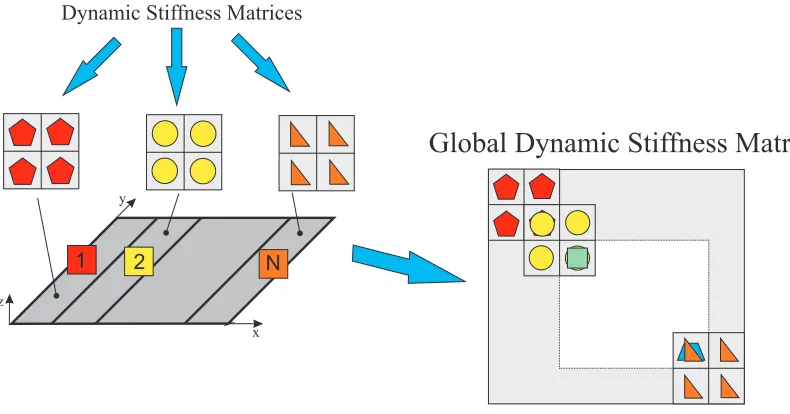
Once the DS matrix of a laminate element has been developed, it can be rotated and/or offset if
required and thus can be assembled to form the global DS matrix of the final structure. The assembly
procedure is schematically shown in Fig. 2 which is similar to that of FEM. Although like the FEM, a
mesh is required in the DSM, it should be noted that the latter is mesh independent in the sense that
additional elements are required only when there is a change in the geometry of the structure. A single
DS laminate element is enough to compute any number of its natural frequencies to any desired accuracy,
which, of course, is impossible in the FEM. However, for the type of structures under consideration DS
plate elements do not have point nodes, but have line nodes instead. In this particular case, no change in
geometry along the longitudinal direction is admitted. This is in addition to the assumed simple support
boundary conditions on two opposite sides, inherent in DSM for plate elements at present. The other
two sides of the plate can have any boundary conditions. The application of the boundary conditions
of the global dynamic stiffness matrix involves the use of the so-called penalty method. This consists
of adding a large stiffness to the appropriate leading diagonal term which corresponds to the degree of
freedom of the node that needs to be suppressed. It is thus possible to apply free (F), simple support (S)
and clamped (C) boundary conditions on the structure by penalizing the appropriate degrees of freedom.
clamped boundary condition U, V, W, Φy, Φx, W, x will have to be penalized. Of course for the
free-edge boundary condition no penalty will be applied. Because of the similarities between DSM and FEM,
DS elements can be implemented in FEM codes and thus the accuracy of results can be enhanced very
considerably.
2.5. Application of the Wittrick-Williams Algorithm
In order to compute the natural frequencies of a structure by using the DSM, an efficient way to solve
the eigenvalue-problem is to apply the Wittrick-Williams algorithm [3] which has featured in literally
hundreds of papers. For the sake of completeness the procedure is briefly summarized as follows.
First the global dynamic stiffness matrix of the final structureK∗ is computed for an arbitrarily chosen
trial frequency ω∗. Next, by applying the usual form of Gauss elimination the global stiffness matrix, is
transformed into its upper triangularK∗△ form. The number of negative terms on the leading diagonal
of K∗△ is now defined as the sign counts(K∗) which forms the fundamental basis of the algorithm. In
its simplest form, the algorithm states that j, the number of natural frequencies (ω) of a structures that
lie below an arbitrarily chosen trial frequency (ω∗) is given by:
j=j0+s(K∗) (41)
where j0 is the number of natural frequencies of all single elements within the structure which are still
lower than the trial frequency (ω∗) when their nodes are fully clamped. It is necessary to account for this
clamped-clamped frequencies because exact free vibration analysis using DSM allows an infinity number
of natural frequencies to be accounted for when all the nodes of the structures are fully clamped, i.e.
in the overall formulation K δ = 0, these natural frequencies correspond to δ = 0 modes. Thus j0 is
an integral part of the algorithm and not really a peripheral issue. However, unless exceptionally high
frequencies are needed,j0is usually zero and the dominant term of the algorithm is the sign-counts(K∗),
of Eq. (41). One way of avoiding the computation ofj0 is to split the structure into sufficient number of
elements so that the clamped-clamped natural frequencies of an individual element in the structure are
never exceeded. Once s(K∗) andj0of Eq. (41) are known, any suitable method, for example, bi-section
technique, can be devised to bracket any natural frequency within any desired accuracy. The mode shapes
are routinely computed by using standard eigenvector recovery procedure in which the global dynamic
stiffness matrix is computed at the natural frequency and the force vector is set to zero whilst deleting
one row of the DS matrix and giving one of the nodal displacement component an arbitrarily chosen
value and then determining the rest of the displacements in terms of the chosen one.
3. Results ans Discussion
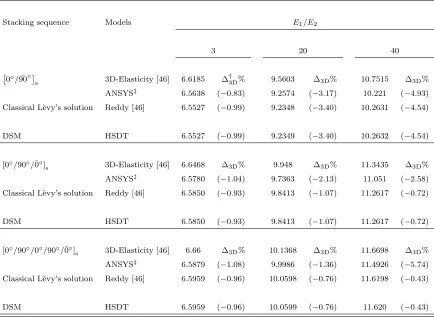
The first set of results was obtained to validate the dynamic stiffness theory using HSDT presented
in this paper. For the fundamental natural frequency, Table 1 shows representative results in
non-dimensional form for a cross-ply composite square plate simply supported on all edges using the present
theory along side the published results from literature. Of particular significance, is the inclusion of
results obtained by the present theory. Note that the ANSYS results were obtained by using SHELL181
element. Results in Table 1 cover a broad range of laminate lay-ups and stacking sequences. It is evident
that the DS theory using HSDT predicts natural frequencies of composite plate in an accurate manner.
The maximum error incurred when compared to 3D elasticity solution is 4.54% for an artificially large
value of the orthotropic ratio E1/E2 = 40. For realistic orthotropic ratios, the error is expected to be
much less. (Note that for carbon-epoxy and glass-epoxy composite structures the ratioE1/E2 is around
10.) The next set of results was obtained to examine the effects of the thickness to length ratio and
the orthotropic ratio on the first four natural frequencies of the square plate, simply supported on all
edges, but with stacking sequence [0◦/90◦/0◦/90◦/¯0◦]
s. The results using the current DSM based on
HSDT are shown in Table 2 together with the ones obtained by using the DSM program (based on
FSDT) developed by Boscolo and Banerjee [22, 23]. Some interesting observations can be made from
these results. Clearly, the difference in natural frequencies when using the more accurate HSDT and
as opposed to relatively less accurate FSDT, increases when the plate becomes progressively thicker, as
expected. One of the anomalies in using FSDT arises from the difficulty to select the shear corrector
factor (χ), which is generally introduced on an ad-hoc basis in an attempt to account for the correct
shear stress distribution which in reality is not uniform through the cross section. Strictly speaking, the
FSDT can never achieve zero shear stress distribution at the free boundaries. Thus there is an element
of uncertainty in choosing the shear corrector factor and different authors have used different values (see
Mindlin [44] , Reissner [45]). The problem of choosing the shear corrector factor is even more troublesome
for composites. However, this factor is taken to be 5/6 (see [45]) in the FSDT results shown in Table 2.
By contrast the HSDT results based on refined displacement field do not rely on such fictitious (and quite
often arbitrarily chosen) shear correction factor because the HSDT intrinsically account for the parabolic
shear stresses distribution. To confirm the predictable accuracy of the current method, 3D elasticity
solution has been used for comparison purposes. Both the influence of the thickness-to-length ratio and
the orthotropic ratio on results are also shown in Table 2. The next set of results are focused on the
effect of boundary conditions. For two representative values of thickness ratio (b/h), the results in Table
3 show the effects of the boundary conditions on the first four natural frequencies of the above plate.
It should be noted that FSDT results are also included in the table. Clearly, when the plate is simply
supported on to opposite sides and clamped on the other two sides, the natural frequencies assume higher
values as expected. For this case, the maximum error encountered is in the third natural frequency when
using FSDT instead of the more accurate HSDT. The absolute values of these errors are around 7.5%
and 4.2% when the thickness ratios are 5 and 10 respectively, as can be seen in Table 3. It also evident
from the results that on occasions, the FSDT results are lower than the HSDT ones. The reason for this
can be attributed to the fact that the choice of the shear correction factor (which is non-existent and
unnecessary in HSDT), influences the FSDT results in some unpredictable way. Such discrepancies are
not uncommon and can be found in the literature. In order to demonstrate the applicability of the theory
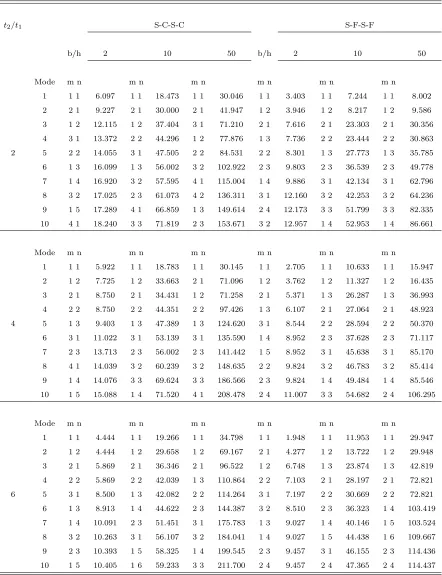
to an assembly of composite plates, a stepped panel which is schematically shown in Fig. 3 has also been
analysed. As in previous cases, the results were obtained in non-dimensional form and with particular
representative from a practical standpoint. The results where obtained for different boundary condition,
and for a wide range of thickness ratios between the stiffened plate and parent plate (t2/t1) ranging from
2 to 6. The first ten natural frequencies using the present theory with S-C-S-C and S-F-S-F boundary
conditions, are shown in Table 4 for different values ofb/h. The results shown are exact and cannot be
found in the existing literature, neither can they be obtained in an exact sense using other methods. The
following comments about these results are relevant. Understandably, the natural frequencies are higher
for S-C-S-C boundary conditions compared to S-F-S-F ones, as expected, but more importantly, for thick
plates, e.g. b/h= 2, increasingt2/t1, decreases all the natural frequencies significantly. By contrast, for
relatively thin plates with b/h= 10 the natural frequencies increase with increasing t2/t1 ratio for this
particular problem. The reason for this can be attributed to the fact that for higherb/h ratio the effect
of mass of the stiffened plate appears to be more pronounced than its stiffness, yielding lower natural
frequencies as a consequence. The final set of results was obtained to demonstrate the mode shapes of the
composite plate and the stepped panel using HSDT based DSM. In Figs. 4 to 6, a direct comparison of
the first, fifth and ninth modes between the simple cross-ply laminated composite plate and the stepped
panel has been made for the boundary conditions S-C-S-C, when the step ratio t2/t1 = 2, whilst the
overall dimensions for the two configurations are kept the same. These figures reveal some interesting
features. For the fundamental mode, see Fig. 4, there is hardly any difference in the natural frequency
and mode shape between the simple plate and stepped panel. This is in sharp contrast to the fifth and
ninth modes shown in Figs. 5 and 6 respectively, where some differences in the natural frequencies and
mode shapes are prevalent. It is clear from these two figures that significant alteration in the mode
shapes is possible when required as a result of using stepped panel. The corresponding results for
S-F-S-F boundary condition are shown in Figs. 7, 8 and 9. Figure 7 shows that the fundamental natural
frequency changes significantly, but the mode shape follows more or less the same pattern. The sixth and
ninth modes shown in Figs. 8 and 9, fortuitously reveal the same picture as the fundamental one shown
in Fig. 7. It is interesting to note that for S-C-S-C and S-F-S-F boundary conditions, results and trends
are markedly different. These observations are important when solving frequency attenuation problems
to avoid certain undesirable natural frequencies and mode shapes of complex composite structures.
4. Concluding Remarks
An exact dynamic stiffness theory for composite plate elements using higher order shear deformation
theory is developed for the first time in this paper using Hamiltonian mechanics and symbolic algebra.
The theory is implemented in a computer program to carry out free vibration analysis of composite
structures modelled as plate assemblies. The proposed theory is a significant refinement over recently
developed dynamic stiffness method using classical and first order shear deformation plate theories. The
developed DSM model is particularly useful when analyzing thick composite plates with moderate to high
orthotropic ratios for which the FEM may become unreliable, particularly at high frequencies. A detailed
parametric study has been carried out by varying significant plate parameters and boundary conditions.
The results have been critically examined and the theory has been assessed using existing theories and
been analyzed for its dynamic behavior. Based on the computed results the following comments can be
made:
• The proposed exact dynamic stiffness composite plate element based on HSDT is shown to be more accurate in terms of results and computational efficiency when compared with FEM in free vibration
analysis of composite plate assemblies.
• The theory provides a significant refinement over FSDT element, particularly when thick plates with high orthotropic ratios are analyzed.
• The boundary conditions do not seem to affect the error incurred using FSDT as opposed to more accurate HSDT.
• The dynamic behavior of stepped composite plates are very different from those of simple com-posite plates depending on the boundary conditions, but significant alteration in mode shapes is possible
by using stepped panels. This could be useful in solving frequency attenuation problems.
References
[1] J. R. Banerjee, Dynamic stiffness formulation for structural elements: A general approach,
Comput-ers & Structures 63 (1) (1997) 101–103.
[2] O. C. Zienkiewicz, The Finite Element Method in Engineering Science, 1st Edition, McGraw Hill,
London, England, 1971.
[3] W. H. Wittrick, F. W. Williams, A general algorithm for computing natural frequencies of elastic
structures, Quarterly Journal of Mechanics and Applied Mathematics 24 (3) (1970) 263–284.
[4] M. S. Anderson, F. W. Williams, J. R. Banerjee, B. J. During, C. L. Herstrom, D. Kennedy, D. B.
Warnaar, User manual for BUNVIS-RG: An exact buckling and vibration program for lattice
struc-tures with repetitive geometry and substructuring option, NASA Technical Memorandum 87669,
1986.
[5] W. H. Wittrick, F. W. Williams, Buckling and vibration of anisotropic or isotropic plate assemblies
under combined loadings, International Journal of Mechanical Sciences 16 (4) (1974) 209–239.
[6] F. W. Williams, Computation of natural frequencies and initial buckling stresses of prismatic plate
assemblies, Journal of Sound and Vibration 21 (1972) 87–106.
[7] R. Plank, W. H. Wittrick, Buckling under combined loadings of thin flat-walled structures by a
complex finite-strip method, International Journal of Numerical Methods in Engineering 8 (1974)
[8] F. W. Williams, M. S. Anderson, Incorporation of Lagrange multipliers into an algorithm for finding
exact natural frequencies or critical buckling loads, International Journal of Mechanical Sciences
25 (8) (1983) 579–584.
[9] M. S. Anderson, F. W. Williams, C. J. Wright, Buckling and vibration of any prismatic assembly
of shear and compression loaded anisotropic plates with an arbitrary supporting structures,
Inter-national Journal of Mechanical Sciences 25 (8) (1983) 585–596.
[10] D. Kennedy, F. W. Williams, Vibration and buckling of anisotropic plate assemblies with winkler
foundations, Journal of Sound and Vibration 138 (3) (1990) 501–510.
[11] F. W. Williams, D. Kennedy, M. S. Anderson, Analysis features of VICONOPT, an exact
buck-ling and vibration program for prismatic assemblies of anisotropic plates, Proceeding of the 31st
AIAA/ASME/ASCE/AHS/ASC Structures, Structural Dynamics and Materials Conference, Long
Beach, California AIAA Paper 90-0970 (1990) 920–990.
[12] R. Butler, F. W. Williams, Optimum design features of viconopt, an exact buckling and
vibration program for prismatic assemblies of anisotropic plates, Proceeding of the 31st
AIAA/ASME/ASCE/AHS/ASC Structures, Structural Dynamics and Materials Conference, Long
Beach, California AIAA Paper 90-1068 (1990) 1289–1299.
[13] M. S. Anderson, D. Kennedy, Inclusion of transverse shear deformation in the exact
buckling and vibration analysis of composite plate assemblies, Proceeding of the 32nd
AIAA/ASME/ASCE/AHS/ASC Structures, Structural Dynamics and Materials Conference,
Dal-las, Texas, April 13-15 1992 AIAA Paper 92-2287.
[14] D. M. McGowan, Development of curve-plate elements for the exact buckling analysis of
compos-ite plate assemblies including transverse-shear effects, NASA/TM-1999-209512, Langley Research
Center, Hampton, Virginia, USA, 1999.
[15] J. R. Banerjee, Free vibration analysis of a twisted beam using the dynamic stiffness method,
Inter-national Journal of Solids and Structures 38 (38-39) (2001) 6703–6722.
[16] J. R. Banerjee, Free vibration of sandwich beams using the dynamic stiffness method, Computers
and Structures 81 (18-19) (2003) 1915–1922.
[17] J. R. Banerjee, Development of an exact dynamic stiffness matrix for free vibration analysis of a
twisted timoshenko beam, Journal of Sound and Vibration 270 (1-2) (2004) 379–401.
[18] J. R. Banerjee, H. Su, D. R. Jackson, Free vibration of rotating tapered beams using the dynamic
stiffness method, Journal of Sound and Vibration 298 (4-5) (2006) 1034–1054.
[19] J. R. Banerjee, C. W. Cheung, R. Morishima, M. Perera, J. Njuguna, Free vibration of a
three-layered sandwich beam using the dynamic stiffness method and experiment, International Journal
[20] M. Boscolo, J. R. Banerjee, Dynamic stiffness elements and their applications for plates using first
order shear deformation theory, Computers & Structures 89 (2011) 395–410.
[21] M. Boscolo, J. R. Banerjee, Dynamic stiffness method for exact in-plane free vibration analysis of
plates and plate assemblies, Journal of Sound and Vibrations 330 (12) (2011) 2928–2936.
[22] M. Boscolo, J. R. Banerjee, Dynamic stiffness formulation for composite Mindlin plates for exact
modal analysis of structures. part I: Theory, Computers & Structures 96-97 (2012) 61–73.
[23] M. Boscolo, J. R. Banerjee, Dynamic stiffness formulation for composite Mindlin plates for exact
modal analysis of structures. part II: Results and applications, Computers & Structures 96-97 (2012)
74–83.
[24] J. Reddy, A simple higher order theory for laminated plates., Journal of Applied Mechanics 51 (1984)
745–752.
[25] J. Reddy, D. Phan, Stability and vibration of isotropic , orthotropic and laminate plates according
to a higher-order shear deformation theory., Journal of Sound and Vibration 98 (2) (1985) 157–170.
[26] J. Reddy, T. Kuppusamy, Natural vibration of laminated anisotropic plates., Journal of Sound and
Vibration 94 (1) (1984) 63–69.
[27] B. Vlasov, On the equations of bending of plates, Dokla Ak Nauk Azerbeijanskoi SSR [in Russian]
3 (1957) 955–959.
[28] Jemielita, Technical theory of plates with moderate thickness., Rozprawy Inz [in Polish] 23 (1975)
483–499.
[29] Jemielita, On kinematical assumptions of refined theories of plates., Journal of Applied Mechanics
57 (1990) 1088–1091.
[30] E. Carrera, F. A. Fazzolari, L. Demasi, Vibration analysis of anisotropic simply supported plates
by using variable kinematic and Rayleigh-Ritz method, Journal of Vibration and Acoustics 133 (6)
(2011) 061017–1/061017–16.
[31] F. A. Fazzolari, E. Carrera, Advanced variable kinematics Ritz and Galerkin formulation for accurate
buckling and vibration analysis of laminated composite plates, Composite Structures 94 (1) (2011)
50–67.
[32] F. A. Fazzolari, E. Carrera, Thermo-mechanical buckling analysis of anisotropic multilayered
com-posite and sandwich plates by using refined variable-kinematics theories, Submitted for publication,
2012.
[33] E. Carrera, M. Petrolo, On the effectiveness of higher-order terms in refined beam theories, Journal
of Applied Mechanics 78 (2011) 021013–1021013–17.
[35] F. A. Fazzolari, Fully coupled thermo-mechanical effect in free vibration analysis of anisotropic
multilayered plates by combining hierarchical plates models and a trigonometric Ritz formulation,
Mechanics of Nano, Micro and Macro Composite Structures, Politecnico di Torino 18-20 June, 2012.
[36] E. Carrera, M. Boscolo, Classical and mixed finite elements for static and dynamic analysis of
piezoelectric plates, International journal for numerical methods in engineering 70 (2007) 1135–1181.
[37] E. Carrera, M. Boscolo, A. Robaldo, Hierarchic multilayered plate elements for coupled multifield
problems of piezoelectric adaptive structures: Formulation and numerical assessment, Archives of
computational methods in engineering 14 (2007) 383–430.
[38] E. Carrera, On the use of transverse shear stress homogeneous and non-homogeneous conditions in
third-order orthotropic plate theory, Composite Structures 77 (2007) 341–352.
[39] J. N. Reddy, Mechanics of Laminated Composite Plates and Shells. Theory and Analysis, 2nd
Edi-tion, CRC Press, 2004.
[40] Y. F. Xing, B. Liu, Exact solutions for the free in-plane vibrations of rectangular plates, International
Journal of Mechanical Sciences 51 (3) (2009) 246–255.
[41] C. I. Park, Frequency equation for the in-plane vibration of a clamped circular plate, Journal of
Sound and Vibration 313 (1-2) (2008) 325–333.
[42] D. Gorman, Exact solutions for the free in-plane vibration of rectangular plates with two opposite
edges simply supported, Journal of Sound and Vibration 294 (1-2) (2006) 131–161.
[43] Y. F. Xing, B. Liu, New exact solutions for free vibrations of thin orthotropic rectangular plates,
Composite Structures 89 (4) (2009) 567–574.
[44] R. D. Mindlin, Influence of rotary inertia and shear on flexural motions of isotropic elastic plates.,
Journal of Applied Mechanics 18 (10) (1951) 1031–1036.
[45] E. Reissner, On the theory of bending of elastic plates, Journal of Mathematical Physics 23 (4)
(1944) 184–191.
[46] T. Kant, K. Swaminathan, Free vibration of isotropic, orthotropic, and multilayer plates based on
Tables
Table 1: Dimensionless fundamental natural frequency parameter ˆω = ω b h
q ρ
E2, for a cross-ply square composite plate simply supported at all edges witha/h= 5,E1/E2= open,G12/E2=G13/E2= 0.6,G23/E2= 0.5,ν12=ν13= 0.25.
Stacking sequence Models E1/E2
3 20 40
0◦/90¯◦
s 3D-Elasticity [46] 6.6185 ∆ †
3D% 9.5603 ∆3D% 10.7515 ∆3D%
ANSYS‡ 6.5638 (−0.83) 9.2574 (−3.17) 10.221 (−4.93)
Classical L`evy’s solution Reddy [46] 6.5527 (−0.99) 9.2348 (−3.40) 10.2631 (−4.54) DSM HSDT 6.5527 (−0.99) 9.2349 (−3.40) 10.2632 (−4.54) [0◦/90◦/¯0◦]
s 3D-Elasticity [46] 6.6468 ∆3D% 9.948 ∆3D% 11.3435 ∆3D%
ANSYS‡ 6.5780 (−1.04) 9.7363 (−2.13) 11.051 (−2.58)
Classical L`evy’s solution Reddy [46] 6.5850 (−0.93) 9.8413 (−1.07) 11.2617 (−0.72) DSM HSDT 6.5850 (−0.93) 9.8413 (−1.07) 11.2617 (−0.72) [0◦/90◦/0◦/90◦/¯0◦]
s 3D-Elasticity [46] 6.66 ∆3D% 10.1368 ∆3D% 11.6698 ∆3D%
ANSYS‡ 6.5879 (−1.08) 9.9986 (−1.36) 11.4926 (−5.74)
Classical L`evy’s solution Reddy [46] 6.5959 (−0.96) 10.0598 (−0.76) 11.6198 (−0.43) DSM HSDT 6.5959 (−0.96) 10.0599 (−0.76) 11.620 (−0.43)
† ∆3D% = ˆ ω−ωˆ3D
ˆ
ω3D ×100.
Table 2: Dimensionless fundamental natural frequency parameter ˆω=ω b h
q ρ
E2, of a cross-ply square composite plate, sim-ply supported at all edges with stacking sequence [0◦/90◦/0◦/90◦/¯0◦]
s,b/h= open,E1/E2= open,G12/E2=G13/E2=
0.6,G23/E2= 0.5,ν12=ν13= 0.25 .
E1/E2 Models b/h
2 5 10 100
3 HSDT 4.5542 ∆†HT% 6.5974 ∆HT% 7.2559 ∆HT% 7.5327 ∆HT%
FSDT∗ χ=5
6
4.5375 (−0.36) 6.5955 (−0.03) 7.2556 (−0.004) 7.5327 (0.00) 10 HSDT 5.1766 ∆HT% 8.5341 ∆HT% 9.9576 ∆HT% 10.6416 ∆HT%
FSDTχ=5
6 5.1355 (−0.79) 8.5227 (−0.13) 9.9532 (−0.04) 10.6416 (0.00) 20 HSDT 5.5412 ∆HT% 10.0646 ∆HT% 12.5357 ∆HT% 13.9312 ∆HT%
FSDTχ=5
6 5.4572 (−1.52) 10.0415 (−0.23) 12.5229 (−0.10) 13.9312 (0.00) 30 HSDT 5.7410 ∆HT% 10.9927 ∆HT% 14.3872 ∆HT% 16.5764 ∆HT%
FSDTχ=5
6 5.6065 (−2.34) 10.9605 (−0.29) 14.3663 (−0.15) 16.5764 (0.00) 40 HSDT 5.8815 ∆HT% 11.6200 ∆HT% 15.8222 ∆HT% 18.8499 ∆HT%
FSDTχ=5
6 5.6925 (−3.21) 11.5788 (−0.35) 15.7943 (−0.17) 18.8499 (0.00)
† ∆HT% = ˆ
ωFSDT−ωˆHSDT
ˆ
ωHSDT ×100.
![Table 2: Dimensionless fundamental natural frequency parameter ˆ = open,0ply supported at all edges with stacking sequence [0.6, G23/E2 = 0.5, ν12 = ν13 = 0.◦/90◦/0◦/90◦2/E , of a cross-ply square composite plate, sim-¯0◦] sω b, b/h ρω =h� E1/E2 = open, G12/E2 = G13/E2 =25 .](https://thumb-us.123doks.com/thumbv2/123dok_us/1539898.106552/27.595.76.519.298.581/dimensionless-fundamental-frequency-parameter-supported-stacking-sequence-composite.webp)
![Table 3: Dimensionless natural frequency parameter ˆ◦/0◦/90◦/¯0◦]s, b/h = 5, E1/E2 = 40, G12/E2 = G2sequence [0◦/90 = ω b�h ρωE , of a cross-ply square composite plate, with stacking13/E2 = 0.6, G23/E2 = 0.5, ν12 = ν13 = ν23 = 0.25.](https://thumb-us.123doks.com/thumbv2/123dok_us/1539898.106552/28.595.74.546.233.638/table-dimensionless-natural-frequency-parameter-sequence-composite-stacking.webp)
![Figure 4: Fundamental natural frequency and mode shape of a simple and stepped composite plate, with boundary conditionS-C-S-C and stacking sequence [0◦/90◦]s,bt1 = 10, t2t1 = 2.](https://thumb-us.123doks.com/thumbv2/123dok_us/1539898.106552/31.595.81.524.468.681/figure-fundamental-frequency-composite-boundary-conditions-stacking-sequence.webp)
![Figure 6: Ninth natural frequency and mode shape of a simple and stepped composite plate, with boundary conditionS-C-S-C and stacking sequence [0◦/90◦]s,bt1 = 10, t2t1 = 2.](https://thumb-us.123doks.com/thumbv2/123dok_us/1539898.106552/32.595.75.486.451.682/figure-frequency-stepped-composite-boundary-conditions-stacking-sequence.webp)
![Figure 8: Sixth natural frequency and mode shape of a simple and stepped composite plate, with boundary conditionS-F-S-F and stacking sequence [0◦/90◦]s,bt1 = 10, t2t1 = 2](https://thumb-us.123doks.com/thumbv2/123dok_us/1539898.106552/33.595.81.526.472.683/figure-frequency-stepped-composite-boundary-conditions-stacking-sequence.webp)