Rochester Institute of Technology
RIT Scholar Works
Theses
Thesis/Dissertation Collections
11-12-2004
Memory fix
Christopher James Jordan
Follow this and additional works at:
http://scholarworks.rit.edu/theses
This Thesis is brought to you for free and open access by the Thesis/Dissertation Collections at RIT Scholar Works. It has been accepted for inclusion
in Theses by an authorized administrator of RIT Scholar Works. For more information, please contact
Recommended Citation
MEMORY FIX
BY
CHRISTOPHER JAMES JORDAN
THESIS
Submitted in Partial Fulfillment of the Requirements for the Degree of
Master of Fine Art
in
Imaging Arts
Rochester Institute of Technology
Therese Mulligan, Chair
Therese Mulligan, Ph.D.
Angela Kelly
, Committee Advisor
Angela Kelly (TM)
Elliott Rubenstein, Committee Advisor _ _ _ _ _ _ _ _
_
Patricia Russotti, Committee Advisor
Patricia Russotti
Through
dreams,
the
variousdwelling-places
in
ourlives
co-penetrate andretainthe
treasures
offormer days. And
after we arein
the
newhouse,
whenmemories ofother places wehave lived in
comeback
to us,
wetravel
to the
land
ofMotionless
Childhood,
motionlessthe
way
allImmemorial
things
are.We
live
fixations...
Gaston
Bachelard,
The Poetics ofSpace
ACKNOWLEDGEMENTS
I
wouldlike
to thank
many
people whohave
inspired,
challenged,
or otherwise supportedmy
efforts.First,
I
wouldlike
to
acknowledgemy
patient,
stimulating
andinsightful
thesis
committee,
including
Therese
Mulligan,
Angela
Kelly,
Patricia
Russotti,
andElliott
Rubenstein,
eachof whomhas
contributeduniquely
to
my
artistic andintellectual
development.
Willie Osterman
andJeff Weiss
have
madeindelible
impressions
onmy methodology
and approachesto
working.Their
influence
wasparticularly felt
early on,
and continuesto
encourage new ways ofbeing.
Again,
I
mentionPatricia
Russotti,
in
additionto
Greg
Barnett,
for
inspiring
my
inevitable
plungeinto
digital,
withits
wonderfultechnical
intricacies.
I
would alsolike
to thank
John
Roche for
encouraging my writing
pursuitsin
poetry,
as well asthe
patientTim
Perkins for
introducing
meto the
book
arts.I
wouldlike
to
extend a generalacknowledgementofthanks
to the
rest oftheRIT
faculty
whohave
sharedtheir
enthusiasm and expertisealong
the way,
including
Jessica
Leiberman,
Dan
Larkin,
Myra
Green,
Andrew
Davidhazy,
Doug
Nishimura
to
name afew,
in
additionto those
I
have forgotten
to
mention.I
alsothank
(in
no particularorder) Bill
Finger,
Kristen
Gleason,
Tom
Morin,
Grady
"Smitty"Defoore,
Leyla
Safavi,
Ariya
Martin,
Leslie
Grant,
Michael
Cheney,
James
Shaheed,
Matt
Tintello,
Don
Totton,
Jeremy
Stipano,
Susana
Reisman,
Aki
Miyoshi,
the
late
Doug
May,
andthe
many
others with whomI
have
sharedmy
time
in
Rochester,
in
various ways.Thanks
to
Carol Barton
for
allthe
help
withaccordions and paperfolding,
along
withKari Horowicz
ofSpecial
Collections
atWallace
Library,
for
her
help
withartistsbooks,
andRoxana
Aparicio
Wolfe
andthe
rest ofthe
staff atGeorge Eastman House.
Next,
I
wouldlike
to thank
Nick Johnson
for
inspiring
my
first
serious effortsin
photography.Then I
would
like
to
extend a mostheartfelt
thanks
to
my parents,
for providing
such wonderfulencouragementthrough
graduate school and overthe
years.I
endby
thanking
Karen
Schlesinger,
for her
love,
support,
and most ofall,
her
patience.MEMORY FIX
By
Christopher James
Jordan
B.A.,
Psychology,
Colby
College,
1992
M.F.A.,
Imaging
Arts,
Rochester Institute
ofTechnology,
2004
ABSTRACT
This
thesis
serves asthe
written accompanimentto the
visual workcomprising
the
exhibit:Memory
Fix,
examining
notions of personalgeography
set within more generalized conceptions ofplace,
memory
andidentity
formation.
Further,
it
exploresthe
ambiguity between
waysin
which placeis
remotely
documented
versusintimately
experienced.We
live in
a culture ofdisplacement,
wheretechnologies
paradoxically
render
far-away
places moreaccessible,
but
also contributeto the
distancing
ofthe
immediate
and authentic.This
displacement
also extendsto the
world ofimage
anddepiction.
Place-representations
are emptied of original meanings and connotationsthrough
overexposure andmass circulation.Against
this
voidthe individual
strugglesto
retain an authentic place-basedidentity,
lest he
orsheface
annihilationby
the
forces
oftechno-capitalism.
Recently,
I
revisitedseveral ritualizedwalksfrom my
childhood,
specifically
my
walksto
school.I
photographedthe
oldjourneys
andmixedthe
imagery
withmaps,
aerialphotographs, poetry,
portraits ofmy
father,
andfamily
snaps-shots.The
backlit
wallpieces,
collectively
titled
Phases of
theSon
provides viewsofthis
psychological
landscape
from
remote andastronomical perspectives.The
book Walk
toSchool
revisitsBrooklyn
from
theperspectiveofa reflectiveadultlooking
back
upon a childhood setting.
The book Another Horizon
mostdirectly
addressesthe
poetic notionsofplace, reverie,
andthegossamerbarrier
thatdivides
internal
and external concepts ofplace.Through
its
physicalform
asbooks
andilluminated
displays,
my
work gainsauthenticity
throughits
engagementwiththe
viewerthrough
CONTENTS
Acknowledgements
iv
Abstract
vList
ofIllustrations
viiIntroduction
1
Chapter
1.
Conceptions
of place4
2.
Evolving
notions ofsublimity
10
3.
Mobility,
displacement,
andthe
mediatedview17
4.
Photography,
authenticity,
and expression27
5.
Perceptions,
provocations,
andthe
inner
eye33
6.
Artist
books:
some reflections37
7.
Discussion
ofworks:Walk
toSchool
and38
Another Horizon
8.
Discussion
of work:Phases of
theSon
42
9.
Digital:
the
specterof photo realism returns48
10. Conclusion
51
Bibliography
52
ILLUSTRATIONS
All
illustrated
worksareby
Christopher James
Jordan,
unless otherwise noted.Figure
1
.Catherine
Opie,
Skyway
#10,
Kiandra Franzen:
Transformation,
200
1
6
2.
John
Sexton,
Oaks
atDusk,
Carmel
Valley, California,
1988
7
3
.Roni
Horn,
When Dickinson Shut
Her
Eyes,
1
994
9
4.
Frederic Edwin
Church,
Coto^axi, Equador,
1862
12
5.
Napping
in the
Jetstream,
2003
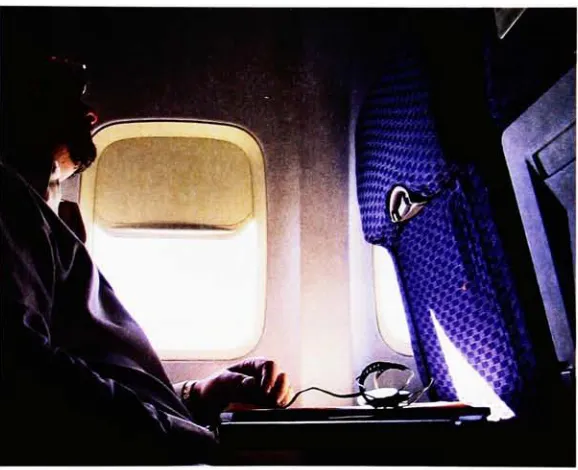
18
6.
Doug LaRoe,
Cowboy
onComputer,
1997
19
7.
www.projectrsr. com.2003
21
8.
Patrick
Nagatem,
Alamogordo
Blues,
1986
22
9.
Douglas
Huebler,
S7te
Sculpture
Project: Variable Piece
no.1,
1967
24
10.
Hamish
Fulton,
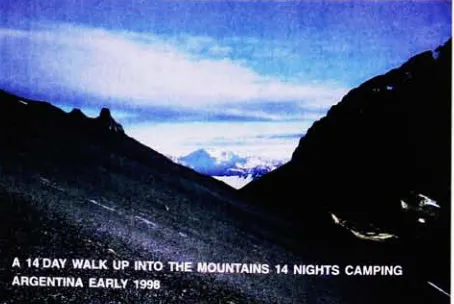
14-Day
Walk Argentina,
Early
1998,
1998
25
11. Minor
White,
Metal
Ornament, Pultneyville,
New
York,
1957
28
12.
Chimney Blucff
Deadfall
#4,
2003
3 1
13. Excerpt from
Another
Horizon,
2004,
p.2
39
14. Excerpt
from
Walk
toSchool,
2004,
p.4
40
15. Excerpt from
Walk
to
School,
2004,
p.5
40
1
6. Excerpt from
Walk
toSchool,
2004,
p.3
41
17.
Remote/Intimate
Sensing
#3,
2004.
42
1
8.
Phases of
theSon,
Phase
#
1
,2004
43
19.
Phases of
the
Son,
Phase
#
2,
2004
43
20.
NASA,
Apollo 1
1
,Earthrise
overMoon,
1969
44
2 1
.Phases of
theSon,
Phase
#
4,
2004
44
22.
Phases of
theSon,
Phase
#
3,
2004
45
23.
Phases of
the
Son,
Phase
#5,2004
45
24.
Paul
Klee,
Senecio,
1922
46
25.
Phases of
theSon,
Phase
#
6,
2004
46
26.
Keith
Cottingham,
Fictitious
Portrait: Untitled
(Single),
1992
48
Introduction
I
have
had
along-standing
interest in
geography,
mapping
andlandscape
photography.A
critical analysis ofmy
work priorto
my
thesis project,
which couldbe
characterizedasexpressiveartphotography
in
the
mode ofMinor White
orAaron
Siskind,
led
meto
researchthe
underpinnings of modernist photographic practice and notions ofthe
American
picturesque and sublime.This
workinvestigated
notonly
the
mannerismsoflandscape
representation,
but
prevailing
attitudestoward the
land
itself,
andhow
these
inform
one another.To
this
day,
the
so-called progress ofAmerican
expansionism continuesin
daunting
fashion
as even newerfrontiers
arebeing
uncovered.Now
wehave
geneticengineering,
remotesensing,
smartbombs,
superviruses,
psychopharmacology,
and cyberspace...the
list
goes on.Contemporary
notions ofsublimity
canbe
understoodin
terms
ofprivacy,
security,
consumerism,
andthe
digital
divide.1The
individual
nowfaces
annihilationby
the
forces
ofrunaway
techno-capitalism.A
relevant place-based art practice needsto
be informed
by
these
circumstances,
eithertacitly
or explicitly.My
thesis
workspecifically
exploresthe
relationshipsbetween
self andplace,
representationandauthenticity,
and mostimportantly,
inner
versus exterior projections of placed-basedidentity.
Experience
of place canbe
extremely
varied,
from
animmediate
bodily
sensation ofbeing,
to
a cool and aloofdetachment.
Place
can referto
physicallocations,
but
alsointernal
but
very
reallocalities
withinthe
memory
or psyche.Likewise,
the
numerouswaysin
whichplaces areoutwardly
andinwardly
represented,
from
mapsto
daydreams,
to
family
snapshots,
spans afull
spectrum of psychologicalcolors.
My
work contraststhe
specificity
of autobiographicalimagery
withthe
generality
of remote anddetached
views,
andhow
these may
resonatethrough
memory.Aerial
photographs, maps,
andtechnologies that
oncefound home
in
the
areas of science ormilitary,
arerepopulatedwith warmthandsentiment,
whilethe
personalbecomes
fixed in
geographic space.image/representation in
our culturethreatens
to
reduce authenticexperienceto
displaced
modes of
imitation,
subjugation,
and qualification.Individuals constantly
repositionthemselves.
There
is
a needfor
alandscape
artthat
is
expressiveandautobiographical,
poetic andtranscendent,
but
whichalso acknowledgesthe
complexities ofimage-based
culture.Such
an art could operate withinthe
expectationsof,
andthe
attachmentsto,
imaging
systemslike
photography
anddigital
imaging.
The
hope
wouldbe
that
any
such realism affordedby
an artlike
this,
would gainits
authenticity
through
an emotional andaesthetic momentprompted
by
the
viewing
encounter.Specificity
ofmeaning
residesin
sympatheticprojections of
the viewer,
asthey
recognizetheir
own strugglefor
authentic position againstthe
sublime ofthe
technological,
mediated,
andincreasingly
distant.
The
title
ofmy
exhibitis
Memory
Fix,
the
multiple meaningsintended
to convey,
on onehand,
the
attemptto
obtain afixin
the
navigationalsense,
onsomething
asfluid
and abstract asmemory,
and onthe
other,
the
very
human
tendency
to
revise oxfix
ourmemoriesas we grow andappreciate
them
in
evolving
ways.Further,
there
is
the
idea
offixation
in
the
psychoanalyticsense,
whichis
appropriatein light
the
work's orientationto
object-relations psychology.Finally,
asmy
work notonly
addresses place-memoriesand personal
geography
themes,
but
alsodisturbing
technological
andmilitary
sublimethemes
(and
the
struggle ofego self againstthese
tensions),
fix
astargetdenotations
are also relevant.Mirroring
ourculture,
my
workis
multi-medial;
it
utilizesvisual,
verbalandsignatory
systems(maps)
in
the
hope
ofreinforcing
a complex gestalt of additive andcross-referential meanings.
The
exhibit consists of sixbacklit
transparency
displays
combined with
two
artist'sbooks,
located
ontables
and pedestals.The
wallpiecesarecollectively
entitledPhases of
theSon,
referring
to
remoteimagery
of a celestialbody
(sun)
in
various stages of anevolutionary
cycle.The
play
on wordssonversussunrepositions
any
empiricalassociations within ahierarchy
that
assertsthe
primacy
of anemotional,
psychologicalreading.The
pieces areprintedonLambda Duraclear
media,
whichoffersa
high degree
of color saturation andtonal
richness for
abacklit
display,
not unlike what wouldbe
found in advertising
or museumdisplays. The
overhead3
allows
both
the
messageandthe
illumination
ofthese
piecesto
spillthroughout the
viewing
space.The
artist'sbooks
are meantto
be handled
by
the
viewer.The
two
books
areentitled,
Another Horizon
andWalk
toSchool.
Both
are printed on alarge-format
inkjet
printer,
subsequently
cutinto
strips andfolded
and gluedinto
accordion structures.The
text
blocks
arebound
into
coversthat
have
been
hand
assembled with artistpapers,
selected
specifically
with visual andtextural
qualitiesin
mind.The
former,
Another
Horizon
is
afoldout
accordion structuredisplayed
on along
table.
It may
be
opened,
folded,
sequenced and positioned as preferredby
the viewer.It
mostspecifically
addresses
the
notion of reverie whilewalking,
andthe
dominance
of aninternal,
emotionally
oriented visionin
apperception ofthe
externalhorizon. The second, Walk
toSchool is
also an accordionbook,
but
the
covers arebound, hmiting
viewing
to
alinear
sequence,
asif
with a conventionalbook.
This book
addressesthe
notions of presentversus past
(going back),
adult versuschild,
andthe
relationship between
perception andthe
internal
voice,
contextualized withinthe
dynamics
ofwalking
withinaroutine,
familiar
place- the walkto
school.
My
thesis
projectis
essentially
a reconstitution ofpersonalgeography
throughthe
use of photographicrepresentation,
symbolization and abstraction.I
intend for my
work
to
be
transformational
and experiential.Meaning
is
suspended wherepoetry
endsand
imagery
begins. Pictures
ofeveryday
places... ofhouses,
towns,
roads,horizons,
groups of
people,
aswell astheplacesknown
to
moredistant
cameras,
can allbe
charged with
projections, memories,
anddreams. A
gossamerbarrier divides
theinternal
and external
landscape. I intend for my
workto
be
readableinsomuch
as viewers projecttheir
own place associationsuponthe work,
hopefully
recognizing
thatthey
have
yettobe
annihilated.1
David E.
Nye,
American Technological Sublime(Cambridge,
MA: The METPress,
1994)
281-296;
Jeremy Gilbert-Rolfe,
"I'm Not Sureits
Sticky,"Chapter
1
Conceptions
ofPlace
Place
has
been
defined
in
numerousways.The
cultural,
historical,
andindeed,
personalissues
arecomplex.J.B.
Jackson,
the
renownedlandscape
historian,
suggests"a
senseofplace"
is
aterm
usedsoloosely
that
it doesn't
referto
anything
atall.1
My
researcheshave
led
me across a vastfrontier
of conceptualapproachesandunderstandingsof place.
In
adescription
of urbanAmerican
life,
J.B. Jackson
emphasizesthat
a commonsense of
place,
say
the
hometown,
depends less
onthe
physical or architecturalfeatures
than
a sharedculture,
a common sense oftime,
ritual
and event.Shared
timetables,
traffic
patterns,
workhours,
vacationschedules,
and regular celebrations all markthe
flow
oftime,
providing
us with a sense of collectivehistory
withina commonsetting.2
Everyday
placesbecome
visitedritually,
often withouttacit
acknowledgement;
they
aretied to
ourdaily
routinesto
adegree
that
almostbecome
an extensionofthe
home.
In
asense,
these
places are autonomic-like breath
or
pulse;
anunderstanding
and consciousawareness of
these
placesis
subconscious,
yet constantand evolving.These
vernacular,
neighborhood places mightbe
the
school, church,
cornerstore, office,
etc.3
Reflecting
uponthese
ideas,
I
began
to
look
atthe
rituals
that markedmy
childhood,
similarly
the
various placesmy
family
has lived. One
of most poignant wasmy
daily
walkto school,
aritual
that
many American
childrenliving
in
urban and small-town settings share.J.B.
Jackson
defines
placein
socio-culturalterms
as well as psychological.He
places anemphasis on
the
human
landscape:
ruralfarming
communities,
towns,
cities,
neighborhoods,
trailer
parks,
ratherthan
a remote or pristine wilderness.When
deconstructed,
anunderstanding
ofthese places,
how
they
have
comeabout,
andthe
patterns ofdevelopment
they
have
followed,
revealsimportant
values and patterns ofthe
socialfabric.
For
instance,
the
ubiquity
oftrailer
parks speaksto the
vast number ofblue-color
families
depending
ontemporary
wage-jobs.The mobility
ofthese
homes
reflects
the
postureoftheir
inhabitants
5
This
emphasisonthe
vernacular contrasts with moreidealized
notions of place -such asthose
perpetuatedby
reverent writersand artistslike
Henry
David
Thoreau,
John
Muir,
andAnsel
Adams,
who celebratedthe
spiritualsignificance ofthe
wilderness.5
Jackson
statesthat
he
has little
qualm withthe
viewscodifiedby
these
individuals.
A
walk
in
the
wildscanindeed
do
wondersfor
one's sense of metaphysical equilibrium.However,
it
is
when certainideologies
of place are orderedhierarchically,
as whenworship
ofthewildernessis
considered ofhigher
orderthan
a walkto the
corner storefor
cigarettes or scratchtickets,
that
he
has
qualms.The
vernacularis
most ofthe
time
and should
therefore
beget
most of our attention.Similarly,
writerslike
Grady Clay
have
contributedto
a greaterunderstanding
ofplace,
especially
with respectto
the
urbanenvironment.While Jackson
perhapslooks
moreto
social and culturalpsychology
for his
theoretical underpinnings,
someonelike
Clay
morespecifically
addresses categorization and classification.His
book,
Real
Places: An
Unconventional Guide
toAmerica 's
Generic
Landscapes
atfirst
rings withthe
clever,
perhapsrenegade, posturing
ofEd Ruscha's
work,
as well asmy
ownRandom
Survey
Rochester. A systematic,
matter-of-factcataloguing
of suchplaces as"The
Boon-docks,
Town
Creek,
Growth
Area,
andRiot
Scene"is
undeniably
fun
to
read and amuseover.6
Of
course, the
root ofthisirony
lies in
the
way
such observationalapproaches
had been
previously
reservedfor
describing
much more austereplaces,
such as wildfrontiers
atthe
edge of civilization.Yet
when onegetsbeyond
this
(as
I
admittedly
had
to),
adeeper
appreciationofvernacularplaceetiology
soontakes
hold.
The
provocationandposturing
begins
to
meltinto
genuine analysis.One
artistworking addressing
vernacularplacein
a similar modeto
Clay
orJackson's
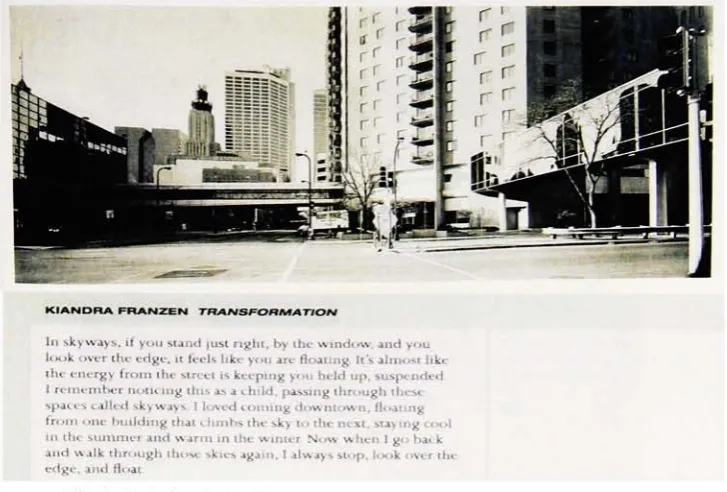
writingsis Catherine Opie.
Her
workhas been described
as a"visual
road trip,"using
photography
andtransportation
as mediator of place7.The
substance ofher
work,
in
my opinion,
lies
between
the
iconic
andthe
personalthrough
juxtaposition
ofthe two.
She
choosesicons
that
are sometimes overlooked ortaken
for
granted,
but
whichengendera sense ofidentity
orbelonging
to
a place(fig.
2).8
For
instance,
in
her
daily
basis.
In
her
work,
objectsperhapstoo
banal
to
registeronthepersonal radarbecome
charged withricher
meanings andassociations.KIANDRA FRANZEN TRANSFORMATION
Iiiskyways,ifyoustandjustright,bythe window, andyou
lookover the edge,itteels likeyou
an-floating It 'saim.SIlike
tinenergyfromthe streetiskeepingyouheldup.suspended
Iremember
noticingthisas achild,passingthrough these
1'ius calledskyways Iloved toutingdowntown,Moating fromone buildingthattlimbstht sk>ti-thenest sta\ingeool
[image:14.517.76.440.91.337.2]intlusummer andwarminthe winter Nowwhen1gobatk andwalkthrough[host skiesagain.1alwaysstop,lookiiverth edge,andfloat
Fig. 1.
Catherine
Opie,
Skyway
#10,
Kiandra Franzen:Transformation,
2001An
avowedtree
hugger,
I
acknowledge a certainfascination
withthe
wilderness.My
friends,
family
andI
have found
much enjoymenthiking,
mountaineering,
rock-climbing
andcreating
artin
these
settings.For
me,
I
think this
is
anissue
oftemperament
and upbringing.An
introverted
person,
I
find
a sense of calmin
the
outdoors,
in
isolation from
other people.That
being
said,
I
alsoenjoy
the
company
ofother
hikers
and climbers.But
this
is
whenthe
outdoorsbecomes
a socialactivity,
sharing
a sense of place(albeit
mythologizedto
adegree)
with one's peers.I
alsoacknowledge
the
influence
ofmy
family;
"getting
outside"
has
long
been
apostureassociated with
health
andforward
motion.Further,
my
parents,
both
artists,
have drawn
or painted
in
the
landscape for
aslong
asI
can remember.This
was considered ahealthy,
wholesome andfulfilling
activity.When I
look
at worksby
Hudson River
School
artistsincluding
Frederick
Church
orThomas
Cole,
I
am struck with a sense offamiliarity
-both
with
the
Hudson
River
Valley
as a place wheremy
family
has
spent muchtime
(and
indeed,
a place withtransforming
a sceneinto
anexpression,
andthe
very
sublimationofidentity
or selfwithin
the
environmentalsetting.Undoubtedly,
my
fascination
with photographers ofthe
greatModernist landscape
tradition,
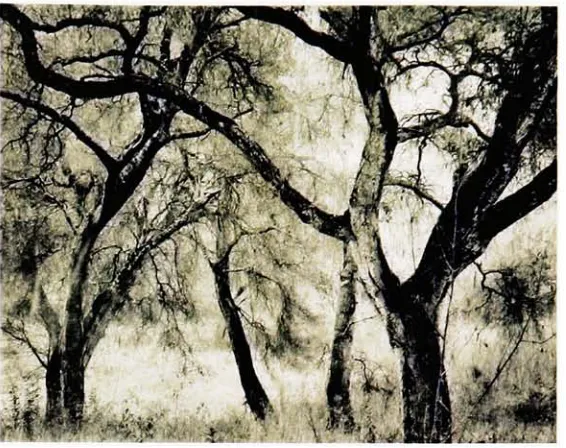
suchasAnsel
Adams
andJohn
Sexton,
grewfrom
suchassociations(fig.
3).
Fig.3. John
Sexton,
OaksatDusk,
CarmelValley, California,
1988Of
course,
criticism of worklike
this
often stemsfrom
criticism of modernismitself,
withits
white male practitionersproclaiming
universals ofhuman
experience.Indeed,
criticslike Deborah Bright
also point outthat the
pictoriallandscape
conventions of
the
aestheticizedlandscape,
mostnotably,
depictions
ofthe
unsulliedwilderness succeed
primarily
in
perpetuating
myths aboutthe
American
landscape
atthe
expense of
those
for
whomhistory's
voicehas been
repressed.9
Even
the
New
Topographers,
namely Robert
Adams,
werenotimmune
from
the
bug
ofaesthetics,
couching
their
endeavorsin
the
neutrality
of socialstudies,
yet nonethelessgracing
the
walls of museumsand
galleries.10
Admittedly,
I
have
mixedfeelings
about suchcriticisms.
On
onehand,
I
understandthe
positionsbehind
them.
Yet
onthe
otherhand,
I
am also
familiar
withthe sensitivity,
dedication,
andpractice requiredfor
this
artform,
andadmire
the
work whenit is
welldone.
Geographer
Yi-Fu
Tuan
has
writtenextensively
aboutthe
human
experienceof [image:15.517.121.404.126.350.2]physical, visual,
orpsychological11.Mobility,
the
capacity
to
coverdistance
overtime,
is
crucialto
a child'sdevelopment
of selfand object-relations.Indeed,
existentialistslike
Gabriel Marcel
wouldsay
that to
"be
in
the
world"is
the
equivalentto
having
abody.
The
body
representsthe primary
"place
in
the
world"from
which onesenses, perceives,
thinks, defines
self,
andthus,
existence.12
Developmentally,
the
mother or parentis
the
only
placeofsignificancefor
the
child,
aprimary
home
providing
for
all needs.The
ability
to
move aroundis
associated withfreedom,
competency
andincreased
independence.
13Through
growth,
explorationandexperience, the
horizon
expandsto
objects,
faces,
toys,
rooms andfar beyond.
Through
the
direct
experience ofhome
andneighborhood,
passing
through
its
spaces,
interacting
withobjects andpeople,
experiencing
the
change ofseasons,
feeling
the
movements of expectationto
fulfillment,
tension to
easement, accumulating
memories,
a profoundintimacy
is
established withplace14.
A
postman-turned-philosopheroffers a poetic slantGaston Bachelard
emphasized
the
importance
ofthe
inner landscape: "Space
that
has been
seizeduponby
the
imagination
cannot remainindifferent
space subjectto the
measures and estimates ofthe
surveyor.It
has been
lived
in,
notin its
positivity,
but
with allthepartiality
ofthe
imagination."15This
subjectivemodality
resonates withthe
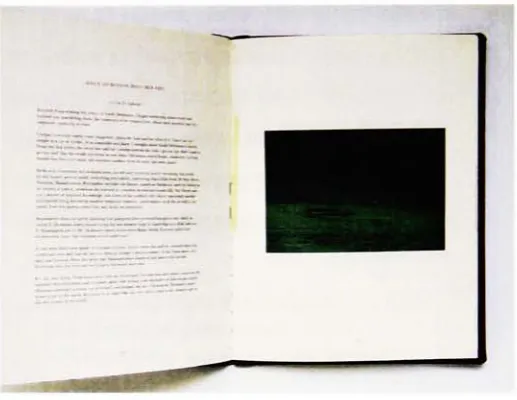
work of artistRoni
Horn,
in her
studies of
Iceland.
Representing
the
next generation of minimalists afterthe
likes
ofDonald
Judd (who
she cites as a majorinfluence),
Horn
infuses her
workwithpersonalmeaning
andliterary
reference,
withties to
authorslike
Emily
Dickinson
andJules
Verne.
Spending
months aloneexploring
the
Icelandic
wildernessby
foot
andmotorcycle affords
Horn the opportunity
to
obtain atruer
sense ofself-understanding
and
inner
geography
through
agathering
of experiencein
anisolated
setting.16To
the averageAmerican,
the
Icelandic landscape
woulddefinitely
seemdramatic,
atleast in
the
geologicalsense,
withits
smoking
crevicesfulfilling
all sorts of creationistfantasies.
Horn,
however,
resists suchstereotypical conceptionsby
acknowledging
them
outrighthuge
accomplishment.17She
mentionsthat
it
tookher
almosttenyearsbefore
shefelt
ready
to
use a camerain
Iceland. This
conditionofbeing
present shelikens
tothe
verbform
of place toplace.18When
shedoes
createimages, drawings,
photographs,
sculpture,
and writtenpassages, the
workoperateswithinthe
dialog
between
the
[image:17.517.148.407.144.344.2]observer and observed
(fig.
4).
Fig. 4. Roni
Horn,
WAe*DicHnson ShutHerEyes,
1994.John Brinkerhoff
Jackson,
ASense ofPlace,
aSense of Time (New Haven: YaleUniversity
Press,
1994),
157. 2Jackson,
160. 3Jackson,
158. 4Jackson,
62. 5Jackson,
90. 6Grady
Clay,
Real Places: An Unconventional GuidetoAmerica 'sGeneric Landscape
(Chicagoand London: TheUniversity
ofChicagoPress,
1994).7
Catherine Opie: Skyways & Icehouses (Minneapolis: Walker Art
Center,
2002)
8 Ibid. 9
Deborah
Bright,
"Of Mother NatureandMarlboro Men: AnInquiry
into
theCultural MeaningsofLandscapePhotography"
Firstpublishedin
Exposure
23.4,
Winter
1985. Thisversionreprintedin Illuminations: WomenWriting
onPhotography
from
the1850s
to thePresent,
eds.LizHeron
andValWilliams
(Durham,
N.C.:DukeUniversity
Press, 1996),
334. 10Ibid.,
341. 11Yi-Fu
Tuan,
SpaceandPlace:The Perspective ofExperience (Minneapolis:
University
ofMinnesota
Press,
1977and2001),
138. 12John
Macquarrie,
Existentialism(Harmondsworth,
Middlesex,
England: Penguin
Books,
Ltd.:
1973),
67.
13Tuan,
28-29,
138-139. 14Tuan, 188,
137. 15Gaston
Bachelard,
xxxii. 16RoniHorn: Inner
Geography
(Baltimore:TheBaltimore Museum
ofArt
andRoni
Horn, 1994)
17Ibid. 18
10
Chapter
2
Evolving
Notions
ofSublimity
Pertinent
to
discussions
ofplace,
specifically
with regardtoplace-identity
relationships
is
sublimity,
a psychological stateassociatedwithconfrontationswiththeunknown.
The first
century
(A.D.)
Greek
philosophercommonly
referredto
asPseudo-Longinus described
thesublime as"beyond
nature,"
capable of
prompting
astate of"ecstasy."1
In
the
context ofthegreat oratorsofGreek
literature,
thesublime"makes
everything
different,
like
lightning,
andshowstheallat oncecapacity
ofthe
speaker."2
The
sublimeis
relatedto thehuman capacity
totranscend
perceivedlimits,
andthereby
attain a sense of existential
meaning
or purpose.According
toLonginus:
... man's
intentness
onperceiving
often everywhere goesoutbeyond
thelimits
of whatholds
him
in,
andif
anyone gazearound atlife
atits
cycle,
he
willswiftly
understandfor
what purposewewereborn,
by
seeing how
muchwhatis
'too
much'andgreat and
fine holds
more advantagein
allthings....Therefore
(heaven
knows)
somehowdriven
by
naturetowonder not atsmallstreams,
evenif
they
are clear anduseful,
but
attheNile.
. . and still more attheOcean.3
Further,
he described
auniversethatis "turned
upsidedown
andtornapart," subjectto
some greater
force,
outsidetheworld.4This
conception ofsublimity
assumes anoverarching
andomnipotentunity
that threatens toneutralizethe
many
andspecific.5
Confronted
withthe
powerfulandoverwhelming,
individual is
thusly
transcended
andbecomes
one with allotherthings.
The
eighteenthcentury English
thinker,
Edmond
Burke,
defines
thesublimespecifically
with regardtoterror,
anemotionreigning
loudly
in
thepsychologicalhierarchy:
Whatever
is fitted
in
any
sortto
excitethe
ideas
ofpain,
anddanger,
that
is
to
say,
whateveris
in any
sortterrible,
oris
conversant aboutterrible objects,
or operatesin
amanneranalogousto
terror,
is
asource ofthe sublime,
it is
productive ofthe
strongestemotion whichthe
mindis
capable offeeling."6Burke
alsodistinguished
the
sublimein
contrastto
beauty.
Beautiful
things
canbe
11
therefore
cannotdeliver
delight7Further,
beauty
is
superficial andornamental,
whilethesublime
silent,
infinite
anddark.8According
to
Immanuel
Kant,
writing just
afew
decades
afterBurke,
sublimity
is
found in
the
formless
andlimitless.
More
importantly,
he
madethedistinction
that
sublimity
resides notin
physicalobjectsperse,
but
ratherin
the
images
orideas
provokedby
encounters with suchobjects.9
Implied
is
a shiftfrom
the
externalto theinternal.
For
Kant,
the
raging
sea cannotbe
calledsublimein
andofitself.
Rather,
the
sublimity is incited
withinthemindofthe observer,
asthevarious associations ofterror
andhorror
combineto
elevatethesensestimulationto
higher
ideas,
through
reason.10He
is
also credited withreducing
the
sublimefrom
theterrible to
themerely challenging
-something
that
couldbe
conqueredthroughreason andmorality,specifically
of aProtestant
kind.11Here
theuniverseis
protected,
theselftranscendednotby
chaoticforces
but
ratheramoraluniverse.12
While I
agreethatsublimity
residesin
the observer,
I disagree
withKant
that
sublimity primarily "concerns
rationalideas."13
For
meit
concernsemotionality
andprimal response.Confrontation
withfear
awakens an awareness ofauthenticity
withinthepsyche.It is
the
recognition offear
perse,
for
instance
when wenoticeourhair standing
onend, that
stabilizes ourautonomy
amidst thevoid.The
intrusion
ofrationality does
eventually
comeinto
play,
but only
as emotionsdissipate.
Burkean
andKantian
notionsof naturalsublimity
found
expressionin
artisticworks ofthenineteenth
century,
specifically
in depictions
ofthe
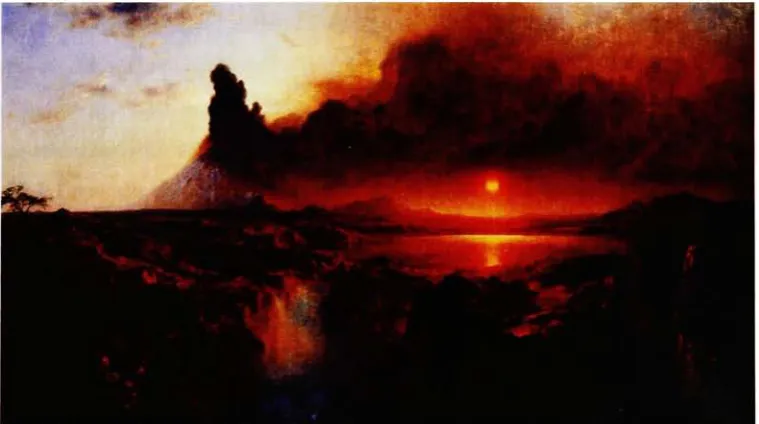
American landscape. In
the
paintings ofThomas
Cole,
Albert
Bierstadt,
andFrederic
Edwin Church
ofthe
Hudson River
Valley
School
(fig.
4),
as well asthe
Photography
ofTimothy
O'
Sullivan
and
John
K. Hillers
wefind
smallhuman figures
almostcompletely
engulfedby
the
expansive scenes.
Nature
wasdepicted
as subjectto
its
ownorder, operating
independently
from
the
seemingly
insignificant influence
ofMan.
Yet
depictions
of eventhe
most omnipotent andself-determining
phenomenaareborn
of cultural context.During
westwardexpansion ofthe
Americas,
pre-Darwiniantheoriesofgeology
and natural processes wereimbued
withdivine,
Creationist
overtones14.The
theory
of12
providing
alink between
the naturalworldandGod.
Violent,
fuming
fissures
andterrible,
watery
abysses wereevidenceof afurious
geologicaldivine
tantrum.
Explorer
Clarence
King
conveysthe terrorofadistinctly
Burkean
orderin his
description
ofShoshone
Falls:
Suddenly
you standuponthebrink,
asif
the
earthhad
yawned.Black
wallsflank
the
abyss.Deep
in
thebed
a greatriver fights its way
through the
labyrinths
ofblackened
ruins,
andplungesin
foaming
whiteness over acliff oflava.
You
turn
from
thebrink
asfrom
afrightful
glimpseoftheinferno.
.While
these
depictions
ofsublimity
are notablefor
theirdramatic
qualities,
Barbara Novak
emphasizesthat thoseofsilencecanlikewise
provoke a similartranscendence.16
On
theopposite side ofthe sonicspectrum,
silence expresses asanctified and mystical order
beyond
thecomprehensionoftherational mind.This is
the
sound ofthe endless
sky
orthe
ancientforest.
Reflecting
uponmy
ownwork,
specifically
thePhases of
theSon
series,
I
amstruckby
its
quietude.The
depictions
ofnebulae and astral phenomena are presented
from
a perspectivedevoid
of air andthecapacity for
sound.Viewed
from
percheshidden from
the
farthest
reachesoftheself,
[image:20.517.70.450.407.619.2]even
internal dialogs
arehushed.
Fig. 4.
Frederic Edwin
Church, Cotopaxi, Equador,
1862.I
the
contextoftwentieth
century
modernart,
criticCarter Radcliff
placessublimity "outside
the
law,"
13
beauty
andart.17
The
sublimein
modern artis
secular,
operating in
the
realm of a"blasphemous
anddrunken"individuality.18
The
modernist paintersJackson
Pollack,
Barnet
Newman,
andMark Rothko
arewidely
considered practitioners ofa renegadesublime.
Rothko
explorednotionsof vastnessthrough the
use ofcolor-fields,
opengeometries, extremely large
canvases,dark
and vaporouscolor,
andthe
omission of line.19Viewers
lose
themselves
in
the canvases,
contemplating
the
voidthrough
atranscendent
aesthetic experience.Unlike
theeighteenthcentury
Hudson
River
Valley
paintings, the
Rothko
paintingsattemptdirect
provocationsofthe sublime,
ratherthan
meredepictions
ofsublimity
withfigures
literally
placedwithinthe
landscape.
I
wouldhave
to
say
the
work ofJames
Turrell,
withhis optically
oriented ganzfeldpieces,
aswell as
his
controlled celestialobservations,
representsan extension ofthis
mode ofsublimity into
acontemporary
context20.What I find
intriguing
is
that
evenin
a postmodernistcontext,
his
work remains acaptivating
explorationofthe
naturalsublime.
Sublimity
and postmodernisttheory
is
aparticularly
complexintersection.
Interestingly,
it has been
suggestedthatdeconstruction is in
itself,
sublime.21Critic
Thomas
McEvilley
positsthatwe areliving
in
whathe
calls a "post-sublime"world,whereby
the
infinite dangers
thatonce enraptureduswiththeir
awesome powerhave
been
slowly
whittledaway
through
reason anddiscourse extending
far
beyond Kant's
initial
shiftin
this
direction.22Further,
he
suggeststhat
attemptstolocate
sublimity in
postmodern
discourse,
say
in
discussions
of other or gender politicsultimately
servesto
weakenit,
for
whilethese
subjectsmay
represent areasfor
alarmandsocialconcern,
they
arenotusually
consideredterrifying
onthe
epicscale.23
Perhaps,
but
someonewhohas
been
violently
oppressedor otherwise victimized willprobably
tell
you adifferent
story.
Easily
abstractedinto overwhelming
tides,
oppressiveculturalforces
presentvery
realthreats
to
ahealthy
sense of self orautonomy, to
say
the
least. In my
opinion,sublimity hinges
directly
onthe
circumstances and emotionalclimateofthe
individual.
Perhaps supporting
acompatibleperspective,
contemporary
art criticBill
Beckley
writesthat the
sublimeis primarily
concernedwith,
in his
words,
"what
it
meansto
be
ahuman."24
So
withpostmoderncriticism ofhumanism,
whichwasborn
out ofskepticism14
25
taken
hold
begins
to
crumble.Beckley
suggestsfurther
that the
survival ofsublimity
necessarily hinges
upon anacknowledgementthat there
arepowers,
spiritual orotherwise
that
residebeyond
thereachesofhuman
discourse.26Whether
onmacro-ormicro-levels,
sublimeterror
has
found
realizationthroughout the
evolving
American scene,
recurring
asnatural, geometrical,
industrial,
electrical,
consumer and mostrecently,
techno-capitalist
versions.27The development
ofthe
atomicbomb,
especially
its first
weaponized use onHiroshima is
often cited as criticaltouchstone
in
the
progressive march oftechnology.
Prior
to
thisdevelopment,
technological
advances and marvels were oftenbeheld
with reverentialaweandoptimism.
While humans have
usedtechnology
againstthemselves
sincethebeginnings,
never
before had
scientistsbe
ableto
harness
energy
on such agrand,
annihilating
scale.The
writerJeremy
Gilbert-Rolf
esuggeststhat the
technological sublimedraws
powerfrom its similarity
to
thenaturalsublime.28
A
pictureis
painted with a clearhierarchy:
human
subordinatetomachine,
andtechnology
appearing
asif
it
is
naturally
occurring.What is particularly
frightening
is
that the
forces
that threaten
our annihilationhave
been
born
of our own effortsandhave
acquired alife
oftheir own,
indicating
thatweareindeed
flirting
areaspreviously held in exclusivity
by
the
gods.In
the
realmoftechno-capitalism,
wehave become
increasingly
reliant uponthe
delivery
ofnew products andtheir
quickdelivery
toensure sustained economic growth.The
mass globalmarkethas become
the
newreligion,whilethe
costscontinueto
mountin
terms
ofwaste, pollution,
and greenhouse gasses.The
forces
thatdrive
thismachinery
now appear uncontrollable and
overwhelming
to
theindividual. Genetic engineering is
afield
whererecentdevelopments
like cloning
arecasting
ethical and philosophicalshadows
approaching
sublimity.The
questionremainsnotz/humanbeings
willbe
cloned,
but
when.It
is
this
senseofinevitability
orresignationthatoperates as thesublime markerof our contract with
Progress;
we'vebeen
seduced andtransfixedand we're scaredto
death.29Postmodern
culture canbe described
as multi-medial.A
multitudeof15
modes such as
television,
radio,newsmedia,and advertising.It is
not unusualfor
conflicting
or paradoxicalmessagesto
confrontthe
individual
simultaneously.Further,
meaning may be
codedwithinthe
syntax ofthemessage,
emerging
througha process ofre-contextualizationand
displacement,
raising
the
level
ofcomplexity
evenmore.In
thisclimate
I
would suggestthatcompeting
notionslike
beauty,
sublimity,
skepticism,reverence,
deconstruction
and mysticism can anddo live simultaneously in
ourawareness.
We've learned
to
juggle. The
situationmay be describes
as multiple radiosplaying,
tunedto
different
stations,
similarto
a musical workby
John Cage. While
attendancetoexclusive messages
is difficult because
ofinterference,
wecanjump
between
them,
getting
the
gistofthe
general concepts.In
addition,
wemight evenrecognize patterns
formed between
theadditivelayers
ofnoisewithinthewholeorgestalt.
In my
work, this
unity
refersnottoamoral, cultural,
ordomestic (or
familial)
order,
but
instead
aprevailing necessity for
selfandidentity
to transcendall ofthese.1
Longinus,
OntheSublime,
trans.JamesA ArietiandJohn M.Crossett(Lewiston,
New York; The Edwin MellonPress, 1985),
9.2
Ibid.
3
Ibid.,
177-178.4
Thomas
McEvilley,
"Turned Upside DownandTornApart,"in
Sticky
Sublime,
edBillBeckley
(New York: AllworthPress, 2001),
57.5
Ibid.
5
Edmund
Burke,
"A PhilosophicalEnquiry
into
theOrigins
of ourIdeasoftheBeautifulandSublime,"inPre-Revolutionary Writings,
edIan Harris (Cambridge: CambridgeUniversity Press, 1993),
64.7
McEvilley,
62.8
McEvilley,
63.9
Immanuel
Kant,
"CritiqueofJudgment,
Second Book: AnalyticoftheSublime,"in Basic Writings ofKant,
edAllen W.Wood,
trans.JamesC. Meredith (New York: The ModernLibrary, 2001),
306.10
Ibid,
308. 11McEvilley,
67. 12 Ibid 13Kant,
307 14Barbara
Novak,
NatureandCulture: American LandscapePainting,
1825-1875(Oxford: OxfordUniversity Press,
1995)
52,
53.1S
Rick
Dingus,
The Photographic Artifacts ofTimothy
O'Sullivan(Albuquerque:
TheUniversity
ofNew MexicoPress,
1982),
87.16
Novak,
39.17
Carter
Ratcliff,
"TheSublime
Was Then: The ArtofBarnettNewman,"inSticky
Sublime,
ed.BillBeckley
(New York: AllworthPress, 2001),
23642.18
Ibid
19
Irving
Sandler,
"Mark Rothko: InMemory
ofRobertGoldwater,"in
The Art ofMark Rothko: intoan unknownworld,edMarcGlimcher
(New York: Clarkson N.Potter,
Inc.,
1991)
86.20Ganzfeld
is
atermdescribing
a perceptual phenomenonwherebyhumanvision,whendenied
linearandtonalstimulation
falls
dormant,
contributing
toan experienceresembling blindness. Itis
also referstoafolkmusicalgroup I
belonged
toin
theearlynineties,namely Blue Ganzfeld.21
J.MBerstein,
quotedin
McEvilley,
82w84.
22
16
23 Ibid.
24
Ibid 25
Ibid, 4,
5.
26Ibid,
6.27
David
E.Nye,
American Technological Sublime(Cambridge,
MA:The
MITPress,
1994)
278-296. 28Jeremy Gilbert-Rolfe,
"I'm
Not Sureits
Sticky,"in
Sticky
Sublime,
ed.BillBeckley
(New
York: AllworthPress, 2001),
84.17
Chapter
3
Mobility, Displacement,
andthe
Mediated View
The very
history
ofthe
United States has fostered
a culture ofmobility
anddisplacement.
The
religiousdictums
ofManifest
Destiny
were seento
justify
the
westward
conquering
ofNative American
territories.
Dreams
ofparadise,
fertile
farmland,
abundantriches
(particularly
gold)
fueled
the
compulsionto
seek and gobblegreener pastures.
America
wasthe
Promised
Land,
built
upon puritanicalprinciples anddreams
of abundance and security.Transportation
systems expandedto
moreeffectively
control,
consumeandtransport the
vastriches.
Similarly,
the
horizon itself has become
an
important
symbol,
representing
notonly
distant localities but
also personal goals.The
American
capitalist spiritimbues
this
symbol with notions of optimism and economicimprovement,
motivating forward
motion or expansion.Easily,
withinthis
climate,
a culture ofdisplacement is borne.
As
wehave
become
increasingly
attachedto
ourmobility, the
once-attractive notion of permanencehas become
overshadowedby
fears
ofbeing
tied down1.
With
the
promise of greenerpastures
elsewhere,
appraisals of ourimmediate location become informed
by
comparisons
to
distant
places,
either real orimagined.
A
curefor
stagnancy
andrestlessness
is
conceptualizedby
a quick change-of-scene or newbeginning,
effectiveness not withstanding.
I
am reminded ofthe
lyrics
to
asong
by
the
musicalgroup
Rush,
reflecting
uponthis
tendency:
"We're
only
athome
when we're onthe
fly..."2
As I begin
to
reflect uponmy
work andthe
issues
oftime,
place andmemory, I
am struck
by
the
simpleirony
that,
onceagain,
I
have
moved.Since
my
birth in
1970,
in
Washington, D.C.,
I
have inhabited 22
separatedwellings. The
towns
and citieshave
allbeen
onthe
easternseaboard,
andinclude
Washington
DC,
Brooklyn
NY,
Hanover
NH,
Spring
Glen
NY,
Waterville
ME,
Brighton
MA,
Brookline
MA,
Somerville
MA,
Medford
MA,
Woburn
MA,
Rochester
NY,
andfinally, Albany
NY.
I have
oftenbeen jealous
offriends
andacquaintanceswho grewup in
oneplace.18
people,
have
a more rooted sense of connection.It
has been
suggestedthat
childrenofmigrant
farm
workers sufferin
partdue
to their
lack
of consistenthome
turf,
a placeby
which
they
can measuretheir
growth andexperience,
as well as a venuewithin whichthey
canform intimate
connections.3This
is
whatis implied
when peoplesay
withpride:"I
wasborn
and raisedin
Albany."They
areo/theseplaces:it is felt in
their
bones.
Perhaps,
while a certainmobility is
essentialfor
healthy
human
development,
too
muchmay
lead
to
a sense of emplacement.I
don't
wantto
harp
on whetherit is
better
or worsefor
families
to
stay
put(many
otherfactors
wouldhave
to
inform
such ajudgment)
but
rather,
suggestthat
suchmigratory
patterns resonateprofoundly
through
a sense ofself,
[image:26.517.116.405.252.487.2]history,
and personal geography.Fig. 5.
Napping
intheJetstream,
2003
Further,
the
virtualmobility
affordedby
technology
has
alsoacceleratedthis
process.
The
technologies
ofprint, cinema,
television,
and mostrecently,
the
Internet,
have
become
the
broadcasters
ofthis
image-based
culture,
andarguable,
have
displaced
more
immediate,
authentic notions ofplace.Jeremy
Gilbert-Rolfe
describes
such alandscape,
.. .
filled
notwithland,
but
withtoys
andimages from
elsewherethat
standfor
19
Their
groundis
electronictechnology,
a world ofideas
andinvisible
processes.You
can'tmakemuddy
colors onvideo,
andthe techno-sublime
is
without mud.Cyberspace
completesthe
symmetry
ofAmerican
landscape
mythology.As
did
the
Western survey photographs, it
draws
strengthfrom
the
compelling
notionofthe
new
frontier.
With
the
geographic advantageaffordedby
ourbrowsers,
illusory
landscapes
aremagically
navigatedby
the
efforts of a singlefinger.
While providing
newchannels
for
communicationandinformation
exchange, this turf
is
also well suitedfor
corralling business.
In
anothersense,
theInternet
has
provided a surrogatereality
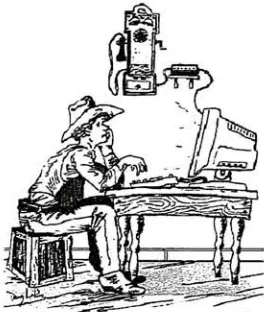
or [image:27.517.193.325.242.398.2]frontier.
Fig. 6.
Doug
LaRoe,
Cowboy
onComputer,
1997One
artisticpiece playsdirectly
onthe
notionof website as place:www.nonplace.com.
Websites
representthe
embodiment of paradoxicalnon-place.5The
actual
location
ofthe
siteis
ananonymousserver,
located
who-knows-where,
interconnected
through
many
degrees
of separationfrom
one's ownlaptop.
Yet,
plugging in the
coordinates re-creates ananalog
of placein
a privateviewing
spacealmost
immediately. The
creatorsofthis
siteplay
uponthese
ironies,
purposely offering
very
little
substance or contentthe
pages.In
his
Society
of
theSpectacle, Guy
Debord
speaksto
the
unifying
forces
that
reduce
human
experiencesto
forms
moreeasily
aligned withthe
world ofimage
andcommodity.6
Similarly,
Martha Rosier has
stated, the
"industrialization
ofexperiencehas
servedto
empty
the
actualexperienceofits
content,
and makeit
acarrierofanotherexperience
altogether."
20
fallen
subjectto this reduction,
functioning
more asicon
than
reaL andserving
to
communicate mythologies
imbedded
within our geographicalhistory. As
early
asthe
late 1800s
there
is
evidenceofthis tendency.
Robin E.
Kelsey
has
suggestedin
his
recent article onTimothy
O'Sullivan
that
asearly
asthe
King
andWheeler survey
expeditionsof
the
American
West,
it
wasrecognizedthat
photography's mostusefulfunction
wasits ability
to
convey
culturalimpressions
ofthe
land,
ratherdistilling
usefulscientificinformatioa8
There
is
a crucial paradoxunderlying
the
relationship between
place-representation
technologies
andhuman
experience.While
wemay be dazzled
by
expandedviews,
we aresimultaneously
confronted withasense ofinsignificance
anddetachment.
While recognizing (or
evenlamenting)
the
roll oftechnology
in
ourlives,
weare also complicit
in its dominance.
In
the
words ofDavid
Nye,
wehave become
"both
the
all-seeing
observer on ahigh
tower
andthe
ant-like pedestrianinching
onthe
pavementbelow."9
This
viewconjures notions ofMichel Foucault's panopticon,
whereby
technologies
fulfill the
aims of surveillance andcontrol.10
Afforded
this
top-down
perspective,
wefunction
simultaneously
as observer andobserved,
dominant
andsubordinate,
detached
and connected.The
fulcrums
of most paradoxes pointinward;
their
resolutionmanifests withinin
ourbeing.
I've
been fascinated
by
aerialphotography,
remotesensing,
andthe
Global
Positioning
System
(GPS)
asthey
epitomize whatDonna J.
Haraway,
notedwriteronthe
history
ofscience,
has
termed
the
"god-trick,"or view of everywherefrom
nowhere.11
Initially
born
ofintellectual
inquiry
these
technologies
found developmental
traction
in
the
military
sector.High-resolution
satelliteimagery
servedto
enforcecompliance with arms control
treaties.
GPS,
also atechnology
born
ofthe
Cold
War,
was conceived
to
facilitate
the
navigationofintercontinental
ballistic
missiles.It
has
since
found
widespread usein
professionalsectors,
such asforestry,
geology,
archeology,
and maritime navigation.For my
third
quarterwalkthrough,
I
exploredthe
dual
functionality
ofGPS,
mapping,
andInternet
technologies
to
exploreideas
of place andpersonal meaning.21
poking
fun
their objective,
positivisttones,
I
pursuedmy
ownphotographicsurvey
ofthe
Rochester,
NY
area,
enabledby
GPS.
My
goal wasto
explorethe
territory
between
mediated and
detached
representationsofplace,
andthe
inevitable
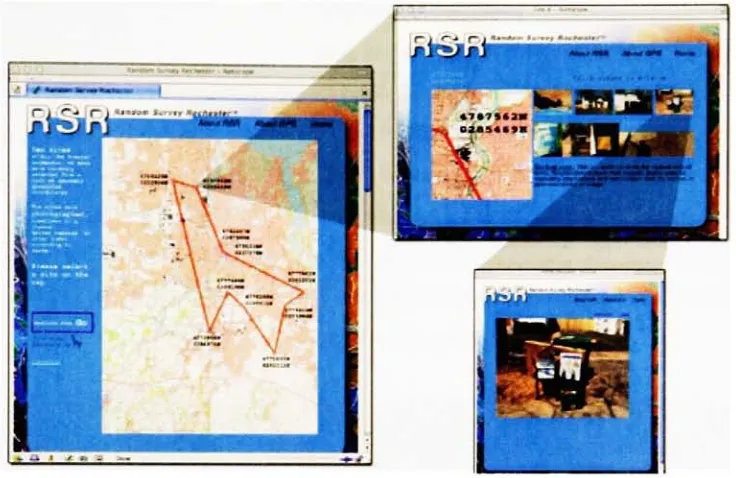
subjective [image:29.517.76.444.138.377.2]associations
that
occur when oneencountersthe
unknown(fig. 7).
Fig. 7. Chris
Jordan,
www.projectrsr.com,2003.Random
Survey
Rochester
(RSR)
features
ten
sites chosenthrough
chanceoperations,
taking
a cuefrom John Cage. To
target
orlocate
these places,
I
used amap
in
conjunction with ahand-held GPS
receiver.I
madeimages
ofthe
locations
andpresented
this
workon awebsite,
deep
withincyberspace.In
light
ofGPS's
originalCold War
applications, the
arbitrary fashion
by
whichthe
sites were chosenmay
resonate ominously.
And
whilethe
chanceoperationmay
suggest a relinquishment ofresponsibility,
it
also affordsconfrontationwith placesI
would nothave
otherwiseexperienced.
In
addition, this
approach removed subjectivebiases
I
mighthave
toward
one
location
over another.If
indeed
I
actedasindiscriminately
as anincoming
missile, I
nonethelessremained an
inquisitive,
reflective,
andexperientialhuman
being
uponmy
detonation.
One particularly
fascinating
artist whohas
addressedthe
darker
sidetechnology,
22
Japan
is
the
only
nationto
have
sufferedthe
wartime use of nuclearweapons,
andis
alsohighly
proneto
disastrous
earthquakes.This
heavy
dose
of sublime of anatural,
technological,
and perhapsarbitrary
orderhas impressed
significantly in Japanese
culture.
(One
needlook
only
asfar
asthe
Godzilla
moviesfor
evidence ofthis.)
In
suchimages
asAlamogordo
Blues,
which referto
locations
of nucleartestsitesin
the
American
Southwest,
Nagatani
utilizespop
artidioms,
juxtaposing
referencesto
consumer
culture,
such astourists
lounging
in
Adirondack
chairsequipped withtheirPolaroid
Cameras,
comfortably
poisedto
catchthesunny
rays ofnuclearfission
onthe
horizon (fig. 8). I
think
it is
particularly
effective thatthe
mediumis
not renderedcompletely
transparent;
onthe contrary,
Nagatani
seemsto
emphasizesthefishing
line
usedtosuspend
the
physicalprops,
emphasizing
thepastiche,
whichis
of coursein
the
grander
scheme,
a referencecommodity
cultureitself.12
Likewise,
withmy Phases of
theSon,
1
decided
to
retainthe
apparent qualities of multi-layeredcollage,
in
spite ofthe [image:30.517.46.473.336.590.2]digital
capabilities atmy disposal
to
renderthesemoretransparent.Fig. 8. Patrick
Nagatani,
AlamogordoBlues,
1986The
apocryphaltruths
of positivismhave
alsoinfluenced how
placeshave been
23
unquestioned
authority
withrespectto
accuracy.In
his book
How
toLie
withMaps,
Mark
Monmonier
discusses how
mapmaking is
inevitably
acompromisedpursuit.From
issues
ofprojection, scale,
andsigns,
there
exists a"cartographic
paradox":in
orderto
present
information
in
a usefulfashion,
he
claims an accuratemap
must"tell
whitelies."
Depending
onthe
purposeofthe map,
andthe
cultural/historicalcontext,
mapsmay
contain mistakesordeliberate
falsifications.
As
withthe
writtenword,
he
emphasizes
that
the
user mustbeware.
Yet
the
publiclargely
takes the
authority
of mapsfor
granted;
the typical
useris
"cartographically
illiterate."14There
are a number of artists whohave
exploitedthe
inherent
ambiguity
of maps.Wim
Delvoye
createda series ofimaginary
mapsdepicting
non-existent places.The
work
blended
recognizablelandmasses
withnonsensenames,
such asOost-Ku,
andTonx. The intent
wasto tackle the
culturalimplications
of place names andterritories.15
The
painterJasper Johns
betrays
thelegibility
ofthe
map
through
his
painterly
andexpressive explorationsof
its
mostgeneralforms.16One
ofmy
morefavorite
photographersAbelardo Morrell similarly
reworksthe
map in
various conceptualand expressive permutations.One
examplefeatures
aphotographof
map
ofthe
United States
crumpledin
such away
that
abasin is formed in
the
Midwestern
region andfilled
with waterforming
alake.
Another
features
water andVaseline
slathered over woodforming
the
shape ofAfrica,
againtransformed
by
17
photographic means
into
gleaming
gelatin-silvertones.
In
the
1970s Roger Welch
exploredthe
notion ofthe
memory
map,
whenexploring
family
histories.
These very
unscientific"folk
maps"
featured
captions writtenin
magicmarker on woodrepresenting
vague recollections of places andevents.18
Many
parts of
the
map
wereleft
blank,
denoting
gapsin
memory.19
More
rece