‘All for One, One for All’:
communicative processes of
co-creation of place brands through
inclusive and horizontal
stakeholder collaborative
networks
Abstract
This paper examines stakeholder communication and interaction
dynamics in place branding processes in order to inform
alternative participatory place branding models. The paper draws
from critical communications and branding theory to argue that
place brand identities are the result of mediated messages in the
public sphere. Consequently, place branding processes need to be
observed as communicative exchanges. Through a case study of
Australia’s southern and only island state of Tasmania, the
research employs participatory action research combined with the
method of sociological intervention to explore stakeholders’
communicative interaction patterns and engagement in place
branding processes. Participants representing formal and
informal stakeholders engaged in communicating meaning about
places were invited to participate in a series of interviews and
focus group discussions that allowed a unique self-reflective
process and analysis of practices and power-geometries. The
proposed quasi-real scenario led to an understanding of the
impediments for communication and to scoping alternative modes
of engagement towards effective stakeholder communication to
support the development of resilient place brand identities. The
findings of the exploration contribute to theoretical development
of the field by providing an analysis of the nature of stakeholder
interactions and communication patterns, impediments and
opportunities for greater communication and collaboration towards a common
purpose. On a practical level, the study can also inform the development of
participatory models of place brand development. Finally, the method proposed here
can serve as a practical tool to foster stakeholder engagement in processes of
co-creation of place brand identities.
Keywords
Place branding, communication, co-creation, networks, participatory action
research.
Special issue
Place Branding
Laura Ripoll González
https://orcid.org/0000-0003-1849-446X
[email protected] School of Social Sciences. University of Tasmania
Libby Lester
https://orcid.org/0000-0003-1046-2412
[email protected] School of Social Sciences. University of Tasmania
© 2018
Communication & Society ISSN 0214-0039
E ISSN 2386-7876
doi: 10.15581/003.31.4.59-78 www.communication-society.com
2018 – Vol. 31(4) pp. 59-78
How to cite this article: Ripoll González, L. & Lester, L. (2018). ‘All for One, One for All’: communicative processes of co-creation of place brands through inclusive and horizontal stakeholder collaborative
1. Introduction
Typically, place branding has followed a hierarchical and unidirectional top-down model of
strategic communication aimed at increasing the competitive advantage of places through the
development of positive place images that get communicated to foreign publics (Braun,
Kavaratzis & Zenker, 2013). With the advent of new Information and Communication
Technologies (ICT), this model is now challenged by emerging patterns of communication
through social networks. Contrary to formal strategic branding models, “network society”
communication about places is more fluid, horizontal and multidirectional (Castells, 2011),
often leading to contestation and counter-narratives, as well as a multiplicity of brand
messages resulting in diffuse place images (Warnaby & Medway, 2013).
Place branding has been described as “inherently political because it always includes a
struggle between a brand and its homogenous, silencing effects, and the overflowing,
polyphonic reality of people’s interpretations of a place” (Clegg & Kornburger, 2010, p. 8).
Therefore, place brands are now conceptualized as multidimensional (Hankinson, 2004), with
research on place branding focusing on interweaving strategic place brand communication
and processes of place identity formation (Kavaratzis & Hatch, 2013, p. 71).
Places are conceived as “boundary objects,” place brands are socially and politically
constructed through exchanges of communication about place, and place branding
“introduces the potential by inserting the brand’s own dimensions into the representational
space between where a place is and where it might be” (Lury, 2011, p. 52). Place brands are also
conceived as both “mediatic spaces” (Arvidsson, 2005, p. 238), “new media objects” supporting
multichannel communication flow and “platforms for action” (Lury, 2004, p. 1), affecting
consumption and identity formation in postmodern societies (Appadurai, 1996). Hence, the
multi-layered, dynamic, social and political context in which place reputations are mediated
(Van Ham, 2008) has challenged formal strategic brand communication with the aim to effect
positive place identities (Kavaratzis & Hatch, 2013). In the public domain, place messages are
fluid and constantly re-interpreted (Castells, 2007). In light of this reality, short-term rigid
approaches to communicating meaning about place through the development of a static set
of attributes need to give way to constant, flexible and resilient models of mediation of
meaning about places (Kavaratzis, 2017).
As a consequence, place branding scholars have turned their attention to the co-creative
process of creation of meaning about places marked by non-linear communication exchanges
by a range of traditional and non-traditional stakeholders, including civil society (Kavaratzis
2012). In this context, place branding serves as a tool for social and political communication
and organization, a process in which the “agents, relationships and interactions” between
different spheres of relationships need to be observed (Hanna & Rowley, 2011, p. 473;
Hankinson, 2004). The reconceptualization of branding for complex entities such as places
has required the contribution to the debate of other disciplines, such as communications and
cultural studies, as well as governance (Kavaratzis & Hatch, 2013; Lucarelli & Berg, 2011). To
further this endeavour, this paper explores the link between the structures and patterns of
strategic communication of meaning about places and the process of place identity formation
that occurs in the network society to inform the development of participatory, inclusive and
co-creative models of place branding that better reflect the processes of mediation of
meaning about places in the public domain. Reviewing the patterns of communication is
important for the development of more inclusive participatory place branding models insofar
as they form the basis of the dialogue underlying the place brand formation process. By
revealing the structural constraints to communication in place branding processes, as well as
scoping potential solutions, alternative arrangements can be formulated.
The paper is structured as follows. We first present a review of the literature on place
process of negotiation of such meanings and the need for more participatory arrangements
to enable co-creative and collaborative place branding processes. This is followed by a
description of the methodology employed. We then present and discuss our results,
concluding with the implications of the research for both theory and practice.
2. From strategic communication to place branding
multilogue
In this section we offer a review of concept, highlighting the implications of observing place
brands as identities, highlighting the communicative process of co-creation aimed at “the
crafting of the brand identity, as well as its transmission” (Sevin, 2011, p. 159).
2.1.
Place brand identity
The conceptualization of place brands has been hindered by the lack of clarity between key
concepts such as place identity, place image, place perception and place reputation (Govers
& Go, 2016). In the field of corporate communications, TC Melewar argues that image is “the
net result of the interaction of all experiences, beliefs, feelings, knowledge, and impressions
that each stakeholder has about an organisation” whereas “corporate identity resides in the
organisation” (2003, p. 214). According to this conceptualization, place images respond to the
commodification of certain characteristics of places and to the potential impression in the
minds of others and are separated from brand identity (Van Ham, 2008). Place brands,
however, show added complexity since places are centers of both production and
consumption (Short, Benton, Luce & Walton, 1993) that are “diffuse, complex and vaguely
defined” (Roberts, 2012, p. 206). Place brands are the result of a “continual process of iteration”
(Aitken & Campelo, 2011, p. 915), shared realities created from social interactions that form
brand ecosystems (Bergvall, 2006). The “brand perceptions" born through such exchanges
form the sets of symbolic meanings that shape place brands, defined as “network of
associations in the consumers’ mind based on the visual, verbal and behavioural expression
of a place, which is embodied through the aims, communication, values and the general
culture of the place’s stakeholders and the overall place design” (Braun & Zenker, 2010, p. 5).
Insofar as they are social conceptions with attached political, cultural, social and economic
value, we understand place brands as holistic representations of place that are negotiated
through communication exchanges.
Simon Anholt defined place brand image as “the perception of the brand that exists in
the mind of the consumers or audience” (2007, p. 5), thus emphasizing place branding as an
exercise of communication with foreign publics to change or positively affect place
reputations, parallel to public diplomacy endeavors. The realization that consumers’
experiences also have an effect on place brand meanings (Warnaby, 2009) has led to the
conceptualization of place brands as network of associations emerging from the interactions
and negotiation of meaning about place by both external and internal audiences (Go & Govers,
2010; Zenker & Beckmann, 2013). Brand identity would be based on the place’s vision and
culture, a sum of symbols made of tangible and intangible place assets (Aaker, 1997), whereas
brand image would refer only to the interpretation of such brand identity (Kapferer, 2012).
The competitive advantage of place brands, we argue, resides rather in a common identity
based on a shared purpose for the place’s advancement determined through engagement with
a range of stakeholders. In the sections to follow we examine the co-creative process of
formation of place identities through communication exchanges.
2.2.
Negotiating meaning about place
Recent conceptualizations of place branding that take into consideration the need for greater
stakeholder engagement have observed the complexities associated with the development of
more participatory processes. Public diplomacy practitioners, for instance, have embraced
engage with non-traditional stakeholders in nation-building, insofar as place branding can
act as a tool to “communicate and cultivate on behalf of a nation-state a desired image and
reputation, and to build common ground and understanding among nations and people”
(Wang, 2005, p. 32). Since then, however, the changes in ICT have affected deeply the conduct
of what has been labelled as New Public Diplomacy (Nye, 2008), and a new form of “dialogical
communication” has emerged as a result (Wang, 2005, p. 34). The role of public diplomacy has
shifted to building common understanding through communicative interactions, otherwise
known as people-to-people diplomacy (Snow, 2014). Place branding, however, encompasses
communication to both foreign and domestic audiences (Anholt, 2007; Cull, 2009) and
therefore the terms of stakeholder engagement need to be redefined, since place brand
associations are mediated by institutions and affected by power relations (Kavaratzis &
Kalandides, 2015). We understand these power relations as the “dialectics of control” of the
branding message (Carpentier, 2011, p. 141). In a Foucauldian sense, the “discursive power”
inherent in the strategies of place brand managers defines how the process is defined and
managed, typically following a rationale of enhancing competitive advantage (Carpentier,
2011, p. 141). This approach to power is inevitably linked to Bourdieu’s (1991) claim that
legitimacy and agency are the key elements for maintaining or subverting such power.
Safeguarding political interests through gatekeeping or other control mechanisms (Mayes,
2008) has been disrupted by ICT developments and the emergence of non-linear and
multimodal communication channels.
With the advent of online communications and media, formal place brands are
challenged by alternative and often contested understandings of the territorial entities they
are set to represent in the digital arena (Graham, Zook & Boulton, 2013). While governments,
typically through public agencies and with the assistance of consultants, develop place brands
based on positive place attributes to increase visitation, attract investment or talent, and boost
exports (Morgan & Pritchard, 2002), organic and constant informal communication about
places is projected, often in dialogue or conflict with the former (Baker, 2007; Houghton &
Stevens, 2011; Kavaratzis & Ashworth, 2015). Furthermore, the development of formal
branding communication emphasizing certain aspects of place risks commodifying other
features of place (Jansen, 2008) and increases the subjectivity to failure in the event of a crisis
(Avraham, 2009; Mayes, 2008; Kaneva, 2011).
In light of the many difficulties governments and public agencies envisage to maintain
control of messages about place in such relational models, they often resort to marketing and
branding experts to develop and manage place identities. Such identities are based on a series
of positive assets that then get communicated to enhance a positive reputation. Place brands,
however, combine representational and functional elements of places (Caldwell & Freire,
2004) in the form of images in the minds of consumers and are constantly reinterpreted
through exchanges of meaning in relational processes (Hankinson, 2015). Furthermore, the
communicated elements can have both intentional and non-intentional communicative
effects (Giovanardi, 2012, p. 39-40).
Place brands are the sum of meaning produced by internal and external audiences.
Furthermore, place brand identities result from the interplay between private, public and civil
society’s interests (Therkelsen, Haider & Jensen, 2010). The negotiation of place brand
meaning now happens in the social network and is heavily influenced by user-generated
content often counteracting official content by public agencies. Communicating place brands
as complex multidimensional entities requires a two-way process in which stakeholder
engagement is key, since positive reputations are built on “common understanding” and
relationships (Wang, 2005, p .41). In the place branding process, different voices affecting the
development of place brands (Baker, 2007) engage in a multilogue (Aitken & Campelo, 2011) of
different perspectives and ideas that are debated in the public domain (Houghton & Stevens,
The realization of the multi-stakeholder nature of place brand communication led to the
development of various relational models (Hankinson, 2004), based on the combination of
representational and functional attributes of place brands (Giovanardi, 2012). In this sense,
places could be rather observed as sets of narratives (Chronis, Arnould & Hampton, 2012;
Lichrou, O’Malley & Patterson, 2010), part of a consumer culture in which consumers produce
meaning whilst identifying lifestyle goals through brands (Arnould & Thompson, 2005, p. 871),
that is amplified and echoed by the accounts of place in the media (Ketter & Avraham, 2012).
In light of such developments, we understand place as a multi-layered and multipurpose
keyword (Harvey & Braun, 1996), a concept comprising a unique blend of identities (Massey,
2007). Insofar as such complexity is the result of the interactions and communication between
actors, we argue that there is a need to develop structures that allow greater participation in
the development of place brand identities. In this sense critical studies in communication and
culture can be useful when observing the organic formation process of place brands.
2.3.
Place branding multilogue: co-creating place brands
As noted above, place brands are co-created and mediated through exchanges of meaning.
Moreover, the communication of place brands is affected by the social context, structures and
relations in which the exchanges of meaning occur, since places are complex entities and their
identities are both imagined and affected constantly by negotiated exchanges of meaning by
stakeholders in social settings (Aitken & Campelo, 2011). Place brand communication is also
subject to representations by consumers (in the public sphere), and media producers
(Kavaratzis, 2004; Lester, 2010). In this process, consumers of formally projected place brands
also become producers of symbolic meaning which in turn affects the place brand (Lury, 2011;
Van Dijck, 2009). This has challenged the linear communication of symbolic meaning about
place in traditional place branding models and has led to the conceptualization of place
brands as networks of associations (Hildreth, 2011) and to an emphasis on the management of
perceptions or reputations (Zenker & Martin, 2011).
Place brands transcend their role as a promotional tool (Gnoth, 2007) since they
contribute to the collective creation of sense of place (Kalandides, 2011) in a postmodern
setting characterised by “a space of flows” where the social and the territorial are
reconfigured in the social network (Castells, 2011). Inevitably, public place branding messages
are nowadays confronted by information disseminated in the public sphere (Lester, 2010, 2014;
McGaurr, Tranter & Lester, 2015), with citizens taking a more active role in creating and
distributing messages in “circular and interactive models” (Ketter & Avraham, 2012, p. 286) in
which brand meaning is constantly interacting “in complementary or conflicting manners”
(Kavaratzis & Kalandides, 2015, p. 1371; Zenker & Beckmann, 2013). Observing the “crafting of
the brand identity, as well as its transmission” (Sevin, 2011, p. 159) in social networks supports
an understanding of place as process that is “absolutely not static” (Massey, 1994, p. 147). The
transformative nature of consumption of meaning about place is linked to a “consumer
culture […] a culture of exchange, mobility and circulation, of transnational movement and
transformation of ideas, people and things” (Lury, 2011, p.192). We can therefore conceptualise
place brands as integrative elements created by both cultures and people (Aitken & Campelo,
2011); visible forces that perform expressive or transformative roles in their mediation of
meanings (Lury, 2011, p. 138).
As “multi-leveled” ontologies (Lury, 2009, p. 67), place brands can also be understood as
processes of assembling culture, continuously affected by cross-cultural and historical
perspectives creating alternative brand perceptions (Kapferer, 2012). Hence, some scholars
argue that the process of place branding must be an “internally-focused, collective exercise”
(Kaneva & Popescu, 2011; Kavaratzis & Ashworth, 2015, p. 169-170). A cultural approach to
place brand processes, moreover, claims that top-down strategic communication processes
the city” to emphasize a set of attractive attributes about place (Jensen, 2007, p. 212-213; Jeong
& Santos, 2004) –risk resulting in the “commodification” of cultural aspects of place (Evans,
2003; Kavaratzis & Ashworth, 2015; Ooi, 2004; Varga, 2013).
If places are characterized by the symbolic interaction between discourses that
characterize the place (Lury, 2009), observing stakeholder relationships and communication
dynamics underlying place brands is therefore key. We observe place branding not only as a
form of formal strategic communication, but as a process of “dialogue and collaboration”
between actors with an interest in the place (Bianchini & Ghilardi, 2007, p. 283).
2.4.
Place brands, decision-making and power
The advent of digital communications and the increasing role and effects of user-generated
content on place reputation (Munro, 2011) present many challenges to democracy,
transparency and accountability of the place brand process (De San Eugenio Vela, 2013; Varga,
2013). The realization that information flows add to social capital and can build community
from constant dialogue (Lee, Árnason, Nightingale & Schucksmith, 2005; Pasquinelli, 2015) is
at the base of a new focus on the marketing concept of co-creation. This concept is linked to
the service-dominant logic of marketing highlighting also intangible brand elements, such as
links and exchanges (Warnaby, 2009) that are determined by stakeholders (Houghton &
Stevens, 2011). New place branding models need to better reflect the co-creative nature of
place brand meaning (Kavaratzis & Hatch, 2013).
The distillation of a brand essence through branding and communication techniques
aimed at promoting a certain set of values (De Chernatony, 2008) is affected by a domination
of decision-making by government and businesses, often neglecting residents and other
stakeholders (Aitken & Campelo, 2011). In this research, we understand stakeholders as “any
group or individual who can affect or is affected by the achievement of the organization’s
objectives” (Freeman, 1984, p. 46), that act as nodes or members of the social system in which
place branding occurs. We aim to observe the ties or interrelationships that provide the
interconnections where meaning about places is mediated (Castells, 2008), including the
absence of such relationships, conflict and particular interests (Houghton & Stevens, 2011;
Olsson & Berglund, 2009).
The above sections argue that place brands are complex social and political constructs
(Aronczyk, 2008) whose true essence lies in the relational exchanges between place brand
managers, place brand consumers and place residents. This translates to increased
importance of stakeholder engagement for the success of place brand management despite
the inherent challenges around mediation of conflicted interests. Despite recognition for the
need to engage with other stakeholders in place branding processes, governments and their
public agencies have proven to be reluctant to give up brand and message control (Zavattaro,
2014).
In the social or public sphere, places are understood as bounded political communities,
whose “normative legitimacy and political efficacy of communicative power” are questioned
in a globalized arena (Fraser, 2007, p. 8; Lucarelli & Giovanardi, 2016). In practice, different
meanings respond to varying interests in place (Ooi, 2004). In this sense, we observe
power-geometries place-identity formation processes, in which place values are created and shared
in relational “networks of networks” (Taylor & Kent, 2014, p. 103).
Scholarly research has highlighted that stakeholder engagement, despite contestation,
ultimately supports the creation of public value contributing to increased efficiency and
coherence in the brand message (Hankinson, 2015), and that reducing place identities to serve
particular interests fails to achieve “authenticity, recognition, acceptance and commitment
by the local community” (Aitken & Campelo, 2011, p. 918). Since “sense of place” in the public
stakeholder dialogue and the empowerment of non-traditional stakeholders through the
development of mutual trust (Ind & Bjerke, 2007; Therkelsen, Halkier & Jensen, 2010).
Place branding processes, we have found, require collective reflection on the reasons,
aims and objectives underlying the development of place brand identities. Place brands must
be understood as complex assemblages of meanings produced, communicated and
reinterpreted by different stakeholders. In reviewing the dynamic and relational nature of
place brands linked to co-creative processes of construction of meaning about place, we have
observed the construction of collective place identity and its “organizations of power,
knowledge and exchange” (Aronczyk, 2008, p. 46). We have highlighted the horizontality and
dynamism of exchanges of meaning about places and the need for alternative arrangements
to support stakeholder communication and engagement that better reflect participation in
communicative processes. We argue that, in light of the challenges that new forms of
horizontal and non-linear communications exchanges have brought to the task of branding
places, it is key to observe communication dynamics between stakeholders to inform the
development of models that better reflect the negotiation of meaning about place for branding
processes and more interactive platforms for engagement. Thus, we set out to investigate
stakeholder interactions and patterns of communication in an applied setting as described in
our research design.
3. Methodology
We situate this research within the broader topics of stakeholder engagement and
participatory place branding. Following a call for more integrated methodologies in place
branding (Chan & Marafa, 2013), we employed a case study methodology (Lucarelli &
Brorström, 2013; Yin, 2003) that combined Participatory Action Research (PAR) and the
method of Sociological Intervention (SI) to deploy a practical rationale to assist social change
in place branding. The methodology is explained in more detail in the paragraphs to follow.
Action research is useful to investigate alternative models and their effects through
participants’ analysis and reflections in practice (Hesse-Biber & Leacy, 2011, p. 50).
Participants’ insights and responses to alternative arrangements provide useful insights to
the development of such alternative arrangements. In addition to building or testing theory,
PAR often focuses on enacting social change by providing collaborative solutions to ‘wicked
problems” and is useful to observe “turbulent environments” by providing access to the reality
underlying them (Perry & Gummesson, 2004, p. 318). Furthermore, the method of SI was
developed to observe the identity formation dynamics of social movements (Touraine, 1981,
2000) and is applied to the Tasmanian case in combination with PAR to provide an innovative
“group-based research” avenue for the exploration of stakeholder interactions and the
process of developing and communicating place brand identities. The method of SI is situated
in the critical tradition of action research and is focused on observing social movements as
‘conflict between actors over the social management of cultural issues which is never
completely reducible to the self-interest of one party or the other’ (Touraine, 2000, p. 113).
The SI method consists of four main stages: a “witness group” where participants share their
approaches to place branding and create collective identities; a “confrontation group” where
participants self-analyze their historical account of their experiences in place branding
processes; a “flexion” group focusing on the development of a common vision supported by
action; and a “conversion” stage representing a long-lasting relationship between action and
analysis (co-creation). The researcher, despite being inserted in the communities under study,
has a different role to that of the ethnographer, since it does not aim to provide participants’
observations in applied research (Herr & Anderson, 2005), but rather as facilitator of
collective debate (Dubet & Wieviorka, 1996, p. 59). The research design adapted the SI method
to the context of this study and used a before-and-after combination of interviews and focus
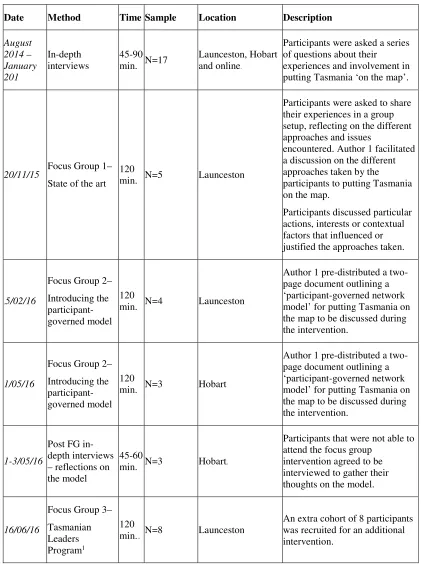
Table 1
: Fieldwork main stages (adapted from Ripoll Gonzalez 2018, p. 118).
Date Method Time Sample Location Description
August 2014 – January 201 In-depth interviews 45-90 min. N=17
Launceston, Hobart and online
Participants were asked a series of questions about their experiences and involvement in putting Tasmania ‘on the map’.
20/11/15 Focus Group 1–
State of the art 120
min. N=5 Launceston
Participants were asked to share their experiences in a group setup, reflecting on the different approaches and issues
encountered. Author 1 facilitated a discussion on the different approaches taken by the participants to putting Tasmania on the map.
Participants discussed particular actions, interests or contextual factors that influenced or justified the approaches taken.
5/02/16
Focus Group 2–
Introducing the participant- governed model
120
min. N=4 Launceston
Author 1 pre-distributed a two-page document outlining a ‘participant-governed network model’ for putting Tasmania on the map to be discussed during the intervention.
1/05/16
Focus Group 2–
Introducing the participant- governed model
120
min. N=3 Hobart
Author 1 pre-distributed a two-page document outlining a ‘participant-governed network model’ for putting Tasmania on the map to be discussed during the intervention.
1-3/05/16
Post FG in- depth interviews – reflections on the model
45-60
min. N=3 Hobart
Participants that were not able to attend the focus group
intervention agreed to be interviewed to gather their thoughts on the model.
16/06/16
Focus Group 3–
Tasmanian Leaders Program1
120
min. N=8 Launceston
An extra cohort of 8 participants was recruited for an additional intervention.
1
The combination between PAR and the SI method is relevant since it provides an
innovative approach to studying identity formation in place branding processes.
Furthermore, the qualitative design presented here is particularly suited to study complex
processes like place branding since it goes beyond content analysis to explore social
interactions by inviting participants to collectively self-reflect on their communicative
interactions (or lack of) (Babbie, 2013; Habermas, 1971). The aim was to observe interactions
and, to some extent, to empower participants to realize the potential of participatory
approaches and increased collaboration (Chevalier & Buckles, 2013). The methodology acted
as a ‘tool for the education and development of consciousness as well as mobilization of action’
(Gaventa, 1991, p. 121-122). The study follows a practical rationale to assist social change in
place branding by observing stakeholders’ power struggles (Dubet & Wieviorka, 1996;
Munday, 2006, p. 94) and responds to academic calls by informing theory and improving
practice through action (Herr & Anderson, 2005).
A participatory and intervention methodology is then applied through a case study of
Tasmania, the southern island state in the Commonwealth of Australia. The case is of interest
since it presents a complex example of interactions and conflict between formal and informal
place branding messages and provides good ground to study the potential for change.
Tasmania’s brand is, at best, the sum of strong formal country-of-origin government-led
branding, highlighting high-quality produce grown in a clean and green environment by the
state’s agribusinesses. Such branding attempts and strategies are challenged by private
brands and civil society, emphasizing environmental concerns over exploitation of World
Heritage Areas and alternative cultural and tourism development and experiences.
Consequently, Tasmania’s reputation is driven by the interactions and contestation between
public, private and civil society actors, which often results in uncoordinated and
counter-effective branding efforts.
The objective of applying an intervention methodology is to study stakeholder
interactions and the communication patterns that characterize the dynamic process of place
identity formation and responds to the following research questions:
R1: What are the interaction and communication dynamics between stakeholders in the
process of branding places?
R2: How and to what extent do stakeholders communicate with others in place branding
processes?
The basic design was flexible and iterative and was further developed and modified
during the inquiry (Chevalier & Buckles, 2013; Babbie, 2013). Using a purposive sample
approach, we recruited a total of 24 participants representing various stakeholder groups
engaged in formally and informally branding Tasmania (Barbour, 2007). Participants’
backgrounds were identified following a literature review and included: ‘government,
business industry, tourism industry, creative arts industry, education industry,
non-governmental and not-for-profit organisations, private industry and civil society (residents)’
(Dattalo, 2008; García, Gómez & Molina, 2012). The transcripts from the interviews and focus
groups were organized using a mix of inductive and deductive coding following specific
theoretical interests identified in the literature review and recurrent issues. The data was
interpreted through constant comparative analysis of the contextual and cultural factors
underlying place branding processes, as well as patterns of interaction (Miles & Huberman,
1994). The results were validated through pragmatic, consensus validation and reflection
(Karslen, 1991). Finally, the qualitative analysis explores social interactions by identifying key
discourse themes (Babbie, 2013).
4. Findings
Our main finding is the perceived lack of interaction between stakeholders in place branding
conferring marginal or purely consultative roles to indirect stakeholders, such as residents
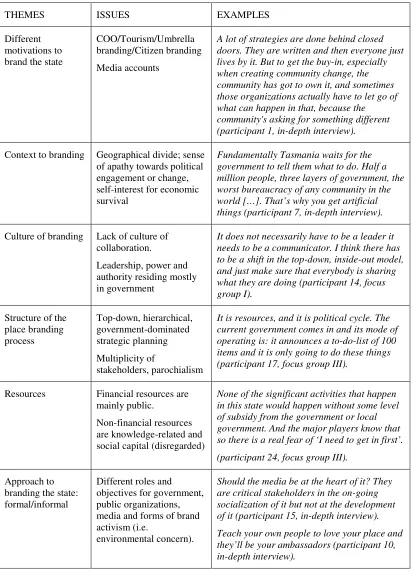
or civil society in the implementation of branding strategies (Klijn, Eshis & Braun, 2012). The
[image:10.595.91.506.186.767.2]main impediments to engagement expressed through the interviews are outlined in Table 2:
Table 2
: Outline of Findings of the In-Depth Interviews by Emerging Themes (authors’
own)
THEMES ISSUES EXAMPLES
Different motivations to brand the state
COO/Tourism/Umbrella branding/Citizen branding
Media accounts
A lot of strategies are done behind closed doors. They are written and then everyone just lives by it. But to get the buy-in, especially when creating community change, the community has got to own it, and sometimes those organizations actually have to let go of what can happen in that, because the community's asking for something different (participant 1, in-depth interview).
Context to branding Geographical divide; sense of apathy towards political engagement or change, self-interest for economic survival
Fundamentally Tasmania waits for the government to tell them what to do. Half a million people, three layers of government, the worst bureaucracy of any community in the world […]. That’s why you get artificial things (participant 7, in-depth interview).
Culture of branding Lack of culture of collaboration.
Leadership, power and authority residing mostly in government
It does not necessarily have to be a leader it needs to be a communicator. I think there has to be a shift in the top-down, inside-out model, and just make sure that everybody is sharing what they are doing (participant 14, focus group I).
Structure of the place branding process Top-down, hierarchical, government-dominated strategic planning Multiplicity of stakeholders, parochialism
It is resources, and it is political cycle. The current government comes in and its mode of operating is: it announces a to-do-list of 100 items and it is only going to do these things (participant 17, focus group III).
Resources Financial resources are
mainly public.
Non-financial resources are knowledge-related and social capital (disregarded)
None of the significant activities that happen in this state would happen without some level of subsidy from the government or local government. And the major players know that so there is a real fear of ‘I need to get in first’.
(participant 24, focus group III).
Approach to branding the state: formal/informal
Different roles and objectives for government, public organizations, media and forms of brand activism (i.e.
environmental concern).
Should the media be at the heart of it? They are critical stakeholders in the on-going socialization of it but not at the development of it (participant 15, in-depth interview).
Lack of stakeholder engagement
Consultative engagement, residents traditionally paying lip service.
I think sometimes it’s information sharing, sometimes it’s true engagement where you do actually collect people’s input because you want to understand whether you’re on the right track or not and give people notice. […] Sometimes decisions have to be made and people just need to be informed (participant 8, focus group IV).
Expected outcomes Specific branding campaigns perceived as successful.
However, stakeholders identified a need for an umbrella brand.
I think they [branding organization] were on the right track [...] they’ve continued
campaigning but what they haven’t spent a lot of time and energy on is talking into the industry about how they live the brand (participant 7, in-depth interview).
The Tasmanian context revealed that this is in part due to governments’ perceived
authority as managers of the resources of a given place (Clegg & Kornberger, 2010; Warnaby,
2009), and to the politics behind the branding exercise (Mayes, 2008; Ooi, 2004) as evidenced
in the quote below:
The only way to control them [place brand agencies] at all is to have them in government. The closer they are to government, the more they are forced to share. The further they drift out, the more they don't communicate. Especially not so much events but tourism. Its inability to explain the roles of Tourism Tasmania, individual organizations, or Regional Tourism Organizations. [...] You have these two groups Tourism Tasmania and industry, and the industry yelling back about this so-called gap in communication (participant 6, focus group III).
Despite the importance of a strong political vision to maintaining trust (Zenker & Martin,
2010), governments’ gatekeeping issues can undermine stakeholder engagement and the
distribution of power across the network (Govers & Go, 2016). Governments seemed to be
particularly concerned with the disrupting potential of media or citizens’ opposition to
particular projects that might affect the brand:
We use the media basically. If it is very important that we keep public awareness around the project and where it is at and how it is going (participant 10, in-depth interview).
That industry [forestry] and its impact on our state from an environmental perspective but equally from a perspective of what it would do to the cost of our road infrastructure and the burden it would place on locals and thirdly the impact on our tourism industry, experience and particularly the brand (participant 10, in-depth interview).
This could hinder the process of developing a common project for the place based on
long-term strong engagement, information and knowledge exchanges and collaboration
towards a mutual purpose (Klijn, Eshuis & Braun, 2012; Pasquinelli, 2015), as evidenced by the
quote below:
I think about changing the frame. Thinking and talking about Tasmania is a very long-term process. It’s not an immediate thing and it is not just one book, or one intervention, or one invention that does that. It is something that needs to be sustained (participant 20, in-depth interview).
Despite the recognition of the potential benefits of engaging stakeholders through
network models of communication and collaboration for place branding, government
representatives seemed reluctant to transition into such models due to their associated risks,
and saturation from end users, among others (Picazo-Vela, Gutiérrez-Martínez, &
Luna-Reyes, 2012):
Linked to a number of reports sitting on your filing cabinet that no one ever reads, and they have costed an exorbitant amount of money to produce, so let alone implementation [...] the key is that it is a co-participation model in terms of the development of the work, but most importantly we then take the work, own the work, it is ours, and then implement it in a way (participant 15, in- depth interview).
The discussions led in fact to a realization of the lack of communication from those in
charge of strategic communications and the ones that actually engage in realizing the promise
or experience associated to the brand:
One of the most evident things from the discussions was a complete lack of perspective with the other partner. We can back the council, and we can back the government, but unless you understand what they have to get done to get you what you want you are going to get frustrated just by not understanding what your partners want or can do (participant 7, focus group I).
This in fact led to a sense of apathy towards the process, and the requirement of
increased leadership and communication from non-traditional sectors (other than the
public):
[Other stakeholders] are very generous but the kind of generosity they have for each other is based on self-interest, so they are not in the communal space (participant 6, focus group III).
Conflict between stakeholder groups often responded to the different interests and
objectives of the brand exercise (Hankinson, 2015, p. 25). The research found that participants
were developing their branding strategies in silos and identified several impediments to the
operationalization of collaborative models, primarily due to power struggles, existing
perceptions and expectations and a rigid institutional framework marked by a government
leading role in the development of place brand strategies. However, there was a general
recognition of the need to do branding differently and collaboratively:
It’s not about believing. We need to do it. We need to be true to ourselves. We love this place and it is special. Having a longer-term vision around what that looks like for prosperity for our future generation is simply absolutely necessarily (participant 15, in-depth interview).
During the interventions, participants had an opportunity to reflect on their practices
and engagement dynamics further by engaging in self-inquiry about potential for change.
This resulted in an outline of impediments to engagement and collaboration, as well as an
Table 3:
Outline of the Findings from the Sociological Intervention by Emerging
Themes (authors’ own)
INTERVENTION DATA
THEMES ASSOCIATED
THEMES
EXAMPLES
ISSUES Multiplicity
stakeholder groups
Management Participant 6: Everyone gets a voice (focus group III).
Apathy Disconnect I think there are a lot of people out
there who have learned either that the system doesn’t work or that the system doesn’t welcome them. And as a result, they have no confidence to actually engage with that system (participant 9, focus group II).
Lack of legitimacy outside government
Find leadership to support legitimate engagement
If you had to go through and write down who the leaders are in this region half them offer their leadership on a voluntary sense. [...] They have no ownership, no awareness of ownership or vested interest in pursuing anything [...] You've got to gain belief and then ownership, otherwise the whole thing just collapses into another document in a bookcase and we've got plenty of them (participant 7, focus group II).
Lack of culture of collaboration
Non-conducive environment; self-interest
That’s the confidence issue [...] people’s history and their
relationships with people and trust (participant 2, focus group IV).
Rigid structure Lack of clear models to implement in practice, mostly top-down
I think because of the isolated nature of the way in which each of the sectors work in the north, there is not that forum that opportunity that platform, whatever, for people to start working collaboratively (participant 11, focus group II).
Gatekeeping issues Resistance to share resources and know how due to
competition
OPPORTUNITIES Alignment of brand message
Sharing
information as a practice
Just wondering about like the use of technology and maybe as a
technological platform that would allow this system to function (participant 4, focus groups IV).
Responsive to global trends (resilient)
Move towards collaboration
[T]hey are fighting over the shared space where they actually don't need to (participant 6, focus group III).
General
acknowledgment of the dynamism of place and the need for flexible structures
Capitalize on such dynamism
Because there is a core set of attributes about a place, and sure they are not forever, and you can have a major disruption with them (participant 17, focus group III).
Employing the opportunity of a threat to start dialogue
Defining a common purpose
There is a crisis, it’s just a really slow gradual one (participant 4, focus group IV).
Revolution Must be guided
by an evolution towards increased changes
There are two ways that stuff can happen: either organically from the bottom up, which I think won't happen here; or it needs a strategic driver for it and leadership at that level, and an example of how that could happen, but isn't happening. (participant 17, focus group III).
Despite an initial in-depth discussion on who the legitimate stakeholders in place
branding processes are, participants abandoned their inherent power positions and incurred
in discussions, knowledge sharing and most importantly collaboration:
In fact, I think one of our key roles is the collective impact approach [...] I believe the more diverse the collaboration, the better the outcome (participant 18, in-depth interview).
The opportunity for engagement, learning and self-reflection in network settings allow
increased trust and exchanges between government and other stakeholders (Zavattaro, 2014).
The Tasmanian case showed the need for education around collaboration for the
communication of place brand identities, especially in times of crisis or rapid changes, and
when face with contestation from the media discourse, such as the case of environmental
conflict in Tasmania (Kapucu, 2006; Lester, 2007).
5. Conclusion
This study offers a unique perspective into the patterns of interaction and
communication underlying place branding processes to inform theory development and the
operationalization of co-creative and participatory place branding models. The case
presented here provides an in-depth account of the communication dynamics as well as an
outline of issues and impediments to collaboration. Beyond this outline, the exploration
identified opportunities for further engagement and scoped the potential and suitability of
The exploration of the motivations, interests, contested agendas and power dynamics
provided recommendations for the development of more inclusive models of place branding.
The action research methodology employed in this study contributes to improve practice
and advance research through collective self-reflection and action (Herr & Anderson, 2005).
By providing a quasi-real scenario to share knowledge and debate approaches, we
empowered participants to collaboratively reflect (and self-reflect) on their practices and
scope actions to support greater collaboration. We explore place branding in action and
observe how the negotiation of meaning occurs through stakeholders’ self-reflecting inquiry
through the different stages of the intervention. Subject to replicating the case in alternative
contexts/scenarios (Karlsen, 1991; Babbie, 2013, p. 94), our findings support the need for
alternative arrangements to operationalize engagement and participation in more
sustainable, democratic and ethical place branding models.
Notwithstanding the regional context of the study, the research emerges from a broader
territorial concern and the applicability of its findings extend beyond specific administrative
and political forms of territories. Further research could replicate the methodological
approach in alternative territorial scenarios (Karlsen, 1991; Babbie, 2013, p. 94) thus providing
further insights into the contextual prerequisites to the development of alternative
governance arrangements to operationalize engagement and participation towards more
sustainable, democratic and ethical place branding models. This would also further
acknowledge SI as a key methodological tool to observe identity-formation processes for
places and as a practical tool to facilitate stakeholder collaboration.
References
Aaker, J. L. (1997). Dimensions of brand personality. Journal of marketing research, 34(3),
347-356.
Aitken, R. & Campelo, A. (2011), The four Rs of place branding. Journal of Marketing
Management, 27(9-10), 913-933.
Anholt, S. (2007). What is Competitive Identity? In S. Anholt, Competitive Identity: The New
Brand Management for Nations, Cities and Regions (pp. 1-23). London, UK: Palgrave
Macmillan.
Appadurai, A. (1996). Modernity al large: cultural dimensions of globalization. Minneapolis, US:
University of Minnesota Press.
Arnould, E. J. & Thompson, C. J. (2005). Consumer culture theory (CCT): Twenty years of
research. Journal of consumer research, 31(4), 868-882.
Aronczyk, M. (2008). ‘Living the brand’: Nationality, globality and identity strategies of
nation branding consultants. International Journal of Communication, 2, 41-65.
Arvidsson, A. (2005). Brands: A critical perspective. Journal of consumer culture, 5(2), 235-258.
Avraham, E. (2009). Marketing and managing nation branding during prolonged crisis: The
case of Israel. Place Branding and Public Diplomacy, 5(3), 202–212.
Babbie, E. (2013). The Practice of Social Research, 13th edition, Boston: Cengage Learning. Baker, B. (2007). Destination Branding for Small Cities. Portland, US: Creative Leap Books.
Barbour, R. S. (2007). Doing Focus Groups. London: SAGE.
Bergvall, S. (2006). Brand ecosystems. In J. Schroeder & M. Salzer-Morling (Eds.), Brand
Culture (pp. 186–197). London: Routledge.
Bianchini, F. & Ghilardi, L. (2007). Thinking culturally about place. Place Branding and Public
Diplomacy, 3(4), 280-286.
Bourdieu, P. (1991). Language and symbolic power. Harvard University Press.
Braun, E. & Zenker, S. (2010). Towards an integrated approach for place Brand management.
50th
Congress of the European Regional Science Association: Sustainable Regional Growth
Braun, E., Kavaratzis, M. & Zenker, S. (2013). My city–my brand: the different roles of
residents in place branding. Journal of Place Management and Development, 6(1), 18-28.
Caldwell, N. & Freire, J.R. (2004). The differences between branding a country, a region and
a city: Applying the Brand Box Model. Journal of Brand Management, 12(1), 50-61.
Carpentier, N. (2011). Keyword: Power. In N. Carpentier, Media and Participation: A site of
ideological-democratic struggle (pp. 137-161). Bristol, UK: Intellect.
Castells, M. (2007). Communication, power and counter-power in the network society.
International journal of communication, 1(1), 238-266.
Castells, M. (2008). The new public sphere: Global civil society, communication networks,
and global governance. The Annals of the American Academy of Political and Social
Science, 616, 78-93.
Castells, M. (2011). The rise of the network society (2nd
ed.). Chichester, UK: John Wiley & Sons.
Chan, C. S. & Marafa, L. M. (2013). A review of place branding methodologies in the new
millennium. Place Branding and Public Diplomacy, 9(4), 236-253.
Chevalier, J. M. & Buckles, D. (2013). Participatory action research: Theory and methods for
engaged inquiry. New York: Routledge.
Chronis, A., Arnould, E. & Hampton, R. D. (2012). Gettysburg Re-imagined: The Role of
Narrative Imagination in Consumption Experience, Consumption Markets and Culture
15(3), 261–86.
Clegg, S. R. & Kornberger, M. (2010). An Organizational Perspective on Space and Place
Branding. In F. M. Go & R. Govers (Eds.), International Place Branding Yearbook 2001:
Place Branding in the New Age of Innovation (pp. 3–11). Houndmills, UK: Palgrave
Macmillan.
Cull, N. (2009). Public Diplomacy: Lessons from the Past. Los Angeles, CA: Figueroa Press,
University of Southern California.
Gnoth, J. (2007). The structure of destination brands: leveraging values. Tourism Analysis,
12(5-6), 345–358.
Dattalo, P. (2008). Determining sample size: Balancing power, precision, and practicality.
Oxford: Oxford University Press.
De Chernatony, L. (2008). Adapting brand theory to the context of nation branding. In K.
Dinnie (Ed.), Nation Branding: Concepts, Issues, Practice (pp. 16-22). Oxford:
Butterworth-Heinemann.
De San Eugenio Vela, J. (2013). The relationship between place branding and environmental
communication: the symbolic management of places through the use of brands. Place
Branding and Public Diplomacy, 9(4), 254-263.
Dubet, F. & Wieviorka, M. (1996). Touraine and the method of sociological intervention. In J.
Clark & M. Diani (Eds.), Alain Touraine (pp. 55-76). Hoboken: Taylor and Francis.
Evans, G. (2003). Hard‐branding the cultural city–from Prado to Prada. International journal
of urban and regional research, 27(2), 417-440.
Fraser, N. (2007). Special section: Transnational public sphere: Transnationalizing the public
sphere: On the legitimacy and efficacy of public opinion in a post-Westphalian world.
Theory, culture & society, 24(4), 7-30.
Freeman, R. E. (1984). Strategic management: a stakeholder approach. Boston, MA: Pittman.
García, J. A., Gómez, M. & Molina, A. (2012). A destination-branding model: An empirical
analysis based on stakeholders. Tourism Management, 33(3), 646-661.
Gaventa, J. (2004). Towards participatory governance: assessing the transformative
possibilities. In S. Hickey & G. Mohan (Eds.). Participation: From Tyranny to
Transformation? (pp. 25-41).London: Zed Books.
Giovanardi, M. (2012). Haft and sord factors in place branding: between functionalism and
Go, F. & Govers, R. (2010). International Place Branding Yearbook 2011. [Electronic resource]:
Place Branding in the New Age of Innovation. New York: Palgrave Macmillan.
Govers, R. & Go, F. (2016). Place branding: Glocal, virtual and physical identities, constructed,
imagined and experienced. (2nd Ed.). Switzerland: Springer.
Graham, M., Zook, M. & Boulton, A. (2013). Augmented reality in urban places: contested
content and the duplicity of code. Transactions of the Institute of British Geographers,
38(3), 464-479.
Habermas, J. (1984). The Theory of communicative Action, Volume One: Reason and the
Rationalisation of Society. Boston: Beacon Press.
Hankinson, G. (2004). Relational network brands: Towards a conceptual model of place
brands. Journal of Vacation Marketing, 10(2), 109-121.
Hankinson, G. (2015). Rethinking the Place Branding Construct. In M. Kavaratzis, G. Warnaby
& G. J. Ashworth (Eds.), Rethinking Place Branding: Comprehensive Brand Development
for Cities and Regions (pp.13-31). Cham, Switzerland: Springer International Publishing.
Hanna, S. & Rowley, J. (2011). Towards a strategic place brand-management model. Journal
of marketing management,27(5-6), 458-476.
Harvey, D. & Braun, B. (1996). Justice, nature and the geography of difference. Oxford:
Blackwell.
Herr, K. & Anderson, G. L. (2005). The Action Research Dissertation: A Guide for Students and
Faculty. Thousand Oaks, CA: Sage.
Hesse-Biber, S. N. & Leavy, P. (2011). The Practice of Qualitative Research (2nd
ed.) Thousand
Oaks, CA: Sage.
Hildreth, J. (2011). The measurement challenge. In N. Morgan, A. Pritchard & R. Pride,
Destination Brands: Managing Brand Reputation (pp. 155-168). Oxford:
Butterworth-Heinemann.
Houghton, J. P. & Stevens, A. (2011). City branding and stakeholder engagement. In K. Dinnie
(Ed.), City Branding: Theory and Cases (pp. 45-53). Basingstoke:Palgrave Macmillan.
Ind, N. & Bjerke, R. (2007). Branding Governance: A Participatory Approach to the Brand
Building Process. London: Wiley & Sons.
Jansen, S. C. (2008). Designer nations: Neo-liberal nation branding – Brand Estonia. Social
Identities, (14)1, 121-142.
Jensen, O. B. (2007). Culture stories: Understanding cultural urban branding. Planning
Theory,6(3), 211-236.
Jeong, S. & Santos, C. A. (2004). Cultural politics and contested place identity. Annals of
Tourism Research,31(3), 640-656.
Kalandides, A. (2011). The problem with spatial identity: revisiting the ‘sense of place’.
Journal of Place Management and Development, 4(1), 28-39.
Kaneva, N. (2011). Nation branding: Toward an agenda for critical research. International
Journal of Communication,5, 117-141.
Kaneva, N. & Popescu, D. (2014). ‘We are Romanian, not Roma’: Nation branding and
postsocialist discourses of alterity. Communication, Culture and Critique,4, 506-523.
Kapferer, J. N. (2012). The new strategic brand management: Advanced insights and strategic
thinking. London, UK: Kogan Page.
Kapucu, N. (2006). Interagency Communication Networks during Emergencies: Boundary
Spanners in Multiagency Coordination. American Review of Public Administration, 36(2),
297-225.
Karlsen, J. I. (1991). Action research as a method: reflections from a program for developing
methods and competence. InW. F. Whyte (Ed.), Participatory Action Research, Sage focus
editions (pp. 143-158). Newbury Park, California: Sage Publications.
Kavaratzis, M. (2004). From city marketing to city branding: towards a theoretical
Kavaratzis, M. (2012). From “necessary evil” to necessity: stakeholders' involvement in place
branding. Journal of Place Management and development,5(1), 7-19.
Kavaratzis, M. (2017). The participatory place branding process for tourism: linking visitors
and residents through the city brand. In N. Bellini & C. Pasquinelli (Eds.), Tourism in the
City (pp. 93-107). Cham, Switzerland: Springer.
Kavaratzis, M. & Ashworth, G. (2015). Hijacking culture: the disconnection between place
culture and place brands. Town Planning Review,86(2), 155-176.
Kavaratzis, M. & Hatch, M. J. (2013). The dynamics of place brands: An identity-based
approach to place branding theory. Marketing theory,13(1), 69-86.
Kavaratzis, M. & Kalandides, A. (2015). Rethinking the place brand: the interactive formation
of place brands and the role of participatory place branding. Environment and Planning
A, (47), 1368-1382.
Ketter, E. & Avraham, E. (2012). The social revolution of place marketing: The growing power
of users in social media campaigns. Place Branding and Public Diplomacy, 8(4), 282-294.
Klijn, E. H., Eshuis, J. & Braun, E. (2012). The influence of stakeholder involvement on the
effectiveness of place branding. Public Management Review,14(4), 499-519.
Lee, J., Árnason, A., Nightingale, A. & Schucksmith, M. (2005). Networking social capital and
identities in European rural development. Sociologia Ruralis,45(4), 269-283.
Lester, E. A. (2007). Giving ground: Media and environmental conflict in Tasmania. Hobart:
Quintus Publishing.
Lester, L. (2010). Media and environment: Conflict, politics and the news. Cambridge: Polity
Press.
Lester, L. (2014). Transnational publics and environmental conflict in the Asian century.
Media International Australia,150(1), 167-178.
Lichrou, M., O'Malley, L. & Patterson, M. (2010). Narratives of a tourism destination: Local
particularities and their implications for place marketing and branding. Place Branding
and Public Diplomacy,6(2), 134-144.
Lucarelli, A. & Olof Berg, P. (2011). City branding: a state-of-the-art review of the research
domain. Journal of place management and development,4(1), 9-27.
Lucarelli, A. & Brorström, S. (2013). Problematising place branding research: A
meta-theoretical analysis of the literature. The Marketing Review,13(1), 65-81.
Lucarelli, A. & Giovanardi, M. (2016). The political nature of brand governance: a discourse
analysis approach to a regional brand building process. Journal of Public Affairs,16(1),
16-27.
Lury, C. (2004). Brands: The logos of the global economy. London: Routledge.
Lury, C. (2009). Brand as assemblage: Assembling culture. Journal of Cultural Economy,2
(1-2), 67-82.
Lury, C. (2011). Brands: Boundary method objects and media space. In A. Pike (Ed.), Brands
and branding geographies (pp. 44-59). Cheltenham, UK: Edward Elgar.
Massey, D. (1994). A global sense of place. In D. Massey (Ed.), Space, Place and Gender (pp.
146-56).Cambridge: Polity Press.
Massey, D. (2007). Space, Place and Gender. Cambridge: Polity Press.
Mayes, R. (2008). A place in the sun: The politics of place, identity and branding. Place
Branding and Public Diplomacy,4(2), 124-135.
McGaurr, L., Tranter, B. & Lester, L. (2015). Wilderness and the media politics of place
branding. Environmental Communication,9(3), 269-287.
Melewar, T. C. (2003). Determinants of the corporate identity construct: a review of the
literature. Journal of Marketing Communications,9(4), 195-220.
Miles, M. B. & Huberman, A. M. (1994). Qualitative data analysis: An expanded sourcebook (2nd
Morgan, N. & Pritchard, A. (2002). Introduction. In N. Morgan, A. Pritchard & R. Pride (Eds.),
Destination Branding: creating the unique destination proposition (pp. 3-14). Oxford:
Butterworth-Heinemann.
Munday, J. (2006). Identity in focus: The use of focus groups to study the construction of
collective identity. Sociology,40(1), 89-105.
Munro, J. (2011). The digital challenge. In N. Morgan, A. Pritchard & R. Pride (Eds.),
Destination Brands: Managing Place Reputation (pp. 141-154), 3rd edition. Oxford: Butterworth-Heinemann.
Nye, Jr. J. S. (2008). Public diplomacy and soft power. The Annals of the American Academy of
Political and Social Science, 616(1), 94-109.
Olsson, K. & Berglund, E. (2009). City marketing: the role of the citizens. In T. Nyseth & A.
Viken (Eds.), Place Reinvention: Northern Perspectives (pp. 127-144). Surrey, London:
Ashgate.
Ooi, C. S. (2004). Poetics and politics of destination branding: Denmark. Scandinavian
Journal of Hospitality and Tourism,4, 107-128.
Pasquinelli, C. (2015). Network brand and branding: A co-opetitive approach to local and
regional development. In S. Zenker & B. P. Jacobsen (Eds.), Inter-Regional Place
Branding (pp. 39-49). Switzerland: Springer.
Perry, C. & Gummesson, E. (2004). Action research in marketing. European Journal of
Marketing,38(3-4), 310-320.
Picazo-Vela, S., Gutiérrez-Martínez, I. & Luna-Reyes, L.F. (2012). Understanding Risks,
Benefits, and Strategic Alternatives of Social Media Applications in the Public Sector.
Government Information Quarterly,29(4), 504-511.
Ripoll González, L. (2017). Inclusive Policy Networks for Participatory Place Branding:
Enhancing Stakeholder Engagement Using an Action Intervention Methodology. Doctoral
Dissertation, School of Social Sciences, University of Tasmania, Hobart, Australia.
Roberts, L. (2012), Mapping cultures. [Electronic resource]: place, practice, performance.
Basingstoke: Palgrave Macmillan.
Sevin, E. (2011). Thinking about place branding: Ethics of concept. Place Branding and Public
Diplomacy,7(3), 155-164.
Short, J. R., Benton, L.M., Luce, W.B. & Walton, J. (1993). Reconstructing the image of an
industrial city. Annals of the Association of American Geographers,83(2), 207-224.
Snow, N. (2014). Public diplomacy: new dimensions and implications. In T. L. McPhail (Ed.),
Global Communication: Theories, Stakeholders, and trends [Electronic resource], (pp.
84-102), 4th
ed. Chichester, West Sussex: Wiley/Blackwell.
Szondi, G. (2008). Public diplomacy and nation branding: Conceptual similarities and
differences. Netherlands Institute of International Relations "Clingendael".
Taylor, M. & Kent, M. L. (2014). Dialogic engagement: Clarifying foundational concepts.
Journal of Public Relations Research, 26(5), 384-398.
Therkelsen, A., Haider, H. & Jensen., O. B. (2010). Branding Aalborg: Building community or
selling place? In G. Ashworth & M. Kavaratzis (Eds.), Towards Effective Place Brand
Management: Branding European Cities and Regions, (pp. 136-156). Cheltenham, UK:
Edward Elgar.
Touraine, A. (1981). The Voice and the Eye: An Analysis of Social Movements. Cambridge:
Cambridge University Press.
Touraine, A. (2000). A method for studying social actors. Journal of world-systems research,
6(3), 900-918.
Van Dijck, J. (2009). Users like you? Theorizing agency in user-generated content. Media,
culture & society,31(1), 41-58.
Van Ham, P. (2008). Place branding: The state of the art. The Annals of the American Academy