Wenli Yang, Saurabh Garg,Ali Raza, David Herbert and Byeong Kang1 Discipline of ICT, School of TED, University of Tasmania, Sandy bay, Australia
[email protected],[email protected],[email protected], [email protected],[email protected]
Abstract. Blockchain has attracted a great deal of attention due to its secure way of distributing transactions between different nodes with-out a trust entity, and tracking the validity of data. Although many experts argue the solutions to several problems in today’s inherently in-secure Internet lies with blockchain technology because of its security and privacy features, there is no systemic survey to analyze and sum-marize blockchain technology from different perspectives. In this paper, we present the current trends in blockchain technology from both tech-nical and application viewpoints and highlight the key challenges and future work required that will help in determining what is possible when blockchain is applied to existing and future problems.
Keywords: Blockchain·Scalability·Crypto-currency
1
Introduction
Recent development and applications of distributed ledgers such as blockchain has given a glimpse as to how to alleviate such issues [19]. One of the key ex-amples is Bitcoin, which is a decentralized currency that is maintained in an autonomous manner. All transactions processed in Bitcoin are tracked through a “blockchain”, where each transaction is verified in a decentraliased manner before it is recorded, preventing any chance of illegitimate transactions occur-ring. Due to the potential use of blockchain and related technologies to maintain tamper-proof systems that can be maintained in a distributed and autonomous manner, blockchain seems to be the perfect match to make various sectors that operate through a public network such as the Internet accountable. With this aim in mind, this paper will review the various trends in blockchain to under-stand how it can play an important role in protecting digital data and its usage. Based on the review, we also give a roadmap for future research that is required to make this vision possible.
In summary, the contributions of our research are:
– we provide a detailed evolution of blockchain systems, and discuss technical resources and typical characteristics of different stages of development. – We describe and categorize trends in blockchain from three criteria: data
structure, consensus method and the overall system.
– We introduce several blockchain platforms and compare them using criteria related to usability, limitation, flexibility and performance, and this summary can serve to guide the future blockchain research and development.
– We discuss future challenges in the design of blockchain-based Internet ecosys-tems, and how the application of AI can guide future implementations. This paper is organized as following: Section 2 introduces the basic concepts of blockchain. Section 3 outlines the existing data structures used and Section 4 describes blockchain’s most common consensus algorithms. In Section 5 we discuss trends in blockchain systems.
2
Blockchain Basics
To understand blockchain, we need to understand the meaning of a distributed ledger. A typical distributed ledger is a shared database that is replicated, and synchronized in a decentralised manner among the different members of a net-work. The distributed ledger stores the transactional data of the participants in the network. A blockchain is based on Distributed Ledger Technology (DLT) that is spread across several nodes or computing devices [14].
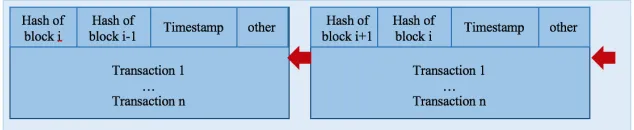
done. Based on the membership of the nodes, the blockchain can be either public, private or hybrid [2]. Public blockchains are fully decentralized where any node can join and leave the system. The other two types enforce some restrictions on membership in regard to system access. Hybrid blockchains tries to combine the characteristics of both private and public blockchains – every transaction is private, however it can be verified in the public state. Figure 1 shows the data structure of a blockchain whose basic concepts include:
1. Transaction:an operation that caused a change of the block.
2. Block:a container data structure, and a block is composed of a header and a long list of transactions.
[image:3.612.149.466.301.366.2]3. Chain:is a continuously growing list of blocks, which are linked and secured using cryptography.
Fig. 1.Blockchain Datastructure
3
Trends in Blockchain Type Data Structure
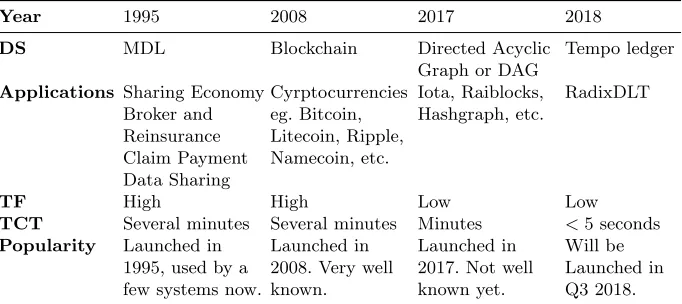
Table 1.Trends in Blockchain Type Data Structure
Year 1995 2008 2017 2018
DS MDL Blockchain Directed Acyclic
Graph or DAG
Tempo ledger
Applications Sharing Economy Broker and Reinsurance Claim Payment Data Sharing
Cyrptocurrencies eg. Bitcoin, Litecoin, Ripple, Namecoin, etc.
Iota, Raiblocks, Hashgraph, etc.
RadixDLT
TF High High Low Low
TCT Several minutes Several minutes Minutes <5 seconds Popularity Launched in
1995, used by a few systems now.
Launched in 2008. Very well known.
Launched in 2017. Not well known yet.
Will be Launched in Q3 2018. MDL=Mutual distributed ledger: a record of transactions shared in common and stored in multiple locations.
DS=key data structure TF=Transaction fee
TCT=Transaction confirmation time
4
Trends in Consensus Algorithms
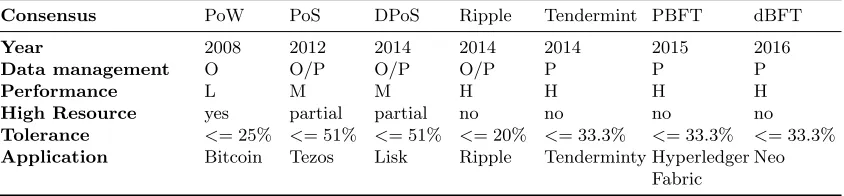
Consensus algorithms are designed to achieve reliability in a network involving multiple unreliable nodes. They ensure that the next block in a blockchain is the one and only version of the truth, and it keeps adversarial groups from derailing the system and successfully forking the chain. The most common consensus algo-rithms include Proof of Work(PoW), Proof of Stake(PoS) [11], Delegated Proof of Stake(DPoS) [11], Ripple [17], Practical Byzantine Fault Tolerance(PBFT) [5] and Delegated Byzantine Fault Tolerance (dBFT). A summary based on dif-ferent application scenarios and features of the consensus mechanism by the following criteria is presented in Table 2.
– Data management:support for whole network nodes and data supervision by privilege nodes.
– Performance and efficiency: confirmed efficiency of consensus between transactions.
– Resource consumption: high CPU load, storage, network capacity, etc. during consensus processing.
– Tolerance power:anti-attacking and cheat-proof capacity.
Proof of Stake (DPoS) is a newer consensus structure where users select some delegate nodes that confirm the validity of a block. Some consensus protocols such dBFT and PBFT are based on communication between different nodes and they are mostly used in private chains having authenticated nodes. Tendermint [12] improves the performance of PBFT by making small modification allowing different nodes with different voting power. The voting power is determined by the stake a user owns in the network. Despite the many modifications to the original consensus protocol, they still fail to scale well. To overcome this, federated protocols such as Ripple were proposed. In these protocols, the whole network is partitioned into smaller units; and each unit runs a local consensus.
Table 2.Consensus algorithm summary
Consensus PoW PoS DPoS Ripple Tendermint PBFT dBFT
Year 2008 2012 2014 2014 2014 2015 2016
Data management O O/P O/P O/P P P P
Performance L M M H H H H
High Resource yes partial partial no no no no
Tolerance <= 25% <= 51% <= 51% <= 20% <= 33.3% <= 33.3% <= 33.3% Application Bitcoin Tezos Lisk Ripple Tenderminty Hyperledger
Fabric
Neo
O=Open,P=Permission L=Low,M=Medium,H=High
5
Trends in Blockchain Systems
Over the past few years, blockchain technology has been evolving rapidly – from the original Bitcoin protocol to the second generation Ethereum plat-form[15], and today we are in the process of building what is informally termed blockchain 3.0 and future-generational blockchain 4.0 (see Table 3). This evo-lutionary change shows how the technology is evolving from its initial form as essentially just a database, to becoming a fully-fledged globally distributed sys-tem. The applications of blockchain have evolved to much wider scopes than crypto-currency and asset management. Applications from different industries including healthcare and energy sectors are being designed with blockchain as an underlying technology. These application’s requirements have also led to struc-tural changes in blockchain itself, which is evolving from linear chains to DAG, with emerging future types of chains such as Relational and Divisible chains.
of any third party. Other crypto-currencies that are recently supported are Lite-coin, Dogecoin etc. The technology stack of bitcoin consists of the blockchain platform, and a protocol which is used to describe how assets are transferred. The concensus algorithm utilised is Proof of Work (PoW). Blockchain 1.0 guar-antees distributed storage, enables data sharing between nodes, and enables transparency in transaction processing.
In Blockchain 2.0, a logic tier was added into the ledger and which supported what is termed smart contracts. Smart contracts are small computer programs that execute automatically when certain conditions are met. Since smart con-tracts are in essence tamper-proof, it reduces the cost of verification, execution and fraud prevention. The most prominent system in this version of blockchain is Ethereum. It is a platform for implementing smart contracts. It was proposed in 2013 and the initial release of its first blockchain was in July 2015. This version enables the creation and transfer of digital assets.
After the initial successes of Blockchain 1.0 and 2.0, several limitations were revealed. The most important ones are:
– Energy consumption:Since mining requires significant energy (electricity) costing billions of dollars per year, it is not scalable to mass adoption. – Volume of transactions: The number of transactions is increasing every
10-12 seconds with each new block creation. Bitcoin can theoretically pro-cess 7 transactions per second while Ethereum propro-cesses 15 transactions per second. If we compare the number of transactions to Visas network, which processes 24000 transactions per second, we still need to improve volume of transactions.
– Cost:Since a small fee is required to pay miners for maintaining the ledger, this scheme is only suitable for a limited number of large transactions but not for micro-transactions as it would become prohibitively expensive. In order to tackle the limitations in blockchain 1.0 and 2.0, a third generation of blockchain platforms are currently under development such as Dfinity [10], NEO [8], IOTA [7] and Ethereum [15], using different approaches. They aim to support multiple programming languages and the development of various mobile based applications.
As the usage of blockchain is continuing to increase, a fourth generation of blockchain platforms is being proposed by Seele whose aim is to innovate the new era of Value Internet. Blockchain 4.0 (aka Seele [3]) proposed new consen-sus algorithms based on Neural Networks that improves the fault tolerance of the system. The proposal also includes a new network architecture, low latency internet connection protocol to enable integration with Internet resources and the development of blockchain-based services.
6
Blockchain-based Internet and Its Challenges
Table 3.Comparison of Different Generations of Blockchain.
Evolution Blockchain 1.0 Blockchain 2.0 Blockchain 3.0 Blockchain 4.0
Year 2008 2013 2015 2018
Apps Digital currency Smart contract Decentralized applications (DApp)
Usable in wider industrial applications CS Meta chain Meta chain a)Meta chain and
side chain, b)Directed graph data structure
a)Relational chains b)Divisible chains
SL very limited FFPL FFPL FFPL
Consensus PoW PoW, PoS PoW,PoS,DPoS,
PBFT,Ripple, PoET
Consensus algorithm based on AI
ID Mining Initial Coin Offering (ICO)
ICO,ZCASH, EOS Seele and others
Features guaranteed transaction authenticity; reduced server costs; transactions
transparency
Guarantee of distributed computation; creating and transferring digital assets
Completely open-source; autonomous operation; arbitrary protocol language support
Faster consensus and transaction
confirmation; complete ecosystem of bottom-up technologies and applications CS=Chain Structure
SL=Scripting Language
network. Keeping these trends in mind, we envision that blockchain technology will significantly advance and become the basis for building totally autonomous security systems that solve the privacy and trust issues faced in today’s web era. However, for this realisation to occur there are several challenges that need to be addressed before the current blockchain technologies can simultaneously ensure scalability, privacy and reliability at scales with billions of transactions every second. Here, we note the key challenges:
– Scalability: The current blockchain requires all transactions to be stored and be available for validating any new transaction. Due to this, crypto-currencies such as Bitcoin can only process a few transactions every second. Newer systems fail to scale after some threshold of record and network sizes. There are several sub-problems that must be solved to address the issues, for example the optimisation of storage for transactions requiring intelligent means to maintain only a minimal amount of data to validate transactions. This also involves the challenge of when data can be archived and deleted. In addition, how data should be distributed between different nodes to en-sure the best efficiency and scalability is another challenge in this context. When considering the scalability of blockchain networks, the consensus pro-tocol also plays an important role. Therefore, load-balancing in terms of how many and which nodes should be used to validate every transaction among participating nodes is another important question to answer.
– Interoperability of Multiple Blockchains: Given the highly distributed and heterogeneous nature of the Internet, we can envisage there will be sev-eral private and public blockchains co-existing in the ecosystem. To maintain a global state of the information, these different blockchains should be able to communicate in a secure and transparent manner without affecting secu-rity. For example, to know the exact identity of a user, several blockchains may be queried before a blockchain validates the transaction of that user. – Blockchain and AI:Current blockchain protocols are effective in securing
and validating the information stored within the network, however most of these are simple and they require long verification times even though the number of nodes in the network is relatively small – the efficency of current consensus protocols need to improve. However, at greater scales, we can expect millions of nodes and this increases the risk of malign nodes trying to break the system. Several AI algorithms can help solve this and many other problems by making different parts of the blockchain ’smarter’. For example, the behaviour of nodes can be learned through their different actions and communication interactions, enabling smart decision-making on whether a particular node is worthy or not. Thus, if some nodes are not trust-worthy, they can be automatically pruned from decision making and this reduces the cost of adding new block.
and devices such as mobile phones, energy usage becomes a key factor. This requires intelligent management of data and computation depending on the device’s capacity in terms of computation and battery power.
– Simulation and Testing:Recently several types of blockchain-based sys-tems have appeared. Each claim to offer advantages over the others. There is currently no standardised simulation environment or benchmarks that are available than can allow comparison between different proposed concensus and data structures in addition to testing security concerns. Simulation en-vironments are not only essential for testing the currently proposed systems but also for future development. Moreover, simulation environments are cost-effective and allow repeatability of results.
7
Conclusion
In this paper, we survey blockchain technologies and applications from different perspectives. We first include an overview of blockchain concepts, and then cat-egorize and compare data structures used in blockchains. We also compare the consensus protocols, and summarize blockchain implementations. Furthermore, we outline some challenges that need to overcome to improve the privacy and security of current internet services. It is becoming clear from developments over the last few years, that blockchain applications have increased and with them come necessary modifications to blockchain’s features to make it more scalable and fault tolerant. However, when using blockchain in massive-scale systems, scalability limitations become prevalent leading to poor performance when mil-lions of nodes participate. Evolving design considerations will enable blockchain to be able to communicate and interoperate on networks of enormous size, main-taining a global and reliable respository of information. AI can address some of the problems that need to be solved, however its applicability needs to be tested in different scenarios. We will consider in depth the modification and ramifica-tions of a combined blockchain and AI approach in future research.
References
1. Allcott, H., Gentzkow, M.: Social media and fake news in the 2016 election. Journal of Economic Perspectives31(2), 211–36 (2017)
2. Anh, D.T.T., Zhang, M., Ooi, B.C., Chen, G.: Untangling blockchain: A data processing view of blockchain systems. IEEE Transactions on Knowledge and Data Engineering (2018)
3. Bi, W.: Seele project. https://seele.pro/ (2018)
4. Buyya, R., Garg, S.K., Calheiros, R.N.: Sla-oriented resource provisioning for cloud computing: Challenges, architecture, and solutions. In: Cloud and Service Comput-ing (CSC), 2011 International Conference on. pp. 1–10. IEEE (2011)
5. Castro, M., Liskov, B., et al.: Practical byzantine fault tolerance. In: OSDI. vol. 99, pp. 173–186 (1999)
7. Divya, M., Biradar, N.B.: Iota-next generation block chain. International Journal Of Engineering And Computer Science7(04), 23823–23826 (2018)
8. Eisses, J., Verspeek, L., Dawe, C., Dijkstra, S.: Effect network: Decentralized net-work for artificial intelligence (2018)
9. Gramoli, V.: From blockchain consensus back to byzantine consensus. Future Gen-eration Computer Systems (2017)
10. Hanke, T., Movahedi, M., Williams, D.: Dfinity technology overview series consen-sus system (2018)
11. Kiayias, A., Russell, A., David, B., Oliynykov, R.: Ouroboros: A provably secure proof-of-stake blockchain protocol. In: Annual International Cryptology Confer-ence. pp. 357–388. Springer (2017)
12. Kwon, J.: Tendermint: Consensus without mining. Retrieved May18, 2017 (2014) 13. McAfee, A., Brynjolfsson, E., Davenport, T.H., Patil, D., Barton, D.: Big data: the
management revolution. Harvard business review90(10), 60–68 (2012) 14. Nakamoto, S.: Bitcoin: A peer-to-peer electronic cash system (2008) 15. Project, E.: Ethereum project. https://www.ethereum.org/ (2018)
16. Ridyard, P.: Tempo white paper. https://projects.radix.global/wiki/radix/wikis/Tempo-White-Paper (2018)
17. Schwartz, D.: The ripple protocol consensus algorithm. https://ripple.com/files/rippleconsensuswhitepaper.pdf (2018)
18. Walport, M.: Distributed ledger technology: Beyond blockchain. UK Government Office for Science (2016)