Sustainable Organic Market Development with International Trade
(SOMDwIT)
Interview guide (WP2)
Deliverable 2.2.
Susanne Pedersen
*, Eva Schwendel, Maria Paternoga,
Jessica Aschemann-Witzel & John Thøgersen
MAPP Centre, Department of Management, Aarhus BSS, Aarhus University,
Bartholins Allé 10, 8000 Aarhus C, Denmark
*
Corresponding author: Susanne Pedersen, [email protected]
June 30, 2016
The SOMDwIT project is part of the Organic RDD 2.2 programme, which is
coordinated by ICROFS (International Centre for Research in Organic Food
Systems). The project is funded by the Green Development and Demonstration
Programme under the Danish Ministry for the Environment and Food.
The project runs from 1-1-2016 to 31-12-2017.
Introduction
The purpose of SOMDwIT WP2 is to explore the influence of “made-in-Denmark” relatively to
competing countries of origin on how organic food products are evaluated on quality dimensions that
consumers perceive as important (both organic food in general and specific product categories) at
important and emerging markets (Germany and France, China and Thailand). The exploration is
based on a mixed-methods qualitative research approach in order to provide depth, insight and
understanding into consumers’ behaviour, motivations and experiences (Malhotra, Birks, & Wills,
2012), and to understand the phenomenon of organic food consumption and country of origin effects
in a wider context.
The qualitative data collection employs two different qualitative methods: In-store interviews and
focus groups. The two methods are utilized both to complement each other and to offset possible
biases inherent to each individual method. Both methods are used to investigate the same
phenomenon, namely the perception of country-of-origin for organic food products, but in a different
context. A key characteristic of the in-store interviews is that consumers are intercepted at the point
of purchase, where the possibilities for capturing what is accessible in the consumers’ mind in the
buying situation are optimal, whereas focus groups allow capturing how consumers reason about this
topic, and justify their choices, in conversation with peers, in a more in-depth discussion and
elaboration process. By exploring consumers’ understanding, reasoning and preferences under such
different constraints, it is possible yield an enriched and elaborated understanding of the phenomenon
of interest and increase interpretability and validity of results (Greene, Caracelli, & Graham, 1989).
In-store interviews
six questions, with the consumers’ location in the store (aisle) and possible product choice (product
category/product) in mind, followed: Questions about the consumers’ involvement in organic
consumption, awareness of country of origin of organic products (referring to aisle), attention and
attitudes towards imported products and the importance and preferences for organic products’ country
of origin. To conclude, age, education and household size was asked and gender and location (aisle)
was noted.
In each of the four countries, the interview guide was translated from English to the local language
and checked for congruence. Also, the local researchers were instructed carefully in how to make use
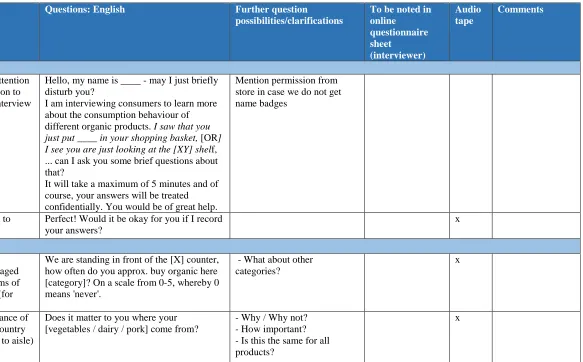
of the interview guide. The interview guide is shown in English in Table 1.
Focus groups
The purpose of the focus groups is to stimulate an in-depth exploration of consumers’ underlying
cognitive processes reflected in the perception of country-of-origin for organic food products. Focus
groups are well suited to address a gap in existing research, as this non-directive open approach based
on a relatively small group of people is able to provide a rich set of data about their perceptions,
thoughts and impressions, where the researcher is not only able to observe their interactions in a social
setting, but also has the possibility to ask for further clarification in order to gain more in-depth
consumer insights. By conducting several focus groups, it is possible to compare results within groups
and detect overall patterns and group variations. Moreover, focus groups provide data that arises in a
relatively natural or indigenous form, as participants are only slightly influenced by the structure
imposed by the researcher and research setting. Hence, a focus group interview simulates to a certain
degree a ‘natural’ conversation with friends, family and acquaintances, which provides valuable data
on how consumers justify their behaviour in front of others. This is especially relevant in the context
of organic food, where research shows that consumers tend to post-rationalize their choices to defend
paying for price premiums (Thøgersen, 2011). However, it is important to keep in mind that focus
groups do not reveal how consumers will behave in an actual purchase situation, but rather shed light
on their justification of their behaviour with reference to perceptions and attitudes.
(Malhotra et al., 2012), or interactive exercises that engage participants in thinking and concentration,
which facilitates uncovering issues or opinions of which participants are not fully aware or not able
to directly verbalize (O'Neill, 2003).
Table 1: In-store interview guide
Timing (Sec.)
Internal purpose Questions: English Further question
possibilities/clarifications
To be noted in online
questionnaire sheet
(interviewer)
Audio tape
Comments
I. Introduction
30 Catch customer's attention
and create motivation to participate in the interview
Hello, my name is ____ - may I just briefly disturb you?
I am interviewing consumers to learn more about the consumption behaviour of different organic products. I saw that you just put ____ in your shopping basket, [OR] I see you are just looking at the [XY] shelf, ... can I ask you some brief questions about that?
It will take a maximum of 5 minutes and of course, your answers will be treated confidentially. You would be of great help.
Mention permission from store in case we do not get name badges
10 Ask for permission to
audiotape
Perfect! Would it be okay for you if I record your answers?
x
2. Questioning Part
(1) 10 Warm-up question
Check for how engaged shoppers are in terms of organic purchases (for category)
We are standing in front of the [X] counter, how often do you approx. buy organic here [category]? On a scale from 0-5, whereby 0 means 'never'.
- What about other categories?
x
(2) 40 Identify the importance of organic products' country of origin (referring to aisle)
Does it matter to you where your [vegetables / dairy / pork] come from?
- Why / Why not? - How important? - Is this the same for all products?
(3) 30 Identify attention to imported products
Some of these products, as e.g. [Y] are imported. Did you realize that?
x - Check origin
beforehand - If an imported organic product is just put into the basket, refer to that one
(4) 40 Identify attitude towards imported products
Do you buy some of these imported products sometimes, too?
- Why / Why not? - For which products?
x
-5 30 Identify the importance of organic products' country of origin (referring to other products)
Do you pay attention where your other organic products (other aisle) come from?
- For which exactly? x
(6) 60 Gain insights into preferred countries of origin
Coming back the [veggie/meat/dairy] counter. If these [carrots / pork / milk] wasn't available from [country], from which country would you prefer to buy?
- Why do your prefer this country?
- Do you think it is especially good for producing organic? - Which other countries would you consider?
x
3. Demographics/ Other info Part
(7) 15 Age This was already the last question. Could
please just tell me, how old you are?
x x
(8) 10 Household Size And how many people live in your
household?
x x
(9) 10 What is your highest attained education?
/ Gender / x x Noted directly by
/ Product aisle (pork, dairy, carrots)
/ x x Noted directly by
interviewer based on observation
4. Final
5 Thank you for your participation. Have a
great day!
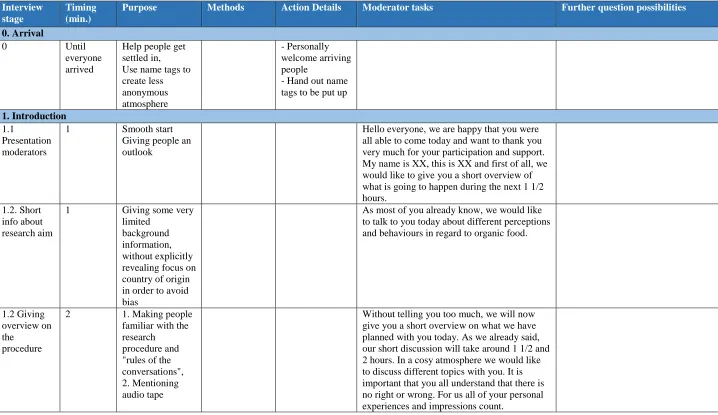
Table 2: Focus group interview guide
Interview stage
Timing (min.)
Purpose Methods Action Details Moderator tasks Further question possibilities
0. Arrival
0 Until
everyone arrived
Help people get settled in, Use name tags to create less anonymous atmosphere
- Personally
welcome arriving people
- Hand out name tags to be put up
1. Introduction
1.1
Presentation moderators
1 Smooth start
Giving people an outlook
Hello everyone, we are happy that you were
all able to come today and want to thank you very much for your participation and support. My name is XX, this is XX and first of all, we would like to give you a short overview of what is going to happen during the next 1 1/2 hours.
1.2. Short info about research aim
1 Giving some very
limited background information, without explicitly revealing focus on country of origin in order to avoid bias
As most of you already know, we would like
to talk to you today about different perceptions and behaviours in regard to organic food.
1.2 Giving overview on the
procedure
2 1. Making people
familiar with the research procedure and "rules of the conversations", 2. Mentioning audio tape
Without telling you too much, we will now
1.3
Introduction of
participants
5 1. Overcoming
anonymity between participants, creating more trustful "coffee table" atmosphere 2. Create relaxed atmosphere by revealing some personal
information about the moderator(s)
Now we would like to know more about each
of you. So feel free introduce yourself briefly. It would for example be interesting to know how many people live in your household or what you do professionally? Moreover, please share 1 fun fact about you.
We are just going to start! (Moderator gives an example)
2. Country associations
Transition ... thanks for your short presentation.
2.1 Free country association
3 Get top of mind
associations with 3-5 importing countries --> What are the countries famous for? Do people maybe even mention food products without being triggered? Word association
- Reveal headline with [First country] on flipchart - Help handing out cards
We want to start with a very general question. As you can see, we have put a pile of cards in front of you. Please write down the first things that comes to your mind when thinking of [First country]. You will have 1 minute to do so.
Reveal headline with [Second country]....
Now we would like to ask you to do exactly the same for the [Second country]. Again, you will have 1 minute to complete this task. And please write for each card the name of the country on it.
Reveal headline with [Third country]....
And finally, please do the same for [Third country]. Don't forget to write for each card the name of the country on it.
7 Discussion Let some
participants explain their cards (randomized)
- Let participants keep their cards and present what they wrote - Discuss associations for 1 country after another - Facilitator collects cards
Great, thanks. We would now like to hear what you have noted down for each country. [Person X], I have seen that you wrote down [word Y] for [first country]. Could you please describe what you mean? Why do you connect especially this with [first country]? ...
afterwards and pins on flipchart
2.2 Evaluative country association
3 Probe attitude
towards country 1, 2 and 3 through (evaluative) adjectives
Ranking / evaluative scale
- Hand out new set of cards
For our second round we would like to ask you to kind of "rate" our 3 countries on a scale from 0 to 10. Imagine you favourite country in Europe/The world got a 10, and the country that you like the least gets a 0, how would you rate each of the 3 countries?
7 Discussion Let some
participants explain their cards (randomized)
- Let participants keep their cards and discuss what they wrote - Discuss ratings for 1 country after another - Facilitator collects cards afterwards and pins on flipchart
As in our first round, I would now like to hear some of your thoughts to your ratings. Who would like to start with a short explanation?
Probing --> moderator should ask further questions to gain insights into positive / negative experiences / thoughts about the countries
3. Food & country
3.1 Food associations with country
3 Get top of mind
association in regard to food products from country 1, 2 and 3 --> Which kind of "groceries" or food products are these countries famous for? --> Use insights (sheet technique) to analyse: - richness of associations per country (how many associations) - repeating associations Word association (specific: food)
- Hand out prepared country sheets (3 column table)
- At the end of focus group, let them write their name on it
Now we want to take a closer look at food products from these different countries. We have prepared some papers for you and would like to ask you to write down some typical food products that come to your mind for each of those countries. Here we want you to disregard completely typical meals countries are famous for, as for example "Spaghetti Bolognese". Instead we would like you to focus on those food products, you would actually buy in a supermarket.
Just write down what comes to your mind, you will have approximately 2 minutes for that.
among participants
7 Discussion Randomized,
open
discussion, not necessarily ask everybody
Now we would like to hear some of your
suggestions. Who would like to start?
- Are there other opinions on that? - Does anybody have an opinion on that?
- Who has to add something - Did anybody write down the same product?...
- Why exactly do you associate [product X] with [country Y]? (probe for origin of this association, e.g. TV, personal experience)
- Have you ever seen this product from [country Y] during one of your grocery shopping trips?
- Have you ever bought this product from [country Y]?
- Do you believe that this country is
particularly good at producing this product? Start probing if the countries are also good at producing mentioned products
3.2 Country strength in food production
3 Specific belief
about a country's strength in a certain food product
Sorting exercise/Props
- Give participants pictures of certain food products (milk, cheese, carrots etc.) without any packaging or advertisement - Let them sort them according to their belief which country is an "expert" producer in each of those products (pin on prepared whiteboard)
Next, we want to take a closer look at some specific food products. For that, we will hand out pictures of different food products. Please assign them to assign them to those countries, which you believe are particularly good at producing this product.
7 Discussion Randomized, open
discussion, not necessarily ask everybody
I can see product [x] was assigned particularly
often to country [y]... Can anybody explain more in detail why you believe that especially this country is an expert in [product x]?
- Are there other opinions on that? - Does anybody have an opinion on that?
- Do you have other reasons for this categorization?
- Why exactly do believe the country is an expert? (probe for origin of this belief, e.g. TV, personal experience)
- Have you ever seen this product from [country Y] during one of your grocery shopping trips?
- Have you ever bought this product from [country Y]?
- Do you have specific brands in mind from this country?
4 Organic & country
Transition In the last part of our discussion we now want
to focus particularly on organic products.
4.1 Importance of country of origin
15 Reveal if
consumers pay attention to country of origin of organic products; and in which
situations/for which products this might be the case Vignettes - imagery grocery shopping Let participants speak freely, use a lot of probing questions!
Please imagine a typical grocery shopping trip in your local supermarket. Surely, you will choose an organic product during this trip. Do you pay attention to where your organic product actually comes from? In which "moments" do you pay more or less attention to the country of origin?
- For which products is the country of origin particularly important? - In which aisles are you when you check for the country of origin? - Where exactly do you look for the country of origin (e.g. packaging, shelf labels etc.)
4.2 Knowledge of country of origin
10 - Probing if
participants actually (based on a concrete example!) paid attention to imported products - Indirectly detect for which products this is the case
Recall Let participants
speak freely, use a lot of probing questions!
If you think about your last grocery shopping in your local supermarket, did you notice that some of your organic food did not come from [research country]?
- Could you please name these products?
- Which country did these products come from?
4.3 Trust in country as organic exporter
3 Reveal thoughts
about and (dis)trust in country as exporter of organic products Countries to include: Denmark, Netherlands, Austria, France, Belgium, Spain, Portugal, Poland, Switzerland, Italy, Greece
(Look at specific justification again)
Assessment exercise
Hand out stickers (dots) for positive and negative evaluations
In fact, [research country] imports a lot of organic food products. We would now like to know from you in how far you trust in other countries as organic producers. We have prepared stickers in 2 different colours for you. Please mark with the two green stickers which 2 countries you trust in most. The red stickers should be assigned to those 2 countries you trust in least.
Start with the country that had most dots etc. (for discussion)
10 Discussion Randomized,
open discussion, not necessarily ask everybody Start with countries with most "positive dots", then look at negative dots...
Thank you! Would some of you like to share the reasons for his assessment? [Person X] could you please elaborate, why you consider [country Y] as a trustworthy organic producer? ...
- Are there other opinions on that? - Does anybody have a controversial opinion on that?
- Do you have other reasons for this assessment?
- For which products do you think this assessment is particularly true? 4.4 Knowledge about other European organic labels
5 Finding out if
people actually know some other European organic labels and how it influences them
Recall If we look at all of these countries again,
which organic labels from these countries do you actually know?
- How does it look like?
- Where do you know the label
from?
- Have you seen it on products in [research country]? Which? - How do you use it?
5. Debrief
5. Wrap up and goodbye
5 Give possibility to
share last thoughts
Open question We are now almost at the end of our
discussion. Is there anything else on the topic of imported organic products you would like to add?
3 Wrap up
Hand over reward Get consent form signed
Facilitator hands
out vouchers for signature Stick around for questions
We would like to thank you for your participation, you were really a great help! The results of today's session contribute to a research project about the perception of organic products, which is conducted at Aarhus University in Denmark. Apart from [Germany], we will perform this study also in [France, Thailand and China].
As a small reward for your participation, we want to give you a voucher for [local store]. In return, we would like to ask you to sign that we are allowed to use your answers for our study and that you have a received a voucher from us.
If you have any further questions, feel free to contact us!