Student Development Through and Beyond
Colourstrings
by
David Sanzone
School of Creative Arts, Conservatorium of Music
Submitted in fulfilment of the requirements for the Degree of
Master of Music (Research)
Declaration of Originality
I declare that this exegesis contains no material that has been accepted for a degree or
diploma by the University or any other institution, except by way of background
information and duly acknowledged.
I have read the University statement on Academic misconduct (Plagiarism) on the
University website at www.utas.edu.au/plagiarism and to the best of my knowledge
and belief the exegesis contains no material previously published or written by
another person except where due acknowledgement is made in the text, nor does the
exegesis contain any material that infringes copyright.
Ethics Declaration
The research associated with this exegesis abides by the international and Australian
codes on human and animal experimentation, the guidelines by the Australian
Government's Office of the Gene Technology Regulator and the rulings of the Safety,
Ethics and Institutional Biosafety Committees of the University. All interviews have
been conducted with Ethics Approval (Reference No.H0014796).
This exegesis may be made available for loan and limited copying in accordance with
the Copyright Act 1968.
Name: David Sanzone
Signed: _________________ _________
My heartfelt thanks goes to my violin teacher and mentor Peter Tanfield, who has
been so supportive and enthusiastic towards my work as a violinist and teacher. I also
wish to thank Associate Professor Heather Monkhouse and Associate Professor
Anne-Marie Forbes as my chief supervisors for their expert advice and guidance in the
preparation of the exegesis.
My extended thanks beyond Tasmania goes to Géza Szilvay, staff at the East-Helsinki
Music Institute and Colourstrings teachers around Australia who have been so helpful
to me.
Since the 1970s, Géza Szilvay (born 1943), along with his colleagues at the
East-Helsinki Music Institute, have taught several generations of professional violinists
using the Colourstrings approach. Colourstrings, however, is generally accepted as an
approach for teaching beginners, usually very young children who begin their
instrumental studies from approximately age four to seven years old. The aim of this
study was to find out how Szilvay and his colleagues develop students through and
beyond Colourstrings towards a higher, professional level.
Prior to this research, I observed the violin teachers and students at the East-Helsinki
Music Institute and am currently undertaking the teacher certification program. My
experiences at the teacher training courses and at the Institute were the chief
inspiration of this research, which ultimately comprises a review of Colourstrings
training and interviews with Szilvay, teachers at the Institute and a certified
Colourstrings teacher in Australia.
The research findings showed that violin teachers using Colourstrings should consider
three areas in their teaching: philosophy, methodology and material. The interviewed
teachers were questioned with regards to these three areas and a general pattern was
found. The underlying philosophies of Colourstrings are inspired by the Hungarian
pedagogue Zoltán Kodály and remain consistent for the teaching of any student no
teacher, given environmental contexts.
The interviews with the East-Helsinki teachers also provided information on a grade
system that has been put into practice at the East-Helsinki Music Institute, which
complements the Colourstrings methodology. The participants gave insight into this
grade system and how it is employed at the Institute; as a result, a general framework
To
Declaration... ii
Acknowledgements... iii
Abstract... iv
Dedication ... vi
List of Figures... x
Chapter 1: Introduction, Review and Research Methods... 3
1.1 Introduction ... 3
1.2 Background to Research... 4
1.3 A Brief History of Colourstrings ... 5
1.4 Review of Related Research ... 9
Conclusion of Related Research ... 17
1.5 Research Methods ... 17
Interviews... 18
Observations... 19
Experimental Research... 20
Data Analysis ... 20
Organisation of Thesis ... 21
Chapter 2: Overview of the Colourstrings Violin System... 22
2.1 Szilvay’s Writings... 22
Objectives of Colourstrings... 24
Influences of Szilvay and Colourstrings... 26
2.2 The Colourstrings Materials ... 28
Pre-Instrumental Education... 30
2.3 Colourstrings Instrumental School: Violin ABC Book A-D ... 34
Folk Song and the Mother Tongue Principle ... 35
Integrated Teaching... 40
Technique – General Posture ... 44
Right-hand Technique... 45
Left-hand Technique ... 49
2.4 Violin ABC Book E, F and Yellow Pages... 52
2.5 Additional and Complementary Material ... 55
Scales and Arpeggios ... 55
Sonatas with Piano ... 59
Violin Duos ... 60
String Chamber Music ... 61
2.6 Conclusion of Colourstrings materials... 62
Chapter 3: Observations of Géza Szilvay, Teachers and Students at the East-Helsinki Music Institute... 63
3.1 The East-Helsinki Music Institute ... 64
Background ... 64
The Violin Programme... 65
3.2 Géza Szilvay... 66
Nurturing and Friendly Behaviour ... 66
[image:7.595.90.510.88.786.2]Teaching Through Touch... 71
Themes and Links with Great Teachers... 73
3.3 Teachers at the East-Helsinki Music Institute... 75
Influence of Géza Szilvay ... 75
Collaboration and Equality ... 76
Growth Mindset ... 77
3.4 Violin Students at the East-Helsinki Music Institute... 80
Relaxed Technique... 80
Play Lightly and With the Ears ... 82
3.5 Further Observations... 83
Music of Béla Bartók ... 83
Teacher Training Courses ... 84
Chapter 4: Interviews with Géza Szilvay and Colourstrings Teachers ... 87
4.1 The Participants ... 88
4.2 Philosophy... 88
Kodály Philosophy and Maintaining a ‘Balanced Musician’ ... 89
Enthusiasm and Motivation... 93
4.3 Methodology ... 95
Contact Time with Students ... 96
Lesson Structure... 99
Starting a New Piece ... 99
‘Light Hands’ and General Posture... 101
‘Building the Violinist’ and Remediation ... 103
4.4 Material... 104
Grade Systems... 104
Scales... 108
Changes of Position... 109
Chamber Music ... 109
Etudes... 110
Performance Pieces ... 111
4.5 General Comments and Advice ... 112
Teacher Training ... 112
Mozart and Folksongs ... 113
Sources for Inspiration ... 114
Chapter 5: Conclusions and Implications... 115
5.1 Philosophical Foundations... 115
Further Understanding the Kodály Approach ... 117
5.2 Methodology and Application... 117
Private Lessons... 118
Group Activities ... 119
General Musicianship... 120
Environmental Contexts... 121
5.3 Materials Beyond Colourstrings... 122
Performance Pieces ... 124
Sonatas with Piano ... 125
Etudes and Exercises... 129
Scales... 126
5.4 Other Activities... 130
Transitioning to Viola and other Instruments ... 130
5.5 Conclusion... 131
Appendix A: Analysis of Songs and Origins in Violin ABC Book A-D... 134
Appendix B: Predetermined Questions for Interview Participants ... 135
Appendix C: Grading Framework Showing the Transition from Colourstrings to Traditional Violin Repertoire ... 137
Appendix D: Framework Showing the Traditional Violin Repertoire to Study Beyond Colourstrings... 138
Bibliography ... 139
List of Figures
Figure 2.1: The structure of the Colourstrings violin teaching system ...29
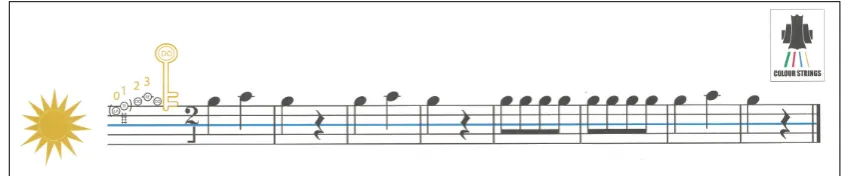
Figure 2.2: Folk song Swallows in the Sunshine used to teach basic rhythms ...35
Figure 2.3: Swallows in the Sunshine used to teach harmonics in the first position ...36
Figure 2.4: Swallows in the Sunshine used to represent the Major 2nd interval on a one-line system and exercise the stopping movement of the first finger...36
Figure 2.5: Swallows in the Sunshine used with added duo part...36
Figure 2.6: Swallows in the Sunshine used to demonstrate ‘Da Capo al Fine' ...37
Figure 2.7: Swallows in the Sunshine used to demonstrate and exercise the lowered 2nd finger hand position on the E-string ...37
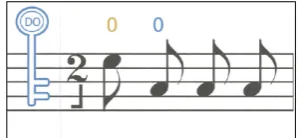
Figure 2.8: DO, RE, MI ...42
Figure 2.9: DO, RE, MI, FA, SO, SO ...42
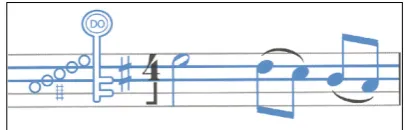
Figure 2.10: Two-line system emphasised over the traditional five-line stave...42
Figure 2.11: Single blue line on stave...43
Figure 2.12: Slightly bold, black line on stave...43
Figure 2.13: Traditional five-line stave...43
Chapter 1
Introduction, Review and Research Methods
1.1 Introduction
Since the 1970s, Géza Szilvay (born 1943), along with his colleagues at the
East-Helsinki Music Institute, have taught several generations of professional violinists
using the Colourstrings approach. Colourstrings, however, is accepted as an approach
for teaching beginners, usually very young children who begin their instrumental
studies from approximately age four to seven years old.1 It would appear though, that
by means of Colourstrings, almost any child could potentially learn to play the violin
to a professional level.
Until it is understood how to use Colourstrings effectively, teachers outside of the
East-Helsinki Music Institute will remain vulnerable to misunderstanding its potential
to teach beyond the beginner level. To illustrate this observation, a comment was
made to me in conversation with an Australian violin teacher regarding
Colourstrings: “It only works for Szilvay.”2 The aim of this study was to find out how
Szilvay and his colleagues develop students through and beyond Colourstrings
towards a higher, professional level.
1 Brenda Sue Mitchell, “A Qualitative Study of Géza Szilvay’s Colourstrings Method for Violin,” (Ph.D diss., Arizona State University, 1994), 40.
1.2 Background to Research
Géza Szilvay introduced me to Colourstrings in 2010 and I became fascinated with it
because it was so different to my own upbringing, which was primarily through The
Suzuki Method in my childhood years and later with orchestral violinists and
university professors. I began using the Colourstrings materials with my own students
and started to see not only gaps in my teaching but also in my own learning of the
violin.
Among many aspects of Colourstrings, I found that using the relative solmisation
system was an effective tool for the children’s intonation and being able to play freely
around the violin fingerboard. I noticed immediately that instead of using visual aids
on the fingerboard and playing in first position for the first few years as I did, in
Colourstrings students are provided with two or three visual aids for the whole
fingerboard in the first few months of learning and then progress to no visual aids.
In 2011 was invited to attend a teacher-training course and to observe the program at
the East-Helsinki Music Institute where Colourstrings originated and subsequently
developed. My observations and experiences at the East-Helsinki Music Institute were
recorded from August to December in 2011, and included private lessons, group
classes, small ensemble tutorials, orchestral rehearsals, concerts, aural classes and
teacher-training courses and commenced the process towards achieving the Colourstrings
teaching certification.3
At the time this study commenced I had completed the first two phases of the
three-phase Colourstrings Teacher Certification. Documentation, notes, and recordings that
were taken from the courses I had participated in were reflected on as part of this
research. These experiences were chiefly the inspiration for this research project, for
on several occasions at the teacher-training courses other participants asked, what I
found to be a compelling query: “What happens after Colourstrings?”4
1.3 A Brief History of Colourstrings
Géza Szilvay originally created the first pages of the Colourstrings violin system for
his daughter in the 1970s, which consisted of colourful game-like material for
teaching her the violin.5 The original materials were devised for family use, however
more were created through Szilvay’s experiences of teaching several generations of
pupils at the East-Helsinki Music Institute in Finland from 1971 through to 2010. The
materials were “enriched and deepened by the experiences, observations, advice and
requests of several generations of pupils.”6
3 These courses included the International Colourstrings Course: Phase IIa and IIb in Klagenfurt Austria, the 22nd International Colourstrings Course, Phase I in St Paul im Lavanttal Austria, and the
2014 Australian Colourstrings Festival at Fairholme College, Toowoomba.
4 In a Question and Answer Session with Géza Szilvay and teacher trainees, “The 22nd International Colourstrings Course for Instrumental Teachers of Violin, Viola, and Cello” (lecture, St. Paul Lavanttal/Kärten, Austria, August 6, 2011).
5 Géza Szilvay, Violin ABC Handbook for Teachers and Parents (Helsinki: Fennica Gehrman, 2010), 141.
The philosophies underpinning Colourstrings are based on the pedagogical ideas of
Zoltán Kodály, (1882 – 1967).7 The materials and methodological progression of
Colourstrings training reflects what is loosely referred to as ‘The Kodály Method.’8
My desire was to create a child-centred violin tutor book, which nevertheless met the expectations set by Zoltán Kodály: constant equilibrium between the development of musical hearing, instrumental technique, music theory and emotion. Singing, hearing, playing, understanding and reading are inseparable. This was a real challenge for me as the architect of the violin school.9
Szilvay’s brother Csaba Szilvay (born 1941) created an adaptation of Colourstrings
for the cello. Subsequent adaptations of Colourstrings have been published for viola,
double bass, guitar, piano and flute. There are also publications targeted at home use
and pre-instrumental training, including songs for vocal and aural training as well as
musical literacy.10 In addition to the tutor books, the Szilvay brothers together with
the Hungarian composer Lászlo Rossa (born 1941) wrote string chamber music and
sonatas for violin or cello with piano. The word ‘Colourstrings’ can therefore be used
as an umbrella term for child-centred educational materials for music, not just for
instrumental study but also for singing, aural training, music theory and chamber
music. According to Mitchell, the word ‘Colourstrings’ was not Szilvay’s idea but
suggested by the original publisher, Fazer Music Inc.11
7 Brenda Sue Mitchell, "String Teaching Plus Kodály Equals "Colourstrings," American String Teacher
48, no. 1 (Winter, 1998): 73-7, accessed May 20, 2014,
http://ezproxy.utas.edu.au/login?url=http://search.proquest.com/docview/964763?accountid=14245. 8 According to the Kodály Institute of the Liszt Ferenc Academy of Music, Zoltán Kodály’s ideas on music education are usually mentioned under the inaccurate name Kodály Method.
9 Szilvay, Handbook, 141.
10 For entire list of Colourstrings publications as of September 2016, see:
In 1972, Géza and Csaba Szilvay founded The Helsinki Junior Strings, (currently
recognised as The Helsinki Strings), a string orchestra based at the East-Helsinki
Music Institute. The ensemble is world-renowned as it has toured over twenty
countries and released more than thirty recordings for Finlandia Records and Warner
Classics.12Over seventy television programmes featured Szilvay with the orchestra at
the East-Helsinki Music Institute under the title Minifiddlers in Musicland, which is
said to have “marked a new era in music education in Finland.”13 The renowned
violinists Yehudi Menuhin and Max Rostal have served as patrons of the orchestra,
and it is still based at the Institute.
Colourstrings and the string programme at the East-Helsinki Music Institute is
acclaimed by international music organisations including the Australian String
Teachers’ Association (AUSTA), the European String Teachers’ Association (ESTA),
American String Teachers’ Association (ASTA), International Society for Music
Education (ISME), Nordic Music Pedagogical Union (NMPU), and the International
Kodály Society.14 Schools and music academies in the United Kingdom, Canada,
Australia, the USA, Germany, France, Spain, Sweden, Norway, Singapore and Hong
Kong are now using Colourstrings.15 The Szilvay Brothers have received
international honours in recognition of their achievements as string pedagogues and
conductors including the Knight Order of the Finnish Lion, the Culture Prize of
12 Summa Cum Laude International Youth Music Festival, Ensembles 2013: The Helsinki Strings, VIA MUSICA - Vienna International Association for Music and Culture Exchange, accessed 19 December 2016: http://www.sclfestival.org/the-helsinki-strings.
13 “The Helsinki String’s Biography,” Last.fm, accessed November 1, 2014, http://www.last.fm/music/The+Helsinki+Strings.
14 Géza Szilvay, “Colourstrings,” in Zoltán Kodály – Composer, Musicologist and Educationist: A
Festschrift for Professor Matti Vainio July 5, 1996, ed. Anu Sormunen (Jyväskylä: University of
Jyväskylä Department of Musicology, 1996), 58-59.
Finland, Hungarian State Award for Cultural Activity, and the Pro Musica Award.16
Géza Szilvay was decorated with the Accent Prize of the Association of Finnish
Music Institutes, the International Kodály Prize, and a Professorship from the
President of Finland.17
Every year since 1977, the Szilvay brothers have presented Colourstrings teaching
workshops in various countries including Sweden, Finland, Canada, Australia,
Denmark, Poland, Scotland, Japan, England, Belgium, Switzerland, Faroe Islands,
Austria, Netherlands, Russia, Hungary, Germany, Korea, China, Estonia, United
States of America, Norway, Romania (Transylvania), Latvia, Ireland, Italy, Spain,
Slovenia, Czech Republic, Nepal and Greece.18
In 2010, Géza Szilvay retired from the East-Helsinki Music Institute; however, he
continued to tour internationally delivering teacher-training courses. In 2012, Szilvay
launched the International Minifiddlers, a distance-learning project broadcast online.
It involved Géza Szilvay teaching a class of beginner violin students in Helsinki with
Colourstrings and was broadcast online using teleconferencing technology to classes
of violin students around the world.19International Minifiddlers has received awards
16 Paul Mittermayer, “Géza Szilvay”, Colourstrings, May 12, 2014, accessed May 30, 2014, http://www.colourstrings.fi/aboutgeza.html.
17 Ibid.
18 Dates and Cities for past Congresses, Symposia and Courses are listed on the Colourstrings Website: www.colourstrings.fi.
19 Inkeri Ruokonen, Pirkko Juntunen and Heikki Ruismäki. “Experiences of participants in
Minifiddlers’ distance learning environment,” Problems in Music Pedagogy, vol. 12, no 2: (December, 2013): 93, accessed October 13, 2014,
from the Finnish Cultural Foundation, the Pro Musica Foundation and Géza Szilvay
was awarded with a Knighthood by the President of Hungary János Áder in 2013.20
1.4 Review of Related Research
Research regarding student development through and beyond Colourstrings is limited
and outdated. Mitchell21 and Loughnan22 examined the Colourstrings violin books
and conducted personal interviews with Géza Szilvay to include in their theses.
Mitchell and Loughnan conducted their research between twenty to thirty years ago
however and there has been a huge expansion of Colourstrings materials for the
violin. For example, during the time of their research, the Colourstrings Violin ABC
series consisted of two books:23 there are now six.24 In the discussion of student
development through and beyond Colourstrings, Mitchell and Loughnan limited their
research predominantly to violin etude material. Pieces and extracts from this material
can now be found in the newer Colourstrings books, in particularly Violin ABC Book
E, F and Yellow Pages.25 These publications however include a wide variety of
material such as sonata repertoire and performance repertoire, not just etudes. Voima
and Viksten briefly reviewed the more recent editions of Violin ABC Book A-D,
however at the time of their research, Book E-F, and Yellow Pages were forthcoming
publications of Colourstrings.26
20 “About International Minifiddlers”, International Miniddlers, accessed May 30, 2014, http://sarestoakatemia.org/minifiddlers/about.
21 Brenda Sue Mitchell, “A Qualitative Study of Géza Szilvay’s Colourstrings Method for Violin” (Ph.D diss., Arizona State University 1994).
22 Celia Loughnan, “Starting With Szilvay” (bachelor’s thesis, University of Tasmania Conservatorium of Music, 1988).
It is possible to link Colourstrings to other violin methods so that continuous
development is not interrupted due to limited resources. Loughnan27 and Pohjola28
agreed that Colourstrings could be used prior to, and in conjunction with the Suzuki
Violin School, as this method is widely used around the world and also intended for
young beginners. One of the chief differences with the Colourstrings material
compared with Suzuki is that individual concepts of violin playing are united with
reading and theory in a step-by-step process in Colourstrings, bringing the violin to an
intellectual activity.29 For that reason, it may be profitable to use Colourstrings prior
to Suzuki repertoire given the added benefit of early reading development.
Loughnan’s list of study repertoire illustrates that the repertoire from Suzuki Volumes
I - VI can be used following the first publications of Colourstrings in 1977.30 There
are many differences in the application of the two systems that were investigated by
Pohjola, in particular how technique is taught and the early use of chamber music in
Colourstrings.31
One key link between Szilvay’s teaching and Suzuki’s approach is that both agree on
creating an active musical environment for young children as an important means for
quality learning.32 Their teaching has not only seen the rise of many professional
violinists, but also, the employment of school string programmes. String programmes
adopting Suzuki have been applied worldwide with subsequent research projects
27 Celia Loughnan, “Starting With Szilvay” (bachelor’s thesis, University of Tasmania Conservatorium of Music, 1988), 40.
28 Anna Pohjola, “Adding Colour to Suzuki Learning” (bachelor’s thesis, Metropolia University of Applied Studies, Ruoholahti Library, Helsinki, 2009), 40, accessed March 1, 2015,
http://www.theseus.fi/handle/10024/6495. 29 Mitchell, “A Qualitative Study,” 36. 30 Loughnan, 40.
31 This research will not investigate these differences, however they may provide useful insight for teachers who have a Suzuki background.
having been implemented. The same cannot be said with regard to Colourstrings;
however, its increasing popularity suggests that future projects will transpire.
Observing Szilvay’s teaching and the string programme at the East-Helsinki Music
Institute has been a source of inspiration for several teachers and researchers. Mitchell
used observations as a research tool for examining the application of Colourstrings
curriculum at the Institute, in particularly of Géza Szilvay teaching and conducting.33
Bunting,34 Pretto35 and Homfray36 have documented brief observations of the string
programme at the East-Helsinki Music Institute during their visits, while Murphy used
the programme as a reference model for informing new programs in Australia,
notably indicating that the Institute allows for the development of future professional
musicians.37 All of these researchers commented on the high quality of every violin
student at the Institute and the impressive ensemble playing of the string orchestra,
one of which was featured in The Strad:
The results are extraordinary. I heard an ensemble of 10 to 13-year-olds rehearsing Vaughan Williams’s Fantasia on a Theme by Thomas Tallis and bringing to it a richness and depth of tone that would put many a more supposedly advanced group to shame.38
33 Mitchell, “A Qualitative Study,” 43-45.
34 Philippa Bunting, “String Pedagogy and musicianship teaching in Hungary, Eastern Europe and Finland: A Comparative Study Trip” (2006), 14, accessed 8 July 2014,
http://www.wcmt.org.uk/sites/default/files/migrated-reports/73_1.pdf.
35 Allesandra Pretto, “The Peter Mitchell Churchill Fellowship – To Observe the Colourstrings Program in Helsinki, Finland,” (2002), accessed 20 August 2014,
https://www.churchilltrust.com.au/media/fellows/Pretto_Alessandra_2002-1.pdf.
36 Tim Homfray, “Altered Images”, The Strad, September 2006, 78-82, accessed October 30, 2015, http://www.colourstrings.at/downloads/Strad%20Artikel.pdf.
37 Fintan Murphy, Nikki Rickard, Anneliese Gill, Helen Grimmett, “Informing new string programmes: Lessons learned from an Australian experience,” British Journal of Music Education, 28:3 (2011): 288, accessed October 1, 2015,
https://www.researchgate.net/profile/Nikki_Rickard/publication/231771263_Informing_new_string_pr ogrammes_Lessons_learned_from_an_Australian_experience/links/0f317535da18dbf8ba000000.pdf?o rigin=publication_list.
The observations recorded by researchers who visited the Institute are predominantly
of Géza Szilvay teaching and conducting. Furthermore, there seems to be almost no
contact or observations recorded of certified Colourstrings violin teachers, (other than
Géza Szilvay) at either the East-Helsinki Music Institute or outside of the Institute.
For this reason, it can be hypothesised that the notable quality of the violinists
observed at the East-Helsinki Music Institute may not be due to Colourstrings itself
but rather more to Szilvay’s ability to teach. Szilvay argued this claim by stating that
his students who have pursued successful careers as professional violinists can credit
Colourstrings rather than their own prodigious talents or Szilvay’s teaching;
furthermore, teachers other than Szilvay have recognised that due to Colourstrings,
their students have gained a more rounded education of the violin and as a result have
reached the possibility of pursuing professional careers.39 Regardless of these
statements, research into the application of Colourstrings outside the Institute is
limited. Mitchell supported this by finding that there is a need for study into
Colourstrings programs other than the East-Helsinki Music Institute in order to
investigate the differences.40 Loughnan41 and Mitchell42 agreed that differences of
application are inevitable due to cultural contexts, while Murphy suggested that
suitably qualified teachers with comprehensive training in the particular philosophies
and methodologies are required for similar programs to succeed.43
In Australia, there are five violin teachers who have been awarded an “Honorary
Colourstrings Teacher Training Certificate by the Colourstrings International
39 Mitchell, “A Qualitative Study,” 39. 40 Ibid., 80.
41 Loughnan, 29.
Association.”44 Three of the five teachers have published research about Szilvay and
Colourstrings, having worked with Szilvay over the past thirty years.45 Banney was
useful to this research as he examined the roles of physical contact in Géza Szilvay’s
teaching, noting that it “allows the student to experience and develop optimal violin
technique from the start.”46 The significance of physical contact established by
Banney suggests that it something that should be analysed by observers of violin
teachers, yet no research to date provides detailed analysis of the physical assistance
offered by either Szilvay or violin teachers at the East-Helsinki Music Institute. The
observations used in this research can confirm that physical assistance was frequently
employed by all of these teachers with students of all ages, and furthermore, training
and guidance in teaching through touch is a core part of the Colourstrings teacher
training courses. Given that playing the violin is in itself is largely a kinaesthetic
activity, learning ways to teach employing appropriate and judiciously applied touch
is crucial.47
The certified Colourstrings teachers in Australia have collaborated several times to
host teacher training and introductory courses in Australian cities delivered by the
Szilvay brothers. Having been a participant on several of these courses in Australia
and abroad, information and observations from the courses are referred to in this
research. There is little information in currently available research documents or
reviews regarding these courses from the perspective of participants. That said
however; Viksten, a current violin teacher at the East-Helsinki Music Institute gave
44 “Find a Colourstrings Teacher,” Colourstrings Australia, accessed November 1, 2014, http://www.colourstrings.com.au/find%20a%20teacher.htm.
45 Ibid.
46 David Banney, “Physical Contact in Violin Teaching,” accessed January 30, 2016, http://www.colourstrings.at/downloads/Physical+Contact+in+Violin+Teaching.pdf.
insight regarding teacher training from the perspective of a Colourstrings teacher
mentor, demonstrating that violin teachers who use Colourstrings without having
experienced the teacher training courses are vulnerable to misunderstanding.48 In
particular for teacher trainees of Colourstrings, Viksten noticed that their
understanding of the curriculum and familiarity with the materials are essential factors
for employing Colourstrings effectively:
Oppimateriaali ei siis saa olla synonyymi sanalle opetussuunnitelma! …
opettajat tuntevat materiaalin ja peruslogiikan niin huonosti, että asioita opetetaan sikin sokin sieltä täältä poimien, saattaen oppilaat täydelliseen epäloogisuuden tilaan.
…
mutta kertovat siitä, että loistavakaan oppimateriaali ei tee kumpaakaan, oppilasta eikä opettajaa, onnelliseksi.49
Study materials should not be synonymous with curriculum! …
The teachers’ familiarity with the material and its basic logic is so poor that things are taught in an illogical order, bringing the students to an illogical completion.
…
Great study literature does not necessarily mean great students or teachers.50
48 Heidi Viksten, A Violin Teacher's Journey from Teaching to Coaching Colleagues on the Colour
Strings Method (bachelor’s thesis, Metropolia Ammattikorkeakoulu, 2009), 12, accessed February 1,
2015,
http://publications.theseus.fi/bitstream/handle/10024/6218/OPETTAJASTA%20OHJAAJAKSI%20Co lourstrings-metodin%20aarella.pdf?sequence=1&isAllowed=y.
Murphy’s assessment of Colourstrings supports Viksten’s theory with regards to
teacher training, though in addition he added that effective teacher training needs to
be implemented both prior to and during teachers’ application of Colourstrings,
especially given its distinctive approaches to technique, methodology and
philosophy.51
One of the original intentions of this research was to collect materials for violin study
following Colourstrings, however in light of Viksten’s research, it was decided that a
single listing of repertoire would not offer enough scope for teachers. The
Colourstrings curriculum involves musicianship activity coupled with instrumental
training; therefore, a continuation of its methodology suggests a more holistic
approach is required, rather than just listing violin repertoire.
The recurring theme in all research projects about the holistic approach of
Colourstrings is that it is based on the philosophies of Zoltán Kodaly. Kodály was a
Hungarian educator, composer and musicologist who considered music education
from infancy to adulthood a necessity of life.52 The Kodály Institute indicated that
Kodály should be approached by his ideas and not necessarily as a method: “He
formulated principles rather than teaching techniques or a step-by-step process or
advice for teachers.”53 Given that Szilvay’s musical upbringing in mid-twentieth
century Hungary was essentially Kodály-based, elements of that training have
inevitably influenced his work:
50 Translation interpreted by the author using “Google Translate”: https://translate.google.com.au. 51 Murphy et al., 296.
52 “Kodály Concept,” Kodály Institute of the Liszt Ferenc Academy of Music, accessed 10 May 2016, www.kodaly.hu/zoltan_kodaly/kodaly_concept.
I was educated in Hungary. And any Hungarian who was educated in the 50s and 60s of course was taught by the so-called Kodály method. I would say that it is in my blood.54
For teachers to understand Colourstrings more deeply means by definition that they
need to understand Kodály. Mitchell confirmed that an awareness of Kodály’s
approach is necessary before using Colourstrings.55 Explaining what Kodály is and
how it works however has been a debate in itself. Many researchers have argued over
the term ‘Kodály method’ -because Kodaly did not actually write a method. The
compositions and writings of Kodály offer a broad resource of music study, pedagogy
and philosophy based on concepts and principles of approach.56 It is evident in the
above quotation from Szilvay, where he refers to his training using the “so-called
Kodály method.
The same can be said about Colourstrings: it is not a method so much as a resource
for a musically rich upbringing. Each methodical step is in the hands of the teacher
and parents, with the student being the teacher’s guide.57 In Szilvay’s description of
Colourstrings, he refers to it not as a method but as a part of childhood and family
life:
54 Mitchell, “A Qualitative Study,” 28. 55 Mitchell, “A Qualitative Study,” 71.
Broadly, this is not a method, but it is a musical upbringing, or, this is a normal upbringing through music. So, it is for families and for parents a help, a device: music.58
Conclusion of Related Research
The review of related research identified several gaps in the knowledge of
Colourstrings. Past reviews of the Colourstrings violin materials are limited to
outdated editions and offer suggestions only on etude materials after using
Colourstrings. The teacher training courses in Colourstrings offer an effective means
into the application of Colourstrings; however, no research to date provides analysis
of these courses. The application of Colourstrings has only been observed at the
East-Helsinki Music Institute, and for the most part of Géza Szilvay, while interviews
about Colourstrings are for the most part with Szilvay.
1.5 Research Methods
The focus of this study was to investigate student development through and beyond
Colourstrings in the way that Szilvay had intended; therefore, how it is applied at the
East-Helsinki Music Institute. The research methods included analysis of the
Colourstrings materials and relevant writings made by the author, field observations,
and interviews with experienced teachers. Patton endorsed these methods as
characteristics of qualitative inquiry,59 which were similar to those employed in
Mitchell’s study.60 However, Kervin, Vialle, Herrington and Okely added that a
58 Mitchell, “A Qualitative Study,” 30.
59 Patton, Michael Quinn, Qualitative Evaluation and Research Methods, 2nd ed. (Newbury Park, California: Sage Publications, 1990), 10.
‘multiplicity of viewpoints’ is a further characteristic of qualitative study,61 which
consequently offers a ‘thick description’ of the topic. ‘Thick description’ is “the
descriptive data gathered from multiple sources to build up a ‘rich’ and ‘thick’
account of what is being studied.”62 The multiple viewpoints of observers and
Colourstrings teachers (including Géza Szilvay) have allowed this study to give a
more holistic inquiry than Mitchell.
A key part of this research was forming the initial questions for the participants,
which primarily required thorough knowledge and understanding of Colourstrings.
Not only did this include an analysis of the Colourstrings materials, but also data that
has been collected by researchers (including the author) in the observation of
Colourstrings in practice.
Interviews
This study ultimately comprises interviews with Géza Szilvay, Colourstrings teachers
at the East-Helsinki Music Institute and a certified Colourstrings teacher in Australia.
Structured and semi-structured interviews were carried out for the purposes of this
research in order to explore the different experiences and perspectives of both Géza
Szilvay and other Colourstrings violin teachers. Kervin, Vialle, Herrington and Okely
differentiated the two interview methods stating that “in a structured interview,
open-ended questions are developed to frame the discussion and only these are used. In a
semi-structured interview, open-ended questions are still devised but during the
interview the interviewer is free to probe the answers to ascertain additional
61 Lisa Kervin, Wilma Vialle, Jan Herrington, Tony Okely, Research for Educators (Australia: Cengage Learning), 2006, 37.
information.”63 The interview with Géza Szilvay was made on the May 10, 2016 via
telephone and was semi-structured. The interviews with the Colourstrings teachers
were by e-mails during a period from June to October 2016 and remained structured.
In contrast to Mitchell’s research, the interviews in this project included several
teachers including a certified Colourstrings teacher in Australia, which resulted in
multiple sources and descriptive data to be used for this study. Kervin, Vialle,
Herrington and Okely described benefits of the use of descriptive data from multiple
sources as helping to “build up a ‘rich’ and ‘thick’ account of what is being
studied.”64 The result is a more holistic and all-encompassing picture of Colourstrings
teaching in practice.
Observations
One of the purposes of qualitative research is that it focuses on a setting such as a
classroom or school for example, and makes use of participants to gather data (in this
instance: teachers and students).65 Observation is a data gathering technique of
qualititative inquiry used in this research, however, it can be limited by interpretation
and, potentially, bias.66 In response to this, a multitude of observations made by
previous researchers as well as my own were used to help establish constistency and
enhance the accuracy of accounts.67
63 Kervin et al., 88.
Experimental Research
Experimental research contributed to this research as it helped provide a deeper
understanding of the Colourstrings material and assisted in determining the effects
from the data. The experimental research approach involved using Colourstrings and
the data collected from research into my own teaching practice. The experimental
research method can be useful in establishing implications of a methodology,68
however it was limited in this study due to the fact that the Colourstrings violin
program is for five to six years of study before progression to traditional violin
repertoire,69 while the scope for of study examined in this project was limited to less
than four years. Nevertheless, the combination of interviewing a certified
Colourstrings teacher in Australia and experimental research contributed to ideas for
developing methods of implementation in the Australian context.
Data Analysis
A summary of the data analysis comprises field observations from several researchers
(including myself), Géza Szilvay’s writings and video recordings of his work,
interview transcripts and experimental research. This outcome presents raw data, as
well as a ‘thick description’ of student development through and beyond
Colourstrings. In analysing the data, new musical sources emerged for review and
became the content for a programme of violin study to follow on from Colourstrings.
While this research used similar methods to Mitchell, the difference in data is
substantial given that the Colourstrings materials have greatly expanded, there are
more teachers using Colourstrings at the East-Helsinki Music Institute, and Szilvay
68 Ibid., 56.
has contributed more writings, speeches and recordings of him teaching on the
Internet.70
Organisation of Thesis
The review of literature most relevant to this study includes the Colourstrings
materials, which is examined in Chapter 2. This included Szilvay’s speeches and
writings, which aid in the interpretation of the materials and how they function.
Observations made at the East-Helsinki Music Institute and teacher-training courses
are included in Chapter 3, which help to define some key characteristics of Szilvay,
violin teachers and students at the Institute. The research findings were informed by
the interviews with Szilvay, violin teachers at the East-Helsinki Music Institute and a
certified Colourstrings violin teacher in Australia. Chapter 4 presents the data from
these interviews, while Chapter 5 concludes the research findings along with
implications for violin study through and beyond Colourstrings.
Chapter 2
Overview of the
Colourstrings
Violin System
This chapter details how a violinist is trained through Colourstrings by reviewing and
outlining the materials. A clear overview of the material shows the next steps that
may be taken after Colourstrings training. Existing published overviews of the
Colourstrings violin materials are now outdated, therefore it was necessary to analyse
the new publications and updated editions of the Colourstrings violin books.71 This
review involved analysing the writings of Géza Szilvay, including the two separate
editions of the Colourstrings Violin ABC Handbook for Teachers and Parents72 as
they both contribute in different ways towards gaining a deeper understanding of the
Colourstrings materials and how they operate.
2.1 Szilvay’s Writings
Géza Szilvay’s instructional guides for teaching Colourstrings students as used in this
project both have the title Violin ABC Handbook for Teachers and Parents – however,
one was published in 1977 and one in 2010. These dates relate to the very early years
and the most recent years of Szilvay’s teaching career at the East-Helsinki Music
Institute. Both Handbooks provide brief instructions on how to teach each page of the
Colourstrings Violin ABC books,73 however they differ in content because
Colourstrings material had expanded so much across the years.
One of the more significant aspects of the Handbooks is that they reveal Szilvay’s
goals with Colourstrings. In the previous chapter, it was mentioned that these goals
are linked to Zoltán Kodály’s philosophies, upon which Szilvay built Colourstrings.74
Szilvay believes that violin playing can grow to become a life-long activity for any
child,75 however the question arises as to how best to do it.76 In approaching this
issue, Szilvay presents the reader (teacher) with three sub-questions to consider:
“What shall I teach? How shall I teach? Why do I teach?”77 This quotation shows that
the Colourstrings materials and Handbooks do not necessarily form a step-by-step
method for the teacher to follow, but rather encourage the teacher to self-analyse and
potentially generate many issues to consider within the three main aspects of their
own teaching approach: materials, methods and philosophies. Szilvay’s response to
these questions was to create a child-centred approach, one that eliminates – or, at
least reduces - the hardships of violin-playing by using games, story-telling and the
child’s own imagination to help maintain a sense of joy at each learning step.78 Each
step can be worked out from using the students’ perspective as a source for finding
understanding and enjoyment of their work. The materials provide a resource to help
teachers define this approach, while the Handbooks provide guidance for teachers to
realise Szilvay’s intentions.
73 Instructions for the Yellow Pages are included in the 2010 edition of the Handbook. 74 Szilvay, Handbook for Teachers and Parents (2010), 141.
75 Ibid., 1.
76 Géza Szilvay, Violin ABC Handbook for Teachers and Parents (Helsinki: Fazer, 1977), 3. 77 Ibid.
Objectives of Colourstrings
The properly trained Colourstrings violinist is a well-rounded musician. Their skills
with the instrument should be connected and balanced with non-instrumental abilities,
such as theoretical understanding of music, aural training, reading and
expressiveness.79 After twenty-five years of teaching, Szilvay listed the following
typical characteristics of Colourstrings-trained students:
- Fine intonation
- Equally sophisticated technique in both hands - A developed musical intellect
- Good ability to read music
- An artistic aptitude for musical timbre, nuance, detail and phrasing - Rich creativity developed through transposing, transforming,
improvising and composing
- Soloistic activity developed together with chamber musicianship and playing as a member of the orchestra. 80
The above-mentioned typical characteristics of Colourstrings-trained students as
quoted from Szilvay demonstrate that his students gain experience in a variety of
skills and attributes from his teaching. The key objective behind these experiences
according to Szilvay “is to stimulate the youngster to develop as a rounded
personality.”81 With this in mind Szilvay is suggesting that the violin teacher should
not limit their attention on the actions of the students’ playing, but also to focus on the
individual behaviour of students by engaging with them as people.
79 Szilvay, Handbook for Teachers and Parents (2010), 2. 80 Szilvay, “Colourstrings,” 54-55.
Colourstrings is centred on the individual child. The learning experiences of the
student are crucial for maintaining a positive working attitude and having the violin as
a life-long musical companion, which Szilvay expresses as one of his ultimate
objectives:
Most important is the experience of the child while playing his violin that he has succeeded in bringing music to life and has had the joy of doing so. This experience is important for his later attitude toward work and for the possibility of his taking pleasure in work.82
The emphasis in Szilvay’s statement seems to be more inclined towards the child’s
attitude and not so much the violin. This may suggest that playing at a high level is
less important to Szilvay than the child’s attitude; however, fifty-nine of his first
sixty-eight beginner students at the East-Helsinki Music Institute went onto become
professional violinists,83 while Banney noted that hardly any of Szilvay’s students will
quit studying the violin.84 A joyful attitude contributes to joyful violin playing. After
teaching for over twenty-five years at the Institute, Szilvay claimed that half of his
students entered the music profession, whilst the remainder became “serious
connoisseurs of music.”85 It is fair to say that this means his students who have not
entered the profession still enjoy playing the violin as a lifelong musical activity. It is
also reasonable to suppose that not every child would want to become a professional
violinist, but the quality of Szilvay’s teaching and his manner with children must be
significant since so many of his students have entered the profession. Szilvay accepts
82 Szilvay, Handbook for Teachers and Parents (1977), 7. 83 Colourstrings Australia: colourstrings.com.au
84 Banney, 1.
the fact that the music profession is not something for all of his students but rather a
possibility instead:
Naturally, not every young beginner will seek to become a professional but the first steps in basic musicianship should be the same for the future
professional and the serious amateur. While using the book, (Colourstrings
Violin Books), the teacher should not take the attitude of pushing the child
into professionalism but should bear in mind that the child may become a great artist on this instrument. This sort of approach in the teacher and parent will create a relaxed atmosphere, nevertheless with an awareness of responsibility for the child’s future.86
Influences of Szilvay and Colourstrings
Given that the Colourstrings materials are so closely connected with Kodály, an
understanding of Kodály’s principles is absolutely necessary for effective use of
Colourstrings. Szilvay went so far as to say that this close connection could be seen as
a weakness of Colourstrings, because it means that all new teachers need to undergo
Kodály training to some extent, particularly to gain understanding of relative
solmisation.87
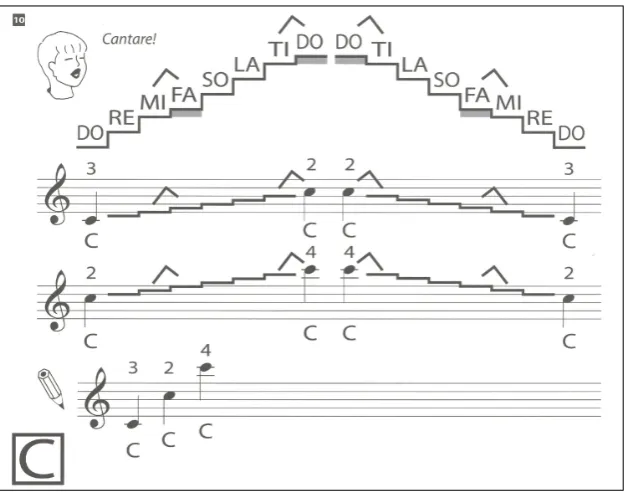
Solmisation is a device used in association with pitch to indicate melodic intervals
and employs the following syllabic names originally fashioned by Guido of Arezzo of
the eleventh-century: Do Re Mi Fa So La Ti. Relative solmisation (also referred to as
Tonic Sol-Fa) is a system that adopts these syllables for the purposes of aural
recognition. It was developed by Sarah Ann Glover (1785 – 1867) and pioneered by
John Curwen (1816 – 1880) in the 1840s as he connected the syllables with
signs.88 The syllables of the Major scale begin from Do and the minor scale is treated
as a mode of the Major, beginning from La.89Kodály adapted relative solmisation for
the use in Hungarian Schools, which became the primary musical language used for
singing.90
Colourstrings study begins with relative solmisation before introducing the students
to the alphabet names (A B C D E F G), which is the basis for a fixed system for
identifying pitch. By comparison, most violin methods begin with and only use the
fixed system of letter-names, or fixed solmisation.91 Szilvay employs the early use of
relative solmisation for the purposes of aural recognition so that the students avoid the
need of visual aids on the violin fingerboard, which subsequently allows for
transposition of songs to be played at any area of the fingerboard.92
Elements of violin technique in Szilvay’s teachings and in Colourstrings are
influenced from Paul Rolland.93 Rolland’s approach to teaching young violin students
was built on the objective of using natural physical movements when playing string
instruments. He formed ideas from Frederick Matthis Alexander (1869 – 1955)94 and
developed The Teaching of Action in String Playing in the 1960s. Throughout
Szilvay’s Handbook, statements and instructions frequently reflect Rolland’s ideas,
88 See Curwen Hand Signs: http://www.kodaly.org.au/wp-content/uploads/2015/12/handsign.pdf 89 Alterations of the solmisation syllables are indicated by change of vowel: sharps to ‘i’, and flats to ‘a’.
90Andrew Hughes and Edith Gerson-Kiwi, "Solmization," Grove Music Online. Oxford Music Online
(Oxford University Press), accessed July 21, 2016,
http://www.oxfordmusiconline.com/subscriber/article/grove/music/26154.
"Tonic Sol‐Fa." The Oxford Dictionary of Music, 2nd ed. rev.. Oxford Music Online. Oxford University Press, accessed July 21, 2016,
http://www.oxfordmusiconline.com/subscriber/article/opr/t237/e10334.
91 The syllables for Do, Re, Mi… are used in place of A, B, C… thus making them fixed to these pitches.
92 Szilvay, Handbook for Teachers and Parents (2010), 2. 93 Mitchell, “A Qualitative Study,” 28.
such as developing flexibility and encouraging relaxation, for example.95 Interesting
parallels between Szilvay and Rolland are that both dedicated their lives to string
teaching, both are Hungarian, and both had professional careers performing in string
quartets.
Kodály and Rolland’s influence on Colourstrings will be linked as much as possible
throughout this review of the materials. This is limited only because I am not a
qualified Kodály teacher;96 but have experience of over ten years worth of
accumulated Kodály-based training, including teacher workshops. Kodály’s writings,
publications of the Kodály Institute and studies concerned with Kodály and his
philosophies were reviewed to confirm and explore the impact of Kodály’s influences
on Szilvay’s Colourstrings.97
2.2 The Colourstrings Materials
The Colourstrings violin materials for analysis in this study consist of twenty-nine
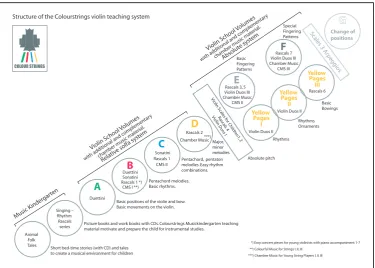
books, which are divided into different series.98 The structure of theviolin materials
is diagrammed in Figure 1, and identifies the three different series with brackets:
Music Kindergarten, Violin School Volumes A-D, and Violin School Volumes E, F
and Yellow Pages.
95 Szilvay, Handbook for Teachers and Parents (2010), 19.
96 The Australian Kodály Certificate (AKC) is the Australian fully accredited and nationally recognised program of teacher training in the Kodály Approach. See Kodály Music Education Institute of
Australia: http://www.kodaly.org.au.
97 Resources are included in the Bibliography.
98 This analysis will not include every page of the volumes but rather give a broader view of what a
Figure 2.1: The structure of the Colourstrings violin teaching system99
Within the second bracket, the series containing the central ‘Violin School Volumes’
in Figure 2.1, there are ‘Additional and Complementary Chamber Music Materials,’
‘Violin Scales for Children,’ ‘Violin Duos,’ and ‘Violin Rascals.’ These are separate
from the core Violin ABC and Yellow Pages volumes and will be discussed at the end
of this chapter. Preceding the ‘Violin School’ is the first series, the ‘Music
Kindergarten’ section, which includes materials that were also analysed. Since leading
educationists have claimed that the education from age zero to six has the greatest
impact on one’s life100 it was important for this research to investigate the
Colourstrings material targeted at these infancy years even though they are not
directly related to violin playing.
99 “Structure of the Colourstrings violin teaching system,” Colourstrings, accessed November 4, 2014, http://colourstrings.fi/downloads/Colourstrings%20taulukko.pdf.
100 Hattie, Selma, Giordano, Visible Learning for Teachers (New York: Routledge, 2012),19.
!"#"$%&'(%)*+'
Sc ales 3 A
rpeggios Violin Sc ales f or C hildr en1, 2 Rasc als 4 Violin D uos I A B E Change of positions F C D Yellow Pages I Yellow Pages II Yellow Pages III
Short bed-time stories (with CD) and tales to create a musical environment for children
Picture books and work books with CDs. Colourstrings Musickindergarten teaching material motivate and prepare the child for instrumental studies.
Basic positions of the violin and bow. Basic movements on the violin.
Pentachord melodies. Basic rhythms.
Pentachord, pentaton melodies. Easy rhythm combinations. Rhythms Absolute pitch Rhythms Ornaments Basic Fingering Patterns Special Fingering Patterns Basic Bowings Major, minor melodies Singing – Rhythm Rascals series Animal Folk Tales Music K inder garten Violin Scho ol Volumes
with additional and c omplemen
tary
chamb er music ma
terial.
Relativ e solfa sy
stem
Violin Scho ol Volumes
with additional and c omplemen
tary
chamb er music ma
terial.
Absolut e system
Rascals 2
Rascals 6
Chamber Music
Chamber Music
Chamber Music
Rascals 3, 5 Violin Duos III
Violin Duos II Violin Duos II
Rascals 1 Sonatini CMS II
CMS II
Rascals 7 Violin Duos III
CMS III
Rascals 1 *)Sonatini Duettini
Duettini
CMS I **)
*) Easy concert pieces for young violinists with piano accompaniment 1-7 **) Colourful Music for Strings I, II, III
***) Chamber Music for Young String Players I, II, III ***)
[image:38.595.113.489.71.339.2]