J. Lang (Ed.): TARK 2017
EPTCS 251, 2017, pp. 118–133, doi:10.4204/EPTCS.251.9
c
Weiwei Chen and Ulle Endriss This work is licensed under the Creative Commons Attribution License.
of Abstract Argumentation Frameworks
Weiwei Chen
Institute of Logic and Cognition and Department of Philosophy Sun Yat-sen University, P.R. China
ILLC, University of Amsterdam, The Netherlands [email protected]
Ulle Endriss
Institute for Logic, Language and Computation University of Amsterdam, The Netherlands
An abstract argumentation framework can be used to model the argumentative stance of an agent at a high level of abstraction, by indicating for every pair of arguments that is being considered in a debate whether the first attacks the second. When modelling a group of agents engaged in a debate, we may wish to aggregate their individual argumentation frameworks to obtain a single such framework that reflects the consensus of the group. Even when agents disagree on many details, there may well be high-level agreement on important semantic properties, such as the acceptability of a given argument. Using techniques from social choice theory, we analyse under what circumstances such semantic properties agreed upon by the individual agents can be preserved under aggregation.
1
Introduction
Formal argumentation theory provides tools for modelling both the arguments an agent may wish to employ in a debate and the relationships that hold between such arguments [4, 22, 23]. In the widely used system ofabstract argumentation, introduced in the seminal work of Dung [11], we abstract away from the internal structure of arguments and only model whether or not one argument attacksanother argument. This is a useful perspective when we require a high-level understanding of how different arguments relate to each other. But when several agents engage in a debate, they may differ on their assessment of some of the arguments and their relationships. How best to model such scenarios of collective argumentation is a question of considerable interest. Over the past decade or so, several authors have started to contribute to its resolution (see, e.g., [1, 5, 7, 8, 9, 13, 24, 25]).
Specifically, when agents differ on their assessment of which attacks between the arguments are in fact justified, i.e., when they put forward differentattack-relations, we may wish toaggregatethese indi-vidual pieces of information to obtain a global view. In this paper, we analyse under what circumstances a givenaggregation rulewillpreserve relevant properties of the individual attack-relations, particularly properties that relate to the various semanticsthat have been proposed for abstract argumentation. For example, if all agents agree that argumentAisacceptable, either because it is not attacked by any other argument or because it can be successfully defended against any such attack, then we would likeAto also be considered acceptable relative to the attack-relation returned by our aggregation rule. Thus,argument acceptabilityis an example for a property that, ideally, should be preserved under aggregation.
how fundamental axiomatic properties of aggregation rules interact with such preservation requirements. Our technical results range from characterisation results that indicate what kind of aggregation rule can satisfy certain combinations of desiderata, to impossibility results that show that only aggregation rules that are clearly unacceptable from an axiomatic point of view (namely, so-called dictatorships) can pre-serve the most demanding semantic properties.
This paper is organised as follows. Section 2 is a brief review of relevant concepts from the theory of abstract argumentation. Section 3 introduces our model and Section 4 present our technical results on the preservation of semantic properties under aggregation. Finally, we discuss related work in Section 5 and conclude, in Section 6, with suggestions for possible directions for future work.
2
Abstract Argumentation
In this section, we recall some of the fundamentals of abstract argumentation as originally introduced by Dung [11]. Anargumentation frameworkis a pairAF=hArg, ⇀i, whereArgis a finite set ofarguments and⇀ is an irreflexive binary relation onArg.1 IfA⇀Bholds for two argumentsA,B∈Arg, we say that A attacks B. Anattack-relation (⇀)⊆Arg×Arg is made up of a set ofattacks att∈Arg×Arg. For a set of arguments∆⊆Argand an argumentB∈Arg, we say that∆attacksB, denoted as∆⇀B, if
A⇀Bholds for some argumentA∈∆. Given an argumentation frameworkAF, the question arises which
arguments to accept. For example, we may not want to accept two arguments that attack each other. A semanticsfor abstract argumentation specifies which sets of arguments can be accepted together. Any such set of arguments is called anextensionofAFunder the semantics in question.
For all the definitions of specific choices of semantics that follow, consider an arbitrary but fixed argumentation frameworkAF=hArg, ⇀iand a set of arguments∆⊆Arg. We say that∆isconflict-free,
if there exist no argumentsA,B∈∆such thatA⇀B. We further say that∆defendsthe argumentB∈Arg,
if∆⇀Afor all argumentsA∈Argsuch thatA⇀B. Finally, ∆is calledadmissibleif it is conflict-free
and defends every single one of its members.
Definition 1. A stable extensionof AF is a conflict-free set ∆of arguments in Arg that attacks every
other argument B∈Arg\∆.
Definition 2. Apreferred extensionof AF is an admissible set of arguments in Arg that is maximal with respect to set inclusion.
Definition 3. Acomplete extensionof AF is an admissible set of arguments in Arg that includes all of the arguments it defends.
The characteristic function of AF is the function fAF : 2Arg→ 2Arg with fAF :∆7→ {A∈Arg |
∆defendsA}, mapping any given set of arguments inArgto the set of arguments it defends.
Definition 4. Thegrounded extensionof AF is the least fixed point of its characteristic function fAF.
We can compute the grounded extension∆by initialising∆with the empty set /0 and then repeatedly
executing the program∆:= fAF(∆), until no more changes occur. Unlike for the other three semantics,
there always is exactly one grounded extension. However, that extension may be empty. It is nonempty if and only if there is at least one unattacked argument.
How do these semantics relate to each other? Every stable extension is also a preferred extension. The set of stable extensions may be empty, while there always is at least one preferred extension. Every
A B
C D
A B
C D
A B
C D
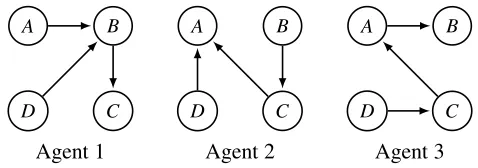
[image:3.612.186.425.69.153.2]Agent 1 Agent 2 Agent 3
Figure 1: Example for a profile withArg={A,B,C,D}.
preferred extension is also a complete extension. Finally, the grounded extension is always a complete extension as well.
An interesting question is under what circumstances two or more semantics coincide. Probably the clearest example is the case of an acyclic attack-relation: if ⇀ does not include any cycles, then the grounded extension is also the only stable extension, the only preferred extension, and the only complete extension. A weaker condition iscoherence: AFis calledcoherentif every preferred extension ofAFis stable, i.e., if the two semantics coincide.
3
The Model
Fix a finite set of arguments Arg. Let N={1, . . . ,n} be a finite set of n agents. Suppose each agent i∈N supplies us with an argumentation framework AFi =hArg, ⇀ii, reflecting her individual views
on the status of possible attacks between arguments. Thus, we are given a profile of attack-relations
⇀
⇀⇀= (⇀1, . . . , ⇀n).2 What would be a good method of aggregating these individual argumentation
frameworks to arrive at a single argumentation framework that appropriately reflects the views of the group as a whole? This is the central question we address in this paper. Anaggregation ruleis a function F:(Arg×Arg)n→Arg×Argmapping any given profile of attack-relations into a single attack-relation.
Example 1. The first aggregation rule that comes to mind is the majority rule: include attack A⇀B in the outcome if and only if a (weak) majority of the individual agents do. If we apply this rule to the profile shown in Figure 1, we obtain an argumentation framework with A⇀B, B⇀C, and C⇀A. △
In the remainder of this section, we first define a number of specific aggregation rules and review their properties. We focus on simple rules that are adaptations of well-known rules used in the social choice literature, particularly in judgment aggregation [17] and graph aggregation [14]. We then adapt several standardproperties of aggregation rules, known asaxiomsin that same literature, to our setting. Finally, we review several semanticproperties of argumentation frameworksand formulate the question of whether a given rule willpreservesuch a property.
3.1 Aggregation Rules
Recall that an aggregation rule is a functionF, mapping any given profile⇀⇀⇀= (⇀1, . . . , ⇀n)∈(Arg×
Arg)nof attack-relations to a single attack-relationF(⇀⇀⇀)⊆Arg×Arg. We sometimes write(A⇀B)∈
F(⇀⇀⇀)for (A,B)∈F(⇀⇀⇀). We useNatt⇀⇀⇀:={i∈N|att∈(⇀i)} to denote the set ofsupporters of the
attackattin profile⇀⇀⇀.
Definition 5. Let q ∈ {1, . . . ,n}. Thequota rule Fq with quota q accepts all those attacks that are
supported by at least q agents:
Fq(⇀⇀⇀) = {att∈Arg×Arg|#Natt⇀⇀⇀>q}
Theweak majority ruleis the quota ruleFqwithq=⌊n2⌋and thestrict majority ruleis the quota rule
Fq withq=⌈n2⌉. Two further quota rules are also of special interest. Theunanimity ruleonly accepts
attacks that are supported by everyone, i.e., this isFqwithq=n. Thenomination ruleis the quota rule
Fqwithq=1. Despite being a somewhat extreme choice, the nomination rule has some intuitive appeal
in the context of argumentation, as it reflects the idea that we should take seriously any conflict between arguments raised by at least one member of the group.
Definition 6. Let C∈2N\ {/0} be a nonempty coalition of agents. Theoligarchic ruleFC accepts all
those attacks that are accepted by all members of C:
FC(⇀⇀⇀) = {att∈Arg×Arg|C⊆Natt⇀⇀⇀}
Thus, any member of the oligarchyCcanvetoan attack from being accepted. Observe that the una-nimity rule can also be characterised as the oligarchic ruleFCwithC=N. A subclass of the oligarchic
rules are thedictatorships. The dictatorship of dictatori∈Nis the oligarchic ruleFCwithC={i}. Thus,
under a dictatorship, to compute the outcome, we simply copy the attack-relation of the dictator. Intu-itively speaking, oligarchic rules, and dictatorships in particular, are unattractive rules, as they unfairly exclude everyone not inCfrom the decision process.
Some rules combine features of the quota rules and the oligarchic rules. For example, we may choose to accept an attack only if it is accepted by(i)a weak majority of all agents and(ii)a small number of distinguished agents to which we want to give the right to veto attacks. Such rules (sometimes called qualified majority rules) are certainly more attractive than the oligarchic rules, but they are still unfair in the sense of granting some agents more influence than others.
Definition 7. Agent i∈N hasveto powersunder aggregation rule F , if F(⇀⇀⇀)⊆(⇀i)for every profile⇀⇀⇀.
Thus, under an oligarchic rule FC the agents in C, and only those, have veto powers. With the
exception of the unanimity rule, a quota rule does not grant veto powers to any agent.
3.2 Axioms
Next, we introduce some basicaxioms, encoding intuitively desirable properties of an aggregation ruleF:
Definition 8. F isanonymous, if F(⇀⇀⇀) =F(⇀π(1), . . . , ⇀π(n))holds for all profiles⇀⇀⇀and all permu-tationsπ:N→N.
Definition 9. F isneutral, if Natt⇀⇀⇀=Natt⇀⇀⇀′ implies att∈F(⇀⇀⇀)⇔att′∈F(⇀⇀⇀)for all profiles⇀⇀⇀and all attacks att, att′.
Definition 10. F isindependent, if Natt⇀⇀⇀=Natt⇀⇀⇀′′′ implies att∈F(⇀⇀⇀)⇔att∈F(⇀⇀⇀′′′)for all profiles⇀⇀⇀,
⇀
⇀⇀′′′and all attacks att.
Definition 11. F ismonotonic, if Natt⇀⇀⇀⊆Natt⇀⇀⇀′′′(together with Natt⇀⇀⇀′=N⇀⇀⇀ ′′′
att′ for all attacks att′6=att) implies att∈F(⇀⇀⇀)⇒att∈F(⇀⇀⇀′′′)for all profiles⇀⇀⇀,⇀⇀⇀′′′and all attacks att.
Definition 12. F isunanimous, if F(⇀⇀⇀)⊇(⇀1)∩ · · · ∩(⇀n)holds for all profiles⇀⇀⇀= (⇀1, . . . , ⇀n).
Anonymity is a symmetry (and thus fairness) requirement regarding agents, and neutrality is a sym-metry requirement regarding attacks. Independence expresses that whether an attack is accepted should only depend on its supporters. Monotonicity says that additional support for an accepted attack should never cause it to be rejected. Unanimity postulates that an attack supported by everyone must be accepted, while groundedness means that only attacks with at least one supporter can be collectively accepted.3
We observe that all quota rules and all oligarchic rules are easily seen to be unanimous, grounded, neutral, independent, and monotonic. The quota rules furthermore are also anonymous. In fact, it is not difficult to adapt a well-known result from judgment aggregation to our setting [10], so as to see that the quota rules arethe onlyaggregation rules that satisfy all of these six axioms (see also [14]).
3.3 Preservation of Semantic Properties
Typically, agents will disagree about which attacks are justified. But even then, there may be high-level agreement on certain features. For example, they may all agree that, under a particular semantics, argumentAis acceptable. Whenever we observe such agreement on semantic features in a profile, we would like those features to be preserved under aggregation. Thus, for our example, under the same semantics, we would like A to be acceptable also in the argumentation framework computed by our aggregation rule. In other words, we are interested in the preservation of properties of argumentation frameworks under aggregation. Formally, anAF-property P⊆2Arg×Argis simply the set of all attack-relations onArgthat satisfyP. But in the interest of readability, we writeP(⇀)rather than(⇀)∈P.
Definition 14. Let F be an aggregation rule and let P be an AF-property. We say that F preservesP, if for every profile⇀⇀⇀we have that P(⇀i)being the case for all agents i∈N implies P(F(⇀⇀⇀)).
This notion of preservation is known under the name ofcollective rationality in other parts of social choice theory [3, 14, 20].
We now review the specific AF-properties for which we study preservation in this paper. Two of them we have already introduced in Section 2, namelyacyclicityandcoherence. They are attractive properties, because—if satisfied by an argumentation framework—they reduce our dependence on a specific choice of semantics, thereby making decisions less controversial.
Recall that the grounded extension may be empty, i.e., this semantics may not suggest any arguments to be accepted. Thus, argumentation frameworks that satisfy the AF-property of nonemptiness of the grounded extensionare of particular interest.
LetA∈Argbe one of the arguments under consideration. Then, for any given argumentation frame-work,Amay or may not belong to the grounded extension. Thus, everyA∈Argdefines an AF-property, namely the property of membership ofAin the grounded extension, i.e., of acceptance of Aunder the grounded semantics. We say thatF preserves argument acceptability under the grounded semantics, if it is the case that, for all argumentsA∈Arg, wheneverAbelongs to the grounded extension ofhArg, ⇀ii
for alli∈N, thenAalso belongs to the grounded extension ofhArg,F(⇀⇀⇀)i. For the stable, preferred, and complete semantics, we require a more refined definition, given that extensions under these semantics need not be unique. We say thatF preserves argument acceptability under the stable semantics, if it is the case that, for all argumentsA∈Arg, wheneverAbelongs tosomestable extension ofhArg, ⇀iifor all
agentsi∈N, thenAalso belongs tosomestable extension ofhArg,F(⇀⇀⇀)i. The corresponding concepts for the preferred and the complete semantics are defined accordingly.4
3Note that, in line with the existing literature in argumentation theory on the one hand and social choice theory on the other, we use the term “grounded” in two unrelated ways in this paper (grounded extensionsvs.grounded aggregation rules).
Rather than just preserving the acceptability status of a single argument, we may also be interested in preserving entire extensions. For example, we say thatF preserves extensions under the stable semantics, if it is the case that, for all sets∆⊆Arg, whenever∆is a stable extension ofhArg, ⇀iifor all agentsi∈N,
then∆is also a stable extension ofhArg,F(⇀⇀⇀)i. Again, the corresponding concept can also be defined
for the other three semantics. Similarly, we say thatF preserves conflict-freeness, if it is the case that, for all sets∆⊆Arg, whenever∆is conflict-free inhArg, ⇀iifor all agentsi∈N, then∆is also conflict-free
hArg,F(⇀⇀⇀)i. Finally,preservation of admissibilityis defined accordingly.
To summarise, we have identified the following AF-properties that, in case all agents agree on one of them being satisfied, we would like to see preserved under aggregation:
• acyclicityandcoherence(reducing semantic ambiguity),
• nonemptiness of the grounded extension(enabling a sceptical approach to argument evaluation), • argument acceptability under different semantics (allowing for agreement on arguments even in
the face of disagreement on the attacks between them), and
• being an extensionunder one of the four semantics or being either aconflict-freeor anadmissible set(also allowing for semantic agreement despite disagreement on attacks).
Example 2. Consider again the profile of Figure 1 and recall that the (weak or strict) majority rule will return the argumentation framework with A⇀B, B⇀C, and C⇀A. Thus, the majority rule does not preserve acyclicity.5 What about some of the other AF-properties? The grounded extension of AF1 is {A,C,D}, that of AF2 is {B,D}, that of AF3 is {A,D}, and that of the majority outcome is {D}. Thus, preservation of both nonemptiness of the grounded extension and argument acceptability under the grounded semantics are not violated by this particular example (which, of course, is not to say that
they might not be violated for other profiles). △
4
Preservation Results
In this section, we present our results on the preservation of semantic properties under aggregation. We begin with argument acceptability, and then turn to the various properties of sets of arguments, and eventually to acyclicity and coherence.
4.1 Acceptability of an Argument
Our first result is going to demonstrate that preserving acceptability of an argument when using a “sim-ple” aggregation rule is impossible, unless we are willing to use a dictatorship. This is true under any of the four semantics. To prove this result—and some of those that follow—we are going to use a technique developed by Endriss and Grandi [14] for the more general framework of graph aggregation, which in turn has been inspired by the seminal work on preference aggregation of Arrow [3]. It amounts to show-ing that, under certain assumptions, the collection of coalitions of agents that are sufficiently powerful to force collective acceptance of an attack must form an ultrafilter.
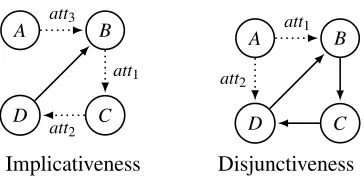
Using our present terminology, Endriss and Grandi [14, Theorem 18] show that, for|Arg|>3, any unanimous, grounded, neutral, and independent aggregation ruleF that preserves some AF-propertyP must be a dictatorship wheneverP belongs to what they call the family ofimplicative and disjunctive properties.Pisimplicativeif there exist a setAtt⊆Arg×Argof attacks and three attacksatt1,att2,att3∈ Arg×Arg\Attsuch that, for anyS⊆ {att1,att2,att3}, we haveP(Att∪S)if and only ifS6={att1,att2}.
Thus,Pshould require that, in the context ofAtt, acceptingatt1 andatt2implies accepting att3(and all seven patterns of acceptance consistent with that requirement are possible).Pisdisjunctiveif there exist Att⊆Arg×Argandatt1,att2∈Arg×Arg\Attsuch that, for anyS⊆ {att1,att2}, we haveP(Att∪S)if and only ifS6=/0. Thus,Pshould require that, givenAtt, we must accept at least one ofatt1andatt2(and all three patterns of acceptance consistent with that requirement are possible).6
In the appendix, we show that, under any of the four semantics and for|Arg|>4, the property of argument acceptability is both implicative and disjunctive. Thus, we obtain the following impossibility result, showing that there exists no aggregation rule that satisfies all of our requirements:
Theorem 1. Let P be the property of argument acceptability under either the grounded, the stable, the preferred, or the complete semantics. For|Arg|>4, any unanimous, grounded, neutral, and independent aggregation rule F that preserves P must be a dictatorship.
This is bad news. For scenarios with|Arg|63, we can do better and show that also the nomination rule preserves argument acceptability. In the interest of space, we omit the details and also do not discuss such boundary conditions for our remaining results.
4.2 Conflict-Freeness and Admissibility
Argument acceptability is a property that relates to asingleargument. Next, we turn to properties that relate tosetsof arguments. Our most basic property of sets of arguments is preserved under essentially all reasonable aggregation rules:
Theorem 2. Every aggregation rule F that is grounded preserves conflict-freeness.
Proof. LetF be an aggregation rule that isgrounded. Consider any set∆⊆Argand any profile⇀⇀⇀=
(⇀1, . . . , ⇀n)such that∆is conflict-free inhArg, ⇀iifor alli∈N. For the sake of contradiction, assume
∆isnotconflict-free inhArg,F(⇀⇀⇀)i, i.e., there exist two argumentsA,B∈∆such that(A⇀B)∈F(⇀⇀⇀).
Due to the groundedness ofF, there then must be at least one agenti∈Nsuch that alsoA⇀iB, i.e.,∆
is not conflict-free inhArg, ⇀iieither, in contradiction to our original assumption.
For admissibility, we obtain a significantly less broad but still positive result. It shows that there exists a reasonable rule that preserves the admissibility of arbitrary sets of arguments:
Theorem 3. For|Arg|>4, the only unanimous, grounded, anonymous, neutral, independent, and mono-tonic aggregation rule F that preserves admissibility is the nomination rule.
Proof. We first show that thenomination ruleindeed preservesadmissibility. So letFbe the nomination rule. Consider any set∆⊆Argand any profile⇀⇀⇀= (⇀1, . . . , ⇀n)such that ∆is admissible inAFi=
hArg, ⇀iifor alli∈N. For the sake of contradiction, assume∆isnotadmissible inhArg,F(⇀⇀⇀)i, i.e.,
there is an argumentA∈∆that, inF(⇀⇀⇀), is attacked by an argumentB∈Arg\∆and there does not exist
aC∈∆such that(C⇀B)∈F(⇀⇀⇀). As(B⇀A)∈F(⇀⇀⇀)and asF is grounded, we must haveB⇀iA
for somei∈N. And as there does not exist aC∈∆such that(C⇀A)∈F(⇀⇀⇀), given the definition of
the nomination rule, there cannot exist an argumentC∈∆such thatC⇀iAfor that same agenti. Hence, ∆is not admissible inAFi, in contradiction to our original assumption.
We still need to show that there can be no other aggregation rule than the nomination rule that preserves admissibility and that satisfies all of the axioms mentioned in the statement of Theorem 3.
A B
C D
A B
C D
A B
C D
[image:8.612.191.422.67.154.2]q−1 agents 1 agent n−qagents
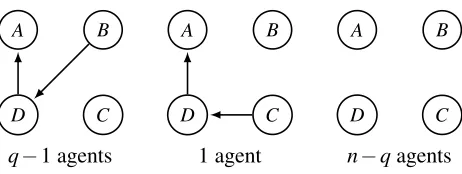
Figure 2: Profile used in the proof of Theorem 3.
By the characterisation result for quota rules due to Dietrich and List [10] in the context of judgment aggregation, which has been adapted to graph aggregation by Endriss and Grandi [14] and which we have briefly recalled near the end of Section 3.1, this claim is equivalent to the claim thatno quota rule Fqwith a quotaq>1 always preserves admissibility. So let us prove this.
Consider the generic profile shown in Figure 2 (and note thatq>1 ensuresq−1>0, i.e., there is at least one agent of the first kind). The set{A,B,C}is admissible in all argumentation frameworks in such a profile. But when we aggregate using a quota ruleFqwith a quotaq>1, we obtain an argumentation
framework with a single attackD⇀A, which means thatAcannot be part of any admissible set. Hence, no such rule can preserve admissibility.
4.3 The Property of Being an Extension
We continue our examination of properties relating to sets of arguments and turn to the property of being an extension of a given argumentation framework. The following result can again be proved by reference to the result of Endriss and Grandi [14]:
Theorem 4. For|Arg|>5, any unanimous, grounded, neutral, and independent aggregation rule F that preserves grounded extensions must be a dictatorship.
The required proof of the fact that all three properties are both implicative and disjunctive can be found in the appendix. We conjecture that Theorem 4 can be extended to the preferred and the com-plete semantics. The added difficulty lies in the fact that these semantics admit multiple extensions. Interestingly, for stable extensions we obtain a much more positive result:
Proposition 5. The nomination rule preserves stable extensions.
Proof. LetFbe thenomination rule. Consider any set∆⊆Argand any profile⇀⇀⇀= (⇀1, . . . , ⇀n)such
that∆is stable inhArg, ⇀iifor alli∈N. According to Theorem 2, given thatFis grounded,Fpreserves
conflict-freeness. Thus,∆is conflict-free inhArg,F(⇀⇀⇀)i.
What remains to be shown is that∆attacks every argumentB∈Arg\∆. In case∆=Arg, the claim
holds vacuously. Otherwise, consider an arbitrary argument B∈Arg\∆. We need to show that Bis
attacked by some argument in∆inF(⇀⇀⇀). Take the argumentation frameworkAFi=hArg, ⇀iifor some
i∈N. As∆is stable inAFiby assumption, there exists an argumentA∈∆such thatA⇀iB. AsFis the
nomination rule, we also get(A⇀B)∈F(⇀⇀⇀)as claimed.
4.4 Nonemptiness of the Grounded Extension
of the grounded extension? The good news is that we can do better for this property. For instance, it is easy to check that the unanimity rule preserves nonemptiness of the grounded extension. Still, as we shall see next, we cannot domuchbetter: only rules that grant veto powers to some agents will work.
Recall that the grounded extension is nonempty if an only if at least one argument is not attacked by any other argument. Thus, this AF-property is about the absence of attacks, while the technique we employed to prove Theorem 4 (and Theorem 1) exploits the presence of certain attacks. We are now going to present our preservation result regarding the nonemptiness of the grounded extension as a corollary to a more general theorem about the preservation of AF-properties that require the absence of certain attacks. Letk∈N. Let us call an AF-propertyP k-exclusive if there existkdistinct attacks att1, . . . ,attk∈Arg×Argsuch that (i){att1, . . . ,attk} ⊆(⇀)for no attack-relation ⇀ withP(⇀), and
(ii)for everyS({att1, . . . ,attk}there exists an attack-relation⇀such thatS⊆(⇀)andP(⇀). Thus,
you cannot accept allkattacks, but you should be able to accept any proper subset of them. We are able to prove the following powerful theorem (recall thatnis the number of agents inN):
Theorem 6. Let k>n and let P be an AF-property that is k-exclusive. Then under any neutral and independent aggregation rule F that preserves P at least one agent must have veto powers.
Proof. Letk>n, let Pbe an AF-property that isk-exclusive, and letF be an aggregation rule that is neutral and independent. We need to show that, ifF preserves P, then F must give some agents the power to veto the collective acceptance of attacks.
First, observe that, if an aggregation ruleF is neutral and independent, then we can describeF by listing all the coalitionsC⊆Nfor which it is the case that, whenever exactly the agents inCsupport an attackatt, thenattmust be collectively accepted. Indeed, independence says that acceptance of an attack should only depend on its supporters, and neutrality adds that this dependence must be the same for all attacks. More formally, there exists a family ofwinning coalitionsW ⊆2N such that, for all profiles⇀⇀⇀
and all potential attacksatt∈Arg×Arg, the following relationship holds:
att∈F(⇀⇀⇀) if and only if Natt⇀⇀⇀∈W
Recall thati∈Nhaving veto powers underF means thatF(⇀⇀⇀)⊆(⇀i)for every profile⇀⇀⇀. We can
now show that an agenti∈Nhas veto powers, if she is a member of all winning coalitions:
i∈ \
C∈W
C implies F(⇀⇀⇀)⊆(⇀i)for all profiles⇀⇀⇀
IfT
C∈WC= /0, then the above claim holds vacuously. Otherwise, take any attackatt∈F(⇀⇀⇀). As attgot accepted, Natt⇀⇀⇀ must be a winning coalition, i.e.,Natt⇀⇀⇀∈W and therefore i∈Natt⇀⇀⇀. But this is just
another way of sayingatt∈(⇀i), so we are done.
Next, we are going to show that the fact thatF preserves thek-exclusive AF-propertyPimplies that the intersection of anykwinning coalitions must be nonempty:
C1∩ · · · ∩Ck6=/0 for allC1, . . . ,Ck∈W
For the sake of contradiction, assume there do exist winning coalitions C1, . . . ,Ck∈W such that
C1∩ · · · ∩Ck= /0. We construct a profile ⇀⇀⇀= (⇀1, . . . , ⇀n)with P(⇀i)for alli∈N as follows: for
every j∈ {1, . . . ,k}, exactly the agents inCj accept attack attj (for all other attacks, it is irrelevant
which agents accept them). As no agent is a member of allk winning coalitions, no agent accepts all k attacks, so this construction indeed is possible. However, as each of thek attacks is supported by a winning coalition, they all get accepted, i.e.,{att1, . . . ,attk} ⊆F(⇀⇀⇀), meaning that the outcome doesnot
Let us briefly recap where we are at this point. We know that F is characterised by a family of winning coalitionsW. We also know thatC1∩ · · · ∩Ck6=/0 for allC1, . . . ,Ck∈W. We need to show that
some agents have veto powers, and we know that this is the case if we can prove thatC(1)∩ · · · ∩C(ℓ)6=/0, where{C(1), . . . ,C(ℓ)}is some enumeration of the coalitions inW. Thus, we are done, if we can show thatC1∩ · · · ∩Ck6= /0 for all C1, . . . ,Ck ∈W impliesC(1)∩ · · · ∩C(ℓ)6= /0. We are going to prove the
contrapositive, namely that the following holds forsome C1, . . . ,Ck∈W:
C(1)∩ · · · ∩C(ℓ)=/0 implies C1∩ · · · ∩Ck=/0
In words, we need to show that in case the intersection ofallwinning coalitions is empty, then so is at least one intersection of justkwinning coalitions.
Recall that we have assumedk>n. We construct a setW′⊆W ofk(or fewer) winning coalitions
as follows. Initially, setW′:=/0. Then, for every jfrom 1 toℓin turn, addC(j)toW′if and only if the
following condition is satisfied:7
C(j) ∩ \
C∈W′ C
!
( \
C∈W′ C
!
Thus, every additionalC(j)is selected only if it causes the removal of at least one further agent from the intersection. As there are only n agents, we therefore will pick at most n coalitions. Hence, we will indeed arrive at a familyW′ ofnor fewer—and thus certainly at most k—winning coalitions, the
intersection of which is empty. This completes the proof.
It now suffices to show that the property of having a nonempty grounded extension is an |Arg|-exclusive property to obtain the following result (the proof of this fact can be found in the appendix):
Theorem 7. If|Arg|>n, then under any neutral and independent aggregation rule F that preserves nonemptiness of the grounded extension at least one agent must have veto powers.
It is not difficult to prove that the converse holds as well: all rules that grant veto powers to at least one agent preserve nonemptiness of the grounded extension.
4.5 Acyclicity and Coherence
Finally, if we apply our techniques to the properties of acyclicity and coherence, we obtain the following results (the proofs of which can be found in the appendix):8
Theorem 8. If|Arg|>n, then under any neutral and independent aggregation rule F that preserves acyclicity at least one agent must have veto powers.
Theorem 9. For|Arg|>4, any unanimous, grounded, neutral, and independent aggregation rule F that preserves coherence must be a dictatorship.
Thus, surprisingly, even though acyclicity is a stronger property than coherence, it is easier to pre-serve under aggregation.
7By convention, letT
C∈/0C=N, i.e., the intersection ofnowinning coalitions is defined as the universeNofallagents. 8Theorem 8 was anticipated in the work of Tohm´e et al. [25], who make a similar claim, but without appealing to the neutrality axiom. We stress that Theorem 8 cannot be strengthened by dropping neutrality. Indeed, there are rules that preserve acyclicity, that are independent (but not neutral), and that do not give veto powers to any of the agents. An example, for
5
Related Work
In this section, we briefly review related work on the aggregation of abstract argumentation frameworks. Coste-Marquis et al. [8] were the first to address this problem, but without making explicit reference to social choice theory. Instead, they focus on aggregation rules that minimise thedistance between the input argumentation frameworks and the output argumentation framework.
Tohm´e et al. [25] were the first to explicitly use social choice theory to analyse the aggregation of argumentation frameworks. Their focus is on the preservation of acyclicity and they show that qualified majority rules (which grant veto powers to some agents) will always preserve this property.
Dunne et al. [13] define several preservation requirements on aggregation rules that directly refer to the semantics of the argumentation frameworks concerned. This includes variants of what we call preser-vation of extensions (“σ-unanimity”) and preservation of argument acceptability (“credulous acceptance
unanimity”). Their focus is on analysing the computational complexity of deciding whether a given ag-gregation rule has a given property, rather than on the axiomatic method. In follow-up work, Delobelle et al. [9] establish for several concrete rules whether or not they satisfy the preservation requirements introduced by Dunne et al. [13].
While Endriss and Grandi [14] explicitly mention abstract argumentation as a possible domain of application for the model of graph aggregation they develop, they do not present any technical results related to argumentation.
Airiau et al. [1] introduce the concept of the rationalisability of a profile of argumentation frame-works. A profile is rationalisable if the diversity of views it contains can be explained in terms of(i)an underlying factual argumentation framework shared by all agents and(ii)everyone’s individual prefer-ences. Thus, their work is concerned with understanding what kind of profiles a good aggregation rule should be able to deal with, rather than with aggregation itself.
Finally, social choice theory has also been used to analyse the aggregation of differentextensionsfor one argumentation framework see, (e.g., [7, 24]). We note that this problem is different from the one studied here and refer to the survey by Bodanza et al. [5] for a comparison.
6
Conclusion
Using a variety of techniques, we have attempted to paint a clear picture of the capabilities and limitations of simple aggregation rules regarding the preservation of properties related to the semantics of abstract argumentation frameworks. While the significance of this issue and the promise of social choice theory for its resolution have previously been emphasised in the work of several authors [5, 9, 13, 25], this is the first systematic analysis of its kind. Our results show that only the most basic of properties, namely conflict-freeness, is preserved by essentially all rules. More demanding properties require either the nomination rule, a rule granting some agents veto powers, or a rule that is dictatorial.
We stress that these results only apply to simple rules, in particular, to rules that satisfy the axiom of independence. An alternative route, the one chosen by Coste-Marquis et al. [8], is to use distance-based rules (which violate independence). Such rules can be designed so as to guarantee specific properties of the outcome, so the question of preservation does not arise. On the downside, distance-based rules are computationally intractable [15, 18, 19]. We also stress that our results are based on the assumption that all agents report attack-relations over a singlecommonset of arguments. Richer models, where different agents may be aware of different sets of arguments, are clearly of great interest as well.
preser-vation of preferred and complete extensions should get settled. Second, one could study further proper-ties of argumentation frameworks. We have already hinted at the possibility of distinguishing between argument acceptability insomeextensions (the property studied in this paper) and argument acceptabil-ity inallextensions. Third, we should eventually go beyond the four classical semantics introduced by Dung [11] and also consider others, such as thesemi-stable semantics [6] or theideal semantics [12]. Fourth, one could vary the axioms imposed on aggregation rules. The most immediately promising direction here would be to investigate whether neutrality can be replaced by additional preservation requirements, in analogy to results in preference and graph aggregation [3, 14]. Finally, it would be in-teresting to investigate the strategic incentives of agents who are reporting an argumentation framework to an aggregation rule and whose objective might be to get a certain argument accepted.
Acknowledgements. We would like to thank Sirin Botan, Umberto Grandi, Ronald de Haan, and Zoi Terzopoulou for numerous enlightening discussions on the material presented in this paper and three anonymous reviewers for their constructive feedback.
References
[1] S. Airiau, E. Bonzon, U. Endriss, N. Maudet & J. Rossit (2016): Rationalisation of Profiles of Abstract Argumentation Frameworks. In: Proceedings of the 15th International Conference on Autonomous Agents and Multiagent Systems (AAMAS).
[2] K.J. Arrow, A.K. Sen & K. Suzumura, editors (2002): Handbook of Social Choice and Welfare. North-Holland.
[3] K.J. Arrow (1963): Social Choice and Individual Values, 2nd edition. John Wiley and Sons. First edition published in 1951.
[4] P. Besnard & A. Hunter (2008): Elements of Argumentation. MIT Press, doi:10.7551/mitpress/9780262026437.001.0001.
[5] G.M. Bodanza, F.A. Tohm´e & M.R. Auday (2017): Collective Argumentation: A Survey of Ag-gregation Issues around Argumentation Frameworks. Argument & Computation 8(1), pp. 1–34, doi:10.3233/AAC-160014.
[6] M. Caminada (2006):Semi-stable Semantics. In: Proceedings of the 1st International Conference on Com-putational Model of Argument (COMMA), IOS Press.
[7] M. Caminada & G. Pigozzi (2011): On Judgment Aggregation in Abstract Argumentation. Journal of Au-tonomous Agents and Multiagent Systems22(1), pp. 64–102, doi:10.1007/s10458-009-9116-7.
[8] S. Coste-Marquis, C. Devred, S. Konieczny, M.-C. Lagasquie-Schiex & P. Marquis (2007): On the Merging of Dung’s Argumentation Systems. Artificial Intelligence 171(10–15), pp. 730–753, doi:10.1016/j.artint.2007.04.012.
[9] J. Delobelle, S. Konieczny & S. Vesic (2015): On the Aggregation of Argumentation Frameworks. In: Pro-ceedings of the 24th International Joint Conference on Artificial Intelligence (IJCAI).
[10] F. Dietrich & C. List (2007):Judgment Aggregation by Quota Rules: Majority Voting Generalized. Journal of Theoretical Politics19(4), pp. 391–424, doi:10.1177/0951629807080775.
[11] P.M. Dung (1995): On the Acceptability of Arguments and its Fundamental Role in Nonmonotonic Reasoning, Logic Programming and n-Person Games. Artificial Intelligence 77(2), pp. 321–358, doi:10.1016/0004-3702(94)00041-X.
[13] P.E. Dunne, P. Marquis & M. Wooldridge (2012): Argument Aggregation: Basic Axioms and Complex-ity Results. In: Proceedings of the 4th International Conference on Computational Models of Argument (COMMA), IOS Press, doi:10.3233/978-1-61499-111-3-129.
[14] U. Endriss & U. Grandi (2017): Graph Aggregation. Artificial Intelligence 245, pp. 86–114, doi:10.1016/j.artint.2017.01.001.
[15] U. Endriss, U. Grandi & D. Porello (2012): Complexity of Judgment Aggregation. Journal of Artificial Intelligence Research (JAIR)45, pp. 481–514, doi:10.1613/jair.3708.
[16] W. Gaertner (2006): A Primer in Social Choice Theory. LSE Perspectives in Economic Analysis, Oxford University Press, doi:10.1007/s00355-007-0273-9.
[17] D. Grossi & G. Pigozzi (2014): Judgment Aggregation: A Primer. Synthesis Lec-tures on Artificial Intelligence and Machine Learning, Morgan & Claypool Publishers, doi:10.2200/S00559ED1V01Y201312AIM027.
[18] E. Hemaspaandra, H. Spakowski & J. Vogel (2005): The Complexity of Kemeny Elections. Theoretical Computer Science349(3), pp. 382–391, doi:10.1016/j.tcs.2005.08.031.
[19] S. Konieczny, J. Lang & P. Marquis (2004):DA2Merging Operators. Artificial Intelligence157(1-2), pp. 49–79, doi:10.1016/j.artint.2004.04.008.
[20] C. List & P. Pettit (2002):Aggregating Sets of Judgments: An Impossibility Result. Economics and Philoso-phy18(1), pp. 89–110, doi:10.1017/S0266267102001098.
[21] I. McLean & A.B. Urken, editors (1995): Classics of Social Choice. University of Michigan Press, doi:10.3998/mpub.12736.
[22] S. Modgil, N. Oren & F. Toni, editors (2012):Proceedings of the 1st International Workshop on Theory and Applications of Formal Argumentation (TAFA). Springer-Verlag, doi:10.1007/978-3-642-29184-5.
[23] I. Rahwan & G.R. Simari (2009): Argumentation in Artificial Intelligence. Springer-Verlag, doi:10.1007/978-0-387-98197-0.
[24] I. Rahwan & F.A. Tohm´e (2010):Collective Argument Evaluation as Judgement Aggregation. In: Proceed-ings of the 9th International Conference on Autonomous Agents and Multiagent Systems (AAMAS). [25] F.A. Tohm´e, G.A. Bodanza & G.R. Simari (2008):Aggregation of Attack Relations: A Social-choice
Theoret-ical Analysis of Defeasibility Criteria. In: Proceedings of the 5th International Symposium on Foundations of Information and Knowledge Systems (FoIKS), Springer-Verlag, doi:10.1007/978-3-540-77684-0 4.
Appendix: Remaining Proofs
In this appendix, we present the proofs omitted from the body of the paper. All of the proofs in this appendix have the same structure: they show that a given semantic AF-property of interest has certain meta-properties, for which a general (impossibility) result is available.
Proof of Theorem 1
Recall that, for each of the four semantics, we have to show that, for |Arg|>4, the AF-property of argument acceptabilityis bothimplicativeand disjunctive. We are able to use the same construction in all four cases. LetPbe the AF-property of argument acceptability under either the grounded, the stable, the preferred, or the complete semantics. Furthermore, letArg={A,B,C,D, . . .}be a set of at least four arguments.
A B
C D
att1
att2
att3
A B
C D
att1
att2
[image:14.612.217.394.72.160.2]Implicativeness Disjunctiveness
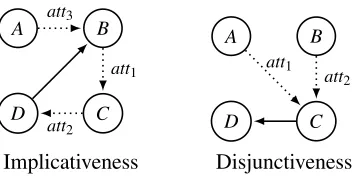
Figure 3: Scenarios used in the proof of Theorem 1.
S⊆ {att2,att3}, then C is not attacked by any other argument. IfS={att1} orS={att1,att3}, then C is defended by D, which is not attacked by any other argument. If S={att1,att2,att3}, then C is defended byA, which is not attacked by any other argument. Thus, in all of these seven cases, eitherC is not attacked by any other argument or it is defended by an argument that is not attacked by any other argument, i.e., in all casesCis acceptable under the grounded, the stable, the preferred, and the complete semantics. On the other hand, ifS={att1,att2}, then{B,C,D}forms an isolated odd-length cycle. This means that all ofB,C, andDwill be unacceptable under the grounded, the stable, the preferred, and the complete semantics. We have thus found a set of attacksAttand three individual attacksatt1,att2,att3 such thatP(Att∪S)if and only ifS6={att1,att2}. Hence,Pis an implicative AF-property.
Next, we show that P is also disjunctive. LetD be the argument under consideration. Let Att= {C⇀D},att1=A⇀C, andatt2=B⇀C. This scenario is depicted on the righthand side of Figure 3. Consider all argumentation frameworks hArg,Att∪Si with S⊆ {att1,att2}. If S={att1}, then D is defended byA. IfS={att2}, thenDis defended byB. If S={att1,att2}, then Dis defended by both AandB. In all three cases,Dis defended by some argument that is not attacked by any other argument. Thus,Dis acceptable under each of our four semantics. However, ifS=/0, thenDis attacked byCand not defended by any other argument, which means thatDis unacceptable under all four semantics. To summarise, we have seen thatP(Att∪S)if and only ifS6=/0. Hence,Pis a disjunctive AF-property.
Proof of Theorem 4
Recall that we need to show that, for|Arg|>5, the propertyPofbeing a grounded extensionis an AF-property that is bothimplicativeand disjunctive. In fact, as we shall see, we can show disjunctiveness even in case|Arg|>4. Let Arg={A,B,C,D,E, . . .}. For the proofs of both properties, we focus on
∆={A,C,E}as the subset of arguments that may (or may not) form the grounded extension.
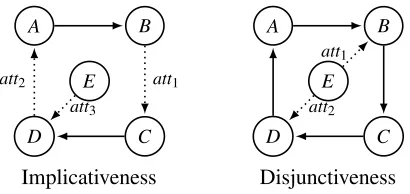
We first show that Pis implicative. LetAtt={A⇀B,C⇀D}, att1=B⇀C,att2=D⇀A, and att3=E⇀D. This scenario is depicted on the lefthand side of Figure 4. Consider all argumentation frameworks of the form AF=hArg,Att∪Si withS⊆ {att1,att2,att3}, and for each of them the corre-sponding characteristic function fAF. IfS={att1}, then fAF(/0) ={A,E}, fAF2 (/0) ={A,C,E}=∆, and
fAF3 (/0) = fAF2 (/0). Thus, the grounded extension is∆ in this case. Using the same kind of reasoning,
it is easy to verify that the grounded extension is ∆ whenever S6={att,att2}. On the other hand, if
S={att1,att2}, then we get fAF(/0) ={E}and fAF2 (/0) = fAF(/0), i.e., the grounded extension now is{E}.
Thus, for our argumentation framework to have∆as its grounded extension, we must insist that, if both
att1andatt2are accepted, then alsoatt3is accepted. Hence,Pis implicative.
Next, we show that P is also a disjunctive AF-property. Let Att={A⇀B,B⇀C,C⇀D,D⇀
A B
C D
E att1
att2
att3
A B
C D
E
att1
att2
[image:15.612.207.412.69.166.2]Implicativeness Disjunctiveness
Figure 4: Scenarios used in the proof of Theorem 4.
{A,C,E) =∆, and f4
AF(/0) = fAF3 (/0), i.e.,∆is the grounded extension of AF. By analogous reasoning,
∆is the grounded extension also for S={att2} and for S={att1,att2}. However, for S= /0, we get
fAF(/0) ={E}and fAF2 (/0) = fAF(/0), i.e., the grounded extension now is just{E}. Thus,∆is the grounded
extension if and only ifS6= /0, meaning thatatt1oratt2are accepted. Hence,Pis disjunctive.
Proof of Theorem 7
To obtain the claim as a corollary to Theorem 6, we need to show that the property of an argumentation frameworkhaving a nonempty grounded extension is ak-exclusive AF-property for k=|Arg|. Recall that having a nonempty grounded extension is equivalent to the property ofhaving at least one argument that is not attackedby any other argument. We are going to show that the latter property isk-exclusive fork=|Arg|.
So letk=|Arg|. Take an arbitrary enumeration{A(1), . . . ,A(k)}ofArgand consider the set of attacks {att1, . . . ,attk} withatti:=A(i)⇀A(i+1) fori<k and attk :=A(k)⇀A(1). Clearly, this set of attacks
meets our requirements: (i) if{att1, . . . ,attk} ⊆(⇀), then⇀ does not have the property of leaving at
least one argument without an attacker and(ii)for everyS({att1, . . . ,attk}there exists an attack-relation
⇀withS⊆(⇀), namelySitself, that does leave one argument without an attacker.
Proof of Theorem 8
Recall that, if we can show that acyclicity is an |Arg|-exclusive AF-property, then the claim follows from Theorem 6. In fact, it is straightforward to show that acyclicity is ak-exclusiveproperty for every k∈ {2, . . . ,|Arg|}. To see this, consider the case where the attacks {att1, . . . ,attk} form a cycle, and
observe that the shortest (proper) cycle has length 2, while the longest cycle visits every argument exactly
once and thus has length|Arg|.
Proof of Theorem 9
Recall that we need to show that, for|Arg|>4,coherenceis an AF-property that is bothimplicativeand disjunctive. LetPrepresent coherence and letArg={A,B,C,D, . . .}.
A B
C D
att1
att2
att3
A B
C D
att1
att2
[image:16.612.216.398.71.161.2]Implicativeness Disjunctiveness
Figure 5: Scenarios used in the proof of Theorem 9.
which once again also is stable. Thus, in all seven cases, AFis coherent. However, ifS={att1,att2}, the only preferred extension is{A}, which is not stable, asB,C, andDare not attacked byA. We have thus found a set of attacksAttand three individual attacksatt1,att2,att3such thatP(Att∪S)if and only ifS6={att1,att2}. In other words,Pis an implicative AF-property.