City, University of London Institutional Repository
Citation:
Kainuma, M., Mangalagiu, D., Asrar, G., Jacob, K., Pereira, L. ORCID:
0000-0002-4996-7234, Rocamora, A., van Vuuren, D., Hurley, F., Lucas, P., King, P., Gomi, K. and
van der Ende, M. (2019). The Way Forward. In: Global Environment Outlook (GEO-6):
Healthy Planet, Healthy People. (pp. 581-596). Cambridge: Cambridge University Press.
ISBN 9781108707664
This is the published version of the paper.
This version of the publication may differ from the final published
version.
Permanent repository link:
http://openaccess.city.ac.uk/id/eprint/21960/
Link to published version:
http://dx.doi.org/10.1017/9781108627146
Copyright and reuse: City Research Online aims to make research
outputs of City, University of London available to a wider audience.
Copyright and Moral Rights remain with the author(s) and/or copyright
holders. URLs from City Research Online may be freely distributed and
linked to.
City Research Online:
http://openaccess.city.ac.uk/
[email protected]
The Way Forward
Coordinating Lead Authors: Mikiko Kainuma (Institute for Global Environmental Strategies [IGES]), Diana Mangalagiu (University of Oxford and Neoma Business
School), Ghassem R. Asrar (Pacific Northwest National Laboratory (PNNL), Klaus Jacob (Freie Universität Berlin)
Lead Authors: Laura Pereira (Centre for Complex Systems in Transition, Stellenbosch University), Alexis Rocamora (Institute for Global Environmental Strategies), Detlef van Vuuren (PBL Netherlands Environmental Assessment Agency), Fintan Hurley (Institute of Occupational Medicine), Steve Hedden (Frederick S. Pardee Center for International Futures, University of Denver), Paul Lucas (PBL Netherlands Environmental Assessment Agency), Peter King (Institute for Global Environmental Strategies)
Contributing Authors: Kei Gomi (National Institute for Environmental Studies [NIES]), Robyn Lucas (National Centre for Epidemiology and Population Health, The Australian National University)
GEO Fellow: Mandy Angèl van den Ende (Utrecht University)
24
Chapter
© Shutterst
ock/ESB Pr
of
24 24
Executive summary
Systemic and transformative policies, technologies and social practices, if used together and holistically, have the potential for achieving the Sustainable Development Goals (SDGs) and other Multilateral Environmental Agreements (MEAs) (established but incomplete). Transformation is a disruptive process that goes beyond the mere incremental improvement of existing technologies and practices to serve human needs, in an innovative manner. Its origin could be technology, policy or social norms and practices, but to be transformative it should be all encompassing (i.e. holistic). Transformations do not necessarily result from top-down approaches. They emerge from the co-evolution of multiple interdependent factors and the active engagement of diverse stakeholders. {24.2}
Transformative pathways to sustainable development require (1) visions to guide systemic innovation towards sustainability, (2) social and policy innovation, (3) the phasing out of unsustainable practices, (4) policy experimentation and, (5) engaging and enabling actors and stakeholders (established but incomplete). Innovative solutions are required to link policies to SDGs, to promote viable business
models, to finance the support and management of investment
risks, to support international cooperation, and to address the concerns of citizens and stakeholders and ensure their active participation in the entire process. {24.3}
The promotion of systemic innovation is key to
socioeconomic development (established but incomplete). Many countries are struggling to develop, adopt and diffuse innovative technologies due to the perceived high costs associated with them and, in some cases, technical or regulatory barriers to implementation. For example, in some countries, low-carbon technologies have been adopted by industries only to the extent that they have been successful in market competition. However, the development of
policies and governance – including financial mechanisms,
policy innovation and the relevant human capacities – at local, subnational and national levels to create an enabling environment, is crucial for wide-scale diffusion. {24.3.1}
Transformative environmental policies have the potential to complement existing ones (established but incomplete). The potential of the environmental policies developed and implemented over the past decades is far from realized. Some strategically important environmental policies that address technologies, reduce emissions and improve resource
use efficiency lack effective implementation. For example,
sectoral policies often lack a consideration of environmental concerns. Transformative policies do have considerable potential to go beyond these measures, but it is less certain that experimental and systemic innovation will succeed in the short term. Accordingly, both approaches, with a focus on more effective implementation of strategically important existing and transformative policies, should be pursued together. {24.1, 24.4}
A healthy planet is the ultimate foundation for supporting all life forms and human well-being, which depend on the viability of Earth’s life-support system (well established). The Healthy Planet, Healthy People perspective recognizes that human activities have transformed Earth’s natural systems and disrupted its self-regulatory mechanisms and life-support system. Economic growth has come at the cost of ecosystem health. The resulting environmental degradation has increased the burden of disease through exposure to harmful pollutants as well as through reduced access to the ecosystem services that we enjoy (e.g. clean air, biodiverse ecosystems, healthy food, clean oceans, land and freshwater). The Healthy Planet, Healthy People approach will be central to global efforts to promote the stewardship of resources from air, biodiversity, land, oceans and freshwater to support human well-being, and the sustainability of the Earth system. For example, the global health savings from reduced air pollution are estimated to be 1.4-2.5 times greater than the costs of mitigating climate change. The proposed strategy to reach the less than 2°C warming target by the end of this century is projected to have
24 24
24.1 Approaches for environmental policy:
strategic and transformative
The 2030 Agenda for Sustainable Development, together with a range of Multilateral Environmental Agreements (MEAs), set an ambitious long-term vision for the universal pursuit of sustainable development through economic, social, environmental and institutional transformation (Chapter 20). Although progress has been made in managing some environmental problems (e.g. ozone depletion, acid rain), overall global agreements and associated policies have not been able to bend the unsustainable trajectory. Without new policies and effective actions, the ambitious sustainable development vision will not be met (Chapter 21).
Options for bending the prevailing trends do exist. Moving to a sustainable path requires a mix of technological innovations, lifestyle changes and local, regional, global and decentralized solutions with stakeholder engagement, at an unprecedented pace of change (Chapters 22 and 23). The potential from
efficiency improvements and emission reductions are far from
fully exploited, yet because of rebound and growth effects,
it is questionable that they will be sufficient. More disruptive
and transformative changes, including new social practices, seem necessary. This chapter discusses promising innovative approaches and transformative, effective policies that will help to attain the goal of a Healthy Planet, Healthy People.
Part A of this report provides the evidence that the current pace of change is inadequate to reverse the environmental harm we are already experiencing. Without a fundamental redirection, most environmental domains will continue to degrade, threatening the economic and social progress achieved to date and the fate of the multiple species that share planet Earth. Part B concludes that, despite a proliferation of policy innovation, often only second-best and small-scale solutions
are being observed, rarely going beyond technological fixes.
Moreover, potentially effective and ambitious environmental policies are not getting traction. The future projections and potential pathways in Part C suggest that new policies and measurable actions are required at all levels (i.e. local, national, regional and global) to attain the Sustainable Development
Goals (SDGs) and targets by 2030, and beyond. The analysis shows that for most environmental goals, the projected conditions appear to worsen, e.g.,
v More and more people will be living in water-stressed areas (Hejazi et al. 2014).
v Increasing greenhouse gas emissions will result in a large overshoot of the “well-below-2°C” target of the Paris Agreement on climate change (Iyer et al. 2015; United Nations Framework Convention on Climate Change [UNFCCC] 2015).
v The rapid decline in biodiversity will continue
(Intergovernmental Science-Policy Platform on Biodiversity and Ecosystem Services [IPBES] 2018).
v Stressed food systems will continue to result in persistent malnourishment, affecting both human well-being and planetary health (Whitmee et al. 2015).
Some pathways for change are assessed in various sustainability scenarios in Chapter 22, and through the potential seeds of change in Chapter 23. The sustainability challenge, however, requires new strategies that will stretch humanity’s collective imagination, and the current knowledge
and action. Incremental steps are insufficient.
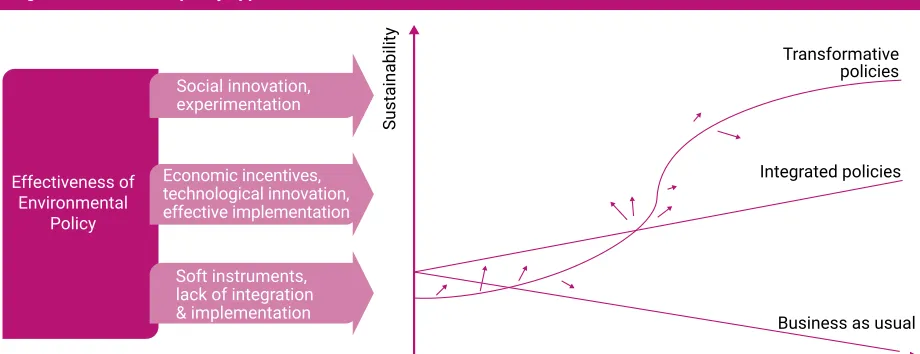
Figure 24 .1 illustrates the sustainability trajectories for integrated and transformative approaches compared with business as usual. Business as usual, with unambitious environmental policies, lacks effective implementation and holistic integration in other sectoral policies and therefore will not contribute to safeguarding the environment and meeting the sustainable development goals. Stronger environmental policies, including those that provide economic incentives for
reducing emissions and improving the efficiency of resource
use, do have considerable potential. A transformative approach, based on experimentation and consideration of social practices may be more open-ended and less certain in its direction and chance of success, but it offers greater potential for higher impact and achieving sustainability goals. Both policy approaches could be pursued in parallel to ensure a greater chance of success in both the short and long term.
Sustainab
ility Transformative
policies
Integrated policies
Business as usual
Time
Effectiveness of Environmental
Policy
Social innovation, experimentation
[image:4.612.86.546.527.704.2]Soft instruments, lack of integration & implementation Economic incentives, technological innovation, effective implementation
24 24
24.2 Transformative change
Our needs for nutrition, health, energy, housing mobility, and so on, are met by a range of social-ecological, socio-technical and socioeconomic systems (Folke et al. 2011; Geels and Schot 2017: Díaz et al. 2018). Such systems provide their services to society not only by a single technology or service, but are embedded in infrastructure, markets, institutions and social practices, including norms and values (Grießhammer and Brohmann 2015). The different elements of these systems mutually reinforce and stabilize each other, but they are viewed
relatively independently of each other, making it difficult for
environmental policies to fundamentally change the structure of the systems and organizations involved, let alone their interlinkages and interactions.
Environmental policies have triggered innovation in many sectors through strategies and actions such as ecological modernization, green economy, the valuation of ecosystem services, and the potential for further innovation remains
considerable. There is significant potential for improving
resource productivity by factors of four to ten (i.e. with one unit of resource, four to ten times more goods are produced) (Schmidt-Bleek 2008; von Weizsäcker et al. 2009). Improved
resource productivity is necessary but not sufficient because
it does not change the underlying systems adequately to achieve the required transformation towards a sustainable
society. Therefore, a fundamental reconfiguration of societal
systems, including mental models and thought processes, institutions, and norms and values, is necessary (Westley et al.
2013; Olsson, Galaz and Boonstra 2014; Bennett et al. 2016). Such transformations do not necessarily result from top-down approaches. They emerge from the co-evolution of multiple interdependent factors and the active engagement of diverse stakeholders (Chapter 23). It is important to coordinate actors and resources, guided by a vision of a dramatically different future.
Fostering the ability to transform could enable new
development trajectories for social-ecological systems that are more sustainable and have more space for dynamic innovation (Folke et al. 2010; Jacob et al. 2018). Transformations start
from niches defined as small, protected spaces in which new
practices can develop, thus causing changes from local to regional and global scales (Loorbach and Raak 2006; Olsson
et al. 2006; Jänicke and Rennings 2011; Olsson, Galaz and
Boonstra 2014). Once feedback mechanisms have reached a critical mass, however, transformative change can be abrupt, and existing technologies and their supporting infrastructure, knowledge, capital and institutions are de-legitimized, and the transformative change is ultimately well integrated into norms and practices (Arthur 2011).
Historical transformation has followed this pattern, starting from innovation in niches, and challenging prevailing practices, with a co-evolutionary and emergent character (Diamond 1997; Arthur 2011; Westley, McGowan and Tjörnbo eds. 2017). In many cases, these transformations were unguided processes that led to increased resource use, emissions and environmental degradation rather than the sustainable use and stewardship of resources and the environment. Hence, there is a need to navigate and guide transformations onto more desirable trajectories (Olsson et al. 2006; Jacob et al. 2018).
Transformative approaches may differ country by country.
Moreover, while current policies have been insufficient to
address environmental problems, they need to continue in
terms of pollution control, efficiency improvements, planning
for the environment and so on. Some countries could achieve transformative changes by leapfrogging to best practices, whereas others may need incremental changes in their policies and practices before reaching transformative stages. Deploying instruments such as economic incentives for innovation and changes in existing economic frameworks, including internalization of external costs, eliminating environmental subsidies, promoting the valuation of ecosystem services, reforming green budget investments, could all play key roles in bringing about transformative changes.
There is no simple recipe for enabling transformative change towards sustainability, but recent methodological innovations emphasize the need for different actors to come together and to experiment with innovations that have the potential for systemic transformation (Frantzeskaki, Wittmayer and Loorbach 2014: Pereira et al. 2015). Many of these processes are dubbed lab-based processes. The features of these real-world labs that contribute to transformation include experimental methods, a transdisciplinary mode of research, and the scalability and
transferability of results as well as scientific and societal learning and reflexivity (Schapke et al. 2018). Examples include social-innovation labs (Westley et al. 2012), resilience labs (Frantzeskaki et al. 2018), transformation labs (Charli-Joseph et al. 2018; Zgambo 2018; van Zwanenberg et al. 2018), living labs (Budweg et al. 2011; Hooli et al. 2016), including urban living labs (Cosgrave et al. 2013; Voytenko et al. 2016) and transition
arenas (Loorbach 2010). Other related processes draw on fields
such as foresight – an approach that covers a wide range of methods to systematically investigate the future across systems like the food system (Hebinck et al. 2018), urban systems (Potjer, Hajer and Pelzer 2018) or energy systems (Hajer and Pelzer 2018). Some processes refer to new ways of thinking about how change needs to happen, from the individual level through ideas like “inscaping”, where individuals surface their inner experiences (Nilsson and Paddock 2014), to how groups can undergo change using concepts like “Theory U” (Scharmer 2007), and drawing more on stories and lived experiences to create real connections with people and their environments in the future (Galafassi et al. 2018). These system interventions have been defined as
transformative spaces, safe collaborative environments in which
experimentation with new configurations of social-ecological
systems, crucial for transformation, can occur (see Charli-Joseph et al. 2018; Drimie et al. 2018; Dye 2018; Galafassi et al. 2018; Hebinck et al. 2018; Marshall et al. 2018; Moore et al.
2018; Pereira et al. 2018; van Zwanenberg et al. 2018). These approaches can be an important step in navigating onto a more sustainable trajectory.
24.3 Building blocks for transformation
Five key approaches to guide, shape and enable transformation
can be identified:
i. visions to guide systemic innovation towards sustainability; ii. social and policy innovation;
iii. the phasing out of unsustainable practices; iv. policy experimentation; and
24 24
These necessary ingredients are discussed and illustrated through the examples given in the sections that follow.
24.3.1 Visions to guide systemic innovation towards sustainability
An increasing number of governments, cities, companies and communities are expressing compelling visions of a more sustainable future and sharing their strategies and plans for achieving those visions. Many of these visions realize that new ways of measuring progress are also needed (Midgley and Lindhult 2017).
The concept of gross national happiness (GNH) as an alternative to monetary values to measure societal progress was introduced in Bhutan’s 1999 strategy for sustainable development (Niestroy, Schmidt and Esche 2013; Jacob, Kannen and Niestroy 2014). Since then it has been evolved as the core vision for Bhutan’s governmental and economic activities. Policies and investments are assessed against their contribution to increased GNH instead of their monetary cost
and benefits. GNH is key for Bhutan’s five-year plans and is
included in its Constitution. A GNH commission monitors the implementation. GNH is based on four pillars:
i. equitable socioeconomic development (equity between individuals, communities and regions to provide social harmony and stability);
ii. conservation of the environment;
iii. preservation and promotion of culture (appreciation of the country’s cultural heritage and the preservation of spiritual and emotional values); and
iv. promotion of good governance (developing institutions and human resources and providing opportunities for participation).
In response to a regrettable history of deforestation and environmental degradation (Food and Agriculture Organization of the United Nations 2016), Costa Rica has developed a vision of modernity that gives environmental quality a prime place (Silva 2002; Johnson 2016). The 1994 Constitution of Costa Rica provides for “the right to a healthy and ecologically balanced environment” (United Nations, General Assembly 2014). Some recent policy approaches to attaining that vision include payment for ecosystem services, forest preservation
for carbon credits, forest credit certificates, legal protection
and preservation of iconic species, a ban on open pit mining and, most recently, a pledge to become carbon neutral by 2021. Although challenges remain in relation to water quality and
marine protection, significant environmental improvements
have stemmed from this overarching vision. For example,
forest cover has improved from 26 per cent in the 1980s to 52 per cent in 2010 (United Nations, General Assembly 2014).
An increasing number of cities, communities and regions worldwide aim to reduce their carbon footprint and aspire to become zero-emission or carbon-neutral places (Yamanoshita
and Aamano 2012). A clear definition for the scope of
emissions (e.g. internal emissions based on the geographic boundary, or external emissions directly caused by municipal activities) addressed by such labels at the city level is under development worldwide (Kennedy and Sgouridis 2011; Straatman et al. 2018). Globally, 19 cities have committed to making net-zero-carbon buildings and infrastructure a central
piece of their investment strategy by 2030, and to revisit their current planning policies and regulations for existing buildings infrastructure to make them net-zero carbon by 2050 (C40 Cities 2018). Zero-emission city prototypes have been attempted by using renewable energy, cutting-edge technology, innovative urban planning and an emphasis on total reuse (Premalatha et al. 2013). Other initiatives focus on helping existing cities to get on a pathway towards net-zero emissions (e.g. World Business Council for Sustainable Development 2017) in which municipalities work together with businesses to jointly reduce CO2 emissions, while focusing on sustainability priorities (Zadek 2004; Moore, Riddell and Vocisano 2015).
ProjectZero (2016) in the Sønderborg region (77,000 inhabitants) in the south of the Kingdom of Denmark has the declared vision of becoming CO2-neutral by 2029, based on sustainable growth resulting in new green jobs. This vision is being implemented by a public-private partnership involving the municipality and major businesses in the region. A milestone of
a 25 per cent reduction in CO2 emissions in 2015 was exceeded
(at 35 per cent) (World Future Council 2016). Technological
initiatives are taking place in cities and regions worldwide, such as expanded district heating networks, the conversion of supplies to CO2-neutral sources and the installation of onshore wind turbines and photovoltaic facilities, coupled with programmes that involve citizens and industries, such as the ZEROhousing and ZEROcompany programmes (Bulkeley and Betsill 2005; Betsill and Bulkeley 2006; Frantzeskaki, Wittmayer and Loorbach 2014; Fujino and Asakawa 2017; City of Melbourne 2018).
Iskandar Regional Development Authority (IRDA), a Malaysian federal government agency overseeing the country’s economic and physical development, formulated a vision known as the Low-carbon Society Blueprint 2025. IRDA developed the Green Economy Guideline Manual as a means to implement this vision with the active participation of the business operators
in the region, where there is significant domestic and foreign
investment (Ho et al. 2013; Iskandar Regional Development Authority [IRDA] 2014).
24.3.2 Social and policy innovation
There is no single blueprint for the achievement of these visions, as they are all socially and ecologically embedded in national and local contexts, historical developments, cultural norms and values, and so on. Accordingly, transformation encourages massive social and policy innovation with no guarantees about which forms will ultimately prove successful and worthy of emulation in other domains. One emerging
approach that is finding multiple applications is the concept of
the sharing economy (e.g. shared accommodation and mobility systems), helping to move societies away from wasteful consumption of both renewable and non-renewable resources (see Section 23.3; Frenken 2017). Sharing accommodation and mobility to reduce environmental impacts is potentially transformative. Private vehicle ownership and solo use, with the high running costs of insurance, parking, maintenance,
fuel, and so on, may be reduced by as much as 80 per cent
within a decade if sound regulations and incentive schemes are implemented (Arbib and Seba 2017). Trust is no longer based on personal ties but on mechanisms such as peer ratings,
business and liability regulations and third-party verification
24 24
Some cities are contemplating making all public transport free. In some cities of Switzerland, for example, hotels provide guests with free passes to use public transport and avoid
the traffic and parking congestion. Since 2013, permanent
residents of Tallinn, the capital of the Republic of Estonia, have been entitled to use public transport after registration and the purchase of a green card for just two euros, after which all transport is free of charge. The motivations to introduce the scheme were:
i. to promote a modal shift from private cars to public transport;
ii. to improve accessibility for people on low incomes; and iii. to stimulate the registration of Tallinn residents and so increase the returns from income taxes (Cats, Susilo and Reimal 2017).
As more and more people gravitate to cities, the urban footprint on the hinterland becomes increasingly detrimental to the environment. One promising policy approach to minimizing these impacts, addressing climate change and strengthening community bonds is to create the necessary enabling conditions for increased urban agriculture – green rooftops, vertical farms and community gardens, for example. Of course, for many developing countries, urban agriculture has been a way of life (Orsini et al. 2013) with 11 per cent (Indonesia) to almost 70 per cent (Viet Nam and Nicaragua) of urban
households earning income from urban agriculture. What has changed has been the increasing sophistication of urban agriculture, such as vertical farming (Association of Vertical Farming 2018) and green rooftops (City of Melbourne 2018), predominantly in more developed countries.
Promoting a circular economy is another potential opportunity for reducing CO2 emissions and other waste and preserving natural resources and ecosystems (see Chapter 17). This concept is captured in the approach to managing the consumption of natural resources and to addressing related environmental and socioeconomic challenges that has been taken by the European Commission Circular Economy Action Plan, published in December 2015 (Wilts 2017; European Commission 2018). If materials are preserved in high-quality products or recycled and used as high-quality secondary raw materials, the circular economy can reduce industries’ demands for primary raw materials (Wilts 2017). The concept of circular economy also promotes a decentralized approach to sharing, to providing services and to businesses’ dematerializing innovations. For example, a decentralized mode of service provision, which is not necessarily dependent on product and material ownership, is rapidly becoming possible through the development of information and communication technologies and new business models (Kishita et al. 2018).
24.3.3 The phasing out of unsustainable practices
A commitment to changing the current, unsustainable socioeconomic and environmental trajectory offers great opportunities in all aspects of daily life, with a high potential to generate the required transformations. The banning of single-use plastics provides one of the most recent examples, where the initial phase-out of lightweight plastic bags has moved into a much broader policy response at all levels, addressing the use of all kinds plastics (Onyanga-Omara 2013; European Commission 2018; United Nations Environment
Programme [UNEP] 2018). Developing countries are leading this transformation. In 2002, the People’s Republic of
Bangladesh became the first country in the world to completely ban thin plastic bags after it realized that around 80 per cent of the waterlogging in cities during floods was being caused
by polyethylene bags blocking drains and increasing standing water. This also produced a breeding ground for mosquitoes, increasing the incidence of diseases such as dengue and malaria. Several other countries joined with similar initiatives, including the State of Eritrea in 2005 and the Republic of Kenya in 2017 (Njugunah 2017). Scaling out from tackling plastic bags, the European Commission (2018) made the ground-breaking announcement of banning around ten single-use plastic items (e.g. cutlery, straws, cotton buds, plates, coffee
cups and stirrers) that account for 70 per cent of garbage in
regional waters and beaches. This example was immediately followed by India, marking a historic breakthrough.
In some circumstances, natural materials may provide alternatives to plastics. For example, the Republics of Indonesia, India, Philippines and Kenya are using water hyacinth, which is among the most effective plants for removing carbon dioxide from the atmosphere, as a source
of hard-wearing fibre or to produce paper and paper products,
with the potential to reduce the demand for conventional plastic products. UN Environment is leading the information-sharing and education process at a global level through its Clean Seas campaign and, most recently, by making the theme for World Environment Day 2018 to beat plastic pollution (Dris et al. 2015; Ocean Care 2017). The policies to replace plastics with alternative materials will fail, however, to reduce marine debris if the disposal of the new alternative materials is not considered prior to their introduction. Better collection, recycling and waste management will help to reduce debris on land and in the ocean (Trucost 2016).
24.3.4 Policy experimentation
Transformative policy can often be judged as successful
only with the benefit of hindsight and careful monitoring and
evaluation. Policy mistakes directly introduced at a national level may have long-lasting implications, such as some of the regrettable policies in the past for controlling population growth (Zhang 2017). Accordingly, the precautionary principle suggests that policy experimentation at smaller scales, combined with national support and continuous evaluation, may be a more sensible choice (Heilman 2008; Husain 2017; Shin 2018).
Policy experimentation at a local scale followed by scaling up is a hallmark of China’s policy success (Heilmann 2008). This approach of deliberate experimentalism dates back to early land reforms and addressing agricultural production in the 1940s (Husain 2017). Local-scale policy experiments provide a space for tailoring and innovating policies that are closely monitored; if successful, they are subsequently scaled up, or if unsuccessful, halted. Shin (2018) refers to this approach as experimentation under hierarchy, complemented by
performance incentives for local officials.
24 24
at a grass-roots level (Antikainen, Alhola and Jaaskelainen 2017). These types of policy experiments have been practised for climate adaptation in the Kingdom of the Netherlands (McFagen and Huitema 2018). Climate adaptation experiments have also been practised in cities in developing countries, where experiments rely on community-based strategies that involve concerned community members and professionals, and that gain support from external agents. These adaptation experiments need to be in coherence with their urban political economic contexts to ensure transformative change (Broto and Bulkeley 2013; Chu 2016). Policy experimentation works well when the processes are more iterative and more participatory,
reflecting both a long-term goal formulation and interactive
strategy (Hilden, Jordan and Huitema 2017).
24.3.5 Engaging and enabling actors and stakeholders
Transformation, by definition, will change existing
social-economic systems and create winners and losers. Such changes should not be feared, as the continuation of business as usual involves even greater disruption and larger numbers of losers. While it is not possible here to describe all the actors who need to thrive in the context of these emerging visions of sustainable development, many new opportunities will be created and need to be supported. Participatory approaches to engaging decision makers and actors in all phases of transformative change ensure greater acceptance and
significantly reduce the time to adoption and produce greater
ownership of such changes (Mitchell, Agle and Wood 1997; Umaemiya, Rametsteiner and Kraxner 2010; Smith, Ansett and Erez 2011; Asrar, Ryabinin and Detemmerman 2012; Asrar, Hurrell and Busalacchi 2013; IRDA 2014; Vallentin 2016). Such approaches are widely recognized in a number of international agreements stemming from Principle 10 of the Rio Declaration
(United Nations Educational, Scientific and Cultural
Organization 1992): “Environmental issues are best handled with the participation of all concerned citizens” (e.g. the Aarhus Convention, Escazu Convention, Talanoa Dialogue).
Innovative finance represents a key breakthrough in the
complex pathway to achieving the SDGs. Business as usual does not present any option to close the estimated gap between current and required spending on the SDGs of
US$2.5 trillion per year in developing countries (United Nations
Conference on Trade and Development 2014). Innovative
finance not only aims to establish new financial instruments
but also refers to doing business in the future through more
inclusive processes (SDG 17) (Porter and Kramer 2006; Ritzén
and Sandströma 2017). Instruments that are complementary
to grants or financial stimuli may help to unlock the additional
capital needed to support sustainable investments. Examples that could form part of a smarter funding mix include loans, equity, quasi-equity and guarantees, and green, blue and social bonds (Venugopal and Srivastava 2012; International Capital Market Association 2018). Global companies are being
encouraged to, not only deliver financial performance, but also
show how their businesses make a positive contribution to society (Porter and Kramer 2006; Downie 2017). A number of
institutional investors, banks and other private-sector financial
institutions have joined this appeal, reframing their strategies in asset management and shifting investment capital to companies that incorporate environmental, social and
governance considerations into fundamental financial analyses
(Noguer and Houillier 2010; Enright, McElrath and Taylor 2016).
Cooperative arrangements between governments and the
private sector to create new financial instruments are also
beginning to emerge. For example, the Federal Republic of Nigeria, Africa’s biggest oil producer, in December 2017
became the first country on the continent to issue a green bond to finance projects and programmes on renewable energy micro-utilities and afforestation. The success of the first issuance of N10.69 billion pushed the government to target an additional N150 billion green bonds in 2018. This bond
issuance aims to reduce Nigeria’s CO2 emissions by 40 per
cent by 2030. Assessing the progress, evaluating the impact and sharing the lessons learned and experiences gained from such initiatives are key to successful transformative change in policies and practices (Asrar and Hurrell 2013; Premalatha et al. 2013).
The transformative potential of engagement and cooperation between businesses, governments and non-governmental organizations (NGOs) is also important to highlight. The Southern Africa Food Lab (SAFL) is a platform established to provide a space for diverse stakeholders from across the food system to engage in dialogue, paying particular attention to the relationship between dialogue and action (Drimie et al.
2018). One of these processes involved creating transformative scenarios for the future of the Republic of South Africa’s food system, at the same time as the policy on national food and nutrition security was being approved (See Freeth and Drimie 2016). The scenario process brought together a diverse group of interested stakeholders across the food system, including
government officials, big business and civil-society activists
and legal organizations, who all navigated through their different perspectives to build the meaningful relationships that are fundamental to policy engagement and ultimately to policy change (Freeth and Drimie 2016). SAFL has also become a rallying point for partnerships between NGOs, researchers and small businesses to engage around transformative change in the food system. Many of these partnerships involve the World Wide Fund for Nature (WWF) as a boundary organization for transformative change towards sustainability (Cockburn et al.
2018), by increasing consumer awareness of sustainability
challenges like overfishing (WWF 2014) and transcending
the partisan biases that sometimes hamstring innovative interventions (Drimie and Pereira 2016). The role of NGOs as actors enabling positive change is well documented and needs to be leveraged in order to achieve the sustainable development agenda.
24.4 Healthy Planet, Healthy people:
challenge and opportunity
A healthy planet is the ultimate foundation for supporting all life forms, including the health and well-being of humans, which depend on the viability of this life-support system. This principle is captured in the 2030 Agenda for Sustainable Development and related multilateral environmental agreements. Improving human health and well-being, food security and nutrition, social justice and economic prosperity and environmental stewardship through sustainable development is the major theme of GEO-6.
24 24
2005; Rockström et al. 2009; Intergovernmental Panel on Climate Change 2014; Steffen et al. 2015; Whitmee et al. 2015; Ceballosa, Ehrlichb and Dirzob 2017; IPBES 2018; see Part A of this report).
The Healthy Planet, Healthy People approach is key to promoting stewardship of the air, biodiversity, oceans, land and freshwater that are essential for supporting human well-being and the sustainability of Earth systems for current and future generations. Central to this approach is taking a holistic
and systemic approach, whereby the identified challenges
for all aspects of Earth’s life-support system (e.g. clean air, freshwater, food production from oceans and land, habitats for species) are pursued together with the socioeconomic and health dimensions (e.g. gender, equity, poverty) (Commission on Social Determinants of Health [CSDH] 2008; Gordon et al. 2017; Dye 2018). The complex interlinkages between the different aspects of environmental change are illustrated by
the 12 selected cross-cutting issues described in Chapter 4 and
the synergies and trade-offs analysed in Section 22.4.2.
About a quarter of annual deaths globally are caused by
modifiable environmental factors (Prüss-Ustün et al. 2016). Human health depends on much more than a healthy planet though. Even if it were desirable and feasible to attain a healthy, sustainable planet without addressing socioeconomic issues and the associated determinants of health, it would still leave humanity far short of the goal of healthy people (see also Section 22.2.5, on achieving the SDG target on child mortality).
Socioeconomic and cultural factors have significant health
impacts, through lifestyle choices, inequalities and damaging practices such as war, violence, unsafe working conditions and child labour (CSDH 2008; see Section 4.1). Therefore, the social determinants of health, including social and wealth inequalities,
must also be addressed effectively (Camfield, Møller and Rojas
2015; Donkin et al. 2017).
As reported in Section 4.1, human health is mediated by multiple factors in the natural, social and built environments, including our perceptions of equity and safety as well as equitable access to environmental resources and human contact with nature (CSDH 2008). This perspective
complements the classical definition of human health as “a
state of complete physical, mental and social well-being and
not merely the absence of disease or infirmity” (World Health
Organization 1948), and the practice of using well-being
(Camfield Møller and Rojas 2015; Maggino 2015) together with
health to incorporate the psychological, emotional and social dimensions. The multiple relationships between planetary and human systems link health and well-being directly and indirectly to the majority of the SDGs. As such, the SDGs offer the opportunity to approach human health systemically, unlike other major health initiatives that are often focused on a given disease or pandemic event.
Several frameworks have been developed in recent years to help ensure that research and policy development take account of the complex interrelations between health, socioeconomic and environmental factors (Buse et al. 2018).
However, much of the scientific evidence about the effect
of the environment on human health has a narrower focus, on pollution and disease (i.e. mortality and morbidity), with limited attention to the wider concept of well-being or to the social determinants of health. Within this narrower classical framework of environmental health, the commission on pollution and health of the journal The Lancet (Landrigan et al.
2017) estimated that environmental pollution caused about
9 million premature deaths in 2015; mainly from outdoor and indoor air pollution, which together caused 6.4 million deaths
(Cohen et al. 2017). Also, environmental pressures and their impacts on health and well-being are not equitably distributed (see Part A). They especially hit groups that are already vulnerable or disadvantaged, such as younger, older and female demographic groups, poor people, those with chronic health conditions, indigenous people and those targeted by racial
profiling (Solomon et al. 2016; Landrigan et al. 2017).
The cost of failing to address the challenges of poor environmental conditions must be examined and communicated widely (Haines 2017; see the example in Box 24 .1). Such costs are pervasive, through the loss of life and property; disability; the costs incurred from cardiovascular and respiratory diseases; the costs of health damages due to
the multiple stresses of extreme weather events, to conflicts
over food and water insecurity; gross inequality and poverty; and the tragic plight of refugees around the world.
Box 24.1: The health benefits outweigh the costs of implementing the Paris Agreement
The costs of implementing the Paris Agreement (UNFCCC 2015) between 2020 and 2050 could be outweighed by the health benefits
of reductions in air pollution-related diseases and deaths alone, according to one modelling study (Markandya et al. 2018). The study modelled emission levels under various scenarios and estimated the costs of the consequent air pollution-related deaths (as a result of respiratory diseases ranging from acute lower respiratory tract infections to chronic obstructive pulmonary disease and heart disease, stroke and lung cancer), and compared this with the costs of climate-change mitigation by country or region (the People’s Republic of China, the European Union, the Republic of India, the United States of America and the rest of the world). The scenarios include doing nothing, continuing current country-level policies, and three different strategies for implementing and funding the agreement towards the 2°C and 1.5°C warming limits.
Depending on the scenario used, the health benefits from reduced air pollution were estimated to be, at the global level, 1.4 to 2.5 times greater than the costs of mitigation. The highest benefit-to-cost ratio was for the emission strategy to reach the 2°C target: global health savings were estimated to be US$54.1 trillion, dwarfing the global policy costs of US$22.1 trillion.
Under all the scenarios examined, the countries likely to see the biggest health savings from improved emission-reduction measures were China and India. The cost of implementing climate-mitigation policies in China and India would be fully compensated for by the health
savings under most scenarios, and the added costs of pursuing a 1.5°C target instead of 2°C could generate substantial benefits (for India, about US$3.3-8.4 trillion and for China, about US$0.3-2.3 trillion). For the European Union and the United States, the health savings would
24 24
All of these contribute to inequality and instability and they are all far less expensive to prevent than to react to, in an attempt to manage consequences.
No nation is isolated from the impact of poor environmental conditions. To successfully advance policies, practices and
financial investment in global development as well as address environmental challenges, justifications must be framed
holistically based on how they can improve the security, prosperity and well-being of citizens and nations globally; policy options and sound solutions should be backed by economic analysis and data to demonstrate the savings and/or the new sources of revenue (Haines 2017; Markandya et al. 2018).
In the view of the public health authors of the joint commission on planetary health of the Rockefeller Foundation and The Lancet, “solutions [to the environmental crisis] lie within reach
and should be based on the redefinition of prosperity to focus
on the enhancement of quality of life and delivery of improved health for all, together with respect for the integrity of natural systems” (Whitmee et al. 2015).
24 24
References
Enright, S., McElrath, R. and Taylor, A. (2016). The Future of Stakeholder Engagement: Transformative Engagement for Inclusive Business. San Francisco, CA: Business for Social Responsibility (BSR).
https://www.bsr.org/reports/BSR_Future_of_Stakeholder_Engagement_Report.pdf
European Commission (2018). Implementation of the circular economy action plan. [European Union
http://ec.europa.eu/environment/circular-economy/index_en.htm (Accessed: 04 April 2018). Folke, C., Carpenter, S.R., Walker, B., Scheffer, M., Chapin, T. and Rockström, J. (2010). Resilience thinking: Integrating resilience, adaptability and transformability. Ecology and Society 15(4), 20.
https://doi.org/10.5751/es-03610-150420.
Folke, C., Jansson, Å., Rockström, J., Olsson, P., Carpenter, S.R., Chapin, F.S. et al. (2011). Reconnecting to the biosphere. Ambio 40(7), 719–738. https://doi.org/10.1007/s13280-011-0184-y. Food and Agriculture Organisation of the United Nations (2016). The Global Forest Resources
Assessment 2015: How are the World’s Forests Changing? Rome: Food and Agriculture Organisation.
http://www.fao.org/3/a-i4793e.pdf.
Frantzeskaki, N., van Steenbergen, F. and Stedman, R.C. (2018). Sense of place and experimentation in urban sustainability transitions: The resilience lab in Carnisse, Rotterdam, The Netherlands.
Sustainability Science 13(4), 1045-1059. https://doi.org/10.1007/s11625-018-0562-5. Frantzeskaki, N., Wittmayer, J. and Loorbach, D. (2014). The role of partnerships in ‘realising’ urban sustainability in Rotterdam’s City Ports Area, The Netherlands. Journal of Cleaner Production 65, 406-417. https://doi.org/10.1016/j.jclepro.2013.09.023.
Freeth, R. and Drimie, S. (2016). Participatory scenario planning: from scenario ‘stakeholders’ to scenario ‘owners’. Environment: Science and Policy for Sustainable Development 58(4), 32-43.
https://doi.org/10.1080/00139157.2016.1186441.
Frenken, K. (2017). Sustainability perspectives on the sharing economy. Environmental Innovation and Societal Transitions 23, 1-2. https://doi.org/10.1016/j.eist.2017.04.004.
Fujino, J. and Asakawa, K. (2017). Taking actions on the SDGs in Japanese Cities: The “Future City” Initiative and its Achievement on the SDGs. Kamiyaguchi: Institute for Global Environmental Strategies. https://pub.iges.or.jp/pub_file/iges-dp-sdgs-city-en-1pdf/download.
Galafassi, D., Daw, T.M., Thyresson, M., Rosendo, S., Chaigneau, T., Bandeira, S. et al. (2018). Stories in social-ecological knowledge cocreation. Ecology and Society 23(1). https://doi.org/10.5751/ES-09932-230123.
Geels, F.W. and Schot, J. (2017). Typology of sociotechnical transition pathways. Research Policy
36(3), 399-417. https://doi.org/10.1016/j.respol.2007.01.003.
Gordon, L.J., Bignet, V., Crona, B., Henriksson, P.J.G., Van Holt, T., Jonell, M. et al. (2017). Rewiring food systems to enhance human health and biosphere stewardship. Environmental Research Letters
12(10). https://doi.org/10.1088/1748-9326/aa81dc.
Grießhammer, R. and Brohmann, B. (2015). Wie Transformationen und Gesellschaftliche Innovationen Gelingen Können: Transformationsstrategien und Models of Change für Nachhaltigen Gesellschaftlichen Wandel. Umweltbundesamt. https://www.umweltbundesamt.de/sites/default/
files/medien/376/publikationen/wie_transformationen_und_gesellschaftliche_innovationen_gelingen_
koennen.pdf.
Haines, A. (2017). Health co-benefits of climate action. The Lancet Planetary Health 1(1), e4-e5.
https://doi.org/10.1016/S2542-5196(17)30003-7.
Hajer, M.A. and Pelzer, P. (2018). 2050 - An energetic odyssey: Understanding ‘Techniques of Futuring’ in the transition towards renewable energy. Energy Research and Social Science 44, 222-231.
https://doi.org/10.1016/j.erss.2018.01.013.
Hebinck, A., Vervoort, J.M., Hebinck, P., Rutting, L. and Galli, F. (2018). Imagining transformative futures: Participatory foresight for food systems change. Ecology and Society 23(2).
https://doi.org/10.5751/ES-10054-230216.
Heilmann, S. (2008). Policy experimentation in China’s economic rise. Studies in Comparative International Development 43(1), 1-26. https://doi.org/10.1007/s12116-007-9014-4. Hejazi, M., Edmonds, J., Clarke, L., Kyle, P., Davies, E., Chaturvedi, V. et al. (2014). Long-term global water projections using six socioeconomic scenarios in an integrated assessment modeling framework. Technological Forecasting and Social Change 81, 205-226. https://doi.org/10.1016/j. techfore.2013.05.006.
Hildén, M., Jordan, A. and Huitema, D. (2017). Special issue on experimentation for climate change solutions editorial: The search for climate change and sustainability solutions - The promise and the pitfalls of experimentation. Journal of Cleaner Production 169, 1-7. https://doi.org/10.1016/j. jclepro.2017.09.019.
Ho, C.S., Matsuoka, Y., Chau, L.W., Teh, B.T., Simson, J.J. and Gomi, K. (2013). Blueprint for the development of low carbon society scenarios for Asian regions: Case study of Iskandar Malaysia.
IOP Conference Series: Earth and Environmental Science 16, 012125. https://doi.org/10.1088/1755-1315/16/1/012125.
Hooli, L.J., Jauhiainen, J.S. and Lähde, K. (2016). Living labs and knowledge creation in developing countries: Living labs as a tool for socio-economic resilience in Tanzania. African Journal of Science, Technology, Innovation and Development 8(1), 61-70. https://doi.org/10.1080/20421338.2015.1132 534.
Husain, L. (2017). Policy experimentation and innovation as a response to complexity in China’s management of health reforms. Globalization and Health 13(54). https://doi.org/10.1186/s12992-017-0277-x.
Intergovernmental Panel on Climate Change (2014). Climate Change 2014: Impacts, Adaptation, and Vulnerability. Part B: Regional Aspects. Contribution of Working Group II to the Fifth Assessment Report of the Intergovernmental Panel on Climate Change. Barros, V.R., Field, C.B., Dokken, D.J., Mastrandrea, M.D., Mach, K.J., Bilir, T.E. et al. (eds.). Cambridge: Cambridge University Press.
https://www.cambridge.org/core/books/climate-change-2014-impacts-adaptation-and-vulnerability-part-b-regional-aspects/036A899BD52861D61B0D519C5F2B9334.
Intergovernmental Science-Policy Platform on Biodiversity and Ecosystem Services (2018). Summary for Policymakers of the Regional Assessment Report on Biodiversity and Ecosystem Services for Africa of the Intergovernmental Science-Policy Platform on Biodiversity and Ecosystem Services. Archer, E., Dziba, L.E., Mulongoy, K.J., Maoela, M.A., Walters, M., Biggs, R. et al. (eds.). Bonn: Intergovernmental Science-Policy Platform on Biodiversity and Ecosystem Services. https://www.ipbes.net/system/tdf/
spm_africa_2018_digital.pdf?file=1&type=node&id=28397.
International Capital Market Association (2018). Green and Social Bonds: A High-Level Mapping to the Sustainable Development Goals. Zurich: International Capital Market Association.
https://www.icmagroup.org/assets/documents/Regulatory/Green-Bonds/Mapping-SDGs-to-Social-and-Sustainability-Bonds-Final-030818.pdf.
Iskandar Regional Development Authority (2014). Green Economy Guideline Manual. Iskandar Regional Development Authority (IRDA). http://www.greengrowthknowledge.org/sites/default/files/
learning-resources/action/IRDA%20GEG%20Manual%20-%20Tourism.pdf. Antikainen, R., Alhola, K. and Jaaskelainen, T. (2017). Experiments as a means towards sustainable
societies - Lessons learnt and future outlooks from a Finnish perspective. Journal of Cleaner Production 169, 216-224. https://doi.org/10.1016/j.jclepro.2017.06.184.
Arbib, J. and Seba, T. (2017). Rethinking Transportation 2020-2030: The Disruption of Transportation and the Collapse of the Internal-Combustion Vehicle and Oil Industries; A RethinkX Sector Disruption Report. RethinkX. https://static1.squarespace.com/static/585c3439be65942f022bbf9b/t/591a2e4be 6f2e1c13df930c5/1494888038959/RethinkX+Report_051517.pdf.
Arthur, B. (2011). The Nature of Technology: What it is and how it Evolves.
http://www.simonandschuster.com/books/The-Nature-of-Technology/W-Brian-Arthur/9781416544067.
Asrar, G.R., Hurrell, J. and Busalacchi, A. (2013). A need for “actionable” climate science and information: Summary of WCRP open science conference outcomes. World Climate Research Program Open Science Conference. Denver, CO, 24–28 October 2011. http://journals.ametsoc.org/ doi/pdf/10.1175/BAMS-D-12-00011.1
Asrar, G.R. and J. W. Hurrell. (eds.) (2013). Climate Science for Serving Society: Research, Modeling and Prediction Priorities: Springer. https://www.springer.com/gp/book/9789400766914. Asrar, G.R., Ryabinin, V. and Detemmerman, V. (2012). Climate science and services: Providing climate information for adaptation, sustainable development and risk management. Current Opinion in Environmental Sustainability 4(1), 88-100. https://doi.org/10.1016/j.cosust.2012.01.003. Association of Vertical Farming (2018). Introducing the Vertical Farming Global Sustainability Registry (SURE) Network. Association for Vertical Farming https://sure.vertical-farming.net/ (Accessed: 26 January 2018).
Bennett, E.M., Solan, M., Biggs, R., McPhearson, T., Norström, A.V., Olsson, P. et al. (2016). Bright spots: Seeds of a good Anthropocene. Frontiers in Ecology and the Environment 14(8), 441-448.
https://doi.org/10.1002/fee.1309.
Betsill, M.M. and Bulkeley, H. (2006). Cities and the multilevel governance of global climate change.
Global Governance 12(2), 141-159. http://journals.rienner.com/doi/pdf/10.5555/ggov.2006.12.2.141. Broto, V.C. and Bulkeley, H. (2013). A survey of urban climate change experiments in 100 cities. Global Environmental Change 23(1), 92-102. https://doi.org/10.1016/j.gloenvcha.2012.07.005 Budweg, S., Schaffers, H., Ruland, R., Kristensen, K. and Prinz, W. (2011). Enhancing collaboration in communities of professionals using a Living Lab approach. Production Planning and Control 22(5-6).
https://doi.org/10.1080/09537287.2010.536630.
Bulkeley, H. and Betsill, M. (2005). Rethinking sustainable cities: Multilevel governance and the ‘urban’ politics of climate change. Environmental Politics 14(1), 42-63. https://doi.org/10.1080/096440104 2000310178.
Buse, C.G., Oestreicher, J.S., Ellis, N.R., Patrick, R., Brisbois, B., Jenkins, A.P. et al. (2018). Public health
guide to field developments linking ecosystems, environments and health in the Anthropocene.
Journal of Epidemiology and Community Health 72(5), 420-425. https://doi.org/10.1136/jech-2017-210082.
C40 Cities (2018). C40 cities. https://www.c40.org/ (Accessed: 24 February 2018).
Camfield, L., Møller, V. and Rojas, M. (eds.) (2015). Global handbook of quality of life: Exploration of well-being of nations and continents: Springer. https://www.springer.com/gp/book/9789401791779. Cats, O., Susilo, Y.O. and Reimal, T. (2017). The prospects of fare-free public transport: Evidence from Tallinn. Transportation 44(5), 1083–1104. https://doi.org/10.1007/s11116-016-9695-5. Ceballosa, G., Ehrlichb, P.R. and Dirzob, R. (2017). Biological annihilation via the ongoing sixth mass extinction signaled by vertebrate population losses and declines. Proceedings of the National Academy of Sciences. https://doi.org/10.1073/pnas.1704949114.
Charli-Joseph, L., Siqueiros-Garcia, J.M., Eakin, H., Manuel-Navarrete, D. and Shelton, R. (2018). Promoting agency for ecological transformation: A transformation-lab in the Xochimilco social-ecological system. Ecology and Society 23(2), 46. https://doi.org/10.5751/ES-10214-230246. Chu, E.K. (2016). The governance of climate change adaptation through urban policy experiments.
Environmental Policy and Governance 26(6), 439-451. https://doi.org/10.1002/eet.1727. City of Melbourne (2018). Green Rooftop Project. http://www.melbourne.vic.gov.au/building-and-development/sustainable-building/Pages/rooftop-project.aspx (Accessed: 22 March 2018). Cockburn, J., Koopman, V., Pereira, L.M. and van Niekerk, J. (2018). Institutional bricolage to address sustainability challenges in the South African sugarcane industry. In Food, Energy and Water Sustainability. Routledge in association with GSE Research. 133-151. https://www.taylorfrancis.com/ books/e/9781317446194/chapters/10.4324%2F9781315696522-14
Cohen, A.J., Brauer, M., Burnett, R., Anderson, H.R., Frostad, J., Estep, K. et al. (2017). Estimates and 25-year trends of the global burden of disease attributable to ambient air pollution: An analysis of data from the Global Burden of Diseases Study 2015. The Lancet 389(10082), 1907-1918.
https://doi.org/10.1016/S0140-6736(17)30505-6.
Commission on Social Determinants of Health (2008). Closing the Gap in a Generation: Health Equity through Action on the Social Determinants of Health. Geneva: World Health Organization.
http://apps.who.int/iris/bitstream/handle/10665/43943/9789241563703_eng.pdf?sequence=1. Cosgrave, E., Arbuthnot, K. and Tryfonas, T. (2013). Living labs, innovation districts and information marketplaces: A systems approach for smart cities. Procedia Computer Science 16, 668-677.
https://doi.org/10.1016/j.procs.2013.01.070.
Diamond, J. (1997). Guns, Germs, and Steel. W. W. Norton and Company, Inc. http://books.wwnorton. com/books/978-0-393-35432-4/.
Díaz, S., Pascual, U., Stenseke, M., Martín-López, B., Watson, R.T., Molnár, Z. et al. (2018). Assessing nature’s contributions to people: Recognizing culture, and diverse sources of knowledge, can improve assessments. Science 359(6373), 270-272. https://doi.org/10.1126/science.aap8826.
Donkin, A., Goldblatt, P., Allen, J., Nathanson, V. and Marmot, M. (2017). Global action on the social determinants of health. BMJ Global Health 3(1). https://doi.org/10.1136/bmjgh-2017-000603. Downie, C. (2017). Business actors, political resistance, and strategies for policymakers. Energy Policy
108, 583-592. https://doi.org/10.1016/j.enpol.2017.06.018.
Drimie, S., Hamann, R., Manderson, A.P. and Mlondobozi, N. (2018). Creating transformative spaces
for dialogue and action: Reflecting on the experience of the Southern Africa Food Lab. Ecology and Society 23(3). https://doi.org/10.5751/ES-10177-230302
Dris, R., Imhof, H., Sanchez, W., Gasperi, J., Galgani, F., Tassin, B. et al. (2015). Beyond the ocean: Contamination of freshwater ecosystems with (micro-) plastic particles. Environmental Chemistry
12(5), 539-550. https://doi.org/10.1071/EN14172.