The clinical and cost effectiveness of functional electrical stimulation and 1
ankle-foot orthoses for foot drop in Multiple Sclerosis: a multicentre 2
randomised trial 3
Introduction 4
Impairment of walking ability is a significant concern for 85% of people with Multiple 5
Sclerosis.1 Foot drop, a frequently occurring problem in Multiple Sclerosis presents 6
as a reduction in dorsiflexion during heel strike and the swing phase of walking, 7
resulting in poor foot clearance, increasing the risks of trips and falls and impacting 8
on health-related quality of life.1 9
Two assistive devices, ankle-foot orthoses and functional electrical stimulation are 10
commonly used in the treatment of foot drop. Ankle-foot orthosis, a polypropylene 11
device worn on the lower leg and foot, limits the range of motion at the ankle and 12
aids foot clearance.2 Functional electrical stimulation, delivers electrical stimulation 13
applied to the common peroneal nerve by means of surface or implanted electrodes, 14
contracting the anterior tibialis muscle during the swing phase of gait.3 15
The effects of both devices on walking can be described as orthotic (the difference 16
walking with the device compared to without), or therapeutic (the difference walking 17
without the device over time). There is growing evidence of positive initial and 18
ongoing orthotic effects of functional electrical stimulation.4 Despite ankle-foot 19
orthoses being considered as usual care in the United Kingdom, few studies have 20
investigated their impact on gait in Multiple Sclerosis 5,6 and only three small studies 21
have compared the effects of both devices.7-9 The cost benefit of functional electrical 22
stimulation has been investigated in Multiple Sclerosis 10,11, however no comparison 23
The primary aim of our study was to compare the clinical and cost effectiveness of 25
ankle-foot orthoses and functional electrical stimulation over 12 months in people 26
with Multiple Sclerosis presenting with foot drop. 27
Methods 28
This study was prospectively registered with the UK Clinical Trials Gateway 29
(Identifier: 15884)
https://www.ukctg.nihr.ac.uk/clinical-trials/search-for-a-clinical-30
trial/. The study was funded by the Multiple Sclerosis Society UK (grant reference: 31
001). It commenced on 1st April 2014 and was completed on 31st March 2018. 32
Ethical approval was granted by the West of Scotland Research Ethics Committee 33
(14/WS/0014) and the study was sponsored by NHS Ayrshire and Arran Research 34
and Development department. A fully powered, multicentre, non-blinded, randomised 35
trial design was employed. 36
37
Potential participants known to Multiple Sclerosis healthcare practitioners working 38
across seven out-patient centres in Scotland; Ayrshire & Arran, Greater Glasgow & 39
Clyde, Dumfries and Galloway, Lanarkshire, Lothian, Fife and Tayside, were 40
informed of the study and issued with a participant information sheet. Potential 41
participants contacted the researchers if they were interested in participating. 42
Participants required to have; a clinical diagnosis of Multiple Sclerosis, persistent 43
foot drop (lasting a minimum of 3 months) observed during a 5-minute walk test, 44
stable disease (no change in the Extended Disability Status Score12 or relapse in 45
previous 3 months), 5° of passive dorsiflexion, and tolerance of functional electrical 46
stimulation. Participants were excluded if they had; previously used functional 47
electrical stimulation or an ankle-foot orthosis for foot drop, moderate to severe 48
to other disorders, other conditions significantly affecting gait, contraindications to 50
functional electrical stimulation, marked proximal weakness, plantar flexor spasticity, 51
stance phase instability or severe lower limb/ trunk ataxia affecting gait. 52
53
Potential participants were screened for eligibility, and written informed consent was 54
gained prior to randomisation. Participants were randomly assigned (1:1) to receive 55
an ankle-foot orthosis or functional electrical stimulation device, by selecting the next 56
envelope from eighty-five randomly ordered prefilled sealed opaque envelopes. 57
Demographics were collected; age, gender, Multiple Sclerosis subtype and time 58
since diagnosis. Disability was determined by the Extended Disability Status Score 59
by an unblinded assessor trained in the Neurostatus Scoring System.14 60
61
Outcome measures were administered by two unblinded assessors (RH and AL) at 62
baseline (0), 3, 6 and 12 months, except for the Psychological Impact of Assistive 63
Devices Score15 which was administered at twelve months only. The primary 64
outcome was walking speed as measured by the 5-minute self-selected walk test. 65
Participants walked twice, once with their device and once without, resting for 20 66
minutes between. The order of testing was randomised between participants but was 67
kept consistent for each participant throughout the trial. Participants walked at their 68
preferred walking speed around a 9.5m elliptical course for 5 minutes, resulting in a 69
10-meter shuttle length. The total distance walked was recorded and the mean 70
walking speed (m/s) calculated. This protocol has been used previously by our 71
group.16-18 72
Two further secondary walking outcomes; the oxygen cost of walking and Timed 25 74
Foot Walk19 were included. The oxygen cost of walking was measured during the 5-75
minute self-selected walk test. Participants wore the COSMED K4b2 (COSMED, 76
Rome, Italy) portable gas analysis system, a facemask (Hans Rudolph Inc., Kansas 77
City, MO, USA) and Polar heart-rate monitor (Polar, Finland). Calibration was 78
undertaken prior to each assessment and participants sat for 5 minutes prior to the 79
test to ensure resting metabolism was established. The oxygen uptake per kilogram 80
body weight (mL min-1kg-1) recorded between minutes three and four of the walk test 81
was used to determine the oxygen cost per unit distance walked (mL min-1kg-1m-1), 82
The COSMED system is a valid system for measuring oxygen uptake in healthy 83
adults.20 For the Timed 25 Foot Walk participants walked along a 25 foot course “as 84
quickly as possible, but safely”. The test was repeated four times, twice with and 85
twice without the device. The time taken to complete the walks was recorded using a 86
stop watch and the mean time for each pair of walks was used to calculate gait 87
speed (m/s). 88
89
Other secondary patient reported outcome measures included; the Multiple Sclerosis 90
Impact Scale-2921, Multiple Sclerosis Walking scale-1222,Modified Fatigue Impact 91
Scale23, Activities-specific Balance and Confidence Scale24, Euroquol five-dimension 92
five-level questionnaire (EQ-5D-5L)24 andPsychological Impact of Assistive Devices 93
Scale.15 The Multiple Sclerosis Impact scale-29 has two sub scales; physical and 94
psychological, with higher scores indicating a greater physical and psychological 95
impact of Multiple Sclerosis on an individual’s life. The Psychological Impact of 96
Assistive Devices scale consists of three subscales; Competence (C), Adaptability 97
functional independence, well-being, and quality of life.26 The EQ-5D-5L consists of a 99
visual analogue scale of perceived health from zero to one hundred and a 100
questionnaire, the results from which were converted to a utility index, which was 101
used to calculate a health outcome measure, quality-adjusted life years. 102
103
Participants randomised to the usual care group were fitted with a custom-made, 104
solid, ankle-foot orthosis by an orthotist, within four weeks of their initial assessment. 105
The recommendations made by the Best Practice Statement for ankle-foot orthoses 106
following stroke were applied.27 The orthoses were made with 5mm homopolymer 107
polypropylene, trim lines were anterior to the malleoli and reinforcements added to 108
the ankle section as required. The angle of the tibia was inclined forward, 109
approximately 10 to vertical and each orthosis was ‘tuned’ by the addition or 110
removal of small heel wedges. 111
112
Participants randomised to the functional electrical stimulation group were assessed 113
and fitted with an Odstock Dropped Foot Stimulator Pace (OML, Salisbury) device by 114
a physiotherapist experienced in functional electrical stimulation (AL). Wired heel 115
switches and a stimulation frequency of 40Hz were applied. Electrode position, pulse 116
width, waveform and ramping parameters were adjusted for each participant in order 117
to achieve a comfortable and efficient muscle contraction. The current amplitude 118
ranged from 7 to 72mA (mean=40mA).Participants in both groups were instructed to 119
gradually increase the wear of their devices over the first few 6 weeks. 120
121
Data from the 5-minute self-selected walk test collected from our initial study5 was 123
applied to determine the sample size. A minimum of thirty-seven participants were 124
required to detect a change of at least 75% of 1 standard deviation value (0.16 m/s) 125
to achieve a power of 90% at a 5% level of significance. Eighty-five participants were 126
recruited allowing for an approximate 15% attrition rate. 127
128
Descriptive statistics for demographic data are presented as means and standard 129
deviations unless otherwise indicated. A repeated measures ANOVA model was 130
employed to analyse the outcome variables where the main factors, Group (ankle-131
foot orthoses/functional electrical stimulation), Time (Baseline (0), 3, 6, 12 months) 132
and for the speed and oxygen cost of walking measures, the Condition (with/without 133
device) and their interactions. The estimated means, standard errors and estimated 134
differences were calculated to inform the ongoing and total orthotic effects and the 135
therapeutic effect on the objective walking outcomes. A Restricted Maximum 136
Likelihood approach to fitting mixed models was employed to allow intention to treat 137
assumptions to cope with missing data. All analysis was performed on IBM SPSS 138
v24, using a 5% level of significance. 139
140
A cost-utility analysis was performed to compare the value for money of functional 141
electrical stimulation with ankle-foot orthoses (usual care). A National Health Service 142
and Personal Social Services perspective analyses was adopted and a discount rate 143
of 3.5% to future costs and health benefits was applied as recommended by the 144
National Institute for Clinical Excellence.28 Equipment costs for both devices were 145
derived from purchase costs at the time of the study. National Health Service staff 146
following interviews with the clinicians involved. The staff time was then multiplied by 148
the relevant Information Services Division unit cost. The EQ-5D-5L data was 149
converted to a utility index using a published algorithm29 and analysis applied the 150
area under the curve method to determine quality-adjusted life years. Missing values 151
were accounted for by carrying forward the last data point and drop outs were 152
assumed to revert to an average of the baseline values to capture expected disease 153
progression. The analysis adopted a time horizon of two years to determine cost-154
effectiveness for a further year beyond the trial. The analysis assumes that quality-155
adjusted life years estimates derived over the first year are maintained for the 156
additional 12 months. Uncertainty was evaluated by undertaking a sensitivity 157
analysis, by varying a number of parameters by up to 10%. Several scenarios were 158
analysed to test the sensitivity of the model to changes in structural assumptions. 159
The base case results are presented as an incremental cost-effectiveness ratio. An 160
incremental cost-effectiveness ratio below the standard threshold of £20,000 161
(€22962.00) -£30,000(€34443) per quality-adjusted life year is indicative that an 162
intervention is cost-effective.30 The incremental cost-effectiveness ratio for functional 163
electrical stimulation was calculated using the following standard formula: 164
𝑇𝑜𝑡𝑎𝑙 𝑐𝑜𝑠𝑡 𝑜𝑓 𝑡𝑟𝑒𝑎𝑡𝑚𝑒𝑛𝑡 𝐹𝐸𝑆 − 𝑇𝑜𝑡𝑎𝑙 𝑐𝑜𝑠𝑡 𝑜𝑓 𝑡𝑟𝑒𝑎𝑡𝑚𝑒𝑛𝑡 𝐴𝐹𝑂 𝑇𝑜𝑡𝑎𝑙 𝑄𝐴𝐿𝑌𝑠 𝑜𝑓 𝑡𝑟𝑒𝑎𝑡𝑚𝑒𝑛𝑡 𝐹𝐸𝑆 − 𝑇𝑜𝑡𝑎𝑙 𝑄𝐴𝐿𝑌𝑠 𝑜𝑓 𝑡𝑟𝑒𝑎𝑡𝑚𝑒𝑛𝑡 𝐴𝐹𝑂
Abbreviations- FES: functional electrical stimulation; AFO: ankle-foot orthoses; 165
QALYs: quality-adjusted life years 166
Results 167
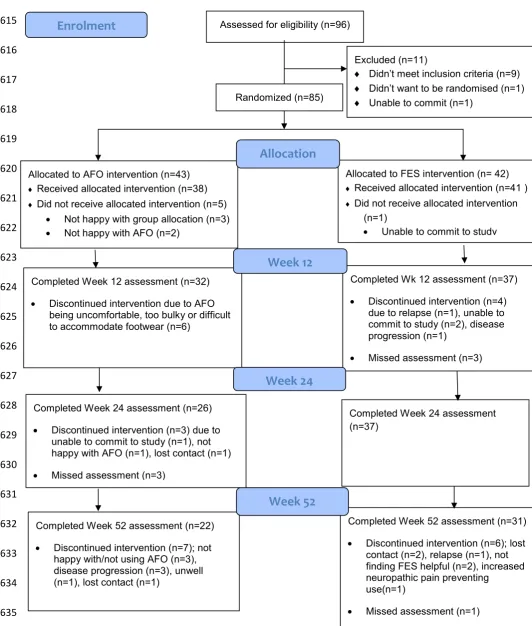
Eighty-five participants met the criteria for inclusion and consented to participate in 168
the study between September 2014 and January 2017 (Figure 1). Five participants 169
completed the baseline assessment and were included in subsequent analysis. The 171
recruitment and flow of patients through the study is shown in Figure 1, and the 172
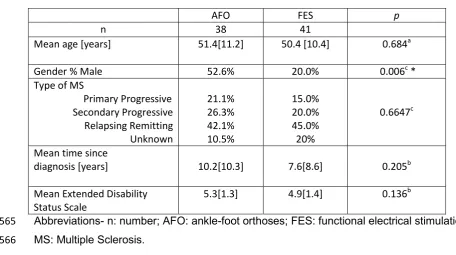
baseline demographic data are detailed in Table 1.Thirty-sevenparticipantsdropped 173
out over the course of the study and although there was no statistically significant 174
difference in drop-out rates between the groups, the proportion was higher in the 175
ankle-foot orthoses group. 176
177
Insert Figure 1 near here 178
179
Insert Table 1 near here 180
181
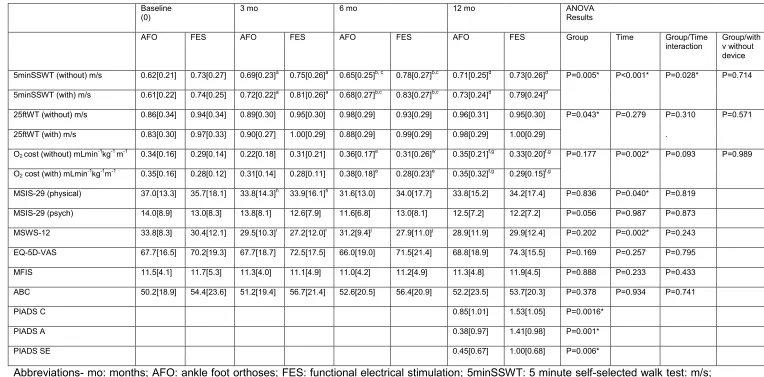
Table 2 presents the data for all outcomes, for both groups, at all assessment points 182
(0, 3, 6, 12 months) and the results for the repeated measures ANOVA model 183
employed for all outcomes. 184
185
Impact of devices on measures of walking performance 186
For the primary outcome measure, walking speed as measured by the 5-minute self-187
selected walk test, a significant difference was observed between the groups 188
(p=0.005) with the functional electrical stimulation group consistently walking faster 189
at all assessment points. Over the 12 months a significant improvement occurred in 190
both groups (p<0.001), although the groups changed differently over this time 191
(p=0.028). The functional electrical stimulation group improved steadily for the first 6 192
months then declined, whereas changes in the ankle-foot orthoses group fluctuated 193
over 12 months. There was no significant difference between the groups with 194
196
For the Timed 25 Foot Walk the functional electrical stimulation group walked faster 197
overall compared to the ankle-foot orthoses group (p=0.043). There was no 198
significant difference between the groups, nor did the groups react differently over 199
the 12 months. There was a significant change in oxygen cost of walking at 12 200
months (p=0.002) for both groups, however there was no difference between the 201
groups. 202
203
Insert Table 2 here 204
205
Impact of devices on Patient Reported Outcome Measures 206
Significant improvements in thephysical sub-scale of the Multiple Sclerosis Impact 207
Scale (p=0.040) and the Multiple Sclerosis Walking scale-12 (p=0.002) were 208
observed and this was most notable at 3 months in both groups respectively 209
(p=0.045; p<0.001). There were no differences between the groups for Patient 210
Reported Outcome Measures, except for all sub scales of the Psychological Impact 211
of Assistive Devices Scale, where the functional electrical stimulation group 212
demonstrated significantly higher scores for Competence (p=0.016), Adaptability 213
(p=0.001) and Self-Esteem (p =0.006) at 12 months. 214
215
Orthotic and therapeutic effects on the speed and oxygen cost of walking 216
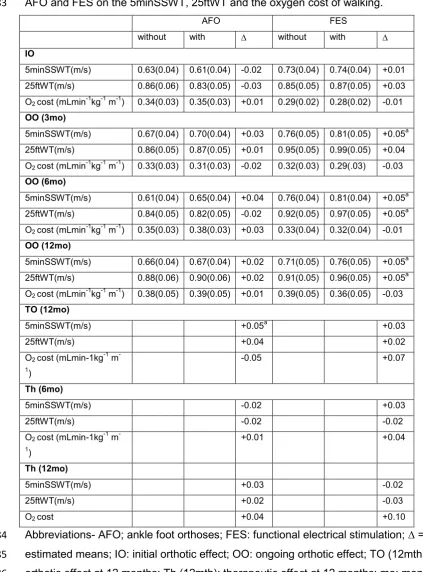
Clinically significant effects were determined by an observed increase in walking 217
speed of ≥ 0.05m/s, which has been previously identified by Perera et al.31 A 218
the functional electrical stimulation, but not the ankle-foot orthoses group (Table 3). 220
A clinically significant total orthotic effect on the primary walking outcome measure 221
was noted in the ankle-foot orthoses, but not the functional electrical stimulation 222
group at 12 months. 223
There was a negative total orthotic and therapeutic effect on oxygen cost of walking 224
with both devices, except for the ankle-foot orthoses at 12 months where a positive 225
total orthotic effect was observed. 226
227
Insert Table 3 here 228
229
Cost effectiveness 230
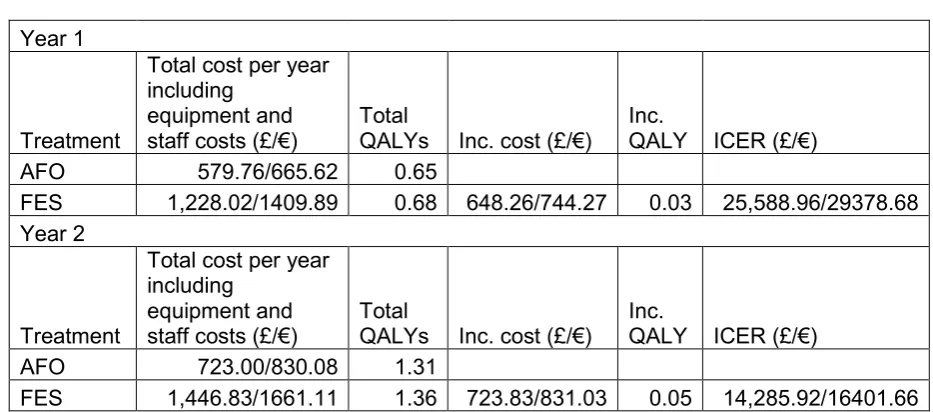
The total quality-adjusted life years were higher for functional electrical stimulation 231
than ankle-foot orthoses (Table 4). Further deterministic sensitivity and scenario 232
analysis indicated that the base case incremental cost-effectiveness ratio in the two-233
year model was relatively robust to changes in parameter values or structural 234
assumptions. 235
236
Insert Table 4 here 237
238
Discussion 239
Both devices demonstrated improvements in walking speed at 12 months, although 240
there were no significant differences in their effects. There were many drop outs over 241
the course of the study and the proportion was higher for ankle-foot orthoses, 242
non-significant positive ongoing orthotic effects observed with functional electrical 244
stimulation were of a similar magnitude to the results previously published in a meta-245
analysis from our group with respect to the combined long walk (i.e. 0.04m/s), but 246
not the short walking tests (i.e. 0.08m/s).4 Two small studies previously investigating
247
the ongoing orthotic effect of ankle-foot orthoses on walking speed reported 248
inconclusive results.5,6 Only three small non randomised studies have previously 249
compared the impact of these two devices on walking outcomes in Multiple 250
Sclerosis.7-9 Sheffler et al.7 reported mixed results on gait speed (n=4), and a more 251
recent study (n=20)9 found no difference between the devices on the speed or 252
energy cost of walking. Street et al.8 reported a significant difference in walking 253
speed (n=40, p=0.03) in favour of functional electrical stimulation, however 254
participants issued with functional electrical stimulation had already rejected ankle-255
foot orthoses, potentially biasing results. Such results suggest that devices may offer 256
similar efficacy, or that the walking performance measures selected may not be 257
sensitive enough to detect differences that exist. 258
259
No clinically significant therapeutic effects on walking speed were observed in either 260
group, although the pattern of effect was different. Results from a recent meta-261
analysis comparing the therapeutic effect of both devices in a stroke and cerebral 262
palsy population also reported comparable positive effects.32 No previous studies 263
have evaluated therapeutic effects of ankle-foot orthoses in Multiple Sclerosis, 264
however several functional electrical stimulation studies have investigated these 265
effects over shorter time frames33-37 with inconclusive results. Our previous meta-266
analysis reported a deterioration in unstimulated walking speed during long walking 267
al.35 reported a third of participants gained clinically meaningful therapeutic effects, 269
whilst a third experienced a decline in walking over the same time frame. Given the 270
neurodegenerative nature of Multiple Sclerosis it seems unlikely that either device 271
could offer a therapeutic effect over the longer time frame investigated in our study. 272
However, as observed by Street et al.35 it may be possible that a sub group of people 273
with Multiple Sclerosis have the potential to experience such effects and we 274
observed small positive therapeutic effects with ankle-foot orthoses at 12 but not 6 275
months. This finding suggests that changes may take longer than 6 months to 276
develop with ankle-foot orthoses. Further kinematic and neural control studies are 277
required to corroborate these findings and to understand the possible underlying 278
therapeutic mechanisms of these devices in people with Multiple Sclerosis. 279
280
There were no significant differences between the devices with regards to their 281
impact on the oxygen cost of walking. To our knowledge only one other study has 282
compared the ongoing orthotic effects of these devices on the energy and efficiency 283
of gait and reported no difference between these devices.9 Nevertheless, there were 284
different patterns of effects observed between the groups, with the functional 285
electrical stimulation group demonstrating small non-significant positive orthotic 286
effects throughout, and the ankle-foot orthoses group observing a greater positive 287
total orthotic effect (-0.05 mL min-1 kg-1m-1; 14.7%). These results are difficult to 288
interpret. However, they may have been influenced by the lower baseline oxygen 289
cost of walking in the functional electrical stimulation group. 290
291
There was no difference between the groups with regards to the patient reported 292
participants in the functional electrical stimulation group reported significantly higher 294
scores for all three subscales. Two previous studies evaluated the impact of 295
surface34 and implantable40 functional electrical stimulation on the Psychological 296
Impact of Assistive Devices Score. Scores for the functional electrical stimulation 297
group in the current study (Competence (1.53); Acceptance (1.00); Self Efficacy 298
(1.41)) were similar to those observed by Taylor et al.40 (Competence (1.59); 299
Acceptance (1.34); Self Efficacy (1.44)). The Psychological Impact of Assistive 300
Devices Scale has been found to be predictive of device compliance and retention 301
and is responsive to device stigma.41 Higher scores observed in the functional 302
electrical stimulation group suggests that device acceptance may be greater than 303
ankle-foot orthoses. Although both devices aim to promote functional autonomy, 304
assistive technology can be viewed as a symbol of disability, a loss of independence 305
and altered self-image.42 Some participants in the ankle-foot orthoses group reported 306
that wearing their device emphasised their disability and this may have contributed to 307
the higher rate of device abandonment observed in this group. Squires et al.43 308
suggests that assistive technology needs to meet both the physical and 309
psychological needs of an individual to ensure positive outcomes and continued use. 310
Future studies therefore need to consider the psychological acceptance of a device 311
in addition to its impact on walking outcomes. 312
313
Against a background of financial constraints there is a need for evidence of the cost 314
benefits of interventions. Our study indicates that although the upfront costs of 315
functional electrical stimulation are greater than usual care (ankle-foot orthoses), it 316
may be considered as a potentially cost-effective treatment option for foot drop and 317
effectiveness ratio for year one and two for functional electrical stimulation were 319
below the National Institute for Health and Care Excellence’s conventional 320
thresholds of £20,000 (€22962)-£30,000 (€34443) per quality-adjusted life year.28 No 321
previous studies have examined cost effectiveness of functional electrical stimulation 322
exclusively within Multiple Sclerosis or compared the cost effectiveness of these two 323
devices. Two previous economic evaluations which examined the cost effectiveness 324
of functional electrical stimulation in a mixed neurological population reported 325
incremental cost-effectiveness ratios of £25,235 (€28972.30) over one year, 326
reducing to £12,431 (€14272) over five years10 and £15,406 (€17688) compared to 327
physiotherapy.11 An economic report undertaken in 2009 found that functional 328
electrical stimulation was likely to be cost-effective, although data were almost 329
exclusively from studies recruiting stroke participants.44 The results of our current 330
economic analysis concur with these previous investigations and suggests that 331
further improvements in cost-effectiveness of the device could be gained with greater 332
compliance, thus offsetting the upfront costs and allowing the benefit of treatment to 333
accrue over the longer term. 334
335
This study has several limitations. Despite this study being powered to detect 336
change, the relatively small number of participants recruited and the high overall 337
dropout rates, with a greater loss from the ankle-foot orthoses group, make it difficult 338
to draw definitive conclusions. In addition, the participant, assessor and treatment 339
provider were not blinded, thus ascertainment bias is likely, although such bias may 340
be less relevant with objective outcomes, such as gait speed.45 341
The multi-centre design of this study enhances the generalisability of results. 343
However, although the ankle-foot orthoses prescription was standardised, variations 344
did occur across sites. Ankle-foot orthoses specification can influence biomechanical 345
aspects of gait, thus impacting on walking performance outcomes46 and device
346
retention. The ankle-foot orthoses prescription employed was based on stroke 347
guidelines and it is not clear whether this prescription was the most appropriate for 348
people with Multiple Sclerosis, particularly those presenting with a less severe foot 349
drop where such a rigid design may have resulted in higher drop outs. Further 350
investigation is required to identify the most appropriate and acceptable prescription. 351
We excluded participants with stance phase instability and reduced passive range of 352
ankle motion, therefore, findings are only applicable to those with mainly swing 353
phase impairments. 354
355
Although the 6-minute Walk Test has been found to be an accurate walking 356
performance test to assess the benefits of assistive technology for foot drop in 357
Multiple Sclerosis47, the validity and reliability of our primary outcome, the 5-minute 358
self-selected walk test, has not been established. This is a significant limitation of 359
this study. 360
361
The inclusion of an economic analysis is a strength. However, analysis did not 362
consider the impact on other healthcare resources, the time horizons were short, and 363
the differences detected in quality-adjusted life years for both devices were small. 364
Therefore, despite undertaking sensitivity and scenario analyses, the results should 365
be treated with caution. 366
Results from this randomised trial which to the best of our knowledge is the first and 368
largest study undertaken comparing the clinical and cost effectiveness of two 369
interventions for foot drop in Multiple Sclerosis over 12 months has provided 370
evidence that functional electrical stimulation is a comparable to ankle-foot orthoses 371
with regards to its impact on walking speed and patient reported outcomes. Although 372
this study suggests that functional electrical stimulation may also provide a value for 373
money alternative to usual care, a larger study which includes follow up of device 374
drop outs, and the employment of long-term modelling to explore the cost and 375
quality-adjusted life years of both interventions over the lifetime of a person with 376
Multiple Sclerosis, is required before definitive conclusions can be drawn with 377
regards to the cost effectiveness of functional electrical stimulation. Further 378
investigation as to how both interventions impact on walking, from a biomechanical, 379
muscle activation, neural control and personal perspective is also recommended. 380
The results from this study will nevertheless begin to inform clinical decisions and 381
contribute towards future policy decisions regarding the management of foot drop, 382
ultimately improving outcomes for people with Multiple Sclerosis. 383
384
Clinical messages 385
Ankle-foot orthoses and functional electrical stimulation have comparable 386
positive orthotic effects on gait speed in Multiple Sclerosis. 387
Despite higher initial upfront costs for functional electrical stimulation, it offers 388
a value for money alternative to usual care. 389
More people stopped using ankle-foot orthoses than functional electrical 390
stimulation over twelve months. 391
Acknowledgements 393
The research team would firstly like to thank the Multiple Sclerosis Society, UK for 394
funding this study (grant reference: 001). We would also like to thank the people with 395
Multiple Sclerosis who participated in this study, the Multiple Sclerosis services 396
across Scotland who assisted with recruitment and the orthotists involved from 397
National Health Services in Ayrshire and Arran, Tayside and Lothian. We would like 398
to thank Odstock Medical Limited, Salisbury and Buchannan Orthotics, Glasgow who 399
provided a discount on their products used in the study. 400
401
Declaration of Conflicting Interests 402
The author(s) declared no potential conflicts of interest with respect to the research, 403
authorship, and/or publication of this article. 404
405
References 406
1. LaRocca NG. Impact of walking impairment in multiple sclerosis. Patient 2011; 4: 407
189-201. 408
2. Michael j. Lower limb orthoses. In: Hsu J, Michael J, Fisk J eds, AAOS Atlas of 409
Orthoses and Assistive Devices. Philadelphia, PA: Mosby; 2008: 343-355. 410
3. Liberson WT, Holmquest HJ, Scot D, et al. Functional electrotherapy, stimulation 411
of the peroneal nerve synchronised with the swing phase of gait in hemiplegic 412
patients. Arch Phys Med Rehabil 1961; 42: 101-105. 413
4. Miller L, McFadyen A, Lord AC, et al. Functional Electrical Stimulation for Foot 414
Drop in Multiple Sclerosis: A Systematic Review and Meta-Analysis of the Effect 415
5. Sheffler LR, Hennessey MT, Knutson JS, et al. Functional effect of an ankle foot 417
orthosis on gait in multiple sclerosis: a pilot study. Am J Phys Med Rehab 2008; 418
87: 26-32. 419
6. Bregman DJ, De Groot V, Van Diggele P, et al. Polypropylene ankle foot 420
orthoses to overcome drop-foot gait in central neurological patients: a mechanical 421
and functional evaluation. Prosthet and Orthot Int 2010; 34: 293-304. 422
7. Sheffler LR, Norgan Bailey S, Chae J. Spatiotemporal and kinematic effect of 423
peroneal nerve stimulation versus an ankle-foot orthosis: A case series. Am J 424
Phys Med & Rehabil 2009; 1(7): 604-611. 425
8. Street T, Swain I, Taylor P. A comparison between ankle assisted orthotics and 426
Functional Electrical stimulation: a feasibility study. Multiple Sclerosis 2014; 20: 427
1001 428
9. Khurana SR, Beranger AG, Felix ER. Perceived exertion is lower when using a 429
functional electrical stimulation neuroprosthesis compared with an ankle-foot 430
orthosis in persons with Multiple Sclerosis. Am J Phys Med & Rehabil 2017; 431
96(3): 133-139. 432
10. Taylor P, Mann G, Jolley C et al. Economic Justification for the Odstock Dropped 433
Foot Stimulator (ODFS); ISPO meeting: 3rd Nov 2007. 434
11. Taylor P, Humphreys L, Swain I. The long-term cost-effectiveness of the use of 435
functional electrical stimulation for the correction of dropped foot due to upper 436
motor neuron lesion. J Rehabil Med 2013; 45: 154–160. 437
12. Kurtzke JF. Rating neurologic impairment in multiple sclerosis: an expanded 438
disability status scale (EDSS). Neurology 1983; 33(11):1444-1452. 439
13. Nasreddine ZS, Phillips NA, Bédirian V, Charbonneau S, Whitehead V, Collin I, 440
screening tool for mild cognitive impairment. J Am Geriatr Soc 2005; 53(4): 695-442
699. 443
14. Neurostatus.net, www.neurostatus.net
444
15. Day H and Jutai J. Measuring the psychosocial impact of assistive devices: The 445
PIADS. Can J Rehabil 1996; 9(2): 159-168. 446
16. Paul L, Rafferty D, Young S, et al. The effect of functional electrical stimulation on 447
the physiological cost of gait in people with multiple sclerosis. Multiple Sclerosis 448
2008; 14(7): 954-961. 449
17. Miller L, Rafferty D, Paul L, et al. A comparison of the orthotic effect of the 450
Odstock Dropped Foot Stimulator and the Walkaide functional electrical 451
stimulation systems on energy cost and speed of walking in Multiple Sclerosis. 452
Disabil Rehabil Assist Technol 2015; 10(6): 482-485. 453
18. Miller L, Rafferty D, Paul L, et al. The impact of walking speed on the effects of 454
functional electrical stimulation for foot drop in people with multiple sclerosis. 455
Disabil Rehabil Assist Technol 2016; 11(6): 478-83. 456
19. Cutter GR, Baier ML, Rudick RA, Cookfair DL, et al. Development of a multiple 457
sclerosis functional composite as a clinical trial outcome measure. Brain 1999; 458
122: 871–82. 459
20. McLaughlan JE, King GA, Howley ET, et al. Validation of the COSMED K4b 460
portable metabolic system. Int J Sports Med 2001; 22: 280–284. 461
21. Hobart J. The Multiple Sclerosis Impact Scale (MSIS 29): A new patient-based 462
outcome measure. Brain 2001; 124: 962-973. 463
22. Hobart J. Measuring the impact of MS on walking ability. Neurology 2003; 60(1): 464
23. Fisk JD, Pontefract A, Ritvo PG, Archibald CJ, Murray TJ. The impact of fatigue 466
on patients with multiple sclerosis. Can J Neurol Sci 1994; 21: 9–14. 467
24. Powell LE, Myers AM. The Activities-specific Balance Confidence (ABC) Scale. J 468
Gerontol A Biol Sci Med Sci 1995 ;50(1): 28-34. 469
25. Brazier J, Ratcliffe J, Tsuchiya A, Salomon J. Measuring and Valuing Health 470
Benefits for Economic Evaluation. Oxford: Oxford University Press; 2007 471
26. Day H, Jutai J, Campbell KA. Development of a scale to measure the 472
psychosocial impact of assistive devices: lessons learned and the road ahead. 473
Disabil Rehabil 2002 15; 24(1-3): 31-37. 474
27. National Health Service, Quality Improvement Scotland, Best practice statement: 475
use of ankle-foot orthoses following stroke. Edinburgh and Glasgow: National 476
Health Service, Quality Improvement Scotland 2009: 1-60. 477
28. NICE “The guidelines manual” Process and Methods National NICE available 478
assessing-cost-effectiveness November 2012 available 479
https://www.nice.org.uk/process/pmg6/chapter/assessing-cost-effectiveness
480
29. Devlin N, Shah K, Feng Y, et al. Valuing health-related quality of life: An EQ-5D-481
5L value set for England. Health Econ 2017; 27(1):7-22. 482
30. NICE (2015) “carrying NICE over the threshold” NICE 19th February 2015 483
available https://www.nice.org.uk/news/blog/carrying-nice-over-the-threshold
484
31. Perera S, Mody SH, Woodman RC, et al. Meaningful change and responsiveness 485
in common physical performance measures in older adults: meaningful change 486
and performance. J Am Geriatr Soc 2006; 54(5): 743-49. 487
32. Prenton S, Hollands KL, Kenney LPJ, et al. Functional electrical stimulation and 488
analysis providing direction for future research. J Rehabil Med 2018; Feb 490
13;50(2):129-139. 491
33. Barr C, Patritti BL, Bowes R, et al. Orthotic and therapeutic effect of functional 492
electrical stimulation on fatigue induced gait patterns in people with multiple 493
sclerosis. Disabil Rehabil Assist Technol 2017; 12(6): 560-572. 494
34. Barrett CL, Mann GE, Taylor PN, et al. A randomized trial to investigate the 495
effects of functional electrical stimulation and therapeutic exercise on walking 496
performance for people with multiple sclerosis. Multiple Sclerosis 2009; 15(4): 497
493-504. 498
35. Street T, Taylor P, Swain I. The effectiveness of functional electrical stimulation 499
on walking speed, functional walking category and clinically meaningful changes 500
for people with multiple sclerosis. Arch Phys Med Rehabil 2015; 96(4): 667-672. 501
36. Taylor PN, Burridge JH, Dunkerly AL, et al. Clinical Use of the Odstock Dropped 502
Foot Stimulator: It’s Effect on the Speed and Effort of Walking. Arch Phys Med 503
Rehabil 1999; 80(12): 1577-1583. 504
37. Van der Linden M, Hooper J, Cowan P, et al. Habitual Functional Electrical 505
Stimulation Therapy Improves Gait Kinematics and Walking Performance, but 506
Not Patient-Reported Functional Outcomes, of People with Multiple Sclerosis 507
who Present with Foot-Drop. PLOS ONE 2014a; 9(8): e103368. 508
38. Taylor P, Barret C, Mann G, et al. A feasibility study to investigate the effect of 509
functional electrical stimulation and physiotherapy exercise on the quality of gait 510
of people with Multiple Sclerosis. Neuromodulation 2014; 17(1): 75-84. 511
39. Stein RB, Everaert DG, Thompson AK, et al. Long-term therapeutic and orthotic 512
nonprogressive neurological disorders. Neurorehabil Neural Repair 2010; 24(2): 514
152-67. 515
40. Taylor PN, Wilkinson Hart I, Khan MS, et al. The Correction of Dropped Foot Due 516
to Multiple Sclerosis Using the STIMuSTEP Implanted Dropped Foot Stimulator. 517
Int J MS Care 2016; 18(5): 239-247. 518
41. Jutai J, Day H. Psychological Impact of Assistive Devices Scale: the assessment 519
of Assistive Technology Outcomes, Effects and Costs. Technol Disabil 2002; 520
14(3): 107-111. 521
42. Verza R, Lopes Carvalho ML, Battaglia MA, et al. An interdisciplinary approach to 522
evaluating the need for assistive technology reduces equipment abandonment. 523
Multiple Sclerosis 2006; 12: 88-93. 524
43. Squires LA, Williams N, Morrison VL. Matching and accepting assistive 525
technology in multiple sclerosis: A focus group study with people with multiple 526
sclerosis, carers and occupational therapists. J Health Psychol 2016:1-15. 527
44. Centre for Evidence-based Purchasing (CEP), Feb 2010. Economic report: 528
Functional electrical stimulation for drop foot of central neurological origin (CEP 529
10012). UK: NHS Purchasing and Supply Agency. Available from: 530
http://www.cedar.wales.nhs.uk/sitesplus/documents/1091/CEP10012%20FES%2
531
0econ%20report.pdf
532
45. Hróbjartsson A, Thomsen AS, Emanuelsson F, et al. Observer bias in 533
randomised clinical trials with binary outcomes: systematic review with both 534
blinded and non-blinded outcome. BMJ 2012; 27 (344): e1119. 535
46. Chen CC, Hong WH, Wang CM, et al. Kinematic features of rear-foot motion 536
using anterior and posterior ankle-foot orthoses in stroke patients with hemiplegic 537
47. Andreopoulou G, Mercer T H, van der Linden M L. Walking measures to 539
evaluate assistive technology for foot drop in multiple sclerosis: A systematic 540
review of psychometric properties. Gait Posture 2018; 61: 55-66. 541
542
543
544
545
546
547
548
549
550
551
552
553
554
555
556
557
558
559
560
561
562
Table 1. Demographic characteristics of participants. 564
AFO FES p
n 38 41
Mean age [years] 51.4[11.2] 50.4 [10.4] 0.684a
Gender % Male 52.6% 20.0% 0.006c *
Type of MS
Primary Progressive Secondary Progressive
Relapsing Remitting Unknown
21.1% 26.3% 42.1% 10.5%
15.0% 20.0% 45.0% 20%
0.6647c
Mean time since
diagnosis [years] 10.2[10.3] 7.6[8.6] 0.205b
Mean Extended Disability Status Scale
5.3[1.3] 4.9[1.4] 0.136b
Abbreviations- n: number; AFO: ankle-foot orthoses; FES: functional electrical stimulation; 565
MS: Multiple Sclerosis. 566
Data values are mean [SD] for continuous variables and n (%) for categorical variables 567
unless otherwise stated. Between group differences for demographic data (a: t-test, b: Man-568
Whitney, c: chi-square, *: significant). 569
Table 2: Means and SD for the primary and secondary outcome measures in the intervention and usual care group at 0,3,6 and 12 months. 571
Baseline
(0) 3 mo 6 mo 12 mo ANOVA Results
AFO FES AFO FES AFO FES AFO FES Group Time Group/Time
interaction
Group/with v without device 5minSSWT (without) m/s 0.62[0.21] 0.73[0.27] 0.69[0.23]a 0.75[0.26]a 0.65[0.25]b, c 0.78[0.27]b,c 0.71[0.25]d 0.73[0.26]d P=0.005* P<0.001* P=0.028* P=0.714
5minSSWT (with) m/s 0.61[0.22] 0.74[0.25] 0.72[0.22]a 0.81[0.26]a 0.68[0.27]b,c 0.83[0.27]b,c 0.73[0.24]d 0.79[0.24]d
25ftWT (without) m/s 0.86[0.34] 0.94[0.34] 0.89[0.30] 0.95[0.30] 0.98[0.29] 0.93[0.29] 0.96[0.31] 0.95[0.30] P=0.043* P=0.279 P=0.310 P=0.571 25ftWT (with) m/s 0.83[0.30] 0.97[0.33] 0.90[0.27] 1.00[0.29] 0.88[0.29] 0.99[0.29] 0.98[0.29] 1.00[0.29] .
O2 cost (without) mLmin-1kg-1 m-1 0.34[0.16] 0.29[0.14] 0.22[0.18] 0.31[0.21] 0.36[0.17]e 0.31[0.26]w 0.35[0.21]f,g 0.33[0.20]f,g P=0.177 P=0.002* P=0.093 P=0.989
O2 cost (with) mLmin-1kg-1m-1 0.35[0.16] 0.28[0.12] 0.31[0.14] 0.28[0.11] 0.38[0.18]e 0.28[0.23]e 0.35[0.32]f,g 0.29[0.15]f,g
MSIS-29 (physical) 37.0[13.3] 35.7[18.1] 33.8[14.3]h 33.9[16.1]h 31.6[13.0] 34.0[17.7] 33.8[15.2] 34.2[17.4] P=0.836 P=0.040* P=0.819
MSIS-29 (psych) 14.0[8.9] 13.0[8.3] 13.8[8.1] 12.6[7.9] 11.6[6.8] 13.0[8.1] 12.5[7.2] 12.2[7.2] P=0.056 P=0.987 P=0.873 MSWS-12 33.8[8.3] 30.4[12.1] 29.5[10.3]i 27.2[12.0]i 31.2[9.4]j 27.9[11.0]j 28.9[11.9] 29.9[12.4] P=0.202 P=0.002* P=0.243
EQ-5D-VAS 67.7[16.5] 70.2[19.3] 67.7[18.7] 72.5[17.5] 66.0[19.0] 71.5[21.4] 68.8[18.9] 74.3[15.5] P=0.169 P=0.257 P=0.795
MFIS 11.5[4.1] 11.7[5.3] 11.3[4.0] 11.1[4.9] 11.0[4.2] 11.2[4.9] 11.3[4.8] 11.9[4.5] P=0.888 P=0.233 P=0.433
ABC 50.2[18.9] 54.4[23.6] 51.2[19.4] 56.7[21.4] 52.6[20.5] 56.4[20.9] 52.2[23.5] 53.7[20.3] P=0.378 P=0.934 P=0.741
PIADS C 0.85[1.01] 1.53[1.05] P=0.0016*
PIADS A 0.38[0.97] 1.41[0.98] P=0.001*
PIADS SE 0.45[0.67] 1.00[0.68] P=0.006*
Abbreviations- mo: months; AFO: ankle foot orthoses; FES: functional electrical stimulation; 5minSSWT: 5 minute self-selected walk test: m/s; 572
meters per second: 25ftWT: 25 foot walk test; O2 cost (mLmin-1kg-1m-1); oxygen cost of walking per unit distance walked: MSIS-29 (physical); 573
12; Multiple Sclerosis walking scale-12: EQ-VAS; Euroqual questionnaire visual analogue scale; MFIS; modified fatigue impact scale; ABC: 575
activities and balance confidence scale; PIADS C: psychological impact of assistive devices scale competence sub scale; PIADS A: 576
adaptability subscale; PIADS SE: self-esteem subscale; *: statistically significant difference detected; a:ANOVA sig time effect 0-3months, 577
p<0.001; b: ANOVA sig time effect 0-6 months, p=0.029; c: ANOVA sig time effect 3-6 months, p=0.028; d: ANOVA sig time effect 3-12 months, 578
p=0.09; e: ANOVA sig time effect 3-6 months, p=0.07; f: ANOVA sig time effect 0-12 months, p=0.011; g: ANOVA sig time effect 3-12 months, 579
p=0.001; h: ANOVA sig time effect 0-3 months, p=0.045; I: ANOVA sig time effect 0-3 months, p<0.001; j : ANOVA sig time effect 3-6 months, 580
Table 3: Estimated means (SE) of initial, ongoing and total orthotic and therapeutic effects of 582
AFO and FES on the 5minSSWT, 25ftWT and the oxygen cost of walking. 583
AFO FES
without with without with
IO
5minSSWT(m/s) 0.63(0.04) 0.61(0.04) -0.02 0.73(0.04) 0.74(0.04) +0.01 25ftWT(m/s) 0.86(0.06) 0.83(0.05) -0.03 0.85(0.05) 0.87(0.05) +0.03 O2 cost (mLmin-1kg-1 m-1) 0.34(0.03) 0.35(0.03) +0.01 0.29(0.02) 0.28(0.02) -0.01
OO (3mo)
5minSSWT(m/s) 0.67(0.04) 0.70(0.04) +0.03 0.76(0.05) 0.81(0.05) +0.05a 25ftWT(m/s) 0.86(0.05) 0.87(0.05) +0.01 0.95(0.05) 0.99(0.05) +0.04 O2 cost (mLmin-1kg-1 m-1) 0.33(0.03) 0.31(0.03) -0.02 0.32(0.03) 0.29(.03) -0.03
OO (6mo)
5minSSWT(m/s) 0.61(0.04) 0.65(0.04) +0.04 0.76(0.04) 0.81(0.04) +0.05a 25ftWT(m/s) 0.84(0.05) 0.82(0.05) -0.02 0.92(0.05) 0.97(0.05) +0.05a O2 cost (mLmin-1kg-1 m-1) 0.35(0.03) 0.38(0.03) +0.03 0.33(0.04) 0.32(0.04) -0.01
OO (12mo)
5minSSWT(m/s) 0.66(0.04) 0.67(0.04) +0.02 0.71(0.05) 0.76(0.05) +0.05a 25ftWT(m/s) 0.88(0.06) 0.90(0.06) +0.02 0.91(0.05) 0.96(0.05) +0.05a O2 cost (mLmin-1kg-1 m-1) 0.38(0.05) 0.39(0.05) +0.01 0.39(0.05) 0.36(0.05) -0.03
TO (12mo)
5minSSWT(m/s) +0.05a +0.03
25ftWT(m/s) +0.04 +0.02
O2 cost (mLmin-1kg-1 m -1)
-0.05 +0.07
Th (6mo)
5minSSWT(m/s) -0.02 +0.03
25ftWT(m/s) -0.02 -0.02
O2 cost (mLmin-1kg-1 m -1)
+0.01 +0.04
Th (12mo)
5minSSWT(m/s) +0.03 -0.02
25ftWT(m/s) +0.02 -0.03
O2 cost +0.04 +0.10
Abbreviations- AFO; ankle foot orthoses; FES: functional electrical stimulation; = effect of 584
estimated means; IO: initial orthotic effect; OO: ongoing orthotic effect; TO (12mth): total 585
orthotic effect at 12 months; Th (12mth): therapeutic effect at 12 months; mo: months; 586
5minSSWT: 5-minute self-selected walk test: m/s: meters per second; 25ftWT: Timed 25 foot 587
walk; O2 cost (mL min-1 kg-1 m-1); oxygen cost of walking per unit distance walked; a indicates 588
a mean change in walking speed of ≥ 0.05m/s, considered to be clinically significant. 589
Table 4: Treatment costs, quality-adjusted life years and incremental cost effectiveness 591
ratio’s for both devices over both one and two years. (year two costs represent the 592
cumulative total of year one and year two costs). 593
Year 1
Treatment
Total cost per year including
equipment and staff costs (£/€)
Total
QALYs Inc. cost (£/€)
Inc.
QALY ICER (£/€) AFO 579.76/665.62 0.65
FES 1,228.02/1409.89 0.68 648.26/744.27 0.03 25,588.96/29378.68 Year 2
Treatment
Total cost per year including
equipment and staff costs (£/€)
Total
QALYs Inc. cost (£/€)
Inc.
QALY ICER (£/€) AFO 723.00/830.08 1.31
FES 1,446.83/1661.11 1.36 723.83/831.03 0.05 14,285.92/16401.66 594
Abbreviations- AFO; ankle foot orthoses; FES: functional electrical stimulation; inc: 595
incremental; QALY: quality adjusted life year; ICER: incremental cost effectiveness ratio. 596
Values presented are British pounds and euros. 597
598
599
600
601
602
603
604
605
606
607
608
609
610
612
Figure 1: Consort diagram.
613
Abbreviations: AFO: ankle-foot orthoses, FES: functional electrical stimulation 614 615 616 617 618 619 620 621 622 623 624 625 626 627 628 629 630 631 632 633 634 635
Assessed for eligibility (n=96)
Excluded (n=11)
Didn’t meet inclusion criteria (n=9) Didn’t want to be randomised (n=1) Unable to commit (n=1)
Completed Week 12 assessment (n=32)
Discontinued intervention due to AFO being uncomfortable, too bulky or difficult to accommodate footwear (n=6)
Allocated to AFO intervention (n=43) Received allocated intervention (n=38) Did not receive allocated intervention (n=5)
Not happy with group allocation (n=3)
Not happy with AFO (n=2)
Completed Wk 12 assessment (n=37)
Discontinued intervention (n=4) due to relapse (n=1), unable to commit to study (n=2), disease progression (n=1)
Missed assessment (n=3) Allocated to FES intervention (n= 42) Received allocated intervention (n=41 ) Did not receive allocated intervention
(n=1)
Unable to commit to study Allocation
Week 24 Week 12 Randomized (n=85) Enrolment
Completed Week 24 assessment (n=26)
Discontinued intervention (n=3) due to unable to commit to study (n=1), not happy with AFO (n=1), lost contact (n=1)
Missed assessment (n=3)
Missed appointments (n=5)
Completed Week 24 assessment (n=37)
Completed Week 52 assessment (n=31)
Discontinued intervention (n=6); lost contact (n=2), relapse (n=1), not finding FES helpful (n=2), increased neuropathic pain preventing
use(n=1)
Missed assessment (n=1) Completed Week 52 assessment (n=22)
Discontinued intervention (n=7); not happy with/not using AFO (n=3), disease progression (n=3), unwell (n=1), lost contact (n=1)