JOURNALOFVIROLOGY, JUlY1991, p.3451-3459 Vol.65,No. 7 0022-538X/91/073451-09$02.00/0
CopyrightX3 1991,American Society for Microbiology
Biological
Activities of Hybrid RNAs
Generated by 3'-End
Exchanges between
Tobacco
Mosaic and
Brome
Mosaic
Viruses
MASAYUKI
ISHIKAWA,lt*
PHILIPKRONER,2'3t
PAULAHLQUIST,2'3
ANDTETSUOMESHI'Department ofBiophysics and Biochemistry, Faculty of Science, UniversityofTokyo, Hongo, Tokyo 113,
Japan,'
andInstituteforMolecular Virology2 and Department of Plant Pathology,3 University of Wisconsin-Madison,Madison, Wisconsin 53706
Received22January 1991/Accepted 21 March 1991
Sequences within the conserved, aminoacylatable 3' noncoding regions of brome mosaic virus (BMV) genomicRNAs 1, 2,and3 direct initiationof negative-strand synthesis byBMVpolymeraseextractsand,like
sequences at thestructurally divergent but aminoacylatable 3' end oftobacco mosaic virus(TMV) RNA, are
required in cis for RNA replication in vivo. A series of chimeric RNAs in which selected 3' segments were exchanged between the tyrosine-accepting BMV and histidine-accepting TMV RNAs were constructed and
theiramplification was examined in protoplasts inoculated with or without otherBMV andTMVRNAs.TMV
derivatives whose 3' noncoding region was replaced by sequences from BMV RNA3 were independently replication competent when the genes for the TMV
130,000-Mr
and 180,000-Mr RNA replication factors remained intact. TMV replicase can thus utilize the BMV-derived 3' end, though at lower efficiency than the wild-type (wt) TMV 3' end. Providing functional BMV RNA replicase by coinoculation with BMV genomic RNAs 1 and 2 did notimprove the amplification of these hybrid genomicRNAs. By contrast, BMVRNA3 derivatives carrying the 3' noncoding region ofTMV were notamplified when coinoculated with wt BMVRNA1 and RNA2, wt TMV RNA, or all three. Thus, BMV replicase appearedtobe unable to utilize theTMV
3' end,and therewas noevidenceof intervirus complementationinthereplication of any of the hybrid RNAs.
Inprotoplasts coinoculated with BMVRNAl and RNA2, thenonamplifiable RNA3 derivatives bearing TMV
3' sequences gave rise to diverse new rearranged or recombined RNA species that were amplifiable.
Tobacco mosaic virus (TMV) and brome mosaic virus (BMV) arepositive-strandRNAviruses of plants. TMV is a
rod-shaped virus with a single 6.4-kb genomic RNA (51). BMV is an isometric, tripartite virus with three separately
encapsidated genomic RNAs, RNA1
(Bi,
3.2 kb), RNA2 (B2, 2.9 kb), and RNA3 (B3, 2.1 kb) (2, 29). Despite theirdivergent particle multiplicity and genome organization, TMVand BMV share someimportantbasic properties.The
genomicRNAs of bothviruses have 5' m7GpppGcapsand 3'
aminoacylatable, tRNA-like structures, although each
ge-nome is charged with adifferent aminoacid (18, 19). Each
virusencodes four known proteins, including one structural and three nonstructural proteins (2, 5, 16, 40). The two
largest nonstructuralproteins, the130,000-Mr(130k protein)
andthe 180kprotein ofTMV andthe laand 2aproteins of
BMV, areinvolvedin viral RNAreplication (15, 21, 25, 26,
27, 50; unpublished results). Remarkable amino acid
se-quencesimilarities exist among these BMV andTMV
repli-cation factors andproteins encoded by the animal
alphavi-ruses and many other positive-strand RNAviruses (6, 20).
These and other common features suggest that BMV and TMV havefundamentalsimilaritiesintheirreplication
strat-egies.
ForBMV, the 3'-terminal 200bases ofall three
genomic
RNAsarestrongly conservedandhighlystructured(1),and
portions
ofthis region playacrucial role intemplate recog-nition by BMV replicase. The 3'-terminal 134-base RNAfragment is both aminoacylatable and sufficient to direct
*
Corresponding
author.tPresent address: Department ofAgricultural Chemistry, Fac-ulty of Agriculture, Hokkaido University, Sapporo 060, Japan.
tPresentaddress: TheBlood CenterofSoutheasternWisconsin,
Milwaukee,WI53233.
initiation of negative-strand RNA synthesis by an
RNA-dependent RNA polymerase extract from BMV-infected
barley leaves, which synthesizes RNAs complementary to
exogenouslyinputBMV RNAsbut not other viral orcellular RNAs(37, 38). Mutationalanalyses withbiologically active
viral cDNA clones haveconfirmed the importance ofthese
3'-terminal sequences forreplication ofBMV RNA in vivo (10, 13) and the corresponding importance of 3' noncoding
sequencesforTMVRNAreplication invivo(48). 5' and in
some cases internal sequences are also required in cis for
bromovirus RNA replication in vivo (13, 42) and similarly contribute to template specificity and activity in the full RNAreplication cycle(41a).
To examine the strictness of the relationship between TMVreplicase and the 3'-terminal sequence ofTMV RNA
(23), three chimeric viruses were recently constructed by replacing the 3' noncoding sequence ofthe TMV-L strain (40)with the corresponding regions fromTMV-OM (a com-mon strain[39, 47]), TMV-Cc(acowpeastrain [34,52]), or
cucumber green mottle mosaic virus, anothertobamovirus (33, 41). EventhoughtheVal-accepting 3' end ofTMV-Cc RNA is remarkably divergent in structure from the
His-acceptingends of these othertobamovirusRNAs(34,44),all
ofthe chimeric viruses were able to
replicate, indicating
a degree of permissiveness in the interaction between the TMV replicase and the 3' end. Similarpermissiveness
has also been demonstrated for 3'-terminal exchangesbetween BMVand cowpeachloroticmottle virus, anotherbromovi-rus(7, 50;unpublished results).
Toexplorethefunctional limits of such 3' exchanges,we
have nowconstructed several hybrid genomes
transferring
thehighlydivergent3'noncodingregionsbetween TMV and BMVRNAs.SinceTMVand BMVboth
replicate
in tobaccoorbarleyprotoplasts,these
experiments
werealsodesigned
3451
on November 10, 2019 by guest
http://jvi.asm.org/
to test the possibility of creating chimeric RNA templatesfor whichpositive- and negative-strand synthesis in vivo would be catalyzed by different replicases from two coinfecting viruses. Such a system would beuseful fordissociating and analyzing specific steps in RNA replication. Our results show that TMV replicase was able, at low efficiency, to amplify templates bearing BMV 3' sequences, while BMV replicase was unable toamplify anyof thehybrid templates. Simultaneous coinoculation with both BMV and TMV rep-lication helper viruses did not enhance genomic RNA syn-thesisfor any of the hybrid templates.
MATERIALS AND METHODS
Plasmids. pLFW3 is the standard plasmid used toobtain
infectious TMV (L strain) RNA by in vitrotranscriptionwith Escherichia coli RNA polymerase (32). pLQDN, a deriva-tive of pLFW3, lacks the 30kprotein and coatprotein genes (35). pBlTP3, pB2TP5, and pB3TP8 are cDNA clones of BMV RNA1 (Bi), RNA2 (B2), and RNA3 (B3), respec-tively, from which infectioustranscripts can be synthesized
with T7 RNA polymerase (24). pB3C97 is a pB3TP8 deriv-ative that contains a deletion in the 3a gene (13). pB3BX1 (13), a pB3PM1 derivative (4), has a deletion in the coat protein gene of a B3 cDNA copy linked to an E. coli RNA polymerase promoter (4). pB2SB8 is aframeshift derivative of pB2TP5 that produces a truncated, nonfunctional 2a protein (50). pBlSB1 is a frameshift derivative of pBlTP3 thatcontains the 10-baseinsertion GGATCGATCCbetween bases 875 and 876 of the Bi cDNA sequence, leading to
production of a truncated, nonfunctional la protein (25a). Plasmid constructions. (i) pLB1 and pLB2. The 0.2-kb filled-in BstNI-HindIII fragment of pB3C97 was inserted betweenthe filled-inMluIandHindIlI sitesofpUCG91 (32).
The resulting plasmid, pB3M1, has an MluI site at the junction between the B3-derived sequence and thepUCG91 polylinker sequence. TheBMV-derived sequence ofpB3Ml wasconfirmed by sequencing. pB3C97M wasconstructed by ligating the 3.5-kbBamHI-EcoRI and 0.9-kb BamHI-HindIII fragments of pB3C97 and the 0.2-kbEcoRI-HindIIIfragment ofpB3M1. pB3C97 and pB3C97M are identical except that an MluI site is introduced just downstream of the BMV sequence in pB3C97M. pB3D1 was constructed bydeleting
the sequence between theBglII and XbaI sites of pB3C97. pLB1 was constructed by replacing the sequence between the SspI and MluI sites of pLFW3, containing the 30k and coatprotein genes and the 3' noncoding sequence, with two
fragments, the 0.4-kb filled-in BamHI-HindIII fragment of
pB3D1 and the 0.2-kb MluI-HindIII fragment of pB3M1.
pLB2 was constructed by the same method except that the 0.9-kb filled-in BamHI-HindIII fragment derived from pB3C97 was used in place ofpB3D1.
(ii)pLB3, pLB4, and pLB6. pLB1 was digested withXbaI,
filled in, and religated to create pLB4. The resulting 4-base frameshifting insertion was confirmed by sequencing. pLB6 was constructed by replacing the 1.6-kb BglII fragment of pLB1 with the corresponding fragment from pLFR3 (21), resulting in a frameshift in the 180k protein gene just downstream of the 130k protein gene. pLB3 was created by ligating three fragments: the 4-kb
EcoRV-MluI
fragment of pLFW3, the 0.9-kb filled-in BamHI-HindIII fragment of pB3C97, and the 0.2-kb MluI-HindIII fragment ofpB3M1.(iii) pB3PK series. pOL1, derived from pLFW3, has a TMV-OM-derived 3' noncoding sequence between the NsiI
and MluI sites in place of the authentic L-derived sequence (23). TheNsiI-MluI fragment of pB3C97Mcontaining the 3'
noncoding sequence and the C-terminal portion of the coat protein gene of B3 was replaced with the 0.2-kb NsiI-MluI fragments of pOLl and pLFW3, creating pB3PK1 and pB3PK2, respectively. The 1.8-kb SphI-NsiI fragment of pB3TP8 was introduced into the corresponding regions of pB3PK1 and pB3PK2 to create pB3PK3 and pB3PK4, re-spectively.
(iv) Plasmidsfor RNA probe production. pT732 was
con-structed by inserting the NsiI-filled-in MluI fragment of pLFW3, the 3'noncoding sequence of TMV-L, between the PstI and SmaI sites of pT7T3-19U (Pharmacia). pBCPSN1
was constructed by inserting the SacI-NsiI fragment of pB3TP8,derived from theinternalportion of the BMVcoat
protein gene, between the PstI and SacI sites ofpT7T3-19U. pB3HE1carries the sequencederived from the 3'noncoding
region of B3 (13).
Invitrotranscription. Plasmidswere linearized with MluI (TMV-based constructs, pB3C97M, and pB3PKseries
con-structs) or EcoRI(BMV-basedconstructs).Accordingtothe promoterlinkedtothe viralcDNA, linearizedplasmidswere
thentranscribed in vitro withE. coli RNApolymeraseorT7 RNA polymerase asdescribedpreviously (3, 13, 35). When used alone as theinoculum for tobaccoprotoplasts, in vitro transcripts produced by E. coli RNA polymerase were
purified by phenol extraction and ethanol precipitation.
Template DNAs were notremoved because their presence did not cause a serious decrease in infection efficiency,
because digestion of templates with DNase I occasionally
resulted in inefficient infection, and because RNA at low
concentrations is recovered inefficiently by LiCl
precipita-tion. In experiments requiring the coinoculation of
tran-scripts produced by T7 and E. coli RNA polymerases, the
transcripts were mixed and purified by LiCI precipitation
since the presence of BMV cDNA templates in inocula causes inefficient infection ofbarley cells (15). TMV
tran-scripts were efficiently recovered along with BMV
tran-scriptsby this method.
Protoplast inoculation.Tobaccoprotoplasts
prepared
fromsuspension-cultured cells (56) were inoculated with in vitro
transcriptsessentiallyasdescribed
previously
(54).Briefly,
6 x 10⁵protoplasts were inoculated by electroporation within vitro transcripts produced from 7.5Kg
oflinearizedplasmidforE.coli RNApolymerase and/or2to2.5 ,ugof
plasmid
for T7 RNApolymerase. Forsomeexperiments,
2jig
ofTMV-L virion RNA, extracted from tobacco plants inoculated with LFW3transcripts, wasused as aTMV-Linoculum inplaceof pLFW3 transcripts (see Fig. 5). Inoculated
protoplasts
were divided into four parts, and each aliquot (1.5 x 10⁵
cells) wascultured in the dark in the presence of
dactinomy-cin (25 ,ug/ml). Total nucleic acids were extracted as de-scribed before(53). ForNorthern (RNAblot)analysis, DNA was removed with DNase I (22) and total RNAs were
glyoxalated andseparatedby electrophoresis on1%agarose gels (49). Infection in each experiment was concurrently
checked by pulse-labeling with [3H]uridine from 21 to 23 h
postinoculation (p.i.), followed by gel electrophoresis of total nucleic acids thatwereextracted and fluorographed as
described before (53). Immunofluorescence with anti-BMV antibodies showed that typically 20 to 30% of inoculated tobacco cells were infected by the procedures used here.
Before undertaking coinoculation experiments with Bi
and B2, we confirmed that the amount of E. coli RNA
polymerasetranscriptusedastheinoculum for theLB series
hybridRNAs was sufficient in principle for detectable
repli-cationbyBiand B2.Thiswasdonebycoinoculating
Bi
andB2 transcripts togetherwith asuitable range ofdilutions of
on November 10, 2019 by guest
http://jvi.asm.org/
AMPLIFICATION OF TMV-BMV HYBRID VIRUSES 3453
1c00 3000
130k
wt
TMV-L
o-LQDN
of
+4nt
(LB4)
+4nt (B3BX 1
wtB3
al
u
. {
180k
5000 6o00 Int)
£ 30k CP z 3'end(6384)
TMV3'
LB6)
II
I"
3a X31CP X end(2113)
04~~x_P
ls
IIW
_" BMV CP BMV3'
B3C97
9
OiL~
i
LB3
FIG. 1. SchematicdiagramofTMV-BMV hybrid RNAs LB1, LB2, LB3, LB4, and LB6, with comparisons to wtTMV-L andwtBMV RNA3 (B3). LB1, LB2, and LB3 arediagrammedindividually, and thepositions of the LB4andLB6frameshift mutations (see text)are
indicatedbelow the LB1structure.LQDN, B3BX1, and B3C97arehighlyreplicating deletionmutantsofTMV-L and B3 thatwereusedas
models andintermediates for construction of the hybrids (see Materials and Methods) andascontrols forsomelaterexperiments.TMV-and BMV-derivedsequencesareshown by thin andbold lines,respectively. Open circles indicate5'capstructures.Codingregions for theTMV 130k,180k, 30k, andcoat(CP) proteins and the BMV 3a andcoat(CP) proteinsareshown byopenboxes.The B3intercistronicoligo(A)tract isdenoted byasolidrectangle. The starting positions of BMV (14) and TMVsubgenomicmRNAsareshownby bentarrows.The starting positions indicated for the TMV-L 30k and CP subgenomic mRNAsarebasedonthecorrespondingstartsites intheclosely relatedTMV-OM and TMV-U1strains (17, 55). Thick bars below thewtTMVand B3 diagrams identify the regions subclonedtomake theTMV3', BMV 3', and BMVCP in vitrotranscriptprobes, whichwere used for Northern blotanalysis ofprogenyRNA.nt, nucleotides.
E.coli RNA polymerasetranscripts of B3BX1,a
replication-competent B3 deletion derivative (13). Toconfirm that the
extra3'nucleotides provided bythe MluItermination site of
LB seriestranscripts did notinhibit amplification by BMV
replicase, weintroduced anequivalent MluI site into the3'
end of the B3 derivative B3C97and demonstrated that the
resultantRNA isreplicatedinprotoplasts coinoculatedwith
Bi and B2 (13) (see plasmid pB3C97M inthis section).
Barleyprotoplasts wereisolatedand inoculated as
previ-ously described (26). Protoplasts (105)were inoculated with
in vitrotranscripts producedfrom 1 ,ugof eachappropriate
linearizedplasmid and,whenappropriate,with 2,gof TMV
virion RNA. Following inoculation, 105 protoplasts were
incubated at 30°C for 5 to 24 h. Total nucleic acids were
extracted andseparated by electrophoresis on agarose gels
followingdenaturation in thepresenceofglyoxal (26).
Northernblotting. Four differentprobeswerepreparedto
specificallydetect BMVRNA,TMVRNA,andthedifferent hybridtranscripts. Nick-translatedpLFW3 orpLQDN was
used for detection of TMV-derived sequences. 32P-labeled
transcripts derived from pT732, pB3HE1, and pBCPSN1
wereusedtospecifically detectthe3' end ofTMV, thefour BMV RNAs, and derivatives with the BMV coat protein gene sequence, respectively. Transcript probes were
pre-pared essentiallyasdescribedpreviously (31).Hybridization with GeneScreen membrane (Du Pont) was performed
ac-cording to thesupplier's protocolwith slightmodifications.
Hybridization with ZetaProbe membrane (Bio-Rad) was
performedasdescribed previously (26).
RESULTS
Independent replication of TMV derivatives bearing
3'-terminalsequencesfrom BMV RNA3. Toassesswhether the
tRNA-like 3' end ofaBMVgenomicRNAcouldfunctionally
replacethe 3' end of TMV RNA and support RNA
replica-tion by TMV replicase, hybrids LB1 and LB2 were
con-structed in cloned viralcDNA(Fig. 1). LB2 containsthe 5'
4.9 kb of wild-type (wt) TMV-L RNA, including the 5'
noncoding sequence and complete 130k and 180k protein genes, followed by the 3' 1.1 kb of BMV RNA3 (B3), including theintercistronic noncoding region, the coat pro-teingene,and the 3'noncodingregion.LB1 differs fromLB2 in lacking the BMV coat protein gene and some of its 5'-flanking sequence, including the core promoter for
syn-thesis of the BMVsubgenomiccoatproteinmRNA(14, 30).
In vitrotranscripts fromthe LB1 and LB2 cDNA clones
were inoculated separately into tobacco protoplasts, and
LB1
LB2
Y
--A aVOL.65, 1991
IrIA
0a 00
-, 4.4 4
on November 10, 2019 by guest
http://jvi.asm.org/
[image:3.612.136.492.76.375.2]3454 ISHIKAWA ET AL.
(A) C
y In ZI
Jv: [NJ + Cn
C) a a: a: a: o C
F4.52 .4 m
'I"4 5j 74 5, ?4 5 ,'4 ;) `?4 .'4 b- d4 nrr v7.
(B)
C. In m v; :n m o
F-. _i __ _. M
`. .;;;4 r4 -;:P4 af:?4 2 24 2 t 2
C%,
iri
1.3:.'. .1. If. .- .; 7...
4^ ': ?4 4 5, r4 ,rlr' 3:
'o'M .jn
I'l .~:4
fI fi*
TMV probe
*1 VI
42
B4
BMV 3' probe
FIG. 2. Accumulation of 5' TMV-3' BMV hybrid RNAs in
tobaccoprotoplasts. The transcriptsusedfor inoculation are
indi-cated aboveeachlane. Totalnucleic acidswereextractedat5 or 24
hp.i.,treated with DNaseI,denatured withglyoxal,separatedby
1%agarose gel electrophoresis, andblotted to GeneScreen
mem-branes (DuPont).Membraneswereprobedwith(A)nick-translated
pLQDN(TMV probe) andwith(B) atranscriptprobe
complemen-tary to the conserved 3'-terminal 200 bases of all three BMV
genomicRNAs (BMV3' probe;seeFig. 1). Nocross-hybridization
was observed with either probe (see lanesBi +B2 + B3 in panel A
andLQDN in panelB). One-fifteenth of the totalRNAfrom1.5 x
105inoculatedprotoplasts was usedfor each lane,exceptfor lanes
LQDN(A)andBi + B2+ B3 (B),for which1/15,000thofthetotal
RNA from 1.5 x 10⁵ protoplasts was loaded. The positions of
LQDN,wtBMV RNAs 1(Bi),2(B2), and3(B3), and subgenomic
RNA4(B4)areindicatedtotheright ofthepanels, with abracket
(LB) encompassingthepositions of the LB1, LB2, LB4, and LB6
hybridRNAs.Arrowheads inpanel B indicate bandsdiscussed in
thetext.
11.1
TmV probe
(B)
24 5 24 5 24
24 5 24 5 24
L.: ,.,
x s-1 -r :.
5 24 5 24 5 245 2 4 '~24;hrpi':
(C)
_~
aInrT; 44 +InJ
24 45a245 24 5 2 4 5 ,424 r n
- F-|:<
k '1
BMV 3 probe BMV CP probe
their fate was examined by Northern blot analysis of total
RNAextractedat5 and 24hp.i. Bands correspondingtothe LB1 and LB2 genomic RNAs were detected with probes
specifictoeither the TMVorthe BMVsequences thatthey
contain (Fig. 2). At 5 h p.i., onlyfaint genomic RNA-sized
bandswere visible andmostof the hybridization signalwas
found in a lower-molecular-weight (MW) RNA smear that
presumably represents degraded inoculum. By 24 h p.i.,
most of this low-MW material had disappeared, but there
was a substantial increase in the intensity of the LB1 and
LB2genomicRNAbands, showingthatthese hybridRNAs
were replicated in vivo. The levels of LB1 and LB2
accu-mulation, however, were 100-to 1,000-fold lowerthan that ofLQDN (Fig. 2A),aninternaldeletionmutantof TMV that
sharesonedeletion boundarywith LB1 and LB2(Fig. 1)but
has wtRNAreplication activity (35).
In addition to genomic RNA, some discrete lower-MW
RNAswerealsoseenat24 h p.i. in LB1 andLB2infections (Fig. 2). Most of these RNAs wereof low intensity relative
togenomic RNA, andmanyvaried in levelbetweendifferent
experiments. Similar low-intensity bands often accompany
wt TMV and BMV replication. These bands may include
degradation products of the genomic RNA. For both LB1 and LB2, the BMV 3' probe also consistentlyrevealedone
lower-MW RNA species withstrongintensityrelativetothe
genomic RNA (bands marked by arrowheads in Fig. 2B).
Hybridization tothe BMV 3' probe (Fig. 2B) indicates that
these RNAsarecoterminalornearly coterminal with the 3'
end, while lack ofadetectable signal with the LQDN TMV
probe (Fig. 2A) shows that they contain little or no TMV
sequence. These facts and the observed electrophoretic
FIG. 3. Accumulation of 5' TMV-3' BMV hybrid RNAs in
tobaccoprotoplasts coinoculated with Bi andB2. The transcripts
usedfor inoculationareindicatedaboveeachlane, andRNAs were
analyzedas describedin thelegendto Fig. 2.One-fifteenth of the
totalRNAsfrom1.5x 105inoculatedprotoplastswasusedforeach
lane,except for lanesLQDNandLQDN+ Bi+ B2 inpanelAand
laneBi+B2+B3inpanel C, for which1/15,000th of the totalRNA
from1.5 x 105protoplastswasloaded. Nick-translatedpLQDNwas
used as aTMV-specific probe in panelA.PanelBshows
hybridiza-tion of the BMV 3' probe with thesamesamplesasin the first15
lanes ofpanelA. The BMV 3' andCP(coatprotein) probes used in
panelsBandCaremapped in Fig.1.The BMVCPprobe doesnot
cross-hybridize to wt TMV RNA (see Fig. 5). The positions of
relevantRNAbandsareshowninthemargins, andanarrowheadin
panel C marksaband discussed in thetext.
mobilities suggest that the marked bands may represent
subgenomic RNAs synthesized from the TMV 30k
subge-nomic mRNA promoter, whosestart site is present in LB1 andLB2shortly5'tothejunctionwith BMV sequences(Fig.
1).
Hybrids LB3, LB4, and LB6 were made to confirm the
dependenceof LB1 and LB2 replicationon the TMV repli-cation genes. LB3 isanLB2derivative withalargedeletion in the130k and 180kprotein-codingsequences (Fig.1). LB4 and LB6 are LB1 derivatives with 4-base frameshifting insertions in the 130k and 180k protein gene, respectively
(Fig. 1).LB3and LB4donotproduceeither the 130kor180k
protein,andonly the 130kproteinisproduced by LB6. From
5 to 24hp.i., the intensityof thegenome-sized LB3, LB4,
and LB6 RNA bands from the input inoculum decreased rather thanincreased(Fig.2AforLB4and LB6 andFig. 3C
J. VIROL.
c-m
_ B
*uUN
!r-3
fI ..
on November 10, 2019 by guest
http://jvi.asm.org/
[image:4.612.65.294.55.230.2] [image:4.612.322.554.82.414.2]AMPLIFICATION OF TMV-BMV HYBRID VIRUSES 3455 for LB3). Thus, just as for wt TMV (21), at least the 180k
protein is required for detectable replication of LB1 and LB2.
Coinoculation of 5' TMV-3' BMV hybrids with BMV RNAs 1 and 2. To determine whether BMV replicase could further enhance the amplification of LB1 and LB2, these hybrid RNAs were coinoculated with BMV RNA1 (Bi) and RNA2 (B2), which encode BMV RNA replication proteins la and 2a, respectively. Since LB1 and LB2 (Fig. 1) contain all BMV 3' sequences required for initiation ofnegative-strand synthesis in vitro by BMV polymerase extracts (12, 37), BMV replicase may recognize the LB series RNAs as templates for negative-strand synthesis in vivo. If the resul-tant BMV replicase-derived LB negative-strand RNAs could then serve as templates for positive-strand synthesis by TMV (or possibly BMV) replicase, greater hybrid RNA accumulation might occur than in cells inoculated with the LB series hybrids alone.
In protoplasts coinoculated with Bi and B2, the accumu-lation of LB1 (Fig. 3A and B) and LB2 (Fig. 3C) genomic RNA was slightly enhanced over that after inoculation of LB1 or LB2 alone. However, equivalent enhancement of LB1 and LB2 accumulation was also observed after coinoc-ulation with the nonreplicating Bi and B2 mutants BlSBi
and B2SB8, which bear lethal frameshiftmutations in the la and 2a genes, respectively (Fig. 3A and B for LB1, and Fig. 3C for LB2). The increase in LB1 and LB2accumulation in such coinoculations thus appears to be due to relatively nonspecific effects, such as the higher total RNA level in the inoculum or the use of LiCl precipitation in the final purifi-cation of inoculum transcript mixtures containing BMV components (see Materials and Methods) rather than the replicative action of the BMV la and 2aproteins. LB3, LB4, and LB6, which were incapable of independent replication, still showed no amplification whencoinoculated withBiand B2 (Fig. 3A for LB4 and LB6, Fig. 3C for LB3). Hybridiza-tion of strand-specific probes to blots ofglyoxal-denatured protoplast RNA also revealed nodetectable accumulation of LB3, LB4, and LB6 negative-strand RNA after coinocula-tion with Bi and B2 (results not shown). Such probing reliably and specifically detects negative-strand RNA in infections with wt BMV, wt TMV, and any of their deriva-tives that replicate to asignificant level (26, 27;unpublished results).
As shown in Fig. 1, LB2 contains thecomplete sequence of the BMV subgenomic coatprotein mRNA, RNA4, and all of the upstreamsubgenomic promoter sequences required in vivo for RNA4 synthesis by BMV replicase (14). Upon coinoculation of LB2 with Bi and B2, a new RNA band appeared that hybridized to the BMV coat gene probe and exactly comigrated with BMV subgenomic RNA4 (Fig. 3C, indicated by arrowhead). This RNA did not appear when LB2 was coinoculated with BlSB1 and B2SB8 (Fig. 3C).
Behavior of BMV RNA3 derivatives bearing 3'-terminal
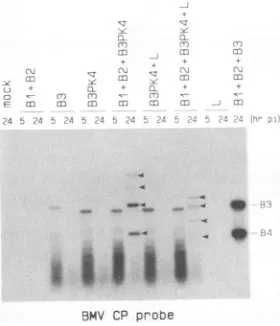
sequences from TMV RNA. To explore the consequences of reciprocalexchanges, BMV RNA3 (B3) derivativescarrying TMV 3' noncoding sequences were constructed. Figure 4 shows the structure of hybrid B3PK4, in which a 3' portion of the BMV coat gene and 3'noncoding region werereplaced with the 3'noncoding region of TMV-L. This change did not significantly alter B3 stability in vivo, since, in the absence of Bi and B2, thedecrease in input B3PK4transcriptsfrom 5 to 24 h p.i. was similar to that observed for wt B3 (long exposures of Fig. 5 and similar experiments).
Coinoculation withBi and B2 or with TMV-L RNA, or all three, did not alter the decline in the B3PK4 RNA band
1000 2000 (nt)
ax Z z f 3 end(2113)
wtB3 3a
BMV CPI BMV 3'
B3PK4
-3'end(62W4)
wtTMV-L
30k ltCP
TMV 3'
FIG. 4. Schematicdiagram ofBMV-TMV
hybrid
RNA B3PK4and comparison with wt B3 and wt TMV-L. Abbreviations and
conventionsarethesame as inFig. 1.
between 5 and 24 h
p.i.
(Fig.
5),
indicating
thatBi, B2,
and TMV-L were unable to direct detectablereplication
of B3PK4.Nevertheless,
whenever B3PK4 was coinoculatedwith
Bi
and B2, new RNA bandsappeared
that did notcomigrate
withB3PK4(arrowheads
inFig. 5,
lanesBi + B2 + B3PK4 andBi
+ B2 + B3PK4 +L).
The appearanceofsuch novel RNA bands was observed in a
large
numberofsamples
derived from manyindependent
coinoculations of B3PK4,Bi,
andB2,
inthe presenceorabsence of TMV-L. The novel RNAswere visibleat24hp.i.
butnot at5 hp.i.,
indicating
thatthey
wereamplified
progeny RNAs. Sincethese RNAs
hybridized
to theB3-specific
BMV CPprobe,
they must be derived from
B3PK4,
while their alteredmobility
ondenaturing
gels
shows that the RNA3 sequencesBMV CP probe
FIG. 5. AnalysisofprogenyRNA intobaccoprotoplasts
inocu-lated with BMV-TMVhybridB3PK4 in the presenceorabsence of
Bi,B2,and TMV-LRNA(L).Thetranscriptsused for inoculation
are indicated above each lane, and RNAs were analyzed as
de-scribedin thelegendtoFig. 2.One-fifteenth of the total RNA from
1.5 x io' inoculatedprotoplastswasused for eachlane, exceptfor
laneBi + B2 + B3, for which1/15,000thofthetotalRNAfrom 1.5
X iO5 protoplasts was loaded. The TMV-L inoculum for this experimentwasTMV-Lvirion RNA extracted fromtobacco inoc-ulated with LFW3transcripts(seeMaterials andMethods). Arrow-heads mark the position of novel bands discussed in the text. The positionsofwtBMV RNAs 3and4areindicatedattheright,and the
positionof theinputB3PK4RNAisseeninthe 5-h p.i. lanes. RNA
bands werevisualized withtheBMV CP probe (seeFig.4).
VOL.65, 1991
I
on November 10, 2019 by guest
http://jvi.asm.org/
[image:5.612.318.556.77.222.2] [image:5.612.369.509.440.603.2](A)
Ir + LQ *, .1
El Elr
:4 b C , a)4
t4;~~~~~~~~tS -'-e4m
| +
I::
BMV CP probe TMV 3' probe
FIG. 6. Diversity of putative recombinants detected in tobacco protoplasts inoculated with B3PK4 plus Bi and B2. In each of three independent experiments (denoted 1, 2, and 3),apool of protoplasts was inoculated with Bi, B2, and B3PK4 and then divided into several aliquots (1.5x 10⁵cells each) thatwereculturedseparately. Individual aliquotswereharvestedat5,22, and 24 h p.i.as shown,
andtotal RNAwasextracted from each and analyzed by Northern
blottingasdescribed for Fig. 2. (A)Hybridization with the BMV CP probe. (B) Analysis of thesame samples from lanesSto8 of panel
A with the TMV3' probe. Arrowheads mark bands in lanes5and 6
ofpanel A for comparison with thecorresponding positions in panel B (see text). Lanes 1 to 8 each contain 1/15th of the total RNA isolated from the full 1.5 x 10⁵ cell population of the relevant aliquot. Thus, the signal in each lane is produced by 1/15th of the viral RNApresentin each infected cell of the original population. Forsignal strength comparisons (see Discussion), total RNA from cells inoculated withwtBi, B2, and B3wasdilutedsothat lanes 9 and 10 contain theequivalent of 1/15th of the total RNA from 1 and 10cells, respectively, inoculated with Bi, B2, and B3. RNA from mock inoculationswasincludedsothatthe total RNA concentration
was unchanged during dilution. The position of the input B3PK4
transcript, seenin lane2, is indicatedatthe left. The BMV CP and TMV 3'probes, used in panels A and B, respectively,aremapped in Fig. 1. A host RNA that weakly cross-hybridized withtheBMVCP probe is indicated byan arrowatthe left.The TMV 3'probe didnot hybridizeto wtBMVRNAs (panel B).
must be covalently associated with new sequences or
se-quence rearrangements; i.e., these bands must have arisen
from recombination events. This conclusion is considered furtherintheDiscussion.
The variability exhibited by the novel B3PK4-derived RNAs is further demonstrated in Fig. 6. In this experiment,
several pools of tobacco protoplasts (1, 2, and 3) were
coinoculated with Bi, B2, and B3PK4. Each pool wasthen
divided into additional separatealiquots priortoincubation. Individual aliquots wereharvested at5,22,or24h p.i., and
total RNA was analyzed as shown. As in Fig. 5, only the
input B3PK4 transcriptwas visible in cellsharvestedat5h
p.i., while new RNAs appeared in all cell populations
harvestedat22 or24h p.i. (Fig. 6A). The number and size
distribution of bands were different ineach of the aliquots,
which constitute independent populations of inoculated
cells. This appearance of distinct patterns of bands in
aliquots separated after inoculation clearly demonstrates
thatthenovel RNAs didnotarise fromanycontamination of
the initial inoculum. Furthermore, the variety of different
bands thatemerged inseparatealiquots(eachcontaining1.5
X
105
cells) implies that most individual bands arosefromevents that were relatively infrequent even in cell
popula-tions of this size. Comparison of the bands marked by arrowheads in Fig. 6A with the equivalent lanes and posi-tions in Fig. 6B shows that some of the novelbandsrevealed by the BMV coat geneprobe did nothybridizeto the TMV 3' probeand have thus lost the TMV 3' sequencesoriginally
presentinB3PK4. All of the novel bandswereofextremely
low intensity compared with B3 signals from wt BMV infections (Fig. 5 and 6A).
In addition to tobacco cell experiments such as those showninFig. 5and6, equivalent resultswereobtained after inoculating barley cells with B3PK4 in the presence and
absence of Bi and B2. Other hybrids were also made by
replacing the 3' B3 region deleted in B3PK4 with the 3'
noncoding region of TMV-OM (hybrid B3PK3) and by replacing the corresponding 3' region of B3 deletionmutant
B3C97 (Fig. 1) with the 3' noncoding regions of TMV-OM (hybrid B3PK1)orTMV-L(hybrid B3PK2).As withB3PK4,
coinoculation of these hybrids with Bi and B2, with or
without TMV-L, didnotamplify thestartinghybridbutdid
lead to the appearance of diverse, novel RNAs late in
infection.
DISCUSSION
Amplification of 5' TMV-3' BMV hybrid genomes. The results presented above for hybrids LB1 and LB2
demon-strate that TMV replicasecan utilize 3'-terminal sequences
from BMV in place of essential sequencesatthe 3' end of TMV RNA. This strengthens the view that the RNA repli-cation mechanisms of TMV and BMV RNA arerelated, as
wasfirst indicated by thesimilarity oftheir RNAreplication genes (6, 20). Because priormutational analyses (48) imply
specificinteractions between TMVreplicase and 3'-proximal sequences in its templates, it was notapparent before this
that the His-accepting 3' end of TMV-L RNA could be
functionally, if inefficiently, replaced by the Tyr-accepting3'
end from a virus as divergent as BMV. The primary
se-quencesof the TMV and BMV 3' sequencesarenot
detect-ablysimilar. Moreover, while both 3'noncodingregionsare
highly structured and contain potential pseudoknots, their
higher-orderstructuresappeartodiffer inmanyfundamental
ways (1, 44, 48). This suggests that successful interaction with TMV replicase may involve some common subset of structural features in the TMV and BMV 3' noncoding regions, or that distinct but related cellular factors might
mediate the interaction of thesedifferently aminoacylatable
ends with the virus-coded components ofTMVreplicase.
In contrast to the above results, reciprocal exchanges
revealed that BMV replicase wasunable todetectably
am-plify templatesbearingthe 3'noncoding regions ofTMV-L
orTMV-OMRNAs.Sinceeventhesuccessfulreplication of
LB1and LB2was extremelylow compared with that ofwt
TMV, this may not reflect basic differences in BMV and TMV RNAreplication. Alternatively, BMVreplicasemight be intrinsically less tolerant of variant 3' structures than TMV. Forexample, the high specificity of BMV negative-strand synthesisappearstobe derived solely from recogni-tion of3'-proximal sequences (12, 37), while template
rec-ognition by TMV replicase might also be stabilized by
interaction with internal TMV RNA sequences retained in LB1 and LB2. Internal sequences docontributeto replicase-RNA interactions for bacteriophage
Qp
(36) and possiblyalsoforBMVRNA3positive-strand synthesis(13).
Alterna-tively, as suggested foralphaviruses (45, 46) andpoliovirus
(9, 28), atranslation-coupled orotherwise cis-acting
on November 10, 2019 by guest
http://jvi.asm.org/
[image:6.612.91.278.67.250.2]AMPLIFICATION OF TMV-BMV HYBRID VIRUSES 3457 anism might exist for template selection by theTMV-coded
replication components. The inherent template selectivity of acis-acting replicase could allow more relaxed requirements for 3' template structure while retaining the necessary initi-ation specificity. Unlike thesesingle-component viruses, the BMV replicase must act in trans to initiate negative-strand synthesis on each of its three genomic RNAs.
Lack ofinterviruscomplementation in replication of hybrid
genomic RNAs. Thecoinoculation experiments of Fig. 3 and
5 show that providing functional BMV and TMV replicase in combination did not enhance the replication of any TMV-BMV or TMV-BMV-TMV RNA hybrids in this study. This obser-vation is most significant for TMV-BMV hybrids LB1 and LB2, whose independent replication was severely limited due to 3' modifications that presumably interfered with negative-strand synthesis by TMV replicase and which con-tained all BMV 3' sequences required for replication in vivo (13) and initiation of negative-strand synthesis by BMV polymerase in vitro (12, 37). If BMV replicase synthesized negative strands from the LB1 and LB2 templates in vivo, these negative strands were neither utilized as templates for positive-strand synthesis by BMVreplicase nor accessible to TMV replicase. The only potential complementation effect seen was the possible BMV-directed synthesis of subge-nomic BMV RNA4 after coinoculation of LB2, Bi, and B2 (Fig. 3C). However, BMV-directed RNA4 synthesis might have occurred from BMV-synthesized LB2 negative strands, and so may not represent actual complementation between the BMV and TMV replication machinery.
Emergence of new, replicatable RNAs in cells inoculated
with nonreplicatable 5' BMV-3' TMV hybrids. Although
BMV replicase did not amplify BMV RNA3 derivatives
bearing TMV 3' sequences, coinoculation of B3PK4 and
similar hybrids with Bi and B2 gave rise to diverse new RNAs that were amplified during infection (Fig. 5 and 6). These RNAs hybridized to RNA3 probes and, in most cases, also to a TMV 3' probe, showing that they were derived from B3PK4. However, the electrophoretic mobilities of these bands showed that the B3PK4-derived sequences had be-come linked to additional sequences or had undergone sequence rearrangements. The novel RNAs thus must rep-resent amplifiable recombinants arising from B3PK4. Since B3PK4 contained a full BMVsubgenomic promoter, some of thefaster-migrating novel bands may be subgenomic RNAs derived from higher-MW recombinants.
Bujarski and Kaesberg found that plants infected with a B3 variant bearing a partially debilitating 3' noncoding mutation gave rise to more actively replicating B3 deriva-tives that had acquired conserved 3'-terminal sequences fromBi or B2 by homologous and nonhomologous recom-bination (11). Similar recomrecom-bination between B3PK4 and the 3' ends of Bi or B2 would restore B3 amplification, as observed in Fig. 5 and 6, and is one potential explanation for the B3PK4 results. At least some of therecombinants have undergone 3' modifications since they have lost the 3'-terminal TMV sequences originally present in B3PK4 (Fig. 6). Because of the extremely low intensity of the recombi-nant bands (see below), lower-MW background from wt
Bi
and B2 (e.g., Fig. 3B) prevented meaningful probing of Northern blots to determine whether therecombinants con-tain Bi or B2 3' sequences. This question as well as the nature of the presumed recombination junctions will be addressed by more sensitive approaches in future experi-ments.
The diverse sizes of novel RNAs that emerged in separate experiments imply that a variety of recombination events
generated amplifiable B3PK4 derivatives. This is consistent with possible recombination between B3PK4 and the Bi or B23' ends, which would necessarily involve nonhomologous crossovers due to the extentof B3 3' sequence deleted from B3PK4 (Fig. 4). An origin by diverse, individually rare
recombination events of anykindwouldimply that few cells gaverise to anysingle detectably amplified recombinant, and the weak intensity of the novel RNA bands is inkeeping with this. Even when total RNA from 1.5 x 10⁵ protoplasts inoculated with B3PK4, B1, and B2 wasassayed, the inten-sity of individual recombinant bands was intermediate be-tween the wt B3 signals produced by extracts equivalent to 1 and 10 protoplasts inoculated with Bi, B2, and B3 (Fig. 6A, compare lanes 3 to 8 with lanes 9 and10). Sincetypically 20 to 30% of inoculated protoplasts were infected (see Materials and Methods),the wt B3 signals in lanes 9 and 10 of Fig. 6 should be equivalent to about 0.2 and 2 infected cells, respectively. The relative band intensities are thus consistent with eachof the more strongly visualized
recom-binants being generated early in infection ina single cell of the relevant 1.5 x 10⁵ cellpopulation and having
amplifica-tion efficiencies similar to that of wt B3. Weaker recombi-nant bands may have arisenlater in infection or may have loweramplification efficiencies than wt B3.
Intermolecular recombination during bromovirus
replica-tion has been documented previously in whole-plant exper-iments with the relatedbromovirus cowpeachlorotic mottle virus (8) as well as BMV (11). Inthesein plantaexperiments,
recombinants were only visualized 4 to 10 days p.i., after selectiveamplificationbymultiple passagesthrough second-arily infected cells. The results reported here indicate that recombinants can be visualized within a virus population
even when amplification is limited to the single infection cycle within which therecombinants were generated.
While this manuscript was in preparation, Rao and Hall reported similar results for a nonamplifiable 3' deletion
mutant of B2, from which amplifiable variants also arose in protoplasts coinoculated with wt
Bi
and B3 (43).ACKNOWLEDGMENTS
We thank Y. Okada and T. Ohno forencouragement throughout this work, Y. Watanabe for help, and Ben Young for excellent technical assistance.
This work was supported in part by a Grant-in-Aid from the Ministry ofEducation, Science and Culture, Japan, and by Public Health Service grant GM35072 from the National Institutes of Health.
REFERENCES
1. Ahlquist,P., R.Dasgupta,and P.Kaesberg. 1981. Nearidentity
of 3' RNA secondary structure in bromoviruses and cucumber mosaic virus. Cell 23:183-189.
2. Ahlquist, P., R. Dasgupta, and P. Kaesberg. 1984. Nucleotide
sequenceof the bromemosaic virusgenomeand itsimplications for viralreplication. J. Mol. Biol. 172:369-383.
3. Ahlquist, P., R.French, M.Janda, and L. S. Loesch-Fries. 1984.
MulticomponentRNAplant virus infection derived fromcloned
viral cDNA. Proc. Natl. Acad. Sci. USA 81:7066-7070. 4. Ahlquist, P., and M. Janda. 1984. cDNA cloning and in vitro
transcriptionof thecompletebrome mosaicvirus genome. Mol.
Cell. Biol. 4:2876-2882.
5. Ahiquist, P., V. Luckow, and P. Kaesberg. 1981. Complete nucleotide sequenceofbrome mosaic virus RNA3. J. Mol. Biol. 153:23-38.
6. Ahiquist, P., E. G. Strauss, C. M. Rice, J. H. Strauss, J. Haseloff, and D. Zimmern. 1985. Sindbis virusproteinsnsPl and nsP2 contain homology to nonstructural proteins from several RNA plant viruses. J. Virol. 53:536-542.
VOL.65, 1991
on November 10, 2019 by guest
http://jvi.asm.org/
7. Allison, R. F., M. Janda, and P. Ahiquist. 1988. Infectious in
vitro transcripts from cowpea chlorotic mottle virus cDNA
clones and exchangeof individualRNAcomponents withbrome
mosaic virus. J. Virol. 62:3581-3588.
8. Allison, R., C. Thompson, and P.Ahlquist. 1990. Regeneration
ofafunctional RNA virus genome by recombination between
deletion mutants andrequirement forcowpea chlorotic mottle
virus3a and coat genesfor systemic infection.Proc. Nati. Acad.
Sci. USA 87:1820-1824.
9. Bernstein, H. D., P. Sarnow, and D. Baltimore. 1986. Genetic
complementation among poliovirus mutants derived from an
infectiouscDNAclone. J.Virol. 60:1040-1049.
10. Bujarski, J. J., P. Ahlquist, T. C. Hall, T. W. Dreher, and P. Kaesberg.1986. Modulation of replication, aminoacylation and
adenylation in vitro and infectivity in vivo of BMV RNAs
containing deletions withinthemultifunctional3'end. EMBOJ.
5:1769-1774.
11. Bujarski, J. J., and P. Kaesberg. 1986. Genetic recombination
betweenRNA componentsofamultipartite plant virus.Nature
(London) 321:528-531.
12. Dreher, T. W.,and T. C. Hall. 1988. Mutationalanalysis of the sequence and structural requirements in brome mosaic virus
RNAfor minus strand promoteractivity.J. Mol. Biol.
201:31-40.
13. French, R., and P. Ahlquist. 1987. Intercistronic as well as
terminal sequences are required for efficient amplification of
brome mosaic virusRNA3. J.Virol. 61:1457-1465.
14. French, R., and P. Ahlquist. 1988. Characterization and
engi-neering of sequences controlling in vivo synthesis of brome
mosaic virus subgenomicRNA. J. Virol. 62:2411-2420.
15. French, R., M. Janda, and P. Ahlquist. 1986. Bacterial gene
inserted in an engineered RNA virus: efficient expression in
monocotyledonous plant cells. Science 231:1294-1297. 16. Goelet, P., G. P. Lomonossoff, P. J. G. Butler, M. E. Akam,
M.J. Gait, and J. Karn. 1982.Nucleotidesequenceoftobacco
mosaic virus RNA. Proc.Natl. Acad. Sci. USA 79:5818-5822.
17. Guilley, H., G. Jonard, B. Kukla, and K. E. Richards. 1979.
Sequence of1000nucleotidesat the3' end of tobacco mosaic
virus RNA. Nucleic AcidsRes. 6:1287-1308.
18. Haenni, A.-L., S. Joshi, and F. Chapeville. 1982. tRNA-like structuresin thegenomesofRNAviruses. Prog. Nucleic Acid
Res. Mol. Biol. 27:85-104.
19. Hall, T. C.1979.Transfer RNA-likestructuresin viralgenomes. Int. Rev. Cytol. 60:1-26.
20. Haseloff, J., P. Goelet, D. Zimmern, P.Ahlquist, R.Dasgupta, and P. Kaesberg. 1984. Striking similarities in amino acid sequence among nonstructural proteins encoded by RNA vi-ruses that have dissimilar genomic organization. Proc. Natl.
Acad. Sci. USA 81:4358-4362.
21. Ishikawa, M., T. Meshi, F. Motoyoshi, N. Takamatsu, and Y. Okada. 1986. In vitro mutagenesis of the putative replicase genes of tobacco mosaic virus. Nucleic Acids Res. 14:8291-8305.
22. Ishikawa, M., T. Meshi, T.Ohno, Y. Okada, T. Sano,I. Ueda, and E.Shikata.1984. Arevisedreplication cycle for viroids:the
roleof longerthanunitlengthRNAin viroid replication. Mol.
Gen. Genet. 196:421-428.
23. Ishikawa, M., T. Meshi, Y. Watanabe, and Y. Okada. 1988.
Replication of chimeric tobacco mosaic viruses which carry
heterologouscombinationsofreplicasegenes and 3' noncoding
regions. Virology164:290-293.
24. Janda, M., R. French, and P.Ahlquist. 1987. High efficiency T7
polymerase synthesis of infectious RNA from cloned brome
mosaic virus cDNA and effects of5' extensions ontranscript
infectivity. Virology 158:259-262.
25. Kiberstis, P. A., L. S. Loesch-Fries, and T. C. Hall. 1981. Viral
protein synthesis in barley protoplasts inoculated with native
andfractionated brome mosaic virus RNA. Virology
112:804-808.
25a.Kroner,P.Unpublisheddata.
26. Kroner, P., D. Richards, P. Traynor, and P. Ahlquist. 1989.
Defined mutations inasmallregion ofthe bromemosaicvirus 2a
gene causediverse temperature-sensitive RNAreplication
phe-notypes. J.Virol. 63:5302-5309.
27. Kroner,P.A.,B. M.Young,and P.Ahlquist. 1990.Analysisof
the role of brome mosaic virus la protein domains in RNA
replication, using linker insertion mutagenesis. J. Virol. 64: 6110-6120.
28. Kuge,S., I.Saito, and A. Nomoto. 1986. Primary structure of
poliovirus defective-interfering particle genomes and possible
generation mechanisms of theparticles. J.Mol. Biol. 192:473-487.
29. Lane, L. 1981. Bromoviruses, p. 333-376. In E. Kurstak(ed.),
Handbookofplantvirusinfections andcomparativediagnosis.
Elsevier/North-Holland BiomedicalPress, Amsterdam.
30. Marsh,L.E., T. W.Dreher, and T.C.Hall. 1988. Mutational
analysis of the core and modulator sequences of the BMV RNA3subgenomicpromoter.Nucleic AcidsRes.16:981-995. 31. Melton, D. A., P. A. Krieg, M. R. Rebagliati,T. Maniatis, K.
Zinn, and M. R. Green. 1984. Efficient in vitro synthesis of
biologically active RNA and RNAhybridization probes from
plasmids containing a bacteriophage SP6 promoter. Nucleic
AcidsRes. 12:7035-7056.
32. Meshi, T.,M.Ishikawa,F.Motoyoshi,K.Semba,and Y.Okada.
1986. Invitrotranscriptionof infectiousRNAsfromfull-length
cDNAs of tobacco mosaic virus. Proc. Natl. Acad. Sci. USA 83:5043-5047.
33. Meshi,T., R.Kiyama,T.Ohno,and Y.Okada.1983.Nucleotide
sequenceof thecoatproteincistron and the3'noncodingregion
of cucumber green mottle mosaic virus (watermelon strain)
RNA. Virology127:54-64.
34. Meshi, T., T. Ohno, H. Iba, and Y. Okada. 1981. Nucleotide
sequence of a cloned cDNA copy of TMV (cowpea strain)
RNA, including the assembly origin, the coatprotein cistron,
andthe 3' non-coding region.Mol. Gen.Genet. 184:20-25.
35. Meshi, T.,Y. Watanabe,T. Saito,A.Sugimoto,T. Maeda,and
Y.Okada. 1987.Function ofthe30kdproteinoftobacco mosaic
virus: involvement in cell-to-cell movementand dispensability
forreplication. EMBOJ.6:2557-2563.
36. Meyer, F.,H. Weber, and C. Weissmann. 1981. Interaction of
Q,Breplicasewith Qf RNA.J. Mol. Biol. 153:631-660.
37. Miller, W. A., J. J. Bujarski, T. W. Dreher, and T. C. Hall.
1986. Minus-strand initiation by brome mosaic virus replicase
within the 3' tRNA-likestructureof nativeandmodified RNA
templates.J. Mol. Biol. 187:537-546.
38. Miller, W. A., and T. C. Hall. 1983. Use of micrococcal
nuclease in thepurificationofhighly template dependent
RNA-dependentRNApolymerasefrombrome mosaic virus-infected
barley.Virology125:236-241.
39. Nozu, Y., and Y. Okada. 1968. Amino acid sequence of a
commonJapanese strain of tobacco mosaic virus.J.Mol. Biol. 35:643-646.
40. Ohno, T., M. Aoyagi, Y. Yamanashi, H. Saito, S. Ikawa, T.
Meshi,and Y.Okada. 1984.Nucleotidesequenceofthetobacco
mosaic virus(tomato strain)genome andcomparisonwith the
commonstraingenome. J. Biochem. 96:1915-1923.
41. Okada, Y. 1986. Cucumber green mottle mosaic virus, p.
267-281. In M. H. V.vanRegenmortelandH.Fraenkel-Conrat
(ed.),Theplantviruses 2. Therod-shaped plantviruses.Plenum Publishing Corp., NewYork.
41a.Pacha, R. F,and P. Ahlquist. 1991. Use ofbromovirus RNA3
hybridstostudy templatespecificityin viralRNAamplification. 65:3693-3703.
42. Pacha, R., R. Allison, and P. Ahlquist. 1990. Cis-acting
se-quencesrequiredforinvivoamplificationofgenomicRNA3are organized differently in related bromoviruses. Virology 174: 436-443.
43. Rao, A. L., and T. C. Hall. 1990. Requirement for a viral trans-acting factor encoded by brome mosaic virus RNA-2 providesstrongselectionin vivo for functional recombinants. J.
Virol.64:2437-2441.
44. Rietveld, K.,K.Linschooten,C. W. A.PleU,and L. Bosch.1984.
The three-dimensional folding of the tRNA-like structure of
tobacco mosaic virus RNA. A new building principle applied
twice. EMBOJ.3:2613-2619.
45. Sawicki, D. L., and S. G. Sawicki. 1980. Short-lived
on November 10, 2019 by guest
http://jvi.asm.org/
AMPLIFICATION OF TMV-BMV HYBRID VIRUSES 3459 strand polymerase for Semliki Forest virus. J. Virol.
34:108-118.
46. Sawicki, D. L., S. G. Sawicki, S. Keranen, and L. Kaariainen. 1981. Specific Sindbis virus-coded function for minus-strand RNAsynthesis. J. Virol. 39:348-358.
47. Takamatsu, N., T. Ohno, T. Meshi, and Y. Okada. 1983. Molecular cloning and nucleotide sequenceof the 30k and the
coat protein cistron of TMV (tomato strain) genome. Nucleic Acids Res. 11:3767-3778.
48. Takamatsu, N., Y. Watanabe, T. Meshi, andY. Okada. 1990. Mutationalanalysis of the pseudoknot region in the 3' noncod-ing region of tobaccomosaic virus RNA. J. Virol. 64:3686-3693. 49. Thomas, P. S. 1980.Hybridization of denatured RNA and small DNA fragmentstransferredtonitrocellulose. Proc. Natl. Acad. Sci. USA 77:5201-5205.
50. Traynor, P., and P. Ahlquist. 1990. Use ofbromovirus RNA2 hybrids to mapcis- and trans-acting functions ina conserved
RNAreplicationgene.J. Virol.64:69-77.
51. vanRegenmortel,M. H. V.,and H.Fraenkel-Conrat(ed.).1986. The plant viruses 2. The rod-shaped plant viruses. Plenum PublishingCorp., New York.
52. Varma, A. 1986. Sunn-hemp mosaic virus, p. 249-266. In
M. H. V.vanRegenmortel and H. Fraenkel-Conrat (ed.), The plant viruses 2. The rod-shaped plant viruses. Plenum Publish-ing Corp., New York.
53. Watanabe, Y., Y.Emori,I.Ooshika, T. Meshi, T. Ohno, andY.
Okada. 1984. Synthesis of TMV-specific RNAs andproteinsat the early stage ofinfection in tobacco protoplasts: transient expression of the 30k protein and its mRNA. Virology 133:18-24.
54. Watanabe, Y., T. Meshi, and Y. Okada. 1987. Infection of tobacco protoplasts with in vitro transcribed tobacco mosaic virus RNA usingan improved electroporation method. FEBS
Lett. 219:65-69.
55. Watanabe, Y., T. Meshi,and Y.Okada. 1984.The initiation site fortranscription of the TMV 30-kDa protein messengerRNA. FEBSLett. 173:247-250.
56. Watanabe, Y., T. Ohno, and Y. Okada. 1982. Virus multiplica-tion intobaccoprotoplasts inoculated with tobacco mosaicvirus RNA encapsulated in large unilamellar vesicle liposomes. Vi-rology 120:478-480.
VOL. 65, 1991