0022-538X/92/084855-09$02.00/0
Copyright © 1992, American Society forMicrobiology
Mutational
Analysis of the ICP4 Binding Sites in the 5'
Transcribed Noncoding Domains
of
the Herpes
Simplex
Virus
1
UL49.5
Y2
Gene
MARIA GRAZIAROMANELLI,t PENELOPE
MAVROMARA-NAZOS,4
DAVID
SPECTOR,
ANDBERNARD ROIZMAN*The
Maryjorie
B. Kovler Viral Oncology Laboratories, The University of Chicago, 910 East 58th Street, Chicago, Illinois 60637Received1April 1992/Accepted 6 May 1992
Aprevious report (P. Mavromara-Nazos and B. Roizman, Proc.Natl. Acad. Sci. USA 86:4071-4075, 1989) demonstrated that substitution of sequences of the thymidine kinase (tk) gene, a
13
gene,extending from -16 to +51 with sequences extending from -12 to +104 of the'Y2
UL49.5 gene in viral recombinant R3820 conferred upon the chimeric geneXy2
attributes in the context of the viral genome in a productive infection. The UL49.5 gene sequences extending from -179 to +104 contain four DNA binding sites for themajorregulatory proteinICP4. Ofthesesites, two map between nucleotides +20 and +80 within the sequence which confers-Y2 regulation upon the chimeric gene. To determine the role of these ICP4 binding sites inconferringthe-Y2gene attributes, sequences comprising the two ICP4 binding sites were mutagenized and used to reconstruct the R3820 recombinantvirus. In addition, a new recombinant virus (R8023) was constructed in which tk sequences extending from -240 to +51 were replaced with wild-type or mutated sequences contained between nucleotides -179 to +104 of theUL49.5 gene. Vero cells infected with the recombinant viruses in the presence or absence ofphosphonoacetate,aspecific inhibitor of viral DNA synthesis, were then tested for accumulation of tk RNA byusinganRNase protection assay. The results indicate that in therecombinant R3820, a mutation which destroyedoneofthetwoUL49.5 ICP4DNAbinding sitessignificantly
reduced theaccumulation of tk RNAat bothearly and late times after infection. The effect of this mutationwaslesspronounced in cells infected with theR8023 virus,whose chimeric tk gene contains thetwoupstream UL49.5 ICP4binding sites. None of the mutationsaffected thesensitivity ofthechimeric genes to phosphonoacetate. The mutated site appears to be involvedinthe accumulation of RNA.Herpes simplexvirus 1 (HSV-1) genes form threemajor groups designated a,
1,
and y, whose expression is coordi-nately regulated and sequentially ordered in a cascade fashion (26, 27). The a genes arethe firsttobe expressed. Functional aproteins, especiallyfunctional productsof the a4 gene (encoding the infected cell protein 4 [ICP4]), are required for the expression of 1 genes, whose products synthesizeviral DNA. Lastly, ry genes,whoseproductsare primarily virion structural proteins, form a heterogeneous groupwhose expression requires functional a genes and is impeded partially (e.g.,-yl
genes) or completely (e.g., Y2 genes) byinhibitors of viral DNAsynthesis(3,9-13, 16,20, 23, 26, 27,31, 34, 37,48,50-52,
67,68). The mechanismsby which both HSV-1 1 and Y2 genes are induced in produc-tively infected cells have been the focus of considerable research effort. Akey question is the role of ICP4 in the induction process. This report is based on two series of previous reportsfromthislaboratory.In attemptstomapthe
cis-acting
determinants of _Y2 gene regulation, weselected apromoterofa _Y2 genemapped by Hall etal. (21) in theBamHI D' fragmentofHSV-1 DNA. This model -Y2 gene promoter, designated-Y242orUL49,was recently shown to regulate a hitherto unsuspected gene designated UL49.5 (4).Inprevious studies,itwasshown that achimeric geneconsistingofthe promoter and 5'noncoding*Correspondingauthor.
tPresent address: InstituteofBiological Science, Universityof Verona,Verona, Italy.
*Present address: PasteurInstitute, Athens,Greece.
transcribed domains of the UL49.5 gene fused to the tran-scribed noncoding domains of the HSV-1 thymidinekinase (tk) gene, a 13 gene (13-tk),was regulated as a lY2 gene when contained intheenvironmentof the viral genome (recombi-nantvirus R3112) in a productive infection (61). To define more precisely the domain of the UL49.5 gene which con-ferred upon the chimeric gene the attributes of -Y2regulation, several recombinant viruses were constructed in which various 5' untranscribed and transcribednoncodingdomains of the,B-tk genewerereplacedwith those of theUL49.5gene (43). Expression of the chimeric geneswasthenanalyzedfor phenotypic attributes suchas(i)sensitivityofexpressionin cellsexposedtosufficientphosphonoacetate(PAA)toblock viral DNA synthesis, a property which discriminates _Y2 genesfrom all other genes,including13 genes,(ii) expression earlyininfection, apropertyof 1 genes,and(iii) expression late ininfection,apropertyof _Y2 genes. Wereportedthat the nucleotide sequence extendingfrom -77to +104of the _Y2 gene,when replacingthe sequenceextendingfrom -200 to +51 of the 1-tk gene, conferred upon the latter all ofthe tested attributes ofY2genes.
Akeyrecombinant virusdeveloped in those studieswas designated R3820. In that recombinant, the 1-tk sequence -16 to +51 was replaced with the Y2 sequence extending from -12 to +104. The chimeric tk gene of R3820 had the attributes of both 13 and Y2 genes in that it was partially sensitive toPAA andwas expressed both
early
and late in infection. The extended expression of the tk gene wasreflected both in higher levels of
thymidine
kinaseactivity
andin the accumulated levels of1-tkmRNA. Itis notewor-4855
on November 9, 2019 by guest
http://jvi.asm.org/
thy that in all of the recombinants tested, the presence of transcribed noncoding domains of the
Y2
geneextending at least from +17 to +104 conferred complete or partial sensi-tivity to PAA. Conversely, the chimeric gene consisting of1-tk
sequences downstream of -16 fused in the correcttranscriptional orientation to the untranscribed domain of the
Y2
UL49.5 geneextending from -179to -12was atbest poorly expressed. Also in these studies, no regulatory role could be ascribed to the0-tk
gene sequences extending downstream from nucleotide +51. These studies led tothe conclusion that the regulatory domains of ,B genes exempli-fied by the tk gene were upstream of nucleotide +51, while the sequences which conferredY2
gene regulation were located downstream of the TATAA box.The second series of reports dealt with the binding of ICP4 to viral DNA. Previous studies from this laboratory have shown that ICP4 binds to DNA directly and that antibody to ICP4 can bind to ICP4-DNA complexes and retard the migration of the complex in nondenaturing gels (38, 45-47). Of particular interest has been the observation that HSV genes maycontain multiple binding sites for ICP4 (6, 14, 29, 35, 45-47, 49, 53, 55, 57, 58-60, 62, 65, 66). In the case ofthe UL49.5 gene, these analyses demonstrated at least four binding sites mapping between -170 and -94 (site 1), -70 and -40(site 2), +20 and +40 (site 3), and +45 and +70 (site 4) relative to the transcription initiation site at + 1. At least two of the ICP4 binding sites were in DNA fragments mapping between +21 and +80, i.e., within the region which conferred upon the chimeric gene the attribute of
Y2
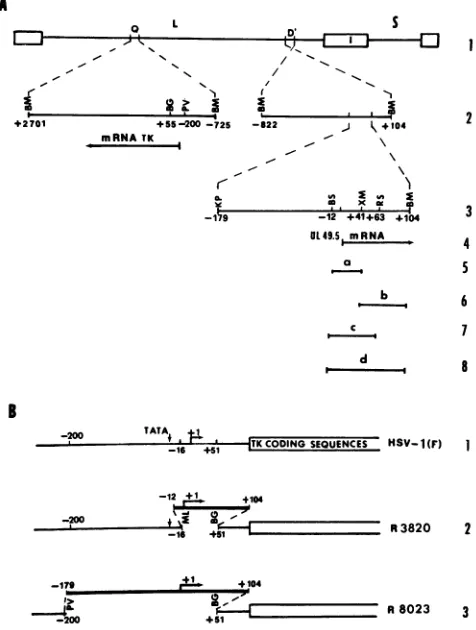
regula-tion. Akey question is the contribution of the ICP4 binding sites to the regulatory attributes encoded in this fragment.Subsequent studies based on footprinting of ICP4 to DNA fragments (46a) narrowed the positions of the binding sites. In the studies described in this report, we mutagenized binding sites 3 and 4, and fragments containing these muta-tions were used to construct two series of viruses (Fig. 1). The first series consisted of derivatives of R3820 described above. In thesecond virus series, the ,-tksequence extend-ing from -200 to +51 was replaced with the
Y2
UL49.5 sequence extending from -179 to +104. Thus, whereas the R8023virus contains allat4binding sites mapped within the domain of the UL49.5 gene, the R3820 virus contains only twosuch sites. We report thatspecific mutations in one ICP4 binding site in R3820 had a drastic effect on expression of the chimeric gene. This was not the case for the R8023 virus, probably because the additional UL49.5 gene sequences compensated for the destroyed binding site.MATERIALS AND METHODS
Cells and viruses. The parent and mutant viruses were grown, and their titers were determined, in Vero cells. Rabbitskin cells, originally obtained from J. McLaren, were used for cotransfection with viral DNAs. The selection for thymidinekinase (tk+) recombinants was done in the human 143 thymidine kinase-minus (143TK-) cells overlaid with hypoxanthine-aminopterine-thymidine medium. Nuclear ex-tractswere made from HeLa cells maintained inDulbecco's modified Eagle's medium in 5% (vol/vol) fetal calf serum. Strain HSV-1(F)A305 with a deletion in the tk gene was derivedasdescribed by Post et al. (56) from HSV-1(F), the prototype HSV-1 wild-type strain used in this laboratory. The construction ofrecombinant R3820 was described pre-viously (43). Recombinant R3112 contains the
UL49.5
se-quence extending from -822 to + 104 inserted into theBglII site of the tk gene as previously described (61).A
0 L
+2701 +55 -200 -725
mRNATK
C-S
j
0
/ ..
/
-322 .) I\+104
\l
\1 1
,#, £ - £
.. . . 1 -12 +41+63 +104
6L49.5. mRNA
a
2
-179 +104
___4 8023 3
-200 +51
FIG. 1. SequencearrangementsofHSV-1(F) and of recombinant viruses used in these studies. (A) Line 1,sequencearrangementof the HSV-1 genome. The rectangles represent the reiterated se-quences flanking the long (L) and short (S) components. Line 2,
sequencearrangements of the natural p-tkgeneand of theUL49.5 gene. Line 3, expansion of the region showing the UL49.5 5'
untranscribed and transcribed noncoding domains. Line 4,
tran-scriptioninitiation and direction of transcription of theUL49.5open
reading frame. Lines 5 through 8, positions of DNA fragments a
(BssHII-XmaIII), b (XmaIII-BamHI), c (BssHII-RsaI), and d
(BssHII-BamHI) used asprobes for binding of ICP4. (B) Line 1, sequence arrangement of the tkgene in HSV-1(F); lines 2 and 3,
structureof the chimeric UL49.5-tkpromoterinserted in
recombi-nant viruses R3820 and R8023, respectively. Numbers above the heavy lines refertonucleotide positions relativetothetranscription initiation at +1 ofUL49.5; numbers below the thin lines refer to
nucleotide positions of the tk gene relative to the transcription
initiation siteat +1.The dashed linesshow the siteof insertion of
theUL49.5sequencesin the domain ofthetkgene.TheTATAAbox
(indicatedby letters TATA) is representedbyaverticalarrowin the
schematic diagram of the tk genes of the recombinant viruses.
Restriction sites: BM, BamHI; BG,BglII; PV, PvuII; KP,KpnI;
BS, BssHII; XM,XmaIII; RS, RsaI; ML, MluI.
Plasmid constructions. The EcoRI-BamHI HSV-1(F) DNA fragment from pRB3628 containing the 283-bp (-179 to
+104)KpnI-BamHIDNAfragmentof the UL49.5gene was
cloned into M13mpl9 to yield pRB3874. pRB3874 was
mutagenized asdescribedby Spectoretal. (63) with the aid of the Muta-Gene invitro mutagenesis kit (Bio-Rad, Rich-mond, Calif.) and 35-meroligonucleotides synthesizedonan
Applied Biosystems model 308B DNA synthesizer. All plasmid constructs were verified by sequencing, using
Se-quenase (United States Biochemical, Cleveland, Ohio).
2
3 4
-. 5
76
d
B
-200 TATA +t
-16 +51 7TKCODINGSEQUENCES HSV-1(F)
-12 ,_+1 0
-200 ____3820
-16 451R32
c
on November 9, 2019 by guest
http://jvi.asm.org/
[image:2.612.313.551.81.396.2]pRB3823 carries the HSV-1(F) BamHI Q fragment cloned in pUC19 from which the PvuII-BglII sequence had been replaced with a polylinker. In this plasmid, the tk gene sequence extending fromnucleotides -200 to +51 relative to the transcription initiation site at nucleotide + 1 had been deleted.
The wild-type and mutatedEcoRI-BamHI sequences from the UL49.5 gene were cloned into theXbaI site of pRB3823 such that the UL49.5 sequences were inserted in the correct transcriptional orientation relative to the coding sequences of the tk gene. The plasmids made with the fragments indicated above were designated pRB8023 (wild-type par-ent), pRB8018 (mutation A), pRB8019 (mutation B), pRB8020(mutation C), and pRB8021 (mutation D). Plasmids pRB3820 (wild-type parent [43]), pRB8024 (mutation A), pRB8025(mutation B), pRB8026(mutation C), and pRB8027 (mutation D) were made by replacing a portion of the 5' untranscribed and transcribed noncoding domains of the tk gene(MluI-BglIIfragment ofpRB3172) with the parentalor mutated BssHII-BamHI (-12 to +104) sequence from the
UL49.5
gene.Construction of the UL49.5-tk mutant viruses. Plasmids containing the chimeric UL49.5-tk genes were cotransfected with intact HSV-1(F)A305 DNA into rabbit skin cells, and TK+ progeny were selected on 143TK- cells as described previously (40, 61). The recombinant viruses were plaque purified four times and checked forpurity by hybridization of the electrophoretically separated fragments of the viral DNAdigested withBamHIorEcoRI after Southern trans-fer. The BamHI Q' fragment was used as a probe to differentiate the parental HSV-1(F)A305 tk sequences from the chimeric UL49.5-tk sequences. Thejunction sequences involved in the recombination, and the mutated sequences introduced in the recombinantviruses,weresequenced with the appropriate primers afteramplification by the polymer-asechain reaction asdescribedpreviously (30).
Preparation ofnuclearextracts. Confluent monolayers of HeLa cells were grown in 850-cm2 roller bottles, mock infected or infected with 5 PFU ofHSV-1(F) per cell, and harvested 14 h postinfection. Nuclear fractions were pre-paredasdescribedpreviously(15).Proteinconcentrations of the nuclear extracts ranged from 20to30 mg/ml, as deter-minedbythe Bio-Radprotein assay.
DNAband shift assay. TheDNAprobes consisted of the following UL49.5 DNA fragments: BssHII-XmaIII (-12 to +41), which contains ICP4 binding site 3 with either the wild-type sequence or mutated sequence A or B; the XmaIII-BamHI fragment (+41 to +104), which contains ICP4 binding site 4 with either the wild-type sequence or mutated sequence CorD; the BssHII-RsaIfragment (-12to +63),in which RsaIdigestiondestroyedICP4bindingsite4, leaving intactbinding site 3 forusewith mutated sequence C; and theBssHII-BamHI fragment (-12 to +104),which contains ICP4bindingsites 3 and4with mutated sequences A, B, and D. These fragmentswerepurifiedfrom polyacryl-amide gels, dephosphorylated with calf intestinal alkaline phosphatase (Boehringer Mannheim Biochemicals, India-napolis, Ind.), and5' end labeled with
[_y-32P]ATP
(>7,000 Ci/mmol; Dupont, NENResearchProducts,Boston,Mass.) and T4polynucleotidekinase(UnitedStatesBiochemical)to anaverageactivityof50,000cpm/ngoffragmentDNA.The standard competitor DNA used in these assays was syn-thetic poly(dI-dC)-poly(dI-dC) (Pharmacia P-L Biochemi-cals, Piscataway, N.J.). DNA-protein binding assays and electrophoresis in nondenaturing gels were done as de-scribed previously (38). Anti-ICP4 monoclonal antibody-180 +I +85
~~~~~-~~~ I
-,_~~-~ ~
\-WT
A B
C
D
+21 +80
TCCGCCCCCICGAITAG ACGGCCGTGTGCCAGTCGCCATCGTACCCCCGACCCAAGCT
TCCGCCCCCGCGAGTCTAGACGGCCGTGTGCCAGTCGCCATCGTACCCCCGACCCAAGCT
TCCGCCCCCGCGAGTAGCGACGGCCGGTTTCCATTCGCCATCGTACCCCCGACCCAAGCT
[image:3.612.325.563.80.180.2]TCCGCCCCCGCGAGTAGCGACGGCCGTGTGCCAGTCGCCCTcTTACCCccTACCCAAGCT
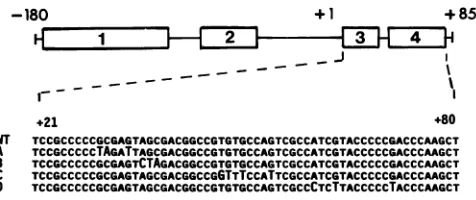
FIG. 2. The265-bp(-180to+85)portion of theUL49.5 untran-scribedandtranscribednoncoding domains. Rectangles 1 through 4 representthe minimaldomains of theICP4proteinbinding. Below arethe sequencesoftheregion subjectedtomutagenesis. Mutations A and B are located in domain3, mutationC is located between domains 3 and 4, and mutation D is located in domain 4. The replaced nucleotides areidentifiedby uppercase letters. WT, paren-talvirusdefinedaswildtypeinthese studies.
H640, a gift from LenorePereira, was described elsewhere (1).
Thymidinekinase assay.143TK- cells were infected with 5 PFU per cell and incubated in the presence (300
jig/ml)
or absence of PAA(agiftfrom AbbottLaboratories).Thecells wereharvested at 7, 10, 13, and 16 hpostinfection, and the cytoplasmic fractions were assayed for thymidine kinase activity aspreviously described (39, 56).RNase protection assay.Plasmid pRB4086(63) contains the HSV-1(F) tk gene sequence MluI-NruI (+126 to +400) in pGEM-3Z.The350-bpRNAprobe generatedforassayingtk transcriptswasmadeby cleavageof thevectorsequencesin pRB4086 with EcoRIandtranscription with SP6 polymerase (Promega, Madison, Wis.); it protected 274 bp of the tk mRNA.The RNA probefor assaying a-trans inducing factor (aTIF) transcripts was constructed as follows. Plasmid pRB4392 was made by cloning the 267-bp ApaI-PvuI frag-ment from pRB3623 (44) into the SmaI site of pGEM-3Z. Cleavage of pRB4392 with EagI and transcription with T7 polymerase(Promega) generateda171-bpRNAprobe which protected 148 bp of otTIFmRNA.To prepare the test RNAs, replicate 150-cm2Verocell cultureswereexposedto5 PFU of recombinant viruses per cell for 1 h andthen overlaid with fresh medium in the presence or absence of PAA. Cells were harvested at 6 and 12 hpostinfection, and the cytoplasmic RNA was prepared as previously described (61). RNase protection assays andelectrophoretic separationwere done aspreviously described (63).
Radioactivity in protected bands for the aTIF and UL49.5-tk mRNAs from the parental and the recombinant viruseswas measured on a model 603 Betagen Betascope blotanalyzer aspreviouslydescribed (63).
RESULTS
Generation ofmutants and analyses of the mutated frag-ments for the capacity toform demonstrable complexeswith ICP4. A previous report (46) identified at least four ICP4 binding sites detected by gel retardation assays in the promoter-regulatory domain of the UL49.5gene (Fig. 1).Of these,twositeswere5'of thetranscriptioninitiation site and two were located in the5' transcribednoncodingdomain of the gene (46). To determine the role of the binding sites located in the 5' transcribednoncodingdomain of theUL49.5 gene, four sites of transversion mutations were generated (Fig. 2). The wild-type and mutated fragments were
on November 9, 2019 by guest
http://jvi.asm.org/
a b
~I
| WT
|
A
I B I
C
| D
|A,,
d
I-+- +.
1-
+ + - -+ - t ab*-tw X ^e
_~~~~im
ICP4+ab
'A~
.4
ICP4
1#'.t* :t
a b a a c b b d
fragment
FIG. 3. Autoradiogram of labeled DNA-infe
complexes electrophoretically separated in a n(
DNAfragmentsa,b, c, and d(Fig.1A, lanes 5tl
fromwild-type (lanesWT[wild type], A, B,andC) (remaining lanes) fragments andtested for bindin
the bottom. The mutated sites (A through D) for
fragments were tested are indicated atthe top. al
usedto recognizeICP4in theDNA-proteincomp
minuses above the lanes indicate whether antib(
presentorabsentduringthe reactionof the infecte
the DNAfragment. The specificityof the reactiv
clonalantibodywithICP4wasextensivelycharac
and Roizman(38)andbyHubenthal-Vosset al.(21
the ICP4-DNAcomplexisindicated withan arrow
thepositionof the antibody-ICP4-DNA complex.
quenced aftermutagenesisinM13 and after recombination into the genomes. In additioi and mutated fragments (Fig. 1, lines 5 to8) the ability to bind ICP4 as described in
Methods. The sequences selected for
mutal
follows.(i) Mutation sites A and B (Fig. 2)were
basis of the observation thatthey spannedti ICP4bindingsite(44a).The results ofDNA
ses(Fig. 3)indicatethat DNAfragments co] the mutagenized sites failed to form dem plexeswithICP4. Mutation sites A and Bwo
importancesincethey affected thesame IC We should note that verification of the
plexesis based onthe useofamonoclonal either retards themigration of thecomplex turing gelor, asoccasionally happens, bloc fromenteringthegel.
(ii) Mutation site C was selected to det mutagenesisof thesequenceslyingbetween binding sites might affect binding ofICP4 c
the chimeric gene. Site C is not an IC]
inasmuchasextensive studiesfailedtodemonstrate
binding
ofICP4by
DNAfragments
containing
site C.Asexpected,
T A W B mutagenesis of site C did not affect the binding of ICP4 to +I-+ -+- 1
adjacent
sites(Fig.
3a).
.+l-^+..
(iii)
Mutation site D was selected on the basis of the observationthatitwasasiteofbinding
of ICP4 andbecause itwas theonly
sitehomologous
to the ICP4DNAbinding
consensus sequence derived
by
Faber and Wilcox(18).
As shown inFig. 3a,
themutagenized
fragment
failed to form demonstrablecomplexes
withICP4.(iv)
Thethree mutation sitesA, B,
and Daccountforall of thebinding
sites within theUL49.5 fragment replacing
the authenticP-tk
sequencesin R3820 and for all of thebinding
sites in the 5' transcribed noncoding domain of theUL49.5
geneinserted into the R8023 recombinant virus.
Construction ofrecombinant viruses. In our earlier
study
(43),
itwasshownthatthe minimalUL49.5
sequencetested whichimparted
upon thechimeric tkgenethe attributes ofa.Y2
gene consistedof the sequence -12to +104(recombinant
R3820).
However,
becausethe ICP4binding
sitesofUL49.5
extendedfrom -179to
+85,
it seemeddesirableto testthe role of thebinding
sites within the leadersequence also in the context of a chimeric gene inwhich all four identified ICP4binding
siteswerepresent.Consequently,
twoseriesof viruses were constructed. In the firstseries,
thewild-type
a a a a viruswas recombinant R3820, in which the
P-tk
sequence -16 to +51wasreplaced
with theUL49.5
sequence -12 tocted cell protein +104. Virus mutants R3820-A
through
R3820-Dwerecon-ondenaturing
gel
structedby
recombination aspreviously
reported
for thehnrough
8) derived R3820 recombinant (43), but using the mutated rather than)rand
mutagenized
thewild-type fragments. In the second series, thewild-type Igare indicated at virus was recombinantR8023,
in which theP-tk
sequencerwhich the DNA -200to+51was
replaced
withtheUL49.5
sequence -179tob, antibody H640 +104. Theparentaland mutantviruses, R8023 and R8023-A )lexes. Pluses and through R8023-D, respectively, were derived by
recombina-ody
to H640 was tion betweenHSV-1(F)A305
andthefragment
containing
thedcellextractwith chimeric genes as described in Materials and Methods. After
teyrized
tby
ristie
purification of the viral progeny carrying the mutations, bothte)
The
positionsof
the sites of insertion of the UL49.5 sequence and theThead;
adot
marksmutagenized
sites were sequenced to verify that the se-quences contained in the viral genomecorrespond
tothose showndiagrammatically
inFig.
1 and 2.Figure
4 shows the accumulation ofthymidine
kinaseactivity
in 143TK- cells infected withHSV-1(F), carrying
cloning
prior
to the natural,B-tk, R3112,
describedpreviously
(61)
asthefirst n, thewild-type
UL49.5-tk
chimeric geneexpressing
the attributes of aY2
were tested for gene, R3820 and R8023. tk gene
expression
in both R3820 Materials and and R8023 isgrossly
inhibitedby
concentrations of PAAgenesis
were ascapable
ofinhibiting
viral DNAsynthesis.
Accumulationof tk RNA in Vero cells infected with recom-selected on the binant viruses
carrying wild-type
andmutagenized
chimeric tkte position
ofan genes.Replicate
culturesof Vero cellswereinfected with5 igel
shiftanaly-
PFUof recombinant virusper cell in the presenceorabsencentaining
each of of PAA. The infected cells were harvested 6 and 12 h ionstrable com-postinfection,
and tk mRNA accumulationwas determinedereof
particular
by
RNaseprotection
assays. To control forvariability
in P4binding
site. extraction andpurification
ofRNA,
wesimultaneously
mea-CP4-DNA com- sured theamountof mRNA of the aTIFgene
(5,
8,
22,
54)
inantibody
which each RNaseprotection
assay. For thesestudies,
the virus inthe nondena- stocksusedtoinfect cellswerecarefully
controlledtoensure:ks
thecomplex
thatthey
wereprepared
in a uniform fashion andwere of identicalorsimilar titers. At leastthreesetsof RNAswereermine whether
prepared
independently
for eachsetof recombinant viruses. the known ICP4 The RNaseprotection
assays were done as described in )rexpression
of Materials andMethods. Gelscontaining
theelectrophoreti-P4
binding
sitecally separated,
protected
RNAswerevisualizedby
on November 9, 2019 by guest
http://jvi.asm.org/
12 HSV-1(F) R3112 13820 R8023
_6
0 5 10 15 20 5 10 1520 5 10 15 20 5 10 1S 20
[image:5.612.323.559.78.413.2]Heirs post idfectioN
FIG. 4. Specific activities of the thymidine kinase made in cells infectedwith parental and recombinant viruses in the presence or absence ofPAA.Replicate culturesof143TK-cellswereinfected with5PFUoftheindicatedwild-type or recombinant virus per cell andincubated in thepresence(5)orabsence (-) ofPAA.The cells were harvested at 7, 10, 13, and 16 h postinfection. The specific activity ofthymidine kinaseis expressed as counts perminute per microgram of protein. Structures of the chimeric tkgenein recom-binants R3820 and R8023 are shown in Fig. 1. As previously reported, the chimeric promoter fused to the tk gene in R3820 contains elementsofboth 13and y promoters andis expressed both earlyandlate ininfection (43).
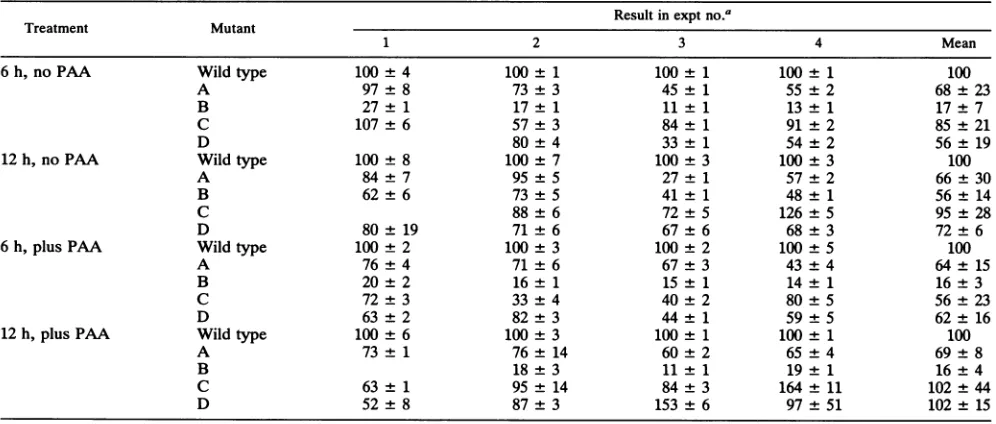
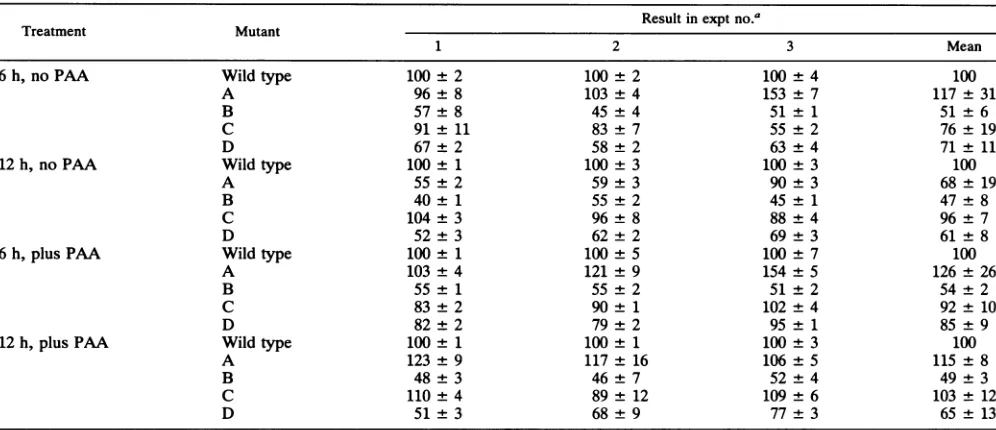
diography and analyzed in a model 603 Betagen Betascope blot analyzer. The radioactivity was measured in each protectedband and also in the area above and below each band (background) a total of three times. After each mea-surement,the gridswere reset tominimize errors resulting from the placement ofcoordinatesonthe actualbands and to obtain background counts. The averagecounts for eachtk RNA bandwerenormalizedwith respecttothe value for the corresponding otTIF RNA. Figures 5 and 6 show the auto-radiographic images of electrophoretically separated pro-tected RNAs from one of the experiments. The average values obtained for each of the independently derived RNAs for each virus series areshown in Tables 1 and 2.
Aswould be expected fora -y gene, aoTIF RNA accumu-lated at both 6 and 12 h postinfection in much smaller amounts in cells treated with PAA than in untreated cells. Bothchimeric tk genesweresensitive toPAAand accumu-lated in smalleramounts late in infection. At 6 h postinfec-tion, the chimeric tk gene in R8023 appeared to be more sensitivetoPAAthanwasthe chimeric tk gene contained in R3820. This result is not entirely unexpected. As noted previously, the R3820 chimeric gene shares properties of both , and -y genes inthat it isexpressedbothearlyand late in infection, whereas the R8023 chimeric gene, like that presentin R3112reportedearlier(61),resemblesa-y genein itstemporalpatternofexpression.
Comparison of the expressionofthe chimeric tk gene in R3820with that of the natural
p-tk,
reportedearlier,showed thatthe chimeric gene was expressed late in infection to a higher level and was more sensitive to PAA thanwas the native tk gene(43). Akey questioniswhether the mutations introduced into the UL49.5 sequencesof the chimeric gene alter its expressionrelative tothat of the nonmutagenized, wild-typeparent. Theresults,summarized inTables 1and2, were asfollows.(i) In cells infected with the R3820 recombinant virus series,at6 hpostinfectionand in the absence ofPAA,the B mutationreduced the concentration of tkRNAbyafactor of 6. The reduction in the tk RNA observed in cells infected with theB mutant wasconsistent and of similarmagnitudein all experiments. Although the tk RNA levels observed in cells infected with the Dmutants were thenextlowest, the decrease in tk RNA levels noted in cells infected with all
6h PI
-PAA
0 0
ao BC
'V' A B C D
12hPI
+ PAA -PAA +PAA
A 0
N- A
242 _n gm-_ n - _ _ _ _ __
0TIF
110
[image:5.612.63.303.78.176.2]67
FIG. 5. Autoradiographic image of electrophoretically sepa-rated, in vitro-synthesized, labeled probe RNA protected from RNasedegradation by UL49.5-tk andaTIF mRNAs.ThetestRNAs were extractedfrom Vero cells infected withthe R3820 series of recombinantvirusesat6and 12 hpostinfection(PI).The virus used
to infect cells is indicated above each lane. R3820 refers to the nonmutagenizedparentvirus.A,B, C,and D refertothemutations
at sites shownin Fig. 2 andrecombined intothe viral genome as
describedin the text. The tkprobe measured transcriptionofthe chimerictk reporter gene,whereasthe aTIFprobe measured the accumulation of aTIF mRNAtranscripts for normalization ofthe results. Fragment lengths in nucleotides ofMspI-digested, end-labeledplasmid pGEM-3Zareshownattherightasstandards.Lane 2x contains twice the amount of RNA addedtothe otherlanesto
verifylabeled RNAprobe excessunder the assay conditions.
mutantsother thanB was much lessdrastic, morevariable fromexperiment toexperiment, and potentiallyless signifi-cant.The effect of the Bmutationlargely disappearedor was much reduced in cells harvestedat12 hpostinfectionin the absence of PAA. In this series ofexperiments, thetkRNA levels observed in cells infected with the C mutant were closest to those obtained with the wild-type parent R3820 virus.
(ii) In the presence of PAA, cells infected with the B mutant of the R3820 series again accumulated significantly lesstkRNAthan did cells infected with thewild-typeparent virus or other mutantviruses.Inthisinstance,the decrease wasnearlyidenticalatboth 6 and 12 hpostinfectionandthe reduction in accumulation of tk RNA was consistent and reproduciblein allexperiments.All othermutations resulted
-as...
-...&ipgo
on November 9, 2019 by guest
http://jvi.asm.org/
6h Pi 12hPi
-PAA + PAA -PAA 1
MI X A B C D = A B C D X A B C Di
500 404 358
242 - .f _ __ _
190 --.
1417
110
i e
i".,
[image:6.612.61.297.74.397.2]67
FIG. 6. Autoradiographic image of electropho rated, in vitro-synthesized, labeled probe RNA I RNasedegradation byUL49.5-tk andaTIF mRNAs.
wereextracted fromVero cells infected with theFi
recombinant virusesat6and 12 hpostinfection(PI).
to infect cells is indicated above each lane. R802
nonmutagenizedparentvirus.A, B, C,and D refert4 at sites shown in Fig. 2and recombined into thev
describedinthetext.For otherdetails, seethelege
inminimalreduction(mutation A)or nosignificantreduction
(mutations CandD) of RNAexpression.
+PAA (iii)Theaccumulationof tkRNAin cells infected withthe
R8023 series of viruses and maintained in the absence or
A B C D presence of PAA was less affectedbythe mutations thanwas that of the R3820 series of viruses. While thecells infected with the B mutants accumulated lesstk RNA than did the cells infected with the parent virus, the difference in this
TK instance was smaller than that seen in the case of the R3820
series ofrecombinant viruses. DISCUSSION
For thepastseveralyears, anumber of laboratorieshave
aTIF reported that thecis-acting determinants of HSV-1 y gene
expressionmapatordownstream of the TATAA box(7,17,
19, 24,25, 32, 33, 36, 69).The studiesdescribedin this report centeronthe observationthat the chimeric tkgeneencoded
by the R3820 recombinant virus was expressed both early and late in infection and accumulated levels ofthymidine kinase activity higherthan those expressed by the natural
j-tkgene. Furthermore, the accumulationwas more
sensi-tivetoPAA thanwasthat observed in cells infected with the
wild-typeparent.
The objectives of the studies described in this report centeredonthe role of theICP4 DNAbindingsite andwere
twofold. The first objectivewas to determine whether the UL49.5 sequences contained in the chimeric tk gene and which boundICP4played arole inrendering expression of
the chimeric gene sensitive to PAA. The rationale for examining this issue rests on the possibility that the ICP4
bindingsites in 5' transcribednoncodingdomains could have both positive and negative functions. Thus, sensitivity to iretically sepa- PAAimplies that viral DNA synthesis is required foroptimal
protected from expression of thegene.Previousstudies have indicated that Thetest RNAs viral DNA synthesis exerts its effect in cis rather than in
The
Virus
used trans(42).
One model described in earlierreports
is that a3
refers
to the viralprotein binding
to5' transcribednoncoding
domains of3themutationst ygenesblockstranscriptionuntiltheonset of DNA
synthe-riralgenome as sisdislodgesthe boundprotein (2,42). ICP4mayhaveboth nd toFig.5. functions;itmay,forexample,actastheblockin
transcrip-TABLE 1. RNaseprotection studiesonRNAextracted fromcells infectedwiththeR3820 series of HSV-1 mutants
Resultin exptno.a
Treatment Mutant
1 2 3 4 Mean
6h,no PAA Wildtype 100 4 100 1 100 1 100 1 100
A 97 8 73 3 45 1 55 2 68 23
B 27±1
17±1
11±1
13±1
17±7
C 107 6 57 3 84 1 91
±2
85 21D 80 4 33 1 54 2 56 19
12h,no PAA Wildtype 100 8 100 7 100 3 100 3 100
A 84 7 95 5 27 1 57 2 66±30
B 62±6 73 5 41 1 48 1 56± 14
C 88 6 72 5 126 5 95±28
D 80± 19 71 6 67 6 68±3 72±6
6h,plusPAA Wildtype 100 2 100 ±3 100 2 100 ±5 100
A 76 4 71 ±6 67 3 43±4 64± 15
B 20 2 16±1 15 1 14 ±1 16±3
C 72 3 33 ± 4 40 2 80 ±5 56± 23
D 63 2 82±3 44 1 59 5 62±16
12h,plusPAA Wildtype 100 6 100 ±3 100 1 100 1 100
A 73 1 76 ±14 60 2 65 4 69±8
B 18 ±3 11 1 19 1 16±4
C 63±1 95±14 84±3 164±11 102±44
D 52 8 87±3 153 6 97 51 102± 15
aValueswerecalculatedasfollows:(mRNAinitiatedfrommutantpromoter/mRNAinitiated fromwild-typepromoter)x 100.
w W& jo6
on November 9, 2019 by guest
http://jvi.asm.org/
[image:6.612.59.557.506.718.2]TABLE 2. RNase protection studies on RNA extracted from cells infected with the R8023 series of HSV-1 mutants
Result in exptno.a
Treatment Mutant
1 2 3 Mean
6h,noPAA Wild type 100 2 100 2 100 4 100
A 96 8 103 4 153 7 117±31
B 57 8 45 4 51 1 51 ±6
C 91 11 83 7 55 2 76± 19
D 67 2 58 2 63 4 71 ± 11
12h,noPAA Wildtype 100 1 100 3 100 3 100
A 55 2 59 3 90 3 68± 19
B 40 1 55 2 45 1 47±8
C 104 3 96 8 88±4 96±7
D 52 3 62 2 69 ± 3 61 ±8
6h,
plus
PAA Wildtype 100 1 100 5 100 ±7 100A 103 4 121 9 154 ± 5 126±26
B 55 1 55 2 51±2 54±2
C 83 2 90 1 102 ±4 92± 10
D 82±2 79 2 95±1 85 ±9
12h,
plus
PAA Wildtype 100 ±1 100 ±1 100±3 100A 123 ±9 117± 16 106 ±5 115 ±8
B 48±3 46±7 52±4 49±3
C 110±4 89±12 109±6 103±12
D 51 ±3 68 +±9 77±3 65 ± 13
aValueswerecalculatedasfollows:(mRNA initiated frommutantpromoter/mRNAinitiated from wild-type promoter) x100.
tion, and it may transactivate expression of the gene. In this instance, we could expect that mutagenesis of the sequence which renders the gene sensitive to PAA would result in increased accumulation of tk RNA in infected cells treated withPAA.
With respect to this objective, none of the mutations introduced into the UL49.5 sequence contained in either of the chimerictk genes reduced the effect of PAAon expres-sion of the chimeric genes. These data argue that the two ICP4 binding sites contained within the UL49.5 sequence contained in the chimeric tk gene are not each individually sites ofputative repressionoftranscriptionthat is alleviated by the onset of viral DNA synthesis. Furthermore, the resultsobtained in this studyneither supportnorrefute the model described above.
The secondobjectivewas todeterminewhether the ICP4 binding sites played arole in expressionof the chimeric-tk gene andspecificallywhether the ICP4bindingsitewasthe cis-actingsiteresponsiblefor theincrease in theexpression of thechimeric tkgenecontained in therecombinantR3820. Ifthishypothesisweretenable, mutagenesisofone or more ICP4 binding sites within the domain of the UL49.5 gene contained in the chimeric gene would beexpected toreduce theexpressionof the chimeric gene.
Theexperiments described in this report indicate that in the contextof the R3820 recombinantvirus, at leastone of thetwoICP4bindingsites is involved in the accumulation of the tk RNA in a fashion similar to those of y genes.
Specifically, mutagenization
of the B site in the UL49.5 sequence inserted into the chimeric tk gene (Fig. 2) signifi-cantly reduced the accumulation of the tk RNA in cells infected with the R3820 virus. The findingsare particularly significant since the mutation abolishedonlyoneof thetwoknown ICP4 binding sites. The effect of mutagenesis of eithersite Aorsite Dwaslesspronounced.The
significance
of the results ofmutagenesisofsites A and Dis uncertain. The results obtained with the mutatedsiteA areparticularly puzzlinginasmuch asbothsites A and B appearto
destroy
the ICP4 binding site which these sequences flank. It is
conceivable that site A isnot completelydestroyed or that this site has other functionsinapparent inourassays.
The effect of the site B mutation in the context of the R8023 virus was less drastic. One explanation for the ob-served effect of this mutation in R8023rests onthe observa-tion that the cis-acting sites within regulatory domains of HSV genesarehighly redundant. This redundancy is partic-ularly noteworthy for the aTIF response elements located upstreamof a genes(41)and for the ICP4bindingsites found inseveral genes. In the case of the cxTIF, recent studies have shown that the response elementsareadditive and comple-mentary (63, 64). Inasmuch as the UL49.5 sequence con-tained within the chimeric gene encoded in R8023 contains two additional ICP4binding sites upstream from the tran-scriptioninitiation sites,it isconceivablethat one or both of those sites act toreplace the site destroyed by mutageniza-tion of site B. Parenthetically, the evidence linking ICP4 DNA binding sites with transcriptional activation in the contextof genescontainedwithin viral genomesintroduced into cellsby infection is paradoxically weak. Although the enthusiasm for linking binding sites with transactivation remainsunabated, a recentpaperreportedthat the destruc-tion of all apparentbindingsites in the promoter-regulatory domains of the glycoprotein D gene failed to affect signifi-cantlyitsexpression inproductive infection(62).
This report is in effect the first evidence linking the destruction ofanICP4bindingsite with downregulationof the accumulationofa
transcript.
Akeyissue,
which remains unresolved, is the relationship between the destruction of the ICP4binding site and the decreased accumulation of tk RNA. Because thebinding site is within the 5' transcribed noncoding domain, mutagenesis of the ICP4 binding site could affect either transcription or the stability of the mRNA.Technically,the resolution of thetwoalternatives is particularlyvexingsince nuclearRNArunoff,
which could measuretranscription rates, isnotoriouslyunreliable in the caseof HSV -y genes(2,61).
Furtherstudiesonother-ygenes mayresolve this problem.on November 9, 2019 by guest
http://jvi.asm.org/
ACKNOWLEDGMENTS
Wethank SuzannaRudofskyfor technical assistance.
These studieswereaidedbyPublic HealthService grantsfrom the National Cancer Institute (CA47451)and the NationalInstitute for Allergy and Infectious Diseases (AI124009 and AI1588). M.G.R.
wasaidedbyagrant from NATO(0527/87). D.S. isapredoctoral
trainee under Public HealthgrantGM7281. REFERENCES
1. Ackermann, M.,D. K.Braun,L.Pereira,andB.Roizman. 1984. Characterization ofherpes simplexvirus1aproteins 0, 4,and 27 withmonoclonal antibodies. J. Virol. 53:108-118.
2. Arsenakis, M., G. Campadelli-Fiume, and B. Roizman. 1988. Regulation ofglycoprotein D synthesis: does a4, the major regulatory proteinofherpessimplexvirus1,regulatelategenes bothpositivelyandnegatively?J. Virol. 62:148-158.
3. Arsenakis, M., J. Hubenthal-Voss, G. Campadelli-Fiume, L.
Pereira,andB.Roizman.1986. Constructionandpropertiesofa
cell line constitutively expressing the herpes simplex virus glycoproteinBdependentonfunctionala4protein synthesis.J. Virol. 60:674-682.
4. Barker,D.E., andB. Roizman.1992. The uniquesequenceof theherpessimplexvirus1 L component containsanadditional translated open reading frame designated UL49.5. J. Virol. 66:562-566.
5. Batterson,W., andB. Roizman. 1983. Characterization of the herpes simplex virion-associated factor responsible for the inductionof a genes. J.Virol.46:371-377.
6. Beard,P.,S.Faber,K. W.Wilcox,andL. I. Pizer.1986.Herpes simplex virus immediate early infected-cell polypeptide a4 binds to DNAand promotes transcription. Proc. Natl. Acad. Sci. USA83:4016-4020.
7. Blair, E. D., C. C. Blair, and E. K. Wagner. 1987. Herpes simplexvirus virionstimulatory proteinmRNAleadercontains sequenceelements which increase both virus-induced transcrip-tion andmRNAstability.J. Virol.61:2499-2508.
8. Campbell,M.E.,J.W. Palfreyman,andC. M. Preston.1984. Identificationofherpessimplexvirus sequences which encodea
transactingpolypeptide responsiblefor stimulation of
immedi-ateearly transcription. J. Mol. Biol. 180:1-15.
9. Conley,A.J.,D.M.Knipe,P.C.Jones,and B.Roizman. 1981. Moleculargeneticsofherpessimplexvirus. VII. Characteriza-tion of a temperature-sensitive mutant produced by in vitro mutagenesisanddefective inDNAsynthesisandaccumulation of -ypolypeptides. J. Virol.37:191-206.
10. DeLuca, N. A., A. M. McCarthy, and P. A. Shaffer. 1985. Isolation and characterization of deletion mutants of herpes simplex virus type 1 in the gene encoding immediate-early regulatoryproteinICP4. J. Virol. 56:558-570.
11. DeLuca,N.A.,andP. A.Schaffer. 1985.Activationof immedi-ate-early, early, and late promoters by temperature-sensitive and wild-type forms of herpes simplexvirus type 1 protein ICP4. Mol. Cell. Biol. 5:1997-2008.
12. DeLuca,N. A.,andP. A. Schaffer. 1987. Activitiesofherpes simplexvirustype 1 (HSV-1) ICP4 genesspecifyingnonsense
polypeptides.
NucleicAcidsRes. 15:4491-4511.13. DeLuca,N.A.,and P.A. Schaffer. 1988.Physicalandfunctional domains of theherpessimplexvirustranscriptional regulatory proteinICP4. J.Virol. 62:732-743.
14. DiDonato, J. A., J. R. Spitzner, and M. T. Muller. 1991. A predictive model for DNArecognition bythe herpes simplex virusproteinICP4. J. Mol. Biol.219:451-470.
15. Dignam,J.D.,R. M. Lebovitz,and R. Roeder. 1983. Accurate transcription initiation by RNA polymerase II in a soluble
extractfrom mammaliannuclei. NucleicAcids Res. 11:1475-1489.
16. Dixon, R. A. F., and P. A. Schaffer. 1980. Fine-structure mapping and functional analysis oftemperature-sensitive
mu-tants in the gene encoding the herpes simplex virus type 1 immediateearlyproteinVP175. J.Virol. 36:189-203.
17. Everett, R. D. 1983. DNA sequences required for regulated expressionof the HSV-1glycoproteinDgeneliewithin83bp.of theRNAcapsites. Nucleic Acids Res.11:6647-6666.
18. Faber,S.W.,and K. W. Wilcox. 1986. Association of theherpes simplexvirusregulatoryprotein ICP4 withspecificnucleotide sequencesinDNA. Nucleic Acids Res. 14:6067-6083. 19. Flanafan,W.M.,A. G.Papavassiliou,M.Rice,L. B.Hecht,S.
Silverstein, and E. K. Wagner. 1991. Analysis of the herpes simplexvirus type 1 promoter controlling the expression of UL38, a truelategeneinvolved in capsid assembly. J. Virol. 65:769-786.
20. Gelman,I.H.,and S.Silverstein. 1985. Identification of imme-diateearly genes fromherpes simplexvirusthat transactivate the virus thymidinekinase gene. Proc. Natl.Acad. Sci. USA 82:5265-5269.
21. Hall,L.M.,K.G.Draper,R.J. Frink,R. H.Costa,and E.K. Wagner.1982.Herpes simplexvirus mRNAspeciesmappingin EcoRIfragmentI. J. Virol. 43:594-607.
22. Heine, J. W.,R. W.Honess,E.Cassai,and B. Roizman. 1974. Protein specified by herpes simplex virus. XII. The virion polypeptidesoftype 1 strains.J. Virol. 14:640-651.
23. Holland, L. E., K. P. Anderson, C. Shipman, Jr., and E. K. Wagner.1980.Viral DNAsynthesisisrequiredfor theefficient expression of specific herpes simplex virus type 1 mRNA species. Virology101:10-24.
24. Homa, F. L., J. C.Glorioso, and M.Levine. 1988. Aspecific 15-bpTATAboxpromoterelement isrequiredforexpressionof aherpes simplex virustype1lategene.Genes Dev.2:40-53. 25. Homa, F. L., T. M. Otal, J. C. Glorioso, and M. Levine. 1986.
Transcriptionalcontrolsignalsof aherpessimplexvirustype1 late(y2)gene lie within bases -34 to +124 relative to the 5' terminus of the mRNA. Mol. Cell. Biol.6:3652-3666. 26. Honess, R. W., and B. Roizman. 1974. Regulation of herpesvirus
macromolecularsynthesis.I.Cascade regulationof the synthe-sis of the threegroupsof viralproteins. J. Virol. 14:8-19. 27. Honess, R. W., and B. Roizman. 1975. Regulation ofherpesvirus
macromolecularsynthesis: sequential transition ofpolypeptide synthesis requires functional viral polypeptides. Proc. Natl. Acad. Sci. USA 72:1276-1280.
28. Hubenthal-Voss, J., R. A. Houghten,L. Pereira, and B. Roiz-man.1988. Mappingoffunctionalandantigenic domainsof the a4protein of herpes simplex virus1.J. Virol.62:454-462. 29. Imbalzano, A. N., A. A. Sheperd, and N. A. DeLuca. 1990.
Functional relevance of specific interactions between herpes simplex virustype 1 ICP4 and sequencesfrom the promoter-regulatorydomain of the viralthymidine kinasegene.J. Virol. 64:1-14.
30. Innis, M. A., B.K.Myambo, D.H.Gelfand,and M.A. Brown. 1988. DNAsequencingwithThermus aquaticusDNA polymer-aseand direct sequencing of polymerase chain reaction ampli-fied DNA. Proc. Natl. Acad. Sci. USA85:9436-9440. 31. Johnson, P. A., and R. D. Everett. 1986. DNAreplication is
requiredforabundantexpression ofaplasmid-borne lateUS11 gene of herpes simplex virus type 1. Nucleic Acids Res. 14:3609-3625.
32. Johnson,P.A.,and R. D. Everett. 1986. Thecontrolofherpes simplexvirustype late geneexpression:aTATAboxcap-site region is sufficient for fully efficient regulated activity.Nucleic AcidsRes. 14:8247-8264.
33. Johnson, P. A., C. MacLean, H. S. Marsden, R. G. Dalziel,and R. D. Everett. 1986. The product of gene US11 of herpes simplexvirus type 1 isexpressed as a truelate gene. J. Gen. Virol. 67:871-883.
34. Jones, P. C., andB. Roizman. 1979.Regulation of herpesvirus macromolecular synthesis. VIII. The transcription program consists of threephasesduringwhichbothextentof transcrip-tion andaccumulationof RNA inthecytoplasmareregulated.J. Virol.31:299-314.
35. Kattar-Cooley, P.,andK. W. Wilcox.1989. Characterizationof theDNA-binding propertiesof theherpessimplex virus regula-toryproteinICP4.J.Virol. 63:696-704.
36. Kibler, P. K., J. Duncan, B. D. Kleith, T. Hupel, andJ. R.
Smiley.1991.Regulationofherpes simplexvirustruelate gene
expression: sequences downstreamfromtheUSllTATAbox inhibit expression from an unreplicated template. J. Virol. 65:6749-6760.
on November 9, 2019 by guest
http://jvi.asm.org/
37. Knipe, D. M., W. T. Ruyechan, B. Roizman,and I. W. Halli-burton. 1978. Moleculargenetics of herpes simplexvirus: dem-onstration ofregions of obligatory and nonobligatory identity withindiploid regions ofthe genome bysequence replacement and insertion. Proc. Natl. Acad. Sci. USA75:3896-3900. 38. Kristie,T.M., and B. Roizman. 1986. a4, the major regulatory
proteinofherpessimplex 1isstably andspecificallyassociated with thepromoter-regulatorydomains of a genes and of selected otherviral genes. Proc.Natl. Acad. Sci.USA83:4700-4704. 39. Leiden, J. M., R. Buttyan, and P. G. Spear. 1976. Herpes
simplex virus geneexpression in transformed cells. I. Regula-tion of the viralthymidine kinasegeneintransformedLcells by products of superinfecting virus.J.Virol. 20:413-424. 40. Longnecker,R., and B. Roizman. 1986. Generation of an
invert-ing herpes simplex virus 1 mutant lacking the L-S junction a sequences, an origin of DNA synthesis, and several genes including those specifying glycoprotein E and thea47 gene.J. Virol. 58:583-591.
41. Mackem, S., and B. Roizman. 1982. Differentiation between a promoter and regulator region ofherpes simplex virus 1: the functional domains and sequence of a movable a regulator. Proc. Natl. Acad. Sci.USA 79:4917-4921.
42. Mavromara-Nazos, P., and B. Roizman. 1987. Activation of herpes simplex virus 1 _Y2 genes by viral DNA replication. Virology 161:593-598.
43. Mavromara-Nazos, P., and B. Roizman. 1989. Delineation of regulatory domains of early(1)and late(Y2)genes by construc-tion of chimeric genes expressed in herpes simplex virus 1 genomes. Proc.Natl. Acad. Sci. USA 86:4071-4075.
44. McKnight,J. L.C.,P. E.Pellett, F. J.Jenkins,and B.Roizman. 1987. Characterization and nucleotide sequence of two herpes simplexvirus 1 geneswhoseproducts modulate a-trans-induc-ing factor-dependent activation of a genes. J. Virol. 61:992-1001.
44a.Michael,N.Unpublished data.
45. Michael, N., and B. Roizman. 1989. Binding of the herpes simplex virus major regulatory protein to viral DNA. Proc. Natl.Acad. Sci. USA 86:9808-9812.
46. Michael, N., and B. Roizman. 1990. Determination of the number of protein monomers binding to DNA with Fab
frag-ments ofmonoclonal antibodies tothe protein. Methods Mol. Cell. Biol. 1:203-211.
46a.Michael, N.,and B.Roizman.Unpublisheddata.
47. Michael, N., D. Spector, P. Mavromara-Nazos, T. M. Kristie, and B.Roizman.1988. TheDNA-binding properties of the major regulatory protein a4 ofherpes simplex viruses. Science 239: 1531-1534.
48. Morse,L.S.,L.Pereira, B.Roizman,and P. A.Schaffer. 1978. Anatomy ofherpes simplexvirus(HSV)DNA. X. Mapping of viralgenesby analysisof polypeptides and functions specified byHSV-1 xHSV-2recombinants. J.Virol. 26:389-410. 49. Muller,M. T.1987. Binding of theherpes simplex virus
imme-diate-earlygeneproductICP4 to its own transcription start site. J.Virol. 61:858-865.
50. O'Hare, P.,and G.S.Hayward. 1985. Evidence for a direct role forboth the 175,000- and110,000-molecular-weight immediate-early proteins of herpes simplexvirus in thetransactivation of delayed-earlypromoters. J. Virol. 53:751-760.
51. O'Hare, P., and G. S. Hayward. 1985. Three trans-acting regulatory proteins ofherpes simplex virus modulate immedi-ate-early geneexpression in apathway involving positive and
negativefeedbackregulation.J. Virol.56:723-733.
52. O'Hare,P., and G. S. Hayward. 1987. Comparison of upstream sequencerequirementsfor positive and negative regulation of a herpes simplex virus immediate-early gene by three virus-encodedtrans-actingfactors. J. Virol. 61:190-199.
53. Paterson, T.,and R. D.Everett. 1988. The regions of the herpes
simplexvirus type 1 immediateearly proteinVmwl75required for site specific DNA binding closely correspond to those
involved in transcriptional regulation. Nucleic Acids Res. 16: 11005-11025.
54. Pellet, P. E., J. L. McKnight, F. J. Jenkins, and B. Roizman. 1985. Nucleotide sequence andpredicted amino acidsequence of a protein encoded in a small herpes simplex virus DNA fragment capable oftrans-inducing agenes. Proc. Natl. Acad. Sci. USA 82:5870-5874.
55. Pizer, L. I., R. D. Everett, D. G. Tedder, M. Elliot, and B. Litman. 1991.Nucleotides within bothproximal and distal parts of the consensus sequence are important for specific DNA recognition by the herpes simplex regulatory protein ICP4. Nucleic Acids Res. 19:477-483.
56. Post, L. E., S. Mackem, and B. Roizman. 1981. Regulationofa
genes of herpes simplex virus: expression of chimeric genes produced by fusion of thymidine kinase with a gene promoters. Cell 24:555-565.
57. Roberts, M. S., A. Boundy, P. O'Hare, M. C. Pizzorno, D. M. Ciufo, and G. S. Hayward. 1988. Direct correlation between a negative autoregulatory response element at the cap site ofthe herpes simplex virus type 1IE175 (a4) promoter and a specific binding site for theIE175 (ICP4) protein. J. Virol. 62:4307-4320. 58. Shapira, M., F. L. Homa, J. C. Glorioso, and M.Levine. 1987. Regulation of the herpes simplex type 1 late(Y2)glycoprotein C gene: sequences between base pairs -34 to +29 control tran-sient expression and responsiveness to transactivation by the products of immediate early a4 and aO genes. Nucleic Acids Res. 15:3097-3111.
59. Shepard,A. A., and N. A. DeLuca. 1991. A second-site revertant of a defective herpes simplex virus ICP4 protein with restored regulatory activities and impaired DNA-binding properties. J. Virol. 65:787-795.
60. Shepard, A. A., A. N. Imbalzano, and N. A. DeLuca. 1989. Separation of primary structural components conferring auto-regulation, transactivation, and DNA-binding properties to the herpes simplex virus transcriptional regulatory protein ICP4. J. Virol. 63:3714-3728.
61. Silver, S., and B. Roizman. 1985.y2-thymidine kinase chimeras are identically transcribed but regulated as Y2genes in herpes simplex virus genomes and as
P
genes in cell genomes. Mol. Cell. Biol. 5:518-528.62. Smiley,J. R., D. C. Johnson, L.I. Pizer, and R. D. Everett. 1992. The ICP4 binding sites in the herpes simplex virus type 1 glycoprotein D (gD) promoter are not essential for efficient gD transcription during virus infection. J. Virol. 66:623-631. 63. Spector, D., F. Purves, and B. Roizman. 1990. Mutational
analysis of the promoter region of the a27 gene of herpes simplex virus 1 within the context of the viral genome. Proc. Natl.Acad. Sci. USA 87:5268-5272.
64. Spector, D., F. Purves, and B. Roizman. 1992. Role of a-trans inducing factor (VP16) in the induction of a genes within the context of viral genomes. J. Virol. 65:3504-3513.
65. Tedder,D.G.,R.D. Everett,K. W. Wilcox, P. Beard, and L. I. Pizer. 1989. ICP4-binding sites in the promoter and coding regions of the herpes simplex virus gD gene contribute to activation of in vitro transcription by ICP4. J. Virol. 63:2510-2520.
66. Tedder, D. G., and L. I. Pizer. 1988. Role for DNA-protein interaction in activation of the herpes simplex virus glycopro-tein D gene. J. Virol. 62:4661-4672.
67. Watson,R.J., and J. B.Clements. 1980. A herpes simplex virus type 1 function continuously required for early and late virus RNAsynthesis. Nature (London) 285:329-330.
68. Weinheimer, S. P., and S. L. McKnight. 1987. Transcriptional andpost-transcriptional controls establish the cascade of herpes simplex virusproteinsynthesis. J. Mol. Biol.195:819-833. 69. Weir, J. P., and P. R. Narayanan. 1990. Expression of the
herpes simplex virus type 1 glycoprotein C gene requires sequences in the 5' noncoding region of the gene. J. Virol. 64:445-449.