Rochester Institute of Technology
RIT Scholar Works
Theses
Thesis/Dissertation Collections
10-18-1985
Computerized medical illustration
Cynthia Duffer
Follow this and additional works at:
http://scholarworks.rit.edu/theses
This Thesis is brought to you for free and open access by the Thesis/Dissertation Collections at RIT Scholar Works. It has been accepted for inclusion in Theses by an authorized administrator of RIT Scholar Works. For more information, please [email protected].
Recommended Citation
ROCHESTER
INSTITUTE OF TECHNOLOGY
A Thesis Submitted
to theFaculty
ofThe College
ofFine
andApplied Arts
in
Candidacy
for theDegree
ofMASTER OF FINE ARTS
COMPUTERIZED MEDICAL
ILLUSTRATION
By
Cynthia E.
Duffer
APPROVALS
ADVISER: MR. ROBERT WABNITZ/
DATE:
$(
1/5/%~
Robert Wabnitz
ASSOCIATE ADVISOR: MR. GLEN HINTZ/
Glen Hintz
DATE:
~JI:l1 8E!3~
ASSOCIATE ADVISOR: MR. WILLIAM DuBols/
William W. DuBois
DATE:
~
{?
/N
SPECIAL ASSISTANT TO THE
h I
DEAN FOR GRADUATE AFFAIRS: MR. PHILIP
w.
BORNARTH/
P
i ip W. Bornarth
DATE'
0~
DEANJ COLLEGE OF
Dr. Robert H. Johnston Ph.D.
FINE AND ApPLIED ARTS:
.!::!..!.DR.l..!..~J~O!..U.HN~ST~O~N/L--
_ _ _ _ _ _ _ _ _ _
_
DATE:
\
0
\\)\?~
\
-\
L
Cynthia Duffer
JHEREBY GRANT PERMISSION TO THE
Being
a practical personality/I
wanted informationabout the possible markets and uses for my medical illustration
talents.
There
must be new growth areas and untapped markets.My
thesis will revolve around areas that are untraditional,gaining usage and hold great potential for more than one market.
First,
I
needed to know what potential markets wereAVAILABLE FOR MY SKILLS.
I
SET ABOUT THIS TASK, BY TAKING ACLOSE LOOK AT MY COMMUNITY, TALKING TO INSTRUCTORS, MEDICAL
ILLUSTRATORS
I
KNEW, FORMER STUDENTS OUT IN THE MARKET PLACE ANDDOING RESEARCH IN THE CITY LIBRARY.
I
CALLED THE OBVIOUS USERSOF MEDICAL ILLUSTRATORS, HOSPITALS AND PUBLISHING PHYSCIANS,
GOT ON THE PHONE AND SPOKE TO BUSINESSES, AND
I
WENT OUT TOPHARMACEUTICAL COMPANIES.
MEDICAL
ILLUSTRATION IS A MARRIAGEOF MEDICAL AND SCIENTIFIC KNOWLEDGE WITH ARTISTIC SKILLS, BUT NO
SKILL OR TALENT IS OF ANY USE UNLESS IT FINDS PURPOSE AND AN
AUDIENCE WHO BENEFITS FROM IT.
FOR
CLARITY,I
HAVE BROKEN DOWN THE MAJOR MARKETS ANDNEW GROWTH AREAS THAT HAVE POTENTIAL USE FOR MEDICAL ILLUSTRATION,
INTO SIX TOPICS: HOSPITALS AND PUBLISHING PHYSCIANS, GOVERNMENT
AND NON-PROFIT HEALTH ORGANIZATIONS, PERIODICALS, TELEVISION,
impact this information had on my thesis project and go into detail on the thesis pieces individually.
it
has been five hundred years since the famous anatom ical texts and drawings ofleonardo
davlnci
to the present; the market for anatomy texts is pretty well glutted.yet
medicalillustration is commonly thought of in old traditional terms.
Detailed
anatomical renderings are indeed a part of medical ill ustration, ALBEIT, A SMALL PERCENTAGE.It
IS SIMPLY MORE COSTEFFECTIVE TO REVISE EXISTING, WELL KNOWN VERSI ONS, THAN TO CONTRACT A NEW EDITION.
So
WHERE DO MEDICAL ILLUSTRATORS MARKET THEIRSKILLS?
HOSPITALS AND PUBLISHING PHYSCIANS
Call
most hospitals and ask for their"Department
ofMedical
Illustration";
eight times out of ten, there will be no such department, or if there is a staff illustrator, thedepartment in which he/she works will be
"Audio-Visual
Services" or"Medical
Photography
andBiomedical
Communications".
There
will usually be no more than two permanent staff illustrators,if there are any at all.
most
of the work the illustrator will do will be charts, graphs, hospital service promotional items and medical illustration when needed.Medical
illustrators are known as costly highly specia lized ARTISTS, WHO ILLUSTRATE SURGICAL TEXTS, MEDICAL JOURNALS, ANDPHYSCIANS'
sustaining contracts.
most
medical illustrators operate on a free-lance basis with one or more physcians/ specialists in anumber of locations.
a
well known illustrator may name his price and do quite well with two to four publishing physcians.inci
dentally, a hospital may suggest an artist to a doctor seeking medical illustration skills, but it is usually the doctors'responsibility to find his or her own illustrator.
Most
hospitals can not afford a competitive salary and benefit package for staff illustrators, so they keep illustrators on file and pay free"lance prices for needed skills.working
in a hospital setting, an illustrator must be able to do a bit of everything: paste~up, graphs, cells for slide shows, pamphlet design, exhibit design and illustration.despite
the diversified skills required of the medical illustrator working in a hospital, hospitals usually reflect the lowest paying medical illustration salaries.The
obvious traditional markets of publishing doctors and hospitals are just the"tip
of the iceberg", so to speak, of possible jobs available.Todays'
society is based upon visual
images, less on the written word and more personal time is spent viewing fast paced compacted media, such as television,
films, pamphlets and periodicals.
the
public expects specialized subjects, like medical advances, disease, medical proceduresand treatments, to be available to them in a digestible manner.
4
HEART TRANSPLANTS DONE IN
LOUISVILLE,
KENTUCKY,
WERE LAVISHLYEXPLAINED BY DOCTORS^ HEART PUMP DIAGRAMS AND ILLUSTRATIONS OF
THE EXPERIMENTAL SURGERY WERE SEEN ACCROSS THE NATION ON
T.V.,
IN NEWSPAPERS AND MAGAZINES.
BABY
Fae'S
BABOON HEART TRANSPLANTand
President
Regans'
colon surgery were also explained in detail
in THE media.
Now,
more than ever, THE PUBLIC is willing to payFOR MEDICAL INFORMATION, AS WELL AS, TREATMENTS AND MEDICINES.
GOVERNMENTAL AND NON-PROFIT HEALTH
ORGANIZATIONS
Health
care agencies and accessory organizations areengulfing enormous amounts of tax dollars; the public pay these
costs and are demanding an explanation of what and how their
dollars are being spent.
the
1985,
statistical abstract
of theUnited
States,
105th
edition, states the following health careshare of the budget, as well as, national health care expendi
TURES:
Data:
1983/
health programs*
billions dol.
maternal
&
child health programs1,016.
public health activities
11.
vetrans hospitals/ medical
7,660.
Data:
1983/
national health expenditures billions dol.drugs
&
sundries23.7
eyglasses and appliances
6.2
nursing home care/ health services
37.3
Data:
1984/
federal outlays for health millions dol.health research
4,434.
consumer safety
769.
FEDERAL OUTLAYS FOR HEALTH CONTINUED: MILLIONS DOL.
RESEARCH TRAINING
205.
CLINICAL TRAINING
200.
-iOCCUPATIONAL SAFETY
&
HEALTH373.
THE
PERCENTAGE AMOUNT OF THESE FIGURES, THAT IS ALLOCATEDFOR PUBLISHING LITERATURE, SLIDE SHOWS/ VIDEOS AND SUPPLEMENTAL
HEALTH CARE INFORMATION IS NOT AVAILABLE.
BUT
IN MOST COMMUNITYHEALTH AGENCIES AND GOVERNMENTAL AGENCIES, ILLUSTRATED BOOKLETS,
PAMPHLETS AND MANUALS ARE AVAILABLE FOR NOMINAL FEES OR FREE OF
CHARGE.
HERE
IS A LIST OF WELL KNOWN HEALTH AGENCIES, BOTH GOVERNMENTAL AND NON-PROFIT, THAT UTILIZE MEDICAL ILLUSTRATION IN A
VARIETY OF MEDIUMS:
CDC
(Center
forDisease Control):
bulletins on communicable diseases, films&
literaturePlanned Parenthood:
birth control literature, films, slide shows and educational aidesRed Cross:
cpr classes and literature, training filmsBurn
andPoison
Hotlines:
local phone numbers and community educational classes and literatureThe
list is long; the free-lance opportunities formedical illustrators to do pamphlets, design exhibits, posters,
announcements, training manuals and films are enormous.
Ad
agencies and audio houses are often highly priced, and out of
reach of budget conscious health organizations, most of whom
ARE NON-PROFIT AND RUN ON GRANTS OR VERY RESTRICTED FUNDS.
If
THE FREE-LANCE ILLUSTRATOR DOES NOT HAVE THE AUDIO-VISUAL
U.S.
Department
ofCommerce,
Bureau
of theCensus,
Statistical Abstract
of theUnited
States
(Washington
D.C:
equipment, having the art work and layouts free-lanced and the
audio-visual equipment subcontracted, is still cheaper than
having a whole project done out of house.
PERIODICALS
Another
growing market for medical illustrators isPOPULAR PERIODICALS.
By
POPULAR,I
MEAN THOSE MAGAZINES NOTSPECIFIC TO MEDICAL FIELDS OR MEDICAL SPECIALTIES.
IN 1975
THERE WERE9,657
PERIODICALS PUBLISHED IN THEU.S.;
in1984,
10,809
periodicals were available to the public.That
is an increase of1,152
new magazines of various subjects.Popular
magazines, such as:Readers Digest,
Health,
Parents,
and
Working Mother,
to list just a few, contain medical treatments, SYMPTOMS AND REMEDIES, THAT ARE OFTEN ACCOMPANIED BY
illustrations and/or photographs.
Siamese
twin separationsand reconstructive and plastic surgeries have been covered by
women's magazines, ie:
ladies home journal,
family circle
andMcCalls.
Most
notably, and perhaps a trend, are the"Health
and Fitness" features in the popular woman's magazine
Self.
A
1983,
B.A.
graduate ofRIT's Medical
Illustration Department,
Mary Ellen Thomas,
has done pen and ink and full colour airbrush MEDICAL ILLUSTRATIONS FOR
SELF
MAGAZINE.ALL
THESE HEALTHfeatures are attempts at demystifying medicine and satisfying the
public's curiosity.
These
serious mindedfeatures,,
also helpgeneral interest publications gain critical respect.
TELEVISION
The
most popular vehicle of information in our visualand image oriented society is television.
Programs
likeNOVA
and
CHN
(Cable Health
Network)
contain spots for medical illustrations.
Crtically
acclaimed television specials, such as,"The Body
Human" and"The
Brain" have the program informationin book form and available in bookstores.
These
books and programs are very well illustrated and represent a growing market.
If
aT.V.
special enjoyed popularity, the resulting book hasTHE BENEFIT OF NATIONAL ADVERTISING.
BUSINESS
National
expenditures on drugs and sundries runs intothe billions of dollars each year.
after
research and testing,and manufacturing costs, the largest sums spent by pharmaceutical
corporations are in marketing and advertising.
ads
for medicines,both over the counter and by perscr ipt ion, utilize full colour
medical illustrations.
television
ads, such as the ones currentlyused by
buffrin,
utilize a full colour illustration of themusculature of the body and animated arrows pointing to the
areas of relief provided by
buffrin.
ads
are replaced quicklywith new campaign material.
for
this reason, pharmaceuticalillustrations represent a plentiful market.
Behind
the public advertising campaigns, a whole otheri
went tosquib pharmaceutical's world headquarters,
princeton,
New Jersey,
to talk about the art needs atSquib.
The
managerof
Art Services
showed me the pen and ink illustrated information sheets, that accompany perscription drug samples for
physcians.
These
sheets are a service ofSquib,
for doctors, sothat they are able to perscribe the drug properly.
When
research and testing receives approval from theFDA
to release perscription medications into the market,Squib
puts together literature portfolios for doctor's education.
These
portfolios contain cassette tapes and detailed bookletsthat describe side effects, cautionary measures and physiolo
gic effects of the new product.
The
booklets contain text,numerical data and illustrations.
They
are graphically effective PORTFOLIOS, WELL DESIGNED, THOROUGHLY PROFESSIONAL AND
SERIOUS.
Along
with the new product portfolios,Squib
isheavily involved with huge nationally held product seminars
for doctors.
elaborate
slide shows and video-tapes are constructedfor the seminars.
invitations
go to seminar sites held allover the
u.s.;
those unable to attend are sent detailedvideo-tapes and portfolios, to be viewed at their convenience.
Squib
picks up the tab for obvious reasons.If
a doctormisperscribes a drug, it is usually the drug manufacturer
WHO GETS SUED SLONG WITH THE PHYSCIAN.
If
A DRUG PROVES UNSAFEOR TOO HAZARDOUS FOR USE, THE
FDA
CAN PULL THE DRUG OFF THE9
careful elaborate educational campaigns are a way to lessen
misuse of their products.
Besides
pharmaceutical companies, manufacturers ofhealth aids, such as home patient lifts, wheelchairs, and
prosthetic devices, also need medical artists.
instructional
booklets on product usage are often illustrated, as are health
aids advertising and packaging.
as
hospital costs continuallyrise, alternative home care and the equipment needed for
rehabilitation and maintenance, will be increasingly used by
the public's effort to lower costs and preserve patient
self-sufficiency, especially with regards to home care of the
ELDERLY.
COMPUTER GRAPHICS
Wyeth Laboratories
inPennsylvania,
is another hugepharmaceutical corporation;
i
spoke with the director ofaudio
VISUAL
Services
about the art needs atWyeth.
Wyeth
has aTHOROUGH AUDIO-VISUAL DEPARTMENT FOR THE MAKING OF IN~HOUSE
LITERATURE,
T.V.
CLIPS,AND A GREAT DEAL OF SLIDE SHOWS.WYETH
ALSO HAS A
STARBURST
COMPUTER
GRAPHICS
SYSTEM,
WHICH THEY USEFOR SLIDE SHOWS, SHOWN MAINLY FOR IN-HOUSE USE.
THE
COMPUTERGENERATED SLIDE SHOWS CAN BE TRANSFERED TO VIDEO CASSETTE AND
ARE VERY EFFECTIVE FOR TRANSMITTING INFORMATION TO A WIDE
AUDIENCE AT ONE TIME.
THE
SLIDES AND CASSETTES ARE ALSO EASILYSTORED, TAKING UP LITTLE SPACE;
WYETH
HAS A HUGE LIBRARY OF10
Wyeth
uses theAVL
Starburst Computer
for graphs ofstatistical data, chemical diagrams, schematics and illustrations.
Their
chemists and research departments use slide shows tocommunicate their new ideas and products, to other departments
AT
WYETH.
By
USING SLIDE SHOWS AND TAKING THEM TO EACH DEPARTMENT,Wyeth
saves time, increases corporate inter-communication andkeeps a record of developments.
i
was also told that the visualpresentations were made far more appealing and effective with
the variety achieved on the computer.
Audio-Visual Services
has found that their computergraphics package has paid for itself in the following advantages:
ease of execution
(no
paste~ups and mechanicals)ease of error correction and editing
quick generation of charts and graphs
quick computer transfer to slides or video
*
good colour and text reproduction
ability to incorporate photos into slides by using
the computer
The
reasonable price of the computer system offered a practicalsolution to an over worked staff.
wyeth
still does medicalillustration for pamphlets, and
i
was told, would remain doingso, but computer graphic systems were too cost-effective for
much of their
work,
for them to ever consider going back toboard done art.
Computer
generatedT.V.
clips, advertising and educational FILMS, DONE OF MEDICAL AND SCIENTIFIC SUBJECTS, ARE FAST
11
Columbus,
Ohio,
has gained distinction for its computer generated ANIMATION OF BIOLOGICAL AND MEDICAL SUBJECTS.
THE
MARKETFOR COMPUTER GENERATED ART AND ANIMATION, IS AN EVER INCREAS
ING, POSSIBILITY FILLED, AREA FOR MEDICAL ILLUSTRATORS TO MOVE
INTO.
Computer
graphics do not replace traditional medicalillustration, but rather add to the list of mediums used and
new markets in which to expand.
large
teaching and researchhospitals, like
the cleveland clinic
andhahnemann
university
Hospital
ofPhiladelphia,
have multi-stationed computer systemsto generate art and slides.
the
fact that computer generatedmedical graphics is such a young and expanding field, is precisely
why
i
chose it for my thesis.i
explored computer images, doneon
RIT's Artronics Computer
system, that could be used in popular MAGAZINES, MEDICAL JOURNALS, TITLE SLIDES FOR SLIDE SHOWS,
and book illustrations.
all
of the possible markets for medicalillustration skills that
i
have discused, could have theirwork needs done on a computer.
i
designed seven images of medically oriented subjectson the
Artronics
Computer.
Below
each photograph of the computerRESEARCH
1\DEVELOPMENTAL
EMBRYOLOGY
__f5*l
_
RESEARCH
IN DEVELOPMENTAL EMBRYOLOGY
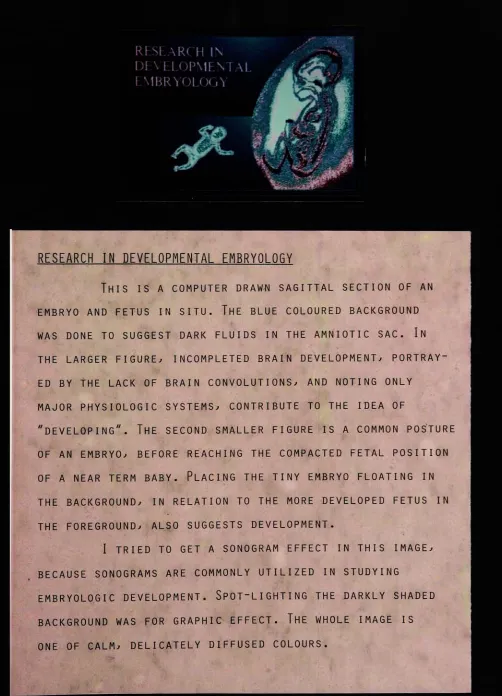
This
is a computer drawn sagittal section of anembryo and fetus in situ.
the
blue coloured backgroundWAS DONE TO SUGGEST DARK FLUIDS IN THE AMNIOTIC SAC.
In
THE LARGER FIGURE, INCOMPLETED BRAIN DEVELOPMENT, PORTRAY
ED BY THE LACK OF BRAIN CONVOLUTIONS, AND NOTING ONLY
MAJOR PHYSIOLOGIC SYSTEMS, CONTRIBUTE TO THE IDEA OF
DEVELOPING
The
second smaller figure is a common postureOF AN EMBRYO, BEFORE REACHING THE COMPACTED FETAL POSITION
OF A NEAR TERM BABY.
PLACING
THE TINY EMBRYO FLOATING INTHE BACKGROUND, IN RELATION TO THE MORE DEVELOPED FETUS IN
THE FOREGROUND, ALSO SUGGESTS DEVELOPMENT.
I
TRIED TO GET A SONOGRAM EFFECT IN THIS IMAGE,BECAUSE SONOGRAMS ARE COMMONLY UTILIZED IN STUDYING
EMBRYOLOGIC DEVELOPMENT.
SPOT"L
IGHT I NG THE DARKLY SHADEDBACKGROUND WAS FOR GRAPHIC EFFECT.
THE
WHOLE IMAGE IS [image:16.558.22.524.22.718.2]SPECIAL SENSES:
THE
EYE
THE EYE
Special Senses:
The
Eye
was designed for use asa title slide for an educational slide show or video.
the
eyes are brightly coloured in oranges and yellow, set in
an ultramarine blue background.
this
colour combinationprojects well and is attractive.
the
title slide is often the"attention
getter",so
i
felti
could be less realistic and more graphic;later illustrations could be more realistic.
despite
the"flying
onion"feel of the eye balls, the basic eye
MEDICINE
&
SPORTS
MEDICINE AND SPORTS
Medicine
andSports
is an image specificallydesigned for general interest magazines or pamphlets.
This
image could also be used for a book cover on"sports
MEDICINE WHICH HAS BECOME A SPECIALTY FIELD OF ITS OWf
The
use of computerized sports testing equipment AND ENDURANCE MACHINES IN SPORTS TESTING CLINICS
AND FITNESS CENTERS, COMPELLED ME TO MAKE THIS IMAGE
OBVIOUSLY COMPUTER MADE.
I
DID NOT CLEAN UP THE PIXELS,BUT ENHANCED THE GRANULATED FEEL OF THE RUNNING FIGURES.
I
ALSO CHOSE A SMALL RANGE OF GRADUATED COLOURS FOR THESHADED BACKGROUND, SO THAT THE BACKGROUND WOULD APPEAR
VERY COMPUTERIZED.
MEDICINE AND
SPORTS
IS A SIMPLY BALANCED GRAPHICIMAGE THAT IS MEANT TO ATTRACT ATTENTION, BUT NOT EDUCATE
FOR A SPECIFIC SPORTS INJURY OR TREATMENT.
THE
BACKGROUND IS DARK, SO THAT THE IMAGES POP OUT.
I
CHOSERUNNERS OVER OTHER SPORTS, PURELY BECAUSE OF RUNNING'S
TRAUMA CENTER
TRAUMA
CENTER
Trauma Center
is a graphic portrayl of a phenomena THAT KILLS MORE
AMERICANS
THAN ANY-OTHER SINGLECAUSE.
I
DIDN'T WISH TO USE A FACE, THAT WOULD BE TOOspecific; SO,
I
CHOSE A BLACK ANDorange-RED SKULL, WHICH
IS MORE UNIVERSAL.
THE
DEEP RED OF THIS IMAGE, CAPTURESVISUAL ATTENTION AND CONTRASTS WELL WITH THE DELICATE PINK OF THE VENERABLE BRAIN TISSUE.
If
YOU EXAMINE THEUPPER RIGHT HAND CORNER OF THE SKULL, THERE IS AN EMBED
DED BULLET, ONE EXAMPLE OF POSSIBLE TRAUMA.
This
image is flat, simple andI
believe aGRAPHICALLY EFFECTIVE PORTRAYL OF A SERIOUS MEDICAL PHENO
MENA.
Stating
"Trauma
Center"
gives all the necessary
INFORMATION TO SUPPLEMENT THE IMAGE.
THIS
IMAGE WAS DONEWITH EXHIBIT AND PARAMEDIC TRAINING
(SLIDE
SHOWS) INMIND.
Robert
Eggold,
M.D.,
"Trauma
Care
Regionaliza-tion:A
Necessity,"
The
Journal
ofTrauma 23
(March
1983)
WORLD CONFERENCE
ON
PEDIATRIC
MEDICINE
w
WORLD CONFERENCE ON PEDIATRIC
MEDICINE
This
is an image for an exhibit poster andconference title slide.
Obviously,
pediatricians at aconference on pediatric medicine are going to be discus
sing specific issues in medical jargon, so
I
FELT someWARM EHIMSICAL CHILD-LIKE IMAGE COULD BE USED FOR A POSTER
THE
WORLD CONFERENCE THEME IS CARRIED THROUGH THE TRADITIONALLY DRESSED CHILDREN, ANIMATED AND MARCHING ACCROSS SPACE.
THE
"OUTER
SPACEWINDOW"
COMPROMISED
PA
-INFECTIONS
IN THE COMPROMISED PATIENT
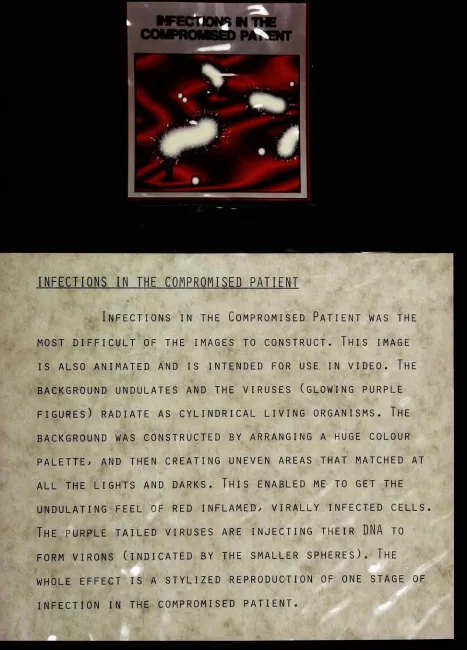
Infections
in theCompromised Patient
was themost difficult of the images to construct.
this
imageis also animated and is intended for use in video.
the
background undulates and the viruses
(glowing
purplefigures) radiate as cylindrical living organisms.
the
background was constructed by arranging a huge colour
palette, and then creating uneven areas that matched at
all the lights and darks.
this
enabled me to get theundulating feel of red inflamed, virally infected cells,
The
purple tailed viruses are injecting theirDNA
toFORM VIRONS
(INDICATED
BY THE SMALLER SPHERES).THE
WHOLE EFFECT IS A STYLIZED REPRODUCTION OF ONE STAGE OF
[image:21.558.33.500.54.704.2]'
/
DNA
CONSTRUCTION
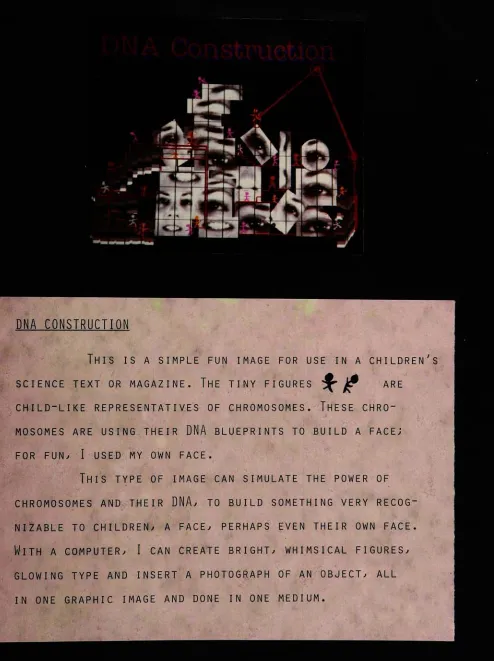
This
is a simple fun image for use in a children's SCIENCE TEXT OR MAGAZINE.THE
TINY FIGURES*
AREchild-like representatives of chromosomes.
these
chro mosomes are using theirdna
blueprints to build a face; for fun,i
used my own face.This
type of image can simulate the power ofchromosomes and their
dna,
to build something very recog nizable to children, a face, perhaps even their own face. [image:22.558.40.534.47.708.2]19
Using
theArtronics Computer
as the medium for mythesis, allowed me to explore the potential of medical computer
GRAPHICS.
From
THE RESEARCH I did on medical illustrationMARKETS,
I
KNOW THAT COMPUTER GENERATED MEDICAL ILLUSTRATIONHAS ONLY JUST BEGUN.
MY
THESIS HAS GIVEN ME COMPUTER SKILLSTHAT CAN ONLY ENHANCE MY ABILITY TO BE A MEDICAL ILLUSTRATOR,
BECAUSE IT GIVES ME ANOTHER ARTISTIC MEDIUM AND PREPARES ME
LIST OF REFERENCES
Eggold,
Robert,
M.D.
"Trauma
Care
Regionalization:
A
Necessity,"The Journal
ofTrauma 23 (March 1983):
260
-62.
U.S.
Department
ofCommerce,
bureau of theCensus.
Statistical
Abstract
of theUnited
States.
Washington,
D.C,:
U.S.