City, University of London Institutional Repository
Citation
:
Shah, D. & Knott, L. (2017). The role of attention at retrieval on the falserecognition of negative emotional DRM lists. Memory, doi: 10.1080/09658211.2017.1349803
This is the accepted version of the paper.
This version of the publication may differ from the final published
version.
Permanent repository link: http://openaccess.city.ac.uk/18715/
Link to published version
:
http://dx.doi.org/10.1080/09658211.2017.1349803Copyright and reuse:
City Research Online aims to make research
outputs of City, University of London available to a wider audience.
Copyright and Moral Rights remain with the author(s) and/or copyright
holders. URLs from City Research Online may be freely distributed and
linked to.
City Research Online: http://openaccess.city.ac.uk/ [email protected]
Running head: ATTENTION AND FALSE RECOGNITION
The Role of Attention at Retrieval on the False Recognition of Negative Emotional DRM
Lists
Datin Shah & Lauren M. Knott
City, University of London
Address correspondence to: Dr Lauren Knott
Department of Psychology
City University London
London, EC1V 0HB
Phone: +44 (0)20 7040 3354
Abstract
This study examined the role of attention at retrieval on the false recognition of emotional
items using the Deese-Roediger-McDermott (DRM) paradigm. Previous research has shown
that divided attention at test increases false remember judgements for neutral critical lures.
However, no research has yet directly assessed emotional false memories when attention is
manipulated at retrieval. To examine this, participants studied negative (low in valence and
high in arousal) and neutral DRM lists and completed recognition tests under conditions of
full and divided attention. Results revealed that divided attention at retrieval increased false
remember judgements for all critical lures compared to retrieval under full attention, but in
both retrieval conditions, false memories were greater for negative compared to neutral
stimuli. We believe that this is due to reliance on a more easily accessible (meaning of the
word) but less diagnostic form of source monitoring, amplified under conditions of divided
attention.
The Role of Attention at Retrieval on the False Recognition of Negative Emotional DRM
lists
Due to the reconstructive nature of our memory, one can falsely recall details of an
experienced event. A popular paradigm to examine false memories in a laboratory setting is
the Deese/Roediger-McDermott (DRM) paradigm (Deese, 1959; Roediger & McDermott,
1995). Here, participants study semantically associated word lists (e.g. bed, rest, and awake)
that all converge on a non-presented critical lure (e.g. sleep). In subsequent tests, it is found
that critical lures are frequently falsely recalled and recognised. Additionally, when
participants are required to make either remember (a conscious and vivid recollection of a
presented word) or know (word familiarity without vivid remembrance) judgements alongside
their recognition decisions, remember responses to false critical lures are made at a similar
rate to correct list items (e.g. Roediger & McDermott, 1995, Expt. 2).
One theoretical account to explain false memories in this paradigm is the
activation-monitoring framework (Roediger & McDermott, 1995). Words presented at encoding (e.g.
table) are activated, which then spreads to corresponding semantically-related
concepts/associates (e.g. wood, legs). Critical lures within one’s semantic network are
thought to receive repeated activation (chair) through list item presentation, thus increasing
the likelihood of its false recognition/recall. During a memory test, failure to successfully
monitor the source (internally generated or externally presented) of the non-presented items
(i.e. critical lures) leads to the production of false memory (Johnson, Hashtroudi & Lindsay,
1993).
To improve the ecological validity of the DRM paradigm, recent research has been
increasingly interested in the role of emotion on memory performance. Similar to the effects
Kilb, 2012; Talmi, Luk, McGarry, & Moscovitch, 2007), we typically see an enhanced false
memory effect for emotional stimuli with higher false alarms for negative compared to
neutral valance associative critical lures (e.g. Brainerd, Stein, Silveira, Rohenkohl, & Reyna,
2008; Howe, Candel, Otgaar, Malone, & Wimmer, 2010).
The heightened emotional false memory effect has been attributed to the
well-integrated and dense networks of interrelated concepts for negative valence information.
Fewer theme nodes means more likely activation of the critical lure (Otgaar, Howe,
Brackmann, & Smeets, 2016). Otgaar et al. (2016) argued that in such a well-integrated and
dense network, negative information is more likely to spread in a fast and automatic manner.
A recent study by Knott, Howe, Toffalini, Shah, & Humphreys (2017, under review) found
evidence to support this claim with higher false recognition rates to critical lures associated
with negative high arousing compared to positive and neutral DRM lists after divided
attention at study. Knott et al (2017). argued that the encoding of negative items benefits
from automatic processing and less demanding attentional resources. It occurs relatively
automatically, and without the individual’s explicit direction. Thus the secondary task at
encoding has a less damaging effect on the relatively automatic activation of concepts/nodes
in the negative emotional memory network.
Although research has examined the role of automatic and controlled encoding
processes on enhanced emotional (both veridical and false) memory performance, less
thought has been given to the importance of attention, and controlled and automatic
processing during the retrieval phase. If retrieval of emotional items is relatively automatic,
then the enhanced emotional memory effect should still be observed even under divided
attention at retrieval. Alternatively, if retrieval of emotional stimuli is an effortful process
then divided attention during retrieval may eliminate or reduce the enhanced emotional
lists of positive, neutral, and negative words pairs under full attention at encoding, divided
attention at encoding, or divided attention at retrieval. They reported that when studied in a
full attention condition at encoding but tested under a divided attention at retrieval, no
emotion enhanced memory effect emerged for single item recognition and word pair
associations. The disappearance of this effect appears to be a result of an increase in false
alarms, reducing the overall accuracy scores for negative item recognition with divided
attention at retrieval. They concluded that retrieval of emotional stimuli relies in part on
controlled attention. That is, controlled processing is required to inhibit the processing
fluency of lure items, a conclusion that has some theoretical support given that past evidence
has suggested that negative stimuli benefit more from semantic categorisation than do
positive or neutral stimuli (Talmi & McGarry, 2012). The impact of controlled attention at
retrieval on false memory production has also been examined using the DRM paradigm.
Knott and Dewhurst (2007a), found that false remember responses to critical lures increased
whilst correct remember responses were unaffected when attention was divided (using a
random number generation [RNG] secondary task) during the recognition test. They
concluded that the increase in false remember responses was due to the interference with
more controlled source monitoring processes at retrieval, forcing participants to make more
automatic but less diagnostic source monitoring decisions that increase errors in identifying
the source of the critical lure (internally generated versus externally presented). This study
however, use neutral valence DRM lists. Research has yet to examine the effect of attention
at retrieval and the role of automatic and controlled processing on the production of negative
emotional false memories.
This would be an important investigation as it would provide further understanding
related to any differences in retrieval processes and retrieval monitoring for emotionally
at retrieval are unclear. Research has shown that the semantic cohesiveness of negative
stimuli leads to greater activation of the critical lure and greater source confusion at retrieval.
Under conditions of normal retrieval, we should expect to see higher instances of false
memory production for negative emotional compared to neutral DRM lists. However, what
would we expect when attention is limited at retrieval? Maddox et al. (2012) found that the
enhanced emotional memory effect disappeared for correct recognition because controlled
processing was needed to inhibit the processing fluency of lure items and thus reduce false
alarms. But this logic would imply an increase in negative false recognition responses in the
DRM paradigm. We have seen from previous research, that false remember responses
increase for neutral DRM critical lures due to possible disruptions in the effortful
source-monitoring needed to strategically evaluate the presence of the item on the list. The question
is, will the enhanced false memory effect for negative stimuli remain, even with disruption to
attentional resources at retrieval? The aim of the present study is to investigate this question.
Method
Participants
Thirty-six participants (15 males and 21 females) aged 18-52 (M = 20.06, SD = 5.75)
participated for either course credits or £6. A sample size of 36 was required to detect
significance as indicated by an a priori power analysis, with a medium effect size and a high
Power (α = 0.05, 1-β err prob) of 0.95.
Design and stimuli
The experiment followed a 2 (Attention at Retrieval: Full vs. Divided) x 2 (List Type:
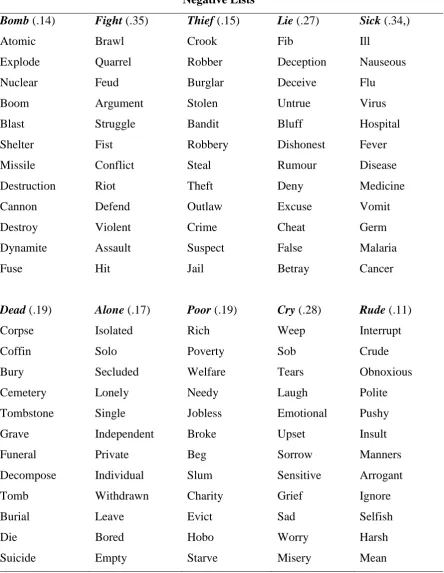
Neutral vs. Negative) repeated measures design. A total of 20 DRM lists (10 negative and 10
neutral) were used (see Appendix). Neutral lists were either taken from Stadler, Roediger,
University of South Florida Free Association Norms database choosing 12 associates to each
list (Nelson, McEvoy, & Schreiber, 1998). All negative lists were developed using the Nelson
et al. (1998) norms. Affective Norms for English Words (ANEW; Bradley & Lang, 1999)
were used to obtain available arousal and valence values for the individual list items and
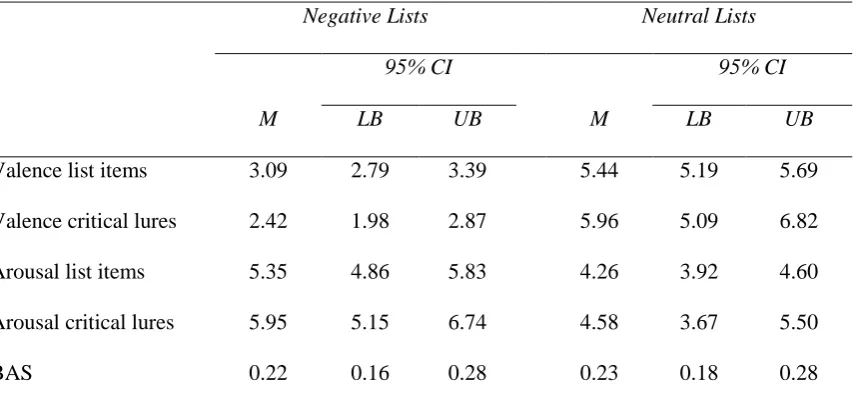
critical lures. Independent samples t-test showed that negative list items and critical lures
were significantly higher in arousal, t(18) = 4.17, p < .001, r = .70, and t(15) = 2.65, p < .05, r
= .56 respectively, and significantly lower in valence, t(18) = -13.53, p < .001, r = .03, and
t(15) = -8.81, p < .001, r = .92 respectively, compared to neutral list items and critical lures.
Mean values and 95% confidence intervals for all the list characteristics can be found in
Table 1.
List type was blocked and counterbalanced so that half of the participants began with
negative lists followed by neutral lists after the first test. List presentation within the emotion
block type was randomised. The negative and neutral lists were matched for backward
associative strength (BAS). An independent samples t-test showed that BAS between the
negative and neutral conditions did not differ significantly, t(18) = -.44, p = .66, r = .10 (see
Table 1).
Procedure
Participants took part in two study-test phases, one with negative lists and one with
neutral lists. Each phase followed the same procedure. Before the presentation of each new
list, participants were shown an on-screen instruction (i.e. List 1, List 2, etc.) that lasted for 1
second. Thereafter, 12 words from the lists appeared individually for 2 seconds, with an
inter-stimulus interval of 1 second. After the study phase, participants engaged in a 5-minute
non-verbal distractor task. A self-paced recognition test was then administered. The attention
the first half of the test followed by FA in the second half. In the DA condition, participants
performed an RNG secondary task that involved randomly generating numbers aloud
between 1 and 20 in time with a metronome every 750ms. Such a task has been shown to
successfully disrupt retrieval processes (e.g. Knott & Dewhurst, 2007a, 2007b). They were
instructed to maintain the correct speed and a correct level of randomness, and to avoid
incremental counting or following familiar sequences. Consent to record their number
generation during the task was also obtained in order to calculate measures of randomness for
each participant. RgCalc (Towse & Neil, 1998) was used to analyse number sequences.
RgCalc provides a numerical value between 0 and 1 for each participants’ sequence, with
high degree of randomness represented by a low RNG score.
Each recognition test was constructed in the same fashion. The test contained 60
words: 10 critical lures, 30 presented words (3 items from each list from positions 1, 6, and
12), and 20 non-studied words (10 related and 10 unrelated fillers). The
weakly-related fillers were selected from the (near) bottom of the Nelson et al. (1998) normed lists.
The words were individually presented on the computer screen and participants made old/new
responses for each word by pressing keys marked with the corresponding response. If
participants responded old, they were then asked to make a remember/know/guess judgement.
Instructions for remember, know, and guess responses were taken from Dewhurst and
Anderson (1999). In line with these instructions participants were asked to make a remember
response if they recollected some aspect of the item’s explicit study presentation; a know
response if the word felt familiar but they were unable to recollect any specific details; or a
guess response if they were unsure whether or not the word had appeared at study. List
Results
Random number generation task
Secondary task performance was measured in each of the list type conditions for each
participant. An RNG score was obtained to measure participant’s randomness in generated
number sequences. Paired samples t-test revealed that RNG did not differ significantly
between negative (M = .24, 95% CI [.22, .27]) and neutral (M = .24, 95% CI [.22, .27])
conditions, t(35) = .19, p = .85, r = .03. The number of responses generated within each
sequence was also noted. However, since the time taken to complete the recognition test
varied between participants and between list type conditions, the total was converted into an
average that represented the number of responses generated every 10 seconds, Na. Paired
samples t-test revealed that Na did not differ significantly between negative (M = 7.65, 95%
CI [6.63, 8.67]) and neutral (M = 7.44, 95% CI [6.54, 8.35]) conditions, t(35) = .76, p = .45, r
= .13. Overall, neutral and negative conditions did not differ in attentional resources allocated
to the completion of the secondary task.
Recognition test responses
Proportions of the recognition test responses (old, remember, know, and guess
judgements) to critical lures, studied items, weakly related and unrelated filler items were
subjected to a 2 (Attention at Test: FA vs. DA) x 2 (List Type: negative vs. neutral) repeated
measures ANOVA. Any significant interactions were further analysed using paired-samples
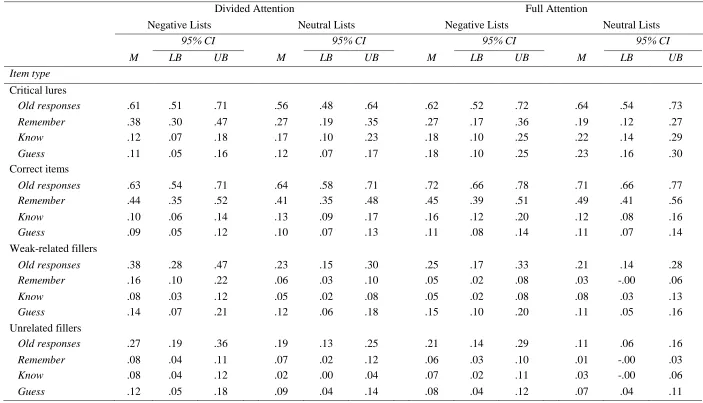
t-test with Bonferroni corrections (alpha set at .025). Table 2 reports all the mean proportions
and their 95% confidence intervals for the recognition responses in each type of test item.
Correct recognition. For old responses, there was a significant main effect of
attention, F(1, 35) = 7.84, p = .008, ηp2 = .18, whereby correct recognition was higher in the
There were no significant main effects of list type, F(1, 35) = .08, p = .78, ηp2 = .002,
indicating an absence of an emotion enhanced memory effect (although this is not unexpected
when using the DRM paradigm), and no significant Attention x List Type interaction, F(1,
35) = .20, p = .66, ηp2 = .01. For correct remember judgements, there were no significant
main effects or interaction (all Fs < 2.50). For correct know judgements, there was a
significant main effect of attention, F(1, 35) = 4.77, p < .05, ηp2 = .12, with higher correct
recognition found again in the FA (M = .14, 95% CI [.11, .17]) compared to the DA (M = .12,
95% CI [.08, .15]) condition, but no main effect of List Type was observed, F(1, 35) = .17, p
= .68, ηp2 = .01. However, there was a significant Attention x List Type interaction, F(1, 35)
= 6.83, p = .01, ηp2 = .16. The Simple Main Effects (SME) of list type revealed no difference
in correct know responses between attention conditions for the neutral list type, t(35) = .48, p
= .63, r = .08. However, correct know responses were significantly higher when tested under
FA (M = .16, 95% CI [.12, .20]) than under DA (M = .10, 95% CI [.06, .14]) for the negative
list type, t(35) = -3.84, p < .001, r = .54. For guess judgements, the main effects nor
interaction reached significance (all Fs < 1.20).
False Recognition of Critical lures. For false old responses, there were no main
effects or Attention x List Type interaction (all Fs < 1.70) For false remember judgements,
there was a significant main effect of attention, F(1, 35) = 9.23, p = .004, ηp2 = .21, with
higher false recognition found in the DA (M = .33, 95% CI [.26, .39]) compared to the FA (M
= .23, 95% CI [.17, .29]) condition. There was also a significant main effect of list type, F(1,
35) = 4.63, p < .05, ηp2 = .12, where negative false remembering (M = .33, 95% CI [.25, .40])
was significantly greater compared to neutral false remembering (M = .23, 95% CI [.17, .30]),
revealing an enhanced false memory effect for emotional lists. There was no Attention x List
Type interaction, F(1, 35) = .28, p = .60, ηp2 = .01. For the analysis of false know judgements,
false recognition was higher in the FA compared to the DA condition, a reversed pattern to
false remember responses. There was no significant main effect of list type, F(1, 35) = 2.01, p
=.17, ηp2=.05, nor interaction, F(1, 35) = .01, p =.92, ηp2=.00. Similarly for guess
judgements, a significant main effect of attention was found, F(1, 35) = 6.06, p < .05, ηp2 =
.15, with the same pattern as know judgements, but no significant main effect of list type or
Attention x List Type interaction was found (all Fs < 2.00).
False Recognition of Weakly Related Items. For false old responses, there was no
main effect of attention, F(1, 35) = 3.63, p = .07, ηp2 = .09, However, there was a significant
main effect of list type, F(1, 35) = 11.25, p = .002, ηp2 = .24, with higher false responses
produced in the negative (M = .31, 95% CI [.24, .38]) compared to the neutral (M = .22, 95%
CI [.16, .28]) condition. A significant Attention x List Type interaction was also found, F(1,
35) = 4.19, p < .05, ηp2 = .11. The analysis of SME revealed false responses was significantly
greater within the negative (M = .38, 95% CI [.28, .47]) compared to the neutral (M = .23,
95% CI [.15, .30]) condition when test was taken under DA, t(35) = 3.74, p = .001, r = .53.
No difference was found when test occurred under FA (p = .31). For false remember
judgements, there were main effects of attention, F(1, 35) = 13.35, p < .001, ηp2 = .28, and
list type, F(1, 35) = 7.07, p < .05, ηp2 = .17, with higher false remembering occurring in the
DA condition and in the negative compared to the neutral condition (see Table 2). The main
effects were qualified by an Attention x List Type interaction, F(1, 35) = 6.24, p < .05, ηp2 =
.15. Analysis of SME revealed that when retrieval was under DA, false remembering was
significantly greater within the negative (M = .16, 95% CI [.10, .22]) compared to the neutral
(M = .06, 95% CI [.03, .10]) condition, t(35) = 3.00, p = .005, r = .45. No difference was
found when test occurred under FA (p = .29). For false know and guess judgements, there
False Recognition of Unrelated Items. For false old responses, there were main
effects of attention, F(1, 35) = 5.98, p < .05, ηp2 = .15, and list type, F(1, 35) = 6.59, p < .05,
ηp2 = .16, with higher false recognition of unrelated items in the DA condition and higher
false recognition rates for negative compared to neutral stimuli. There was no significant
Attention x List Type interaction, F(1, 35) = .08, p = .78, ηp2 = .002. For false remember
judgements, there was a significant main effect of attention, F(1, 35) = 4.94, p < .05, ηp2 =
.12, but no main effect of attention or significant interaction (both F < 1), and for false know
judgements, there was a significant main effect of list type, F(1, 35) = 10.42, p = .003, ηp2 =
.23, but no main effect of attention or significant interaction (both F < 1). For false guess
judgements, there were no significant main effects or interaction (all Fs < 1.60). See table 2
for the means and 95% confidence intervals for the aforementioned significant effects.
False recognition of negative weak-related and unrelated filler items was higher than
that of neutral filler items. Researchers (e.g., Knott & Thorley 2014;Howe et al 2010) have
argued that the semantic connectivity of negative items leads to a wider spread of activation
and possibly a more liberal response bias. We found a similar effect in our own research. The
persistence of the finding demonstrates the fact that negative filler items are naturally more
inter-related compared to neutral filler items.
Discussion
The aim of the present study was to investigate the effect of DA at test on true and
false memory production for neutral and negative items using the DRM paradigm. The
findings from this study demonstrate that negative, in addition to neutral, critical lures were
more falsely remembered under DA compared to FA conditions at retrieval. In addition,
although typical for DRM studies, we did not find an emotionally enhanced memory effect
The high false remembering of critical lures, but decrease in knowing, associated with
retrieval under DA compared to FA for both negative and neutral words replicates and
extends the findings of Knott and Dewhurst (2007a). The source-monitoring component of
the activation-monitoring framework (Roediger, Watson, McDermott, & Gallo, 2001) can
explain this finding. As outlined in the introduction, the monitoring component suggests that
false recognition of critical lures occurs due to the inability to discriminate between internally
and externally generated items (Roediger & McDermott, 1995). According to Mather,
Henkel, and Johnson (1997), poor source monitoring can occur when one’s memory contains
insufficient information to accurately discriminate between items, or when easily accessible
but less diagnostic information is preferred over potentially accurate source information.
Knott and Dewhurst (2007a) referred to the distinction between controlled and automatic
source monitoring decisions to explain the pattern of findings in their study. According to
Johnson, Hastroudi, and Lindsay (1993) automatic source monitoring processes are made
rapidly and without awareness. When we rely on automatic processing, it is the perceptual
details that take precedence when making such decisions. In contrast, controlled source
monitoring requires a more strategic process with the need for additional information and
reasoning. The latter process would be greatly disrupted when attentional resources are
limited, but the former would remain largely unaffected. Similar to Knott and Dewhurst
(2007a), the increase in false remember responses to both negative and neutral critical lures
during conditions of reduced attention are likely a result of the reduced availability of more
controlled source-monitoring processes and the over reliance on more automatic source
monitoring decisions. Without disruption controlled and automatic source-monitoring
decisions work together to reduce recognition errors, but with disruption, controlled source
monitoring processes cannot monitor memories that would otherwise be readily accepted by
schemas or templates (Johnson, 1991). In this instance such an effect led to the increase in
false memory production because the DA task increased the difficulty of using source
information to strategically evaluate whether the item was one presented on the list, or
internally activated when associated items were presented during study. This caused a
specific increase in remember responses because, as evidenced by Knott & Dewhurst (2007a;
2007b; but see also Dewhurst, Holmes, Brandt & Dean, 2006), remember responses rely on
relatively automatic, fast retrieval processes. If an item triggers perceptual or contextual
features, a remember response can be made immediately. Decisions under DA were based on
more automatic source-monitoring that rely on perceptual details thus increasing false
remember responses.
Briefly, we also note that the correct recognition responses associated with remember
and know judgements also replicate findings from Knott and Dewhurst (2007a, 2007b). That
is, correct know responses were reduced under DA conditions, but correct remember
responses remained unaffected. These findings too can be explained by controlled and
automatic processes. According to Knott and Dewhurst (2007a), correct remember responses
are based on automatic processes that can be made immediately by relying only on perceptual
details. Hence, these responses are unaffected by limited attentional resources during
retrieval. However, correct know responses are based on controlled processes that require
effortful post-retrieval decisions, which are disrupted by the DA task. Deciding whether a
level of familiarity is sufficient to identify the item as old requires a more effortful decision
and attentional resource.
Regardless of attention condition, we found higher rates of false remembering for
negative compared to neutral critical lures. This finding supports previous research that
demonstrates an enhanced emotional false memory effect (Brainerd et al., 2008; Howe et al.,
earlier. In order for a false memory to occur the associate links between nodes/concepts need
to be activated. Negative items are highly interconnected and more easily activated (Thijssen,
Otgaar, Howe, & de Ruiter, 2013). Therefore, participants are more likely to believe that the
critical lure was part of the presented list, consequently increasing the likelihood of false
remembering to occur. Interestingly, Dehon, Laroi, and Van der Linden (2010, Experiment 2)
asked participants at the end of the memory test to specify words they had thought of during
the presentation of each list but did not write them down because they believed them not to
be experimenter-generated. They found that the probability of activating critical lures from
neutral and emotional lists was similar, but accurate monitoring of emotional lures was a
difficulty compared to non-emotional lures. The more easily accessible but less diagnostic
information (the meaning of the item) is used in absence of additional information and
reasoning of the source of the item. Much the same way that our reduced attention condition
prevents the use of more controlled effortful source monitoring procedures.
We did not find an enhanced emotional memory effect for veridical recognition,
however characteristics of emotional stimuli that has been known to elicit the enhanced effect
will likely explain the absence of the effect in the FA condition. Emotional stimuli tend to be
high in semantic density (the semantic relatedness between stimuli) compared to neutral
stimuli, and quite distinctive if intermixed with neutral stimuli (Talmi et al., 2007). Both
factors improve memory for emotional stimuli resulting in a subsequent enhanced retrieval.
The associative nature of neutral and negative lists and the presentation style have likely led
to similar levels of correct recognition between neutral and negative words. This supports
Talmi et al. (2007), who found that when both factors were controlled, the emotion enhanced
effect was eliminated.
At the beginning of this study we asked the question, would the enhanced (increased)
resources at retrieval? The answer is yes. Both neutral and negative false memories do
increase with divided attention, but the enhanced effect for negative over neutral false
memories remains even when attentional resources are limited at retrieval. To end, if we were
to apply the findings of the present study to a more ecologically valid environment then we
could imply that if witnesses do not hold full attention when retrieving information about a
witnessed event, the chances of producing false memories of event details (be it neutral or
negative) is high. Of course witnesses would not be asked to randomly generate numbers
while being presented with a photographic line-up, however, there are other ways to disrupt
retrieval, and we should be mindful of the effects this has on our source-monitoring processes
and accurate recognition. This study has begun an important investigation, but applying this
procedure to other false memory paradigms will help develop a consensus for the effects of
References
Baddeley, A., Lewis, V., Eldridge, M., & Thomson, N. (1984). Attention and retrieval from
long-term memory. Journal of Experimental Psychology: General, 113(4), 518-540.
Bradley, M. M., & Lang, P. J. (1999). Affective norms for English words(ANEW):
Instruction manual and affectiveratings (Tech. Report No. C-1). Gainesville, FL: The
Centre for Research in Psychophysiology, University of Florida.
Brainerd, C. J., Stein, L. M., Silveira, R. A., Rohenkohl, G., & Reyna, V. F. (2008). How
does negative emotion cause false memories? Psychological Science, 19(9), 919-925.
Clark-Foos, A., & Marsh, R. L. (2008). Recognition memory for valenced and arousing
materials under conditions of divided attention. Memory, 16(5), 530-537.
Craik, F. I., Govoni, R., Naveh-Benjamin, M., & Anderson, N. D. (1996). The effects of
divided attention on encoding and retrieval processes in human memory. Journal of
Experimental Psychology: General, 125(2), 159-180.
Deese, J. (1959). On the prediction of occurrence of particular verbal intrusions in immediate
recall. Journal of Experimental Psychology, 58(1), 17-22.
Dehon, H., Larøi, F., & Van der Linden, M. (2010). Affective valence influences participant's
susceptibility to false memories and illusory recollection. Emotion, 10(5), 627-639.
Dewhurst, S. A., & Anderson, S. J. (1999). Effects of exact and category repetition in true
and false recognition memory. Memory & Cognition, 27(4), 665-673.
Dewhurst, S. A., Holmes, S. J., Brandt, K. R., & Dean, G. M. (2006). Measuring the speed of
the conscious components of recognition memory: Remembering is faster than knowing.
Consciousness and Cognition, 15(1), 147-162.
Fernandes, M. A., & Moscovitch, M. (2000). Divided attention and memory: evidence of
substantial interference effects at retrieval and encoding. Journal of Experimental
Howe, M. L., Candel, I., Otgaar, H., Malone, C., & Wimmer, M. C. (2010). Valence and the
development of immediate and long-term false memory illusions. Memory, 18(1), 58-75.
Johnson, M. K. (1991). Reality monitoring: Evidence from confabulation in organic brain
disease patients. In G. P. Prigatano & D. L. Schacter (Eds.), Awareness of deficit after
brain injury: Clinical and theoretical issues (pp. 176-197). New York: Oxford
University Press.
Johnson, M. K., Hashtroudi, S., & Lindsay, D. S. (1993). Source monitoring. Psychological
Bulletin, 114(1), 3-28
Kensinger, E. A., & Corkin, S. (2004). Two routes to emotional memory: Distinct neural
processes for valence and arousal. Proceedings of the National Academy of Sciences of
the United States of America, 101(9), 3310-3315.
Knott, L. M., & Dewhurst, S. A. (2007a). The effects of divided attention at study and test on
false recognition: A comparison of DRM and categorized lists. Memory & Cognition,
35(8), 1954-1965.
Knott, L. M., & Dewhurst, S. A. (2007b). Divided attention at retrieval disrupts knowing but
not remembering. Memory, 15(6), 664-674.
Knott, L. M., & Thorley, C. (2014). Mood-congruent false memories persist over time.
Cognition & Emotion, 28(5), 903-912.
Knott, L. M., Dewhurst, S. A., & Howe, M. L. (2012). What factors underlie associative and
categorical memory illusions? The roles of backward associative strength and interitem
connectivity. Journal of Experimental Psychology: Learning, Memory, and Cognition,
38(1), 229.
Knott., K. L., Howe, M. L., Toffalini, E., Shah, D., & Humphreys, L. (2016). The role of
attention in immediate emotional false memory enhancement. Manuscript submitted for
Maddox, G. B., Naveh-Benjamin, M., Old, S., & Kilb, A. (2012). The role of attention in the
associative binding of emotionally arousing words. Psychonomic Bulletin & Review,
19(6), 1128-1134.
Mather, M., Henkel, L. A., & Johnson, M. K. (1997). Evaluating characteristics of false
memories: Remember/know judgments and memory characteristics questionnaire
compared. Memory & Cognition, 25(6), 826-837.
McEvoy, C. L., Nelson, D. L., & Komatsu, T. (1999). What is the connection between true
and false memories? The differential roles of interitem associations in recall and
recognition. Journal of Experimental Psychology: Learning, Memory, and Cognition,
25(5), 1177–1194.
Nelson, D. L., McEvoy, C. L., & Schreiber, T. A. (1998). The University of South Florida
word association, rhyme, and word fragment norms. (Available at:
http://www.usf.edu/FreeAssociation/)
Otgaar, H., Howe, M. L., Brackmann, N., & Smeets, T. (2016). The malleability of
developmental trends in neutral and negative memory illusions. Journal of Experimental
Psychology: General, 145(1), 31.
Pezdek, K., & Lam, S. (2007). What research paradigms have cognitive psychologists used to
study “false memory,” and what are the implications of these choices?. Consciousness
and Cognition, 16(1), 2-17.
Roediger, H. L., & McDermott, K. B. (1995). Creating false memories: Remembering words
not presented in lists. Journal of Experimental Psychology: Learning, Memory, and
Cognition, 21(4), 803-814.
Roediger, H. L., Watson, J. M., McDermott, K. B., & Gallo, D. A. (2001). Factors that
determine false recall: A multiple regression analysis. Psychonomic Bulletin & Review,
Smith, S. M., Gerkens, D. R., Pierce, B. H., & Choi, H. (2002). The roles of associative
responses at study and semantically guided recollection at test in false memory: The
Kirkpatrick and Deese hypotheses. Journal of Memory and Language, 47(3), 436-447.
Stadler, M. A., Roediger, H. L., & McDermott, K. B. (1999). Norms for word lists that create
false memories. Memory & Cognition, 27(3), 494-500.
Talmi, D., Luk, B. T., McGarry, L. M., & Moscovitch, M. (2007). The contribution of
relatedness and distinctiveness to emotionally-enhanced memory. Journal of Memory
and Language, 56(4), 555-574.
Towse, J. N., & Neil, D. (1998). Analyzing human random generation behavior: A review of
methods used and a computer program for describing performance. Behaviour Research
Appendix
Neutral Lists
Car (.26) Chair (.22) Fruit (.23) Square (.21) Window (.24)
Vehicle Table Kiwi Rectangle Pane
Drive Recliner Citrus Circle Sill
Van Stool Pear Triangle Shutter
Truck Couch Vegetable Round Blinds
Bus Sit Banana Cube Curtain
Jeep Furniture Strawberry Pyramid Door
Caravan Sofa Orange Oval Glass
Fuel Bench Apple Shape Drapes
Ride Sitting Grape Sphere Shade
Taxi Cushion Basket Object Screen
Train Throne Orchard Cone Open
Race Legs Bowl Prism Frame
Mouth (.11) Smell (.37) Pen (.20) Mountain (.20) Pants (.29)
Tongue Odour Ink Climber Trousers
Jaw Aroma Quill Hill Slacks
Lip Scent Pencil Climb Zipper
Teeth Stench Marker Peak Jeans
Throat Incense Write Hike Belt
Gums Sniff Fountain Valley Shorts
Moustache Perfume Point Summit Shirt
Whistle Fragrance Felt Slope Dress
Braces Sense Scribble Rocks Pocket
Cheek Rose Blot Steep Skirt
Eyes Nostril Crayon Canyon Suit
Negative Lists
Bomb (.14) Fight (.35) Thief (.15) Lie (.27) Sick (.34,)
Atomic Brawl Crook Fib Ill
Explode Quarrel Robber Deception Nauseous
Nuclear Feud Burglar Deceive Flu
Boom Argument Stolen Untrue Virus
Blast Struggle Bandit Bluff Hospital
Shelter Fist Robbery Dishonest Fever
Missile Conflict Steal Rumour Disease
Destruction Riot Theft Deny Medicine
Cannon Defend Outlaw Excuse Vomit
Destroy Violent Crime Cheat Germ
Dynamite Assault Suspect False Malaria
Fuse Hit Jail Betray Cancer
Dead (.19) Alone (.17) Poor (.19) Cry (.28) Rude (.11)
Corpse Isolated Rich Weep Interrupt
Coffin Solo Poverty Sob Crude
Bury Secluded Welfare Tears Obnoxious
Cemetery Lonely Needy Laugh Polite
Tombstone Single Jobless Emotional Pushy
Grave Independent Broke Upset Insult
Funeral Private Beg Sorrow Manners
Decompose Individual Slum Sensitive Arrogant
Tomb Withdrawn Charity Grief Ignore
Burial Leave Evict Sad Selfish
Die Bored Hobo Worry Harsh
Suicide Empty Starve Misery Mean
[image:24.595.65.510.109.683.2]Table 1. Mean values and 95% Confidence Intervals for list items, critical lures, and BAS, as
a function of List Type
Note:M, LB, and UB refers to mean, lower bound, and upper bound respectively. The Mean is taken based on those items where valence and arousal ratings are available.
Negative Lists Neutral Lists
95% CI 95% CI
M LB UB M LB UB
Valence list items 3.09 2.79 3.39 5.44 5.19 5.69
Valence critical lures 2.42 1.98 2.87 5.96 5.09 6.82
Arousal list items 5.35 4.86 5.83 4.26 3.92 4.60
Arousal critical lures 5.95 5.15 6.74 4.58 3.67 5.50
Table 2. Mean proportions and 95% Confidence Intervals for recognition test responses to critical lures, correct items, weakly related filler items, and unrelated filler items as a function of List Type and Attention
Divided Attention Full Attention
Negative Lists Neutral Lists Negative Lists Neutral Lists
95% CI 95% CI 95% CI 95% CI
M LB UB M LB UB M LB UB M LB UB
Item type
Critical lures
Old responses .61 .51 .71 .56 .48 .64 .62 .52 .72 .64 .54 .73
Remember .38 .30 .47 .27 .19 .35 .27 .17 .36 .19 .12 .27
Know .12 .07 .18 .17 .10 .23 .18 .10 .25 .22 .14 .29
Guess .11 .05 .16 .12 .07 .17 .18 .10 .25 .23 .16 .30
Correct items
Old responses .63 .54 .71 .64 .58 .71 .72 .66 .78 .71 .66 .77
Remember .44 .35 .52 .41 .35 .48 .45 .39 .51 .49 .41 .56
Know .10 .06 .14 .13 .09 .17 .16 .12 .20 .12 .08 .16
Guess .09 .05 .12 .10 .07 .13 .11 .08 .14 .11 .07 .14
Weak-related fillers
Old responses .38 .28 .47 .23 .15 .30 .25 .17 .33 .21 .14 .28 Remember .16 .10 .22 .06 .03 .10 .05 .02 .08 .03 -.00 .06
Know .08 .03 .12 .05 .02 .08 .05 .02 .08 .08 .03 .13
Guess .14 .07 .21 .12 .06 .18 .15 .10 .20 .11 .05 .16
Unrelated fillers
Old responses .27 .19 .36 .19 .13 .25 .21 .14 .29 .11 .06 .16
Remember .08 .04 .11 .07 .02 .12 .06 .03 .10 .01 -.00 .03
Know .08 .04 .12 .02 .00 .04 .07 .02 .11 .03 -.00 .06
Guess .12 .05 .18 .09 .04 .14 .08 .04 .12 .07 .04 .11