City, University of London Institutional Repository
Citation
:
Ayub, N. and Rakocevic, V. ORCID: 0000-0002-3081-0448 (2019). Credit-Based
Relay Selection Algorithm Using Stackelberg Game. Wireless Days, doi:
10.1109/WD.2019.8734269
This is the accepted version of the paper.
This version of the publication may differ from the final published
version.
Permanent repository link:
http://openaccess.city.ac.uk/id/eprint/22524/
Link to published version
:
http://dx.doi.org/10.1109/WD.2019.8734269
Copyright and reuse:
City Research Online aims to make research
outputs of City, University of London available to a wider audience.
Copyright and Moral Rights remain with the author(s) and/or copyright
holders. URLs from City Research Online may be freely distributed and
linked to.
City Research Online:
http://openaccess.city.ac.uk/
[email protected]
Credit-Based Relay Selection Algorithm Using Stackelberg Game
Naumana Ayub
Department of Electrical and Electronic
Engineering
City, University of London, United Kingdom
[email protected]
Veselin Rakocevic
Department of Electrical and Electronic
Engineering
City, University of London, United Kingdom
[email protected]
Abstract— Public wireless networks usually comprise of self-interested users who are reluctant to cooperate with other users of the network unless and until they are provided with some incentives. This paper presents a new incentive-based relay selection algorithm, which motivates the self-interested in-range mobile users to act as relays providing network access to the out-of-range users, thus extending the coverage range of a wireless network. The new Credit-based Relay Selection (CRS) algorithm uses Stackelberg game employing a credit-based incentive mechanism, providing instantaneous as well as long-term benefit to the selfish in-range users. In addition to this, theCRSalgorithm takes into account both the achievable data rate at the out-of-range user and fair consumption of battery power of in-range user as the relay selection criteria. Simulation results presented in this paper show that when the CRS algorithm is used for relay selection, it is advantageous even for the self-interested in-range users to participate in the relaying process to earn some benefit to utilize it when they move outside the transmission range of access point and need to buy assistance from other users. The CRS algorithm also provides better data rate to the out-of-range users as well as fair utilization of battery power of the in-range users compared to a default algorithm which uses Signal to Interference and Noise Ratio (SINR) as relay selection criterion.
I. INTRODUCTION
To avoid the infrastructural and operational cost of spe-cialized relay stations, ordinary mobile users have been used to support cooperative communication between the source and the destination as well as to extend the coverage area of a wireless network. Usage of ordinary mobile users as relays requires them to cooperate with one another. However, a public wireless network may comprise of self-interested users who are not always willing to cooperate and are only interested in their own benefit. The factors that contribute towards the selfishness of the users are [1]: 1) lack of resources, e.g. low battery power, available memory or computational capability 2) security concern of receiving malicious information from other users of the network 3) no incentive to collaborate with other users. These self-interested users need to be given proper incentives in order to make them use their resources for providing relay service to other users of the network [5]–[9], [13] and [14].
To encourage the selfish users to participate in collab-orative communication, reputation based and credit-based mechanisms are two commonly used cooperative incentive mechanisms [2]. The reputation of a node/ user in a wireless network basically represents its willingness to utilize its
resources for other users of the network, which can be deter-mined either centrally at a specialized control station or indi-vidually at each node. The main advantage of this approach is detection of misbehaving selfish and/ or malicious nodes and isolating them, since the reputation of a node is computed based on observations from multiple entities [3]. However, there are several issues with reputation based mechanisms which have not been addressed [4]. Firstly, the incentives given to the selfish nodes have not been properly analyzed. In order to earn good reputation, network users may be over generously using their resources, thus putting themselves at a loss. Secondly, the selfish nodes may conspire to increase their benefit which has not been considered in reputation based schemes. Also these schemes rely on broadcast nature of wireless channel to compute reputation which with the introduction of directional antennas will become difficult and challenging.
In credit based-mechanisms, a user earns tokens or mon-etary benefits by assisting fellow users of the network. These tokens and monetary benefits compensate for the cost incurred by the cooperating users, which may be in terms of battery power consumption, sharing of bandwidth or transmission time. The earned credits can then be utilized to purchase cooperation from other users when needed and thus putting the users with no credits at disadvantage. The users considered in this paper are self-interested but not malicious, therefore, the relay selection algorithm proposed in this paper employs a credit-based mechanism to encourage the self-interested users to take part in the data forwarding service to the out-of-range users, to extend the coverage area of the network.
The network model studied in this paper consists of two types of users, the users which can directly access their data from the access point (AP) are termed as the in-range users. Whereas the users which require assistance from the in-range intermediate users to communicate with the AP are called the out-of-range users. The in-range intermediate users are assumed to selfish which need to be incentivized in order to make them help the out-of-range users. Stackelberg game has been utilized to formulate a Credit-based Relay Selection (CRS) algorithm which takes into account the instantaneous benefit of both in-range and out-of-range users as well as provides long-term benefit to the in-range users.
services. The price advertised by the in-range user is in turn dependent on the relaying cost it experienced. The relaying cost is calculated using the ratio of average to instantaneous battery power dissipation of the in-range user to ensure that all in-range users get the opportunity to act as relays resulting in fair utilization of battery power. The price paid to the in-range is accumulated as credits by the in-in-range user which it can utilize to purchase data relaying service for itself when it becomes the out-of-range user. Thus providing long-term benefit to the in-range users. The main contribution of this paper is the detailed analysis of the CRS algorithm in terms of long-term benefit of the in-range users when they exchange their role and become the out-of-range users.
The reminder of the paper is organized as follows: sec-tion II summarizes the literature on credit-based incentive techniques encouraging the selfish intermediate users to participate in cooperative communication. The system model and the proposedCRSgame are described in section III. The
CRSalgorithm based on theCRSgame is provided in section IV. The simulated network model and obtained results are discussed in section V and section VI concludes the paper.
II. RELATEDWORK
Different credit-based mechanisms and pricing schemes have been proposed to motivate self-interested users to collaborate with one another, which can be broadly classified into three categories. In the first category, the threat of future punishment is utilized to enforce cooperation among network users [5]–[7]. The second category provides network users with opportunities to earn credits and tokens which can be used later when needed, giving them incentives to help one another [8]–[12]. Whereas the third category of credit and pricing mechanisms employs auction theory to promote collaboration among network users [13], [14].
Altman et al. in [5] enforced cooperation among self-interested users by punishing the misbehaving users. If the amount of messages forwarded by a user is less than that relayed by the other users of the network then a misbehaving user is identified and as a punishment other users will decrease the fraction of messages they were relaying for the misbehaving user. The proposed method leads to partial cooperation, thus giving some freedom to the network users to sometimes deliberately choose to save their resources for themselves and bear less aggressive punishment. Han et al.
[6] also proposed a punishment based policy to enforce cooperation and to control transmission rate in wireless networks.
[7] is another work in which the threat of punishment in future has been used to promote cooperation among the self-interested users. They have formulated a framework in which a repeated game is used to enforce collaboration and a distributed self-learning process is utilized to determine optimal forwarding probability of each user of the network. Each user detects the greedy behavior of other user by com-paring its utility to a threshold value, if the utility is less than the threshold then it implies that some users are deviating from cooperation and as a punishment for a fixed period of
time the user who had detected the misbehavior plays non-cooperatively. The drawback of punishment based incentive mechanisms is that there is no instantaneous benefit for the intermediate users and there is no choice available to them to reserve their resources for their own data transmission.
In [4] a simple credit based system is proposed by Zhang
et al.in which a centralized entity is responsible for receiving credits from the source node and distributing among the intermediate nodes assisting the source- destination commu-nication. However, Zhanget al. have analyzed their scheme from the prospective of security to avoid cheating from the selfish nodes by colluding with each other which is out of scope of this paper.
Crowcroft et al. in [8] devised an incentive model that stimulates mobile ad-hoc users to act as transit nodes and earn credits which then be used to send their own traffic. When a user joins an ad-hoc network, it has some initial balance, which it can top up by relaying data for other users. The transit nodes determine the price of their service in a distributed manner considering the usage of their bandwidth and power. The traffic generating user, considering its credit balance, evaluates its willingness to pay to the intermediate transit nodes. The price the intermediate nodes ask for data delivery is deducted from the balance of the data generating node and the credit balance of helping nodes is incremented. Since Crowcroft et al. used only instantaneous power to calculate price, some of the intermediate nodes will be relaying data more frequently than others, thus resulting in unfair consumption of battery power of intermediate nodes. In [9], Srinivasan et al. have utilized the Generous TIT-FOR-TAT (GTFT) algorithm for a wireless ad-hoc node to determine whether to accept a relaying request or refuse it. The GTFT algorithm is based on non-cooperative game theory and employs behavioral strategy in which each player takes its decision based on the past conduct of other nodes in the network. The GTFT algorithm will not work for the network scenario studied in this paper because the in-range users do not need the out-of-range users to access their data unless and until they move out of the transmission range of the access point or base station.
Pricing mechanisms have also been used to incentivize selfish users to help the other users with low battery power to achieve energy saving [10]. Stackelberg game and genetic algorithm have been employed to develop the optimal pricing model for sharing of bandwidth in an integrated WiMAX and WiFi network in [11]. Shastry and Adve also formulated a pricing mechanism that induces cooperation among the source node and the relays which takes into account both the real energy cost incurred by the relay and the cost of delays relay’s own data suffers [12].
Fig. 1. Network comprising of in-range and out-of-range users
a central controlling entity called the auctioneer to govern the interaction between the seller and the buyer, making it an infeasible option for the network model studied in this paper. Similarly the techniques using the threat of future pun-ishment are not applicable to the considered network model because the in-range users can directly access their data and do not need help from the out-of-range users. Therefore, a new credit-based mechanism providing instantaneous as well as long-term benefit along with ensuring fair consumption of battery power of all participating in-range users is needed.
III. SYSTEMMODEL ANDCREDIT-BASEDRELAY
SELECTION(CRS) GAME
The system model studied in this paper is composed of two types of users, the in-range users and the out-of-range users as depicted in Figure 1. The out-of-range users cannot directly communicate with the AP and require help from the in-range users to access their data. Since the in-range users are self-interested users, they need to be given incentives to encourage them utilize their battery power to forward data to the out-of-range users. Along with compensation for the cost incurred by the in-range users for acting as relays, they also have concerns regarding fair utilization of their battery power. On the other hand, the out-of-range users want to achieve good data rate through the selected in-range users. A Credit-base Relay Selection (CRS) game has been developed which aims to ensure fair consumption of battery power of in-range users along with attaining better data rate at the out-of-range users. The CRS game employs a credit-based mechanism to motivate the in-range users to assist the out-of-range users, thus gaining instantaneous as well as long-term benefit for themselves.
Stackelberg game forms the foundation of the proposed
[image:4.595.310.563.56.200.2]CRSgame. Stackelberg game is a seller buyer game which takes into account the utility of both the seller and the buyer to determine the optimal strategy each player shall follow to maximize its utility. In the system model under study, the in-range users are the sellers of the data forwarding service and the out-of-range users are the buyers. In theCRSgame,
Fig. 2. Decision making at the in-range and out-of-range users for the Credit-base Relay Selection (CRS) game
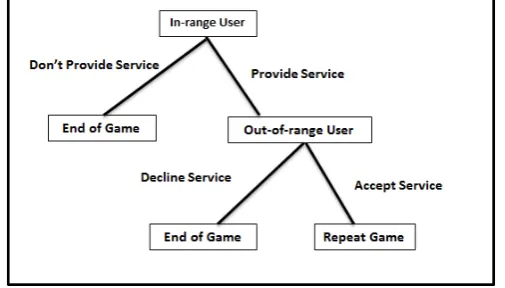
the in-range user considering its utility decides whether to provide relaying service to the out-of-range or not and the out-of-range user taking into account its utility determines whether to purchase the service from the in-range user or not as presented in Figure 2. The out-of-range users want to maximize their utility which depends on the date rate achieved by availing the relaying service and the price paid for the service, given by equation (1).
Uj =Rij−pij (1)
In equation (1),Uj represents the utility of the out-of-range
userj, Rij the data rate at user j achieved through the
in-range useriandpij the price advertised by the in-range user
i for providing assistance to user j. Whereas the utility of the in-range user i is dependent on the price it advertised for its service minus the cost incurred while providing the service and is given by equation (2).
Ui =pij−cij (2)
whereUi is the utility of the in-range useriandcij the cost
experienced by useri for providing relaying service to user j. Compared to our previous work [15], the utilities of the in-range and the out-of-in-range users and the cost are calculated in the same manner. The cost suffered by user i depends on its average to instantaneous battery power consumption given by cij = SBPSBPiij. The main difference is the way the
in-range users determine the price for their service based on their available battery power and the long-term benefit the in-range users achieve if they cooperate with the out-of-range users. A finite budgetβij has also been assumed for the
out-of-range users which they can use to buy relaying service themselves which is the case in practical systems.
Fig. 3. Graphical representation of the pricing function given in equation(3)
price linearly after relaying data to an out-of-range user until its battery power reaches the first threshold value i.e.BPth1.
From BPth1 to the second threshold value, the critical
thresholdBPthc, the price is incremented exponentially and
after BPthc the in-range user does not participate in the
relaying process.
f(pij) =
pij+cijt BPi ≥BPth1
pijecijt BPth1 > BPi> BPthc
∞ otherwise
(3)
The formulated pricing function is given by equation (3) and is graphically represented in Figure 3. The purpose of initially increasing the price linearly is that the out-of-range users can receive assistance from the in-range users with best channel conditions providing maximum data rate. However, as the battery power of the best in-range users is dissipated beyond BPth1, they need to push the out-of-range users
towards other in-range users to conserve their battery power. Thus beyond BPth1 till BPthc, the price is incremented
exponentially with respect to cost. Another advantage of this formulation of the pricing function is to ensure that each in-range user gets fair opportunity to relay data for the out-of-range users, thus resulting in fair utilization of battery power of in-range users providing longer service time to the out-of-range users.
The price received by the in-range user for relaying data provides instantaneous benefit to the in-range users. TheCRS
game converts this price into credits for the in-range user which it can use when it moves out of the transmission coverage of the AP, thus giving long-term benefit to the in-range users. The long-term benefit for the in-in-range user is given by equation (4).
Bk =Rk−Ck (4)
wherekis the in-range user changing its role,Rkis the data
rate nodekreceived as out-of-range user,Ckthe cost it bore
[image:5.595.55.306.53.231.2]as relay and Bk is its long-term benefit. It is advantageous
Fig. 4. Credit-based relay selection (CRS) algorithm
for a node to provide relaying service only if its long term benefit is greater than zero.
IV. CREDIT-BASEDRELAYSELECTION(CRS)
ALGORITHM
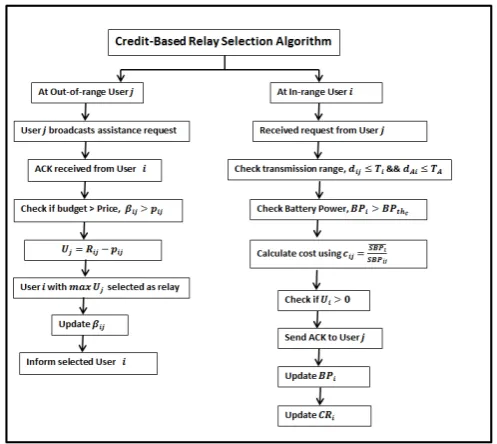
TheCRSalgorithm is based on theCRSgame and Figure 4 presents the CRS algorithm with exchange of messages between the in-range and the out-of-range users. In the
CRS algorithm, the out-of-range users first broadcast the assistance request message. The in-range user upon receiving the assistance request message checks two conditions; 1) whether it is in transmission range of the AP and the out-of-range user or not i.e. dij ≤ Ti&&dAi ≤ TA and 2)
its battery power is above the critical threshold BPi >
BPthc. The in-range user then calculates its relaying cost
cij = SBPSBPiji and its price using equation (3) to determine its
utilityUi. If its utility is greater than zero, then it sends an
acknowledgement message (ACK) to the out-of-range user j.
When the out-of-range userj receives ACK from the in-range users, it determines whether it has enough budget to pay the price advertised by each in-range user i. If the criterion on budget is fulfilled, the userjcomputes its utility and the in-range user i providing the maximum utility is selected as relay. Useriupdates its budget by deducting the price it will be paying to the chosen relay and also informs the selected relay. The relay after providing data forwarding service updates its battery power and adds the received price to its credits.
V. SIMULATIONRESULTS
Simulation Duration
0 10 20 30 40 50 60
Average Data Rate (Mbps)
0.4 0.5 0.6 0.7 0.8 0.9 1 1.1
1.2 Average Data Rate vs Simulation Duration
[image:6.595.326.540.51.300.2]Default Algorithm CRS Algorithm
Fig. 5. Average data rate at the out-of-range users achieved through the default and theCRSalgorithms
Simulation Duration
0 10 20 30 40 50 60
Jain's Fairness Index
0.3 0.4 0.5 0.6 0.7 0.8
0.9 Jain's Fairness Index vs Simulation Duration
[image:6.595.69.279.54.163.2]Default Algorithm CRS Algorithm
Fig. 6. Jain’s fair index for battery power consumption when the default and theCRSalgorithms are used for relay selection
a default algorithm. The default algorithm uses only the Signal to Interference and Noise Ratio (SINR) as the relay selection criterion, thus the in-range users with best channel conditions are repeatedly chosen as relays for the out-of-range users. A network model consisting of five in-out-of-range and ten out-of-range users is simulated with an assistance request probability of 50% from the out-of-range users. The price advertised by the in-range user is incremented linearly until 20%of its battery power is consumed and then exponentially until its battery power reaches 50%, after which it declines the out-of-range user’s request.
The average data rate achieved by the out-of-range users when the default and the CRSalgorithm are used for relay selection is depicted in Figure 5. It can be seen that the
CRS algorithm outperforms the default algorithm. In the first 35 simulation slots, the CRS algorithm provides approxi-mately 30%better data rate. However, the difference between the data rate attained with the two algorithms drastically increases with the simulation duration. This is due to the fact that in the default algorithm there is no mechanism to ensure fair utilization of battery power, therefore the battery power of the in-range users with best channel conditions quickly reach their critical threshold value and can no longer serve the out-of-range users. The CRS algorithm, on the other hand, uses both achievable data rate as well as the fair utilization of battery power, thus provides longer service time of the in-range users and accomplishes better data rate. Jain’s fairness index [16] has been used to determine how fairly the battery power of the in-range users is consumed by theCRSalgorithm compared to the default algorithm. Figure 6 presents the Jain’s fairness index values for the default
Horzontal Dimensions
0 20 40 60 80 100
Vertical Dimensions
0 10 20 30 40 50 60 70
AP
N1 N2 N3 N4
N5
N6 N7
N8
N9 N10 N11
N12 N13
N14 N15
Position of Nodes
(a)
Horzontal Dimensions
0 20 40 60 80 100
Vertical Dimensions
0 10 20 30 40 50 60 70
AP
N1
N2 N3
N4 N5 N6
N7 N8
N9 N10
N11 N12
N13 N14 N15
Position of Nodes
(b)
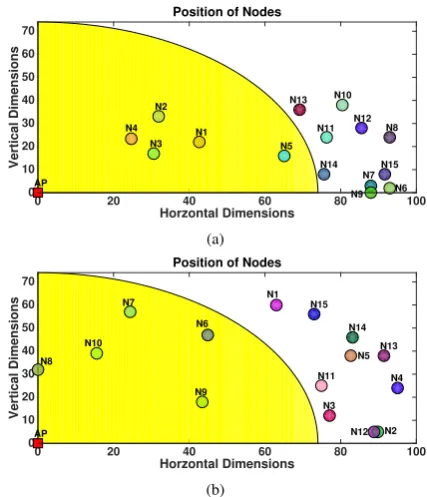
Fig. 7. Simulated network scenario with in-range and out-of-range users exchanging their role once: (a) Position 1 before exchange; and (b) Position 2 after exchange.
and theCRSalgorithms. The higher the Jain’s fairness index value, the fairer the system. TheCRSalgorithm uses the ratio of average to instantaneous battery power consumption for the calculation of cost incurred and price advertised by the in-range users, thus providing the in-in-range users fair opportunity to act as relays resulting in 85%-90% fair utilization of battery power of all relays. Whereas for the default algorithm the value of Jain’s fairness index is just 40%.
To demonstrate the long-term benefit of theCRSalgorithm given by equation(4) and accumulation and usage of credits earned by a node/user, a network model with nodes exchang-ing their roles as in-range and out-of range users has been analyzed. The network model still comprises of 15 nodes as presented in Figure 7(a); 5 in-range users and 10 out-of-range users and half way through the simulation duration five of the out-of-range users swap their roles with the in-range users. To assess the performance of theCRS algorithm when such exchange of roles occurs, two test case scenarios have been considered. In scenario 1, the in-range and out-of-range users change their positions only once as shown in Figure 7. Whereas for scenario 2, four such exchanges of positions have been examined. For both test case scenarios, theCRS
[image:6.595.66.282.202.314.2]Horzontal Dimensions
0 20 40 60 80 100
Vertical Dimensions 0 10 20 30 40 50 60 70 AP N1 N2 N3 N4 N5 N6 N7 N8 N9 N10 N11 N12 N13 N14 N15
Position of Nodes
(a)
Horzontal Dimensions
0 20 40 60 80 100
Vertical Dimensions 0 10 20 30 40 50 60 70 AP N1 N2 N3 N4 N5 N6 N7 N8 N9 N10 N11 N12 N13 N14 N15
Position of Nodes
[image:7.595.68.284.51.300.2](b)
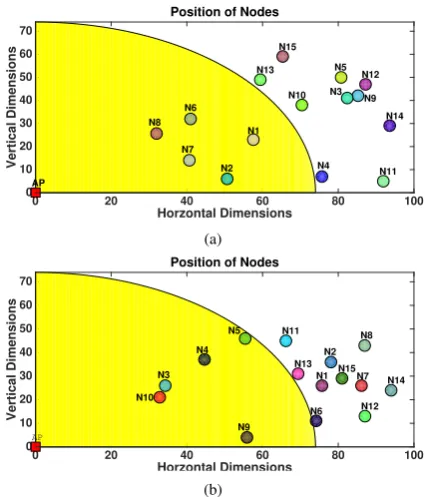
Fig. 8. Simulated network scenario comprising of the remaining two
positions of in-range and out-of-range users for test case scenario 2: (a) Position 3 and (b) Position 4.
Node Number
1 2 3 4 5
Overall Benefit of Nodes
0 5 10 15 20 25
30 Benefit Gained by Each Node
Default Obedient CRS Algorithm
Fig. 9. Overall benefit attained by nodes when default obedient andCRS
algorithms are used
• In variation 1, for the default algorithm it has been assumed that the in-range users are obedient users and do not ask for any price for their services.
• Variation 2 deals with the selfish in-range users who ask for a price for their services but there is no mechanism to ensure fair utilization of battery power of the in-range users.
The results obtained when the in-range and out-of-range users exchange their roles for these two variations of the default algorithm in comparison with theCRSalgorithm are discussed below.
1) Variation 1: Figure 9 presents that overall benefit gained by the nodes who were the in-range users in position 1 depicted in Figure 7(a) and became the out-of-range users in position 2 shown in Figure 7(b). The overall benefit of a node depends on the cost it experienced being a relay and the data rate it received being the out-of-range user. Simulation duration of 120 slots with a request probability of 50%
from the out-of-range users and the exchange of positions
Simulation Time
0 10 20 30 40 50 60
Battery Power (%)
40 50 60 70 80 90
100 Service Time of Node vs Simulation Duration
[image:7.595.327.538.54.162.2]Default Obedient Node 5 CRS Algoirthm Node 5
Fig. 10. Service time ofN5when default obedient andCRSalgorithms
are used
Simulation Time
0 20 40 60 80 100 120
Credits 0 5 10 15 20 25 30
35 Credits Earned as Relay and Credits Usage as Out-of-Range User
Node 1 Node 2 Node 3 Node 4 Node 5 Position 2 Position 1
Fig. 11. Accumulation of credits when acting as the relay and usage of credits when become the out-of-range user for theCRSalgorithm
occurring after first 60 slots has been simulated. Since the in-range users for the default algorithm are considered to be obedient, irrespective of whether the nodesN1,N2,N3,N4
andN5provide data forwarding service in position 1 or not, they will always receive assistance when they become the out-of-range users. This is because the nodesN6,N7,N8, N9andN10in position 2 are also obedient users. Therefore, all the five nodes N1, N2,N3, N4 andN5 achieve good positive overall benefit for the default algorithm as well.
There are five relays in position 1 (Figure 7(a)), however despite the relays being obedient users, the out-of-range users only avail the services of N5 in case of the default algorithm. Therefore, in Figure 10 the service time of only N5 has been plotted. Service time is the duration in which the relay is assisting the out-of-range users before its battery power reaches the critical threshold value. From Figure 10, it can be concluded that the CRS algorithm provides approximately 50% longer service time compared to the default algorithm with obedient relays in this scenario. This is due to the pricing function given in equation (3) which takes into account the fair consumption of battery power. The formulated pricing function conserves the battery power of in-range users with best channel conditions and provides incentives to both in-range users to help the out-of-range users and to out-of-range users to buy services from the in-range users which do not provide best SINR but are asking for less price.
Acquisition of credits by nodesN1,N2,N3,N4andN5
[image:7.595.328.541.206.309.2] [image:7.595.69.282.349.455.2]Total Cost Experienced by A Node
0 2 4 6 8 10
Total Price Advertised by A Node
0 5 10 15 20 25 30
35 Total Price vs Total Cost Experienced by A Node
[image:8.595.331.538.55.157.2]Node 1 Node 2 Node 3 Node 4 Node 5
Fig. 12. Comparison of price received a node as relay for its services vs the cost it experienced for the CRSalgorithm
Cost Experienced by A Node
0 2 4 6 8 10
Data Rate (Mbps)
0 5 10 15 20 25 30
35 Achievable Data Rate vs Cost Experienced by A Node
[image:8.595.73.280.55.162.2]Node 1 Node 2 Node 3 Node 4 Node 5
Fig. 13. Comparison of cost incurred by a node as relay for its services vs the data rate it received as the out-of-range user for theCRSalgorithm
line represents the transition when these five nodes change their role from providing assistance to requiring assistance. The flat period in Figure 11 in position 1 represents that either the node has ran out of its battery power or is asking for too high a price that the out-of-range user cannot afford. In position 2 the flattening means that node has exhausted its credits bank or in other words its budget has been fully used and has no more budget to buy relaying service for itself. Figures 12 and 13 present the comparison of the price received by a node as relay for its services vs the cost it experienced and the cost incurred by it as relay vs the data rate it received as the out-of-range user in case of the CRS
algorithm, respectively. From Figures 12 and 13, it is clear that even though the in-range users experience a cost when helping the out-of-range users it is still advantageous for them to participate in the relaying process considering the benefits provided by theCRSalgorithm in terms of credits, utility and data rate.
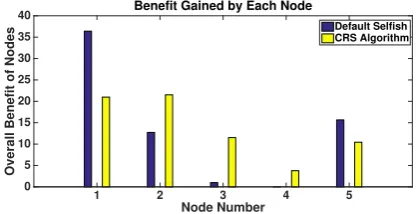
2) Variation 2: In variation 2, the default algorithm also offers price to the in-range users assisting the out-of-range users irrespective of the cost in terms of battery power consumption they undergo. Figure 14 shows the overall benefit gained by the nodesN1,N2,N3,N4andN5when the default algorithm and the CRS algorithm are used for relay selection. In case of theCRSalgorithm, the benefit is more evenly distributed among the five nodes as compared to the default algorithm. Also node N4 receives almost negligible benefit. This is because in position 1 of Figure 7, in case of the default algorithmN4has no incentive to help the out-of-range users, thus earns zero credits and cannot avail relaying services when it becomes the out-of-range user in
Node Number
1 2 3 4 5
Overall Benefit of Nodes
0 5 10 15 20 25 30
35 Benefit Gained by Each Node
[image:8.595.73.281.206.313.2]Default Selfish CRS Algorithm
Fig. 14. Overall benefit attained by nodes when default algorithm
considering selfish in-range users asking for price, irrespective of their cost
andCRS algorithm are used
Node Number
1 2 3 4 5
Overall Benefit of Nodes
0 5 10 15 20 25 30 35
40 Benefit Gained by Each Node
Default Selfish CRS Algorithm
Fig. 15. Overall benefit attained by nodes for test case scenario 2 where the in-range and out-of-range users swap their positions multiple times.
position 2 of Figure 7. Also the cost of providing assistance as well as fair dissipation of battery power of relays have not been taken into account while determining the willingness of the in-range users to act as relays in the case of the default algorithm.
For the test case scenario 2, the in-range and the out-of-range users exchange their roles four times as depicted in Figures 7 and 8. In positions 1 and 3 ( in positions 1 and 4) of Figures 7 and 8 nodesN1andN2(N3,N4andN5) are the in-range users whereas in positions 2 and 4 (positions 2 and 3) they become the out-of-range users. In the test case scenario 2 of swapping of roles, the default algorithm with pricing irrespective of the relaying cost for the selfish in-range users is considered.
Figure 15 displays the overall benefit gained by nodesN1, N2, N3, N4 and N5 swapping their role as the in-range and out-of-range users multiple times during the simulation period of 120 slots, twice acting as the relays and twice as the out-of-range users. Even when the nodes change their roles multiple times, all nodes receive benefit when theCRS
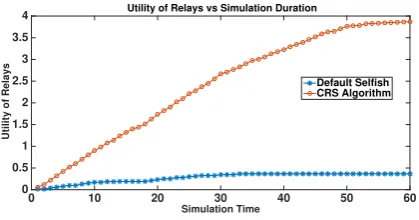
algorithm is used. Whereas the default algorithm provides benefit to only N1, N2 and N5 and almost negligible to N3 and N4, thus giving no long term benefit to N3 and N4to assist the out-of-range users. Therefore, the cumulative utility achieved byN1,N2,N3,N4 andN5when helping the out-of-range users is approximately 80% less than that achieved with theCRSalgorithm as depicted in Figure 16
VI. CONCLUSION
[image:8.595.328.537.208.315.2]Simulation Time
0 10 20 30 40 50 60
Utility of Relays
0 0.5 1 1.5 2 2.5 3 3.5
4 Utility of Relays vs Simulation Duration
[image:9.595.70.280.54.164.2]Default Selfish CRS Algorithm
Fig. 16. Cumulative utility of nodesN1,N2,N3,N4andN5for test case scenario 2 when acting as relays
paper which along with ensuring instantaneous benefit to relays also presents long-term benefit to them. The long-term benefit provided by the CRS algorithm has been evaluated by considering two test case scenarios in which the in-range and out-of-in-range users exchanges their roles. From the obtained simulation results, it can be clearly seen that the
CRSalgorithm provides better data rate and fairer utilization of battery power of in-range users achieving longer service time compared to the default algorithm. TheCRSalgorithm gives enough incentives to encourage the self-interested in-range users to take part in the relaying process and provides long-term benefit to all participating users. Despite the cost experienced when relaying data for the out-of-range users, it is beneficial for a node to act as a relay considering its overall benefit in terms of earned credits, utility and data rate when the CRS algorithm is used for relay selection. Future work will comprise of performance evaluation of the
CRSalgorithm under different mobility models and network scenario with high mobility users.
ACKNOWLEDGMENT
This work is supported by EU-India Research Initiative project REACH: Rural Broadband Internet Access using Cooperative Mesh Networking in White Space Spectrum.
REFERENCES
[1] R. I. Ciobanu, C. Dobre, M. Dascalu, S. Trausan-Matu and V. Cristea, Collaborative selfish node detection with an incentive mechanism for opportunistic networks. In Integrated Network Management (IM 2013), 2013 IFIP/IEEE International Symposium on (pp. 1161-1166). [2] D. E. Charilas and A. D. Panagopoulos, A survey on game theory applications in wireless networks. Computer Networks, 2010, 54(18), 3421-3430.
[3] S. Buchegger and J. Y. Le Boudec, Performance analysis of the CONFIDANT protocol. In Proceedings of the 3rd ACM international symposium on Mobile ad hoc networking&computing, 2002, June (pp. 226-236). ACM.
[4] S. Zhong, J. Chen and Y. R. Yang, Sprite: A simple, cheat-proof, credit-based system for mobile ad-hoc networks. In INFOCOM 2003. Twenty-Second Annual Joint Conference of the IEEE Computer and Communications. IEEE Societies (Vol. 3, pp. 1987-1997).
[5] E. Altman, A. A. Kherani, P. Michiardi and R. Molva, Non-cooperative forwarding in ad-hoc networks. In International Conference on Re-search in Networking (pp. 486-498). Springer, Berlin, Heidelberg, May 2005.
[6] Z. Han, Z. Ji and K. R. Liu, Dynamic distributed rate control for wireless networks by optimal cartel maintenance strategy. In Global Telecommunications Conference, 2004. GLOBECOM’04. IEEE (Vol. 6, pp. 3454-3458).
[7] Z. Han, C. Pandana, and K. R. Liu, A self-learning repeated game framework for optimizing packet forwarding networks. In Wireless Communications and Networking Conference, 2005 IEEE (Vol. 4, pp. 2131-2136).
[8] J. Crowcroft, R. Gibbens, F. Kelly and S. string, Modelling incentives for collaboration in mobile ad hoc networks. Performance Evaluation, 2004, 57(4), 427-439.
[9] V. Srinivasan, P. Nuggehalli, C. F. Chiasserini and R. R. Rao, Coopera-tion in wireless ad hoc networks. In INFOCOM 2003. Twenty-Second Annual Joint Conference of the IEEE Computer and Communications. IEEE Societies (Vol. 2, pp. 808-817).
[10] Y. Guo, L. Duan and R. Zhang, Optimal pricing and load sharing for energy saving with cooperative communications. IEEE Transactions on Wireless Communications, 2016, 15(2), 951-964.
[11] D. Niyato and E. Hossain, Wireless broadband access: Wimax and beyond-integration of wimax and wifi: Optimal pricing for bandwidth sharing. IEEE communications Magazine, 2007, 45(5).
[12] N. Shastry and R. S. Adve, Stimulating cooperative diversity in wireless ad hoc networks through pricing. In Communications, 2006. ICC’06. IEEE International Conference on (Vol. 8, pp. 3747-3752). [13] D. Yang, X. Fang and G. Xue, Truthful auction for cooperative
communications. In Proceedings of the Twelfth ACM International Symposium on Mobile Ad Hoc Networking and Computing (p. 9), 2011.
[14] J. Huang, Z. Han, M. Chiang and H. V. Poor, Auction-based resource allocation for cooperative communications. IEEE Journal on Selected Areas in Communications, 2008, 26(7).
[15] N. Ayub and V. Rakocevic, Fair battery power consumption algorithms for relay nodes in rural wireless networks. In Wireless Networks and Mobile Communications (WINCOM), 2017 International Conference on (pp. 1-6). IEEE.