0022-538X/89/062726-11$02.00/0
Copyright© 1989, American SocietyforMicrobiology
DNA
Sequences
That
Regulate Expression
of
a
Vaccinia
Virus
Late
Gene (L65) and Interact with
a
DNA-Binding Protein from
Infected
Cellst
JEFFREYN. MINERANDDENNIS E. HRUBY*
Centerfor Gene Research, Department of Microbiology, Oregon State University, Corvallis, Oregon 97331-3804
Received 13 June 1988/Accepted28February1989
To beefficiently expressedinvivo,the vaccinia virus lategene,L65, requires 5'-proximal cis-actingelements
which binda factor from infected cells. Deletion mutagenesis and vaccinia virushelper-dependenttransient
expression procedureswereused to demonstrate that twodistinct latepromoterelements directtranscription fromtwodifferentstartsites(proximal [+1]and distal[-92]). The-128 to -112regionwasessentialforL65 distal promoterfunction, while sequences between -59 and +50were sufficientfor L65 proximal promoter function.TheproximalDNAsequencesinteract withaprotein, bindingfactor I(BF-I),whichwasisolatedand
partially purifiedfrom vaccinia virus-infected cellsatlate timespostinfection.Thisactivityisnot detectablein uninfected cellsorinpurified virions. This factor bindsspecificallytotwo different sites within theproximal promoter,one5' andone3' tothe transcriptionstartsite, but does notbindtothe distalpromoter element.
Within infected cells, the expression of vaccinia virus (VV) genes is regulated in a distinct temporal fashion (16, 32). During replication, VV proceeds throughthreegeneral phases ofgene expression: immediate-early, delayed-early, and late. Since the replication cycle of VV occurs exclu-sively in the cytoplasm of infected cells, many of the regulatoryfunctions affecting viralgene expressionmay be encodedbythe virus (25). The lack ofany apparent eucary-otic consensus signals within the promoter regions of VV
genes tends to supportthis possibility (19). Understanding the mechanisms responsible for the regulation ofVV gene expression is ofparticular importance not only as a model systemforarelatively complex genetic regulatory pathway but alsoforfacilitatingthecontinued development of VV as
aeucaryotic expression vector.
Experiments directed towards the identification and anal-ysis of the cis and trans elements responsible for the regulated expression of VV genes in vivo are under way in a number of laboratories. The information accumulated to date indicates that VV early promoter elements are quite small, requiring only about 30 base pairs (bp) of upstream sequence to achieve regulated expression of a downstream reporter gene (7, 30).Similarly, protein factors which bind to these early VV promoters have been identified in virion extracts, partiallypurified (6, 31, 33), and shown to enhance transcriptionof cloned early genes in a fractionated cell-free transcription systemprepared from VV virions (5, 6). How-ever,in bothcasestheprecise molecular identification of the
cis and trans elements responsible for transcriptional en-hancement has not yet been achieved.
Although relatively little is known regarding the signals which regulate the expression of VV early genes, even less is known concerning late-gene expression, the study of which is complicated by two unusual transcriptional properties. First, VV late-gene transcription is characterized by a lack of discrete 3' termination, generating long (>10-kilobase) transcripts traversing through other downstream late or
* Correspondingauthor.
tTechnical paper 8851 from the Oregon State University Agri-cultural Station, Corvallis, Ore.
earlygenes(29). Second,recentreports have indicated that
VV late messages contain a 5' poly(A) head or leader sequence of variable size (3, 17, 23).
In previous work on late-gene promoters, putative late-promoter regions have been abutted to reporter genes and assayed eitherbyVVhelper-dependent transient expression procedures or after recombination of the chimeric genes back into theviral genome(2, 7, 10, 15, 30). Bothofthese approaches have given equivalent results (7, 30). Several studies have provided evidence that a TAAAT(G) motif, locatedat or nearthetranscriptionstartsite,isimportantfor late-gene expression (2, 10). However, this motifalone is apparently insufficient to direct high-level late-gene
tran-scription,as anumberof VV late genes havebeen shownto
require additional short upstreamelements forfull promoter activity, includingthe L5 (28K) andAl genes(15, 30).
In contrast topreviously mentionedVVlate-gene promot-ers,theregulatorysequencesdirectingtheexpression of the L65(VV D13) gene appearto be somewhat more complex. Byutilizing twotranscriptional startsites (distal [-92] and proximal [+1]), the L65 promoter governs theexpressionof
a transcript encoding an abundant late VV protein of 65 kilodaltons (L65) to which rifampin resistance has been mapped (1, 24).The L65 gene is located within the HindIII D/Aregion of the VV genome (open reading frame [ORF] D13) (28) and lies within a cluster of ORFs which are
noncoordinately expressed at late times postinfection (26, 27). The L65 promoter has been shown to contain two
separate transcriptional elements, one between -128 and
-112 (element I) and another between -235 and -175 (elementII)(15).
Inthe presentwork,wehave used internally controlledS1 nuclease analysis ofRNA from transiently expressed L65 promoter/chloramphenicol acetyltransferase (CAT) gene
constructs toanalyze the sequences required for transcrip-tionfrom theproximalsite. Signals sufficient for expression from the proximal promoter lie between -59 and +50. To investigate whether virus-encoded regulatory factors may interact with elements in the L65 promoter, cytoplasmic
extracts were madefromuninfected and VV-infected HeLa cells andassayedfor the presenceofDNA-binding proteins.
2726
on November 10, 2019 by guest
http://jvi.asm.org/
DNA fragments corresponding to the L65 promoter region were isolated, labeled, and used as probes in gel retention assays (8) and were found to specifically bind a relatively heat-stable, proteinase K-sensitive factor (binding factor I [BF-I])from infected-cell extracts. After partial purification, we were able to demonstrate by competition that this factor interacts specifically with regions of the proximal L65 pro-moter found to be essential for expression. To map the binding sites more closely, deleted versions of the promoter were used in both competition and direct-binding studies, revealing the presence of two binding sites within the pro-moter.
MATERIALS AND METHODS
Plasmid construction. Recombinant plasmids were con-structed, propagated, and analyzed essentially as described by Maniatis et al. (14). The pPD13:CAT plasmid contains 300 bp of upstream sequence from the L65 ORF (distal L65 promoter) fused to the bacterial CAT gene (15). pPD13L:CAT contains 440 bp of upstream sequence and 50 bp of downstream sequence from the distal and proximal L65 promoters fused to the CAT gene (Fig 1). This 490-bp FokI-PstI promoter fragment was trimmed with Si nuclease and ligated to the SmaI site of pUC13:CAT, generating pPD13L:CAT. Plasmid pPD13L:CAT served as the starting material for the deletion series. Digestion with KpnI and XbaI followed by limited exonuclease III-S1 nuclease treat-ment allowed unidirectional 5' deletion into the promoter fragment. Dideoxy DNA sequencing of the plasmids con-firmed the extent of the deletions (22).
Cells and virus. Growth, purification, and plaque titration of VV (strain WR) was carried out as previously described (12). BSC-40 and L cells were maintained in Earle minimum essential medium (GIBCO Laboratories) supplemented with 10% heat-inactivated fetal bovine serum, 50Fig of gentamicin sulfate per ml, and 2mM L-glutamine at 37°C in 5% CO2 and 95% humidity (15).
Transient expression. Transient expression assays were carried out as previously described (7, 15). Briefly, recom-binant plasmids (51Lgof internal control plasmid and 10 pug of test plasmid) were coprecipitated with carrier salmon sperm DNA by using the calcium phosphate method (9). Precip-itated DNA was layered onto monolayers of L cells. The monolayers were treated 3 h later with glycerol at 37°C. After a 1-h recovery period, the cells were superinfected with VV at a multiplicity of 30 PFU per cell. The infected cells were incubated at37°Cfor 24 h prior to RNA extraction or CAT enzyme extract preparation.
CAT extracts and assays. Infected cells were harvested at 24 h postinfection, washed twice with ice-cold phosphate-buffered saline, centrifuged,suspended in 1 ml of CAT assay buffer (40 mM Tris chloride [pH 7.8], 1 mM EDTA, 150 mM NaCI), and incubated at 25°C for 5 min. The cells were centrifuged again and suspended in 0.1 ml of 0.25 M Tris chloride (pH 7.8). After the cells were subjected to three freeze-thaw cycles, the nuclei were removed and the extract was stored at -20°C. CAT assays were performed as previ-ously described (15).
RNA preparation andS1 nuclease analysis. Aftertransient expression, totalcytoplasmic RNA was isolated from mono-layers of transfected L cells. Cells were washed twice with phosphate-buffered saline, lysed with 2 ml of guanidine isothiocyanate solution (4 M guanidine isothiocyanate, 25 mM sodium citrate [pH 7.0], 0.5% lauryl sarcosine, 0.1 M ,B-mercaptoethanol), sheared by six passages through a
23-gauge needle, layered onto a 3-ml CsCl cushion (5.7 M CsCl, 0.1 M EDTA [pH 7.0]), and centrifuged for 12 h at
15°C and 35,000 rpm in an SW50.1 rotor. RNA pelletswere
rinsed twotimes with ice-cold70% ethanol, suspended, and ethanol precipitatedtwice. DNA probes for the Si nuclease analyses were isolated from agarose gels byelectroelution of DNAfragments onto Whatman DE 81 paperafterdigestion of plasmid DNA with the appropriate restriction enzymes andagarose gel electrophoresis. The 5' ends were radiola-beled with [-y-32P]ATP by using polynucleotide kinase. Probes to be single-end labeled were asymmetrically cut
with restriction enzymes and then reisolated. Probes were
denatured, annealed to 10 ,ug of infected-cell cytoplasmic RNA, anddigestedwithSinuclease as described
previously
(27).Reaction products were subjected toelectrophoresisin 8 Murea-8%polyacrylamide gels. Enzymes and radionucle-otides were obtained from commercial suppliers
(Bethesda
Research Laboratories, Inc.; New England BioLabs, Inc.; Boehringer Mannheim Biochemicals; and Dupont, NEN Research Products) and usedaccordingtotheinstructions of themanufacturers.
Cell extract and protein fractionation. Growth and infec-tion of HeLa cellswas done by usingpreviously described protocols (12). At either 3 or 8 h
postinfection,
2 liters of infected cells wascentrifuged in aBeckmanTJ-6centrifuge
(2,000 rpm, 10 min), washed twice in buffer W (137 mM
NaCl, 10 mMNa2HPO4, 2 mM KH2PO4, 2.7 mM
KCI,
0.5 mM MgCI2)(20), and then snapfrozen inliquid
nitrogen
and stored at -70°C. Cells prepared in this manner were stable forseveral months. To preparecell extracts, twice thepellet
volume oflysis buffer (0.5% Nonidet P-40, 20 mM HEPES [N-2-hydroxyethylpiperazine-N'-2-ethanesulfonic
acid]
[pH
7.6], 2 mM magnesium acetate, 1 mM dithiothreitol
[DTT])
was added and the suspension was mixed, incubated on ice for 5 min, andremixed. Nucleiand cell debriswereremoved by centrifugation at 10,000 rpm for 2 min in a microcentri-fuge. One volume of buffer A (200 mM Tris chloride
[pH
8.0], 20 mM DTT, 500mM KCl, 0.2 mM
EDTA)
wasadded to the supernatant fluid, which was thenapplied
to a 1-ml DEAE-cellulose (DE-52, Whatman, Inc.)columnwhich had been equilibrated with buffer A (100 mM Tris chloride[pH
8.0], 10 mM DTT, 250mM
KCI,
0.1 mMEDTA).
Withbuffer Aused as an eluant, 12 100-,ul fractions were collected and theproteinconcentration of each fractionwasdeterminedby
using a Bio-Rad protein assay kit. Peak fractions were
pooled anddialyzed for3 h
against
severalchanges
of TGED buffer (50 mM Tris chloride [pH 8.0], 1 mM EDTA, 1 mMDTT, 0.1% Nonidet P-40, 20%
glycerol)
containing
0.1 MKCl. A 1-ml phosphocellulose column
(Bio-Rad
Cellex-P)
preequilibrated with TGED-0.1 MKCl wasused to fraction-ate the dialyzed extract. Extract was added tothe column and then step eluted with successive 1.0-ml
aliquots
of TGEDcontaining0.1,0.35, and0.6 M KCl followedby
4ml of TGED containing 1 M KCI. Fractions(500
[lI)
werecollected andassayed for
protein
concentration andspecific
binding activity (data notshown).
Alternatively,
thephos-phocellulose column was
developed
with a lineargradient
from 0.1 to 1 M KCI. Fractions which demonstrated the ability tobind specificallyto L65promotersequences
(BF-I)
werepooled (usually fractions
containing
0.8 MKCI).
Thesefractionsweredialyzed againstbufferZ
(25
mMHEPES[pH
7.8], 12 mMMgCl2,
1 mMDTT,
0.1% NonidetP-40,
20% glycerol) containing 10 mM KCI(13)
and were further purifiedbyusingasalmon spermDNAaffinity
columnwhich consisted of sonicated salmon sperm DNAcoupled
toCNBr-activated Sepharose4B
(Pharmacia)
(4).
Flowthrough
on November 10, 2019 by guest
http://jvi.asm.org/
D A
VV
Hind
III
Map
ORF D12 ORF
D13
ORF Al(L65)
Proximal Distal
+50 Start site Start
site
I+1 -92 -300 -44
,.
-92 V
40
-300
_- .pUC
L65
gene
pPD1
3:CAT
D13 probe
+50
pUC...
iK
E+1
v
-92
v
-300 -440
I
...puC
pPDI
3L:CAT
D13L probe
HaI
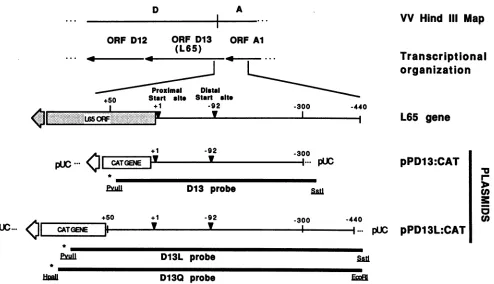
D13Q probeFIG. 1. Plasmids andprobes derivedfrom the HindIII D/Aregionof the VVgenome.The locations ofthe L65(orfD13)geneandpromoter and direction oftranscriptionareshown.V, Previously mappedstartsitesat +1(proximal)and -92(distal)ontheL65promoter(25).Two
VVL65 promoter/CAT constructs (pPD13:CAT andpPD13L:CAT) used in theseexperiments aredrawnto scale. Theprobesutilizedin
various Si nuclease protection experiments areshown(*, positions of radiolabeled nucleotides). ProbeD13wasisolated frompPD13:CAT
as aPvuIIfragment, labeled, digested withSstI,and purified, generatingasingle-end-labeled fragmentof450bp.ProbeD13Lwasisolated
frompPD13L:CAT by precisely thesameprotocol, generatingasingle-end-labeled fragmentof 607bp.The680-bp D13Q probewasisolated
frompPD13L:CAT by digestion withHpaIl(whichcutswithinthe CATgenejust5'tothe PvuIIsite),end-labeled, digestedwithEcoRI,and
reisolated.
fractions were collected, and the column was step eluted
withfour 1-ml aliquots of buffer Z-10mMKCl and then with
two 1-mlaliquotseach of bufferZ containing 0.1, 0.35, 0.6,
and1.0M KCl.Afterglycerolwasaddedtoaconcentration of 30%, protein concentrations were established and frac-tions were assayed for BF-I activity. BF-I-containing frac-tions were pooled, concentrated by dialysis against dry Aquacide III (Calbiochem-Behring) at 4°C, and stored at
-200C.
Gel retentionassays. Binding reactionscontained the pro-tein fraction being tested, 1 ,ug ofpoly(I)-poly(C), 4 pl of buffer B (10 mM HEPES [pH 8.0], 10% glycerol, 0.5 mM
EDTA, 0.5 mM DTT, 15 mM KCI), and the indicated
amount ofunlabeled competitor fragment ina totalvolume of 20 pul. Heat stability of BF-I was tested by heating the extracts prior to addition to the reaction. Sensitivity to
sodium dodecyl sulfate was tested by addition of sodium dodecyl sulfate to a final concentration of 0.01%. The reactions wereincubatedon ice for10min priortoaddition
of 1 pul of radiolabeled DNA probe fragment (20 fmol [-10,000 cpm]). Reactions wereincubated foranadditional
5min on iceand subsequently transferred to room
temper-aturefor30min (21). DNA-protein complexes were electro-phoretically separated on low-ionic-strength, prewarmed 7.5% polyacrylamide gels (1.7 mM Tris chloride [pH 8.0],
0.37 mMsodiumacetate,1 mM EDTA)ataconstant current
of20 mA withrecirculated buffer. Afterapproximately 3 h, gelswere dried and radioactivity wasdetectedby exposure
to Kodak XAR-5 film (Eastman Kodak Co., Rochester, N.Y.) withan intensifyingscreenat -70°C.
RESULTS
Transcription from the L65promoter.Previousanalysis of the L65 promoter has shown that transcriptional initiation from the distal site isgovernedbytwo upstreamsignals,one
between -123 and -106 and the other between -235 and -170 (15). The experiments described below were done to
delineate the sequences required for proximal start site functionand determinewhetherthesesequencesspecifically bind trans-acting factors from infected cells.
Tofacilitatetheseexperiments, plasmids wereassembled
which contained various portions of the region upstream
from the L65 ORF abutted to the CAT gene. The first plasmid (pPD13:CAT) has been described previously (15) and consists of the L65 upstream region from +1 to -300 adjacent to the CAT gene within a pUC13 vector (Fig. 1). The second plasmid (pPD13L:CAT)contained additional 3'
and 5'sequences whichspanned from +50to -440(Fig. 1). The probefragments usedtodetect transcriptsfrom each of
these constructionsby S1nucleaseanalysisareshownbelow
each construction (Fig. 1).
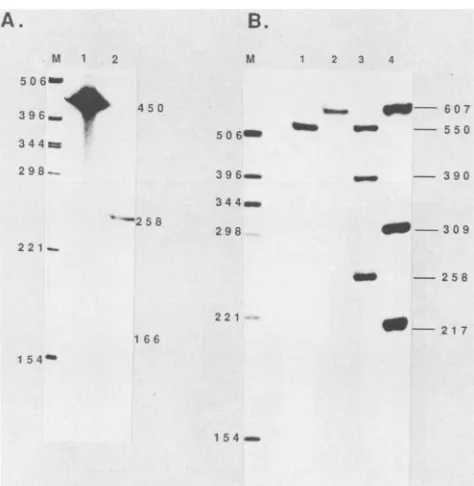
S1 nuclease protection assays using single-end-labeled probeD13 and cytoplasmic RNA generatedby VV helper-dependent transientexpression ofplasmid pPD13:CAT
pro-duced two bands, one which corresponded to full-length
Transcriptional
organization
+1
KLCI.,
ZIQ
MD [image:3.612.75.569.75.359.2](I)
... ...
o -..o@+
AX@:4:-:*:-. :-j:: --:e:
on November 10, 2019 by guest
http://jvi.asm.org/
B.
M 1 2 5 0 6
e-3 4 4 m
2 98-_
A.
M 1 2 3 4 +5 0
<1
CAT l_d. _ 6 07
506- - - 550
3 96_ _ - 390
Proximal .1 V
Distal -92
TT T T
T'
+9-9 -35 -59 -1 1 2 -1 28
pPD13L:CAT Deletions
B.
34 4 m-258
298 _00- 309
2 21
-- 258 2 2 1
166 -0-217
15
[image:4.612.50.287.74.317.2]4-1 54
FIG. 2. S1 nuclease analysis of RNA derived from transient expression of pPD13:CAT and pPD13L:CAT. S1nuclease analysis
wasperformedasdescribed in Materials and Methods.(A) Lanes: 1,
probe D13 digested with S1 nuclease in the presenceof calf liver
tRNA only; 2, reaction with probe D13 and RNA isolated from VV-infected cells transiently expressing the pPD13:CATconstruct; M, size marker DNA. Numbers indicatelength in bases. (B) Lane 1 isacontrol lane containing probe D13Xhybridized to10 ,ug of calf liver tRNA and digested with S1 nuclease under conditions identical tothose used for lanes 3 and 4; lane 2 isidenticaltolane 1except that theprobe is D13L. Lanes 3 and 4areidenticaltolanes 1 and 2
exceptthat RNA which had been isolatedat24 hpostinfection from cells transiently expressing plasmids -235:D13:CAT and D13L:CAT, respectively, wasused. Lane Mand numbersare asin panel A.
protection of the probeat 450nucleotides (nt)andanother,
at 258 nt, mapping to the distal transcriptional start site of the L65promoter(Fig. 2A).Aprotected fragment of 166 nt
would have been expected if transcription from the proximal
startsite had occurred. Likewise, withprobe D13Xand the RNAtranscribed frompPD13:CAT(-235) (a plasmidwitha small70-bp 5'deletion [15] [Fig. 2B, lane 3]), a258-nt band which correspondedtotranscriptionfromthedistalsitewas protected.CATgeneexpressiondrivenbythe -235 deletion mutantwas identicalto thefull-length constructionas mea-suredbythe CATassay.Anadditional bandwasalso visible at 390ntwhichcorrespondedtotranscripts reading through
the 5' endofthe L65promoterandprotectingtheD13probe
up to the -235 position (Fig. 2B, lane 3; see below). No
166-nt band which would correspond to transcription from
theproximalstart sitewas detected. Therefore, in boththe full-length pPD13:CATconstruction(Fig. 2A)and the -235 deletion mutant (Fig. 2B), transcription from the proximal
startsitewasvirtuallyundetectable. The lack oftranscripts mapping tothe proximal start site suggested either that the
proximal transcriptional start site had been destroyed by truncation at +1 orthat additional sequences3' or5'to +1 wererequired for full proximalpromoterfunction. Thus,the
plasmid pPD13L:CAT,which containsanadditional50bpof 3' sequence in addition to 440 bp of 5' sequence was assembled and used in similar transient expression assays.
120
-100
00
40
C
CL -440 -128 -112 -59 -35 .9 +9 c
5' deletions of pPD13L:CAT
FIG. 3. Effect of 5' deletions into thefull-length L65 promoter (pPD13L:CAT) on CAT gene expression. (A) Map showing the position of each deletion tested relativetothe CATreadingframe
and S1 nuclease-mapped start sites. (B) CAT activity generated from thefull-length construct(-440) compared with CAT activity from various 5' deletions. All values were normalized to CAT activity generated by the full-length promoter (-440), and the standard deviations (bars) were calculated after normalization of
each of three independent trials. Column C is the CAT activity produced by the identical vector without VV sequences (pUC:CAT).
S1 nuclease analysis with RNAderived fromthis construct and probe D13L showed transcriptional activity from both sites (Fig. 2B, lane4). The threeprotected fragments were 607, 309, and 217 nt in size, corresponding to full-length probe protectionand distal andproximalstartsites,
respec-tively. This resultindicates theimportance ofthesequences between +1 and +50 in pPD13L:CAT. Deletion of the upstream sequences to -128 did not affect the levels of
transcription from the proximal start site, which strongly
suggeststhat it isthe additionalsequences 3' to +1 that are required for proximal start site function (see Fig. 4, lane
-128). A TAAATmotifimplicatedin theregulationof other lategenesislocated between +2 and -3and is restoredby
theadditional sequences.
Specific sequences involved in L65 transcriptional
regula-tion. To further dissect the L65 promoterelement,aseries of 5' deletions ofpPD13L:CAT wereprepared whichspanned
both the upstream elements responsible for the
transcrip-tionalactivityof the distal startsite and the region
immedi-atelyupstreamof theproximalsite(Fig. 3A).These deletion mutants were used in concert with transient expression
assays.Relative expressionof these mutants wasmeasured
byCATenzymeassays(Fig. 3B)andquantitative Si
nucle-aseanalysis (Fig. 4).
Figure3B shows that deletion from -440to -128 hadno reproducible effect on CAT activity from pPD13L:CAT.
Further deletion of 16 bp to nt -112 resulted in a twofold
drop in CAT gene expression to 60% of that with the
full-length promoter.This deleted region correspondstothe distalpromoterelementIpreviouslydiscussed(15).Deletion ofsequencesbetween -59 and -35 resulted inanadditional threefold decreasein CATenzymeproduced (to20% ofthat
made with thefull-length promoter);removal of the next26
A.
-440
on November 10, 2019 by guest
http://jvi.asm.org/
[image:4.612.307.543.84.287.2]A
-440-1 28-1 1 2pPD13L:CAT Deletions-59 -3 5 -9 tRNA
FL 6800"'e-%
*a
5 0 6
2000
4)
C
396 E
en
.I-C 0)
294 4
D 368E
.f
_P 274 .,..
2 6 7
-440 -128 -1 1 2 -59 -35 -9
pPD13L:CAT Deletions
* distal O proximal
E readthrough
234
2 2 0
21 3
FIG. 4. Si nucleaseanalysisof RNA derived from transientexpressionof 5' deletionconstructs withtheD13Lprobe. (A)Each laneis designated bythe deletion construct used in transient expression (top, -440to -9). Largearrowheads mark bands of interest. FL 680, Full-length probe protection andprobe rehybridization; D368, distal site; P274, proximal site; IC 222, internalcontrol signal. Smaller
arrowheads indicate bands generated by readthroughinto the deletedpromoterconstructs.Size markers(in bases)areshownattherightof
thepanel.The tRNA lane is the identical reaction exceptthat tRNAwassubstitutedfor VV RNA. (B) QuantitationoftranscriptionofS1 nuclease signals from the L65 promoter/CATdeletion series. Laserdensitometry ofappropriate exposures of the gel shown inpanel A
provideddataregarding transcriptionfrom both the distal and theproximalstartsites. These dataareshown ingraphformafter normalization tothe internal control. The deletionmutantsanalyzedareshownonthexaxis. Thereadthroughdataarealso included.
basepairs to -9 decreased activity fivefold below the -35 deletion signal (to 4% of that made with the full-length promoter), effectively eliminatingall CATexpressionabove
background levels. When taken togetherwith the results of the experiments discussed earlier, this indicates that the elements whichareresponsibleforexpression of CAT from pPD13L:CATappeartobe located between -128 and -9.
To examine theeffectsofthedeletionsatthe levelofRNA
synthesis, internally controlled Si nuclease analysis was used on RNA generated from transient expression of the
deletion series. Cellsweretransfected with 10 ,ug ofagiven deletion plasmid plus 5 ,g of pPAl:CAT (pPA1:CAT is a previously described plasmid [15] which contains the pro-moterforORFAl abutted tothe CATgene). The ORF Al promoter is a strong late promoterwith a single start site. The transfected cells were infected with VV and then cytoplasmic RNA was harvested at 24 h postinfection.
Probeswhich detectedtranscription from pPD13L:CAT also protected a fragment of 222 nt due to transcription from pPAl:CAT allowing internal control of transfection effi-ciencyand RNA extraction procedures(Fig. 4). Titration of
pPA1:CAT and pPD13L:CAT plasmids shows that at the concentrations used, no competitive effects were detected which affected RNA synthesis or expression from either
plasmidduringtransientexpression (datanotshown). Figure
4A shows the results ofthis Si nucleaseanalysis with the
D13Q probe (Fig. 1); protected fragmentsatP(274 nt)and D
(368 nt)aresignalsfrom theproximaland distalstartsitesof
parental pPD13L:CAT, respectively (Fig. 1 and 3). The internal control migrated at 222 nt and was designated IC 222.Bands markedbysmallarrowheads inFig.4correspond
toprotectionof theprobe fragmentwhichmapstothe 5' end of the particular deletion used, suggesting that
transcrip-tionalreadthroughfrom the circularvectorintoeach ofthese deletionmutantsfrom the 5'sideoccurs(Fig. 2B, lane 3 and Fig. 4A). Densitometric scanning ofappropriate exposures and normalization to the internal control enabled
quantita-tion of relative transcriptional signal strengths (summarized
inFig.4B). Figure4 showsthat, inagreementwith the CAT
expressiondata(Fig. 3) aswellaswith previous work(15),
this assay detected a positive regulatory region acting on transcription from the distal start site which is located
B
IC 222
on November 10, 2019 by guest
http://jvi.asm.org/
[image:5.612.88.552.80.431.2]Proximal
+1I
+50 -59
Distal -92
-112 -123
It
.W-1 70 -235
w _
0 w vV V
L65
ORF
L65 promoter
+50/-59
+1 /-88
-1
81
/-300
-99/-1 81
+50/+9 +1/-13
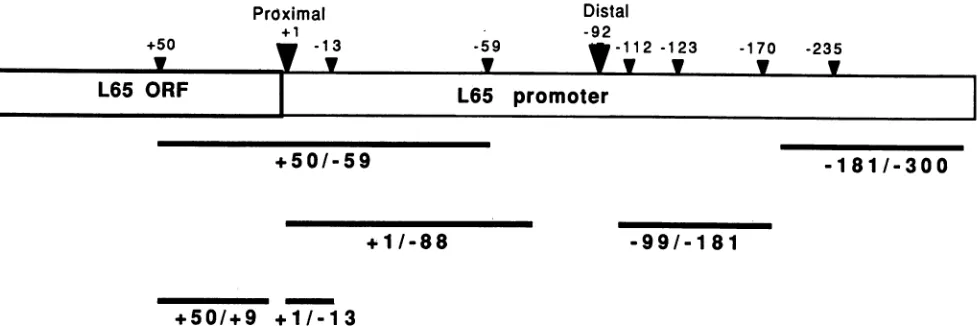
FIG. 5. Schematic representation of various probes and competitors used in gel retention assays. The L65 promoter and part of the L65 ORFareshown. Each probe isnamed by its endpoints on the L65 promoter. Each of these probes contains flanking pUC sequences to correct for differences in size. +50/-59, 180 bp; +1/-88, 120 bp; -181/-300, 120 bp; -99/-181, 100 bp; +50/+9, 150 bp; +1/-13, 110 bp.
between -128 and -112 and two other positive regulatory regionsacting on the proximal start site located between -59 and -9.Sequences between -128 and -440 had only minor effectsonthedistal site in thiscontext,in contrast toearlier work showing a twofold decrease due to these sequences in thepPD13:CATdeletion mutants (15). Deletion of the distal elementshad little effect on the transcriptional activity of the proximal site. Deletionof the region between -128 and -112 reduced the signal from the distal start site by 65-fold; the proximal site was relatively unaffected. A 2.5-fold reduction in transcription from the proximal start site was seen when sequences from -59 to -35 were removed, and a further 25-fold decrease occurred upon deletion to -9. This region between -59 and -9 does not contain any previously described regulatory signals. The TAAAT motif implicated in the regulation ofseveral late genes (19) is found at the proximal startsite. This TAAATmotif is alsofound within the -128 to -112 region governing activity of the distal promoter (15).
VV promoter-specific binding factor. It is reasonable to
predict
that both the distal and proximal L65 promoter elements function in vivo through interaction with trans-activating factors that stimulate or repress transcription. Usingagel retentionassay, previous workershaveisolated putative transcription factors fromVVvirions whichinteract withVV early promoters (5, 6, 33). Wehave used asimilar strategy to search for factors from VV-infected cells that bindspecifically totheproximal L65 promoterregion. The probesandcompetitors used in theseexperimentsareshown in Fig. 5. DNA-protein complexes were resolved from free DNAby native gelelectrophoresis (8). The crude cytoplas-mic extract had to besubjectedtoboth DEAE-cellulose and phosphocellulose ion-exchange chromatography steps be-fore individual DNA-protein complexes could be resolved (see Materials and Methods). The protein eluted from the phosphocellulose column at different KCI concentrations containedanumberofDNA-binding activities which,when incubated with a labeled probe containing the proximal promoter region from +50 to -59 (Fig. 5), generated anumber of DNA-protein complexes that migrated more
slowly than free probe in native gels. However, only the protein in the eluate from the 1 M KCl wash
generated
a DNA-protein complex which could be eliminated byprior
incubation with a 10- to 20-fold molar excess of unlabeled +50/-59 L65 promoterfragment but notby
preincubation
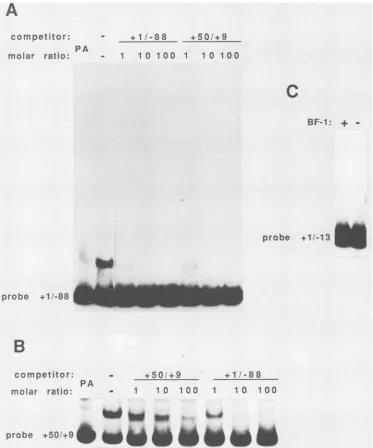
with the same molar ratio of a similarly sized unlabeled pUC fragment (Fig. 6A; data not shown). This activity was designated BF-I. The specificity of BF-I binding for the proximalpromoter wasconfirmed by competitionwith a
10-to20-fold molarexcess ofa fragmentcontaining -99/-181
or a 10- to 20-fold molar excess ofa fragment containing -181/-300 from the distal promoter (Fig. 6A). At the concentrations tested, neither of these elements affected formation of the complex. Competitor (+50/+9 and -99/ -181)-to-probe (+50/-59) molar ratios of 1, 10, and 100 were used to further demonstrate the specificity of the interaction(Fig. 6B). Thefragmentcontainingthe 3'portion ofthe L65proximal promotercompetedefficiently for bind-ingatlowmolarratios,while the competitorfrom the distal promotercompeted forbindingonlyabove a molarratio of 100. BF-I activity appears to be resistant to mild heating, becauseincubationat65°C for10 mindidnotaffectcomplex formation, whereasincubation oftheextracts at90°Cfor 10 min eliminated complex formation. In addition, the BF-I complex was sensitive to either 0.01% sodium dodecyl sulfateorproteinaseKinthereactions(datanotshown). As
a nonspecific competitor, double-stranded polyribonucle-otide
poly(I)-poly(C)
was used.Poly(dI)-poly(dC)
or poly(dA)-poly(dT) generally producedlessdistinctretarded bands.By using promoter
fragments
derived from the pPD13L:CAT and pPD13:CAT deletionfamilies,thebinding sitescouldbepositionedonthe promoterfragmenteitherby
testing for the ability of a
given
deletion to compete for complexformation(Fig. 6)orbytestingforbinding of BF-Itoeachdeletionmutant(Fig. 7).
Competition
withfragments
from either5' or3'regions relativetotheproximalstartsite demonstrated the existence of two separable binding sites (Fig. 5and6).Afragment containing sequencesbetween+1 and -88
(11-88)
competed equally
as wellforbinding
as a fragment containing sequences between +50 and +9 (+50/ +9), although neitherfragmenthad thecompetition
activity
of the entire +50 to -59 (+50/-59) fragment
(Fig. 6A).
Fragmentscontaining sequences between +1 and -13
(+1/
-13) did not compete for binding. These results were
confirmed by
using
thesefragments
as labeledprobes (Fig.
7A,B, andC,lanes1and2).Fragments
containing
eitherthe +1/-88 or +50/+9 region formedcomplexes
similar to-59/+50(Fig. 7A andB,lanes1and
2),
whereasafragment
with the +1/-13regiondidnot(Fig. 7C,lane1and
2).
Allofon November 10, 2019 by guest
http://jvi.asm.org/
[image:6.612.57.546.77.240.2]A
competitor:
o
5°/
1 2 3
+ 1 / -88
4 5
-18181/ -300
6 7
-99 -1 8 1
8 9 1 0 1 1 1 2 1 3 1 4
,J! ..I
B
lo
F&u-competitor:
molar ratio:
0
PA
+501/+9
0 1 10 100
-1 81 /-300
1 10 100
lE.
1 2 3 4 5 6 7 8
4
.4 F
[image:7.612.126.507.78.528.2]FIG. 6. Gel retentionassaysestablishing the specificity of BF-I bindingto the L65 proximalpromoterregion. All reactions contained radioactively labeled +50/-59 probe incubated with BF-I-containing fractions from the salmon sperm DNAcolumnunder the conditions described inMaterials and Methods. (A) Lane 1 containsnocompetitor; lanes 2 through 13 areidenticalexceptthat unlabeled competitor DNA isincluded in the reaction. Lanes: 2 and 3, +50/-59 (proximalpromoter) 10-and 20-fold molarexcess,respectively; 4 and 5, +1/-88 (5' portion ofproximal promoter) 10- and 20-fold molarexcess, respectively; 6 and 7, -99/-181 (region upstreamfrom distal promoter [element II]) 10- and 20-fold molar excess, respectively; 8 and 9, -99/-181 (distal promoter [element I]) 10- and 20-fold molar excess,
respectively; 10 and 11, +50/+9(3' portion of proximalpromoter) 10-and 20-fold molarexcess,respectively; 12 and 13, +1/-13 (proximal
start site only) 10- and 20-fold molarexcess, respectively; 14, probe without protein. (B) Lanes (from left toright): 1, noprotein; 2, no
competitor; 3through 5, 1-, 10-, and 100-fold molarexcessesof the +50/+9 competitor, respectively;6through 8,1-, 10-, and100-fold molar
excessesof the -181/-300 competitor, respectively.
the fragments in the binding and competition studies
con-tained 88 bp offlanking sequences of the pUC vectorfrom whichtheywerederived;however, these flankingsequences
were not involved in the binding, because the fragment
+1/-13,whichcontainsthesesamepUCsequences,didnot
form a complex itself or competitively inhibit +50/-59 complex formation.
Becausethe datasuggestthepresenceoftwoBF-I-binding
sites within the L65 proximal promoter and because
frac-tions containing BF-I were not highly purified, it was of
interest to determine whether one binding site could com-peteeffectivelyforBF-Ibindingtotheother site. The results
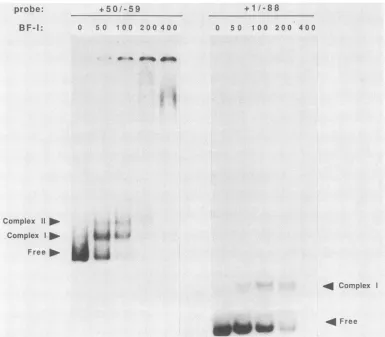
of this so-called cross-competitionexperimentare shownin Fig.7A and B. Inbothcases, eachbinding sitewascapable of competing for BF-I bound to the other site, which suggeststhat the samefactor interacted witheachfragment. Increasing theamount ofBF-I protein in a reaction with the +50/-59 probe generated what appearedto be a multi-meric form of theprobe-BF-I complex (Fig. 8A). This result
would be expected ifthe +50/-59 fragment contained two +50 "r 1 1i
+50/9 1
3PA
+9 -13
m".
4B
5S F
on November 10, 2019 by guest
http://jvi.asm.org/
A
competitor:
PA
molar ratio:
- +1 /-88 +501+9
- 1 1 0 100 1 1 0 100
C
BF-1: +
-probe +11-13
to
probe +11/-88
B
competitor: molar ratio: PA
- +50/+9
- 1 1 0 100
+1 /-88 1 1 0 1 00
WSW
0
glA-probe
+501+9* e S S U eSFIG. 7. Specific binding ofBF-Ito twosites near the L65 promoter andcross-competition between them.(A)Standardbinding reaction including probe +1/-88. Lanes(from lefttoright):1and2, no BF-Iprotein and no competitor,respectively;3through 5,resultsof binding reactions which contained 1-, 10-, and 100-fold molar excesses of +1/-88 unlabeled competitor fragment, respectively; 6 through 8, competition with 1-, 10-,and 100-fold molarexcessesof the unlabeled +50/+9fragment, respectively.(B)Binding reactionswhich contain labeledprobe+50/+9. Lanes (from left toright):1 and 2, controls without andwith BF-I protein, respectively; 3 through 6, binding reactions which contain 1-, 10-and100-fold molar excesses of the +50/+9 fragment, respectively; 7 to 9, binding reactions which contain 1-, 10-, and 100-foldmolar excessesof+1/-88 unlabeled competitor fragment,respectively. (C) Bindingreactionwith probe +1/-13. Lane 1 and2 are without and withBF-Iprotein,respectively.
binding sites which were both bound by BF-I at a high protein-to-probe ratio. Competition experiments showed that both complexes were subject to competition by
frag-ments from the proximal promoterregion. However,
com-plex II was affected at alower concentration ofcompetitor compared with complex I, which is consistent with this model (Fig. 6A; data not shown). It follows thatafragment containing only a single binding site (+1/-88) should only generatea single
bouind
complex, as shown in Fig. 8B.DISCUSSION
To investigate cis-acting signals affecting this promoter, Si nuclease analysis of RNA generated from
transiently
expressed promoter-CATplasmidswas usedtomonitorthe effectsofvarious promoter deletion mutationson
transcrip-tion efficiency. The pPD13:CAT plasmid initially used in these studies showed undetectable levels of transcription from the proximal site. In contrast, high levels ofgenomic L65-specific RNA from the proximal site were generated
on November 10, 2019 by guest
http://jvi.asm.org/
[image:8.574.94.467.65.513.2]+50I/-59
0 5 0 100 200 400
+1 /-88
0 50 100 200 400
do .4 .s"% *0
Complex 11 > Complex I >
Free o
4 Complex
*Wr._
4 Free
FIG. 8. Effect ofincreasing proteinconcentrationonretardedspecies.BF-Iwasaddedtobindingreactions in concentrations of0, 50, 100, 200,and 400ngwithboth +50/-59and +1/-88probesasindicated abovethe lanes.ComplexIcorrespondstothe usualBF-Icomplex,and
complexIIis theadditional speciesformedathighproteinconcentrations, with theprobe containingtwobindingsites. In the400-ng lane, the+1/-88 probe wasretainedatthe originofthe gel (not shown),similartothatseenin the400-nglane withprobe +50/-59.
during infection. To analyze sequences required for
tran-scriptionfrom the proximal site, additional VV sequences, both 5' and3' tothose alreadypresentinpPD13:CAT,were
included in another plasmid (pPD13L:CAT). Si nuclease
analysis of RNA from this plasmid showed that the
addi-tional sequences activated the proximal site without
af-fectingthe distalsite. Deletion of the additional 5'sequences -440to-128 hadnoeffectonthe level oftranscriptionfrom theproximal site, strongly suggestingthat the additional50
bp of 3' sequencecontained additionalinformationrequired
for transcription from the proximal site. These sequences contain partofaTAAAT motif found attheproximal start
site, and it is possible that restoration of this signal was necessary for the transcriptional activity of the proximal promoter.
To dissect functional regions within the proximal pro-moter, deletions that removed the distal start site and the
regionuptoand including the proximalstartsiteweremade in pPD13L:CAT. These plasmids were used in transient expression assays, and the level of CATenzyme produced from each construct was measured. Cotransfection of a controlplasmidinthese experiments allowed quantitative Si
nucleaseanalysis of the RNAgenerated by these plasmids.
Results obtained from the Si nuclease analysis and CAT
assays generally agreed, although the CATassays presum-ably measured expression from both sites, whereas the Si nucleaseanalysis differentiated between thetwo.Deletion of
theregionfrom -440to -128 has beenpreviouslyshown to cause a twofold decrease in CAT gene expression from
pPD13:CAT. Wewereunabletofullyconfirm this resultby usingthelonger pPD13L:CATconstruct. In thiscase, CAT activitywasnotaffectedsignificantly whenthesesequences were deleted, and Si nuclease analysis showed only a moderate 1.4-fold decrease intranscription from the
proxi-mal start site. The distal start site was also relatively unaffected by this deletion. Removal of the next 16 bp to
-112 effectively eliminated the signal from the distal start
site, causinga60-fold reduction in itsintensity.Theseresults confirm and refine previousworkshowingthepresenceofa distalpromoterregulatoryelementbetween -128 and -106.
Taken together, these deletions map the 5' end ofa distal promoter regulatory element to a 12-bp segment between -128 and -112, the presence of which caused a 60-fold increase in the level oftranscriptionfromasite located 30bp
downstream. The startsiteaffectedbythiselementmapsto aTAAAG at -92 by Si nucleaseanalysis of both genomic
RNA (27) and RNA from transient expression of pPD13:CAT and pPD13L:CAT (Fig. 4). The TAAAG start site isdownstream fromaTAAAT motif(at -113to -117)
which has been showntobeimportant fortheexpressionof several other late genes (2, 10, 19). In these previously
characterized promoters, theTAAATsignalis locatedator within a few base pairs of the apparent start site. In the context of the L65 distal promoter, the TAAATmotifmay
probe:
BF-1:
-.-, L....,-.A i, ..
wmw L,-,4
MPMW
on November 10, 2019 by guest
http://jvi.asm.org/
[image:9.612.121.506.77.414.2]befunctioning in another role since it lies within an element shown to be crucial to a transcription start site 30 bp downstream. It is also possible that in this context that TAAAT motif is nonessential and that other signals within this short segment constitute the distal promoter.
The sequences responsible for the transcriptional activity of the proximal promoter are located further downstream from the distal promoter, between -59 and -9. Sequences
between -59 and -35 were responsible for a 2.5-fold effect on transcription from the proximal start site. When the remaining sequences between -35 and -9 were deleted, an
additional 20-fold decrease in activity occurred, essentially eliminating the signal and thus mapping the 5' end of the element to this region. Sequence similarity searches of this segment have revealed none of the previously characterized VV regulatory elements.
In addition to theS1 nuclease signals generated by the two start sites and the internal control, a signal was present in each lane in Fig. 4 and in lane 3 in Fig. 2B, which corre-sponds to readthrough transcripts from each of the deleted plasmids. The 680-bp probe was complementary to the deletions up to the deletion endpoint; any RNA generated which read through the junction was detected as a higher-molecular-weight species which migrated according to the extent of the deletion. The presence of readthrough tran-scripts is explained by the fact that trantran-scripts from the L65 promoter do not terminate but read around the circular
plasmid and back into thepromoterregion.The S1
nuclease-mapped RNA is in fact bona fide mature VV lateRNA, since both the distal and proximal start site-derived transcripts
contained a 5' poly(A) leader sequence (J. Miner, unpub-lished results).
The tr-ans-activation of these promoters during transient expression inVV-infectedcells implies that diffusible factors are involved in recognition of and transcription from these
sequences. A factor (BF-I) that specifically binds to the proximal promoter regionshown tobeinvolved inregulation
of the proximal site has been detected in infected-cell extracts at late times postinfection. This activity was not
detectable in uninfected cells, virion extracts, or infected
cells at early timespostinfection (datanotshown). A specific
complex was formed in gel retention assays which was subject tocompetition only with fragments containing parts
of the proximal promoter. Fragments containing the distal
promoter (-181/-300) did not compete for complex forma-tion, nor did fragments containing 120 bp of sequence upstream fromthe distal promoter(-99/-181) or fragments
from pUC19(Fig. 6A andB).Thissuggests that BF-I binding
is specific for the proximal promoterregion. BF-I is sensitive
toproteinase Kdigestion, heat, and sodiumdodecyl sulfate,
which strongly suggests that BF-I is aprotein.
Using appropriate fragments from the deletion constructs
described above, we have mapped what appear to be two BF-I-binding sites between -13 and -59 and between +50
and +9 on the proximal promoter. Nonoverlapping
frag-ments from the proximal promoter (+50/+9 and +1/-88)
formed specific complexes with BF-I, while fragments
cor-responding tootherregionsdid not (Fig. 7A to C). That both sites can be filled at once in vitro was implied by results
shown in Fig. 8. When a probe with two putative binding
sites (+50/-59) was used, another more slowly migrating
complex was generated at high BF-I-to-probe ratios. Filling
of these two sites does not appear to be highly cooperative. These two sites presumably bind identical BF-I molecules; this presumption is based on the fact that cross-competition experiments show thatfragments containing onebindingsite
cancompeteforbindingof BF-I tothe other and viceversa
(Fig. 7A and B). It should be noted,however, that in several
experiments, the +50/+9 fragment competed forBF-I
bind-ing less well than did the +1/-88 fragment, implying a
qualitative difference in BF-I affinity forthe two sites (Fig.
6B and 7A and B). Sequences 3' to the proximal start site bound toBF-I, butit is not yet clear whichportion ofthe 3'
element is responsible for activating the proximal promoter
inpPD13L:CAT. TheTAAAT motif that is locatedbetween
+2 and -3 is likely to be important for proximal promoter function, which leaves open the importance of the 3'
BF-I-binding site, especially in light of its reduced affinity for this site. The same proximal DNA sequences which are responsible fortranscriptional activationof theproximal site also bound avidly to BF-I. The association of BF-I with
transcriptionally important DNA sequences has several
in-terestingimplications. First, it ispossible thatBF-Ifunctions
to modify the structure ofthe DNA whichlies between the
twoproteins, allowingan entry pointfor VV RNA
polymer-ase. Second, it is possible that BF-I interacts directly with
VV RNA polymerase toprovide a surface thatpositions the polymeraseat the start site. Thefact that BF-I binds only to the proximal promoterandnottothe distal promoter may in part explain thedifferential regulation ofthesetwo start sites (27).
In addition, we have preliminary data indicating that this
factor also binds to the VV thymidine kinase (TK) early
promoter (L. Wilson and J. Miner, unpublished results). It may be relevant that TK RNA synthesis is negatively
regulated at 2 to 3 h postinfection, which is the same time that transcription from the L65 promoter is beginning (11).
The sequence AATTA(T/A)A is conserved between the 5' and 3' portions of the L65 proximal promoterand isfound in the invertedorientation at -43 within the TK promoter. The assessment of the importance of this sequence will await DNase Ifootprinting of BF-I on the L65 and TK promoters and demonstration that BF-I occupancy ofthese sites cor-relates with transcriptional activation in vitro and in vivo. Thusfar,footprinting ofDNA-binding proteins on VV DNA
has proved to beproblematic. This may be in part duetothe
extreme A/T richness of the VV promoter regions or the relatively lowaffinity of thebinding factors or both. Ineither
case it is likely that it will be necessary to purify large
quantities ofbiologicallyactive BF-I before such studies can be undertaken. Perhaps of more immediate importance will be to make use of recently described VV cell-free transcrip-tion systems (18, 23) which are responsive to exogenously
added VV late genes to determine whether BF-I has a positive or negative effect on transcription from the L65 proximal promoter element.
ACKNOWLEDGMENTS
WethankL. Wilson and S.Strain for theirassistance with several
of these experiments. We also thank S. Weinrich, L. Wilson, J.
Carrington, W. Dougherty, and the Hruby laboratory for helpful discussions and encouragement.
These studies were supported by Public Health Service grant Al-20563 and Research Career Development Award AI-0666 to D.E.H. from the National Institutes of Health. J.N.M. was
sup-ported by Public Health Service Molecular and Cellular Biology Training Grant GM07774-07 fromthe National Institutes of Health.
LITERATURE CITED
1. Baldick, C.,and B. Moss. 1987. Resistance of vaccinia virus to
rifampicin conferred byasinglenucleotide substitution nearthe
predicted NH, terminus of agene encoding a M,.62,000 poly-peptide. Virology 156:138-147.
on November 10, 2019 by guest
http://jvi.asm.org/
2. Bertholet, C., P. Stocco, E. Van Meir, and R. Wittek. 1986. Functional analysis of the 5' flanking sequence of a vaccinia virus late gene. EMBO J. 5:1951-1957.
3. Bertholet, C., E. Van Meir, B. ten Heggeler-Bordier, and R. Wittek. 1987. Vaccinia virus produces latemRNAsby discon-tinuous synthesis. Cell 50:153-162.
4. Briggs, M. R., J. T.Kadonaga, S. P. Bell, and R. Tjian. 1986. Purificationandbiochemical characterization ofthe promoter-specific transcription factor,Spl. Science235:47-52.
5. Broyles, S., and B. Moss. 1988. DNA-dependentATPase activ-ity associated with vaccinia virus early transcription factor. J. Biol.Chem. 263:10761-10766.
6. Broyles, S., L. Yuen, S. Shuman, and B. Moss. 1988. Purification of a factor required for transcription of vaccinia virus early genes. J. Biol.Chem.263:10754-10760.
7. Cochran, M. A., M. Mackett, and B. Moss. 1985. Eucaryotic transient expression system dependent ontranscriptionfactors and regulatory DNA sequences of vacciniavirus. Proc. Natl. Acad.Sci. USA82:19-23.
8. Fried, M., and D. M. Crothers. 1981.Equilibriumand kinetics of lac repressor-operator interactionsbypolyacrylamidegel elec-trophoresis. NucleicAcidsRes. 9:6505-6525.
9. Graham,F., and A. J. Van Der Eb. 1973. A newtechniquefor theassayofinfectivity ofhumanadenovirus 5 DNA.Virology 52:456-467.
10. Hanggi, M., M. Bannwarth, and H. G. Stunnenberg. 1986. Conserved TAAAT motif in vaccinia virus late promoters: overlapping TATA box and site of transcription initiation. EMBOJ.5:1071-1076.
11. Hruby, D. E., and A. Ball. 1981. Control of expression of the vacciniavirusthymidine kinase gene. J. Virol. 40:456-464. 12. Hruby, D. E., L. A. Guarino, and J. R. Kates. 1979. Vaccinia
virus replication. I. Requirement for the host-cell nucleus. J. Virol. 29:705-715.
13. Kadonaga, J. T., and R. Tjian. 1986. Affinity purification of sequence-specificDNAbinding proteins.Proc. Natl.Acad.Sci. USA83:5889-5893.
14. Maniatis, T., E. Fritsch, and J. Sambrook. 1982. Molecular cloning: a laboratory manual, p. 90-93. Cold Spring Harbor Laboratory, Cold SpringHarbor, N.Y.
15. Miner, J. N., S. L. Weinrich, and D. E. Hruby. 1988. Molecular dissection of cis-acting regulatory elements from 5'-proximal regions of a vaccinia virus late gene cluster. J. Virol. 62: 297-304.
16. Moss, B. 1985. Replication of poxviruses, p. 685-803. In B. N. Fields,D. M.Knipe, and R. M.Chanock(ed.), Virology. Raven Press, N.Y.
17. Patel, D., and D. Pickup. 1987. Messenger RNA's of a strongly-expressedlate gene of cowpoxvirus contain 5' terminal poly(A) sequences. EMBO J.6:3787-3794.
18. Puckett, C., and B. Moss. 1983. Selective transcription of vacciniavirus genes intemplate dependent soluble extractsof infected cells. Cell35:441-448.
19. Rosel, J. L., P. L. Earl, J. P. Weir, and B. Moss. 1986. ConservedTAAATG sequenceatthetranscriptionaland trans-lationalinitiationsites of vaccinia virus late genesdeducedby
structural and functional analysis of the HindIII H genome
fragment. J. Virol. 60:436-449.
20. Rosenfeld, P.J., and T.J. Kelly. 1986. Purificationof nuclear factor I by DNA recognition site affinity chromatography. J. BiolChem. 261:1398-1408.
21. Samuels, M., A. Fire, and P. A. Sharp. 1982. Separation and characterizationoffactors mediatingaccurate transcription by
RNApolymerase II.J. Biol. Chem.257:14419-14427. 22. Sanger, F.,S.Nicklen,and A. R.Coulson. 1977. DNA
sequenc-ing with chain terminating inhibitors. Proc. Natl. Acad. Sci. USA 74:5463-5467.
23. Schwer, B., J. Visca, C. Vos, and H. G. Stunnenberg. 1987. Discontinuous transcription or RNA processing of vaccinia virus late messengers results in a 5' poly(A) leader. Cell 50:163-169.
24. Tartaglia, J., A. Piccini, and E. Paoletti. 1986. Vaccinia virus rifampicin-resistance locus specifies a late 63,000 Da gene product. Virology 105:45-54.
25. Villarreal, E. C., N. A. Roseman, and D. E. Hruby. 1984. Isolation of vaccinia virus mutants capable of replicating inde-pendentlyofthe host cell nucleus. J. Virol. 51:359-366. 26. Weinrich, S. L., and D. E. Hruby. 1986. A tandemly-oriented
late gene cluster within the vaccinia virus genome. Nucleic AcidsRes. 14:3003-3015.
27. Weinrich,S.L.,andD. E.Hruby. 1987. Noncoordinate regula-tion ofavaccinia virus late gene cluster. J. Virol.61:639-645. 28. Weinrich,S.L.,E.Niles,andD. E.Hruby.1985.Transcriptional
and translationalanalysis of the vaccinia virus late gene L65. J. Virol.55:450-457.
29. Weir, J. P., and B. Moss. 1984. Regulation of expression and nucleotide sequence of a late vaccinia virus gene. J. Virol. 51:662-669.
30. Weir,J. P., and B. Moss. 1987.Determination of the transcrip-tional regulatory region of a vaccinia virus late gene. J. Virol. 61:75-80.
31. Wilson, E. M., C. Edbauer, and D. Hruby. 1988. Characteriza-tion of a binding factor that interacts with the sequences upstream ofthe vaccinia virus thymidine kinase gene. Virus Genes 2:31-48.
32. Wittek, R. 1982. Organization and expression of thepoxvirus genome. Experientia38:285-410.
33. YuenL.,A.Davison, and B. Moss. 1987. Early promoterbinding factor from vaccinia virions. Proc. Natl. Acad. Sci. USA 84:6069-6073.