Implementation of a Flexible and Modular
Multiphase Framework for the Analysis of
Surface-Tension-Driven Flows Based on a
LS-VOF Approach
Paolo Capobianchi, Marcello Lappa, Mónica S. N. Oliveira
James Weir Fluids Laboratory, Department of Mechanical and Aerospace Engineering, University of Strathclyde, Glasgow G1 1XJ, UK
Abstract: The mathematical modelling and numerical simulation of multi-phase flows are both a demanding and highly complex exercise. In typical problems with industrial relevance, the fluids are often in non-isothermal conditions and interfa-cial phenomena are a relevant part of the problem. A number of effects due to the presence of temperature differences must be adequately taken into account to make the results of numerical simulations consistent and realistic. Moreover, in general, gradients of surface tension at the interface separating two liquids are a source of numerical issues that can delay (and even prevent completely in some circumstances) the convergence of the solution algorithm. Here, we propose a fundamental and concerted approach for the simulation of the typical dynamics re-sulting from the presence of a dispersed phase in an external matrix in non-isothermal conditions based on the modular computer-aided design, modelling, and simulations capabilities of the OpenFOAM environment. The resulting framework is tested against the migration of a droplet induced by thermocapillary effects in the absence of gravity. The simulations are fully three-dimensional and based on an adaptive mesh refinement (AMR) strategy. We describe in detail the countermeasures taken to circumvent the problematic issues associated with the simulation of this kind of flows.
1 Introduction
The motion of gas bubbles and liquid droplets in fluid media is a widespread phenomenon in nature and a subject of great relevance to many engineering and materials processing applications.
Nguyen et al (2006), Brunet et al. (2010)). Even in the absence of body forces, a similar phenomenon can be induced by another fundamental mechanism, the so-called thermalMarangoni (or thermocapillary) effect. This process, which occurs every time a gradient of temperature or concentration is present at the interface separating two fluid phases, becomes particularly important in all those situations where body forces (such as gravity) do not play a major role, e.g. in the micro-gravity environment provided by orbiting platforms, or when either the densities of the fluid pair are similar and/or the typical size of the dispersed phase is very small (e.g. atomised droplets).
The first pioneering study on the thermocapillary migration of droplets was conducted in the late 50’s by Young et al. (1959), who, under some limiting as-sumptions (perfectly spherical drop of radius R moving in an indefinite liquid un-der Stokes flow conditions) un-derived a landmark solution (in analytical form) of the governing equations. With such approach, velocity and temperature fields were considered to be fully established at every moment of time, while neglecting the inertia and convective effects. Under this approximation the temperature field can be inferred independently of the flow field and this greatly simplifies the deriva-tion of an analytical soluderiva-tion to the problem, yielding a precise reladeriva-tionship be-tween the asymptotic (steady) droplet migration velocity and the properties of the considered fluids and characteristics of the driving force.
Over subsequent years, especially because of the advent of space programs and the possibility to execute experiments in the field of fluids and materials in space (sounding rockets, Space Shuttle and most recently the International Space Sta-tion, see, e.g., Lappa, 2004), the subject gained an increasing popularity, with this kind of research extending to multidisciplinary fields.
Balasubramanian and Subramanian (2000) extended the analytical study of Young et al. (1959) to the case in which the Reynolds number tends to infinity. They analysed the steady migration of a spherical drop in a continuous phase when subjected to a temperature gradient under conditions such that inertial terms in the momentum equation and convective-transport terms in the energy equation dominate over the corresponding molecular-transport terms (i.e. Ma and Re for which they were able to derive analytical solutions partially based on the earlier mathematical model of Harper and Moore (1968)). The migration ve-locity of the drop was obtained by these authors in the framework of a potential-flow theory by equating the rate at which work is done by the thermocapillary stress to the rate of viscous dissipation of energy; the method of matched asymp-totic expansions was employed to solve the conjugate heat-transfer problem in the two phases (characterised by the presence of thin thermal boundary layers both outside and within the drop). In physical terms, they found that in the limit of Ma, the velocity of a drop is proportional to the square of the temperature gra-dient and the cube of the radius of the drop, whereas in the opposite limit (Ma0), both dependences are linear.
recently, attempts have been made to approach the problem directly in the frame-work of moving boundary methods such as Volume of Fluid (VOF) or Level Set (LS) techniques, by which the typical simplifications of past analytical approaches can be removed and the typical difficulties (and cost) of microgravity-based ex-perimentation avoided.
Despite valuable numerical advances over the years (Haj-Hariri et al., 1997; Tryggvason et al., 2001; Lappa, 2005a; Yin et al., 2012, Ma et al., 1999; Zhao et al., 2011; Brady et al., 2010), the numerical simulation of droplet migrating under the influence of surface-tension gradients at finite values of the Reynolds and Ma-rangoni numbers can still be regarded as an “open task”. In the present chapter, we lay the general foundation of a possible theoretical and mathematical treatment of the subject based on the modular capabilities of the OpenFOAM environment. Starting from an already existing algorithm (Yamamoto et al., 2016) we undertake all the necessary steps to expand the range of treatable physical effects as neces-sary. Furthermore, the code is validated against the analytical solution of Young et al. (1959) and used to study the impact of the geometrical configuration on the drop migration pattern.
2 Mathematical Formulation
The ingredients of our overall conceptual architecture are provided and dis-cussed with a step-by-step approach with the declared intention to define the in-volved sub-models as simply as possible and build and grow the framework “or-ganically” by progressive integration of components and parts. The class of such sub-parts or sub-models (well known or partially of a prototypical nature as we will see later in this chapter) is highly diverse including typical moving boundary methods and energy transport models in synergy with non-dimensional and as-ymptotic analyses.
2.1 Governing Equations
system might be considered as if composed by one single fluid with variable mate-rial properties (undergoing discontinuities across the fluid-fluid boundaries). In terms of momentum, the presence of the interfacial stresses is accounted by add-ing “extra” forces to the transport equation.
More precisely, if we assume that the effect of the gravity and any other exter-nal body force is negligible, the conservation of momentum can be written as:
p
t
T
u
u u u u f ( 1 )
where trepresents time,, are the fluid density and viscosity, respectively, p is the pressure and u the velocity vector. The last termfis a force accounting for the capillary (f,n) and thermocapillary (f,τ) forces at the interface:
, , T k0 S T S
n τ
f f f n ( 2 )
Here, kand nare the curvature and normal unit vector at the interface, respective-ly, I is the identity tensor and the operator (I nn)accounts for the pro-jection of the surface tension gradient along the direction tangent to the interface. The termS represents a function which can be shown to be coincident with the canonical Dirac -function (Lappa, 2005b). Since the interfacial tension depends on the temperature T, we have explicitly included the related dependence in Eq. 2. Closure of the mathematical model requires consideration of the conserva-tion of mass for incompressible flows (Eq. 3) and the temperature transport equa-tion (Eq. 4)
0
u ( 3 )
p T
c T T
t
u ( 4 )
wherecpis the specific heat and the thermal conductivity coefficient of the flu-id. Following common practice for this kind of problems (see, e.g., Yin, 2012), all material properties are assumed to be constant in each phase and are evaluated at a suitable reference temperature. The dependence on temperature, however, is re-tained for the surface tension via a linear relationship:
T 0 T
T T0
where T
T Tis negative for most known fluids (Balasubramanian and Subramanian, 2001) and T0is the reference temperature.2.2 The Simplified LS-VOF Method
Our solver relies on a simplified coupled LS-VOF code (based on the hybrid formulation originally developed by Albadawi et al. (2013), see also Sussman and Puckett (2000)) implemented into the framework of OpenFOAM (Yamamoto et al., 2016) as an extension of the standard VOF solver “interFoam”. The simplified coupled LS-VOF for an isothermal system is based on the solution of the Eqs. 6-10. The equation for the volume fraction reads:
1
c
0t
u u ( 6 )
whereis the volume fraction and ucis an artificial “compressive velocity” (Berberović et al., 2009). Although, there was a consistent improvement in terms of accuracy and reduction of the so-called “parasite” currents with respect to the original two-phase solver, we had to take additional countermeasures to fix typical “algorithm stability” issues at the interface (where Marangoni stresses of thermal nature are produced). This was accomplished by “proper” smoothing both the lev-el set and volume of fluid phase functions, as further described in Sect. 2.3.
The resulting time-marching procedure can be outlined as follows: in order to calculate the level set function , first we calculate the field 0
2 1
where0.75 x
and xis the grid resolution (see Albadawi at al., 2013). Subsequent-ly, a re-initialisation equation is solved (see, e.g., Sussman and Fatemi, 1999):
0
1
Sgn
( 7 )
with the initial condition
x,0 0
x and where Sgn
0 0 0 . Once the scalar field
is known at each point, it is possible to evaluate the curvature at the interface
withn
|| being the unit vector perpendicular to the interface. Final-ly, the term described by Eq. 2 is evaluated leading to the momentum equation cast in compact form as
T
| |u u u u u
T
p k T
t
( 9 )
where
0 if 1 1 cos if 2
( 10 )
and 2 3 x.
The reader is referred to Lappa (2005b) for additional information about the mathematical manipulations required to turn the surface force seen in Eqs. 1-2 into a corresponding volume force spread over a region of finite thickness, which no longer relies on the use of the Dirac function. Additional details on the dependences on and present in Eq. 9 are provided in Sect. 2.3.
2.3 Implementation of the thermal Marangoni migration method
in OpenFOAM
We used properly mollified variables to increase algorithm stability and avoid unphysical effects at the interface. More precisely, the smoothing was applied to each “relevant variable” (various variables required by the LS and VOF im-plementation in different parts of the solver, as needed) using a “pure diffusive” evolution equation n 1 n
2 n
mol mol mol
where is an artificial or fictitious
time, to be solved with the initial condition for a prefixed number of cycles n (the condition n0corresponding to the recovery of the original non-smoothed func-tion). is defined according to the following well-known numerical stability cri-terion (see e.g. Fletcher (1991))
2
2 2 2
0.5
1/ x 1/ y 1/ z
( 11 )
mol
mol mol
mol
k
n ( 12 )
wheremol is the smoothed version of
.As discussed in Sect. 2.1, accounting for surface-tension effects requires two additional source terms in the momentum equation (see Eq. 2). In the framework of an optimisation strategy based on a trial-and-error approach, we could obtain the best results using the mollified level set function to determine the unit vector perpendicular to the interface (and the corresponding tangent unit vector) and re-taining a non-mollified volume fraction in the gradient appearing in the expression of the thermal contribution (see Eq. 13). The level set function was also used ac-cordingly to determine the curvature.
, T T T mol mol T
τ
f I n n ( 13 )
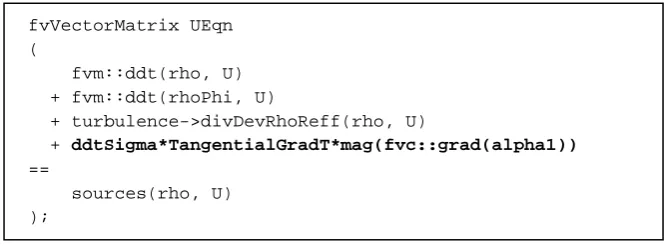
The portion of code in which we have included the thermocapillary force is shown in Fig. 1.
fvVectorMatrix UEqn (
fvm::ddt(rho, U) + fvm::ddt(rhoPhi, U)
+ turbulence->divDevRhoReff(rho, U)
+ ddtSigma*TangentialGradT*mag(fvc::grad(alpha1))
==
sources(rho, U) );
Fig. 1 Snippet of code from the UEqn.H file. The line highlighted in boldface represents the stresses due to the thermocapillary effect, where ddtSigma represents the interfacial tension co-efficient T , TangentialGradT is the projection Tof the temperature gradient
(imple-mented in the code as gradT – (gradT & nMoll)*nMoll where gradT is the tem-perature gradient and nMoll corresponds to nmol) and the last term is the magnitude of the gradient of the volume fraction ||
[image:7.595.131.466.382.505.2]
1 1 2
mol mol
( 14 )
Special care has also been devoted to the solution of the energy equation. Some mathematical manipulations were indeed necessary to increase algorithm stability and its related ability to reproduce available test cases in the literature (as dis-cussed later in this chapter). We rearranged the equation as follows: by introduc-ing the thermal diffusivityD cp and considering that all the fluid material properties can in general change across the interface, after some algebraic manipu-lations we obtained the following equivalent expression for the energy equation:
1p T
T D T T D T
t c
u ( 15 )
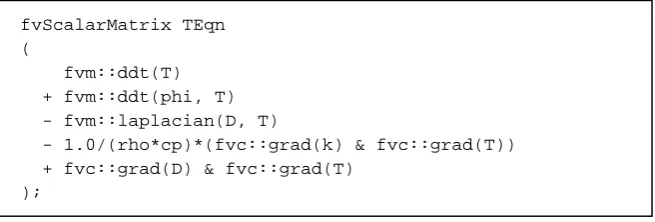
The snippet of code displayed in Fig. 2 shows the corresponding implementation.
fvScalarMatrix TEqn (
fvm::ddt(T) + fvm::ddt(phi, T) - fvm::laplacian(D, T)
- 1.0/(rho*cp)*(fvc::grad(k) & fvc::grad(T)) + fvc::grad(D) & fvc::grad(T)
[image:8.595.132.460.332.443.2]);
Fig. 2 Implementation of the temperature equation. The name of the variables have direct corre-spondence to the symbolism adopted in Eq. 15
The different macro steps in which our algorithm has been articulated can be finally sketched as follows:
1. Solve the re-initialization equation (Eq. 7);
2. The volume fraction equation is solved using MULES algorithm (which is es-sentially an explicit method, see e.g., the OpenFOAM user guide, 2008) to guarantee the boundedness of the scalar field ;
3. Solve the temperature equation;
4. Computation of the thermal Marangoni force f,τ;
5. Calculation of the velocity and pressure field using a projection method (PISO algorithm);
6. Back to step 1
d m
, cp cp d, cp m, and kkd km, the capillary number
0T
Ca T R , the Marangoni number MaT
T R
2 m mand ei-ther the Reynolds number
2 2m T m
Re T R or the Prandtl number
m m m
Pr , since MaRePr. The subscripts “m” and “d” stand for matrix and drop, respectively.
3 Solver validation
As indicated at the end of Sect. 2, our overall framework has been built via the integration of self-contained modules, which could be individually tested. Howev-er, because it is crucial that the entire numerical architecture is tested as a single integrated unit, we considered available solutions in the literature for comparison. In order to validate our code, in particular, we focused on the thermocapillary mo-tion of a perfectly spherical Newtonian droplet of radius Rin a constant tempera-ture gradient Tembedded in an unconfined Newtonian matrix in the limiting case of
Ma Re,
0 and negligible buoyancy effects. As discussed in theintro-duction, in such a case an analytical solution exists for the velocity of the droplet (Young et al., 1959) (YGB theory), which in dimensional form reads:
2
2 2 3
T m YGB d d m m T R U k k
( 16 )
re-gion of the drop is employed. For the boundary conditions, we have applied no-slip conditions for the velocity and “zeroGradient” for the pressure at each
wall of the container (a reference pressure “pRefValue = 0” has been set at
the centre of the “cold” wall). For the temperature, we set constant values at the two “cold” and “hot” sides, and adiabatic (“zeroGradient”) conditions in the
[image:10.595.167.434.234.399.2]rest of the domain.
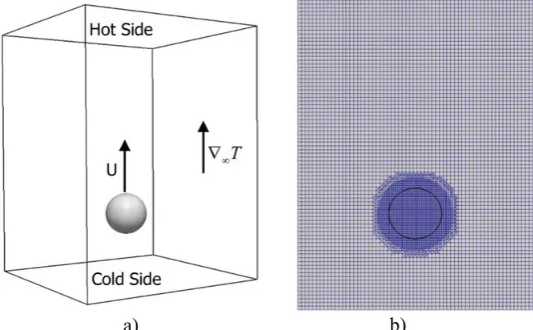
Fig. 3 a)Initial conditions used for the simulation. At the initial instant the droplet is at rest. The velocity arrow has been included to show the migration direction when a temperature gradient
T
is imposed. b) Particular of the mesh in a plane parallel to the motion of the droplet. Note the area of refinement in the region of the droplet.
All simulations were executed applying two (n2) cycles of smoothing for
the Level Set function .
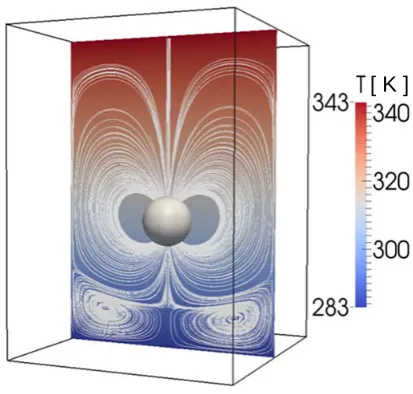
Fig. 4 shows a snapshot of the flow pattern and the temperature distribution in a plane parallel to the direction of migration in the case of C0.22. As expected, a
toroidal roll is formed by the thermocapillary effect. The intersection of such a roll with the considered visualisation plane clearly shows regions of recirculating fluid surrounding the droplet. As time increases such vortices move with the droplet.
Fig. 5 shows the dimensionless migration velocity as a function of the dimen-sionless time t' m T
T
for the same case. As evident in this figure, after a given transient, the droplet reaches a steady state where its (final) migration veloc-ity is in excellent agreement with the predictions of the YGB theory.Fig. 4 Snapshot of flow pattern and temperature field in a plane parallel to the direction of migra-tion at instant t' 10 . The droplet is moving from the bottom (cold side) toward the top (hot side).
We also studied the effect of the geometric “confinement” considering narrow-er containnarrow-ers with CR L> 0.22. We found that the migration velocity decreas-es non-trivially with the degree of confinement. More specifically, when the height of the geometry is halved (C0.44), the resulting steady state migration
velocity is about 12% smaller than the limit predicted by the YGB theory. Such results, summarised in Fig. 5, clearly indicate that some care should be taken in the choice of the geometry if wall effects are not intended to be a relevant aspect of the analysis.
[image:11.595.196.403.157.354.2]Fig. 5 Velocity history for various geometry and confinements C. The results are normalised us-ing the YGB theoretical velocity. Notice the difference between the two cases C = 0.296 (still in good agreement with the YGB theory) and the case C = 0.44.
The last test considered was the simulation of a droplet migrating into a con-vergent channel, resorting to the same set-up adopted for the previous simulations. We used a convergent duct having “cold side” cross sectional area equal to the case of C0.44, with the cross-sectional area of the “hot side” being half of the
cold one.
[image:12.595.132.464.117.367.2]Conclusions and Future Directions
In this work, we addressed the question of how a typical numerical framework for isothermal multi-phase flows can be adequately extended to make it suitable for the simulation of phenomena in which surface-tension gradients act as the main flow or pattern driver. In particular, starting from existing implementations in OpenFOAM of moving-boundary methods, some effort has been put into strengthening the used approach by incorporating in the algorithm the possibility to account for thermal effects of different nature. Special care has been devoted to numerical stability issues that are typical of such problems (in which the phenom-ena occurring in a limited neighbourhood of the interface separating the two liq-uids play a “crucial role”).
The framework has been successfully tested under restricted conditions, but future work shall be devoted to the application and testing of the resulting approach to more complex problems in which inertial terms in the momentum equation and convective-transport terms in the energy equation dominate over the correspond-ing molecular-transport terms.
References
Albadawi A., Donoghue D. B., Robinson A. J., Murray D. B., Delauré Y. M. C. (2013), Influ-ence of surface tension implementation in volume of fluid and coupled Volume of Fluid with Level Set methods for bubble growth and detachment, International Journal of Multiphase Flow, 53, 11-28.
Balasubramaniam R. and Subramanian R. S, (2000), The migration of a drop in a uniform tem-perature gradient at large Marangoni numbers, Physics of Fluids, 12(4): 733-743.
Balasubramaniam R. and Subramanian R. S, (2001), The motion of bubbles an drops in reduced gravity, Cambridge University Press.
Balasubramaniam R., Lacy C.E., Wozniak G., Subramanian R.S., (1996), Thermocapillary mi-gration of bubbles and drops at moderate values of the Marangoni number in reduced gravity, Physics of Fluids, 8(4): 872-880.
Berberović, van Hinsberg N. P., Jarkirlić S., Roisman L. V., Tropea C., (2009), Drop impact on-to a liquid layer of finite thickness: Dynamics of the cavity evolution, Phyical. Review E, 79, 036306.
Brackbill J.U., Kothe D.B., Zemach C., (1992), A Continuum Method for Modeling Surface Tension, Journal of Computational Physics, 100 (2): 335-354.
Brady P. T., Hermann M., Lopez J. M., (2011), Confined thermocapillary motion of a three-dimensional deformable drop, Physics of Fluids, 23, 022101.
Brunet P., Baudoin M., Bou Matar O., Zoueshtiagh F., (2010), Droplet displacement an doscilla-tion induced by ultrasonic surface acoustic waves: A quantitative study, Physical Review E 81, 036315.
Fletcher C. A. J., Compuational techniques for fluid-dynamics, (Springer Verlag, Berlin, 1991). Hadland P.H., Balasubramaniam R., Wozniak G., Subramanian R.S., (1999), Thermocapillary
Haj-Hariri H., Shi Q., Borhan A., (1997), Thermocapillary motion of deformable drops at finite Reynolds and Marangoni numbers, Physics of Fluids 9 (4):845-855.
Harper J.F. and Moore D.W., (1968), The motion of a spherical liquid drop at high Reynolds number, Journal of Fluid Mechanics, 32(2): 367–391.
Lappa M. (2004), Fluids, Materials and Microgravity: Numerical Techniques and Insights into the Physics, 538 pages, Elsevier Science (2004, Oxford, England)
Lappa M., (2005a) Assessment of VOF Strategies for the analysis of Marangoni Migration, Col-lisional Coagulation of Droplets and Thermal wake effects in Metal Alloys under Microgravi-ty conditions, Computers, Materials & Continua, 2(1), 51-64.
Lappa M., (2005b), Coalescence and non-coalescence phenomena in multi-material problems and dispersed multiphase flows: Part 2, a critical review of CFD approaches, Fluid Dynamics & Materials Processing, 1(3): 213-234.
Ma X., Balasubramanian R., Subramanian R. S., (1999), Numerical simulation of thermocapil-lary drop motion with internal circulation, Numerical Heat Transfer, 35, 291-309.
Nguyen N., Ng K. M., Huang X., (2006), Manipulation of ferrofluid droplet using planar coils, Applied Physics Letters 89, 052509.
OpenFOAM User Guide, 2008.
Sussman, M. and Fatemi, E. (1999): An efficient,interface-Preserving Level Set Redistancing Algorithm and its application to Interfacial Incompressible Fluid Flow. SIAM Journal of. Sci-entific Computing, 20, 1165-1191.
Sussman, M.; Puckett, E. (2000), A coupled level set and volume-of-fluid method for computing 3D and axisymmetric incompressible two-phase flows. Journal of Computational Physics, vol. 162, pp. 301-337.
Tryggvason G., Bunner B., Esmaeeli A., Juric D., Al-Rawahi N., Tauber W., Han J., Nas S.,and Jan Y.-J., (2001), A Front Tracking Method for the Computations of Multiphase Flow, Jour-nal of ComputatioJour-nal Physics, 169: 708-759.
Tryggvason G., Scardovelli R., Zaleski S., (2011), Direct numerical simulations of gas-liquid multiphase flows, Cambridge University Press.
Wozniak G., (1991), On the thermocapillary motion of droplets under reduced gravity, Journal of Colloid and Interface Science, 141(1): 245-254.
Yamamoto T., Okano Y., Dost S., (2016), Validation of the S-CLSVOF method with the densi-ty-scaled balanced continuum surface force model in multiphase systems coupled with ther-mocapillary flows, International Journal of Numerical Methods in Fluids.
Yin Z., Chang L., Hu W., Li Q., and Wang H., (2012), Numerical simulations on thermocapillary migrations of nondeformable droplets with large Marangoni numbers, Physics of Fluids, 24, 092101.
Young N.O., Goldstein J.S., Block M.J., (1959), The motion of bubbles in a vertical temperature gradient, Journal of Fluid Mechanics, 6, 350-360.