Meritocracy today involves the idea that whatever your social position at birth, society ought to offer enough opportunity and mobility for‘talent’to combine with ‘effort’ in order to‘rise to the top’. This idea is one of the most prevalent social and cultural tropes of our time, as palpable in the speeches of politicians as in popular culture. In this book Jo Littler argues that meritocracy is the key cultural means of legitimation for contemporary neo-liberal culture – and that whilst it promises opportunity, it in fact creates new forms of social division.
Against Meritocracyis split into two parts. Part I explores the genealogies of meritocracy within social theory, political discourse and working cultures. It traces the dramatic U-turn in meritocracy’s meaning, from socialist slur to a contemporary ideal of how a society should be organised. Part II uses a series of case studies to analyse the cultural pull of popular ‘parables of progress’, from reality TV to the super-rich and celebrity CEOs, from social media controversies to the rise of the‘mumpreneur’. Paying special attention to the role of gender, ‘race’and class, this book provides new conceptualisations of the meaning of meritocracy in contemporary culture and society.
AGAINST
MERITOCRACY
Culture, power and myths
of mobility
2 Park Square, Milton Park, Abingdon, Oxon OX14 4RN
and by Routledge
711 Third Avenue, New York, NY 10017
Routledge is an imprint of the Taylor & Francis Group, an informa business
© 2018 Jo Littler
The right of Jo Littler to be identified as author of this work has been asserted by her in accordance with sections 77 and 78 of the Copyright, Designs and Patents Act 1988.
The Open Access version of this book, available at www.taylorfrancis. com, has been made available under a Creative Commons Attribution-Non Commercial-No Derivatives 4.0 license.
Trademark notice: Product or corporate names may be trademarks or registered trademarks, and are used only for identification and explanation without intent to infringe.
British Library Cataloguing-in-Publication Data
A catalogue record for this book is available from the British Library
Library of Congress Cataloging-in-Publication Data Names: Littler, Jo, 1972- author.
Title: Against meritocracy : culture, power and myths of mobility / Jo Littler.
Description: Abingdon, Oxon ; NewYork, NY : Routledge, 2017. | Includes index.
Identifiers: LCCN 2017002013 | ISBN 9781138889545 (hardback : alk. paper) | ISBN 9781138889552 (pbk. : alk. paper) |
ISBN 9781315712802 (ebook)
Subjects: LCSH: Social mobility. | Plutocracy. | Power (Social sciences) Classification: LCC HT612 .L57 2017 | DDC 305.5/13--dc23 LC record available at https://lccn.loc.gov/2017002013
ISBN: 978-1-138-88954-5 (hbk) ISBN: 978-1-138-88955-2 (pbk) ISBN: 978-1-315-71280-2 (ebk)
For Robin and Isla,
List of
fi
gures
ix
Acknowledgements
xi
Introduction: Ladders and snakes
1
PART I
Genealogies
21
1
Meritocracy
’
s genealogies in social theory
23
2
Rising up: Gender, ethnicity, class and the meritocratic
de
fi
cit
48
3
Meritocratic feeling: The movement of meritocracy in
political rhetoric
78
PART II
Popular parables
113
4
Just like us?: Normcore plutocrats and the popularisation
5
#Damonsplaining and the unbearable whiteness of merit
147
6
Desperate success: Managing the mumpreneur
179
Conclusion: Beyond neoliberal meritocracy
212
I.1
‘Upward Mobility’
by Gloria Pritschet and Tobias
Mixer, exhibited at
Grammar of the Elite
, The Gallery
Project, Ann Arbor, Michigan, 2012. Photograph by
Jennifer Metsker. Reproduced courtesy of the
photographer, the artists and the Gallery Project.
6
1.1
Gyanbazi game from Gujarat/Rajasthan, India, late 19th
or 20th century. Watercolour on cloth. Reproduced
courtesy of the Victoria & Albert Museum, London.
29
1.2
Snakes and ladders board game. Designed in England
and manufactured in Germany,
c.
1900.
Chromolithographed paper on card. Reproduced
courtesy of the Victoria & Albert Museum, London.
30
3.1
UK newspaper
The Sun
announces that Prime Minister
Theresa May is o
ff
ering
‘
Mayritocracy
’
through a new
wave of grammar schools. Photograph by Nick Ansell /
PA Wire / PA Images (PA.28579747). Reproduced
courtesy of
The Sun
and the Press Association.
98
4.1
Cover of Duncan Bannatyne,
Anyone Can Do It
.
Reproduced courtesy of Orion Books.
122
6.1
Cover of Annabel Karmel,
Mumpreneur
. Reproduced
6.2
‘
Are You on the Passion Ladder?
’
,
CEO Mums
.
Reproduced courtesy of Nicola Huelin and
CEO Mums
.
202
C.1 Altgen graphic. Design by Constance Laisné for Altgen.
Reproduced courtesy of Constance Laisné and Altgen
I have always loved acknowledgements in academic books. As an under-graduate they were evidence that these authors were indeed living, breathing, feeling people with lives. They offered slivers of insight into what the existence of this strange breed called academicsmight actually be like. Plus! they seemed to be one of the few ways tofind out something of how these books actually got written. My all-time favourite academic preface is in Alan Sinfield’s bookFaultlines (Oxford: Clarendon Press, 1992), where he dissects this miniature paratextual genre with arch wisdom (‘we might’, he writes, ‘call it the higher gossip’). Noting that, at least these days, fewer prefaces end with‘the ultimate solecism: thanking the wife for typing it all’, Sinfield thanks his male partner and concludes with a flourish: ‘Oh, and I typed it myself.’
I cannot match Alan Sinfield’s sardonic prowess and only occasionally stray into the confessional. However, I share the sense that it is useful to expose a little of the process involved in writing, in order to dramatise the palpable fact that books are not the singular product of the name on the spine but the result of multiple apparatuses and flows of communication (although I also typed it myself). There are many thanks to give– indeed, given the nature of interdependent relationality, infinite thanks–but I’ll try and keep it brief.
and support and for making everyday life more meaningful than I could otherwise imagine. Thanks and lots of love to our daughters Robin and Isla: yes, Ihavefinished my work now. At least for the moment. Many thanks to all of my extended family and friends, from Aachen to Swansea, from Lucky Cloud to the locals, who I look forward to seeing more of now the intense stage of completing the book is over.
This book would not have beenfinished – nor indeed properly started, as at least half of it was written at this time – without a three-month research sabbatical from City, University of London where I have worked for the last few years. It was my first sabbatical for ten years, and it is not a coincidence that is also myfirst single-authored book in ten years. I would like to thank all my colleagues in Sociology (especially Rachel Cohen, who pointed me in the direction of some useful statistics) and in particular my colleagues in the Centre for Culture and Creative Industries: Debbie Dickinson, Cecilia Dinardi, Ana Gaio, Ros Gill, Jenny Mbaye, Janet Merkel, Andy Pratt, Marisol Sandoval, Alex Williams and Diana Yeh.
A small proportion of this work appeared in earlier versions in previous publications. ‘Meritocracy as Plutocracy: The Marketising of “Equality” within Neoliberalism’(New Formations80–81 [2013] pp. 52–72) appears in chapters 1 and 2. I am grateful to Lawrence & Wishart for permission to use this piece. A couple of small (and adapted) paragraphs from ‘Consumer Culture and Cultural Studies’ (in Deirdre Shaw, Michal Carrington and Andreas Chatzidakis [eds], Ethics and Morality in Consumer Culture: Inter-disciplinary Perspectives [New York: Routledge, 2016]) and from‘The New Victorians: Celebrity Charity and the Demise of the Welfare State’(Celebrity Studies 6[4] [2015] pp. 471–485) appear in chapters 2 and 4. A few para-graphs in chapter 4 thematically update my earlier work on celebrity CEOs that Su Holmes and Sean Redmond supported and published, and I am still grateful to them for that. The writing in this book on The Apprentice is indebted to Nick Couldry, for the work we did together to produce our two articles on the subject, back when Donald Trump was but a mere media mogul and corporate CEO. The discussion of Downton Abbey in chapter 6 is the result of many conversations with Roshi Naidoo on the matter, and part of a paper we are writing, and I am grateful to Roshi for her laser-like sense of humour and for being a wonderful friend.
academic rooms. So thanks to everyone who was supportive along the way. Particular thanks to those who offered – or who were bribed – to read chunks or chapters of this book: Doreen Massey, Roshi Naidoo, Emma Dowling, Anamik Saha, Gil Rodman, Ros Gill, Milly Williamson, Jeremy Gilbert (who heroically read the entire manuscript) and Sara Hackenberg (who gets a special endurance medal for reading so much of my work over the years). I am extremely grateful for the advice, suggestions, kindness and encouragement you all gave.
At Routledge, many thanks to Natalie Foster for suggesting they publish it and to Sheni Kruger, Kitty Imbert, Stacey Carter and Jamie Askew for putting up with me extending the deadline again (and again). Thanks to Diane Bell at City, University of Library, Fan Yang, Lene Bull Christiansen, Aeron Davis, Joanna Figiel, Dave O’Brien and Ben Little for some very helpful reading suggestions, and to Martin Gilbert for sharing his related writings on the subject. Thanks to all those who invited me to talk on meritocracy at various universities over the past few years, including Brighton, Kings College London, Royal Holloway, Warwick, and Manchester in the UK; University College Dublin, Roskilde University, Denmark and the ACS Institute in Bloemfontein, South Africa.
Special thanks to Trisha Pender for telling me to just write the damn thing already at the beginning and to Bridget Byrne who helped me see that it might be time to stop. Many thanks to Mark and Zöe Fisher for being so enthusiastic about my initial article on meritocracy which formed the basis of chapters 1 and 2. I am also grateful to Judith Watson for being encouraging early on and for sharing her ideas on employment progression with me. For conversations which, whether long or short, really helped, particular thanks to Sarah Banet-Weiser, Rebecca Bramall, Kay Dickinson, James Hay, Toby Miller, Diane Negra, Carol Tulloch, Alison Winch, Helen Wood and to all the students at City who told me exactly what they thought of meritocracy. Thanks to Angela McRobbie, Larry Grossberg, Paul Gilroy and Vron Ware for being kind as well as inspiring. Thanks also to the people who said nice things about work I have done in the final stretch which helped me not give up or press the delete button but con-tinue towards concluding and submitting the manuscript.
All the members of the editorial collective ofSoundings: A Journal of Politics and Culture, past and present, have in one way or another helped me be able to produce this book.
children to share nicely, but not the grown-ups. So this is for the grown-ups, as a way to help the arguments, movements, strategic discussions and con-versations about how we can share. Because if there was ever a time, it is now.
Ladders and snakes
Meritocracy contradicts the principle of equality, of an equalitarian democracy, no less than any other oligarchy.
Hannah Arendt1
Meritocracy as plutocracy
Capital in the Twenty-First Century,‘our democratic societies rest on a merito-cratic worldview’(Piketty 2013: 297).
This book argues that it is not merely a coincidence that a pronounced lack of social mobility and the continual importance of inherited wealth (Piketty 2013; Dorling 2011; Marmot 2004; McNamee and Miller 2009; Wilkinson and Pickett 2010) co-exist with the common idea that we live in a meritocratic age. On the contrary: the idea of meritocracy has become a key means through which plutocracy–or government by a wealthy elite– perpetuates, reproduces and extends itself. Meritocracy has become the key means of cultural legitimation for contemporary capitalist culture.
In particular, over the past few decades, the language of meritocracy has become an alibi for plutocracy and a key ideological term in the reproduction of neoliberal culture. And in the Global North it has done so by seizing the idea, practice and discourse of greater social equality that gradually emerged in the first half of the twentieth century and the struggles over identity politics and recognition in the late 1960s and marketising them. Meritocracy has long his-torical roots, but it also has a new face. It proclaims greater equality of opportu-nity for more people than ever before. We have been encouraged to believe that if we try hard enough we can make it: that race or class or gender are not, on a fundamental level, significant barriers to success. To release our inner talent, we need to work hard and market ourselves in the right way to achieve success.
There are then two significantly new features about the culture of mer-itocracy today. Firstly, it has drawn on the movements for greater equality that emerged and grew stronger in the Global North over the twentieth century. Secondly, it is characterised by the sheer extent of its attempts to atomise people as individuals who must compete with each other to succeed, by extending entrepreneurial behaviour into the nooks and crannies of everyday life. The interaction between these characteristics is crucial. The attempt to absorb the language of equality and identity politics into entrepre-neurial self-fashioning has created lonely forms of selective empowerment, ones profoundly ill-equipped to deal with the wider structural causes of sexism, racism, environmental crisis and economic inequality.
‘Lord of the Rungs’(Hudson 2004). ‘The ladder of success is best climbed by standing on the rungs of opportunity’asserts a widely reproduced motiva-tional quote, appearing on multiple fridge magnets and digital memes, often attributed to the twentieth-century right-wing libertarian guru Ayn Rand.2 Meritocracy may seem a very contemporary idea, but, as Raymond Williams argued in a book review in 1958, the ladder is a perfect symbol of the bourgeois idea of society, for, while it undoubtedly offers the opportunity to climb, ‘it is a device that can only be used individually; you go up the ladder alone’. Such an ‘alternative to solidarity’, pointed out Williams, has dazzled many working-class leaders and is objectionable in two respects: firstly, it weakens community and the task of common betterment; and secondly, it ‘sweetens the poison of hierarchy’ by offering advancement through merit rather than money or birth, whilst retaining a commitment to the very notion of hierarchy itself (Williams 1958: 331). This double move is a core characteristic of meritocratic discourse: it promises opportunity whilst producing social division. In the contemporary era, the promises of meritocracy have become increasingly loud and competitive participation has come to be presented as a moral obligation at the same time as the ladders have grown longer.
What’s wrong with meritocracy? Five problems
Much empirical and critical work emerged in and around social science since the 2000s on the limitations of and problems with‘social mobility’as a descriptive concept and a normative aim. These limitations have become more apparent as the marketising effects of neoliberalism have ripped through the forms of social protection built up in the Global North in the mid-century and the gap between rich and poor has become increasingly wide. In The Meritocracy Myth, for example, American sociologists Stephen McNamee and Robert Miller examine the prevailing belief that‘people get out of the system what they put into it based on individual merit’ and conclude that, while US society has reduced some of its prejudicial inequalities structuring the opportunities for women and non-whites, ‘the most important factor for determining where people end up economically is where they started in thefirst place’(McNamee and Miller 2009: 16).‘The simple fact’, they write, ‘is that there is far more talent, intelligence, hard work, and ability in the population than there are people lucky enough to find themselves in a position to exploit them’(McNamee and Miller 2009: 19). The fact that the expansion of inequality militates against social mobility has become a preoccupation of a number of recent authors (Piketty 2013; Bloodworth 2016; Wilkinson and Pikett 2010).
The second problem is that the contemporary logic of meritocracy frequently (though not always) assumes that talent and intelligence are innate: it depends on an essentialised conception of intellect and aptitude. In other words, it primarily assumes an ability which is inborn and either given the chance or not to succeed. This notion of intelligence is overwhelmingly sin-gular and linear. Its problems are powerfully critiqued in the magnificent multi-authored book Inequality by Design, which shows how a particularly narrow notion of intelligence, in the form of psychometric testing of IQs, structured‘the bell curve’debates in the US in the 1990s and became a conduit for renewed racism towards African Americans (Fischer et al. 1996). Con-clusively demonstrating that context shapes IQ scores and discussing the history of the IQ test in military planning, they foreground the sheer complexity of the thing we call‘intelligence’and the vast range of methods which are, have been or could be used to measure it. Such techniques include Raymond Cat-tell’s distinction between crystallised andfluid intelligence and Joy Guilford’s analysis of at least 120 components of intelligence (Fischeret al.1996: 26–27). These are conceptions of intelligence as multiple and various: of it as a living phenomena which can change and grow in numerous directions.
1958 workThe Rise of the Meritocracy, the logic of eugenics (Young 1994). This elitist ‘myth of inherent difference’accelerated in intensity in affluent nations during the 1950s. In Britain, as Danny Dorling points out,‘the state enthusiastically sponsored the division of children into types, with the amount spent per head on grammar school children being much higher than on those at the alternative secondary moderns’ (Dorling 2011: 870). What Dorling terms ‘apartheid schooling’was challenged in the 1960s and 1970s, but it was this 1950s’rising tide of elitist stratification in both schools and society that in part prompted Michael Young’s use of the term‘meritocracy’ in 1958. All these events were possible because of the ambiguous nature of ‘merit’.
The third problem with the contemporary idea of meritocracy is that it ignores the fact that climbing the ladder is simply much harder for some people than others. Gloria Pritschet and Tobias Mixer’s art installation ‘Upward Mobility’, featuring two parts of a ladder with a large gap in the middle, beautifully illustrates this point (Figure I.1; see Metsker 2012). For some people the rungs of the ladder are not as available or as tangible in the same way as for others: the top is placed out of reach. This can be as much about the social context of the time as, for example, the positon of a parti-cular family within it. For instance, as I discuss in chapter 2, the chances of upward social mobility for working-class people in mid-twentieth-century Britain were far greater than for their parents – or for their children in the period since 1980 – due to the expansion and then the contraction of the welfare state and public sector. There was more ‘room at the top’for that particular generation at that particular time and in that particular place.
I explore these permutations and intersections of social position and identity with meritocratic structures and discourse in chapter 2.
[image:21.391.83.310.75.399.2]roles to aspire to above those of vet or nurse? Why, today, as income dis-parity widens, are celebrity-based professions rising in ascribed status? What exactly is being ‘made’ when we ‘make it’? And in what, and whose, interests is it being ‘made’ for? These are not questions that mainstream commercial or political culture like to ask today. The question of what exactly is being rewarded by social mobility is rarely posed.
enabling a fair system of social mobility is therefore both profoundly unfair and an ideological sleight of hand, working to justify a system based on greed and extensive structural injustice.
The dominant meaning of meritocracy in circulation today might there-fore be broadly characterised as a potent blend of an essentialised and exclusionary notion of ‘talent’, competitive individualism and the need for social mobility. Neoliberal meritocracy promotes the idea of individualistic, competitive success, symbolised by the ladder of opportunity. This book analyses this particular cultural cocktail, by considering how the claims of meritocracy have worked and circulated in terms of political narrative and public discourse. It argues for abandoning this notion of the individual social ladder altogether and replacing it with the less divisive priorities of mutual progress and egalitarianism.
I explore the theoretical implications of the alternatives more fully in chapter 1 and the practical incarnations of such alternatives more fully in the conclusion. The rest of the book is taken up with a multifaceted analysis of meritocracy. This is partly because meritocracy is strangely under-theorised, and, when it is analysed, it is analysed in a profoundly uni-disciplinary fashion, having predominantly been the concern of academics in educational and social policy and political journalists. I suggest that, in order to understand its strength and potency, we need to draw on other disciplines and tools, on its cultural and political as well as economic and empirical dimensions. Meritocracy needs to be unpacked as an ideologically charged discourse which permeates so many areas from school to work to reality TV.
Meritocracy as social system and as ideological discourse
how ‘intergenerational social mobility reflects equality of opportunities’ (OECD 2010: 2). Whilst social scientists argue over the details, particularly distinctions between income and occupation, they unequivocally concur that, for most working- and lower-middle-class people in the UK and the US the potential for social mobility has in fact declined over the past few decades (Savageet al.2015: 187–207; Bukodiet al. 2015; Goldthorpe 2013; Goldthorpe and Jackson 2007).5It is therefore in part what is deemed to be a socially acceptable level of unevenness which either substantiates or threatens a‘meritocratic’order.
The form a meritocratic social system takes is contextually specific. For instance, it took a different form in the civil service examinations conducted in imperial China than in Britain in 1945 when Second World War social provision was expanded into the welfare state, and it takes a different form again in the contemporary education systems of Singapore (Elman 2013; Todd 2015; Talib and Fitzgerald 2015). A meritocratic social system cannot be divorced from an understanding of how it functions in connection with the contextual issues of economic and cultural redistribution and recognition (in terms of, for example, the roles assigned and enabled in terms of physical ability, gender or caste) and with how social success is demarcated andfinancially and culturally rewarded.
In a second, equally important sense, meritocracy needs to be understood as an ideological discourse, as a system of beliefs which constitute a general worldview and uphold particular power dynamics. This in turn brings us back to the classic 1970s debates on ideology and hegemony (Hall 1986; Grossberg and Hall 1986; Laclau 2002; Lash 2007). As I have discussed elsewhere (Littler 2017) ‘ideology’ is a charged term: from its original eighteenth-century designation by Desutt de Tracey to mean‘the science of ideas’, through Napoleon’s influential use of it as a pejorative term, it became adopted by Marx to understand how social relationships work to legitimise capitalism (Williams 1983; Marx and Engels 1987). This meaning of ideology was extended by Althusser and Gramsci to consider its ritual and material functions, psychological effects and role in cultural power struggles (Althusser 2014; Gramsci 2005). Analysing ideology could therefore be used to understand both institutional practice and discursive norms. In their work, greater attention was paid to the instabilities of ideology: to how struggles over meaning were contests to secure hegemony or to secure more dominant forms of social, political and economic power and control. These elements are very useful for understanding meritocracy.
some of the problems involved in the implication of ‘false consciousness’ that ideology carried, particularly when crudely applied (Foucault 1981; Hall 1997; Mills 1997). ‘Discourse’ meant a set of shared meanings in a historically specific‘discursive formation’, and it could be conveyed through institutions, imagery and behaviour as well as language. Particular discourses lay claims to truth and work through institutions to set the boundaries of acceptable behaviour. Yet this usage also lost its connection to and stake in understanding how political power dynamics and vested interests were reproduced (thus chiming with this apolitical critical era of postmodern relativism). Here then I tend to use the term‘ideological discourse’ in the same spirit that cultural studies, in its CCCS-derived manifestation, impli-citly tended to: in order to retain the power of both of these critical terms whilst being alert to the reductive possibilities of each, and using them to offset each other’s limitations (Hall 1986; Grossberg and Hall 1986; McRobbie 1978). When I use the phrases‘meritocratic ideology’or‘ mer-itocratic discourse’in this book it is in the vein of this critical spirit and set of theoretical writings.
everyone to get on in life if they really want to. It comes down to the individual and how much you are motivated’. Only 14% disagreed (Bamfield and Horton 2009: 24).
In other words, in both surveys the majority of people interviewed thought society was unequal but fair, socially mobile and meritocratic enough for the majority to get ahead if they wanted to. Similarly, a 2008 US-based survey indicated that two-thirds of Americans agreed that people are rewarded for intelligence and skill, but only one fifth thought that having a wealthy family was important for getting ahead (McNamee and Miller 2009: 2–3). All these surveys are historically specific, however; and, in the later UK survey, carried out on the cusp of thefinancial crisis, there were already signs that the degree of acceptable wealth disparity was becoming breached, with excessively large incomes receiving more con-demnation. These fluctuating attitudes indicate the imbrication between meritocracy as an ideological discourse and the wider social structure. They also indicate an increasing contemporary dissatisfaction with meritocracy as a persuasive ideological discourse in the Global North since the financial crisis, an issue borne out by a recent rapid increase in reference to, com-mentary on and questioning of the subject (Hennessey 2015; Hattenstone 2016; Bloodworth 2016; Frank 2016).
This book shows how different constituencies have been encouraged to adopt meritocratic ideas for a range of historical and cultural reasons, and how they have been persuasive (or not). For instance, chapter 4 shows how those particularly likely to believe in the worth of meritocracy are those sections of the super-rich who have experienced upward social mobility, unlike vast swathes of the population. Chapter 6 discusses how new mothers are incited to put faith in neoliberal meritocratic solutions due to a combination of their presentation as feminist, their mediated ubiquity and the paucity of other viable solutions. What can be termed‘the cultural pull of meritocratic hope’is therefore produced by highly specific vested interests, the successful affective resonance of meritocratic narratives, and the limited range of available options in a given social context.
connects to everything else’ in order to evaluate the power dynamics that constitute meritocracy. This book therefore uses a multifaceted, transdisci-plinary cultural studies approach to analyse how the contemporary discourse of neoliberal meritocracy works and how it has come to achieve dom-inance. The analysis of this book will nonetheless be partial and specific–as all works are–but the aim is to provide a different and multifaceted lens to understand the uses of this concept.
How this book is organised
This book is split into two halves. Part I explores some of the different genealogies of meritocracy in terms of changes in social and cultural theory, identity politics and political discourse. Part II considers case studies which present and disrupt meritocratic myths of mobility and popular parables of progress. These explore gender and work (by analysing the figure of the ‘mumpreneur’); racialisation in media production (by analysing the ‘Damonsplaining’ incident that blew up in 2015); and different media representations of the ultra-rich. Whilst the chapters can all be read in fairly self-contained form, the narrative and theorisation also builds throughout.
Part I of the book therefore explores meritocracy’s contemporary genealogies. Chapter 1 begins this process by discussing the complexity of meritocracy’s historical and geographical lineages and examining some contemporary definitions of the term. The bulk of the chapter is concerned with the changing uses of the concept since the word was introduced in academic social theory in the mid-twentieth century. It traces the journey of the word in English from itsfirst use by radical industrial sociologist Alan Fox as a wholly negative term, through Michael Young’s affably disparaging deployment of the word to describe a dystopia in his 1958 bestsellerThe Rise of the Meritocracy, to Hannah Arendt’s critique of meritocracy in the context of UK education. It then charts Daniel Bell’s approving adoption of the concept in the 1970s, its popularity in the new-right think tanks of the 1980s and its significant presence in the work of sociologist Anthony Giddens in the late 1980s and early 1990s. For whilst the volte-face of the term’s meaning – like Michael Young’s notorious claim that later politicians who used the term approv-ingly had not read his book – have been fairly widely cited, surprisingly scant attention has actually been paid to how and why the connotations of the term mutated to such a degree (Dench 2006; Young 2001).
of gender, race and class. It terms this disavowed disadvantage‘the egalitarian deficit’to indicate how those not at the top of the social pyramid are often doubly or trebly disadvantaged by neoliberal narratives of meritocracy whilst being particularly incited to climb it. Taking a broader historical view, it considers the reasons both for such parables of progress and the intersec-tional inconsistencies they tend to hide, in the process drawing on a wide range of examples from Mad Men to the civil service. The chapter argues that a problematic but quasi-democratic post-war language and practice of egalitarianism was filleted and marketised for corporate gain, popularising the idea of the ‘level playing field’ whilst perpetuating many problems of inbuilt and structural prejudices in terms of race, class, gender and ability. In other words, discourses of post-racism, post-sexism and what could be termed‘post-classism’ –the idea that inequalities of race, gender and class are a thing of the past – have over the past few decades worked hand in hand with neoliberal meritocracy to fuel each other and give each other strength. The chapter also discusses the selective shifts in the characteristics of this formation in recent years, from disavowing the feminist and civil-rights movement to attempting to channel it and poach its imagery in the service of a reinvigorated neoliberal settlement. This formation identifies an egalitarian deficit as a‘meritocratic deficit’ and prescribes not equality but individualising, neoliberal capitalism. The book describes this discourse as offering what I call‘neoliberal justice narratives’.
Chapter 3 considers how the idea of meritocracy has come to be mobilised as a key feature of contemporary neoliberal rhetoric and public discourse. It illustrates this process by examining the resonance of the term in relatively recent British political discourse: from a Thatcherite anti-establishment version, through the explicit Blairite adoption of the concept as a means to legitimise a competitive and individualistic ethos, to its recent life in the British coalition government and Conservative discourse as part of David Cameron’s ‘Aspiration Nation’. It then considers the different discourse around ‘Aspiration for All’ offered by the opposition Labour Party and the xenophobic demotic populism mobilised by the far (and near) right. The chapter examines the differences and continuities in political discourse in relation to meritocracy. In doing so, it provides an account of how what the book terms‘meritocratic feeling’(drawing on Raymond Williams’work on ‘structures of feeling’, alongside more recent work on affect) has taken various forms in different political regimes of neoliberal culture.
failures and disruptions. Chapter 4 asks: How do plutocratic elites use dis-courses of meritocracy to maintain and reproduce their privilege? It considers this question by identifying particular motifs and themes deployed in the mediated presentation of the super-rich and characterising them as particular social types. These are,first, the ‘normcore plutocrat’, when elites are pre-sented as‘just like us’; second, the‘kind parent’, when they are positioned as the benevolent custodians of society; and third, the ‘luxury-flaunter’, when they show off their material excess. The chapter traces these motifs across a range of media, considering examples such as celebrity CEOs, the rehabilitation of the royal family,Rich Kids of Instagram, Downton Abbeyand The King’s Speech and analysing them in relation to changes in both the demographics of the international super-rich and to the fluctuating mean-ings of‘meritocracy’. It argues that in such populist modes of presentation, elites are actively mobilising the widely felt injustices of ‘post-democracy’ and rechannelling them for their own benefit and that plutocratic elites believe in neoliberal meritocracy because they are the ones benefitting from it most. The chapter concludes by considering how the rich have variously presented themselves after capitalist crises through an analysis of various historical versions of the film Annie. Whereas plutocratic excesses were curbed in the post-war period, today they have not been: the super-rich have been permitted to flourish, which makes it much more pressing for them to appear‘just like us’.
racialised in contemporary neoliberal culture and what are the meanings of its disruption?
Chapter 6 uses its analysis of the‘mumpreneur’ –a mother who becomes an entrepreneur, starting a business at home while her kids crawl under the kitchen table –as a springboard into discussing the gendering of neoliberal meritocracy and its structuring of academic texts as well as working lives, popular culture and social possibilities. It opens by considering how the relationship between gender, work and childcare has, for a long time, been spectacularly inequitable and how, since the 2008 financial crisis, these old inequalities have been situated within a newly challenging economic set-ting. Being a mumpreneur is presented as a solution for these combined difficulties: offering self-realisation through entrepreneurialism, a solution for the problems of childcare and the sop for the inadequacies of the labour market. Yet it often works to heap unmanageable pressure on women despite and through its narrative of liberation. The chapter argues that the mumpreneur predominantly operates through a motif of what I call‘desperate success’: a motif and a coping strategy which often negates the potential for more collective forms of co-operation that were raised by second-wave feminism. Later, it moves to consider what this example reveals about wider genderings of entrepreneurialism as a category (in academia as well as a lived gendered reality), discussing recent work on neoliberalism alongside earlier work on gender and enterprise coming out of cultural studies in the 1980s and 1990s. Finally, it analyses the specificity of the contemporary‘ post-post-Fordist’ conjunction between gender and enterprise by following the mumpreneur online and examining the now seemingly indispensable dynamic of the ‘branded self’. The chapter ends by considering what dis-courses and alternatives might be useful resources to find routes out of the mumpreneur’s pragmatic yet constrained worldview.
Having attempted to track some of meritocracy’s contemporary journeys and meanings, the conclusion considers what the alternatives are. It dis-aggregates the concept of meritocracy to see what might be worth salva-ging. Then it considers the contemporary status of meritocracy in terms of its ideologicalfluctuation, discussing which constituencies no longer believe in neoliberal meritocracy and why.
However, as I have indicated, today it is also more noticeably under attack: whilst writing this book there has also been an increase in the number of voices critiquing the idea and practice of meritocracy. It is becoming much more commonplace for media articles and politicians to mention, or even to foreground, its problems: that meritocracy is not working, or is problematic, is now more widely acknowledged (The Economist 2013; Hayes 2012; Bloodworth 2016; Frank 2016). This is because the aftermath of the 2008 crisis has overwhelmingly worked to bolster the position offinancial elites, rather than to move toward greater equality, and thus, in many ways, the neoliberal meritocratic dream has perhaps never looked so tenuous.
At the same time, capitalism is persistent, and, as I outline in chapters 2 and 3, new versions of neoliberal meritocracy are emerging, both in the shape of right-wing populist nationalisms and through forms of neoliberal meritocracy that selectively draw on the rhetoric of social justice move-ments or‘neoliberal justice narratives’. From the billionaire Donald Trump’s claims to speak for the hardworking oppressed masses in the US, to Prime Minister Theresa May’s vision of making Britain ‘the great meritocracy of the world’ whilst re-introducing educational segregation through grammar schools, the centrality of narratives of meritocracy is being aggressively re-established in new guises. The active refashioning of these stories make this a crucial moment to examine the meritocratic dream in all its variations: to expand our critical understanding of what it means, and the abuses to which this term is put, in order to contribute to reshaping popular narratives around it and working toward more egalitarian societies.
Notes
1 Arendt 2006: 176–177.
2 The quote has been extensively reproduced, but I have not yet been able tofind the original source.
3 The Stuart Hall Projectshows a clip of Stuart Hall on a TV discussion programme. He says:‘We can now begin to identify a range of different processes which do tend in particular kinds of societies to deliver a certain number of people at the bottom of a number of different ladders. Some of them are technological, some of them have to do with race and ethnicity, some of them have to do with single parenthood. Although the causes are multiple, what seems to be important is that they deliver a certain number of people to a multiple series of disadvantages. And then, the ques-tion of permanence comes in: how on earth do people like that get themselves out? Well, they don’t get themselves out of being stuck in that way by being thrifty or getting on their bikes or any of those things’(The Stuart Hall Project2013).
5 While social-mobility statistics are continually contested and in process, the majority of quantitative analysis has pointed to a decline in the possibility for upward social mobility for working and lower-middle classes (particularly men) in the more unequal countries in the Global North. Research by Jo Blanden and her colleagues in the UK, for instance, examining incomes of people in com-parison to that of their parents found a clear decline in income mobility between cohorts born in 1958 and 1970 (Blandenet al.2004). Other work, particularly in teams including John Goldthorpe, has complicated what they see as an overall
‘decline narrative’, but their arguments still end up concluding that opportunities for the working class are declining. For particular attention to gender analysis, see Bukodiet al.2015; I discuss the significance of this in relation to meritocracy in chapters 2 and 6.
References
Althusser, Louis (2014)On the Reproduction of Capitalism: Ideology and Ideological State Apparatuses. London: Verso.
Arendt, Hannah (2006)Between Past and Future: Eight Exercises in Political Thought. London: Penguin Books.
Bamfield, Louise, and Tim Horton (2009) Understanding Attitudes to Tackling Economic Inequality. London: Joseph Rowntree Foundation, www.jrf.org.uk/rep ort/understanding-attitudes-tackling-economic-inequality. Accessed 1 December 2016.
BBC (2013)Start the Week, Radio 4, 24 June.
Blanden, Jo, Alissa Goodman, Paul Gregg and Stephen Machin (2004)‘Changes in Intergenerational Mobility in Britain’, in Miles Corak (ed.) Generational Income Mobility in North America and Europe. Cambridge: Cambridge University Press, pp. 122–146.
Bloodworth, James (2016)The Myth of Meritocracy: Why Working-Class Kids still Get Working-Class Jobs. London: Biteback Publishing.
BSA (2009) British Social Attitudes 27th Report. London: National Centre for Social Research.
Bukodi, Erzsébet, John H. Goldthorpe, Lorraine Waller and Jouni Kuha (2015)
‘The Mobility Problem in Britain: New Findings from the Analysis of Birth Cohort Data’,British Journal of Sociology66(1) pp. 93–118.
Dench, Geoff(ed.) (2006)The Rise and Rise of Meritocracy. Oxford: Wiley-Blackwell. Dorling, Danny (2011) Injustice: Why Social Inequality Still Persists, Kindle edn.
Bristol: Policy Press.
The Economist(2013)‘Repairing the Rungs on the Ladder: How to Prevent a Vir-tuous Meritocracy Entrenching Itself at the Top’, 9 February, www.economist. com/news/leaders/21571417-how-prevent-virtuous-meritocracy-entrenching-itself-top-repairing-rungs. Accessed 1 December 2016.
Fischer, Claude S., Michael Hout, Martín Sánchez Jankowski, Samuel R. Lucas, Ann Swidler and Kim Voss (1996) Inequality by Design: Cracking the Bell Curve Myth. Princeton: Princeton University Press.
Foucault, Michel (1981)‘The Order of Discourse’, in Robert Young (ed.),Untying the Text: A Post-Structuralist Reader. London: Routledge, pp. 48–78.
Frank, Thomas (2016) Success and Luck: Good Fortune and the Myth of Meritocracy. Princeton: Princeton University Press.
Goldthorpe, John H. (2013) ‘Understanding – and Misunderstanding – Social Mobility in Britain: The Entry of the Economists, the Confusion of Politicians and the Limits of Educational Policy’, Journal of Social Policy 42(3) pp. 431–450.
Goldthorpe, John H., and M. Jackson (2007) ‘Intergenerational Class Mobility in Contemporary Britain: Political Concerns and Empirical Findings’,British Journal of Sociology58 pp. 526–546.
Gramsci, Antonio (2005) Selections from the Prison Notebooks, trans. Quintin Hoare and Geoffrey Nowell-Smith. London: Lawrence & Wishart.
Grossberg, Lawrence, and Stuart Hall (1986) ‘On Postmodernism and Articula-tion: An Interview with Stuart Hall’, in David Morley and Kuan-Hsing Chen (eds), Stuart Hall: Critical Dialogues in Cultural Studies. London: Routledge, pp. 131–150.
Hall, Stuart (1986) ‘The Problem of Ideology: Marxism without Guarantees’, in David Morley and Kuan-Hsing Chen (eds),Stuart Hall: Critical Dialogues in Cultural Studies. London: Routledge, pp. 24–45.
Hall, Stuart (1997)‘The Work of Representation’, in Stuart Hall (ed.),Representation: Cultural Representation and Signifying Practices. London: Sage, pp. 41–63.
Hattenstone, Simon (2016) ‘Is the New Meritocracy a Sham?’, The Guardian, 10 August, www.theguardian.com/society/2016/aug/10/is-the-new-meritocracy-a-sham. Accessed 1 December 2016.
Hayes, Christopher (2012)Twilight of the Elites: America After Meritocracy. New York: Crown Publishing Group.
Hennessey, Peter (2015)Establishment and Meritocracy. London: Haus Publishing. Hickman, Rebecca (2009)In Pursuit of Egalitarianism: And why Social Mobility cannot
get Us There. London: Compass.
Hudson, Phillip (2004)‘Analysis: Latham’s Ladder: Eight Rungs make a Right’,The Age, 1 February, www.theage.com.au/articles/2004/01/31/1075340894078.htm l?from=storyrhs. Accessed 1 December 2016.
James, Wilmot (2012)‘The Language of Meritocracy’,Inside Politics, 5 March, https:// inside-politics.org/2012/03/05/the-language-of-meritocracy. Accessed 1 December 2016.
Khan, Shamus (2010) Privilege: The Making of an Adolescent Elite at St Paul’s School. Princeton: Princeton University Press.
Laclau, Ernesto (2002)On Populist Reason. London: Verso.
Littler, Jo (2017)‘Ideology’, in Laurie Ouellette and Jonathan Gray (eds),Keywords for Media Studies. New York: NYU Press, pp. 98–101.
McKenzie, Lisa (2015) Getting By: Estates, Class and Culture in Austerity Britain. Bristol: Policy Press.
McNamee, Stephen J., and Robert K. Miller (2009)The Meritocracy Myth. Lanham: Rowman & Littlefield.
McRobbie, Angela (1978) ‘Jackie: An Ideology of Adolescent Femininity’, CCCS Stencilled Occasional Paper, University of Birmingham, http://epapers.bham.ac. uk/1808. Accessed 1 December 2016.
Marmot, Michael (2004) Status Syndrome: How your Place on the Social Gradient Directly Affects your Health. London: Bloomsbury.
Marx, Karl, and Friedrich Engels (1987)The German Ideology. London: Lawrence & Wishart.
May, Theresa (2016) ‘Britain, the great meritocracy: Prime Minister’s speech’, 9 September. https://www.gov.uk/government/speeches/britain-the-great-mer-itocracy-prime-ministers-speech. Accessed 1 January 2017.
Metsker, Jennifer (2012)‘Lost Ladder–Middle Section Broken–Last Seen 1967’,
Art Hopper, 31 October, http://arthopper.org/lost-ladder-middle-section-broken-last-seen-1967. Accessed 1 December 2016.
Mills, Sara (1997)Discourse. London: Routledge.
Obama, Barack (2013) ‘Inaugural Address of Barack Obama’, 31 January, www. whitehouse.gov/the-press-offi ce/2013/01/21/inaugural-address-president-barack-obama. Accessed 1 December 2016.
OECD (2010) Economic Policy Reforms: Going for Growth, www.oecd.org/eco/ growth/economicpolicyreformsgoingforgrowth2010.htm. Accessed 1 December 2016.
Piketty, Thomas (2013)Capital in the Twenty-First Century. Cambridge, MA: Belknap Press.
Savage, Mike, Niall Cunningham, Fiona Devine, Sam Friedman, Daniel Laurison, Lisa McKenzie, Andrew Miles, Helene Snee and Paul Wakeling (2015) Social Class in the Twenty First Century. Milton Keynes: Pelican.
Skeggs, Beverley (2003)Class, Self, Culture. London: Routledge.
Soko, Mills (2015)‘South Africa Needs a Meritocratic Civil Service, not a Political One’,Rand Daily Mail, 14 May, www.rdm.co.za/politics/2015/05/14/sa-needs-a -meritocratic-civil-service-not-a-political-one. Accessed 1 December 2016.
The Stuart Hall Project(2013) dir. John Akomfrah. London: BFI.
Talib, Nadira, and Richard Fitzgerald (2015)‘Inequality as Meritocracy: The Use of the Metaphor of Diversity and the Value of Inequality within Singapore’s Meritocratic Education System’,Critical Discourse Studies12(4) pp. 445–462. Todd, Selina (2015)The People: The Rise and Fall of the Working Class, 1910–2010.
London: John Murray.
Tyler, Imogen (2013) Revolting Subjects: Social Abjection and Resistance in Neoliberal Britain. London: Zed Books.
Wilkinson, Richard, and Kate Pickett (2010)The Spirit Level: Why Equality is Better for Everyone. London: Penguin.
Williams, Raymond (1958) ‘Democracy or Meritocracy?’, Manchester Guardian, 30 October, p. 10.
Williams, Raymond (1983) Keywords: A Vocabulary of Culture and Society. Oxford: Oxford University Press.
Young, Michael (1994) The Rise of the Meritocracy [1958], 2nd revd edn. London: Transaction Publishers.
1
MERITOCRACY
’
S GENEALOGIES IN
SOCIAL THEORY
The idea of meritocracy may have many virtues, but clarity is not one of them.
Amartya Sen1
Never start with the dictionary
Government by persons selected on the basis of merit in a competitive edu-cational system; a society so governed; a ruling or influential class of educated people. Hencemeritocratsbanda.;meritocratica.
(Oxford English Dictionary2001: vol. IX, p. 635)
and important points to make about meritocracy in a book review). We will therefore have to do some of this genealogical work ourselves.
It is only too easy to see from the dictionary entry above why meritocracy is such a charged,‘of the zeitgeist’subject. Just look at the issues it connects to: the question of who governs society, the issue of a small group having influence over the many, competitiveness in general and within education in particular, the thorny problem of what it means to have ‘merit’ and the promise (and, less conspicuously, the pitfalls) of social mobility. These are core themes and problems of our time. Noticeably, however, other dictionary definitions have slightly different emphases. Some foreground meritocracy’s emphasis on individual advancement through wider social structures. To take the widely used online Free Dictionary’s current version:
Meritocracy:
1. A system in which advancement is based on individual ability or achievement.
2.
a. A group of leaders or officeholders selected on the basis of individual ability or achievement.
b. Leadership by such a group.
(Free Dictionary 2016)
Here meritocracy is a system structured around advancement of people who are selected on the basis of individual achievement; and, as I show throughout this book, its emphasis on the individual is important. The ‘-ocracy’ of ‘meritocracy’ derives from the Greek word for government, and, as this definition illustrates, the word can with modifications (‘ mer-itocrat’) refer to an elite group of people who govern and who have been able to arrive at such a position ‘on the basis of individual ability or achievement’. Whereas ‘a meritocracy’ refers to a social system where people are selected by some undefined source according to their merit,‘the meritocrats’ can also mean an elite group of rulers who have risen up through this system. There is an immediate palpable contrast and chasm between the elite cadre of rulers and the ‘open’ system of access to that elite, a gap that is bridged by the image of travelling up the ladder.
difficult to separate given the extent to which they have shaped each other. Furthermore, as this chapter discusses, contemporary definitions of meritocracy often rest on some problematic foundations in terms of what they cite as the first use of the word. As Amartya Sen wrote, ‘the idea of meritocracy may have many virtues, but clarity is not one of them’(Sen 2000: 7).
In the introduction I suggested that it is useful to separate the meaning of the social system from meritocracy as an ideological discourse and to rigorously contextualise both of them. This chapter discusses the slippage between meritocracy-as-a-social system and meritocracy-as-a-discourse in a number of ways. It considers how meritocracy has changed in meaning, tracing its etymology, mapping the stunning U-turns the word has undertaken in its journey from negative slur to positive axiom of modern life. It suggests that particular conceptual categories might be created to help understand the mutations of the word. To these ends this chapter traces a journey from what it terms the ‘socialist critique of meritocracy’ through ‘social democratic meritocracy’and thenfinally to‘neoliberal meritocracy’. It traces these historical formations through the usage of the word in social theory, from Alan Fox, Hannah Arendt, Michael Young, Daniel Bell and Anthony Giddens. Social theory does not exist in a vacuum, and so the discussion gestures to the lines of traffic between these writers and the wider cultural and political climate that they helped form and which formed them, con-texts which are explored in more detail in later chapters. But to begin with it is useful to consider what happened to meritocracy before it was coined as a word.
Early genealogies, histories and geographies
language of diversity, meritocracy and opportunity have been used to help entrench economic inequality in Singapore’s educational system and its wider society between the 1970s and the present, despite and alongside its novel attempts to tackle racialised forms of discrimination (Quinn Moore 2000; Talib and Fitzgerald 2015). In terms of wider histories of the concept, we might cite a number of different international examples, such as the early example of the exams introduced in the civil service in imperial China providing ‘access for all’to the profession (Elman 2013). And at the same time the meaning of meritocracy, as I discuss it here, has been shaped by Western histories and values which themselves were shaped through past and present transnational imperialisms.
In the West the expansion of the potential for‘social mobility’has been a key feature of ideological narratives, if not of widespread social reality, in different ways and forms ever since the establishment of industrial capitalism and the Enlightenment, which emphasised the supposedly equal potential of those it qualified as ‘human’. For instance, after the Paris Commune of 1871 – which overthrew the French monarchy – was crushed, the re-established republic announced that it was now a regime in which ‘careers were open to talents’ (Ross 2002).2 These developments were echoed in the British Victorian self-help tradition, most famously repre-sented in the bestselling books by Samuel Smiles (e.g. Self-Help, 1859). Smiles had been a Chartist but later jettisoned his commitment to socialism in favour of an enthusiastic embrace of capitalism and the Protestant work ethic and the perceived potential of the individual to pull themselves up by their bootstraps (Lindemann 2013: 121–122; Hobsbawm 1988: 255). The gradual expansion of the democratic franchise and educational provision in the UK in the nineteenth and early twentieth centuries was also justified and rendered acceptable to conservatives and capitalists on the basis that it would facilitate the movement of a small pool of talented people into the Establishment, and into the capitalist class, rather than on the basis of increasing equality (Todd 2015).
feudalism that so struck the French diplomat, historian and political scientist Alexis de Tocqueville who wrote about it in his bookDemocracy in America (De Tocqueville 1994).
A narrative of social mobility enabling a talented few to rise to the top has then been a discourse which is extremely compatible with capitalism for a couple of centuries. Indeed a dominant strand of the Western liberal capitalist tradition is that we are ‘taught to scorn equality of property whilst aspiring to equality of condition’, as Steve Cross put it (Cross and Littler 2010). This division is reflected in how the phrases‘equality of opportunity’and‘equality of outcome’became political terms.‘Equality of opportunity’became synon-ymous with liberal capitalism, and‘equality of outcome’became associated with socialism (Schaar 1997). To some extent these terms echo classic sociological theory.‘Equality of opportunity’echoes Emile Durkheim’s idea of a society providing‘free space for all merits’: that the most social harmony will be achieved if people can find work according to their natural ability (Durkheim 2013). ‘Equality of outcome’ echoes Marx’s emphasis on dis-secting capitalism’s exploitations to argue for equality in distribution of wealth, a theory taken up across the wide political spectrum on the left, from vicious authoritarian communists through social democrats to libertarian anarchists (Marx and Engels 2004).
Ladders and level playing fields
As we saw earlier, the ‘ladder of opportunity’ is a key metaphor for meritocracy. At times the ladder is also used metonymically to stand for the whole of society. In the collaborative sociological studyInequality by Design, the authors discuss how, whereas some societies or nations can be under-stood as being short, broad ladders, with lots of room for many people all the way to the top, other societies (particularly the US and South Africa) have tall, narrowing ladders: ladders with vast distances between top and bottom rungs (Fischeret al. 1996: 7, 12). A connected problem of the long social ladder is that once people get to the top they tend to pass on their privilege to their children, as I discuss in the conclusion. This‘social ladder’ imagery also has a resonance in imperialistic accounts of development, whereby ‘developed’ countries are placed at the top of the global social ladder and‘other’or‘undeveloped’countries below them (Kothari 2005).
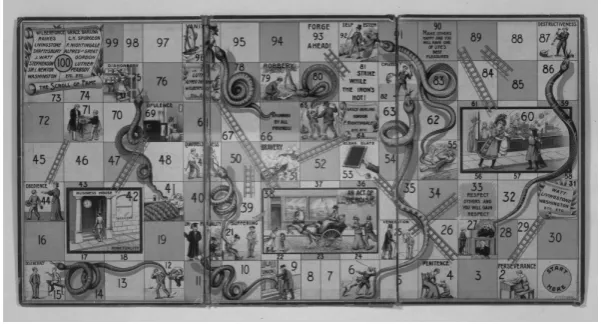
It is therefore important to remind ourselves that this key emblem or motif of individual people going up single ladders is historically and contextually specific. There is an interesting resonance here in the evolution of the board game Snakes and Ladders. The earliest examples known are Hindu, Jain and Islamic versions from India, Nepal and Tibet, where they were developed as religious instruction games (Parlett 1999; Topsfield 2006a, 2006b). Figure 1.1 is a Jain version, ‘Gyanbazi’, from either Gujarat or Rajasthan in the late nineteenth century.3 The pavilion at the top represents the heavens, where the liberated beings live together. There is no supreme creator god: Jains, like Buddhists and Hindus, believe in a cycle of birth and rebirth influenced by the effects of good and bad deeds and attitudes. The goal is for people to move past the many snakes (symbolising bad behaviour) and to arrive, through good behaviour, at the pavilion at the top.
rise of possessive individualism, of the idea of the self as bounded individual subject which arose during capitalist modernity (Macpherson 2010). The Protestant work ethic is here hard at work in fuelling and helping generate individualised forms of capital. Its goal is no longer spiritual enlightenment, but a different mixture of celebrity, virtue and wealth.
[image:44.391.47.345.77.416.2]in 1943 by board-game manufacturer Milton Bradley. Bradley took the health and safety option of removing the snakes to make the board game appear less dangerous and to popularise it as a game for children (Augustyn 1974: 27; Slesin 1993). The characters on the board were exclusively white until 1974, when black children werefinally represented as having a chance to ‘climb the ladder’ (Slesin 1993). Boards increasingly foregrounded a singular goal of winning. Today, in a recent version for smartphones, the game is streamlined even further–with a single snake being split into squares and the singular aim of attaining wealth symbolised by a treasure chest full of gold.6
[image:45.391.45.346.78.242.2]The popular charge of the phrase is dependent on the popularity of sport (and sporting metaphors have a far longer history, as does the notion of ‘levelling’). The usage of the term ‘level playing field’ was further popu-larised by such management texts as American journalist Thomas Friedman’s 2005 business bestsellerThe World is Flat.This book extended the vision of a level playing field to the whole world, arguing that shifts in geopolitics and technology now enabled a dynamic transnational meritocracy to surface from its brave new world of commercial competitiveness (Friedman 2005). Such visions of a level playing field for a mobile cosmopolitan workforce have been enthusiastically embraced by contemporary management litera-ture and neoliberal governmental rhetoric (as I discuss in the following chapter), but just as emphatically criticised by geographers and cultural, educational and political theorists. Educational scholars Brown and Tan-nock, for instance, critique the idea of a transnational level playingfield in education, arguing that it contradicts the fact that ‘in reality, economic, social and education inequalities both within and between nations are vast and increasing’ (Brown and Tannock 2009: 386). They argue that the construction of a competitive ‘global war for talent’, as manifested in uni-versities, which is characterised by an increasingly stratified vision of‘ hyper-meritocracy’ and skewed towards a ‘winner takes all’ market, greatly exacerbates such inequalities (Brown and Tannock 2009; Frank and Cook 1995; see also Piketty 2013; chapter 4 below).
its evolution and its stunning U-turn as a term since it was coined in English in the mid-twentieth century.
Socialist roots and critique
Michael Young is widely regarded as having coined the term‘meritocracy’ in his 1958 book The Rise of the Meritocracy. However, the term was in fact used two years earlier by Alan Fox in ‘Class and Equality’ for the journal Socialist Commentary, as the British historian David Kynaston recently noted inModernity Britain: Opening the Box, 1957–59(Kynaston 2013: loc. 3666; Fox 1956). As Kynaston is not especially interested in meritocracy, he devotes only a couple of sentences inModernity Britainto the discovery, but in terms of the etymology of the word and its cultural currency, this is a significant and quite remarkablefinding.7
What is striking about Fox’s article is that it makes more extensive critical and politically radical use of the term than Michael Young (whose use of it I discuss below). Alan Fox was to become an influential industrial sociologist whose radical perspective on industrial relations challenged the liberal orthodoxy of the discipline. In 1956 he was a researcher at Nuffield College Oxford, working on a history of British trade unions and a history of the National Union of Boot and Shoe Operatives (Oxford Dictionary of National Biography2013; Fox 2004: 230). The journal the article appeared in,Socialist Commentary, was the weekly publication of the Socialist Vanguard Group, a political group to the left of the Labour Party. Indeed, in 1955 the Labour leader and former prime minister, Clement Atlee described Socialist Com-mentaryas‘a useful corrective to theNew Statesman[a more mainstream UK left weekly magazine]’(Douglas 2002: 80).
raises the hope that mechanisation and workers’demands on the shopfloor would make blue-collar lives better, he suggests that this is only part of the story. For even if mechanisation improves and unionisation succeeds, social stratification will remain. For Fox, inequality
will remain as long as we assume it to be a law of nature that those of higher occupational status must not only enjoy markedly superior education as well but also, by right and of necessity, have a higher income into the bargain. As long as that assumption remains– as long as violations of it are regarded as grotesque paradoxes – then so long will our society be divisible into the blessed and the unblessed– those who get the best and most of everything, and those who get the poorest and the least. This way lies the ‘meritocracy’; the society in which the gifted, the smart, the energetic, the ambitious and the ruthless are carefully sifted out and helped towards their destined positions of dominance, where they proceed not only to enjoy the fulfilment of exercising their natural endowments but also to receive a fat bonus thrown in for good measure.
This is not enough. Merely to devise bigger and better ‘sieves’ (‘equality of opportunity’) to help the clever boys get to the top and then pile rewards on them when they get there is the vision of a certain brand of New Conservatism; it has never been the vision of socialism.
(Fox 1956: 13)
I quote this at length because it is both a remarkable and remarkably unquoted passage. It indicates the radical origins of critiques of meritocracy–roots that have been obscured – alongside the extent to which it has travelled as a term. For Fox, ‘meritocracy’ is a term of abuse. It denotes a society in which‘the gifted, the smart, the energetic, the ambitious and ruthless’not only reap the rewards for their (dubious or admirable) skills but receive too much: these ‘fat bonus[es]’, the rewards piled on them are excessive and mean that others suffer.
As a result of this analysis, Fox suggests‘cross-grading’as a route towards greater equality. ‘Cross-grading’ is conceptualised not only in financial terms, but also in terms of time, education and leisure. He makes pointers towards policies of redistribution; these
waste of time’. It might mean that those who perform the dull and repetitive jobs in which our economy abounds receive substantially more leisure than the rest.
(Fox 1956: 13)
Fox’s remarkable article in which the earliest use of ‘meritocracy’ to be recorded to date appears is therefore an explicitly socialist argument against the very logic of meritocracy. These origins were forgotten, however, until 2013, in favour of Michael Young’s playful, dystopian social satire,The Rise of the Meritocracy.
Social democratic meritocracy
The Rise of the Meritocracywas published in 1958 and set in 2034. It is voiced by a pompous narrator who draws on the PhD thesis of the now-deceased social scientist‘Michael Young’ –who (we learn at the end) died in a ferocious battle caused by the problems with the new social system of meritocracy. ‘Meritocracy’here is understood as produced through the formula I + E = M, or‘Intelligence combined with Effort equals Merit’. Thefirst half of the book depicts early twentieth-century Britain from the vantage point of a science-fiction future. It charts the demise of the old class-bound nepotistic order, in which kinship triumphs over skill and the rich bequeath their social worlds to their children, as a world overthrown by movements for greater social equality. The second half relates the ascendancy of the new system of merit, which turns out to lead not to an equal society but rather to a new caste system in which IQ determines social station. In this world, the lower rungs are occupied by both ex-rich and ex-poor who are dim-witted and, to borrow contemporary terminology, ‘socially excluded’; careers tend to dip after people reach 40 or 50; and there is a roaring black-market trade in brainy babies. The book concludes by gesturing towards the 2034 ‘Battle of Peterloo’ when an alliance of housewives and ‘populists’ fight back on May Day against meritocracy. We learn that it was in this battle that‘Michael Young’died.
(Savage 2010).8The book portrays a hidebound, class-bound British society as grossly unfair and registers the seismic post-war moves towards a more egalitarian society and the redistribution of resources by the welfare state. But it is also, clearly, a book in which meritocracy is not depicted as a problem-free goal that such class-bound societies should strive for. On the contrary, it is presented as an ideology or organising principle that will become a problem, by leading to new inequalities of power and forms of social stratification.
Through its satire, The Rise of the Meritocracy was both questioning the way the social order was being re-made and connecting to older political– philosophical debates around merit. These debates included, for example, Emile Durkheim’s vision of society providing‘free space to all merits’; those of the US structuralist–functionalists of the 1940s and 1950s, who sought to update his ideas; and the scepticism of British social democratic radicals of the interwar period like Tawney, Cole and Hobson, who argued that the production of‘merit’needed to be understood instead as a more egalitarian, co-operative process (Beck 2008). Young’s political–philosophical position was closer to the latter. As a key writer of the 1945 Labour Party manifesto Let Us Face the Futureand Labour’s director of research, Young wroteThe Rise of the Meritocracyin part as a warning shot to his party against newly emergent forms of social division (Briggs 2006). The book is critical of tendencies toward over-valorising innate ability and the emergence of new hierarchies. As Raymond Williams argued in a review of Young’s book, ‘we think of intelligence as absolute and limited because we have been told to think so, by this kind of society. It seems increasingly obvious, in practice, that our concepts of intelligence are peculiarly unintelligent’(Williams 1958).
I will come to the issue of how ‘meritocracy’ changed in value from the 1960s onward below, but it is worth considering how Young’s book itself– or rather, the text and its author’s paratextual framings of it – may have contributed, despite themselves, to such misreadings.9For, whilst The Rise of the Meritocracy is a text which is known for being disparaging of meritocracy, there is also a fair amount of ambiguity on this issue within both the text itself and in Michael Young’s comments on it. Its author claimed thatThe Rise of the Meritocracywas‘intended to present two sides of the case – the case against as well as the case for a meritocracy’ (Young 1994: xvii). In the book, whilst‘meritocracy’is valued for its ability to dis-mantle inherited privilege, it is also damned for its power to create new, unfair social divisions. The fictional ‘Chelsea Manifesto’ is the clearest expression of an alternative to both, with its often powerful arguments for equality, for valuing‘kindliness and courage, sympathy and generosity’over narrow conceptions of intelligence; and yet this alternative vision is truncated and cut off. Neither was the author’s paratextual activity always consistent. For instance, Young stated that he supported the ideal of a classless society; yet when asked in the 2000s whether the book was arguing to promote‘the comprehensive idea’ in education, he replied with an unexpansive but unequivocal‘no’(Dench 2006: 74).
Young, who was director of the Institute of Community Studies at the time of writing the book, later became a founder and co-founder of a variety of institutions key to post-war British life and progressive social education, including the Open University, the Consumer’s Association and the University of the Third Age. He was deeply committed to formations which enabled innovative forms of participation and engagement with political and social structures. It is for this reason that his legacy is held in such high regard in the UK today. This is a political–conceptual lineage which connects Young’s work with that of contemporary advocates of participatory democracy; the tentative conclusion of the book’s story, in which the housewives and other populists rise up together, is symptomatic of this tendency.