City, University of London Institutional Repository
Citation
:
Baggio, M., Sax, O. O., Sfondrini, A., Stefanski, B. & Torrielli, A. (2017). Protected string spectrum in AdS(3)/CFT2 from worldsheet integrability. Journal of High Energy Physics(4), 91.. doi: 10.1007/JHEP04(2017)091This is the accepted version of the paper.
This version of the publication may differ from the final published
version.
Permanent repository link:
http://openaccess.city.ac.uk/17702/Link to published version
:
http://dx.doi.org/10.1007/JHEP04(2017)091Copyright and reuse:
City Research Online aims to make research
outputs of City, University of London available to a wider audience.
Copyright and Moral Rights remain with the author(s) and/or copyright
holders. URLs from City Research Online may be freely distributed and
linked to.
City Research Online: http://openaccess.city.ac.uk/ [email protected]
JHEP04(2017)091
Published for SISSA by Springer
Received: January 20, 2017 Revised: April 2, 2017 Accepted: April 6, 2017 Published: April 14, 2017
Protected string spectrum in AdS
3/CFT
2from
worldsheet integrability
Marco Baggio,a Olof Ohlsson Sax,b Alessandro Sfondrini,c Bogdan Stefa´nski, Jr.d and Alessandro Torriellie
aInstituut voor Theoretische Fysica, KU Leuven, Celestijnenlaan 200D, B-3001 Leuven, Belgium
bNordita, Stockholm University and KTH Royal Institute of Technology, Roslagstullsbacken 23, SE-106 91 Stockholm, Sweden
cInstitut f¨ur Theoretische Physik, ETH Z¨urich, Wolfgang-Pauli-Str. 27, 8093 Z¨urich, Switzerland
dCentre for Mathematical Science, City, University of London,
Northampton Square, EC1V 0HB London, U.K. eDepartment of Mathematics, University of Surrey,
Guildford, GU2 7XH, U.K.
E-mail: [email protected],[email protected], [email protected],[email protected],
Abstract:We derive the protected closed-string spectra of AdS3/CFT2dual pairs with 16 supercharges at arbitrary values of the string tension and of the three-form fluxes. These follow immediately from the all-loop Bethe equations for the spectra of the integrable worldsheet theories. Further, representing the underlying integrable systems as spin chains, we find that their dynamics involves length-changing interactions and that protected states correspond to gapless excitations above the Berenstein-Maldacena-Nastase vacuum. In the case of AdS3×S3×T4 the degeneracies of such operators precisely match those of the dual CFT2and the supergravity spectrum. On the other hand, we find that for AdS3×S3×S3×S1 there are fewer protected states than previous supergravity calculations had suggested. In particular, protected states have the same su(2) charge with respect to the two three-spheres.
Keywords: AdS-CFT Correspondence, Bethe Ansatz, Conformal Field Theory
JHEP04(2017)091
Contents
1 Introduction 1
2 BPS states in N = (4,4) theories 4
2.1 Poincar´e polynomial 5
2.2 (Modified) elliptic genus 6
3 The AdS3×S3×T4 Bethe equations 7
4 Spin-chain interpretation 10
4.1 Massive excitations 10
4.2 Massless excitations 12
5 Fermionic zero modes and protected states 14
6 Protected states for AdS3×S3 ×S3×S1 17
7 Protected states in mixed-flux AdS3 backgrounds 19
8 Wrapping corrections 20
9 Conclusion 21
A The psu(1,1|2) superalgebra 23
B Computation of the modified elliptic genus 25
C Multiplet joining and length-changing effects 27
C.1 Massive excitations 27
C.2 Massless excitations 29
D Dynamic spin chains 30
1 Introduction
JHEP04(2017)091
for these backgrounds [1–3].1 An efficient way to check whether integrability persists at
the quantum level is to study the S matrix that scatters the excitations on the string worldsheet, following the ideas pioneered by Zamolodchikov and Zamolodchikov for two-dimensional relativistic integrable QFTs [5]. Indeed, for the cases of AdS3×S3×T4 and AdS3×S3×S3×S1 supported by arbitrary three-form fluxes, the two-body S matrix can be fixed by symmetry considerations up to “dressing factors” and turns out to automatically satisfy the Yang-Baxter equation [6–11].2 The dressing factors are not fixed by symmetry, rather they satisfy crossing equations. So far they have been found only for the case of AdS3 ×S3 ×T4 supported by pure-RR fluxes [13, 14]. Equipped with an integrable S matrix, one may write down the Bethe equations that predict the asymptotic spectrum3 of closed strings in these backgrounds; this construction has been recently completed for pure-RR AdS3×S3×T4 [14,17], and preliminary results are known for AdS3×S3×S3×S1 too [18,19].
The integrability construction interpolates between the perturbative string NLSM regime and the “perturbative CFT” regime. For this purpose, we introduce a coupling constanth so that the large-coupling limith1 corresponds to large string tension4 (and hence a perturbative description on the worldsheet) while h 1 corresponds to the ’t Hooft coupling being small. The large-h expansion of the integrability construction has been matched against a number of perturbative string NLSM computations in the near-plane-wave, near-flat-space and semi-classical regimes, see e.g. [20, 23–30]. On the other hand, the small-h limit is more subtle. While it is known that the AdS3×S3×T4 back-ground lives in the moduli space of the a semi-direct product CFT (SymN(T4))nT4[31,32], it is not clear how the symmetric-product orbifold point is related to the h → 0 limit of the integrability description nor how to find integrability there [33]. The first evidence of integrability on the CFT2 side has instead been found in the IR limit of the Higgs branch of the two-dimensional super-Yang-Mills theory with matter [34] and deserves to be ex-plored further. The scenario is even more mysterious for AdS3×S3×S3×S1, where the identification of what the dual CFT2 might be remains a challenge [35].5
In this paper we use integrability to determine the protected closed-string spectra of the AdS3/CFT2 models. We begin with the case of pure-RR AdS3×S3×T4 for which we derive in detail such protected states from the all-loop Bethe equations, elaborating on the results announced in [17]. Our findings are valid for generic values of the string tension in the planar theory. The degeneracy we find matches precisely the spectrum of protected operators [37] and the (modified) elliptic genus of the symmetric-product orbifold CFT and supergravity [38, 39]. Let us stress that the protected states’ Bethe roots are particularly simple: they carry no worldsheet momentum. As such, determining the protected spectrum from the Bethe equations is a remarkably straightforward exercise. Furthermore, it is also
1
See also ref. [4] for some earlier progress in AdS3/CFT2 integrability. 2See also ref. [12] for a review of these constructions.
3This description is valid up to finite-size “wrapping” effects [15,16].
4The precise relation between the couplinghand the string tension is at present only known perturba-tively [20,21]. In the case of integrable AdS4/CFT3 backgrounds an analogous functionhwas determined exactly by comparing integrability and localisation results [22].
JHEP04(2017)091
easy to show that finite-size “wrapping” corrections to the Bethe ansatz exactly cancel for these protected states. In a small way, this simplicity indicates the power of integrability in solving the spectral problem.
Based on these results, it becomes clear that protected states can be found for more general AdS3 integrable backgrounds by classifying zero-momentum Bethe roots. In partic-ular, we find that the spectrum of protected operators for the pure-RR AdS3×S3×S3×S1 theory consists only of states that have equal su(2) charges J+ =J− with respect to the
two three-spheres; once again, this result is valid for generic values of the string tension in the planar theory. We compare our findings with the results available in the literature. At the supergravity point, it has been proposed [40] that protected multiplets with J+6=J−
should exist, yielding a much larger degeneracy. On the other hand, at generic points of the moduli space, it is expected [40,41] that such multiplets should not be protected.6 Our integrability-based findings give an explicit confirmation of this expectation, though this does not address whether additional degeneracies might appear at the supergravity point. The analysis of ref. [40] is not conclusive as it relies on the assumption that all Ka lu˙za-Klein (KK) modes sit in short representations and thus might overcount the BPS states. A simple yet effective way of checking if protected KK modes with J+6=J− exist is to study
point-like string solutions for the AdS3×S3×S3×S1background [1], see also [42,43], which are in one-to-one correspondence with its bosonic supersymmetric ground states. We find that, even in the large-tension limit, the only BPS multiplets are the ones with J+ =J−.
In addition, we show that our integrability analysis of protected states holds also for mixed RR- and NSNS-flux AdS3 backgrounds. It is interesting to note that the restriction on the allowed angular momenta J+ = J− for AdS3×S3×S3×S1 was also found for BPS giant-graviton D-strings [44]. This suggests that this condition may well apply to the full non-perturbative protected spectrum of the theory.
One of the central lessons of holographic integrability in higher dimensions [45], see also [46,47] for a review, has been the appearance of an integrable spin-chain in the small-h
regime. Such a description is very useful for enumerating the states of the theory, and in particular for classifying the protected operators. As in the higher-dimensional cases, all the pure-RR AdS3 backgrounds exhibit a lattice-like dispersion relation
E(p) = s
m2+ 4h2 sin2 p
2
, (1.1)
JHEP04(2017)091
structure of the Bethe equations for pure-RR AdS3×S3×T4strings ath1. Building on these, in section 4 we construct the weakly-coupled spin chain. It is then straightforward to derive, in section 5, the spectrum of protected operators and to match that with the results of section 2. We then describe in section 6 how to apply the same techniques to the case of pure-RR AdS3 ×S3 ×S3 ×S1, derive the spectrum of protected states and corroborate it by a classical string-theory calculation. In section 7 we argue on general grounds that our results are unchanged in the presence of a mixture of RR and NSNS three-form fluxes. Finally, in section8we argue that our results, which where derived from the Bethe equations, remain valid even when wrapping corrections are taken into account. We conclude in section9, and relegate some technical details to four appendices.
Note added. While we were in the final stages of preparing our manuscript, we re-ceived [49] where the protected spectrum on AdS3×S3×S3×S1 is also investigated both at the Wess-Zumino-Witten point by CFT techniques and at the supergravity one through a direct analysis of the KK spectrum. The results perfectly agree with our integrability findings for this background.
2 BPS states in N = (4,4) theories
In this section we review the properties of chiral states in theories withsmallandlargeN = (4,4) superconformal symmetry. The global smallN = (4,4) algebra consists of two copies of the psu(1,1|2) algebra, acting on the left- and right-moving sectors respectively. As reviewed in appendixA, representations are characterized by the (left and right) conformal dimension (DL, DR) and the R-symmetry quantum numbers (JL, JR) of the superconformal primaries. The unitarity bound for the left copy of the algebra in these conventions is
DL≥JL, (2.1)
and similarly for the right one. Multiplets that saturate this bound are called (left) chiral primary multiplets. They contain 2J + 1 superconformal primaries differing in their J eigenvalue j. The highest-weight state with j =J is annihilated by the supercharges Q1 and ˙Q2.7 As a consequence, chiral primary multiplets are shorter than generic multiplets. Multiplets that saturate the unitarity bound in both the left and right sector are 1/2-BPS, those that saturate it only in one sector are 1/4-BPS. More details on the structure of short and long representations of the psu(1,1|2) algebra are presented in appendix A.
We now discuss short representations of the large N = (4,4) algebra. Its global part is given by two copies of d(2,1;α). For each copy, the R symmetry is su(2)⊕su(2), so that representations are labelled by the conformal dimension D and the two su(2) spins (J+, J−). The unitarity bound then reads8
D≥αJ++ (1−α)J−. (2.2)
7The lowest weight statej=−Jis annihilated byQ
2 and ˙Q1, while generic superconformal primaries withj 6=±J are not annihilated by any combination of the supercharges. Instead, they satisfy nullness conditions, in that certain combinations of their superconformal descendants vanish.
JHEP04(2017)091
The highest-weight states of representations that saturate this bound are annihilated by one supercharge, so such multiplets are shorter than generic ones, but preserve less super-symmetry compared to their small N = (4,4) counterparts. We then have 1/4-BPS and 1/8-BPS multiplets, depending on whether they saturate the unitarity bound on both left and right sectors or only on one sector. The BPS bound for the full superconformal algebra (as opposed to its global part) differs from (2.2) whenJ+6=J− [50]. However, we will find
in section 6 that the only BPS states for AdS3×S3×S3×S1 satisfyJ+=J−, so we will
not discuss this point further.
2.1 Poincar´e polynomial
In theories with small N = (4,4) supersymmetry, the spectrum of 1/2-BPS states can be usefully encoded in the Poincar´e polynomial
Pt,¯t= Trt2J L¯
t2JR
, (2.3)
where the trace is taken over the space of highest-weight states of the chiral primary multiplets. This polynomial has finite degree, since the spectrum of chiral primaries is bounded from above [51]
h≤ c
6. (2.4)
In the case of a sigma model with target space M, it can be shown that the Poincar´e polynomial is given by [52]
Pt,¯t=
X
p,q
hp,qtpt¯q, (2.5)
where hp,q are the Betti numbers of the target space M. In this paper, we are especially interested in the case M = T4, whose Betti numbers can be read off from its Hodge diamond
1
2 2
1 4 1
2 2
1
(2.6)
The Poincar´e polynomial of the symmetric orbifold SymN(M) can also be expressed in terms of the Betti numbers of M[37,53]:
X
N
QNPt,¯t(SymN(M)) =
∞
Y
m=1 Y
p,q
1 + (−1)p+q+1Qmtp+d2(m−1)t¯q+ d
2(m−1)(−1)
p+q+1hp,q
,
(2.7) wheredis the dimension of M.
The large-N behaviour ofPt,¯t(SymN(M)) can be extracted using the relation [37]
Pt,¯t(Sym∞(M)) = lim
Q→1(1−Q)
∞
X
N=0
JHEP04(2017)091
In the case of M= T4, this gives
Pt,¯t(Sym∞(T4)) =
(1 +t)2(1 + ¯t)2 (1−t¯t)5
∞
Y
J=2
(1 +tJ¯tJ−1)4(1 +tJ−1¯tJ)4
(1−tJ−2t¯J)(1−tJt¯J−2)(1−tJ¯tJ)6. (2.9) This exhibits the expected structure of a freely generated partition function: bosonic gen-erators with su(2)L⊕su(2)Rcharge (JL, JR) contribute a factor of the form
1 +t2JL¯t2JR+t4JL¯t4JR+. . .= 1
(1−t2JL¯t2JR), (2.10) while fermionic ones give rise to
1 +t2JL¯t2JR. (2.11) In particular, we can read off from (2.9) the following generators: for J ≥2
• 6 bosonic generators with charges J2,J2,
• 4+4 fermionic generators with chargesJ−21,J2and J2,J−21,
• 1+1 bosonic generators with charges J2 −1,J2 andJ2,J2 −1, and additionally, there are
• 2+2 fermionic generators with charges12,0and 0,12
• 5 bosonic generators with charges 12,12.
In section 5, we will derive this exact spectrum of protected states using the all-loop integrable Bethe Equations and show how such degeneracies appear from a spin-chain perspective.
2.2 (Modified) elliptic genus
A more refined quantity that is constant over the moduli space is the elliptic genus. This is defined in the NS sector as9
E(q, y) = Tr|anythingiL⊗|chiral primaryiR(−1) Fq2DL
y2JL
. (2.12)
This quantity vanishes for theories with large N = (4,4) supersymmetry [39]. The chi-ral algebra of the SymN(T4) theory, due to the additional u(1)4 symmetry associated to translations along the four directions of the torus, is actually a degenerate largeN = (4,4) algebra, so that its elliptic genus vanishes. Therefore, we consider the modified elliptic genus [39], defined in the NS sector as
E2(q, y) = Tr|anythingiL⊗|chiral primaryiR(−1) Fq2DL
y2JL
(2JR)2. (2.13) 9This quantity is usually defined in the Ramond sector of the Hilbert space
TrRR(−1)Fq2(DL
−c/24) ¯
q2(DR−c/24)y2JL,
JHEP04(2017)091
In analogy to the Poincar´e polynomial (2.7), it is useful to introduce the generating function of elliptic genera for the symmetric orbifold:
˜
E2(Q, q, y) =X N
QNE2(SymN(T4)). (2.14)
Unlike the Poincar´e polynomial, the elliptic genus diverges in the large N limit, so the comparison with the spin-chain computation is more subtle. The same issue was encoun-tered in the computation of the elliptic genus in supergravity [38], where a suitable notion of degree was introduced to take into account the stringy exclusion principle [54], see also appendixB. In this case, the only terms that can be meaningfully compared are those that correspond to states with dimension D < N/4 [39]
˜
E2(Q, q, y) =X N
2N QN+. . . . (2.15)
We will reproduce this result in the spin-chain picture after introducing an appropriate notion of degree.
3 The AdS3×S3 ×T4 Bethe equations
Bethe equations [55] are a set of polynomial equations whose solutions — theBethe roots— determine the spectrum of an associated integrable system. In the simplest cases the Bethe roots are in one-to-one correspondence with the momenta of particles or magnons and the Bethe equations are immediately recognisable as quantisation conditions for the momenta, accounting for periodic boundary conditions and for phase shifts due to scattering of the magnons. The energy of a given state is determined through the dispersion relation much like in a free theory. In theories with extra global symmetries, like the ones we consider here, themomentum-carrying roots are supplemented byauxiliary roots. The latter do not directly affect the dispersion relation, but are necessary to reproduce states with different Noether charges.
The full set of Bethe equations for pure-RR AdS3×S3×T4strings was found in [14,17]. It is convenient to work with the weak-coupling Bethe equations [14], which are valid at small but non-vanishing h. Besides simplifying our formulae, this will allow us to explicitly enumerate the states in a spin-chain language, which is more natural at weak coupling, and still reproduce the generic spectrum of protected states. The weak-coupling Bethe equations are reproduced in equations (3.2)–(3.10) below. There are in total nine types of Bethe roots, three momentum-carrying and six auxiliary. For the excitations charged under psu(1,1|2)L we have momentum-carrying roots {uk}k=1,...M2 and auxiliary roots{v1,k}k=1,...M1 and{v3,k}k=1,...M3. Similarly for psu(1,1|2)Rwe writev¯1,k,u¯k, v¯3,k and
M¯1, M¯2, M¯3. Finally, the massless sector is described by the momentum-carrying roots
z±k and the auxiliary roots r1,k and r3,k, with excitation numbers N0, N1 and N3.10 The 10The massless momentum-carrying roots are conveniently parametrised using two complex conjugate parametersz+
k andz
−
k which satisfyz + kz
−
JHEP04(2017)091
momentum-carrying Bethe roots are directly related to the momentum of the corresponding excitations through the relations
uj+2i
uj−2i
=eipj, u¯j+
i 2 ¯
uj−2i
=eipj, z
+ j
zj− =e
ipj, (3.1)
where in the three equations above for simplicity of notation we indicate with the same pj the momentum of a given left-massive, right-massive and massless excitation, respectively. Note that for real momenta uj,u¯j ∈R and |z±j |= 1. The energy of a given state can be deduced via the weak-coupling limit of the dispersion relation (1.1), which in terms of the Bethe roots is given below in equation (3.12) .
The massive left-moving Bethe roots satisfy the psu(1,1|2)L Bethe equations
1 = M2
Y
j=1
v1,k−uj −2i
v1,k−uj +2i
, (3.2)
uk+2i
uk−2i
!L−N0+N1+N3 =
M2
Y
j=1 j6=k
uk−uj+i
uk−uj−i M1
Y
j=1
uk−v1,j−2i
uk−v1,j+2i M3
Y
j=1
uk−v3,j− 2i
uk−v3,j+ 2i
, (3.3)
1 = M2
Y
j=1
v3,k−uj −2i
v3,k−uj +2i
, (3.4)
while the massive right-moving roots satisfy the psu(1,1|2)R equations
1 = M¯2
Y
j=1
v¯1,k−u¯j+2i
v¯1,k−u¯j−2i
, (3.5)
¯
uk+2i ¯
uk−2i
!L =
M¯2
Y
j=1 j6=k
¯
uk−u¯j−i ¯
uk−u¯j+i M¯1
Y
j=1 ¯
uk−v¯1,j+ 2i ¯
uk−v¯1,j− 2i M¯3
Y
j=1 ¯
uk−v¯3,j+2i ¯
uk−v¯3,j−2i
, (3.6)
1 = M¯2
Y
j=1
v¯3,k−u¯j+2i
v¯3,k−u¯j−2i
. (3.7)
These two sets of equations differ from each other in two ways. Firstly, the equations for the left movers are written in an su(2) grading (i.e. feature the Heisenberg su(2) S matrix) while the equations for the right movers are written in an sl(2) grading.11 Secondly, the lengths appearing in the driving terms on the left hand sides of equations (3.3) and (3.6) are different whenever the excitation numbers Nj corresponding to the massless Bethe roots are non-zero. As we will see below this feature is essential for obtaining a spin-chain interpretation of the full set of Bethe equations including the massless modes.
JHEP04(2017)091
The massless Bethe roots satisfy the equations
1 = N0
Y
j=1
r1,k−zj+
r1,k−zj− M2
Y
j=1
uj +2i
uj −2i
, (3.8)
zk+ zk−
!L =
N0
Y
j=1 j6=k
zk+−zj− zk−−zj+(σ
◦◦
kj)2 M2
Y
j=1
uj−2i
uj+2i N1
Y
j=1
zk−−r1,j
zk+−r1,j N3
Y
j=1
zk−−r3,j
zk+−r3,j
, (3.9)
1 = N0
Y
j=1
r3,k−zj+
r3,k−zj− M2
Y
j=1
uj +2i
uj −2i
, (3.10)
where σ◦◦kj is the massless-massless dressing factor [14, 17]. Note that the massless roots couple to thetotal momentum carried by the massive left-moving roots uk.
Finally, the three types of momentum-carrying roots are coupled through the level-matching constraint
1 = M2
Y
k=1
uk+2i
uk−2i M¯2
Y
k=1 ¯
uk+2i ¯
uk−2i N0
Y
k=1
zk+
zk−. (3.11)
and enter the dispersion relation as
δD=h2
M2
X
j=1 2 1 + 4uj
+h2
M¯2
X
j=1 2 1 + 4¯uj
+i h
N0
X
j=1 1
z+j −
1
zj−
!
, (3.12)
where δD denotes the anomalous dimension. It is interesting to note that in the weak-coupling limit, massless modes contribute one order earlier than massive ones, as expected from (1.1).
The Cartan charges corresponding to a solution to the Bethe equations are given in terms of the excitation numbers by
D=DL+DR=L+M¯2+ 1
2 M1+M3+N1+N3−M¯1−M¯3−N0
+δD,
J = JL+JR =L−M2+ 1
2 M1+M3+N1+N3−M¯1−M¯3−N0
,
S =DL−DR= −M¯2+ 1
2 M1+M3+N1+N3+M¯1+M¯3−N0
,
K = JL−JR = −M2+ 1
2 M1+M3+N1+N3+M¯1+M¯3−N0
.
(3.13)
As discussed in [14] (see also [8, 9]) massless excitations are charged under an additional su(2)◦ that commutes with psu(1,1|2)L⊕psu(1,1|2)R. This symmetry is implicit in the Bethe equations and yields a 2N0-fold degeneracy of the spectrum. We can easily account for it by arbitrarily assigning an eigenvalue±1/2 to each massless momentum-carrying root. The global psu(1,1|2)L⊕psu(1,1|2)Rsymmetry manifests itself through the possibility of adding extra massive Bethe roots at infinity without affecting the Bethe equations or the dispersion relation (3.12). Additionally, as discussed in [14] we can add an arbitrary number of bosonic massless excitations at zero momentum (zj± = 1);12 this too is a symmetry
12The apparent symmetry when adding a massless root at|z±
JHEP04(2017)091
corresponding to shifts along T4 in target space. Adding a fermionic massless zero mode to the Bethe equationsis not a symmetry unlessM2 =M¯2 = 0. As we will see in section5, in that case the fermionic zero modes precisely generate the protected states expected from the discussion of section 2.
4 Spin-chain interpretation
Let us now see how the structure of the weak coupling Bethe equations discussed above can arise from a spin-chain picture of local operators. Such a formulation is very helpful for enumerating the solutions of the Bethe equations, and hence the states of the theory. In particular, as we will see below, it will give us a concrete description of the protected operators at weak coupling. The structure we find here follows directly from the Bethe equations by introducing an appropriate set of fields that to describe local operators. This notation is purposefully reminiscent of that introduced in [34] in the context of integrability on the Higgs branch of the dual CFT.
4.1 Massive excitations
To start with we will consider the massive sector by setting the excitation numbers N0,
N1 andN3 of the massless Bethe roots to zero. This case was already discussed in [7,18]. The massive spin-chain is homogenous with the sites transforming in the 1/2-BPS12;12⊗
1 2;
1 2
representation of psu(1,1|2)L⊕psu(1,1|2)R. Since this representation will be im-portant in the following discussion let us review its construction.
The representation 12;12 of psu(1,1|2) consists of two bosons φ± transforming as a doublet under the su(2) R symmetry of psu(1,1|2) and two fermions ψ± transforming as a doublet under the outer su(2)• automorphism of psu(1,1|2). Additionally there are
derivatives ∂ that generate the su(1,1) descendants of the bosons and fermions. The bosons have su(1,1) weight 1/2 while the fermions have weight 1. Explicit expressions for the action of the generators on the states can be found in, e.g., appendix B of [18].
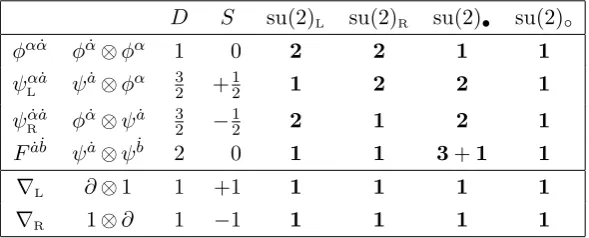
The symmetry of AdS3 ×S3 ×T4 includes two copies of psu(1,1|2) and the sites of the massive spin chain transform under the same 12;12 representation under both
copies. However, only the diagonal outer automorphism su(2)• is a symmetry.13 The fields
appearing at the site of this spin chain are listed in table 1.
The Bethe equations are constructed with respect to a ground state of the form14
|(φ++)Li. (4.1)
This state carries charges DL = JL = DR = JR = L/2 and hence satisfies the 1/2-BPS conditions (2.1).
13This su(2)
•can be seen as arising from anα→0 contraction of d(2,1;α)L⊕d(2,1;α)R, or geometrically as part of the so(4) symmetry in the T4directions in the NLSM target space; it is sometimes referred to as “custodial” su(2), see for example [35].
JHEP04(2017)091
D S su(2)L su(2)R su(2)• su(2)◦
φαα˙ φα˙⊗φα 1 0 2 2 1 1
ψLαa˙ ψ ˙
a⊗φα 3 2 +
1
2 1 2 2 1
ψRα˙a˙ φ ˙
α⊗ψa˙ 3 2 −
1
2 2 1 2 1
Fa˙b˙ ψa˙⊗ψb˙ 2 0 1 1 3+1 1
∇L ∂⊗1 1 +1 1 1 1 1
[image:13.595.151.446.84.203.2]∇R 1⊗∂ 1 −1 1 1 1 1
Table 1. Primary fields appearing at the sites of the massive spin chain. The first column gives the
various fields, and the second column gives their decomposition under psu(1,1|2)L⊕psu(1,1|2)R. The rest of the table shows how the fields transform under the bosonic subalgebra as well as under the two extra symmetries su(2)• and su(2)◦. The derivatives in the last two lines of the table are not fields but are included to indicate the quantum numbers carried by su(1,1) descendants of the fields. Note that the field Fa˙b˙ can be decomposed into a triplet and a singlet under su(2)
• by writing Fa˙b˙ =Da˙b˙+a˙b˙F, where Da˙b˙ is symmetric.
To obtain an excited state we replace the φ++ sitting at one or more of the sites with one of the other fields in table 1. This can be interpreted as acting on the field at those sites with lowering operators of psu(1,1|2)L⊕psu(1,1|2)R.
A generic state will contain several excitations and transform as a long representation of psu(1,1|2)L⊕psu(1,1|2)R. However, let us consider the case where we have only a single left-moving excitation, so that the state takes the form15
|(φ++)L−1φ−+i+ permutations. (4.2)
If the excitation has non-zero momentum this is a highest weight state with charges16
L 2,
L 2 −1;
L 2,
L 2
0 up to anomalous corrections of order h
2 given by eq. (3.12). Since the
state has DL> JL butDR =JR it should transform in a long psu(1,1|2)L representation, but in a short representation of psu(1,1|2)R. This would imply that the charge DR−JR is protected, while DL−JL can receive continuous corrections. However, this cannot be since the charges S =DL−DR and K =JL−JR are compact and hence have quantised eigenvalues. In fact, as long as the momentum of the excitation is non-vanishing, we expect from the Bethe equations that DL+DR is corrected by δD > 0, cf. (3.12)–(3.13). The resolution of this puzzle is that several such 1/4-BPS multiplets join to form long multiplets.
For instance, in the case we analysed, the representation with chargesL2,L2 −1;L2,L2
0 is short under psu(1,1|2)R and hence has a highest weight state that is annihilated by S2R and ˙SR1, as well as by the raising operators. However, this representation can join up with
15When we write a sum over permutations as in (4.2) this is meant to indicate linear combination of states where the excitation appears at different sites. In general we consider a state of definite spin chain momentump, such asPL
n=0e
ipn|(φ++)nφ−+(φ++)L−n−1i. However, as the exact form of the state is not important for this discussion, we only indicate the field content.
16We use the notation (D
L, JL;DR, JR)J• to denote the eigenvalues of a state under the Cartan elements
JHEP04(2017)091
three more 1/4-BPS representations with highest weight states carrying charges
L 2,
L
2 −1;
L−1 2 ,
L−1 2
+12
,
L 2,
L
2 −1;
L−1 2 ,
L−1 2 −1 2 , L 2, L
2 −1;
L
2 −1,
L
2 −1
0
.
(4.3) The combined representation can then receive an anomalous dimension δD in which case we obtain a single representation with charges
L+δD 2 ,
L
2 −1;
L+δD
2 , L 2 0 . (4.4)
This deformed representation is long under both psu(1,1|2)L and psu(1,1|2)R.
Using the field content of table1we can construct the multiplets (4.3) explicitly. Their highest-weight states are
|(φ++)L−2ψL++i, |(φ++)L−2ψ+L−i, |(φ++)L−3∇Lφ++i, (4.5)
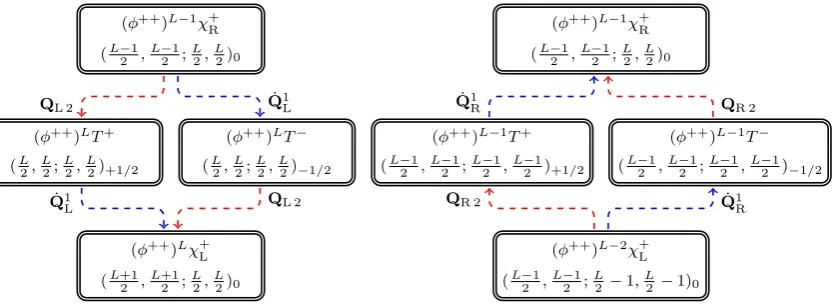
respectively. As all these states must be part of a long multiplet of psu(1,1|2)R, they must be related to the action of some right-moving supercharges; namely, in this case, by ˙Q1Rand QR2. We see here that these superchargeschange the lengthof the spin-chain ground-state, as proposed in [7]. Clearly we could derive a similar picture starting from a right-moving excitation in equation (4.2), see appendix C.1 where we also further detail the length-changing action of the supercharges on such multiplets. Furthermore, in appendix D we determine how psu(1,1|2)L⊕psu(1,1|2)R generators act on the massive spin-chain for the first fewh-orders in a more general sub-sector. These length-changing effects are then seen to follow from the closure of the algebra much like in AdS5/CFT4 [56].
4.2 Massless excitations
Having understood the structure of the massive spin chain, let us now turn to the massless excitations. To start with we consider a simple configuration consisting of one left-moving and one right-moving massive excitation, M2 =M¯2 = 1. In the absence of any other Bethe roots these massive roots satisfy the free momentum quantisation conditions
u+2i
u− i 2
!L
= 1, u¯+
i 2 ¯
u− i 2
!L
= 1, (4.6)
whereu≡uj withj= 1, and similarly for ¯u. If we now additionally turn on one massless momentum-carrying root by settingN0= 1 we find that the above equations are modified to
u+2i
u−2i
!L−1
= 1, u¯+
i 2 ¯
u−2i
!L
= 1. (4.7)
The new equations still describe two free massive excitations. However, the effective length of the spin chain along which the excitations propagate is different in the left and right sectors. It is natural to interpret this as the presence of a chiral site in the spin chain: at the site where the massless excitation sits the representation 12;12⊗1
2; 1 2
JHEP04(2017)091
replaced by ˜1a⊗12;12, where ˜1a is a singlet under psu(1,1|2)L.17 From the structure of the world-sheet excitations studied in [8, 9] we know that the massless highest weight excitation is fermionic. Hence we have included a tilde on the singlet to indicate that it has an odd grading.
When we add the massless root, we also get an additional equation from (3.9), de-scribing the quantisation of the momentum of the massless excitation. In the simple case of N0= 1 and M2, M¯2 ≥0 this equation reads
z+
z−
L =
M2
Y
j=1
uj+2i
uj−2i
. (4.8)
We see that the massless excitation behaves almost like a free excitation propagating on a chain of length L, except it feels an extra twist which depends on the total momentum of the massive left-moving excitations, cf. equation (3.1).
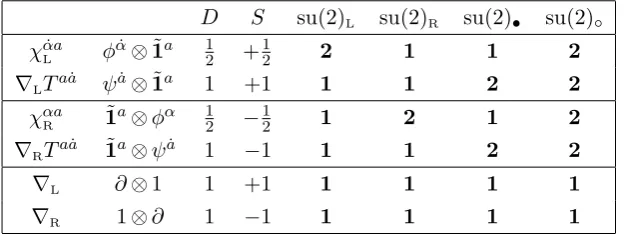
Let us now consider an even simpler system consisting of only a single massless exci-tation inserted above a ferromagnetic ground state of length L. In order to simplify the description of such states we label the extra fields appearing in the chiral spin chain as in table 2. The state with a single massless excitation then takes the form
|(φ++)L−1χ+Rai+ permutations, (4.9) and carries psu(1,1|2)L⊕psu(1,1|2)R charges
L−1 2 ,
L−1 2 ;
L
2,
L
2
0
. (4.10)
At zero coupling this satisfies the 1/2-BPS conditions DL =JL and DR =JR. Hence, in the free theory it transforms in a short representation which is annihilated by the creation operators QL2, ˙Q1L, S
2
R and ˙SR1. Should its dimension to be protected even when the coupling constanthis non-zero? This cannot be the case in general: firstly it would result in a glut of protected operators [57]. Secondly, when the excitation has non-zero momentum and h >0, the dispersion relation in equation (3.12) shows that the state should receive an anomalous dimension δD. The mechanism for the dimension of such states to receive corrections comes once again through multiplet joining and length changing.
In order to construct the additional states that are needed to complete a long represen-tation we need one additional ingredient: a bosonic field Taa˙ that transforms as a singlet under psu(1,1|2)L⊕psu(1,1|2)R and as a bi-spinor under su(2)•⊕su(2)◦. This field, which emerges naturally in the near-BMN analysis of the string spectrum [8], represents a spin-chain site that transforms trivially in both the left and the right sector. When we allow for states that include this massless bosonic excitation we can construct a long representation as described in appendix C.2.
If the massless excitation in (4.9) has vanishing momentum, its anomalous dimension vanishes even for non-zero coupling. In fact, it is easy to see that this is the case even
17As discussed above there is also an additional su(2)
JHEP04(2017)091
D S su(2)L su(2)R su(2)• su(2)◦
χαaL˙ φ ˙
α⊗1˜a 1 2 +
1
2 2 1 1 2
∇LTaa˙ ψa˙⊗1˜a 1 +1 1 1 2 2
χαaR 1˜
a⊗φα 1 2 −
1
2 1 2 1 2
∇RTaa˙ 1˜a⊗ψa˙ 1 −1 1 1 2 2
∇L ∂⊗1 1 +1 1 1 1 1
[image:16.595.143.456.84.201.2]∇R 1⊗∂ 1 −1 1 1 1 1
Table 2. The massless fields decomposed as representations of psu(1,1|2)L⊕psu(1,1|2)R. The
symbol ˜1a describes an psu(1,1|2)L⊕psu(1,1|2)Rsinglet with fermionic grading which transforms as a doublet under su(2)◦.
in the all-loop dispersion relation (1.1). These states are solutions of the Bethe equations that correspond to 1/2-BPS multiplets at arbitrary values of the string tension. We will see in the next section that they precisely reproduce the spectrum of protected closed-string states that we expect from supergravity and from the dual CFT2.
5 Fermionic zero modes and protected states
As we have just seen, it is interesting to consider massless excitations with zero momentum on top of the BMN ground state. The resulting states solve the all-loop Bethe equations, and have anomalous dimension δD = 0. As such, they are groundstates, degenerate with the ferromagnetic BMN vacuum. Since there are four different massless fermionic excita-tions (χ+R± andχ
+±
L ) we have a total of four such fermionic zero modes.
The Bethe equations ensure that these 1/2-BPS multiplets exist for arbitrary values of the couplingh[17]. It is particularly transparent to construct their highest-weight states in the spin-chain description that emerges at small but non-vanishing h. The ferromagnetic ground state of lengthL is
|(φ++)Li (5.1)
and in the Bethe equations its excitation numbers are all set to zero. Turning on a single massless momentum-carrying root (N0= 1) we get one of the two states
|(φ++)L−1χ+R±i+ symmetric permutations, (5.2)
depending on which su(2)◦ spin we assign to the root. Since the excitation has vanishing
momentum, the above states arecompletely symmetric, cf. footnote15. The corresponding Bethe root isz±= 1 and its Bethe equation (3.9) is trivially satisfied with both sides equal to one. Similarly we can get a left-moving fermion
|(φ++)Lχ+L±i+ symmetric permutations, (5.3)
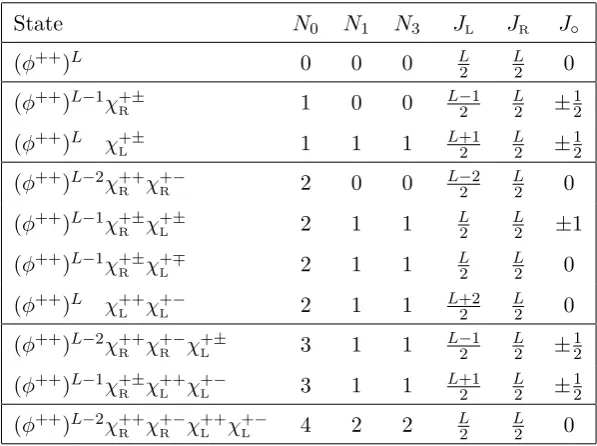
JHEP04(2017)091
State N0 N1 N3 JL JR J◦
(φ++)L 0 0 0 L2 L2 0
(φ++)L−1χ+R± 1 0 0 L−1
2 L 2 ±
1 2
(φ++)L χ+L± 1 1 1
L+1 2 L 2 ± 1 2 (φ++)L−2χ++
R χ +−
R 2 0 0
L−2 2
L
2 0
(φ++)L−1χ+R±χ +±
L 2 1 1
L 2
L 2 ±1
(φ++)L−1χ+R±χ +∓
L 2 1 1
L 2
L
2 0
(φ++)L χ++L χ +−
L 2 1 1
L+2 2
L
2 0
(φ++)L−2χ++R χ +−
R χ +±
L 3 1 1
L−1 2
L 2 ±
1 2
(φ++)L−1χ+R±χ++L χ+L− 3 1 1 L+12 L2 ±1 2
(φ++)L−2χ++R χ +−
R χ ++ L χ
+−
L 4 2 2
L 2
L
[image:17.595.148.447.83.306.2]2 0
Table 3. The sixteen 1/2-BPS states obtained from a spin-chain ground state of length L by
inserting the four fermionic zero modes, and the corresponding excitation numbers and charges under su(2)L, su(2)Rand su(2)◦.
Note that only the fermions χ+±
R and χ +±
L give a new state with the same energy as the corresponding ground state. If we were to insert the fermion χ−±L the resulting state would no longer satisfy the 1/2-BPS condition, because the fermion would give a positive contribution to the energy.18 Hence the next states we can obtain contain two fermionic ex-citations. For example, to consider a state containing two right-moving massless fermions,
|(φ++)L−2χ++R χ+R−i+ symmetric permutations, (5.4)
we set N0 = 2, with both particles having zero energy, i.e. roots sitting at z± = +1 or
z± =−1. Due to fermion anti-symmetry the two excitations have to have opposite su(2)◦
spin.19 Continuing in this fashion we obtain the sixteen states shown in table 3.
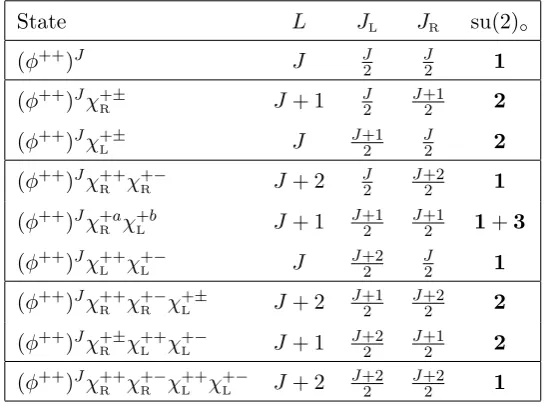
In the grading we use it is natural from the spin-chain perspective to group the BPS states according to their su(2)Rcharge. However, since the states sit in different irreducible representations of psu(1,1|2)L⊕psu(1,1|2)R this grouping is completely arbitrary, and a more transparent picture of the BPS states emerges if we instead reorganise the states according to the number of fields φ++ appearing in the operators. The resulting set of states is shown in table 4.
It is now straightforward to count the total number of states of a given charge (JL, JR) that appear. ForJ ≥2 we find
18From the Bethe equation point of view, such a state can be interpreted as a multi-excitation state, as discussed at the end of section4.2.
JHEP04(2017)091
State L JL JR su(2)◦
(φ++)J J J2 J2 1
(φ++)Jχ+R± J+ 1 J 2
J+1
2 2
(φ++)Jχ+L± J
J+1 2
J
2 2
(φ++)Jχ++ R χ
+−
R J+ 2
J 2
J+2
2 1
(φ++)Jχ+Raχ +b
L J+ 1
J+1 2
J+1
2 1+3
(φ++)Jχ++L χ +− L J J+2 2 J 2 1
(φ++)Jχ++R χ +−
R χ +±
L J+ 2
J+1 2
J+2
2 2
(φ++)Jχ+R±χ ++ L χ
+−
L J+ 1
J+2 2
J+1
2 2
(φ++)Jχ++ R χ +− R χ ++ L χ +−
L J+ 2 J+2
2
J+2
[image:18.595.161.434.84.287.2]2 1
Table 4. The sixteen 1/2-BPS states containing J copies of the field φ++ obtained by inserting
the four fermionic zero modes. The lengthL of the corresponding spin-chain ground state and the charges under su(2)L, su(2)Rand the su(2)◦representation are also given.
• 6 bosonic states with charges J2,J2,
• 4+4 fermionic states with charges J−21,J2 andJ2,J−21,
• 1+1 bosonic states with charges J2 −1,J2and J2,J2 −1. Additionally, there are
• 2+2 fermionic states with charges 12,0and 0,12
• 5 bosonic states with charges 12,12.
Summing over all the single-particle and multi-particle states with the terms weighted as in the Poincar´e polynomial in equation (2.3), we find that the partition function in the 1/2-BPS sector of the spin chain perfectly reproduces the result for the symmetric orbifold SymN(T4) presented in equation (2.9).
As anticipated in section 2, the computation of the (modified) elliptic genus requires more care, since it diverges in the large-N limit. Following [38,39], we assign to each state in table 4 a degreed=J+ 1. One can then compute the elliptic genus ˜E2(Q, q, y) as
˜
E2(Q, q, y) = Tr|anythingiL⊗|chiral primaryiR(−1)
FQdq2DL
y2JL
(2JR)2. (5.5) In appendixBwe show that if we consider states with (left) conformal dimensionDL< d/4, the result is given by
˜
E2(Q, q, y) = 2Q
(1−Q)2 +. . .= X
N
2N QN +. . . , (5.6)
JHEP04(2017)091
6 Protected states for AdS3 ×S3×S3 ×S1
Another interesting string theory background is AdS3×S3×S3×S1, which also preserves sixteen supercharges. Strings in this background are expected to be dual to a CFT with
large N = (4,4) superconformal symmetry. As discussed in section 2, the global part of this symmetry is given by the algebra d(2,1;α)L⊕d(2,1;α)R, where the parameter α is related to the ratio of the radii of the two three-spheres
α
1−α = RS23
−
R2S3 +
. (6.1)
The all-loop integrable S matrix for AdS3 ×S3 ×S3 ×S1 was found in [11]. The world-sheet spectrum contains, among other excitations, two massless fermions. It is straightforward to generalize the all-loop derivation of the protected spectrum carried out in section 5 to the present background. As before, the Bethe equations have a (trivial) BMN vacuum solution above which there are excitations that are obtained by acting with Zamolodchikov-Fadeev creation operators in the conventional way. In general, their mo-menta are determined via non-trivial solutions to the Bethe equations and so will have non-zero energies. However, just as in section 5,zero-momentum solutions of the all-loop Bethe equations corresponding to massless fermionic excitations above the BMN vacuum can be obtained very straightforwardly, because the Bethe equations reduce to 1 = 1 at zero momentum. This demonstrates that to all orders in the string tension, the massless fermionic excitations are gapless just as in the case of the AdS3×S3×T4 background.
Let us discuss the protected AdS3×S3×S3×S1 spectrum in more detail from a spin-chain perspective. The spin spin-chain describing the massive sector of the pure-RR AdS3× S3×S3 ×S1 integrable system was constructed in [18]. The basic building blocks of the spin chain are the two doublet representations of d(2,1;α). These representations carry sl(2)⊕su(2)⊕su(2) charges (D, J+, J−) =
α 2,
1 2,0
and1−2α,0,12, and are 1/4-BPS since they saturate the bound discussed in section 2
D≥αJ++ (1−α)J−. (6.2)
To write down the supersymmetric BMN ground states we introduce two fields Φα and Φ1−α which are the highest weight states of the representations
α 2,
1 2,0
⊗α2,12,0 and
1−α 2 ,0,
1 2
⊗1−α 2 ,0,
1 2
of d(2,1;α)L⊕d(2,1;α)R. The supersymmetric BMN ground states then take the form
JHEP04(2017)091
The two massless fermionic excitations correspond to sites transforming in represen-tations of the form1⊗12,12,12 and12,12,12⊗1.20 Denoting the highest weight state of these representations by χL and χR, the chiral ring is then made out of states of the form
|(ΦαΦ1−α)Li, |(ΦαΦ1−α)LχLi, |(ΦαΦ1−α)LχRi, |(ΦαΦ1−α)LχLχRi. (6.4)
These states saturate (6.2) and have equal angular momentum on the two three-spheres,
J+ = J−. Moreover, the four d(2,1;α)L ⊕d(2,1;α)R multiplets precisely fit into one multiplet of the largeN = (4,4) algebra.
This prediction, valid for generic string tension, is at odds with the proposal for the supergravity spectrum of ref. [40]. There it was proposed that protected states withJ+6=
J−should exists, yielding a much larger degeneracy; this was derived under the assumption
that all AdS3×S3×S3×S1 Ka lu˙za-Klein modes sit in short representations of d(2,1;α) —an assumption that may indeed lead to overestimating the number of protected states.21 This additional degeneracy appeared unlikely to exist at generic points of the moduli space, as emphasised in ref. [35]. In fact, states with J+ 6=J− must satisfy different shortening
conditions in d(2,1;α) and in the large N = (4,4) superconformal algebra, which made it difficult to believe that they would remain protected. Our derivation of the protected spectrum explicitly confirms the reasoning of [35]. It is however still interesting to see whether such an additional degeneracy is there at all at the supergravity point.
A simple yet effective way to investigate the protected supergravity spectrum is to consider point-like string solutions in AdS3×S3×S3 ×S1. These are in one-to-one cor-respondence with bosonic supersymmetric ground states: should these exist at J+ 6= J−,
so must such classical solutions. Point-like string solutions for AdS3×S3×S3×S1 were briefly discussed in [1] (see also [42, 43]), and we review them here. The strings can be taken to move only along the time direction tof AdS3 and the great circlesϕ± of the two
three-spheres. The equations of motion are then solved by
t=κτ, ϕ+ =ω+τ, ϕ−=ω−τ, (6.5)
where the constants κ and ω± are related to the energyD and angular momentaJ± by
D=κ, J+=αω+, J−= (1−α)ω−. (6.6)
The Virasoro constraint gives
D= q
αJ2
++ (1−α)J−2, (6.7)
and as discussed the 1/4-BPS bound of d(2,1;α)L⊕d(2,1;α)R takes the form (6.2). We see immediately that the energies (6.7) only saturate the bound whenJ+=J−. The states
that saturate the bound, together with the two fermionic zero modes that we obtained
20The d(2,1;α) representation 1 2,
1 2,
1 2
is the only 1/4-BPS representation that appears in the decom-position of the tensor product of the two doublet representations α
2, 1 2,0
and 1−α 2 ,0,
1 2
JHEP04(2017)091
above, then generate the spectrum of protected operators,22
M
J
[J, J;J, J]s⊕
J+ 1 2, J+
1 2;J+
1 2, J+
1 2
s
⊕
J, J;J+1 2, J +
1 2
s
⊕
J+ 1 2, J+
1 2;J, J
s
.
(6.8)
For J+ 6= J− the point-like strings do not saturate the BPS bound and hence fall in
long representations. These solutions correspond to supergravity modes with classical energy (6.7). In addition, since they sit in long representations, their energy will receive corrections in the string tension.
7 Protected states in mixed-flux AdS3 backgrounds
So far we have focused on string theory on AdS3 backgrounds supported by a RR three-form. Both AdS3×S3×S3×S1 and AdS3×S3×T4 remain classsically integrable when additionally the NSNS three-form is turned on [3]. Moreover, up to the dressing factors, the integrable S matrices can also be fixed entirely by symmetry in these cases [10,11]. In fact, for both families of backgrounds the structure of the worldsheet fluctuations and the symmetries of the light-cone gauge-fixed theory remain the same when the NSNS flux is turned on. The only modification is that the representation of the light-cone gauge sym-metries gets deformed in a way that can be accounted for by a suitable deformation of the Zhukovski parameters.23 This means that the form of the Bethe equations is independent of the flux, which only enters in the relation between the Bethe roots and the world-sheet energy and momentum. The dispersion relation takes the form [10,58]
E(p) = s
(m− k
2πp)
2+ 4h2sin2 p
2 (7.1)
wherekis the integer-valued coupling of the Wess-Zumino term of the bosonic string NLSM action, and the coupling h is suitably rescaled [10,11].
Without needing to resort to constructing the spin chain, we immediately see that when m = 0 we will have again gapless modes in the spectrum; in particular, just like in the pure-RR case, we find four fermionic zero modes over the BMN vacuum for the AdS3×S3×T4 background and two for AdS3×S3×S3 ×S1. Their quantisation leads to a tower of sixteen 1/2-BPS states for each ground state in the former case, and of four 1/4-BPS states in the latter, so that the structure of the chiral ring is the same for any flux. It is worth remarking that, even if the structure of the Bethe equations is not modified by k≥1, it may very well be that the spin-chain description is altered rather drastically. There are two reasons for this. Firstly, the mixed-flux dispersion relation (7.1) is no longer a periodic function of the world-sheet momentum p, which might suggest that the discretised lattice picture should be altered. Secondly, we expect the spin-chain picture to
22Here we denote a short multiplet of d(2,1;α)
L⊕d(2,1;α)R by the charges of its highest weight state under the compact subalgebra as [JL
+, J−L;J+R, J−R]s.
JHEP04(2017)091
appear when the coupling constant is small. However, in the mixed flux case, the string tension is bounded from below due to the presence of the Wess-Zumino term in the NLSM action, and hence there is no genuine weak-coupling limit in the dual CFT. It would be very interesting to investigate this further.
8 Wrapping corrections
It is well-known [15] that the Bethe equations for AdS/CFT integrability yield an incom-plete description of the spectrum, as they do not account for finite-size effects of the type first described by L¨uscher for relativistic systems [59, 60]. These corrections can be in-terpreted as arising from particles wrapping the worldsheet cylinder one or more times, and can be in principle be understood as part of a systematic expansion around large vol-ume [61,62]. The finite-volume description that resums all these effects can be expressed by employing more refined formalisms such as the mirror thermodynamic Bethe ansatz (TBA) [63–67] or the quantum spectral curve [68–70]. It is interesting to note that gener-ically such wrapping corrections may lift degenerate multiplets [71]. Therefore, we should ask ourselves whether the spectrum of protected states we found from the Bethe equations is robust when wrapping effects are taken into account.24
As a mirror-TBA formalism for AdS/CFT pairs involving gapless excitation has not yet been developed, discussing the exact finite-volume spectrum is beyond our reach. In-terestingly, we will nonetheless be able to see exactly what happens to protected states. Let us start by recalling the form of a single-wrapping correction25
δDwrapping≈ Z
d˜p e−LE˜X
a
(−1)FaSab1(˜p, p1)· · ·Sabk(˜p, pk). (8.1)
Here we consider a physical state consisting of k particles with fixed momenta p1, . . . pk and flavoursb1, . . . bk. Moreover, we consider the scattering of a virtual particle in the the so-called mirror kinematics [63] with mirror momentum ˜p, mirror energy ˜E, and flavoura. We will have to sum over all possible particle types aand integrate over momenta ˜p. Note that we have assumed that the scattering is always given by a pure transmission process, for reasons that will become clear soon. Let us now take the the case in which the index
alabels the states in a given representation ρ; we recognise the mirror transfer matrix
Tρ(˜p;{p1, . . . pk}) =
X
a∈ρ
(−1)FaSab1(˜p, p1)· · ·Sabk(˜p, pk). (8.2)
We will then have to sum over all possible representationsρ, for all fundamental particles as well as bound states. Let us now specialise the case in which all particles of flavoursb1, . . . bk are massless modes at zero momentum p1 =· · · =pk = 0. Recall that such particles are
singlets of the light-cone symmetry algebra psu(1|1)4c.e. [9]. Hence the scattering that we are considering is
S: ρ⊗17→1⊗ρ , (8.3)
24We thank the anonymous referee for raising this point, and giving us the opportunity to report on the results presently.
JHEP04(2017)091
i.e. it can only result in pure transmission. Furthermore, invariance under psu(1|1)4
c.e.means that all states in the multipletρ will pick up the same phase shift, Sab(˜p,0) = exp[iϕb(˜p)], independently from a.26 All in all we find
Tρ(˜p;{p1, . . . pk}) = exp
iϕb1(˜p) +· · ·iϕbk(˜p) X
a∈ρ
(−1)Fa = 0, (8.4)
where we used the fact that all representations ρ are supersymmetric. This cancella-tion process is completely analogous to the one that guarantees that the BMN vacuum is protected from wrapping corrections. In fact, while it is subtle to systematically define multiple-wrapping formulae, cf. also [16, 62, 74], it is seems natural that the wrapping corrections for the states that we consider here should follow the same fate as those for the BMN vacuum — this can be explicitly checked for certain wrapping contributions for which explicit formulae are available [16,62].
As we have seen, supersymmetry forces the wrapping corrections to vanish order by order for the protected states that we constructed out of fermionic zero-modes. In fact, our argument applies to both massless fermionic and bosonic zero-modes. In the latter case, it shows that the shift isometries along the flat directions are unbroken as expected. The argument holds for both the AdS3×S3×T4 and the AdS3×S3 ×S3×S1 backgrounds, in presence of arbitrary three-form fluxes. Therefore, this condition may be taken a useful guiding principle in the formulation of a set of mirror TBA equations for the finite-volume spectrum: each protected state should yield a sector for the mirror TBA equations. The exact Bethe roots will be fixed in a manner similar to what happens in ref. [75] for “ex-ceptional” operators; furthermore, and in contrast to the case of exceptional operators, the vacuum energy should be quantised in each sector.
9 Conclusion
In this paper we investigated the spectrum of closed-string excitations in integrable AdS3/CFT2 backgrounds. We developed a spin chain for the weak-coupling limit of the all-loop Bethe equations [17] of string theory on AdS3×S3×T4supported by RR fluxes, em-phasizing the role that length-changing interactions play in it. The spin-chain constructed here is very similar to the one appearing in large-N perturbative calculations in the Higgs-branch CFT [34]. It would be interesting to extend the perturbative analysis carried out there to the complete weak-coupling theory and match with the spin chain proposed here. Further, constructing a framework for incorporating wrapping interaction [15,16] into AdS3 holography, such as the mirror TBA [63–67] and quantum spectral curve [68–70] remains an important task.
We showed that protected closed-string states are determined by classifying zero-momentum Bethe roots. This can be done straightforwardly at all values of the string tension in the planar theory. We found that, in addition to the BMN vacuum, a number of further protected states exist. For example, in the weakly-coupled spin-chain description