Rochester Institute of Technology
RIT Scholar Works
Theses Thesis/Dissertation Collections
5-23-2001
"New work"
Joe Bialkowsky
Follow this and additional works at:http://scholarworks.rit.edu/theses
This Thesis is brought to you for free and open access by the Thesis/Dissertation Collections at RIT Scholar Works. It has been accepted for inclusion in Theses by an authorized administrator of RIT Scholar Works. For more information, please [email protected].
Recommended Citation
"NEW WORK"
A Graduate Thesis:
By
Joe Bialkowsky
Presented in fulfillment of a Masters in Fine Arts (Photography Concentration) From the:
College of Imaging Arts and Sciences: At Rochester Institute of Technology
May 23, 2001
The following members of my thesis committee have agreed to accept this written portion of my thesis as the completion of a Masters in Fine Arts:
-
----L!...!l~/~
ltl /
Chair: Jeff Weiss Date
Associate Professor, College of Imaging Arts and Sciences
Tim Engstrom
Associate Professor, College of Liberal Arts
Date
Dan Larkin Date
Assistant Professor, College of Imaging Arts and Sciences
Elliott Rubenstein Date
"NEW WORK"
A Graduate Thesjs:
By
Joe Bialkowsky
Presented in fulfillment of a Masters in Fine Arts (Photography Concentration) From the:
College of Imagjng Arts and Sdences: At Rochester Institute of Technology
May 23, 2001
I Joe Bialkowsky grant Rochester Institute of Technology permission to copy the written portion of this thesis, in full or in part, assuming due credit will be given to the author
when needed. The image portion of this thesis may only be copied with permission granted by the author. I may be reached at (509) 927-8422.
Joe BiaIkowsky
Joe Bialkowsky
Date
/I/~S/CJI~
.
Mythesisshow"newwork"
presents elevenverydifferent images linkedby
elevenhorizon lines dominatingthecomposition. TherearethreeAfricandesertscapes,
threeseascapes,twopictures ofRochester InternationalAirport,animageof adesk, a
Rothko,and an 17th
century Dutchlandscape. Only twoofthepieces are
"actual"
horizonlines,inthat theearth was photographed right atthepoint whereitmeetsthe
troposphere. Fivewere madein myapartment, twoinmuseums, one onfinalto runway
31RatJFK, and one isa picture of ones andzeros,ornothing at alldependingonhow
youlookatit. Everyoneoftheseimages dependontheframeofthecameratocreate
landscapesthatexistonlythrough thephotographer. In presentingtheseimages itoccurs
tomethat thephotographeris awriterof non-fiction. Becauseoftheverynatureof
photographytheimages aretobeseen as real. Thispresentsaninterestingparadoxinthe
context ofmywork. Theperfecthorizon isnotfound innature,onlythrough the
photographicframecan theperfecthorizonbeachieved. Thecontradictionisinthe
definitionofnon-fiction.
Here,obviously, wemust realizethatnon-fictionmerelymeans
basedinreality,whichphotography is,butatthesametimemalleableto the edgeofthe
definition. As I am alwaysthefirsttoadmitItrytomakebeautifulpictures. Butifwe
useKant theparadoxcontinues, "The beautiful innatureisconnectedwiththeformof
the object,which consistsinhaving [definite]boundaries. Thesublime, ontheother
hand, istobe foundinaformlessobject, asfaras initorbyoccasionofit boundlessness
ispresented and yetitstotalityisalso presenttothought." Thehorizon intheseimages
iscreatedusingaframetoallowittobecome infinite. Theseimages are sublimeinwhat
theybecomeandbeautiful intheirfiction.
1
Kant, Immanuel. CritiqueofJudgment. Translated byJ.H. Bernard. New York:
I
Gettingto thisbodyof workwas a process forme. Ifirsthadto releam,whatI
alreadyknew. Imade a major mistake uponfirstentering RIT andittookme most of a
yeartorecover. Theend resultisthis show,andIbelievefully thatmytimeatRIT
transformedme froma studentintoanartist,by allowingmetorecognizethatI already
was one.
Mymistake wastointroduce falsenarratives,whichIwilldiscussshortly, into
myworkinsteadofrecognizingtheonesthatwerethere to startwith. The second
mistake wastomakeworkforthosewho would critiqueme insteadofmaking it for
myself. My firstbodyofworkwas airplanes. I loveairplanes. Inthecourseoftime I
havebeenhereIhavebecome apilotmyself. Iwantedtohaveabodyofworkthatwas
incredibly simple andto thepoint. Simplicity isanaestheticvalueI strivefor,as seenin
minimalism. Inbasictermsitwould readas aestheticpresentationthatisuncluttered
withpoliticalagenda,wheretheaesthetic
"subject"
is paramountinimportanceto the
reality ofthe subject. This allowsfortheaestheticstobecomethesubject and notmerely
theframework. Furthennoretohelpdefinethesimplicity in my work we canconsiderthe
overall subject oftheseimagestobethemathematicalanddynamicsublimefound in
Kant.2
Theinfinite dimensionsofthesky asopposedto thetangible dimensionsofthe
groundhaveasimplicity inthat thereisno definition. Itcouldbearguedthat the
metaphoristheconqueringoftheunknownthroughtechnology, butIwouldsaythe
2
airplaneisobserved againsttheskynotin oppositiontoit. Thesublimehere issimple in
thatithasnodefinition. Atthe timeofthe critique oftheseimages,I hadnotyetcometo
understandtheimplications of whatmyaesthetic was. Or betteryet, Ihadnotbeenable
totranslatewhatI strivedtoattainintoEnglish. Oneofthecritiques thatstruck me was
this, "theseare stockimagesthatI have seen ahundredtimesbefore."
Iwastakenback
bythiscritique asnegative, andit may wellhavebeen,but I didnot seethatitwas
exactlywhatIwasaiming at. Theyaretheeveryday imagesyousee andhearinthe sky,
butIwantyoutolookatthemforthebanality,andthinkaboutthemasartobjectsframed
out ofthe dayto dayworld. Theirbanalityistheirstrength. Againconsiderthe
photographer asthewriterof non-fiction. In showing realitythewriterhasmade a
decisionabout reality. Hehas decidedwhatis importantenoughto portray, andI am not
showingyou an airplanebecauseI wanttocommenton airtravelortechnology, Iam
showingyouan airplane soyoucan see it. Intransformingthe image fromaframecut
fromtheeverydayintoan artobject,Icanachieveanaestheticofthebanal. There may
be littleor nodifferencebetweenone ofmy imagesandthoseofa corporatereport,but
herethecontextbecomesimportant. Thepointisnottoshowtheairplaneina romantic
waysuch astoattractpotentialcustomers,buttodisplaytheviewofairplane andsky as
somethingworthconsidering aesthetically and perhaps as a creation oftheartistic
sublimefromthemundane. When critiquing landscapephotographers inthegrand
traditionofAnsel Adamsandcompany, thereisno questionabouttheaweinspiring
sublime and overwhelmingbeautyofnature,I seetheseimages inthesame way.
Althoughtheskydoes not possesstheabilityto inspireaweaseasilyasthemountain, its
simplicity. Theairplanedeservesmore observationby itsabilitytoexistin suchan
immenseenvironment. The dualnature oftheskytopossess thesublimein itsmost
potentformand itsaestheticsimplicitymakeit veryworthnoting philosophically and
artistically. My argumenttowardsmy aestheticisthatsimplicity doesnot comeeasily
andthatiswhat givesit immensepoweraestheticallyand philosophically. The false
narrative,Imentionedearlier, wasmy attempttogivemeaningtoseemingly
meaninglessimages of airplanes. Here istheartist's statementfromtheairplaneshow.
Theairplanehas transformed thephysicallandscape. Thevastness ofthelandscapeshrankwith
therailroadsandlatertheinterstatesystem, but theairplanehasmadeitminuscule. Mountain
ranges thatusedto takemonthsto cross,pass inminutes. The toweringRockyMountainsare
bumpsonan endless horizon. Themonthsat seatotravelfrom Paris toNew Yorkbecomea
movie and a nap.
Whiletheairplanehasrecreatedthelandscapeithas becomea partofit. Campingin Montanaa
hundredmilesfromthe nearesttownyou canlook upandseeplanesheadingfrom Seattleto the
east coast. While sittingaround a campfire inthe snow,hundreds ofpeople areon a plane above
drinkingcoffee andreadingmagazines. Distanceturnsabstract. Inthe time itwouldtake to
walkfromthe campsiteto thecar afewmilesaway,people ontheplane willbein New Yorktaxis 2,000milesto theeast.
Ihadnoideathatmyworkhadartsignificance, andsecondly I hadnoideathatI
reallyknewwhatI wasdoing. I cameupwiththisstatementtojustifythe work, out of a
needtofeel legitimateas an artist. Ofcourse,those who critiquedme could not seethe
substanceofthisstatementinthework. Howcouldthey? I donotbelievethestatement
tobewrongorfabricated. IdobelievethatI tried tousetheideas in myheadtovalidate
thework onthewall. WhyI findairplanesinteresting isnotthepoint. ThepointisthatI
puttheairplanesonthewallbecause I findtheminteresting. I respondedto thenegative
critiqueinthewrongway. I wasalready very insecure aboutmy abilitytospeak
intellectually aboutmyworkandthismade itworse. Ican remembertellingthe story,
nearesttown. Theisolationwas atthesametimewonderful andterrifying. Ilookedsix
milesupatthecontrailofajet. Itwas wonderful,and maybe one ofthemostsublime
thingsIhadever seen. Itmadethefeelingofremoteness even stronger and atthe same
timemore comfortable. Itwas an experiencethatisverysimilarto theaestheticI
described earlier. Montanaiscalled"big sky
country"
forareason. Formethisview of
an airplaneis a much stronger experience ofthesublimethanany Ican recollect. The
feelingcomesfromthe sheer sizeinvolved. Lookingupand seeingatiny silhouetteof an
aircraft against such a massiveskywhose volumeisincomprehensiblereminds me of
howsmall we are,and yetuptherepeople are drinkingcoffee andreadingmagazines,
andtheydonotfeel so small. Itoccurredtomehowmuch perspective plays a role in
understandingthesize and power ofthings. Andwhilethismay havenotbeenan
importantelementto the airplaneimages, it is verymuch a part ofthethinkingthatledto
this thesis. Itold the storyas ananalogytoward theideas Iwastryingtoincorporatewith
thework. I believeI wastryingtodescribe howtheairplanehasmadetheworld smaller
(someofthebullshit Itried tomaketheworkseemlegitimate). Someonecommented, "
Yes, Iknowwhatits liketobeinthemiddleof nowhereand youlook up and seean
airplane."
Thecomment was anegative responsetoward technology's invasionof nature.
Thisresponse was not at all whatI was fishingfor. Inever wantedtoincorporatethese
ideas intothe work,butfeltIneededtoinorderforthesepictures tobecomeart. Butall
thewhiletheideaofexperiencing thesublimein bothnature andtechnologybecame
important. Irealizedthat seeingamachineflyingthroughtheatmosphereinso remote a
who seeanyinvasionoftheuntamedbyman asnegative, Iseeit as abeautiful and
profound comment on modemlife.
Iwouldhavetosaythatas an artist one ofthemostdepressingthingsistoknow
youmake strong,while notknowingwhy. Ibeganalongprocess offocusingonthe
contentofmywork. Forthefirsttimeinmylife Itookanideaandtried tomakework
aboutit. Allofthe things thatI nowknowwere successful abouttheairplanes
disappearedfrom mymind andI made arttoimpressmyprofessors and make me a
legitimateartist. Mywork sufferedbecauseI was nolonger usingtheframeofthe
cameratocreatetheimagesthatIsee,buttoprovethatIhadtheintellectualcapacityto
make good art. I havelongbelievedthat thebestandlongest livedartworkis thatwhich
isbrilliantaesthetically, whichinturn,makesitbrilliant intellectually. Iwasmaking
workwhich was neither andthatkindofworkisshortlived indeed. The workfrom my
showfollowingtheairplaneswasvery poorinthecritique. I donotrecall whattheidea
wasexactlybecause itwas completely fabricatedfor myprofessors.I realizedif I was
goingtobecomeanartistinsteadofastudent,IhadtofindoutwhatI wasreallydoing
artisticallyanddiscuss it.
Ittook twoevents toreversethedownwardtrendIhadtaken. Thefirstwas a
small show atRITofworkbygraduatestudents. Itookfourimages fromthebodyof
workfollowingtheairplane show and reorganizedthem. Theimages hadbeencoupled
with others intriptychsanddiptychs, intheirfirstshowing. Iwas attemptingagainto
place a narrative onthework which wasnonexistent visually. Again,as withthe
airplane showthecritique was verynegative. Theworkno longergavetheviewer a
7
I selectedfouroftheimagesand putthemup,this timeonthere own, Irealizedthatthey
weregood. Whatwas strongaboutmyworkhadn'tdisappeared,myunderstanding ofit
had. Itcamerushing backtome howmuchI adoremakingart,andhowpassionate I was
abouttheimages. The secondthingthatfixedme was afellowartistwhohelpedme
rememberthatartis funandbeautiful,and pointed outthatImake artinthatmold.
I startedtakingpicturesthatI lovedagain andItookalot. Whenthelastreview
ofmywork cameupthatspring, I hadtwelveimages selectedfromover600. It had been
thesingle mostintenseand successfulworkingperiod ofmylife. IntwomonthsI
photographed everything. I didn'tstoptoconsider whatthework wasaboutbecausethe
question was answeredinthemakingofthework. Ifinallycamefullcircle. Everything
thatwassuccessful abouttheairplaneswas inthisworkandIknewwhy. Evennow
typingthis paper,I realizehowsimplethatanswer was allalong,andhowimportantthe
process offindingtheanswerwas. Ihadalways assumedthat therewouldbea revelation
thatallowed metojustifymy workintellectually. Ihadneverknown howpowerful
visuallanguageis. Thereisalmost no waytodescribewhatmakes a good picturegood,
youjust know. Gerhard Richterwhenaskedtocommentonhispaintings says,"talk
about painting: there'sno point whenyouconveyathingthrough themedium of
languageyou
change."3
My failingwastryingtoconveyan imagewiththewrong
language insteadofdescribing why Itake thepicture. By lookingintomyimagesand
askingwhatis itthatcompels meinthe subject matterI foundtheanswers Iwaslooking
for. Iwastryingtofindsome profoundartistic needin making images,insteadof
lookingforthe simple reasons. These images are sometimes of subjects sobanal it seems
3
Cora, Bruno. "GerhardRichter: TheExperienceofPaintingandtheKnowledgeof
Reality"
8
ridiculoustoconsiderthemaesthetically. When I havemycamera andam withfriends
theyoften see metakea picture andsay,"What inthehell are youtakinga picture
of?"
or,"Whyare youtakinga pictureof that?"
Ihavedifficultyexplaining why I wouldhave
nointerestin photographinga sunsetbecauseIwouldbetransformingsomething sublime
into somethingbeautiful. This forme represents astep inthe wrong directionartistically.
Thesublime sunsetis bestviewedinreallife. My goal wouldbeto take thatwhichis
disregardedas aneverydayoccurrence and make itbeautiful,orthatwhichis beautiful
and makeit sublime. Imakebeautifulthings out ofwhatis essentially not,generally
speaking. The frameofthecamerais importanthere in its abilitytore-contextualizean
image. Theargumentbecomesphilosophical,as Iamassumingthatmyimages,before
they areframedout ofthe everyday,arenotsublimeinandofthemselves. Considera
busycity street. Theimagesand sounds areconstantly changing,amongstthis isablue
sheet of plywood propped against afencetoencloseaconstruction site. Observed
amongsttherest oftheimagery inthecity it isofno consequence. But iftheframeofthe
camerafiltersouttherest ofthecity andleaves onlythespacewheretheplywoodmeets
the street, theimage isplacedina newcontext. It may be obvious whattheimage is of,
butwhatitconveyshaschanged. Itisnowastudy oflineandcolor, it isalandscape.
Onlythrough thecameraisthistransformation achieved,takingwhat was notsublime,
butmerely a part ofsomething larger,andgiving itaforum for itself.
Two wordsthatareoverused in myexplanations ofmyworkare
"beauty" and
"simplicity". From my perspectiveIusetheminterchangeablyalongwiththesublime. I
have foundthatinordertotranslatemypersonal visual language,I must showthe
connectionbetween"simple"and
"beautiful" and
"beautiful"
thecontext ofmyworktheinterpretation ofthesewords andtheirrelationtooneanother
is importanttoapproachmy workingmethod. Eachisinreferencetoan essential
element ofmywork. Considersimplicity. Itwouldbean error formeto linkthisalone
withthe aesthetictheoriesofminimalism,butminimalisttheoriesare
very important in
describingmy aesthetic. Two drivingformsofminimalism aredominant in my work.
Thefirst is describedas an,"extremeand reductiveformalism ofthePost-Painterly
abstractionists,who soughttopurify painting ofeverything butitsmostirreducibly
essential
properties"4
Andthesecondtheoryis this,"Theusein highartofobjects from
low, everydaylifewith minimal orno modification imposedonthembythe artist"5
Bothofthese theoriesadequatelydescribetheinfluenceminimalismhas hadonmywork.
Thelattershouldbeobviousconsidering my subjectmatterandthediscussion ofthelast
paragraph. The former isnot as obvious. A
"simple"
reductionofformand contentto
only essential propertiesis fortheminimalists awayofapproachinganideal. Formeit
istocreateclarity inseeing, ormoretothe point, tomaketheimage lesscluttered. The
simplicity I seekis inthe sublime. It may seem ahypocrisyto linkthese twowords as
thesublimeusuallyreferstothatwhichisbeyond humanunderstanding, in Kantian
terms,but hereI see aconnection. Considerthepointwherethe skymeetstheearthin
thehorizon line. Here isthemostsimplisticformoflandscape aesthetically. Itisalso
simpleintermsofthesublime. Itisabasicequation, equalamountsofearth andsky, it
isthesameequationthatminimalartisbasedon, thatofpositiveand negative space,bare
essentialform. But atthe sametime this compositionistheultimate formofthesublime
4
Hunter, SamandJohnJacobus. Modem Art: Painting SculptureArchitecture. 3rded.
New York: PrenticeHall, 1992.
5
Hunter, SamandJohnJacobus. Modem Art: Painting Sculpture Architecture.
3rd
ed.
10
becauseit dealswithinfinity. When shownintheformatofmythesisworkthisline
extendsto infinity. The skyisendless, andincomprehensible. Wherethemountain
rangemayhave more powertoinspire awe,it is comprehensible,its massiscalculable,
anditspowerislimited. The horizonline isnot. Itismyattemptto create asimplistic
formofthesublime andtherefore to create an ultimate formofthe sublime. Themore
simplistic, themore powerful.
Beautyis something I oftenusetoreplacethe sublime,because Iam an artist and
theform Iwishtocreateisoneofsublime pleasure. In referringto thesublime andto
beautyKantmakes adistinction,"The beautifulinnatureisconnectedwiththeformof
the object,whichconsists inhaving [definite] boundaries. The sublime,ontheother
hand,istobefoundinaformlessobject, asfaras in itorbyoccasionofit boundlessness
ispresentedand yetitstotalityisalso presentto
thought."6
Ifused inthe context ofthe
horizon linethisquoteis very fitting. There isaboundlessness inthehorizonitselfand
itstotalitycanbeconsidered withintheimage,yettheformlessness is intheinfinite
space suggestedbysuchalineandbytheimmense sizeimplied. The form ofthehorizon
line isbeautiful andits implicationsaresublime.
For everytimeI depressthe shutter,I may havepointedthecameratentimesand
decidedagainstphotographing it. Therewere problems withthethirdbody ofwork. The
main problem wasthat theimages werenotconnected. Thatistrue. Iwantedtoput all
600 onthewall. Ihadphotographed sointenselyforsolongthatin editingtheworkI
could not selectsimilarimages for fear Imightintroducean unwanted narrative.And
whiletheshowmayhavefailedonsome levels,overallitwas anincredible successfor
6
Kant,Immanuel. CritiqueofJudgment. TranslatedbyJ.H. Bernard.New York:
11
me. I hadfiguredout whatIdo,becomeincrediblyconfidentin mywork, andstarted
lovingart again. The statementfromthisshowleddirectlytomythesisshow.
Thecontemporary landscape isnotthenaturalsublime, butthe mundane,and
over-familiar. Byreducingthisworldthrough thephotographicframe, a form ofbeautyisfound.
Thesesometimescoldandbanalimages createastandardofbeautyisolatedfroma worldthat is
seemingly uglyin itsrepetition.
As Ihavestatedbefore, thereisanessential needtousetheframeofthecamera
as aneditingtool. Ireferto thecontemporary landscapeasthatof repetition. Here I am
referringto the everyday plasticityofcontemporary culture- the
world we trytoescape
frombyvacationingtoplaces wherethenatural sublimeisintact. Ifelttheneedto
createbeauty outoftheworldthatispassedby. Imentioned earliertheblueplywood
andtransformingittoa singular experienceworthy ofinspection. Theshiftfromthislast
bodyofworktomythesisworkis seeingtheworkas sublime as opposedtomerely
beautiful. Imentioncold andbanal inreferenceto theseimages,whichin some cases is
truebutoverallthisrefersto thesubjectmatter. The importance artistically formeis
againthesimplebeautythatcanbe foundinaneveryday image. A sidewalkiseveryday
and overfamiliar,but iftransformedintoan artisticformthroughthecameraitcan
become beautiful. The purposeistorecreate an objectinto aformal relationshipwhich
allowsittobecomeartistic. Oftheforemostminimaliststhemajorityworked with
sculpture. Thismakes sense as a sculpturecanbecreatedcompletelyas aformal
relationship,where something based in reality hastobetransformedinordertosuggest
an artisticformality. This isonereasonthatI amnot atrue minimalist,nor wishtobe,
12
II
Whilehavingathesis show oftwelveseeminglyunconnectedimages couldhave
beenproblematic forthe viewer, itgave methebasis for understandingthe systemIuse
inphotographing. As I said, Itend tophotographthebanalandthrougha specific
method ofeditingcreatemyart. J.M.W Turner, a manwhoiswellknown for painting
sublimelandscapesfullof atmosphere andlight,made apainting in 1844thatis
incrediblymodem and similarto mywork. Hetook the railroad, theultimate symbol of
thedestructivenature ofindustrializationandturneditintothesublime. Rain, Steam,
andSpeed(Figure 12.)wastheresult of atraintripTurnertookinwhichhe spent mostof
theridehanginghis head fromthe window,something I amveryfamiliarwith. When
askedbyafriendwhy hewould paintsomethingsougly hereplied,"toprovethatIcan
make eventheuglybeautiful."7The significanceofunderstandingthispainting is
importantinhelpingtounderstandmyown work. Turneris a painterofthesublime. His
atmospheric canvasses are neverstill,theysuggestthemotion and conflict of nature.
Whendescribinghis reasoning for paintingthetrain,Turneris humble. His attemptto
makesomething ugly beautifulisa simpleway ofdescribingtheconflict ofthenatural
sublime andthetechnological sublime. JeremyGilbert-Rolffdescribesthe
"techno-sublime",asthis, "The limitlessnessonce found innaturegivesway, intechnology,toa
limitlessnessproduced out of an ideawhich isnotinterested inbeing anideaofnature,
butone which replacestheideaofnature. Naturesublimated inasublimethatcomes
7
13
afteritand in,orwith,with whichit is now obligedtolive"8 What linksthisworkto
mine and what makes ita sublimepainting istheinsistence ofharmony. Theindustrial
sublime, as viewedthrough thetrain, is linkedto coal andsmoke, loudcold and
destructivecreations ofsteel andbackbreakinglabor. For Turnertorepresentthe trainas
beautiful andinharmonywith natureistheultimate comment of optimismforthefuture
anda shiftfromthethinkingofthosewhofindtheultimate experience of artin God.
Although Hegel findsthesublimeinGod,he also seestheapparent needfortechnology
inadialecticalrelationshipwithnature. 9 Thereis a needfortechnologyandits
existencebecomes sublimeby itsappearance. CommentingonGunpowder,which we
can useinplace ofthetrain,Hegelsuggeststhis need," Humanityneededit,anditmade
its appearance
forthwith"10
Inthe traditions ofthepastartwhichdealswithmaninthe
everydayisbanal and cowersbeneaththepower ofthenatural sublimei.e. God. Turner
haschangedtheparadigmby placingbeautyequally intonatureand man. Thefeelingof
thesublime one encounterswithnatureis now afeelingofthesublimeinthecreations of
man. Theconnectionwithmy work istheneedtodisassociatemyselfwiththegrand
traditionoflandscape painters. Myimagesarecreatedsolelythrough the lensof
technology. If my imagesaretobeseenas sublimeit isnotthesublimeofGod butthat
of man. Nowtheaweinspiringpowerofthemountaincanberecreatedthroughman.
This concept mightbecomeeasiertograsp ifoneistorememberwhatthereaction wasto
8
Gilbert-Rolff,Jeremy. BeautyandtheContemporary Sublime. New York: Allworth Press, 1999.
9
Hegel,G.W.F. Aesthetics: Lectures onFineArt. Trans: T.M.Knox, London: Oxford UniversityPress, 1975.
10
Gilbert-Rolff,Jeremy. Beauty andtheContemporary Sublime. NewYork: Allworth
14
askyscraper,airplaneortrainwhenseen as a child. This isthepowerthetrainhadto the
worldacentury ago. Technologyhasbecomenatures equalinits
abilitytoinspireawe.
Partofarrivingat anunderstandingof ones own
work,is infindingits placein art
history. Ihave longbeenresistantto the ideaofmyworkas post modem. Myconceptof
the postmodern, when placed onphotographers, isthe workofRichardPrince, Sheri
Levine,andCindy Sherman. Myworkhas alwaysbeenbasedon aesthetics andtohave it
labeledpostmodernwould,forme,placeitinthedecidedlyanti-aesthetic arthistorical
slot oftheaforementionedartists. Theproblem allalonghasbeenthat theworkisnot
straightforewordenoughtobemodem. Iftheeraofthepostmodern isanageoflost
innocence, asUmbertoEcowoulddescribeit,thenmyworkwouldhavetobeveryself
aware. Itisnot. Myworkcouldbedescribedas
"innocent"
inan age oflost innocence.
Theuse ofthe televisionand computertocreateimagesalongwithimagestraditionally
made speaks ofthepostmodern appropriation of mass culture. It isandisnot. Forthe
Richard Princestheappropriationisthe art, thelossof artisticinnocence, (beauty, form,
originality)is thepostmodern statement. With myworkthe appropriation, or
photographing oftechnologicallandscapes, isan
"innocent"
use ofthe imagery around
me, albeit a calculatedpostmodern innocence. Iamdescribingtheuseoftelevisionasif it
were alandscape,notblindto the implicationsofaninformationsociety,but usingit
withoutworryingaboutitspolitical statement. In away Iuseditbecause itwasthere.
ThepostmoderndefinitionofCarl Jencksisapplicabletomy workashe isdescribing
postmodern architecture. Inhiswordsthepostmodernis, "doublecoding: the
combination ofmodemtechniques withsomething
else."11
Myworkis basedin
15
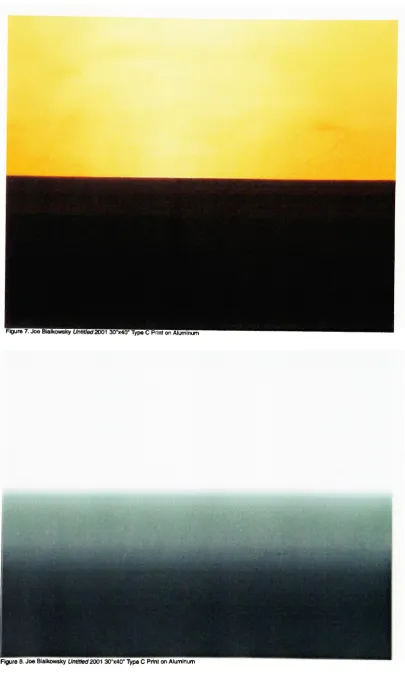
modernism, asthe aesthetics are paramount. Thedouble codingisintheuse ofanyand
allsourcesfortheexecution ofthework. Inone ofthepieces(Figure. 8),thecomputeris
solelyusedtocreatethelandscape. WhentheworkisshownI donotmentiontheuse of
thecomputerbecauseIdonot wantthatsourcetobeconsidered as asubjectofthework.
HereagainI say Iamusingthesource"innocently"withfull knowledgeofits
postmodernimplications,allthewhiledenyingitsimportance. Againinthewords of
Jencks,"Ican'tdenytheconventionalbeauty ofthe past, orthecurrenttechnologicaland
social
reality."
Myimagesareveryformbased, createdusingaformula makingthem
modem,ontheotherhandthe sources are eclecticborderingonsporadic,whichis
postmodern. Whatdifferentiatesthesefromotherpostmodernphotographs,besidesthe
emphasisona modernistaesthetic, isagainthe innocentuseofthesources. The heightof
postmodernappropriation createdtheultimate skepticismregardingthedrive forstraight
forewordoriginalityfoundinthemodernists. Myuse of appropriationisnotavain
attemptto usurpmodernism,butareinsertionof modernism intoimageryderived froma
postmodernworld. Thissaid,I willsay mywork isclosertowhatEdward Rothstein
believeswillbethepostpostmodern,"Postpostmodernismwillbeavarietyof
modernism."12
If IhadtodescribewhatIwantedmythesis tobethroughreferencetomy
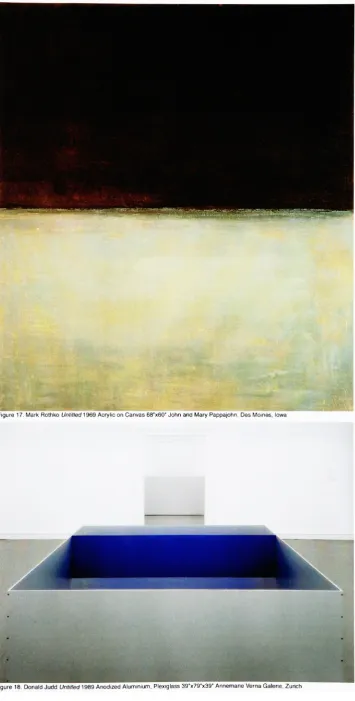
influences, Iwouldsaythis; Iwanttheclean linesandminimal perfection ofDonald
Judd (Figure 18.), IwantthebrillianceofAndreasGursky(Figure 15.),andIwantthe
raw sublimebeautyofMark Rothko (Figures 16. & 17.). These weremygoals. I wantto
start withGursky,because afterseeinghis retrospectiverecently Ifinally understood
12
Rothstein, Edward. Modem andPostmodernthebickeringtwins.The New York Times
16
whatit isthatis sobrilliantabouthiswork. Upuntilthisrealization, I believed onlythat
hemade picturesthatwere somonumentallybigthattheyhadtobegood. ButnowI see
whytheyare sointriguingandwhyhe issobrilliant. Gursky recreatesthe worldin a
wayitcould neverbeseen. BythisI don'tmeanthe transformationoftherealthatis
inherenttoany artwork,butanironyof seeing. Gursky's images seemveryrealandvery
straightforeword. WhatmakesGursky's imagery,"Knock-your-socks-off,"
inthewords
ofPeter Galassi isthat thereis anunderlyingstrangenessto theimagery. They aretoo
perfect. The images havea sharpness andclaritythatishyper-real,thusbecoming
imaginary. Thebestexample ofthisfoundinGurskyandwhichmost echoesmy workis
Rhine II(Fig. 15) InthisimageGurskyfoundanunnaturallystraightsection ofthe
meandering RhineriverinwesternGermany. Inorderto givetheimagea minimalist
perfectionheremovedseveraldistractingelements ofthesceneviacomputer. Theresult
isariver scapehorizonlinethatistooperfectfornature andcanonlybecreatedthrough
Gursky'seyes. This imageis depictingavery natural sceneinahyper-realway. When
one considersthehardstraightlinesofminimalism suchasin Donald Judd'ssculpture, or
Sol Lewitt'swalldrawings, itseemsinoppositionto theorganic shapeofthenatural
world. Thereisamathematical purity intheseworks thatisechoedthroughGursky. The
riverscenedoes notexist, andfurthermorewhatwasnaturalbecomesalandscape builtto
fitthemold of artisticcomposition. Gurskyachievesthesublimeintheway Turnerdid,
buttakingitto anotherlevelthatis so simpleitis brilliant. Like Turner'strain,Gursky
usestechnologyandmoldsitwithnatureina perfectharmonythatevokesthesublime in
bothnature andinman. Inthewords ofthedirectoroftheMuseumofModemArt,
13
17
"Gurskypresents some ofthemost original andimpressivecontributionstorecent
art."14
Bytakingwhat was almostinoppositiontonatureby itslackofemotion,minimalismis
transposedontothenatural worldcreatinga post-industriallandscapethatcombinesthe
bestoflandscapepaintingwiththemost strippeddownformofmodemart.
Iwantmy showtohavethecleanlines and perfection you seein Donald Judd.
(Fig. 18). Theconstruction ofthespacefortheshow wasdone mainlytoremoveany
distractionfromthework. Iwantedthehardand sometimes soft edgeofthehorizonto
dominatethe space, intheway Judd'sboxes dominatea spacewithalmost eerie
simplicity. Bybreakingdown formto amathematicallyprecise workingmethod,Judd
addscomplexityto the form. Galassimakesthemostto thepointdescriptionofthe
overlap betweenminimal andconceptualart, "...rigor ofconception,precision of
execution,and stringentrejectionofostentatiousaffect are notbarrierstodrop-dead
beauty. Onthe contrary,especially inconcerttheycanbeexcellentmeans ofachieving
it."15
Judd's minimalismalsoflowedintotheworkby means ofthehorizon line. In
several oftheimagesfromthisshowtheline is almostperfect, something rarely found in
nature,withthepossible exceptionoftheseascape. Thereis something unbelievably
powerful intherigid simplicityoftheunmarredhorizon. InGurskyandSugimoto (Fig.
14),themoreminimalthe imagebecomes,themore sublimeits impact. God's horizon
line isnot one of mathematicalsimplicity,butoneof chaoticcomplexity, whenit is
reducedto formit becomesthesublimeofman. Thechair ofmy committeecommented,
thatifyoudrawalinethrougharectangle you willhavealandscape. Itistooperfectto
14
Galassi, Peter. Andreas Gursky. NewYork:TheMuseumofModemArt,2001. pg 6.
18
bealandscapebutashumans weare unabletodivorcetheequationoftopandbottom
fromthelandscape.
Thequestion of subject matterhascomeupwhendiscussing mywork. The
subjectisthepoint where earth andskymeetcreatingthehorizon line. Thesubjectisthat
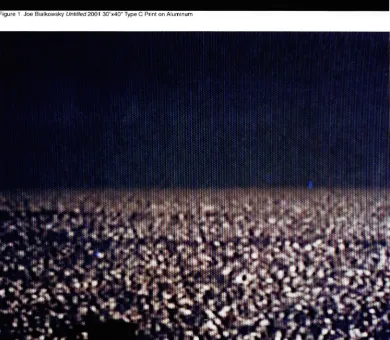
point wherespaceis defined. Theoneimage fromtheshowwithadefinable subjectis
Untitled(Fig. 1). Inthis imagethesubjectis nottheforeground, as itshouldbein a
landscape,butthewingoftheplaneinthe"empty"space abovethehorizon. Thenatural
sublime inthelandscape isthat theearthisman's anddefinableandthesky isGod's
countryandindefinable. Heretheskyis dominatedwiththesubject andthe land is
belowas an afterthought. Again Turnercomestomindinthat thisisthe sublimeofman.
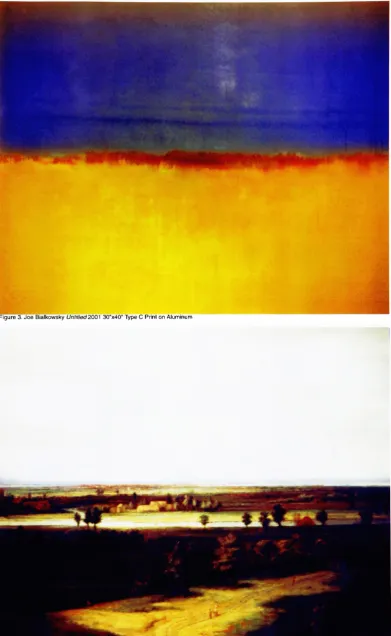
MarkRothkoturnsup inmy workin Untitled (Fig. 3). Mark Rothko'spaintings are
monumentalinthe same scale ofGursky'sphotographs. Rothko'sare sublime insize and
color. They are notlandscapes butthereare landscapesinthem. Rothkotakes simplicity
to theextreme. Foran entirecareerhemade paintings about colorand lightthatnever
became boring. MyimageofRothkoisnotheretocomment onRothko. Iam nottrying
toconvey whatit is liketobenear aRothko,buttoshowtheviewerwhatit is likeforme
tobe in frontof aRothko. By specifically framingaline inhispaintingandchanging
what was ahugeverticalcanvas intoahorizontal photograph, Imakelandscapes within
hispaintings. Youcan not seetheRhine in Gursky'sview withoutthecomputerand you
can not seethehorizonlinein Rothkowithoutmycamera. Thecomputer, forGursky,
removestheelements ofthenaturallandscapethathe founddistractingandthatobscured
thelineofthe composition,withoutthis tool theviewinGursky'smindcouldneverbe
19
fields aredominant. Usingthecameratotransformthe
verticalto thehorizontaland
emphasizingthelinethatseparatesthecolors, alandscapeisbom,whichwaspreviously
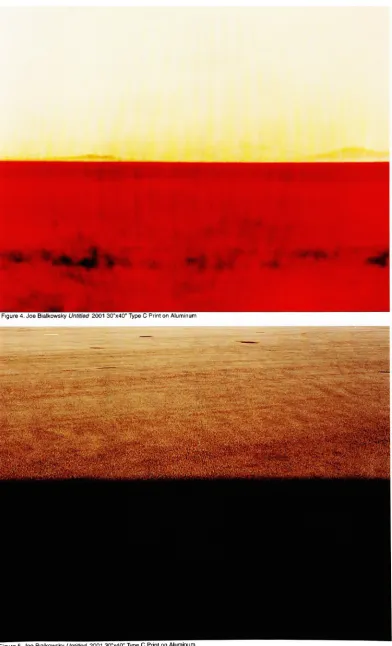
onlyviewedinconcept. A second piecein my showisdirectly influencedbyRothkoand
thatis Untitled(Fig. 6). Itisnotnecessaryto theimagetomakethis connection, butis
important intheway Iconstructanimage. A second, muchdifferent,Rothkoinspired
this image directly. (Fig. 17), is abasiccompositionofdarkoverlight. Whatmakesthis
apaintingofformandcolor, and not alandscape, isthat thedark, orearth,isontopand
thecanvas isvertical. I lookedforthisformin mydaytodaybusinessandfoundit ina shadow on an airportparking ramp. Ididnot needto track thisRothko downto
photographitandtheninvertit. I couldfindit inahugeslab of asphalt. Thelight isnow
ontopwherethe skyshouldbeandit becomesalandscape.
Gerhard Richter (Fig. 13),makes paintings ranging fromfields ofcompletegray,
topicturesque landscapes,tocomplete abstractions. Whilehe maynot admittoit; the
similaritiesbetweentheworksare striking. Onecould arguethathisabstractions arejust
as muchlandscapesashis
"real"
landscapes. Hemakeshispaintingsfromphotographs,
andwhenaskedwhatthey are, hereplies, "I'mnottryingtoimitate aphotograph;I'm
tryingtomake one. And ifIdisregardtheassumptionthataphotographisa pieceof
paper exposedto light,thenIampracticing photographyby othermeans: I'mnot
producingpaintingsthatremind youofaphotographbut producing
photographs"16
Richter is conveyingthesublimethroughpaintingthroughphotography. Theinfluence
hereis intherealizationthat photography is morethanrepresentation. Itis not a new
ideatosaythataphotographtransformsreality. Ofcourse,itcanneverconveythe true
16
Elger,Dietmar. Gerhard RichterLandscapes. Ostfildern-Ruit: CantzVerlag, 1998. pg
20
qualities ofthemomentit depicts. Ithas longbeen knownthatphotographsdolie, ortell
halftruths. What is important forme aboutRichteris hisunderstandingthatbypainting
reality inawaytocreate aphotograph, he is commentingontheintellectual capacityof
photography,andelevatingitto thestatus of painting. Usingpaintingandphotography
interchangeablyallowsthephotographertobeelevatedintellectually. Richteris placing
importanceontheabilityto reproduce arealitythat the artist wishestosee. For me,
photographyhas alwaysbeen barredinthis way. If Mark Rothkopaintingswere
photographs,viewers would always questionthesubject. Paintingisallowedtogo
beyondthesubjectintotherealmoftheabstract withoutthis crutch. Byremovingthis
distinction Richtercan paintlandscapesand abstractions onthesame day. Ina world
wherethephotographedlandscape is overusedandthuslooses itspunch, thepainted
photograph can regain it. I foundthatIneeded pieces ofboth. Icouldcreate a landscape
thatbecomesrealbecauseit isaphotograph,whileretainingthepower ofcreationfound
inpainting. In Untitled(Fig. 4), IphotographedapaintingbytheDutch landscape
painterPhillips Konick. UpuntilthepointI happeneduponhis painting,whilesearching
forVermeer,Landscape 1619. (Fig. 19)I hadneverheardofhim. Whatstruckmewas
howsimplistic andengagingthispaintingwas,especially surroundedbyover painted
landscapes inwhichthelandscape itselfisonlyabackdropto man's activity. My
photographofKonickis innoway acommentonhim,butareaction ofmycamera. Two
interestingsituations developedout ofmakingthisimage. Firstofall, Irealizedthat
Konickwas not sounlikeme. Althoughhemadehis landscapes inthetraditionofthe
natural sublime,he fixedthemtofit hisaesthetic. Whenyouseetheoriginalpainting
21
landscapeswithhills, as thewhole countryis flatterthata pancake. Thesecondsituation
istheinterestingone. Landscapesarehardtoconvey,astheframe hindersthemagnitude
oftheimage. When Iset outtophotographKonick, his framemadeithardformeto
cropouthismountainssoI couldhavemyperfecthorizon line. I comebacktoRichterin
thatashesayshemakesphotographs, I wouldsaythisisnot a photograph of aKonick
painting,buta photograph of alandscape.
The four imagesintheshowtakenfromthe television Untitled, (Fig. 2,4,10,11),
couldbeusedtoconnectthework as a whole. As Istatedearlier, theproblemIfacedas
a new student wasinrecognizingthesignificance ofmyown work. As Ihavealso
stated,simplicity offormand aestheticshave ruledmy methodology for makingwork.
Through makingandtalkingabouttheworkpresentedhere,I realizedthat thecontent
whichIfeltIwaslackingwas embeddedinthe aesthetic,ormoretheretrieval ofthe
aesthetic. Inthesearchfor horizonlines Iwantedtotry asmany sources as possible. It
never occurredtomethat the content oftheworkwas inthewaythe sources were
gathered. I photographedhorizonsonthe televisionbecausethey werethereand
accessible. If Ilookto modernismfor myinfluences,thenitmustbeunderstoodthatit is
throughpostmodern glasses. The landscapeseenthroughthe televisioncanbeseen asan
exampleof aninformation driven societywhere moreworldexperiences are found
throughtechnologyratherthanthroughreallife. Thecreationofanaturalsublime
landscapefromthetechnologicalsublime of massinformationculture,isaresponseto
technology similartoTurner's responseto therailroadage. Where Turnerplacesthe
traininharmony withnature, I have createdthepicturesqueout oftechnologyplacingthe
22
Myworkhas alwaysbeenpositive whetherit dealswithtechnology or nature. There isa
loveofthe timeand culturethatinspired it,asopposedtoso much currentpostmodern
workwhich does nothing butcomplain about social ills andlongsfor
thepastinsteadof
embracingthepresent. DonGrey,an artist andcritic,inaletterto theSenate
Subcommittee onEducationwrote, "is itanywonderthatmostcontemporary artis itself
meaningless andpurposelessexcepttoscoff atsociety and genuineart,and mimicthe
depletedviews ofits creators and adherents? Likeother aspectsofoursociety, such
artisessentially diseased. Itiserodedbypsuedo-creativity,dehumanization,triviality,
venality,and
sterility."1
Ibringthisupatthe end ofthepapertoleaveanimpressionof
themost strippeddownreasonfor my makingwork. Imentionedbeforeafeelingof
creating
"innocent"
workina postmodern world of lost-innocence. This comes froma
longingforbeauty and optimisminart. The generalfeelinginmuchcontemporary
critiqueisthat, artdrivenby optimismandbeautyhas less intellectualpowerthan thatof
"serious"
art. The ideaofthe torturedartistis a cliche andmakingwork withstrong
negativeimplicationswhilecriticizingsomesocial standardismucheasierintellectually,
thanmakingpositiveworkthatlookstoward thefuturewith an openhand.
17
Bibliography
Audi, Robert. TheCambridge Dictionary ofPhilosophy. Cambridge: Cambridge
UniversityPress, 1999. 2nd ed.
Butlin, Martin,andEvelyn Joll. ThePaintings ofJ.M.W. Turner. Vol. 2 New Haven: YaleUniversityPress, 1977.
Cora, Bruno. "Gerhard Richter: TheExperienceofPaintingandtheKnowledgeof Reality"
FromGerhardRichter(Prado: GliOri, 1999)
Elger, Dietmar. GerhardRichterLandscapes. Ostfildern-Ruit: CantzVerlag, 1998.
Galassi,Peter. Andreas Gursky. New York: The Museum ofModemArt,2001.
Gilbert-Rolff,Jeremy. BeautyandtheContemporarySublime. New York: Allworth
Press, 1999.
Gray,Don. Letterto theSenateSubcommittee onEducation. April 5, 1990.
Hegel,G.W.F. Aesthetics: LecturesonFine Art. Trans: T.M. Knox,London: Oxford
UniversityPress, 1975.
Hunter, SamandJohnJacobus. Modem Art: PaintingSculpture Architecture. 3rded. New
York: PrenticeHall, 1992.
Jencks,Charles. Whatis Post-Modernism?: London:Academy Editions, 1989.
Kant, Immanuel. CritiqueofJudgment. TranslatedbyJ.H. Bernard. New York:
Macmillan, 1951.
Rosenblum,Naomi. A World History ofPhotography. New York: AbbevillePress, 1997.
3rd ed.
Ross,Stephen David. Editor. ArtandIt's Significance.Albany: StateUniversityofNew YorkPress, 1994.
Rothstein,Edward. ModemandPostmodernthebickeringtwins. The New York Times
ontheWeb, October21,2000.
Sugimoto,Hiroshi. Sugimoto. New York: Fotofolio, 1993.
Colophon
I wouldliketo thank thefollowingpeoplefor makingthisshowpossible:
MyCommittee:
Chair: Jeff Weiss Dan Larkin
Tim Engstrom Elliott Rubenstein
My ParentsJanieandBill andmy Sister Sarah
Kara Crombie Jim Johnson Andrew Wainio
And
Amanda Bauer
Figure 1 JoeBialkowskyUntitled 200130"x40"
TypeC PrintonAluminum
Figure 2.JoeBialkowskyUntitled200130"x40"
[image:29.513.62.453.343.683.2]Figure 3. JoeBialkowskyUntitled 200130"x40"
TypeCPrintonAluminum
Figure 4.JoeBialkowskyUntitled200130ux40B
Figure 5.JoeBialkowskyUntitled200130"x40"
Figure8.JoeBialkowskyUntitled200130"x40"
[image:32.513.57.463.23.700.2]Figure 9. JoeBialkowskyUntitled 200130"x40"
TypeCPrintonAluminum
Figure 10.JoeBialkowskyUntitled 200130"x40"
M
Figure1 1.JoeBialkowskyUntitled
30"x40"
[image:34.513.62.454.177.491.2]Figure 12. J.M.W TurnerRain, Steam,andSpeed-TheGreat WesternRailway1844Oilon canvass91"x122"
NationalGallery,London
[image:35.513.62.459.362.682.2]Figure 14. Hiroshi Sugimoto CaribbeanSea,Jamaica1980Silver Gelatin Print
Figure 15. AndreasGurskyRhine I1 1999 ColorCPrint 6'81/4"x1V83/4"
Figure 1 6.Mark Rothko YellowandBlue(Yellow.BlueonOrange)1955OilonCanvas102"x66"
Figure 17.Mark Rothko Untitled 1969 AcryliconCanvas68x60''
JohnandMaryPappajohn,DesMoines,Iowa
=igure 18.Donald JuddUntitled1989 Anodized Aluminium, Plexiglass
39"x79"x39"
Untitled 30"x40" C print
on aluminum
JoeBialkowsky2001
Untitled 30"x40" Cprint on aluminum
JoeBialkowsky2001
Untitled 30"x40"
Cprint
onaluminum
JoeBialkowsky2001
Untitled 30"x40"C print
onaluminum
Joe Bialkowsky2001
Untitled 30"x40"Cprint on aluminum
JoeBialkowsky2001
Untitled 30"x40" Cprint on aluminum
Joe Bialkowsky2001
Untitled 30"x40"Cprint on aluminum
JoeBialkowsky2001
Untitled 3Q"*4Q" Cprint onaluminum Untitled 30"x40" Cprint onaluminum
JoeBialkowsky2001 JoeBialkowsky2001
Untitled
30"x40"
Cprint
on aluminum
-I
9 JoeBialkowsky2001
Untitled 30"x40"Cprint on aluminum