Rochester Institute of Technology
RIT Scholar Works
Theses
Thesis/Dissertation Collections
12-1-2003
Maximizing the capability of wireless sensor
networks
Cory Cress
Follow this and additional works at:
http://scholarworks.rit.edu/theses
This Thesis is brought to you for free and open access by the Thesis/Dissertation Collections at RIT Scholar Works. It has been accepted for inclusion in Theses by an authorized administrator of RIT Scholar Works. For more information, please [email protected].
Recommended Citation
Rochester Institute of Technology
MAXIMIZING THE CAPABILITY OF WIRELESS SENSOR NETWORKS
A Thesis
Submitted in partial fulfillment of the
requirements for the degree of
Master of Science in Industrial Engineering
in the
Department of Industrial
&
Systems Engineering
Kate Gleason College of Engineering
by
Cory D. Cress
B.S., Industrial Engineering, Rochester Institute of Technology, 2003
DEPARTMENT OF INDUSTRIAL AND SYSTEMS ENGINEERING
KATE GLEASON COLLEGE OF ENGINEERING
ROCHESTER INSTITUTE OF TECHNOLOGY
ROCHESTER, NEW YORK
CERTIFICATE OF APPROVAL
M.S. DEGREE THESIS
The M.S. Degree Thesis of Cory D. Cress
has been examined and approved by the
thesis committee as satisfactory for the
thesis requirement for the
Master of Science degree
Approved by:
Dr. Moises Sudit
MAXIMIZING THE CAPABILITY OF WIRELESS SENSOR NETWORKS
I,
Cory
D.
Cress.
hereby grant permission to the RIT Library of the Rochester Institute
of Technology to reproduce my thesis in whole or in part. Any reproduc;tion will not be
for commercial
te or profit.
ACKNOWLEDGEMENTS
Iwouldliketoextend sincerethanks tomythesiscommitteemembers, Dr. Moises Suditand
Dr. S.
Jay
Yang. Dr. Suditwasvery helpful withmythesisinprovidingme withhisexpertisein OperationsResearchandDiscrete Optimization. His superiorknowledgeand
experiencein OperationsResearchwasinspiring. Dr. Yang's
dedication,
patience,andattentiontodetailwereincredible. His hardworkand enthusiasm aboutthis thesismotivated
metoachieve alevel of successbeyondmyexpectations.
Also,
Iwouldliketo thankJacquelineMozrall,
MarilynHouck,
andtherest ofthefaculty
and staffintheIndustrialandSystems
Engineering
DepartmentatRIT;
yourdedicationtoyour studentsisunparalleled.
Finally,
Iwouldliketo thankmyfamily
foralwaysbeing
supportive of me inall ofmyacademic endeavors. Icannot putintowords, thegratitudeIhave foryou. Thankyou so
Abstract
Wireless micro-sensors introduce a new frontier in sensing devices and data acquisition
capabilities. These sensors, capable of sensing, processing
data,
and short-rangecommunication, can be spread over regions to form ad hoc wireless sensor networks
(WSN)
so as to deliver aggregate information from geographically diverse areas. Thisaggregate datagatheringandprocessing inducesa synergistic effect and enables a sensor
network to complete sensing tasks that may never be feasible using a single, perhaps
powerful, sensor. This new paradigm in sensing devices is not without many
fundamental challenges, one
being
a constrained energyresource, which firstneed to besolvedbeforethe truecapabilities ofthesenetworksmayberealized.
This thesis will discussthe models andtechniques developed as an attempttomaximize
the capability of a WSN. The premise used in the research is that the capability of a
WSN can be maximize
by developing
a scheme that can duplicate the optimal energyefficient behavior ofindividual wireless sensors in a contention
dominated,
distributeddecision-making,
network environment. This optimal energy efficient behavior asdetermined
by
an analytically derived model and a mixed integer programming modelwill be presented. The analytical model enables the optimal sensor behavior to be
calculated given a contention-less environment, and the integer programming model
determines the optimal ON/OFF/transmission schedule for each sensor in a contention
dominatednetwork,overtime.
Finally,
theoptimal behaviorfound inthe twomodelshasbeen converted into a preliminary heuristic protocol that coordinates sensors in "real
time."
The
key
aspects ofthis protocol along with itseffectiveness, as compared to theTABLE
OF CONTENTS
1. INTRODUCTION.
1.1 OverviewofMicro-sensor Architecture 2
1.2Literature ReviewonEnergy Efficient WSN Operations 4
2.
PROBLEM DESCRIPTION
6
3. OPTIMAL
SENSOR BEHAVIOR
8
3.1 Continuous ON Scheme 9
3.2ON/OFF Scheme 1 1
3.3 ComparisonofContinuous ON SchemeandON/OFF Scheme 15
4.
NETWORKED
SENSOR BEHAVIOR
18
4.1 SolutionofSmallNetworks 21
4.2 EffectofArrival Pattern 24
4.3 EffectofBuffer Size 25
4.4 EffectofNetwork Service Capacity 28
4.5EffectofNetwork Connectivity 29
5.
HEURISTIC DEVELOPMENT
31
5.1 HeuristicCapabilityAssessmentthroughSimulation 35
6. CONCLUSIONS
AND FUTURE WOIUC
39
REFERENCES
42
APPENDIX
44
-TABLE
OF
FIGURES
Figurel.l Architectureof wireless sensor 2
Figure3.1 Bufferutilizationfor a sensor turningONandOFFperiodically through itslifetime.1 1
Figure3.2Dataretrieved by using theContinuous ONscheme and theON/OFFschemewith
differentnumbers ofON/OFFperiods;also shown is the maximum delayassociatedwith the
ON/OFFSCHEME 15
Figure 4.1 Thesensor-gatewaybipartitenetwork model 19
Figure4.2 Themixedintegerprogramming model for bipartite sensor-gatewaynetworks 20
Figure4.3 Datatransmittedovertime forone of the sensors on a4-2 (SensorstoGateways)
bipartitenetwork,whentheon/offschemeandthecontinuous onschemeareused 22
Figure 4.4 Bufferutilizationover time for one ofthebasemodelsensors inabipartite network
demonstratingon/offbehavior 23
Figure4.5 Theamount of data retrieved by a4-2bipartitenetwork withrespect to the various
arrival patterns 24
Figure 4.6 Dataretrieved bya4-2bipartitenetwork withrespect tobuffersize solved optimally
foron/offscheme,and analyticallyfor bothon/offscheme andcontinuousonscheme.26
Figure 4.7 Networkretrieval capability of a5-3bipartite networkasafunctionof the network's
totalretrieval capability per second 28
Figure 4.8 Fromtheleft,a fully connectednetwork,a(2,2,1)network,anda(3,1,1)network 30
Figure4.9 Totalnetworkretrievalwith respecttobuffersizefornetworks with differing
connectivity levels 30
Figure5.1 Sensorheuristic flow chart(left)andgateway heuristic flowchart(right) 32
Figure 5.2 Bufferutilizationover time of a single sensorina4-2bipartite network based on the
MIPmodeland the simulatednetwork under heuristic control 36
Figure 5.3 Networkdataretrieve with respect to thebuffersizebasedon theheuristic,the single
1.
Introduction
Wireless micro-sensors introduce a new frontier in sensing devices and data acquisition
capabilities. These sensors, capable of sensing, processing
data,
and short-rangecommunication, canbespread overregionstoformadhocWireless Sensor Networks
(WSN)
that deliver aggregate information from geographically diverse areas. This aggregate data
gathering and processing induces a synergistic effect and enables a sensor network to
completesensingtasks thatmayneverbe feasibleusingasingle,perhapspowerful, sensor.
Technological advances in Integrated Circuit
(IC)
fabrication and Micro-ElectronicMechanical Systems
(MEMS)
have enabled wireless sensors to be made atthe micro scale.Meanwhile,
the price ofmaking these devices has also been reduced. These reductions insize and cost have made self-organizing ad hoc networks of thousands of sensors
theoretically
possible.However,
unlike themechanical and electronic devices thatmake upwireless micro-sensors, an inexpensive small scale power supply,
i.e.,
abattery,
capable ofsustaining a micro-sensor for many years is still under development. In order to continue
making smaller and less expensive sensors, smallerbatteries supplying less energy are used
sincethereare no other options. Theuseofthesebatteriesrestrictsthe totalenergy supplyof
each sensor, which, in turn, constrains the energy supply that is available to the entire
network. With energy at apremium, the
key
to achieving the maximum capability from aWSN is to determine howto optimize the energy usage at the individual sensor level such
thatthemaximum amount ofdatacanberetrieved atthenetworklevel. Twoaspects
impact
how network capability canbe maximized subject to individual sensor resource constraints:
the architecture ofindividual micro-sensorsandthe networklevel operations. The
following
1-two sections provide an overview of wireless micro-sensors and a summary of existing
networklevelapproachesthatattempttominimizeenergyconsumptions.
1.1 Overview
ofMicro-sensor
Architecture
Well
known,
modern sensingdevices,
or nodes, include COTS Dust and Smart Dustdeveloped
by
UCBerkeley,
UCLA's wireless sensing node termedWINS,
Rockwell's nodealso named
WINS,
and Sensor Websby
JPL [17]. These developerstypically
useoff-the-shelf components to design their nodes. This strategy makes the nodes modular and easily
adjustable; howeverthe choice of component can
drastically
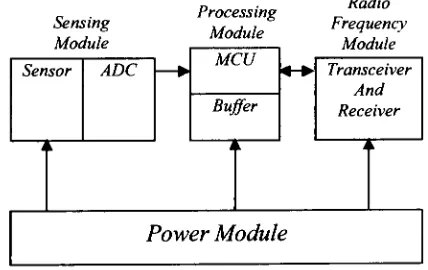
alter the performance, energyconsumption, etc., ofthe final device. Mostnodes are comprised of a powermodule, radio
frequency
module,sensingmodule,andprocessingmodule[1],
as shownin Figure 1.Sensing Module
Processing Module
Radio Frequency
MCU
Sensor ADC ? 4rt> Transceiver And Receiver Buffer
tk iL t i
[image:11.540.154.368.388.523.2]Power Module
Figure 1.1 Architectureofawireless sensor.
The power module shown in Figure
1.1,
supplies the energy to each ofthe other modules.The sensingmodulecontinuouslycollects
data,
convertsit from ananalogtoadigital signal,andthen passes itto the processing module. The data is processed
by
the Micro ControllerThe RF module isthe only partthe sensing device that is
directly
affectedby
other sensorscontending for access to a communication channel or a data collection gateway. It also consumes a significant amount ofthe overallenergyprovided
by
thepower module. Infact,
studies inthepast have shownthattransmitting
1 bitover 100 meters consumesroughlythe same amount ofenergy as executing 3000 instructionsby
the MCU[10],
which ishighly
significant. A plus side to the RF module is that its complexity, transmission rate, transmission range, reliability, etc., may all be adjusted to meet specific requirements andtherefore enhanced capabilities may be sacrificed in order to conserve energy.
Many
RFmodules also have the capability of operating in different energy consumption modes,
including
sleep,idle,
receive, andtransmit modes [13].The sleep mode, which will also be referred to as the OFF mode, consumes a negligible
amount ofenergyandis
typically
usedduring
inactive periodsto conserve energy. The idle modeisthemode inwhich theRFcircuitisturnedONyetthe transceiverisnotreceiving ortransmitting
data. To switch from OFF toON,
an amount of spike energy is consumed and has beenshowntobequite significant [18]. Asaresult,one must usetheenergy conservingOFF mode cautiously since switching between ON and OFF may result in a larger overall
consumption due to the spike energy. In the ON mode,
however,
the sensor can switch betweentransmitand receive modes withoutconsuming anyspike energy.Thetransmitmodeisused
by
the transceiver to senddata,
and consumes a significant amountofenergyinadditiontothat consumedintheON mode.
Finally,
thereceivemode, similarto the transmit mode, consumes energy in addition to the ON mode consumption,however
3-consumesonlya small amount of additionenergy [19]. Alsonote thatthereceive mode and
the transmitmodebothrequire theuse ofthetransceiverand, therefore, cannotbe preformed
simultaneously.
Over the lifetime of a sensor, the majority ofthe sensor's energy is
typically
consumedby
the RF module, thus the focus of a sensor or network operational model should aim at
understanding howthis module consumes energy
during
theOFF, ON,
andtransmit modes.Also,
in a"multi-hop"
network, where data is relayed through multiple sensors before
reaching the final
destination,
the receive mode should also be considered in the model.Finally,
the spike energy needs to be considered in a model so that switching between theOFF mode and the ON mode can be investigated under realistic energy consumption
conditions.
1.2 Literature Review
onEnergy
Efficient WSN Operations
Many
methods forreducinga sensor'senergyconsumption havebeen proposedin literature.In general, these approaches can be divided into one of two categories. The first set of
approaches
indirectly
reducesthe amount ofenergy spentby
the RFmoduleby
routing datathroughout a network using the most energy-efficient paths.
They
focus on "multi-hop"networks inwhich datamay
jump
from sensorto sensoruntil itreaches its final destination.Inessence, thisset of worklooksat waystobalance dataflowsovertheentire networkinthe
steady state, such that the amount of energy consumed
by
each sensor's RF module isroughly the same. Optimal steady state solutions have been found for models seeking to
for models aiming atmaximizing the data retrieved overthe entire network
[6]
[12]. Thesesteady state models provide information abouthow data shouldbe disseminated throughout
the network on average overthe network lifetime andprovide innovative methods for how
WSNoptimization models maybedeveloped.
Yet,
they
do not provide adequateinformationthat would enable sensors to make decisions in real time and do not account for the spike
energy sincethe model is developed forthe steady state,
i.e.,
no switching between OFFandONmodes.
The second set ofapproaches taken to reduce a sensor's energy consumption is to
develop
efficient Medium Access Control
(MAC)
protocols that create more efficient transmissionschedules
by
utilizing the different energy modes of the RF module. These protocols[13][18][19][20]
mostlymakedecisions withregardto switchingthe RF module of a sensorbetween transmit mode and OFF mode and generally achieve significant performance
improvementswhencomparedtoschemesthat
keep
the sensorin ONmode ortransmitmodeat all times. This set ofwork,
however,
does notaccountforthedatathat hasbeen collectedby
the sensing circuitry and often overlooks the spike energy consumed. In addition, theseprotocols focus on
heuristically finding
the compromise among the various energyconsumption factors but lack a theoretical foundation to compare actual performance with
maximum performance capabilities.
2. Problem Description
Theapproaches reviewed intheprevious section offerinvaluablelessonsonhow energycan
be conserved, either
directly
orindirectly,
by
the RF module. Yetthey
are not capable ofdetermining
how each networked sensor should turnON,
OFF,
or transmit over time, suchthat the networkcapability is maximized. For
instance,
the firstapproach,least-energy
dataflows,
provides a good method for modeling a sensor network environment,i.e.,
theoptimization model.
Yet,
theoptimal results obtained arelimited sincethey
lackinformationaboutthebehaviorofthesensors overtime. As forthe second approach, theMACprotocols
are capable ofconserving energy
by
making the sensors behave more efficiently overtime.However,
these protocols are based on single sensor power consumption models andtherefore do not accurately incorporate the impact of contending sensors in a network
environment. The
inadequacy
ofbothoftheabove approachesis thatthey
attempttosolve aspecific problemratherthan
looking
atthebroadchallenge.Theresearchinthis thesisattemptstomaximizethecapabilityofaWSN
by
determining
howthe optimal energy efficient
behavior1
ofindividual wireless sensors can be duplicated in a
contention dominated network environment.
Using
the contributions of other research asreference, various modeling approaches are used to determine the optimal sensor
behavior.
First,
an analytically derived model is developed to determine the optimal single sensorenergy efficient behavior given an optimal environment,
i.e.,
no contention among sensorswhentransmitting. Two schemes:
first,
sensorsarekept ON at alltimesandsecond, sensorsare switched between ON and OFF modes, are examined in this model. For the second
1
scheme where sensors are turned ON and
OFF,
the effect ofbuffering
data for a variableperiod oftime and allowing sensors to transmit at the most efficient time is explored. In
addition, the spike energy and other realistic energy parameters are accounted for in this
model.
This single sensorbehaviormodel, dueto the fact that itrepresent the ideal case, serves as
the theoreticalbounds incomparisontoresults obtainedina network environment andresults
obtained viasimulation models. Thisthesisproposes amixedinteger programmingmodelin
a dynamicregime. Thismodel, which accountsforrealistic energy consumption parameters
and
buffer,
determines the optimal ON/OFF/transmission schedule, orbehavior,
of eachsensor over time. These results may then be used to better understand how a contention
dominated network environment affectsthe optimal, contention-less, single sensorbehavior.
After
developing
a baseline contention model solution, the effect of independent factorsincluding
buffer size, arrival pattern, service capacity, network connectivity, and receivingduty
cycle are evaluated with respectto thebaselinemodelcapability.Knowing
the optimal transmissionschedules overtimeenables thisbehaviortobe convertedto a distributed decision making heuristic. A heuristic ofthis type is a set of rules that
enables a sensorto
independently
schedule whento turnON,
turnOFF,
andtransmit inrealtime. It isanimportantextension,asitwill enable asensortobecapable ofadjusting toreal
world changes on-line. Future research may include the development of a MAC protocol.
To conclude this research,
however,
simulation results for sensors controlledby
a3. Optimal Sensor
Behavior
The analyticallyderived model usedto investigatethe optimal single sensor energy efficient
behavior will be discussed in this section. This model is developed assuming an optimal
communication scenario.
Therefore,
thediscussion begins withadescription ofthemodel'soptimal conimunicationscenario,variables, andenergyparameters. Thiswill be followed
by
a comparison oftwo schemes, one inwhichthe RF module ofthe sensoris ON at all times,
and a second schemeinwhichtheRFmoduleisturnedONandOFF. Thegoal ofthismodel
is to investigate the optimal sensor behavior over time when
buffering
of sensed data isallowed.
The best communication scenario for a sensor in a sensor network is to always have full
access to a data collection gateway whenever it is needed and to have every bit ofdata
transmittedreachthedestination successfully. Full accesstoadatacollectiongatewaycould
be achieved through other sensors;
however,
this multi-hop capability is ignored in thismodel. This best scenario is assumed forthis model and the amount ofdata a sensor can
sense and transmit to adatacollection gateway (or gateway in short) giventhe total energy,
elol , available for the sensor, will be investigated. Let thetotal amount ofdataretrieved
by
thegateway beR=
\U(t)dt
, where
U(t)
<// istheamountofdatatransmittedby
the sensorattimet, and jj. is themaximumtransmissioncapacityofthesensor. Also let k< /j. bethe
fixed arrival rate of the sensed data. For the different energy consumption parameters,
keeping
the RFcircuitON foronetimeunitisdesignated,
e0, theenergy fortransmitting
oneandtheenergyconsumedforswitchingtheRFcircuitfrom OFFtoONis
designated,
e., also
referredtoasthe spike energy.
3.1 Continuous
ON Scheme
First consider the case where a sensor has its RF circuit remain ON at all times. The
following
claim showsthat the totaldataretrieval underthisscheme,Rcomon
,isindependentoftheamount ofdatathatisretrievedateachtimeperiod.
Theorem 1: The maximum amount of data a sensor can retrieve when a sensor is kept
Continuously
ONoveritsentirelifetimecanberepresented as:RCotON
=(31)
Proof: Let Tbethelifetimeofasensor.Thenthe totalenergyconsumed,elol, andtheamount ofdata
toberetrieved,
Rc0>uON
,are1 i
=esT+e0T+
et
ju(k)dk
andRConiON
=ju(k)dk
lc=0 k=0
Basedontheassumptionthatno senseddataislostandthebuffer maynotbeover
filled,
onecandeterminethat
IT-B<
[u{k)dk
<XTA=0
where,B, isthebuffersize ofthesensor. Let \U(k)dk=XT-8
; where 0<8<B. Onecan
k=0
therefore rewrite, etot=
esT+e0T+et(kT-S), whichleadsto
T=
jt2L
+
eIS__
es+e0+ e,A
Now,
one can rewrite RcomON as afunctionof8,RContON
= kT - Setotk + etkS es8 + e0S + etkS
es +eo + et^ es + eo + et?i
=
etot^ ~S(es +eo)
es+eo+etx
Clearly, RcontON
ismaximizedwhen,8
0 andthemaximumdataretrievalk
^ContON
~7*eto/ es+e0+etk
I
This result is dueto the simple fact that the cumulativeamount ofdatathatcanbe collected
at any point in time cannot be greater than what has been sensed.
Apparently,
one way toachieve this optimal performance is
by
simplyletting
U(t)
=k,
Vr>0,
i.e., transmitting
whatever is sensed
immediately
upon arrival. This policy is referredto as the "ContinuousON"
Bits ti
B
X
\>--'-N..,'X
Toff
1T [image:20.540.55.476.59.171.2]on Time
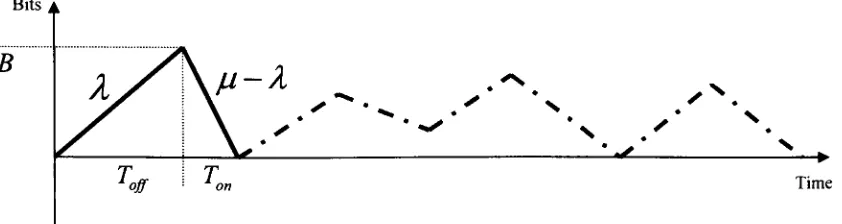
Figure 3.1 BufferutilizationforasensorturningONandOFF periodicallythroughits lifetime.
3.2 ON/OFF Scheme
In contrast to the Continuous ON scheme, one may utilize the buffer space, to
temporarily
storethesenseddatawhiletheRFcircuitis
OFF,
andthen turn the RFcircuitONtotransmit,perhaps at full capacity forone or many consecutive time periods, as shown in Figure 3.1.
To understand what constitutes an optimal
behavior,
the energy expenditure of a generalnetwork without any contentions,
i.e.,
sensor can transmit data whenever itdesires,
isanalyzed, given a fixedamount of
data,
R
,toberetrieved. Thefollowing
equation representsthelowerboundonthe total energy,
^lb
,consumedunderthissetting:R R
eLB=ep+es,-+
eo +etR
k jU
To minimize the spike energy, a single OFF/ON cycle is assumed, which leads to a single
spike inenergy,
ep
,i.e.,
the firstterm ofthe aboveequationabove. The secondterm oftheR
equation,es
y
, represents the minimum amount of sensing energy that could be used,by
assuming that the sensor will completely drain its buffer and completely consume all ofits
energy atpreciselythe same time.
Assuming
themaximum transmitcapacity,M, is utilizedR
forevery
transmission,
the thirdterm,
eo , representsthe minimum ON energy consumed Mby
the sensor.Finally,
theamount ofenergyto transmit R units ofdata is simplyafactoroftheamount ofdataandtheenergyconsumedper
bit,
etR.Basedon the equationabove, one can derive the
following
resultforthe optimal amount ofdatathatcanberetrieved,
RON/OFF
,by
anON/OFFschemeina network without contentions.Theorem 2: The largestamount ofdatathatcouldberetrieved
by
asensorusingandON/OFFscheme, RON I OFF-IS
RON I OFF ~
ietot-ep)
es eo
+ +.,
(3.2)
k /U
Proof: Considerthelower boundenergydescribedabove,
,
RONIOFF
RON
I OFFR +eo
etRON/ OFF
A Ll
'-tot ^ *LB ~
ep
^"ses eo etot
-ep
+&ON
I OFF~7~+ +
et V A J*
RONIOFF
\etot
-ep)k fi
A logical progression from this
finding
is to determine whether there exists a simpleanswerisyes,
by
having
thesensor complete one andonlyone"full ON/OFF cycle."Afull
ON/OFF cycle starts with a sensor
being
OFF,
storing any data it senses in itsbuffer,
andthen iluTiing ON and
transmitting
continuously until the buffer is empty. Note that theoptimal
RONIOFF
is achieved ifthe sensor's energy is completely expended at exactly thesame time the buffer is expended. To complete a full ON/OFF cycle, a buffer of sufficient
capacityisrequired.
Although the cost of memory has become relatively
inexpensive,
it is still necessary toinvestigatetheactual amount of storage requiredtocomplete afull ON/OFFcycle. In
fact,
abuffer size of this magnitude may lead to an unacceptable amount delay. A natural
progression of Theorem 2 allows the derivation of the buffer size required to
achieveRONIOFF.
Corollary
1: LetB*
represent the smallest buffer size required
by
a sensor to achieve itsmaximumdata retrieval capability in a contention-less environment,
ande^
>0,
then,
*
(/J-Wetot-ep)
D =
e0+Me,+jes
(3.3)
Proof: Considerasensorthathasabufferof size
B,
andfollowsafullON/OFFtransmissioncycle.Thetotaldataretrievable,
R,
achievableby
thissensorisR=d
B ^
H-X)
Giventhat R^
ron/off
andTheorem2,
itcanbeconcludedthatetot
ep
1 1
=R
ONIOFF >R =ju
-es+/uet+e0
B
yH~kj
(etot-epr(M-A)^B*^B
es+fiet+e0
Basedon Theorem 1 and Theorem
2,
one can also determinethe condition (as afunction oftheenergyparameters, arrival rate,and servicecapacity) forwhichtheON/OFF schemewill
retrieve agreater amountofdatathan theContinuous ON scheme, orR*ON/OFF >
R*Co
^ContONCorollary
2: A sensorusingtheoptimalON/OFF schemewillretrieve a greater amount ofdatathantheoptimalContinuous ONschemeifandonly if
, M
~ A, .
ep
^etot
(
)
H e0+es+ etk
(3.4)
Proof: ConsidertheoptimalContinuous ONscheme
(3.1)
andtheoptimalON/OFF scheme(3.2).k
\etot
ep)
_D* _
V
~
KON I OFF - KContON
es eo
k //
J
\etot ~
eP
)
k
e0+es +etk tot
>
e0+es+etk 'tot
=> -e_ >
e0+es+etk
^eD ^etot(-
)
Ktot
ess eo + +e.
k jU
-tot
n ^tOtV ' .
3.3
Comparison
ofContinuous
ON
Scheme
andON/OFF Scheme
The above results canbeusedto determine whether employing an optimal ON/OFF scheme
is beneficial (as compared to the Continuous ON scheme), and to detemiine the maximum
amount ofdatathat may beretrieved
by
usingthis ON/OFF scheme. Howevera significant,or perhaps unrealistic, buffer space may be required to construct a single ON/OFF cycle
throughout the sensor lifetime.
Moreover,
asthe buffer sizeincreases,
the queuingdelay
ofthe sensed data also
increases,
which may pose yet another problem from the application'sperspective. One waytoaccommodate a smallerbuffersizethan theone showninFigure 3.2
is to have multipleON/OFF cycles foran ON/OFF scheme. One caneasily derive the total
[image:24.541.53.503.454.650.2]amount of retrieved data for a multiple ON/OFF cycle scheme based on
(3.2)
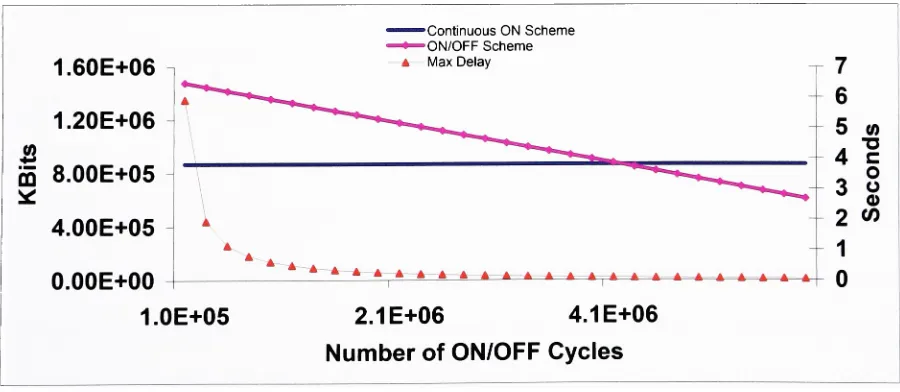
and (3.3).Figure 3.2 exhibits the amount of data that can be retrieved
by
using the two schemes:Continuous ONandON/OFF withrespectto thenumberofON/OFF cycles. The maximum
queuing
delay
associatedwithusing such ON/OFF schemes isalso shown in Figure 3.2 andisalso plotted withrespectto thenumberofON/OFFcycles.
1.60E+06
1.20E+06
fi
8.00E+05 __4.00E+05
0.00E+00
ContinuousON Scheme ON/OFFScheme
MaxDelay
1.0E+05 2.1E+06 4.1E+06
NumberofON/OFF Cycles
Figure 3.2 Data retrieved
by
using the Continuous ONscheme and the ON/OFF scheme withdifferent numbers ofON/OFF periods; also shown is the maximum
delay
associated withthe ON/OFFscheme.Parameter Value Units
X 2 Kbit/sec
V 10 Kbit/sec
es .01 J/sec
eP .001 J
e, .0005 J/Kbit
eo .012 J/sec
[image:25.540.193.352.59.198.2]etot 10,000 J
Table 3.1 ModelParameters
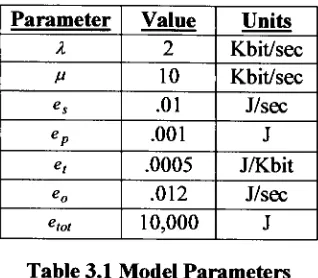
To plot Figure
3.2,
the set of parameters shown in Table 3.1 were considered. Theseparameters were derived based on the information provided in
[4]
[13],
for the purpose ofexhibiting the realistic performance achievable
by
a wireless micro-sensor. Sensors fordifferent sensing purposes, whichhave adifferent RF
implementation,
may have a differentset of parameters.
However,
thegeneral performance trendis foundto remain consistentfora large variety of parameter choices. Given the set of parameters shown in Table 1, the
maximum possible retrievable amount of data is found to be about 1500 Mbits for the
ON/OFF scheme with a single ON/OFF cycle (not shown in Figure
3.2),
and about 870Mbits (the constant line shown in Figure
3.2)
for the Continuous ON scheme. The buffersize and the queuing
delay
associated with the single ON/OFF cycle scheme however areunrealistically large
-about 1.2 Gbits and 7 hours worthofdelay.
By
stretchingthe sensoroperation into more and more ON/OFF cycles, it is foundthatthe retrievable data decreases
linearly,
while the maximumdelay
decreases much more quickly as a reciprocal functiontothe number of ON/OFF cycles. Notice that the ON/OFF scheme is capable ofretrieving
moredatathantheContinuousONschemeuntilthenumberofON/OFFcycles reaches about
4.2 million. Atthis point abufferofonly 160 bitswould berequired, which resultsin about
scheme is at, perhaps, 1 million ON/OFF cycles, where a significant amount ofdata (1340
Mbitsout of possible 1500
Mbits)
canberetrieved whilethedelay
isdroppedsignificantly toabout 500millisecondswiththebuffersize
being
about 1 Kbit. Thisset ofnumerical resultssuggeststhe superiorityof an ON/OFFscheme overtheContinuous ON scheme, evenwitha
quitelargenumber ofON/OFFcycles.
4.
Networked Sensor
Behavior
The analysis in the previous chapterhas suggest that a sensor should store as much sensed
data as possible and then transmit at full capacity, as
long
as the sensor is capable oftransmitting
toadatacollectiongatewaywheneverit desires. Inanetworksetting,however,
multiple sensorsmaycontendforthe same wireless communication channel ofeachgateway;
thus, the full ON/OFF cycle described in the previous sectionmay not be feasible. In this
chapter, the optimal, contention
dominated,
networked sensor behavior is investigatedby
consideringa mixedinteger programmingmodel. Thistaskisaccomplished
by
analyzingthebehavior ofthe sensors in a baseline model. With the behavior ofthe baseline contention
model solution
determined,
theeffect ofthebuffersize, arrivalpattern,networkconnectivity,and service capacity, are evaluated with respect to the baseline model behavior and
capability.
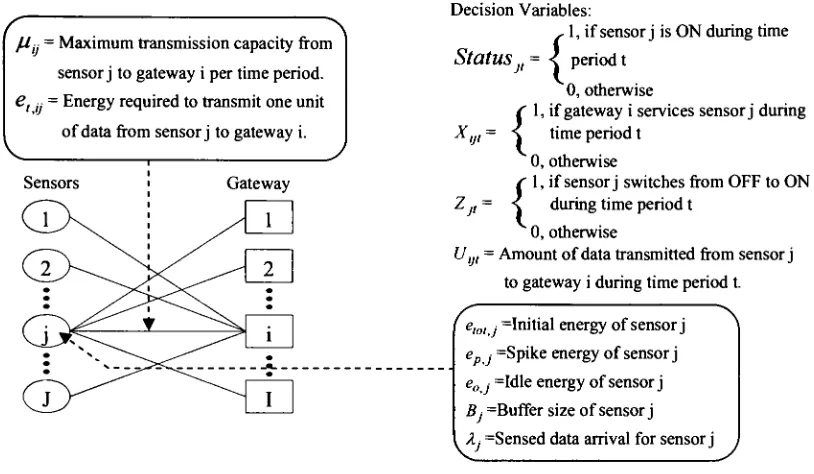
The interaction among gateway sharing sensors is modeled using a bipartite network, as
shown in Figure
4.1,
in which one set ofnodes represents the sensors and are connected tothe other set of nodes representingthe gateways. This simple bipartite structure allows the
focusto beplaced onthe ON/OFF behaviorofthe sensorsthatare contending fora common
gatewayaswell as those thatmay be serviced
by
multiple gateways. Althoughitseems likea simplified sensornetwork, thebipartitenetwork modelcanbe viewed asthe
building
blockJUy
=Maximumtransmissioncapacityfrom
sensorjtogatewayipertimeperiod.
etj
=
Energyrequiredtotransmitone unit
ofdata fromsensorjtogatewayi.
Sensors Gateway
Decision Variables:
, 1,ifsensorjis ONduringtime Statusji < periodt
A'
{
{
0,otherwise
1,if gatewayiservices sensorj during
timeperiodt
0,otherwise
1,ifsensorjswitchesfrom OFFtoON duringtimeperiodt
0,otherwise
U,.,=Amount
ofdatatransmittedfromsensorj
ii
togateway iduringtimeperiodt.
elolj=Initialenergyofsensorj
epj=Spikeenergyof sensorj
ej=Idleenergyof sensorj
[image:28.540.43.450.46.283.2]Bj
=Buffersizeof sensorjkj
=SenseddataarrivalforsensorjFigure 4.1 The sensor-gateway bipartitenetwork model.
Tounderstandin depth how contending sensors shouldbehaveovertime,
"time"
isadiscrete
variable in the mixed integer programming model. The notation defined in the previous
section is
followed,
and extended with subscripts to indicate the associatedsensor
{j; j
=\,...J}
, gateway
{/';
i =1,.../}
, andtimeperiod{t;
t =\,...T}
. Figure 4. 1 showsthevariablesand constants that defineall datathat willberepresented inthemodel. Figure 4.2
defines the objective and constraints of a
fully
comprehensive mixed integer program.Notice that the arrival rate is now generalized to
kp
, enabling a variable amount ofdata toarrive atdifferenttimeperiods. Inadditiontocreatingavariable
Ul]t
thatcorrespondsto theamount of data transmitted from sensor
j
to gateway i at time t, threebinary
decisionvariables are introduced. The first decision variable,StatusJt , is used to represent whether
sensory is ON
(1)
or OFF(0),
attime t. In order for a sensorto transmitdata,
the sensor/
mustbe
ON, Status,-,
=1,
attime tanditmusthaveaccesstoagatewaywhich means one of19-its datapaths,XiJt, must equal 1 andthe rest mustbe
Xikt
=
0,
V&* / . To accountfor thespikeenergy, the value of
ZJt
is setZjt
= 1 whenthesensoryturns ON attimet after
being
OFF at time t-\, and remains 0 otherwise. It should be noted that the combination ofthe
binary
variables with the linearvariablesUiJt
ina single model, results inthe mixedintegerpropertiesoftheproblem.
The mixed integer programmingmodel ispresented inFigure 4.2. Notice that the objective
function of the model is to maximize the total data retrieved
by
the network given amaximumtime T. This will result in creatinga
binary
search process overtimeT,
betweenfeasible andnon-feasible modelswith
differing
valuesofT.i"=l j=\ r=l
suchthat,
j=i
Vi&Vf,
Status,
Z^Xy,, y/&vr,Z, >Status
Jt
-Status
7(,_1}, V/&Vf,
U1Jt<rlIJXIJt
V/&V;&V?,1=1 =1 1=1 (=1
\fj&VS=1,2,-T
,
i=i 1=1 i=i
V/& VS=1,2,..J ,
TIT T
Thisobjectivemaximizesthe totaldatatransmitted.
Sensorsarelimitedtoaccess 1 gatewayat atime.
SensorsmustbeONtoaccess agateway.
This decidesthespikeenergystatus of all sensors attime t.
Sensorscannottransmitmorethanthecapacityofthelink.
Sensorscannottransmitmorethanwhathas beensensed.
Sensorscannot overfillthebuffer.
Sensorscannot use moreenergythan theinitialtotalenergy
epJ^ZJt +XXe'-y(/' +eoj^StatusJ'-e>o',j' V/' /=1 <=1 t=\ t=\
[image:29.540.45.494.350.597.2]Statute{0,1},V/&Vr; J^e&lKVz&vy&V/; ^,>0,vi&vjr&V/.
4.1
Solution
ofSmall Networks
At first sight, the problem presented in the previous section has a lot of similarities to a
Bipartite
Matching
Problem which has been dealt with inliterature
by
usingdifferent typesofpolynomial-time algorithms [9]. In reality,
however,
theproblem is much more complex,as sensors are contending for resources and buffer overflows are not allowed. This
contention andfinite storage resource creates aNP-Hard MIPproblem,
i.e.,
optimalitycan beachieved in an exponential number of steps based on the
input,
which encompasses thegeneralized knapsackproblem [7].
Finding
the globally optimal solutionfortheMIP modelas a comprehensive solution approachiscomputationallyprohibitive.
Due to the
difficulty
and time required to solve the MIP model, a very small network, 4sensors and 2 gateways, was chosen for the base scenario topology. The sensors in this
scenario were set up such that
they
werefully
connected, meaning all sensors shared accesstobothgateways,andthesame energyparameters asshownin Table 3.1 were consideredfor
all sensorswiththe
following
assumptions:1. The sensing energy consumption is assumed to be zero since it is consumes a
negligible amount ofenergyconstantlyovertime.
2. The buffer is fixed at 24
Kbits,
which was determined from the single sensorbehaviormodeltobea
"reasonable"
buffersize.
3. The energyis scaleddownto0.2joulestocontrolthesize ofthemodel.
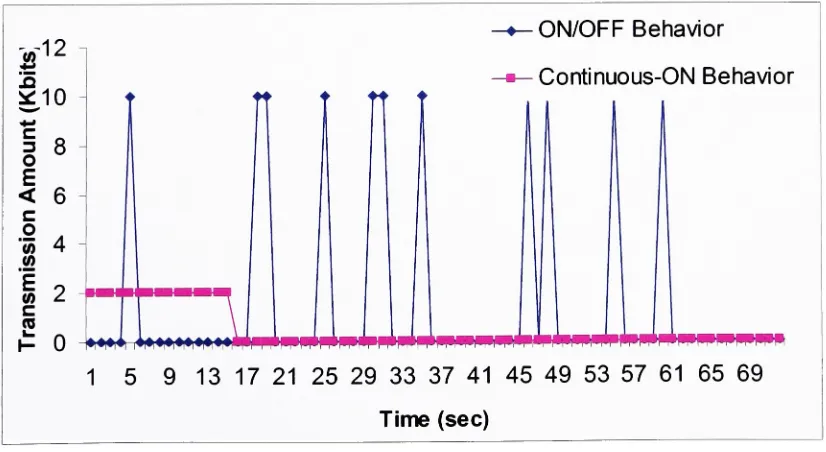
The spikedcurve in Figure4.3 shows the transmission scheduleof a single senorfrom a4-2
network. The sensor, whose transmission schedule is shown, was capable ofretrievingthe
21-maximum amount of data over its maximum lifetime. Figure 4.3 shows the transmission
schedule over the maximum possible lifetime of a sensor on one exemplary simple network
thathas 4sensors and2 gateways. The linesplottedinFigure 4.3 representthetransmission
rate used
by
one ofthe sensors (regardless ofwhich gatewaythe data is sent to), whentheON\OFFscheme andthe Continuous ONscheme are used. Noticethat
by
usingtheON/OFFscheme, the sensor has a much longer
lifetime,
61 time periods as compared to the 15achieved
by
the sensor using the Continuous ON scheme. Further comparing the totalamountofdataretrieved viathis sensor,whichisthesum ofthetransmitteddata overtime, it
is found to be 110 Kbits for the ON/OFF scheme
-a 267% improvement over the
Continuous ON scheme that is capable of collecting 30 Kbits. A
key
reason that theON/OFFscheme is ableto retrieve much moredata giventhe sameenergy constraintsis the
use ofbuffer space, which allows transmission at full capacity almost every time the RF
circuitisturned ON.
-^ON/OFF Behavior
-Continuous-ON Behavior
mumm^r*mm
1 5 9 13 17 21 25 29 33 37 41 45 49 53 57 61 65 69
[image:31.541.62.475.436.662.2]Time
(sec)
Figure 43Datatransmittedovertimeforone ofthesensors ona4-2 (Sensorsto
Gateways)
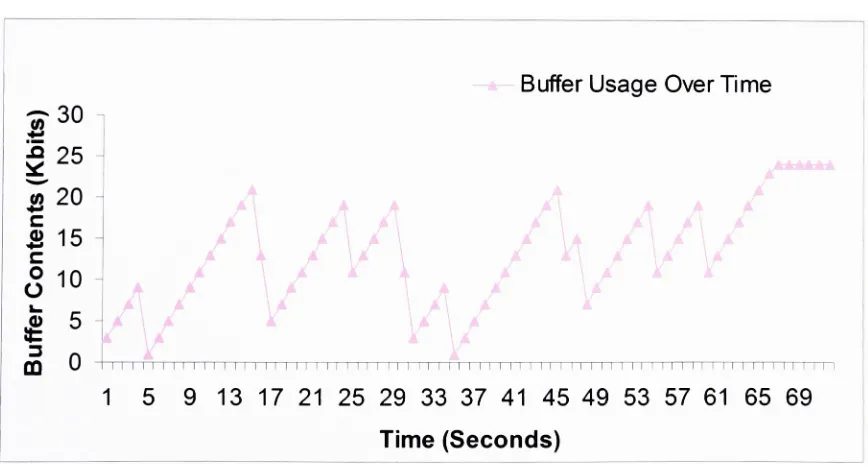
Figure 4.4 displays the buffer usage over time, corresponding to the optimal ON/OFF
transmission schedule that was plotted in Figure 4.3. Notice on two occasions (at time 15
and time
29),
the sensor's buffer comes nearly full and is followedby
two consecutivetransmissions,
which significantly reduces the buffer's content. This behavior does notexactly duplicate the ON/OFF behavior found analytically,
however,
it does provideevidencethat thesensorisseekingtobehaveintheoptimal
fashion,
i.e.,
fullON/OFFcycles.Full ON/OFF cyclesmaynotbecompleted,
however,
duetocontentioninthenetwork. Alsonotice that the buffer is not completelyemptiedbefore the sensorturns OFF. This behavior
may be attributed to the sensor
being
incapable ofcompletely empting its bufferduring
asingle ONperiod unless ittransmitsbelow itsmaximumtransmitcapacity foratleast one of
its transmissions. As a result, rather than
transmitting
at less than full capacity, which isinefficient,
thesensorbuffersthedata.Buffer Usage Over Time
30
!
3
25
j2 20
c
B
15c
O10
__ 5 it
3 n
OQ U i ii I I I I I I I [ I I I I I I I II I I I I I I M II I I I I I M I I I I ! I I I I M M I I II I I l I I I I I I III I I II I I I
1 5 9 13 17 21 25 29 33 37 41 45 49 53 57 61 65 69
Time
(Seconds)
Figure 4.4 Bufferutilization overtimeforone ofthebasemodel sensorsinabipartitenetwork
demonstrating
ON/OFF behavior. [image:32.541.46.480.406.640.2]23-4.2
Effect
ofArrival Pattern
Wireless sensor networks may be used in many different applications, each ofwhich may
haveaconsiderablydifferentarrival patterns overtime. Fora givenapplication,onepossible
arrival patternmay consist of periodsinwhich alarge amount ofdata is sensed followed
by
long
inactive periods. The results above show that an ON/OFF scheme can achievesignificant data retrieval improvements over the Continuous ON scheme, assuming all data
arrives constantly. To determine how the arrival patterns would affect the amount oftotal
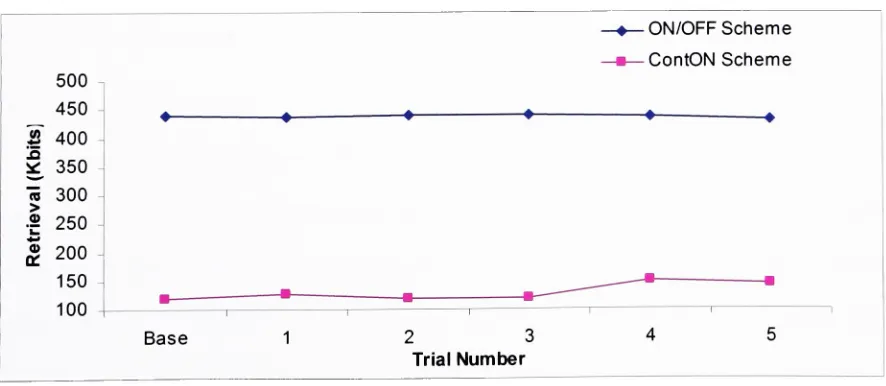
dataretrieved, thedifferentarrival patterns showin Table 4.1 are consideredforthe same4-2
network. The resulting optimal data retrieval amounts
by
the ON/OFF scheme and theContinuous ONscheme areplottedin Figure 4.5.
Trial Arrival Pattern(Kbits)
Base 2-2-2-2-2-2-2-2-2-2-2-2-...
1 4-0-4-0-4-0-4-0-4-0-4-0-...
2 6-0-0-6-0-0-6-0-0-6-0-0-...
3 10-0-0-0-0-10-0-0-0-10-...
4 14-0-0-0-0-0-0-14-0-0-0-...
[image:33.541.169.367.342.439.2]5 1g-O-O-O-O-O-O-O-O-18-0-...
Table 4.1 Arrival Patternswith same average arrival rate(2 Kbits/Sec).
500
450 1"
400
* 350
NJ K) OJ
O
OI
O
150
inn
Base
-?ON/OFF Scheme
-n ContON Scheme
2 3
Trial Number
Figure4.5 The amountofdata retrieved
by
a4-2 bipartite network withrespectto thevarious [image:33.541.47.490.475.668.2]As shown in the figure above, the amount of data that can be retrieved is relatively
insensitivetothedifferenttrafficpatterns considered. FortheON/OFFscheme, this is dueto
the buffer
being
capable ofabsorbingthe arrivals.Therefore,
aslong
as the amount ofdatathat arrived in a single period does not exceed the buffer size, the transmission schedule
won't change much, and
hence,
similar amounts of total data are retrieved. For theContinuous ON scheme, where data is transmitted
immediately
upon arrival2, the totalamount ofdataretrieved isequal to the total amount ofdata arrivedthroughout the network
lifetime,
with one exception when the data sensed in the last time period is larger than themaximumtransmission capacity. Thedifference in total data retrieval dueto the exception
will bemarginal as
long
as the sensorlifetime is muchlargerthan the inactiveperiod ofthetraffic pattern. This is indeed the case inthe scenario considered in Figure 4.5. This set of
results exhibits that, forat leastthe base scenarioconsidered, the ON/OFF scheme provides
robust performance with respect to fluctuations inthe data arrival pattern, and consistently
outperformsthe Continuous ON scheme. An
interesting
extension relatedto this studyistoconsider stochastic arrival rates.
4.3
Effect
ofBuffer
Size
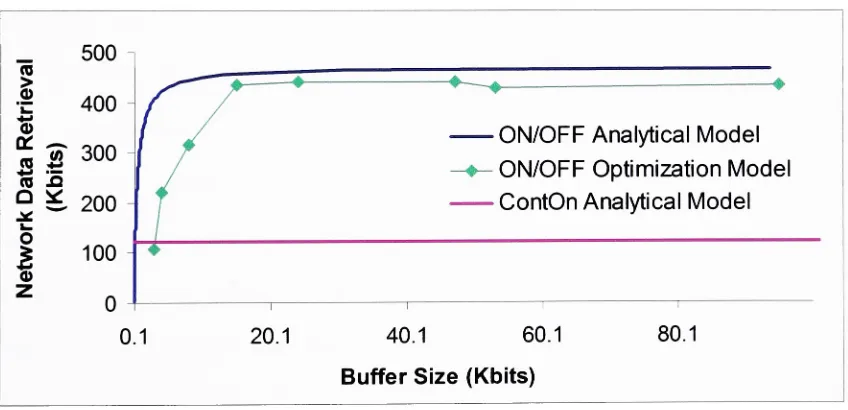
Figure 4.3 and Figure 4.5 demonstrate the significant performance improvements of the
ON/OFF behavior as compared to the Continuous ON behavior. These resultshowever are
basedon anetwork inwhich each sensorhas afixed buffersize of24
Kbits;
thus theimpactofthe buffer size in these figures is unknown. Figure 4.6 contains a plot ofthe total data
retrieved
by
the4-2 bipartitenetwork whenone uses anincreasing
buffersize.Interestingly,
2
Incases where moredataarrives
during
atimeperiodthancantransmitted,theexcessdata isassumedtobe bufferedandtransmittedduring
thesubsequenttimeperiod(s).the total dataretrieval increases significantlyas the buffer size
increases
whenthe buffer issmall (less than 18
Kbits),
and saturates to about 430-440 Kbits after that. Notice that inFigure 4.4 the actual buffer space utilized, i.e. the buffer size minus the residual buffered
data,
iscalculatedto be approximately 17-20Kbits,
which is consistentwiththe buffersizerequiredtoretrievethemaximum amount ofdata fromtheoptimalbehaviorsection. Several
other small networks were examined and the same performance trend with respect to the
buffer size was observed. This leadsto a logical question ofwhetherthe total dataretrieval
of440 Kbits is indeedthemost one can collect no matterhow largethebuffer size is. This
question was answered using the analytical results fromthe optimal behavior section which
determinedthisamount of retrievaltobe veryclosetooptimal.
500
re > 01
400
<-> 01 Ul
tfl 300
(U 4-> re _3
Q
_ *
200
o
|
0> 100ON/OFFAnalytical Model
ON/OFF Optimization Model
ContOn Analytical Model
0.1 20.1 40.1 60.1
Buffer Size
(Kbits)
[image:35.541.45.469.350.555.2]80.1
Figure 4.6 Dataretrieved
by
a4-2 bipartitenetwork with respecttobuffersize solvedoptimallyfor ON/OFFscheme,andanalytically for both ON/OFFschemeandContinuous ONscheme.
From Figure 4.3 it was deteiminedthat the networked sensors are not capable ofachieving
full ON/OFF cycles due to contentions with other sensors.
If, however,
all ofthe sensorsbetter than the networked sensor scenario in terms ofthe energy usage and the total data
retrieval. A characteristic curve is drawn based on the optimal
behavior,
in Figure4.6,
toexhibit the performance that could have been achieved
by
the four sensors ifthere were nocontention. Thecharacteristic curve is derived basedon equation
(3.2)
and equation(3.3)
asdone for Figure
3.2,
yet here it is scaled up to correspond to four sensors. Alsoplotted inFigure4.6isthe total dataretrieval achievable
by
theContinuousON scheme as areference.Many
interesting
observations canbe made from Figure 4.6.Foremost,
one shall note that,as
long
asthebuffersize isnottoo small,the total dataretrievalby
thefoursensors inreality(with contention) is verycloseto what
they
couldhave retrievediftherewere nocontention,i.e.,
the bestthey
cando. Infact,
by
examiningthe transmissionschedule ofthe sensors, thecontention amongthe sensors is found to be severe (sensors
frequently
switch between ONand OFF states and
hardly
utilize the full transmission capacity) when the buffer size issmall, and gradually lessens as the buffer size increases.
Increasing
the buffersize reducesthe contention because it allows the sensors to stay OFF
longer,
allowing other sensors toaccess the gateway, and in a sense, alternates the transmissions. The same performance
trends, asabove, are again observed whenconsideringother simplebipartite networks. This
suggests that one needs only a moderate buffer to retrieve an amount ofdata close to the
largest possible retrieval amount even for contending networked sensors. The analytical
results seem to serve as a tightbound and agood approximationto whatnetworked sensors
can achieveusinganON/OFFscheme.
4.4
Effect
ofNetwork
Service
Capacity
The total network retrieval capability with respect to the maximum network service
capabilityper second is displayed inFigure 4.7 fora scenario whichhad five
fully
connectedsensors and three gateways. Maximum network service capability per second is defined as
the maximum amount ofdatathatcanbetransmittedout ofthenetwork pertime period,
i.e.,
the total number of gatewaystimes the maximumtransmissioncapability ofthe sensors. In
each of the trials, the maximum network service capacity was adjusted
by increasing
themaximum transmission capacity of each sensor
by
one Kbit. All of the same energyconsumption parametersastheprevious4-2 models are again considered except forthe total
energyofthe sensors, which was increased to 0.5 Joules.
Also,
to ensure that the effect ofsensor contention is demonstrated (at least for the low maximum network service capacity
levels)
the buffer was reducedto 12Kbits,
andthe arrival rate was increased to 5 Kbitspersecond.
_ 260
re
I
2401
220o 5 180
|
-160E
140g
120100
ON/OFFScheme Network Retrieval
12 17 22 27 32 37 42
Maximum Network Service
Capacity (Kbits/sec)
[image:37.540.39.474.406.619.2]47
Figure 4.7 Networkretrievalcapabilityof a5-3 bipartitenetwork asafunctionofthenetwork's
In Figure
4.7,
when the service capacity is low (15-18Kbits)
the sensor is capable ofretrieving 128 Kbits - 139 Kbits
whichisvery lowcomparedto the expectedretrieval, -250
Kbits,
which was calculatedby
the optimal behaviormodel. This lowretrieval is dueto thelarge arrival rate and the low service capacity requiring the sensor to alternate every other
transmission in order to
keep
its buffer from over flowing. When the sensor's status overtimewas
investigated,
itwas determinedthat aContinuous ONscheme was actually utilizeddue to the
frequency
ofthe sensor'stransmissions,
i.e.,
every other second. Once the totalservice capacityreaches 20
Kbits,
the ON/OFFbehavior is utilizedby
the sensor and resultsin a linear increase in total network retrieval before
leveling
off once the total servicecapacity reaches the mid thirties.
Increasing
the total network service capacity no longerincreases the total amount of data retrieved because the total network retrieval is now
constrained
by
thebuffersize.Running
thesame scenario yet with larger buffersizes resultsin the same curve except that it does not level off until the total network service capacity
reaches ahigheramount.
4.5 Effect
ofNetwork
Connectivity
Network connectivity refers to the number of gateways that each sensor is capable of
transmitting
to. In networks covering a small area, it is feasible that each sensor would becapable of
transmitting
to every data collection gateway; this type ofconnectivity will bereferred to as
"fully
connected."
Along
with afully
connected network, Figure 4.8 showstwoadditional networks withinwhichsensorsmaynotbeabletoreach all gateways.
Figure 4.8 Fromthe
left,
afully
connectednetwork,a(2,2,1)
network,and a(3,1,1)
network.Figure 4.9 shows the total data retrieval
by
the afore-mentioned three networks as theindividual sensor sizes increase. The separations betweenthe plots inFigure 4.5 illustrates
the impactofthedifferent connectivity levels as well astheeffectivenessofeven arelatively
small
buffer, i.e.,
18(Kbits),
ineliminatingthisdifference.Moreover,
this plotdemonstratesthat a networkthat isnot
fully
connectediscapable ofretrieving thesame amountofdata asanetworkthat is
fully
connected. Thisisa significantfinding
as itsuggeststhat a network'sconnectivitycanbereduced,so astoreducethe
difficulty
ofcoordinatingthe sensors, yetthenetworkmaystillbecapable ofachievingitsmaximumcapability.
140
120
ra > _
%
100a. _
* J 80
o 3
|
* 60Q)
Z 40
ra
p 20
Full Connected
(2,2,1)
(2,1,2)
(1,3,1)
3 4 5 6 8 9 10 11 12 13 14 15 16 17 18
Buffer Size
(Kbits)
Figure 4.9 Total network retrieval with respect to buffer size for networks with
differing
5.
Heuristic
Development
InChapter
4,
the optimalbehaviorof a sensor ina network environment wasdetermined andmany
key
characteristics ofthisbehaviorwerediscussed. Theterm"behavior"referstohowa sensor schedules itsRFcircuits to turn
ON,
turnOFF,
andtransmitovertime inanetworkenvironment.
Ideally,
each sensor in a physical network could be preprogrammed with itsoptimal
behavior;
yet this cannot be done due to thedifficulty
ofsolving the mixed integerproblemforeven small networks . More
importantly,
thispredeterminedbehaviorrequiresaprior knowledge on the data arrivals and, therefore, is infeasible in practice where
hard-to-predict sensed events happen in real time.
Consequently,
a preliminary heuristic has beendevelopedtomimictheoptimal sensorbehavior. Theproposed heuristicconsistsoftwo sets
of criteria that will be used
by
the sensors and thegateways4
to make decisions on the
transmission and the receiving
behavior,
respectively, in an on-line fashion. The idea is tohave the sensors
independently
decide when to turn the RF circuit ON and request fortransmission, while each ofthe gateways will decide which requesting sensor it will grant
access to. The goal ofthis distributive process is to have the network achieve close to the
optimal overall capability as exhibited in Chapter 4. The flow charts ofthe two decision
criteria are showninFigure 5.1.
Several decision criteria determine the sensor behavior (the flow chart onthe left ofFigure
5.1)
andhowwelltheheuristicperforms.First,
asensor willdecidewhento"TurnON?"3
Anoptimal solution fora4-2 network withthe parameterT=50 was notfound
by
theCPLEXmixedintegeroptimizerafter10.23 hours.
4
The heuristic developed in this thesis assumes a 2-level hierarchical network, where the sensors will be
sensingandtransmitting datawhilethegateways willbeonly receiving data. Astraightforwardgeneralization
oftheheuristicisto implementthe twoset ofdecisioncriteria on each sensor sothata sensor will behave as bothatransmitterand a receiver asitmaybe inpractice.
Start
Receive requests or
data
<-V
Determine SensortoGrant
V
Sendgrant
Figure5.1 Sensor heuristic flowchart
(left)
andgateway heuristic flowchart(right).(the first decision
box)
based onthe bufferutilization,i.e.,
howfull thebuffer is. Sincethesensoris OFFwhenitreachesthis
block,
theheuristic is designedtoremain intheOFF stateso as to conserve as much energy as possible.
Only
when the buffer's utilization hassurpassedthe UpperBuffer Limit
(UBL), i.e.,
thebufferwill soonbefull,
willthe sensorturnON andbeginrequestingaccessto a gateway.
Similarly,
the decisionblock,
"Stay
ON?,"isdesigned to
keep
the sensor inthe ON state aslong
as possible so as to distribute the spikeenergy, consumed when
turning
from OFFtoON,
overthemaximumnumber oftransmitted [image:41.540.67.438.49.417.2]buffer
isnearlyempty, indicatedby
examiningwhetherthebufferutilizationhas fallenbelowthe Lower Buffer Limit
(LBL),
thesensorwill stop requesting accesstogateways and switchto the OFF mode. The values ofthe UBL and LBL are determined based on the average
arrival rate ofthe sensor andthemaximumtransmissioncapacityofthe sensor,respectively.
Ifthe decision is "yes"
for either the
"Stay
ON?" or "Turn ON?"blocks,
the sensor willdeterminethe highest priority neighboring gateway, and senditatransmissionrequest. The
highest priority gateway is the gateway that is expectedto cause the sensor consuming the
least amount of energy ifthe sensed data were transmitted to it.
Determining
the highestpriority gateway and sending it a request are the tasks performed
by
the sensor in the"Request Gateway"block. The highest priority gatewayofsensory is thegateway i thathas
thelowestvalue of
cStaty
basedonthefollowing
equation.cStaty
=Uy
*euij
+(Bj
-Uy)*
eu_j
V/ &Vy
(5.1)
The variable
cStaty
estimates the amount ofenergythat will be consumedby
sensory, if itcompletely empties its
buffer,
Bj
(Kbits),
in a single ON time period and makes itstransmission of the
first,
Uy
Kbits to gateway/,
with the rest equally transmitted to allneighboringgateways. Theparameter
euj
istheenergyconsumedby
transmitting
oneKbitofdata from sensory to gateway /', and
e,_j
representsthe average energy consumption perKbittransmitted
by
sensory over allneighboring gateways. This processofdetermining
thehighest priority gateway and sending it a request is performed repetitively until sensory is
granted access or until no more gateways are available. Notice that if the sensor is not
granted afterrequesting accesstoall ofitsneighboring gateways, thesensorwillbackofffor
a short period oftimeandbeginrequestingagainstartingwithits highestprioritygateway.
The decision of whether the sensor is granted access to a gateway takes place in the
"Accepted?"
decision block. This decision is actually made
by
the gateway. Infact,
thesensor will wait forthe gateway to send back a "grant" acknowledgement, and ifreceived,
the senor will transmit datauntil the utilization ofthe buffer falls below the
LBL,
atwhichtime the sensorwill turn off. The actual decision ofaccepting the sensor performed
by
thegatewayisexplained subsequently.
Ontheright side ofFigure 5.1 above, the flowchartfortheheuristic residingatthe gateway
is illustrated. The purpose ofthis part of heuristic is to allow only a single sensory to
transmit to a particular gateway / at anypoint intime. In addition, the total channel access
allottedto sensory overtime,
by
all ofitsneighboring gatewayscombined,must be sufficientto ensure thatonly aminimal amountofdata is lost. Sincethesensorsdetermine when
they
should begin to transmit without
knowing
other sensor's status, each gateway needs tochoose the sensor that is expected to lead to more efficient energy consumption. This
decision ismade
by
comparingthe values oftStattJ
based onthefollowing
equationforeachsensory thathaverequested accesstogateway /.
tStaL = J
V/'V-/'
<5-2>
The sensor
j
with the largesttStattJ
will be granted for access to gateway/,
since it is thehave the longest ON periodto disperse the spike energy. The parameter,
C,
(Kbits),
is thecurrent bufferutilization,
q~j
(Kbits/sec)
is theaverage servicecapacityofsensory, to all itsneighboringsensors,and
kj
(Kbits/sec)
istheaverage arrival rateforsensory.The heuristic describedabove essentially pairs up sensors and gateways, so that each sensor
once turned
ON,
will stay ONforthelongesttimepossible. Noticethatintherealworldthisprocess ofpairing up maytake afew signaling exchanges among the sensorsand gateways,
and therefore consumes time and energy. The proposed
heuristic, however,
assumes suchprocess consumes much less time and energy than those used for
transmitting
the senseddata,
and therefore ignores both factors when conducting the simulations.Consequently,
whenever there is at least one sensor request, the simulator will determine the "maximal
match"
betweentherequestingsensorsandthegateways.
5.1 Heuristic
Capability
Assessment
through
Simulation
To investigatethe effectiveness ofthe heuristicabove, thebehaviorof a sensor ina network
controlled
by
the heuristic and a sensor whose behavior was found optimallyby
the MIPmodel,werecompared. To makethis comparison,a4-2 networkwassimulatedandrun with
all ofthe sensors
having
identical power consumptionparameters, buffer sizes, dataarrivalrates and servicecapacitiesto those sensors usedto generatetheresults shownin Figure4.4.
Theresultsofthiscomparison arediscussed below.
Figure 5.2 demonstrates the bufferutilization overtime for a sensor ina 4-2 networkbased
onthe MIPmodel andfora sensor ina4-2 simulatednetwork controlled
by
theheuristic. In35-Figure
5.2,
notice the similar behavior exhibitedby
one of the sensors under the twoexperimental setups. In
fact,
the sensor,underboth setups, transmitsatotal of11 times, andtransmitsatfullcapacityforevery
transmission,
and as aresult,retrieves atotalof1 10 Kbitsofdata.
25
MIP-Buffer Usage Over Time
-?
Heuristic-Buffer Usage Over Time
10 20 30 40
Time
(sec)
[image:45.541.60.469.185.377.2]50 60 70
Figure 5.2 Bufferutilizationovertimeofasingle sensorina4-2 bipartite networkbasedonthe
MIPmodel andthesimulated networkunderheuristiccontrol.
The other network sensors under the two setups also exhibit similar results, but may not
achieve exactly the same data retrieval, which is obviously expected. The overall
performance oftherespective networksisalso similar, whereatotalof440 Kbitsisretrieved
under the MIP model, and it is 420 Kbits forthe simulated network based on the heuristic.
The full ON/OFF behavior seems tobe moreprominent intheplotforthe simulated sensor.
One shouldhowevernotethat thebufferutilizationforthesimulatedsensorneverexceeds20
Kbits,
while it can reach 24 Kbits-the full buffer size, under the MIP model. This
discrepancy
between the two setups leads to the slightly higherperformance achieved usingThe above results show an example ofhowa sensor
behavior,
similarto thatofthe optimalbehavior can be reproduced
dynamically
by
a sensor controlledby
a heuristic. It is alsointeresting
to investigate whether the performance trends of the wireless sensor networkpreviously exhibited in Chapter 4 can be also observed for the simulated network. In
particular, this thesiswillfocuson
investigating
theperformanceimpact dueto thesize ofthebufferat each sensor. For comparison, this set of results will beplotted in Figure
5.3,
alongwith the data points already shown in Figure 4.6. As exp