Institute for Logic, Language and Computation
Lecture Notes
An Introduction to Prolog Programming
Ulle Endriss
c
Preface
These lecture notes introduce the declarative programming language Prolog. The em-phasis is on learning how to program, rather than on the theory of logic programming. Nevertheless, a short chapter on the logic foundations of Prolog is included as well.
All examples have been tested using SWI-Prolog (www.swi-prolog.org) and can be ex-pected to work equally well with most other Prolog systems. These notes have originally been developed for a course I taught at King’s College London in 1999 and 2000.
Amsterdam, August 2005 U.E.
The present version corrects a number of minor errors in the text, most of which have been pointed out to me by students following a number of courses I have given at the University of Amsterdam since 2005.
Amsterdam, September 2014 U.E.
For this latest version of the lecture notes, I have added 15 new exercises. This includes somewhat more complex exercises, several of which can easily be turned into small programming projects, on topics such as working with unary numbers, simple databases, robot navigation, verifying Goldbach’s conjecture in number theory for small instances, competing in the game show Countdown, text-based graph plotting, computing prime factorisations of integers, translating logic formulas into various normal forms, and analysing the voting power of countries in the European Union.
Amsterdam, August 2015 U.E.
Contents
1 The Basics 1
1.1 Getting Started: An Example . . . 1
1.2 Prolog Syntax . . . 4
1.2.1 Terms . . . 4
1.2.2 Clauses, Programs and Queries . . . 5
1.2.3 Some Built-in Predicates . . . 6
1.3 Answering Queries . . . 8
1.3.1 Matching . . . 8
1.3.2 Goal Execution . . . 10
1.4 A Matter of Style . . . 11
1.5 Exercises . . . 12
2 List Manipulation 15 2.1 Notation . . . 15
2.2 Head and Tail . . . 15
2.3 Some Built-in Predicates for List Manipulation . . . 18
2.4 Exercises . . . 19
3 Arithmetic Expressions 23 3.1 The is-Operator for Arithmetic Evaluation . . . 23
3.2 Predefined Arithmetic Functions and Relations . . . 24
3.3 Exercises . . . 25
4 Operators 35 4.1 Precedence and Associativity . . . 35
4.2 Declaring Operators with op/3 . . . 38
4.3 Exercises . . . 39
5 Backtracking, Cuts and Negation 45 5.1 Backtracking and Cuts . . . 45
5.1.1 Backtracking Revisited . . . 45
5.1.2 Problems with Backtracking . . . 46
5.1.3 Introducing Cuts . . . 47
vi Contents
5.1.4 Problems with Cuts . . . 50
5.2 Negation as Failure . . . 51
5.2.1 The Closed World Assumption . . . 51
5.2.2 The\+-Operator . . . 52
5.3 Disjunction . . . 53
5.4 Example: Evaluating Logic Formulas . . . 54
5.5 Exercises . . . 56
6 Logic Foundations of Prolog 61 6.1 Translation of Prolog Clauses into Formulas . . . 61
6.2 Horn Formulas and Resolution . . . 63
6.3 Exercises . . . 65
A Recursive Programming 67 A.1 Complete Induction . . . 67
A.2 The Recursion Principle . . . 68
A.3 What Problems to Solve . . . 69
A.4 Debugging . . . 69
Chapter 1
The Basics
Prolog (programming inlogic) is one of the most widely used programming languages in artificial intelligence research. As opposed to imperative languages such as C or Java (the latter of which also happens to be object-oriented) it is adeclarative programming lan-guage. That means, when implementing the solution to a problem, instead of specifying
how to achieve a certain goal in a certain situation, we specifywhat the situation (rules
andfacts) and the goal (query) are and let the Prolog interpreter derive the solution for us. Prolog is very useful in some problem areas, such as artificial intelligence, natural language processing, databases, . . . , but pretty useless in others, such as graphics or numerical algorithms.
By following this course, you will learn how to use Prolog as a programming language to solve practical problems in computer science and artificial intelligence. You will also learn how the Prolog interpreter actually works. The latter will include an introduction to the logical foundations of the Prolog language.
These notes cover the most important Prolog concepts you need to know about, but it is certainly worthwhile to also have a look at the literature. The following three are well-known titles, but you may also consult any other textbook on Prolog.
• I. Bratko. Prolog Programming for Artificial Intelligence. 4th edition, Addison-Wesley Publishers, 2012.
• F. W. Clocksin and C. S. Mellish. Programming in Prolog. 5th edition, Springer-Verlag, 2003.
• L. Sterling and E. Shapiro. The Art of Prolog. 2nd edition, MIT Press, 1994.
1.1
Getting Started: An Example
In the introduction it has been said that Prolog is a declarative (or descriptive) language. Programming in Prolog means describing the world. Using such programs means asking Prolog questions about the previously described world. The simplest way of describing the world is by statingfacts, like this one:
2 Chapter 1. The Basics
bigger(elephant, horse).
This states, quite intuitively, the fact that an elephant is bigger than a horse. (Whether the world described by a Prolog program has anything to do with our real world is, of course, entirely up to the programmer.) Let’s add a few more facts to our little program:
bigger(elephant, horse). bigger(horse, donkey). bigger(donkey, dog). bigger(donkey, monkey).
This is a syntactically correct program, and after having compiled it we can ask the Prolog system questions (orqueries in proper Prolog-jargon) about it. Here’s an example:
?- bigger(donkey, dog). Yes
The query bigger(donkey, dog) (i.e., the question “Is a donkey bigger than a dog?”) succeeds, because the factbigger(donkey, dog) has previously been communicated to the Prolog system. Now, is a monkey bigger than an elephant?
?- bigger(monkey, elephant). No
No, it’s not. We get exactly the answer we expected: the corresponding query, namely bigger(monkey, elephant)fails. But what happens when we ask the other way round?
?- bigger(elephant, monkey). No
According to this elephants are not bigger than monkeys. This is clearly wrong as far as our real world is concerned, but if you check our little program again, you will find that it says nothing about the relationship between elephants and monkeys. Still, we know that if elephants are bigger than horses, which in turn are bigger than donkeys, which in turn are bigger than monkeys, then elephants also have to be bigger than monkeys. In mathematical terms: the bigger-relation is transitive. But this has also not been defined in our program. The correct interpretation of the negative answer Prolog has given is the following: from the information communicated to the system it cannot be proved that an elephant is bigger than a monkey.
If, however, we would like to get a positive reply for a query likebigger(elephant, monkey), we have to provide a more accurate description of the world. One way of doing this would be to add the remaining facts, such as bigger(elephant, monkey), to our program. For our little example this would mean adding another 5 facts. Clearly too much work and probably not too clever anyway.
Ulle Endriss. And Introduction to Prolog Programming 3
of bigger. AnimalXis bigger than animalYeither if this has been stated as a fact or if there is an animal Zfor which it has been stated as a fact that animal X is bigger than animal Z and it can be shown that animal Z is bigger than animal Y. In Prolog such statements are calledrules and are implemented like this:
is_bigger(X, Y) :- bigger(X, Y).
is_bigger(X, Y) :- bigger(X, Z), is_bigger(Z, Y).
In these rules :- means something like “if” and the comma between the two terms bigger(X, Z)and is_bigger(Z, Y)stands for “and”. X,Y, and Zare variables, which in Prolog is indicated by using capital letters.
You can think of the the bigger-facts as data someone has collected by browsing through the local zoo and comparing pairs of animals. The implementation ofis_bigger, on the other hand, could have been provided by a knowledge engineer who may not know anything at all about animals, but understands the general concept of something being bigger than something else and thereby has the ability to formulate general rules regarding this relation. If from now on we use is_bigger instead of bigger in our queries, the program will work as intended:
?- is_bigger(elephant, monkey). Yes
Prolog still cannot find the factbigger(elephant, monkey) in its database, so it tries to use the second rule instead. This is done bymatching the query with the head of the rule, which isis_bigger(X, Y). When doing so the two variables get instantiated: X = elephantandY = monkey. The rule says that in order to prove thegoal is_bigger(X, Y)(with the variable instantiations that’s equivalent tois_bigger(elephant, monkey)) Prolog has to prove the two subgoals bigger(X, Z) and is_bigger(Z, Y), again with the same variable instantiations. This process is repeated recursively until the facts that make up the chain between elephantand monkey are found and the query finally succeeds. How this goal execution as well as term matching and variable instantiation really work will be examined in more detail in Section1.3.
Of course, we can do slightly more exiting stuff than just asking yes/no-questions. Suppose we want to know, what animals are bigger than a donkey? The corresponding query would be:
?- is_bigger(X, donkey).
Again, X is a variable. We could also have chosen any other name for it, as long as it starts with a capital letter. The Prolog interpreter replies as follows:
?- is_bigger(X, donkey). X = horse
4 Chapter 1. The Basics
happy already, we can press Return now and that’s it. In case we want to find out if there are more animals that are bigger than the donkey, we can press the semicolon key, which will cause Prolog to search for alternative solutions to our query. If we do this once, we get the next solution X = elephant: elephants are also bigger than donkeys. Pressing semicolon again will return a No, because there are no more solutions:
?- is_bigger(X, donkey). X = horse ;
X = elephant ; No
There are many more ways of querying the Prolog system about the contents of its database. As a final example we ask whether there is an animal X that is both smaller than a donkey and bigger than a monkey:
?- is_bigger(donkey, X), is_bigger(X, monkey). No
The (correct) answer isNo. Even though the two single queries is_bigger(donkey, X) and is_bigger(X, monkey) would both succeed when submitted on their own, their conjunction (represented by the comma) does not.
This section has been intended to give you a first impression of Prolog programming. The next section provides a more systematic overview of the basic syntax.
There are a number of Prolog systems around that you can use. How to start a Prolog session may differ slightly from one system to the next, but it should not be too difficult to find out by consulting the user manual of your system. The examples in these notes have all been generated using SWI-Prolog (in its 1999 incarnation, with only a few minor adjustments made later on).1
1.2
Prolog Syntax
This section describes the most basic features of the Prolog programming language.
1.2.1 Terms
The central data structure in Prolog is that of a term. There are terms of four kinds:
atoms, numbers, variables, and compound terms. Atoms and numbers are sometimes grouped together and calledatomic terms.
1
Ulle Endriss. And Introduction to Prolog Programming 5
Atoms. Atoms are usually strings made up of lower- and uppercase letters, digits, and the underscore,starting with a lowercase letter. The following are all valid Prolog atoms:
elephant, b, abcXYZ, x_123, another_pint_for_me_please
On top of that also any series of arbitrary characters enclosed in single quotes denotes an atom.
’This is also a Prolog atom.’
Finally, strings made up solely of special characters like + - * = < > : & (check the manual of your Prolog system for the exact set of these characters) are also atoms. Examples:
+, ::, <--->, ***
Numbers. All Prolog implementations have an integer type: a sequence of digits, optionally preceded by a - (minus). Some also support floats. Check the manual for details.
Variables. Variables are strings of letters, digits, and the underscore, starting with a capital letter or an underscore. Examples:
X, Elephant, _4711, X_1_2, MyVariable, _
The last one of the above examples (the single underscore) constitutes a special case. It is called the anonymous variable and is used when the value of a variable is of no particular interest. Multiple occurrences of the anonymous variable in one expression are assumed to be distinct, i.e., their values don’t necessarily have to be the same. More on this later.
Compound terms. Compound terms are made up of afunctor (a Prolog atom) and a number of arguments (Prolog terms, i.e., atoms, numbers, variables, or other com-pound terms) enclosed in parentheses and separated by commas. The following are some examples for compound terms:
is_bigger(horse, X), f(g(X, _), 7), ’My Functor’(dog)
It’s important not to put any blank characters between the functor and the opening parentheses, or Prolog won’t understand what you’re trying to say. In other places, however, spaces can be very helpful for making programs more readable.
The sets of compound terms and atoms together form the set of Prolog predicates. A term that doesn’t contain any variables is called aground term.
1.2.2 Clauses, Programs and Queries
In the introductory example we have already seen how Prolog programs are made up of
6 Chapter 1. The Basics
Facts. A fact is a predicate followed by a full stop. Examples:
bigger(whale, _). life_is_beautiful.
The intuitive meaning of a fact is that we define a certain instance of a relation as being true.
Rules. A rule consists of a head (a predicate) and a body. (a sequence of predicates separated by commas). Head and body are separated by the sign :- and, like every Prolog expression, a rule has to be terminated by a full stop. Examples:
is_smaller(X, Y) :- is_bigger(Y, X). aunt(Aunt, Child)
:-sister(Aunt, Parent), parent(Parent, Child).
The intuitive meaning of a rule is that the goal expressed by its head is true, if we (or rather the Prolog system) can show that all of the expressions (subgoals) in the rule’s body are true.
Programs. A Prolog program is a sequence of clauses.
Queries. After compilation a Prolog program is run by submitting queries to the in-terpreter. A query has the same structure as the body of a rule, i.e., it is a sequence of predicates separated by commas and terminated by a full stop. They can be entered at the Prolog prompt, which in most implementations looks something like this: ?-. When writing about queries we often include the?-. Examples:
?- is_bigger(elephant, donkey). ?- small(X), green(X), slimy(X).
Intuitively, when submitting a query like the last example, we ask Prolog whether all its predicates are provably true, or in other words whether there is anXsuch thatsmall(X), green(X), and slimy(X)are all true.
1.2.3 Some Built-in Predicates
What we have seen so far is already enough to write simple programs by defining pred-icates in terms of facts and rules, but Prolog also provides a range of useful built-in predicates. Some of them will be introduced in this section; all of them should be ex-plained in the user manual of your Prolog system.
Ulle Endriss. And Introduction to Prolog Programming 7
Equality. Maybe the most important built-in predicate is = (equality). Instead of writing expressions such as =(X, Y), we usually write more conveniently X = Y. Such a goal succeeds, if the termsX and Ycan be matched. This will be made more precise in Section1.3.
Guaranteed success and certain failure. Sometimes it can be useful to have predi-cates that are known to either fail or succeed in any case. The predipredi-catesfailandtrue serve exactly this purpose. Some Prolog systems also provide the predicatefalse, with exactly the same functionality asfail.
Consulting program files. Program files can be compiled using the predicate consult/1.2 The argument has to be a Prolog atom denoting the program file you want to compile. For example, to compile the filebig-animals.pl submit the following query to Prolog:
?- consult(’big-animals.pl’).
If the compilation is successful, Prolog will reply withYes. Otherwise a list of errors will be displayed.
Output. If besides Prolog’s replies to queries you wish your program to have further output you can use thewrite/1predicate. The argument can be any valid Prolog term. In the case of a variable its value will get printed to the screen. Execution of the predicate nl/0 causes the system to skip a line. Here are two examples:
?- write(’Hello World!’), nl. Hello World!
Yes
?- X = elephant, write(X), nl. elephant
X = elephant Yes
In the second example, first the variableXis bound to the atomelephantand thenthe value of X, i.e., elephant, is written on the screen using the write/1 predicate. After skipping to a new line, Prolog reports the variable binding(s), i.e.,X = elephant.
Checking the type of a Prolog term. There are a number of built-in predicates available that can be used to check the type of a given Prolog term. Here are some examples:
2
8 Chapter 1. The Basics
?- atom(elephant). Yes
?- atom(Elephant). No
?- X = f(mouse), compound(X). X = f(mouse)
Yes
The last query succeeds, because the variableXis bound to the compound termf(mouse) at the time the subgoal compound(X)is being executed.
Help. Most Prolog systems also provide a help function in the shape of a predicate, usually called help/1. Applied to a term (like the name of a built-in predicate) the system will display a short description, if available. Example:
?- help(atom). atom(+Term)
Succeeds if Term is bound to an atom.
1.3
Answering Queries
We have mentioned the issue of term matching before in these notes. This concept is crucial to the way Prolog replies to queries, so we present it before describing what actually happens when a query is processed (or more generally speaking: when a goal is executed).
1.3.1 Matching
Two terms are said tomatch if they are either identical or if they can be made identical by means of variable instantiation. Instantiating a variable means assigning it a fixed value. Two free variables also match, because they could be instantiated with the same ground term.
It is important to note that the same variable has to be instantiated with the same value throughout an expression. The only exception to this rule is the anonymous vari-able _, which is considered to be unique whenever it occurs.
We give some examples. The termsis_bigger(X, dog)andis_bigger(elephant, dog) match, because the variable X can be instantiated with the atom elephant. We could test this in the Prolog interpreter by submitting the corresponding query to which Prolog would react by listing the appropriate variable instantiations:
Ulle Endriss. And Introduction to Prolog Programming 9
X = elephant Yes
The following is an example for a query that doesn’t succeed, becauseX cannot match with1and 2at the same time.
?- p(X, 2, 2) = p(1, Y, X). No
If, however, instead of Xwe use the anonymous variable _, matching is possible, because every occurrence of _ represents a distinct variable. During matching Y is instantiated with2:
?- p(_, 2, 2) = p(1, Y, _). Y = 2
Yes
Another example for matching:
?- f(a, g(X, Y)) = f(X, Z), Z = g(W, h(X)). X = a
Y = h(a)
Z = g(a, h(a)) W = a
Yes
So far so good. But what happens, if matching is possible even though no specific variable instantiation has to be enforced (like in all previous examples)? Consider the following query:
?- X = my_functor(Y). X = my_functor(_G177) Y = _G177
Yes
In this example matching succeeds, becauseXcould be a compound term with the functor my_functorand a non-specified single argument. Ycould be any valid Prolog term, but it has to be the same term as the argument inside X. In Prolog’s output this is denoted through the use of the variable_G177. This variable has been generated by Prolog during execution time. Its particular name,_G177 in this case, may be different every time the query is submitted.
10 Chapter 1. The Basics
1.3.2 Goal Execution
Submitting a query means asking Prolog to try to prove that the statement(s) implied by the query can be made true provided the right variable instantiations are made. The search for such a proof is usually referred to asgoal execution. Each predicate in the query constitutes a (sub)goal, which Prolog tries to satisfy one after the other. If variables are shared between several subgoals their instantiations have to be the same throughout the entire expression.
If a goal matches with the head of a rule, the respective variable instantiations are made inside the rule’s body, which then becomes the new goal to be satisfied. If the body consists of several predicates the goal is again split into subgoals to be executed in turn. In other words, the head of a rule is considered provably true, if the conjunction of all its body-predicates are provably true. If a goal matches with a fact in our program, the proof for that goal is complete and the variable instantiations made during matching are communicated back to the surface. Note that the order in which facts and rules appear in our program is important here. Prolog will always try to match its current goal with the first possible fact or rule-head it can find.
If the principal functor of a goal is a built-in predicate the associated action is exe-cuted whilst the goal is being satisfied. For example, as far as goal execution is concerned the predicate
write(’Hello World!’)
will simply succeed, but at the same time it will also print the words Hello World!on the screen.
As mentioned before, the built-in predicate true will always succeed (without any further side-effects), whereasfail will always fail.
Sometimes there is more than one way of satisfying the current goal. Prolog chooses the first possibility (as determined by the order of clauses in a program), but the fact that there are alternatives is recorded. If at some point Prolog fails to prove a certain subgoal, the system can go back and try an alternative way of executing the previous goal. This process is known as backtracking.
We shall exemplify the process of goal execution by means of the following famous argument:
All men are mortal. Socrates is a man.
Hence, Socrates is mortal.
In Prolog terms, the first statement represents a rule: Xis mortal, if X is a man (for all X). The second one constitutes a fact: Socrates is a man. This can be implemented in Prolog as follows:
Ulle Endriss. And Introduction to Prolog Programming 11
Note thatXis a variable, whereassocratesis an atom. The conclusion of the argument, “Socrates is mortal”, can be expressed through the predicatemortal(socrates). After having consulted the above program we can submit this predicate to Prolog as a query, which will cause the following reaction:
?- mortal(socrates). Yes
Prolog agrees with our own logical reasoning. Which is nice. But how did it come to its conclusion? Let’s follow the goal execution step by step.
(1) The querymortal(socrates) is made the initial goal.
(2) Scanning through the clauses of our program, Prolog tries to match mortal(socrates)with the first possible fact or head of rule. It finds mortal(X), the head of the first (and only) rule. When matching the two terms the instantia-tionX = socrates needs to be made.
(3) The variable instantiation is extended to the body of the rule, i.e.,man(X)becomes man(socrates).
(4) The newly instantiated body becomes our new goal: man(socrates).
(5) Prolog executes the new goal by again trying to match it with a rule-head or a fact. Obviously, the goalman(socrates)matches the factman(socrates), because they are identical. This means the current goal succeeds.
(6) This, again, means that also the initial goal succeeds.
1.4
A Matter of Style
One of the major advantages of Prolog is that it allows for writing very short and compact programs solving not only comparatively difficult problems, but also being readable and (again: comparatively) easy to understand.
Of course, this can only work, if the programmer (you!) pays some attention to his or her programming style. As with every programming language, commentsdo help. In Prolog comments are enclosed between the two signs/* and */, like this:
/* This is a comment. */
Comments that only run over a single line can also be started with the percentage sign %. This is usually used within a clause.
aunt(X, Z)
12 Chapter 1. The Basics
Besides the use of comments a good layout can improve the readability of your programs significantly. The following are some basic rules most people seem to agree on:
(1) Separate clauses by one or more blank lines.
(2) Write only one predicate per line and use indentation:
blond(X)
:-father(Father, X), blond(Father), mother(Mother, X), blond(Mother).
(Very short clauses may also be written in a single line.)
(3) Insert a space after every comma inside a compound term:
born(mary, yorkshire, ’01/01/1995’)
(4) Write short clauses with bodies consisting of only a few goals. If necessary, split into shorter sub-clauses.
(5) Choose meaningful names for your variables and atoms.
1.5
Exercises
Exercise 1.1. Try to answer the following questions first “by hand” and then verify your answers using a Prolog interpreter.
(a) Which of the following are valid Prolog atoms?
f, loves(john,mary), Mary, _c1, ’Hello’, this_is_it
(b) Which of the following are valid names for Prolog variables?
a, A, Paul, ’Hello’, a_123, _, _abc, x2
(c) What would a Prolog interpreter reply given the following query?
?- f(a, b) = f(X, Y).
(d) Would the following query succeed?
?- loves(mary, john) = loves(John, Mary).
Why?
(e) Assume a program consisting only of the fact
a(B, B).
has been consulted by Prolog. How will the system react to the following query?
?- a(1, X), a(X, Y), a(Y, Z), a(Z, 100).
Ulle Endriss. And Introduction to Prolog Programming 13
Exercise 1.2. Read the section on matching again and try to understand what’s hap-pening when you submit the following queries to Prolog.
(a) ?- myFunctor(1, 2) = X, X = myFunctor(Y, Y).
(b) ?- f(a, _, c, d) = f(a, X, Y, _).
(c) ?- write(’One ’), X = write(’Two ’).
Exercise 1.3. Draw the family tree corresponding to the following Prolog program:
female(mary). female(sandra). female(juliet). female(lisa). male(peter). male(paul). male(dick). male(bob). male(harry).
parent(bob, lisa). parent(bob, paul). parent(bob, mary). parent(juliet, lisa). parent(juliet, paul). parent(juliet, mary). parent(peter, harry). parent(lisa, harry). parent(mary, dick). parent(mary, sandra).
After having copied the given program, define new predicates (in terms of rules using male/1,female/1 andparent/2) for the following family relations:
(a) father
(b) sister
(c) grandmother
(d) cousin
You may want to use the operator \=, which is the opposite of =. A goal like X \= Y succeeds, if the two terms Xand Ycannot be matched.
14 Chapter 1. The Basics
brother(X, Y) :-parent(Z, X), parent(Z, Y), male(X), X \= Y.
Exercise 1.4. Recall our big animal program consisting of four facts and two rules. Change the order of the two subgoals of the second rule. What happens when you execute the following query, asking for all possible alternative solutions using the semicolon key? Briefly explain why this happens.
?- is_bigger(A, donkey).
Advice: Try to predict what will happen before trying it on the computer.
Chapter 2
List Manipulation
This chapter introduces a special notation for lists, one of the most important data structures in Prolog, and provides some examples for how to work with them.
2.1
Notation
Lists are contained in square brackets with the elements being separated by commas. Here’s an example:
[elephant, horse, donkey, dog]
This is the list of the four atomselephant, horse,donkey, and dog. Elements of lists could be any valid Prolog terms, i.e., atoms, numbers, variables, or compound terms. This includes also other lists. The empty list is written as[]. The following is another example for a (slightly more complex) list:
[elephant, [], X, parent(X, tom), [a, b, c], f(22)]
Internal representation. Internally, lists are represented as compound terms using the functor . (dot). The empty list[] is an atom and elements are added one by one. The list[a,b,c], for example, corresponds to the following term:
.(a, .(b, .(c, [])))
2.2
Head and Tail
The first element of a list is called itshead and the remaining list is called the tail. An empty list doesn’t have a head. A list just containing a single element has a head (namely that particular single element) and its tail is the empty list.
A variant of the list notation allows for convenient addressing of both head and tail of a list. This is done by using the separator | (bar). If it is put just before the last term inside a list, it means that that last term denotes another list. The entire list is
16 Chapter 2. List Manipulation
then constructed by appending this sub-list to the list represented by the sequence of elements before the bar. If there is exactly one element before the bar, it is the head and the term after the bar is the list’s tail. In the next example,1is the head of the list and [2,3,4,5] is the tail, which has been computed by Prolog simply by matching the list of numbers with the head/tail-pattern.
?- [1, 2, 3, 4, 5] = [Head | Tail]. Head = 1
Tail = [2, 3, 4, 5] Yes
Note that Head and Tail are just names for variables. We could have used X and Y or whatever instead with the same result. Note also that the tail of a list (more generally speaking: the thing after|) is always a list itself. Possibly the empty list, but definitely a list. The head, however, is an element of a list. It could be a list as well, but not necessarily (as you can see from the previous example—1is not a list). The same applies to all other elements listed before the bar in a list.
This notation also allows us to retrieve the, say, second element of a given list. In the following example we use the anonymous variable for the head and also for the list after the bar, because we are only interested in the second element.
?- [quod, licet, jovi, non, licet, bovi] = [_, X | _]. X = licet
Yes
The head/tail-pattern can be used to implement predicates over lists in a very compact and elegant way. We exemplify this by presenting an implementation of a predicate that can be used to concatenate two lists.1 We call itconcat_lists/3. When called with the first two elements being instantiated to lists, the third argument should be matched with the concatenation of those two lists, in other words we would like to get the following behaviour:
?- concat_lists([1, 2, 3], [d, e, f, g], X). X = [1, 2, 3, d, e, f, g]
Yes
The general approach to such a problem is a recursive one. We start with a base case and then write a clause to reduce a complex problem to a simpler one until the base case is reached. For our particular problem, a suitable base case would be when one of the two input-lists (for example the first one) is the empty list. In that case the result (the third argument) is simply identical with the second list. This can be expressed through the following fact:
1
Ulle Endriss. And Introduction to Prolog Programming 17
concat_lists([], List, List).
In all other cases (i.e., in all cases where a query withconcat_listsas the main functor doesn’t match with this fact) the first list has at least one element. Hence, it can be written as a head/tail-pattern: [Elem | List1]. If the second list is associated with the variableList2, then we know that the head of the result should beElemand the tail should be the concatenation of List1 and List2. Note how this simplifies our initial problem: We take away the head of the first list and try to concatenate it with the (unchanged) second list. If we repeat this process recursively, we will eventually end up with an empty first list, which is exactly the base case that can be handled by the previously implemented fact. Turning this simplification algorithm into a Prolog rule is straightforward:
concat_lists([Elem | List1], List2, [Elem | List3]) :-concat_lists(List1, List2, List3).
And that’s it! The predicate concat_lists/3 can now be used for concatenating two given lists as specified. But it is actually much more flexible than that. If we call it with variables in the first two arguments and instantiate the third one with a list, concat_lists/3 can be used to decompose that list. If you use the semicolon key to get all alternative solutions to your query, Prolog will print out all possibilities how the given list could be obtained from concatenating two lists.
?- concat_lists(X, Y, [a, b, c, d]).
X = []
Y = [a, b, c, d] ;
X = [a]
Y = [b, c, d] ;
X = [a, b] Y = [c, d] ;
X = [a, b, c] Y = [d] ;
X = [a, b, c, d] Y = [] ;
No
18 Chapter 2. List Manipulation
2.3
Some Built-in Predicates for List Manipulation
Prolog comes with a range of predefined predicates for manipulating lists. Some of the most important ones are presented here. Note that they could all easily be implemented by exploiting the head/tail-pattern.
length/2: The second argument is matched with the length of the list in the first argu-ment. Example:
?- length([elephant, [], [1, 2, 3, 4]], Length). Length = 3
Yes
It is also possible to uselength/2with an uninstantiated first argument. This will generate a list of free variables of the specified length:
?- length(List, 3).
List = [_G248, _G251, _G254] Yes
Thenames of those variables may well be different every time you call this query, because they are generated by Prolog during execution time.
member/2: The goalmember(Elem, List)will succeed, if the termElemcan be matched with one of the members of the listList. Example:
?- member(dog, [elephant, horse, donkey, dog, monkey]). Yes
append/3: Concatenate two lists. This built-in works exactly like the predicate concat_lists/3 presented in Section2.2.
last/2: This predicate succeeds, if its second argument matches the last element of the list given as the first argument of last/2.
reverse/2: This predicate can be used to reverse the order of elements in a list. The first argument has to be a (fully instantiated) list and the second one will be matched with the reversed list. Example:
?- reverse([1, 2, 3, 4, 5], X). X = [5, 4, 3, 2, 1]
Yes
select/3: Given a list in the second argument and an element of that list in the first, this predicate will match the third argument with the remainder of that list. Example:
?- select(bird, [mouse, bird, jellyfish, zebra], X). X = [mouse, jellyfish, zebra]
Ulle Endriss. And Introduction to Prolog Programming 19
2.4
Exercises
Exercise 2.1. Write a Prolog predicate analyse_list/1that takes a list as its argu-ment and prints out the list’s head and tail on the screen. If the given list is empty, the predicate should put out an message reporting this fact. If the argument term isn’t a list at all, the predicate should just fail. Examples:
?- analyse_list([dog, cat, horse, cow]). This is the head of your list: dog
This is the tail of your list: [cat, horse, cow] Yes
?- analyse_list([]). This is an empty list. Yes
?- analyse_list(sigmund_freud). No
Exercise 2.2. Write a Prolog predicate membership/2 that works like the built-in predicatemember/2(without usingmember/2).
Hint: This exercise, like many others, can and should be solved using a recursive approach and the head/tail-pattern for lists.
Exercise 2.3. Implement a Prolog predicate remove_duplicates/2 that removes all duplicate elements from a list given in the first argument and returns the result in the second argument position. Example:
?- remove_duplicates([a, b, a, c, d, d], List). List = [b, a, c, d]
Yes
Exercise 2.4. Write a Prolog predicate reverse_list/2 that works like the built-in predicatereverse/2 (without usingreverse/2). Example:
?- reverse_list([tiger, lion, elephant, monkey], List). List = [monkey, elephant, lion, tiger]
Yes
Exercise 2.5. Consider the following Prolog program:
20 Chapter 2. List Manipulation
whoami([_, _ | Rest]) :-whoami(Rest).
Under what circumstances will a goal of the form whoami(X) succeed?
Exercise 2.6. The objective of this exercise is to implement a predicate for returning the last element of a list in two different ways.
(a) Write a predicate last1/2 that works like the built-in predicate last/2 using a recursion and the head/tail-pattern for lists.
(b) Define a similar predicate last2/2 solely in terms of append/3, without using a recursion.
Exercise 2.7. Write a predicate replace/4 to replace all occurrences of a given ele-ment (second arguele-ment) by another given eleele-ment (third arguele-ment) in a given list (first argument). Example:
?- replace([1, 2, 3, 4, 3, 5, 6, 3], 3, x, List). List = [1, 2, x, 4, x, 5, 6, x]
Yes
Exercise 2.8. Prolog lists without duplicates can be interpreted as sets. Write a program that given such a list computes the corresponding power set. Recall that the power set of a set S is the set of all subsets ofS. This includes the empty set as well as the set S itself.
Define a predicate power/2 such that, if the first argument is instantiated with a list, the corresponding power set (i.e., a list of lists) is returned in the second position. Example:
?- power([a, b, c], P).
P = [[a, b, c], [a, b], [a, c], [a], [b, c], [b], [c], []] Yes
Note: The order of the sub-lists in your result doesn’t matter.
Exercise 2.9. Write a predicate longer/2that takes two lists as arguments and suc-ceeds if the second is longer (has more elements) than the first. Implement your solution using only the tools and techniques introduced so far (in particular, do not make use of any arithmetic expressions, i.e., do not make use of any of the material to be covered in the next chapter). Examples:
?- longer([dog,cat,snake], [giraffe,elephant,lion,tiger]). Yes
Ulle Endriss. And Introduction to Prolog Programming 21
Exercise 2.10. This exercise is about numbers. You are used to representing, say, the numbertwelve using the decimal system, in which it is written as ‘12’. But you could also use theunary system, in which it can be written as ‘111111111111’. In the next chapter we will see how to work with numbers in the usual decimal system, but you actually already know everything you need to know to work with numbers in the unary system. Your task will be to implement some basic arithmetical operations for working with unary numbers. We will represent unary numbers as lists ofx’s of the appropriate length. Thus, five would be [x,x,x,x,x],twelve would be [x,x,x,x,x,x,x,x,x,x,x,x], and
zero would be []. In the sequel, all numbers are understood to be such non-negative integers given in unary notation.
(a) Thesuccessor of a number is the number we obtain if we addone to it. Thus, for example, the successor of five is six. Write a predicate called successor/2 that will return, in the second argument position, the successor of the number provided in the first argument position. Examples:
?- successor([x, x, x], Result). ?- successor([], Result). Result = [x, x, x, x] Result = [x]
Yes Yes
(b) Implement a predicateplus/3to compute the sum of two given numbers. Example:
?- plus([x, x], [x, x, x, x], Result). Result = [x, x, x, x, x, x]
Yes
(c) Implement a predicatetimes/3 to multiply two given numbers. Examples:
?- times([x, x], [x, x, x, x], Result). Result = [x, x, x, x, x, x, x, x]
Yes
?- times([x, x, x], [x, x, x, x, x], Result), write(Result). [x, x, x, x, x, x, x, x, x, x, x, x, x, x, x]
Result = [x, x, x, x, x, x, x, x, x|...] Yes
Note that in the last example, the result (a list of fifteenx’s) is too long for Prolog to print, so we force printing using the write-command at the end of our query. Make sure your predicate works correctly also when one of the numbers iszero.
Chapter 3
Arithmetic Expressions
If you’ve tried to use numbers in Prolog before, you might have encountered some unex-pected behaviour of the system. The first part of this section clarifies this phenomenon. After that an overview of the arithmetic operators available in Prolog is given.
3.1
The
is
-Operator for Arithmetic Evaluation
Simple arithmetic operators such as+or*are, as you know, valid Prolog atoms. There-fore, also expressions like+(3, 5) are valid Prolog terms. More conveniently, they can also be written as infix operators, like in3 + 5.
Without specifically telling Prolog that we are interested in thearithmetic properties of such a term, these expressions are treated purely syntactically, i.e., they are not being evaluated. That means using= won’t work the way you might have expected:
?- 3 + 5 = 8. No
The terms 3 + 5 and 8 do not match—the former is a compound term, whereas the latter is a number. To check whether the sum of 3 and 5 is indeed 8, we first have to tell Prolog to arithmetically evaluate the term3 + 5. This is done by using the built-in operatoris. We can use it to assign the value of an arithmetic expression to a variable. After that it is possible to match that variable with another number. Let’s rewrite our previous example accordingly:
?- X is 3 + 5, X = 8. X = 8
Yes
We could check the correctness of this addition also directly, by putting8instead of the variable on the lefthand side of theis-operator:
?- 8 is 3 + 5. Yes
24 Chapter 3. Arithmetic Expressions
But note that it doesn’t work the other way round!
?- 3 + 5 is 8. No
This is because is only causes the argument to its right to be evaluated and then tries to match the result with the lefthand argument. The arithmetic evaluation of 8 yields again 8, which doesn’t match the (non-evaluated) Prolog term 3 + 5.
To summarise, theis-operator is defined as follows: It takes two arguments, of which the second has to be a valid arithmetic expression with all variables instantiated. The first argument has to be either a number or a variable representing a number. A call succeeds if the result of the arithmetic evaluation of the second argument matches with the first one (or in case of the first one being a number, if they are identical).
Note that (in SWI-Prolog) the result of an arithmetic calculation will be a float (rather than an integer) whenever one of the input parameters is a float. This means, for example, that the goal1 is 0.5 + 0.5would not succeed, because0.5 + 0.5evaluates to the float1.0, not the integer1. However, other Prolog systems may do this differently. In general, it is better to use the operator=:=(which will be introduced in Section3.2) instead whenever the left argument has been instantiated to a number already. That is, do not use is/2 tocompare the values of two arithmetic expressions; only use it to
evaluate arithmetic expressions, i.e., only use it with a variable on the lefthand side.
3.2
Predefined Arithmetic Functions and Relations
The arithmetic operators available in Prolog can be divided intofunctions andrelations. Some of them are presented here; for an extensive list consult your Prolog reference manual.
Functions. Addition or multiplication are examples for arithmetic functions. In Prolog all these functions are written in the natural way. The following term shows some examples:
2 + (-3.2 * X - max(17, X)) / 2 ** 5
Themax/2-expression evaluates to the largest of its two arguments and2 ** 5stands for “2 to the 5th power” (25). Other functions available include min/2 (minimum), abs/1 (absolute value), sqrt/1 (square root), and sin/1 (sinus).1 The operator // is used for integer division. To obtain the remainder of an integer division (modulo) use the mod-operator. Precedence of operators is the same as you know it from mathematics, i.e., 2 * 3 + 4 is equivalent to(2 * 3) + 4etc.
You can use round/1 to round a float number to the next integer and float/1 to convert integers to floats.
All these functions can be used on the righthand side of the is-operator.
1
Ulle Endriss. And Introduction to Prolog Programming 25
Relations. Arithmetic relations are used to compare two evaluated arithmetic expres-sions. The goal X > Y, for example, will succeed if expression X evaluates to a greater number than expressionY. Note that theis-operator is not needed here. The arguments are evaluated whenever an arithmetic relation is used.
Besides > the operators < (less than), =< (less than or equal), >= (greater than or equal),=\=(non-equal), and=:=(arithmeticallyequal) are available. The differentiation of =:= and = is crucial. The former compares two evaluated arithmetic expressions, whereas the later performs logical pattern matching.
?- 2 ** 3 =:= 3 + 5. Yes
?- 2 ** 3 = 3 + 5. No
Note that, unlikeis, arithmetic equality=:=also works if one of its arguments evaluates to an integer and the other one to the corresponding float.
3.3
Exercises
Exercise 3.1. Write a Prolog predicatedistance/3to calculate the distance between two points in the 2-dimensional plane. Points are given as pairs of coordinates. Examples:
?- distance((0,0), (3,4), X). X = 5
Yes
?- distance((-2.5,1), (3.5,-4), X). X = 7.81025
Yes
Exercise 3.2. Write a Prolog program to print out a square ofn×n given characters on the screen. Call your predicate square/2. The first argument should be a (positive) integer, the second argument the character (any Prolog term) to be printed. Example:
?- square(5, ’* ’). * * * * *
26 Chapter 3. Arithmetic Expressions
Exercise 3.3. Write a Prolog predicate fibonacci/2 to compute the nth Fibonacci number. The Fibonacci sequence is defined as follows:
F0 = 1
F1 = 1
Fn = Fn−1+Fn−2 forn>2
Examples:
?- fibonacci(1, X). X = 1
Yes
?- fibonacci(2, X). X = 2
Yes
?- fibonacci(5, X). X = 8
Yes
While some authors define the sequence slightly differently (with F0 = 0), your imple-mentation should conform to the definition given above.
Exercise 3.4. This exercise assumes you have already solved the previous one. In fact, it is not too difficult to translate the mathematical definition of the Fibonacci sequence into a working Prolog predicate for computing the nth Fibonacci number. However, the most straightforward implementation is not very efficient at all and will run out of memory for larger numbers (try it!). Examples:
?- fibonacci(5, X). X = 8
Yes
?- fibonacci(20, X). X = 10946
Yes
?- fibonacci(50, X). ERROR: Out of local stack
Ulle Endriss. And Introduction to Prolog Programming 27
?- fastfibo(50, X). X = 20365011074 Yes
?- fastfibo(100, X). X = 573147844013817084101 Yes
What is the 42nd Fibonacci number?
Exercise 3.5. Write a Prolog predicateelement_at/3 that, given a list and a natural numbern, will return thenth element of that list. Examples:
?- element_at([tiger, dog, teddy_bear, horse, cow], 3, X). X = teddy_bear
Yes
?- element_at([a, b, c, d], 27, X). No
Exercise 3.6. Write a Prolog predicate mean/2to compute the arithmetic mean of a given list of numbers. Example:
?- mean([1, 2, 3, 4], X). X = 2.5
Yes
Exercise 3.7. Write a Prolog predicateminimum/2 to find the smallest number within a given list of numbers. Example:
?- minimum([4, 6, 8, 3, 5, 7], Result). Result = 3
Yes
What does your predicate do when given the empty list as input? Is that the correct answer? Why?
28 Chapter 3. Arithmetic Expressions
?- range(3, 11, X).
X = [3, 4, 5, 6, 7, 8, 9, 10, 11] Yes
?- range(7, 4, X). X = []
Yes
Exercise 3.9. This exercise demonstrates how to implement a simple database in Pro-log. Copy the following list of eight facts (the data) into a program file:
born(jan, date(20,3,1977)). born(jeroen, date(2,2,1992)). born(joris, date(17,3,1995)). born(jelle, date(1,1,2004)). born(jesus, date(24,12,0)). born(joop, date(30,4,1989)). born(jannecke, date(17,3,1993)). born(jaap, date(16,11,1995)).
That is, we are representing dates as terms of the form date(Day,Month,Year).
(a) Write a predicate year/2 to retrieve all people born in a given year (through repeated backtracking). Example:
?- year(1995, Person). Person = joris ;
Person = jaap ; No
(b) Implement a predicate before/2that, when given two date-expressions, will suc-ceed if the first expression represents a date before the date represented by the second expression (you may assume that the user will only ask for well-formed dates, e.g., not for the 31st of April, and do forth). Example:
?- before(date(31,1,1990), date(7,7,1990)). Yes
(c) Implement a predicate older/2 that succeeds in case the person given first is (strictly) older than the person given second. Example:
?- older(jannecke, X). X = joris ;
X = jelle ; X = jaap ; No
Ulle Endriss. And Introduction to Prolog Programming 29
Exercise 3.10. Imagine you have built a robot that can execute three different com-mands: turn right (by 90 degrees), turn left (by 90 degrees), and move forward (by 1 metre). Suppose you place your robot on a grid at position (0,0), facing north. Your ultimate task is to write a Prolog predicatestatus/3that will return the robot’s position and orientation after having executed a given list of commands. For example, if your robot first moves forward twice, then turns right, and then moves three more times, then it will be at position (3,2), facing east. Examples:
?- status([move, move, right, move, move, move], Position, Orientation). Position = (3,2)
Orientation = east Yes
?- status([], Position, Orientation). Position = (0,0)
Orientation = north Yes
?-status([left, left, move], Position, Orientation). Position = (0,-1)
Orientation = south Yes
Start by writing a predicateexecute/5 for executing a single command: it should take the current position, the current orientation, and a single command (one of the atoms right, left, move) as input in the first three argument positions, and return the new position and orientation in the last two argument positions. Note that positions are pairs of the form (X,Y), with X and Y representing integers, while the orientation has to be one of the four atomsnorth,south,west,east.
Then implement a predicate status/5that takes as input the current position, the current orientation, and the list of commands still to be executed, and that returns the final position and final orientation. That is, this predicate is like the predicate status/3 you are ultimately supposed to implement, except that it also includes the current position and orientation as input. Finally, implement the predicatestatus/3as specified above.
Exercise 3.11. Polynomials can be represented as lists of pairs of coefficients and exponents. For example the polynomial
4x5+ 2x3−x+ 27
can be represented as the following Prolog list:
30 Chapter 3. Arithmetic Expressions
Write a Prolog predicatepoly_sum/3for adding two polynomials using that representa-tion. Try to find a solution that is independent of the ordering of pairs inside the two given lists. Likewise, your output doesn’t have to be ordered. Examples:
?- poly_sum([(5,3), (1,2)], [(1,3)], Sum). Sum = [(6,3), (1,2)]
Yes
?- poly_sum([(2,2), (3,1), (5,0)], [(5,3), (1,1), (10,0)], X). X = [(4,1), (15,0), (2,2), (5,3)]
Yes
Hints: Before you even start thinking about how to do this in Prolog, recall how the sum of two polynomials is actually computed. A rather simple solution is possible using the built-in predicate select/3. Note that the list representation of the sum of two polynomials that don’t share any exponents is simply the concatenation of the two lists representing the arguments.
Exercise 3.12. Recall that the set of prime numbers is {2,3,5,7,11,13,17, . . .}, i.e., the set of numbers with exactly two divisiors each (namely 1 and the number itself). Write a Prolog predicateprime/1 to check whether given number is prime. Examples:
prime(17). prime(18).
Yes No
Exercise 3.13. In 1742, in a letter to the famous mathematician Leonhard Euler, Christian Goldbach conjectured that every even integer greater than 2 can be expressed as the sum of two prime numbers. In his own words (quote taken from Wikipedia, consulted on 3 August 2015):
“Dass . . . ein jeder numerus par eine summa duorum primorum sey, halte ich f¨ur ein ganz gewisses theorema, ungeachtet ich dasselbe nicht demonstriren kann.”
To this date, nobody has been able to prove the truth of this statement forall integers, although it has been verified for very many of them with the help of computers.
Write a predicate called goldbach/2 that, when given an even integer greater than 2 in the first argument position, will return an expression of the form A + B, such that bothAandBare prime numbers and their sum is equal to the input number. Examples:
?- goldbach(30, Solution). ?- goldbach(17420000, Solution). Solution = 7+23 Solution = 109+17419891
Yes Yes
Ulle Endriss. And Introduction to Prolog Programming 31
given numberN. First you need to choose the first numberA, which can be any number between 2 and N/2 (think about why these are the correct bounds!). Then you need to check whether A really is prime. Then you need to compute Bas the difference of N and A, and finally you also need to check whether Bis prime. You may find the built-in predicatebetween/3 useful.
Exercise 3.14. One of the major news stories involving AI in recent years has been about IBM Watson, a computer program that successfully competed in the American television game showJeopardy! in 2011, beating the very best human contestants. An-other famous television game show is the British Countdown (also known as Cijfers en Letters in the Netherlands and as Des Chiffres et des Lettres in France, where it had been broadcast first). The purpose of this exercise is to see whether we can win this one for AI as well. We will focus on the letters game of the Countdown show. In this game, we are given nine letters of the alphabet (possibly including some repetitions). The goal then is to construct the longest possible word from these letters. Your score is the length of your word (provided it is a valid word of the English language).
Your ultimate task is to write a Prolog predicate topsolution/3to play this game. When given a list of nine letters in the first argument position, it should return as good a solution as possible, consisting of a word of the English language that can be constructed from those letters, in the second argument position and the length of that word (i.e., the score) in the third argument position. Example:
?- topsolution([g,i,g,c,n,o,a,s,t], Word, Score). Word = agnostic,
Score = 8 Yes
Start by downloading the filewords.pl fromhttp://tinyurl.com/prolog-words and put it in the same directory as your program file. This is a list of a little over 350,000 of the most common words of the English language, froma tozyzzyva, presented as a sequence of facts, such as “word(agnostic).”, etc. Include the line “:- consult(words).” in your program to make these facts available to you. Then proceed as follows.
First, search your Prolog reference manual for a built-in predicate for decomposing an atom into a list of characters. Use it to implement a predicate word_letters/2 for converting a word (i.e., a Prolog atom) into a list of letters. Example:
?- word_letters(hello, X). X = [h, e, l, l, o]
Yes
As an aside, note that you can use this predicate to find words with 45 letters:
32 Chapter 3. Arithmetic Expressions
Letters = [p, n, e, u, m, o, n, o, u|...] Yes
Second, write a predicate cover/2 that, given two lists, checks whether the second list “covers” the first. That is, it checks whether every item that occursk times in the first list also occurs at leastk times in the second. Examples:
?- cover([a,e,i,o], [m,o,n,k,e,y,b,r,a,i,n]). Yes
?- cover([e,e,l], [h,e,l,l,o]). No
Third, write a predicatesolution/3that, when given a list of letters as the first argument and a desired score as the third argument, returns a word covered by that list that would provide the given score (i.e., the length of which is equal to the desired score). Example:
?- solution([g,i,g,c,n,o,a,s,t], Word, 3). Word = act
Yes
Finally, implementtopsolution/3. Document your program by showing how it performs for at least three different lists of letters. One of them should be[y,c,a,l,b,e,o,s,x]. This was one of the lists used in the edition ofCountdownaired in Britain on 18 December 2002, when Julian Fell achieved the best overall score in the history of the show. He found the wordcables, earning him a score of 6. Can your program beat the champion?
Exercise 3.15. The purpose of this exercise is to develop a system for plotting text-based graphical representations of simple functions (and, more generally, of relations). We assume that we are given a predicatepoint/3, withpoint(D,X,Y)succeeding if and only if we want to draw a point at position (X,Y) on a grid of sizeD×D. For example, the functionf(x) =xis represented as follows (in this case,Dis irrelevant, so we use the anonymous variable):
point(_, X, Y) :- X =:= Y.
Your ultimate task is to implement a predicateplot/1, taking as its only argument the dimensionDof the graph, that will plot the relation represented by the predicatepoint/3 currently compiled as part of your program. Examples:
?- plot(4). * * * * Yes
Ulle Endriss. And Introduction to Prolog Programming 33
You will have to draw*’s and empty spaces as you go along, from position(1,D)(upper lefthand corner) down to (D,1)(lower righthand corner).
Start by implementing a predicatenext/3that, given the dimensionDand the current position (X,Y), generates the next position. Keep in mind that you have to follow the
y-axis in reverse order. Examples:
?- next(10, (8,3), Pos). Pos = (9,3)
Yes
?- next(10, (9,3), Pos). Pos = (10,3)
Yes
?- next(10, (10,3), Pos). Pos = (1,2)
Yes
Now implement a predicateplot/2that takes as arguments a dimensionDand a position (X,Y) and that (a) draws a * in case point(D,X,Y) succeeds (and an empty space otherwise), and that (b) recursively calls itself with the same dimension and the next position (using next/3). Make sure you define an appropriate base case to ensure the recursion terminates once your picture is complete. Finally, you can easily implement your main predicateplot/1by using plot/2.
Below are some further examples. We can instruct Prolog to draw a circle by asking it to mark all points with distance at most D/2from the centre of the grid:
point(D, X, Y) :- (X-D/2) ** 2 + (Y-D/2) ** 2 =< (D/2) ** 2.
Now, once you have replaced the original definition of point/3 with the one above, Prolog should react to your queries as follows:
?- plot(13).
* * * * * * * * * * * * * * * * * * * * * * * * * * * * * * * * * * * * * * * * * * * * * * * * * * * * * * * * * * * * * * * * * * * * * * * * * * * * * * * * * * * * * * * * * * * * * * * * * *
* * * * * * * * * * * * * * * * * * * *
34 Chapter 3. Arithmetic Expressions
Here are three more examples for the output we get for different definitions of point/3:
point(D, X, Y) :- X + Y > D.
?- plot(5). * * * * *
* * * * * * * * * * Yes
point(D, X, Y) :- X + Y > D. point(_, X, Y) :- X >= Y.
?- plot(5). * * * * *
* * * * * * * * * * * * * * * * Yes
point(_, _, _).
Chapter 4
Operators
In the chapter on arithmetic expressions we have already seen some operators. Several of the predicates associated with arithmetic operations are also predefined operators. This chapter explains how to define your own operators, which can then be used instead of normal predicates.
4.1
Precedence and Associativity
Precedence. From mathematics and also from propositional logic you know that the
precedence of an operator determines how an expression is supposed to be interpreted. For example,∧binds stronger than∨, which is why the formulaP∨Q∧Ris interpreted asP∨(Q∧R), and not the other way round.
In Prolog every operator is associated with an integer number (in SWI-Prolog between 0 and 1200) denoting its precedence. The lower the precedence number, the stronger the operator is binding. The arithmetic operator*, for example, has a precedence of 400,+ has a precedence of 500. This is why, when evaluating the term2 + 3 * 5, Prolog will first compute the product of 3 and 5 and then add it to 2.
The precedence of a term is defined as 0, unless its principal functor is an operator, in which case the precedence is the precedence of this operator. Examples:
• The precedence of 3 + 5 is 500.
• The precedence of 3 * 3 + 5 * 5is also 500.
• The precedence of sqrt(3 + 5)is 0.
• The precedence of elephantis 0.
• The precedence of (3 + 5) is 0.
• The precedence of 3 * +(5, 6)is 400.
36 Chapter 4. Operators
Associativity. Another important concept with respect to operators is their associa-tivity. You probably know that there are infix operators (like +), prefix operators (like
¬in logic), and sometimes evenpostfix operators (like the factorial operator ! in mathe-matics). In Prolog the associativity of an operator is also part of its definition.
But giving precedence and indicating whether it’s supposed to be infix, prefix, or postfix is not enough to fully specify an operator. Take the example of subtraction. This is an infix operator and in SWI-Prolog it is defined with precedence 500. Is this really all we need to know to understand Prolog’s behaviour when answering the following query?
?- X is 10 - 5 - 2. X = 3
Yes
Why didn’t it compute 5−2 = 3 and then 10−3 = 7 and returnX = 7as the result? Well, it obviously did the right thing by first evaluating the left difference 10−5 before finally subtracting 2. But this must also be part of the operator’s definition. The operator -is actually defined as an infix operator, for which the righthand argument has to be a term of strictly lower precedence than 500 (the precedence of - itself), whereas the lefthand argument only needs to be of lower or equal precedence. Given this rule, it is indeed impossible to interpret10 - 5 - 2as10 - (5 - 2), because the precedence of the righthand argument of the principal operator is 500, i.e., it is not strictly lower than 500. We also say the operator -“associates to the left” or “is left-associative”.
In Prolog associativity (together with such restrictions on arguments’ precedences) is represented by atoms like yfx. Herefindicates the position of the operator (i.e.,yfx denotes an infix operator) and x and y indicate the positions of the arguments. A y should be read as on this position a term with a precedence less than or equal to that of the operator has to occur, whereasxmeans thaton this position a term with a precedence strictly less than that of the operator has to occur.
Checking precedence and associativity. It is possible to check both precedence and associativity of any previously defined operator by using the predicatecurrent_op/3. If the last of its arguments is instantiated with the name of an operator it will match the first one with the operator’s precedence and the second with its associativity pattern. The following example for multiplication shows that *has precedence 400 and the same associativity pattern as subtraction.
?- current_op(Precedence, Associativity, *). Precedence = 400
Ulle Endriss. And Introduction to Prolog Programming 37
Here are some more examples. Note that -is defined twice; once as subtraction (infix) and once as negative sign (prefix). The same is true for+.1
?- current_op(Precedence, Associativity, **). Precedence = 200
Associativity = xfx ; No
?- current_op(Precedence, Associativity, -). Precedence = 200
Associativity = fy ; Precedence = 500 Associativity = yfx ; No
?- current_op(Precedence, Associativity, <). Precedence = 700
Associativity = xfx ; No
?- current_op(Precedence, Associativity, =). Precedence = 700
Associativity = xfx ; No
?- current_op(Precedence, Associativity, :-). Precedence = 1200
Associativity = fx ; Precedence = 1200 Associativity = xfx ; No
As you can see, there aren’t just arithmetic operators, but also stuff like= and even :-are decl:-ared as operators. From the very last example you can see that:-can also be a prefix operator. You will see an example for this in the next section.
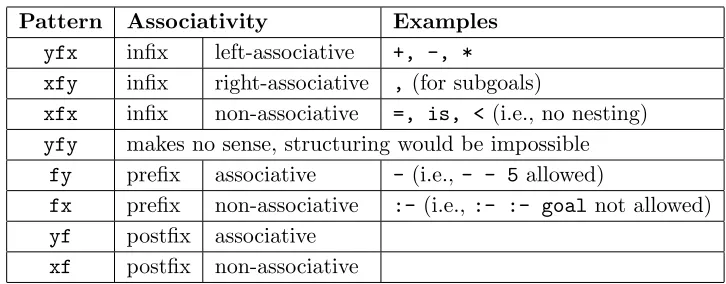
Table4.1 provides an overview of possible associativity patterns. Note that it is not possible to nest non-associative operators. For example,isis defined as anxfx-operator, which means a term like X is Y is 7 would cause a syntax error. This makes sense, because that term certainly doesn’t (make sense).
1
38 Chapter 4. Operators
Pattern Associativity Examples yfx infix left-associative +, -, *
xfy infix right-associative ,(for subgoals)
xfx infix non-associative =, is, < (i.e., no nesting) yfy makes no sense, structuring would be impossible
fy prefix associative -(i.e., - - 5allowed)
fx prefix non-associative :- (i.e.,:- :- goal not allowed) yf postfix associative
[image:44.592.105.468.123.265.2]xf postfix non-associative
Table 4.1: Associativity patterns for operators in Prolog
4.2
Declaring Operators with
op/3
Now we want to define our own operators. Recall the example on big and not so big animals from Chapter 1. Maybe, instead of writing terms like is_bigger(elephant, monkey) we would prefer to be able to express the same thing using is_bigger as an infix operator:
elephant is_bigger monkey
This is possible, but we first have to declare is_bigger as an operator. As precedence we could choose, say, 300. It doesn’t really matter as long as it is lower than 700 (the precedence of =) and greater than 0. What should the associativity pattern be? We already said it’s going to be an infix operator. As arguments we only want atoms or variables, i.e., terms of precedence 0. Therefore, we should choose xfx to prevent users from nestingis_bigger-expressions.
Operators are declared using the op/3 predicate, which has the same syntax as current_op/3. The difference is that this one actually defines the operator rather than retrieving its definition. Therefore, all arguments have to be instantiated. Again, the first argument denotes the precedence, the second one the associativity type, and the third one the name of the operator. Any Prolog atom could become the name of an operator, unless it is one already. Ouris_bigger-operator is declared by submitting the following query:
?- op(300, xfx, is_bigger). Yes
Ulle Endriss. And Introduction to Prolog Programming 39
?- elephant is_bigger donkey. Yes
As far as matching is concerned, predicate and operator notation are considered to be identical, as you can see from Prolog’s reply to this query:
?- (elephant is_bigger tiger) = is_bigger(elephant, tiger). Yes
Query execution at compilation time. Obviously, it wouldn’t be very practical to redefine all your operators every time you re-start the Prolog interpreter. Fortunately, it is possible to tell Prolog to make the definitions at compilation time. More generally speaking, you may put any query you like directly into a program file, which will cause it to be executed whenever you consult that file. The syntax for such queries is similar to rules, but without a head. Say, for instance, your program contains the following line:
:- write(’Hello, have a beautiful day!’).
Then every time you consult the file, this will cause the goal after :-to be executed:
?- consult(’my-file.pl’). Hello, have a beautiful day!
my-file.pl compiled, 0.00 sec, 224 bytes. Yes
?-You can do exactly the same with operator definitions, i.e., you could add the definition foris_bigger
:- op(300, xfx, is_bigger).
at the beginning of the big animals program file and the operator will be available directly after compilation. This means that you can use is_bigger in infix-notation to define clauses in your program file and you can use it for queries when you run your program.
4.3
Exercises
Exercise 4.1. Consider the following operator definitions:
:- op(100, yfx, plink), op(200, xfy, plonk).
(a) Copy the operator definitions into a program file and compile it. Then run the following queries and explain what is happening.
40 Chapter 4. Operators
(ii) ?- cow plonk elephant plink bird = X plink Y.
(iii) ?- X = (lion plink tiger) plonk (horse plink donkey).
(b) Write a Prolog predicatepp_analyse/1to analyse plink/plonk-expressions. The output should tell you what the principal operator is and which are the two main sub-terms. If the main operator is neither plink nor plonk, then the predicate should fail. Examples:
?- pp_analyse(dog plink cat plink horse). Principal operator: plink
Left sub-term: dog plink cat Right sub-term: horse
Yes
?- pp_analyse(dog plonk cat plonk horse). Principal operator: plonk
Left sub-term: dog
Right sub-term: cat plonk horse Yes
?- pp_analyse(lion plink cat plonk monkey plonk cow). Principal operator: plonk
Left sub-term: lion plink cat Right sub-term: monkey plonk cow Yes
Exercise 4.2. Consider the following operator definitions:
:- op(100, fx, the), op(100, fx, a), op(200, xfx, has).
(a) Indicate the structure of this term using parentheses and name its principal functor:
claudia has a car
(b) What would Prolog reply when presented with the following query?
?- the lion has hunger = Who has What.
(c) Explain why the following query would cause a syntax error:
?- X = she has whatever has style.
Exercise 4.3. Define operators in Prolog for the connectives of propositional logic. Use the following operator names: