R E S E A R C H A R T I C L E
Open Access
Mycobacterium tuberculosis
complex drug
resistance pattern and identification of species
causing tuberculosis in the West and Centre
regions of Cameroon
Jean-Paul Assam-Assam
1,2, Veronique B Penlap
2, Fidelis Cho-Ngwa
1, Jean-Claude Tedom
2, Irene Ane-Anyangwe
1and Vincent P Titanji
1*Abstract
Background:Data on the levels of resistance ofMycobacterium tuberculosiscomplex (MTBC) strains to first line anti-tuberculosis drugs in Cameroon, and on the species of MTBC circulating in the country are obsolete. The picture about 10 years after the last studies, and 6 years after the re-organisation of the National Tuberculosis (TB) Control Programme (NTBCP) is not known.
Methods:The study was conducted from February to July 2009 in the West and Centre regions of Cameroon. A total of 756 suspected patients were studied. MTBC species were detected by the standard Ziehl-Neelsen staining method. Bacterial susceptibility to the first line drugs [isoniazid (INH), rifampicin (RIF), ethambutol (EMB) and streptomycin (SM)] were performed on cultures using the indirect proportion method. MTBC species were identified by standard biochemical and culture methods.
Results:Of the 756 suspected patients, 154 (20.37%) were positive by smear microscopy. Of these, 20.77% were HIV patients. The growth ofMycobacteriumwas observed with the sputa from 149 (96.75%) subjects. All the isolates were identified as eitherM. tuberculosisor M. africanum. Among these, 16 (10.73%) were resistant to at least one drug (13.3% for the West region and 8.1% for the Centre). The initial resistance rates were 7.35% for the Centre region and 11.29% for the West region, while the acquired resistance rates were 16.66% (1/6) for the Centre region and 23.07% (3/13) for the West. Within the two regions, the highest total resistance to one drug was obtained with INH and SM (2.68% each). Multidrug-resistance (MDR) was observed only in the West region at a rate of 6.67%. No resistance was recorded for EMB.
Conclusions:M. tuberculosisandM. africanumremain the MTBC species causing pulmonary TB in the West and Centre regions of Cameroon. Following the re-organisation of the NTBCP, resistance to all first line anti-TB drugs has declined significantly (p < 0.05 for West; andp < 0.01 for Centre) in comparison to previous studies. However, the general rates of anti-TB drug resistance remain high in the country, underscoring the need for greater enforcement of control strategies.
* Correspondence: [email protected] 1
Biotechnology Unit, Faculty of Science, University of Buea, P.O. Box 63 Buea, Cameroon
Full list of author information is available at the end of the article
Background
Every year approximately 9 million people contract tuberculosis (TB) and close to 2 million die from the dis-ease [1]. The success of propagation of TB remains directly linked to the socio-economic and hygienic condi-tions of human populacondi-tions [1]. While most TB cases are in Asia, the highest incidence rates are in Africa where high rates of HIV and malnutrition weaken immune sys-tems and accelerate the spread of the disease [2]. Conse-quently, the number of new TB cases in most African countries has more than quadrupled since 1990, with 2.8 million new TB cases and roughly 735 thousand deaths annually [3]. The emergence of anti-tuberculosis drug resistance is a serious problem for TB control pro-grammes in industrialized and developing countries alike. A global project on anti-tuberculosis drug resistance sur-veillance by the WHO and the International Union Against Tuberculosis and Lung Disease (IUATLD) [4] reported a prevalence of initial drug resistance of more than 10% in over 30 countries; it also identified 14 coun-tries in which the prevalence of initial multidrug resistant TB strains (MDR-TB) (defined as resistance to at least isoniazid [INH] and rifampicin [RMP]) was more than 3%. In a 2000 WHO report on Africa, the overall level of initial resistance varied from 6.3% to 24.8%, and the level of MDR-TB from 1% to 5.3% [4]. However, the data available on the rates of drug resistance in Africa are not extensive and up to date.
In Cameroon, a country with over 18 million inhabi-tants distributed in 10 regions (previously provinces), the incidence of tuberculosis is relatively high, with more than 300 new cases per 100,000 inhabitants yearly [5]. Further contribution to the increased death rate due to TB in the country has been the emergence of drug-resistant strains to nearly all first line drugs [6]. RIF, INH, SM, and EMB are components of first-line multi-drug therapy in Cameroon [7]. Between 1997 and 1998 in the West region of Cameroon, the overall resistance rate to at least one anti-TB drug was 26.9%, with initial resistance being 19.7% and acquired resistance 51.1% [6]. In the Centre region of the country, the rate of initial resistance to at least one drug in 1995 was 31.8%, and in 1998 it was 35.2% [8,9]. In 2000 the rate of acquired resistance was determined in the Centre region to be 58.2% [10]. Since then, no other report on the rates of resistance to these drugs in the country has been carried out. The rising prevalence of MDR strains has resulted in outbreaks and cases that are not only marginally treatable, but also often fatal. Following the awareness generated by the previous studies and the re-organsiation of the National TB Control Programme with a focus on proper treatment methods, it has been necessary to reassess the levels of resistance to the main anti-TB drugs in the country. Thus, in the present
paper, we report on the current levels of resistance to these first line drugs in the West and Centre regions of Cameroon and identify the species of MTBC causing TB in the regions.
Methods
Study population and classification of samples
The study was conducted from February - July 2009 in six centres for the detection and treatment of TB (CDT) of the Centre region (Jamot Hospital, Mbalmayo District Hospital and Catholic Health Centre of Mvolye) and of the West region (Regional Hospital of Bafoussam, Dis-trict Hospital of Baleng and DisDis-trict Hospital of Dje-leng). Ethical permit was obtained from the Cameroon National Ethics Committee in Yaounde. In addition, each subject had to sign or thumbprint a patient con-sent form before they could be admitted into the study. A patient was confirmed sputum smear positive if at least two of three sputum samples collected over a 48 hour period were positive for acid fast bacilli (AFB). All sputum smear positive patients were included in the study. Patients confirmed as having pulmonary tubercu-losis for the first time and without any history of pre-vious anti-tuberculosis treatment were considered as new (or initial) cases and any drug resistance associated to them were reported as initial resistance. Patients with previous anti-tuberculosis treatment lasting a month or more were considered as old cases and any drug tance based on them were reported as acquired resis-tance. Other pieces of information (notably age, occupation, gender, HIV status) were taken from the patients using a questionnaire. The sputum samples which were smear positive were kept temporarily at +4° C and transported within 48 hours to the Mycobacter-iumLaboratory of the Centre Pasteur du Cameroun in Yaoundé for bacteriological procedures.
Bacteriological procedures
Each sputum sample was examined for acid-fast bacilli (AFB) by the standard Ziehl Neelsen staining method, and if positive, was cultured on Lőwenstein-Jensen (LJ) agar slants in tubes and in triplicate. One of the tubes was supplemented with sodium pyruvate at 0.4% to encourage the growth of any M. bovispresent. The cul-tures were incubated at 37°C and examined weekly for a maximum duration of 10 weeks. Strain identification was based on the following criteria: growth rate, colony morphology, growth affinity for pyruvate, niacin produc-tion, reduction of nitrates and catalase activity [11].
streptomycin at 4 mg/l, and ethambutol at 2 mg/l. Drug resistance was defined as growth on a drug containing medium greater than or equal to 1% of that recorded on the drug-free control medium of the same experiment.
Statistical analysis
Data were analyzed using Epi info 2000 version 12 or, when appropriate, by Fischer’s Exact test, the Student`s t-test or the z-test for comparison of proportions. A dif-ference was considered significant ifpwas < 0.05.
Results
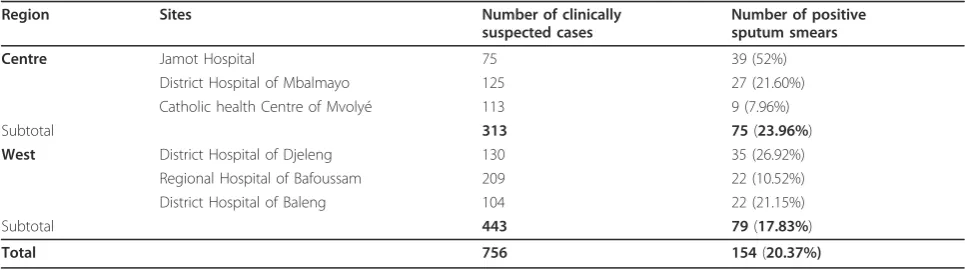
From a total of 756 subjects who presented clinical symptoms of tuberculosis at the hospital study sites, 154 (20.37%) were diagnosed positive by smear microscopy. They were 100 men (64.93%) and 54 women (35.07%) (Table 1). Patients’ age distribution showed a steady decline in age-specific prevalence from 30.58% in age group 15-29 years to 15.51% in the age group above 60 years (Table 2). Of the 154 patients, 32 (20.77%) were HIV positive (Table 3); while 135 (87.66%) were new cases and 19 (12.33%) were old cases.
The growth of Mycobacterium tuberculosis complex strains was observed with sputa from 149 (96.75%) of the 154 patients. The 5 samples without growth were thus excluded from further analysis. All the 149 isolates were identified as either M. tuberculosis or M. africa-numspecies. Among these, 133 (89.26%) were suscepti-ble to all the drugs tested, while 16 (10.73%) were resistant to at least one drug. This overall resistance rate was higher in the West region (13.3%) than in the Cen-tre region (8.1%). Within the two regions, the highest resistance rate to one drug was obtained with INH and SM (2.68% each). We did not find any resistance to EMB in this study. Resistance to more than one drug stood at 4.69% (7 isolates) for the two regions (Table 4). A total of 4 isolates (2.68%) were resistant to two drugs only, and 3 (2.01%) to three drugs. We did not find any case of resistance to all four drugs (Table 4).
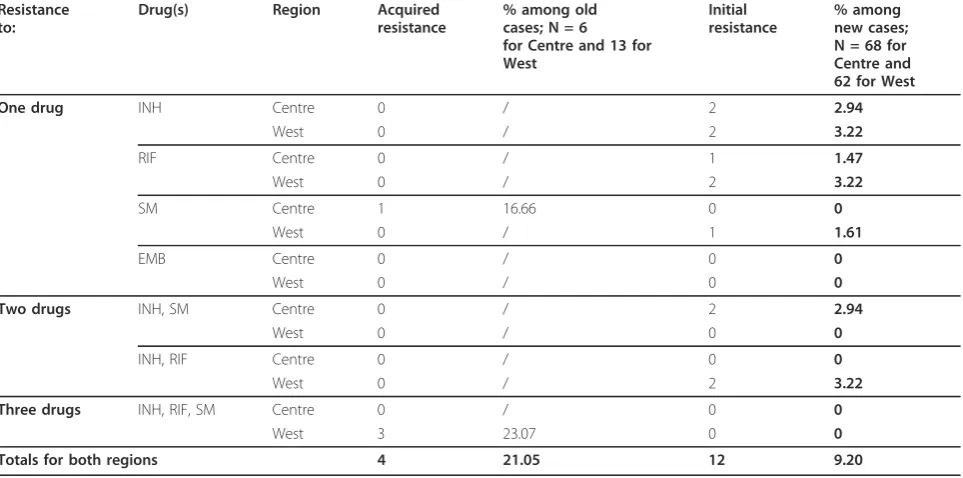
The pattern of initial and acquired drug resistance is shown in Table 5. Initial resistance to at least one drug amongst the new cases of both regions (n = 130) was 9.23%, with resistance to INH being the most common (3.08%). The initial resistance rate was 7.35% (5/68) for the Centre region and 11.29% (7/62) for the West region. Acquired resistance to one drug amongst the old cases (n = 19) of both regions was 21.05%, with the resistance to SM being the most common (4/19 or 21.05%). The acquired resistance to at least one drug was 16.66% (1/6) for the Centre region and 23.07% (3/ 13) for the West region. Multidrug-resistantM. tubercu-losis(MDR-TB) complex strains according to the defini-tion were found in 5 (6.67%) of all the 75 isolates from the West region. By contrast, MDR-TB was not detected in any of the 74 isolates from the Centre region. MDR-TB was more frequently observed in the old cases than in the new cases (p< 0.05).
Discussion and conclusions
Only a relatively small number of studies on anti-tuber-culosis drug resistance have so far been carried out in Cameroon. The last of such studies carried out in the West (pilot region) and Centre (capital city being Yaounde) regions of the country were done over 10 years ago and before the re-organisation of the Camer-oon National TB Control Programme [6,8,9]. The objec-tive of the present study was to identify the mycobacterial species responsible for the spread of pul-monary TB in these two regions and to study the pat-tern of resistance of isolates to common first line anti-tuberculosis drugs in the regions. These regions are amongst the most socio-economically active in the country.
[image:3.595.56.539.589.724.2]The growth of MTBC strains was observed with the sputa of 149 (96.75%) of the 756 suspected patients. The identification of the isolates by biochemical tests revealed the presence of onlyM. tuberculosis orM. afri-canum species. These results are in line with those of
Table 1 Distribution of sputum samples collected
Region Sites Number of clinically
suspected cases
Number of positive sputum smears
Centre Jamot Hospital 75 39 (52%)
District Hospital of Mbalmayo 125 27 (21.60%)
Catholic health Centre of Mvolyé 113 9 (7.96%)
Subtotal 313 75(23.96%)
West District Hospital of Djeleng 130 35 (26.92%)
Regional Hospital of Bafoussam 209 22 (10.52%)
District Hospital of Baleng 104 22 (21.15%)
Subtotal 443 79(17.83%)
previous studies in the West and Centre regions of Cameroon where in 1995 and 1998, only these species were detected [8,9].
The majority of the patients were men (63.93%) and this was found to be in agreement with previous find-ings [12]. The prevalence of TB decreased steadily with age, with the youths being at greater risk of becoming active patients. The youths are socio-economically more active, and have the highest HIV infection rates in Cameroon. At least 32 (20.77%) of the 154 patients were HIV positive based on analysis of the questionnaires. The official prevalence of HIV infection in Cameroon is about 5.5%, indicating a greater than 4-fold increase in the prevalence of HIV infection amongst TB patients. On the global scale in 2007, 15% of all new cases of TB were infected with HIV [2]. Global figures suggest that HIV-positive people are between 6 to 37 times more likely than HIV-negative people to develop TB [2]. However, all the drug resistant MTBC isolates in the present study were from people who indicated they were HIV negative.
The overall resistance rates (one or more drugs) were 8.1% and 13.3% for the Centre and West regions respec-tively. The initial resistance rates were 7.35% and 11.29% for the Centre and West regions respectively, while the acquired resistance rates were 16.66% and 23.07% for the Centre and West regions respectively. Within the two regions, the highest resistance rates to one drug were obtained with INH and SM, while no resistance was recorded for EMB. A previous study car-ried out in the Centre region (capital city, Yaounde) of Cameroon in 1998 indicated an overall resistance rate of 35.2%, with initial resistance being 31.8% (164/516) and acquired resistance, 55.8% (48/86). In the study, resis-tance to streptomycin (20.5%), and isoniazid (12.4%) were the highest, while ethambutol showed the least (0.4%) [13,14]. A similar study carried out in the West region from 1997-1998 indicated the overall resistance
rate to be 26.9%, with initial resistance being 19.7% (86/ 437) and acquired resistance, 51.1% (66/129). Again, the resistance to streptomycin (11.7%) and isoniazid (12.1%) were the highest, while the rates for ethambutol (2.5%) and rifampicin (2.1%) were low [6]. Our observations therefore follow the trends of these previous results obtained for the same regions, albeit a significant drop (p < 0.05 for West; andp < 0.01 for Centre) in resis-tance to all the drugs tested. This drop could be the fall-out of the reorganization of the National TB Control Programme, which emphasises the implementation of the directly observed treatment strategy (DOTs). The lower resistance rates for the Centre region in the present study could be accounted for, at least in part, by the fact that the region is the seat of the capital city of Cameroon, Yaounde where better health care facilities may be found. Both SM and INH have been in use in Cameroon for longer periods than RIF and EMB. However, a compila-tion of 63 surveys on resistance to anti-tuberculosis drugs carried out between 1985 and 1994 in some coun-tries showed the rate of acquired EMB resistance to be as high as 13.7% [15]. The rate of initial resistance in the present study was found to be higher (9.2% for the two regions) than that reported from other African countries such as Zimbabwe (3.3%) and Bostwana (3.7%) [16], but lower than those reported in similar studies from Uganda [17], Ivory Coast [16], and Sierra Leone [16] (27.4%, 13.4%, and 28.1% respectively). In some African countries the rates of acquired drug resistance are reported to be lower or similar (e.g. Zimbabwe, 13.9%; Botswana, 14.9%; and Swaziland, 20.5%) [16].
[image:4.595.57.539.101.161.2]A more serious aspect of the TB drug problem is when the infecting organism is resistant to both INH and RIF, referred to as multi-drug resistant TB (MDR-TB) [18]. Under this condition, the duration of treat-ment is prolonged from 6 to 18-24 months, and the cure rate could decrease from nearly 100% to less than 60%. This makes the treatment of multi-drug-resistant cases particularly challenging [19]. MDR-TB strains were found in 5 (6.67%) of the 75 isolates from the West region. No MDR-TB strain was detected in any of the 74 isolates from the Centre region. A similar work done in the West region in 2000 indicated an MDR-TB rate of 4.1% [6]. This indicates a slight increase in the rate of MDR-TB. MDR-TB is an important problem globally [20]. It results from deficiencies in TB case
Table 3 Distribution of patients according to their HIV serological status
HIV
Positive HIVNegative Unknown HIVstatus Number of
patients
[image:4.595.55.292.684.731.2]32 (20.77%) 103 (66.88%) 19 (12.33%)
Table 2 Age distribution of study subjects and patients
Age range (years) 15- 29 30-44 45 - 60 > 60
Number of suspected cases in age range (%) 206 216 122 58
Number positive by smear microscopy (% of positive cases) 63 (41.00%)
53 (34.41%)
29 (18.83%)
9 (5.84%)
management and control programmes, and there is growing evidence now of an overlap between this epi-demic and HIV infection [21]. In 2004, it was estimated that 4.3% of all new and previously treated tuberculosis cases world-wide were multidrug resistant [22]. The results of a worldwide survey showed that in 2006, 2% of M. tuberculosisisolates were extensively multidrug resistant (XDR-TB, caused by MDR strains also resistant
to quinolones plus one of the injectable second line agents) [23].
[image:5.595.59.539.100.324.2]We conclude thatM. tuberculosis andM. africanum remain the MTBC species causing pulmonary TB in the West and Centre regions of Cameroon, and that follow-ing the re-organisation of the NTBCP, resistance to all first line anti-TB drugs has declined significantly in comparison to previous studies, with ethambutol now
Table 5 Pattern of acquired and initial resistance to first line anti-tuberculosis drugs in the Centre and West regions of Cameroon
Resistance to:
Drug(s) Region Acquired resistance
% among old cases; N = 6 for Centre and 13 for West
Initial resistance
% among new cases; N = 68 for Centre and 62 for West
One drug INH Centre 0 / 2 2.94
West 0 / 2 3.22
RIF Centre 0 / 1 1.47
West 0 / 2 3.22
SM Centre 1 16.66 0 0
West 0 / 1 1.61
EMB Centre 0 / 0 0
West 0 / 0 0
Two drugs INH, SM Centre 0 / 2 2.94
West 0 / 0 0
INH, RIF Centre 0 / 0 0
West 0 / 2 3.22
Three drugs INH, RIF, SM Centre 0 / 0 0
West 3 23.07 0 0
Totals for both regions 4 21.05 12 9.20
[image:5.595.58.540.484.723.2](INH) = Isoniazid; (RIF) = Rifampicin; (SM) = Streptomycin; (EMB) = Ethambutol
Table 4 First line anti-tuberculosis drug resistance pattern in the Centre and West regions of Cameroon
Resistance to:
Drug(s) Region Number of resistant cases in region
% in patients of region: N = 74 for Centre and 75 for West
Total % in patients of both regions
One drug INH Centre 2 2.70 2.68
West 2 2.66
RIF Centre 1 1.35 0.67
West 0 0
SM Centre 1 1.35 2.68
West 3 4.00
EMB Centre 0 0 0
West 0 0
Two drugs INH, SM Centre 2 2.70 1.34
West 0 0
INH, RIF Centre 0 0 1.34
West 2 2.66
Three drugs INH, RIF, SM Centre 0 0 2.01
West 3 4.00
Totals to at least one drug 16 8.10 (Centre); 13.30 (West) 10.73
showing no resistance in both regions. However, the general rates of anti-TB drug resistance remain high in both regions, underscoring the need for greater enforce-ment of control strategies in the country.
Acknowledgements
This research was funded by a grant from the Biosciences Eastern and Central Africa (BecANet), a network of the New Partnership for Africa’s Development (NEPAD). The authors thank all the staff at the local, regional and district hospitals for interviewing patients and collecting samples. Our acknowledgements also go to theCentre Pasteur du Cameroun(CPC) staff, especially Dr. Niobe SN for their technical assistance during the bacteriological studies.
Author details
1Biotechnology Unit, Faculty of Science, University of Buea, P.O. Box 63 Buea,
Cameroon.2Laboratory of Tuberculosis Research, Biotechnology Centre of Nkolbisson, Faculty of Science, University of Yaoundé I, Yaounde, Cameroon.
Authors’contributions
JPAA carried out many of the experiments as a PhD student, participated in field work and drafted the manuscript; VBP participated in field work and in the conception, design, supervision of the experiments, analysis of data and revision of the manuscript; FCN participated in field and laboratory work and in the conception, design, supervision of the experiments, analysis of data as well as in the drafting and revision of the manuscript; JCT assisted JPAA in the field and on the laboratory bench; IAA participated in the field work and in the revision of the manuscript; VPT was the overall supervisor and chief designer of the project. All authors read and approved the final manuscript before submission.
Competing interests
The authors declare that they have no competing interests.
Received: 25 October 2010 Accepted: 15 April 2011 Published: 15 April 2011
References
1. WHO (World Health Organization):Global tuberculosis control: surveillance, planning, financial.WHO report 2005Geneva, Switzerland; 2005.
2. WHO (World Health Organization):Global tuberculosis control: epidemiology, strategy, financing.Geneva, Switzerland; 2009.
3. WHO (World Health Organization):Tuberculosis Control: The Situation in the African Region.The 55th session of the WHO original committee for Africa held in Maputo, Mozambique, August 2005, resolution AFR/RC55/R5 Geneva, Switzerland; 2005.
4. WHO (World Health Organization):Anti-tuberculosis drug resistance in the world. Report number 2: Prevalence and Trends.The WHO/IUATLD global project on anti-tuberculosis drug resistance surveillance. WHO/CDS/TB/2000.278 Geneva, Switzerland; 2000.
5. Niobe SN, Kuaban C, Sorlin P, Cunin P, Thonnon J, Sola C, Rastogi N, Vincent V, Gutierrez MC:Genetic Biodiversity ofMycobacterium
tuberculosiscomplex strains from patients with pulmonary tuberculosis in Cameroon.Journal of Clinical Microbiology2003,41(6):2547-2553. 6. Kuaban C, Bercion R, Noeske J, Cunin P, Nkamsse P, Niobe SN:
Antituberculosis drug resistance in the West Province of Cameroon.Int J Tuberc Lung Dis2000,4(4):356-360.
7. Soini H, Musser JM:Molecular diagnosis of mycobacteria.Clinical Chemistry2001,47:809-814.
8. Bercion R, Kuaban C:Initial resistance to anti-tuberculosis drugs in Yaounde, Cameroon.Int J Tuberc Lung Dis1997,1:110-114.
9. Bercion R, Kuaban C:Resistance deMycobacterium tuberculosiscomplex aux principaux antibacillaires a Yaounde, Cameroun.Bull Soc Path Ex 1998,91:199-202.
10. Kuaban C, Bercion R, Jifon G, Cunin P, Blackett KN:Acquired anti-tuberculosis drug resistance in Yaounde, Cameroon.Int J Tuberc Lung Dis 2000,4(5):427-32.
11. Canetti G, Rist N, Grosset J:Measurement of sensitivity of the tuberculous bacillus to antibacillary drugs by the method of proportions.Rev Tuberc Pneumol1963,27:217-272.
12. Godfrey-Faussett P, Sonnenberg P, Shearer SC, Bruce MC, Mee C, Morris L:
Tuberculosis control and molecular epidemiology in a South African gold- mining community.Lancet2000,356:1066-1071.
13. Bercion R, Kuaban C:Resistance ofMycobacterium tuberculosiscomplex to the principal anti-bacillary drugs in Yaounde, Cameroon.Bull Soc Path Ex 1998,91:199-202.
14. Kuaban C, Bercion R, Jifon G, Cunin P, Blackett KN:Acquired anti-tuberculosis drug resistance in Yaounde, Cameroon.Int J Tuberc Lung Dis 2000,4(5):427-32.
15. Cohn DL, Bustreo F, Raviglione MC:Drug-resistant tuberculosis: review of the worldwide situation and the WHO/IUATLD global surveillance project.Clin Infect Dis1997,24:S121-S130.
16. WHO (World Health Organisation):Anti tuberculosis drug resistance in the world.The WHO/IUATLD Global project on anti-tuberculosis drug resistance surveillanceGeneva: World Health Organization. Geneva, Switzerland; 1997, WHO/TB/97.229.
17. Bretzel G, Aziz M, Wendl-Richter U, Adatu F, Aisu T, van Wijnen A, Sticht-Groh V:Anti-tuberculosis drug resistance surveillance in Uganda 1996-1997.Int J Tuberc Lung Dis1999,3(9):810-5.
18. Jereb JA, Kelly GD, Dooley SW Jr, Cauthen GM, Snider DE Jr:Tuberculosis mortality in the United States final data, 1990.MMWR CDC Surveillance 1991,40:23-28.
19. Akcaly S:In-vitro susceptibility ofMycobacterium tuberculosisstrains to first-line antituberculosis drugs in Manisa region.Microbiology specialist thesis, Manisa2000.
20. Zignol M, Hosseini MS, Wright A, Weezenbeek CL, Nunn P, Watt CJ, Williams BG, Dye C:Global incidence of multidrug-resistant tuberculosis.J Infect Dis2006,194:479-485.
21. Kochi A, Vareldris B, Styblo K:Multidrug-resistant tuberculosis and its control.Res Microbiol1993,144:104-110.
22. Wells CD, Cegielski JP, Nelson LJ, Laserson KF, Holtz TH, Finlay A, Castro KG, Weyer K:HIV infection and multidrug resistance -the perfect storm.J Infect Dis2007,196(Suppl 1):S86-S107.
23. Gandhi NR, Moll A, Sturm AW, Pawinski R, Govender T, Lalloo U, Zeller K, Andrews J, Friedland G:Extensively drug resistant tuberculosis as a cause of death in patients co-infected with tuberculosis and HIV in a rural area of South Africa.Lancet2006,368:575-1580.
Pre-publication history
The pre-publication history for this paper can be accessed here: http://www.biomedcentral.com/1471-2334/11/94/prepub
doi:10.1186/1471-2334-11-94
Cite this article as:Assam-Assamet al.:Mycobacterium tuberculosis
complex drug resistance pattern and identification of species causing tuberculosis in the West and Centre regions of Cameroon.BMC Infectious Diseases201111:94.
Submit your next manuscript to BioMed Central and take full advantage of:
• Convenient online submission
• Thorough peer review
• No space constraints or color figure charges
• Immediate publication on acceptance
• Inclusion in PubMed, CAS, Scopus and Google Scholar
• Research which is freely available for redistribution