R E S E A R C H
Open Access
Communication tools for end-of-life
decision-making in the intensive care unit:
a systematic review and meta-analysis
Simon J. W. Oczkowski
1*, Han-Oh Chung
1, Louise Hanvey
2, Lawrence Mbuagbaw
3,4and John J. You
1,3Abstract
Background:For many patients admitted to the intensive care unit (ICU), preferences for end-of-life care are unknown, and clinicians and substitute decision-makers are required to make decisions about the goals of care on their behalf. We conducted a systematic review to determine the effect of structured communication tools for end-of-life decision-making, compared to usual care, upon the number of documented goals of care discussions, documented code status, and decisions to withdraw life-sustaining treatments, in adult patients admitted to the ICU.
Methods:We searched multiple databases including MEDLINE, Embase, CINAHL, ERIC, and Cochrane from database inception until July 2014. Two reviewers independently screened articles, assessed eligibility, verified data extraction, and assessed risk of bias using the tool described by the Cochrane Collaboration and the Newcastle Ottawa Scale. Pooled estimates of effect (relative risk, standardized mean difference, or mean difference), were calculated where sufficient data existed. GRADE was used to evaluate the overall quality of evidence for each outcome.
Results:We screened 5785 abstracts and reviewed the full text of 424 articles, finding 168 eligible articles, including 19 studies in the ICU setting. The use of communication tools increased documentation of goals-of-care discussions (RR 3.47, 95 % CI 1.55, 7.75, p= 0.020, very low-quality evidence), but did not have an effect on code status documentation (RR 1.03, 95 % CI 0.96, 1.10, p= 0.540, low-quality evidence) or decisions to withdraw or withhold life-sustaining treatments (RR 0.98, 95 % CI 0.89, 1.08,p= 0.70, low-quality evidence). The use of such tools was associated with a decrease in multiple measures of health care resource utilization, including duration of mechanical ventilation (MD−1.9 days, 95 % CI−3.26,−0.54,p= 0.006, very low-quality evidence), length of ICU stay (MD−1.11 days, 95 % CI−2.18,−0.03,p= 0.04, very low-quality evidence), and health care costs (SMD−0.32, 95 % CI−0.5,−0.15,p< 0.001, very low-quality evidence).
Conclusions:Structured communication tools may improve documentation of EOL decision making and may result in lower resource use. The supporting evidence is low to very low in quality. Further high-quality randomized studies of simple communication interventions are needed to determine whether structured, rather than ad hoc, approaches to end-of-life decision-making improve patient-level, family-level, and system-level outcomes.
Trial registration:PROSPERO CRD42014012913
Keywords:Communication, End-of-life, Ethics, Palliative care, Critical care
* Correspondence:[email protected]
1Department of Medicine, McMaster University, Hamilton, ON, Canada
Full list of author information is available at the end of the article
© 2016 Oczkowski et al.Open AccessThis article is distributed under the terms of the Creative Commons Attribution 4.0 International License (http://creativecommons.org/licenses/by/4.0/), which permits unrestricted use, distribution, and reproduction in any medium, provided you give appropriate credit to the original author(s) and the source, provide a link to the Creative Commons license, and indicate if changes were made. The Creative Commons Public Domain Dedication waiver (http://creativecommons.org/publicdomain/zero/1.0/) applies to the data made available in this article, unless otherwise stated. Oczkowskiet al. Critical Care (2016) 20:97
Background
Rationale
With its advanced technology, the intensive care unit (ICU) can provide life-saving medical treatment to the sickest of patients; however, that same technology can also prolong the dying process for patients who are unlikely to survive. Furthermore, many people who are approaching the end of life (EoL), either due to advan-cing age or progressive disease, would opt for fewer invasive and aggressive treatments in favor of a more palliative or comfort-based approach if asked, but such preferences are often undocumented in the medical record [1]. As a result, ICU clinicians and the substitute decision-makers (SDMs) often engage in goals-of-care discussions to interpret the patient’s known values and preferences in the context of their illness, and to decide which ICU treatments would be in keeping with their wishes [2]. Given the medical and moral complexity of such discussions, and the need to conduct them under acute, often stressful conditions, many communication tools (including decision aids, structured meeting plans, and educational interventions) have been devel-oped in order to assist SDMs and clinicians with EoL decision-making.
However, there remains uncertainty as to whether the use of structured communication tools for EoL decision-making is superior to usual care. Therefore, we con-ducted a systematic review of the medical literature to determine the impact of communication tools for EoL decision-making in the ICU on the following outcomes: the number and quality of EoL discussions between SDMs and healthcare providers (HCPs); the documenta-tion of code status; and decisions to withdraw or with-hold life-sustaining treatments.
Methods
Protocol and registration
The protocol for this review is available in the PROS-PERO registry (http://www.crd.york.ac.uk/PROSPROS-PERO/ display_record.asp?ID=CRD42014012913).
Eligibility criteria
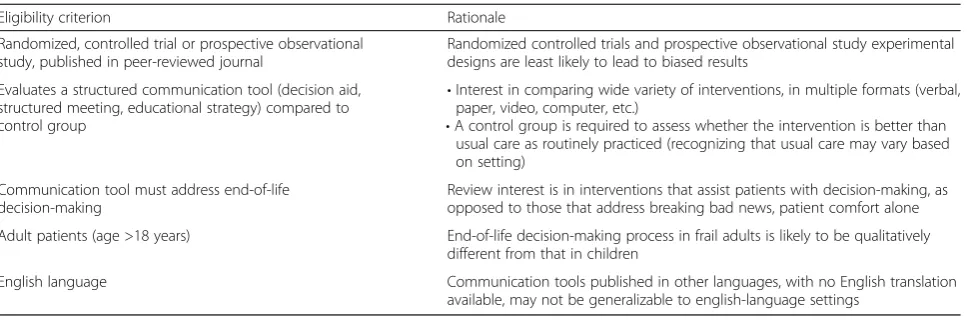
We included randomized controlled trials (RCTs) or prospective observational studies with a control group (including pre-post studies in which participants acted as their own control) published as articles in peer-reviewed journals, restricted to the English language. To be eligible for this review, studies must have included patients over the age of 18 years, and evaluated a com-munication tool to assist in EoL decision-making in comparison to a control group.
For our study, we defined a communication tool as any intervention designed to directly assist individual pa-tients and SDMs in decision-making, or their clinicians
to better facilitate the EoL decision-making process. This included traditional decision aids in any format (paper, video, computer, etc.), and other structured approaches to assisting decision-making, including organized meet-ing plans, consultation with services for the purpose of assisting with decision-making (e.g., ethics or palliative care), and educational interventions on EoL care op-tions. Interventions designed solely for information-sharing (e.g., breaking bad news, providing emotional support) were excluded, because although such interven-tions may affect decisions at the EoL, it is not their ex-plicit purpose to do so (Table 1). Communication tools for ICU settings are distinct from those in the ambula-tory or non-ICU inpatient setting, as they are directed towards patients and SDMs, and not towards patients, who are generally too ill to participate in EoL decision-making; furthermore, communication tools in the ICU setting are usually directed towards decisions about current acute care, rather than advance care planning to prepare for future acute illness. For this reason, we report findings from eligible studies that were conducted in the ICU. Studies conducted in the ambulatory setting and in the inpatient non-ICU setting, and studies of educational interventions for improving clinicians’ competencies in EoL communication and decision-making will be analyzed and reported separately.
For this paper, which focuses on the ICU setting, our primary outcomes were: (1) proportion of patients with documented goals of care discussions; (2) proportion of patients with documented code status; and (3) proportion of patients with new decisions to withdraw or withhold life-sustaining treatments, as we considered these to be the most immediate patient-level outcomes affected by goals-of-care discussions. Our secondary outcomes were (1) patient or family satisfaction with EoL care; 2) patient or family knowledge about EoL care, including knowledge about palliative care and intensive care; (3) quality of com-munication between the patient/SDM and HCPs; (4) health care resource utilization (including duration of mechanical ventilation, ICU length of stay, hospital length of stay, and financial cost of care); and (5) the acceptability of the intervention. Secondary outcomes 1–3 were se-lected to help understand the mechanisms by which com-munication tools affect EoL decisions, while secondary outcome 4 was chosen to understand the resource impli-cations of using these tools, and, for study participants who received the intervention, secondary outcome 5 was chosen to help understand whether the use of such tools, irrespective of other benefits, would be acceptable to patients/SDMs.
Information sources and search strategy
We searched the following databases from database inception until the present: MEDLINE (1946 through
July 2014); Embase (1980 through July 2014); CINAHL (1982 through July 2014); Cochrane Database of Clinical Controlled Trials (2005 through July 2014); and ERIC (1966 through July 2014). Our search terms included: “communication,” “decision-making,” “end-of-life,” “ car-diopulmonary resuscitation” (complete electronic search strategies for each database can be found in Additional file 1: Appendix 1). We also hand-searched the reference lists of eligible articles to identify further articles for screening.
Study selection
Retrieved titles and abstracts were screened independ-ently and in duplicate by two reviewers (HC, SO) for po-tential eligibility using standardized, piloted screening forms. The full text of all articles that passed initial screening by either reviewer were then assessed inde-pendently and in duplicate using standardized, piloted eligibility forms. Disagreement about study eligibility was resolved by consulting with a third reviewer (JY). Reviewers were not blinded as to article authors, journal, or results, when screening for eligibility. Kappa statistics were calculated to assess the inter-rater reliability of the screening and eligibility phases [3]. Studies were then divided based on study type into outpatient, inpatient, or intensive care unit settings; or educational interventions for clinicians.
Data collection process and data items
Study data were collected using standardized, piloted online forms by the two reviewers (HC and SO). Study authors were contacted to obtain missing data for our primary or secondary outcomes. We col-lected data on publication information, study dates and population characteristics, study interventions, our primary and secondary outcome measurements, and the study methods required to assess the risk of bias in individual studies.
Risk of bias in individual studies
For RCTs, we assessed the risk of bias in individual stud-ies using the Cochrane risk-of-bias tool with regard to random sequence generation, allocation concealment, blinding of participants and personnel, incomplete out-come data, selective reporting, and where appropriate, cluster design [4]. Each domain was assessed independ-ently by both reviewers and reported as having high, low, or uncertain risk of bias. Studies were considered to have low risk of bias if assessed as having low risk of bias in all domains; to have uncertain risk of bias if assessed as having uncertain risk of bias in at least one domain and no domains at high risk of bias; and to have high risk of bias if there was high risk of bias in any domain. For studies with uncertain risk of bias, we attempted to contact study authors to clarify the rele-vant issue(s), and revised the overall study risk-of-bias accordingly. Disagreement between reviewers about risk of bias was resolved by consulting with a third reviewer (JY). For observational cohort and case– con-trol studies, we used the Newcastle-Ottawa scale to assess risk of bias, using seven stars for our cutoff for good vs. poor studies [5]. For uncontrolled before–after studies, the National Institutes of Health rating system was applied [6].
Synthesis of results
[image:3.595.58.542.97.258.2]We used Revman 5.3 software to conduct our analyses [7]. For each outcome, similar studies were pooled, with priority given to randomized trials i.e., data were sought from RCTs first and non-randomized studies were only used in the absence of data from RCTs. However, given the small number of RCTs found, we also reported the results of observational studies in separate analyses for comparison. Pooled outcomes (standardized mean dif-ference (SMD) or mean difdif-ference (MD) for continuous variables, relative risk (RR) for dichotomous variables) and 95 % confidence intervals (95 % CI) were calculated Table 1Study eligibility criteria
Eligibility criterion Rationale
Randomized, controlled trial or prospective observational study, published in peer-reviewed journal
Randomized controlled trials and prospective observational study experimental designs are least likely to lead to biased results
Evaluates a structured communication tool (decision aid, structured meeting, educational strategy) compared to control group
•Interest in comparing wide variety of interventions, in multiple formats (verbal, paper, video, computer, etc.)
•A control group is required to assess whether the intervention is better than usual care as routinely practiced (recognizing that usual care may vary based on setting)
Communication tool must address end-of-life decision-making
Review interest is in interventions that assist patients with decision-making, as opposed to those that address breaking bad news, patient comfort alone
Adult patients (age >18 years) End-of-life decision-making process in frail adults is likely to be qualitatively different from that in children
English language Communication tools published in other languages, with no English translation available, may not be generalizable to english-language settings
using a random-effects model. For cluster-randomized RCTs, intraclass correlation coefficients were used to adjust the effective sample size to adjust for clustering effects within groups [8]. Where standardized deviations were missing, or represented by interquartile ranges, estimates were generated using the calculations de-scribed in the Cochrane handbook [9].
Investigation of heterogeneity and subgroup analyses
Clinical heterogeneity was assessed by reviewers investi-gating study populations, interventions, and comparisons. If the studies were considered to be of sufficient similarity for data pooling, heterogeneity was quantified for each outcome of interest and using the I2statistic, with values greater than 50 % indicating substantial heterogeneity [9].
We conducted one exploratory subgroup analysis, comparing the results of the communication tools be-tween patients who survived to discharge from ICU (ICU survivors) and those who died in the ICU (ICU non-survivors). Several of the studies only reported outcomes for ICU non-survivors. We chose to report these results separately, as the subgroup of ICU non-survivors may rep-resent a population more likely to have withdrawal of life support (due either to pre-existing advance directives, se-verity of illness, or medical comorbidities), and would thus be inappropriate to pool with studies that included both ICU survivors and non-survivors. This subgroup is also of interest as it may correlate with a group of patients for whom ICU resources constitute‘non-beneficial care’[10].
Publication bias
Publication bias was assessed using visual inspection of funnel plots generated in Revman 5.3, where sufficient numbers of studies existed to permit interpretation [11].
Rating of quality of evidence
We used the Grading of Recommendations Assessment, Development, and Evaluation (GRADE) approach to as-sess the quality of evidence for each outcome [12]. Out-comes for which the majority of evidence was derived from RCTs was considered to initially be of high quality, while those from which the majority of evidence was from observational studies started at low quality, with both types rated up or down after considering the risk of bias across studies (e.g., publication bias), potential biases and their direction within each study, and the imprecision, in-consistency, and indirectness of the evidence. GRADE summary of findings tables were generated using the on-line GradePRO software [13].
Results
Study selection
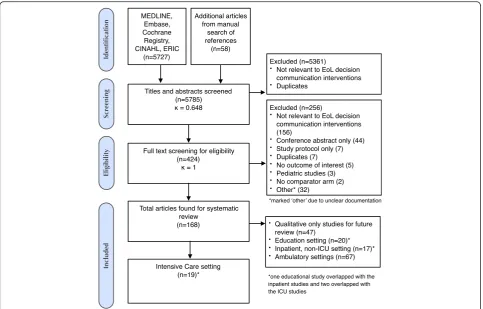
Initial database searches retrieved 5727 articles, with 58 articles found using reference screening. After exclusion
of duplicate references and conference abstracts, title and abstract screening resulted in 424 articles eligible for full text review (κ= 0.648; 95 % CI 0.601, 0.695). A total of 168 articles were eligible for our systematic review after full-text review and additional manual refer-ence screening, of which 19 studies were conducted in the ICU setting (Fig. 1).
Study characteristics
Study settings and populations
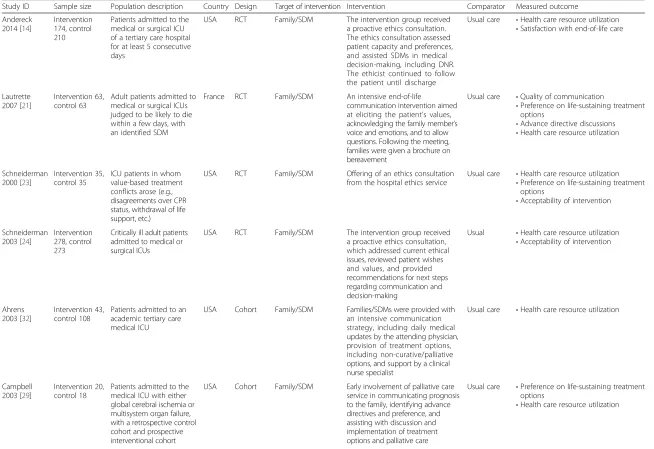
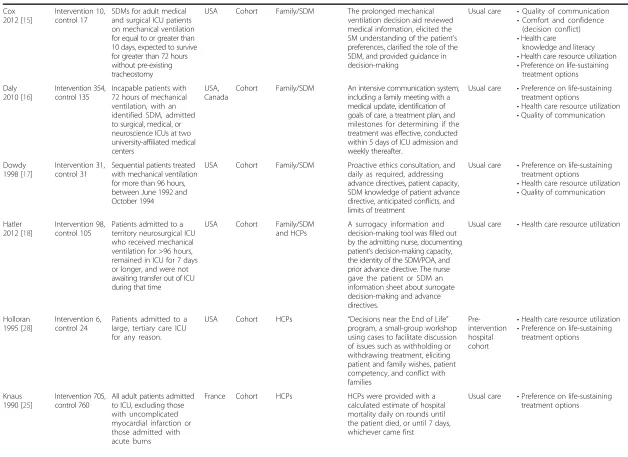
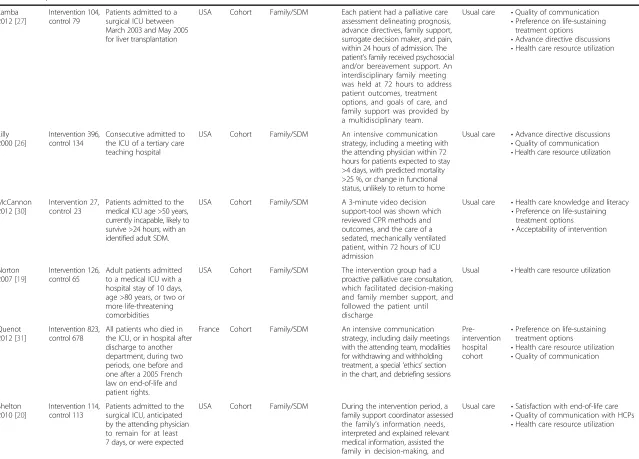
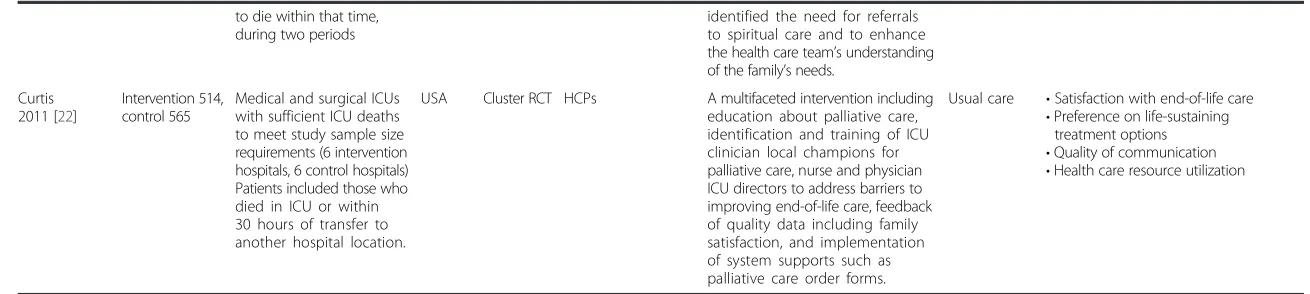
Study publication dates ranged from 1995 to 2014. Most were conducted in the USA or Canada (n = 16, 84 %), with three conducted in France (16 %). Three studies were conducted in medical ICUs, two in surgical ICUs, and fourteen in mixed medical-surgical or non-specified ICU type. Seven studies specifically focused on patients with longer ICU or hospital stays [14–20]. Two studies were conducted in patients considered likely to die [21, 22]. One study specifically evaluated interventions in pa-tients for whom there were conflicts over goals of care [23] (Table 2).
Interventions
Fifteen interventions were directed solely at the family/ SDM, three at HCPs, and one intervention had elements directed at both groups. Interventions included ICU team-led intensive communication strategies (n = 6, 32 %); ethics consultations (n = 4, 21 %) or palliative care consultations (n = 3, 16 %) for the purpose of assisting with EoL decision-making; written decision aids (n = 3, 16 %); video decision aids (n = 2, 11 %); and complex multifaceted ICU quality improvement interventions (n = 1, 5 %) (Table 2).
Characteristics of excluded studies
Of the studies that underwent full-text review, 256 were excluded because they: did not address EoL decision-making (n = 156, 61 %); were conference abstracts with no corresponding full-text publication available (n = 44, 17 %); were study protocols only (n = 7, 3 %); included pediatric patients (n = 3, 1 %); did not include a compari-son group (n = 2, 1 %); or provided only qualitative data (n = 47, 18 %).
Risk of bias within studies
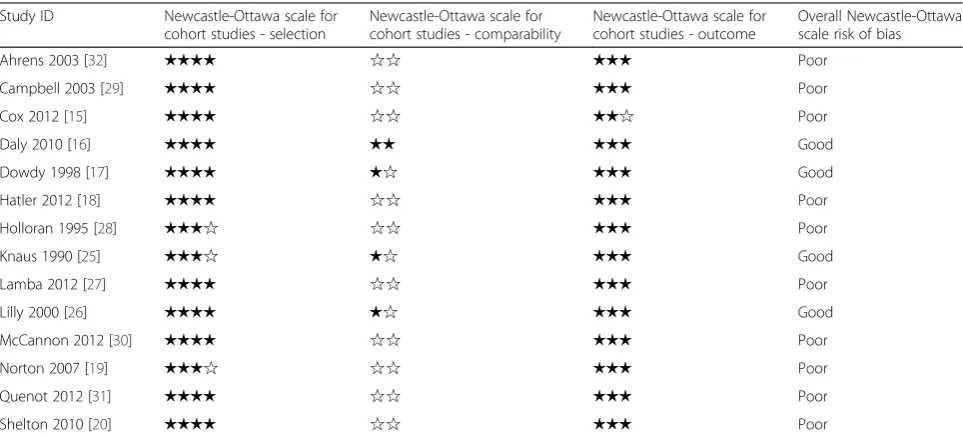
Five of the included studies were RCTs, of which three were considered to have an overall low risk of bias [14, 21, 24], one to have uncertain risk of bias [23], and one to have high risk of bias [22]. The fourteen observational studies were prospective co-hort studies, with four having Newcastle-Ottawa scores considered to be good [16, 17, 25, 26], and the re-mainder of cohort studies having a poor quality rating (Tables 3 and 4).
Synthesis of results
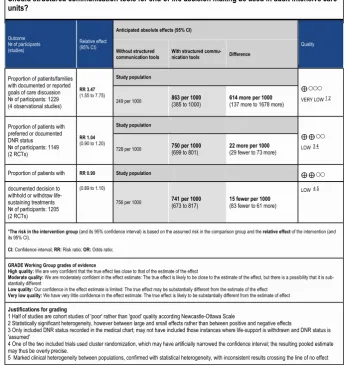
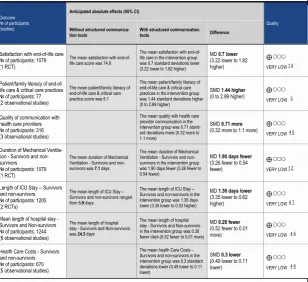
Overall ratings for the quality of evidence for the effective-ness of communication strategies on end-of-life decision-making can be seen in the GRADE summary of findings Tables (Tables 5 and 6).
Primary outcomes
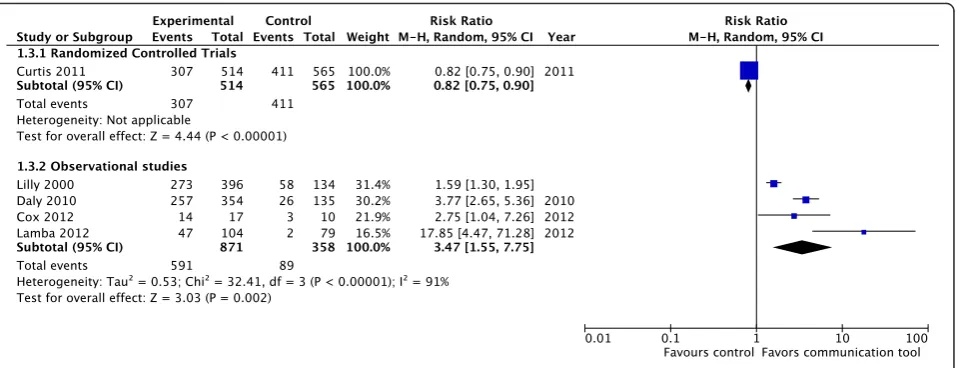
1. Proportion of patients with documented goals of care discussions: one cluster RCT (1079 patients), considered to have a high risk of bias, reported on documented goals-of-care discussions [22], finding a significant reduction in the number of documented discussions in the intervention group (relative risk (RR) 0.82, 95 % CI 0.75, 0.90,p< 0.001). By contrast, four observational studies (1229 patients) found an increase in documented goals-of-care discussions (RR 3.47, 95 % CI 1.55, 7.75,p= 0.020) [15,16,26,27]. Our overall GRADE assessment for the quality of evidence is very low for both the RCT and observational data, indicating that future studies are highly likely to affect our estimates of effect, for this outcome; we selected the observational studies for our primary analyses, given the limitations of the data from the single RCT (Fig.2)
2. Proportion of patients with documented code status or‘do not resuscitate’(DNR) status: two RCTs (295 patients), one considered to have a high risk of bias [22], the other an uncertain risk of bias [23], reported the proportion of patients with documented code status/DNR status, finding no significant difference with the use of structured communication tools (RR 1.04, 95 % CI 0.90, 1.20,p= 0.57, low-quality evidence). Four observational studies (895 patients) also reported on this outcome [16,17,27–30], again finding no significant differences between the intervention and control within these studies (RR 1.30, 95 % CI 0.95, 1.78, p= 0.11) (Fig. 3) 3. Withholding or withdrawal of life-sustaining
treatments: two RCTs (351 patients), one considered to have a low risk of bias [21], and one a high risk of bias [22], reported on decisions to withhold or withdraw life-sustaining treatments, finding no significant difference between the study arms (RR 0.99, 95 % CI 0.89, 1.10,p= 0.85, low-quality
evidence), although in the study by Lautrette et al. all patients in both arms of the study ended up having life support withdrawn. Six observational studies (3727 patients) also reported on withdrawal of life-sustaining treatments [15–17,25,27,31], finding Fig. 1Flowsheet of study screening, eligibility, and inclusion
[image:5.595.57.541.87.396.2]Table 2Study characteristics
Study ID Sample size Population description Country Design Target of intervention Intervention Comparator Measured outcome
Andereck 2014 [14]
Intervention 174, control 210
Patients admitted to the medical or surgical ICU of a tertiary care hospital for at least 5 consecutive days
USA RCT Family/SDM The intervention group received a proactive ethics consultation. The ethics consultation assessed patient capacity and preferences, and assisted SDMs in medical decision-making, including DNR. The ethicist continued to follow the patient until discharge
Usual care •Health care resource utilization •Satisfaction with end-of-life care
Lautrette 2007 [21]
Intervention 63, control 63
Adult patients admitted to medical or surgical ICUs judged to be likely to die within a few days, with an identified SDM
France RCT Family/SDM An intensive end-of-life
communication intervention aimed at eliciting the patient’s values, acknowledging the family member’s voice and emotions, and to allow questions. Following the meeting, families were given a brochure on bereavement
Usual care •Quality of communication
•Preference on life-sustaining treatment options
•Advance directive discussions •Health care resource utilization
Schneiderman 2000 [23]
Intervention 35, control 35
ICU patients in whom value-based treatment conflicts arose (e.g., disagreements over CPR status, withdrawal of life support, etc.)
USA RCT Family/SDM Offering of an ethics consultation from the hospital ethics service
Usual care •Health care resource utilization •Preference on life-sustaining treatment
options
•Acceptability of intervention
Schneiderman 2003 [24]
Intervention 278, control 273
Critically ill adult patients admitted to medical or surgical ICUs
USA RCT Family/SDM The intervention group received a proactive ethics consultation, which addressed current ethical issues, reviewed patient wishes and values, and provided recommendations for next steps regarding communication and decision-making
Usual •Health care resource utilization •Acceptability of intervention
Ahrens 2003 [32]
Intervention 43, control 108
Patients admitted to an academic tertiary care medical ICU
USA Cohort Family/SDM Families/SDMs were provided with an intensive communication strategy, including daily medical updates by the attending physician, provision of treatment options, including non-curative/palliative options, and support by a clinical nurse specialist
Usual care •Health care resource utilization
Campbell 2003 [29]
Intervention 20, control 18
Patients admitted to the medical ICU with either global cerebral ischemia or multisystem organ failure, with a retrospective control cohort and prospective interventional cohort
USA Cohort Family/SDM Early involvement of palliative care service in communicating prognosis to the family, identifying advance directives and preference, and assisting with discussion and implementation of treatment options and palliative care
Usual care •Preference on life-sustaining treatment options
•Health care resource utilization
Table 2Study characteristics(Continued)
Cox 2012 [15]
Intervention 10, control 17
SDMs for adult medical and surgical ICU patients on mechanical ventilation for equal to or greater than 10 days, expected to survive for greater than 72 hours without pre-existing tracheostomy
USA Cohort Family/SDM The prolonged mechanical ventilation decision aid reviewed medical information, elicited the SM understanding of the patient’s preferences, clarified the role of the SDM, and provided guidance in decision-making
Usual care •Quality of communication •Comfort and confidence
(decision conflict) •Health care
knowledge and literacy •Health care resource utilization •Preference on life-sustaining
treatment options
Daly 2010 [16]
Intervention 354, control 135
Incapable patients with 72 hours of mechanical ventilation, with an identified SDM, admitted to surgical, medical, or neuroscience ICUs at two university-affiliated medical centers
USA, Canada
Cohort Family/SDM An intensive communication system, including a family meeting with a medical update, identification of goals of care, a treatment plan, and milestones for determining if the treatment was effective, conducted within 5 days of ICU admission and weekly thereafter.
Usual care •Preference on life-sustaining treatment options
•Health care resource utilization •Quality of communication
Dowdy 1998 [17]
Intervention 31, control 31
Sequential patients treated with mechanical ventilation for more than 96 hours, between June 1992 and October 1994
USA Cohort Family/SDM Proactive ethics consultation, and daily as required, addressing advance directives, patient capacity, SDM knowledge of patient advance directive, anticipated conflicts, and limits of treatment
Usual care •Preference on life-sustaining treatment options
•Health care resource utilization •Quality of communication
Hatler 2012 [18]
Intervention 98, control 105
Patients admitted to a territory neurosurgical ICU who received mechanical ventilation for >96 hours, remained in ICU for 7 days or longer, and were not awaiting transfer out of ICU during that time
USA Cohort Family/SDM and HCPs
A surrogacy information and decision-making tool was filled out by the admitting nurse, documenting patient’s decision-making capacity, the identity of the SDM/POA, and prior advance directive. The nurse gave the patient or SDM an information sheet about surrogate decision-making and advance directives.
Usual care •Health care resource utilization
Holloran 1995 [28]
Intervention 6, control 24
Patients admitted to a large, tertiary care ICU for any reason.
USA Cohort HCPs “Decisions near the End of Life” program, a small-group workshop using cases to facilitate discussion of issues such as withholding or withdrawing treatment, eliciting patient and family wishes, patient competency, and conflict with families
Pre-intervention hospital cohort
•Health care resource utilization •Preference on life-sustaining
treatment options
Knaus 1990 [25]
Intervention 705, control 760
All adult patients admitted to ICU, excluding those with uncomplicated myocardial infarction or those admitted with acute burns
France Cohort HCPs HCPs were provided with a calculated estimate of hospital mortality daily on rounds until the patient died, or until 7 days, whichever came first
Table 2Study characteristics(Continued)
Lamba 2012 [27]
Intervention 104, control 79
Patients admitted to a surgical ICU between March 2003 and May 2005 for liver transplantation
USA Cohort Family/SDM Each patient had a palliative care assessment delineating prognosis, advance directives, family support, surrogate decision maker, and pain, within 24 hours of admission. The patient’s family received psychosocial and/or bereavement support. An interdisciplinary family meeting was held at 72 hours to address patient outcomes, treatment options, and goals of care, and family support was provided by a multidisciplinary team.
Usual care •Quality of communication •Preference on life-sustaining
treatment options
•Advance directive discussions •Health care resource utilization
Lilly 2000 [26]
Intervention 396, control 134
Consecutive admitted to the ICU of a tertiary care teaching hospital
USA Cohort Family/SDM An intensive communication strategy, including a meeting with the attending physician within 72 hours for patients expected to stay >4 days, with predicted mortality >25 %, or change in functional status, unlikely to return to home
Usual care •Advance directive discussions •Quality of communication •Health care resource utilization
McCannon 2012 [30]
Intervention 27, control 23
Patients admitted to the medical ICU age >50 years, currently incapable, likely to survive >24 hours, with an identified adult SDM.
USA Cohort Family/SDM A 3-minute video decision support-tool was shown which reviewed CPR methods and outcomes, and the care of a sedated, mechanically ventilated patient, within 72 hours of ICU admission
Usual care •Health care knowledge and literacy •Preference on life-sustaining
treatment options •Acceptability of intervention
Norton 2007 [19]
Intervention 126, control 65
Adult patients admitted to a medical ICU with a hospital stay of 10 days, age >80 years, or two or more life-threatening comorbidities
USA Cohort Family/SDM The intervention group had a proactive palliative care consultation, which facilitated decision-making and family member support, and followed the patient until discharge
Usual •Health care resource utilization
Quenot 2012 [31]
Intervention 823, control 678
All patients who died in the ICU, or in hospital after discharge to another department, during two periods, one before and one after a 2005 French law on end-of-life and patient rights.
France Cohort Family/SDM An intensive communication strategy, including daily meetings with the attending team, modalities for withdrawing and withholding treatment, a special‘ethics’section in the chart, and debriefing sessions
Pre-intervention hospital cohort
•Preference on life-sustaining treatment options
•Health care resource utilization •Quality of communication
Shelton 2010 [20]
Intervention 114, control 113
Patients admitted to the surgical ICU, anticipated by the attending physician to remain for at least 7 days, or were expected
USA Cohort Family/SDM During the intervention period, a family support coordinator assessed the family’s information needs, interpreted and explained relevant medical information, assisted the family in decision-making, and
Usual care •Satisfaction with end-of-life care •Quality of communication with HCPs •Health care resource utilization
Table 2Study characteristics(Continued)
to die within that time, during two periods
identified the need for referrals to spiritual care and to enhance the health care team’s understanding of the family’s needs.
Curtis 2011 [22]
Intervention 514, control 565
Medical and surgical ICUs with sufficient ICU deaths to meet study sample size requirements (6 intervention hospitals, 6 control hospitals) Patients included those who died in ICU or within 30 hours of transfer to another hospital location.
USA Cluster RCT HCPs A multifaceted intervention including education about palliative care, identification and training of ICU clinician local champions for palliative care, nurse and physician ICU directors to address barriers to improving end-of-life care, feedback of quality data including family satisfaction, and implementation of system supports such as palliative care order forms.
Usual care •Satisfaction with end-of-life care •Preference on life-sustaining
treatment options •Quality of communication •Health care resource utilization
RCTrandomized controlled trial,SDMsubstitute decision-maker,CRPcardiopulmonary resuscitation,HCPhealth care provider
Oczkowski
et
al.
Critical
Care
(2016) 20:97
Page
9
of
an increase in treatment withdrawal with the use of communication tools, in contrast to the randomized studies (RR 1.54, 95 % CI 1.2, 1.98,p< 0.001); however, there was a large amount of statistical heterogeneity between these studies (I2= 99 %) (Fig.4).
Secondary outcomes
1. Patient and family satisfaction with end-of-life care: only one RCT (1079 patients) [22] and one observational study (227 patients) [20] reported on patient and family satisfaction with EoL care. No
differences in mean total satisfaction score were seen in the RCT (74.1 (SD 22) vs. 74.8 (SD 20),p= 0.59, very low-quality evidence); however, the observational study demonstrated a significant improvement in overall family satisfaction with care (4.5 (SD 0.11) vs. 4.3 (SD 0.3),p< 0.001)
[image:10.595.57.521.103.262.2]2. Family/SDM literacy in end-of-life and critical care practice: two observational studies (77 SDMs) reported measures of SDM literacy of end-of-life care, including understanding of cardiopulmonary resuscitation [30] and mechanical ventilation [15]. SDMs who received the intervention scored significantly higher on tests of medical comprehension
Table 4Risk of bias/quality assessment for observational studies
Study ID Newcastle-Ottawa scale for cohort studies - selection
Newcastle-Ottawa scale for cohort studies - comparability
Newcastle-Ottawa scale for cohort studies - outcome
Overall Newcastle-Ottawa scale risk of bias
Ahrens 2003 [32] ★★★★ ☆☆ ★★★ Poor
Campbell 2003 [29] ★★★★ ☆☆ ★★★ Poor
Cox 2012 [15] ★★★★ ☆☆ ★★☆ Poor
Daly 2010 [16] ★★★★ ★★ ★★★ Good
Dowdy 1998 [17] ★★★★ ★☆ ★★★ Good
Hatler 2012 [18] ★★★★ ☆☆ ★★★ Poor
Holloran 1995 [28] ★★★☆ ☆☆ ★★★ Poor
Knaus 1990 [25] ★★★☆ ★☆ ★★★ Good
Lamba 2012 [27] ★★★★ ☆☆ ★★★ Poor
Lilly 2000 [26] ★★★★ ★☆ ★★★ Good
McCannon 2012 [30] ★★★★ ☆☆ ★★★ Poor
Norton 2007 [19] ★★★☆ ☆☆ ★★★ Poor
Quenot 2012 [31] ★★★★ ☆☆ ★★★ Poor
Shelton 2010 [20] ★★★★ ☆☆ ★★★ Poor
Using the Newcastle-Ottawa Scale, stars are awarded for each quaity item, with the maximum number of stars in the "Selection," "Comparability," and "Outcome" being four, two, and three, respectively. In the table, solid stars indicate stars awarded for quality items, while open stars indicate quality items which were absent Table 3Risk of bias assessment for randomized controlled trials
Study ID Random sequence generation
Allocation concealment
Blinding of participants and personnel
Blinding of outcome assessment
Incomplete outcome data
Selective outcome reporting
Othera
Andereck 2014
Curtis 2011a
Lautrette 2007
Schneiderman 2003
Schneiderman 2000
a
In a cluster randomized trial, there are other domains to consider for risk of bias, including (1) recruitment bias; (2) baseline imbalance; (3) loss of clusters; (4)
incorrect analysis; and (5) comparability. We judged Curtis 2011 [22] to be at high risk due to loss of clusters, incorrect analysis (due to lack of adjustment for
clustering effects), and non-comparability between hospitals. Green = low risk of bias, Yellow = unclear risk of bias, Red = high risk of bias
[image:10.595.57.539.495.714.2](SMD 1.44, 95 % CI 0.0, 2.89, p= 0.05, very low-quality evidence) (Fig. 5)
3. Quality of communication between family/SDMs and the health care provider: one RCT (126 SDMs) reported outcomes related to the quality of communication [21], finding that communication tools resulted in family members reporting an increase in expressing the patient’s wishes (70 % vs. 54 %, p= 0.04) and reduction in expressing their own wishes (70 % vs. 84 %, p= 0.05), however no summary measures of quality of communication were reported. Three observational studies (316 SDMs) [15, 17, 20] reported measures of quality of communication, finding improved communication scores with the use of structured communication tools (SMD 0.71, 95 % CI 0.32, 1.10, p< 0.01, very low-quality evidence) (Fig. 6)
4. Health care resource utilization: health care resource utilization was generally reported using one of four measures, which we analyzed separately to ensure clinical interpretability: (a) duration of mechanical ventilation; (b) length of ICU stay; (c) length of hospital stay; and (d) financial costs. A significant number of trials reported health care resource utilization separately for patients who did not survive. We conducted an exploratory subgroup analysis on this subset of patients (a) Duration of mechanical ventilation: one RCT
[22] (1079 patients) reported duration of mechanical ventilation, finding a reduced number of days of mechanical ventilation with the use of the communication tool (MD−1.9 days, 95 % CI−3.26,−0.54,p= 0.006, very low-quality evidence). Two observational stud-ies [16,18] (692 patients) also reported on
[image:11.595.123.469.116.483.2]duration of mechanical ventilation but did not Table 5GRADE summary of findings table - primary outcomes
note any differences between the treatment groups (MD −0.79 days, 95 % CI −2.21, 0.63, p= 0.27) (Fig. 7a)
Two RCTs (621 patients) reported the effects of the intervention upon duration of mechanical ventilation in ICU non-survivors [23,24], and did not find a significant reduction in the mean days of ventilation (MD−4.69 days, 95 % CI−10.57, 1.19,p= 0.12) (Fig.7b)
(b) Length of ICU stay: two RCTs (351 patients) [21,22], reported the length of ICU stay, finding a significant reduction (MD−1.36 days, 95 % CI−3.35, 0.62,p= 0.18, low-quality evidence),
with no evidence of statistical heterogeneity (I2= 0 %). Eight observational studies (1824
[image:12.595.145.454.127.409.2]patients) also reported the length of ICU stay, [15–17,19,20,26,27,32], but did not find a reduction with the use of communication tools (MD−1.57 days 95 % CI−3.23, 0.10,p= 0.07) (Fig.8a). Three RCTs (729 patients) [14,23,24] reported the length of ICU stay amongst the subgroup of ICU non-survivors, finding no significant reductions with the use of communication tools (MD −3.46, 95 % CI −8.55, 1.64, p= 0.18) although significant heterogeneity was noted (I2= 96 %). Three Table 6GRADE Summary of findings table - secondary outcomes
observational studies (1625 patients) [17,29,31] also reported this outcome, with a significant reduction in the length of ICU stay (MD−5.96 days, 95 % CI−6.51,−5.41,p< 0.001) (Fig.8b)
(c) Length of hospital stay: no RCTs reported on the mean length of hospital stay; however, six observational studies (1244 patients) [15,16,18, 19,27,32] did not find a difference in the length of hospital stay with the use of communication tools (MD−4.48 days, 95 % CI−9.11, 0.14,p= 0.06, very low-quality evidence), with marked heterogeneity (I2= 78 %) (Fig.9). One RCT (108 patients) reported the mean length of hospital stay in the subgroup of ICU non-survivors, finding no difference in the length of stay (median number of days, 23 vs. 21,p= 0.74) [14]
(d)Financial costs: no RCTs, but five observational studies (670 patients) reported on the effects of the communication tools on financial costs [15,17,18, 20,32], finding a reduction in hospital costs (SMD −0.30, 95 % CI −0.49,−0.11, p = 0.002, very low-quality evidence), with no evidence of statistical heterogeneity (I2= 26 %) (Fig. 10). One RCT (108 patients) [14] reported financial costs amongst the subgroup of ICU non-survivors, finding no differences in health care costs (US$167,350 vs. US$164,670, p= 0.92). Two observational studies (124 patients) [17, 29] also found no differences in this subgroup (SMD −0.76, 95 % CI −1.57, 0.04, p= 0.06) 5. Patient and family acceptability of the intervention:
only two RCTs reported measures of the Fig. 2Proportion of patients with documented goals-of-care discussions
Fig. 3Documented code status/‘do not resuscitate’status
[image:13.595.61.540.87.271.2] [image:13.595.60.535.513.711.2]acceptability of the interventions, both finding the majority of SDMs would accept the use of the communication tool for EoL decision-making again in the future [23,24]. One observational study of a video decision-support tool also reported that a ma-jority of patients were comfortable with the inter-vention, found it helpful, and would recommended it to others [30]
Discussion
Given the centrality of EoL decision-making to the care provided in the ICU, it is surprising that our review found so few studies evaluating the use of structured communication tools to assist SDMs and clinicians with this process. Only very low-quality evidence (from one RCT with a high risk of bias and four observational studies) was found that evaluated whether such tools in-crease the number of documented goals-of-care discus-sions, indicating that future studies are very likely to alter our estimates of effect. We found low-quality evi-dence that the use of structured communication tools does not increase the number of patients with docu-mented code status or DNR status, or decisions to with-draw or withhold treatment. Equally surprising is that the use of communication tools, in comparison to usual
care, had minimal to no effect in the studies we found that reported on these outcomes. This may be because the studies lacked sufficient power to find a true differ-ence, the tools themselves were ineffective, the tools have variable efficacy without a significantclass effectfor their use, or because there is minimal room for measur-able improvements beyond standard care once the pa-tient is in the ICU. If the latter is true, it may be more effective to direct structured interventions earlier in the course of a patient’s care, before they are in the ICU, when there is a greater opportunity for such interven-tions to help patients and families create documented care plans, and improve the concordance between the care they receive, and the care they wish to receive.
The one area where significant improvements with the use of structured communication tools was dem-onstrated was in health care resource utilization, al-though the quality of evidence was again very low. The existing evidence suggests that the use of such tools may decrease the number of days of mechanical ventilation, length of ICU stay, number of hospital days, and financial costs of care. These results were not seen in the exploratory subgroup analysis of ICU non-survivors, in which similar reductions in health care utilization were not demonstrated.
Fig. 4Documented decisions to withdraw or withhold treatments
Fig. 5Patient and family literacy in end-of-life care
[image:14.595.63.539.86.295.2] [image:14.595.60.540.644.716.2]The mechanisms by which these interventions could decrease health care resource utilization without increas-ing the number of patients with documented code status or withholding or withdrawal of treatments is unclear. The most obvious possibility is that the studies that demonstrated a decrease in resource use were not the same studies that failed to find improvements in docu-mented goals-of-care discussions, code status documen-tation, and decisions to withdraw or withhold therapies, and thus, heterogeneity between the studies may ac-count for the differences. Or, it may be that in the stud-ies evaluating these tools, while there actually were increases in the number of decisions to withhold or withdraw life-sustaining therapies, such decisions were poorly documented. If there is a clear consensus be-tween SDMs and clinicians that the current ICU level of care is futile or unwanted, clinicians may fail to docu-ment resuscitation status and decisions to withdraw or
withhold treatment, whereas in conflict-charged
situations, documentation may be extensive. Another possible explanation for decreased resource use is that the use of communication tools may result in less ag-gressive, less expensive care, in ways that are not always considered to be withdrawing or withholding of life-sustaining therapies (e.g., fewer diagnostic tests and in-vasive procedures, or the use of one-way extubation, with rapid transfer out of ICU).
Overall, the low quality of evidence suggests that more high-quality randomized trials are needed to determine whether the use of structured communication tools to assist SDMs and clinicians with EoL decision-making has a major effect upon outcomes that are important to patients. Given the considerable experience ICU clini-cians have in assisting SDMs with EoL decision-making, it may be reasonable to focus such studies on patient populations for which extra assistance would be needed. For instance, high-quality randomized trials of simple structured communication tools would be of value in
Fig. 6Quality of communication between family/substitute decision-maker and health care providers
Fig. 7Health care resource utilization - duration of mechanical ventilation (days).aStudies including both intensive care unit survivors and non-survivors.bStudies including intensive care unit non-survivors only
[image:15.595.62.540.89.165.2] [image:15.595.58.537.451.705.2]ICU patients with conflict over goals of care, or in long-stay ICU patients. We would recommend that such studies report outcomes related to three domains: patient-level outcomes (e.g., documented code status, withdrawal or withholding of treatment, and mortality);
family-level outcomes (satisfaction, and long-term men-tal health outcomes, including depression and anxiety), and system-level outcomes (resource use, including bed use), given that decisions about whether ICUs should implement structured communication tools to assist EoL
Fig. 8Health care resource utilization - length of intensive care unit stay (days).aStudies including both intensive care unit survivors and non-survivors.bStudies including intensive care unit non-survivors only
Fig. 9Health care resource utilization - mean length of hospital stay (days), Studies including both intensive care unit survivors and non-survivors
[image:16.595.58.541.89.467.2] [image:16.595.63.538.593.716.2]decision-making should ideally take all three domains into account. Alternatively, it may be worth focusing more ef-forts on communication tools at earlier points in a pa-tient’s care trajectory, such as in the ambulatory care setting, where the decisions made have the potential for greater impact on the care patients receive.
Strengths
The strength of our study lies in its broad search strat-egy to find communication tools to assist in EoL decision-making. This allowed us to capture the full range of tools available to ICU clinicians, including traditional decision aids, structured meeting plans, edu-cational interventions, the use of consulting services, and complex quality improvement programs. Further strengths of our study include: the rigorous search strat-egies; the input of two separate authors in assessing studies for screening, eligibility, and risk of bias, with secondary checking and verification of data extraction; and our use of GRADE to assess the overall quality of evidence for each outcome.
Limitations
Our study has limitations related both to its methods, and to the studies we retrieved. First, our use of very broad inclusion criteria resulted in difficulty in identify-ing studies that evaluated interventions related to EoL decision-making. Extensive review of abstracts, study methods, and outcomes was often required to determine whether or not a study intervention was indeed a com-munication tool designed to assist in EoL decision-making, or a communication tool for another purpose (e.g., not all palliative care consultations have the pur-pose of assisting decision-making; instead, many have the purpose of providing emotional comfort and symp-tom control). By not limiting our review to one specific type of intervention, it became more difficult to identify the studies we wanted to include; given this difficulty, it is possible that our review failed to identify some poten-tially relevant articles, despite our rigorous search.
Our second limitation was related to the outcomes re-ported in the studies we found. Although documented
code status and decisions to withdraw and withhold treat-ments were commonly reported, they are ultimately sur-rogate measurements for unknown patient wishes. Ideally, studies would be able to directly assess patient wishes for care and assess concordance between patient preferences and care plans, and patient preferences for care and the care actually received. We recognize the fact that many patients may not have a completed advance directive or may not have discussed EoL preferences with their SDMs; however, we believe that reporting concordance between patient wishes and the actual care received at the EoL would still be an important, even if imperfect, outcome for future studies to report.
The third limitation of our review is the limited num-ber of studies retrieved, which were varied in quality and intervention type. We found very few RCTs that re-ported on our outcomes of interest, with the result that one trial by Curtis et al., considered to be at substantial risk of bias, given the variability between clusters, lack of adjustment for cluster design for some outcomes, and loss of a cluster, was responsible for much of the ran-domized data in our primary outcomes. The quality of evidence for all of our outcomes is of very low to low quality according to GRADE, meaning our estimated effects are very likely to be affected by future studies.
Conclusions
[image:17.595.69.539.88.196.2]We found very low-quality evidence that the use of structured communication tools increases the number of documented goals-of-care discussions and low-quality evidence that they do not affect the number of patients with documented code status/DNR forms or decisions to withdraw/withhold life-sustaining treatments. We also found very low-quality evidence that the use of struc-tured communication tools results in reduced health care resource utilization compared to usual care. More high-quality RCTs are required to evaluate the effects of structured communication tools to facilitate EoL decision-making in the ICU upon system-level, family-level, and patient-level outcomes, including concordance between patient wishes for care and the care received at the end of life.
Fig. 10Health care resource utilization - financial costs, Studies including both intensive care unit survivors and non-survivors
Key messages
Many studies of structured communication tools to improve end-of-life decision-making in adult ICU patients have been published
The evidence that such interventions increase the documentation of goals-of-care discussions and code status, or withdrawal and withholding of life-sustaining treatments is low to very low in quality
Future studies of simple interventions in targeted ICU populations are needed, and should report upon patient-level, family-level, and system-level outcomes
Additional file
Additional file 1:Appendix: Electronic search strategies. (DOC 72 kb)
Abbreviations
CI:confidence interval; DNR: do not resuscitate; EoL: end of life; GRADE: Grading of Recommendations Assessment, Development, and Evaluation; HCP: health care provider; ICU: intensive care unit; MD: mean difference; RCT: randomized controlled trial; RR: relative risk; SDM: substitute decision-makers; SMD: standardized mean difference.
Competing interests
The authors declare that they have no competing interests.
Authors’contributions
SO and HC conceived and designed the project, conducted the research, interpreted the data, and wrote the manuscript. LH designed the project, interpreted the data, and edited the manuscript. LM interpreted the data and edited the manuscript. JY designed the project, conducted the research, interpreted the data and edited the manuscript. All authors read and approved the final manuscript.
Acknowledgements
This work was supported by a grant from the Technology Evaluation in the Elderly Network (TVN Grant #KS 2014–06). TVN had no role in the design, conduct, or publication of the study.
Author details
1
Department of Medicine, McMaster University, Hamilton, ON, Canada.
2Canadian Hospice Palliative Care Association, Ottawa, Canada.3Department
of Clinical Epidemiology & Biostatistics, McMaster University, Hamilton, ON, Canada.4Biostatistics Unit, Father Sean O’Sullivan Research Centre, St Joseph’s
Healthcare Hamilton, Hamilton, ON, Canada.
Received: 13 November 2015 Accepted: 11 March 2016
References
1. Heyland DK, Barwich D, Pichora D, Dodek P, Lamontagne F, You JJ, Tayler C, Porterfield P, Sinuff T, Simon J, ACCEPT (Advance Care Planning Evaluation in Elderly Patients) Study Team, Canadian Researchers at the End of Life Network (CARENET). Failure to engage hospitalized elderly patients and their families in advance care planning. JAMA internal medicine. 2013;173:10.
2. You JJ, Dodek P, Lamontagne F, Downar J, Sinuff T, Jiang X, et al. What really matters in end-of-life discussions? Perspectives of patients in hospital with serious illness and their families. CMAJ. 2014;186:E679–87.
3. Viera AJ, Garrett JM. Understanding interobserver agreement: the kappa statistic. Fam Med. 2005;37:360–3.
4. Higgins JPT, Altman DG, Gøtzsche PC, Jüni P, Moher D, Oxman AD, et al. The Cochrane Collaboration's tool for assessing risk of bias in randomised trials. BMJ. 2011;343:d5928.
5. Stang A. Critical evaluation of the Newcastle-Ottawa scale for the assessment of the quality of nonrandomized studies in meta-analyses. Eur J Epidemiol. 2010;25:603–5.
6. National Institute of Health: Quality assessment tool for before-after (pre-post) studies with no control group. http://www.nhlbi.nih.gov/health-pro/ guidelines/in-develop/cardiovascular-risk-reduction/tools/before-after. Accessed 25 July 2014.
7. Cochrane Collaboration. Review Manager (RevMan) [Computer program]. Version 5.3. Copenhagen: The Nordic Cochrane Centre. 2014
8. Rao JN, Scott AJ. A simple method for the analysis of clustered binary data. Biometrics. 1992;48:577–85.
9. Higgins JPT, Green S. Cochrane Handbook for Systematic Reviews of Interventions. Chichester: Wiley; 2008.
10. Downar J, You JJ, Bagshaw SM, Golan E, Lamontagne F, Burns K, et al. Nonbeneficial treatment Canada: definitions, causes, and potential solutions from the perspective of healthcare practitioners*. Crit Care Med. 2015;43: 270–81.
11. Guyatt GH, Oxman AD, Montori V, Vist G, Kunz R, Brozek J, et al. GRADE guidelines: 5. Rating the quality of evidence–publication bias. J Clin Epidemiol. 2011;64:1277–82.
12. Guyatt GH, Oxman AD, Vist GE, Kunz R, Falck-Ytter Y, Alonso-Coello P, et al. GRADE: an emerging consensus on rating quality of evidence and strength of recommendations. BMJ. 2008;336:924–6.
13. Cochrane Collaboration: GradePRO. http://www.guidelinedevelopment.org. Accessed 20 December 2014.
14. Andereck WS, McGaughey JW, Schneiderman LJ, Jonsen AR. Seeking to reduce nonbeneficial treatment in the ICU: an exploratory trial of proactive ethics intervention. Crit Care Med. 2014;42:824–30.
15. Cox CE, Lewis CL, Hanson LC, Hough CL, Kahn JM, White DB, et al. Development and pilot testing of a decision aid for surrogates of patients with prolonged mechanical ventilation. Crit Care Med. 2012;40:2327–34. 16. Daly BJ, Douglas SL, O’Toole E, Gordon NH, Hejal R, Peerless J, et al.
effectiveness trial of an intensive communication structure for families of long-stay ICU patients. Chest. 2010;138:1340–8.
17. Dowdy MD, Robertson C, Bander JA. A study of proactive ethics consultation for critically and terminally ill patients with extended lengths of stay. Crit Care Med. 1998;26:252–9.
18. Hatler CW, Grove C, Strickland S, Barron S, White BD. The effect of completing a surrogacy information and decision-making tool upon admission to an intensive care unit on length of stay and charges. J Clin Ethics. 2012;23:129–38.
19. Norton SA, Hogan LA, Holloway RG, Temkin-Greener H, Buckley MJ, Quill TE. Proactive palliative care in the medical intensive care unit: effects on length of stay for selected high-risk patients. Crit Care Med. 2007;35:1530–5. 20. Shelton W, Moore CD, Socaris S, Gao J, Dowling J. The effect of a family
support intervention on family satisfaction, length-of-stay, and cost of care in the intensive care unit. Crit Care Med. 2010;38:1315–20.
21. Lautrette A, Darmon M, Megarbane B, Joly LM, Chevret S, Adrie C, et al. A communication strategy and brochure for relatives of patients dying in the ICU. N Engl J Med. 2007;356:469–78.
22. Curtis JR, Nielsen EL, Treece PD, Downey L, Dotolo D, Shannon SE, et al. Effect of a quality-improvement intervention on end-of-life care in the intensive care unit: a randomized trial. Am J Respir Crit Care Med. 2011;183:348–55.
23. Schneiderman LJ, Gilmer T, Teetzel HD. Impact of ethics consultations in the intensive care setting: a randomized, controlled trial. Crit Care Med. 2000;28:3920–4.
24. Schneiderman LJ, Gilmer T, Teetzel HD, Dugan DO, Blustein J, Cranford R, et al. Effect of ethics consultations on nonbeneficial life-sustaining treatments in the intensive care setting: a randomized controlled trial. JAMA. 2003;290:1166–72.
25. Knaus WA, Rauss A, Alperovitch A, Le Gall JR, Loirat P, Patois E, et al. Do objective estimates of chances for survival influence decisions to withhold or withdraw treatment? The French Multicentric Group of ICU Research. Med Decis Making. 1990;10:163–71.
26. Lilly CM, De Meo DL, Sonna LA, Haley KJ, Massaro AF, Wallace RF, et al. An intensive communication intervention for the critically ill. Am J Med. 2000;109:469–75.
27. Lamba S, Murphy P, McVicker S, Harris Smith J, Mosenthal AC. Changing end-of-life care practice for liver transplant service patients: structured palliative care intervention in the surgical intensive care unit. J Pain Symptom Manage. 2012;44:508–19.
28. Holloran SD, Starkey GW, Burke PA, Steele G, Forse RA. An educational intervention in the surgical intensive care unit to improve ethical decisions. Surgery. 1995;118:294–8–discussion 298–9.
29. Campbell ML, Guzman JA. Impact of a proactive approach to improve end-of-life care in a medical ICU. Chest. 2003;123:266–71.
30. McCannon JB, O'Donnell WJ, Thompson BT, El-Jawahri A, Chang Y, Ananian L, et al. Augmenting communication and decision making in the intensive care unit with a cardiopulmonary resuscitation video decision support tool: a temporal intervention study. J Palliat Med. 2012;15:1382–7.
31. Quenot JP, Rigaud JP, Prin S, Barbar S, Pavon A, Hamet M, et al. Impact of an intensive communication strategy on end-of-life practices in the intensive care unit. Intensive Care Med. 2012;38:145–52.
32. Ahrens T, Yancey V, Kollef M. Improving family communications at the end of life: implications for length of stay in the intensive care unit and resource use. Am J Crit Care. 2003;12:317–23. discussion 324.
• We accept pre-submission inquiries
• Our selector tool helps you to find the most relevant journal
• We provide round the clock customer support
• Convenient online submission
• Thorough peer review
• Inclusion in PubMed and all major indexing services
• Maximum visibility for your research
Submit your manuscript at www.biomedcentral.com/submit