R E S E A R C H A R T I C L E
Open Access
Does typing of
Chlamydia trachomatis
using housekeeping multilocus sequence
typing reveal different sexual networks
among heterosexuals and men who have
sex with men?
Bart Versteeg
1, Sylvia M. Bruisten
1,2, Arie van der Ende
2,3and Yvonne Pannekoek
2,3*Abstract
Background:Chlamydia trachomatisinfections remain the most common bacterial sexually transmitted infection worldwide. To gain more insight into the epidemiology and transmission ofC. trachomatis, several schemes of multilocus sequence typing (MLST) have been developed. We investigated the clustering ofC. trachomatisstrains derived from men who have sex with men (MSM) and heterosexuals using the MLST scheme based on 7 housekeeping genes (MLST-7) adapted for clinical specimens and a high-resolution MLST scheme based on 6 polymorphic genes, includingompA (hr-MLST-6).
Methods:Specimens from 100C. trachomatisinfected men who have sex with men (MSM) and 100 heterosexual
women were randomly selected from previous studies and sequenced. We adapted the MLST-7 scheme to a nested assay to be suitable for direct typing of clinical specimens. All selected specimens were typed using both the adapted MLST-7 scheme and the hr-MLST-6 scheme. Clustering ofC. trachomatisstrains derived from MSM and heterosexuals was assessed using minimum spanning tree analysis.
Results:Sufficient chlamydial DNA was present in 188 of the 200 (94 %) selected samples. Using the adapted MLST-7 scheme, full MLST profiles were obtained for 187 of 188 tested specimens resulting in a high success rate of 99.5 %. Of these 187 specimens, 91 (48.7 %) were from MSM and 96 (51.3 %) from heterosexuals. We detected 21 sequence types (STs) using the adapted MLST-7 and 79 STs using the hr-MLST-6 scheme. Minimum spanning tree analyses was used to examine the clustering of MLST-7 data, which showed no reflection of separate transmission in MSM and heterosexual hosts. Moreover, typing using the hr-MLST-6 scheme identified genetically related clusters within each of clusters that were identified by using the MLST-7 scheme.
Conclusion:No distinct transmission ofC. trachomatiscould be observed in MSM and heterosexuals using the adapted MLST-7 scheme in contrast to using the hr-MLST-6. In addition, we compared clustering of both MLST schemes and demonstrated that typing using the hr-MLST-6 scheme is able to identify genetically related clusters ofC. trachomatis strains within each of the clusters that were identified by using the MLST-7 scheme.
Keywords:Chlamydia trachomatis, Multilocus sequence typing, MLST, High-resolution genotyping, Sexually transmitted infections, MSM
* Correspondence:[email protected] 2
Center for Infection and Immunity Amsterdam (CINIMA), Academic Medical Center, University of Amsterdam, Amsterdam, The Netherlands
3Department of Medical Microbiology, Academic Medical Center,
Amsterdam, The Netherlands
Full list of author information is available at the end of the article
Background
Despite intensive efforts to reduce the spread of chla-mydial infections, Chlamydia trachomatis remains the primary cause of bacterial sexually transmitted diseases worldwide [1]. These C. trachomatis infections can re-sult in serious sequelae including epididymitis and pelvic inflammatory disease, leading to infertility in women and possibly also in men [2–4].
Molecular epidemiological studies are essential to understand the genetic population structure and to gain insight into the transmission of C. trachomatis [5, 6]. Until recently, the epidemiology of C. trachomatis was based on serotyping of the major outer membrane pro-tein (MOMP) or sequence analysis of its encoding gene
ompA. However, typing based on the ompA-gene only is not recommended as typing method forC. trachomatis,
as whole-genome-sequencing (WGS) data revealed that it is an unstable and unreliable target due to extensive recombination [7]. Numerous sets of WGS data have become available for a variety of bacterial isolates includingC. trachomatis [7]. Unfortunately, due to the complex intracellular lifecycle of C. trachomatis it re-mains technically challenging to perform WGS dir-ectly on clinical specimens. Instead, several multilocus sequence typing (MLST) schemes were successfully developed and validated to gain insight into the epi-demiology and transmission of C. trachomatis [8–11]. An advantage of using MLST schemes to type C. tra-chomatisstrains, is that it is a standardized and port-able method to index variation among strains, which can easily be used in different laboratories on a global basis since it yields robust data [12–14].
In previous studies a clear separation ofC. trachomatis
strain types was seen for specimens derived from men who have sex with men (MSM) and from heterosexuals as defined by a high-resolution MLST scheme based on 6 polymorphic genes, including ompA (herein referred to as hr-MLST-6) [11, 15–17]. The hr-MLST-6 scheme was specifically designed for short-term epidemiology and outbreak investigations and was intended to be highly discriminating. In contrast, another MLST scheme was designed based on 7 housekeeping genes (herein referred to as MLST-7) [9]. The slow rate of molecular evolution within these housekeeping genes makes the MLST-7 scheme useful to answer evolu-tionary questions and to investigate the epidemiology of C. trachomatis over a longer time-frame. A limita-tion of the published MLST-7 scheme is that it con-sists of single PCRs, which has a decreased sensitivity making it less suitable for typing of C. trachomatis
strains from direct clinical specimens and is therefore not applicable for large population studies. Typing of
C. trachomatis using the MLST-7 scheme is therefore often dependent on an additional culture step possibly
leading to biased study outcomes. Moreover, it is un-known whether the clear separation in transmission of C. trachomatis strain types for specimens derived from MSM and from heterosexuals can also be seen using the MLST-7 scheme.
The objective of this study was therefore to: (1) adapt the MLST-7 scheme to a nested assay to be suitable for direct typing of clinical specimens with-out the need for an additional cell culture step, (2) determine whether separate C. trachomatis transmis-sion in MSM and from heterosexual hosts could also be seen using the MLST-7 scheme and (3) compare clustering of the C. trachomatis strain types accord-ing to both MLST schemes.
Methods
Clinical specimen selection
For this retrospective analysis, C. trachomatis-positive specimens and data were selected from a previous study [17]. All specimens and data were matched on sexgroup and a random selection was made using SPSS 21 (SPSS Inc., Chicago, IL, USA). In total, 100 specimens from MSM and 100 specimens from heterosexual women were selected. Rectal swab specimens from MSM were collected between July 2008 and August 2009.C. tracho-matis-positive urogenital swab specimens from hetero-sexual women were collected between December 2011 and December 2012.
Ethics
The STI outpatient clinic of the Public Health Service of Amsterdam, the Netherlands uses an opting-out ap-proach to recruit clients for scientific research. All cli-ents of the STI clinic are notified that remainders of samples may be used for scientific research, after anon-ymisation and de-identification of client clinical data and samples. If clients objected, data and samples are dis-carded. Therefore, no additional informed consent was obtained for this study. This procedure was approved by the Medical Ethical Committee of the Academic Medical Center of the University of Amsterdam, the Netherlands (reference number W14-200 # 14.17.0247).
DNA Extraction and amplification
dissolved in 50 μl 10 mM Tris-buffer (pH 8.0). These DNA isolates were stored at−20 °C until further use.
[image:3.595.56.538.273.680.2]Extracted DNA was tested to indicate the load of chla-mydial DNA using an in-house pmpH real time PCR [11, 16, 17]. For DNA specimens that testedpmpH nega-tive, DNA was re-extracted from the original Aptima C. trachomatis positive specimens and retested. All speci-mens that repeatedly tested negative for thepmpHtarget were excluded.
Primer selection for adaptation of MLST-7
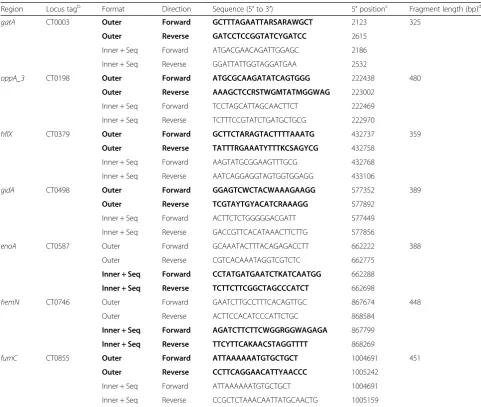
Primers were designed and a nested PCR assay was developed to enable direct testing of clinical samples.
MLST-7 regions were analyzedin silicousing the Chla-mydiales MLST database (http://pubmlst.org/chlamy-diales/) Comparison of all available C. trachomatis
sequences from the MLST database demonstrated that shortening of the original amplicons for 5 out of the 7 genes (gatA, oppA_3, hflX, gidA andfumC) to perform nested PCR would not result in loss of resolution as no known polymorphic sites for C. trachomatis were found in these‘deleted’regions. Therefore, new‘inner’ PCR primers were designed for these 5 genes (Table 1). For two other genes (hemN and enoA) the original amplicon was extended to prevent loss of resolution and known polymorphic sites. Therefore, new ‘outer’
Table 1Primers used for the MLST-7 scheme for Chlamydia trachomatisa
Region Locus tagb Format Direction Sequence (5′to 3′) 5′positionc Fragment length (bp)d
gatA CT0003 Outer Forward GCTTTAGAATTARSARAWGCT 2123 325
Outer Reverse GATCCTCCGGTATCYGATCC 2615
Inner + Seq Forward ATGACGAACAGATTGGAGC 2186
Inner + Seq Reverse GGATTATTGGTAGGATGAA 2532
oppA_3 CT0198 Outer Forward ATGCGCAAGATATCAGTGGG 222438 480
Outer Reverse AAAGCTCCRSTWGMTATMGGWAG 223002
Inner + Seq Forward TCCTAGCATTAGCAACTTCT 222469
Inner + Seq Reverse TCTTTCCGTATCTGATGCTGCG 222970
hflX CT0379 Outer Forward GCTTCTARAGTACTTTTAAATG 432737 359
Outer Reverse TATTTRGAAATYTTTKCSAGYCG 432758
Inner + Seq Forward AAGTATGCGGAAGTTTGCG 432768
Inner + Seq Reverse AATCAGGAGGTAGTGGTGGAGG 433106
gidA CT0498 Outer Forward GGAGTCWCTACWAAAGAAGG 577352 389
Outer Reverse TCGTAYTGYACATCRAAAGG 577892
Inner + Seq Forward ACTTCTCTGGGGGACGATT 577449
Inner + Seq Reverse GACCGTTCACATAAACTTCTTG 577856
enoA CT0587 Outer Forward GCAAATACTTTACAGAGACCTT 662222 388
Outer Reverse CGTCACAAATAGGTCGTCTC 662775
Inner + Seq Forward CCTATGATGAATCTKATCAATGG 662288
Inner + Seq Reverse TCTTCTTCGGCTAGCCCATCT 662698
hemN CT0746 Outer Forward GAATCTTGCCTTTCACAGTTGC 867674 448
Outer Reverse ACTTCCACATCCCATTCTGC 868584
Inner + Seq Forward AGATCTTCTTCWGGRGGWAGAGA 867799
Inner + Seq Reverse TTCYTTCAKAACSTAGGTTTT 868269
fumC CT0855 Outer Forward ATTAAAAAATGTGCTGCT 1004691 451
Outer Reverse CCTTCAGGAACATTYAACCC 1005242
Inner + Seq Forward ATTAAAAAATGTGCTGCT 1004691
Inner + Seq Reverse CCGCTCTAAACAATTATGCAACTG 1005159
a
The primers given in boldface were the original MLST primers taken from Pannekoek et al. [9]. All other primers were newly designed. Nested PCRs were performed for each region. The primers used for the outer PCRs are indicated with Outer, those used for the inner PCRs are indicated with Inner, and those used for sequencing are indicated with Seq
b
Locus tags are given relative to the sequence of reference strain D/UW-3/CX (GenBank accession no. AE001273)
c
Positions are given in base pairs relative to the sequence of reference strain D/UW-3/CX (GenBank accession no. AE001273)
d
PCR primers were designed, thus the same inner PCR product was obtained as published previously (Table 1) [9].
Nested PCR of MLST regions
For MLST-7, DNA extracts were amplified by nested PCR for all regions using the oligonucleotide primers shown in Table 1. Full hr-MLST-6 data was already available for all specimens from previous studies [17]. Also for this typing method a nested PCR was used to amplify the regions
ompA, CT046 (hctB), CT058, CT144, CT172, and CT682 (pbpB). For both MLST schemes the inner PCR was per-formed with M13-tagged primers, identical to the standard inner primers. This allowed sequencing using universal M13 primers for high throughput purposes [11, 16, 17].
Sequencing analysis
The obtained sequences were analysed, assembled and trimmed using BioNumerics 7.5 (Applied Maths, Sint-Martens-Latem, Belgium). For MLST-7, cleaned primer-to-primer sequences were checked against the Chlamydiales MLST database (http://pubmlst.org/ chlamydiales/). For hr-MLST-6, analysis was per-formed as described previously [17]. In brief, cleaned primer-to-primer sequences were checked against the
Chlamydia trachomatis hr-MLST database (http:// mlstdb.bmc.uu.se/).
Minimum spanning tree analysis
BioNumerics software (version 7.5, Applied Maths, Sint-Martens-Latem, Belgium) was used to construct a mini-mum spanning tree of fully typed specimens using STs of each of the MLST schemes. As algorithm we used the predefined template ‘Minimum spanning tree for cat-egorical data’ plugin to generate an minimum spanning tree under the categorical coefficient of similarity and the priority rule of the highest number of single-locus variants (SLV), which calculates a standard minimum spanning tree. A large cluster was defined as a group of genetically related STs differing by not more than 1 locus from another ST within that group (SLV) and it had to include at least 5 % of the total number of speci-mens. Clusters containing less then 5 % of the total number of specimens were defined as small clusters.
Results
C. trachomatistyping using the MLST-7 scheme
Although in 188 of 200 C. trachomatis-positive speci-mens (94.0 %), sufficient chlamydial DNA was present, as assessed by qPCR, no amplicons were obtained using the MLST scheme, primers and cycle conditions as were previously described [9], indicating relative low sensitiv-ity of the method. We therefore adapted the MLST-7 scheme to a nested assay and, using this adapted MLST-7 scheme, for 187 (93.5 %) specimens full MLST-7 profiles
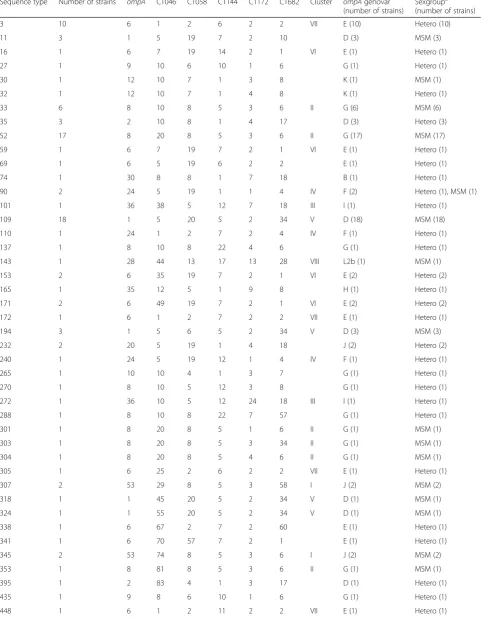
were obtained. Of these 187 typed specimens, 91 (48.7 %) specimens were from MSM and 96 (51.3 %) specimens were from heterosexuals (Additional file 1: Table S1). For the 187 fully typed specimens, we found 7 novel allele sequences: 3 foroppA_3, 1 forgidA, 1 for enoA, and 2 forhemN.
Among the 187 typed specimens, 21 unique MLST-7 STs could be assigned of which 18 (85.7 %) were novel to the Chlamydiales MLST database (http://pubmlst.org/ chlamydiales/). Novel STs were found in 125 of 187 specimens (66.8 %). Of all identified STs, 8 (38.1 %) had multiple representatives (2 to 52 isolates) while 13 (61.9 %) were found in only a single isolate each (Table 2). Moreover, 4 STs (ST97, ST132, ST133, ST1 34; 19.0 %) were found in specimens from both MSM and heterosexuals and 6 STs (ST44, ST97 ST132, ST1 33, ST137, ST142; 28.6 %) were associated with mul-tiple (2 to 5)ompAgenovars (Table 2).
C. trachomatistyping using hr-MLST-6 scheme
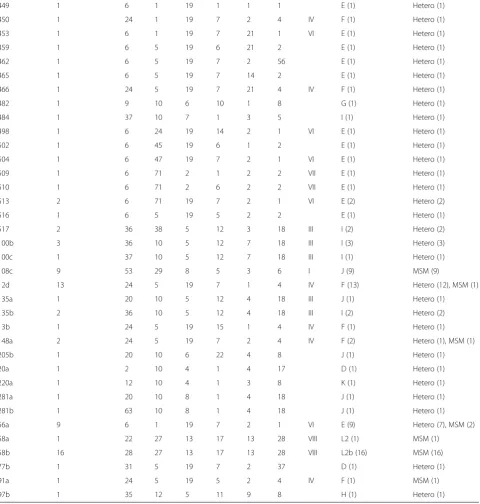
Full hr-MLST-6 profiles were available for the 187 C. tra-chomatis-positive specimens that were also successfully typed using the adapted MLST-7 scheme (Additional file 2: Table S2). The hr-MLST-6 data from the 187C. trachoma-tis-positive specimens have been described before in more detail [11, 15–17]. In brief, among the 187 typed specimens, 79 unique hr-MLST-6 STs could be assigned of which 22 (27.8 %) had multiple representatives (2 to 18 isolates) while 57 (72.2 %) were found in only a single isolate each (Table 3). Of all identified STs, 3 (ST12d, ST56a, ST90; 3.8 %) were found in specimens from both MSM and het-erosexuals (Table 3).
Minimum spanning tree analysis of the MLST-7 scheme and the hr-MLST-6 scheme
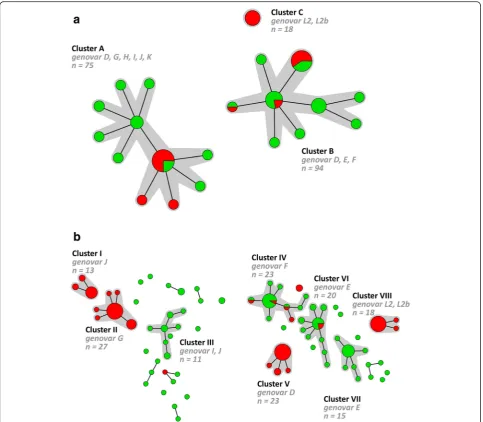
in specimens from 2 individuals of whom 1 was MSM. Cluster C solely consisted of specimens from MSM which were all associated with the same ST (ST44).
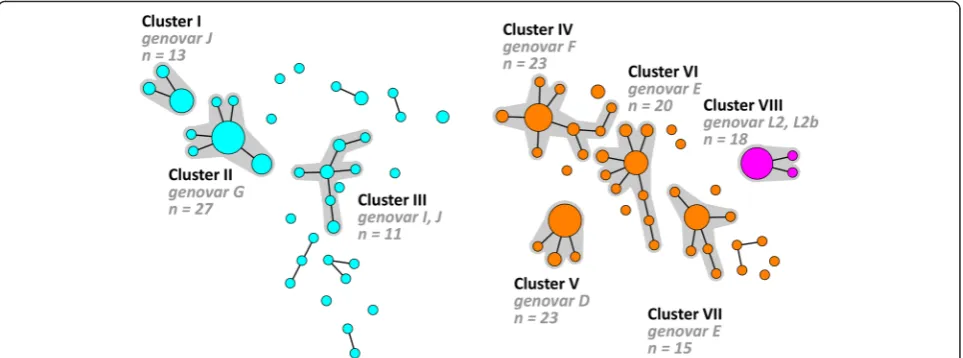
A minimum spanning tree was also generated basted on the hr-MLST-6 STs and 8 large clusters (I-VIII) were identified (Fig. 1b). These clusters ranged from 13 to 27 specimens comprising 80.2 % of all specimens. The remaining 37 specimens were distributed over 20 single-tons and 6 small clusters, ranging from 2 to 4 speci-mens. The minimum spanning tree showed a clear distinction between specimens from MSM and hetero-sexual individuals and high genetic diversity among the
C. trachomatis population especially for strains from heterosexuals, as was also previously described by us [11, 15–17]. Of the 8 large clusters, 4 (III, IV, VI and VII) consisted predominantly of specimens from hetero-sexuals (82.6 to 100 %) whereas the other 4 large clus-ters (I, II, V and VIII) solely consisted of specimens from MSM (Table 3). Of the 4 clusters (III, IV, VI and VII) consisting predominantly of specimens from heterosex-uals, only 2 clusters (IV and VI) contained MSM speci-mens. Cluster IV contained 4 specimens from MSM (17.4 %) that were associated with 4 STs (ST12d, ST90,
ST91a). Of those 4 STs, ST12d was found in specimens from 13 individuals of whom 1 was MSM, ST90 was found in specimens from 2 individuals of whom 1 was MSM and ST91a was found in only one MSM specimen. Cluster VI contained 2 specimens from MSM which were associated with 1 ST (ST56a). This ST was found in specimens from 9 individuals of whom 2 were MSM.
Comparison of the two minimum spanning trees in Fig. 1 shows that the hr-MLST-6 scheme further diversi-fied each of the clusters generated by using the adapted MLST-7 scheme. For example cluster A (11 STs; Fig. 1a) is subdivided into clusters I, II, and III, using the hr-MLST-6 scheme, and also the majority of the singletons and small clusters (Fig. 2) comprising 37 STs. Cluster B (9 STs; Fig. 1a) is further subdivided into clusters IV, V, VI, VII and some remaining single-tons and small clusters (Fig. 2) comprising 39 STs. Cluster C (1 ST; Fig. 1a) is identical to cluster VIII (Figs. 1b and 2) but included 3 STs.
Discussion
[image:5.595.59.539.107.430.2]In this study, we successfully adapted the MLST-7 scheme to a nested assay and applied it to direct clinical specimens. Table 2Results ofC. trachomatisusing the MLST-7 scheme based on seven housekeeping genes in comparison withompA-typing and sexgroup
Sequence type Number of strains gatA oppA_3 hflX gidA enoA hemN fumC Cluster ompAgenovar (Number of strains)
Sexgroupa (number of strains)
8 1 2 1 1 2 4 2 3 B F (1) Hetero (1)
44 18 1 3 3 3 2 2 19 C L2 (1), L2b (17) MSM (18)
97 42 33 1 2 2 4 2 3 B D (24), E(1), F(17) Hetero (17), MSM (25)
106 1 2 3 2 5 3 2 3 A J (1) Hetero (1)
131 1 33 27 2 4 3 2 3 A G (1) MSM (1)
132 52 33 3 2 4 3 2 3 A G (26), H (1), I (10), J (13), K(2) Hetero (13), MSM (39)
133 26 33 1 1 2 4 2 3 B D (3), E (21), F (2) Hetero (20), MSM (6)
134 2 33 1 1 2 3 2 3 B F (2) Hetero (1), MSM (1)
135 19 33 4 1 2 4 2 3 B E (19) Hetero (19)
136 11 33 3 2 5 3 2 3 A B (1), D (2), G (4), J (4) Hetero (11)
137 1 33 3 2 40 3 2 3 A G (1) Hetero (1)
138 1 33 29 1 2 4 2 3 B E (1) Hetero (1)
139 1 33 1 1 2 32 2 3 B E (1) Hetero (1)
140 1 33 3 2 4 3 1 3 A G (1) Hetero (1)
141 4 33 3 2 5 3 1 3 A D (3), I (1) Hetero (4)
142 1 33 4 1 32 4 2 3 B E (1) Hetero (1)
143 1 33 3 2 5 3 25 3 A K (1) Hetero (1)
144 1 33 3 2 5 3 24 3 A G (1) Hetero (1)
145 1 33 3 2 4 24 2 3 A H (1) Hetero (1)
146 1 2 4 1 2 4 2 3 B F (1) Hetero (1)
147 1 33 28 2 4 3 2 3 A J (1) MSM (1)
a
Table 3Results ofC. trachomatistyping using the hr-MLST-6 scheme based on six polymorphic genes in comparison withompA-typing and sexgroup
Sequence type Number of strains ompA CT046 CT058 CT144 CT172 CT682 Cluster ompAgenovar (number of strains)
Sexgroupa (number of strains)
3 10 6 1 2 6 2 2 VII E (10) Hetero (10)
11 3 1 5 19 7 2 10 D (3) MSM (3)
16 1 6 7 19 14 2 1 VI E (1) Hetero (1)
27 1 9 10 6 10 1 6 G (1) Hetero (1)
30 1 12 10 7 1 3 8 K (1) MSM (1)
32 1 12 10 7 1 4 8 K (1) Hetero (1)
33 6 8 10 8 5 3 6 II G (6) MSM (6)
35 3 2 10 8 1 4 17 D (3) Hetero (3)
52 17 8 20 8 5 3 6 II G (17) MSM (17)
59 1 6 7 19 7 2 1 VI E (1) Hetero (1)
69 1 6 5 19 6 2 2 E (1) Hetero (1)
74 1 30 8 8 1 7 18 B (1) Hetero (1)
90 2 24 5 19 1 1 4 IV F (2) Hetero (1), MSM (1)
101 1 36 38 5 12 7 18 III I (1) Hetero (1)
109 18 1 5 20 5 2 34 V D (18) MSM (18)
110 1 24 1 2 7 2 4 IV F (1) Hetero (1)
137 1 8 10 8 22 4 6 G (1) Hetero (1)
143 1 28 44 13 17 13 28 VIII L2b (1) MSM (1)
153 2 6 35 19 7 2 1 VI E (2) Hetero (2)
165 1 35 12 5 1 9 8 H (1) Hetero (1)
171 2 6 49 19 7 2 1 VI E (2) Hetero (2)
172 1 6 1 2 7 2 2 VII E (1) Hetero (1)
194 3 1 5 6 5 2 34 V D (3) MSM (3)
232 2 20 5 19 1 4 18 J (2) Hetero (2)
240 1 24 5 19 12 1 4 IV F (1) Hetero (1)
265 1 10 10 4 1 3 7 G (1) Hetero (1)
270 1 8 10 5 12 3 8 G (1) Hetero (1)
272 1 36 10 5 12 24 18 III I (1) Hetero (1)
288 1 8 10 8 22 7 57 G (1) Hetero (1)
301 1 8 20 8 5 1 6 II G (1) MSM (1)
303 1 8 20 8 5 3 34 II G (1) MSM (1)
304 1 8 20 8 5 4 6 II G (1) MSM (1)
305 1 6 25 2 6 2 2 VII E (1) Hetero (1)
307 2 53 29 8 5 3 58 I J (2) MSM (2)
318 1 1 45 20 5 2 34 V D (1) MSM (1)
324 1 1 55 20 5 2 34 V D (1) MSM (1)
338 1 6 67 2 7 2 60 E (1) Hetero (1)
341 1 6 70 57 7 2 1 E (1) Hetero (1)
345 2 53 74 8 5 3 6 I J (2) MSM (2)
353 1 8 81 8 5 3 6 II G (1) MSM (1)
395 1 2 83 4 1 3 17 D (1) Hetero (1)
435 1 9 8 6 10 1 6 G (1) Hetero (1)
Moreover, we demonstrated that using this adapted MLST-7 scheme no reflection of separate transmission between MSM and heterosexual hosts was seen. In addition, we compared clustering of both typing methods and demon-strated that typing using the hr-MLST-6 scheme is able to identify small genetically related clusters ofC. trachomatis
strains within each of the clusters that were identified by using the modified MLST-7 scheme (Fig. 2). These clusters seem to represent biovars.
[image:7.595.59.540.114.619.2]We successfully modified the MLST-7 scheme that was previously published by us [9]. The sensitivity of the MLST-7 method was increased by modification into a
Table 3Results ofC. trachomatistyping using the hr-MLST-6 scheme based on six polymorphic genes in comparison withompA-typing and sexgroup(Continued)
449 1 6 1 19 1 1 1 E (1) Hetero (1)
450 1 24 1 19 7 2 4 IV F (1) Hetero (1)
453 1 6 1 19 7 21 1 VI E (1) Hetero (1)
459 1 6 5 19 6 21 2 E (1) Hetero (1)
462 1 6 5 19 7 2 56 E (1) Hetero (1)
465 1 6 5 19 7 14 2 E (1) Hetero (1)
466 1 24 5 19 7 21 4 IV F (1) Hetero (1)
482 1 9 10 6 10 1 8 G (1) Hetero (1)
484 1 37 10 7 1 3 5 I (1) Hetero (1)
498 1 6 24 19 14 2 1 VI E (1) Hetero (1)
502 1 6 45 19 6 1 2 E (1) Hetero (1)
504 1 6 47 19 7 2 1 VI E (1) Hetero (1)
509 1 6 71 2 1 2 2 VII E (1) Hetero (1)
510 1 6 71 2 6 2 2 VII E (1) Hetero (1)
513 2 6 71 19 7 2 1 VI E (2) Hetero (2)
516 1 6 5 19 5 2 2 E (1) Hetero (1)
517 2 36 38 5 12 3 18 III I (2) Hetero (2)
100b 3 36 10 5 12 7 18 III I (3) Hetero (3)
100c 1 37 10 5 12 7 18 III I (1) Hetero (1)
108c 9 53 29 8 5 3 6 I J (9) MSM (9)
12d 13 24 5 19 7 1 4 IV F (13) Hetero (12), MSM (1)
135a 1 20 10 5 12 4 18 III J (1) Hetero (1)
135b 2 36 10 5 12 4 18 III I (2) Hetero (2)
13b 1 24 5 19 15 1 4 IV F (1) Hetero (1)
148a 2 24 5 19 7 2 4 IV F (2) Hetero (1), MSM (1)
205b 1 20 10 6 22 4 8 J (1) Hetero (1)
20a 1 2 10 4 1 4 17 D (1) Hetero (1)
220a 1 12 10 4 1 3 8 K (1) Hetero (1)
281a 1 20 10 8 1 4 18 J (1) Hetero (1)
281b 1 63 10 8 1 4 18 J (1) Hetero (1)
56a 9 6 1 19 7 2 1 VI E (9) Hetero (7), MSM (2)
58a 1 22 27 13 17 13 28 VIII L2 (1) MSM (1)
58b 16 28 27 13 17 13 28 VIII L2b (16) MSM (16)
77b 1 31 5 19 7 2 37 D (1) Hetero (1)
91a 1 24 5 19 5 2 4 IV F (1) MSM (1)
97b 1 35 12 5 11 9 8 H (1) Hetero (1)
a
nested PCR format. This nested PCR format allowed de-tection of many novel sequence types because we were now able to test direct clinical specimens without the need for an additional cell culture step. In total, 187 of 188 samples could be fully typed using the modified MLST-7 scheme resulting in a high success rate of 99.5 %. Failure to generate an MLST-7 profile for one out of 188 samples after repeated testing is most likely the result of an insufficient amount of chlamydial DNA in this sample as it produced the highest cycling thresh-old value in thepmpHreal time PCR.
The discriminatory capacity of the original MLST-7 scheme was maintained as no known polymorphic sites for C. trachomatis were lost due to shortening of some of the amplicons. Moreover for two genes (hemN and
enoA) the amplicon was extended because new ‘outer’ PCR primers were designed which ensured that the same inner PCR product was obtained as published pre-viously [9]. Designing‘inner’PCR primers for these two genes would have resulted in very short amplicons and loss of resolution as known polymorphic sites would have been lost. The maximum target length in our
Fig. 1Minimum spanning tree showing the clustering of 187Chlamydia trachomatis-positive specimens from MSM and heterosexuals. Each circle
[image:8.595.57.541.87.509.2]assay format was 480 bp, which allowed easy sequence analysis from single PCR fragments. It is unlikely that polymorphisms were missed by our adapted MLST-7 scheme. Even if there were so far unknown missed polymorphisms, we think that these would not dramat-ically increase the genetic diversity using the adapted MLST-7 scheme.
The MLST-7 scheme was developed according to the original MLST principle [13, 18, 19], which aims to index the diversity of nucleotide sequences of fragments of housekeeping genes. Housekeeping genes are pre-sumed to be under neutral or nearly neutral selection pressure making them stable over time, which makes this method useful to answer evolutionary questions and to investigate the epidemiology ofC. trachomatisover a longer period in time [18]. In comparison, the hr-MLST-6 scheme uses non-housekeeping genes that are under immune pressure or have variable repeat regions and are thus more polymorphic [11, 16]. This enabled us to demonstrate detailed genetic differences between C. trachomatis strains that were involved in transmission chains in human hosts in a short time-frame of only a few years [11, 15–17]. However, using the adapted MLST-7 scheme no reflection of separate transmission networks between MSM and heterosexual hosts was seen. Minimum spanning tree analysis of the MLST-7 scheme showed mixed clusters of specimens from MSM and heterosexual individuals with the exception of one cluster (Fig. 1a; cluster C) which solely included specimens from MSM. All these cluster CC. trachomatis
specimens belonged to the lymphogranuloma venereum (LGV) biovar, which is known to show major genetic dif-ferences compared to the urogenital biovar types [20–23].
These results suggest that separate transmission chains in human hosts can only be observed over a small time-frame using highly discriminating genetic typing methods. Transmission chains between MSM and heterosexuals were not totally separated in our previous studies with lar-ger trees, including randomly chosen samples [15–17]. This overlap was expected since there will also be individ-uals who identify themselves as MSM, but have had con-tact with heterosexual women (Fig. 1b).
Comparison of the clustering of both MLST schemes showed that both MLST schemes were able to resolve the C. trachomatis specimens in a number of STs and clusters. Minimum spanning tree analysis using data from the adapted MLST-7 scheme revealed 3 main groups of circulating C. trachomatis strains (Fig. 1), as was also previously described by us using the original MLST-7 scheme [9]. One group is composed solely of the LGV genovars. Another is composed of the clinically prevalent urogenital genovars, whereas the third con-tains the less frequently occurring urogenital genovars. Similar groupings are reported in previous studies using WGS analysis or MLST analysis based on housekeeping genes [7, 9, 10]. In comparison to MLST-7, minimum spanning tree analysis of the hr-MLST-6 scheme was able to further diversify each of these 3 main groups and clusters of circulating C. trachomatis strains in smaller genetically related clusters and thus allowed for more detailed analysis within these groups (Fig. 2). Using max-imum likelihood analysis, we previously demonstrated that the hr-MLST-6 targets provided a tree similar to trees based on WGS, but with lower bootstrap support values [12]. Since we already observed clear differences in the diversification of strains between the MLST-7 and
Fig. 2Minimum spanning tree showing the diversification by hr-MLST-6 of the clusters that were generated using the MLST-7 scheme. Each circle
[image:9.595.58.540.88.267.2]hr-MLST-6 scheme (Fig. 1), a similar tree based on the MLST-7 targets is expected to differ from a tree based on WGS by showing less genetic diversity.
Conclusions
We successfully adapted and applied the MLST-7 scheme to direct clinical specimens from MSM and heterosexuals. However, using this adapted MLST-7 scheme no distinct transmission ofC. trachomatiscould be observed in MSM and heterosexuals in comparison to the hr-MLST-6 scheme. In addition, we also compared clustering of both MLST schemes and demonstrated that typing using the hr-MLST-6 scheme is able to identify genetically related clusters ofC. trachomatisstrains within each of the clus-ters that were identified by using the MLST-7 scheme. Hr-MLST-6 may therefore also be a useful tool to for more detailed analysis of C. trachomatis strains within identified MLST-7 clusters.
Availability of data and materials
[image:10.595.307.537.80.738.2]Data on all 187 samples typed with both the hr-MLST-6 en MLST-7 scheme are included in Additional file 1: Table S1 and Additional file 2: Table S2. Corresponding nucleotide sequences can be derived from the publicly available databases: http://mlstdb.bmc.uu.se/ (hr-MLST-6) and http://pubmlst.org/chlamydiales/ (MLST-7).
Additional files
Additional file 1: Table S1.MLST-7 data of the 187 successfully typed
samples. (DOCX 57 kb)
Additional file 2: Table S2.Hr-MLST-6 data of the 187 successfully
typed samples. (DOCX 53 kb)
Competing interest
The authors declare that they have no competing interests.
Authors’contributions
SMB, AvdE and YP conceived the study, and participated in its design and coordination. BV performed the experiments. BV, SMB, AvdE, YP analysed the data. BV, SMB, AvdE, YP wrote the paper. All authors read and approved the final manuscript.
Acknowledgements
The authors thank Michelle Himschoot for technical assistance and expertise.
Author details
1Public Health Laboratory, Cluster Infectious Diseases, Public Health Service
Amsterdam, Amsterdam, The Netherlands.2Center for Infection and Immunity Amsterdam (CINIMA), Academic Medical Center, University of Amsterdam, Amsterdam, The Netherlands.3Department of Medical Microbiology, Academic Medical Center, Amsterdam, The Netherlands.
Received: 4 December 2015 Accepted: 29 March 2016
References
1. WHO. Global incidence and prevalence of selected curable sexually transmitted infections: 2008. Reprod Health Matters. 2012;20:207–9.
2. Haggerty CL, Gottlieb SL, Taylor BD, Low N, Xu F, Ness RB. Risk of sequelae after Chlamydia trachomatis genital infection in women. J Infect Dis. 2010;201 Suppl 2:S134–55.
3. Land JA, Van Bergen JE, Morre SA, Postma MJ. Epidemiology of Chlamydia trachomatis infection in women and the cost-effectiveness of screening. Hum Reprod Update. 2010;16:189–204.
4. Rekart ML, Gilbert M, Meza R, Kim PH, Chang M, Money DM, et al. Chlamydia public health programs and the epidemiology of pelvic inflammatory disease and ectopic pregnancy. J Infect Dis. 2013;207:30–8.
5. Herrmann B, Torner A, Low N, Klint M, Nilsson A, Velicko I, et al. Emergence and spread of Chlamydia trachomatis variant, Sweden. Emerg Infect Dis. 2008;14:1462–5.
6. Jurstrand M, Christerson L, Klint M, Fredlund H, Unemo M, Herrmann B. Characterisation of Chlamydia trachomatis by ompA sequencing and multilocus sequence typing in a Swedish county before and after identification of the new variant. Sex Transm Infect. 2010;86:56–60. 7. Harris SR, Clarke IN, Seth-Smith HM, Solomon AW, Cutcliffe LT, Marsh P,
et al. Whole-genome analysis of diverse Chlamydia trachomatis strains identifies phylogenetic relationships masked by current clinical typing. Nat Genet. 2012;44:413–9. S1.
8. Klint M, Fuxelius HH, Goldkuhl RR, Skarin H, Rutemark C, Andersson SG, et al. High-resolution genotyping of Chlamydia trachomatis strains by multilocus sequence analysis. J Clin Microbiol. 2007;45:1410–4.
9. Pannekoek Y, Morelli G, Kusecek B, Morre SA, Ossewaarde JM, Langerak AA, et al. Multi locus sequence typing of Chlamydiales: clonal groupings within the obligate intracellular bacteria Chlamydia trachomatis. BMC Microbiol. 2008;8:42.
10. Dean D, Bruno WJ, Wan R, Gomes JP, Devignot S, Mehari T, et al. Predicting phenotype and emerging strains among Chlamydia trachomatis infections. Emerg Infect Dis. 2009;15:1385–94.
11. Bom RJ, Christerson L, van der Loeff Schim MF, Coutinho RA, Herrmann B, Bruisten SM. Evaluation of high-resolution typing methods for Chlamydia trachomatis in samples from heterosexual couples. J Clin Microbiol. 2011;49:2844–53.
12. Herrmann B, Isaksson J, Ryberg M, Tangrot J, Saleh I, Versteeg B, et al. Global Multilocus sequence type analysis of Chlamydia trachomatis strains from 16 Countries. J Clin Microbiol. 2015;53:2172–9.
13. Maiden MC, Bygraves JA, Feil E, Morelli G, Russell JE, Urwin R, et al. Multilocus sequence typing: a portable approach to the identification of clones within populations of pathogenic microorganisms. Proc Natl Acad Sci U S A. 1998;95:3140–5.
14. de Vries HJ, van der Loeff Schim MF, Bruisten SM. High-resolution typing of Chlamydia trachomatis: epidemiological and clinical uses. Curr Opin Infect Dis. 2015;28:61–71.
15. Christerson L, Bom RJ, Bruisten SM, Yass R, Hardick J, Bratt G, et al. Chlamydia trachomatis strains show specific clustering for men who have sex with men compared to heterosexual populations in Sweden, the Netherlands, and the United States. J Clin Microbiol. 2012;50: 3548–55.
16. Bom RJ, van der Helm JJ, van der Loeff Schim MF, van Rooijen MS, Heijman T, Matser A, et al. Distinct transmission networks of Chlamydia trachomatis in men who have sex with men and heterosexual adults in Amsterdam, The Netherlands. PLoS One. 2013;8:e53869.
17. Versteeg B, van Rooijen MS, van der Loeff Schim MF, de Vries HJ, Bruisten SM. No indication for tissue tropism in urogenital and anorectal Chlamydia trachomatis infections using high-resolution multilocus sequence typing. BMC Infect Dis. 2014;14:464.
18. Jolley KA, Maiden MC. Using multilocus sequence typing to study bacterial variation: prospects in the genomic era. Future Microbiol. 2014;9:623–30.
19. Maiden MC, van Rensburg Jansen MJ, Bray JE, Earle SG, Ford SA, Jolley KA, et al. MLST revisited: the gene-by-gene approach to bacterial genomics. Nat Rev Microbiol. 2013;11:728–36.
20. Almeida F, Borges V, Ferreira R, Borrego MJ, Gomes JP, Mota LJ. Polymorphisms in inc proteins and differential expression of inc genes among Chlamydia trachomatis strains correlate with invasiveness and tropism of lymphogranuloma venereum isolates. J Bacteriol. 2012;194: 6574–85.
22. Nunes A, Borrego MJ, Gomes JP. Genomic features beyond Chlamydia trachomatis phenotypes: what do we think we know? Infect Genet Evol. 2013;16:392–400.
23. Abdelsamed H, Peters J, Byrne GI. Genetic variation in Chlamydia trachomatis and their hosts: impact on disease severity and tissue tropism. Future Microbiol. 2013;8:1129–46.
• We accept pre-submission inquiries
• Our selector tool helps you to find the most relevant journal
• We provide round the clock customer support
• Convenient online submission
• Thorough peer review
• Inclusion in PubMed and all major indexing services • Maximum visibility for your research
Submit your manuscript at www.biomedcentral.com/submit