Rochester Institute of Technology
RIT Scholar Works
Theses
Thesis/Dissertation Collections
2002
Application of a synalysis packaging design method
in PC magniviewer package redesign
Jun Cao
Follow this and additional works at:
http://scholarworks.rit.edu/theses
This Thesis is brought to you for free and open access by the Thesis/Dissertation Collections at RIT Scholar Works. It has been accepted for inclusion
in Theses by an authorized administrator of RIT Scholar Works. For more information, please contact
.
Recommended Citation
APPLICATION
OF
A
SYNALYSIS
PACKAGING DESIGN METHOD IN PC
MAGNIVTEWER
PACKAGE REDESIGN
BY
JUN CAO
A Thesis
Submitted
to
the
Department
ofPackaging
Science
College
ofApplied
Science
andTechnology
in
partialfulfillment
ofthe
requirementsfor
the
degree
ofMaster
ofScience
Rochester Institute
ofTechnology
Department ofPackaging Science College of Applied Science and Technology Rochester
Institute of Technology
Rochester, New York
Certificate of Approval
M. S. DEGREE THESIS
The M. S. Degree Thesis ofJun Cao
has been examined and approved
by the thesis committee as satisfactory
for the thesis requirements for the
Master of Science Degree.
Richard Stryker
Dan Goodwin
August 2002
Title of Thesis: Application of a SyNalysis Packaging Design Method in PC
MagniViewer Package Redesign.
I, Jun Cao, hereby grant permission to the Wallace Memorial Library, of Rochester
Institute of Technology, to reproduce my thesis in whole or in part. Any
reproduction wiD not be for commercial use or profit.
Date: August 2002
ACKNOWLEDGMENTS
Many
generous peoplehave
contributed
their
time,
information,
expertise andknowledge
to
help
methroughout this thesis.
Special
thanks to
Dr. David
Olsson
andDr. Daniel
Goodwin
who guided meto the
rightdirection
and providedthe
sources ofinformation. I
also would
like
to thank
Richard Stryker
ofBausch
&
Lomb
for
giving
methe
permissionto
usetheir
newproduct
PC MagniViewer
asthe
casestudy,
andtheir
suppliersin
Tian
Jin,
China
andTaipei
Taiwan
for providing
the
information
I
needed.I
wouldlike
to
expressmy
appreciation alsoto
Gary
Tartick,
a sales representative ofSealed Air
Packaging
Corporation
whoprovided
the
information
aboutthe
Instapak 901
seriespackaging
system andhelped
me makethe
newPC
MagniViewer
sample package.In
addition, I
wantto thank the
Sealed
Air
Packaging
Corporation
staffin China
who providedthe
901
packaging
system costinformation.
As
aforeign
student,
I especially
would
like
to thank
Lauren
Launer,
Dr. Daniel Goodwin
andDr. David O'lsson
whohelped
me correctthe
English
and editthe thesis.
Without
the
help
from
these
wonderfulpeople,
this thesis
would
nothave
been
possible.My
appreciation goesto
many
professors atRochester
Institute
ofTechnology
for
instilling
in
methe
packaging knowledge
anddiscipline
that
arethe
most precioustreasures
I
possess.In
addition,
I
wantto thank
Scott
Lawson,
whois
an architect and adirector
offacility
offices ofRIT. He
inspired
me withmany
similaritiesbetween
architecture and
packaging
sciencethat
somebecome
the
part ofthe thesis.
I
also wouldlike
to thank
John O'Connell
from
Motorola,
who provided me withthe
opportunity
to
experience
the
realpackaging engineering
world andtaught
me someimportant,
practicalknowledge in
this
area.Finally,
my
thanks
alsogoto
Sam
andArt,
my
two sons,
andto
my
motherfor
their
help
and cooperation sothat
I
couldfind
time to
work onthis thesis.
I
hope
that sometime,
whenmy
sons growup,
they
canbenefit from
it.
Application
of aSyNalysis
Packaging
Design Method in PC
MagniViewer
Package
Redesign
By
Jun
Cao
2002
ABSTRACT
This
study
addressesthe
over-packaging
phenomenain
packaging
design
perspectivesand,
through the
review of architecturaldesign
methods andpackaging
design
principles,
setsup
aSyNalysis
packaging
design
method withthe
packaging design
process.Furthermore,
an example of aPC
magnifierredesigning
is demonstrated
in
the
thesis,
step
by
step.The SyNalysis
method contains scientific analytical methods andthe
designer's
creative,
synthetic methods.
Its
embodimentis
presentedin
three
processes:analysis,
design
and evaluation ofthe
processes.The
SyNalysis
packaging design
method serves as a guideto
help
packaging
designers,
and
especially
newandinexperienced designers
pursuea morelogical
and practicalway
Table
ofContents
List
ofTables
viiiList
ofFigures
ix
1.0
Introduction
1
2.0
The Problem
andIts
Setting
2
2
.1
Background
2
2.2
The
needfor
alogical design
method3
3.0
Comparison
ofArchitectural
andPackaging
Science
4
3.1
Reasons
4
3.2
Comparison
4
3.3
Findings
4
4.0
Reviewing
ofArchitecturalDesign Method
andits
Process
6
4.
1
Exploring
&
Investigating
Process
6
4.2
Creative
process6
4.3
Design
process andDesign
procedure6
4.4
Revision
process7
5.0
Establishing
aSyNalysis
Packaging
Design Method
8
5. 1
Analysis Process
12
5.2
Design Process
12
5.2. 1
Concept
Forming
Process
13
5.2.2
Design Procedure
13
5.2.2.1
Integrate
13
5.2.2. 1. 1
Packaging
System Design
13
5.2.2.2
Individual
14
5.2.2.2.1
Primary
Packaging
Design
14
5.2.2.2.2
Secondary Packaging
Design
14
5.2.2.2.3
Tertiary
Design
14
5.2.2.3
Parts
andDetails
15
5.2.2.4
Individual
andIntegrate
15
5.3
Evaluation
Process
15
5.3.1
Function
15
5.3.2
Structure
15
5.3.3
Economy
15
5.3.4
Environment
15
6.0
Redesign
the
PC MagniViewer Package
withNew Method
16
6.1
Analysis
process19
6.1.1
Product's Characteristics
19
6.1.2
The Distribution
andWarehouse Statement
19
6.1.3
Profile
andAnalysis
21
6.1.4
Critical Parts That Need
Improvement
22
6.2
Redesign Process
23
6.2.1
Concept
Forming
23
6.2.2
Redesign
Procedure
23
6.2.2.1
Integrate
andIndividual
23
6.2.2.2
Parts
andDetails
23
6.2.2.2.
1
Magnifier Screen
Packaging
Redesign
23
6.2.2.2.2 Cushion Redesign
24
6.2.2.2.3
Redesign Possible
Plan
26
6.2.2.2.4
The Three
Options
Comparison
30
6.2.2.3
Individual:
New
PC
MagniViewer Package Design
31
6.2.2.3.1 New
PC MagniView Package Cost
32
6.2.2.4
Integrate:
Packaging
Process
33
6.3
Evaluating
Process
34
6.3.1
Lab
Test
Method
34
6.3.2
Test Result
34
6.4
Cost Comparison
37
6.5
Findings
38
7.0
Conclusions
39
Appendix
Appendix
A:
PC MagniViewer Specification
andPC
MagniViewer Figure
41
Appendix B: PC MagniViewer
New Package
Design Data Sheet
43
Appendix
C:
PC MagniViewer
New
Package
Cost
Data
Sheet
44
Appendix
D:
Instapak 901 Foam-in
-PlacePackaging
System Information
Sheet
45
Appendix
E: Foam-in-Place Material
Safety
Data
Sheet
47
Bibliography
53
List
of
Tables
Table
1: Comparison
ofPackaging
andArchitectural Design
4
Table 2: PC MagniViewer Profile
andAnalysis
21
Table
3:
Typical Product
Fragility
Factors
25
Table
4: Three
Options Comparison
31
List
of
Figures
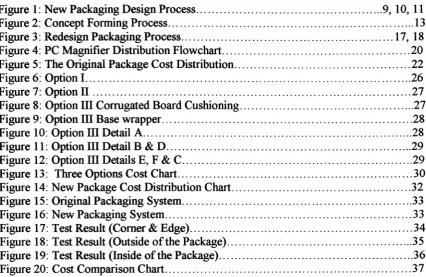
Figure 1
:New
Packaging
Design
Process
9, 10,
11
Figure
2:
Concept
Forming
Process
13
Figure 3:
Redesign
Packaging
Process
17,
18
Figure
4: PC
Magnifier Distribution
Flowchart
20
Figure 5: The Original Package Cost
Distribution
22
Figure
6:
Option 1
26
Figure 7: Option II
27
Figure 8: Option
III
Corrugated
Board
Cushioning
27
Figure 9:
Option
HI Base
wrapper28
Figure 10: Option m
Detail
A
28
Figure 11: Option JJIDetailB&D
29
Figure
12:
Option
JH Details
E,
F
& C
29
Figure 13:
Three Options Cost Chart
30
Figure 14: New Package
Cost
Distribution
Chart
32
Figure
15:
Original
Packaging
System
33
Figure 16: New
Packaging
System
33
Figure 17. Test Result (Corner
&
Edge)
34
Figure 18: Test Result
(Outside
ofthe
Package)
35
Figure 19: Test Result
(Inside
ofthe
Package)
36
Figure 20:
Cost Comparison Chart
37
1.0 INTRODUCTION
In
any design
process,
when onefaces
atask
ofdesigning
the
packagefor
a product orrenovating
anexisting packaging
design,
there
are always questionslike how
and whereto
get startedin
the
design.
How
can one avoiddesigning
an over-packed orunder-packed package?
How
would oneanalyze
the
olddesign
and usethe
information
in
the
redesigning
process?One has
to
considermany
factors,
gothrough
many
steps,
and sometimes use creative approachesin
orderto
comeup
with a solidpackaging
design.
Traditionally,
eachpackaging designer has his/her
ownway in
applying packaging
design
theory
to the
realdesign
problems,
which can resultin
inconsistency
in
productpackaging in
terms
of performance and cost effectiveness.It
wouldbe
beneficial
to the
packaging design community if
there
were sometype
of practical andlogical
methodto
guidedesigners in
their
design
procedure.A
review ofthe
packaging
design literature
shows alack
of suchmethods,
although some writers callfor
a practical method.The
goal ofthis thesis
is
to
setup
a practicalpackaging
design
methodby
reviewing
packaging design
principles andcomparing
them
with architecturaldesign
methods.To
illustrate
the
application of such amethod,
PC
MagniViewer packaging
redesignis
usedas an
example, showing
the
practicalpackaging design
processstep
by
step.The
mainidea
ofthe thesis
wastriggered
by
a projectto
generate new specificationsfor
aPC
MagniViewer
for
alarge
optical goods corporation.The
apparent overpackaging
ofthe
old
design
raised questions aboutdesign
methodology.Why
did
the
previousdesigner
do
it
this
way?Was it because
of alack
ofdesigning
skill orsimply
awrong
approach?How
wouldit be helpful if
a practicalbut logical design
method were usedfor
guidance?2.0
PROBLEM AND
ITS
SETTING
2.1 Background
The
concept ofpackaging
canbe
traced
back
to the
beginning
ofhuman history.
When
humans became
hunter-gatherers,
they
used natural materialsto
fabricate
objectsto
contain, protect,
andtransport
food,
medicines, clothing, ornaments,
and otheritems.
The
"shoppers"of
the
day
usedhollow
gourds,
tree
bark,
and animalbladders.
Through
outthe
packaging
history,
there
have
been
several stages ofpackaging
development:
Direct
Natural
Packaging: People
use natural resourcelike
plants,
leaves,
animalskin or
bladders,
and shells aspackaging
materialsto wrap,
fold,
contain orsimply
coverthings.
.
Hand-made Craft Packaging:
People
use plantfibers
to
braid
bags, baskets,
andboxes
or used other materialslike
wood and rockto
carve containers.Ceramic Container Packaging: The invention
of ceramic markedthe
beginning
ofhuman
civilization.Ceramic
containers were used asfood
packaging
andthey
continue
to
be
usednow.Bronze
Age
Packaging: With
the
discovery
andrefining
technology
ofbronze,
the
bronze
containerdeveloped.
The
durability
andthe toughness
ofthe
bronze
container were
big
improvements
compared withthe
ceramic container.However,
due
to
its
stiffness,
it
washard
to
form
certainshapes,
soit died
out early.Iron Packaging: Iron
containers wereusually
large
andheavy
comparedto the
bronze
containerbecause
ancientpeople were not ableto
makethin
iron
sheets.Paper
Packaging:
Paper
wasfirst
used aslining
andcushioning
materialsin
packaging.
Then it
was used as a containerwiththe
development
oftechnology.
And
peoplehave
been using it
constantly
in
packaging
today
because it is
light,
cheap,
andeasy
to
form
anddispose.
Early
packagedesign
started atthe
hand-made
craft package stage.At
that
time,
the
design
grewfrom human
naturalinstinct,
andthe
process was simple.With
the
evolutionof
human
history,
design became
increasingly
complicated.The
development
of newtechnology
andthe
change ofpeople'slifestyles have
greatly
influenced
the
way
packagedesign is
conducted.For
example, the
invention
of paper enableddesign-by-drawings
styles
for
most packagedesigns.
Nowadays,
the
components of packagedesign
are notlimited
to
form
and artdesign,
but
alsoinclude
many
materialssciences,
mechanicaltechnologies,
andmanufacturing
processes,
as well as market and cost.A
packaging
engineeris
responsiblefor
understanding
all elements andtheir
interrelationships
involved in
the
complicated packagedesign
process.Obviously,
this
is
by
no means aneasy
job.
Unfortunately,
over-packaging
of productsis
commonto
companies everywhere andthe
reasonfor
over-packaging
may be
the
lack
ofthe
necessary
packaging
design knowledge
orthe
know-how
ofhandling
the
complicated
relationships across all elements encounteredduring
packagedesign.
In
these
cases,
designers
tend to
be
onthe
safe sideby
over-packing products,
whichis
not a good solutionin
terms
ofoverall
cost,
the
complexity
ofmanufacturing
and environmentalresponsibility
for
wasted materials.Moreover,
suchpackaging
may
notnecessarily be
more protectivefor
Today,
withthe
rapiddevelopment
oftechnology
andintense
competitionin
industry,
over-packaging is
nolonger
anacceptable
solution.
Many
major companieshave
launched
someform
ofinnovative
cost reduction programsin
packaging
engineering.I
hope
that the
design methodology
presented
in
this
discussion
may
provide a usefultool
for
efficientpackaging
design.
2.2 The
Need
to
Have
aPractical Design
Method
Packaging
performs essential rolesin
the
protection, containment,
andidentification
ofthe
product.These
basic
tasks
mustbe
carried out atthe
reasonable cost with a minimumimpact
onthe
environment.
.
Protection:
Protection
is
the
goal ofthe
packaging.Protection
methodsvary
withthe
characteristics
ofthe
products andconsumers' needs.
Containment: Containment is
the
meansthrough
whichpackaging
reachesits
goal.
It
is
presentedby
athree
dimensional form
to
locate
the
product.Identification:
Identification
ofthe
product consists of adescription
ofthe
contents.
In
mostinstances,
there
is
information
aboutthe
product andits
use,
ora
legally
requiredtext.
The
identification
rolemay
be
extendedto
include
promotion,
wherethe
package notonly
identifies
the
contents,
but
alsoactively
promotesthem.
The
primary
use ofgraphicsis
to
establish productidentity.
Packaging
engineering is
a set ofsystematic,
integrated
activities,
which meansthat
packaging design
cannotbe
conductedin
isolation.
While
creativethinking
is important
during
packaging
design,
the
success of a goodpackaging
design depends
more onanalytical,
synthetic skill anddesign disciplines.
This
is
because many
requirementsbesides basic
packaging
functions
will alsoimpact
the
packaging
design.
Examples
ofthese
requirements areeconomy, regulation,
environment and aesthetics(in
consumerpackaging
design).
It
is
noteasy
to
deal
withallthese
factors
atthe
sametime
during
the
design.
Only having
the
theory
and principlesis
not enoughto
masterthe
complicateddesign
process,
evenfor
experienceddesigners,
soit
wouldbe
quitehelpful
to
have
a3.0 COMPARISON OF
ARCHITECTURE
AND PACKAGING SCDXNCE
3.1 Reasons
Among
design
activities,
few
ofthem
create spaceto
contain an object.This is
the
major objective ofboth
building
design
andpackaging design.
Building
design
createsa relativelarge
spacefor its
intended
objects,
human
beings,
sodoes
packagedesign
with smallerspace
for its
objects variousforms
of products.The
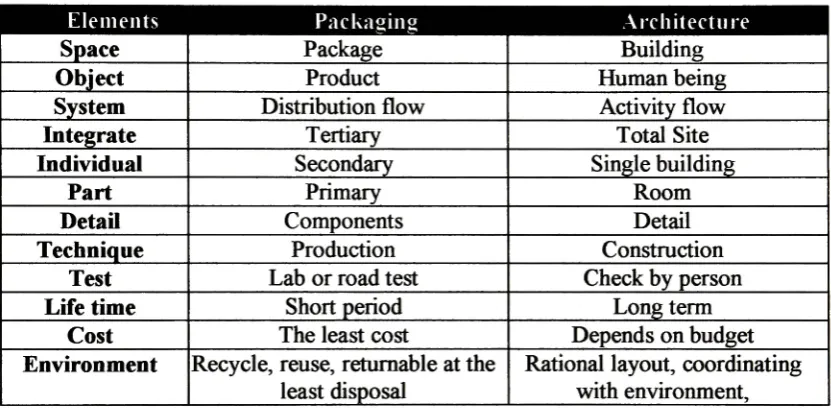
following
table
lists
some comparable elementsfor both
architecturaldesign
andpackaging
from
adesign
perspective.
3.2
Comparison
Table
1:
Comparison
ofPackaging
andArchitectural Design
Elements
Packaging
Architecture
Space
Package
Building
Object
Product
Human
being
System
Distribution
flow
Activity
flow
Integrate
Tertiary
Total
Site
Individual
Secondary
Single
building
Part
Primary
Room
Detail
Components
Detail
Technique
Production
Construction
Test
Lab
or roadtest
Check
by
personLife
time
Short
periodLong
term
Cost
The
least
costDepends
onbudget
Environment
Recycle,
reuse,
returnable atthe
least disposal
Rational
layout,
coordinating
with
environment,
3.3 Findings
From
the
comparison of architecture andpackaging
science,
we can seethat there
aremany
similaritiesin
both
design
prospects.Design
goals are similarThey
both
createspaces,
evenboth design
objectives andthe
results arevery
different.
Design
principles are similarNeither
ofthem
are pure artisticdesign,
but
functional design.
In
packaging
design,
form
submitting
function is
a mainstreamfor majority
ofdesigns
andfunction
submitting
form
cases areonly
appearedin
consumerproduct
for
marketing
orexhibiting
reasons.Thinking
methods are similar [image:14.542.73.489.241.445.2]Both
requirelogical,
analyticaland
synthesizing
thinking
skillto
deal
with allthe
factors
well.Working
stylesare similarThey
both have
cross-functionalworking
stylethat
demands
peoplefrom different
functioning
areasto
worktogether.
The
effectiveness ofcross-functionalteams
directly
affectsthe
quality
ofthe
design.
Since
architecturaldesign
and packagedesign
processeshave
similardesign goals,
design
principles,
thinking
methods as well asworking styles,
wethink
it is
logical
that
we can4.0 REVIEW
OF
ARCHITECTURAL
DESIGN METHOD
AND ITS PROCESS
There
arefour
mainelements
in
architecturaldesign:
function, form,
aesthetics andeconomy.
While
there
are stillarguments
between form submitting
function
andfunction
submitting form
today,
the
mainstream ofarchitecture
design is form
submitting function
even
there
do
existed cases offunction
submitting
form. The
Sydney
Opera
House
in
Australia
is
an example offunction submitting form.
Even
though
it
wascostly
anddifficult
to
construct,
it
has
been
wellknown
as a piece of excellent workby
its
fascinating
sail sculpturein
the
harbor.
However,
regardless whether you start yourdesign from form submitting
function
orfunction
submitting
form,
the
form
definitely
has
to
matchthe
function
atthe
end.Architectural design is
avery
complicated anddifficult
process.There
aremany
factors
to
be
considered and numerous problemsto
be
solved
during
the
design
processthrough
analysis, synthesis,
comparisons, compromise,
etc.Generally,
weprofilethe
design
processinto
three
mainprocesses,
they
are:4.1
Exploring
andInvestigating
Process
Before
starting
the
design,
exploring
the
site wherethe
newbuilding
will stand onis
essential.
We
needto
collectinformation
ofclimate;
directions;
geographicalcondition;
surrounding
environmental condition andexisting
aesthetic style statusfor
the
consideration andlimitation
ofthe
design.
In
sametime,
collecting
the
user'sneeds and client's requirements areindispensable.
Investigating
the
existing
similarbuilding's
advantages anddisadvantages
as well asthe
material market areimportant
too.
4.2
Creative Process
Creative
process penetratesthrough the
wholedesign
circlefrom
beginning
to
end.This
is because
each componentin
the
design
circle requires creative agents.Creative
processwill not end until
the
design
completes.In
brief,
the
creative processis
Problem...
Definition
...Attemptsolution...Incubate...Inspiration. ..Elaboration/Completion*.4.3 Design Process
andDesign Procedure
In
building
design
process,
all elements are classifiedin
two
categories.One is
"known"elements,
such asthe
base knowledge
ofbuilding design,
the
area ofthe
site,
location,
climate,
clientrequirements,
budget,
legal
requirements,
etc;
the
otheris
"unknown" elementsthat
needto
research orcreate.They
aretools,
visualization, plans,
sections andelevations, sketching
and modeling1.The
building
design
processis
as simple asknown...
unknown...returnknown1.
It
means all
known
elements are programmedbased
onknowledge
athand,
researchthose
unknown elementsthrough
acquiring
newknowledge
aboutthem,
convertthe
unknown elementsinto
newknown
ones,
andfinally,
solve conflictsif
any
between
newknown
elements andalready
known
ones.Integrate.
..Individual. ..Parts. ..Details. ..Individual.. .Integrate:1
Design Process: Primer for Architectural
andInterior Design
by
Sam F. Miller 1995
This is
avery
important
step-by-step
design
procedure.Integrate
meansthe
whole set ofdesign activity flow
that
covers
the
wholebuildings
andits
sitedesign.
Individual
is
a setof
design activity covering
asingle
building
or a set of union.Part
is
a set ofdesign
activity for
a singleroom;
details
are allcomponents
to
be designed
or consideredfrom
inside
to
outside ofthe
building.
Completion
ofdetail design does
notsignify
the
end ofbuilding
design
process,
youhave
to
returnfrom details
to
partsto
make surethat there
is
no conflicts at
all, otherwise,
youhave
to
solvethem
by
revising
the
details design
orindividual design.
Similar
step
applies when youfinished
partsdesign
and returnto the
individual
building
design. Once
a"perfect"
single
building
is
finished,
it is
time to
goback
to
integrate
design
using
the
method
as aboveto
check,
solve and reviseif
necessary.
It
is
avery
useful and revisabledesign
procedureto
follow
during
along
andcomplicated period of
design. Designers
will noteasily
getlost in
their
design
work whenthis
procedure
is
applied.4.4
Revising
Process
The
purpose ofthis
processis
to
connect and assurethe
integrity
of eachdesign
stageby
measuring
whether or notthe
design
meets all requirementsthat
we setforth
atthe
beginning
ofthe
design.
Notice
that this
is
repeatable process.The
designer
constantly
reviews
the
design
againstthe
requirementsto
seeif further
revising
is
needed.In general,
researching
andprogramming,
designing
anddrawing,
checking
andrevising
plus creative agents constitute
the
completely
building
design
process.Integrate... Individual... Part... Details... Individual... Integrate
is
a practical and usefulbuilding
design
procedurefrom
which we will setup
a practicaldesign
methodfor
5.0
ESTABLISHING
A
SYNALYSIS
PACKAGING
DESIGN METHOD
Before
setting up
the
practicalpackaging
design
method,
let
us reviewthe
definition
ofthe
design
method.What
aredesign
methods?
In
asense, any
identifiable
way
ofworking,
withinthe
context
ofdesigning,
canbe
adesign
method.In
otherwords,
design
methods areany
procedures,
techniques,
aids,
ortools
usedin designing.
Method
is
a generalname,
andits
corelies
onthe
processthe
method embodies.Packaging
design is
just like
building
design
that
creates a space.Package
design
is
notonly
a creative processbut
also
a processthat
requiresboth
analyzing
andsynthesizing
activitiesbecause
it is
a combined process ofdesign
and science.Usually,
for
design,
synthesizing is
adominant
method whilefor
science,
analyzing is
the
majortool.
Therefore,
packaging design
should consist ofboth
analyzing
andsynthesizing
methods.SyNalysis,
an acronymis
usedto
denote
a practicalpackaging
design
method.SyNalysis
means a process ofcombining both
analytical and synthetic activities with creative effort.In reality,
a packageis
a product of analysis and synthesis process andpackaging
is
a complete systemresulting from
a series of analysis and synthesis.SyNalysis packaging design
method willallow
information
to
be
collectedrationally,
andto
be
incorporated
systematically into
the
design
process.Specifically,
SyNalysis
is
alsoa practical
process,
its integrate...individual...
parts...details...individual...integrate
design
procedure allowspackaging
professionalsto
stay
onthe
righttrack
during
the
design
by
providing
a straightforward
andstep
by
step
guidanceto the
complicatedpackaging design
process.SyNalysis
packaging
design
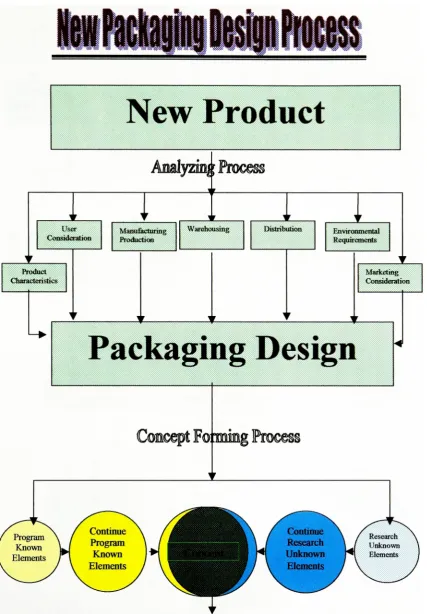
method consists ofthree
processes(See
Fig. 1
below)
they
Figure
1
:New Product
:
yzmn
User Consideration
Product Characteristics
Manufacturing
Production
Warehousing
Distribution Environmental RequirementsMarketing
Consideration
[image:19.542.61.489.55.670.2]Packaging Sy
stem
Design
v ^r \r \r
Incoming
Components
Internal
Packaging
Outbound
Products
Packaging
Recyclable,
Reusable,
Disposable
ftwmy
'Packaging
Design
i
\l
ir ir V v
Products
Combination
Package
Design
Partition
Design
Quantity
V ir
Sec
rOmdaryDesign , V^r
V.
1
Primary
Containers
Combination
Partition
(Dunnage)
Design
Secondary
Container
Design
vTeritaiyDesi
gn
\i irv
Pallet
Oversea
orOption
A
Evaluation A
Data
Analyzing
Sub
-Package
1
PKG Lab
Test
*
or
Field Test
Comparison
in
Performance &
Cost
Option B
Evaluation B
Data
Analyzing
Come
outthe
better
Option
IT
Improving
details
ir
New Package
5.1
Analyzing
Process
Analyzing
process
is
animportant
part
ofthe
overall process.The
outputis
allthe
statement of
the
design
task that
containsrequirements,
limitations
andthe
criterionto
judge
the
quality
ofthe
design
to
be
carried out.The analyzing
criteriaare shownbelow:
Product
characteristics
User
considerationProduction
andmanufacture requirements
Warehousing
considerations
Distribution
requirements
Environmental
requirements
Marketing
consideration5.2
Designing
Process
Design
process containstwo
stages,
conceptforming
anddesign
procedure.Concept
is
the
ultimate goal we striveto
reach andthe
procedureis
the
stepsthat
we couldfellow
without
getting lost.
5.2.1
Concept
forming
processAfter analyzing
andbefore
embodimentdesign,
wehave
the
design
statementin
hand.
Now,
it is
time to
arrange all elements relatedto the
design.
All
elements canbe
divided
two
categoriesKNOWN
andUNKNOWN
just like
building
design.
The KNOWN
elements are
ready
to
be
programmed andUNKNOWN
elementsrequire some researchbased
onthe
knowledge
wemastering
andthe
creativeimpulse
weinspiring.
With
continuing
programming,
researching
and more creativeefforts,
both
circles(programming
range andresearching range)
aregetting
bigger
andbigger.
When
the
circles are
big
enough, overlap
accrues.The overlap
partforms
the
established concept.You may have
two
orthree
this
forming
processbut
the
biggest overlap is
the
mostfeasible
concept.Figure 2
showsthe
conceptforming
symbolically.Figure
2:
Concept
Forming
Process25.2.2 Design Procedure
(integrate... individual...
parts& details...
integrate)
It
is
avery practical,
usefulandstep
by
step
procedurethat
guidesdesigners in
astraight,
efficient manner.5.2.2.1 Integrate
Integrate
here
refersto the
wholepackaging
systemfrom manufacturing
to
distribution;
from
warehouseto market;
from
userto
environment.Sometimes,
it
alsoincludes
incoming
components.It may
include
the
existedpackaging
facilities,
orcreating
any
ofthem
as new components.5.2.2.1.1
Packaging
System Design
The packaging
systemdesign
include
ofthe
wholepackaging
life
cyclethat
consists
ofincoming
componentspackaging
from
suppliers;
internal packaging in
production
line
and outbound product
packaging
in distribution
andwarehousing;
as well asin marketing
and end users.In addition,
the
recycle reuse anddispose
packages arethe
factors
to
make
2
The figure is partially from
Design
Process:
A
Primer
for
Architectural
andInterior Design
by
Sam F.
Miller
1995.
[image:23.542.53.482.98.359.2]the
packaging life
cyclelong
orshort
in packaging
system.Meeting
all requirementsin
the
system andthe
least
cost arethe
mainfactors
andthey
willbe
checkedup
allthe
time
during
the
wholedesign
process.
5.2.2.2
Individual
Individual
design includes
every
single
channelin packaging
system,
suchas productionmechanical
design,
warehouse store
method,
distribution
method as well as environment consideration.Of
cause,
package
design is
the
main partdesign for
packaging
designer.
In
packagedesign,
Individual
also
meanssingle
packagedesign
such as aprimary
package
design,
asecondary
packagedesign
and atertiary
design.
5.2.2.2.1
Primary
packaging
design
Primary
packaging design
consists of productcombination; primary
packagedesign;
partition ordunnage
design
andthe
quantity
ofthe
productin
aprimary
package.What
is
worthto
mentionhere before
aprimary
packaging design
is
the
combination ofproducts,
whichis for
the
product,
contain morethan
two
partsbecause
product's combination affectsthe
primary
package'sform
andits
configurationdirectly.
The
goodCombination
ofProducts (for
morethan two
partsproduct)
criterialisted
as:Symmetric &
balanceable
The
simplest configurationThe
least
dimensions
The
goodprimary
package considerations:Type
of packagePackaging
material selectionFeasible
packaging
productionEnvironment
considerationThe
simplest configurationThe
least dimensions
The
least
cost5.2.2.2.2
Secondary
packaging design:
Secondary
design
consists ofprimary
container's combination and partition ordunnage
design
andsecondary
containerdesign.
The
good combination criteria ofprimary
package units are similarto the
criteria ofproduct's combination.
The
considerations ofsecondary packaging
design
are:The
best
combinationofprimary
package unitsType
ofpackageMaterial's
selection.
The
best fit
pallet and warehousefacilities
.Environment
considerationThe
simplest configurationThe
least dimensions
The least
cost5.2.2.2.3
Tertiary
design:
Tertiary
design
consists of palletdesign
and oversea or non-overseacontainer's
design.
The
consideration shouldbe:
The
best
combinationofsecondary
package unitsType
of enhanced protection.
The
best fit
environment,
transportation
and warehouse5.2.2.3
Parts
anddetails
Part design
anddetail
design
referto
very
specifically
designs
such asthe
calculation ofmechanical
protection,
and noconflicts
between
parts etc.Completing
the
part and
detail design
meansthat
the
first
step draft design has finished.
However,
it
does
not
meanthe
whole
design
processhas
finished;
the
important
reversechecking
andrevising
stepsjust follow
up.5.2.2.4
Individual
andIntegrate
These
two
steps are reversechecking
steps.We
needbring
these
partsdesigns
anddetail
designs back
to
individual
packages
checking
up
that
there
are noany
conflictsamong
primary,
secondary
andtertiary
packaging.Then checking up every
packageis
complied withevery
chainthrough the
packaging
system.Make
sureeverything
meetsthe
requirements and
there
is
no conflict at all.5.3
Evaluating
Process
The
Evaluating
is
mostly
done
through
lab
test
ortour test.
In option,
youmay
have
two
or
three
design
prototypes,
test
and comparethem
withthe
criterialisted below.
Then
we returnto
the
analyzing
processto
check againstthe
requirementslist,
choosethe
optimumdesign
asthe
final
package.The
criteria ofevaluating
package arelisted below:
5.3.1
Function:
To
maintain productquality
To
meet customer needsTo
meet production andpackaging
line
requirementsTo
communicatewellTo
promote sellTo
confirmwithlegal
and regulation aspects5.3.2
Structure:
The
simplest configurationThe
minimum cushionThe
smallestdimension
5.3.3 Economy:
Minimum packaging
cost5.3.4
Environment:
Return,
Reuse,
Recycle,
andMinimize disposal
6.0 REDESIGN
THE
PC MAGNIFIER PACKAGE
WITH NEW METHOD
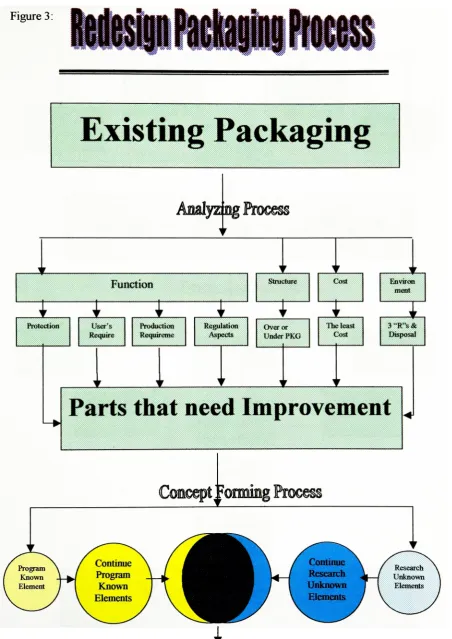
Redesigning
apackaging
process
is slightly different from
a newpackaging
design
process,
because
redesigning is based
onthe
existing
package.Its
main goalis
solving
the
existing
problems andimproving
overall packagequality,
orsaving packaging
costs.The
focus is
to
find
outthe
critical partsthat
needimprovement
through
the
analyzing
process.
After
identifying
all majorknown
and unknownelements,
one conducts someresearch
for
unknown elements and reprograms allknown
elements.Then,
one entersthe
stage offorming
the
redesign concept andmoving
onjust
asthe
stepsusedin
the
newpackaging design
process.(See
Fig.
3
below)
Figure 3
:Protection
Function
User's Require
Production Requtreme
Structure Cost
Regulation
.Aspects
Overor Under PKG
Environ
menl
Theleast Cost
3"R"s& Disposal
V
V
V
PartB
Redesign
PartC
Redesign
1 r
Part
A
Redesign
PartD
Redesign
'
?
Synthesizing
*~J
L
ah. ard1
V
Sub
-New Package
ir \T
Option A
PKGLab
Test
orField
Test
^
Option
B
V ^
Evaluation
A
Data
Analyzing
Evaluation B
Data
Analyzing
Comparison
in
Performance
&
Cost
,d
W ^
ir
Come
outthebetter
Option
Improving
details
X
New Package
18
6.1
Analyzing
Process
6.1.1
Product's
Characteristics
The PC
magnifieris
made ofthree
parts:1)
bottom
base; 2)
arms(both
are made ofplastic)
3)
magnifier screen.The
critical
partis
the
magnifierscreen,
whichis
made ofacrylic.
(See Appendix
1)
Acrylic
is
ahard,
rigid material andit has
excellent optical properties.It
has
outstanding
resistance
to
long-term
exposureto
sunlight and weathering.Though
more vulnerableto
surfacescratching,
it
is
more resistantto
impact
than
glass.In
additionto
excellent opticalproperties,
acrylicshave low
waterabsorption,
good electricalresistance,
andfair
tensile
strength.
The
heat
resistance of acrylicsis
about200F.
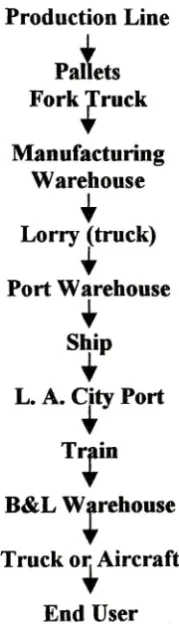
6.1.2
The
Distribution
andWarehouse Statement
PC MagniViewers
are madein
Tian
Jin,
China
transported
overseaby
ship
to
Los
Angeles,
CA.
Then
they
are rail-shippedto
Bausch
&
Lomb in
Greenville,
SC.
PC
MagniViewers
aredelivered
to
end-userby
truck.
(See
Fig. 4).
During
the
overseashipping, the
PC MagniViewers
are stackedface
up,
ninelayers
vertically,
and985
unitsin
one oversea container.In
warehousestorage,
PC MagniViewers
stack on pallet and6
layers in
verticalface
up
also.
Fig. 4 PC
Magnifier Distribution
Flowchart
Production
Line
Pallets
ForkTruck
Manufacturing
Warehouse
I
Lorry (truck)
Port Warehouse
I
Ship
I
L.
A.
City
Port
I
Train
B&L
Warehouse
Truck
orAircraft
End User
6.1.3
Profile
andAnalysis
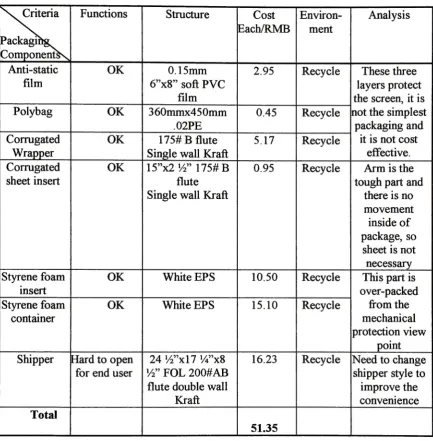
Using
the
packaging
criteria
to
evaluate
the
originalPC
magnifier'package
(see
Table.
2
below)
Table
2:
PC MagniViewer
profile
andanalysis
X.
Criteria
Packaging^
Component^
Functions
Structure
Cost
Each/RMB
Environ
mentAnalysis
Anti-static
film
OK
0.15mm
6"x8" softPVC
film
2.95
Recycle
These
three
layers
protectthe screen,
it is
not
the
simplestpackaging
andit is
not costeffective.
Polybag
OK
360mmx450mm
02PE
0.45
Recycle
Corrugated
Wrapper
OK
175#B
flute
Single
wallKraft
5.17
Recycle
Corrugated
sheet
insert
OK
15"x21/2"175#B
flute
Single
wallKraft
0.95
Recycle
Arm
is
the
tough
part andthere
is
nomovement
inside
ofpackage,
sosheet
is
notnecessary
Styrene foam
insert
OK
White
EPS
10.50
Recycle
This
partis
over-packed
from
the
mechanical protection view pointStyrene foam
containerOK
White EPS
15.10
Recycle
Shipper
Hard
to
openfor
enduser24
Wxll V4"x8
W
FOL 200#AB
flute double
wallKraft
16.23
Recycle
Need
to
changeshipper style
to
improve
the
convenience
Total
51.35
From
the
analysisabove,
some problems are recognized:Too many
layers
in
screenpackaging
is
not cost effectiveCorrugated
sheetinserted between
armsis
notnecessary
Styrene foam
insert
and containeris
over-packedShipping
box
styledifficult
to
openis
inconvenient
to
end users [image:31.542.55.489.112.554.2]6.1.3.1
Cost
Analysis
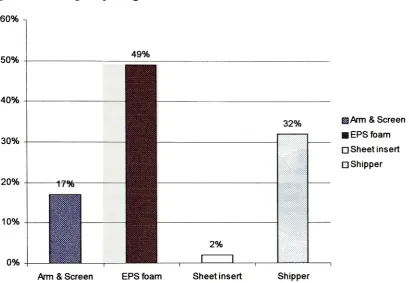
We
canclearly
recognizefrom
figure
5,
Cost
Distribution
chartbelow,
that the
major cost [image:32.542.69.479.132.415.2]is in
the
styrenefoam insert
and container.
It
is
49
%
ofthe total
cost.Figure 5: The
original package costdistribution
60%
50%
40%
30%
20%
10%
0%
49%
Af%-32%
2%
I
I
El Arm
& Screen
EPS foam
? Sheet insert
d Shipper
Arm & Screen
EPS foam
Sheet insert
Shipper
6.1.4
Critical Parts Need Improvement
From
the
costdeduction
subject andthe
result ofthe
analysis,
three
majorpackaging
parts need
improvement.
One is
athree-layer
screen protection andthe
secondis
the
foam EPS cushioning
protection.The
third
partis
the
shipper,
whichneedsto
changeits
style
to
meetthe
user's requirement ofbeing
easy
to
open.In addition,
the
insert between
the
armsmay
be
eliminated.6.2 Redesign Process
6.2.1
Concept
forming
This
is
a redesignproject;
the
majorobjective
here is
cost reduction.The
researchis
centered on
the
critical partsthat
needimprovement
in
terms
of cost effectiveness.The
source ofinformation
neededfor
the
research canbe
acquiredfrom
vendors,
libraries
orInternet
and relatedacademic sources.
From
recommendations
by
the
supplier,
wereviewed
the
PVC
pouchdesign
sampleandits
test
result,
decided
to
usethe
PVC
pouchinstead
ofthe
polybag
and corrugatedwrapper.
From
the
Internet,
the
advancedpackaging
technology,
foam-in-place
packaging
has been
found
that
couldbe
usedin PC MagniViewer packaging
to
replacethe
styreneinsert
andstyrene container.
Further
research shouldbe
conductedregarding
environmentalconsideration.
From
the
corrugatedbox
specificationbook,
the
RSC box
willbe
choseninstead
ofFOL
to
solvethe
difficulty
in opening
problemby
the
end users.During
the
investigation,
wediscovered
the
product'scharacteristics, especially,
the
fragility
ofthe
magnifierscreen,
distribution
flow,
warehousing
information,
cushioning
materials,
cost,
etc.Then,
we programmedthese
elementsinto data flowchart
andtable to
assistantthe
redesign.From
the
packaging
material andpackaging
technology
research,
wefound
somesolutions
to
improve
the
currentPC
MagniViewer
packagein
terms
of cost reduction.They
areindicated
the
redesign of each part withapplying
the
SyNalysis
method anddesign
procedure,
Integrate
- individualParts
-Details
- IndividualIntegrate.
6.2.2 Redesign
Procedure
6.2.2.1
Integrate
andindividual
In
this
PC
magnifierexample,
this
packaging
systemhas
already
existed and workedokay.
In general,
there
is
no significant changein
the
packaging
systembesides
the
foam-in-place design
option.It may have
some minorchangesthat
are causedby
parts ordetail
changes.
The
orientation ofthe
PC
magnifierin
the
packagemay
have
somechange
in
accordance
to
cushions change or some other changes.So,
integrate
andindividual
redesigns cannotbe
taken
untilthe
further
research and parts&
detail
redesign arecompleted.
6.2.2.2
Parts
anddetails
6.2.2.2.1
Magnifier
screenpackaging
redesignThe
original shortages:Three
layers
costtoo
muchin
manufacturing
labor
costVery
difficult
to
packthe
wrapperIt
is
noteasy
to
openfor
userSolutions:
The
new screen package remains an anti-staticthin
film
to
provide protection againstsurface scratch and uses one
PVC
pouchinstead
ofthe
plastic pouch andcorrugated
wrapper.
There
are several significantbenefits from
these
design
changes:
Recover
slight amount ofpacking
space;
.
Save packing
material whichleads
to
cost reductionReduce
package weight.
Simplify
manufacturing
process
in
term
ofsaving labor
Ease
packageopening
operation
for
userThis
newdesign
eliminates allthe
shortcomings
of originaldesign
in
this
regard andachieves
the
cost reduction goal withoutsacrificing
the
packagefunction
performance.Additionally,
the
newPVC
pouchadds
one newfunction
as abonus
that
it
canbe
used as a coverto
shield
from
dust
whenthe
computer
is
notin
use.6.2.2.2.2
Cushions Redesign
Cushioning
material andits
configuration
are critical partsin
the
cushioning
redesign.We
shouldhave
fragility
factor,
drop
height,
staticloading by
collecting,
estimating
andcalculating
to
startthe
redesign.
Statement:
PC
MagniViewer's weight
-141b,
1
personhandling
Drop
height
-30in
Insurance level
II
Fragility
Factor:
There
arethree
possible ways ofdetermining
the
fragility
factor:
By
testing
By
calculationBy
estimationThough
theoretically
possible,
calculations are usedonly
if
wehave
enough mechanical and structuraldata
ofthe
object,
whichis
usually
notthe
case.Hence,
in
practice, this
approach
is
only
used on somevery
simpleitems. Since
the
PC MagniViewer
is
a complexproduct,
it
is difficult
to
calculateits fragility.
Lab
testing
is
also not usedhere
because
ofthe
costsincurred
by breaking
an expensivePC
MagniViewer.
Since
the
fragility
is
not afocal
pointin
this
thesis,
anestimating
method was usedto
obtain
the
fragility
data
ofthe
PC
magnifier.Using
typical value,
givenin
table
3,
I
estimate
its
fragility
was about80g's.
The
reasonfor
this
is
that
PC
MagniViewer' sfragility
shouldbe
larger
than
aTV
screen setbecause
TV
screens are made ofglass,
andthe
PC MagniViewer
is
made of acrylic whichis
atougher
material3.3
Handbook
ofPackaging Engineering by
Joseph F.
Hanlon 1984
3:
Typical
productfragility
factors3Classification
Fragility
Type
of productHighly
fragile
15-25g
Precision
instruments
with sensitivemechanicalbearings
Very
fragile
20-40g
Electro-mechanical
measuring instruments
Fragile
40
-60g
Electro-mechanical
equipment.
E.g. Type
writing,
cashregisters,
calculating
machinesetc.Moderately
fragile
60
-85g
Television
receivers,
opticalprojectors
Fairly
robust85
-lOOg
Domestic
appliances(washing
machines,
refrigerators,
cookers)
Calculation
for
cushiondesign:
If
the
new cushiondesign
maintainsthe
originalcushioning
materialEPS,
how
muchEPS
material needin
the
packagefrom
shock and vibrationtheory?
PC MagniViewer:
W
=141b
G=80g'H
=30"Dimensions:
15"x21"x5I/4"
Maximum
dynamic
compressionDm
=2h
/
gm=2x30
/
80
=0.75in
If
the
working
length
=60%
Total
thickness
TT
=dm /0.6
=0.75
/
0.6
=1.25in
We find
psiis
0.4
from
the
EPS
curve4The
bearing
area ofthe
cushioning
=product weight
/
staticloading
141b
/0.4psi
=35in2From
the
result ofthe calculation,
wefound
that the
PC MagiViewer
needs atleast
35in2cushion
in
the
package.Due
to the
product'stwo
parts specificconfiguration,
the
cushioning
function is
to
fix
the
screen andthe
armfrom
shifting
around morethan
mechanical protectionfrom
shock&
vibration.Fixing
the
Arm & Screen
part onthe
Base
part
is
critical when we considerthe
cushion redesign problem.Fundamentals
ofpackaging dynamics
page-1336.2.2.2.3 Redesign Possible Plan
We
could gothree
basic
possible redesign
directions.
One is
retaining
the
sameEPS
material and
reducing
the
cushiondimensions.
Option
I
is
the
redesign.The
otheris
changing
the
cushioning
material andchanging
the
packaging
systemthat
is
the
optionII.
The
third
oneis changing
the
cushioning
materialthat
is
the
optionIII.
Option
I
Eliminate
the
EPS
foam
containerby
adding
two
EPS
sheets atthe
bottom
andthe
top,
and retain
the
EPS form
insert (see figure
6)
Figure
6: Option
I,
Eliminate
the
EPS Container
and usetwo
EPS
sheets atbottom
&
top
Option
D
Use
form-in-place hand-held
packaging
systemto
replacethe
EPS foam
containerand
insert
withoutchangethe
shipperdimensions.
(See figure
7)
[image:36.542.59.460.226.530.2]Figure
7:
Option
II, Foam-in-PIace:
Option in
Change
the
EPS cushioning
materialto
corrugatedboard
both
onbase
and screen&
armparts,
adding
plasticbags
onthese two
partsto
avoidthe
dust. (See
Fig.
8, 9, 10, 11,
and [image:37.542.136.411.62.246.2]12)
Figure 8:
Option
III,
Corrugated
board
cushioning
[image:37.542.102.398.404.598.2]Figure 9:
Option
EI,
Base
Wrapper
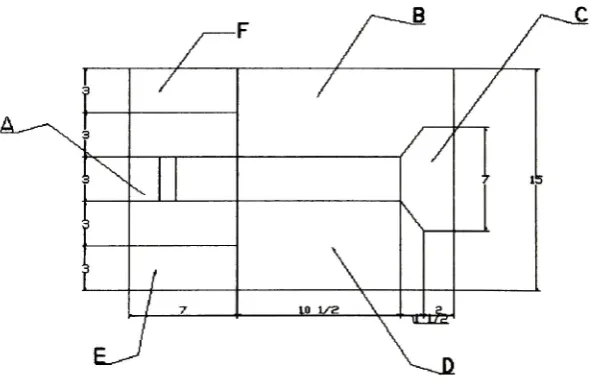
15/0 15- AVS,6 1/4 12 1/a- 6.V.
< J*
Figure 10:
Option
D3,
Detail A
, 4 a.e i/**
j
'( '
l
1 / 1 /2
1 /2 l:/2
J
'?1/4 a i/+ 7 .2 1/4
[image:38.542.163.425.312.514.2]Figure
11: Option
EQ,
Detail
B &
D
1:/
1/13 1 a I 4 1 4 1/3 1 *
Rl-'
[
l/E-b a d
[image:39.542.115.414.70.278.2]Note:Dsectixnlusiwoh>kswdBsectionhisml
Figure 12:
Option
ID,
Detail
E,
F
& C
0
-4 i/a
/L
4 /B
7
:/4
1
1
3 :./*
e a f
[image:39.542.255.469.432.573.2]Figure 13:
The
packages cost comparison chart60
-vMtl Original
Option I
? Option
II
? Option
III
Original
Option I
Option
Option III
6.2.2.2.4 The Three
optionsComparison
From
the table
5
below,
the
least
pointsis
optionn,
foam-in-Place hand-held
packaging
system.
Option I
has
the
minimumchangesfrom
the
originalPC
MagniViewer packaging
withsignificant costreduction,
but
its
fragmentariness
may
influence
the
performance ofthe
package andthe
packaging
labor
cost.Option DI
has
the
most changesbut its
complicated
in
packing
process willincrease
the
labor
cost.The
optimal redesign planis
the
optionII,
Foam-In-Place
hand-
held
packaging
system.Because:
Foam-in-Place
canbe
createdin
avariety
of sizes andshapes,
it
efficiently
protects magnifierin
size,
shapeandtwo
parts movementdifficulties
Foam-in-Place
has
goodcushioning
protectionto
protectthe
product.
Foam-in-Place packaging
system simplifiesthe
packaging
production processFoam-in-place
savesthe
foam-shipping
trip
from
packaging
supplierto
production
line.
Foam-in-Place
speedsup PC
magniViewer's packaging
process andsignificantly
improves
productivity
Foam-in-Place
has
light
weight and savestransportation
costFoam-in-Place
saveslabor
costTable 4: Three Options
Comparison
Table
'^v.
Packages
Evaluation"'^
Original
Option
I
EPS
Insert &
Sheets
Option II
Foam-In-Place
Option ED
Corrugated
Board
Functions
OK
OK
OK
OK
Weight
3
2
1
4
Dimensions
3
2
4
1
Labor
3
2
1
4
Transportation
4
3
1
2
Cost
4
1
3
2
Environment
Recycle
Recycle
Possible Reuse
Recycle
Total
points18
11
8
13
*
1
is
the
least,
4
is
the
mostThe PC MagniViewer
packaging
redesign will selectthe
foam-in-Place
hand-held
packaging system,
the
rest ofthe
workis
focus
oncontacting
the
sale representative ofS