R E S E A R C H
Open Access
A novel combination of fipronil and
permethrin (Frontline Tri-Act®/Frontect®)
reduces risk of transmission of
Babesia
canis
by
Dermacentor reticulatus
and of
Ehrlichia canis
by
Rhipicephalus sanguineus
ticks to dogs
Frans Jongejan
1,2*, Christa de Vos
3, Josephus J. Fourie
3and Frederic Beugnet
4Abstract
Background:The ability of Frontline Tri-Act®/Frontect®, a topical ectoparasiticide containing fipronil and permethrin for dogs, to prevent the transmission ofBabesia canisas well asEhrlichia caniswas evaluated by infesting dogs with infected vector ticks.
Methods:For theBabesia canisstudy, 16 dogs were randomly allocated to two groups. Eight dogs were treated on day 0 with a topical spot-on formulation containing 6.76 %w/vfipronil plus 50.48 %w/vpermethrin and eight dogs served as the untreated control group.Dermacentor reticulatusticks, with aB. canisinfection rate ranging between 2 and 10 %, were placed onto dogs on days 7, 14, 21 and 28.In situtick counts were performed on Days 9, 16 and 23. Ticks were counted and removed on Day 30. Infection of the dogs withB. caniswas monitored by rectal temperature readings, clinical examinations and blood smears as well as PCR and IFA (indirect fluorescent antibody assay).
For theEhrlichia canisstudy, another 16 dogs were allocated to two groups. Eight dogs were treated with the fipronil and permethrin combination on days 0 and 28 and eight dogs served as untreated controls.Rhipicephalus sanguineusticks, carrying an infection rate of 13 % forE. canis,were released in the sleeping kennels of the dogs on days 7, 14, 21, 28, 35, 42, 49 and 56. Ticks were countedin situon the dogs on a weekly basis. All ticks were removed and counted on the final assessment day 58. Infection of the dogs withE. caniswas monitored by rectal temperature, clinical examinations, and testing of blood samples by PCR, IFA and platelet counts.
Results:B. caniswas transmitted byD. reticulatusticks to all eight untreated control dogs and to one treated dog, which was confirmed by blood smears, PCR and IFA.E.caniswas transmitted byR. sanguineusticks to all eight untreated control dogs. Two of the dogs in the treated group were found positive based on PCR and/or IFA.
Conclusions:Frontline Tri-Act®/Frontect® significantly lowered the risk for dogs to acquire aB. canisinfection by 87.5 % over a challenge period of 28 days. The risk for dogs to acquireE. caniswas reduced by 75 % over a period of 56 days.
Keywords:Babesia canis,Ehrlichia canis,Dermacentor reticulatus,Rhipicephalus sanguineus, Fipronil, Permethrin, Transmission blocking studies
* Correspondence:[email protected]
1Utrecht Centre for Tick-borne Diseases (UCTD), FAO Reference Centre for Ticks and Tick-borne Diseases, Faculty of Veterinary Medicine, Utrecht University, Yalelaan 1, 3584CL, Utrecht, The Netherlands
2
Department of Veterinary Tropical Diseases, Faculty of Veterinary Science, University of Pretoria, Private Bag X04, Onderstepoort 0110, South Africa Full list of author information is available at the end of the article
Background
Hard ticks (Acari: Ixodidae) infest dogs all over the world, causing direct damage due to high tick burdens. Their main importance, however, is related to their capacity to transmit a wide range of pathogenic micro-organisms [1, 2]. As a re-sult, there is a continuous need to develop novel and/or combine existing tick control compounds for sustained tick control on companion animals, in particular dogs. Im-proved acaricidal formulations and combinations that are easy to administer, long acting, fast killing, and reduce in-fection by tick-borne diseases, e.g. babesiosis and ehrlichio-sis, do provide value to veterinarians and their clients.
Canine babesiosis is caused by a number of different protozoan species of the genus Babesia, which vary in virulence and have expanded their distribution in re-cent years in particular in Europe [3].
Here the focus is onBabesia canis, where the occurrence largely coincides with the distribution of the ornate dog tick,Dermacentor reticulatus(Fabricius, 1794), a Palearctic species with a highly focal distribution pattern [4]. This tick occurs in foci in south-western England in the west all the way into Central Asia reaching the Yenisei river basin in Si-beria in the east [5].
The second focus is on Ehrlichia canis, the causative agent of canine monocytic ehrlichiosis, which is trans-mitted by the brown dog tick,Rhipicephalus sanguineus
(Latreille, 1806), and found worldwide anywhere be-tween 50° N and 30° S [6].
Guidelines for conducting veterinary clinical studies have traditionally focussed on demonstrating acaricidal efficacy against ticks [7]. However, because of the importance of ticks as vectors of pathogens causing diseases in dogs and humans, there is an increasing demand for control methods that do not only kill ticks, but are also able to reduce the transmission of disease. Fipronil spotted onto dogs was shown to prevent infection withE. canistransmitted byR. sanguineus in Senegal [8]. Furthermore, application of amitraz-impregnated collars onto dogs in South Africa pre-vented infections withBabesia rossitransmitted by Haema-physalis elliptica ticks [9]. In this particular study eight of 30 control dogs (26.6 %) became infected over a 6-month period compared to none of the 20 treated dogs. Field trials, however, depend on locally occurring challenge pressure, which often results in unpredictable numbers of untreated control animals contracting the tick-transmitted disease. Over the past couple of years, laboratory models that allow for a much more standardised evaluation of the transmis-sion blocking ability of acaricidal compounds have been de-veloped both for B. canis[10] as well as forE. canis[11]. As a result, the WAAVP recognised this development and included in their recent guidelines that specific claims re-garding the prevention or reduction of tick-borne pathogen transmission are now possible [12]. However, specific rec-ommendations regarding the design of pathogen blocking
studies have not yet been included in any of the regulatory guidelines [13].
Both transmission blocking models were initially used to determine the level of transmission blocking of B. canis-infected Dermacentor ticks and E. canis-infected
Rhipicephalus ticks applied onto dogs treated with a combination of fipronil, amitraz and (s)-methoprene (CERTIFECTTM) [10, 11]. Two additional studies were conducted with the E. canisblocking model; one study addressed the preventive capacity of a topical combin-ation of imidacloprid and permethrin and the second study focussed on an imidacloprid and flumethrin col-lar for dogs [14, 15]. In addition to the topically active compounds [10] and slow release collar matrices [16], both recently discovered novel systemic compounds, afoxolaner [17] and fluralaner [18]) were also tested for their capacity to block transmission ofBabesia[19, 20]. Recently, a combination of fipronil and permethrin (Frontline Tri-Act®/Frontect®) was tested for its acari-cidal efficacy against D. reticulatus ticks [21] and also againstR. sanguineusticks [22]. Fipronil is a phenylpyra-zole, which has been widely used as an acaricide/insecticide [23]. Permethrin, is a synthetic pyrethroid with a residual acaricidal activity as well as repellency effect sensu lato against ticks.
The studies reported in this paper assessed whether this combination is capable of preventing the transmission of
Babesiaas well asEhrlichiausing established transmission blocking models.
Methods
Study design and treatments
Both studies were conducted in compliance with the South African animal welfare legislation, the Good Clinical Prac-tice guideline (Veterinary International Conference on Harmonization GL9) and the European Medicines Agency guidelines for testing and evaluation of the efficacy of anti-parasitic substances for treatment and prevention of tick and flea infestation in dogs and cats (EMEA/CVMP/005/ 2000-Rev.2). The studies employed a parallel group design, randomised and blinded. The dogs were ranked, within gender in descending order of individual body weight on Day -7. All dogs, identifiable by a microchip number, were individually housed in tick-proof kennels and observed daily throughout the study duration. Persons involved in the post-treatment assessments and observations were dif-ferent from those that performed the treatments with the active ingredients in order to eliminate bias.
groups for theEhrlichiastudy. They were admitted to the study after they were confirmed sero-negative for ehrlichi-osis by IFA as well as PCR negative forEhrlichiaDNA.
The treatment consisted of 6.76 mg/kg fipronil and 50.48 mg/kg permethrin applied by parting the hair and applying the acaricide directly onto the skin along the midline of the neck. The total amount was divided into two fractions: one was applied between the shoulders and one at the base of the skull. Dogs were observed hourly for 4 h following treatment administration.
Tick challenge on dogs
A laboratory-bredDermacentor reticulatustick strain, ori-ginating from France, naturally infected withB. canis, was used. Ticks from the above mentioned strain were in-fected withB. canisby acquisition feeding on a dog with confirmed acute babesiosis. Unfed adult ticks with a bal-anced gender ratio (50 % female: 50 % male) were used for the dog infestations. A sample of 50 D. reticulatus ticks taken from the batch of ticks to be used was confirmed positive by PCR analysis (rate ranging between 2 and 10 %). Each dog was infested on days 7, 14, 21 and 28 with 50 (±5) viable ticks applied directly onto the back of the dog. During this process dogs were restrained for 10 min in an infestation crate. Gloved fingers were used to facili-tate the ticks through the dog’s hair coat in order to reach the skin. Any tick that was found dislodged during the first ten min was placed back onto the dog.
In the second study, a laboratory-bredR. sanguineustick strain, originating from France and infected withE. canis,
was used for the dog infestations. Ticks from the above mentioned strain were infected withE. canis by acquisi-tion feeding on a dog with confirmed acute ehrlichiosis. A sample of 50R. sanguineusticks from the batch used for infestation was confirmed infected withE. canis with an infection rate of 13 % by PCR analysis. Fifty (± 5) unfed adult ticks of equal gender were released in the sleeping kennels of the dogs on days 7, 14, 21, 28, 35, 42, 49 and 56. Once a dog became infected with E. canis and was subsequently rescue-treated, adult R. sanguineus ticks from a pathogen-free batch were used for the artificial in-festations (on Days 49 and 56) for a comparison of the acaricidal efficacy between groups. Additionally, the pens of the dogs were inspected daily from Day 14 onwards for engorged detached ticks. These ticks were collected and preserved in 70 % ethanol from each individual animal. Tick counts on dogs
In the Babesia study, in situ thumb counts were per-formed approximately 48 h after each tick challenge (Days 9, 16 and 23). Ticks were removed only 48 h after the last infestation (Day 30). In the Ehrlichia study, ticks were counted approximately 48 h post-application on the dogs without removing them (Days 9, 16, 23, 30, 37, 44, and
51). All ticks were removed on the final assessment day (Day 58). During thein situthumb counts, sexes were not distinguished. The ticks counted and removed on Day 58 were categorized within sex (male/female) as free or at-tached and dead or alive following the recommendations recently updated by the WAAVP [12].
Methods for calculating the acaricidal efficacy
Efficacy against ticks was calculated from the total count of live ticks counted on the dogs 48 h after each infestation, or removed. Efficacy calculations based on arithmetic and geo-metric means of the tick counts was calculated using Abbott’s formula: Efficacy (%) = 100 × (C–T) / C, whereby: C = Mean live tick count on the control group; T = Mean live tick count on the treated group. Statistical analysis were carried out using the chi-square test or Fisher’s exact test as applicable using software package SAS ® version 9.3. The level of significance of the tests was set at 5 %.
Monitoring ofBabesiaandEhrlichiainfections
Babesia
Scheduled clinical examinations were conducted on Days −7, 7, 14, 21, 28, 35, 42, 49 and 56. The clinical examination included general appearance, respiration rate, heart rate and body temperature. Additional exami-nations were conducted on all dogs displaying clinical signs associated with babesiosis, which included fever, depression, anorexia, lethargy, anaemia, haematuria and icterus. Blood smears were prepared from dogs display-ing abnormally high body temperatures (>39.4 °C) and examined for B. canis infection in erythrocytes. Treat-ment for babesiosis consisted of 1 ml/20 kg body weight diminazene followed by 1.2 ml/kg imidocarb dipropio-nate 24 h later.
Blood was collected for PCR analysis from all dogs prior to the start of the study and on Days 14, 21, 28, 35, 42 and 56 and on any dog at the time of diagnosis with babesiosis prior to rescue treatment. Blood was also collected for ser-ology on the same days as for PCR analyses, and addition-ally on Day 7 prior to the tick challenge. EDTA blood samples collected for PCR analysis were collected in EDTA tubes and total genomic DNA extracted using a commercial kit. A fragment of approximately 300 bp from the 18S internal transcribed spacer-1 gene ofBabesiawas PCR amplified using methods originally published by Duarte et al. [24] and subsequently modified by Beugnet et al. [19]. Positive, negative, no template as well as in-ternal amplification controls were included in each run.
Ehrlichia
Infection with E. canis was monitored by rectal temperature records, clinical examinations and plate-let counts, as well as by testing blood samples by PCR and IFA. Dogs displaying clinical signs usually based on an elevated body temperature >39.4 °C for two consecutive days received appropriate concomi-tant treatment with doxycycline and dexamethasone. EDTA blood samples were collected for PCR from all dogs prior to the first infestation and on Days 21, 28, 35, 42, 49, 56, 63, 70, 77 and 84, as well as any dogs that developed fever.
For PCR analysis ofE.canis, a specific primer set was used for amplification of a fragment of the dsb gene (ECAdsbF: 5′- GCAAGTGCGGGCAGAGAATGAAG-3′; ECAdsbR: 5′- GTATCCCCTACTATGATAGCAGG AGTGC-3′). The amplified product was subjected to agarose gel electrophoresis for confirmation. Up to 400 ng isolated DNA served as template for PCR amplification of the target region in a 20μl reaction volume using Phire HotStart II DNA polymerase. A PCR product of approxi-mately 500 bp confirmed the presence of theE. canisdsb target region in the sample. Positive, negative, no template as well as internal amplification controls were included in each run.
For serology, serum was recovered and frozen at−20 °C until assayed forE. canisantibodies using an IFA assay for the detection of specific E. canisantibodies using a com-mercial test kit (MegaCor Diagnostik, Austria). An add-itional serum sample was collected three weeks after the last scheduled serum collection on Day 84, to confirm the results for dog 4FA 06A that had not sero-converted by the end of study.
Methods for calculating theBabesia/Ehrlichiablocking efficacy
An efficacy failure (successfully infected with Babesia) was defined as a dog in the treatment group that tested serologically positive for B. canis antibodies or positive for B. canis DNA by PCR analysis. An efficacy failure (successfully infected with Ehrlichia) was defined as a
dog in the treatment group that tested serologically posi-tive forE. canisantibodies or tested positive forE. canis
DNA by PCR analysis. Any treated dog that met either one of the above criteria was considered infected. Per-centage blocking efficacy for the treatment group was calculated as follows: Efficacy (%) = 100 × (Tc−Tt)/Tc,
whereby Tc= Total number of infected dogs in the
nega-tive control group, and, Tt= Total number of infected
dogs in the treatment group.
As proposed recently by Navarro et al. 2015 [25], the per-centage of protection may also be calculated in comparison to the number of infective challenges, and not in relation to the number of infected dogs in the control groups.
Protection (%) = 100 (IcC−IcT)/IcC whereby IcC is the number of infective tick challenges conducted in the control group that lead to positive infection and IcT the number of infective tick challenges in the treated dogs that lead to infection. This % of protection provides a better view of the risk reduction provided by the treat-ment to dogs that will face infected tick challenges.
Results
In general, clinical signs, fever and reduced platelet counts, observed in dogs enrolled in the studies could be linked to the tick-transmitted Babesia or Ehrlichia infections, and there were no adverse reactions noted in response to the treatment.
Efficacy on ticks
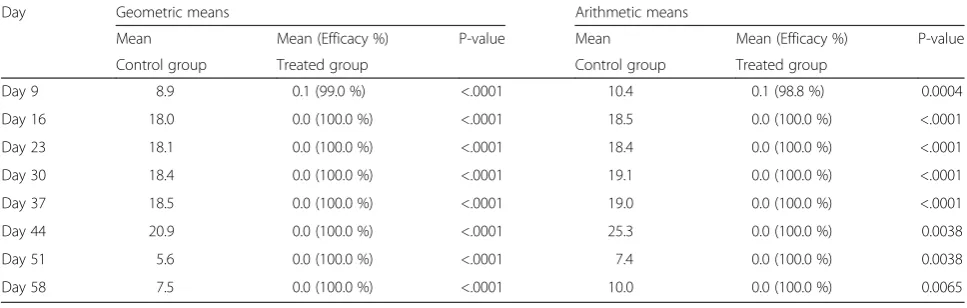
The acaridical efficacy of Frontline Tri-Act®/Frontect® against D. reticulatus and R. sanguineus ticks is sum-marised in Table 1 and Table 2, respectively. The effi-cacy againstD. reticulatusticks was 98.3 % on Day 9 and increased to 100 % on Day 16 (Table 1). Any dog that tested positive for B. canis parasites in stained blood smears was not challenged any further with infected Der-macentorticks. As a result, meaningful statistical compari-son was limited to Days 9 and 16 (Table 1).
[image:4.595.57.540.613.708.2]LiveR. sanguineusticks were only found on Day 9 with a corresponding efficacy of 99.0 % for the treatment group (Table 2). The control group carried statistically (p< 0.05) more ticks compared to the treated group on all assessment
Table 1Acaricidal efficacy based on geometric and arithmetic means againstDermacentor reticulatusticks
Day Geometric means Arithmetic means
Mean Mean (Efficacy %) P-value Mean Mean (Efficacy %) P-value
Control group Treated group Control group Treated group
Day 9 23.1 0.4 (98.3 %) <.0001 24.5 0.9 (96.4 %)
Day 16 30.6 0.0 (100.0 %) <.0001 32.7 0.0 (100.0 %)
Day 23 NA 0.5 1.4
Day 30 NA 0.3 0.6
P-value: One-way ANOVA test Dogs were treated once on day 0
days with a group average of 5.6 to 20.9 (Table 2). After Day 9, no more live ticks could be found on the treated dogs on any of the assessment days (i.e. 100 % efficacy).
Babesia canis blocking efficacy
The infection rate of ticks used for infestation on day 7 was 2 %, whereas those used on Days 21 and 28 carried an infection rate of 10 and 8 %, respectively.
Blood smears were prepared and examined for the presence of B. canis for all dogs from Day 14 onwards when pyrexia (>39.4 °C) was present. B. canis was ob-served in blood smears of all control dogs on at least one occasion (Table 3). By Day 28, all the dogs in the control group were positive for Babesia, and therefore for those animals tick challenges were discontinued. For all treated dogs, tick challenges were continued up to Day 28, except for dog B2A 234 from the treatment group, confirmed positive on Day 22.
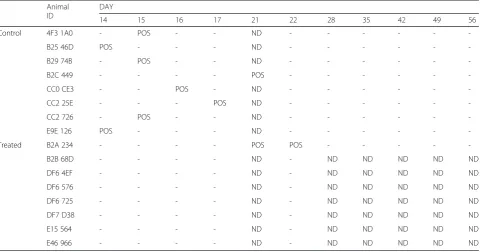
Blood smear examination was followed up by PCR and IFA analysis. All eight untreated dogs were confirmed positive by PCR on the same day as their positive blood smear (Table 4). By Day 28 all untreated dogs had sero-converted and displayed specific B. canis antibodies (Table 5). One of the dogs (B2A 234) in the treated group was found positive for babesiosis based on blood smear examination (Day 22) (Table 3), PCR (Day 21) (Table 4) and IFA (Day 42) (Table 5). Overall the effect-iveness of Frontline Tri-Act®/Frontect® in reducing Babe-siatransmission was 87.5 % over the challenge period of 28 days compared to control dogs (P-value: 0.0014). When calculating the protection conferred against in-fective tick challenges, the percentage of protection was 94.3 % ([8/15−1/31)/8/15] = 1 infection in 31 infective challenges in treated dogs compared to eight infections in 15 challenges in control dogs).
Ehrlichia canis blocking efficacy
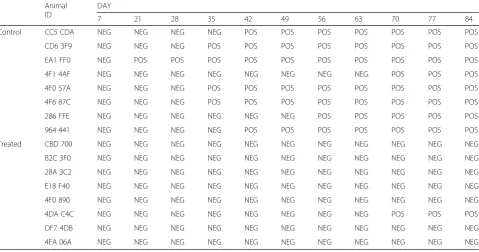
Fifty adultR. sanguineusticks were taken from the batch of ticks used for challenging the dogs and confirmed PCR positive (13 %). In both groups, four dogs were observed with elevated body temperatures (>39.4 °C) (Table 6). Reduced platelet counts (< 200 × 109/l) were observed in five untreated dogs, but also in four of the treated dogs (Table 6).Ehrlichia canisinfection was confirmed by PCR in all untreated dogs (Table 7) and they also all serocon-verted (Table 8). Ehrlichia DNA was detected in two treated dogs (4DA C4C and 4FA 06A on Day 70 and Day 77, respectively) (Table 7). However, only one of the PCR positive dogs in the treated group was confirmed by IFA (Table 6). Additional serum samples collected from dog 4FA 06A after Day 84 were also sero-negative. Over-all, Frontline Tri-Act®/Frontect® effectively reduced trans-mission of E.canis to dogs by 75 % over the challenge period of 56 days compared to control dogs (P-value: 0.0070). When calculating the protection conferred against infective tick challenges, the percentage of pro-tection was 85.15 % (two infections based on PCR in 64 infective challenges compared to eight infections in 38 challenges in control dogs).
Discussion
Acaricidal efficacy
Topical administration of a combination of fipronil and permethrin onto eight dogs enrolled in each of the clin-ical studies included in this paper did not induce any ad-verse reactions. Any clinical signs observed were linked to eitherB. canisinfection or toE.canisinfection.
[image:5.595.56.540.101.255.2]The advantage of combining 6.76 % fipronil and 50.48 % permethrin is their different mode of action. Permethrin has a pronounced repellency effect related to irritant effect by contact, and then is followed by a killing effect. Fipronil
Table 2Acaricidal efficacy bases on geometric and arithmetic means againstRhipicephalus sanguineusticks
Day Geometric means Arithmetic means
Mean Mean (Efficacy %) P-value Mean Mean (Efficacy %) P-value
Control group Treated group Control group Treated group
Day 9 8.9 0.1 (99.0 %) <.0001 10.4 0.1 (98.8 %) 0.0004
Day 16 18.0 0.0 (100.0 %) <.0001 18.5 0.0 (100.0 %) <.0001
Day 23 18.1 0.0 (100.0 %) <.0001 18.4 0.0 (100.0 %) <.0001
Day 30 18.4 0.0 (100.0 %) <.0001 19.1 0.0 (100.0 %) <.0001
Day 37 18.5 0.0 (100.0 %) <.0001 19.0 0.0 (100.0 %) <.0001
Day 44 20.9 0.0 (100.0 %) <.0001 25.3 0.0 (100.0 %) 0.0038
Day 51 5.6 0.0 (100.0 %) <.0001 7.4 0.0 (100.0 %) 0.0038
Day 58 7.5 0.0 (100.0 %) <.0001 10.0 0.0 (100.0 %) 0.0065
P-value: One-way ANOVA test
induces a progressive onset of tick mortality [23].“ Syner-gistic” effects, or at least additive effects, by combining both topical compounds into a single formulation, as dis-covered for the combination of fipronil and amitraz [26], have not been reported but are probable.
Speed of transmission
Pathogen transmission depends on the duration of at-tachment required by ticks to transmit specific patho-gens such asB. canisandE. canis.In general, protozoan
[image:6.595.57.540.102.363.2]Babesia parasites require several days (36 to 72 h) for
Table 3Rectal temperature records and detection ofBabesia canisin blood smears from dogs challenged with infectedDermacentorticks
Group Animal
ID
Body temp range (°C)
Blood smear preparation and examination day
14 15 16 17 20 21 22 28 35 42 49 56
Min Max
Control 4F3 1A0 37.7 40.3 - POS - - -
-B25 46D 37.9 39.1 POS - - -
-B29 74B 38.2 39.7 ND POS - - - ND - ND ND ND ND ND
B2C 449 37.8 38.8 - - - POS - - -
-CC0 CE3 37.6 39.6 ND ND POS - - ND - ND ND ND ND ND
CC2 25E 37.6 39.2 - - - POS - - -
-CC2 726 37.5 40.1 ND POS - - -
-E9E 126 37.9 39.8 POS - ND - - ND ND ND ND ND ND ND
Treated B2A 234 37.7 40.5 ND - - ND ND POS ND ND ND ND ND
B2B 68D 38.4 39.2 - - -
-DF6 4EF 37.8 38.8 - - -
-DF6 576 38.0 39.0 ND - - - ND ND - ND ND
DF6 725 37.4 39.1 ND - - - - ND - ND ND - - ND
DF7 D38 37.6 38.4 - - -
-E15 564 37.5 38.4 - - -
-E46 966 37.3 39.2 ND - - - ND
-NDnot detected,POSpositive, - = no blood smear prepared
Table 4Detection ofBabesia canisDNA using a PCR assay in dogs challenged with infectedDermacentorticks
Animal ID
DAY
14 15 16 17 21 22 28 35 42 49 56
Control 4F3 1A0 - POS - - ND - - -
-B25 46D POS - - - ND - - -
-B29 74B - POS - - ND - - -
-B2C 449 - - - - POS - - -
-CC0 CE3 - - POS - ND - - -
-CC2 25E - - - POS ND - - -
-CC2 726 - POS - - ND - - -
-E9E 126 POS - - - ND - - -
-Treated B2A 234 - - - - POS POS - - - -
-B2B 68D - - - - ND - ND ND ND ND ND
DF6 4EF - - - - ND - ND ND ND ND ND
DF6 576 - - - - ND - ND ND ND ND ND
DF6 725 - - - - ND - ND ND ND ND ND
DF7 D38 - - - - ND - ND ND ND ND ND
E15 564 - - - - ND - ND ND ND ND ND
E46 966 - - - - ND - ND ND ND ND ND
[image:6.595.59.540.474.726.2]their sporoblasts to mature into infective sporozoites within the tick’s salivary glands before they can be trans-mitted [27]. Bacterial pathogens, such as Anaplasma phagocytophilum, require 24 to 36 h to be transmitted by nymphalIxodes scapularis ticks. [28, 29]. In a recent study, the time that an infectedR. sanguineustick had to
[image:7.595.60.538.103.352.2]be attached before it could transmit E. canis was deter-mined in vivo as well asin vitro[30]. The study revealed that transmission of E. canis starts within a few hours (3 h on dogs and 8 h on artificial membranes), an inter-val considerably shorter than presumed previously. These findings highlight the need for further research
Table 5Detection ofBabesia canisantibodies by Indirect Fluorescent Antibody assay in dogs challenged with infectedDermacentorticks
Animal ID
DAY
Pre -infestation Day - 7 7 21 28 35 42 49 56
Control 4F3 1A0 NEG NEG POS - - POS POS POS
B25 46D NEG NEG POS - - POS POS POS
B29 74B NEG NEG NEG POS - POS POS POS
B2C 449 NEG NEG NEG POS - POS POS POS
CC0 CE3 NEG NEG NEG POS - POS POS POS
CC2 25E NEG NEG POS - - POS POS POS
CC2 726 NEG NEG POS - - POS POS POS
E9E 126 NEG NEG NEG POS - POS POS POS
Treated B2A 234 NEG NEG NEG NEG NEG POS POS POS
B2B 68D NEG NEG NEG NEG NEG NEG NEG NEG
DF6 4EF NEG NEG NEG NEG NEG NEG NEG NEG
DF6 576 NEG NEG NEG NEG NEG NEG NEG NEG
DF6 725 NEG NEG NEG NEG NEG NEG NEG NEG
DF7 D38 NEG NEG NEG NEG NEG NEG NEG NEG
E15 564 NEG NEG NEG NEG NEG NEG NEG NEG
E46 966 NEG NEG NEG NEG NEG NEG NEG NEG
POSPositive,NEGNegative; - = No sample tested
Table 6Rectal temperature records and platelet counts in dogs challenged byEhrlichia canis-infectedRhipicephalusticks
Animal ID
Body temp range (°C) Platelet count and examination Day
Min Max −6 21 28 35 36 42 49 56 63 70 77 84
Control CC5 CDA 37.5 39.7 285 275 292 284 - 221 - - -
-CD6 3F9 37.5 38.8 224 234 218 189 - - -
-EA1 FF0 37.7 39.8 245 171 - 246 - - -
-4F1 4AF 38.1 40.1 494 415 519 449 - 459 383 388 274 - -
-4F0 57A 37.8 39.4 253 282 279 197 - - -
-4F6 87C 38.2 39.8 333 327 194 179 - - -
-286 FFE 38.4 39.4 485 478 512 505 - 495 406 143 - - -
-964 441 37.8 39.1 377 349 359 353 - 269 - - -
-Treated CBD 700 37.3 38.6 213 238 216 - 209 221 210 193 208 213 185 193
B2C 3F0 38.2 39.6 259 192 192 169 - 153 181 198 216 170 204 180
28A 3C2 38.1 39.8 363 343 307 380 - 370 348 351 376 349 325 308
E18 F40 38.0 39.2 480 228 304 250 - 299 280 280 288 312 275 277
4F0 890 38.2 39.6 347 367 332 330 - 372 341 204 378 349 339 332
4DA C4C 38.2 39.2 425 385 402 360 - 299 320 291 323 163 -
-DF7 4DB 37.7 39.1 248 273 268 255 - 244 248 259 314 252 265 244
4FA 06A 37.6 39.7 249 281 256 250 - 244 269 235 181 228 202
-Normal range for platelet count is between 200 × 109
/l and 500 × 109
[image:7.595.63.541.466.717.2]concerning the actual speed of transmission of tick-borne pathogens.
As a result, the preventive efficacy of ecto-parasiticides with respect to blocking pathogen transmission has be-come an important issue in advice from veterinarians to-wards pet owners.
Transmission blocking efficacy
The blocking capacity of various acaricidal compounds against infectedD. reticulatusticks has been evaluated in a series of clinical laboratory studies [10, 16, 19, 20, 25]. For instance, the ability to block transmission ofB. canis
[image:8.595.58.540.102.352.2]by D. reticulatus to dogs was recently demonstrated for
Table 7Detection ofEhrlichia canisDNA using a PCR assay in dogs challenged with infectedRhipicephalusticks
Animal ID
Day
−6 21 28 35 42 49 56 63 70 77 84
Control CC5 CDA ND ND ND ND POS - - -
-CD6 3F9 ND ND ND POS - - -
-EA1 FF0 ND POS - ND - - -
-4F1 4AF ND ND ND ND ND ND ND POS - -
-4F0 57A ND ND ND POS - - -
-4F6 87C ND ND POS POS - - -
-286 FFE ND ND ND ND ND ND POS - - -
-964 441 ND ND ND ND POS - - -
-Treated CBD 700 ND ND ND ND ND ND ND ND ND ND ND
B2C 3 F0 ND ND ND ND ND ND ND ND ND ND ND
28A 3C2 ND ND ND ND ND ND ND ND ND ND ND
E18 F40 ND ND ND ND ND ND ND ND ND ND ND
4 F0 890 ND ND ND ND ND ND ND ND ND ND ND
4DA C4C ND ND ND ND ND ND ND ND POS -
-DF7 4DB ND ND ND ND ND ND ND ND ND ND ND
4FA 06A ND ND ND ND ND ND ND ND ND POS
-POSPositive,NDNot detected; - = Not tested
Table 8Detection ofEhrlichia canisantibodies by Indirect Fluorescent Antibody assay in dogs challenged with infectedRhipicephalusticks
Animal ID
DAY
7 21 28 35 42 49 56 63 70 77 84
Control CC5 CDA NEG NEG NEG NEG POS POS POS POS POS POS POS
CD6 3F9 NEG NEG NEG POS POS POS POS POS POS POS POS
EA1 FF0 NEG POS POS POS POS POS POS POS POS POS POS
4F1 4AF NEG NEG NEG NEG NEG NEG NEG NEG POS POS POS
4F0 57A NEG NEG NEG POS POS POS POS POS POS POS POS
4F6 87C NEG NEG NEG POS POS POS POS POS POS POS POS
286 FFE NEG NEG NEG NEG NEG NEG POS POS POS POS POS
964 441 NEG NEG NEG NEG POS POS POS POS POS POS POS
Treated CBD 700 NEG NEG NEG NEG NEG NEG NEG NEG NEG NEG NEG
B2C 3F0 NEG NEG NEG NEG NEG NEG NEG NEG NEG NEG NEG
28A 3C2 NEG NEG NEG NEG NEG NEG NEG NEG NEG NEG NEG
E18 F40 NEG NEG NEG NEG NEG NEG NEG NEG NEG NEG NEG
4F0 890 NEG NEG NEG NEG NEG NEG NEG NEG NEG NEG NEG
4DA C4C NEG NEG NEG NEG NEG NEG NEG NEG POS POS POS
DF7 4DB NEG NEG NEG NEG NEG NEG NEG NEG NEG NEG NEG
4FA 06A NEG NEG NEG NEG NEG NEG NEG NEG NEG NEG NEG
[image:8.595.59.539.475.727.2]afoxolaner [19] as well as for fluralaner [20]. Moreover, blocking of the transmission ofE. canishas also been eval-uated in a number of similar studies with other acaricidal molecules [11, 14, 15].
Recently, prevention ofB. canisby a fixed combination of permethrin and fipronil (Effitix®) using the blocking model with infectedD.reticulatusticks was reported [25].
When calculating the protection conferred against Ba-besia-infected tick challenges, the percentage of protec-tion was 93.4 % (one infecprotec-tion in 31 infective challenges versus eight infective challenges in 15 in control dogs). Likewise, the percentage of protection againstEhrlichia -infective tick challenges was 85.15 % (two infections based on PCR in 64 infective challenges compared to eight infections in 38 challenges in control dogs). This approach allowed for a more realistic estimate of the re-peated tick challenge of the dogs without the need for additional dogs.
Another interesting issue is the definition of an effi-cacy failure or success when executing blocking models. Per definition transmission blocking implies the preven-tion of any babesial sporozoites or ehrlichial organisms from passing from the tick vector to the host. A dog that has sero-converted and/or tested positive forB. canis or
E. canisDNA by PCR is therefore regarded as an efficacy failure, irrespective of any clinical disease manifestation [13]. However, it can also be argued that successful trans-mission of a pathogen should result in clinical disease. It is possible that a dog that sero-converted or tested positive by PCR did not develop any clinical signs due to insufficient challenge. An acaricidal product can potentially disrupt the feeding process sufficiently to prevent transmission of a vi-able infection load of either B. canis or E. canis. In that case, prevention of disease transmission should be calcu-lated in regard to the number of dogs developing clinical signs and confirmed by either PCR or serology. Neverthe-less, it is the opinion of the authors that the definition of a successfully infected B. canisdog was used by Navarro et al.[25], stating that infected dogs must be PCR positive and seropositive is not acceptable. We consider that in terms of infection, PCR is a proof that the pathogen has been inoculated, as well as seropositivity. Therefore, it is our opinion that one or the other should be regarded as an efficacy failure [10].
Another improvement of the protocol for these models includes the way ticks are brought into contact with the dogs.R. sanguineusticks were placed in the dog’s kennel [11], whereas D. reticulatuswas placed directly onto the dogs. This is considered in line with differences in host seeking behaviour of both tick species. Moreover, re-infestation with non-infected ticks after a dog has become positive was introduced in the protocol of the Ehrlichia
study, which resulted in a meaningful statistical compari-son between groups throughout the study (Table 2).
In the Ehrlichia study, dogs were monitored for thrombocytopenia by determining platelet counts in non-infected dogs ranging between 200 × 109/l and 500 × 109/l. Platelet counts below 200 × 109/l were de-tected in both groups as different time points and did not correlate with an elevated body temperature (Table 6). In fact, in the control group there were only two dogs (EA1 FF0 and 4F6 87C) with fever and low platelet counts, whereas in the treated group there were also two dogs (B2C 3F0 and 4FA 06A) with fever and lower platelet values (Table 6). Clearly, sero-conversion and PCR positivity are better criteria than platelet counts. Nevertheless, thrombocytopenia is a characteristic of monocytic ehrlichiosis, but differs be-tween individual dogs and bebe-tween time points col-lected from the same dogs [31].
In these studies, dogs were challenged with either D. reticulatus ticks with Babesia infection between 2 and 10 % with B. canis or withR. sanguineus ticks carrying an Ehrlichia infection rate of around 13 %. Tick infec-tion rates in field collecinfec-tions vary between publicainfec-tions and depend upon which publication is cited. However, the challenge load in both models appears fairly realistic when compared to an E. canisincidence risk in dogs in southern Europe of 11 % [32] and with an infection rate inD. reticulatusfield ticks of 1.64 % recently determined in the Netherlands [33].
Conclusions
The findings presented here demonstrate that a combin-ation of 6.76 %w/vfipronil and 50.48 %w/v permethrin was able to reduce transmission ofB. canis as well asE. canisto dogs.
Competing interests
This research was funded by Merial S.A.S., a Sanofi company, France, of which FB is an employee. Frontect®/Frontline Tri-Act® and Certifect® are registered trademarks of Merial. Any references in this article to these trademarks are informative only and not intended for commercial purposes.
Authors’contributions
FJ, CDV, JJF and FB contributed to the design and protocols of two different blocking studies targetingB. canisandE. canis. CDV carried out the study, whereas CDV and JJF compiled and analysed the data. The results of both studies were integrated into one document by FJ, who also wrote the first draft of the manuscript. This version of the manuscript was subsequently revised and improved by all authors and resulted in the final version, which was approved by all authors.
Acknowledgements
The authors gratefully acknowledge all technical staff of ClinVet International Ltd, who carried out both studies according to high standards and for taking good care of the dogs enrolled in these studies.
Author details
International (Pty) Ltd, P.O. Box 11186Universitas, Bloemfontein 9321, Republic of South Africa.4Merial S.A.S., 29 Av Tony Garnier, 69007 Lyon, France.
Received: 29 July 2015 Accepted: 11 November 2015
References
1. Jongejan F, Uilenberg G. The global importance of ticks. Parasitology. 2004; 129(Suppl):S3–14.
2. Irwin PJ. It shouldn’t happen to a dog…or a veterinarian: clinical paradigms for canine vector-borne diseases. Trends Parasitol. 2014;30:104–12. 3. Beugnet F, Marié J-L. Emerging arthropod-borne diseases of companion
animals in Europe. Vet Parasitol. 2009;163:298–305.
4. Estrada-Peña A, Farkas R, Jaenson TGT, Koenen F, Madder M, Pascucci I, et al. Association of environmental traits with the geographic ranges of ticks (Acari: Ixodidae) of medical and veterinary importance in the western Palearctic. A digital data set. Exp Appl Acarol. 2013;59:351–66.
5. Dautel H, Dippel C, Oehme R, Hartelt K, Schettler E. Evidence for an increased geographical distribution ofDermacentor reticulatusin Germany and detection ofRickettsiasp. RpA4. Int J Med Microbiol. 2006;296(Suppl):149–56.
6. Walker AR, Bouattour A, Camicas J-L, Estrada-Peña A, Horak IG, Latif AA, Pegram RG, Preston PM. Ticks of domestic animals in Africa: a Guide to identification of species. 2003. University of Edinburgh. http://www. alanrwalker.com/assets/PDF/tickguide-africa.pdf
7. Marchiondo AA, Holdsworth PA, Green P, Blagburn BL, Jacobs DE. World Association for the Advancement of Veterinary Parasitology (W.A.A.V.P.) guidelines for evaluating the efficacy of parasiticides for the treatment, prevention and control of flea and tick infestation on dogs and cats. Vet Parasitol. 2007;145:332–44.
8. Davoust B, Marié JL, Mercier S, Boni M, Vandeweghe A, Parzy D, et al. Assay of fipronil efficacy to prevent canine monocytic ehrlichiosis in endemic areas. Vet Parasitol. 2003;112:91–100.
9. Last RD, Hill JM, Matjila PT, Rème CA. A field trial evaluation of the prophylactic efficacy of amitraz-impregnated collars against canine babesiosis (Babesia canis rossi) in South Africa. J S Afr Vet Assoc. 2007;78:63–5.
10. Jongejan F, Fourie JJ, Chester ST, Manavella C, Mallouk Y, Pollmeier MG, et al. The prevention of transmission ofBabesia canis canisbyDermacentor reticulatusticks to dogs using a novel combination of fipronil, amitraz and (S)-methoprene. Vet Parasitol. 2011;179:343–50.
11. Fourie JJ, Ollagnier C, Beugnet F, Luus HG, Jongejan F. Prevention of transmission ofEhrlichia canisbyRhipicephalus sanguineusticks to dogs treated with a combination of fipronil, amitraz and (S)-methoprene (CERTIFECT®). Vet Parasitol. 2013;193:223–8.
12. Marchiondo AA, Holdsworth PA, Fourie LJ, Rugg D, Hellmann K, Snyder DE, et al. World Association for the Advancement of Veterinary Parasitology (W.A.A.V.P.) second edition: guidelines for evaluating the efficacy of parasiticides for the treatment, prevention and control of flea and tick infestations on dogs and cats. Vet Parasitol. 2013;194:84–97. 13. Fourie JJ. Integrated Control of Ticks and Fleas on Dogs with Particular
Reference to the Prevention of Vector-Borne Diseases. PhD thesis, Utrecht University. 2015; 1-180. ISDN 978-90-393-6407-9.
14. Fourie JJ, Luus HG, Stanneck D, Jongejan F. The efficacy of Advantix® to prevent transmission ofEhrlichia canisto dogs byRhipicephalus sanguineus ticks. Parasite. 2013;20:36.
15. Stanneck D, Fourie JJ. Imidacloprid 10 % / flumethrin 4.5 % collars (Seresto®, Bayer) successfully prevent long-term transmission ofEhrlichia canisby infectedRhipicephalus sanguineusticks to dogs. Parasitol Res. 2013;112:21–32. 16. Fourie JJ, Stanneck D, Jongejan F. Prevention of transmission ofBabesia
canisbyDermacentor reticulatusticks to dogs treated with an imidacloprid/ flumethrin collar. Vet Parasitol. 2013;192:273–8.
17. Shoop WL, Hartline EJ, Gould BR, Waddell ME, McDowell RG, Kinney JB, et al. Discovery and mode of action of afoxolaner, a new isoxazoline parasiticide for dogs. Vet Parasitol. 2014;201:179–89.
18. Gassel M, Wolf C, Noack S, Williams H, Ilg T. The novel isoxazoline ectoparasiticide fluralaner: selective inhibition of arthropodγ-aminobutyric acid- and L-glutamate-gated chloride channels and insecticidal/acaricidal activity. Insect Biochem Mol Biol. 2014;45:111–24.
19. Beugnet F, Halos L, Larsen D, Labuschagné M, Erasmus H, Fourie J. The ability of an oral formulation of afoxolaner to block the transmission of
Babesia canisbyDermacentor reticulatusticks to dogs. Parasit Vectors. 2014;7:283.
20. Taenzler J, Liebenberg J, Roepke RKA, Heckeroth AR. Prevention of transmission ofBabesia canisbyDermacentor reticulatusticks to dogs treated orally with fluralaner chewable tablets (BravectoTM). Parasit Vectors. 2015;8:305.
21. Dumont P, Fourie JJ, Soll M, Beugnet F. Repellency, prevention of attachment and acaricidal efficacy of a new combination of fipronil and permethrin against the main vector of canine babesiosis in Europe, Dermacentor reticulatus ticks. Parasit Vectors. 2015;8:50.
22. Dumont P, Chester TS, Gale B, Soll M, Fourie JJ, Beugnet F. Acaricidal efficacy of a new combination of fipronil and permethrin againstIxodes ricinusandRhipicephalus sanguineusticks. Parasit Vectors. 2015;8:51. 23. Beugnet F, Franc M. Insecticide and acaricide molecules and/or combinations
to prevent pet infestation by ectoparasites. Trends Parasitol. 2012;28:267–79. 24. Duarte SC, Linhares GFC, Romanowsky TN, da Silveira Neto OJ, Borges LMF.
Assessment of primers designed for the subspecies-specific discrimination amongBabesia canis canis, Babesia canis vogeliandBabesia canis rossiby PCR assay. Vet Parasitol. 2008;152:16–20.
25. Navarro C, Reymond N, Fourie J, Hellmann K, Bonneau S. Prevention of Babesia canisin dogs: efficacy of a fixed combination of permethrin and fipronil (Effitix®) using an experimental transmission blocking model with infectedDermacentor reticulatusticks. Parasit Vectors. 2015;8:32. 26. Prullage JB, Cawthorne WG, Le Hir de Fallois LP, Timmons PR. Synergy
between fipronil and amitraz in aRhipicephalus sanguineustick residual contact test. Exp Appl Acarol. 2011;54:173–6.
27. Piesman J, Spielman A. Human babesiosis on Nantucket Island: prevalence ofBabesia microtiin ticks. Am J Trop Med Hyg. 1980;29:742–6.
28. Des Vignes F, Piesman J, Heffernan R, Schulze TL, Stafford KC, Fish D. Effect of tick removal on transmission ofBorrelia burgdorferiandEhrlichia phagocytophilabyIxodes scapularisnymphs. J Infect Dis. 2001;183:773–8. 29. Katavolos P, Armstrong PM, Dawson JE, Telford SR. Duration of tick
attachment required for transmission of granulocytic ehrlichiosis. J Infect Dis. 1998;177:1422–5.
30. Fourie JJ, Stanneck D, Luus HG, Beugnet F, Wijnveld M, Jongejan F. Transmission ofEhrlichia canisbyRhipicephalus sanguineusticks feeding on dogs and on artificial membranes. Vet Parasitol. 2013;197:595–603. 31. Fourie JJ, Horak I, Crafford D, Erasmus HL, Botha OJ. The efficacy of a
generic doxycycline tablet in the treatment of canine monocytic ehrlichiosis. J S Afr Vet Assoc. 2015;86:E1–E10.
32. René-Martellet M, Lebert I, Chêne J, Massot R, Leon M, Leal A, et al. Diagnosis and incidence risk of clinical canine monocytic ehrlichiosis under field conditions in Southern Europe. Parasit Vectors. 2015;8:3.
33. Jongejan F, Ringenier M, Putting M, Berger L, Burgers S, Kortekaas R, et al. Novel foci ofDermacentor reticulatusticks infected withBabesia canisand Babesia caballiin the Netherlands and in Belgium. Parasit Vectors. 2015;8:232.
Submit your next manuscript to BioMed Central and take full advantage of:
• Convenient online submission
• Thorough peer review
• No space constraints or color figure charges
• Immediate publication on acceptance
• Inclusion in PubMed, CAS, Scopus and Google Scholar
• Research which is freely available for redistribution