Rochester Institute of Technology
RIT Scholar Works
Theses
Thesis/Dissertation Collections
2006
Print Process Identification for Forensic Document
Examiners
Roxanne Stevens
Follow this and additional works at:
http://scholarworks.rit.edu/theses
This Thesis is brought to you for free and open access by the Thesis/Dissertation Collections at RIT Scholar Works. It has been accepted for inclusion in Theses by an authorized administrator of RIT Scholar Works. For more information, please [email protected].
Recommended Citation
Print Process Identification for Forensic Document Examiners
By
RoxanneStevens
Athesissubmittedinpartialfulfillmentofthe
requirementsforthedegreeofMasterofScience inthe
SchoolofPrint Media inthe
Collegeof
Imaging
ArtsandSciencesoftheRochester Instituteof
Technology
May
2006Thesis Advisor: ScottWilliams
School of Printing Media
Rochester Institute of Technology
Rochester, New York
Certificate of Approval
Master's Thesis
This is to certify that the Master's Thesis of
Roxanne Stevens
has been approved by the Thesis Committee as satisfactory
for the thesis requirement for the Master of Science degree
at the convocation of
May 2006
Thesis Committee:
Scott Williams
Primary Thesis Advisor
Michael Riordan
Secondary Thesis Advisor
Twyla Cummings
Graduate Thesis Coordinator
Twyla Cummings
Graduate Program Coordinator
Illegible Signature
PermissiontoReproduce Thesis
Print Process Identification for Forensic Document Examiners
I,Roxanne
Stevens,
hereby
grant permissionto theWallace MemorialLibrary
ofRITtoreproducemythesisinwhole orinpart.
Any
reproduction will notbeforcommercialuse or profit.
Acknowledgements
Thecompletion ofthis thesiswould nothave beenpossiblewithoutthe
help
ofmyfamily,
friends andtheRITFaculty
andStaff.Iwouldliketo thankmygoodfriendandstudentadvisorLana
Dolinskiy,
who was oneofmybiggestsupporters andcheeringsquad.Herencouragement,patience andmany
hoursspent with meinthe
library
contributedgreatlyto thecompletion ofthis thesis.Iwouldalsoliketo thank themembersofmythesis committee,ProfessorScott
Williams,
Professor Twyla CummingsandProfessor Michael
Riordan,
fortheirguidance andsupport. Specialthanks toProfessor Michael RiordanwhomIfeltwentabove andbeyond
his
duty
as afaculty
member andthesisadvisor. Withouthisexceptional guidance andadviceIwould neverhavebeenabletocomplete this thesis.
In
doing
researchforthis thesis thereare several people whohelpedme greatly.Thesepeople areMilton
Pearson,
BillPope,
KenPosman,
BarbaraGiordano andJohn Eldridge.Theirexpertisewas invaluable. Iwould alsoliketo thank the staff atPALfor
helping
meprintthe targetandJared
Schott,
Arlene Stevens andKristina Dunoskiwhotookvaluabletime toproofreadmythesis andsupplyadvice.
Mostof allIwouldliketo thankmymotherVivianwhohas supportedmeinall ofmy
decisionsthroughoutmyentirelife. Shehas made great sacrificesinorderfor mysister
andItopursue ourdreams.I loveyoumom.
TableofContents
ListofFigures vi
ListofTables vii
Abstract viii
Chapter 1: Introduction 1
a. StatementoftheProblem 1
b. BackgroundandSignificance 1
c. Reasons for Interest 2
Chapter 2: Literature Review 3
1.
Counterfeiting
andForgery
3a.The CauseandFacilitationof
Counterfeiting
3b.The DamageandImpactof
Counterfeiting
5c. EffortstoReducetheEaseof
Counterfeiting
7d. Limitationsto the
Technology
82. The RoleoftheForensic Document Examiner 9
3. The
Printing
Processes andCharacteristics 11a. Offset
Lithography
12b.Digital
Printing
13i. Electro photography 13
ii. Inkjet 15
iii. Thermal Transfer Dye Sublimation 16
4.
Summary
17Chapter 3: Research Statement 18
Chapter4:
Methodology
191. Introductionand
Methodology
192. Target DesignandAnalysis 19
3. Methodology: SequenceofEvents 27
4. Print Device Specifications 33
Chapter5: Results 37
1. Observer Population Statistics 37
2.
Survey
Results 37a.
Frequency
oftheResults 41b. ConfidenceLevel 42
c.BreakdownofResults
by
Sample 43d. MostandLeast Helpful ElementsasDescribed
by
theObservers 45
Chapter 6:
Summary
andConclusions 47Chapter 7: Recommendations for Further Investigation 51
Bibliography
53ListofFigures
Figure 1:
Marking
Engine Characterization Target 21Figure2: RIT Alpha Numeric Test Patch 22
Figure3:FourColor Offset 23
Figure4: PositiveandNegative Micro Lines 24
Figure 5:Radialgradient without
banding
25Figure 6: Radialgradient with
banding
25Figure 7: Single character printed withblacktoner 26
Figure8: Micro
Printing
27Figure9: The Press Run Organizer 30
Figure 10:
Survey
Results 40Figure 1 1:
Frequency
ofScore 41Figure 12: ComparisonofConfidence Levels 42
Figure 13:
Frequency
ofCorrect Answerby
Sample 43ListofTables
Table 1:
Survey
Results 39Table 2:
Frequency
ofIncorrect Answersby
Sample 44Table 3:Comparison ofMostandLeast Helpful ElementstoOverall Score 45
Abstract
Theadvent ofcurrentdigitalprint
technology
hasresultedinadrasticincrease intheaccessibilityofcounterfeiting currencyand securedocuments. Inresponse,organizations
such asthe
CIA,
Secret ServiceandFBImustcontinuallytrainandeducatetheiremployeesand staff.Tomeetthe
increasing
demandsofthese groups, theRochesterInstitute of
Technology
has developedtheMarking
EngineCharacterization(MEC)
target to trainand assistforensic documentexaminersin
identifying
print processes.The MECtarget's effectivenessin
identifying
print processes wastestedby
printingthe targeton avarietyofmarkingengines and processes.These markingengines
included:
Heidelberg
Speedmaster 74-Offset
Lithography
Nexpress2100
-Dry
electro-photographic processXerox DocuColor6060
-Tonerbasedelectro-photographicprocess
Indigo3000
-Liquidinkelectro-photographic process
FujiPictroproof-Silverhalidephotographic process
Iris Realist FX 5015
-Continuous inkjetprocess
Epson9600
-Piezobased inkjetprocess
Kodak Approval NX- Thermal
dye sublimation
The substrate used
during
thestudywaslimitedto 100# Titanglosstodecreasevariability,
however,
theFujiPictroproof,
Epson9600andIris Realist FX 5015 arenotcompatiblewith otherbrandsof stock and usedthe
following
stocks:Fuji PictroproofMatte
Paper,
Epson Premium Gloss Photo PaperandIris Realist Inkjet Gloss Paper.SWOP specificationswere used asbenchmarksettingsfor CMYKandthe specific
settingsof eachmarkingengineswasdocumented usingthePress Run Organizer.
Thirty-sixMECtargetswere printed permarkingengineandvisuallyevaluatedtoensurethe
markingengines were consistent.A groupof samples were selected and evaluated
by
13observerswho were participantsintheForensic Document Examiners Seminarheldat
RITonNovember
18,
2005.Theresults oftheobservationgroup leadtoseveral conclusions.
Firstly,
theMECtargetisnot effectivein
helping
forensicdocumentexaminersidentify
print processes.Secondly,
the attendees ofthe seminardidnothaveenough experiencein digitalprocesses todistinguishbetweenthem.
Thirdly,
the experienceamongtheusergroup isvaried.
Fourthly,
observers usedmanyaspects ofthe targetsuch as substrate andinktodeterminetheprocess.
Finally,
that thereisnorelationship betweentheobservationgroup's confidenceleveland acorrectorincorrectanswer.
Chapter 1
Introduction
StatementoftheProblem
Inthe past,counterfeitingwasleftto theartisticallyandcreatively gifted;each
counterfeiter a craftsmaninthe art of reproduction.Afalse documentcouldtakea
painstakingamount ofenergy, resources andtime tocreate.
Today
the sametaskcouldtakeafractionofthe timeandfarlessskill
(Gillen,
2004). "Itusedtobethatyouhadnochoicebuttogotoa printerforwhat you caneasily doon ahome computer today"
says
Bob
Puleo,
president ofGlobe TicketandLabel(Selingo,
2004).Advancements in printingtechnologieshavemadecounterfeiting comparatively
effortless andinexpensive.Technologiessuchashomeprinters,color copiers and
scanners makecounterfeitingacheapand portable crime. Documents suchas currency,
identification
documents,
checks,bonds,
ticketsand even productpackagingare nowsubjecttoincreasedcounterfeiting.Thedamageis
devastating
costingeconomiesbillionsofdollars thatresultsinthelossofjobsand eventhelossofhumanlife.
BackgroundandSignificance
organizationsoffer continuous
training
to theiremployeestohelp
thembetteridentify
counterfeitdocuments.Inresponseto this
demand,
other organizations now offertraining
inForensic Document Identification. The RIT Print
Industry
Centerisamongtheseorganizations andoffersthe
Printing
Process Identification for Forensic DocumentExaminersSeminartwiceayear.
Along
witha series of guestspeakers,hands-onactivitiesandinformative
lectures,
theRITattendees also receiveapacket ofinformationcoveringall lecturesand a set of print samplesfromavarietyof printprocesses.
TheresearcheralongwithMilton PearsonandBill Popedevelopedatest target
calledthe
Marking
EngineCharacterizationtargetthatserves as atraining
tooltobeusedintheForensic Document Examiners Seminar. Thisthesis tested theMECtarget'sability
to
help
Forensic Document Examinersidentify
print processes.Reasons for Interest
Thoughadvancements and achievementsthathave beenmadeinthe
Printing Industry
have hadagenerallypositive effectintheworld, thereisalso a negative effect.
Currently,
thereisa worldepidemic of counterfeiters who usetheseadvancements inprint
technology
for illegalintentions.Thedamagecausedby
theillegal counterfeitingindustry
affectseveryaspect ofsociety. Privatecompanies and governmentorganizations fromall overtheworld must spendtimeand resources
battling
thiscriminal element. Thisisanissuethatrequires constant attention
today
and even more soChapter 2
Literature Review
Counterfeiting
andForgery
The CauseandFacilitation of
Counterfeiting
Therearethreedramaticandimportant keystoneswithinthe
Printing
Industry
thathaveacceleratedtheact ofcounterfeitingandforgery:theadventofthefirstphotocopierin
1963
by
Xerox,
theintroductionofthefirst bubble jetprinterby
Canonin 1985andthewide spread use of computersinthemid 1990s. The easeandavailabilityofcomputers,
inexpensiveprinters and software packages(driven
by
theconsumermarket) havemadeit easy forthecounterfeiter(Lamer &
King,
2004). Thefollowing
excerptfroman articlein The Boston Globe illustratestheabove statement:
TwoChelmsford High Schoolstudents were arrestedyesterday for allegedly
printingcounterfeit
bills,
police said. Ricardo J.Morales, 17,
wascharged withpossession of counterfeitmoneyandmanufacturingmoney.Asecondstudent, a
15-year-oldmale was charged with possession of counterfeit money.Chelmsford
police alongwiththeSecret Serviceare
trying
todetermine howmanybillswereItis clearthat
technology
hasreachedthepoint wherehigh-quality
copiers andprintersare capable ofproducingadequatelook-alikes
(Selingo,
2004). The factiscounterfeitingisenabled
by
today's inexpensivescanners, colorprinters andeasytousepublishing software
(Selingo,
2004). Withinthelast 10years,anincrease intherise ofcounterfeitingincertain sectors hasgrown400%intheUSalone, accounting foran
estimated 10%of worldtrade
during
2005 and2006. Thisincrease has beenaidedby
theadvancementsin high quality home printingcapabilities
(Printing
World,
2004;
Llewellyn,
2004). Governmentagencieshavealsoindicatedincreasing
threatsoffraudand counterfeitcurrency
(Sparshott, 2004; Brooke,
2004).The availabilityof
technology
is onlyone ofthefactors contributingto theincrease incounterfeiting.
Counterfeiting
typically
hasirresistibly
largeprofitmargins,asit is relatively easytomanufacture afakeproduct and
typically
requiresverylittleadvance capital
(Sparshott,
2004). Thisis becausecounterfeiters are not subjectto thesamesafetyandqualitystandards astheoriginal manufacturer
-oftenresulting in
shoddilymadeproducts
(Foster,
2004).The developmentoftheInternetas a commercetoolhasalso caused
counterfeitingto
flourish;
dueto the ease ofsellinganddistributing
counterfeititems,
more ofthese itemsare
being
purchasedovertheInternet(Roberts,
2004). Whateverthecounterfeititemmay
be,
consumers oftenfind it difficulttodistinguish it fromtheThe DamageandImpact of
Counterfeiting
Mostpeople wouldbe surprisedtoknowthatcounterfeitingisnotlimitedto
currencyandfakeCDs.
Counterfeiting
isgrowinginscope andseverity no productcategoryissafe
(Sparshott,
2004). BobPuleo,
PresidentofGlobe TicketandLabelstates,"Technology
makesiteasiertoproducecredible-lookingcounterfeits acrosstheboards,
from moneytotickets"
(Selingo,
2004). Authorities have discovered illegalcopies ofsoftware, music, movies,carparts, clothes,facecream, washingpowder,prescription
drugs,
designersunglasses, cigarettes and photocopiertoneramongothergoods(Foster,
2004; Sparshott,
2004). Sincethepurpose ofcounterfeitingistodeceive,
typically
brandnames of reputed companies are placed onthepackagingoffraudulentproducts
(Sparshott,
2004).Thedamagecaused
by
counterfeitingis immeasurable. Economic damagecausedby
themillions ofdollarsworth offakecurrency,checks,credit cards andintellectual
property rightsviolations.
Security
threatsfrom false identification- the threatofterrorismalonehasbroughtunprecedented attentionto theproblem ofinsecure
documents (Larner &
King,
2004)
as well asthelossofhuman lifefromthegrowingmarket of counterfeit prescriptiondrugsandhealthcareproducts
(Foster,
2004).Itisestimatedthatintellectual propertycrimesdrainan estimated $200- $250
billion fromtheUS economy,resulting inthelossof750,000American jobs anditisnot
limitedto theUnitedStates alone
(Sparshott,
2004). "Thesecriminalsare a globalproblem,"
Commerce
(Sparshott,
2004).Theeffectsofcounterfeitingare notlimitedto countries;
they
also affectbig
businessandindividuals.The
Identify
Theft Resource Centerhasreportedthat thenumber of
identity
theftcaseshas increased80%overthepastyear,withmorethansevenmillionpeoplereportingcasesnationwide (Larner &
King,
2004). Thisis,
ofcourse,facilitated
by
theincreasein printingtechnologiesusedtocopyidentity
documents,
suchasdrivers'
licenses,
passports,birth certificates and socialsecuritycards. Thereisa closerelationship between individuallosses and corporatelosses.
According
to a recentinvestigation
by
MeridianResearch,
thefinancialinstitutionsector willlose$8billiontoidentity
theftby
2006 (Larner &King,
2004).Becausecounterfeiters can noweasilycounterfeitpackagingand
labels,
thenumber of counterfeit productsisontherise.As indicated
by
the research,mostcounterfeitershave little or no concern over who getstheirproducts or who could
potentiallygethurtorkilled
by
theirproducts and actions. Thissentimentis beststatedby
GrahamVenn, headofNorth Yorkshire'strading
standardsteam,
"Cornersare cutinproducing copyproducts, which means
they
will notonlybesub-standard,but mayalsobeunsafe or eveninsomecasesdangerous forexample powertoolswhichhave both
electronic and mechanical
failings"
(Foster,
2004).Themostobviousimpactsofcounterfeitingaremonetaryandphysical;
however,
thereare other seriousissuesthatarise. Asstated
by
MilesSouthworth in his bookQuality
separatesoneproductorservicefromanother, onecompany fromanother. It reallyisanimagethat theconsumerperceives aboutboththeproduct
andthecompany.
Therefore,
it isextremely importanttocommunicatethat theproduct andthecompanyare ofthehighest qualitylevel...Customers
keep
acompany inbusiness.The customerdeterminestheperceivedqualityneedfora
product.Thenthecustomer expectstoreceivethisstandard as a minimum
acceptancelevel fortheproduct
(Southworth,
1989).Oftenwhenacounterfeit item isused,it is
discovered;
howeversomeconsumersdonotdiscover
they
havea counterfeititem. Toillegally
attach abrandnametoalowerqualityproducthurtsthebrandcompany'simageandqualityperception,resulting inthe
lossofcustomers and repeatbuyers.
EffortstoReducetheEase of
Counterfeiting
Agreatdealof resourceshavebeenallocatedto thwartcounterfeiters andto
identify
weaknessesindocuments,
which are assumedtobesecure. Thisefforthasyieldedimprovements in security printing technologies,as well ashowthoseparticular
documents aredesigned. This informationand
technology
isutilizedby
bothgovernmentagencies and privatebusinesses. Forexample, theFDAnow encourages pharmaceutical
manufacturerstoincluderadio-frequency identificationtags intheirpackagingwhile
ticketmakers areaddingmoresecurityfeaturesto thephysicalticket tohalt
2004; Selingo,
2004). Governmentagencies such astheUS Mint are nowupdatingthesecurityfeaturesoncurrency,oneofthenewerfeatures
being
theprintingof"The UnitedStatesofAmerica"in scanner-defyinglettersalongtheedge ofPresidentGrant'scollar
(Peterson,
2004).The primaryrole ofthesecurityprinteristoproducedocumentsthataredifficult
tocounterfeit andalter,as well as provideconsistencywithintheirsecure documents
(Larner &
King,
2004). Private security printingcompanieshavetakenresearchinformationanddevelopedtechnologies thatmake itmoredifficulttoduplicate
items,
such as micro-optic filmsand scanner securedocuments
(Anonymous,
2004).However,
even with all ofthecurrenttechnology,
thereisstill no guaranteethatadocumentcannotbe duplicated. There has notbeena singularsecurity featurethatcan
protect an entiredocument
(Sparshott,
2004). Securedocumentcreators must utilize asmanycomponents as possible
design,
manufacturingprocess,paper, andink toreducethelikelihoodofthedocument
being
counterfeited(Sparshott,
2004).Limitationsto the
Technology
Eventhoughnewtechnologies areconstantly
being
created,counterfeitershavealways managedtoworkaroundtheadvancements. Forexample, technologiessuchas
barcodes andhologramshave beeneasilyduplicated
(Printing
World, 2004; Selingo,
2004). Nomatterhowmany security featuresare implementedwithinthe
document,
thejobof
identifying
a counterfeitisinevitably
lefttoaperson,nottechnology.Ifthatsecurity
features,
thenallanti-counterfeitingtechnology
isrendered useless(Printing
World,
2004). Theresultbeing
that themost sought afterdocuments arethose thatbearthemostsecurityand arethus theleastchallenged when encountered(Larner &
King,
2004). Tocounter
this,
securityprinters aretrying
toofferadetectionsystem, as well asthesecuredocument
(Peterson,
2004). Businessesand government organizations areofferingtheiremployees
training
and educationin howtoidentify
fraudulentdocuments.The RoleoftheForensic Document Examiner
Thedilemmaof
identifying
counterfeit merchandiseistypically
left uptogovernmentagenciessuch asthe
CIA, FBI,
andtheUS Secret Service. EventheUSCustoms andBorder Protection
Agency
areseizingcounterfeit goods at ourborders(Printing
World,
2004). Trainedprofessionals withintheseorganizations,knownasforensic documentexaminers, aretrained toinspectand
identify
counterfeit printeditems. With
technology
movingat such a rapidpace,they
muststayupdated and educatedinorderforthem tobe betterableto
identify
fraudulent documents.Dueto thisneed,manyorganizations now offer seminars andconferences toeducate forensicdocument
examiners. The RochesterInstituteof
Technology
isone oftheseorganizationsthatoffersuchtraining.Twicea yearthe
Printing Industry
CenteratRIToffers aPrint ProcessIdentification for Forensic Document Examiners Seminar. Atthis seminar,forensic
documentexaminers fromaroundthecountryand acrosstheworld attendtoleam
moreaboutsecurity printingand print processesinrelationtocounterfeiting.
following
critical questions:Whoproducedthedocument?
Howwasitproduced(typeof
ink,
paper,printingdevice,
printingprocess)?Whatisthe age ofthedocument?
By
answeringthesequestions, forensic documentexaminers can provideinvestigativeleads,
linksand courtroomtestimony
(Larner &King, 2004),
as well asdeterminetheauthenticityofthe
document,
establishthe origin andidentify
thedifferencesbetweenthecounterfeit andtheoriginal.This informationcanthenbeusedtoimprove existing
technologies
(Pearson,
2004). Peoplemustbe abletoidentify
thedocument'svulnerableareas andknowtheverification environment
(Sparshott,
2004).As statedearlier,forensic documentexaminers mustconstantly
keep
abreast ofthelatesttechnologies. The security featuresthatmanufacturers placeintheirdocumentsare
allcomponentsthatdocumentexaminers mustbeableto
identify
to determinetheirauthenticity. Theseincludeovert componentdetection
(security
threads,fibers/planchettes,
watermarks,microprinting,holographiclaminate,
embossingraisedprinting)and covert components (UVprinting,IR
Printing,
magneticinformation,
reacting
Inks,
barcodepatterns) (Larner &King,
2004).Otherthan
identifying
printingprocesses,forensicdocumentexaminers must alsodetermine ifadocumentisan alteredgenuine,
fraudulently
obtainedgenuine, or acounterfeit(Lamer&
King,
2004). Analtered genuineusuallyhascluesastohowitwasaltered; erasure,
bleach,
scratched,sandblasting, alcohol,photo substitution orPhotoshopalterationstobothpictures and signatures (Lamer &
King,
2004). Acommon exampleofthiswouldbeadriver'slicensewherethepicturehas beentampered
with.
Fraudulently
obtainedgenuine documentsarehardertodistinguish,
thoughthey
typically
originate fromcounterfeitbreeder documents. Breeder documentsaredocumentssuchasdriver'slicenses andbirth certificates.These documentscanbeused
toobtaingenuineidentificationdocuments inordertoperpetratefraud
(identity
theft)
orestablishafalseidentity. Counterfeit breeder documentsare
frequently
accepted asauthenticbecause
they
contain a widevarietyofformats,
designsandsecurityfeatures.Forexamplebirthcertificates exist with no standardization andinover1000 different
authorizedformats (Larner &
King
2004).The
Printing
Processes andCharacteristicsInordertobetterunderstandthepurposeand results ofthisthesis,the
following
sectionontherelevant print processeshasbeenadded. Eachprocess producesanimage using
differenttechnologiesandmechanics, thus theprintsthemselves shouldhaveunavoidable
differencesthatare criticalin recognizingthespecific print process.
Offset
Lithography
Firstdeveloped in
1796,
lithography
hasgrowntobeone ofthemostimportantandcommonlyusedprintingprocesses
today
(Kipphan,
2001). The lithographicprocessisa
"planographic"
processmeaningthat theimagearea and non-image area are located
onthe sameplane and maintainedthrougha chemical process
(Kipphan,
2001;
PocketPal,
2004). Thischemical process isbasedontheprinciplethat grease, oroil,and waterdonot mix. The "offset"
inoffset
lithography
referstoanintermediate stepintroducedbetweentheplate
hitting
andthe substrate,whichisa"blanket"
typically
madeofrubber.Therubberblanketallows foracleaner sharper
image,
increasedlifespan ofthe plate,andallowsfor lithographicprocesstouse a widervarietyof substrates.
Aftertheplateandblanket havebeen loadedontotheappropriatecylinders, the
dampening
rollersthatareincontact withtheplateapplyan even coat offountainsolution(aqueous
fluid)
to theplate.Thentheinking
rollers,which are alsoincontactwiththeplate, apply inkto theplate
(greasy
substance).Theink is appliedto theimageareas only.Thecylindersturnandtheimage isthen transferred
(offset)
to therubberblanketandisthen againtransferred to thesubstrate
(Kipphan,
2001;
PocketPal,
2004).Key
Offset-Lithography
PrintCharacteristics:1. Flatprinted product
-Thesubstrate shouldfeelasif it hasa uniform smoothness.
2. Uniform inkcoverage ofimagearea.
3. Smalltraces ofink may bevisibleinnon-imageareasduetoinkcontamination on
theblanket.
4. Itispossibletouseoffset
lithography
on avarietyofdifferentsubstrates and stillmaintainaclearimage.
5. Cleanedges aroundtype.
6. Eachcolorinthelithographicprocess islaid downseparately;
therefore,
alldotcolorsshouldbevisible under magnification.
7. Registration
(placement)
of each colorbecomescritical.8. Mostcolors are createdthrough theuseofaccurately placing
C, M,
YorKdotsovereachother.Customcolorscanbecreatedforthosecolorsthatcannotbe
achievedthroughcombining
C, M,
YandKdots (Lamer &King,
2004).Digital
Printing
Digital
imaging
technologiesarerelativelynew asthey
relyon computertechnologies,
unlikelithography
thatutilizes plates and pressuretoproduce animage. Digital printingtechnologies areconsideredplate-less and pressure-lessprintingmethods; each cycle oftheprintingenginetransfersafresh imageto thesubstrate.
Therefore,
theresulting imagecan vary.Many
differentdigital printingtechnologieshaveemerged overthe years,including: inkjet technologies,electrophotographic
(xerography)
laser,
color electroniclaser,
twoEPcolorprinting,iconography,
magnetography, thermaltransfer,thermal transferdyesublimation and electro coagulation. Theprocesses relevantto this thesis include: electrophotography(xerography),
thermal transferdyesublimationandinkjet.Electrophotography
Thisprocessisalsocommonly knownasXerography. Aphotoconductivedrum is
charged andusingalightthatis
typically
generatedby
alaser,
createstheimage. Thislaser de-chargesthenon-image area onthedrumandtonerof an opposite chargeis then
appliedto thedrum. Thedrumrotates and placesthe tonerincontact withthepaper(with anintermediate carrierissometimesused); an electrostatic chargeisthencreatedwhich
holdsthe tonerto thesubstrate.Thetonerand substrate arethensentthrougha
fixing
unit,whichusesheatorpressuretosecure the toner to the substrate(Kipphan,
2001;
PocketPal,
2004).Thisisonereasonwhysubstrates comingout ofadigitalprinterarewarmto the touch. Thisalsolimitsthesubstrates availableto theprintingdevice due
tosome substratespossibly meltingwithinthedeviceif heat isusedtosecure the toner.
Dry Tonervs. Liquid Toner
Asmentionedabove, electrophotographic processes usetoners toprintimages. There
aretwo differenttypesoftoners,eachyielding slightly differentprintcharacteristics;
dry
toners,which arethemostcommon,andliquidtoners.Therearefourmaindifferences
between
dry
andliquidtoners(Kipphan,
2001).1. Particlesize
-Dry
tonerparticles arelarger insize(6- 20um), liquidtoner
particles are smaller(<2um).
2. Inklayerthickness
-Dry
tonerinklayersarethicker(5-10um),liquidtonerlayers arethinner(1-3um);inklayerthicknessisrelativeto thesize ofthe
particles.
3. Tonercarriers
-Dry
tonerusesparticle carrierstocarrythe toner throughout theprocessbeforemelting.Liquidtonersuse a carrierliquidforthisprocess.
4. Dueto thenature ofthe
toners,
each requiresdifferentprocesses forfixing
thetoner to thesubstrate.Asmentionedearlier,
dry
tonersrequire pressure orheat.However,
liquidtonersrequire anevaporatingprocess such aspressure, heatoranchoringtoremovethecarrierliquid.
Key
Characteristics
ofElectrophotography:
1.
Typically
agranular appearanceisvisible.Each color(C, M, Y,
and
K)
is adifferentgranule.
2.
Stray
tonerparticlesmaybevisibleinnon-imageareas; seen as color/blackspeckles. Specklesmaybemorefrequentaroundtheedgesofimageareas and
text.
3. Sinceheat iscommonlyusedtosecure
toner,
tonerareasmayappear"melted"orslightlyglossy.
4. Substrates arelimited because of risk of melting.
5. Surfacearea shouldfeelasif it haduniform smoothness.
6. Particlesoftoner thatare notproperly fixedto thesubstratemaycome off(Lamer
&
King,
2004).Inkjet
Theinkjetprintingprocessisalso arelativelynew process.
Basically,
theinkjethead
directly
transferstheinkto thesubstrate. Thismakesinkjet differentfromthe twopreviousprocesses,asthere isnointermediatecarrier neededto"hold"theimage. Within
inkjettherearetwodistinctivesub-processes, continuous inkjetandpiezo
drop-on-demand inkjet.
Continuous inkjet technology
Thistypeofinkjet
technology
creates acontinuous stream ofinkdroplets,
whichsimilarto
toner,
are chargedaccordingtheimage. Chargedparticles arethenattractedtothe"gutter"andfed back into thesystem. Unchargedparticles are abletoreachthepaper
andcreateanimage
(Kipphan,
2001;
PocketPal,
2004).Piezo Drop-on-demand inkjettechnology
Drop-on-demandinkjet
technology
operates ontheconceptthateachdrop
isspecificallyproducedforthatimage.Inotherwords, insteadof acontinuousflowofink
comingfromtheprint
head,
dropsareonlycreatedwhennecessary."Piezo"referstohowtheinkistransferred to the substrate; where an electronic
imaging
signalforcestheinkout ofthenozzle
(Kipphan,
2001).Key
Characteristicsofinkjettechnologies:1. Liquidinksareused;
therefore,
dotsmay bleedinto substratescreatingblurrededges.
2. Irregularshapeddots.
3.
Many
home inkjetprinters use water-solubleinks. Theaddition of water will runinks (Lamer&
King,
2004).Thermal Transfer Dye Sublimation
Thisprocess,alsoknownas thermalsublimation,utilizes specificheat
temperatures totransferinkto thesubstrate.Athermalheadreceives an
imaging
signalandfromthesignal adjustsitstemperature. Anink filmreactsto theheatandreleasesink
through sublimation/diffusion.The amount ofinkreleasedisbasedonthetemperature;
highertemperaturestransfermore
ink,
whilelowertemperatures transferless(Kipphan,
2001;
PocketPal,
2004).Key
Characteristics ofDyeSublimation:
1. Nearphoto
qualityispossible.
2. Product mayseem
blurry
undermagnification.3. Coatedpaperisrequired.
4. Imageis
flat,
shinyand glossy.5. Grid-likepatternmaybeapparent(Lamer&
King,
2004).Summary
Withthegrowth of newtechnologiesinthe
Printing
Industry,
thegrowthofcounterfeitingand
forgery
has alsoincreased.Counterfeiting
involvesmultipleproductsfromthe
Printing Industry
including
currency, checks, identification documentsandpackagingandisalso a problem of global proportions.
Counterfeiting
damageseconomies andbusinessandharms individuals.
However,
organizations areina constantstate of
developing
newtechnologies to thwartcounterfeiters.They
are alsocontinuallyeducatingtheiremployeestobe betterat
identifying
print processes and counterfeititems.
Chapter3
Research Statement
Withadvancementsin printing
technologies,
theact ofcounterfeitingandforgery
hasalsoquicklyprogressed.Withtheintenttobettertrainand educate examinersinprint
process
identification,
Milton PearsonandBill PopefromtheRIT PrintIndustry
Center,
alongwiththeresearcherhavedevelopedatarget the
Marking
EngineCharacterizationtarget thatcontainsthecharacteristicsthatareimportanttoforensic
documentexaminers.Thepurpose ofthis thesisistoprovethat thisnewtest target
effectively delineatesthecharacteristics oftheprintingprocessinordertoenable
accurate print process identification. Thiswillbeaccomplished
by
printingtheMECtargetonavarietyofmarkingengines underdocumentedand consistent conditions.
Multipleobservers willbeusedtoobjectivelyevaluatethe targetandtheirresults willbe
usedtodeterminetheaccuracyoftheMECtarget.
Chapter4
Methodology
Introductionand
Methodology
OverviewMilton PearsonandBill Pope fromtheRIT PrintApplications
Laboratory
originallydevelopedthe
Marking
Engine Characterizationtargetas ateaching
aidforthe"ForensicDocument ExaminersSeminar"
heldatRITbi-annually.
Later,
theresearcherfurtherdevelopedthetarget,withguidancefrom Pearsonand
Pope,
toincludemore elementsthatwouldbe meaningfultoaforensic documentexaminer.
Thepurposeofthis thesisistoprovethat the
Marking
Engine Characterizationtarget throughcomparative visual analysis enables accurate and efficient print process
identificationto aidforensic documentexaminers.Thiswas accomplished
by
printingtheMECtargeton adiversevarietyofprinting devices. Thetargetwasthenverifiedthrough
asurveygiventoparticipants oftheForensicDocument ExaminersSeminar.
Target DesignandAnalysis
The MECtargetwasdesignedwith several assumptionsthatdefinethescope ofthis
thesis:
1. Forensicdocumentexaminersmaynotbeexpertsinprint processes.
2. Forensicdocumentexaminerswillmost
likely
nothavesophisticated printanalysis equipment(e.g. colorimeters, spectrophotometers, etc.) readilyavailable
inthefield.
3.
Thus,
this targetcanbeusedas atraining
toolandfieldguide. TheMECtarget'smainpurposeistoeducate and assistforensic documentexaminersin recognizing
thecharacteristicsbetween differentprint processes.
Becausethis targetis bothafieldguide and a
learning
tool, itwasdesignedtobe easyto use,easytounderstand and portable. The
following
diagramanddescription,
describesthe targetelements andthemethodthatwas usedtoanalyzethe target.
The Print
Industry
CenterMarking
Engine CharacterizationTargetG>
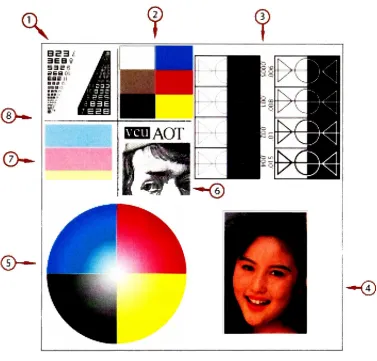
-Figure1:MarkingEngineCharacterizationTarget
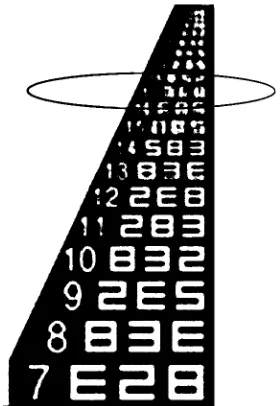
1. RIT Alpha Numeric Textpatch
- Developed
by
FranzSigg
anRITProfessor,
theRITAlpha Numeric Textpatch isincludedtodeterminetheresolution capabilities
ofthemarkingengine,bothas regular and reversetext. Eachline isprogressively
numbered,fromsevento25. This specifictargetwas chosenbecauseofits ease of
use,whichisparticularly beneficialtoaforensic documentexaminer whomay
[image:32.543.96.473.112.473.2]notbe familiarwithtest targets. Theresearchervisuallyinspectedthe textand
determinedatwhichpointthe textbecomesunreadable. Figure 2shows the text
becoming
difficulttoreadatline 15 and notidentifiableby
line 17.! 'IICV,
<SB3
!2EEB
[image:33.542.252.392.144.347.2]10B32
Figure 2: R.I.T. Alpha Numeric Test Patch
2. Paperwhite. Threecolorgray.Black,
C,
MandY- Theseswatches were added
sothat theforensic documentexaminer couldobservethecharacteristicsdifferent markingengines createtoproduce colors.Throughthesecolor
blocks,
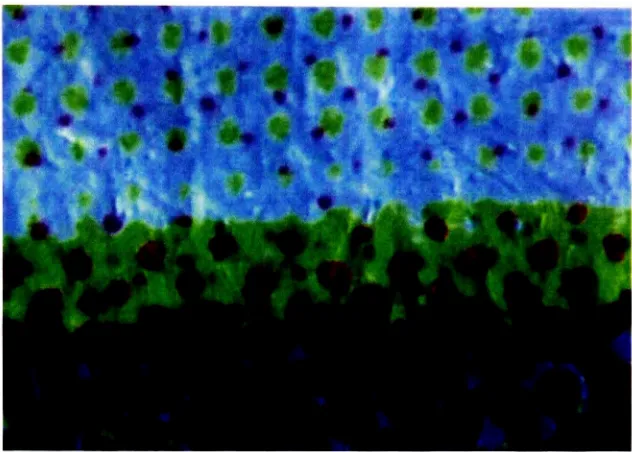
viewers can also observedotshape, size andplacement,allof which areimportant characteristicsto theprint process.Allcolorblockswere examinedto see what colorants are present.Blackwas examinedfor consistencyoftheink layerandbanding.Forexample,Figure3 shows a magnified view of afourcolor offset
sample,which showsthehalftonepattern,dotshape,number of colorants and whichcolorants.Allofthesecharacteristics canbeusedtodeterminea print process.
Figure 3: Four Color Offset
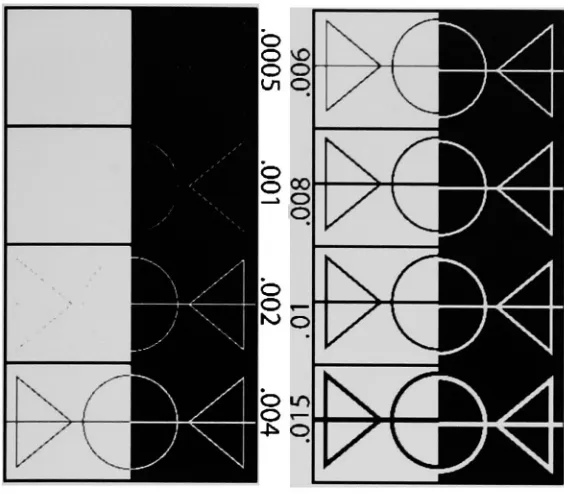
3. PositiveandNegative Microlines- These
areincludedtoobservethecapability
ofthemarkingenginetosustainthinblack lines andthinwhite
lines,
aswell asshow edgequalityand pressdirectionality. Thetargetcontainsblockswithblack
and whitelinesofvaryingsizes anddirections from
0.0005,
0.001, 0.002,
0.004,
0.006, 0.008,
0.01 to0.015inches insize. Throughvisualinspection,
theresearcherdeterminedatwhich pointthe lines disintegrate. Qualitiesof
disintegration includebroken
lines,
poor edgequalityorlackoflines (blackorwhite).Asanexample.Figure 4showsthatlinesare maintained at0.004"but
becomebrokenanddonot printfrom orsmaller.
Figure 4: PositiveandNegative Micro Lines
4. ISO ImageNlA.tiff-Since manyforged
documents,
suchasdriver'slicensesandpassports, contain animage of aperson,this element wasincludedinthe
MECtarget.Eachimagewillbecomparedtoone anotherfromeach print method
forvisualdifferences. Qualitiestobeexaminedincludelevelofdetailmaintained,
blurriness/crispnessofthe
image,
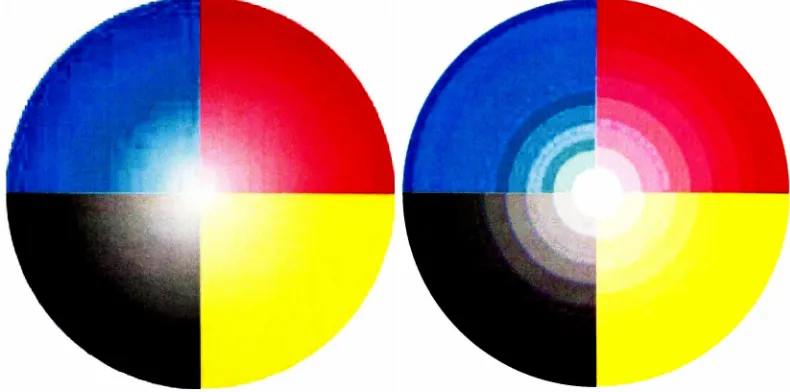
and edge quality.5. Radial Blend
-Thiselement was includedtodeterminethe extentofthemarking
engines
banding
andits abilitytoresolvegradients. Thegradients arecreatedinC,
M,
YandK. Theresearcherobservedfor anybanding;
thisis definedasthepointinthegradientwheretheoutput
device
can nolongermaintainthegradientandinconsistentlyrevertstoasolid.Figures5 & 6showawell-resolvedradial
gradient(figure
6)
versus a radial gradientthatcontainsbanding
(figure6).Figure 5: Radialgradient without
banding
Figure 6: Radialgradient withbanding
6. Serif TextandFine LineDrawing-Theserif
text,
including
theknockouttext,representscommonly foundtexton
frequently
counterfeiteddocuments. The "A"containsboth horizontal anddiagonal
lines,
the"O"containscurvedlinesandthe"T"
has bothverticalandhorizontal lines. Thedetailed line
drawing,
takenfromanintaglioprint,was scanned aslineart at300dpiandis includedtoseethe
markingenginesabilitytoreproducefine lineart,which iscommonly foundon
checks,currency,banknotes and other securedocuments. Theedgesofthe text
andline
drawing
willbeexaminedfor known printingcharacteristics.Forexample,throughvisual
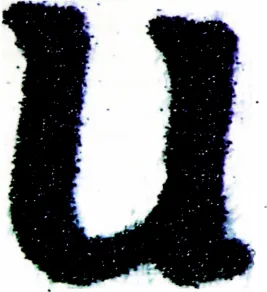
inspection,
it isclearthatFigure 7was producedusingadigitaltoner
technology,
whichis indicatedby
therough edge ofthe text andtheblacktonerparticles present.
Figure 7:Singlecharacter printed withBlack Toner
7. 50%
C,
M andYtones-Thesepatches were added sothattheobserver could
comparethedifferencesin markingengineswhen
they
aredealing
withtones.The 50%tonepatches are alsobetteratrevealingwhetherthemarkingengineis
usinga single coloranttocreatethetone,or multiple colorants. Similarto the
other colorpatches,the50%toneswere observedto seewhatcolorantsare used
toproducethe tonesanddotshape.
8. Microprinting
-Bothvertical and
horizontal
directions areincluded.Textsizesare
0.1mm,
0.2mm,
0.3mmand0.4mm. Microprintingiscommonlyfoundon
documentssuch aschecks,bonds and currency. Typicalmicroprintingfoundon
checks is 0.5pts. Thisfeature determinedthemicroprintingcapabilitiesofthe
markingengine.Thiswasvisuallyinspectedtoobservethepoint at which notext
canberead.In figure
8, 0.1mm,
0.2mmand0.3mm areshown,however,
only0.3mmisreadable,0.2mmandsmallerdoesnot resolve(as indicated
by
theredcircle).
^M^ MM^aI'W>Mili<im)QiWlMrtoiT>rw>amiiftitoiiiicP)i
Figure 8: Micro
Printing
Methodology: SequenceofEvents
The
following
isadescriptionofthesequence of events:1. Throughaconsensusamong Bill
Pope,
Milton Pearsonandthe researcher,itwasdeterminedthat thecurrentMEC targetcouldincludemore elements thatwould
bemeaningfultoaforensic documentexaminer.
1.1 The Fine Line
Drawing,
ISOImage,
andPositiveandNegative Microlineswereadded
by
theresearchertorepresent common elements found infrequently
counterfeited elements.2. Thecurrent samplesused
by
theseminarinclude avariety of processes andmarkingengines. Sincethe targetisbestused whentheobserverisableto
visuallycomparethe
targets,
severalprinting deviceswere chosen.Thespecificprint processes(listedonpages34
-37)
andtechnologiesselected were chosen forthefollowing
reasons.2.1
Popularity
-These technologiesandprocessesarethosecommonly
usedinboth largeandsmall-scaleprint production and are most
likely
tobe encountered
by
examiners inthe field.2.2
Diversity
-Thespecific print characteristics of each oftheseprocesses
vary sufficientlyto enable meaningful comparisonbetweenthem.
2.3
Availability
- Eachofthese technologiesis availablethroughRIT
facilitiestoenable acontrolledand repeatable environmentfortarget
production.
3. Media Selection- Determined
throughresearch and
testing,
100# Titan GlossTextstock was usedasthedefaultstock.This stock was chosenfor its
availability.Threeoftheselectedprinting devicesweredeterminedthrough test
runs tobeincompatiblewiththeTitan Stock. Theseparticulardevicesarethe
Epson
9600,
Fuji PictroproofandtheIris Realist. These printing devicesrequiretheirbrandspecific stockbeused- Fuji Pictroproof Matte
Paper,
Epson PremiumGloss Photo
Paper,
Iris Realist Inkjet Gloss Paper.By
using adefaultstockpaper,variabilityisreduced as much as possible.
4.
Printing
oftheMEC Target followedthefollowing
procedureforeachdevice: 4. 1 Alltheproper supplies were ensuredtobeathand. This includesthesubstrate,press run organizer andPDFtest targetfile.
4.2The Press RunOrganizerwasusedtodocumentthe settings.
4.2. 1 Theoutputdevicewascheckedforproper resolution
and adherencetoSWOP specifications(ortheclose
simulation ofthem).
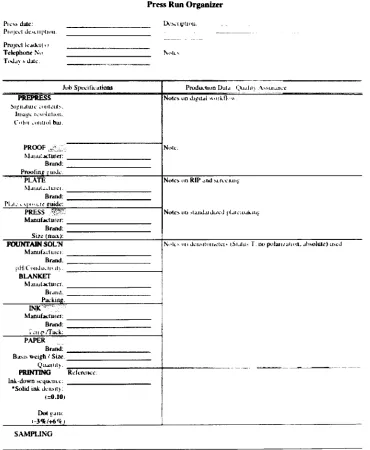
4.2.2 The Press Run Organizerwas usedtodocumentthe
press ran settingsfor repeatability (figure 9). The Press
RunOrganizerisa checklist where specifications ofthe
press,press settings and other relevantinformationcan
bedocumented.
4.2.3
Using
thePress Run Organizerall relevantRIPsettingswerenoted astheseimpactcolor
handling,
screeningandetc.
Picssdale: PlUjLVldocliptRUI.
ProjectU-'-mV-Kvi
Telephone Nu
Tola*s lijic.
Press Run Organizer
LV,vnfc!Unii,
JWIl
Jb SpecLficaricitti PruduLiiuu Duij QualityAiiurance
PREPRESS
Signaturecontents: InanflL' resolution: t'ii'i controlbai:
Note*nnJiciLilwurkll
Note: PROOF Manufacture!; liiii.-. Proofingguide: PLATE Manufacturer
Nu4esimRIPjndscreening
Notesonstandjidizcdplatcrnaking.
Brand:
i'Ll.1^vpusuleeuide.
PRESS
Manufacturer:
Brand: Size (max):
FOUNTAIN SOL \ Manufacturer
N
:l-ki>d*.i_-i'.i"ii.ju. im.iIj*T.unpolarizatiun.absolute)used
B.ji-e. pHiCunductivitv : BLANKET Manufacturer Brand: PiU.klll INK Manufacturer: Brand: linn!' T.i'A. PAPER BtJILll. Bansneieh SLz<.\ Qujiiiit):
PRLNTING Reference:
Ink-dowDsequence:
'Solid ink density:
(0.10)
Dotgain:
SAMPLING
Figure9: The Press Run Organizer
[image:41.542.107.477.124.574.2]5. Thetest targetwasprintedfromaPDFfile using CMYKcolor mode.
5.1 Atotalof36 samples were outputtedfromeachdevice. Thepurposeof
thiswasto ensurethat themarkingengineis operating inaconsistent
and repeatablestate
-furtherdetailscanbe found insection6.2ofthe
methodology.
5.2A listof alldevicesused was created and a number wasbeassignedto
eachdevice. A numbering system was used sothatwhenthe targets
were
labeled,
theobservationgroupwould notbe able toidentify
thedevicesthe targetswere printedfromwithoutevaluatingthem.
5.3 Theprintedtargetswerecollected andlabeledonthebackleft-hand
comer withtheircorrespondingnumberto
identify
theprint processandspecific printermodel.
6. Thetargetswereevaluated.
6. 1 Allsamples werevisuallyevaluatedbasedonthetesttargetevaluation
criteriacontainedinthismethodology.
6.2 Theresults oftheevaluations werethencompared. Elementsofthe
target thatwereonly visuallyevaluated were
"shingled"
(spreading
outthe targets sothata single elementisvisibleand moreeasily
compared) sothat the targetscouldbe visuallycomparedand variation
canbemoreeasilyidentified
(Southworth,
1989). Elementsofthetarget thatarenumericallyquantitativewere subjectedtoa variance of
a population equationtodeterminethestandarddeviation forthat
element.
Any
samplesthatcontain elementsthathadmeasurementsexceedingonestandarddeviation forthatparticular element were
deemedunacceptable.Thepurposeofthisisto ensurethe sample set
was consistent.
7. Developmentofthe
Survey
-The MECtarget survey hadtobeeasyto
understand andtimeefficient. An initial surveywasdevelopedand a pilottestwas
conducted,
however,
itwasfoundtobecomplicated andtimeconsuming.Asecondsurvey,which was moretime efficient,was created.
7. 1 The survey (see
Appendix)
includedeight answerspacesthatcorrespondedtoa numberedtarget.Withineach answerspace,the
observerdeterminedwhich process was usedtoprintthe targetand
howconfident
they
wereintheirdecision basedon a scalefrom 1to
10,
1being
theleastconfident and 10being
themostconfident.They
also answered whichelement(s)ofthe targetthey
feltwasmosthelpfulandleasthelpful. There is also additional space providedfor
comments.
8. Evaluationof mastertargets
by
objective observers.8.1 Selectionoftheobservationgroup- For
thisobservationgroup, 13
participantswere chosentovisuallyevaluatethetarget.
They
werethoseattendingtheForensicDocument Examinersseminar on
November
18th,
2005 atRIT. This groupwas chosenbecausetheMECtargetsmain use willbeforthisseminar as an educationaltooland
thoseattendingtheseminar possessedtheknowledgeneededto
evaluatetheMECtarget.
8.2 Participantswere providedwith pre-packaged envelopescontaining
eightdifferentsamples,a
loupe,
asurvey, acomplimentary RITpenand abriefdescriptionoftheMEC targetsuchasthe onefound inthe
methodology.Notimelimitwassetfor evaluatingthe target.All
results weredocumentedinatableand aPercentAgreementformula
was usedtodetermine ifthe targetisaccurate. Tablesand graphs were
usedtoillustrate theresults and conclusions were writtenbasedonthe
data.
Print Device Specifications
Severaldifferentoutputdeviceswere usedtoprintthe testtarget.Alloutput
devices arelocatedattheRochester Instituteof
Technology,
withinthe SchoolofPrintMediaandthePrintApplications Laboratory. Below isalistofthesedevicesanda short
descriptiongrouped
by
process.Offset
Lithography
HeidelbergSpeedmaster 74- The Speedmaster 74isa6color offset
lithography
sheet-fedpress with a maximum sheet sizeupto20" x29".
Electrophotographic
Nexpress2100- The Nexpress 2100is a
dry
electro-photographic sheet-feddigitalcolorpress. Maximumsheet size availableforthepressis 13.8"x 18.5"andusesDrylnk
Technology
atupto600 dpi. Thepresshasvariabledata printingcapabilities, as well assome inline
finishing
capabilities.Xerox DocuColor 6060
-The Xerox DocuColor 6060runsupto600 dpion a maximum
sheetsizeof12.6" x 19.2."The DocuColoruses colorlasertonerandhasvariabledata
printingcapabilities.
Indigo 3000- The Indigo 3000is
a7color press with a maximum sheet size of12"x 18"
atupto800dpi.The IndigoutilizesLiquid HP
Electroink,
aliquidtoner. Itisalsocapable ofprintingmicro-text,
barcodes,
alphanumeric codes,digitalwatermarks, andiscapable ofusing security inks.
FujiPictroproof- The Fuji Pictroproofcombines a silverhalidephotographic process
with alaser diode exposureto create an
image,
whichisthenthermally
transferred to thesubstrate.Maximum sheet sizefortheFuji Pictroproofis 12.4"
x 18.3" at400dpi.
Inkjet
Iris Realist FX 5015 The Iris Realist FX 5015 isa4-colorcontinuous inkjetprinter
typically
usedtoproofimpositions. This isa web printerthatcan printupto 14" x21"wideat300or600
dpi,
though theprinted piecehas a"perceived"
resolutionofupto
2400dpi.
Epson9600 - Thisis
a6 colorPiezobased inkjetsystemwith a resolution ofup to720
dpi. Itaccepts substratesupto44" wideandcan use sheet or web rolls. Thisis
typically
usedasa colorproofingsystem(acheaper alternativeto theKodak
Approval)
thoughsometimes usedfortheprintingof posters and artwork.
Thermal DyeSublimation
KodakApproval NX- The KodakApproval NX isoften considered a
necessity inthe
digital
halftone-proofing
category.By
usingthermography
ofC,
M,Y,
Kand2 spotcolors, thisprinteris abletoreplicate millions ofcolors,manyspotcolors, as well as
mimicdifferent printingprocesses atupto2540dpi.
The MECtestformswillberunatthe
following
resolutions sothatall samplecharacteristicsandlimitationscanbeaccuratelycompared.Alloutputdevices will runto
SWOP specificationsforcolor.
Offset
Lithography
Heidelberg
Speedmaster 74 - 150lpi;
theresolution oftheplate setteris 2400 dpiDigital Color
Nexpress2100 - 600dpi
Xerox DocuColor 6060- 600 dpi
Indigo3000-812 dpi
FujiPictroproof- 400dpi
Inkjet
Iris Realist FX 5015 - 600dpi
Epson 9600- 720dpi
Thermal DyeSublimation
KodakApproval- 2540
dpi;
200 lpiChapter5
Results
Observer Population Statistics
Itis importanttonotethatnot all observers aredocumentexaminers. Allobservers work
inthefieldoflawenforcement/crimeprevention or are
directly
dealwithprintingprocesses. To betterunderstandtheresults ofthe survey, the
following
is abriefdescriptionoftheobservationgroup:
5 ofthe 13observers describedthemselves asDocument Examiners
3 ofthe 13observers describedthemselvesas aScientistorEngineer
1 ofthe 13 observers described him/herselfasLaw Enforcement Personnel
1 ofthe 13 observers described him/herselfas aFraudAnalyst
3ofthe 13 observers didnotdescribethemselvesas anyoftheabove
Dueto thismix,itcouldbethat theexperience ofthisgroup isvaried,anideawhich will
besupported
by
thefindings fromthesurveyandfurtherdetailedwithinChapter6.Survey
ResultsTable 1 representsthedatacollectedfromthesurvey. The correct answerforeachsample
islistedatthe top. Inparenthesisto theright of each answeristhe confidencelevel
marked
by
theobserver.Thisis donetoshowanycorrelationbetweenanswers andconfidencelevels. Thebottomrowinthe tablerepresentshowmanyoftheobservers
wereabletocorrectly
identify
thesample. Thelastcolumn representsthenumber ofsampleseach observer was abletoaccurately
identify
out ofthe totalnumber ofsamples;a percentageis also giventorepresentthis data.Answersrepresented
by
anNA(NotApplicable),
indicatethat theobserverdidnot answerthatquestion. Thisisinterpretedastheobserver
being
unabletodeterminetheprocess ofthe sample.6
& o * 2 H
I
8* g2 3
2 "
a-Hi rT q a. < o .0 3 T S-^ to to fif re s. o. g-O 3
5
If
T3 . S cr> 5-p w o ft 1 > o rr 3 rp a 3 a. 3 3" IT) CO ro n < w ro o y o3 S^
Q. b. 3 a* v; to ,_? 3 3" o. _ o o cr cr n> a 5 3 rt
Observer
8Observer
9Observer
10Observer
11Observer
12Observer
13Percent
Accuracy
bySample
OOOOOOOIsslsls
If
2232222 20 r. $ 5 a a$ SlOVUIAUUH *- 3 a w
Offset
Offset
Jet/L.To
Offset
NA (NOffset
Offset
Offset
Offset
Dye
Sut
Offset
Offset
/13
(76
**0"^^-^ % -i*rpW I vf-hJ \0<^^CO^CC-COCoM ,i
IV W '_www
5
P-* P" 1 GO ^ _ f ~1
J5* 3 S" ! 3 OB1-J O O^O;
* l/l '/ -*^
l/> 2 oo&ssr. a sssjjs
5
5E~~"\
-. ' ^^-v^J^|
^
Dye
NAInk
Inkjet
Inkiet
Liquid
3/13
(p ff= 0 ?l
z za os. -iHV ^
1-on
"I-1!
K o2o3
0 ^^^coX ~" CO Ul OH
ii o a
|
r-B
1
= ^fllr- ?3"3553'
z zyra m aB? ti
,>>'^NN * rt
s"s
"s
Ul^1-w vH
Due
Silver
ToSliver
Liquid
6/13
IV) UlUiH
"I O -1 -1 < i
Sub
ft(NA
Halld
ner
CHalld
Tone
(46.1
szz~iw;s-S w*- CD y. <j< avoH
" "" '"
-ury
lorTone
Dry
ToDry
ToInkjet
PDyeS
Dry
To2/13
(1JC3DDJiB_ I
"
-1-tHa- ^
0 0 0 0 h nlri j b d ^ ^ 0 b Z"d 3 ID ( It D 3|nr|
, r*
~* * ~* (It r*^M ! *";ni00 ui --^|r*
-vj-- w_ COCO j
in r;
-w -fl
*S <SSODDC
?o??||5
J
ui ^.q. fS rt> <8 fl 3 IOHU1UIUI/
r" sl^occcc - 3 3
r ft|rX Sir c ^B*!
W =r(B ^ cr cr cro
5 5 -^B
W-^W
~"
~
>c- H
' 1 _ f Ul!
Off
Off
Ink
Dye
Off
NA1/13
zgfiQglotf3 ~$l -it^rCfDrliH^^j
z"
m "
"in5. BO 01-j
coBo-#
---VI
\f
1 1 1 1 1 1 1- uiVtl"^"^nP if
Sui#uiuiinl|S
S.ni**.% **-*S. co> a00 co co a
a ar--^~~ H^*UHHU
Ul3illui ui v/i0)
' ************ w*-****Sq^*
Survey
Results
90.00%
80.00%
70.00%
60.00%
Percent
Accurate
50.00%
40.00%
30.00%
20.00%
10.00%
0.00%
=
t
MlHllllllll
Accuracy
1
87.5|
37.5[12.51
0%j
12.51
25%|37.51
12.51
12.51
37.5[
12.51
25/o|
12.5 10 11 12 13Observers
Figure10:
Survey
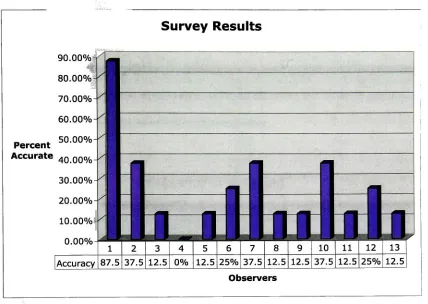
ResultsThe precedinggraph(Figure
10)
illustratesthebreakdownoftheresultsby
observer.Asthegraph
"Survey
Results"
shows,Observer 1 was abletocorrectly
identify
7ofthe8samples(87.5%accuracy).Observer
2, 7,
and 10wereabletocorrectlyidentify
3ofthe8samples(37.5% accuracy).Observers 6and12were ableto
identify
2ofthe8samples(25%accuracy).Observers
3, 5, 8, 9,
1 1 and13 wereabletocorrectlyidentify
1ofthe8samples(12.5%accuracy).
Finally
Observer4was unabletoidentify
anyofthesamplescorrectly
(0%
accuracy). [image:51.543.62.490.57.361.2]Frequency
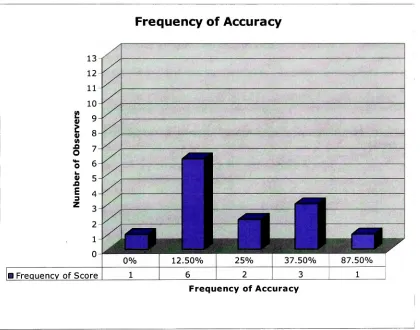
oftheResultsThe
frequency
chart representstherange of accuracies andhowfrequently
they
appeared.This allowstheresearchertoseparatetestresults and observers intocommon groupsto
allowtheobservation ofanyrelationshipsthatmayexist.
Frequency
ofAccuracy
FrequencyofAccuracy
Figure11:FrequencyofScores
As Figure 11
illustrates,
mostobserverswere 12.5%accurate;6 ofthe 13observers(46.15%). Theout
laying
accuraciesarethehighest(87.50%)
andlowest(0%)
accuracies,withboth
having
afrequency
of one. Because onlyoneobserver possesseda [image:52.543.65.485.218.548.2]accuracyhighenoughtoconsiderthe MECtargetasuccess, theMECtargetis considered
unsuccessful. This couldbe becauseof several reasonsthatwillbe described further in
Chapter6.
ConfidenceLevel
Eachobserver was notonlyaskedto
identify
theprocess, butalsotorate on a scale of1to 10(1
being
thelowest,
10being
thehighest)
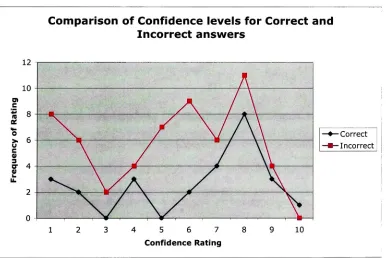
theirconfidencelevel intheirdecision.Theconfidencelevel frequenciesfor bothcorrect andincorrectanswers are shownto
observeanypattern. Asshowninthe graphbelow (figure
12),
otherthana slightdeviationat confidencelevel
6,
bothcorrect andincorrectanswers showed a similarpattern of confidencelevels.
Comparison of Confidence levels for Correctand
Incorrect answers
4 5 6 7
[image:53.543.79.465.362.620.2]ConfidenceRating
Figure 12: Comparison ofConfidenceLevels
Breakdown ofresults
by
SampleFrequency
ofCorrect
Answersby
Sample
[image:54.543.71.498.92.445.2]Samples
Figure 13:Frequencyof Correct Answers
by
SampleFigure 13 illustrates the
frequency
of correctanswersby
sample. Itis clearthatSample 1(Offset
Lithography/Heidelberg
Speedmaster)
wascorrectly identifiedby
amajorityofthe observers(10outof13 or76.92%). Sample 5 (Silver Halide/Fuji
Pictroproof)
wascorrectly identified
by
nearly halfoftheobservers (6out of10or46.15%). Theremainingsampleswere identified
by
lessthan23%ofthe Observationgroup.Inordertobetterunderstandtheresults of samples2-3 and
6-8,
thefollowing
comparisontablewas created(Table 2). Inthis table the
frequency
ofincorrectanswers isshown. Eachnumberrepresentsthenumberoftimes thatparticularprocesswas chosen
by
the observation group.The grayblockswith an"x"representthecorrect answer.Frequency
ofIncorrect Answersby
SampleTable2:
Frequency
ofIncorrectAnswersby
SampleSample1
-Offset
Sample 2 -DryToner
Sample 3 -DryToner
Sample 4
-LiquidToner
Sample 5
-Silver Halide
Sample6 -InkjetCont.
Sample7
-Inkjet Piezo
Sample 8 -DyeSub
Inkjet Cont 0 3 2 1 0 . . ..X.- 0 0
Inkjet Piezo 0 1 1 2 0 1 X 1
DryToner 0 ^ X 1 0 7 1 0
Liquid Toner 1 0 2 X 1 1 1 0
Dye Sub 1 0 0 0 1 1 6 .-Jlk..
-Silver Halide 0 0 0 0 X 0 3 0
Offset X 5 0 3 1 0 1 8
Toner 0 0 0 0 2 1 0 0
Inkjet 1 1 1 0 0 0 0 1
NA 1 2 3 4 2 0 0 2
Incorrectanswers forsamples 1 through5 show a greaterdealofindecisiveness
amongthe observationgroup.Noone process was chosen with a greatfrequency.
Samples 6 through8 (greaterthan
46%)
showthatalargerpopulationoftheobservationgroupchose aspecificincorrectanswer(tallies are
highlighted)
out ofthe totalnumber ofincorrectanswers.
[image:55.542.76.494.193.379.2]MostandLeastHelpful Elements asDescribed
by
theObserverEach surveyincludeda sectionfortheobservertowritethemost andleast helpful
elements ofthe target. The
following
tablerepresentsthe datareceivedfromtheobservation group.The columntitled"Most"representsthe elements, which were most
helpfulinmakingtheir
decision;
thecolumntitled"Least"represents theelements,whichwereleasthelpful in makingtheirdecision. Thefinalcolumn representsthescorethe
observersreceivedoverallonthesurvey. Thisis donetoshowany relationship between
theelements theObserverusedtomaketheirdecisionandtheiroverallscore.
Table3: Comparison ofMostandLeast Helpful ElementstoOverall Score
Most Helpful Least Helpful Score
Observer 1 Micro-printing, Micro-lines,ISOImage,Radial Blend NA 87.50%
Observer 2 NA NA 37.50%
Observer 3 usedall aspects ofthe target NA 12.50%
Observer 4 NA NA 0%
Observer 5 usedall aspects ofthetarget NA 12.50%
Observer 6 Micro-lines,ISO Image NA 25%
Observer 7 Micro-printing,RadialBlend, ISO Image Micro-lines,Text Patch 37.50%
Observer 8 Blackcolorblock,Micro-lines,seriftext ISO 12.50%
Observer 9 Lines NA 12.50%
Observer 10 ISO Image NA 37.50%
Observer 1 1 NA NA 12.50%
Observer 12 ISOImage,Color blocks Micro-lines 25%
Observer 13 NA NA 12.50%
Almost 70% oftheobservers identifiedwhat
they
foundtobemosthelpfulaboutthe targetincontrasttoonly23%thatidentifiedwhat
they
foundleasthelpful. Ofthetop
threehighestscores oftheobservationgroup (scoresequal or greaterthan
37.5%)
that [image:56.543.74.484.323.557.2]identifieda mosthelpful element, eachidentifiedtheISO Imageas
being
themosthelpful. SecondtotheISO
Image,
observers alsofoundthemicroprintingandmicro-linesthemost ofhelpful.The lackofresponsesforthe leasthelpfulelementdoesnot
allowfor anyconclusionsregardingthatcategory.
Chapter 6
Conclusions and
Summary
Thereare severalconclusionsthatcanbemadebasedonthedataobtainedfromthe
survey:
Thetargetis ineffective.Visualexamination ofthe targetdoesnot allowthe
viewertoreadily
identify
theprint process usedtoproduceit.Theelements withinthe MECtargetdonot offerthedefinitive evidencenecessarytohelp
theobservervisuallyidentify
theprint processes.EventhoughObserver 1 was abletoaccuratelyidentify
theprocesses andalsothepressesthe targetwasprintedon, thevastmajorityof participants could not. Itcouldbethat theothermembers oftheObservation group donothave extensiveknowledgeofdigitalprocesses anddevicesasdoesObserver 1.
The overall experience oftheusergroup isvaried. Scoresoftheobservergroup rangedbetweenthosewho were ableto
identify
nearlyall processescorrectlyto thosewhohad
difficulty identifying
anyprocesses correctly.Therange of answersillustratesthat the experience leveloftheobserversisvaried. Theobserver who was unableto correctly
identify
anyofthesamples couldhave littleexperience,whereastheobserverthatwascorrectlyableto
identify
7ofthe8 samples couldhave a greatdealofexperience.The levelofexperience oftheobservationgroup didnot matchupto thelevel
of experience neededtousetheMECtarget.
Theobservationgrouphas
difficulty identifying
between digitalprocesses. Thedatashowsthatthemajorityofobserverswere ableto correctly
identify
Sample 1 asOffset
Lithography,
however,
mostobserverswere unabletoidentify
severaldifferentdigitaldevices.Thiscouldbeinpartduetodeficienciesinthe targetas well as
deficienciesintheobserver'straining.A lackof
training
or experience in digitaldevicesmayaccountforthelow score results. Observer 1 shows thatwith
training
andexperience,one can
identify
between digitalprocesses. Itisalso possiblethat theselection ofprintingdevicesandthekno