This is a repository copy of
Supporting the collection patient reported outcome measures
in the National Clinical Audits for assessing costeffectiveness Work Package 1. What
patient reported outcome measures should be used in the 13 health conditions specified in
the 2013/14 National Clinical Audit programme? APPENDIX C, INFLAMMATORY BOWEL
DISEASE
.
White Rose Research Online URL for this paper:
http://eprints.whiterose.ac.uk/106541/
Version: Published Version
Monograph:
Ara, R., Duarte, A., Harnan, S. et al. (4 more authors) (2015) Supporting the collection
patient reported outcome measures in the National Clinical Audits for assessing
costeffectiveness Work Package 1. What patient reported outcome measures should be
used in the 13 health conditions specified in the 2013/14 National Clinical Audit
programme? APPENDIX C, INFLAMMATORY BOWEL DISEASE. Report. Policy Research
Unit in Economic Evaluation of Health and Care Interventions (EEPRU) . Policy Research
Unit in Economic Evaluation of Health and Care Interventions
[email protected] Reuse
Unless indicated otherwise, fulltext items are protected by copyright with all rights reserved. The copyright exception in section 29 of the Copyright, Designs and Patents Act 1988 allows the making of a single copy solely for the purpose of non-commercial research or private study within the limits of fair dealing. The publisher or other rights-holder may allow further reproduction and re-use of this version - refer to the White Rose Research Online record for this item. Where records identify the publisher as the copyright holder, users can verify any specific terms of use on the publisher’s website.
Takedown
If you consider content in White Rose Research Online to be in breach of UK law, please notify us by
Economic Evaluation of Health
and Social Care Interventions
Policy Research Unit
RESEARCH REPORT
Supporting the routine collection of patient reported
outcome measures
in the National Clinical Audits for assessing
cost-effectiveness
Work Package 1
What patient reported outcome measures should be used in
the 13 health conditions specified in the 2013/14 National
Clinical Audit programme?
APPENDIX C, I
NFLAMMATORY
BOWEL DISEASE
Authors: Roberta Ara, Ana Duarte, Sue Harnan, Jo Leaviss,
Steve Palmer, Mark Sculpher, John Brazier
Correspondence to:
Roberta Ara
, HEDS, ScHARR,
University of Sheffield, Regent Court, 30 Regent Street,
Sheffield, S1 4DA
. Email [email protected]
RR003
0
The Policy Research Unit in Economic Evaluation of Health and Care interventions is funded by the Department of Health Policy Research Programme. It is a collaboration between researchers from the University of Sheffield and the University of York.
The Department of Health's Policy Research Unit in Economic Evaluation of Health and Care Interventions is a 7 year programme of work that started in January 2011. The unit is led by Professor John Brazier (Director, University of Sheffield) and Professor Mark Sculpher (Deputy Director, University of York) with the aim of assisting policy makers in the Department of Health to improve the allocation of resources in health and social care.
INDEX
1 BACKGROUND 2 OVERVIEW 3 METHOD
3.1 Psychometric properties (WP1.1) 3.2 Alternative measures (WP1.2)
3.3 Evidence required for economic evaluations (WP1.3) 4 RESULTS FOR INFLAMMATORY BOWEL DISEASE
4.1 Evidence of appropriateness of EQ-5D in IBD 4.2 Alternative measures in IBD
4.3 Evidence for economic evaluations in IBD 4.4 Recommendations for IBD
5 SUMMARY 6 REFERENCES 7 APPENDIX
TABLES
Table 1 Summary of evidence on PROMs for IBD Table 2 Summary of existing models used in IBD TAs
Table 3 Recommendations and associated future research for IBD
Table 4 Summary of evidence currently available for recommended measure(s)
FIGURES
Figure 1 Modelling approach used in CD HTA
Acronym Definition
AE Adverse events ANOVA Analysis of variance CAI Clinical activity index
CD C
CDAI C disease activity index
CDI C Short form
CGQL Cleveland Global Quality of Life CHQ Child Health Questionnaire
CHQ-CF87 Child Health Questionnaire child form 87 CHQ-PF50 Child Health Questionnaire Parent form 50 CHU-9D Child Health Utility 9D
CLIQ C L I Q DH Department of Health EMA European Medicines Agency
EEPRU Policy Research Unit in Economic Evaluation of Health and Care Interventions EQ-5D (-3L) EuroQol 5 dimensions
EQ-5D-5L EuroQol-5D-5 levels EQ-5D-Y EuroQol-5D youth version ES Effect size
FR Future research GI Gastrointestinal
HRQoL Health related quality of life HS Health states
HTA Health technology assessment HUI2 Health Utility Index mark 2 IBD Inflammatory bowel disease
IBDQ-9 Inflammatory bowel disease questionnaire-9 IBDQ-32 Inflammatory bowel disease questionnaire-32
IBDQOL Inflammatory bowel disease quality of life questionnaire IBDSI Inflammatory bowel disease stress index
ICC Intraclass correlation coefficient
ICF World Health Organization's International Classification of Functioning, Disability and Health
MTA Multiple technology assessment N or n Number
NCA National Clinical Audit NHP Nottingham Health Profile NHS National Health Service
NICE National Institute for Health and Care Excellence PCDAI P C
PedsQL Paediatric quality of life inventory PedsQL
PR Potential recommendations PRO2 Patient reported outcome 2 PRO3 Patient reported outcome 3
PROM(s) patient reported outcome measure(s) QALY Quality adjusted life year
R&D Research and development
RFIPC Rating Form of IBD Patient Concerns RCT(s) Randomised controlled trial(s) SF-36 Short form 36
SIBDQ Short Inflammatory Bowel Disease Questionnaire SR Self report
SRM Standardised response mean STA Single technology assessment TA(s) Technology Appraisal(s) TAG Technology Assessment group TTO Time trade off
UC Ulcerative colitis UK United Kingdom
UK-IBD-Q IBD-Control, quality of life VAS Visual analogue scale WP Work package
1. BACKGROUND
The Policy Research Unit in Economic Evaluation of Health and Care Interventions (EEPRU) was approached by Jason Cox (Research and Development (R&D) Division) to prepare a programme of research to support the appropriateness of, and use of, patient reported outcome measures (PROMs) collected for the National Clinical Audit (NCA). The EEPRU programme was informed by a R&D template prepared by Simon Bennett, Steve Fairman and Keith Willett at National Health Service (NHS) England.
The purpose of introducing PROMs into the NCA programme is to be able to 1) compare performance between providers and commissioners in the NHS, 2) compare the cost-effectiveness of alternative providers in delivering the specific services (i.e. linking outcomes and resource use), and 3) assess the cost-effectiveness of alternative interventions and other changes in the NHS. The intention is to introduce PROMs across a range of conditions over the next 3 years commencing with 13 conditions in the 2014/15 NCA programme.
The agreed research programme consists of 3 concurrent work packages (WP) as described in the document submitted to the Department of Health (DH) (8th November 2013). The current document provides details on the objectives, methodology and results for Work Package 1 (WP1): to determine what PROMS should be used in the 13 health conditions specified in the 2014/15 NCA programme.
2. OVERVIEW
WP1 is split into three separate components consisting of:
WP1.1 To examine whether the EuroQol-5D (EQ-5D) is appropriate in the 13 health conditions specified in the 2013/14 NCA programme.
WP1.2 To identify what measure could be used when the EQ-5D is not appropriate in the 13 health conditions, taking into account that the proposed measure would be used to generate preference-based utility measures (either directly through existing preference-based weights, or indirectly through existing mapping functions suitable for the proposed measure).
WP1.3 To identify the evidence required to address questions of cost-effectiveness using the NCA data.
This Appendix provides the detailed results for the condition i bowel disease (IBD) and should be read in conjunction with both the main report and the methods/search strategy
appendices.
3. METHOD
The full detailed methodology used is provided in Appendix A and B, including the search strategy, selection criteria for studies included, and data extraction etc. In summary, a review of the literature was undertaken to assess the appropriateness of the EQ-5D in terms of classic psychometric criteria (WP1.1); where the EQ-5D was not considered appropriate, additional searches were undertaken to identify alternative measures (WP1.2); and finally, existing health technology appriasials were reviewed and data requirements were compared with variables currently collected in the IBD audit (WP1.3).
3.1 Psychometric properties (WP1.1)
Assessments reported in the included studies were categorised according to the following definitions:
Acceptability
Data relating to how acceptable the measure was to the person completing it, expressed as the proportion of completed surveys, or the proportion of missing data.
Reliability
There are two main definitions for reliability, a) the degree to which a measure reproduces the same results in an unchanged population and b) the degree to which a measure reproduces the same results when completed by different assessors (e.g. patient and proxy report). In both cases, reliability can be assessed by re-testing, and calculating the correlations or difference between tests. In case a) the comparison may be between the same populations separated by time, where no change in health state was observed (as compared to using an alternative condition specific or generic measure). In case b) the measure may be completed by multiple people (proxies) on the
W tcome
Construct validity
This is an assessment of how well an instrument measures what it intends to measure. Two main definitions are used in this review.
a) Known group validity, where estimates for groups that are known to differ in a concept of interest
are compared either qualitatively or statistically. The known groups may be defined using other measures, according to clinical categorisation.
b) Convergent validity assesses the extent to which a measure correlates with other measures of the
same or similar concepts. Correlation coefficients were considered low if <0.3, moderate if between 0.3 and 0.5, and strong when >0.5.
Responsiveness
a) Change over time. This is an assessment of whether measurements using the instrument can
detect a change over time, where a change is expected. This may be before and after an intervention, or through progression of a disease. Evidence was considered to be good where a t-test was significant, though weaker evidence to support responsiveness was considered where there was a change in the expected direction, but was not statistically significant or not tested. Effect size (ES) and standardised response mean (SRM) were also acceptable assessments of responsiveness. b) Ceiling and floor effects were also considered to be indicators of responsiveness. Assessments of
ceiling effects include the proportion of patients who score full health within a group of patients with known health detriments. A ceiling or floor effect can affect the sensitivity of the measure in detecting changes over time in patients at the extremes of the measure (for example those with severe disease activity and those with just minor symptoms of the condition).
3.2 Alternative measures (WP1.2)
As the IBD audit includes paediatrics and the EQ-5D is not designed for use in this population, alternative instruments were reviewed. This entailed both a review of existing guidelines, and a review of primary studies relating to the four prespecified paediatric measures (EQ-5D-Y, Child Health Utility 9D (CHU-9D), Health Utility Index mark 2 (HUI2), Paediatric quality of life inventory (PedsQL)(1-4)), as detailed in section 3.2, Appendix A.
3.3 Evidence required for economic evaluations (WP1.3)
suffice to address questions of cost-effectiveness, and to identify any gaps in the evidence that would be required to compare providers, or the cost-effectiveness of interventions or policies.
4. RESULTS FOR INFLAMMATORY BOWEL DISEASE
4.1 Evidence of appropriateness of EQ-5D in Inflammatory Bowel Disease (IBD) (WP1.1)
As no existing review was known to the authors (see Appendix A), and no relevant systematic review was identified by Longworth et al. 2014a, (5)a search was performed to identify primary studies reporting the results of a psychometric assessment of the EQ-5D in patients with IBD (specifically, C CD) or ulcerative colitis (UC)). The systematic review of primary studies is reported below. All associated Tables are provided in the Appendix.
4.1.1 Results of searches for primary psychometric studies in IBD
Searches for primary studies identified 89 unique titles of potential relevance. 75 studies were excluded upon examination of their title and abstract. The full text of 14 titles was obtained, of which two met the criteria for inclusion in this review. The excluded articles are listed in Appendix B with reasons for exclusion.
4.1.2 Studies included in the systematic review of primary studies for IBD
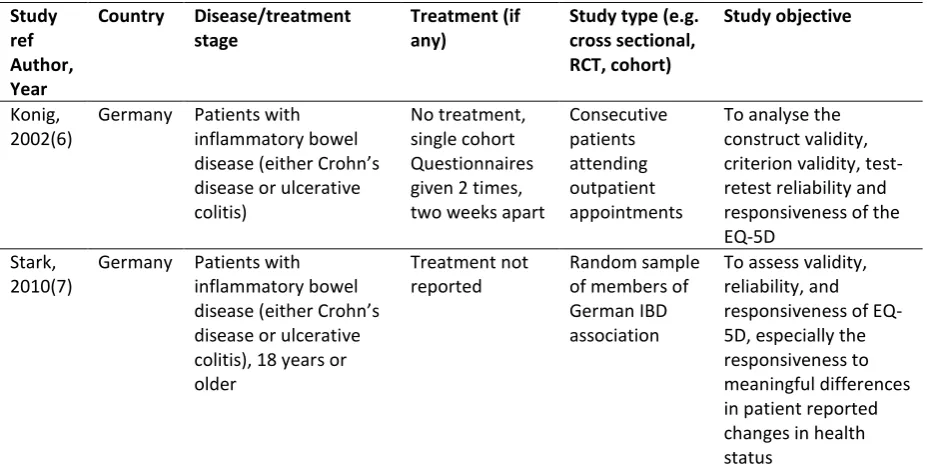
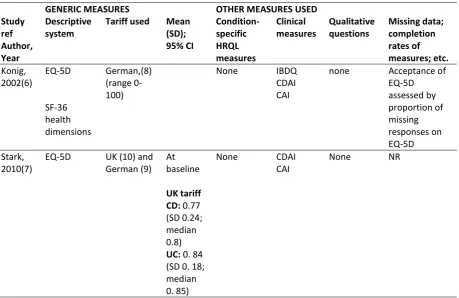
Two studies assessed the psychometric properties of the EQ-5D in IBD.(22;23) Both studies were performed in Germany and both recruited a mix of adult patients (N=152;(6) N=502(7)) with either CD (80.9%,(6) 53.8%(7)) or UC (19.1%,(6) 46.2%(7)). Konig et al. used the van der Schulenburg (1998) German EQ-5D tariff (range: 0 100) which is not comparable with the United Kingdom (UK) preference-based EQ-5D index.(8) Consequently only the results of the analyses involving the EQ-5D health dimensions (and not the EQ-5D index) are reported below.(6) Stark et al. used a more recent German EQ-5D tariff, and the standard UK EQ-5D tariff.(9;10) The results for analyses conducted on the EQ-5D health dimensions and UK EQ-5D index scores are reported below for this study.
Stark et al. compared the EQ-5D data with the inflammatory bowel disease questionnaire (IBDQ
C CDAI
et al. compared the EQ-5D with short form -36 (SF-36) health dimensions (physical functioning, role limitations, social functioning, pain, mental health; all range 0-100), the CDAI and the clinical activity index (CAI).(12;13) The latter two instruments are validated clinical measures in IBD and were used to sub-group patients by severity of symptoms or disease activity and changes over time.(12;13) Konig et al. used the following sub-groups in their analyses: inpatients (n=31) versus outpatients (n=113); patients with active disease (n=58) versus patients in remission (n=94); patients who reported no change in health status over time (n=52).(6) It should be noted that some of the sample sizes of the sub-groups were relatively small, and results from these comparisons may not be robust.
The cohorts in the two studies were similar in terms of age at diagnosis
old), duration of disease, number in remission and number with active disease (Table A2, Appendix). Small numbers of patients were missing from some analyses in both studies.
4.1.3 Psychometric properties reported in the primary studies for IBD
All evidence related to adults (
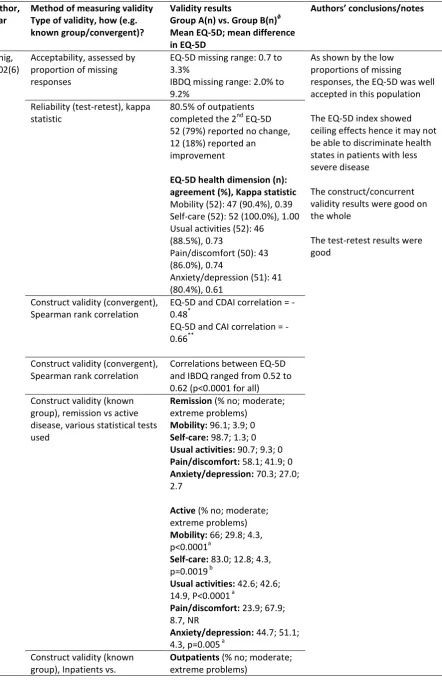
Acceptability: Konig et al. examined the acceptability of the EQ-5D by assessing the proportion of missing responses and found it to be well accepted with less than 3.5% of EQ-5D responses missing (compared to 9% for the IBDQ)(Table A4, Appendix).(6) Stark et al. did not assess acceptability as the sample analysed only included respondents who completed the EQ-5D (N=502).(7)
Reliability: Both studies reported results for test/retest reliability for patients who reported no change in health status over time (Table A4, Appendix). The proportion of agreement in outpatients who reported no change (n=52/66) over an average period of 19.5 days ranged from 80.4% for the health dimension anxiety/discomfort (kappa=0.61, p-values not reported) to 100% for the health dimension self-care (kappa=1.0).(6) Similar results were reported for sub-groups of patients (CD n=195, UC n=166) who reported no change at follow-up in the second study with substantial or almost perfect agreement for all five health dimensions (kappa>0.60, p-values not reported).(7)
the number of inpatients was small, possibly resulting in underpowering.(6) When comparing patients with UC who were in remission with those with active disease, the mean EQ-5D preference based scores and the responses for the health dimensions were significantly better for those in remission (p<0.001), with the exception of the responses for the dimension self-care (p=0.20).(7) Comparing sub-groups, the responses for all five health dimensions were significantly better for those in remission compared to those with active disease. For example, 96.1% of patients in remission indicated they had no problem with mobility compared to 66.0% of patients with active disease, p<0.0001).(6)
Construct validity (convergent): Correlation between the EQ-5D preference-based index and the activity indices were good (Spearman rank: r=-0.75 for CDAI, r=-0.65 for CAI, p<0.0001) (Appendix).(7) Assessing the median responses on the SF-36 and IBDQ dimensions with the median responses on comparable EQ-5D health dimensions (for example physical functioning on the SF-36 was compared with mobility on the EQ-5D, emotional functioning on the IBDQ was compared with anxiety/depression on the EQ-5D), with the exception of the EQ-5D dimension self-care, the results were ordered appropriately according to the responses on the EQ-5D dimensions and results were significantly different between the groups (p<0.0001) (Table A4, Appendix).(6) Stark did not assess this property.(7)
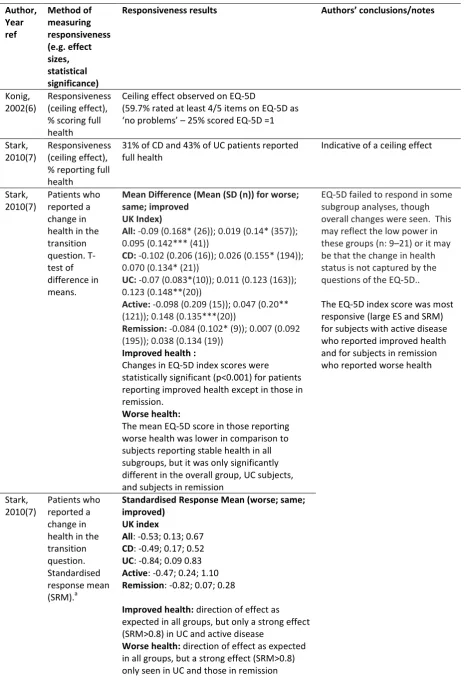
Responsiveness (change over time): When assessing responsiveness to change in health status over time (Table A5, Appendix), statistically significant changes in the expected direction were observed for the EQ-5D preference-based index (change in mean EQ-5D: -0.09, p<0.05 for worse health (n=26); 0.095, p<0.0001 for improved health (n=41)).(7) Stark et al. also performed a number of sub-group analyses, including analysing patients with CD, UC, those with active disease, or those who were in remission separately. In these sub-group analyses, the direction of effect was as expected, but not all sub-group analyses were statistically significant. The results for all sub-groups who reported an improvement in health were statistically significant (except for the remission sub-group (n=19)), though again the small numbers may cause underpowering. Of the results for the sub-groups who reported a deterioration in health, the analyses for patients in remission (n=9), and those with UC (n=16) were statistically significant (p<0.05).
sizes were in the expected direction, but only the results for patients in remission (n=9, SRM=-0.82) and those with UC (n=10, SRM=-0.84) showed a strong effect.
Responsiveness (ceiling effect): Both studies assessed potential ceiling effects on the EQ-5D (Table A5, Appendix). Some evidence of a ceiling effect was reported with 19.4% and 30.1% of inpatients and outpatients respectively scoring no problems on any of the five health dimensions,(6) and 43% and 31% for patients with UC or CD respectively scoring full health on the EQ-5D preference-based index (EQ-5D=1).(7) These results indicate the EQ-5D may not be able to discriminate between different health states in patients with less severe disease or who are in remission, and may be less responsive to improvements over time in these groups. However, it was noted in both studies that the distribution of patients across disease severity was skewed towards those who were less severely affected by the conditions; for example the median IBDQ total score was 174 (observed range 66-224) in one study,(6) and just 0.4% and 2.2% of patients with CD and UC respectively were reported as having severe disease activity in the second study.(7) As such, the studies may be biased towards overestimating a ceiling effect in a routine NHS IBD population.
4.1.4 Conclusion of appropriateness of EQ-5D in IBD
In conclusion, the evidence supporting the appropriateness of the EQ-5D in adults with IBD is good but limited and there is a lack of evidence relating to how appropriate the EQ-5D is for surgical health states (Table 1). Evidence is required in paediatrics, and in patients with more severe disease, both of which are relevant for the IBD NCA population (see Section 3.2).
4.2 Alternative measures in IBD (WP1.2)
The IBD NCA includes paediatrics as well as adults and the EQ-5D adult version is not recommended for use in paediatrics. There is a youth version of the EQ-5D called the EQ-5D-Y, which is based on a minor modification of the wording of the items in the original measure. However, this is a relatively new version and is not widely used as yet. Consequently, searches were conducted to identify alternative measures for use in paediatrics and adults. This comprised a search for existing guidelines and recommendations (section 4.2.1) and a separate search for primary studies relating to EQ-5D-Y, CHU-9D, HUI2, and PedsQL (section 4.2.2).(1-4)
4.2.1 Alternative measures for IBD
Eleven documents were identified by the initial searches as described in Section 3 and Appendix A. Four documents were from the Royal College of Paediatrics and Child Health, describing various results from the IBD NCA reviewed below (Section 4.3), and thus were excluded from further analysis.(14-17) A further five documents related to irritable bowel syndrome and were excluded,(18-22) leaving two reports of relevance to this analysis.(23;24) One was a research guideline from the European Medicines Agency (EMA), produced by an expert panel with a stakeholder consultation period.(23) The report related to CD, and contained a very brief section on paediatrics where the paediatric version of the CDAI (the PCDAI) was recommended as a measurement of efficacy.(23) The final and most recent report (2014) provided a synopsis of the literature available for a particular pharmaceutical intervention in severe, active UC. This document listed several clinical and HRQoL measures used in randomised controlled trials (RCTs) in adults (no paediatric evidence) with UC but no attempt was made to evaluate these.(24)
The first source of evidence is a systematic literature review which compared the contents of IBD specific PROMs relative to the World Health Organization's International Classification of Functioning, Disability and Health (ICF).(26) Four databases (Medline®, EMBASE, PsycINFO, CINAHL and CENTRAL by MC) were searched (terms: C U C D I
B D , and MESH terms (if available)). Articles were limited to those written in English which were published between 1999 and 2009. 46 studies were selected from the initial hits identified (n=9728). These studies used eight IBD-specific PROMs including: Cleveland Global Quality of Life (Faszio Score) (CGQL),(28) Inflammatory Bowel Disease Quality of Life Questionnaire (IBDQOL),(29) Inflammatory bowel disease questionnaire (IBDQ-32),(30) Inflammatory bowel disease stress index (IBDSI),(31) Inflammatory Bowel Disease Questionnaire - short form (IBDQ-9),(32;33) Rating Form of IBD Patient Concerns (RFIPC),(34) Short Inflammatory Bowel Disease Questionnaire (SIBDQ),(35)and Work Productivity and Activity Impairment: Crohn's Disease (WPAI: CD).(36) The IBDQ-32,(30) was used in 60% (36/46) of the studies with the next most common being IBDQOL (6/46), followed by the RFIPC (5/46) and SIBDQ (5/46). The measures were not reviewed in any detail other than their ability to capture ICF and they cannot currently be used to generate utility values.
The second source of evidence is a conference abstract which presented an exploratory analysis examining whether items on the CDAI (pain, stool frequency, general well-being, recorded over a 7 day period) diary card (recorded over 7 days) could be adapted to be used as a PROM in adults with
C (25) Two potential measures were explored: the Patient Reported Outcome-2 (PRO2) score (range: 0-35) which used abdominal pain and stool frequency; and the Patient Reported Outcome-3 (PRO3) score (range: 0-50) which used abdominal pain, stool frequency and general well-being. While only summary results are currently in the public domain, these are promising. Estimates of effects were similar in the PROMs and the full CDAI scores (range: 0-400) across various sub-groups in an RCT. The PRO3 appeared to have a slightly higher correlation with the end of study CDAI score (r=0.89 vs. r=0.76), and change in scores (r=0.71 vs. 0.51) than the PRO2.
will be linked to the current IBD audit. The priorities identified by the authors D
agreed clinical and patient-reported outcome measures that will support ongoing monitoring of the quality, safety and cost- IBD The authors also referred to two PROMs-related projects (discussed below) which were ongoing at the time of publication.(38;39)
The first project involved the IBD-Control©, a PROM which was developed to capture outcome data in adult patients with IBD in a busy clinical setting.(38) The objective was to inform face-to-face consultations, or telephone/virtual clinics. Using a recall period of the previous two weeks, and 13 questions, the measure captures treatment concerns and the physical, emotional and social impact of IBD. Responses to eight of the questions provide an overall summary score (IBD-Control-8 range: 0-16 where 0=worse control). The measure has been validated, using the EQ-5D, the IBD-Control, quality of life questionnaire (UK-IBD-Q), and several clinical measures, in a study including adults with CD (n=160) and UC (n=139). Bodger et al. concluded the IBD-Control was a rapid (mean completion time =1 min 15 secs), reliable (Intraclass correlation coefficient (ICC) test-retest using 2
UK-IBD-Q and EQ-5D (r =0.52-0.86), analysis of variance (ANOVA) for detecting difference in remission, mild, moderate or severe disease (p<0.001)), and sensitive (ES: 0.76-1.44) measure.(38)
The second project involved the C L I Q CLIQ , designed to capture the
C the first PROM specifically designed for adult patients with CD.(39) The CLIQ consists of 27 items relating to quality of life and 9 relating to activity limitations; producing two corresponding unidimensional scales (range: 0-25 with 25 being the most severely affected). In a validation survey (n=273) using the Nottingham Health Profile (NHP) measure as a comparator, internal consistency was reported to be good and both CLIQ scales were shown to distinguish between self-reported severity of CD, general-health and work status. While both CLIQ scales correlated with the NHP (p<0.01), the relationship was strongest between the CLIQ QoL and the NHP Emotional reaction scores (r=0.80); and the CLIQ activity limitation and the NHP physical mobility scores (r=0.65).
4.2.2 Measures for paediatrics with IBD
Results of searches: The searches identified 49 unique references. Full papers of 10 studies identified as being potentially relevant when the abstract and title were assessed against the inclusion criteria were obtained. An additional manuscript was identified from the references lists of these 10 papers,(40) Of the 11 papers, one did not present the psychometric properties of any measure,(41) and two did not report sufficient details for the IBD subgroup (Table A6, Appendix).(42;43) A total of eight articles, representing seven studies, satisfied the inclusion criteria and were included in this review.(40;44-50)
Results of review: Across the seven included studies, the psychometric properties of both IBD-specific measures and generic measures were reported (Appendix). No studies were identified which presented evidence relating to the use of the CHU-9D, HUI2, or EQ5D-Y in paediatrics with IBD.
Abdovic et al. assessed the reliability and validity of the IMPACT-III questionnaire in Croatian children with IBD.(44) While primarily examining the translated version of the IMPACT-III questionnaire, as
P QL
settings. Duffy 2011, described several HRQoL measures used in children with either juvenile idiopathic arthritis or IBD but provided limited information on the psychometric properties of the instruments.(45) Marcus et al. examined fatigue and HRQoL (IMPACT-III, PedsQLTM) in children (aged 10-17 years) with a clinical diagnosis of IBD (CD=52, UC=13) compared with healthy controls (n=157).(46) Perrin et al. evaluated the IMPACT Questionnaire against the PedsQL v4 in children (aged 8-18 years) with either UC (n=59) or CD (n=161), using the P C
index (PCDAI) to categorise severity.(47) Upton assessed the UK translation of the PedsQLTM v4 in a relatively large sample of children (n=1,399) with IBD and their parents (n=970).(48) Ogden used a sample of children with IBD (n=97) to assess the psychometric properties of the IMPACT-III (UK), using the Child Health Questionnaire (CHQ) as the comparator.(40) Finally, Varni et al. and Lane et al. (conference abstract only) presented results from the same study which described a de-novo gastrointestinal (GI) module for the PedsQL. The module was compared with the PedsQLTM v4 and was assessed in children (aged 3-18 years) with either CD (n=192) or UC (n=67).(49;50)
IBD-specific measures and generic HRQoL measures. It should be noted that not all these measures are PROMs, and the clinician reported measures (generally used as a comparator for the HRQoL measures, or to define severity-based subgroups) are included for completion only.
IBD-specific measures used in paediatrics with IBD
Two IBD-specific measures that had been used in paediatrics with IBD were identified: the IMPACT questionnaire (available as versions I, II and III)(51-53) and the P C D A Index (PCDAI).(54)
The IMPACT Questionnaire is a self-report measure developed for children (9 years and over) with IBD.(51;52) The IMPACT-III version (an update of versions I and II) includes 35 questions covering six domains: bowel symptoms, systemic symptoms, social functioning, body image, treatment/interventions, and emotional functioning. The responses (each question has a five-point Likert scale response) are used to generate a total score (range 35 to 175), where higher values indicate a better quality of life.(45) The IMPACT-III does not have a preference-based tariff and thus cannot be used to generate quality adjusted life years (QALYs) in economic evalutions without a validated relationship with a preference-based measure. Three studies included in this review reported data relating to the psychometric properties of IMPACT III.(40;44;45) Two studies included in this review reported data relating to the psychometric properties of IMPACT II but as this version is superceded by IMPACT III, the evidence is not reported here.(45;47)
Acceptability: Abdovic reported acceptability was good with all patients (n=104) completing the IMPACT-III questionnaire compared to 94% of patients completing the PedsQLTM v4.(44) Similarly, 93/94 of children in the Ogden study believed the questions were easy to understand, and 87/94 indicated, if requested, they would complete the IMPACT-III again.(40)
Construct validity (known group): Significant differences across sub-groups categorised by severity (severe vs. moderate vs. inactive/mild symptoms) groups were observed for the embarrassment scale (63.7* vs. 81.0 vs. 81.2, *p<0.05), symptom scale (45.0** vs. 64.2* vs. 80.6, *p<0.05, **p<0.01), and the energy scale (46.4* vs. 62.1* vs. 77.7, *p<0.05) in the validation study.(40) While the IMPACT-III was shown to distinguish between those with active (n=45) and inactive (n=59) disease, the difference in mean scores when comparing moderate/severe activity (n=8) with mild activity (n=37) was not statistically significant (p>0.05) in a second study.(44) However, these sample sizes were extremely small.
Construct validity (convergent): Using comparable domains on the IMPACT-III and the Child Health Questionnaire (CHQ), convergent validity was confirmed in the validation study with significant correlations (p<0.001) for all comparisons presented (e.g. energy compared with physical function, r=0.63, p<0.001).(40) With the exception of the associations between the IMPACT-III domain worry
about stool and the PedsQLTM
the correlations between the IMPACT-III and PedsQL domains were moderate to strong (r>0.4, p<0.001 for all).(44) Strong relationships were reported between the total IMPACT-III scores and self-reported PedsQLTM v4 scores (r=0.74, p<0.001), the PedsQLTM fatigue scores (r=0.63, p<0.001), and the PCDAI scores (r=-0.52, p<0.0001).(46)
Evidence on generic- measures used in paediatrics with IBD
Amongst the included studies, data relating to the psychometric properties of three generic measures (with three variations of one measure) were identified. These were: c depression inventory short-form (CDI); child health questionnaire (CHQ); the paediatric quality of life inventory (PedsQL); The PedsQL Multidimensional Fatigue Scale (PedsQL MFS); and the PedsQL gastrointestinal (PedsQL GI) module.
C D I short-form (CDI)(57) was used in Marcus et al., and referred to in
Duffy 2011.(45;46) The CDI is a self-report screening measure for symptoms of depression in children aged 7-17 years. Items relate to thoughts and behaviours over the previous two weeks and total scores range from 36-100 with scores greater than 63 being indicative of clinically significant symptoms of depression. There was no significant difference in mean scores (44.8 vs. 43.9) when comparing patients with IBD (n=70) and healthy controls (n=157), or in the percentage of respondents with clinically significant depressive symptoms (1.4% vs. 1.3%). However, an inverse relationship was shown between the CDI short-form scores and the PedsQL MFS, indicating a direct relationship between fatigue and symptoms of depression.(46) The CDI does not measure all aspects of HRQoL and cannot be used to generate QALYs in economic evalutions.
Child Health Questionnaire (CHQ)(58) used in Ogden
O L CHQ
health status, and health outcomes in children (4-19 years) and is a widely used and accepted measure. The parent/proxy (CHQ-PF50)(59) is the most widely used version while the Child Health Questionnaire child form 87 (CHQ-CF87) is completed by adolescents (age 10-19 years).(60) The questionnaire includes 87 items covering the following domains: behaviour, bodily pain, general health, mental health, physical functioning, parent impact-time, parent impact-emotional,
The Paediatric Quality of Life Inventory (PedsQL)(49)
Data relating to the psychometric properties of PedsQL were reported in Abdovic et al., Duffy et al., Marcus et al., Perrin et al, and Upton et al. The PedsQL, a generic measure of HRQoL, has been reported as being one of the most thoroughly developed measures available for paediatrics.(60) It takes 4 minutes to complete and is either self-completed (5-18 years), or completed by a parent/caregiver (2-18 years), and comes in 3 forms designed for the patients age (5-7, 8-12, 13-18 years). The measure (version 4) covers 23 items describing four domains: emotional (5 items), social (5 items), physical (8 items), and school (5 items). Items are answered on a five-point Likert scale (0 The scores from these are used to derive summary scores in physical health (8 items) and psychosocial health (15 items), and an overall total score. These are all standardised (0-100) where higher scores indicate better HRQoL. The PedsQL does not have a preference-based tariff which could be used to generate QALYs in economic evaluations, and the main researcher and originator of the measure has no immediate plans to conduct research in this area.(49) [personal communication, Varni June 2014]
Acceptability: Acceptance was very good in one study (CD=74, UC=30) with just 5.8% (6/104) of
P QL
IMPACT III questionnaire.(44)
Reliability: I P QL (44)
(46), and summary score (44) .(46) Internal reliability of the UK version of the PedsQL sub-scales was reported to exceed 0.70 for self-report (total n=1,399, IBD n=76) and proxy-reports.(total n=970, IBD n=87).(48)
Construct validity (convergent): Comparing domains on the PedsQL with similar domains on the
IMPACT III
(47) The PedsQL was also able to detect CD activity, as evidenced by the relationships with the PCDAI scores (total score: r=0.52 p<0.0001; physical health: r=0.47 p<0.001); psychosocial health: r=0.51 p<0.0001; emotional functioning: r=0.46 p<0.001; school functioning: r=0.53 p<0.0001).(46)
Construct validity (known group): The total PedsQL score was statistically significantly lower in patients with IBD (n=70), compared with healthy controls (n=157) (76.69 vs. 85.93, p<0.0001) and the ESs for the PedsQL 4.0 dimensions were reported to range from small (emotional functioning, ES=0.32; social functioning, ES=0.30) to large (total score, ES=0.89; physical health, ES=1.50; school functioning, ES=1.13).(45;46) Similarly, the mean scores on the PedsQL total score, and the sub-scales were lower in children with IBD (n=76) than in healthy controls (n=1032) for both self-report and proxy-report.(48) With the exception of the self-report social functioning scale, all differences were statistically significant (p<0.05).(48)
The PedsQL Multidimensional Fatigue Scale,(51) was used in Marcus et al., and referred to in Duffy et al.(45;46)
The PedsQL GI module used in Varni 2014
There are several disease-specific modules of the PedsQL (for asthma, arthritis, cancer, cardiac disease, diabetes) which are designed to be used in conjunction with the core modules. A recent publication provides initial results from a module designed for use in gastrointestinal (GI) conditions including IBD (CD and UC). In development since 2008, this module has both parent-proxy (ages 2-4, 5-7, 8-12, 13-18 years) and self-report versions (ages 5-7, 8-12, 13-18 years). The module includes 74 items describing 24 different scales relating to GI-specific symptoms: stomach pain and hurt (6 items), stomach discomfort when eating (5 items), food and drink limits (6 items), trouble swallowing (3 items), heart burn and reflux (4 items), nausea and vomiting (4 items), gas and bloating (7 items), constipation (14 items), blood in poop (2 items), diarrhoea (7 items), worry about going poop (5 items), worry about stomach aches (2 items), medicines (4 items), and communication (5 items).(49) As with the core modules, the scales are transformed onto 0-100 scale with higher scores indicating fewer problems and less severe symptoms.(49) This measure is considered to be a candidate measure for the NCA when used in conjunction with the core PedsQL measure.
A relatively large sample (n=584 children aged 5 18 years, n=682 parents of children aged 2 18 years) of patients with either functional gastrointestinal disorders (FGIDs) or organic gastrointestinal diseases (including CD and UC) were used to assess the measurement properties of the PedsQL GI module.
Acceptability: The module was well accepted with just 1.69% and 1.84% of item responses missing on the child self-report and parent proxy-reports respectively.
Reliability: The ICC statistics between the self-report and parent proxy-report showed agreement for the vast majority of PedsQL GI scales, with exceptions being communication (ICC=0.37) and trouble swallowing (ICC=0.49). Test-retest reliability was not tested.
Responsiveness: Although there was no evidence of floor effects, ceiling effects (less GI symptoms) were observed on a number of the individual scales (e.g. >60% scored the , which may infer insensitivity to improvement in paediatrics with less severe symptoms. Responsiveness to changes over time was not tested.
Summary and conclusion of review of literature on paediatrics with IBD
[image:24.595.65.542.433.662.2]While primary research in this area appears to be growing with evidence of development of several PROMs targeted at paediatrics with IBD, the evidence identified which could be used to compare PROMs in this population was limited. The searches, although limited in scope due to the time constraints of the project, did not identify any evidence which could be used to generate QALYs directly from PROMs in this population. The most likely target measures for inclusion in the IBD NCA are the IMPACT-III and the PedsQLTM v4. Based on the evidence reviewed, the target age group, and alternative responder versions, the PedsQLTM is recommended over IMPACT-III measure. However, research is required to generate an associated preference-based tariff for the PedsQLTM (or a mapping function to one of the alternative preference-based generic measures) which could be used to generate utility values for use in cost-effectiveness evaluations.
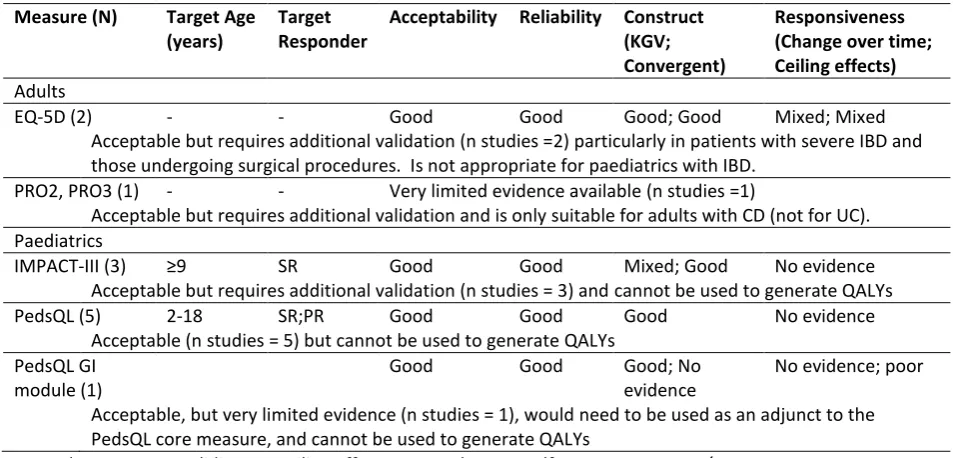
Table 1: Summary of evidence on PROMs for IBD
Measure (N) Target Age (years)
Target Responder
Acceptability Reliability Construct (KGV; Convergent)
Responsiveness (Change over time; Ceiling effects)
Adults
EQ-5D (2) - - Good Good Good; Good Mixed; Mixed
Acceptable but requires additional validation (n studies =2) particularly in patients with severe IBD and those undergoing surgical procedures. Is not appropriate for paediatrics with IBD.
PRO2, PRO3 (1) - - Very limited evidence available (n studies =1)
Acceptable but requires additional validation and is only suitable for adults with CD (not for UC). Paediatrics
IMPACT-III (3) SR Good Good Mixed; Good No evidence
Acceptable but requires additional validation (n studies = 3) and cannot be used to generate QALYs
PedsQL (5) 2-18 SR;PR Good Good Good No evidence
Acceptable (n studies = 5) but cannot be used to generate QALYs PedsQL GI
module (1)
Good Good Good; No
evidence
No evidence; poor
Acceptable, but very limited evidence (n studies = 1), would need to be used as an adjunct to the PedsQL core measure, and cannot be used to generate QALYs
4.3 Evidence foreconomic evaluations in IBD (WP1.3)
4.3.1 Cost-effectiveness modelling approach used in recent HTAs in IBD
Three technology appraisals (TAs) relating to IBD were identified from the searches. One was superseded by a more recent publication,(61) leaving one multiple technology assessment (MTA),(62) and one single technology assessment (STA) (Table 2).(63) The MTA compared several pharmaceutical interventions for the treatment of moderate to severe CD or fistulising CD in both adult and paediatric populations.(62) The STA compared surgery (colectomy) with rescue therapy (standard care or alternative pharmaceutical interventions) for avoidance or delay of surgery and symptom free remission in hospitalised patients with acute exacerbation of UC.(61) Both of these interventions are reflective of those provided to patients in the IBD NCA which gathers information from secondary care settings.
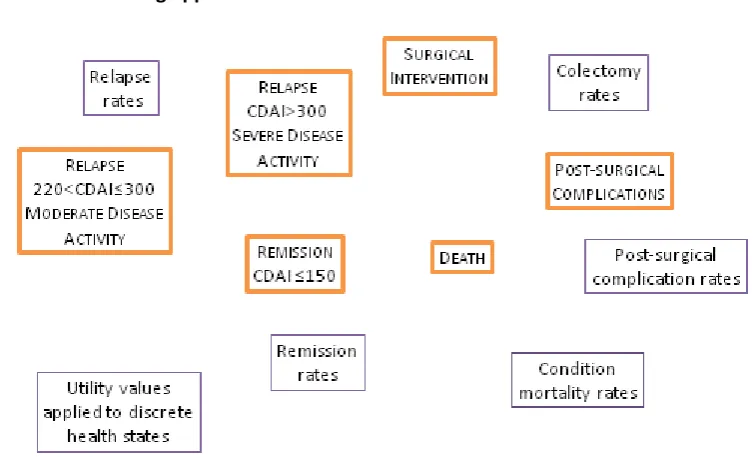
The MTA used a Markov model with discrete health states defined by remission and surgery (Table 2, Figure 1), with both clinical severity and remission informed by the CDAI (e.g. CDAI<150: quiescent disease or remission; 220<CDAI<300: moderately active disease; CDAI>300: severe disease).(64) The STA used an initial decision tree for the clinical trial data and extrapolated beyond the trial horizon using a Markov model.(61) The clinical pathway was represented by discrete health states (e.g. achieved remission, failed treatment, colectomy, post-surgery complications etc). Response was defined as: a clinic-activity score <10 on two consecutive days and a drop of at least three points (N.B. no additional details or reference was provided for the clinical-activity score). Health state transitions for remission, relapse and post-surgical complications for both TAs were derived from RCT data. Although adverse events for anti-TNF agents are a potential problem, these were not modelled explicitly, but were incorporated into withdrawal from the therapies. Prevalence and changes in concomitant medications such as corticosteroids were sourced from clinical studies.
Figure 1: Modelling approach used in CD HTA
Both studies quality adjusted survival by assigning mean utility values to the discrete health states. For CD, published utility values elicited using time trade-off (TTO) methods were initially used.(65) The utilities used in the paediatric assessment, (62) and the surgical health states in both TAs were based on adult values and assumptions respectively due to the absence of more suitable data.
Table 2: Summary of existing models used in IBD TAs
Model method, clinical effect Method used to model utilities
MTA (TA187): Crohn's disease - infliximab (review) and adalimumab (review of TA40); 2010 TAG Markov model
Four discrete health states: remission , relapse (severe: CDAI>300; moderate: 220<CDAI<300), surgery, post-surgery remission , death Effectiveness: intervention specific rates for remission/relapse
Source: RCTs used for clinical effect
Utility: non-preference values obtained using TTO (65); mean values assigned to discrete HS
Source: published literature (adults), assumptions
AEs: not specifically modelled
STA (TA163): Ulcerative colitis (acute exacerbations) - infliximab; 2008 Decision tree followed by Markov model
Four discrete health states: remission, active ulcerative colitis, surgical (colectomy) remission, surgical complications
Effectiveness: individual intervention rates for colectomy, remission, surgical complications Source: RCTs used for clinical effect
Utility: EQ-5D; mean values assigned to discrete HS
Source: survey of patients with ulcerative colitis
AEs: assumed the disutility associated with post-surgery complications were equivalent to the utility of active ulcerative colitis
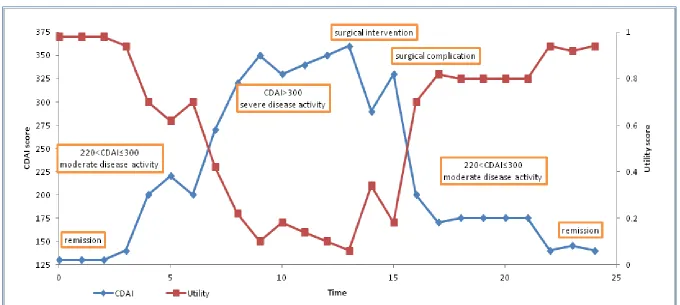
[image:26.595.69.523.465.687.2]Figure 2: Alternative approach describing utilities by proxy measure (CDAI in CD)
In summary, the following evidence would be required to compare providers or the cost-effectiveness of interventions for IBD:
Condition severity (repeatedly measured over time using CDAI for CD, or CAI for UC)
Surgical rates (type of intervention, success rate, post-surgical complication, length of stay)
Pharmaceutical interventions (type of intervention, concomitant medications, remission rates, relapse rates, adverse events)
Utility values (collected alongside condition severity scores and surgical interventions)
Death rates (IBD related, all cause)
The majority of this evidence would need to be linked through timings of collection.
4.3.2 Fields collected in the IBD NCA
The objective of the UK IBD NCA is to improve the quality and safety of care delivered in secondary care for patients (any age including paediatrics) with IBD throughout the UK. The biennial audit collects information on processes and outcomes relating to both inpatient and outpatient services for IBD from each hospital participating in the audit. Different levels of information are collected on each of three sub-categories: CD, UC, IBD unspecified, depending on the particular round of the audit. For example, in the fourth round, the Inpatient, and Organisational audits were only completed for patients (up to a maximum of 501 patients per hospital per year) with UC. To be eligible for inclusion, the patients (of any age) had to have been admitted for treatment or surgery for UC, and had to have remained in hospital for longer than 24 hours. Patients were not eligible for inclusion in the audit if the primary reason for admission was not treatment of UC, or they had a day case procedure (e.g. infusion, endoscopy or day surgery), or they were discharged within 24 hours of admission. The clinical information is collected via three mandatory questionnaires (depending on audit round) completed by NHS staff: Inpatient audit, Organisational audit, and Biologic audit2. There is also a postal patient questionnaire of inpatient experience which includes individual patient unique identifiers and is completed following discharge by either the patient or their parent/carer (for paediatrics).
1
Multiple admissions for same person are treated as independent for the audit. Hence a total maximum of 50 entries may have less than 50 individual patients (multiple admissions linked via the system generated identifier)
2
The Inpatient Care Audit is completed for individual patients and covers areas such as patient demographs, admission and mortality, the extent (or severity) of the condition/symptoms and any comorbidities, medical and surgical interventions, discharge arrangements, and any outpatient care prior to admission (Appendix). The Organisational audit is completed once for the Trust/hospital and provides total numbers and organisation information in the following areas: patient and IBD staff demographs, patient experience and involvement in the IBD service, clinical quality (direct and extended IBD team, available access to specialists and diagnostic services, MDT processes, surgery,
involvement, and education provision and support (Appendix). The Biologic audit is completed for each patient on anti-TNF therapy and contains information on: patient demographs, IBD disease details, initial anti-TNF therapy, current anti-TNF therapy including dose and continued use etc, treatment selection, reviews of treatment, any adverse reactions to the therapies, and a disease severity score (severe, moderate, mild). The self-completed patient questionnaire, which includes
the EQ-5D questionnaire,
services provided by the hospital and background information such as the reason for hospital admittance (elective, scheduled), the type of ward(s) they stayed on, toiletry facilities, hygiene, dietary requirements and standard of food received, the clinicians and nurses involved in providing care, their personal care and treatments, levels of pain, operations and procedures, and information on medications provided during hospitalisation and on discharge (Appendix).
4.3.3 Comparing fields in IBD NCA with variables used in existing HTAs
Based on the existing HTA models, the key clinical information required to inform a standard economic evaluation comparing interventions (either anti-TNF agents, or surgical procedures) in IBD in the secondary care setting would be: condition severity, therapy regimens, the associated remission, relapse and withdrawal rates, the rates and types of surgical interventions and complications, and preference-based utility values. With the exception of the utility data, in the existing TAs the evidence required was sourced from clinical trial data. While the current IBD audit collects some information on the majority of these areas for the individual patients and for the hospitals taking part, there are some obvious omissions and one of the key issues is the timing of the data collection.
rates. However, it not clear if there is sufficient information to adjust for case-mix (for example severity of condition, described using a standardised clinical measure) which could affect surgical success rates. The mandatory biologic audit would provide some of the information require to compare these pharmaceutical interventions (for example withdrawal rates and the reason for discontinuation together with the dates of these), but it is not clear if all data needed is collected (for example remission or relapse rates and associated dates), and again some validated measure of severity of condition, such as the CDAI, would be required to use these data in an economic model.
As mentioned earlier, the EQ-5D is collected in the patient questionnaire. However, this instrument
A P‘OM
indicator of disease severity in the questionnaire, it will not be possible to link these responses to health states defined within an economic model such as remission, relapse or treatment related adverse events. In addition, as the evidence is collected post discharge, the patients will not provide responses relating to surgery or surgical complications. It may be possible to use a published statistical relationship to predict utility values from the reported CDAI scores for patients with CD.(62) While the CDAI is currently collected in the IBD audit, the timing of collection of the EQ-5D and CDAI differ, consequently the evidence will be of limited value for informing the utility values required for an economic evaluation. For these data to be useful for economic modelling purposes, they need to be collected at the same time, particularly as IBD is characterised by periods of and remission.
4.4 Recommendations for IBD
Table 3 summarises the recommendations and associated future research for IBD. In summary, the
EQ-5D appears to be appropriate in adults with IBD, and the current IBD audit collects much of the
information required to conduct economic evaluations. However there are caveats associated with
these conclusions which require consideration. The PedsQL appears to be the most appropriate
measure for paediatrics, but there are limitations with the usefulness of this measure for economic
evaluations. The issues and corresponding potential recommendations (PR) and areas for future
research (FR) are discussed below. All suggested future research areas are indicative and would
require a discussion and detailed proposal if required.
The conclusion that the EQ-5D is appropriate in adults was informed by just two studies involving
patients with either CD or UC, and only one of the studies assessed the EQ-5D UK preference-based
index. The evidence used in the TAs indicated that there was a dearth of robust EQ-5D evidence in
this population, particularly in adults at the more severe end of the disease spectrum, in paediatrics,
and in patients undergoing surgical interventions related to their condition. EQ-5D data collected in
the current IBD patient questionnaire could greatly enhance the evidence base in this area if it could
be linked in some way to clinical severity (see PR.4 below). This would reduce uncertainty in future
economic evaluations used to inform policy decisions in the UK and in particular, would enable
comparisons of biologics as used in routine clinical practice.
The evidence suggested there may be a ceiling effect in the EQ-5D in adults with less severe disease. However, these patients are unlikely to be among those hospitalized for treatment of their IBD condition. The inclusion of the new five level tool (EQ-5D-5L) could potentially reduce the observed ceiling effects,(70) once the preference-based weights have been confirmed. However, the
psychometric properties of this questionnaire have not been assessed in patients with IBD and this
would require additional research (PR.1, FR.1). This would involve the concurrent collection of a
measure against which the EQ-5D could be assessed, together with additional information such as
patient demographs, recent surgical procedures and outcomes, current medications etc.
The IBD NCA includes patients of all ages (including paediatrics) while the EQ-5D is specifically
targeted at adults (over age 18 years). The results of the literature review for paediatrics suggests
the PedsQLTM is the most appropriate measure for inclusion in the NCA, augmented with the
PedsQLTM GI module once validated (PR.2). However, there is no existing method to generate
generate an associated preference-based measure would require collaboration with the developers
of the PedsQLTM. This could be directly through preference-weights for the PedsQLTM, or indirectly
using a mapping function from the PedsQLTM to one of the alternative paediatric preference-based
measures. This is worth considering given that the PedsQLTM has different versions for different age
groups and also has both patient report and proxy-report versions. Alternatively, the inclusion of a
validated preference-based measure specifically designed for paediatrics (such as the CHU-9D or
HUI2 for younger children and the EQ-5D-Y for adolescents)(1-3) is an option which might be
considered in the interim to ensure that the NCA data can be used to inform economic evaluations
(PR.3). Again, the psychometric properties of the measures included would need to be assessed in
this population (FR.3).
As mentioned previously, a review of the latest TA conducted by the National Institute for Health
and Care excellence (NICE) D “ U that the use of a mechanism to map
from condition severity to preference-based utility measures could potentially improve the
methodology (as described in Figure 2) and reduce the uncertainty in the results generated from CD
cost-effectiveness models.(62) There is at least one published function which could be used to map
between the CDAI and the EQ-5D-3L, suitable for adults with CD, but no known functions for UC or
paediatrics.(66) This methodology would require concurrent collection of the EQ-5D and the clinical
measure (e.g. the CDAI and the PCDAI for CD, and equivalent measures for UC) (PR.4). An
alternative would be to identify a suitable PROM for inclusion in the patient questionnaire. As
discussed earlier, the PRO2 or PRO3, which could potentially be used within a cost-effectiveness
model, might be suitable for CD, but no known equivalents are available for either UC or paediatrics.
For this evidence to be used in economic modelling, research would be required to generate
mapping functions between the clinical and preference-based measures in adults and in paediatrics
separately for patients with CD and patients with UC (FR.5).
The IBD audit collects a wealth of information on the clinical status of patients admitted to hospital
for treatment of their condition, and the associated interventions and care received whilst in
hospital and on discharge. However, it is not clear if there is sufficient detailed mandatory
information on variables such as response to treatments, relapse and clinical activity, to inform all
parameters required for an economic model. Additional mandatory fields to capture this
information would considerably increase the flexibility of secondary use of the data (PR.6). Formal
detailed recommendations of which fields to include would require additional detailed inspection of
Finally it is recommended that the proposed links between the IBD audit and the new IBD register
(see Section 4.3.3) are utilised to make full use of the clinical and PROM data that will be available
[image:34.595.63.523.191.551.2](PR.7).
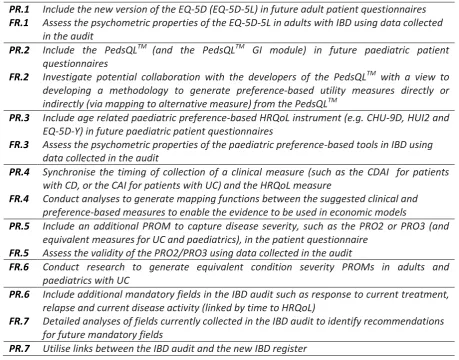
Table 3: Recommendations and associated future research for IBD
PR.1 Include the new version of the EQ-5D (EQ-5D-5L) in future adult patient questionnaires
FR.1 Assess the psychometric properties of the EQ-5D-5L in adults with IBD using data collected
in the audit
PR.2 Include the PedsQLTM (and the PedsQLTM GI module) in future paediatric patient
questionnaires
FR.2 Investigate potential collaboration with the developers of the PedsQLTM with a view to
developing a methodology to generate preference-based utility measures directly or
indirectly (via mapping to alternative measure) from the PedsQLTM
PR.3 Include age related paediatric preference-based HRQoL instrument (e.g. CHU-9D, HUI2 and
EQ-5D-Y) in future paediatric patient questionnaires
FR.3 Assess the psychometric properties of the paediatric preference-based tools in IBD using
data collected in the audit
PR.4 Synchronise the timing of collection of a clinical measure (such as the CDAI for patients
with CD, or the CAI for patients with UC) and the HRQoL measure
FR.4 Conduct analyses to generate mapping functions between the suggested clinical and
preference-based measures to enable the evidence to be used in economic models
PR.5 Include an additional PROM to capture disease severity, such as the PRO2 or PRO3 (and
equivalent measures for UC and paediatrics), in the patient questionnaire FR.5 Assess the validity of the PRO2/PRO3 using data collected in the audit
FR.6 Conduct research to generate equivalent condition severity PROMs in adults and
paediatrics with UC
PR.6 Include additional mandatory fields in the IBD audit such as response to current treatment,
relapse and current disease activity (linked by time to HRQoL)
FR.7 Detailed analyses of fields currently collected in the IBD audit to identify recommendations
for future mandatory fields
5. SUMMARY
5.1 Summary of evidence used to inform the conclusions for WP1.1 and WP1.2
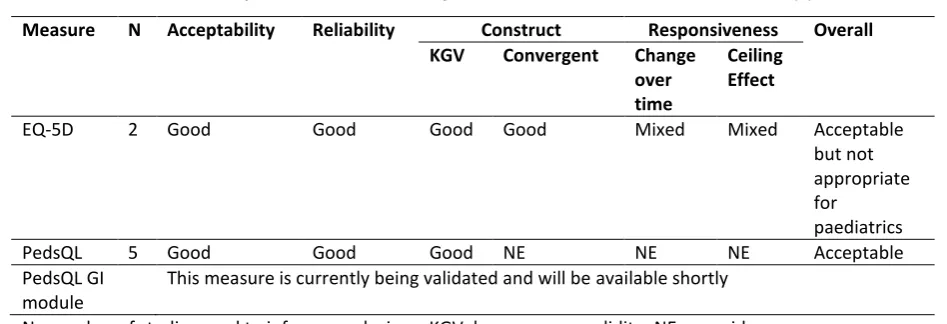
In summary, a review of primary studies (n=2) provides evidence of acceptability, reliability, and
known group/convergent validity for the EQ-5D in adults with IBD (Table 4). However the evidence
on the responsiveness of the EQ-5D is mixed with some ceiling effects and potential insensitivity to
changes over time reported. While the EQ-5D is considered to be acceptable, additional validation is
required particularly in patients with severe IBD and those undergoing surgical procedures. A review
of evidence of PROMs for paediatrics provides evidence of acceptability, reliability and known
group/convergent validity for the PedsQLTM (5 studies) in paediatrics with IBD (Table 4). The
PedsQLTM does not currently have an associated preference-base tariff, but it has both self-report
and parent/carer versions and covers the full age spectrum for paediatrics (2-18 years). Additional
[image:35.595.61.535.346.508.2]preference-based measures are also recommended for use in paediatrics with IBD.
Table 4: Summary of evidence currently available for recommended measure(s)
Measure N Acceptability Reliability Construct Responsiveness Overall KGV Convergent Change
over time
Ceiling Effect
EQ-5D 2 Good Good Good Good Mixed Mixed Acceptable
but not appropriate for
paediatrics
PedsQL 5 Good Good Good NE NE NE Acceptable
PedsQL GI module
This measure is currently being validated and will be available shortly
N= number of studies used to inform conclusions, KGV: known group validity; NE: no evidence
a
consider the PedsQL GI module as an adjunct to the core measure
5.2 Summary of evidence required for use in economic evaluations (WP1.3)
The EQ-5D is currently collected in the IBD audit, but as it is not collected at the same time as other
key variables used in the economics (for example, surgery or flares in symptoms), its usefulness in
comparing interventions is limited. It may be possible to use a clinical variable (for example the CDAI
in patients with CD) and an existing relationship between the CDAI and EQ-5D to enable the NCA
data to be used in economic evaluations. Despite the issue with the timing of collections, the EQ-5D
would be useful when comparing providers and if the timings of data collection could be
synchronised with the clinical data, then it could be used in standard economic evaluations. While
the audit collects much of the information required to conduct economic evaluations, for example
additional evidence, if mandatory, would be beneficial for future economic evaluations. These
include details of pharmaceutical interventions and associated response and relapse data collected
at the same time as a clinical variable such as the CDAI, surgical rates including type of intervention,
APPENDIX: INFLAMMATORY BOWEL DISEASE
The tables in this Appendix provide additional information for the reviews (WP1.1, 1.2 and 1.3) conducted for
[image:37.595.67.531.188.420.2]IBD.
Table A1: Characteristics of studies included in the systematic review of primary studies for IBD
Study ref Author, Year
Country Disease/treatment stage
Treatment (if any)
Study type (e.g. cross sectional, RCT, cohort)
Study objective
Konig, 2002(6)
Germany Patients with inflammatory bowel
C
disease or ulcerative colitis)
No treatment, single cohort Questionnaires given 2 times, two weeks apart
Consecutive patients attending outpatient appointments
To analyse the construct validity, criterion validity, test-retest reliability and responsiveness of the EQ-5D
Stark, 2010(7)
Germany Patients with inflammatory bowel
C
disease or ulcerative colitis), 18 years or older
Treatment not reported
Random sample of members of German IBD association
To assess validity, reliability, and responsiveness of EQ-5D, especially the responsiveness to meaningful differences in patient reported changes in health status
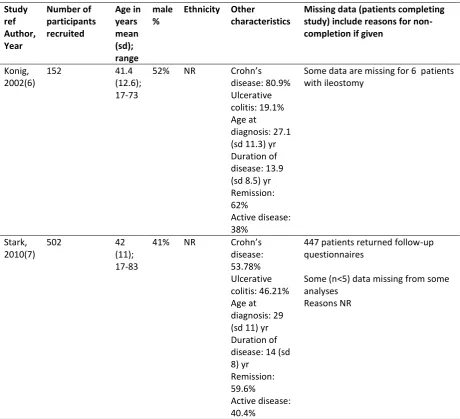
Table A2: Participant characteristics studies in the systematic review of primary studies for IBD Study ref Author, Year Number of participants recruited Age in years mean (sd); range male %
Ethnicity Other
characteristics
Missing data (patients completing study) include reasons for non-completion if given
Konig, 2002(6)
152 41.4
(12.6); 17-73
52% NR C
disease: 80.9% Ulcerative colitis: 19.1% Age at
diagnosis: 27.1 (sd 11.3) yr Duration of disease: 13.9 (sd 8.5) yr Remission: 62%
Active disease: 38%
Some data are missing for 6 patients with ileostomy
Stark, 2010(7)
502 42
(11); 17-83
41% NR C
disease: 53.78% Ulcerative colitis: 46.21% Age at diagnosis: 29 (sd 11) yr Duration of disease: 14 (sd 8) yr
Remission: 59.6%
Active disease: 40.4%
447 patients returned follow-up questionnaires
Some (n<5) data missing from some analyses
Reasons NR