THE ANALYSIS OF HYDR O L O G I C A L DATA
by
Mohan Shankar Amatya
B.Eng. (KMJ.T) , M.Eng. (Chula) Thailand
A dissertation submitted in partial
fulfilment of the requirements for the degree of
Master of Resource and Environmental Studies
in the .
Australian National University
Except where otherwise indicated, this dissertation
is my own work
M.S. Amatya
ACKNOWLEDGEMENTS
Thanks are due to Dr. A. Jakeman for guidance in the use of CAPTAIN package, to Mr M. Greenaway for helping in other programs, to Mr J. Goodspeed and Mr M. Fleming of LUR/CSIRO for allowing me to use their data on the Lerderderg Catchment area, and to Mr J.P. Brown, the District Forester of Trentham, Victoria for providing information on the fire history of the catchment area.
Helpful guidance of my supervisors Professor P.C. Young in time-series data analysis and Mr D.I. Smith in hydrology are gratefully appreciated. Finally the author is very much obliged to the Director of CRES for providing the ANU scholarship to enable him to study at CRES.
ABSTRACT
The account is based upon recursive time-series analysis and its application to the study of river catchment behaviour in order to predict future events. The Lerderderg Representative Basin, in Victoria, was selected as a range of hydrological data was available for this catchment on magnetic tape from the Land Use Research Division of CSIRO. Additional information on soil morphology and fire history was obtained from other sources.
The rainfall, runoff, evaporation and temperature records was analysed using the CAPTAIN package program and both short-term
(hourly data) and long term (daily data) were considered. Since there were no available observations for soil moisture the non-linear soil moisture compensation algorithm of CAPTAIN was used. Transfer functions and steady state gain were calculated and impulse responses analysed.
CONTENTS
Page No.
ACKNOWLEDGEMENTS ±±±
ABSTRACT iv
CONTENTS v
PREFACE V Ü
LIST OF TABLES x
LIST OF FIGURES xi
LIST OF MAPS xvii
CHAPTER 1 : ENGINEERING HYDROLOGY 1
1.1 Introduction 1
1.2 Hydrological Cycle 1
1.3 Interception 3
1.4 Ground Water 4
1.5 Evaporation 5
1.6 Transpiration 6
1.7 Infiltration 7
1.8 Overland Flow 11
1.9 Measurements in Hydrology 12
1.10 Hydrologic Systems 14
CHAPTER 2 : TIME-SERIES ANALYSIS METHODS IN HYDROLOGY 19
2.1 Unit Hydrograph 19
2.2 Unit Impulse Response 20
2.3 The Time-Series Method 25
• CHAPTER 3 :CAPTAIN CONCEPT 34
3.1 Principles 34
3.2 CAPTAIN Use 35
CHAPTER 4 :LERDERDERG RIVER CATCHMENT AREA 39
4.1 Description of the Catchment Area 39
4.2 Soil Morphology 39
4.3 Bushfire History 44
Page No.
CHAPTER 5 : TIME--SERIES MODELLING 48
5.1 Data :: Source and Type 48
5.2 Hourly Data Analysis 49
5.3 Daily Data Analysis 53
5.3.1 Analysis of Rainfall and
Data only
Runoff 54
5.3.2 Analysis of Evaporation,
and Runoff Data
Rainfall 57
5.3.3 Analysis of Temperature,
and Runoff Data
Rainfall 59
5.4 Discussion 62
CHAPTER 6 CONCLUSION 64
BIBLIOGRAPHY 67
PREFACE
Studies of hydrology have played a vital role in the development of human society over the past several thousand years. This study is aimed particularly at evaluating the relevance of system methods and particularly time-series analysis in evaluating catchment behaviour. In particular, it considers the analysis of hydrological data for the Lerderderg River basin catchment and reaches certain
conclusions on the hydrologic behaviour of the catchment on the basis of this analysis. It also attempts to evaluate the advantages and disad vantages of the time-series approach to data analysis in this particular application.
Rainfall data were collected from eight stations by the Land Use Research Division of the Commonwealth Scientific and Industrial Research Organization (LUR-CSIRO). Likewise runoff data were collected from a limited number of gauging stations. They were then processed and stored in magnetic tapes for general use. Evaporation data were collected from three stations within the catchment using class A evaporation pans. This limited data base was supplemented by the use of records from stations in neighbouring catchments in order to generalise the overall evaporation figures for the catchment. All these data and daily dry bulb temperature taken at 15.00 hrs and daily maximum temper ature were stored on magnetic tapes by LUR-CSIRO.
saturated deficit formula or maximum and minimum temperatures. Six years’ daily rainfall, runoff, evaporation, dry bulb temperature and maximum temperature data were used in this study. In addition hourly rainfall and runoff data (Glover, 1979) for short periods were also used.
The basin was assumed to be water-tight, i.e. the catchment behaviour for the purpose of this study was considered to be unaffected by the loss or gain from deep groundwater circulation originating from beyond the catchment boundary. In a strict sense, this is not accurate as some small mineral springs occur within the catchment and these are associated with deeper groundwater circulation, e.g. in the vicinity of the town of Blackwood. In other words the yield of these small springs did not effectively contribute to the overall runoff of the Lerderderg river system. In addition to these points, soil morphology and bush- fire history were studied to consider their possible effects on the catchment behaviour.
A hydrological system can, in general, be either stochastic or deterministic and linear or non-linear. In this study, the determin istic linear system of rainfall-runoff was analysed first and a non linear analysis was attempted later. A new recursive approach (Young, 1972) was adopted, where estimation of the parameters in a transfer function type model were based on the recursive instrumental variable method suggested by Young and Jakeman (1979) .
As infiltration has a considerable effect on the yield of the catchment and depends upon the soil permeability, a particular form of "Antecedent Precipitation Index” (API) was considered to offset the loss due to infiltration.
Data were analysed using the computer package program
effects; to generate their impulse responses (unit hydrographs); and to approximate the standard error of the estimated transfer function parameters. The model structure identification was found to be
2 dependent on the evaluation of the coefficient of determination R^, and the error variance norm EVN (or normalised EVN, NEVN) . In order to assess the likely effects of temperature on the rainfall-runoff relationships analysis was initially undertaken for the dry bulb
temperature. The method was repeated for the maximum temperature, but as expected, there was little difference in the results.
Daily data were analysed in three ways:
(a) considering the raw rainfall only as sole input; (b) considering raw rainfall minus evaporation as the
input, and
(c) modifying the raw rainfall for temperature effects.
LIST OF TABLES
5.1 Hourly Data Sets
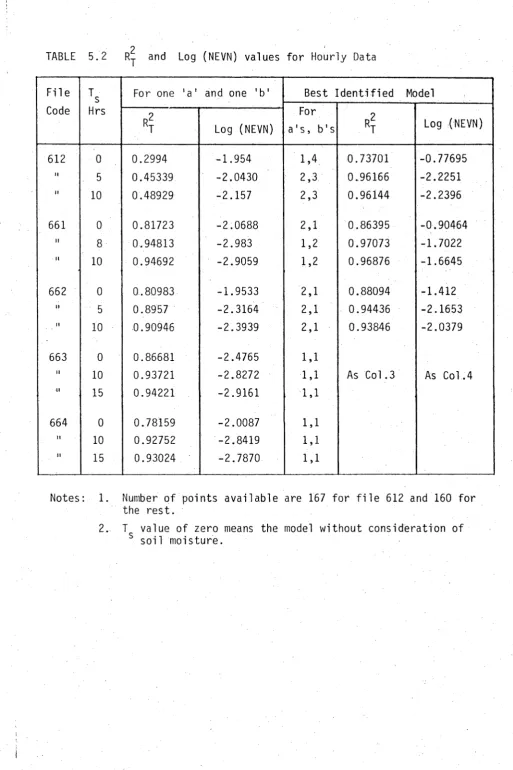
5.2 2
* T and Log (NEVN) Values for
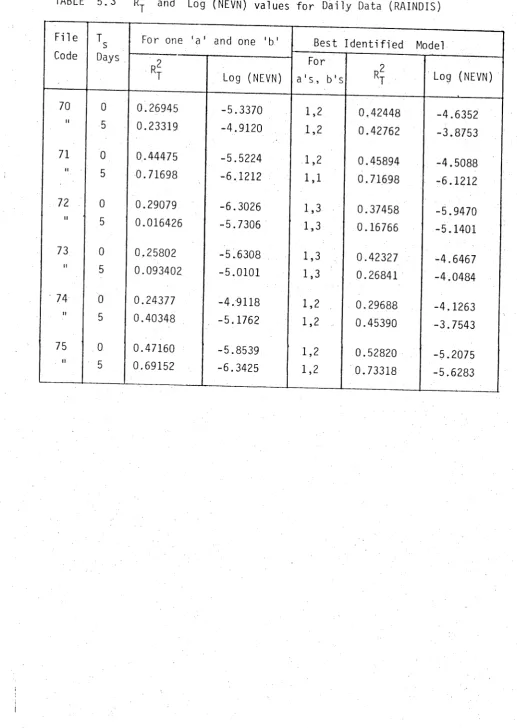
5.3 2
*1 and Log (NEVN) Values for
5.4 2
*T and Log (NEVN) Values for
5.5 2
*4
and Log (NEVN) Values forPage N o .
50
Hourly Data (HOURLY) 51
Daily Data (RAINDIS) 55
Daily Data (SUB) 58
1.1 Systems Diagram of the Global Hydrological Cycle 2
1.2 Flow Diagram Showing Interception, Stemflow and
Throughflow 4
1.3 Infiltration Loss by <J> - index 9
1.4 The Production of Overland Flow in Response to Rainfall Intensities in Excess of the Soil
Infiltration Capacity 11
1.5 Overland Flow on Slopes 13
1.6 A Systems Representation of a Catchment Water
Balance 16
1.7 A Sequential System 17
2.1 Direct Runoff Hydrograph (75 mm), Unit Hydrograph (25 mm),
and Effective Rainfall Duration (4 hours) 21
2.2 The Linear Dynamic System 22
2.3 Rainfall-runoff Time-Series Model 25
2.4 Linear Dynamic System with Non-linear Filter 30
3.1 Recursive and Iterative Data Processing 35
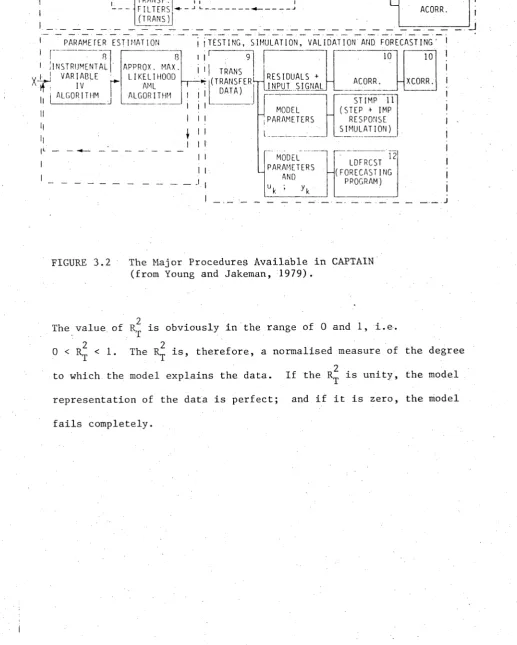
3.2 The Major Procedures Available in CAPTAIN 38
5.1 Rainfall 612 72
5.2 Rainfall 661 73
5.3 Rainfall 662 74
5.4 Rainfall 663 75
5.5 Rainfall 664 76
5.6 Runoff 612 77
5.7 Runoff 661, 662, 663 and 664 78
5.8 Raw Data Model 612 79
5.9 Model 612 with Allowance for Soil Moisture Effects 80
(T = 5 hours) s
5.10 Model 612 with Allowance for Soil Moisture Effects 81
(T = 10 hours) s
5.11(a) Impulse Response for Model Fig. 5.8 82
5.11(b) Sectional Amplification of Fig. 5.11(a) 83
5.12 Impulse Response for Model Fig. 5.9 84
5.13 Impulse Response for Model Fig. 5.10 85
Page No.
5.15 Model 661 with Allowance for Soil Moisture Effects 87
(T = 8 hours) s
5.16 Model 661 with Allowance for Soil Moisture Effects 88
(T = 10 hours) s
5.17 Impulse Response for Model Fig. 5.14 89
5.18 Impulse Response for Model Fig. 5.15 90
5.19 Impulse Response for Model Fig. 5.16 91
5.20 Raw Data Model 661 92
5.21 Model 661 with Allowance for Soil Moisture Effects 93
(T = 8 hours) s
5.22 Model 661 with Allowance for Soil Moisture Effects 94
(T = 10 hours) s
5.23 Impulse Response for Model Fig. 5.20 95
5.24 Impulse Response for Model Fig. 5.21 96
5.25 Impulse Response for Model Fig. 5.22 97
5.26 Raw Data Model 662 98
5.27 Model 662 with Allowance for Soil Moisture Effects 99
(T = 5 hours) s
5.28 Model 662 with Allowance for Soil Moisture Effects 100
(T = 10 hours) s
5.29 Impulse Response for Model Fig. 5.26 101
5.30 Impulse Response for Model Fig. 5.27 102
5.31 Impulse Response for Model Fig. 5.28 103
5.32 Raw Data Model 663 104
5.33 Model 663 with Allowance for Soil Moisture Effects 105
(T = 1 0 hours) s
5.34 Model 663 with Allowance for Soil MOisture Effects 106
(T = 15 hours) s
5.35 Impulse Response for Model Fig. 5.32 107
5.36 Impulse Response for Model Fig. 5.33 108
5.37 Impulse Response for Model Fig. 5.34 109
5.38 Raw Data Model 664 110
5.39 Model 664 with Allowance for Soil Moisture Effects 111
(T = 10 hours) s
5.40 Model 664 with Allowance for Soil Moisture Effects 112
(T = 15 hours) s
5.41 Impulse Response for Model Fig. 5.38 113
5.42 Impulse Response for Model Fig. 5.39 114
Page No.
5.44 Rainfall 1970 116
5.45 Rainfall 1971 117
5.46 Rainfall 1972 118
5.47 Rainfall 1973 119
5.48 Rainfall 1974 120
5.49 Rainfall 1975 121
5.50 Maximum Temperature 1970 122
5.51 Maximum Temperature 1971 123
5.52 Maximum Temperature 1972 124
5.53 Maximum Temperature 1973 125
5.54 Maximum Temperature 1974 126
5.55 Maximum Temperature 1975 127
5.56 Dry Bulb Temperature 1970 128
5.57 Dry Bulb Temperature 1971 129
5.58 Dry Bulb Temperature 1972 130
5.59 Dry Bulb Temperature 1973 131
5.60 Dry Bulb Temperature 1974 132
5.61 Dry Bulb Temperature 1975 133
5.62 Evaporation 1970 134
5.63 Evaporation 1971 135
5.64 Evaporation 1972 136
5.65 Evaporation 1973 137
5.66 Evaporation 1974 138
5.67 Evaporation 1975 139
5.68 Discharge 1970 140
5.69 Discharge 1971 141
5.70 Discharge 1972 142
5.71 Discharge 1973 143
5.72 Discharge 1974 144
5.73 Discharge 1975 145
5.74 Raw Data Model Raindis 70 146
5.75 Raw Data Model Raindis 71 147
5.76 Raw Data Model Raindis 72 148
5.77 Raw Data Model Raindis 73 149
5.78 Raw Data Model Raindis 74 150
Page N o .
5.80 Impulse Response for Model Fig. 5.74 152
5.81 Impulse Response for Model Fig. 5.75 1 5 3
5.82 Impulse Response for Model Fig. 5.76 154
5.83 Impulse Response for Model Fig. 5.77 155
5.84 Impulse Response for Model Fig. 5.78 156
5.85 Impulse Response for Model Fig. 5.79 157
5.86 Model Raindis 70 with Allowance for Soil Moisture 158
5.87 Model Raindis 71 with Allowance for Soil Moisture 159
5.88 Model Raindis 72 with Allowance for Soil Moisture 160
5.89 Model Raindis 73 with Allowance for Soil Moisture 161
5.90 Model Raindis 74 with Allowance for Soil Moisture 162
5.91 Model Raindis 75 with Allowance for Soil Moisture 163
5.92 Impulse Response for Model Fig. 5.86 164
5.93 Impulse Response for Model Fig. 5.87 165
5.94 Impulse Response for Model Fig. 5.88 166
5.95 Impulse Response for Model Fig. 5.89 167
5.96 Impulse Response for Model Fig. 5.90 168
5.97 Impulse Response for Model Fig. 5.91 169
5.98 1970 Model Response with Parameter Values Set to 170
those Estimated for 1971 (Fig. 5.87)
5.99 1972 Model Response with Parameter Values Set to 171
those Estimated for 1971 (Fig. 5.87)
5.100 1973 Model Response with Parameter Values Set to 172
those Estimated for 1971 (Fig. 5.87)
5.101 1974 Model Response with Parameter Values Set to 173
those Estimated for 1971 (Fig. 5.87)
5.102 1975 Model Response with Parameter Values Set to 174
those Estimated for 1971 (Fig. 5.87)
5.103 Modified Input SUB 70 175
5.104 Modified Input SUB 71 176
5.105 Modified Input SUB 72 177
5.106 Modified Input SUB 73 178
5.107 Modified Input SUB 74 179
5.108 Modified Input SUB 75 180
5.109 Model for Modified Input and Measured Runoff 1970 181
5.110 Model for Modified Input and Measured Runoff 1971 182
P a g e N o .
5 . 1 1 2 M o d e l f o r M o d i f i e d I n p u t a n d M e a s u r e d R u n o f f 1 9 7 3 1 8 4
5 . 1 1 3 M o d e l f o r M o d i f i e d I n p u t a n d M e a s u r e d R u n o f f 1 9 7 4 1 8 5
5 . 1 1 4 M o d e l f o r M o d i f i e d I n p u t a n d M e a s u r e d R u n o f f 1 9 7 5 1 8 6
5 . 1 1 5 I m p u l s e R e s p o n s e f o r M o d e l F i g . 5 . 1 0 9 1 8 7
5 . 1 1 6 I m p u l s e R e s p o n s e f o r M o d e l F i g . 5 . 1 1 0 1 8 8
5 . 1 1 7 I m p u l s e R e s p o n s e f o r M o d e l F i g . 5 . 1 1 1 1 8 9
5 . 1 1 8 I m p u l s e R e s p o n s e f o r M o d e l F i g . 5 . 1 1 2 1 9 0
5 . 1 1 9 I m p u l s e R e s p o n s e f o r M o d e l F i g . 5 . 1 1 3 1 9 1
5 . 1 2 0 I m p u l s e R e s p o n s e f o r M o d e l F i g . 5 . 1 1 4 1 9 2
5 . 1 2 1 M o d e l F i g . 5 . 1 0 9 A l l o w i n g o f 5 d a y s 1 9 3
5 . 1 2 2 M o d e l F i g . 5 . 1 1 0 A l l o w i n g o f 5 d a y s 1 9 4
5 . 1 2 3 M o d e l F i g . 5 . 1 1 1 A l l o w i n g T g o f 5 d a y s 1 9 5
5 . 1 2 4 M o d e l F i g . 5 . 1 1 2 A l l o w i n g o f 5 d a y s 1 9 6
5 . 1 2 5 M o d e l F i g . 5 . 1 1 3 A l l o w i n g T o f 5 d a y s
s 1 9 7
5 . 1 2 6 M o d e l F i g . 5 . 1 1 4 A l l o w i n g T g o f 5 d a y s 1 9 8
5 . 1 2 7 I m p u l s e R e s p o n s e f o r M o d e l F i g . 5 . 1 2 1 1 9 9
5 . 1 2 8 I m p u l s e R e s p o n s e f o r M o d e l F i g . 5 . 1 2 2 2 0 0
5 . 1 2 9 I m p u l s e R e s p o n s e f o r M o d e l F i g . 5 . 1 2 3 2 0 1
5 . 1 3 0 I m p u l s e R e s p o n s e f o r M o d e l F i g . 5 . 1 2 4 2 0 2
5 . 1 3 1 I m p u l s e R e s p o n s e f o r M o d e l F i g . 5 . 1 2 5 2 0 3
5 . 1 3 2 I m p u l s e R e s p o n s e f o r M o d e l F i g . 5 . 1 2 6 2 0 4
5 . 1 3 3 1 9 7 0 M o d e l R e s p o n s e w i t h P a r a m e t e r V a l u e s S e t t o
E s t i m a t e d f o r 1 9 7 1 ( F i g . 5 . 1 2 2 )
t h o s e 2 0 5
5 . 1 3 4 1 9 7 2 M o d e l R e s p o n s e w i t h P a r a m e t e r V a l u e s S e t t o
E s t i m a t e d f o r 1 9 7 1 ( F i g . 5 . 1 2 2 )
t h o s e 2 0 6
5 . 1 3 5 1 9 7 3 M o d e l R e s p o n s e w i t h P a r a m e t e r V a l u e s S e t t o
E s t i m a t e d f o r 1 9 7 1 ( F i g . 5 . 1 2 2 )
t h o s e 2 0 7
5 . 1 3 6 1 9 7 4 M o d e l R e s p o n s e w i t h P a r a m e t e r V a l u e s S e t t o
E s t i m a t e d f o r 1 9 7 1 ( F i g . 5 . 1 2 2 )
t h o s e 2 0 8
5 . 1 3 7 1 9 7 5 M o d e l R e s p o n s e w i t h P a r a m e t e r V a l u e s S e t t o
E s t i m a t e d f o r 1 9 7 1 ( F i g . 5 . 1 2 3 )
t h o s e 2 0 9
5 . 1 3 8 1 9 7 0 R a i n f a l l M o d i f i e d b y D r y - b u l b T e m p e r a t u r e 2 1 0
5 . 1 3 9 1 9 7 1 R a i n f a l l M o d i f i e d b y D r y - b u l b T e m p e r a t u r e « 2 1 1
5 . 1 4 0 1 9 7 2 R a i n f a l l M o d i f i e d b y D r y - b u l b T e m p e r a t u r e 2 1 2
5 . 1 4 1 1 9 7 3 R a i n f a l l M o d i f i e d b y D r y - b u l b T e m p e r a t u r e 2 1 3
5. 1 4 2 1 9 7 4 R a i n f a l l M o d i f i e d b y D r y - b u l b T e m p e r a t u r e 2 1 4
5.144 5.145 5.146 5.147 5.148 5.149 5.150 5.151 5.152 5.153 5.154 5.155 5.156 5.157 5.158 5.159 5.160 5.161 5.162 5.163 5.164 5.165 5.166 5.167 5.168 5.169 5.170 5.171
Page N o .
1970 Model Allowing for Temperature (dry bulb) 216
Effects
1971 Model Allowing for Temperature (dry bulb) 217
Effects
1972 Model Allowing for Temperature (dry bulb) 218
Effects
1973 Model Allowing for Temperature (dry bulb) 219
Effects
1973 Model Allowing for Temperature (dry bulb) 220
Effects
1974 Model Allowing for Temperature (dry bulb) 221
Effects
Impulse Response for Model Fig. 5.150 222
Impulse Response for Model Fig. 5.151 223
Impulse Response for Model Fig. 5.152 224
Impulse Response for Model Fig. 5.153 225
Impulse Response for Model Fig. 5.154 226
Impulse Response for Model Fig. 5.155 227
Model Fig. 5.150 Allowing for Soil Moisture Effects 228
Model Fig. 5.151 Allowing for Soil Moisture Effects 229
Model Fig. 5.152 Allowing for Soil Moisture Effects 230
Model Fig. 5.153 Allowing for Soil Moisture Effects 231
Model Fig. 5.154 Allowing for Soil Moisture Effects 232
Model Fig. 5.155 Allowing for Soil Moisture Effects 233
Impulse Response for Model Fig. 5.162 234
Impulse Response for Model Fig. 5.163 235
Impulse Response for Model Fig. 5.164 236
Impulse Response for Model Fig. 5.165 237
Impulse Response for Model Fig. 5.166 238
Impulse Response for Model Fig. 5.167 239
1970 Model Response with Parameter Values Set to those 240
Estimated for 1971 (Fig. 5.163)
1972 Model Response with Parameter Values Set to those 241
Estimated for 1971 (Fig. 5.163)
1973 Model Response with Parameter Values Set to those 242
Estimated for 1971 (Fig. 5.163)
1974 Model Response with Parameter Values Set to those 243
Estimated for 1971 (Fig. 5.163)
1975 Model Response with Parameter Values Set to those 244
LIST OF MAPS
Page N o .
1. Lerderderg River 40
2. The Lerderderg River Catchment Basin 41
3. The Lerderderg River System 42
ENGINEERING HYDROLOGY
1.1 Introduction
Hydrology is the branch of science that deals with the
occurence, distribution and movement of water on, over and under the surface of the earth (Ward, 1975). It has been defined in numerous ways, one of the most comprehensive being 'the science of the world's waters, the different forms in which they exist' (Batisse, 1964). There are four basic processes in hydrology viz. precipitation, evap oration and transpiration, surface runoff and groundwater flow.
The scope of hydrology is extremely wide. It is closely linked with a number of other environmental sciences such as
geomorphology, climatology and ecology (Rodda, Downing and Law, 1976). Engineering hydrology is concerned with various methods of controlling the use of water and, in particular, the amount of rainfall, the length of dry period, the amount of storage, losses due to evapotranspiration in river basin or catchment, the regulations of surface runoff, and the design, plan and construction of storage reservoirs and irrigation canals (Wilson, 1974).
1.2 Hydrological Cycle
The movement of water from the sea to the atmosphere and then by precipitation to the earth, where it collects as runoff and returns
structures. Besides that, there is no uniformity in the time a cycle takes. The intensity and frequency of the cycle depend on a variety of geographical and climatological factors. The various parts of the cycle can be complex in detail and a hydrologist can have some control only on the land-phase of the cycle (Wilson, 1974). Figure 1.1 shows the system diagram of the global hydrological cycle.
( m ) o v o p o t r o n s p i r a t i o n
( i ) t r a n s p i r a t i o n
( e ) p r e c i p i t a t i o n —
t o ) i n t e r c e p t i o n
( b ) s 1 e rr. f I o w a n d t h r c u g h f c l l
( f ) o v e r l a n d f l o w f l o o d s —
c a p i l l a r y i n f i l t r a t i o n
( g ) i n t e r f l o w
p e r c o l a t i o n
--- ( h ) b o s e f l o w
---( t ) r u n o u t
6 OCFAN BASINS
( j ) e v a p o r a t i o n
2 SURFACE
3 SOIL MOISTURE 1 VEC STATION
U . GROUND
WATER 7. ATMOSPHERE
The sea-water evaporates due to solar radiation and moves over land areas as water vapour which is precipitated in the form of snow, hail and rain. Part of such precipitation infiltrates into the soil and moves down into the saturated ground zone beneath the water-table. This phreatic zone is usually connected by aquifers to river systems or
to the sea. Part of the infiltrated water is transpired from leafy plants of the vegetated surfaces. Further precipitation is intercepted by the branches and foliage of plants. This is known as interception and may take three possible routes. If the water drips off the plant leaves to ground, the process is known as throughfall. If there is another interception to that, it is known as secondary interception. On the other hand, the water may run along the leaves, branches and then stems to reach the ground. This is referred to as stemflow. Part of the water intercepted may return to the atmosphere by evaporation. These processes are shown in Figure 1.2. Part of the surface water returns to the atmosphere by evaporation and the rest form the river systems which again lose a certain amount through evaporation. Another part of the cycle, ground water, moves slowly to join the river systems to return to the sea.
1.3 Interception
Interception loss varies with the duration and intensity of the precipitation. It also varies over time as a result of seasonal
variations in the vegetation (Weyman, 1975). Penman (1963) showed that there was a fivefold increase in summer interception under a cover of cereal crops compared to the winter equivalent. There are also spatial variations in interception loss due to various plant species. Lull
Secondary throu gh fa ll Rainfall
Secondary interception by gro un d flora Total eva po ration
loss from toliaqe
Proportion of total rainfal reaching the soil
FIGURE 1.2 Flow Diagram Showing Interception Stem!low and Throughflow (from Smith and Stopp, 1978).
throughfall and stemflow. Although the interception has considerable
effect upon the reduction of gross precipitation to net precipitation, no rigorous method has been found for the estimation of interception
loss.
1.4 Ground Water
Any phenomenon which produces a change in pressure on the
ground water causes the ground water level to change. Changes in
storage, resulting from differences between recharge and discharge of
water, cause levels to vary in time from a few minutes to many years.
Variations of runoff stages and evaporation produce localised storage
changes. Secular variations in levels extending over periods of
in which rainfall is above or below the mean. Though recharge is the governing factor of ground water level depending on the rainfall intensity and distribution and the amount of surface runoff, rainfall is not an accurate indicator of groundwater level changes (Todd, 1964). A certain degree of control on ground water levels is possible, for example the regulation of seepage through earth dams and land drainage
(Todd, 1959).
The main concern of hydrologists is the detailed quantitative study of water occurence distribution and movement, i.e. precipitation, evapotranspiration, surface runoff, and ground water flow in a specific area, to predict the most likely quantities involved in the extreme cases of flood and drought, and also the likely frequency with which such events will occur, since such a frequency is a very important part of the hydraulic engineering design (Wilson, 1974).
The hydrology of a specific area or a catchment depends on its topography, geology and climate. The important climatic factors like precipitation, humidity, temperature, and winds have strong effects on the process of evapotranspiration. Precipitation and various
storage of water and high and low rates of runoff are highly influenced by the topography. Geology is another important factor because it influences the topography and because the groundwater zone is where the catchment's underlying rock lie.
1.5 Evaporation
and reflective properties of the surface (the albedo) and differs for various surfaces exposed to or shaded from solar radiation. Solar radiation, wind, relative humidity and temperature are the main factors affecting evaporation. The process of evaporation is most active under the direct radiation of the sun since the process is endothermic. During the process of vaporisation of water the boundary between the earth and air becomes saturated. For the evaporation to continue, the saturated boundary must be replaced by drier air. As the humidity rises, its ability to absorb more water vapour decreases and evaporation slows down. So, unless the boundary layer of the saturated air is replaced by drier one, the evaporation rate will decrease. If the ambient temperature of the air and ground is high, evaporation will take place more rapidly than if they were cool. Since the capacity of air to absorb water vapour increases with the increase in its temperature, the air temperature has a double effect on the
process of evaporation. Recent developments in the study of evaporation can be found elsewhere (e.g. Webb, 1975 and Hoy and Stephens, 1979).
1.6 Transpiration
A small portion of the water required for a plant is retained in the plant structure. Transpiration is the process by which water vapour escapes from the living plant, particularly the leaves, and enters the atmosphere (Ward, 1975). In the case of ground covered with vegetation, it is very difficult to differentiate between
close up and very little moisture leaves the plant surfaces. On the other hand evaporation continues so long as heat input is available and, of course, basically during the day time. Penman (1948)
established, for the estimation of evapotranspiration, the first and most complete theoretical relationship which shows that the evapo
transpiration is inseparably connected to the amount of radiative energy gained by the surface. This relationship has been widely used in Britain, Australia and the eastern part of the U.S.A. (Veihmeyer, 1964). Further development has been reported elsewhere (e.g. Penman, 1970 and Denmead, 1973).
1.7 Infiltration
In the case of the surface being completely wet, the subsequent rain must either penetrate the surface layers or run off the surface to meet a river system. Runoff or penetration depends upon the permeability of the surface. Vegetated areas are always permeable to some degree. Infiltration, therefore, takes place in all the vegetated areas. Once the infiltrating water passes through the surface layers, it then percolates downwards until it reaches the zone of saturation at the phreatic surface. The infiltration rate varies with the type of soil and is the sum of percolation and water entering storage above the ground-water table.
Horton (1945) established the first relationship for the infiltration rate as:
where
f + p e-kt
f - infiltration rate at any time t (mm/h)
f = infiltration capacity at large value of t(mm/h) c
f = initial infiltration capacity at t = 0 (mm/h) o
t = time from beginning of rainfall (min)
k = constant for a particular soil and surface (min *) (e.g. larger value for smoother surface texture like bare soil, and smaller for vegetated surface)
A number of formulae have been proposed since then but further details can be found elsewhere (e.g. Wilson, 1974; Ward, 1975).
Approximations of infiltration losses can be made by means of infiltration indices (Wilson, 1974) . One of them is the <}>-index which is the average rainfall intensity above which the volume of rainfall equals the volume of runoff. In Figure 1.3 the unshaded area below the line represents the amount of rainfall that is not accounted as a part of runoff but as losses including surface detention, evaporation, and infiltration. This cannot be used in predicting the amount of
rainfall being absorbed by the soil, because this is dependent on the state of wetness of the soil at the beginning of the rain. As the infiltration is much the largest loss in many catchments, and the infiltration capacity as well as the amount of run-off depends on the initial soil moisture, forecasting runoff is not simple.
To overcome this difficulty, to a certain degree, an
ne! r a n = ) quo nt'ty of
ru nnf f
$ index
'■ me in h o u r s ---
*-FIGURE 1.3 Infiltration Loss by <{)-index (from Wilson, 1974)
To predict the catchment behaviour and its response to storms, it is necessary to analyse input and output of the catchment. Such analyses can be carried out with the help of ’black-box’ model which will be described, in detail, later. This model establishes a relation ship between total storm rainfall and total storm runoff. The validity of the relationship, however, is limited because the runoff does not vary with the rainfall alone but depends on other factors viz. intensity and duration of the rainfall and, more important, antecedent catchment moisture. At early stages of the hydrological development, the base-
flow discharge was used as an indication of catchment storage at the start of a storm. One of the earliest methods to forecast direct runoff volumes was the co-axial graphical correlation method of Linsley et aZ.
day in question (Weyman, 1975). Thus the A.P.I. calculated on the basis of n days preceding rainfall is written as:
n -t
A.P.I. = £ P .k n t=0 1
where P^_: the precipitation on a day t before the calculation date, and k : constant.
Runoff can be predicted, by using multiple regression analysis, from the combined effect of rainfall and A.P.I. Weyman (1975) has given a good numerical example. The procedures used in the present study are similar to this but have a sounder grounding in systems and estimation theory.
Using a somewhat more detailed level of analysis, Body (1975) expressed that, under Australian conditions, there could be a significant portion of the early storm rainfall totally lost to runoff. This
assumption of loss effect necessitated the introduction of a gross approximation of the water balance for a catchment. The initial loss may be correlated with an indication of catchment moisture status
(e.g. A.P.I.), while the <£-index can be related to the duration of the excess rainfall. Body (1975) argues that these approximate methods are sufficiently accurate in larger size catchments for two reasons:
1. The considerable storage available damps out short period responses to more intense rainfalls over limited areas, and the
catchment contributes runoff only after initial infiltration capacities have been reduced over a significant proportion of the area.
2. The significance of spatial variation in the soil moisture content is reduced by the averaging effect caused by the extent of the area involved, in much the same way as the significance of rainfall variability is reduced when real rainfall estimates are considered.
1.8 Overland Flow
It is generally accepted that the overland flow is the result of rainfall intensities in excess of the infiltration capacity of the
soil (Horton, 1945). Figure 1.4 illustrates an infiltration curve superimposed upon the histogram of storm rainfall, where the shaded area indicates the volume of water left on the ground surface. During the course of a storm, the portion of precipitation left over the surface increases, when the infiltration capacity decreases. On flat areas, or those with very low gradients, soil infiltration capacity is exceeded over the entire area of one soil type more or less simultane ously before overland flow is observed. But on slopes, where overland flow is observed, measured infiltration rates are frequently very high. The term 'overland flow' is used for flow physically over the hillslope surface, and 'runoff' is only for streamflows and not associated with any particular hillslope flow component (Carson, 1972). When overland flow occurs on slopes with a high infiltration capacity, surface water is restricted to only part of the slope. The infiltration-excess
overland flow may, therefore, be restricted to the special cases of the clay soils or soils suffering from surface compaction (Weyman, 1975).
Infiltration rate
Rainfall in excess of infiltration
Rainfall lost to infiltration
Time since start of rainfall (hours)
Numerous assumptions have been made on the way precipitation
reaches river systems from hillslope areas. Figure 1.5 illustrates the
Horton (1945) Overland Flow and Saturated Overland Flow. Movement of
runoff over the land surface is overland flow, whereas downslope
movement within the soil profile is termed throughflow or interflow
and the slower movement through the bedrock is baseflow. The flow
seeping through bedrock is termed groundwater flow. These routes
basically depend on various factors such as rock permeability, soil
texture and depth, and rainfall intensity of the catchment under study.
During the process of vertical infiltration, water can enter saturated
soil into underlying unsaturated soil. However, if surface saturation
is maintained by throughflow from upslope, further precipitation may not be able to enter the soil.
Weyman (1975) argues that the measurement of infiltration
capacity under normal conditions does not reveal this characteristic,
and the control or saturated overland flow is the pattern of soil
moisture existing at the start of a storm or developed during the storm.
The water following different routes accumulates in hollows and at the
base of hillslopes before it moves laterally to join a river system.
Other details of these processes can be found elsewhere (e.g. Ward, 1975) .
1.9 Measurements in Hydrology
Runoff is generally measured in cubic meters per second, cumecs.
There are various methods used to measure it and they fall into three
categories, namely the dye dilution methods, velocity and cross-sectional area method, and methods involving the use of control structures like
Ri ver
-rp
o
0 & o
..
. . * . ’6 ° * o c ° o °
>V " O0 0 o A 0fü ° c
.•0o o o o o o V < 0 o
°
0(a)
Rainfall i n t e n s i t y more than
i n f i l t r a t i o n capacity.
Ri ver
(b)
Rainfall i n t e n s i t y not neces s ar i l y more than i n f i l t r a t i o n capacity.
and in millimeters. Evaporation is directly measured from the free
water surface of evaporation pans and in millimetres. But transpira
tion, being essentially a botanical process, is difficult to measure;
direct measurement of evapotranspiration is virtually impossible. The
normal practice is to take the measurement of potential evapotranspira
tion, which is the amount of water loss that would occur if sufficient
moisture were always available for the needs of the vegetation that
covers the area, and from which an actual evapotranspiration is estimated
(Smith and Stopp, 1978).
Infiltration capacity of a soil-cover and soil moisture complex
is determined in two ways. One is the analysis of hydrographs of runoff
from natural rainfall on plots and watersheds; the other is the use of
infiltrometers with artificial application of water to enclosed sample
areas. However, both are subject to some error (Musgrave and Holtan, 1964).
1.10 Hydrologic Systems
Every hydraulic project requires a prior knowledge of the
catchment behaviour and responses, particularly the exact magnitude
and actual time of occurence of all streamflow events and their
variations in the catchment. Where full details of this type are
not available, various assumptions are necessary in order to derive
sensible hypotheses on the hydrological system behaviour which can be
tested against the available measurements. This problem has dominated
engineering hydrologists' attempts to simplify complex hydrologic
systems and to construct appropriate models for the prediction of the
catchment responses to various natural and man-made hydraulic phenomena.
that the historic hydrology of the catchment, as observed over some time, will be repeated either completely or in part. One outcome of this principle is the mass-curve of runoff analysis (Linsley, Kohler and Paulhus, 1958) which is widely used for the determination of storage yield. Further development necessitated the consideration of water balance of catchments. For small areas, Slatyer's (1967) water balance relationship over a time t is:
P - 0 - U - E + A W = 0 where P : precipitation
0 : runoff
U : deep drainage
E : evapotranspiration and A W : change in soil water storage
since a catchment is of large area, this relationship has been modified (Rodda, Downing and Law, 1976) to the form,
P = R + E + A W
where P : mean catchment precipitation R : mean catchment run-off
E : mean catchment actual evapotranspiration A W : mean storage change over the catchment
Outgoing
water
vapour Incom ing
w a te r
vapour
Evaporation and
transpiration
I n t e r f lo w S u ' f o c e d e ' e n t i o n
A t m O S P ^ e n C we l t e r
Deep percolation
S im p lifie d ca tc h m e n t m odel
FIGURE 1.6 A Systems Representation of a Catchment Water Balance (from Rodda et al.> 1976).
A system has been defined in many ways. One of them is an aggregation or assemblage of objects united by some form of regular interaction or independence (Chow, 1964a) . A system is dynamic if there is a temporally important process taking place in it and is stochastic if the process can only be described, at least in part, in probabilistic terms. As the representation of stochastic system is rather complex most of the hydrologic system models used up to the present have been treated in purely deterministic terms. If, in a system, the
law of probability, the process is known to be deterministic, otherwise stochastic. A detailed analysis of stochastic processes has been given by Papoulis (1965) and Box and Jenkins (1970). And the stochastic system approach has been extensively used by Whitehead, Young and Hornberger (1979) in the Bedford-Ouse River study.
If the system consists of input, output and some working fluid (matter, energy or information) known as throughput passing through the system, it is known as sequential system (Chow, 1964a). Figure 1.7 shows a sequential system representation. A system in a real world is a
physical system. So the hydrological cycle is a physical, sequential and dynamic system which operates within a set of constraints or physical laws that control the movement, storage, and disposition of water within the system and which derives its energy from the spatial imbalances between incoming and outgoing radiation (Freeze and Harlan, 1969). A system is said to be linear if none of its terms involves powers or products of the output, and non-linear if it produces an output which does not bear a simple algebraic relation to the components of its inputs (Bennett and Chorley, 1978). In the linear system, the transfer function remains constant for all magnitudes of input, whereas in non linear one, the transfer function becomes a function of the magnitude of the input.
In the present study, deterministic linear system of rainfall- runoff model is first analysed for the Lerderderg River basin catchment and because of the differences of this type of model, a non-linear system approach is attempted later. The study is carried out to analyse the catchment behaviour of the Lerderderg River basin on the basis of both daily data, as well as short period hourly data.
All analysis is based on time-series methodology using the CAPTAIN
CHAPTER 2
TIME-SERIES ANALYSIS METHODS IN HYDROLOGY
2.1 Unit Hydrograph
A hydrograph is a plot of stage, discharge, velocity or other properties of surface runoff with respect to time (Chow, 1964a). Both
the quantity and intensity of the rainfall have a direct effect on the hydrograph. A unit hydrograph approach is normally made to study the distribution of direct runoff volume in time. This technique was first suggested by Sherman (1932). Sherman’s approach is that, since a
surface runoff hydrograph describes many of the physical characteristics of the catchment area, similar hydrographs will be produced by similar rainfalls occuring with comparable antecedent conditions. So, if the unit hydrograph for a particular catchment and a particular duration of rainfall is known, then the runoff from any other rainfall of any
duration or intensity may be predicted, in which case a unit hydrograph functions like an impulse response of a linear system.
A unit hydrograph is the hydrograph of a unit volume of direct runoff from the entire catchment area resulting from a short, uniform rainfall (usually one inch) with an excess of unit duration (Ward, 1975) There are three hypotheses involved with the establishment of the
correlation between the effective rainfall (i.e. the rain remaining as runoff after all losses by evaporation, interception and infiltration have been considered) and the surface runoff (i.e. the hydrograph of runoff minus baseflow) (Wilson, 1974):
2. For a particular catchment and for an effective rainfall of uniform
intensity, different intensities of rainfall of the same duration
yield runoff hydrographs whose ordinates, at any given time, are
in the same proportion to each other as the rainfall intensities.
3. The principle of superposition applies to hydrographs resulting from
contiguous and/or isolated periods of uniform intensity effective
rai n .
recorded hydrograph of a uniform isolated storm with a fairly large
volume of runoff and having separated out the baseflow by dividing the
discharge ordinates of the remaining direct runoff hydrograph according
to the volume under the hydrograph, i.e. the hydrograph of 1 inch
(or 25 mm). Figure 2.1 illustrates one where the direct runoff hydro
graph representing a runoff volume of 75 mm has been divided by 3 to
yield a unit hydrograph (Ward, 1975). Since the unit storm in this
figure is of four hours duration, the derived unit hydrograph is
referred to as a 4-hour unit hydrograph.
2.2 Unit Impulse Response
A basic result in Laplace transform theory (Sneddon, 1972 and
Bracewell, 1978) concerns the relationship between two time functions
f^(t) and f^(t). If fj^(t) and f^(t) ate Laplace transformable and have
the transforms F^(s) and F 2 (s) respectively, then the product of F^(s)
and F 0 (s) is the Laplace transform of f(t) which results from the
convolution of f^(t) and f ^ t ) ,
Conventionally a unit hydrograph is generally obtained from a
f(t) [F^s) F2(s)]
Rai nf al l e x c e s s
D i r e c t r u n o f f
Unit h y d r o g r a p h
(25 m m )
Time (hours)
FIGURE 2.1 Direct Runoff Hydrograph (75 mm), Unit Hydrograph (25 mm), and Effective Rainfall Duration (4 hours) - (from Ward, 1975)
= /q f2(t—t) f2 (x) dx (2.2)
where x is a dummy variable for t and L ^ denotes inverse Laplace transform.
Now for an ordinary linear dynamic system, if all initial
conditions in the system are zero, as in the case of an isolated storm, then the input and output transforms are related by an equation:
V (s) = H (s) V.(s) (2.3)
where
H(s) : transfer function or system function, V^(s): input transform, and
V i (s)
V s
)
FIGURE 2.2 The Linear Dynamic System
Since Vq(s) in Equation (2.3) is the product of transforms, the convolution integral can be applied as:
v (t) = L 1 [H (s) V.(s)] = v .(t) h(t-x) dx (2.4)
o l U l
= /*: v.(t-x) h(x) dx (2.3)
0 l
These Equations (2.4) and (2.5) are similar to Equations (2.1)
and (2.2). Now, if v (t) = 6(t), the unit impulse or delta function, then
the transform of the unit impulse is V^(s) = 1. Under this condition, Vq(s) = H(s) or v^(t) = h(t) is the impulse response of the system and
the inverse transform of the transfer function H(s) as well. The impulse
response is thus another characteristic of the system just in the way the transfer function is. The Equations (2.4) and (2.5) suggest that if h(t),
the impulse response, is known, then only the input V (t) is to be known
in order to determine the output through the convolution operation. That
is to say that any input convolved with the unit impulse response yields
the output.
Such unit impulse response is known as the weighting function of
the corresponding linear system (Davenport and Root, 1958). Although the
present output is determined by all past history of the input weighted by
the impulse response, the output at any time is mainly determined by
recent values of the transient input and output (Panter, 1965,
Van Valkenberg, 1974). This is one good method of studying the form
linear system may be described by exciting the system with an impulse function and measuring the output (impulse) response (Kuo, 1962). This method is applicable only to ’linear shift invariant systems’ and
provides the information on the system needed to calculate an output corresponding to a given input. But it does not necessarily provide any understanding of the internal functioning of the system (Champeney,
1973).
All mathematical models of dynamic systems are characterised by three components (Faurre and Depeyrot, 1977):
(i) time;
(ii) input quantities provide the major mechanism controlling perturbations in the system, and
(iii) output quantities show the results of the system behaviour.
As a result the mathematical model of a dynamic system can be obtained from the statistical analysis of time-series data. This is particularly necessary when stochastic disturbances offset the system and distort the
observed input-output behaviour. Such time-series models can be expressed in linear differential or difference equations.
There are two approaches to evaluating the dynamic behaviour of stochastic systems of linear differential or difference equation type.
1. Mechanistic Approach: here the transformation of the input into the output is indirectly represented by introducing the notion of the state of the dynamic system (Beck and Young, 1975). The approach is based on the estimation of parameters in a model obtained by the
analysis of both the internal mechanisms, i.e. the state equation, that governs the system operation and its external signal topology (Young,
the output of the system when overall past history of the input is
known. Two examples are intuitive macro-modelling of a socio-economic
system, and predicting the behaviour of an automobile from its entire
history and all past trips. Therefore, a state of a dynamic system is
a set of quantities summarising the past in order to study the future
(Faurre and Depeyrot, 1977).
2. Input-output or 'Black-box Approach': this approach utilises the
external description of the dynamic system. The overall input-output
relationship of the dynamic system is inferred directly from the observed
input-output data. According to Eykhoff (1974), this approach is not
always very realistic, although experimenters in many cases have derived
some physical insight into the system model under consideration by extend
ing the analysis to incorporate a priori knowledge. This may provide
some information on the system, making the box more or less 'grey' or
translucent.
The mechanistic approach can provide valuable information on the
system functioning of the model. On the other hand, despite its
limitations, the 'black-box' approach is simple in terms of its inherent
parametric efficiency (i.e. the model is characterised by very few
parameters). No matter how limited the information this approach
provides on the internal system functioning, it offers a very useful
basis for both assessing input-output behaviour and forecasting future
behaviour of the output variable (Box and Jenkins, 1970).
Young (1972) has suggested a new recursive approach to the
classical procedures of time-series analysis which allows for the
estimation of parameters in linear as well as non-stationary dynamic systems which are subject to both deterministic inputs and stochastic
approach to the alternative non-recursive maximum likelihood methods of
Box and Jenkins (1970). For example, the recursive approach provides
greater flexibility and on-line potential though, in its simplest form (see next chapter), it lacks some of the desirable statistical properties
of the en-bloc methods. Before describing this recursive approach
to time-series analysis, however, it is necessary to consider the nature of time-series models and their relationship to more conventional
hydrological models.
2.3 The Time-Series Model
In a time-series model, the estimation of parameters is usually considered in a discrete time-series or pulse (3) transform transfer function representation of a linear stochastic dynamic system, as shown in Figure 2.3.
Linear Process
Input Output
(Rainfall) (Runoff)
FIGURE 2.3 Rainfall-runoff Time-Series Model
In this model, the output of the system, y , is related to two inputs:
K.
deterministic and measurable input, u , and the disturbances, £ . This
K. K.
noise input is completely uncorrelated with the deterministic input, u . k
In this study the output of the system, y is measured runoff flow while
K.
6 , i s t o c o n s i d e r a n y u n c e r t a i n t y a r i s i n g i n t h e o v e r a l l s y s t e m b e c a u s e K.
i t i s e x t r e m e l y d i f f i c u l t t o e x p l a i n t h e r e a l w o r l d i n c o m p l e t e l y
d e t e r m i n i s t i c t e r m s .
T h e o b s e r v a t i o n o f h y p o t h e t i c a l n o i s e - f r e e r u n o f f , x , a t t h e
K.
k t h i n s t a n t i s r e l a t e d t o t h e p a s t v a l u e s x, , , x. , x, a n d
r k - l k - 2 k - n
t o t h e p r e s e n t an d p a s t v a l u e s o f t h e r a i n f a l l i n p u t u ^ b y t h e d i s c r e t e
m o d e l ( Y o u n g , 1 9 7 2 ) :
\ + a i
\ - i + + a n x, k - n b o k u. + . . . + b n u, k - n (2.6)T h e o u t p u t o f t h e w h o l e s y s t e m , t h e n , b e c o m e s
yk = xk + 'T
( 2 . 7 )R e a r r a n g i n g E q u a t i o n ( 2 . 7 ) a s x ^ = y ^ - a n d s u b s t i t u t i n g t h i s i n
E q u a t i o n ( 2 . 6 ) , t h e d i s c r e t e r e l a t i o n s h i p b e t w e e n t h e e s t i m a t e d r u n o f f
a n d m e a s u r e d r a i n f a l l b e c o m e s :
yk + a l y k - l + • • • + 3 n y k - n = b o \ + • ' • + bn V n + \ ( 2 ' 8)
w h e r e t h e s t o c h a s t i c p a r t o f t h e s y s t e m i s
n. = t + a t . + . . . + a 6,
k k 1 k - l n k - n ( 2 . 9 )
w h i c h a r e s e r i a l l y c o r r e l a t e d b o t h i n t i m e a n d w i t h y ^ , i = k , . . . , k - n .
E q u a t i o n ( 2 . 8 ) c a n now b e e x p r e s s e d i n v e c t o r f o r m a s :
\ ± + \ (2.10)
w h e r e
an d
gk = ( - yk - l ’ • • • ’ - yk-n> uk ’ • • • ’ V n
From Figure. 2.3, we see that the deterministic part of the
system is expressed by the difference equation:
a[z 1 1 = B[z 1 ] u^
B[Z X ]
A[Z
^TT uk
]G[Z_1 ] u,
(
2.
11)
where the operational notation Z ^ is the backward shift operator,
e.g. Z " 1 x k = xk _ L , and
A [ Z _ 1 ] = 1 + a. Z_1 + ... + a Z~n
1 n
B[Z 1 ] = b + b. Z 1 + . . . 4- b Z n
o 1 n
Hence, from Equations (2.7) and (2.11)
B [ Z-1
h = ---- T- Ui +
k AtZ"1] k k
(
2.
12)
B[Z h
where ---- :— is the transfer function of the system which is normally
A[Z~ j
assumed to be stable, i.e. the roots of the polynomial A[Z ] lie outside
the unit circle in the complex plane (Young, 1972).
Alternatively the Equation (2.12) can be written as
yk = G[Z_1] uk + Ck (2.13)
where the polynomial G[Z ] is nominally infinite dimensional, as obtained
by the division of B[Z ^ ] by A[z M , and is expressed as
G[z h = g0 + gj Z 1 + ... + gm z m + ... + g„ z (2.14)
Therefore Equation (2.13) becomes
y, = g U, + g. U, ! + . . . + g u. + E,.
This equation gives an expression for the impulse response or weighting sequence model, in which the output flow of time k is nominally given by the weighted sum of all past values of rainfall and the noise term ^
(Whitehead, Young, Hornberger, 1979). For the pure deterministic case, where u^ = p^o’ t^1G resPonse> y^> to the unit impulse, u^, is given
by yk = Sk ’ where k=0, * • • » 00
It is now clear that Equation (2.15) is directly equivalent to the unit hydrograph representation. For the purpose of the present study,
therefore, the unit impulse u is equivalent to a unit storm disturbance K.
and the infinite dimensional unit hydrograph model can be alternatively represented by the finite dimensional transfer function model Equation
(2.11),
bn + b . Z + ... + b Z
0 1 n
1 + a . Z + ... + a Z
1 n
u k
1 ^ n 1. ii
x, = -a,Z x, —a Z x, - ... -a Z x.+b^u+b.Z u. + ... +b Z u,
k 1 k 2 k n k O k l k n k
Eliminating backward shift operators, x is given by K.
X = - a x . - a x ... - a x +b u +b u , + b u + ... +b u (2.16) k 1 k-1 2 k-2 n k-n O k 1 k-1 2 k-2 n k-n
Thus, for example, the impulse response of the deterministic system for various observation instants, k ’s is given by
when k=1
x i = b .0 1 = b o
k=2
x 2 ~ -aixi+ bj
k=3
x3 = -3lx 2 - a
1 1 1
1 2 2 1 2
etc.
For other inputs, the calculation is similar provided the history of the input sequence is defined over all k. These calculations are ideally
As will be seen in later chapters, the model equation (2.12) characterises the rainfall-runoff data, and the impulse response
obtained by estimating the A[Z ^] and B[Z ^] polynomials provides the unit hydrograph resulting from the direct run-off. Since instrumental variable methods of estimation are used in the time-series analysis, a prior base flow separation is not required in such analysis. In the short term response considered predominantly in rainfall-runoff analysis, the base flow can be considered as not correlated with the rainfall input. Consequently it is also not correlated with the "instrumental variables" used in the analyses. As a result, the terms involving base-flow in the estimation equations approaches to zero, i.e.
P lim
f
k-x» k k 0
where the instrumental variable;
that part of the flow which constitutes the base-flow.
In other words, the base-flow is considered as additive noise for the purpose of estimation; so that the resulting model accounts only for
the direct runoff effect of rainfall. In a real case, if the rainfall